
Introduction
This is the story of the Manoora, a luxury cruise liner of the Adelaide Steamship Company which was launched in 1934 and began operating voyages along the Australian coastline from 1935. The vessel was named after a township in South Australia.
Manoora was a luxury liner for its time and attracted much interest from travellers. After its arrival in Australia the Adelaide Steamship Company held balls on board in each port visited, to aid fund raising for various charities, and as a means of promoting the ship’s luxury travel.
However, Manoora’s days of luxury cruising were to be cut short four years later in 1939 following the outbreak of the Second World War. The Manoora, along with other commercial vessels, was requisitioned by the Commonwealth Government in December 1939. It was converted into a warship for the duration of the war and also for a period thereafter.
In 1943, HMAS Manoora was based at Port Stephens, together with two other Australian naval ships, the HMAS Kanimbla and HMAS Westralia.. These ships provided military training support to the Royal Australian Navy (RAN) naval base, HMAS Assault, in conjunction with the Joint Overseas Operational Training School (JOOTS) which had been set up as a joint training facility by the Australian and USA Governments. See HMAS Assault and JOOTS – 1942/43.
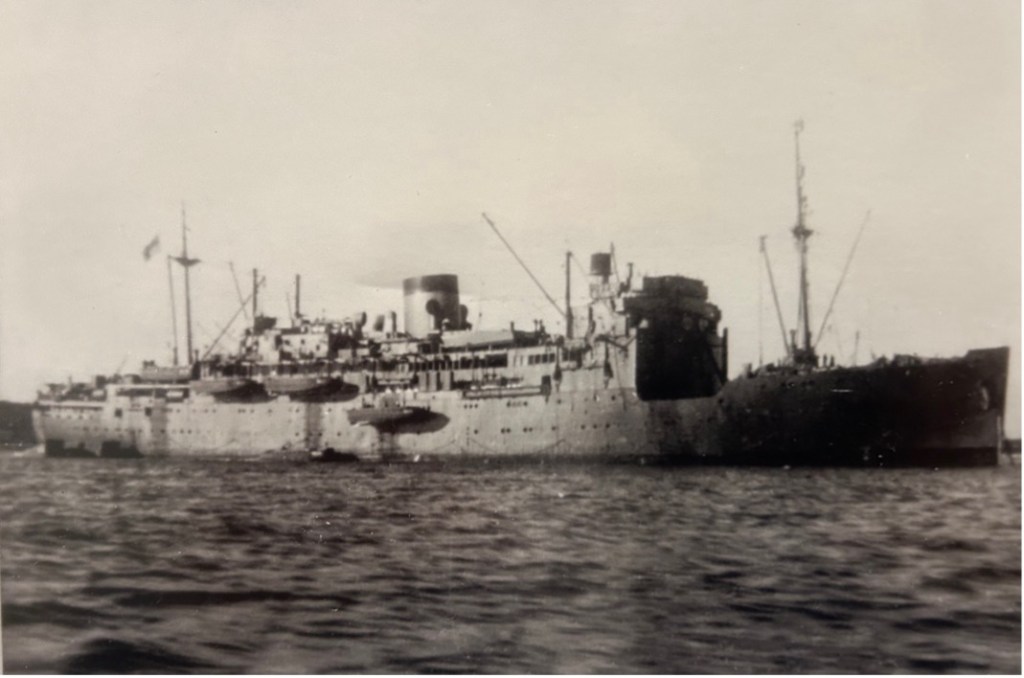
HMAS Manoora at anchor in Port Stephens 1943 [Nelson Bay RSL Sub-branch Photo Collection]
During JOOTS manoeuvres, HMAS Manoora, HMAS Kanimbla and HMAS Westralia, all of which had been converted to ships that could land infantry forces from Navy transport ships onto land, were involved in simulated landings on Zenith Beach, Wreck Beach and Box Beach at Port Stephens (and also within Port Stephens) in readiness for the amphibious invasions in the Southwest Pacific region.
After JOOTS ceased operations at Port Stephens in October 1943, HMAS Manoora saw service in the Southwest Pacific. After the War, she was involved in repatriation missions and the transportation of troops.
The Manoora has a fascinating history, before, during and after the Second World War, the story of which is told in this paper in five parts.
PART ONE: MANOORA PRIOR TO HER ARRIVAL IN AUSTRALIA
Radio Equipment for the Manoora Manufactured in Sydney – 1934
The Daily Commercial News and Shipping List of 9 October 1934, page 5, reported:
‘Wireless equipment for the Adelaide S.S. Company’s new liner Manoora was shipped from Sydney on Friday. The sets were manufactured at the A.W.A. works at Ashfield, and include an automatic alarm receiver, which will function when an operator is not on duty, small transmitting sets for two lifeboats, and a system of amplifiers and loudspeakers for installation throughout the ship. The Manoora ‘s equipment will be more comprehensive than is usual.
The wireless telegraph set includes provision for working on short waves, and this will enable the ship to keep in direct, touch with Australia on her voyage out. An auto alarm receiver will keep watch during the time no operator is on duty, and one or two lifeboats will be provided with small transmitting sets.
A system of amplifiers and loudspeakers is being provided for the benefit of the passengers. It will be possible for three separate programmes to be reproduced at one time. For instance, the broadcast receiver may be used for sporting results given from a certain loudspeaker as selected, phonograph records can provide dance music to another part of a ship, and announcements or talks, or songs from a person before the microphone can be heard in different locations in the ship.
A new appliance, which includes a small wireless transmitter and receiver, is known as an ‘Echometer,’ which, when set in operation by the navigating officer, tells at a glance the depth of water under the ship.’
Launch of the Manoora at Glasgow, Scotland – 1934
The Barrier Miner of 6 November 1934, page 4, reported:
‘The new motor ship Manoora, which was built on the Clyde, for the Adelaide Steamship Company Limited, has been successfully launched, the christening ceremony being performed by Lady Horo-Ruthven, wife of the former Governor of South Australia, in the presence of a large and representative gathering.
The dimensions of this new twin screw vessel are:—Length, 460ft.; breadth, 66ft.; and moulded depth to shelter deck, 35ft. 6in. Her gross tonnage will be approximately 10,000 tons. She will thus be the largest vessel employed on the Australian interstate trade.
The vessel was ordered by the company in accordance with its policy of keeping in the forefront of passenger and cargo requirements. The Manoora equipped with two sets of eight-cylinder four-stroke single acting airless injection pressure charging engines which will give a speed of 17½ knots. Her passenger accommodation has been carefully planned by the company in collaboration with British experts.
About 400 passengers will be carried in the first and second-class accommodation, mostly in single and two-bedstead cabins, and the dining rooms are large enough lo scat all the passengers at one sitting. All cabins are fitted with running hot and cold water, and there are several suites and special cabins with private bathrooms. The most efficient and up-to-date system of ventilation has also been installed.
The ship’s lifeboat’s are all of the latest and most efficient type. They are fitted with Fleming gear by which the boats are propelled with hand-worked levers operating in screw, the use of oars being thus eliminated.
The Manoora will be commanded by Captain G. Irvine, D.S.O. In addition to many years of successful service in command of various vessels on the Australian coast, Captain Irvine also rendered considerable naval service during the Great War, and it was during his command of one of the mystery ships that his vessel succeeded in sinking an enemy submarine. As a result of the action Captain Irvine was decorated by the King.’
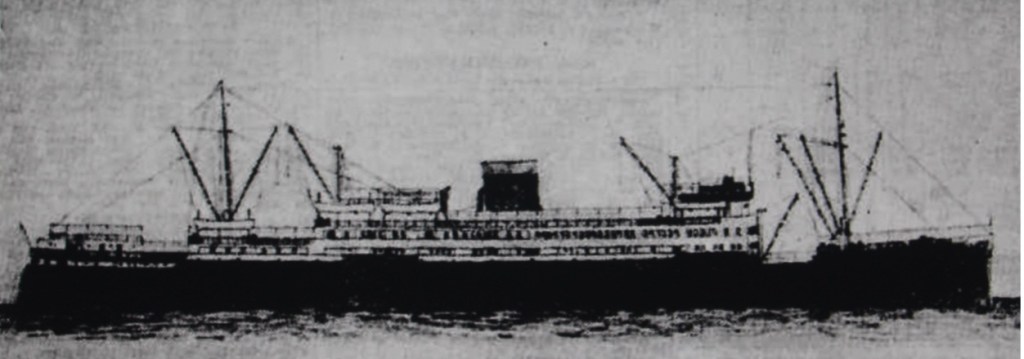
Artist’s impression of the new motorship, Manoora [Sydney Morning Herald, 26 October 1934]
Manoora Completes Her Trials – 1935
The Sydney Morning Herald of 13 February 1935, page 18, reported:
‘Cable advice has been received by the Adelaide S.S. Co., Ltd., that the new motor-ship Manoora completed her trials—during which she attained a speed of 18½ knots—on Saturday. She was expected to leave Glasgow yesterday for Sydney, via Aden.’
PART TWO: MANOORA BEGINS LUXURY CRUISING IN AUSTRALIA
Manoora Arrives in Sydney – 1935
The Daily Commercial News and Shipping List of 25 March 1935, page 5, reported:
‘Built expressly for the Australian interstate trade, the Adelaide S.S. Company’s new motorship Manoora arrived at Sydney from Glasgow on Friday evening and was moved to No. 6 Darling Harbour on Saturday morning.
Reaching the highest pinnacle of luxury for the sea traveller, the Manoora, with its up-to-date appointments and modern facilities, should prove a decided acquisition to the interstate fleet of passenger vessels already operating. Probably the most outstanding feature with regard to the ship’s main public rooms is their spaciousness and pleasing decoration, the latter having been carried out by the famous firm of Hampton & Sons, London, to the design and under the supervision of Mr. A. N. Prentice, a well-known London architect, who has specialised in shipboard interior decoration.
Further evidence of the company’s desire to offer everything possible in modern travelling is seen in the ‘A’ or topmost deck, winch is devoted almost entirely to space for deck games, etc. The length of this deck is more than 180 feet and owing to the use of the most modern types of ship’ boats, davits, winches, etc., it is remarkably free, from obstructions. Also, on this deck is a
pecial sunbaking deck, complete with salt and fresh water showers. There are in all six decks. On the ‘B’ promenade deck is a glass-enclosed space, 66ft. x 48ft., fitted up for use in daytime as an attractive winter-garden and at night a specially decorated ballroom. On this deck also are the first-saloon lounge and music room, two corridor lounges, and smokeroom complete with cocktail bar. On the ‘C’ deck are the first saloon single and two-bed cabins, second-saloon public rooms, glass enclosed dancing space and the deluxe cabins. The ‘Q’ deck is devoted to first and second saloon cabins, the special suite with bedroom, sitting-room and bathroom, the children’s dining-room and nursery, and the barber’s shop. On the ‘E’ deck are some second-saloon cabins and the first and second saloon dining-rooms.
Exceptionally fine weather was experienced by the Manoora during the voyage through the Bay of Biscay, the Mediterranean and Red Sea, but from the Equator to Cape Leeuwin heavy gales and high seas were met with, being particularly severe for five days.
Lady Hore-Ruthven, wife of the Governor of New South Wales, was a passenger on the Manoora. The Manoora is commanded by Captain Geo. Irvine, D.S.O., who has had many years of successful service in command of various vessels on the Australian coast.
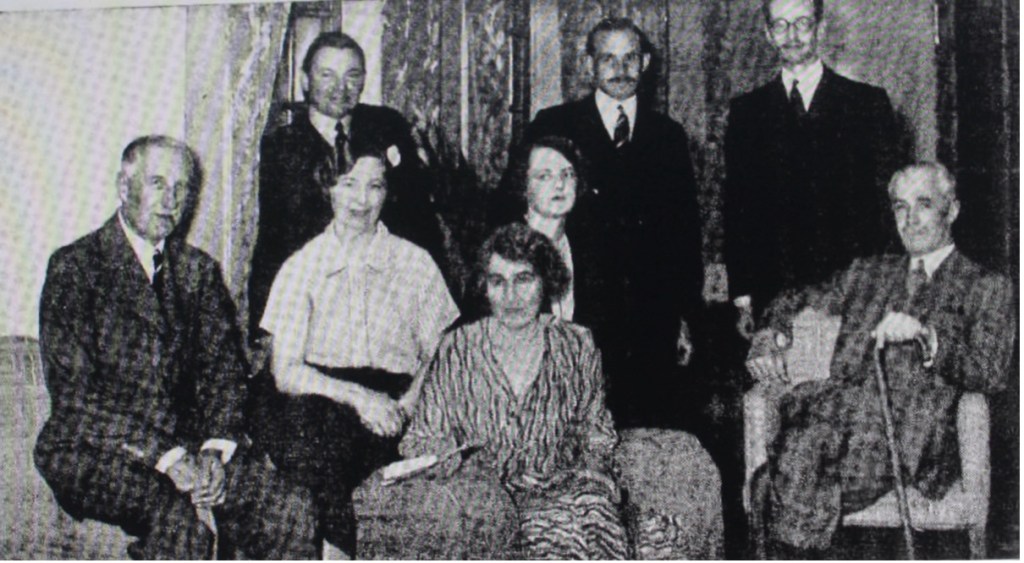
Distinguished guests onboard the Manoora after arriving in Sydney from Glasgow. Front row, left to right: Sir Alexander Hore-Ruthven, Miss Ivay Price, Lady Hore-Ruthven, Miss Priscilla Feilden, Colonel Frederick Blacker. Back row, left to right: Commander Gifford, A.D.C., Captain Holford, A.D.C., Captain Ponsonby, A.D.C. [The Daily Telegraph, 23 March 1935]
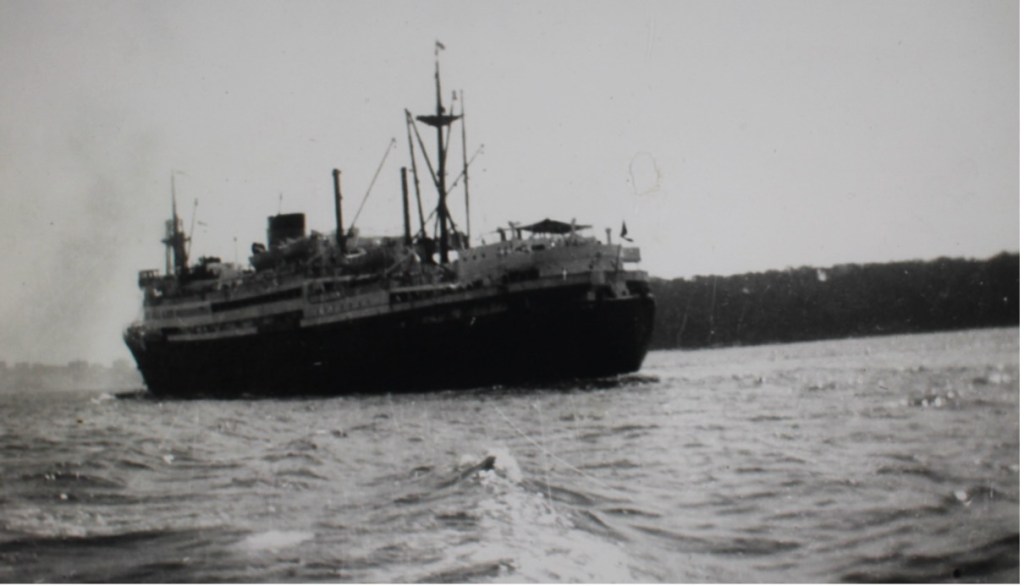
Manoora as a coastal liner [State Library New South Wales]
Sydney Younger Set Ball – 1935
The Daily Telegraph of 7 March 1935, page 14, reported:
‘An element of novelty that is sure to be popular will be introduced by the Younger Set committee at the ball to be held on board the Manoora, in aid of the Benevolent Fund and the Balmain District Hospital. The “hold” of the Manoora has been commandeered by the Younger Set, not that they may celebrate in its capacious depths, but in order to fill it with booty for the assembled guests. All manner of delightful novelties will be parcelled and tucked into the hold, over which a miniature crane will be erected. For the small sum of 1/, guests will draw forth a parcel. The ball will be held on April 4 — not the first— so that the committee guarantees each parcel to be worth the purchase price. Piquancy will be added to the transaction, however, by the simple expedient of including many parcels worth far more than the modest shilling. No distinction will be made in the wrapping of the parcels, and a de-lightful uncertainty will, therefore, attach to the drawing of each.
The T.S.M.V. Manoora, to give the vessel its full title, is the newest addition to the Adelaide Shipping Company’s coastal fleet. It should prove a delightful “location” for the ball, for which this new Younger Set has been formed, and toward the success of which they are lending stalwart aid. Lady Hore-Ruthven, who is traveling to Australia by the Manoora [and who christened the boat in Glasgow], will be present at the function, which will be held under the patronage of his Excellency the Governor.’
The Daily Telegraph of 8 March 1935, page 7, further reported:
‘A meeting of the Younger Set working for the ball, was be held aboard the Manoora on April 4, in aid of the Benevolent Society of N.S.W. and the Balmain Hospital.’
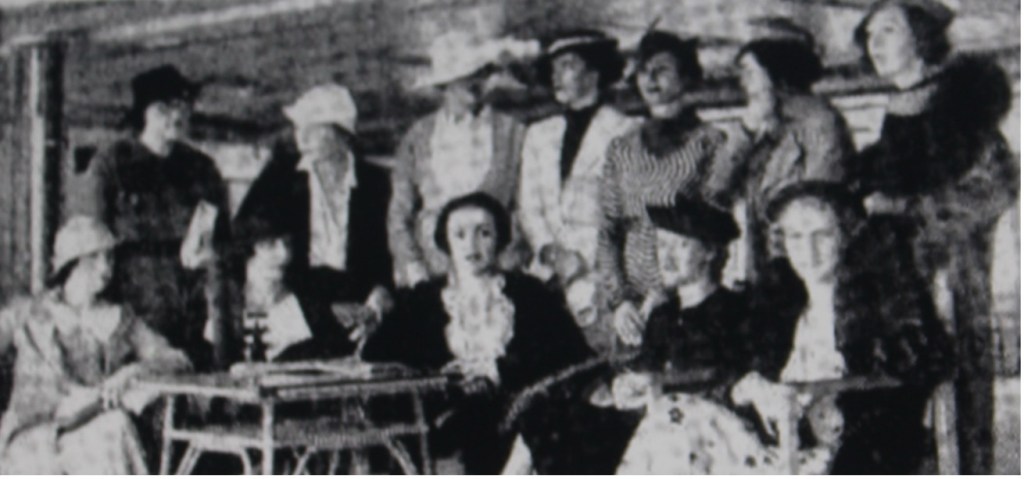
Younger Set Members of the Committee which arranged the Manoora ball aboard the ship. L. to R Sitting: Elsie Wareham, Mrs. A. Bridgman, Eve Sheedy, Thelma Sheedy, Doris Mclver. Standing: Miss Revell-Reid, Marjorie Ashley, Nan Golby, Joan Buchanan, Ron Donovan, Edith Mount, Poppy Bagley [Daily Telegraph of 28 March 1935]
Visitors Entertained on Board the Manoora in Sydney – 1935
The Sydney Morning Herald of 2 April 1935, page 4, reported:
‘Everybody loves looking over a new house, but how much more fascinating is it to look over a new ship, and particularly when that ship is furnished In the most modern manner.
Visitors to the Manoora yesterday, who were entertained in their hundreds by the Adelaide Steamship Company, were told, upon arrival at the gangway, to make themselves entirely at home and go where they liked, which they did to their own complete enjoyment, and the slight consternation of the ship’s company, which found it a little disconcerting to find bevies of ladies who had taken the wrong turning, arriving breathless in the galley, or peering a little uncertainly into the refrigerating plant.
Quite early in the afternoon the reading room, with its walls panelled in sycamore and furniture to match, with pale blue and green chairs and lounges, and the other saloons including the music room, where the decoration is in green and fawn against pale gold panelled woods, were filled to overflowing with guests. Afternoon tea was served in the dining saloon, where a vivid colour scheme, which includes shaded blue walls and luminous silver paint with pale sycamore furniture, upholstered in apple green kid, has been employed.
The guests were received by Mr. and Mrs. Arthur Bridgeman, of the Adelaide Steamship Co.; Mr. and Mrs. P. Bridgeman and Mrs. Guy Packard assisting. In their party was Miss Marjorie Ashley, who recently arrived from England on the maiden voyage of the Manoora.
Captain George Irvine, of the Manoora, and Mrs. Irvine, entertained Mrs. Malcolm Ross, Mrs. Ruby Duncan; and Mrs. Dorothy Kennedy. Among the guests were Sir Hugh and Lady Poynter, Miss Jocelyn Poynter, Mrs. H. F. Pennefather, Miss Susan Spencer, Mrs. Leslie Lamb, Mrs. A. A. Dalglish, Mrs. W. C. Wentworth, Sir George and Lady Mason Allard, Sir Allen and Lady Taylor, Sir Victor and Lady Wilson, Sir Arthur and Lady Rickard, Sir Daniel and Miss Levy, Sir Harry and Lady Budge, and the Misses Elise and Sadie Budge, Lady Fairlie-Cuninghame and Miss Fairlie-Cuninghame, Lady Stephen, Lady Barlow, Colonel and Mrs. T. A. J. Playfair, Lieut.-Colonel and Mrs. J. Sclater, Commander and Mrs. N. Shaw, Engineer Commander and Mrs. C. M. Simms, Colonel P. M. McFarlane.’
First Ball on the Manoora – 1935
The Sydney Morning Herald of 5 April 1935, page 4, reported:
‘The Manoora, in which Lady Hore-Ruthven has a particular interest, for she christened the ship at Glasgow last year, and made the journey out to Australia in it, was last night the scene of the first dance she has attended since her arrival in Sydney.
There was great public interest in the new luxury vessel, which begins her first interstate trip tomorrow, and although it is yet rather early in the season lor dancing, the organisers had no difficulty in disposing of eight hundred tickets for the dance However, there was plenty of room for such a large crowd of dancers on the wide ballroom deck, which features the new strip lighting and a huge revolving shade of mirror glass, suspended from the ceiling and reflecting the coloured lights.
The Adelaide Steamship Company lent the ship for the dance, which will benefit two charities – the Benevolent Society receiving three – quarters of the profits, and the Balmain Hospital one-quarter.
Lady Hore-Ruthven, who brought a party from Government House, was received by members of the committee, and danced the first dance with Mr. P. Bridgman, general manager of the company.’
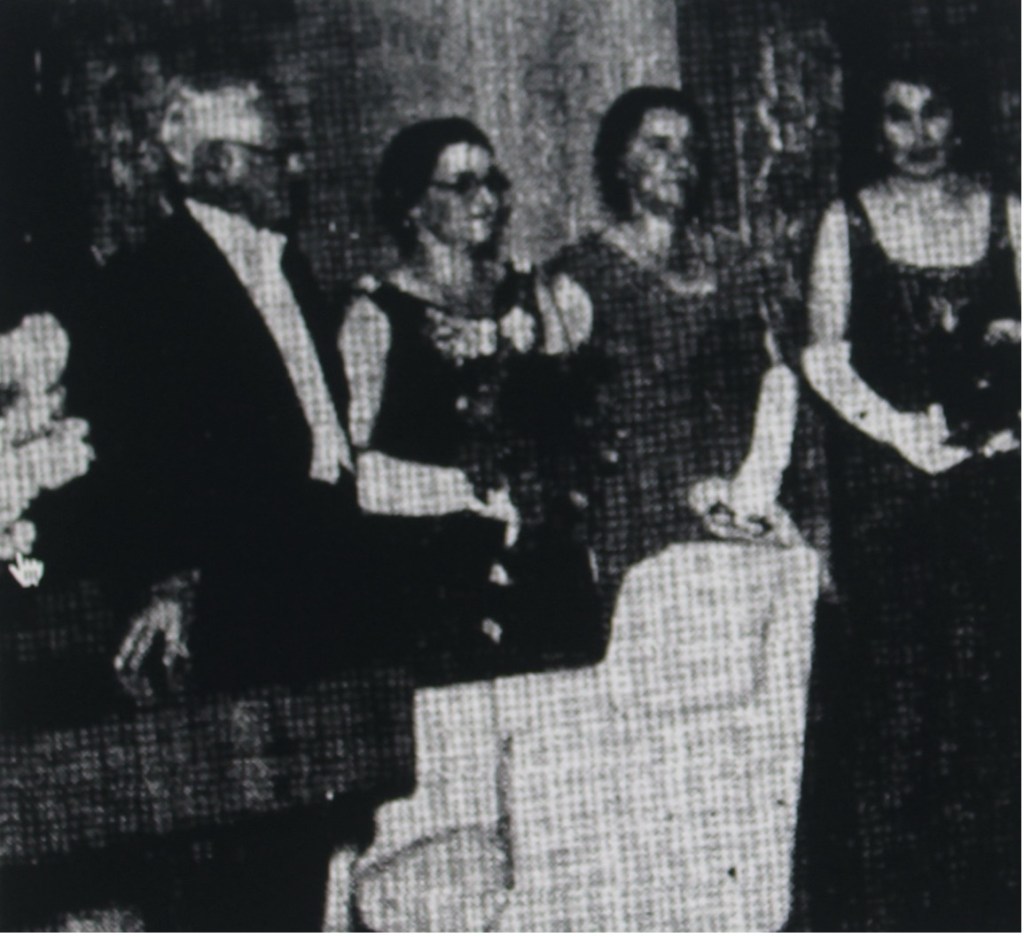
Guests at the Manoora Ball, Left to Right: The Lord Mayor, Ald. A. L. Parker, Mrs. Parker, Mrs. Hubert Fairfax, and Lady Hore-Ruthven.
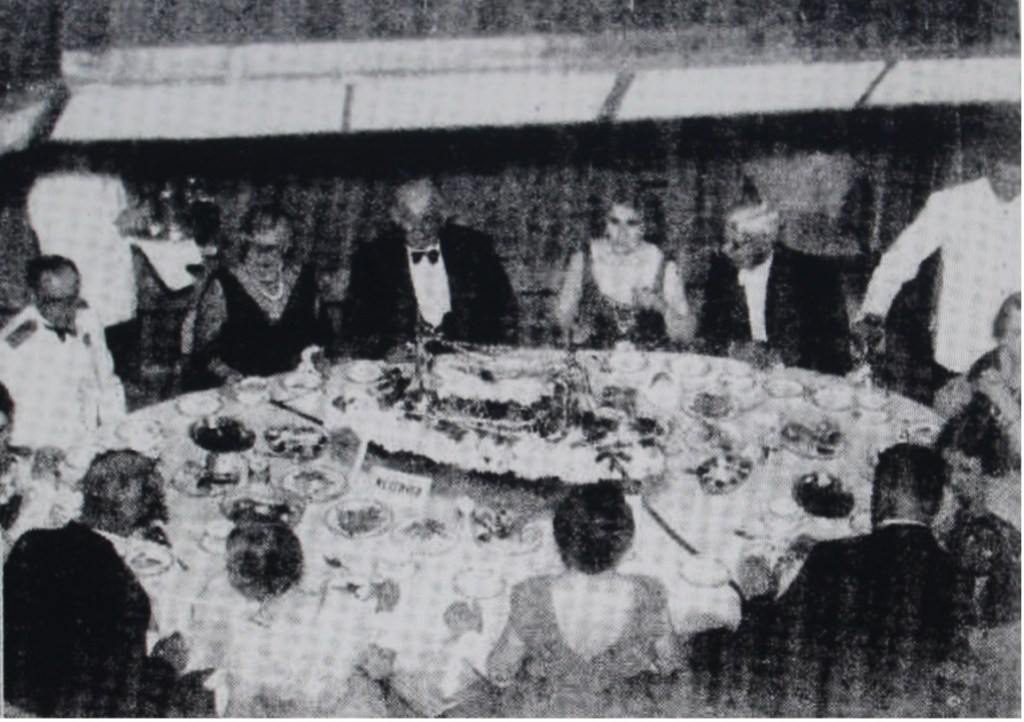
Official Table at the Manoora Gall in ais of the Benevolent Society and Balmain and District Hospital. Facing camera, left to right: Captain Pope, Mrs. F. Bridgman, Captain G. Irving (ship’s master), Lady Hore-Ruthven, and the Lord Mayor (Ald. Parker) [The Daily Telegraph, 5 April 1935]
Manoora Sails from Sydney for Freemantle on First Commercial Voyage – 1935
The Daily Commercial News and Shipping List of 6 April 1935, page 4, reported:
‘The Adelaide Steamship Company’s new motor vessel Manoora, which arrived at Sydney on her maiden voyage from England on March 22, will leave for Fremantle, via ports, from No. 6 wharf, Darling Harbour, at 2 p.m. to-day. The vessel is due to arrive at Melbourne on Monday, Adelaide on Thursday next and Fremantle on April 16.’
Ball Held on Manoora in Adelaide – 1935
The Advertiser of 3 May 1935, page 26, reported:
‘The Manoora was a blaze of lights last night when the Toc H ball was held on board. The whole entertainment was the gift of the Adelaide Steamship Company. There was a wonderful enclosed deck for dancing with concealed lighting. Music was supplied by the band from the Palais Royal…… The colour scheme was yellow. In the saloon, where supper was served, the decorations toned delightfully with the grey woodwork and pale almond green leather. At the captain’s table, where the vice-regal party was entertained, the flowers were hydrangeas. ….. On the ether tables flowers were artistically arranged in tones of yellow.’
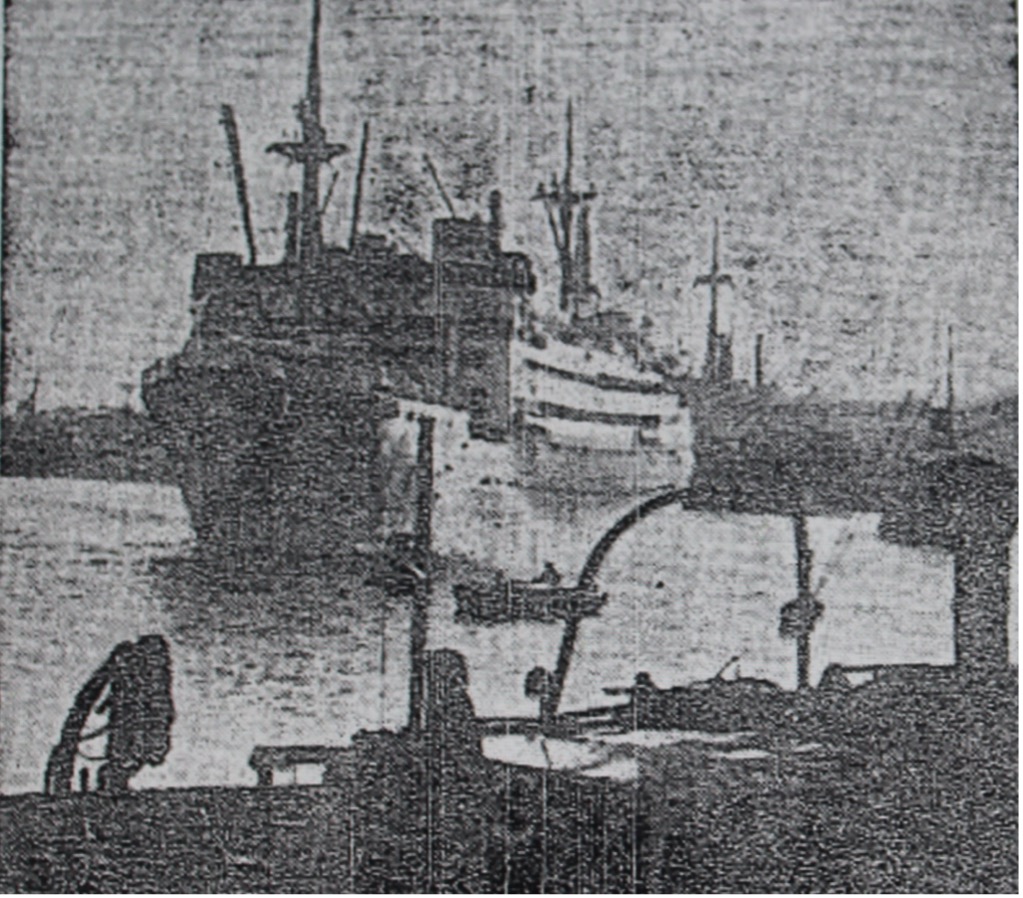
On her first trip to Adelaide, the Manoora moves up the Port River to her berth [News (Adelaide), 11 April 1935]
Ball Held on Manoora in Perth – 1935
The Daily News of 8 May 1935, page 8, reported:
‘Grecian lines with halo plants, a wealth of metal trimmed and metal run fabrics, velvets of deep rich shades, and a carefully-categorised colour scheme, were reflected in a mirror-facetted witch ball which revolved above the dancing floor at the ball on the Manoora last night for Fairbridge Farm School.
For attendance and smart frocking, the ball set a standard which will be hard to equal this season. The Lieutenant-Governor and Lady Mitchell (who was president of the ball committee) were present, accompanied by Captain K. A. Hall. …..
The floral decorations in the dining room were lovely. Against a background of pale green and chromium furnishings, there were bowls of deep red roses, dahlias and chrysanthemums. A telling touch was supplied by crimson pomegranate globes, some split to reveal the rows of scarlet seeds. The many lounge, writing and card rooms, with which the ship is equipped, were decorated, with flowers. There were huge masses of bronze and gold chrysanthemums against deep panelled woodwork. Music from Nice’s orchestra was broadcast over the ship, and beside the main dancing deck, guests danced on other decks.
Congratulations are due to the Adelaide Steamship Company that with the frequent falls of rain throughout the night, the gowns of the dancers wore not spoiled by rain. From the awning of canvas over the gangway, and the way provided through the customs shed, the decks were closely guarded from the rain.’
Ball Held on Manoora in Cairns – 1935
The Northern Herald of 22 June 1935, page 5, reported:
‘A crowd of more than 800 danced aboard the luxury liner Manoora at the Hospital Ball last night, providing- possibly the most spectacular scene in the social history of the city. His Excellency Sir Leslie Wilson, Governor of Queensland, and his charming daughter, Miss Marjorie Wilson, were the guests of honour. ….. The main dancing deck of the ship, resplendent with coloured lights, was the chief rendezvous of the crowd, although all available dancing space was utilised, and the music was broadcast by Julien Breslin’s orchestra. The beautiful liner with her modern furnishings proved a wonderful setting for this hospital ball, and between the dances the crowds enjoyed a leisurely inspection of the lovely liner. The supper was delicious, and the large crowd was catered for in a splendidly organised fashion.’
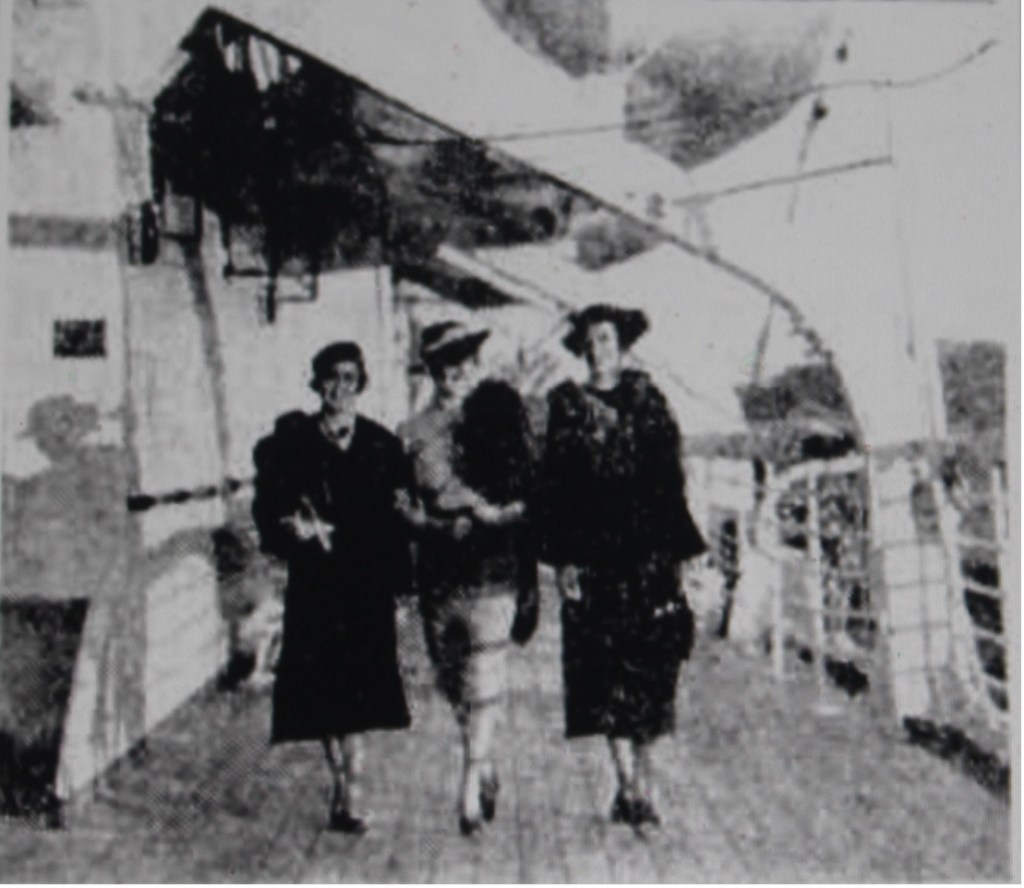
Group of Queensland ladies attending a Bridge Party on the Manoora inspect the ship [The Central Queensland Herald, 18 June 1936]
Afternoon Party in Sydney on the Manoora – 1935
The Sun of 10 June 1935, page 12, reported:
‘A fashion display, arranged by Grace Bros., was one of the attractions of the party on board the Manoora this afternoon, to assist the Lady Mayoress’s Clothing Fund. A musicale, arranged by Mrs. Robert MacKinnon, was contributed to by Mrs. Harry Twigden, Miss Agnes McDiarmid, Miss Daisy Richards, and Mrs Robert MacKinnon, with Mr. Maynard Wilkinson at the piano. Mrs. W. T. Wood wass in charge of the card tables, which were booked out.’
Ball Held on Manoora in Melbourne – 1935
Table Talk of 13 June 1935, page 47, reported:
‘One of the most brilliant balls that we have seen for a long time was that held last Thursday evening on board the luxury liner, the Manoora, in aid of the Royal Melbourne Hospital. The ship was distinguishable from a long way off by the strings of gaily coloured lights slung from bow to stern, while the enclosed decks presented a cosy setting for the dancers. Glorious pink roses from Mr Allister Clark’s home, in tall crystal bowls, adorned the special room set aside for Lady Huntingfield and the committee, while scarlet hollv, green hydrangeas and every imaginable flower sent from homes at Macedon, decked the various supper and drawing rooms. ……
As the Adelaide Steamship Company not only lent the ship, but gave the supper, there were very few expenses. Funds were augmented by the sale of cigarettes and novelties, raffles, a lucky dip and an oyster bar. Many people played bridge and dancing exhibitions were given by Miss Peggy Shields and Mr Victor Delaney.’

Mrs. R. J. Maclennan did brick business at the lucky dip on board the Manoora in Melbourne [Table Talk, 13 June 1935]
Shipping Staffs’ Dance on Manoora in Sydney – 1935
The Sydney Morning Herald of 25 September 1935, page 7, reported:
‘The wharf at Darling Harbour, beside which the Manoora was berthed, and the ship itself, were ablaze with coloured lights and gay with bunting last night, when the combined New South Wales shipping staffs held their annual dance on the ship.
The opportunity of dancing on this new and luxurious vessel was a great attraction, and the committee had no difficulty in disposing of tickets. Eight hundred guests attended. The Adelaide Steamship Company lent the ship and provided the supper, so that all proceeds will go to the Children’s Hospital.’
‘Manoora Manoeuvres’Ball on Manoora at Sydney – 1935
The Sydney Morning Herald of 29 November 1935, page 4, reported:
“Manoora Manoeuvres” held on board the ship last night as one of the events of Kindergarten Week offered a variety of entertainment for the guests. There was dancing on the sports deck; several competitions, including an American pushboard game, which carried an interstate sea trip as its prize; an “eloquent eyes” competition; and a midnight surprise, which was a mock mannequin parade, staged by a group of young men, who paraded in the “Roberta” gowns used in a recent fashion display.
Billed as the “Thursday to Friday” party, the ball began at 9 o’clock last night, and continued until the early hours of this morning, so that there was ample time for the guests to enjoy the “fun alley” with its games and competitions, and to patronise the oyster bar, which was conducted by Miss Anne Gordon and Mr. Claude Healy. As the ball began rather later than is usual, many of the committee entertained at dinner parties beforehand, and brought on their guests to the ship. The Governor and Lady Hore-Ruthven arrived at 10.30, after attending another entertainment.’
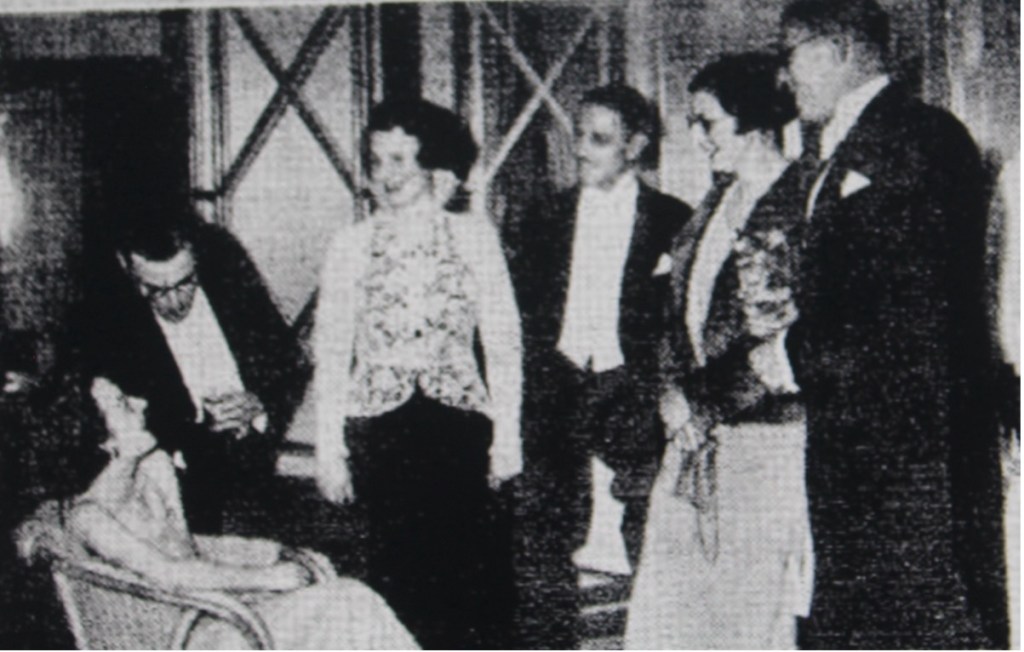
Enjoying cocktails at the Manoora ball held to aid the Kindergarten Union [The Daily Telegraph, 29 November 1935]
Two Luxurious Vessels Due in Sydney Together – 1936
The Daily Commercial News and Shipping List of 22 June 1936, page 4, reported:
‘Two of the most luxurious vessels now engaged in the interstate trade, the Adelaide Steamship Co.’s motor ship Manoora, and MciIlwraith, McEacharn’s new motor ship Kanimbla, are due at Sydney this morning from Cairns and Adelaide respectively.
The Manoora is expected to berth at No. 6 wharf, Darling Harbour, about 7 o’clock and will sail again at 3 p.m. on Wednesday for Melbourne and Adelaide. The Kanimbla will berth at No. 4 wharf, Darling Harbour about 7 o’clock, sailing again at 8 o’clock tomorrow evening on her maiden voyage to Cairns, via ports.’
Manoora Sets Record Time Between Sydney and Melbourne – 1936
The Newcastle Sun of 31 October 1936, page 3, reported:
‘Reaching Sydney yesterday from Melbourne in 35 hours 8 minutes, wharf to wharf, the motor ship Manoora established what officers claim to be a record for the voyage by an inter-state vessel. She berthed at Darling Harbor two hours ahead of schedule. Over the 574 miles, the Manoora averaged 17 knots and at times reached a speed of 19 knots. Fine weather was experienced, and there was a light following wind.’
Manoora Sails for Cairns and Celebrates Coronation Day of King George – 1937
The Daily Commercial News and Shipping List of 12 May 1937, page 4, reported:
‘The Adelaide Steamship Co.’s motor ship Manoora left Sydney last evening for Cairns and the Barrier Reef, a full ship. The is the vessel’s first voyage in the 1937 Cairns tourist season.’
The Daily Telegraph of 13 May 1937, page 18, further reported:
‘With ideal weather and a mill-pond sea, passengers on the Manoora’s first Queensland winter cruise passed Coronation Day [of King George VI and his wife Elizabeth, as King and Queen] very happily.
In the morning Coronation music was broadcast. A gala dinner was served in the spacious dining saloon, where patriotic emblems were featured. Elaborate souvenir menu cards showed much ingenuity. All dishes, from the Imperial cocktail to the Empire Sundae, were appropriately named. An amusing “Coronation Cup” race meeting and dance, with many novelties and prizes, concluded a glamorous evening. Well-known Sydney people aboard included Lady Braddon, Mr. W. S. Bennett, Mrs. S. H. Maas, Mr. and Mrs. N. Wilson, and Mrs. K. Cunningham.’
Manoora Undergoes General Overhaul at Cockatoo Island, Sydney – 1937
The Sydney Morning Herald of 18 September 1937, page 22, reported:
‘The Adelaide S. S. Company’s motor ship Manoora will arrive on Monday and proceed to Cockatoo where she is to undergo a general overhaul in dry dock.’
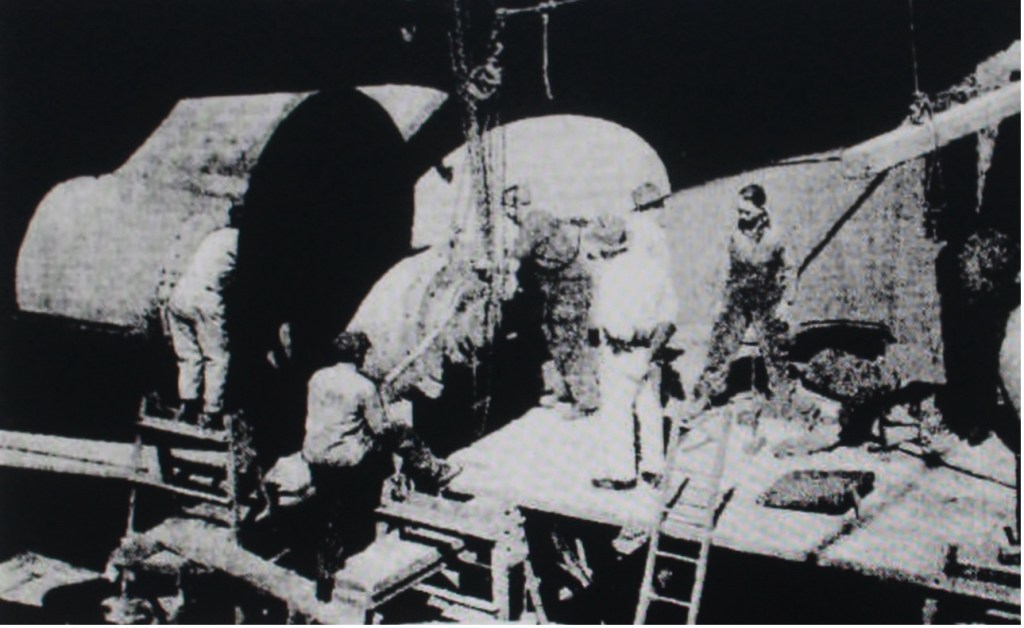
Workers remove the propeller from the Manoora at Cockatoo Dock [Sydney Morning Herald, 7 October 1937]
Farewell to Manoora from Brisbane – 1939
The start of 1939 was to be the last year of operations for the Manoora as an interstate tourist liner. The departure of the Manoora from each Australian port was often special event that would draw spectators to the wharf to witness its departure.
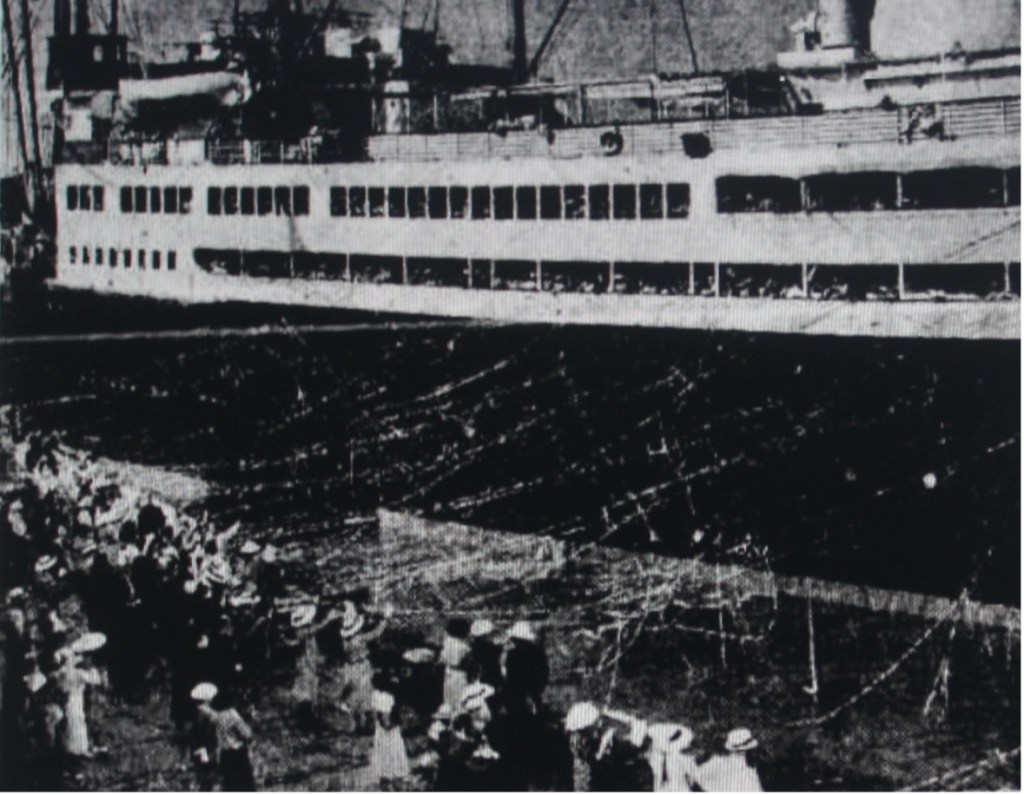
Streamers linked the Manoora with the shore when departing Brisbane for a cruise to the southern ports [The Courier-Mail, 22 January 1939]
PART THREE: MANOORA AS AN AUSTRALIAN NAVY WARSHIP IN THE SECOND WORLD WAR
Manoora’s Proud War Missions
In December 1939, the Manoora was requestioned by the Commonwealth Government and re-fitted as a naval warship for service in the Second World War.
Details of the HMAS Manoora’s various military operations were not publicised during the war years due to security concerns. It was not after the war ended in 1945 that numerous reports of the Manoora’s numerous important missions emerged.
The Armidale Express and New England General Advertiser of 17 September 1947, page 7, provided the following summary of the Manoora’s numerous dangerous military operations:
‘The Australian twin-screw motor ship Manoora which, through the variety of roles she played in the recent war, became known to thousands of Australian and American troops. …… Few Australian merchant ships won such renown as H.M.A.S. Manoora did during recent hostilities.
A modern vessel of 10,856 tons, she was engaged in the inter-State passenger and cargo trade when Hitler decided to throw the world into chaos and confusion and she was taken over by the R.A.N. She was first converted into an armed merchant cruiser, and, by the beginning of February 1940, was doing excellent work on patrol in New Guinea and North Australian waters.
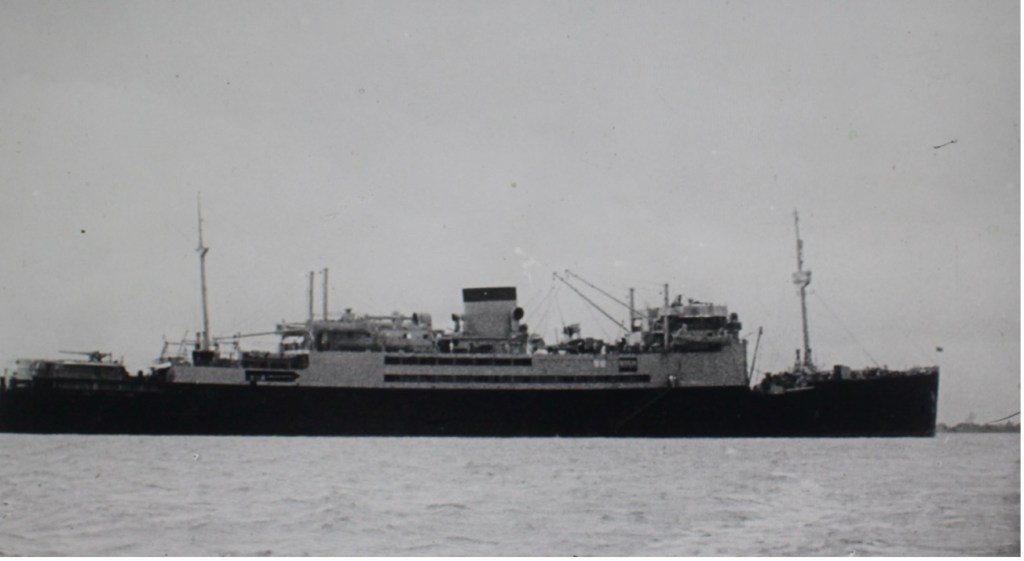
HMAS Manoora as an armed merchant ship, prior to conversion to a landing ship for infantry. A large gun is visible on the ship’s stern [State Library of Victoria]
Later she was recommissioned as an L.S.I. (Landing Ship Infantry) and took part in many historic landings in the Southwest Pacific. She was also used as a transport for Australian troops when reinforcements were sent to Millie Bay, New Guinea, in August 1943.
Since the war ended she has been employed in carrying troops and stores to New Guinea and surrounding areas, and has also carried troops and supplies to Japan for the British Commonwealth Occupation Force. Besides this she has made four trips to N.E.I [Netherlands East Indies] with Dutch and Indonesian passengers.
She recently brought 750 repatriates to Australia from India following the transfer of power from the British Government to the Indians.
Since Manoora was commissioned by the Royal Australian Navy in 1939; she has travelled 327,700 miles—143, 900 miles as an armed merchant cruiser; 70,650 miles as an L.S.I, arid transport; and 113,250 miles in voyages to Japan, N.E.I. and India.
Manoora’s first contact with the enemy occurred on June 12, 1940, when she engaged the armed merchant ship, Romolo. Still on patrol work, she later served in waters near Fremantle, Darwin, Thursday Island, Cairns, Townsville and Brisbane and also adjacent to Ocean Island and Nauru, Port Moresby, Babaul and Kavieng.
Then, in November, 1941, she embarked Admiral Sir Ragnar Colvin, who was then First Member of the Australian Commonwealth Naval Board, and his Staff for Singapore, and arrived there on December 6th, 1941, the day before the Japanese attacked Pearl Harbour. She was lying in Singapore Harbour when Japanese airmen raided it for the first time.
She was ordered to Calcutta to escort convoys from there to Rangoon, in Burma, and after she had finished that task she returned to Sydney, where she was converted to a landing ship infantry. For several months from February 1943, she, carried out practice landings with American troops and marines at the Allied commando training school at Port Stephens (N.S.W.), which was known as H.M.A.S. “Assault.”
After her use as an L.S.I. had been interrupted by her passage as a transport to Milne Bay, Manoora began taking part in the real landings against enemy-held territory for which she and her complement had been training. The first landing in which she was engaged took place at Tanamerah Bay on April 22, 1944. Less than a month later she was one of the vessels at the Wake Island landing.
Other famous landings in which she played a gallant part, were those at Morotai, Leyte, Panaon island, Lingayen, Tarakan, Brunei Bay and Balikpapan.
American forces only were landed at Tanamerah Bay, Wakde Island, Morotai, Leyte, Panaon Island and Lingayen. The troops landed at Tarakan, Brunei Bay and Balikpapan, all in Borneo, were members of the famous 7th and 9th Divisions of the A.I.F.
Following these landings Manoora returned to Sydney on July 25, 1945, shortly before the Japanese surrendered and the Pacific War came to an end. Soon afterwards she began her temporary peace time duties in which she has been employed ever since. (Her present) commander is Captain A. P. Cousin, D.S.O., R.A.N.R. (S).’
Navy Christmas on Board HMAS Manoora – 1944
The Lithgow Mercury of 23 December 1952, page 4, published a retrospective account of the 1944 naval Christmas festivities held on board the Manoora, during its war time operational period:
‘Christmas, wherever it is celebrated, is a joyous festive season, and a shipboard celebration can be memorable. H.M.A.S. Manoora, with a ship’s company of 660 and carrying 1,600 American soldiers, spent Christmas Day 1944, in Seeadler Harbour in the Admiralty Islands, just two degrees south of the equator. ……
But, despite the heat, the, fun and good fellowship among officers and ratings was a rare treat, and we found it excellent for mental health and spiritual life to spend Christmas merrily and in keeping with navy traditions. The ship’s bugler, Able Seaman Cyril Fox, sounded “Call the hands” at 0530 with a decidedly hot, swing effect and aroused everybody to the necessary and extraordinary mood. The daily routine of washing decks developed quickly into a series of battles with hoses, and ratings were more anxious to hose their fellows than the decks.
The idea of treating officers to a hosing was conceived naturally. Pulled unceremoniously from cabin bunks or beset by milling parties of seamen in any part of the ship, officers were man-handled and carried aft to the rigged bathing place and doused very thoroughly with hoses at full pressure: there was no respect for rank or rig. I was dressed ready for church, but that didn’t save me from the hosing.
Fifteen minutes before church time, the ship was in an uproar of hilarity and all clothes being worn were soaked; everybody about the ship looked “as wet as Shakesperean comedians.” But the call, “Hands to clean for church,” was responded to with precision and a large percentage of off-duty personnel were in the proper rig of the day for the diet of worship. With sincere appreciation, I congratulated the members of the congregation on their quick and effective change from boisterous hilarity to a quiet sincerity; it was highly commendable. I had seen very few such striking changes made in such a short time. “O Come All Ye Faithful,” “Whilst Shepherds Watched,” and “Silent Night” were sung with reverent enthusiasm by hundreds of R.A.N, and U.S. Army personnel.
Prayers were offered for loved ones from whom we were separated by the call of stern duty; that parents, wives, children, relatives and friends might enjoy the Christmas season with peace and goodwill superseding anxiety; that men everywhere might be drawn to the manliness and magnanimous purpose of the Holy Child, destined to be the Saviour of all mankind. At the conclusion of the service, Commander A. P. Cousin gave seasonal greetings to all present and thanked the ship’s company for their efforts during an eventful year. He expressed, the hope that a trip home might be in the immediate future, but we had hoped for that far too long. At a celebration of Christmas Day Holy Communion, immediately following, 150 men communicated.
After worship, the fun leaders took charge again. Chiefs and Petty Officers were quickly and methodically mopped up and, ducked by patrols of determined ratings. The general policy was to doubt the word of anybody who said he had been ducked, and any man who missed a ducking had better, forever hold his peace. In the messes, ingenuity was used with striking effect in decorating and, when the Old Man led a long procession of officers on dinner rounds, the messes presented scenes of gaiety which the Christmas spirit only produces in the navy. ……
In all messes there was revelry, and the Christmas fare of star-spangled turkey (a generous gift from Uncle Sam) with pusser’s best in “duff and afters,” and liquid refreshments (not guaranteed true to label and some fierce in effect), were all sampled by the visiting officers. through 40 messes it constituted a severe test on any man’s digestive juices, but nobody seemed to be concerned about consequential abdominal eruptions in the midst of good Christmas fun. ……
The feeding of the multitude in the Manoora on Christmas Day required 2,800 lbs of turkey, 1,860 lbs of ham, 820 lbs. of bacon, 1,800 lbs of bread, 1,700 lbs. of vegetables, 164 dozen eggs, 515 lbs. of sugar, 800 lbs. of beetroot, 480 lbs. of cheese, 220 lbs. of coffee, 24 lbs. of tea, 234 lbs. of butter, 156 lbs. of margarine; 64 pints of vinegar, and 1,500 lbs. of pudding. Fruit juices and titbits and extras, which cannot be calculated, must be added by imagination. These foodstuffs prepared, into various courses for meals were dished out in the galley in 40 minutes for each meal in a cafeteria system. Also included, in victualling, for the day were 6,000 bottles of beer and coca cola. Navy life for most men stimulates appetite.’
PART FOUR: PEACETIME MILITARY OPERATIONS OF HMAS MANOORA
The Second World War ended after Japan surrendered on 2 September 1945, and this major event heralded the start of HMAS Manoora’s new peacetime role.
These peacetime duties primarily involved repatriation missions and the transportation of troops and civilians back from the various theatres of war, and the transport of military personnel involved with occupation duties in Japan.
Indonesian Ex-prisoners of War Leave for Home on HMAS Manoora – 1945
The Goulburn Evening Post of 21 September 1945, page 5, reported:
‘The first of 8000 Asiatic P.O.W’s to be sent home from Rabaul, 459 Indonesians of the N.E.I. [Netherlands East Indies] forces, left here [Rabaul] in H.M.A.S. Manoora.
Drawn from camps scattered about the Gazelle Peninsula, where there are more than 700 Indonesians, they were summoned unexpectedly and quickly gathered together all their belongings, including pigs and fowls. They were piled into trucks, which took them to the wharves. Major L. F. Darling, of Warracknabeal (Vic.), who as O.C. recovered the P.O.W’s, took the final parade; at which some wept with joy.
As they passed from shore to ship in barges flying Dutch flags made from native laplaps, the ex. P.O.W,’s sang songs. These Indonesians, many Australians remarked, were looking far better in health and condition than Indians in whose camps they had been quartered. Some Indians claimed they were given preference in treatment and that some Indonesians even carried side-arms during captivity and sometimes beat the Indians.’
Troops Arrive on HMAS Manoora from Balikpapan in Indonesia – 1946
The Daily Mirror of 14 January 1946, page 2, reported:
‘With 1153 troops from Balikpapan, H.M.A.S. Manoora is due to berth at No. l Wharf, Circular Quay, tomorrow at 8.30 a.m. The N.S.W. total is 589.’
More Indonesians Repatriations and the Return of Australian troops – HMAS Manoora 1946
The Daily Mirror of 5 February 1946, page 6, reported:
‘If present plans are adhered to, H.M.A.S. Manoora will shortly repatriate 500 Indonesians to the Dutch East Indies. There will be an escort of 50 Australian soldiers. The Manoora is due in Sydney next Friday from Wewak and Madang, with Army and Air Force personnel due for demobilisation.’
The Sydney Morning Herald of 7 February 1946, page 5, also reported:
‘Fourteen hundred troops from Wewak and Madang will arrive in Sydney on H.M.A.S. Manoora tomorrow. The vessel will probably berth at No. 14 wharf, Pyrmont.’
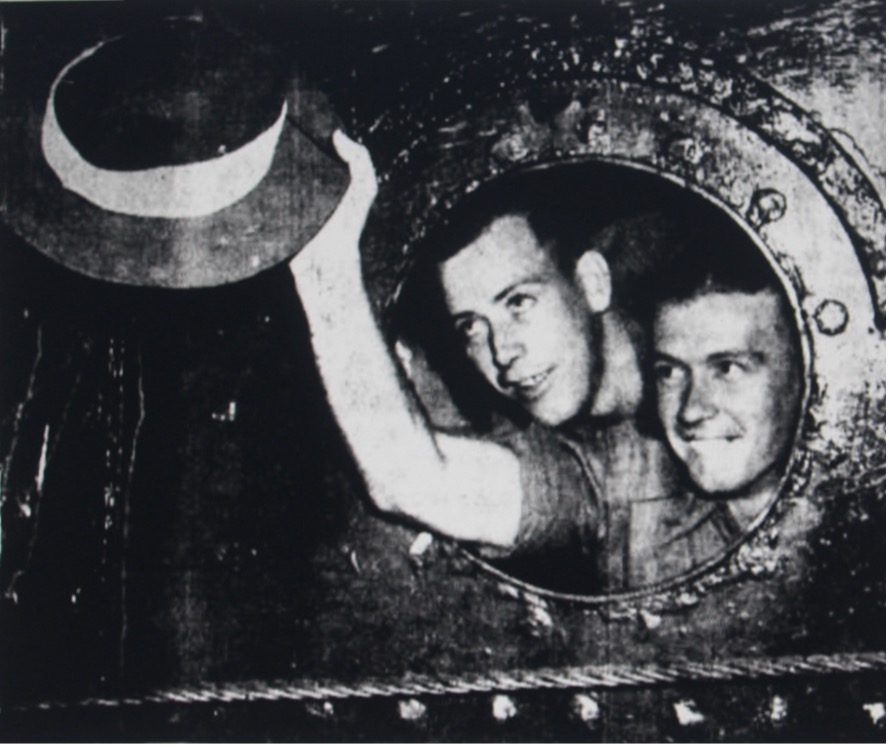
Two A.I.F. Veterans from Wewak arriving back in Sydney [Daily Advertiser, 12 February 1946]
Repatriated Indonesians Reach Java on HMAS Manoora – 1946
The Newcastle Morning Herald and Miners’ Advocate of 13 March 1946, page 1, reported:
‘After a quiet voyage, H.M.A.S. Manoora arrived at Batavia today carrying 821 repatriated Indonesians, including a large number of merchant seamen who had refused to load Dutch ships in Australia. Most of the Indonesians are Javanese, but there are some from Sumatra, Celebes, and other islands. There are a few Chinese. The party comprised 667 men, 61 women, 83 children aged between 1 and 12 years, and 10 infants.’
Australian Timor Force Reach Darwin on HMAS Manoora – 1946
The Inverell Times of 22 March 1946, page 1, reported:
‘The whole of the Australian Timor force, except one officer and eight men of the Australian War Graves unit, arrived here [Darwin] yesterday in H.M.A.S. Manoora. The troops related that many Japanese on Timor were reluctant to return to Japan and had inquired regarding the possibility of coming to settle in Australia. Those who had become prisoners of war by surrendering during the war were in a tragic position being regarded in Japan as officially dead.’
The Sun of 22 March 1946, page 5, further reported:
‘Members or the Timor force who reached Darwin today in HMAS Manoora on their way south expressed amazement at the light sentences recently, imposed by the Darwin War Crimes Court.
These were the men who had helped to round up the Japs, and they regarded it as a waste of time to have brought them here for such light sentences. The whole of the Timor Force, with the exception of No. 16 War Graves Unit, is on board the Manoora, which will also embark 600 RAAF and Army personnel for repatriation. Lieut.-Col. T. W. Bartley, of Hobart, who is in charge of the Timor Force, said that all islands from Flores to Soembawa, and from Soemba to Timor, had been cleared of Japs, with the exception of 600 at Koepang. The big concentration of 22,000 was now at Lopok, on Soembawa, under Lieut.-General Yamada, and they would wait there for repatriation.’
Australian Occupation Force to Leave Sydney for Japan on the HMAS Manoora – 1946
The Sydney Morning Herald of 10 April 1946, page 5, reported:
‘A contingent of 1,055 troops sailed on H.M.A.S. Manoora from Sydney yesterday to join the Australian occupation force at Kure, Japan. This was the third contingent to sail from New South Wales.
It consisted of 55 signalmen from Sydney camps and 1,000 men from Bathurst, where the misbehaviour of a minority had recently caused townspeople to complain.
The embarkation yesterday afternoon was quiet and orderly. Most of the men were young, but many had seen oversea service, and there were a number more than 40 years old.
Crowds of relatives and friends, mostly women and children, lined the gates of Glebe Island. They were not allowed on the wharf until the last batch of troops had embarked, because at a recent embarkation at Glebe Island 1,000 people forced their way to the wharf and hampered the work of embarkation officers.’

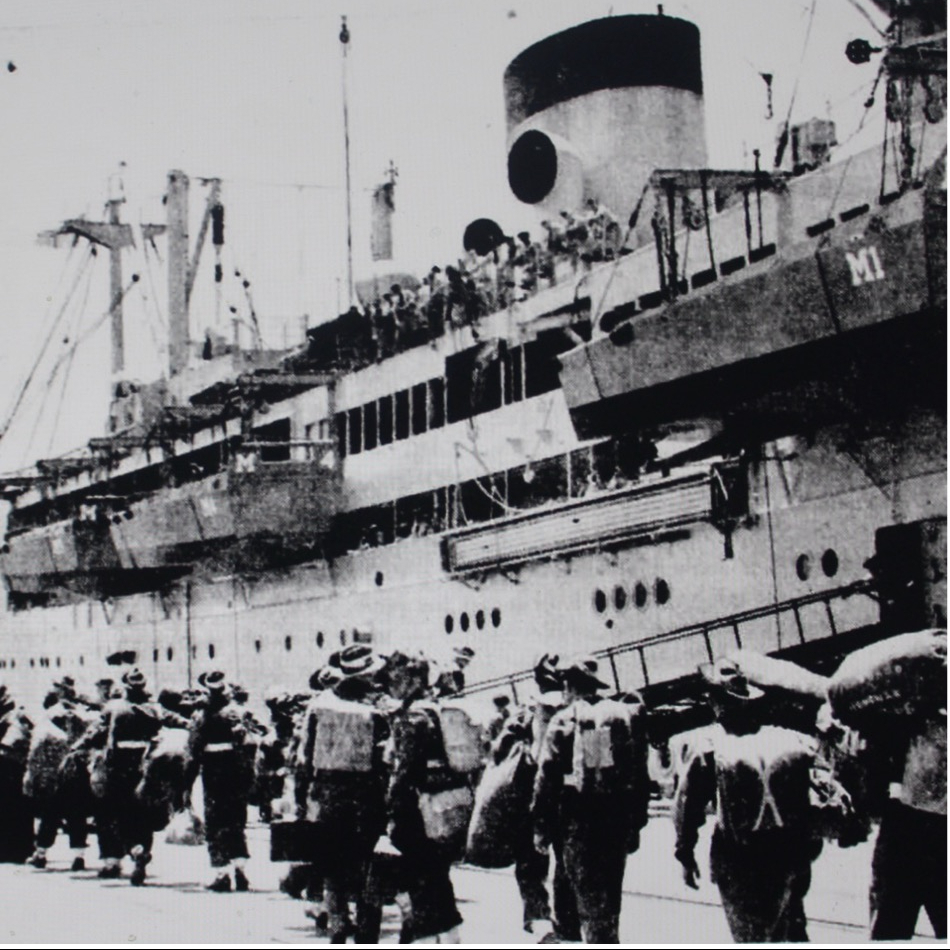
Occupation Forces on the wharf before boarding the troopship HMAS Manoora for Japan. Many were new recruits and there were others wearing the ribbons of famous A.I.F. campaigns [Daily Mirror, 9 April 1946]
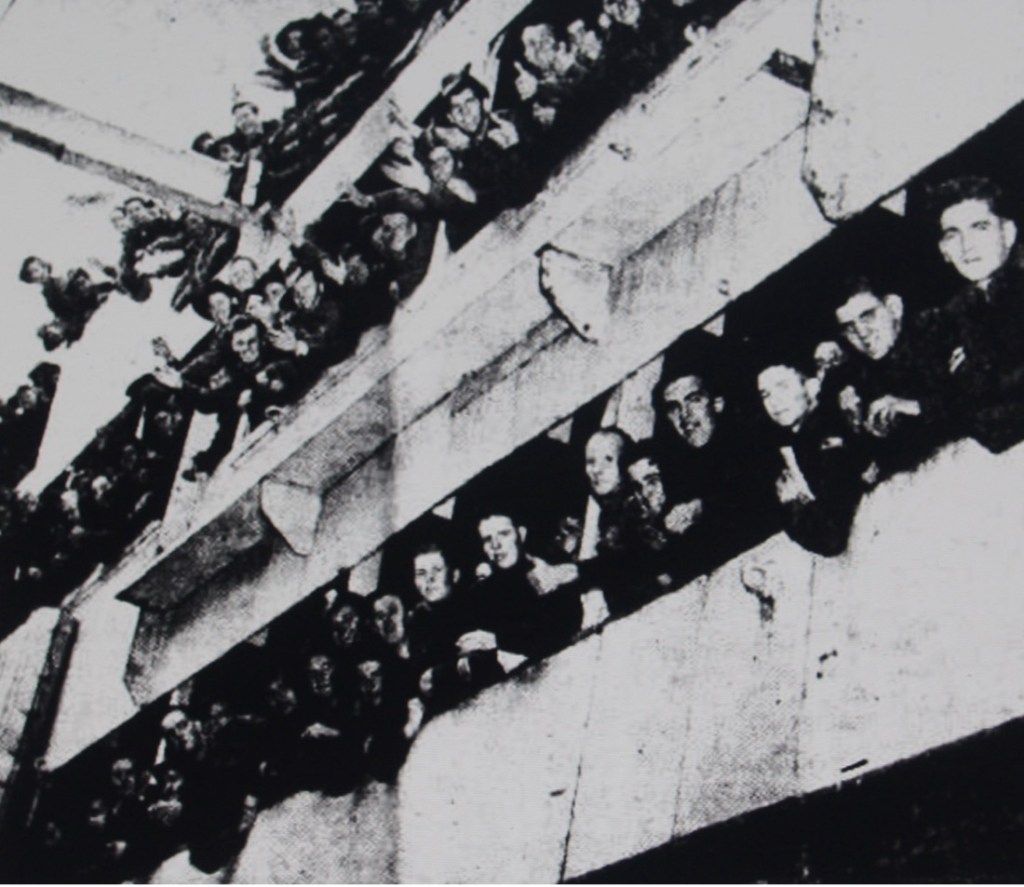
HMAS Manoora leaving Sydney with 1000 reinforcements for the Australian occupation troops in Japan [Daily Advertiser, 11 April 1946]
Servicemen return from Rabaul on HMAS Manoora – 1946
The Sydney Morning Herald of 21 May 1946, page 7, reported:
‘H.M.A.S. Manoora, with 724 Servicemen from Rabaul and 525 from Darwin, will berth at No. 10 Walsh Bay at 10, a.m. today.’
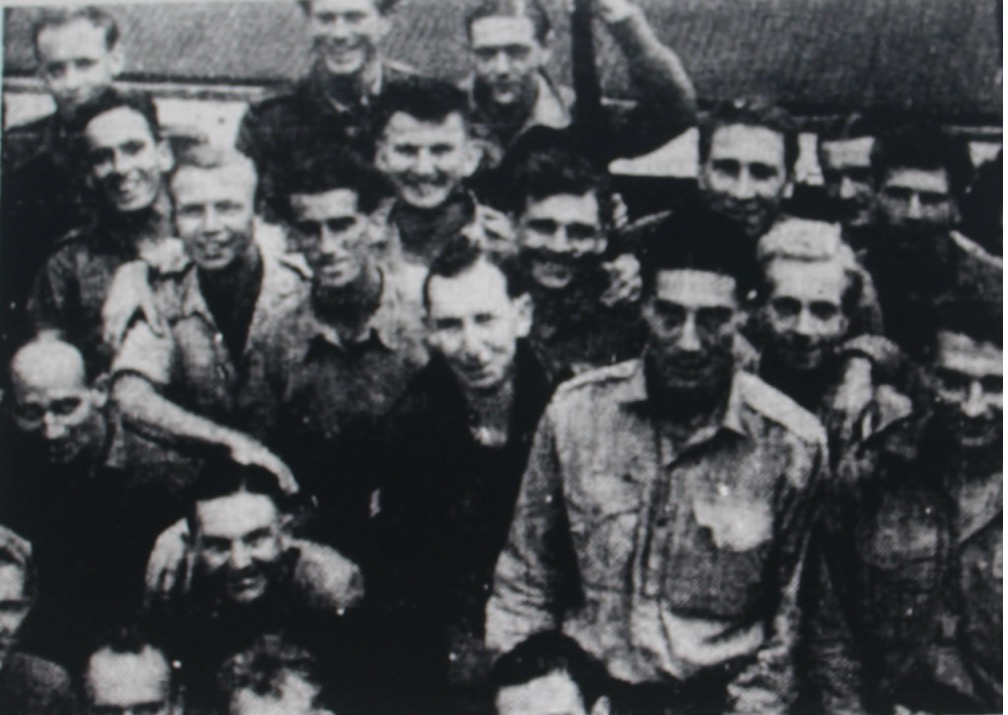
Servicemen on HMAS Manoora at Walsh Bay who returned from Darwin and Rabaul [Daily Mirror, 21 May 1946]
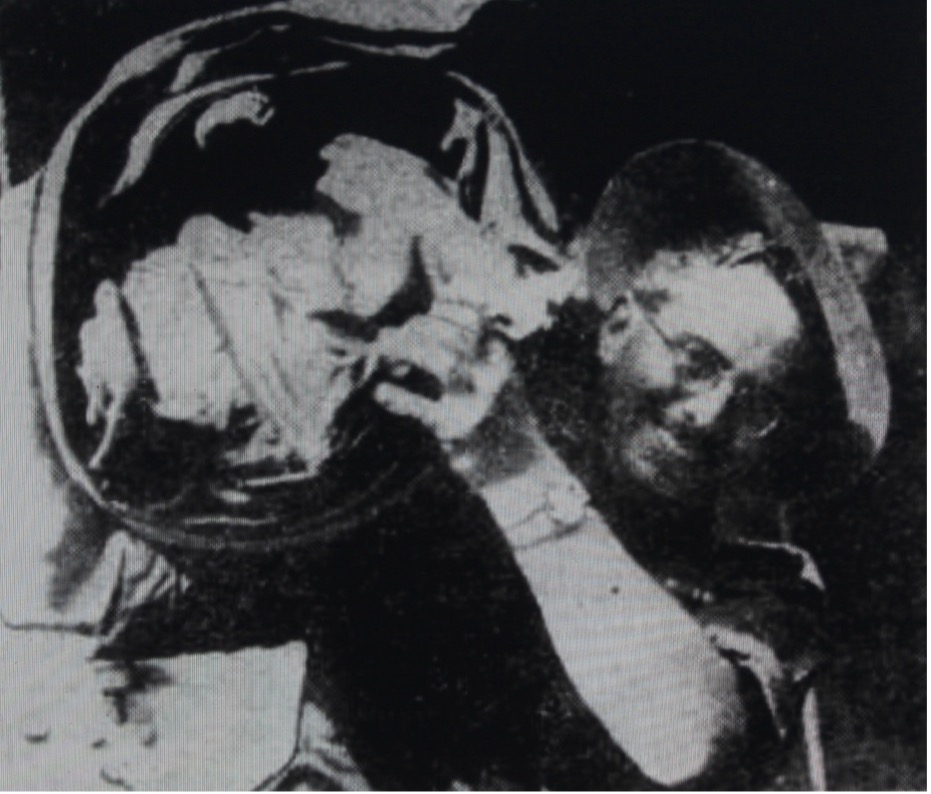
Captain Marchant arrived back to Sydney on HMAS Manoora for discharge [Daily Mirror, 22 May 1946]
Secrecy Surrounds Loading of HMAS Manoora on route to Java – 1946
The Armidale Express and New England General Advertiser of 19 July 1946, page 1, reported:
‘Strange official secrecy shrouds the loading of the R.A.N. auxiliary cruiser Manoora, 11,000 tons, which will sail from Brisbane next week with Dutch stores and equipment for Java. A spokesman refused to disclose the Manoora’s destination or to give details of her cargo.
Executive Officer Lansdell, of the Manoora, said: “Chifley has sent us on a mission. If you want any information, ask him.” Coloured Dutch M.P.’s and civilian guards barred the wharf gate. Pressmen who managed to get aboard the Manoora were asked to leave. Dutchmen on the wharf were loading trucks and jeeps, foodstuffs, heavy machinery, engines and other cargo, including heavy unlabelled cases.’
Complaints of Returning Servicemen – 1946
The Daily Telegraph of 16 August 1946, page 5, reported:
‘Many of the soldiers who arrived in Sydney yesterday from Morotai and Rabaul in H.M.A.S. Manoora complained that great-coats had not been issued to them on embarkation. The men said the weather was so cold three days out of Rabaul that they could not sleep on the decks. Photo, above, shows troops arriving without greatcoats but happy to be home.’
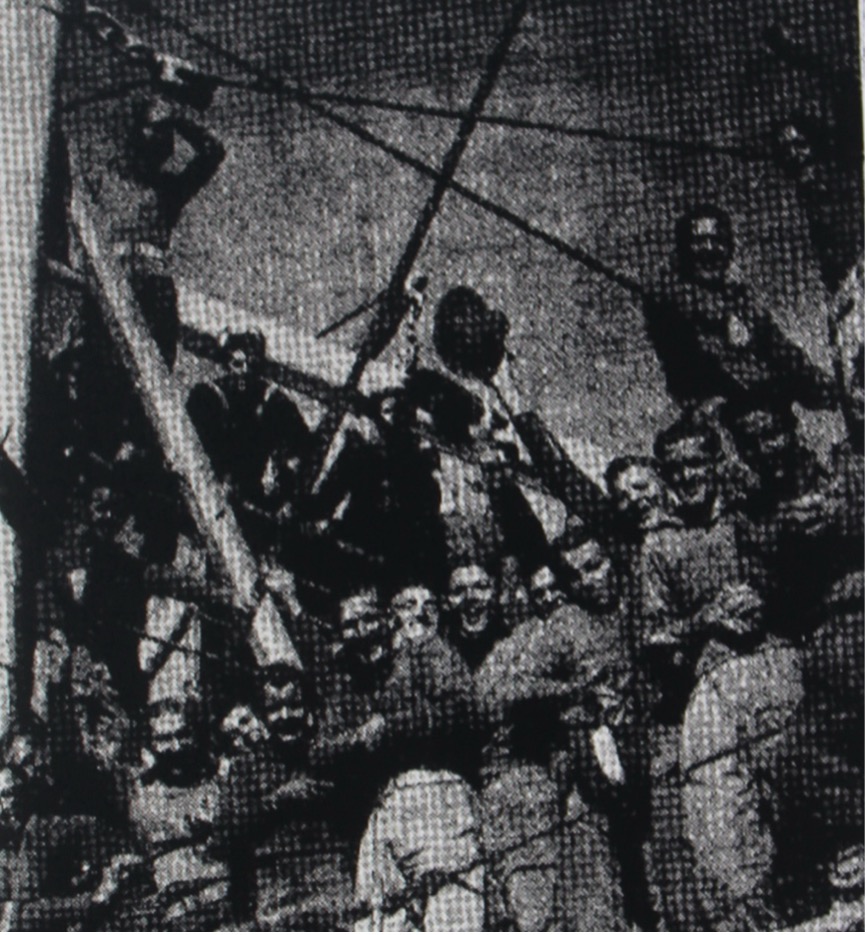
Servicemen return without greatcoats [The Daily Telegraph, 16 August 1946]
Troops return from Rabaul on HMAS Manoora – 1946
The Sydney Morning Herald of 5 November 1946, page 4, reported:
‘H.M.A.S. Manoora, with 240 Australian troops from Rabaul, will berth at No. 3 wharf, Woolloomooloo, at 2 p.m. today.’
Musicians walk off HMAS Manoora in protest – 1947
The Daily Mirror of 22 January 1947, page 2, reported:
‘Nine members of a dance band which was to have made a 26 weeks’ tour of areas occupied by Australian and British forces in Japan walked off H.M.A.S. Manoora, the ship on which they were to sail to Kure, at 1 p.m. today.
Mr. Alan Nash, the band leader, said that the Navy had been unable to fulfil a promise made by the Army that the musicians would mess with the ship’s officers and have the privileges of the wardroom. As this was a matter of principle, he and the others had decided to walk off the ship. Clad in badly fitting khaki uniforms, and wearing new Army boots, the musicians struggled down the gangway loaded with blankets, suitcases, kitbags and instruments. They held a meeting alongside the Manoora at 13 Pyrmont, had several conferences with Army officers and then at 1.30 p.m. left in four taxis. Mr. Nash said the tour was arranged by the Melbourne branch of the Musicians’ Union and by Army Amenities. There was no written agreement, but a gentleman’s understanding on conditions. Mr. Nash said that the accommodation for the band was reasonably satisfactory. The cost of the tour to Amenities would have exceeded £2000. His own loss would be substantial.
One of the ship’s officers said the wardroom could accommodate 77. With 25 women passengers, 25 R.A.A.F. officers, and other Army officers, it was impossible to permit the orchestra players to have the privileges of the wardroom. They were told they could eat in other messes or not sail. All members of the band are from Melbourne.’
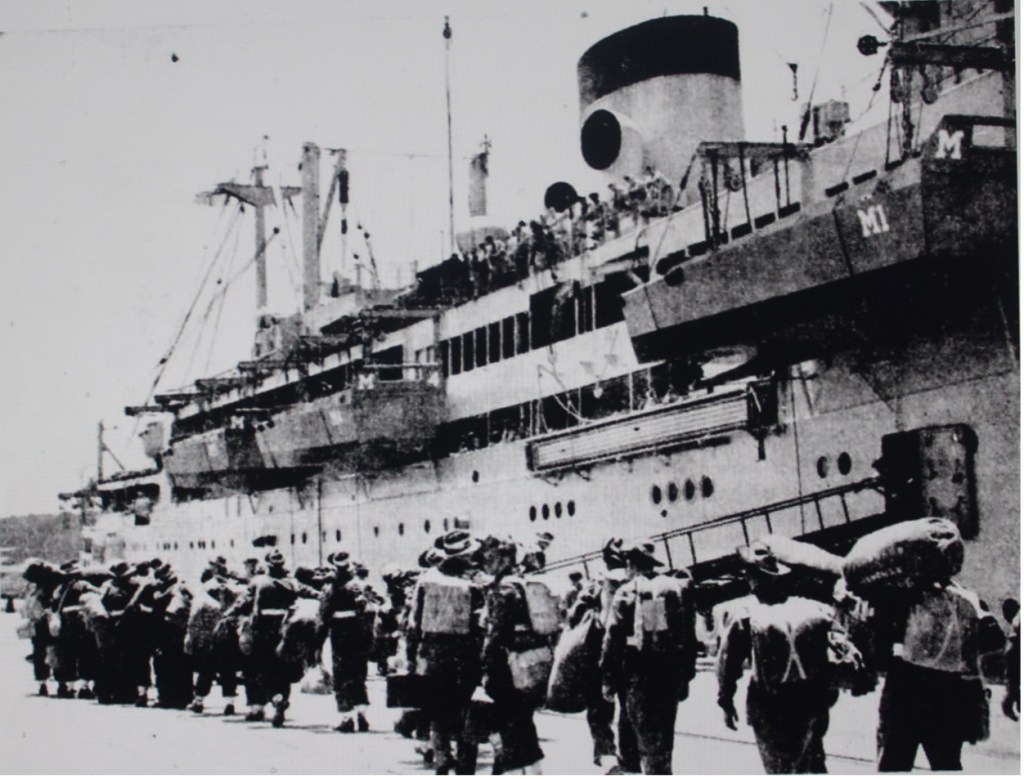
Troops of the Australian Occupancy Force who had been on furlough boarding the Manoora, for return to Kure, Japan. The landing craft are still attached to the side of the ship. The musicians had walked of this ship in protest at being denied access to the wardroom. The infantry lancing craft can be seen fitted to the side of the ship. [Sydney Morning Herald, 23 January 1947]
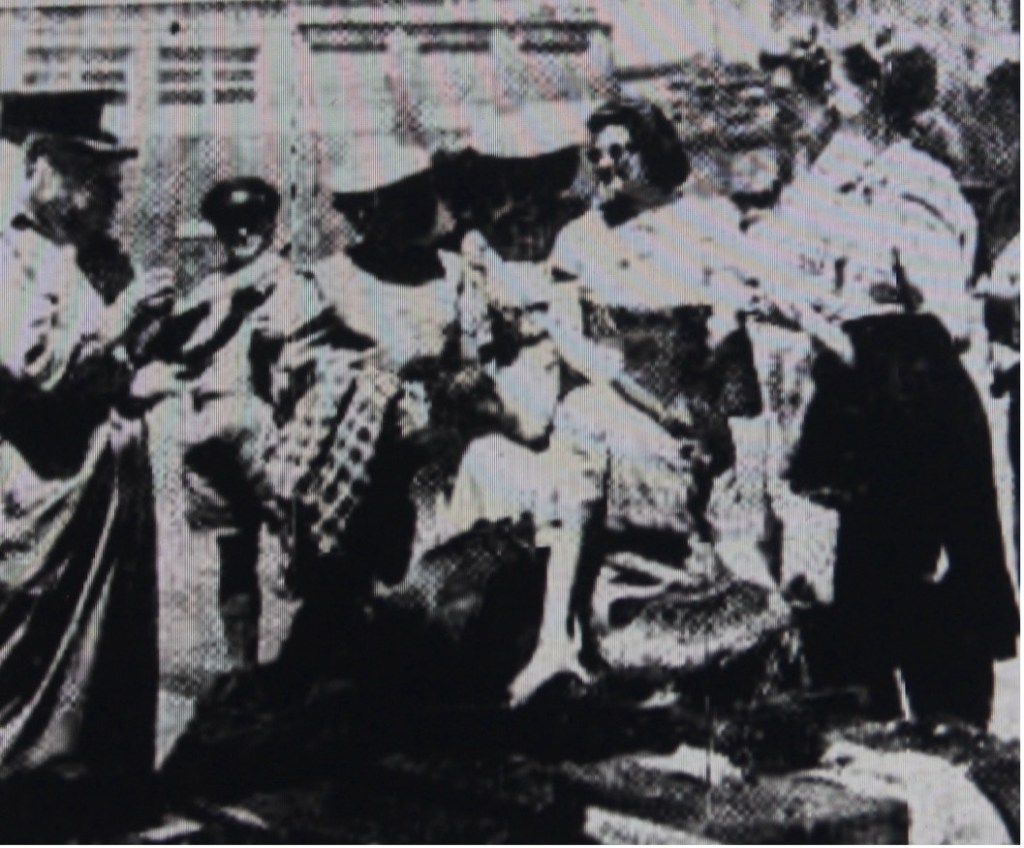
Captain J. Jack addresses a group of women about to board the HMAS Manoora for Japan where they were to work in canteens [Newcastle Morning Herald, 23 January 1947]
Occupation Troops return from Kure, Japan, on HMAS Manoora – 1947
The Daily Mirror of 28 February 1947, page 5, reported:
‘Dozens of cameras were brought home by 527 A.M.F. and 398 R.A.A.F. who arrived from Kure today in H.M.A.S. Manoora. These and binoculars stated to be personal property were not subject to Customs duty. …. Flight-Lieut. F. Muerhardt, of Adelaide, who contracted infantile paralysis in Japan, arrived in an iron lung specially flown from Sydney to Japan. His condition has improved. All except 40 of the A.M.F. are for demobilisation. There were also 65 medical cases and 10 New Zealanders. Snow was seven inches deep on the wharf when the vessel sailed from Japan.’

Flight-Lieut. F. Muerhardt brought home from Japan in an iron lung, being carried off the HMAS Manoora [The Daily Mirror, 28 February 1947]
Crowding on HMAS Manoora – 1947
The Sydney Morning Herald of 16 April 1947, page 6, reported:
‘Servicemen who reached Sydney in H.M.A.S. Manoora from Kure yesterday said that sleeping accommodation aboard was more over-crowded than any other they had experienced, even when travelling in troopships in the war.
On the lowest deck in the ship, below the waterline, several hundred men slept for two weeks in a room 80 by 20 feet. The ceiling was only eight feet from the floor.
Most of the 1,000 Servicemen who arrived in the Manoora are for discharge. They included 650 R.A.A.F. men who were among the original occupation force and had been away 13 months without leave.
The Manoora was delayed for two hours in mid-harbour until the quarantine doctor assured himself that the outbreak of measles was under control. Several cases were reported about 10 days ago.
Hundreds of relatives waited from 7.30 a.m. until after 10 a.m. to catch a glimpse of the men before they were marshalled into special buses to be driven to Marrickville camp.
The men agreed that amenities in Japan generally had improved in the last six months. Corporal K. Boswell, R.A.A.F., said that the best conditions were in Kure itself. At Iwakuni, where he was stationed, amenities were non-existent. Now and again three of the 500 men in his unit were given five days’ leave to stay at one of the rest hotels in Kure.’
The Daily Mirror of 15 April 1947, page 4, also reported:
‘H.M.A.S. Manoora, with 1018 servicemen on board, was held for nearly two hours at Watson’s Bay this morning while doctors made certain that a case of chickenpox was not small pox.
The men cheered when the yellow quarantine flag was pulled down and the ship moved to Glebe Island, where less than 300 people welcomed the 650 R.A.A.F. and 327 A.M.F. personnel. There were also 31 New Zealanders aboard. Most of the Australians are for demobilisation, but among the RA.A.F. men were 172 who have reenlisted for another 15 months.
More than 400 servicemen made customs declarations that they had either cigarettes in excess of 100, or the value of goods in their possession was more than £12 10s. The men on three weeks’ leave were allowed to retain 600 cigarettes, but those for discharge were limited to 100 cigarettes or four ounces of tobacco.
After May 6, when special British armed forces vouchers must be used in purchases, black market transactions in Japan will drop by up to 75 per cent., according to the servicemen. The higher exchange rate was designed to give Empire troops more spending money, but the Japanese increased prices by 300 to 400 per cent.
The only civilian passenger on the Manoora and the only woman on board apart from the nursing staff was Miss Joy Earle, a Y.W.C.A. worker, who will spend her leave in Sydney. Miss Earle, a New Zealander, had been in Japan since last June, and said no troops could complain of shortages or bad conditions. Japan was a filthy country, she said. Whenever the Y.W.C.A. moved to a new area the girls spent at least 14 days scrubbing and cleaning buildings before they were fit for use.’
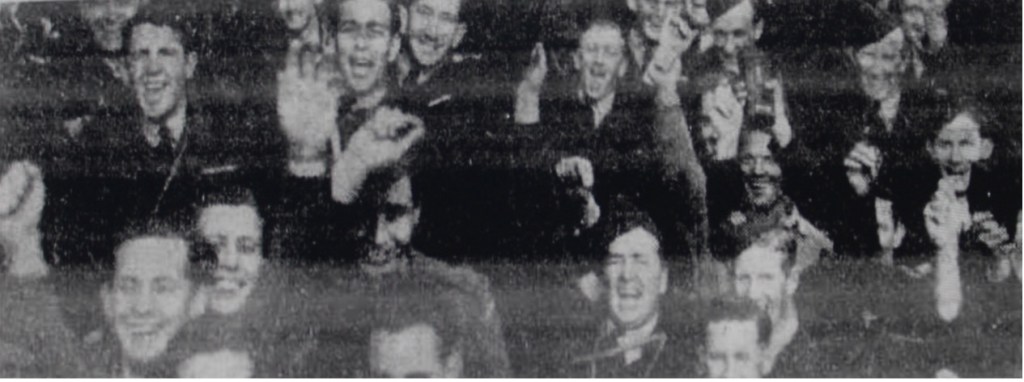
Army and Air Force personnel shout greetings to relatives at Glebe Island wharf [Daily Mirror, 15 April 1947]
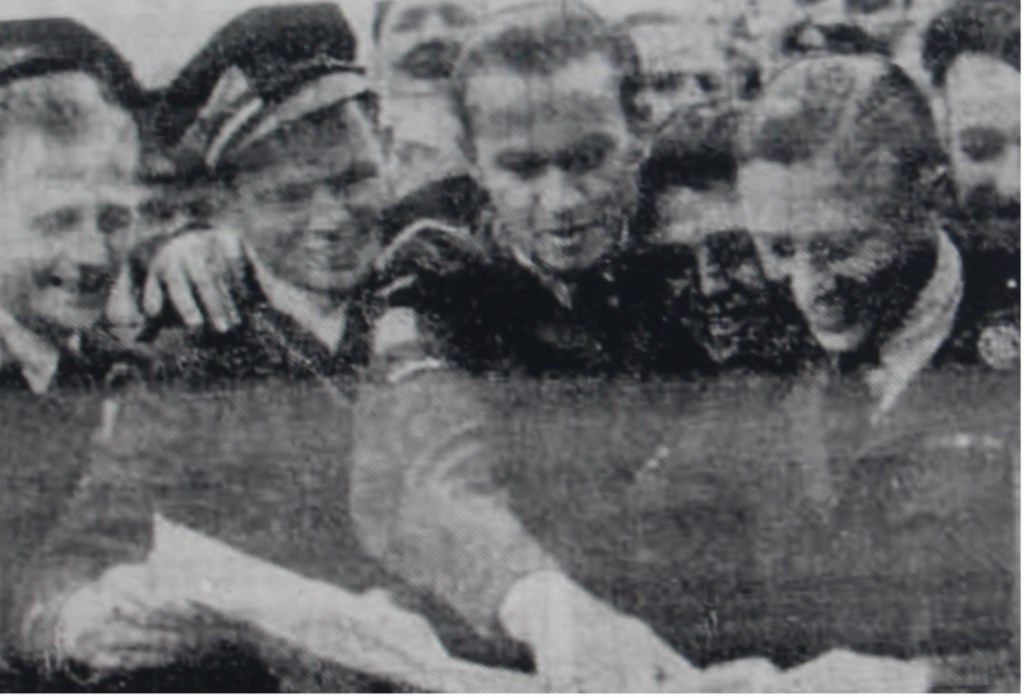
Air Force personnel returning Japan on HMAS Manoora, read the paper to learn about recent happenings [Daily Mirror, 15 April 1947]
Emotional Farewells as Deported Husbands Leave on HMAS Manoora – 1947
The Daily Mirror of 1 May 1947, page 1, reported:
Mr. A. H. Sorongan, secretary of the Indonesian Seamen’s Union, said a tearful farewell to his wife, Mary, and 16-months-old baby daughter, Treina, as he sailed by H.M.A.S. Manoora for Java this afternoon under a deportation order…… She used to work at the Department of Road Transport.
The Daily Telegraph of 2 May 1947, page 1, also reported:
‘Indonesians married to Australian girls had to leave wives and families behind when they sailed home on the Manoora yesterday. Federal Government had refused wives sailing permits because of unsettled conditions in Indonesians. Forty-four Indonesians boarded the ship in Sydney and more than 300 will join them in Brisbane.’
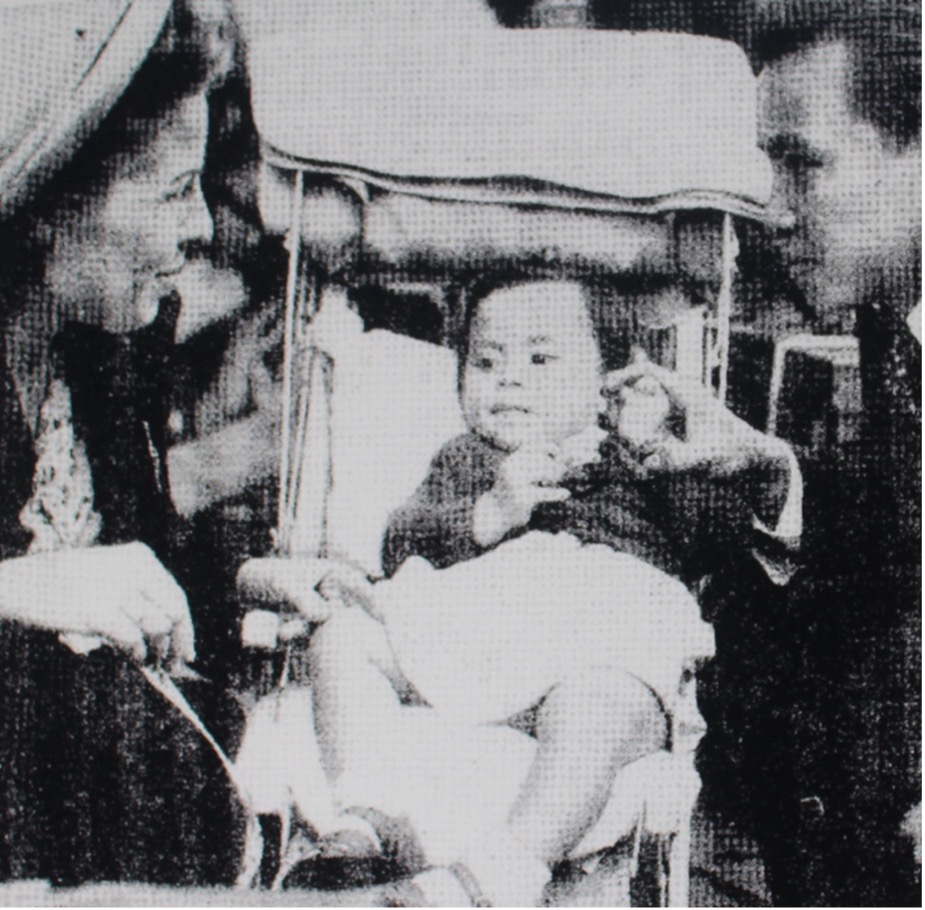
Mr. A Sarongan bids goodbye to his wife and 16 months daughter prior to boarding HMAS Manoora [The Daily Telegraph, 2 May 1947]
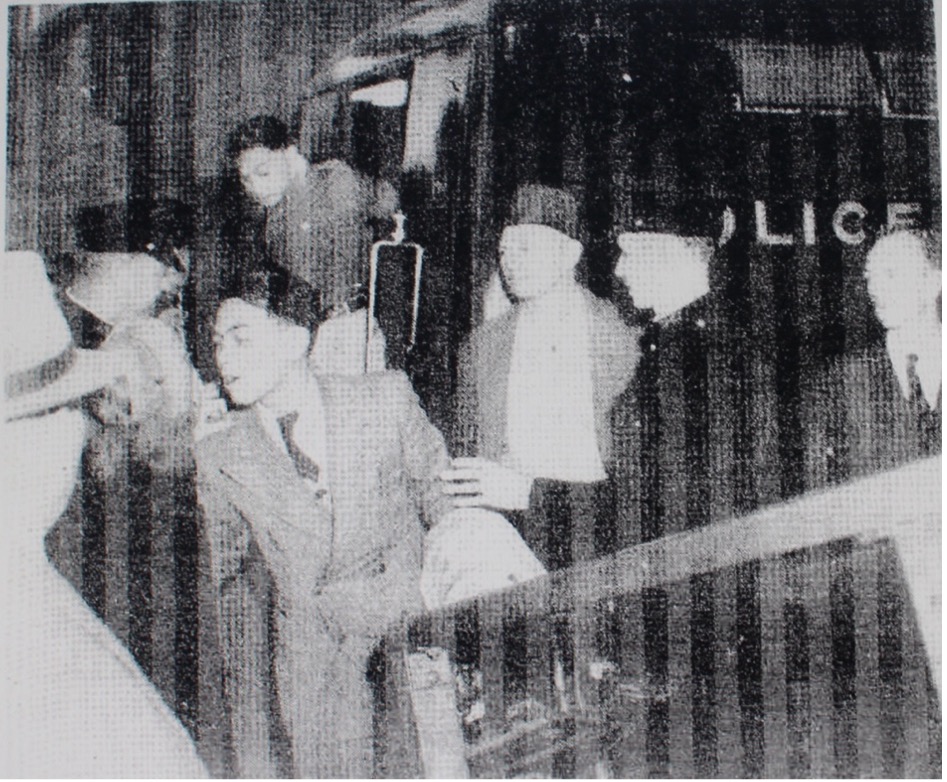
Before stepping on to the gangway, Mr. A. J. Maramis leans over to kiss his wife. Police arrested Mr. Maramis on Monday and held him for deportation [The Daily Telegraph, 2 May 1947]
Britons and Australians to be Returned to Australia on the HMAS Manoora – 1947
The Newcastle Morning Herald and Miners’ Advocate of 30 May 1947, page 5, reported:
‘The Commonwealth Government had decided to make available H.M.A.S. Manoora for two trips between India and Australia to bring back some of the 4000 Britons and Australians waiting in India for transport to Australia, the Minister for Immigration (Mr. Calwell) said today. Manoora would leave for Fremantle within a week to take on stores, and she was expected to reach Fremantle on the first trip from India early in July. The ship was fitted out as a troop carrier, so the passengers would travel under austere conditions at fares commensurate with those conditions.’
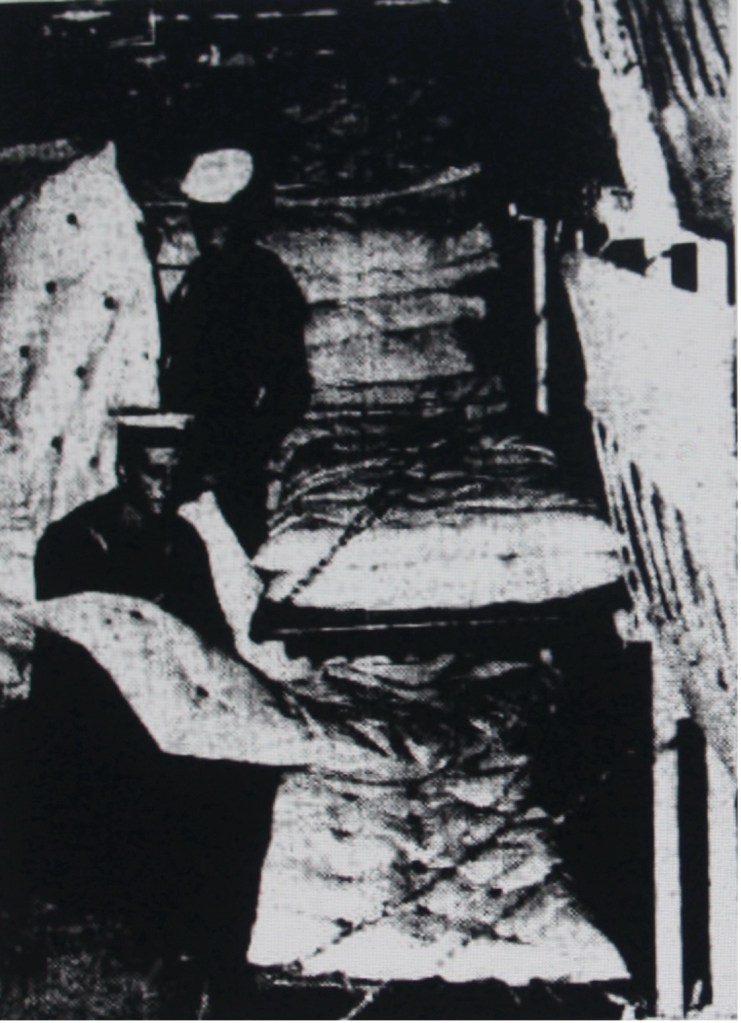
Ratings aboard HMAS Manoora preparing new bunks to be used when the ship brings passengers from India to Australia [Sydney Morning Herald, 11 July 1947]
Indian Settlers Arrive in Sydney on HMAS Manoora – 1947
The Sydney Morning Herald of 29 August 1947, page 8, reported:
‘About 200 persons who intend to settle in Australia arrived from Bombay yesterday in H.M.A.S. Manoora. Many were civil servants in India under British rule who lost their positions through the change of Government. Others are artisans and tradesmen of English, Eurasian, or Anglo-Indian nationality, with a sprinkling of Rumanians, Poles, Hungarians and Russians.
Some had fled to India from Europe early in the war. Many said that they had come to Australia because they were told they were no longer wanted in India. Mrs. C. H. Lloyd, a Scotswoman, arrived with her Australian husband, who is a member of the Church Missionary Society, and family. She said she had lived 60 miles from Calcutta. Fighting between Hindus and Moslems had been bad enough under British rule, but it became worse when India was partitioned. There were no rail or postal ser-vices and often no food during the rioting.
“They are just mad in Calcutta,” Mrs. Lloyd said. “They think nothing of dropping a bomb in a crowded tram or turning a machine gun on a bus, even though there are probably Hindus and Moslems in both.”
Mr. Maurice Shipton, of Wahroonga, who returned from Britain via India, said all his baggage. was stolen from the train outside Madras. Mr. J. B. Thompson, an immigration officer, who travelled back to Australia in the Manoora, denied that any of the passengers were not allowed ashore at Fremantle because of illness.
Canon D. K. McConchie, of Perth, who made the trip as welfare officer, said the trip was a happy one for those on board. All had paid their own fares, and temporary accommodation had been found for them by the Government. They all had considerable funds.’
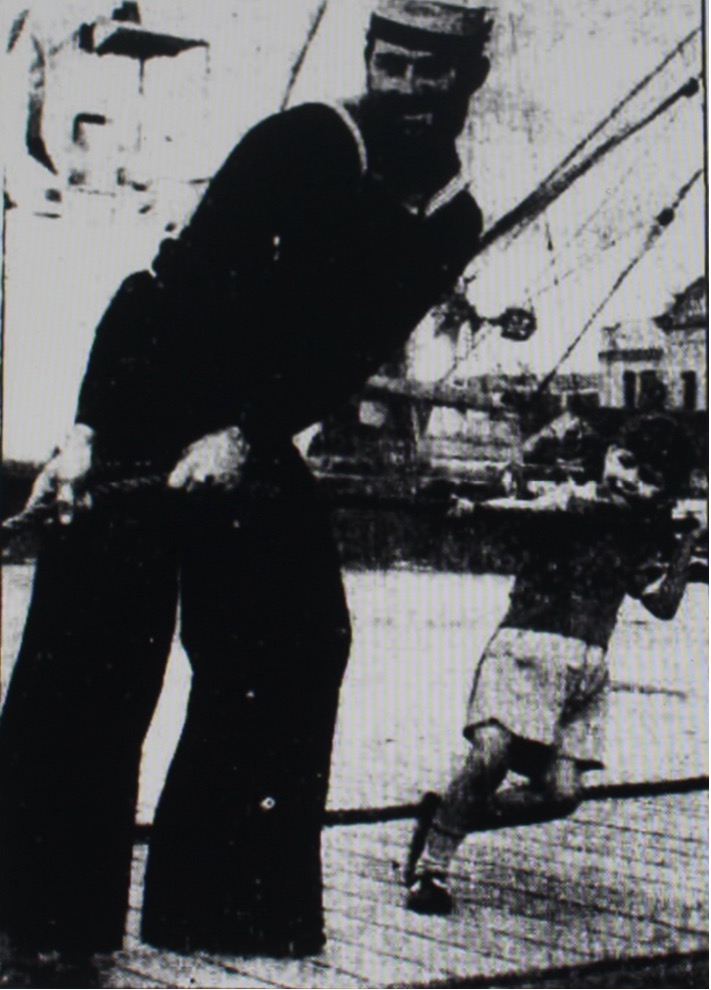
Winston Todd, gives Able Bodied Seaman Snodgrass a ‘helping hand’ on the Manoora, while travelling to Australia from India [The Sun, 28 August 1947]
HMAS Manoora to Resume Role as a Troopship – 1947
The National Advocate of 29 August 1947, page 3, reported:
‘HMAS Manoora, which reached Sydney today from India, is to resume her former role as a troopship. Present arrangements are for the ship to sail from Sydney on September 11 with Australian troops for Japan.’
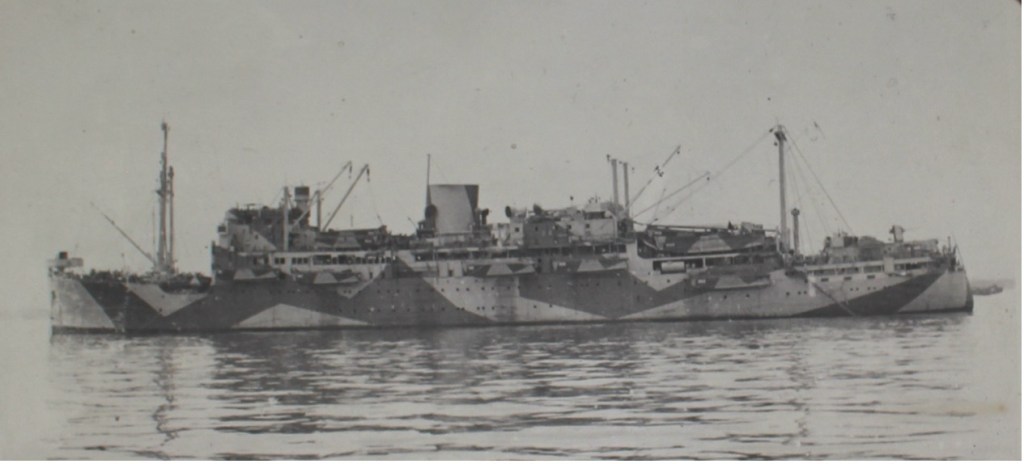
HMAS Manoora in war paint, 1947 [State Library Victoria]
HMAS Manoora Takes Troops to Japan – 1947
The Daily Mirror of 11 September 1947, page 3, reported:
‘Two hours before H.M.A.S. Manoora was due to sail, at 2.15 p.m. today for Kure, 300 relatives and friends of the 560 passengers were allowed on the wharf at 5 Circular Quay. Those in the ship included 516 A.M.F., two businessmen, and 12 actors, and four instrumentalists who will entertain troops in the B.C.O.F. area.
The actors, headed by Mr. John Nugent Hayward, will stage two plays. They haye £600 worth of equipment with them. This voyage of the Manoora may be its last under naval control. If the partial refit of H.M.A.S. Westralia is completed in time, that ship will take the place of the Manoora on the Sydney-Kure run, and the latter ship, when it returns from Japan, will enter Cockatoo Dock to be restored to its pre-war condition.’
HMAS Manoora’s Last Voyage as a Troopship – 1947
The Sydney Morning Herald of 12 September 1947, page 1, reported:
‘Thousands of streamers and brilliant sunshine added colour to the farewell to 600 Servicemen, a number of nursing sisters and two entertainment units when they left Sydney for Japan in H.M.A.S. Manoora yesterday. Most of the men were replacements for the Australian contingent with the British Commonwealth Occupation Forces. On her return, the Manoora will go into dock for an overhaul and refit for the coastal trade.’
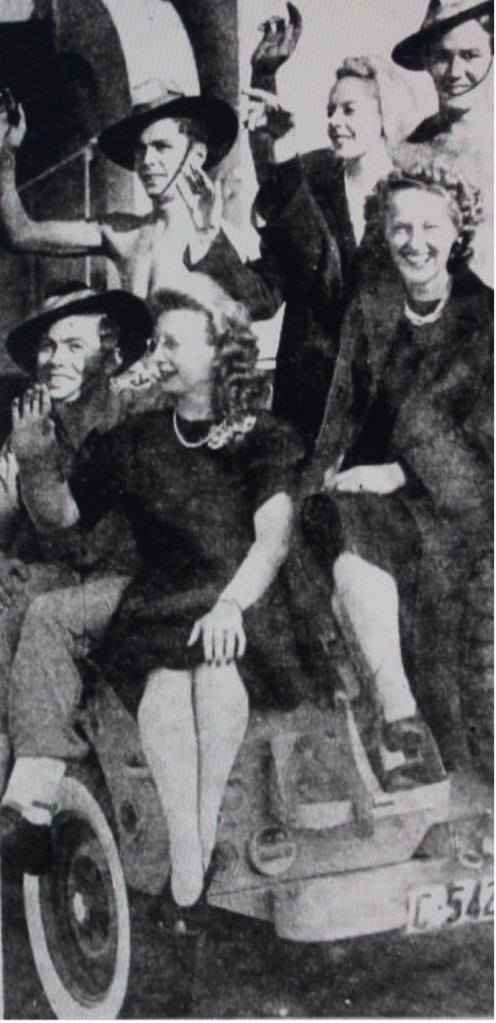
Three Australian members of a concert party who had been entertaining troops in Japan for five months, joined with servicemen in waving to friends as the Manoora berthed in Sydney from Kure [Daily Mirror, 18 October 1947]
Reflections on HMAS Manoora’s Last Voyage as a Troopship – 1947
The Sydney Morning Herald of 22 October 1947, page 2, published the following article written by a staff correspondent:
‘In less than a fortnight H.M.A.S. Manoora will go into Cockatoo Dock for extensive refitting as a passenger ship at an estimated cost of £400,000. She completed her last voyage under naval control when troops from Japan were disembarked at Sydney on Saturday.
Of the big interstate liners commissioned by the Navy during the war, only H.M.A.S. Kanimbla will now remain to pay off. Next week the Manoora will go to Garden Island to be “derequisitioned.” All stores, hospital supplies, and portable naval gear and fittings will be taken off. Then the Manoora, no longer a naval vessel, will be put into Cockatoo Dock to be stripped of unwanted bunks and bulkheads, and refitted as a passenger vessel.
Commissioned by the Navy in December, 1939, the Manoora (10,856 tons) was stripped to make room for troops. During the refit, which will take about 12 months, flooring and the rest of the inside of the vessel will have to be built in, subdivisions for cabins erected, and all the furnishings now in storage put back. The whole job will be done at Cockatoo, and the Government will foot the bill.
Before the war the Manoora during the four winter months ran tourists between Melbourne and Cairns. In the other eight months she carried passengers and 4,000 tons of cargo between Brisbane and Fremantle. What use the owners of the vessel, the Adelaide Steamship Co. Ltd., will make of the ship after refit has not been decided.
When the Manoora goes into Cockatoo another former interstate liner, the Westralia (8,108 tons), owned by Huddart Parker, Ltd., will have almost completed refit. Sailing under the Red Ensign (Merchant Navy flag), she will be used by the Navy as a hired transport to assist the Kanimbla on the run between Australia and Japan.
By November 17, it is expected, the passenger accommodation of the Westralia will be as good as, if not better than, before the war. Two holds will be used as troop decks for 600 troops, who will have all the comforts of first-class travel except for sleeping quarters. Women, children, concert parties, and other civilians will be carried in the cabins.
The Manoora, Kanimbla, and Westralia were commissioned early in the war, and for a time were used as infantry landing ships on Pacific beaches. Later they became troop carriers.
Another interstate liner, the Manunda (9,115 tons), owned by the Adelaide Steamship Co., Ltd., has been refitting in Melbourne for nearly 12 months. She will return to the coastal trade at the end of January. The cost of refitting this ship for the passenger trade will be £300,000.
The Manunda was commissioned as a hospital ship in August 1940. Before the war she ran a three-weekly service between Melbourne and Cairns for eight months, and between Brisbane and Fremantle during the four winter months. Future plans for the Manunda have not been decided.’
HMAS Manoora’s Ensign Presented to an American Veterans Group – 1948
The Sydney Morning Herald of 5 February 1948, page 3, reported:
‘The Australian Ambassador, Mr. N. J. O. Makin, yesterday presented the tattered White Ensign flown by H.M.A.S. Manoora during the war to Surgeon-General Clarence Rungee, who accepted it on behalf of the American Veterans of Foreign Wars.
The Ensign will be added to the organisation’s collection of 171 flags, which will hang in the gallery of its new building at Washington. Surgeon-General Rungee began collecting flags a year ago as a private hobby. The collection now consists of banners from countries in all continents, but all endeavours to secure a Russian banner have failed.’
PART FIVE: MANOORA RECOMMENCES INTERSTATE PASSENGER CRUISING
Manoora to Recommence Passenger Services – 1949
The Sun of 4 August 1949, page 6, reported:
‘Completely refitted, after years of war service, the interstate liner Manoora will make her maiden post war Voyage on September 9.
As the armed merchant ship, HMAS Manoora, she was responsible for the scut-tling of the Italian liner, Romolo. Her reconditioning for the coastal trade began in December, 1947. Timber panelling of the public rooms, stored during the war, has been restored to its original condition. The dining saloon has been decorated with murals commemorating the liner’s war time service. The Manoora has accommodation for 254 first-class passengers in single and double berth cabins, and second-class passengers.’
Passenger Services Commence – 1949
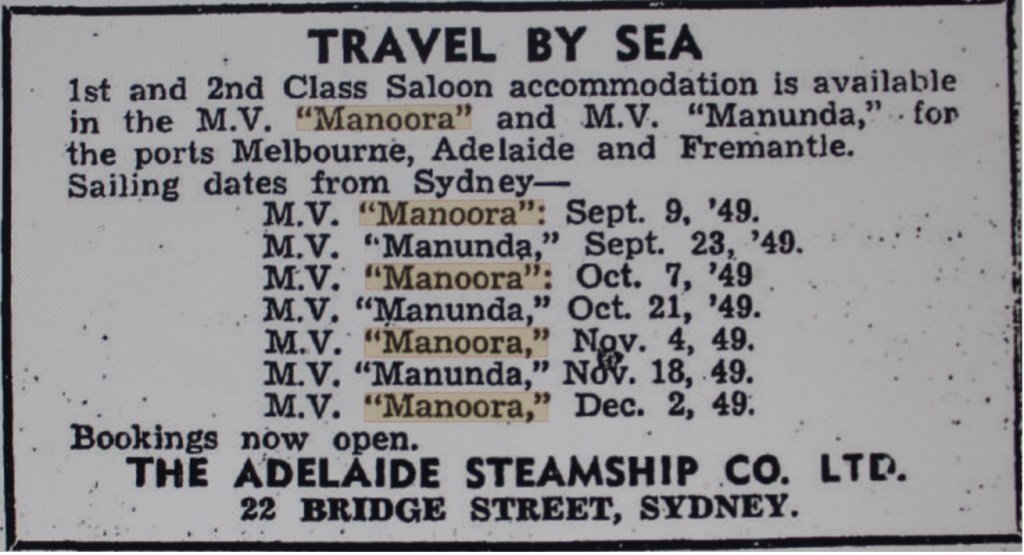
Following the Manoora’s conversion back to a passenger liner, advertisements were soon placed announcing the new sailing schedule. The following advertisement appeared: in The Sun of 4 August 1949
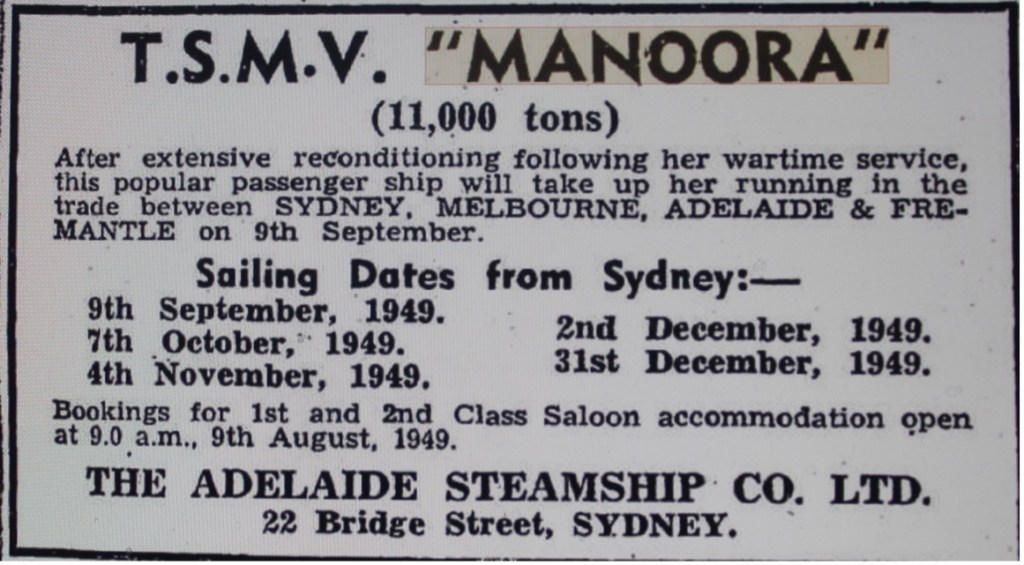
and in The Sun of 13 August 1949:
Concluding Comments
When the Manoora recommenced passenger services late in 1949, the golden-era of interstate passenger cruising was entering changing times.
In post-war Australia, the use of cars and planes to travel to interstate destinations was becoming more common. During the 1950′ the Manoora rarely featured in any newspaper articles, except for instance, to report that a Melbourne Cup horse had been transported by the ship.
In August 1961 the Manoora was sold to an Indonesian company and thereafter sailed under the Indonesian flag as the Ambulombo. The Canberra Times of 10 August 1961, page 9, reported:
‘The Indonesian Government will take formal delivery of the 10,952-ton Australian passenger ship Manoora in Adelaide on August 17—the anniversary of Indonesia’s declaration of Independence. Manoora will be re-named Ambulombo after a mountain in Flores Island, in the Lesser Sundas group.’
The Manoora was finally sold for scrap in 1972.
ADDENDUM
HMAS Manoora Association Memorial at Fly Point, Port Stephens
On the site of the former HMAS Assault at Fly Point, Nelson Bay, a memorial has been placed by the HMAS Manoora association.
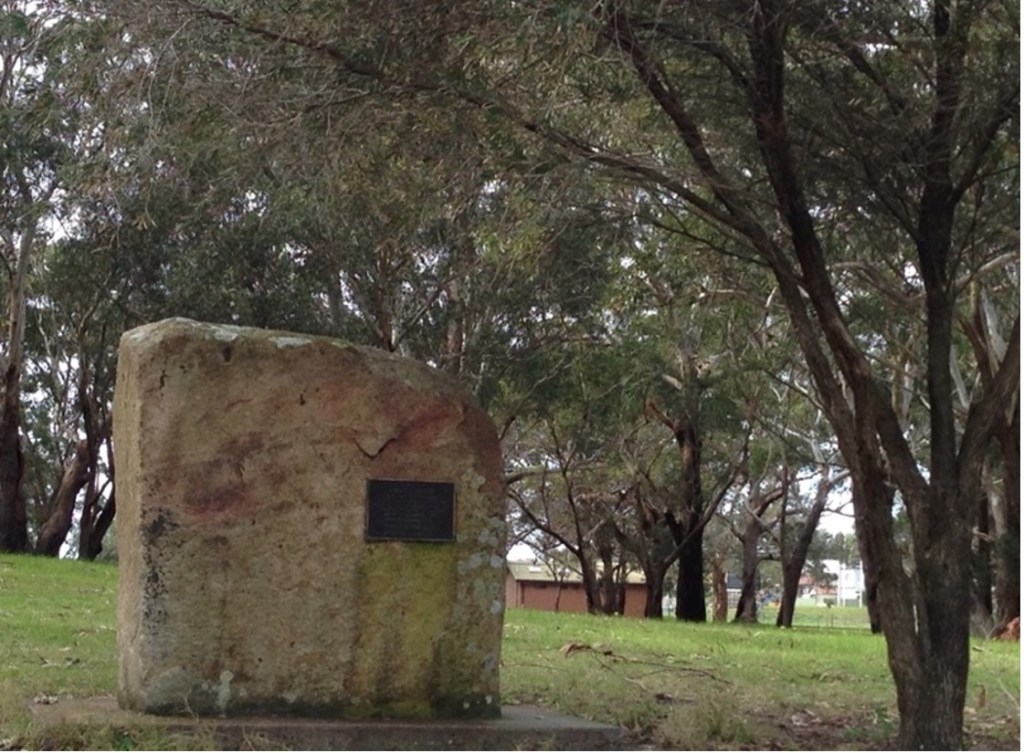
HMAS Manoora Association Memorial erected in 1991 on the site of an accommodation hut at Fly Point [Author Photo – June 2022]
The plaque on the HMAS Manora Association memorial reads:
‘ON THIS SITE
HMAS ASSAULT
WAS COMMISSIONED IN 1942
RAN PERSONNEL TRAINED HERE AS
BOATS CREWS FOR LANDING CRAFT AND
SERVED IN THE SOUTH WEST PACIFIC
AREA IN THE LANDING SHIPS
HMAS MANOORA
HMAS WESTRALIA
HMAS KANIMBLA’
Researched and compiled by Kevin McGuinness
March 2024

 Port Stephens - a history exploration