
Introduction
The Second World War in Europe resulted in the displacement of millions of people. After the conclusion of the War, many countries commenced immigration programs to facilitate the re-settlement of these displaced persons. It was quickly recognised that many of them were highly skilled, and several countries made special efforts to resettle them to boost commercial manufacturing operations and economic growth.
Australia put in place the Displaced Persons Scheme, to obtain a share of these skilled migrants.
Where possible the Commonwealth established migrant camps, to be known as hostels, by upgrading existing vacant facilities such as former military establishments. The former HMAS Assault military camp at Fly Point, Nelson Bay, was one such facility, that was suitable for conversion to a migrant hostel.
The Nelson Bay Migration Hostel (Camp) commenced operations in 1948 and was closed in mid 1953.
There are two elements to the story of the hostel, viz: the formal development and operational issues; and the personal experiences of the residents. This paper examines these two elements.
At the time the Camp was closed, the site comprised 50 timber buildings and 10 Nissen style huts. The original size of the former military camp was increased by the addition of 10 Nissen style huts.
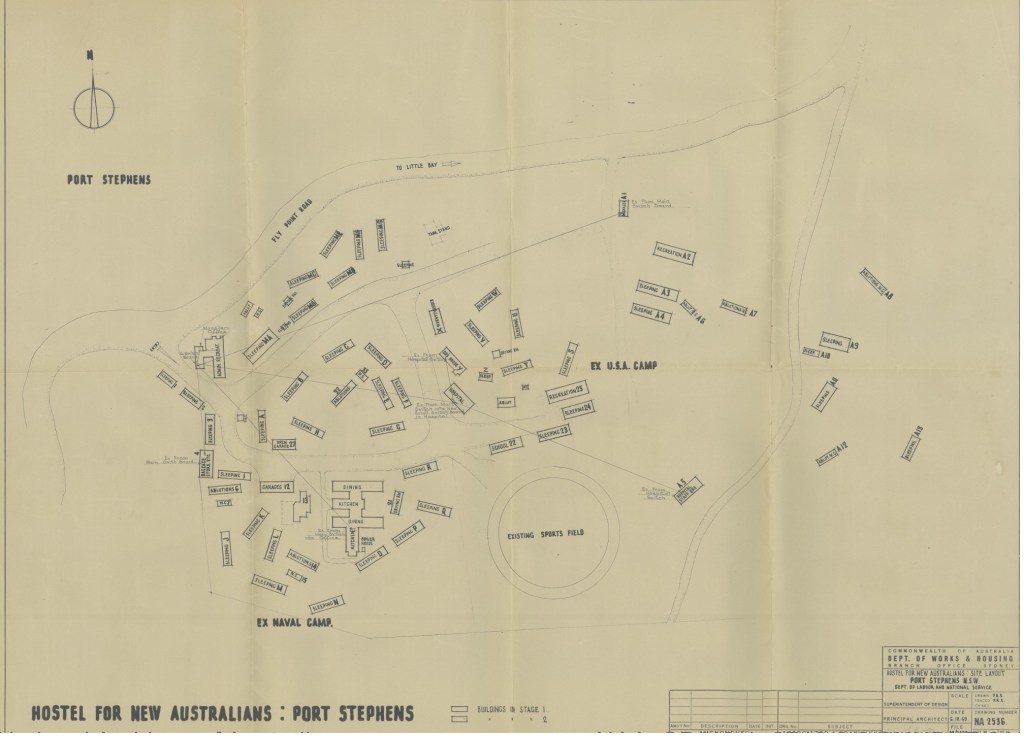
Plan of the Nelson Bay Migration Hostel – 6 October 1949. It shows the facilities of the former HMAS Assault military camp at Fly Point, that were to be used for the migrant hostel. [National Archives of Australia]

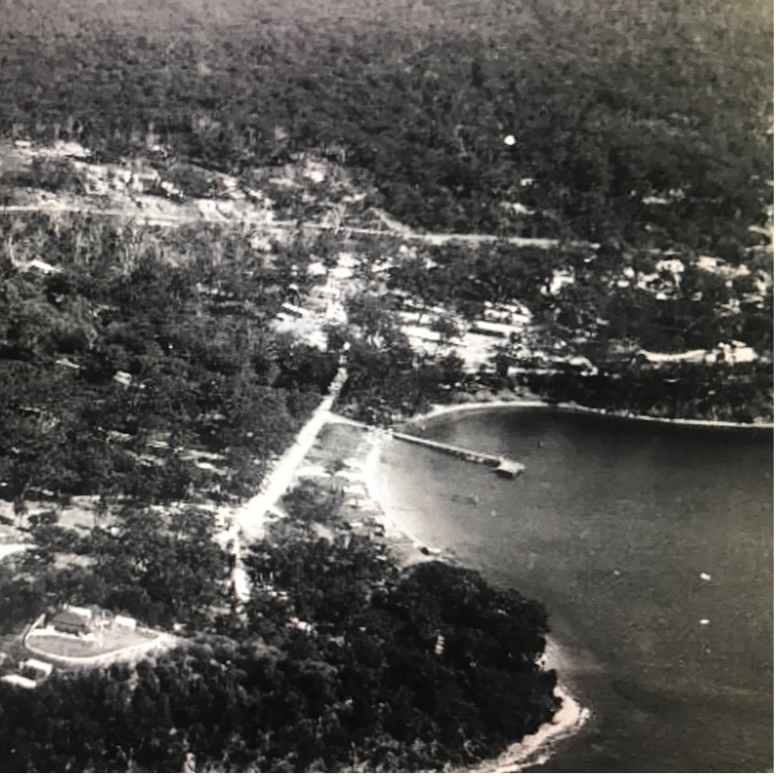
View of the Nelson Bay Migrant Hostel in 1950, showing the recently installed Nissen huts that extend towards Little Beach. Today the area has reverted to bush. The Inner Lighthouse is in the foreground.
The Nelson Bay Migrant Hostel was the second such facility to house war refugees in the Port Stephens area. Prior to the opening of the Nelson Bay hostel in 1948, a previously secret refugee camp, which was known as Bobs Farm Cadre Camp, had housed 600 refugees from Timor following the invasion of their homeland by the Japanese. In November 1945, about 587 of the refugees returned home, after which the camp was dismantled by the military. No remains exist today.
DISPLACED PERSONS SCHEME – 1947
During the years of the Second World War, immigration to Australia was essentially put on hold. The Department of Immigration published the following information about the Displaced Persons Scheme that was put into operation following the end of the war:
‘In spite of the preference for applications from Britons, the number of British people wanting to migrate to Australia fell far short of the numbers needed to fill the quota set for the migration programme. The Empire and Allied
Ex-servicemen Scheme was established offering assisted migration to Australia for former soldiers who had fought with Allied forces during the war. In 1947, Minister Calwell visited Europe to arrange shipping for migrants from Britain. He also met with the International Refugee Organization and agreed to consider immigration to Australia from the displaced persons camps in Europe. Calwell spoke of the ‘splendid human capital’ in the camps as a ready labour pool and was keen for the Department to secure the ‘best’ migrants for migration to Australia. Initially, the Department planned for a quota of 12,000 people per year from the camps.
A small team of departmental officers was dispatched to the camps in Germany to interview potential migrants [often referred to as ‘Balts’ in Australia]. Applicants were required to sign work contracts and have the capacity to work as labourers to be accepted for immigration. The officers found that the conditions for the people living in the camps were often extremely challenging, with food shortages, overcrowding and disease common. The first shipload arrived in 1947 and brought 839 migrants from Estonia, Latvia and Lithuania. All were carefully selected. Departmental staff were required to choose candidates who were young, physically strong and attractive. Considerable efforts were made to promote them in a positive light to the Australian public as willing and valuable contributors to the national workforce.
In 1949, an immigration officer was sent to Berlin to organise an expansion of the scheme, with the remit to select as many people as possible so that the ships sailing to Australia could be filled. Countries like Australia saw displaced persons camps as the solution to widespread labour shortages in the post-war period and Australia often competed with other nations to attract applicants.’
COMMONWEALTH PLAN TO BUILD MIGRANT HOSTELS – 1948
In 1948, the Commonwealth Government announced a plan to construct seven migrant hostels which would supply a body of skilled workers to major industrial centres. Nelson Bay was the location of one of the hostels.
The Daily Examiner of 4 August 1948, page 1, published details of the government plans:
‘Federal Cabinet today decided to build seven hostels at major industrial centres throughout the Commonwealth to provide accommodation for the continuing labour pool of 6000 displaced migrants.
The Prime Minister (Mr. Chifley) said the Cabinet plan provided for three hostels at Sydney, three at Melbourne and one at Port Kembla (N.S.W.). These will be in addition to the two already approved for construction at Newcastle and Port Kembla. The plan also made provision for the conversion of service and other properties at Melbourne, Sydney, Adelaide, Brisbane and Port Stephens (N.S.W.). The service buildings would consist mainly of converted army camps. Mr. Chifley said each migrant accommodated in the new establishments would be charged £2/12/6; a week for board and lodging. In a report to Cabinet, the Minister for Labour (Mr. Holloway) and the Minister for Immigration (Mr. Calwell) said under a labour pool of 6000 persons, the production of essential home building items such as steel, sheet iron, bricks, tiles, earthenware pipes, asbestos-cement, baths, sinks, basins, stoves, window glass, nails, screws and other house fittings would be accelerated.’
PORT STEPHENS MAY HOST MIGRANTS – 1949
The Newcastle Morning Herald and Miners’ Advocate of 8 January 1949, page 1, reported:
‘The naval depot at Port Stephens may be taken over by the Commonweatlh Employment Service soon to house European migrant workers, it was stated officially tonight. Immigration officials said they had no knowledge of the establishment of a reception centre at Port Stephens. It is known that the Minister for Immigration (Mr. Catwell) has sent circulars to the three services requesting accommodation in camps and depots for migrants and their families. The main reception centres are at Bonegilla (Victoria), Bathurst, Uranquinty, and Cowra (New South Wales). The naval depot at Nelson’s Bay has hut accommodation for a large number of people. It is about half a mile east of Nelson’s Bay, going towards Shoal Bay, and extends along the waterfront. The site overlooks Port Stephens. The huts are mainly galvanised iron. The camp is equipped with water and sewerage.’
In April 1949, J. D. Judd Bros., of 37 Rugby Road, New Lambton, was awarded a Commonwealth Government contract worth £7099 to convert the existing H.M.A.S. Assault site into a migrants’ camp. New additional facilities were added later.
An initial intake of 49 migrants helped to set up the new migrant hostel.
PRIME MINISTER’S SUPPORT FOR IMMIGRATION
The Newcastle Morning Herald and Miners’ Advocate of 17 May 1949, page 1, reported on Prime Minister Ben Chifley’s support for immigration:
‘Complete support for the Minister for immigration (Mr. Calwell) in attempting to secure the maximum number of migrants for Australia in the quickest possible time was expressed by Mr. Chifley to a conference of Federal and State immigration authorities to-night. “We must get as many migrants as we can now,” he said. “We will get only rejects later on.” All State Ministers supported the Federal Government’s immigration policy and endorsed progress already made.
Mr. Chifley told the conference that although accommodation difficulties would have to be faced for some time, as the flow of migrants increased, every effort must be made to secure the pick of the migrants offering, particularly from displaced persons’ camps, before they were enticed to go to other countries. The conference agreed that State migration quotas of British migrants for 1949, fixed at the last Ministers’ conference in October, 1948, should be adhered to.
The Minister for Immigration (Mr. Calwell) said woolsheds would be taken over near the capital cities to house displaced persons to work in producing building materials in the metropolitan area. Up to 800 Balts would be provided with accommodation at Port Stephens for steel production, he said. At Port Stephens, 300 Balts would be provided with accommodation almost immediately, and 400 were going into two hostels at Port Kembla. “They do shift work and other unpleasant work which Australians have refused to do,” he added. Mr. Calwell denied he had any differences of opinion with mining or ironworkers’ unions.’
PLAN TO IMPORT NISSEN HUTS – 1949
Migrant camps, such as the one at Nelson Bay, required expansion to accommodate the growing number of immigrants expected to arrive over the following years.
The Daily Telegraph of 28 April 1949, page 1, reported on a plan to import surplus Nissen style huts from Europe:
‘Mr. Chifley has been negotiating in London to buy wartime service huts, says Associated Press. These huts will be shipped to Australia and re-erected as hostels for single men. They will be erected in areas such as Newcastle and Port Stephens.’
WASTAGE OF GALVANISED WATER PIPING – 1949
In 1949 the development of the Nelson Bay hostel gathered pace. The wastage of galvanised water pipe which would have been still in short supply in post-war years came to the attention of the Port Stephens Council.
The Raymond Terrace Examiner and Lower Hunter and Port Stephens Advertiser of 26 May 1949, page 4, wrote:
‘Cr. Richardson at last meeting of the Port Stephens Shire Council referred to a quantity of water pipe being wasted at Nelson Bay. This galvanised piping was being cut into lengths for curtain rods. Many other articles could do to hang curtains. There is a sever shortage of water pipe and it was scandalous to think a wastage like this should take place. Mr. Conroy said he had heard that curtain rods were being made of 6000 feet of good galvanised water pipe. This was at the camp for displaced persons at Nelson Bay. Cr. Rodgers moved that the Federal member be informed that 6000 feet of good galvanised water pipe is being used for curtain rods at Nelson Bay and that he ask a question in the House to bring the matter before the Minister responsible. This was agreed to.’
PLAN TO EMPLOY MEN FROM BALTIC COUNTRIES IN STEELWORKS – 1949
The Newcastle Morning Herald and Miners’ Advocate of 28 May 1949, page 1, reported on plans to employ men from Baltic Countries [Balts] in the Steel Works:
‘Approximately 1200 Balts would be working in the steel industry in Newcastle and Port Kembla by the end of May, the Minister for Immigration (Mr. Calwell) said tonight. A camp was almost ready at Port Stephens to take 300 of these new ironworkers, Mr. Calwell said arrangements were also being made by the Department of Labour and National Services for the accommodation of 500 more workers at Port Stephens. This was being prepared. These Balts would he employed in the Broken Hill Pty. Co. undertaking at Newcastle. Mr. Calwell said that by the end of August a new hostel would be completed at Port Kembla to accommodate 400 more Balts.
He said the Federated Ironworkers’ Association had suggested reasonable terms of agreement to safeguard the interests of Australian members of the union. Representatives of the Steel Works were prepared to employ Balt labourers under conditions largely relating to the particular occupation in which the Balts were required to work, and also taking in the question of seniority of men when laid off because of coal shortages and other industrial troubles in which members of the Ironworkers’ Association were not involved. Mr. Calwell said more routine process work would be carried out by Balts, and officers of the Department of Labour and Immigration would see that categories of work reserved for Australians would not be encroached upon by migrants.’
NATIONAL COAL STRIKE DISRUPTS EMPLOYMENT OF MIGRANTS – 1949
The Sydney Morning Herald of 12 July 1949, page 2, reported on the loss of jobs for immigrants caused by the ongoing miner’s strike:
‘More than, 10,000 Displaced Persons [D.P’s] from Europe are jobless in Australia as a result of the miners’ strike. With migrants arriving at Australian ports at the rate of about 2,000 a week, the total is growing rapidly and building up a major problem for the Immigration Department.
In an effort to cope with the situation, the Commonwealth Office of Education, which works with the Immigration Department in caring for the education, and welfare of D.P.s, yesterday announced details of a plan to keep migrants occupied during the national coal crisis.
The basic aim of the plan is to give D.P.s more educational facilities while they are out of work. Special classes in English will be established at D.P. hostels at Nelsons Bay, Wallgrove Camp (near Penrith), Burwood, Redfield, Meadowfield, Bankstown, and Port Kembla.
Present holding centres will be turned into temporary reception camps to cope with the influx of new migrants and to case the situation at the permanent reception centres at Bathurst (N.S.W.), Bonegilla (Vic), and Greylands (W.A.).
Maximum accommodation at the permanent centres is between 10,000 and 12,000 people.
Under normal conditions, D.P.s stay four weeks at these centres before taking up work under contract to the Commonwealth Government. With most of Australia’s industry now at a standstill, many of the jobs planned for migrants have temporarily, at any rate-vanished. Because of this, migrants will now have to stay longer in the reception camps.
Migrants whose jobs have vanished temporarily or who have been, unable to take up jobs because of the strike are entitled to immediate unemployment benefits, so that, to some extent, anyway, they will be no worse off than many Australians.’
UKRAINIAN COUPLE MARRY AT NELSON BAY – 1949
The Newcastle Morning Herald and Miners’ Advocate of 16 August 1949, page 2, reported, on the marriage of a couple who first met at a displaced persons camp in Germany:
‘The first marriage of migrants at the Nelson’s Bay hostel was celebrated at the Nelson’s Bay Roman Catholic Church at the weekend. The bride was Miss Iryna Matlock and the bridegroom, Mr. Mykola Kowalsky, both Ukraininans, who met in a displaced persons’ camp in Germany four years ago. The bridegroom from the age of 12 fought as a partisan in his native forests of Ukraine against the Germans. The bride wore a white satin gown with a long train and a cut tulle veil which had a pleated halo and orange blossoms. The bridesmaid was Miss Fenko. The groom was attended by Mr. Iven Koren. The bride’s mother, Mrs. Maria Matlock, came from Yass to attend.’
STORY OF A MIGRANT STEELWORKER – 1949
The Newcastle Morning Herald and Miners’ Advocate of 7 October 1949, page 4, reported on a human-interest story about a resident at the Nelson Bay hostel:
‘Mr. John Podcerkiewny (Pot-serkernee), a new Australian who is working at the B.H.P. Steel Works, came to the Greta migrants’ concert at the City Hall last night to see his wife and daughter. The family, born in Poland, came to Australia together, but were separated when the husband was given work in the Steel Works. Mr. Podcerkiewny now lives at the Nelson’s Bay hostel, while his wife and daughter live at Greta migrant centre.

John Podcerkiewny and family
The photo shows the family united for a brief moment before the show. They see one another most weekends, when Mr. Podcerkiewny goes to Greta. He says he and the other new Australians are enjoying working at the Steel Works. But he is finding it difficult to keep his head above water financially. Receiving about £7 a week, he has to pay board at both Nelson’s Bay and Greta, leaving only a few shillings over for himself. “There is no money left for a drink of beer,” he said last night. He is looking for accommodation in Newcastle, so that he and his family may be together.’
A FAMILY HOSTEL – CAMP ACTIVITIES 1949
Up to October 1949, the Nelson Bay Migrant Hostel only housed single and married men. When the hospital at the hostel was re-opened (after its time as a military facility) around this time, the Hostel then accommodated families.
The Newcastle Morning Herald and Miners’ Advocate of 28 October 1949, page 2, reported on this development and conditions at the Hostel in late 1949:
‘Three hundred New Australians at Nelson’s Bay migrant hostel anxiously await completion of the camp hospital there. When medical facilities, including the hospital, are provided, the hostel will become a “family hostel,” and migrant families will be reunited. The hospital, formerly a service hospital, is being converted to cope with childbirth, infectious diseases and surgical needs. It will treat men as well as women. It should be completed shortly. An Australian medical officer will be in charge.
The hostel is run by the Department of Labour and National Service. At the moment, it is inhabited by single and married men working at the Steel Works or studying at the P.M.G. linesmen’s school. The wives and families of the married men are at camps such as Bathurst and Greta. The fact that the men must live apart from their families is a cause for dissatisfaction. They say that they like the work at the Steel Works, and that the Australians there are friendly and helpful. And there, they say, they are learning to speak English. But the long journey between Nelson’s Bay and the Steel Works makes a long day.
The men’s anxiety to be reunited with their families is indicated by an occurrence last week. Three migrants, after a long search in Newcastle, found accommodation in a house for their families, then living at Greta and Bathurst. The deal to rent rooms in the same house was made with the Australian landlord, and the men told their families to come to Newcastle. The mothers, one of them pregnant, and their children arrived in Newcastle and went to the address, only to be told by the Australian landlord that he had changed his mind. Although he did not say he wanted more money, the women gathered this would have pleased him. The women now stay at Nelson’s Bay. When the families move into the hostel, the population of the hostel will rise to more than 700 people. ….. Other work in progress at Nelson’s Bay includes an up-to-date kitchen, kindergarten, recreation rooms and more living quarters converted from naval dormitories.
The diet of the [Nelson Bay] camp is based on the fact that the migrants are doing heavy work. Food represents 4700 calories a day, compared with the 2000-odd calories served at Greta. A typical menu includes breakfast food, scrambled eggs, jam, and bread spreads for breakfast (migrants loathe toast); soup, corned beef and vegetable pie, peas, potatoes and sweets or soup, Lancashire hot-pot and sweets, for lunch; and for dinner, soup, braised rabbit and bacon, green pens and swedes, also prunes and custard. The men going to work have three varied sandwiches cut for them, such as garlic sausage with tomato sauce, meat spread or tomato and onion. They also get a piece of fruit and slice of cake. An Australian chef, who directs migrant cooks, is in charge of the kitchen.
For amusement the migrants, who live in one of the best east coast holiday resorts, enjoy sunbathing and some swimming. They are not happy about sharks. The migrants run ping-pong tournaments and have given a cabaret dance at Nelson’s Bay. Floorshows for such entertainment are given by Fred Jansons and Jacob Baums, two professional comedy tap-dancers from Latvia who billed in Europe as “The Harrises.” A top-ranking Soccer player from Yugoslavia is trying to get a Soccer team together. He hopes to be able to play for a Newcastle team.’
A FOOD BOYCOTT – 1949
The Sydney Morning Herald of Monday 24 October 1949, page 1, reported disquiet at the Migrant Hostel about the quality of the food:
‘Two hundred migrants at Nelson’s Bay migrant camp staged a food boycott on Friday in protest against the quality of cut lunches supplied to men from the camp working at the B.H.P. steelworks.
Communist officials of the Ironworkers’ Union are believed to have prompted the boycott. About 200 migrants who work at the steelworks are iron-workers and union officials have made regular visits to Nelson’s Bay to interview them.
Camp authorities have discovered that Communists have managed to gather groups of men for discussion. Two migrants who refused to take part in the boycott were assaulted on a bus taking them to B.H.P. A second assault occurred on the bus when it picked up the migrants at the steelworks to return them to the camp.
This assault was seen by police who had been called in case of trouble. They arrested a man and charged him at Newcastle police station with offensive behaviour. He will appear at Newcastle police court to-morrow.
The police action caused concern among the migrants, and when the bus reached Nelsons’ Bay camp, a deputation interviewed the camp authorities, apologised for the men’s conduct, and said the boycott was off.
Only 200 of the 800 migrants heeded the demand to boycott the meals. The others told the leaders of the boycott that they were satisfied with the food and they would continue to eat at the camp. The dissatisfied men went to Nelson’s Bay township for food.’
The Newcastle Morning Herald and Miners’ Advocate of 24 October 1949, page 2, provided another report on the incident:
‘Some migrants at Nelson’s Bay started a hunger strike on Friday morning but finished it in the afternoon. The strike, it was alleged, was a protest against the quality of the food. When breakfast was served at the camp before the men left for the Steel Works, some migrants, it was alleged, boycotted the dining room.
Some who refused to take part in the boycott maintained that the food was all right. A 32-year-old native of Poland was apprehended by the police at the B.H.P. parking area on Friday afternoon and charged with having behaved in an offensive manner. It was alleged that another migrant had been attacked while awaiting his bus to Nelson’s Bay. An argument arose while the men were travelling in a bus to the works. It continued when the shift finished in the afternoon. The offence was alleged to have been committed while one of the men who had eaten breakfast was waiting for bus to take him home. The men apologised to the management when they returned to the camp on Friday night, and the hunger strike was called off.’
The Sydney Morning Herald of 25 October 1949, page 4, published a follow-up report about a man appearing in Court over the incident in the bus:
‘Jan ….. , 32, a migrant from Nelson’s Bay camp, who appeared before Mr. Hardwicke, S.M., at Newcastle Police Court to-day on a charge of offensive behaviour, was admonished and discharged by the magistrate.
Evidence was given that …. , who was employed at the B.H.P. steelworks as a labourer, had assaulted another migrant employee of the B.H.P. in a bus outside the steelworks on October 21.’
A SATISFACTORY WORK ETHIC – 1949
A satisfactory work ethic among immigrant workers was reported in The Centralian Advocate of 4 November 1949, page 11:
‘On September 12, New Australians entered into a new phase of contribution to the Australian economy when 94 began work at the BHP steel works at Newcastle. The number of New Australians who have been placed in employment from Reception and Training Centres throughout the Commonwealth now exceeds 30,000. By the end of the year this number will have been increased to 50,000. They are working well in all types of unskilled and semi-skilled jobs, and are playing an important part in Australian industry. Now they are supplying labour for Newcastle’s steel works, where there was a serious shortage of unskilled workers. The 94 New Australians who began work in that industry on September 12 are all young men (none of them is older than 30); they are keen, energetic and hard workers. They were joined on September 20 by another 74 of their fellows. The total number will soon be increased by two hundred.
These New Australians, including Poles, Ukrainians, Lithuanians, Yugoslavs, and Latvians, were accommodated at the Greta Reception Centre on arrival. Now they will be housed at a workers’ hostel at Nelson Bay. All the men are married and will be joined by their wives and children at the hostel, which has accommodation for 600. Already many New Australians are working in other heavy industries in other States. The number so employed was increased by the 100 who began work at Port Kembla on September 13 and another 140 a week later. The introduction of these workers into this type of industry was a result of an agreement between the unions concerned and Mr. Calwell. The agreement provides that the men will supply labour only in unskilled labour categories and where there is insufficient Australian labour offering. No New Australian is employed on a job to the exclusion of any Australian worker. These New Australians are doing labouring jobs on the plant and in the yard. They are paid award rates for their work. They receive about £7 a week out of which they pay for their upkeep at the hostel. They are giving satisfaction to their employers and are mixing in well and happily with the Australian workers employed at the works.’
PORT STEPHENS SHIRE COUNCIL’S CONCERN ABOUT TRANSFER OF DISEASE BETWEEN MIGRANT HOSTELS – 1949
The Newcastle Morning Herald and Miners’ Advocate of 15 November 1949, page 2, reported on concerns about the transfer of diseases between migrant hostels:
‘Port Stephens Shire Council regards as dangerous any practice of people from Greta migrant camp, where there have been poliomyelitis cases, visiting Nelson’s Bay migrant hostel.
The Health Inspector (Mr. Conroy) told the council yesterday that a woman and child from Greta migrant camp had recently visited a sick man at Nelson’s Bay hostel. The man was in the early stages of scarlet fever. Investigation of the scarlet fever case at Nelson’s Bay revealed that some migrants have a habit of visiting various camps without authority. “In this case, the patient’s wife and child visited him and then returned to Greta. Several cases of poliomyelitis have been reported from the camp at Greta, and if this practice of visiting is permitted, it will not be long before cases will be reported from Nelson’s Bay. Then transmission of the disease to the town and district will naturally follow”.
Mr. Conroy said the hostel was regarded as Commonwealth territory and he had no warrant or authority to enter the grounds. “In view of the potential danger to our own citizens. I feel it is necessary for the Commonwealth authorities to recognise the Port Stephens Shire Council and issue its health inspector a warrant or authority to enter the area.” Cr. Rodgers said he knew of two children from Greta camp visiting friends outside. “Yet this camp is supposed to be isolated because of the polio cases reported from there. “There is a distinct danger to the health of people in the district. Our inspector should have the power to enter and investigate the premises. The Government is likely to be lax in this regard, but our inspector is on the spot and could do the investigating.”
The council decided to advise the Immigration and Health Departments that there was a danger and ask that the health inspector be given permission to enter and inspect the hostel. Cr. Parish said he approved the health inspector’s statement and request. “But we have to realise that these migrants have come to a new country with new surroundings and new ideas. It is natural for them to want to visit each other. All due precautions should be taken, but we should do all possible for them or they might get the idea Australia is not the place they might wish it to be. “While I do not wish to create undue hardship to these people, I think inspections should be carried out.” Cr. Rodgers said he agreed with what Cr. Parish had said, but the council must protect the community. “I do not want to create undue hardship either, but we should insist that the council’s officer has full authority to see quarantine is observed. Either these people are in quarantine, or they are not. If they are to be kept in, then it should be strictly enforced.” ‘
FIRST BABY BORN TO COUPLE AT THE NELSON BAY MIGRANT HOSTEL – 1949
The Newcastle Morning Herald and Miners’ Advocate of 20 December 1949, page 2, reported:
‘Nelson’s Bay migrant centre, which was recently made into a family hostel, received its first real new Australian this week when a baby girl was born to Mr. and Mrs. Florek. Mr. Florek is a steelworker at the B.H.P. Mother and daughter are doing well at the Western Suburbs Maternity Hospital.’
CHRISTMAS PARTY HELD AT NELSON BAY HOSTEL – 1949
The Newcastle Morning Herald and Miners’ Advocate of 22 December 1949, page 6, reported:
‘The Legion of Catholic Women gave a Christmas party to migrant children at Nelson’s Bay migrant hostel yesterday afternoon. The members of the Legion giving the party included Mrs. G. Preston, of Stockton (President) and Mrs. J. O. Burton (senior Vice-president). The children were given Christmas presents by Santa Claus. About 170 children attended the party.’
MIGRANT HOSTEL STANDARD LAYOUT – 1950
The journal Construction of 5 April 1950, page 6, outlines how migrant hostels in NSW were designed:
‘Twelve hostels for migrants have now been constructed or are in the course of construction in New South Wales, and plans are being prepared for others. In some cases the work—which began in 1948—has been done by contract, cost plus fixed fee, and in others by day labour employed by the Commonwealth Department of Works and Housing. This Department is responsible for all the design and construction, and as hostels are completed they are transferred to the Department of Labour and National Service. These hostels are quite different from those at the large migrant reception centres such as Bathurst and Bonegilla. They have been established within reasonable distance of centres of employment—at Villawood, Dundas, Wallgrove, Schofields, St. Mary’s, Cronulla, Mascot, Meadowbank, Port Stephens, Port Kembla and Newcastle.
Many thousands of migrants are already housed in these hostels. Two factors were dominant when the immigration programme was instituted. The first was speed of construction; the second was the avoidance as far as possible of the use of materials in short supply. Every opportunity was therefore taken to convert and enlarge existing accommodation which was no longer required for its original purpose—Army buildings at Wallgrove, R.A.A.F. buildings at Schofields, munitions factory buildings at St. Mary’s, the Fisheries School at Cronulla, aerodrome buildings at Mascot, Naval buildings at Port Stephens.
The Department has designed the hostels on the basis of an economic unit of 400 residents, plus staff, and groups consist of anything from one to seven of these units, with the exception of Mascot, which is about half the size of a standard unit. At first, timber-framed dormitories, sheeted with bituminous felt were used, but orders placed in England for “Nissen” type fabricated buildings have now been fulfilled. The main communal buildings are American “Igloo” type huts, dismantled and brought from Manus Island.
In the standard unit “Nissen” huts are used for dormitories and lavatories, ablutions and laundries, and “Igloo” huts for dining rooms and lounges. Four 12 person dormitories are arranged around a toilet and ablution block, and these dormitory groups are arranged around the dining room and the canteen and recreation room. Laundries are adjacent. Offices and stores are situated at the entrance to facilitate control, and each unit has staff and manager’s quarters set slightly apart. All construction work has been reduced to a minimum standard compatible with reasonable comfort. Partitions are lined on one side only, the floors are of concrete covered with bituminous felt, and heating is provided only in the recreation rooms.
The kitchens provide cafeteria-style meals and are fitted with equipment designed to keep overhead operating costs to the minimum. In view of the major problem of providing meals for the large number of residents in the hostels, it has been considered necessary to equip the kitchens with modern cooking and hot-storage equipment, steam-heated boiler equipment and electric or slow-combustion ranges being employed. Because of the difficulty in disposing of sullage within the limited area of land occupied by the hostels it has been necessary to provide other means for sewage disposal. Where no sewerage system exists septic tanks have been constructed, and in the case of larger hostels the method is a combination of septic tanks with secondary-treatment works. Electricity has usually been available but in some cases the Department has had to assist by providing transformers and other materials. All these engineering services have presented difficult problems in the supply of equipment within the short time available.’
MIGRANTS OBJECT TO ‘LABOUR NEWS’ UNION PAPER – 1950
The Newcastle Morning Herald and Miners’ Advocate of 23 June 1950, page 2, reported:
‘About 800 copies of “Labour News” which migrants at Port Stephens Migrant Centre would not accept were dumped unopened in the offices of Newcastle branch of the Federated Ironworkers’ Association yesterday.
“Labour News” is published by the National Secretary of the Ironworkers’ Association (Mr. E. Thornton). It is posted to all financial members. The Commandant of Nelson’s Bay Migrant Hostel (Wing Commander Littlejohn) said last night that the papers were delivered at the camp by post. They were sent to the Newcastle office of the association because the men to whom they were addressed would not take them. Union members who handled the rejected papers yesterday said migrarits who could read English would have nothing to do with the paper because they thought it was a communist journal. Migrants who could not read the paper objected to it because of its recent publication of a picture of Mr. Stalin with a complimentary caption. They said some of the migrants had strong reasons for their objection to communism.
TRADGEDY FOR POLISH COMMUNUTY AT MIGRANT HOSTEL – 1950
Several newspapers reported on a tragic accident at the B.H.P. Steelworks, that killed two men, one of whom was a married Polish resident at the Nelson Bay Migrant Hostel. Another resident at the Hostel was also injured in the same accident, but survived. The Sydney Morning Herald of 26 July 1950, page 5, provided a summary of the circumstances concerning the tragedy:
‘Benzol fumes killed two men and gassed four others in a big storage tank at the B.H.P. steelworks to-day. One of the dead men and two of those injured had entered the tank to rescue others who had been overcome. The fumes came from under a layer of sediment left in the bottom of the tank after it had been cleaned with water, steam, and compressed air. Men were overcome soon after they began to shovel the sediment into a bucket for removal through a manhole 10 feet above.
The dead men are: Reginald James Dowsett, 46, of Pelican Street, Swansea; and Sygmund Worblewski, 29, a migrant of Nelson’s Bay migrant camp. Injured were: Adrian Duel, 37, of Roxburgh Street, Stockton, and Victor Skinner, 40, of Throsby Street, Wickham, who are in Mater Misericordiae Hospital, Waratah; Claude Prosser, and a migrant named Wismewiky, who were treated at the B.H.P. ambulance station.
Dowsett died and Duel and Skinner were gassed rescuing Prosser. Dowsett carried Prosser to the ladder under the manhole but collapsed before he could lift him on to it. Duel and Skinner, who tried to help Dowsett were also overcome and were brought out on a rope tied round them by a man who entered the tank with a mask.
The tank, which measures 35 feet across and is 10 feet high, was entered through the manhole two feet m diameter. To clean the tank the men had filled it with water, and as an extra precaution had applied pressure to the inside with steam and air pipes. Prosser, Worblewski, and Wismewiky entered the tank about 10 a.m and began to shovel sediment into the bucket. Wismewiky left via the man-hole a few minutes later, dazed and incoherent.
A minute later Prosser came out in a stale of collapse. Prosser recovered quickly and said to Harry Mongan, who was standing on top of the tank: “There is a migrant in there I’m going back for him.” Dowsett went in after Prosser. “I screamed to Wismewiky to bring help but he was sick and seemed unable to understand,” said Mongan. “The gas makes you that way.” I could not leave and nobody else new what was happening. I was dazed by the fumes myself, but I yelled for help.
Duel and Skinner came runring to the tank. You couldn’t see anything in the dark beyond the manhole. “Dowsett carried Prosser back to the manhole. Duel went down with a rope round him, but couldn’t get Prosser up. Skinner went down. They were all overcome by fumes.”
“We dragged Duel up on the rope.Then a man named Harry went down with a gas mask on. He tied ropes under their arms and four men hauled them 10 feet up through the manhole. Dowsett was in a bad way. I think he was dead. The migrant Worblewski by this time had been up at the dark end of the tank for about 40 minutes. When they got him he was face down in the sediment. I think he was dead.”
Mongan said there were gas masks provided for the men to wear when cleaning out the tanks. “The men sometimes don’t use them,” he added. “You know how it is—they get in your way when you’re working.” When they were taken from the tank the men were placed in a B.H.P. ambulance and taken to the first-aid station, where they were treated by Dr. Tooth.
Duel and Skinner were taken to the Mater Misericordiae Hospital, where they were given oxygen treatment. Skinner also suffered severe injuries to his back.’
The Newcastle Morning Herald and Miners’ Advocate of 31 August 1950, page 10, reported:
‘A verdict of accidental death by benzol poisoning, was returned by the Acting Coroner (Mr. F. R. Wood, S.M.) at the inquest at Newcastle yesterday on Reginald James Dowsett, 46, of Swansea, and Zygmund Wroblewski, 29, of the migrants’ camp, Nelson’s Bay.’
SPORTS DAY AT THE MIGRANT HOSTEL – 1950
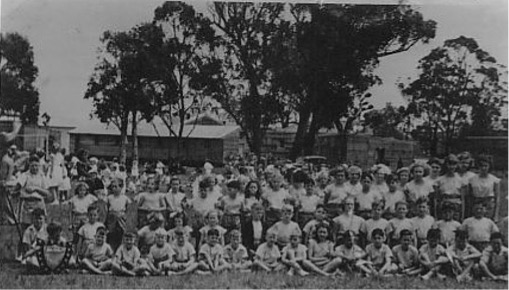
Sports Day at Migrant Hostel – 1950
HOLIDAY CAMPERS CAUSE PROBLEMS AT THE MIGRANT HOSTEL – 1951
The Christmas holiday period drew thousands of campers to the Nelson Bay area, despite adequate toilet and sanitary facilities not being available. This caused problems for the adjacent migrant hostel, which had such facilities available, and led to the campers entering the hostel precinct to gain access to those facilities.
The Newcastle Morning Herald and Miners’ Advocate of 12 January 1951, page 7, reported:
‘The Department of Labour and National Service complained of campers near the Migrant Hostel at Nelson’s Bay using hostel conveniences. Mr. Cook said he had seen many campers near there, some at times within eight feet of the tar road. The council will reply, that the department is responsible for the control of the conveniences. The council’s [camping fee] collector will be asked to supervise more strictly campers on shire property.’
Trespassing at the migrant hostel continued as a problem outside of holiday periods. The Newcastle Morning Herald and Miners’ Advocate of 1 March 1952, page 11, reported:
‘John ….. , of Shoal Bay-road, Nelson’s Bay, was fined £2, with 18/ costs and £3/3/ professional costs, for having entered enclosed land at the migrant hostel, Fly Point, without permission on January 14. Mr. W. Clarke (Messrs. Harris. Wheeler and Williams) said there had been complaints of unauthorised persons using the showers at the hostel. …. had been warned three days previously. Denying that he had been warned, …. said: “They go there by the dozen. I am the unlucky one.” ‘
FURTHER ACCOMMODATION ADDED TO HOSTEL SITE – 1951
In June 1951, the Commonwealth Department of Works and Housing awarded a contract to Darbyshire & Gilkes, of 9 Davidson Parade, Cremorne, to erect additional prefabricated buildings at a cost £20,972/13/8.
BUS-TRUCK COLLISION – 1952
The Newcastle Sun of 15 February 1952, page 2, reported:
‘Three people were injured when a truck and a bus collided near Bob’s Farm late last night. …. The bus was carrying migrant workers from the Nelson Bay Hostel to Stockton, and the truck, on which the injured persons were passengers, was re-turning from Raymond Terrace, where they had been arranging Junior Farmer exhibits for today’s Show. Passengers in the bus escaped injury. Both vehicles were considerably damaged and a relief bus had to be sent from Stockton.’
CHRISTMAS AT NELSON BAY MIGRANT HOSTEL – 1953
The Newcastle Sun of 24 December 1953, page 2, reported on the planned Christmas celebrations at the Nelson Bay Hostel for homesick migrants:
‘While most Newcastle families spend a conventional Christmas at home there will be many homesick people aboard visiting ships, in institutions and immigrant hostels. ……
The manager of the Nelson Bay family migrant hostel (Mr. Travis) said that most of the families would be spending an Australian style Christmas with a midday feast and the afternoon spent on the beach. There will be a special Christmas tree for the 70 children in the camp tonight, when Christmas carols in many foreign tongues will be sung around a campfire.’
LIFE AT THE NELSON BAY MIGRATION HOSTEL
The following photos and their captions are taken from the records of the National Archives of Australia. [Commonwealth Migrant Workers’ Hostels -1951]. They provide an insight into the living conditions of the residents at the Nelson Bay Migrant Hostel:
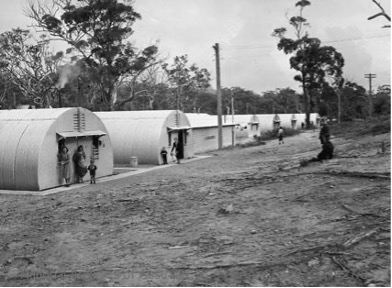
Typical line-up of Nissen huts that accommodate residents of the hostel. Each block of huts has conveniently placed laundry and toilet facilities.

Johna Beerens, former officer of the Netherlands Merchant Navy, consults the advertisements of jobs offering in the newspaper while wife, Antonia, tidies up their living quarters. Mr. and Mrs. Beverens came from Nymegen in the Netherlands.
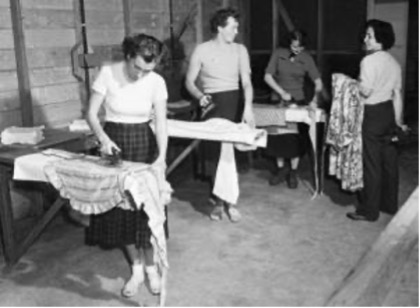
Large ironing room is well used by Dutch women. Room has ten cupboards and large central holding table.
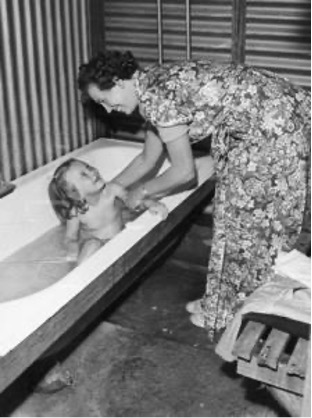
In standard bathroom Mrs Anni-Hermans from Noordwyk Bennen, Holland gives small daughter Nelleke her morning bath.
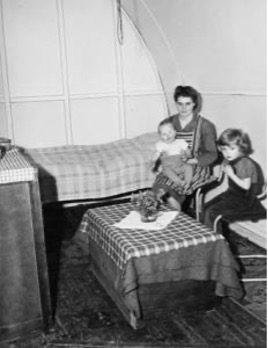
Mrs. Christina Klinkhamer has made her living quarters at Nelson Bay comfortable and attractive. She shares two rooms with her husband and children, Nardie (6), Marja (4) and Robby (1). School age children attend school in hostel ground.
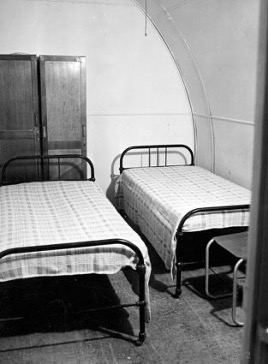
Accommodation is adequate for short stay. In room of sub-divided Nissen hut, wardrobe, chairs, chest of drawers and beds are standard equipment. Bed linen is provided and laundered free of charge.
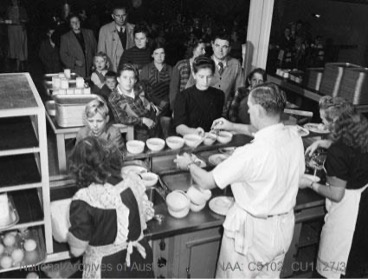
In large dining room hot meals are served from steam heated bain-maries in cafeteria style. Kitchens at these hostels are equipped with most modern cooking apparatus. Good quality food is plentiful. Cut lunches are available for men going out to work and for children. Special provision is made during the day for milk and fruit juice for smaller children.
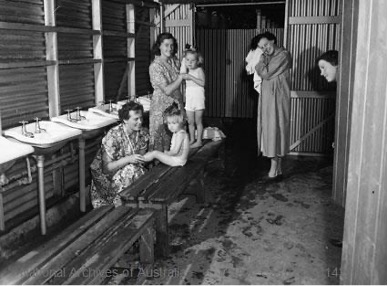
Dutch women make use of communal bathroom for morning ablutions.

Kindergarten children of nine nationalities take their morning stroll around the hostel grounds. A guiding rope is a novelty and keeps them with their teachers. Children sing English nursery thymes as they go.

Dutch women make good use of laundries featuring hot and cold running water and copper for boiling.
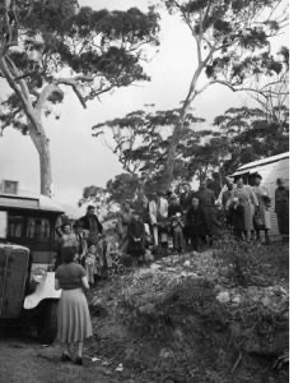
A group of Dutch settlers arrive at Nelson Bay from Bathurst. They will be allocated to accommodation units and provided with towels, linen etc. from hostel section office at rear.

In the vicinity of the spot where the bus would have pulled in at Victoria Parade, Fly Point. [Author photo 2022]

Remains of a pathway for a former Nissen hut at Fly Point. [Author photo 2022]
SETTLING IN A NEW LAND THROUGH THE EYES OF AN EIGHT-YEAR-OLD
Peter Toedter arrived in Australia as an eight-year old with his parents Heinrich and Antonie Toedter. They immigrated from Germany under the Government Assisted Passage Scheme. His father was a carpenter and in return for the fares he was required to work in Australia for a minimum period of two years. He had a contract to work at the BHP Steelworks at Newcastle.
Peter’s memories of his time at the Nelson Bay Migrant Hostel are reproduced below as part of his contrinution to the book “Memories in my Luggage” by Sabine Nielson, 2014:
‘We arrived at the Newcastle Railway Station on 2 June 1954. Dad had to register with the nearby Commonwealth Employment Office in Pacific Street. … We were put on a bus and headed for the Nelson Bay Migrant Camp, officially the Nelson Bay Holding Centre.
The migrant camp was a converted WWII site, as most of the hostels were. Dad started work at the BHP Steelworks at Port Waratah, Newcastle. We were at the hostel for two weeks. Again, there are no photos as they were not good times for my parents. We (children) would walk to Little Beach within Port Stephens. Sometimes we went a bit further to Zenith Beach – an ocean beach with big waves. We collected shells and generally hung around the camp. Nelson Bay was a small fishing village then, not the holiday resort that it is now. …..
The good life for me was coming to an end. In the second week there I had to attend school. The teacher knew that most of the camp residents were transients and we couldn’t speak English so he sat us at the back of the class. He didn’t have any time to spend on us and it was boring as we couldn’t understand anything.
The bus journey to BHP was an hour each way so dad left and came home in the dark. He looked for alternative accommodation for us and found a room with a family in Waratah, an inner suburb of Newcastle.’

Peter Toedter standing in front of the former dining hall, 1991. This was one of the remaining Igloo style huts at Fly Point on a site adjacent to the current Ngioka Horticulture Therapy Centre.

Site of the former dining hall, adjacent to the current Ngioka Horticulture Therapy Centre. [Author photo 2022]
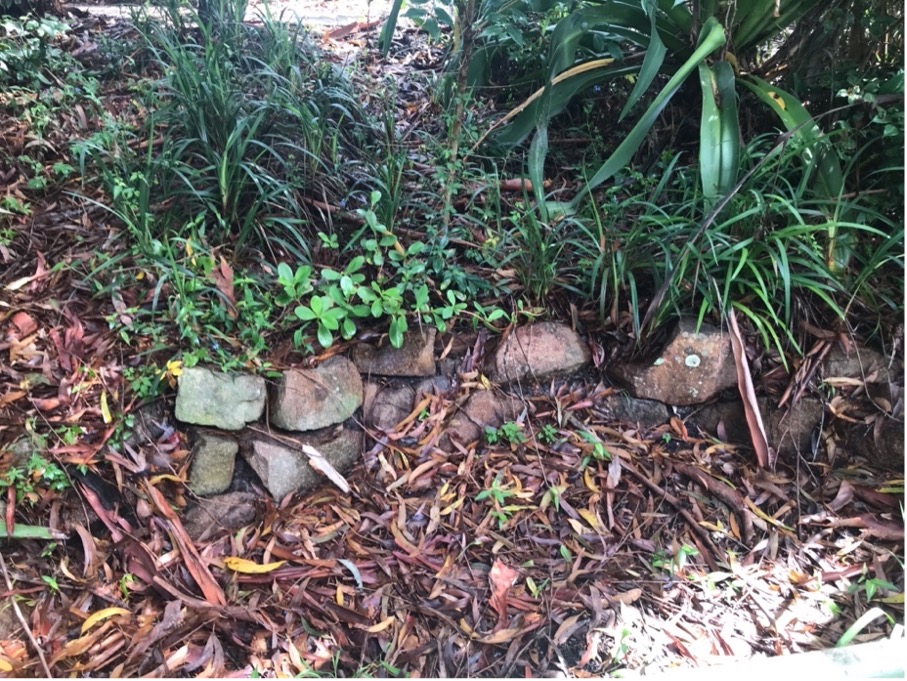
Remains of the small stone wall located in front of the former dining hall, adjacent to the current Ngioka Horticulture Therapy Centre. [Author photo 2022]
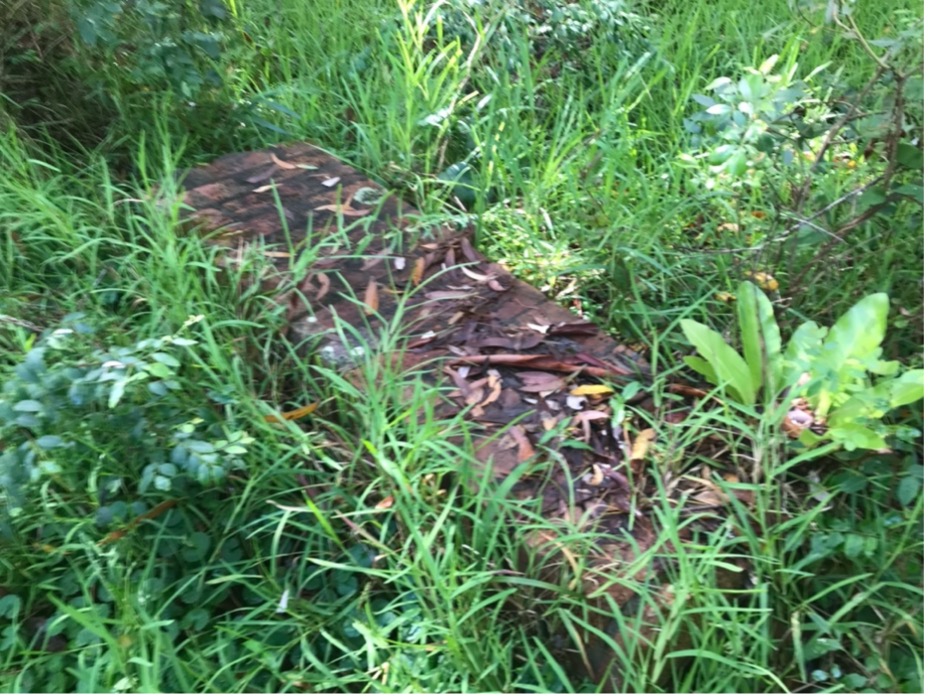
Remains of a brick foundation pier for a demolished migration hostel building, adjacent to the current Ngioka Horticulture Therapy Centre. [Author photo 2022]
DISMANTLING OF THE MIGRANT HOSTEL – 1954
The operation of the migrant hostel commenced to be closed during the later period of 1954. The Migrant hostel buildings (and those of the former military camp) were offered for purchase and removal by auction in November 1954.
At the time of sale, the Migrant Ostel consisted of 50 timber framed buildins and 10 nissen Style hits
The Raymond Terrace Examiner and Lower Hunter and Port Stephens Advertiser of 11 November 1954, page 4, published the following advertisement:
‘WHITMORE AND HAMMOND Builders Irrawang Street, Raymond Terrace or Phone U591, Maitland.
AUCTION SALE, EXTRAORDINARY BUILDINGS. HOT WATER UNITS, etc. for REMOVAL AT H.M.A.S. “ASSAULT” PORT STEPHENS 11 a.m., SATURDAY, 27th NOVEMBER, 1954.
Under instructions from the Minister for the Interior approx. 50 timber framed buildings, mainly wood floors, C. I. Walls, C. A. C. roofs, many lined, ceiled, and partitioned. Brief Details and approx. measurements: Dormitories: 2/72′ x 24′; 12/80′ x 18′; 15 from 76′ x 18′ to 15′ x 12′; Hall 94′ x 32′ with stage 32′ x 18′. Offices: 86′ x 32′; 47′ x 18′ with counter, etc.
Milners’ Fire Resisting Strongroom Door 5’9″ x 2’3½”.
Storerooms: 5 from 66′ x 37′ to 18′ x 10′.
Kit. and Dining Rooms: 2 sec. 124′ x 25′; 1/112′ x 40′; 2/21′ x 15′.
2 Portable Coolrooms with 1 unit, 3 Coolrooms doors only.
Matheson and Walters Oil-burning H. W. Unit complete with fuel and h.w. Storage tanks and stands.
3 Quonset Huts [like Nissen Huts], 52′ x 20′ C. G. I. covering.
7 Nissen Huts, 43′ xx 16′ corr. alum. covering.
Ablutions: 5 from 60′ x 18′ to 41′ x 18′ with qty piping.
5 “Britannia h.w. units, complete with o.h. tanks and stands.
Latrines: 4 from 30′ x 12′ to 11′ x 11′, cisterns and ped. pans.
4 Large Fuel Stoves, “Metters” and “Green” 3 Canopies with exhaust fans and flues.
2 “Goodrid” Incinerators.
Please call, ring or write for catalogues. Inspection by arrangement with Mr. Wailes. E. WINDEYER & SON , RAYMOND TERRACE, Phone 11 Auctioneers in conjunction with W. WAILES, NELSON BAY, PHONE 50.’
AERIAL VIEW OF FLY POINT – 1970’s
A photo taken from a tourist brochure, circa 1970s, gives an overview of the site of the former military camp and later migrant hostel at Fly Point, at that time.
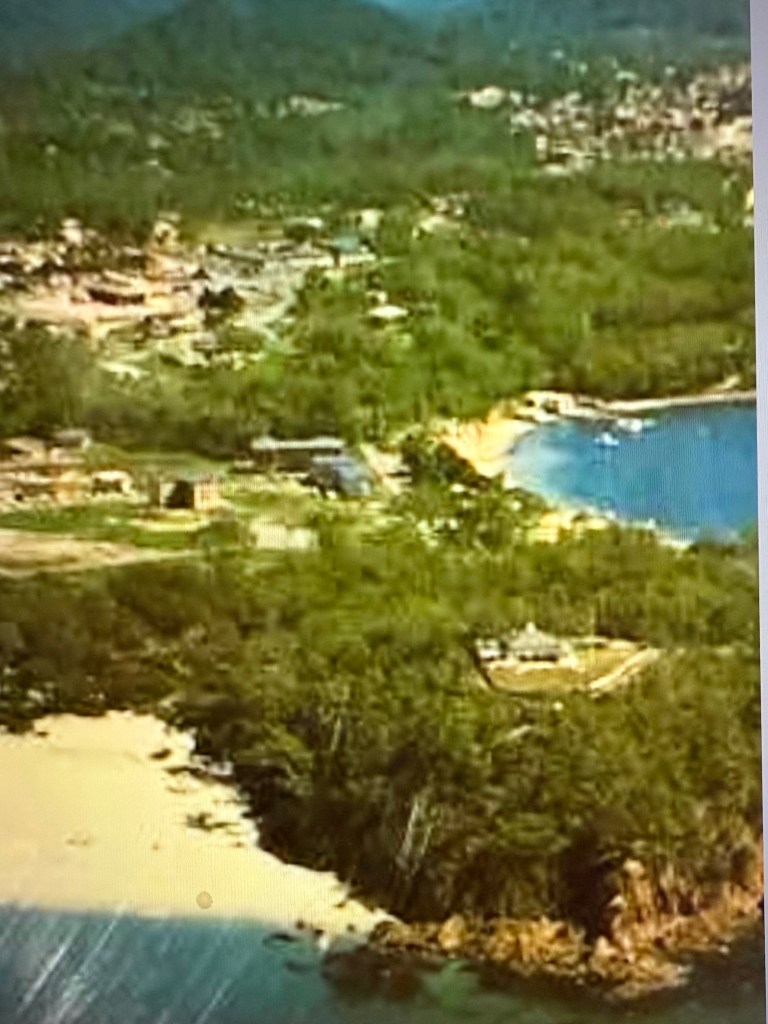
The top left half of the photo, circa 1970s, shows the remnants of the former military camp and later migrant hostel. The lower left half of the photo shows the construction of apartment buildings in the Radburn Estate in the Little Beach area of Nelson Bay, adjacent to the Inner Lighthouse ( in the foreground).
CONCLUDING COMMENTS
Apart from the former sick bay and hospital (now the Port Stephens Community Arts Centre), little evidence remains today of the military camp and the migrant hostel.
Some concrete floor foundations and associated drainage remain as a silent memory of the buildings that the residents once called home.
The 1950s was the era of ‘assimilation’ where migrants had to to adapt their culture and language and ‘blend in’ to the Australian way of life. The residents who passed through the Nelson Bay Migrant Hostel, were no exception.
Nelson Bay provided a most scenic and peaceful location to assist them in the rebuilding of their lives.
The inscription on the H.M.A.S Assault Memorial located on the boundary of the Hostel site provides a fitting conclusion to this story:
‘The Location of HMAS Assault – A World War II Naval Base Which Became In Peace Time A Sanctuary For Refugees From War-Torn Europe 1949 – 1956. Thus Enriching The Lives Of All Australians.’
POSTSCRIPT
In the immediate post war years, the nearest Migrant Camp to Nelson Bay was the Greta Migrant Camp in the Hunter Valley.
Like the Nelson Bay Migrant Hostel, a former World War Two army training camp at Greta was re-purposed in 1949 as an accommodation facility for European migrants and refugees. The camp closed in 1960.
Presently, the area surrounding the Tahlee Homestead at Tahlee in Port Stephens, is used by ‘YWAM Tahlee’. This is part of the world-wide non-profit inter-denominational Christian organisation, ‘Youth With A Mission’ which focuses on community development, youth mentoring and global outreach.
Within the YWAM grounds at Tahlee, there are numerous accommodation and meeting facilities that were previously situated at the Greta Migrant Camp before being moved to Tahlee. Some of these facilities are shown in the photos below.
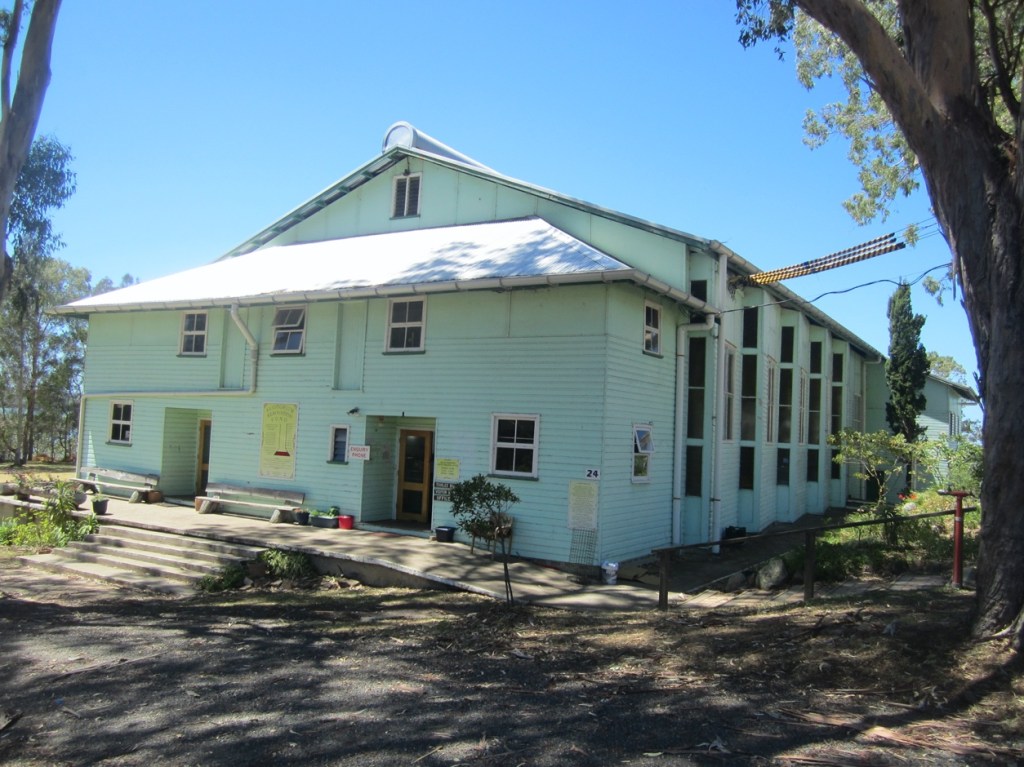
Auditorium at the YWAM site at Tahlee that was previously situated at the Greta Migrant Camp [Author photo – 2014]
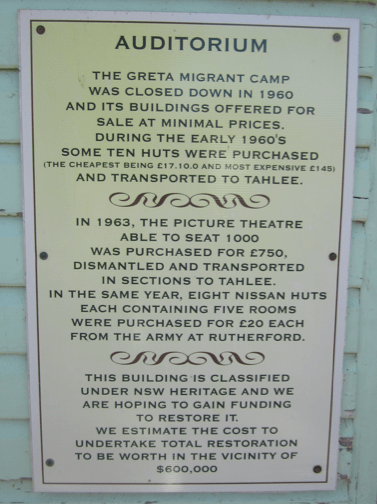
Signage attached to the Auditorium summarising the history of the Greta Migrant Camp buildings relocated to the Tahlee YWAM site [Author photo – 2014]
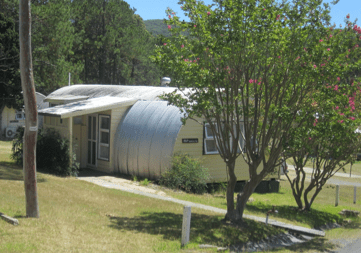
One of the Nissen accommodation huts moved from the Greta Migrant Camp to Tahlee [Author photo – 2014]
Researched and compiled by Kevin McGuinness
March 2022

 Port Stephens - a history exploration