
Introduction
The Fly Point area of Nelson Bay has had a varied history since its first settlement by the Worimi Aboriginal people.
This paper presents a pictorial history of the HMAS Assault site covering its use as a military camp during the Second World War and later as a migrant camp.
The paper also look at the remains of the site of HMAS Assault today and visits various memorials to the former military camp and the personnel who served there.
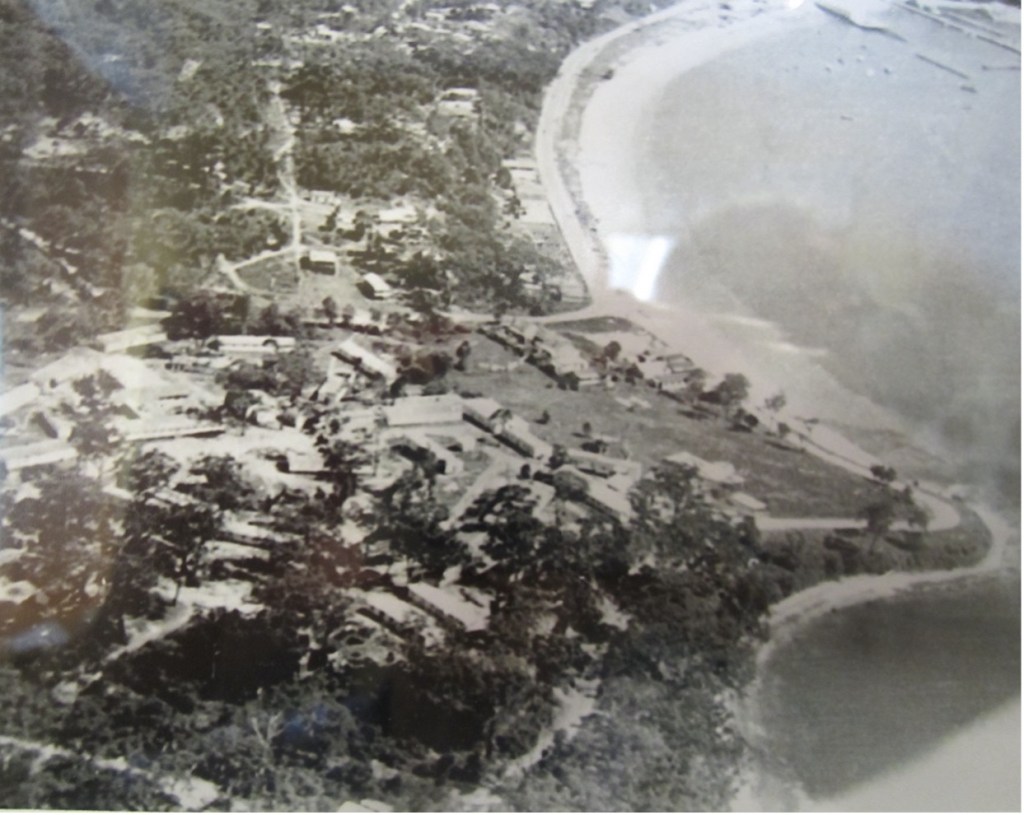
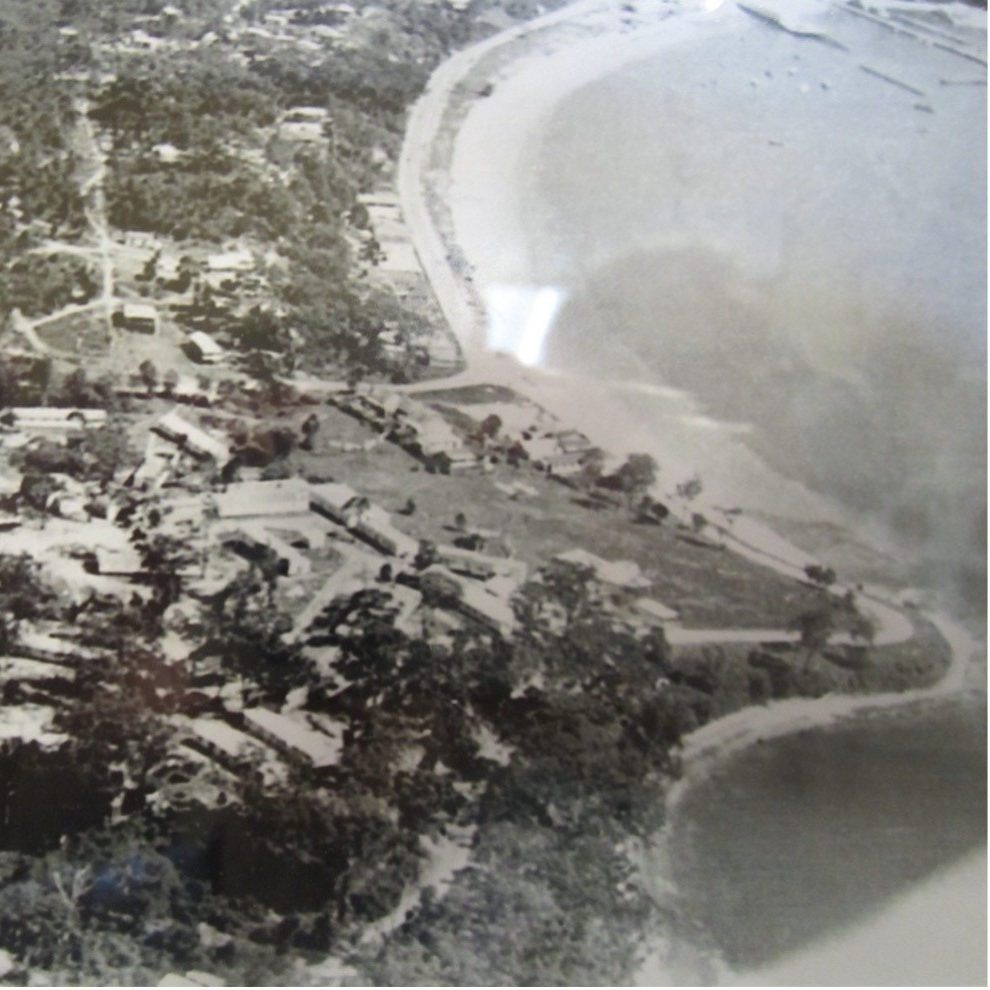
Aerial view of the HMAS Assault site at Fly Point, Nelson Bay, 1950. The additional buildings to accommodate the later Migrant Camp had not yet been added.
HMAS ASSAULT – ITS LIFE AS A MILITARY CAMP 1942-45
In 1942, under the auspices of a Joint Overseas Operational Training School (JOOTS), the Australian and United States Governments established a combined amphibious training facility for military personnel from both countries to prepare them for joint service in the Pacific region, as the Second World War encroached.
The site chosen was the Fly Point area of Nelson Bay at Port Stephens. HMAS Assault, as the Royal Australian Navy base, was commissioned on 1 September 1942. See HMAS Assault and JOOTS.
When the JOOTS facility at Port Stephens closed in October 1943, the Royal Australian Navy (RAN) continued to operate training activities at HMAS Assault until it was decommissioned in August 1944.
In April 1945, the HMAS Assault site was handed over to the British Royal Marines who were then attached to the British Pacific Fleet. The Royal Marines remained at HMAS Assault until March 1946. See Royal Marines at Port Stephens 1946 – 1945/46.
The former HMAS Assault facilities were again maintained in a caretaker mode until 1948 when the Commonwealth Government established the Nelson Bay Migration Hostel on the site at Fly Point. The Hostel ceased operations in 1953. See Nelson Bay Migrant Hostel – a Place for Rebuilding Lives.
The following diagrams show the outline of HMAS Assault at Fly Point.
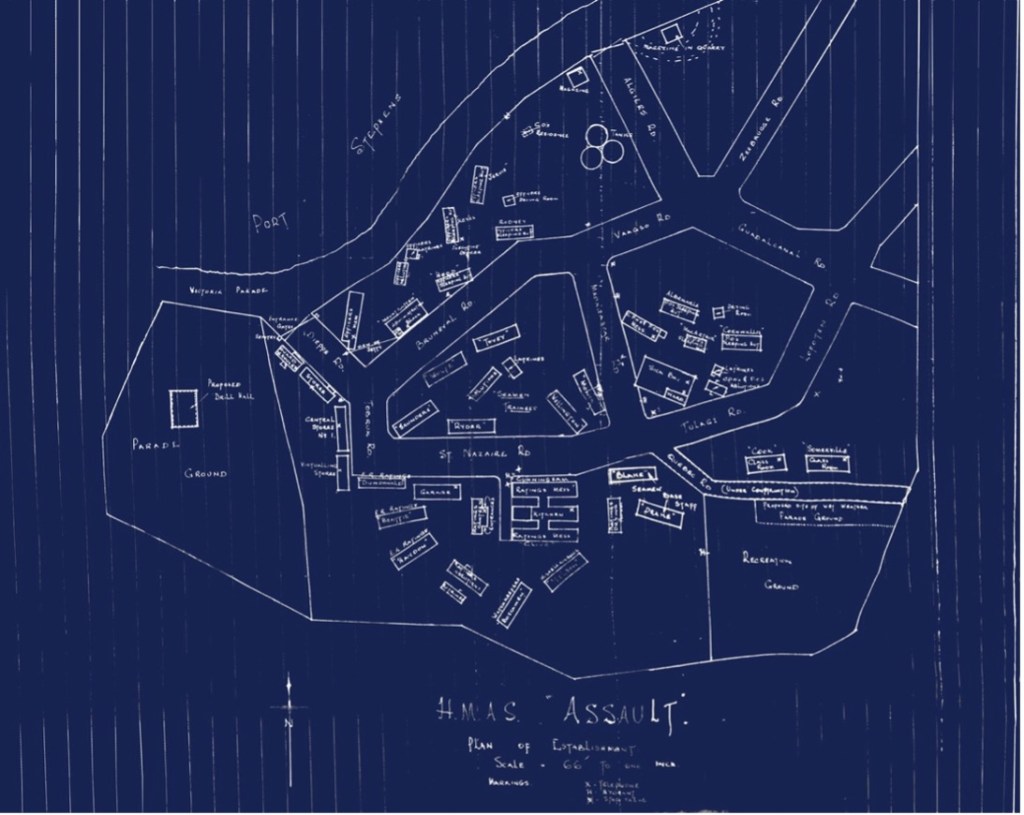
Plan of HMAS Assault (1942-1945) – University of Newcastle Library, Living Histories Collection
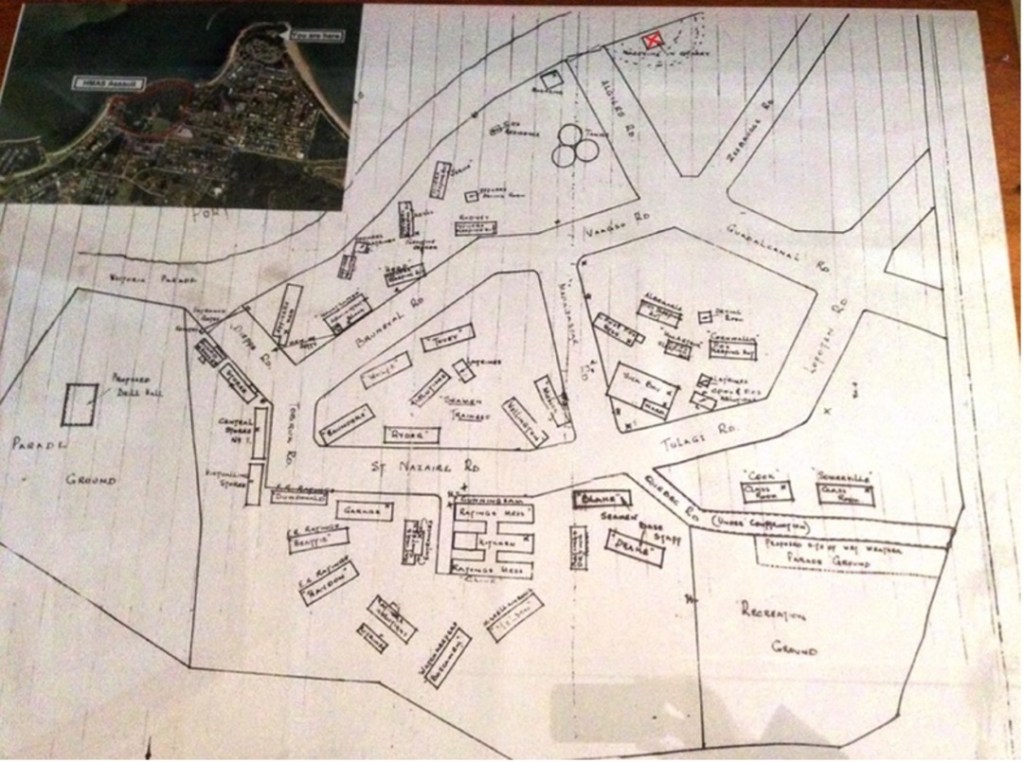
Map of HMAS Assault as displayed at the Inner Light Museum on Nelson Head. It shows the original names of the roads which commemorated European battle sites
NSW State Archives Office Photos
The NSW State Archives Office holds the following series of photos of HMAS Assault:
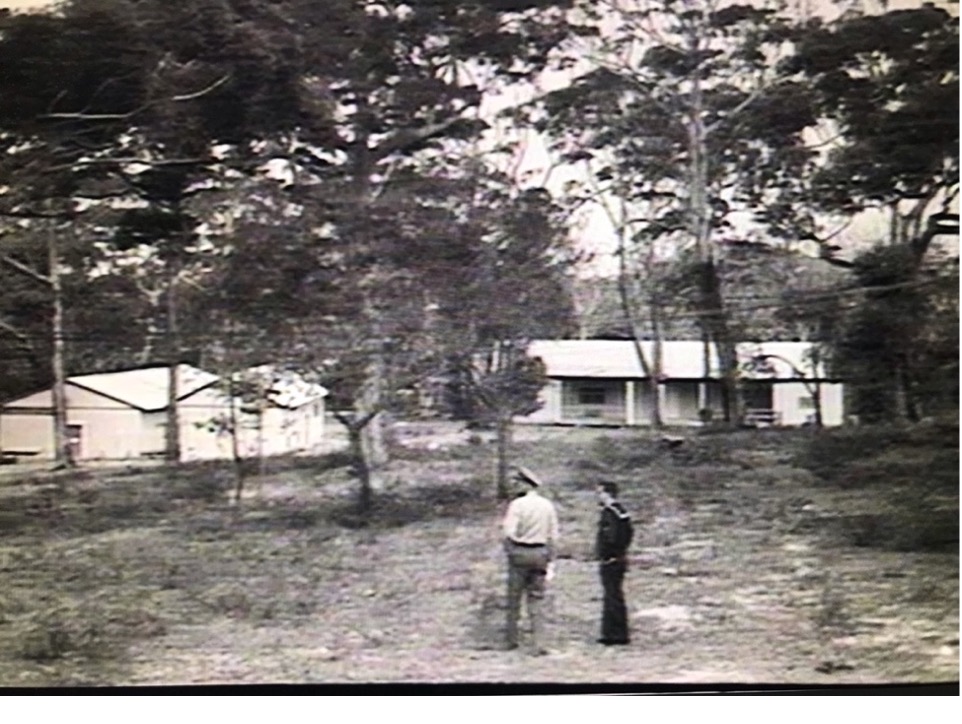
Two naval personnel near buildings located on the southern end of the site with the Gan Gan Mountain in the background

Two naval personnel walking along Tobruk Road towards the entrance of the camp located on Dieppe Road.
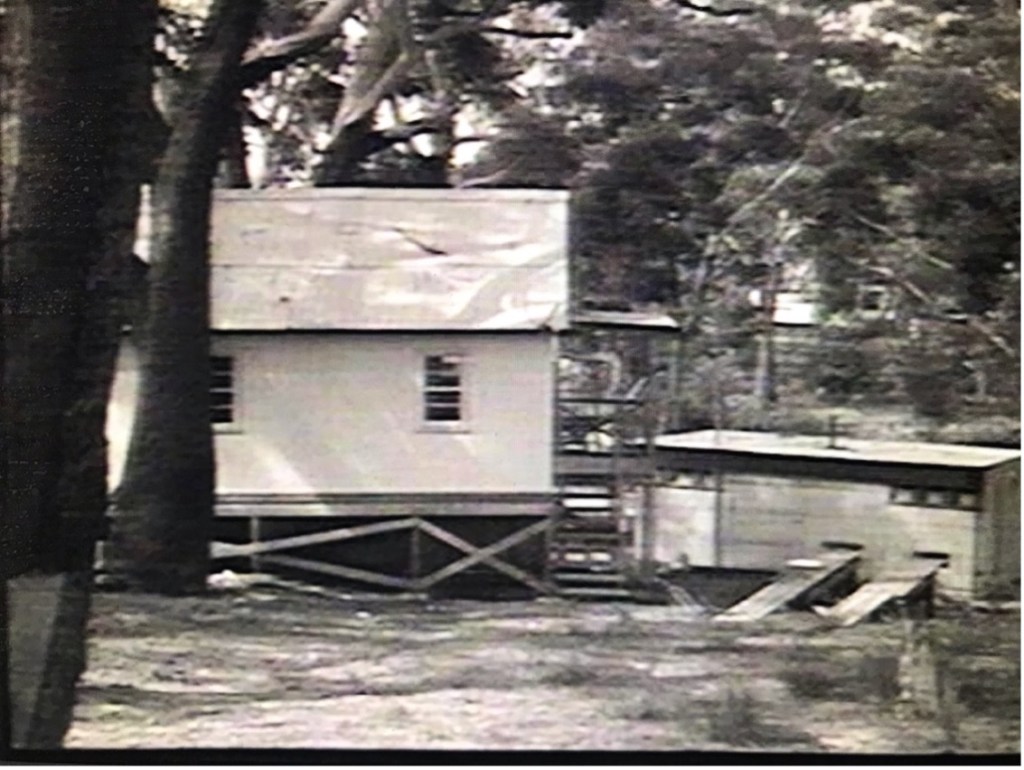
Probable ablution block adjacent to a building.
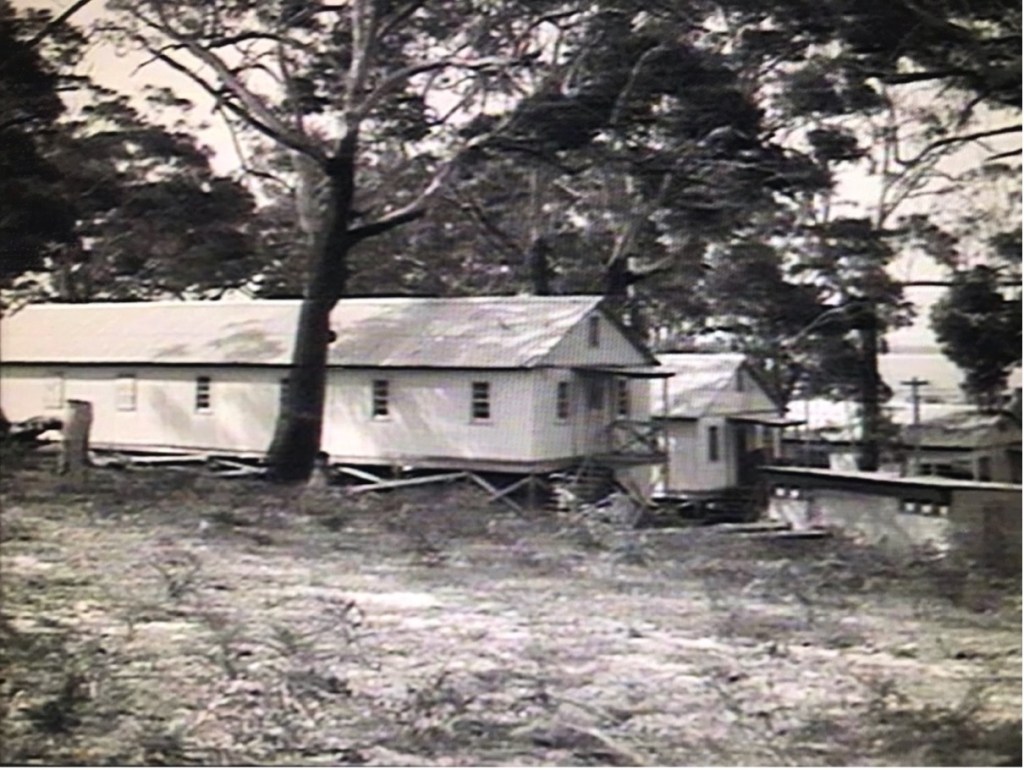
Buildings at the lower end of the site near Victoria Parade.
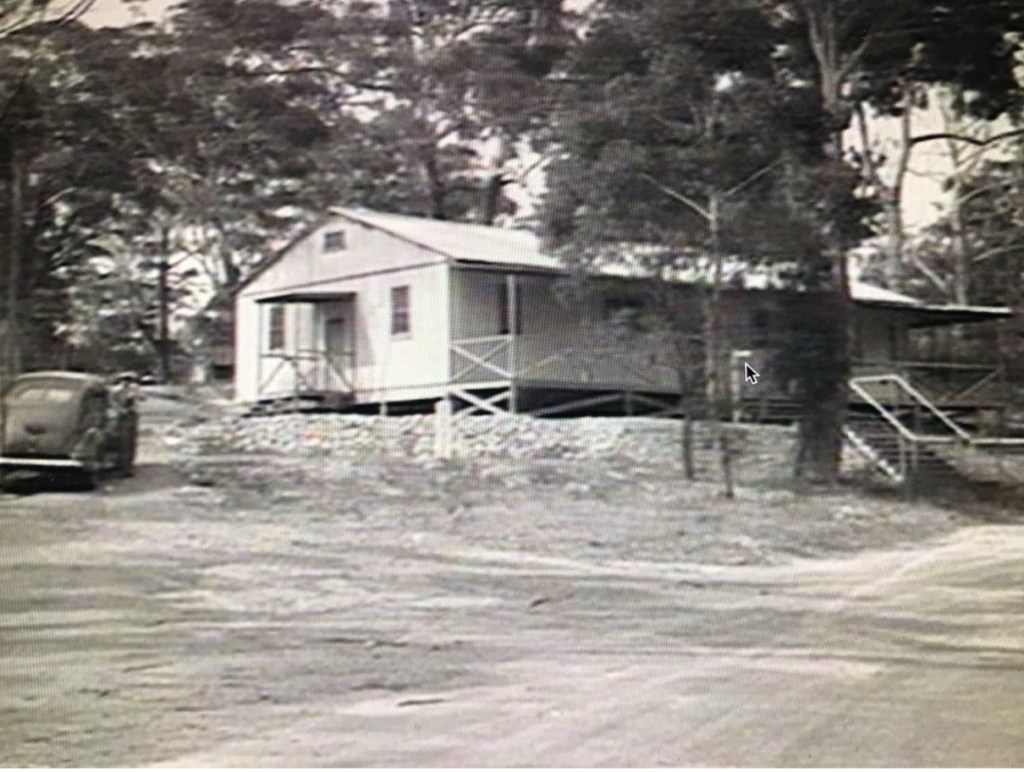
Administrative building near the entrance to the site.
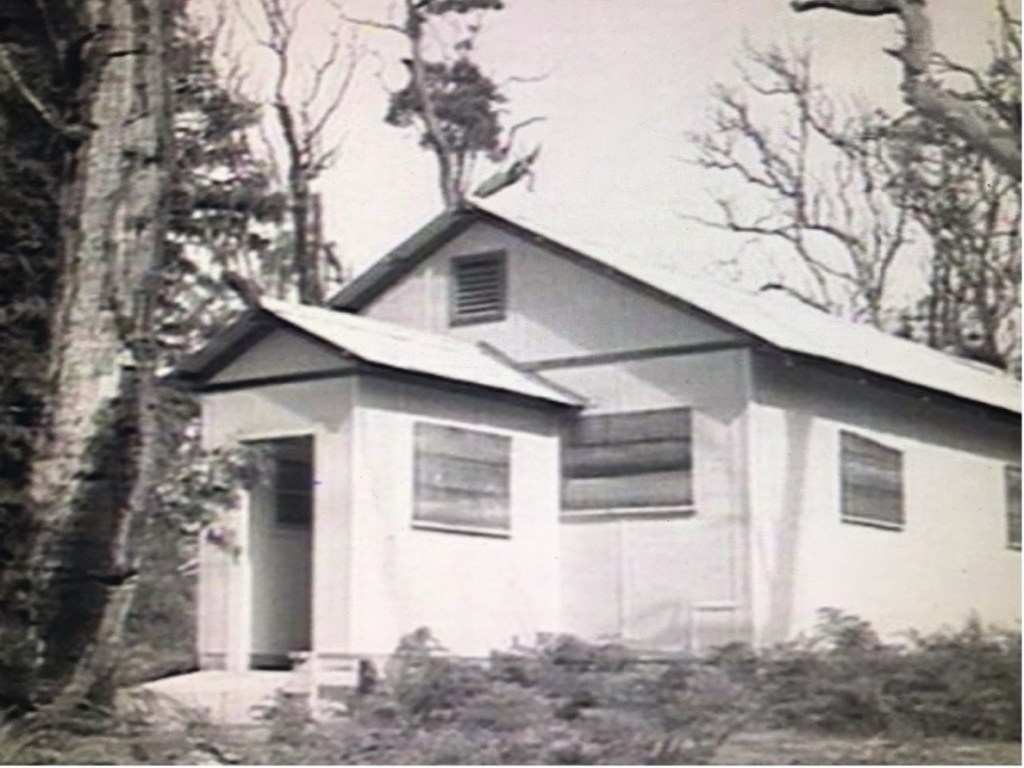
Probable Accommodation building.
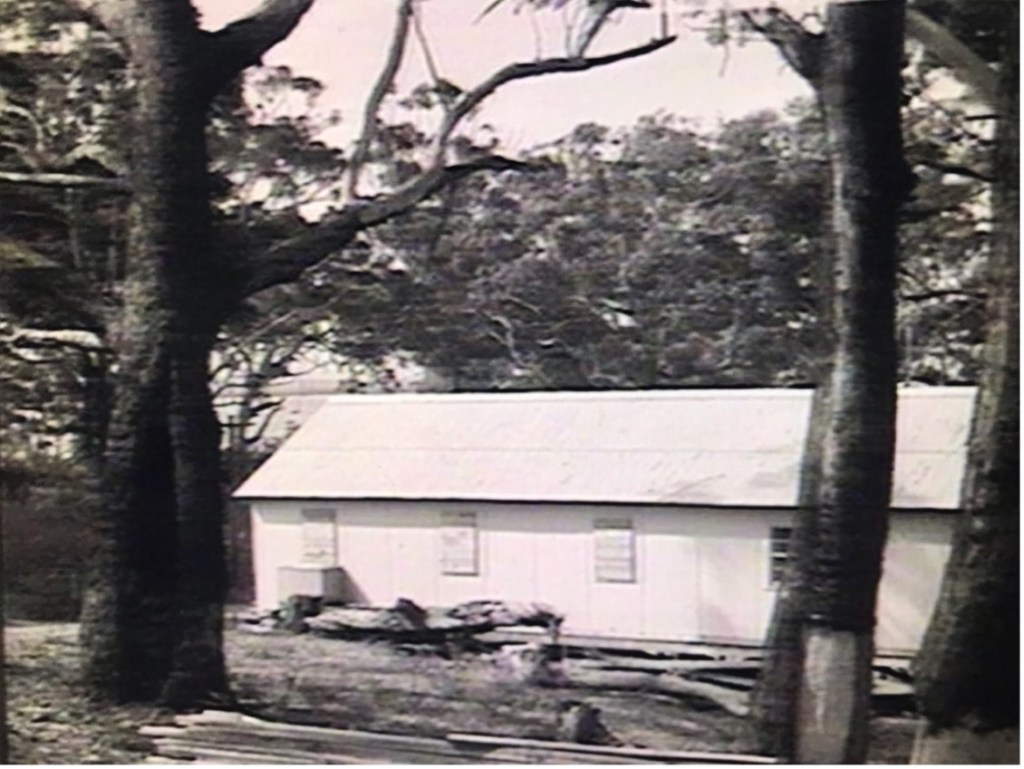
Probable Accommodation building.
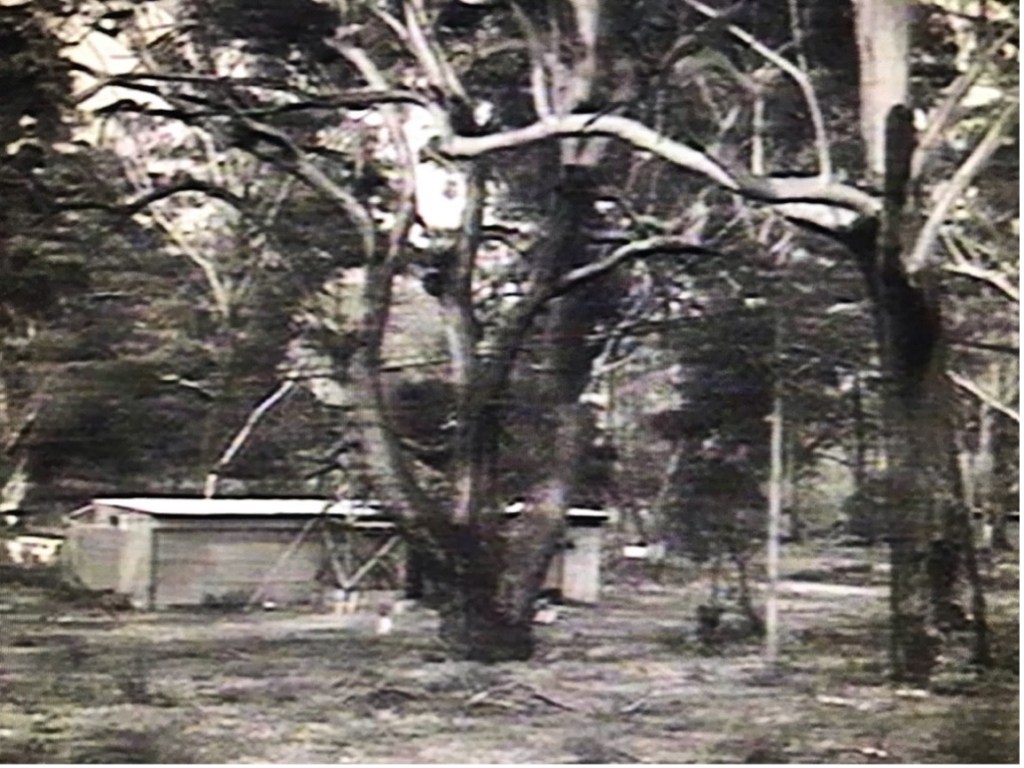
Probable Ablution block.
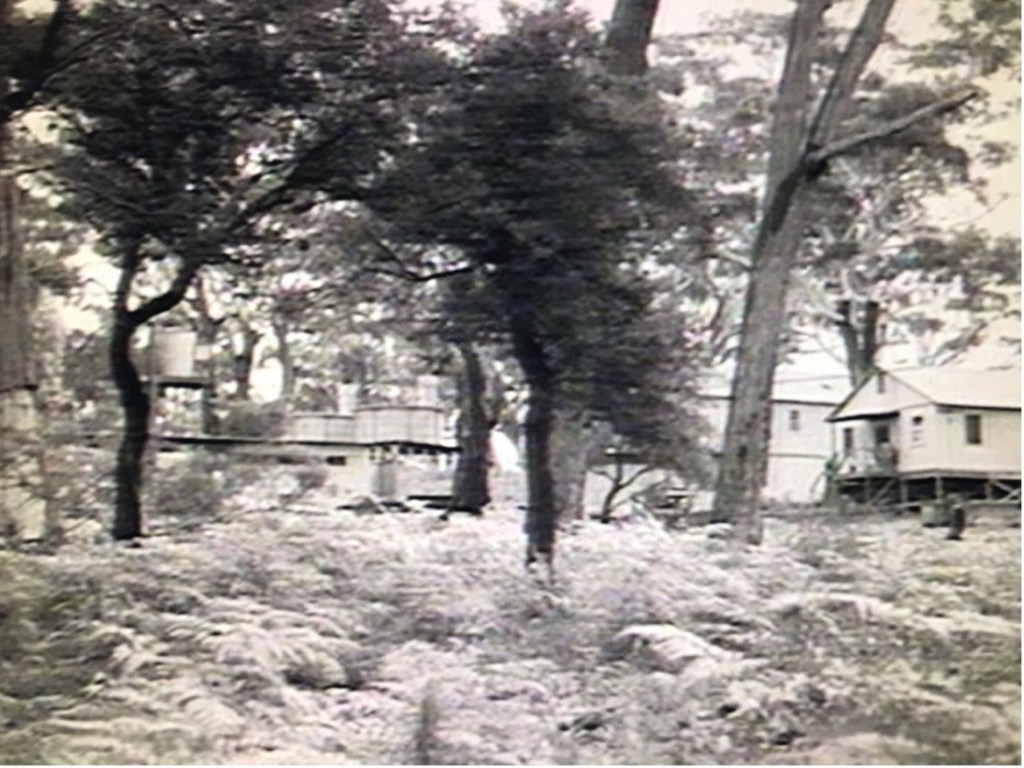
Tanks and probable accommodation buildings on top of the hill to the east of the site entrance.
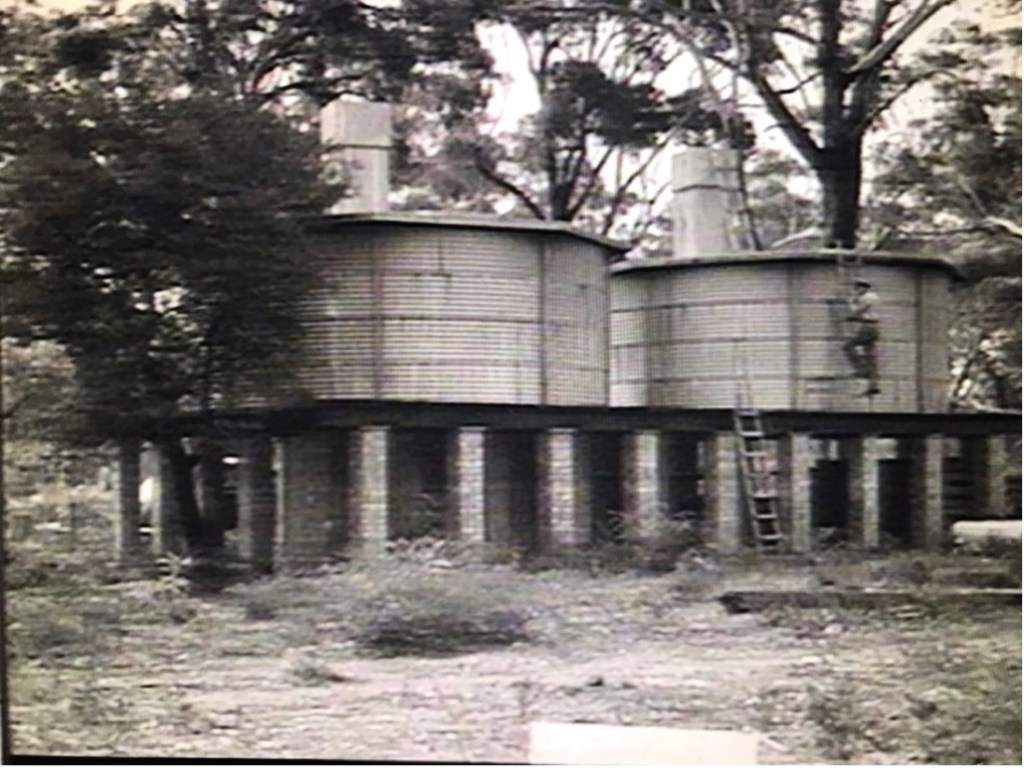
Tanks on top of the first small hill to the east of the site entrance. A naval officer can be seen on a ladder inspecting the tanks.

Probable accommodation buildings on top of the hill to the east of the site entrance.
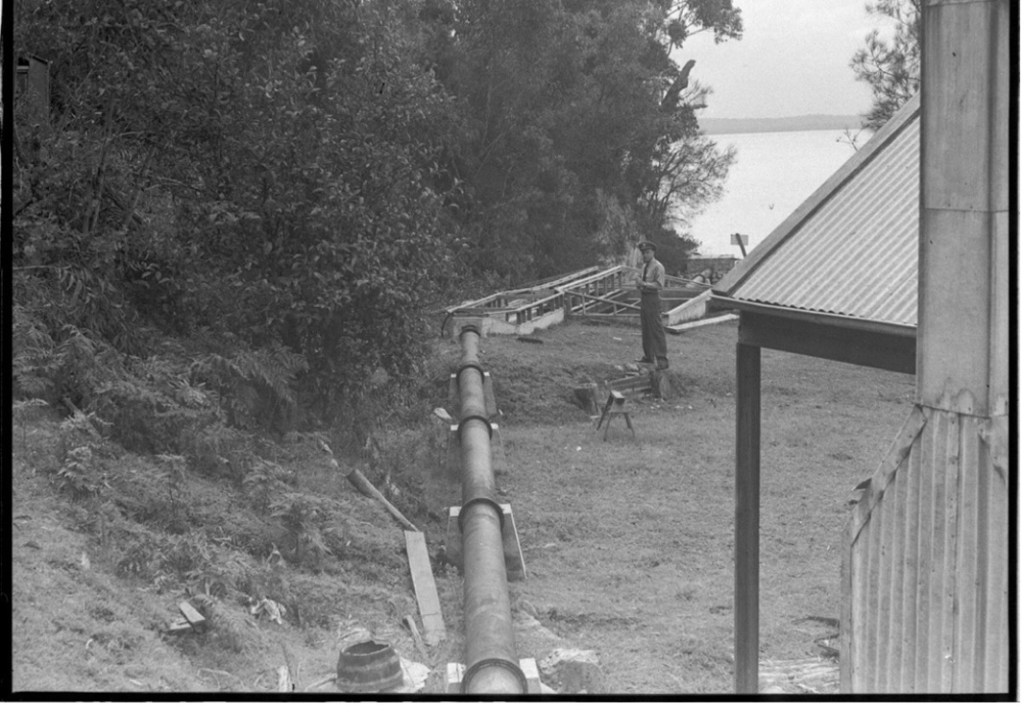
A naval officer inspecting a discharge pipe and box gullies at Little Beach (adjacent to the lower carpark of the current Little Beach Boathouse Restaurant).
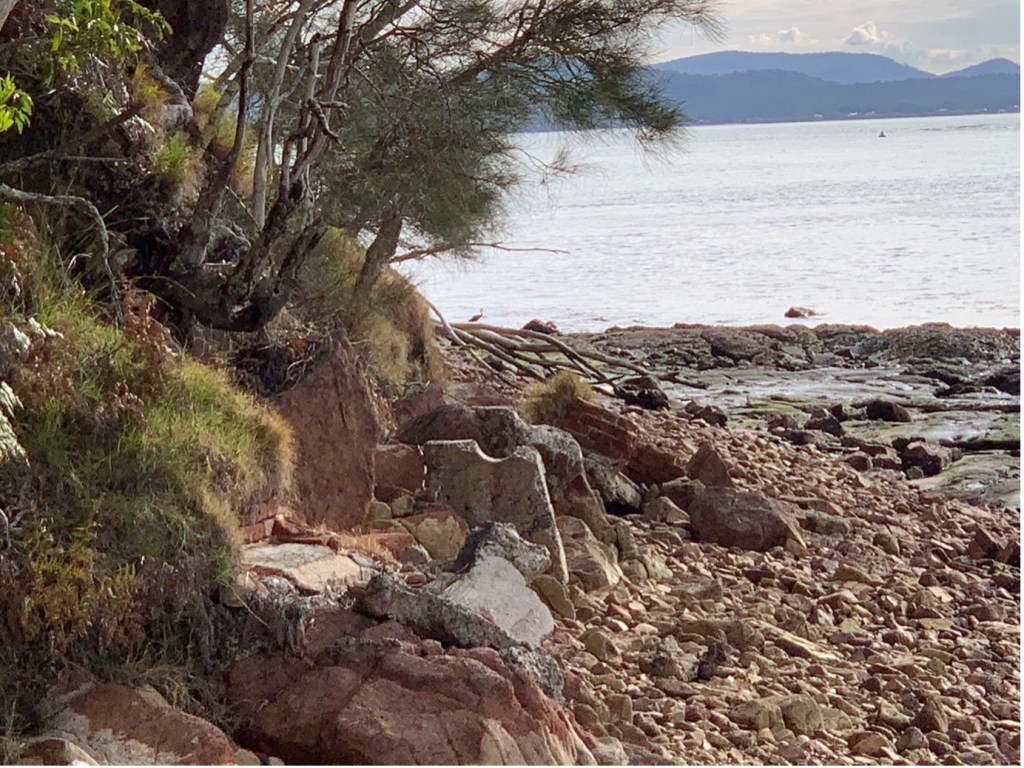
Current remnants of the concrete supports and two box gullies for the discharge pipe on the above site [Author photo – June 2022].
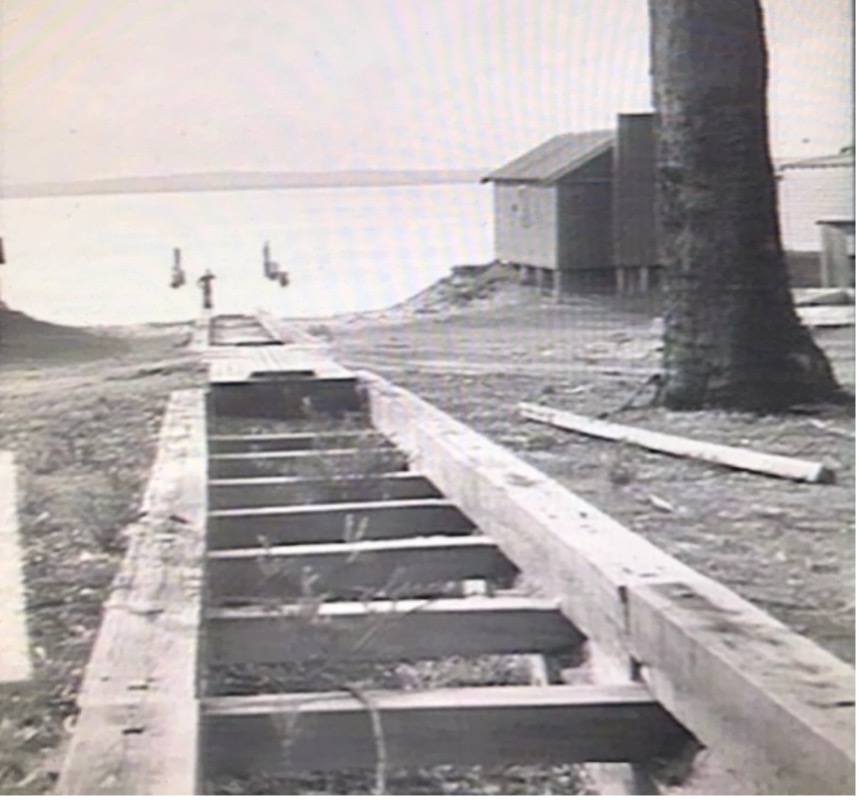
Marine Railway at Engineers’ Beach (now Little Beach) under construction, Nelson Bay.
Australian War Memorial Photos
The Australian War Memorial in Canberra holds various photos of the Fly Point military camp. These photos have been published in other histories of HMAS Assault and are included in this paper to supplement those held by the NSW State Archives Office.
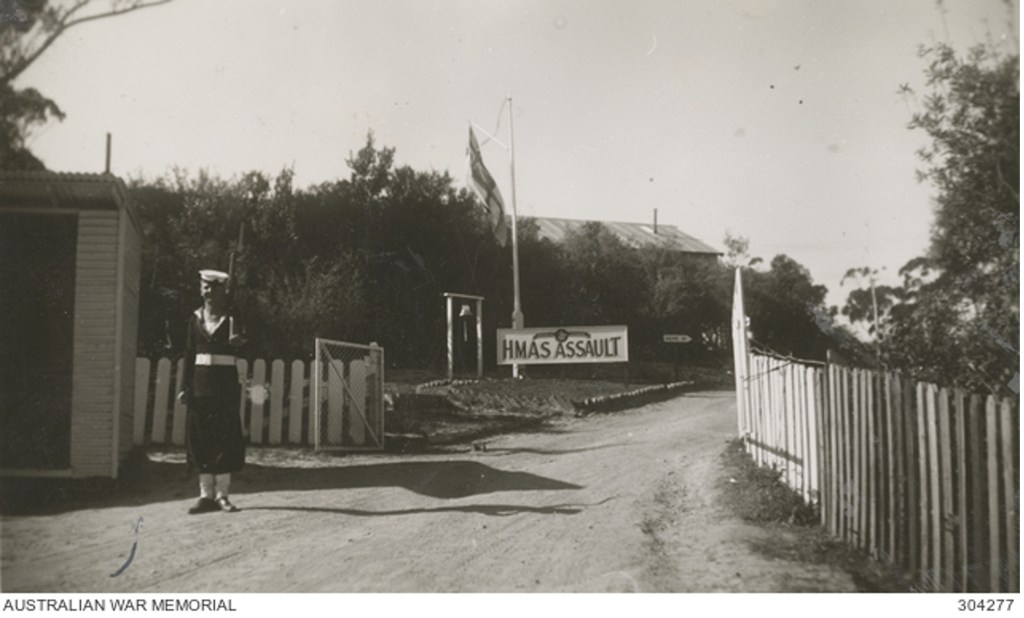
Camp entrance on Dieppe Road. The flagpole, name board and ship’s bell are prominent.
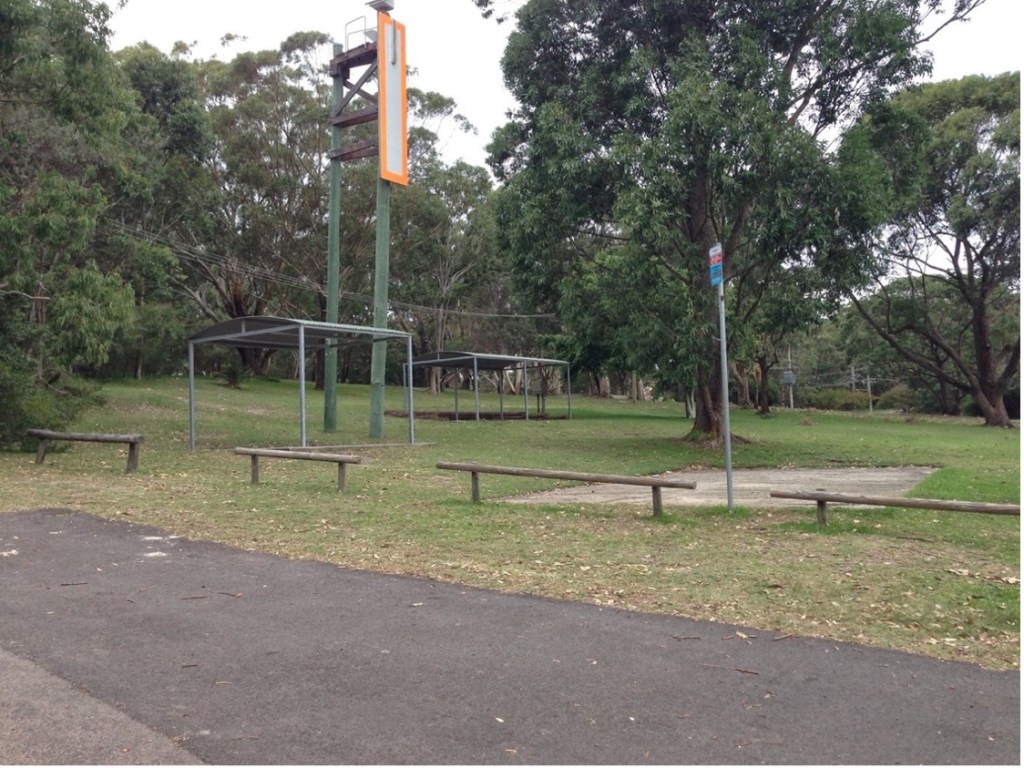
Site of the former camp entrance today, on Victoria Parade, Fly Point [Author photo – June 2022].
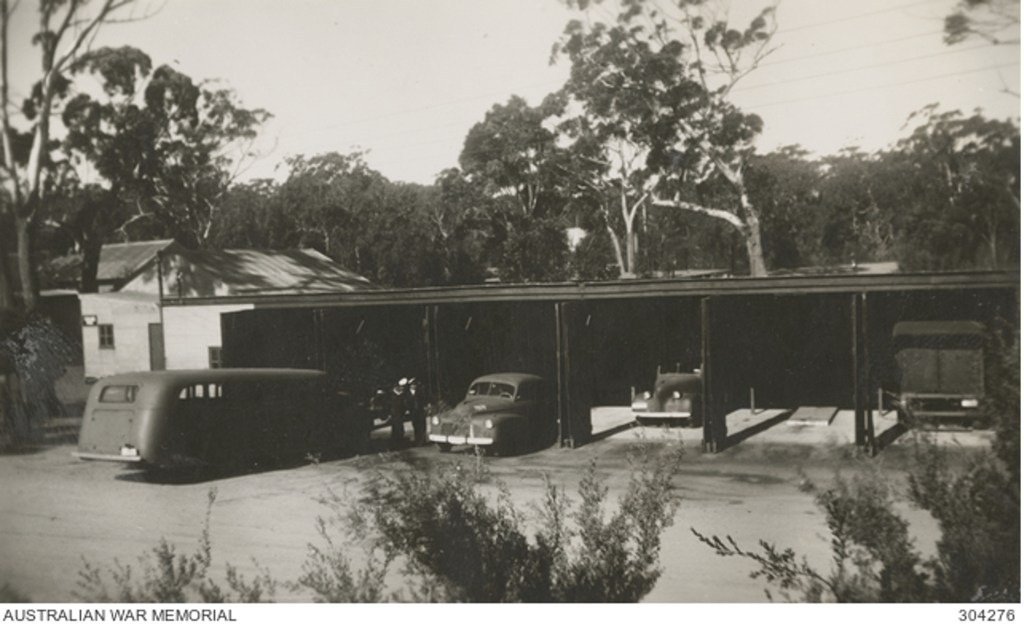
The garage and motor transport on St. Nazaire Road.

St. Nazaire Road showing the buildings used as the dining halls and gallery.
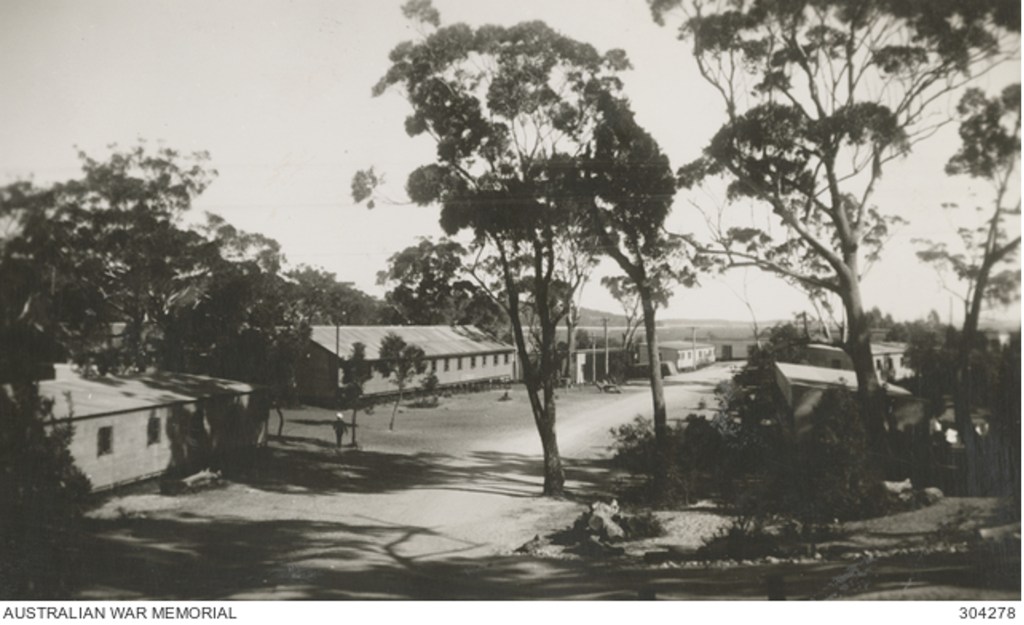
St. Nazaire Road showing the dining halls and gallery, looking towards Nelson Bay.
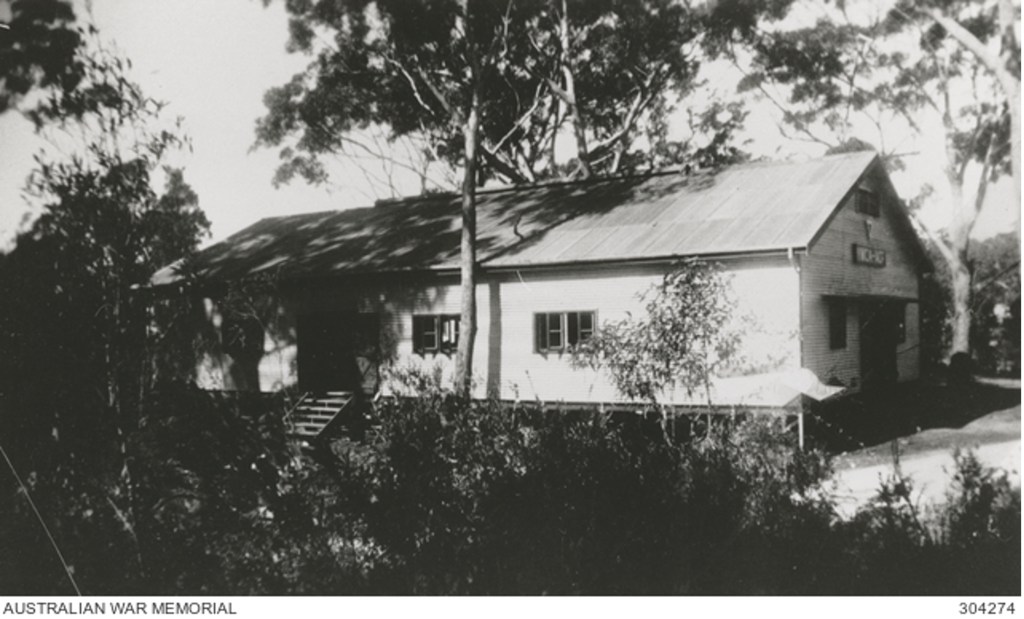
YMCA – Australian Comforts Fund recreation hut.
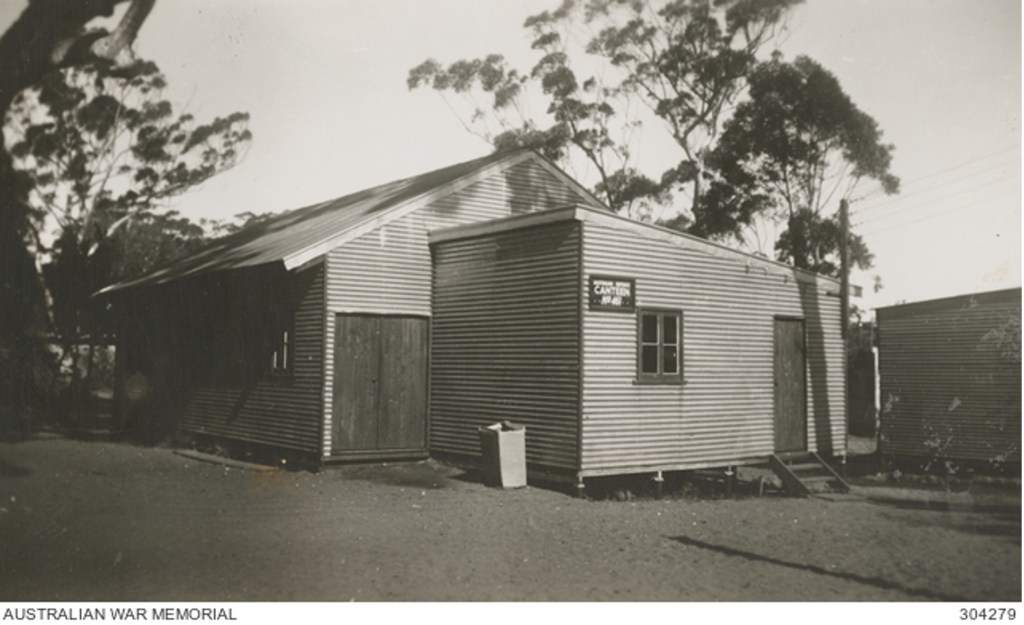
Exterior of the wet and dry canteen.
REMAINS OF HMAS ASSAULT
Little remains of the buildings that once covered the Fly Point site. The most noticeable remains are the concrete floors of a few buildings that include ablution and latrine blocks.
Most administrative and residential buildings were built on wooden and brick pier foundations with the buildings raised up above the ground level.
Some brick pier foundations from the former migrant camp phase remain near Little Beach. At various locations, the remnants of concrete paths and drainage pits and ditches also remain.
The following photos show some of the current remains.
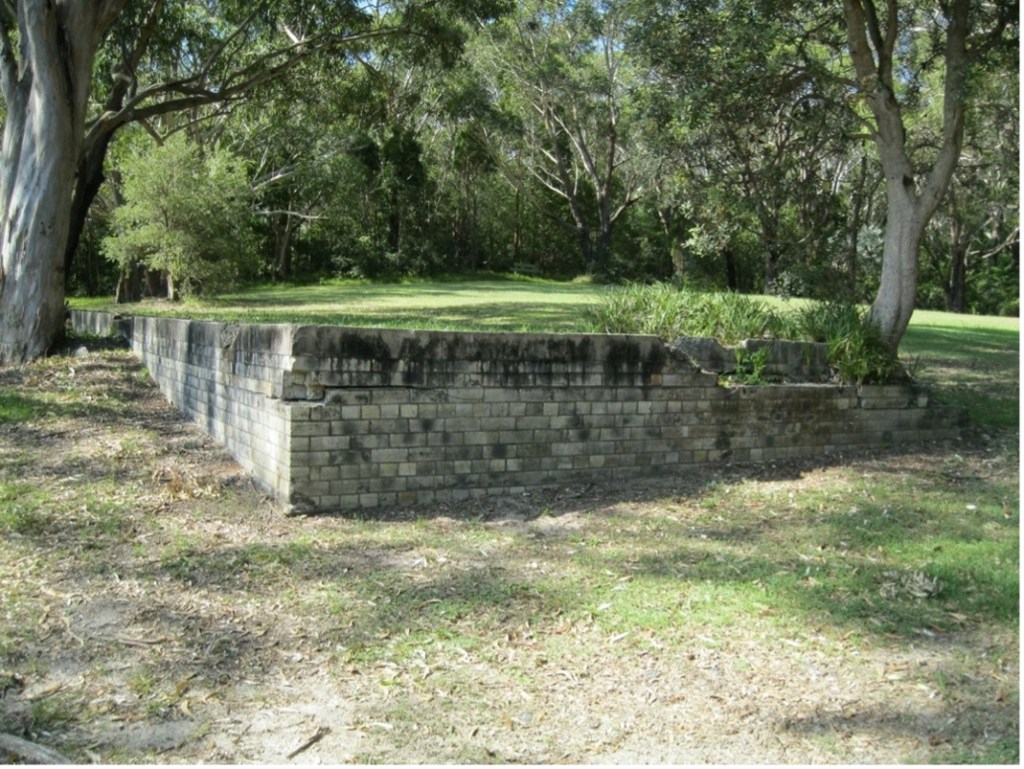
Remains of the Victualling Stores in Neil Carroll Park, Fly Point. The building faced the former Tobruk Road [Author photo].
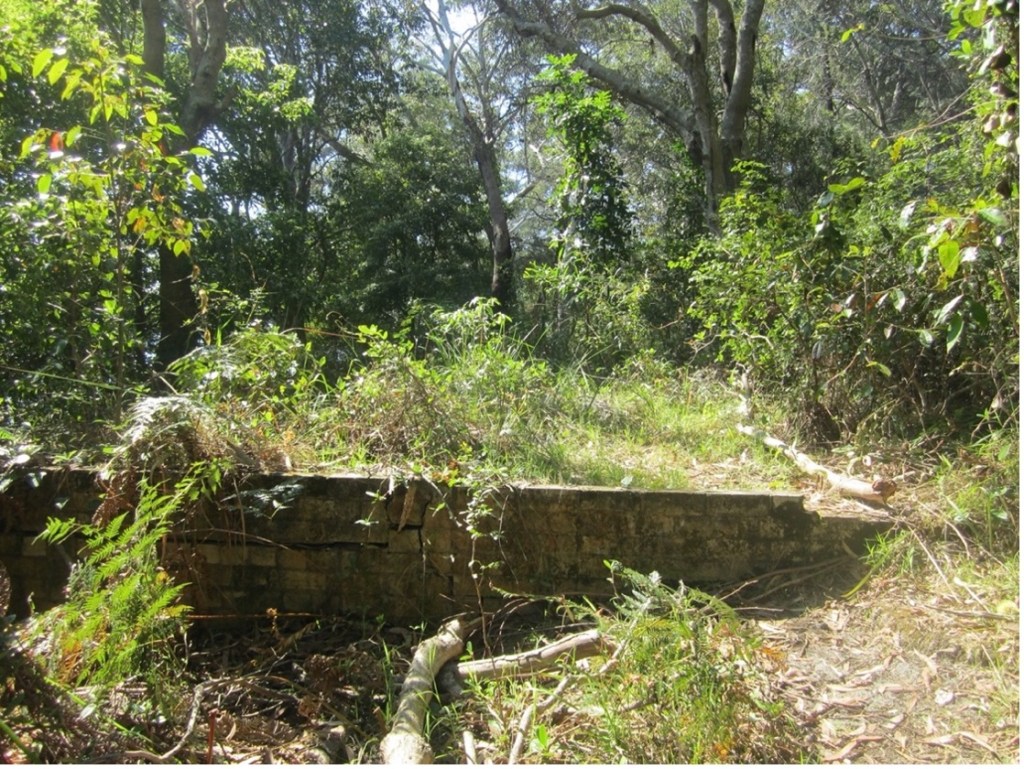
Remains of a building foundation on the hilltop at Fly Point [Author photo].
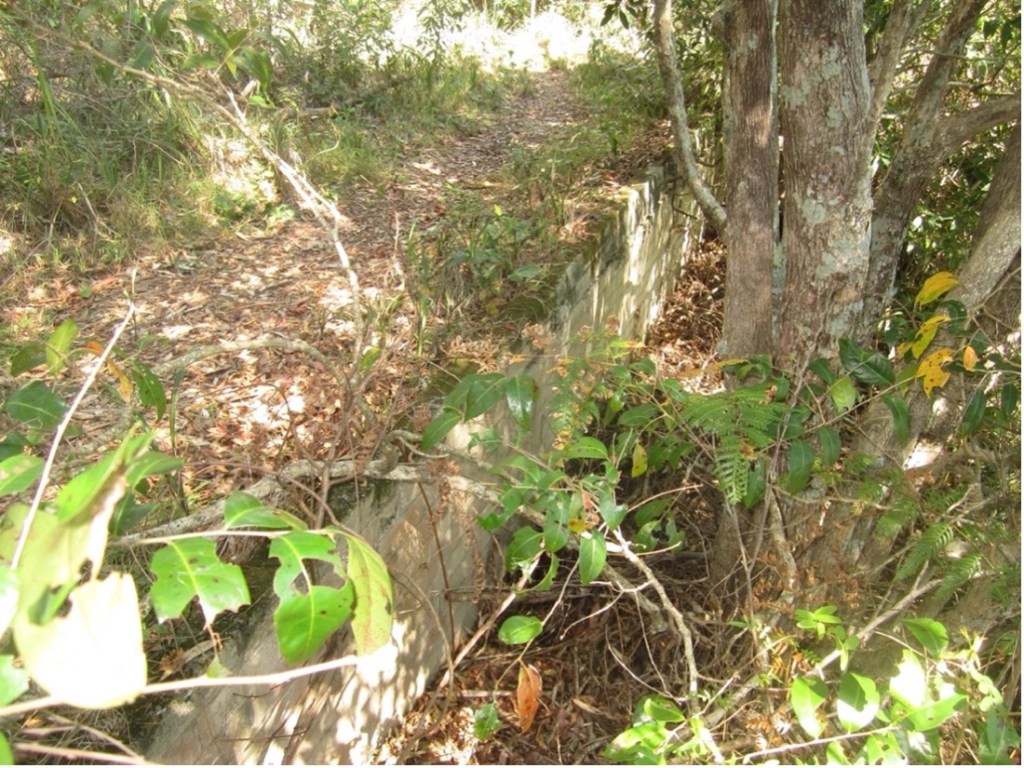
Remains on hilltop at Fly Point [Author photo].
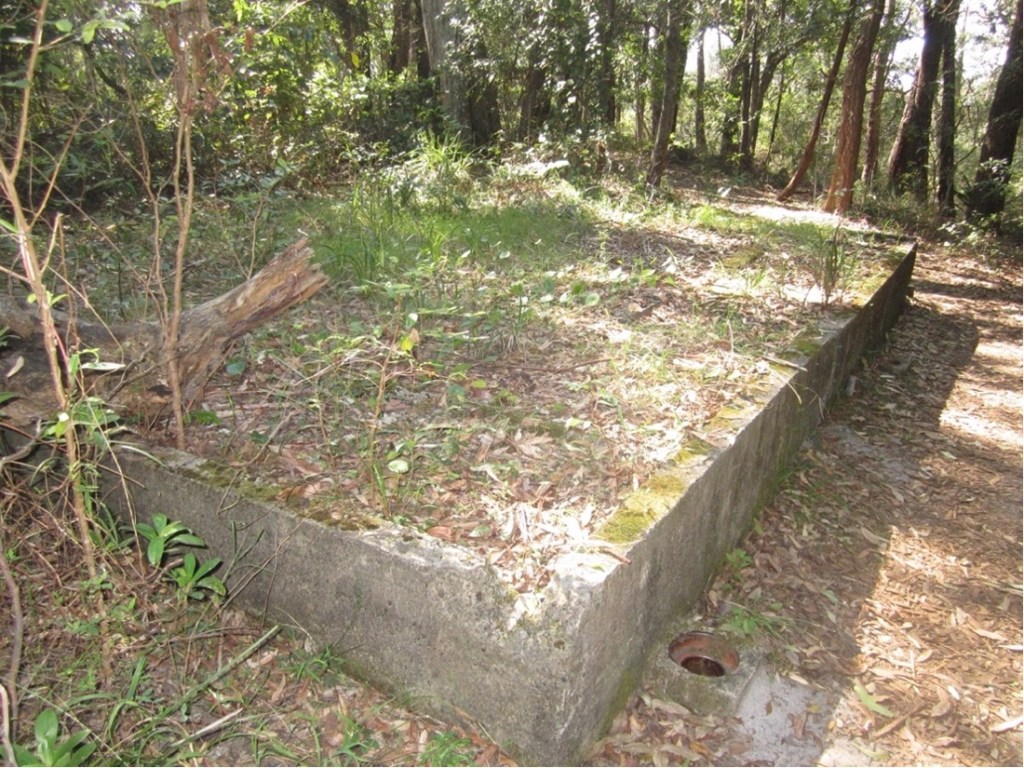
Remains of a building foundation on hilltop at Fly Point [Author photo].
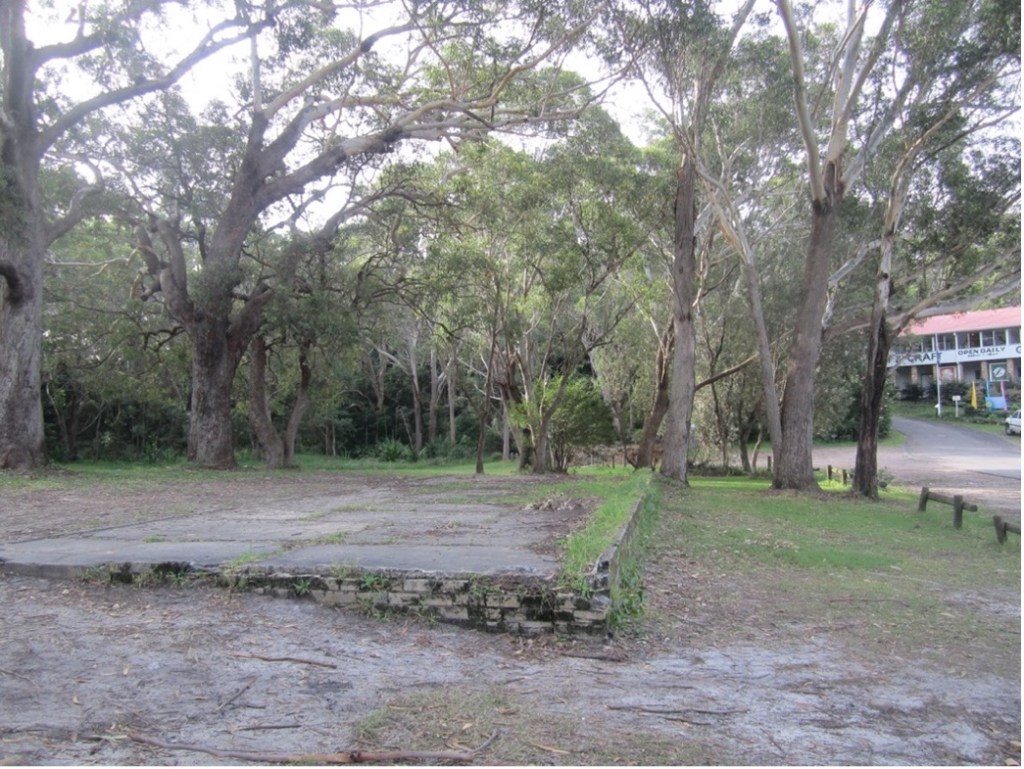
Remains of ‘Ratings Drying Room’ in Neil Carroll Park, Fly Point, near former sick bay [Author photo].
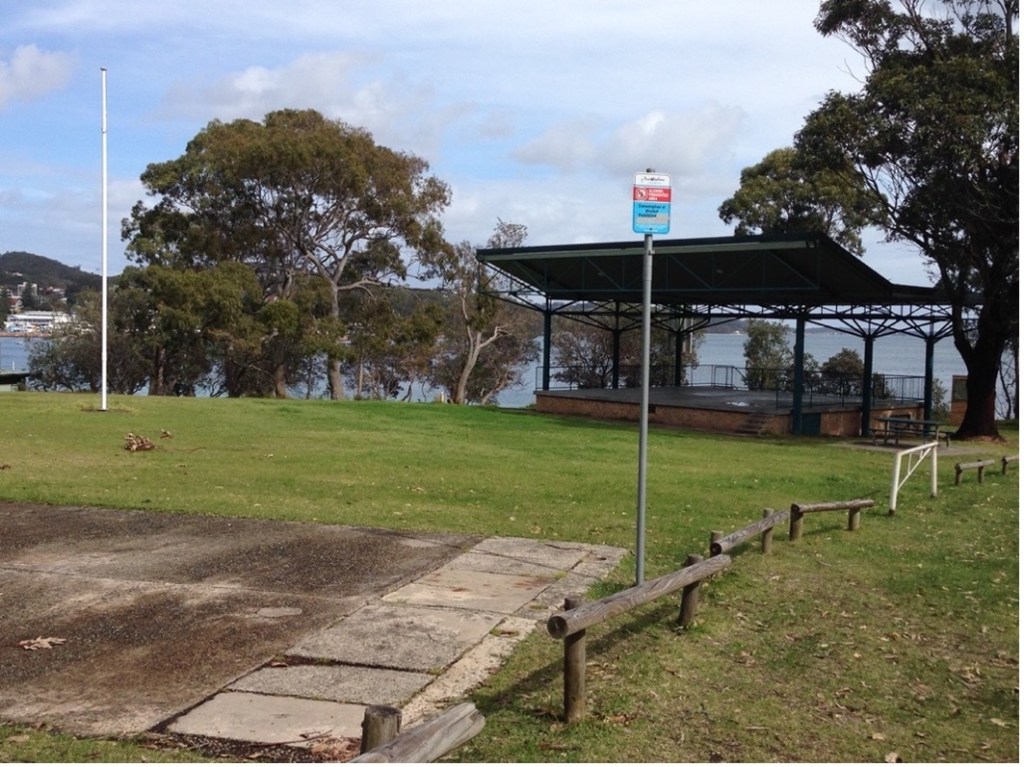
Remains in Neil Carroll Park, Fly Point, near the camp entrance [Author photo].

Remains of two footpaths, at the entrance of the former Officers Mess building, located adjacent to the entrance of the military base, near Victoria Avenue [Author photo].

Remains of a latrine block, located behind the Nelson Bay Community Arts Centre, Fly Point [Author photo].
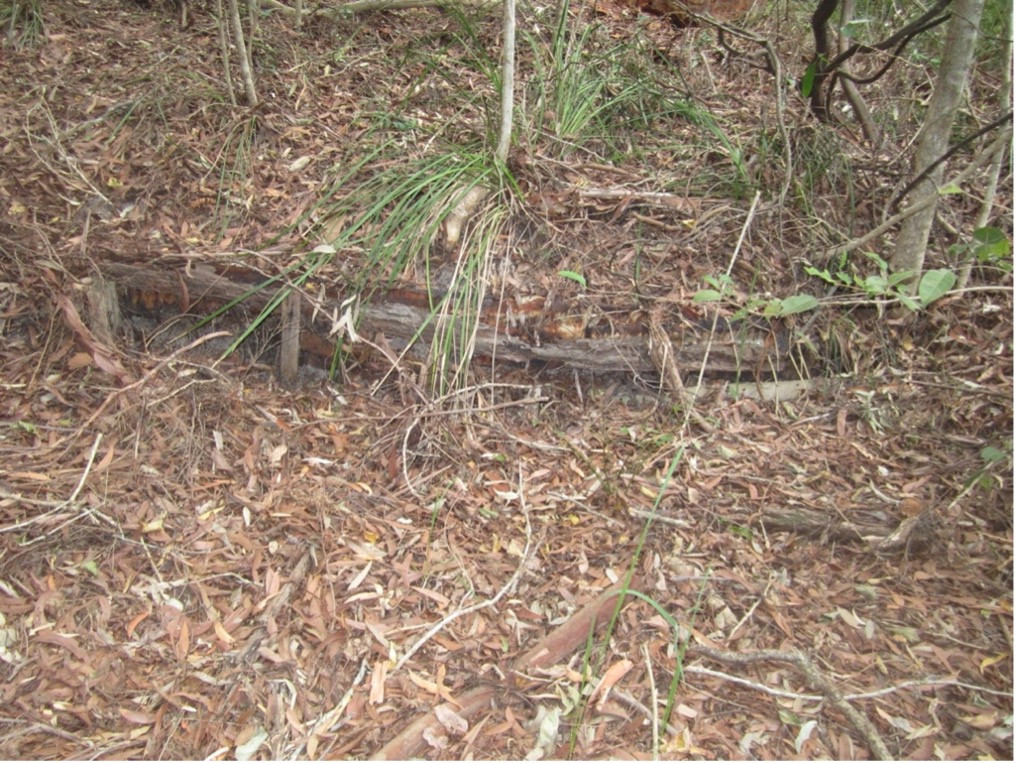
Part of a retaining wall adjacent to the former oil tanks, near Victoria Avenue, Fly Point [Author photo].
FORMER MILITARY CAMP ROADS
The location of many of the original military roads on the Fly Point site can still be pinpointed by the location of some current walking trails.
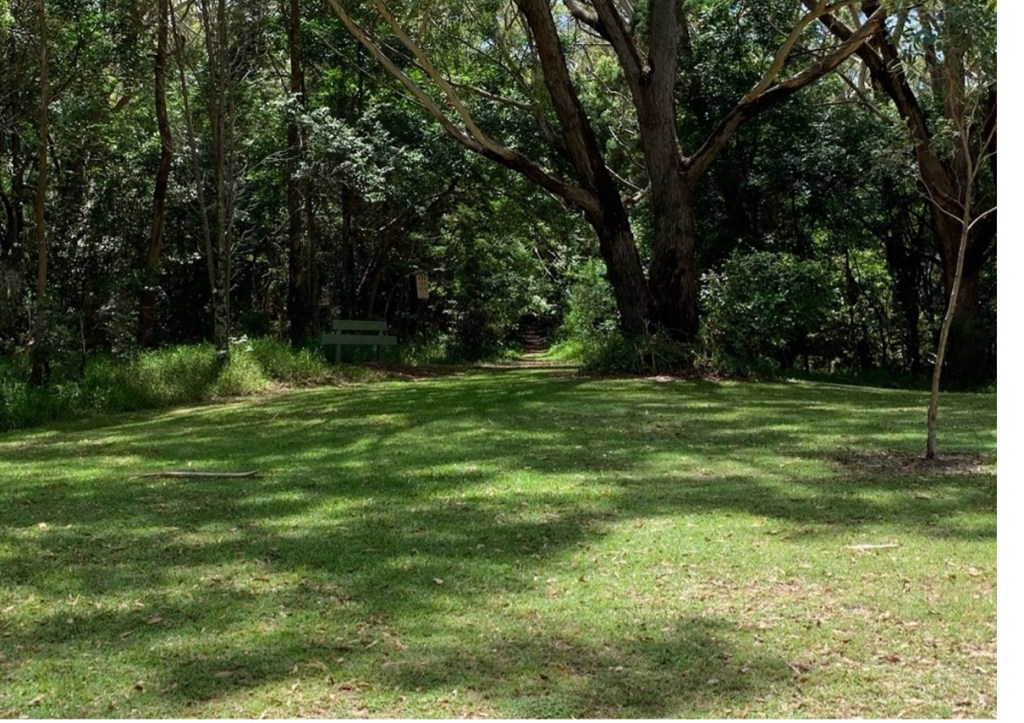
Corner intersection of Bruneval Road (track up the hill) and Tobruk Road (grass portion in foreground) [Author photo].
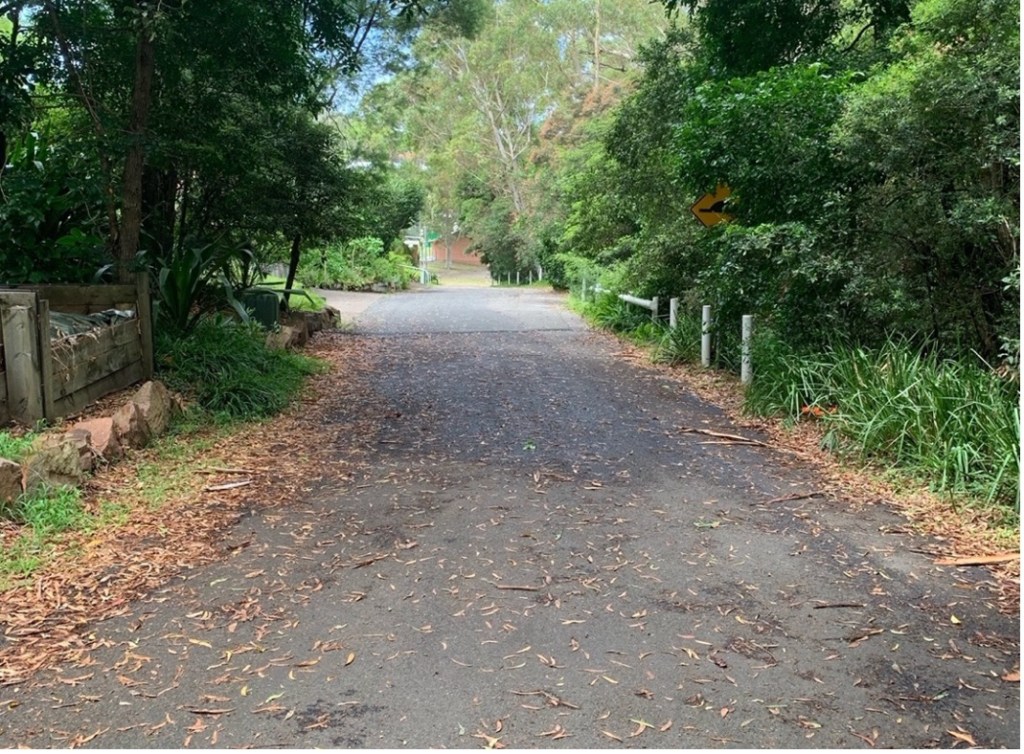
Former Madagascar Road [Author photo].
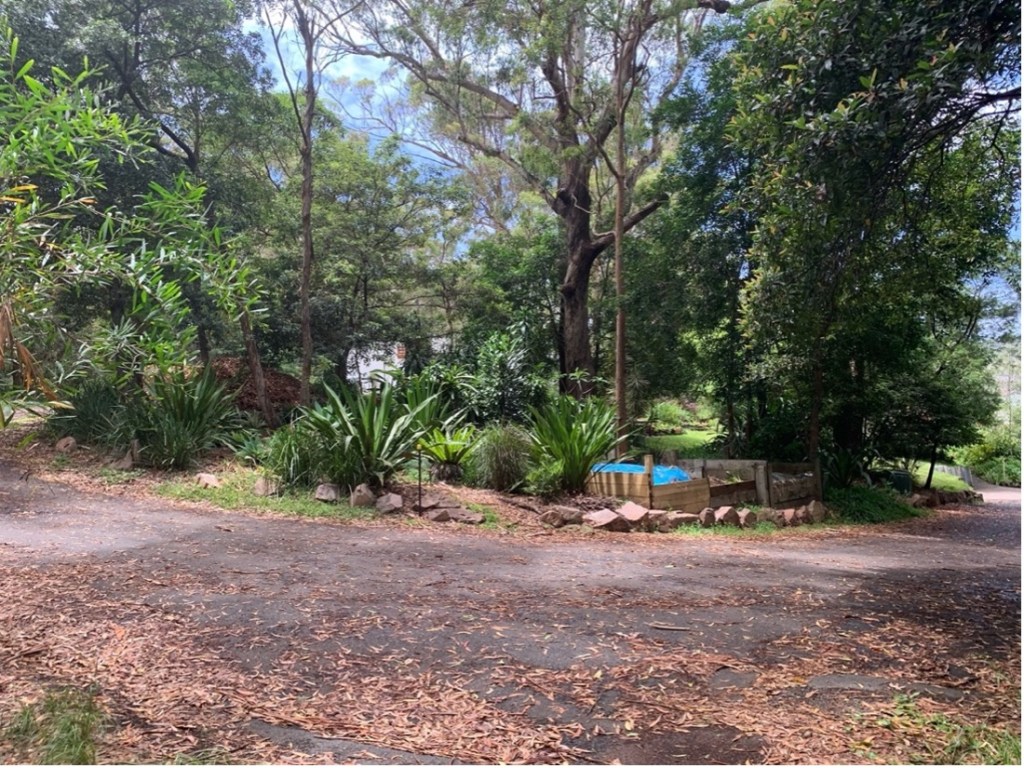
Corner of former Madagascar Road and Vaagsco Road [Author photo].
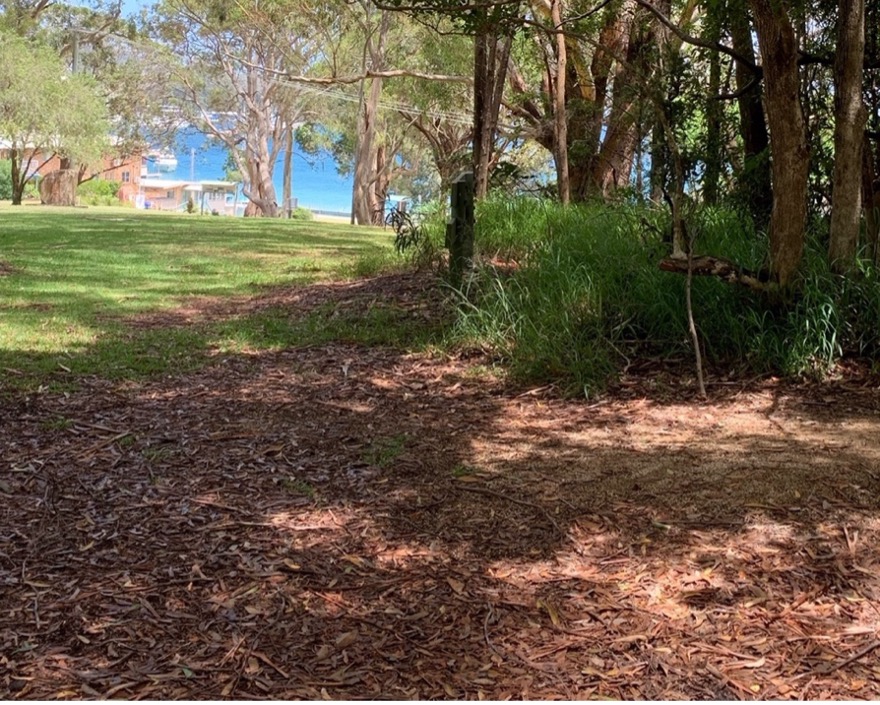
Site of the former Administration block (beside the track in the bushes), at the corner of the former Bruneval Road and Dieppe Road overlooking the Nelson Bay waterfront. [Author photo].
MEMORIALS TO HMAS ASSAULT
Various memorials to the former Military Camp and Naval personnel are located at Port Stephens as shown in the photos below.
Fly Point, overlooking Little Beach
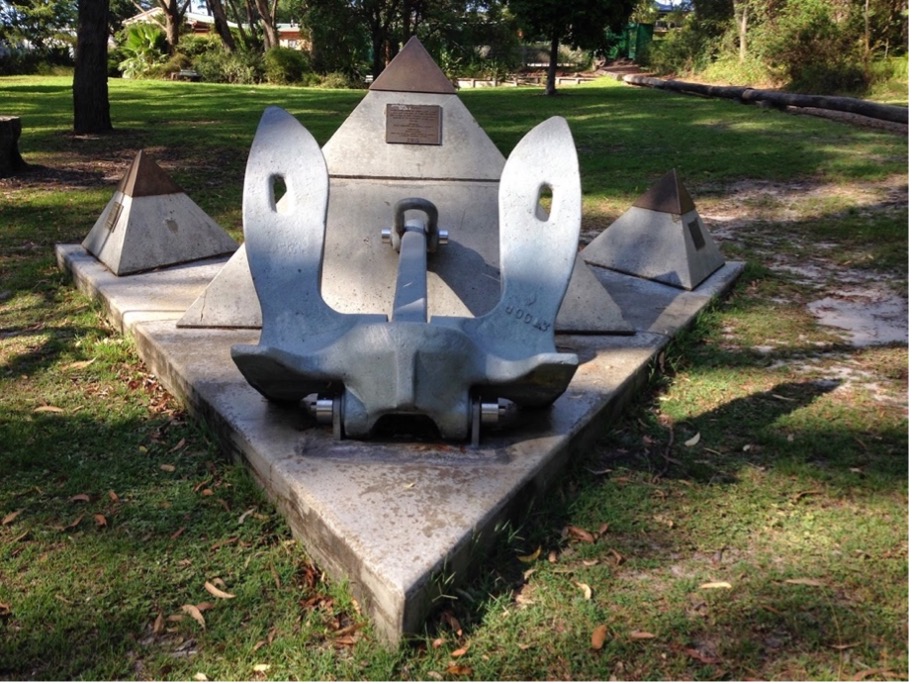
HMAS Assault memorial at Fly Point, Little Beach, in the form of three tank traps, erected by the Port Stephens Historical Society Inc., 19 September 1999. [Author Photo – June 2022]
The four plaques on the above memorial read:
‘REMEMBRANCE
THIS PLAQUE COMMEMORATES
THE LOCATION OF
HMAS ASSAULT
A WORLD WAR II NAVAL BASE WHICH BECAME
IN PEACE TIME, A SANCTUARY FOR REFUGEES
FROM WAR-TORN EUROPE 1949 – 1956 THUS
ENRICHING THE LIVES OF ALL AUSTRALIANS
ADVANCE AUSTRALIA FAIR’
‘TO HONOUR
20,000 UNITED STATES OF AMERICA NAVY, MARINE
CORPS, ARMY AND ARMY AIR FORCE SERVICEMEN
WHO TRAINED AT PORT STEPHENS FOR AMPHIBIOUS
WARFARE IN THE SOUTH WEST PACIFIC AREA
1942-1943′
‘TO HONOUR
THE PRESENCE OF ROYAL MARINES
BRITISH PACIFIC FLEET
WHO LIKE MANY OTHERS TRAINED IN THIS AREA
FOR AMPHIBIOUS WARFARE IN THE SOUTH
PACIFIC REGION AND MADE A SIGNIFICANT
CONTRIBUTION WHICH SAW THE SUCCESSFUL
CONCLUSION TO WORLD WAR II 1942-1945
LEST WE FORGET’
‘IN GRATITUDE
TO THE PEOPLE OF THE TOMAREE
PENINSULA WHO OFFERED FRIENDSHIP
AND HOSPITALITY TO SERVICE
PERSONNEL DURING THEIR PERIOD OF
TRAINING AT PORT STEPHENS
FOREVER REMEMBERED’
HMAS Manora Association Memorial at Fly Point
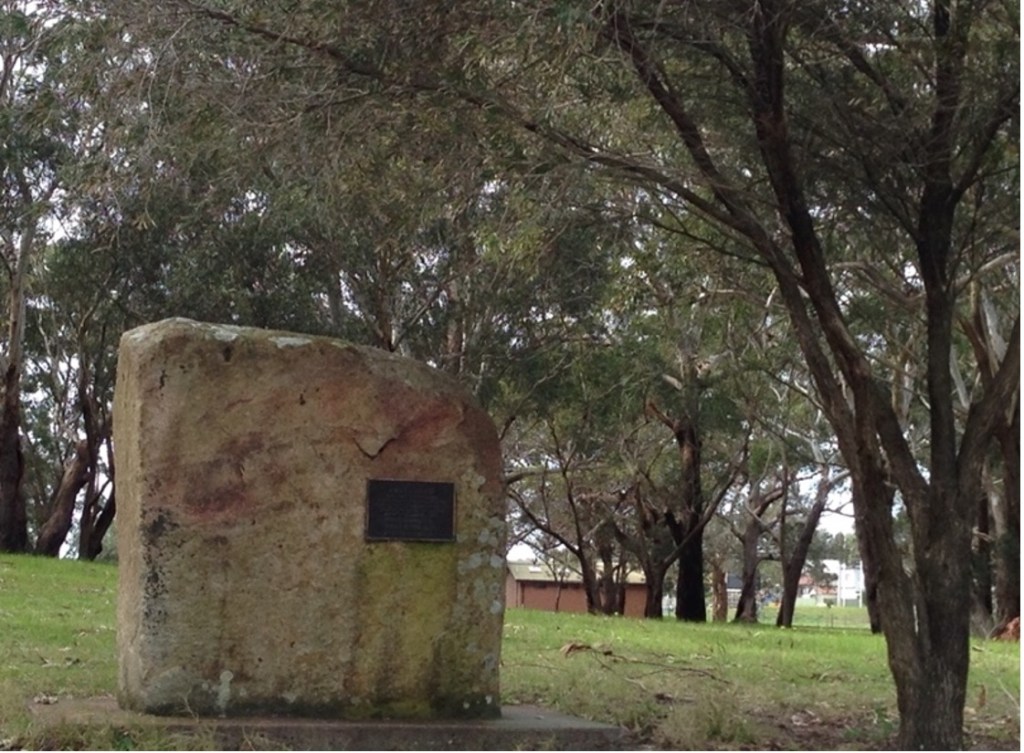
HMAS Manora Association Memorial erected in 1991 on the site of an accommodation hut at Fly Point [Author Photo – June 2022]
The plaque on the HMAS Manora Association memorial reads:
‘ON THIS SITE
HMAS ASSAULT
WAS COMMISSIONED IN 1942
RAN PERSONNEL TRAINED HERE AS
BOATS CREWS FOR LANDING CRAFT AND
SERVED IN THE SOUTH WEST PACIFIC
AREA IN THE LANDING SHIPS
HMAS MANOORA
HMAS WESTRALIA
HMAS KANIMBLA’
Salamander Bay Memorial
The following memorial was erected adjacent to Port Stephens Drive, Salamander Bay, upon the opening of the adjacent Salamander housing estate.
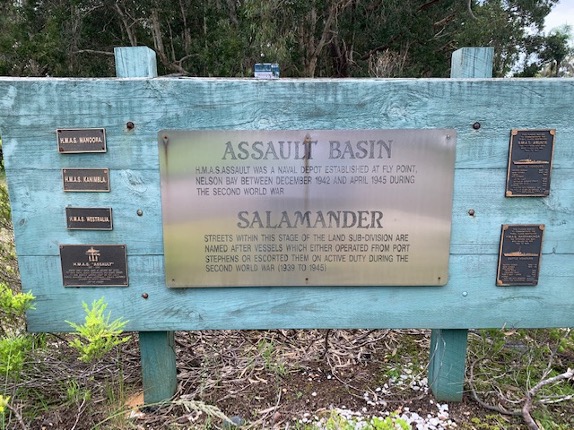
The Salamander Bay Memorial [Author photo].
The main plaque reads:
‘ASSAULT BASIN
HMAS ASSAULT WAS A NAVAL DEPOT ESTABLISHED AT FLY POINT,
NELSON BAY BETWEEN DECEMBER 1942 AND APRIL 1945 DURING
THE SECOND WORLD WAR
SALAMANDER
STREETS WITHIIN THIS STAGE OF THE LAND SUB-DIVISION ARE
NAMED AFTER VESSELS WHICH EITHER OPERATED FROM PORT
STEPHENS OR ESCORTED THEM ON ACTIVE DUTY DURING THE
SECOND WORLD WAR (1939 TO 1945)’
A second plaque reads:
‘HMAS ASSAULT
1942 – 1945
WHICH WAS A NAVAL BEACH COMMANDOS AND BOATS CREWS
TO MAN ASSAULT LANDING CRAFT ON THE L.S.I.’S
ENGAGED IN PACIFIC CAMPAIGNS
LEST WE FORGET’
There are five small plaques commemorating the following ships:
‘HMAS ARUNTA; HMAS WARRAMUNGA; HMAS MANOORA; HMAS KANIMBLA;
HMAS WESTRALIA’
PROPOSED SALE OF PORTION OF FLY POINT FOR RESIDENTIAL ALLOTMENTS
In the 1950’s, an area of Fly Point was subdivided for housing but local opposition managed to save the area for parkland. The subdivision utilised the existing road pattern from the military base but renamed all the roads.

Road names and allotments of the proposed residential development at Fly Point. The original military road names were replaced.
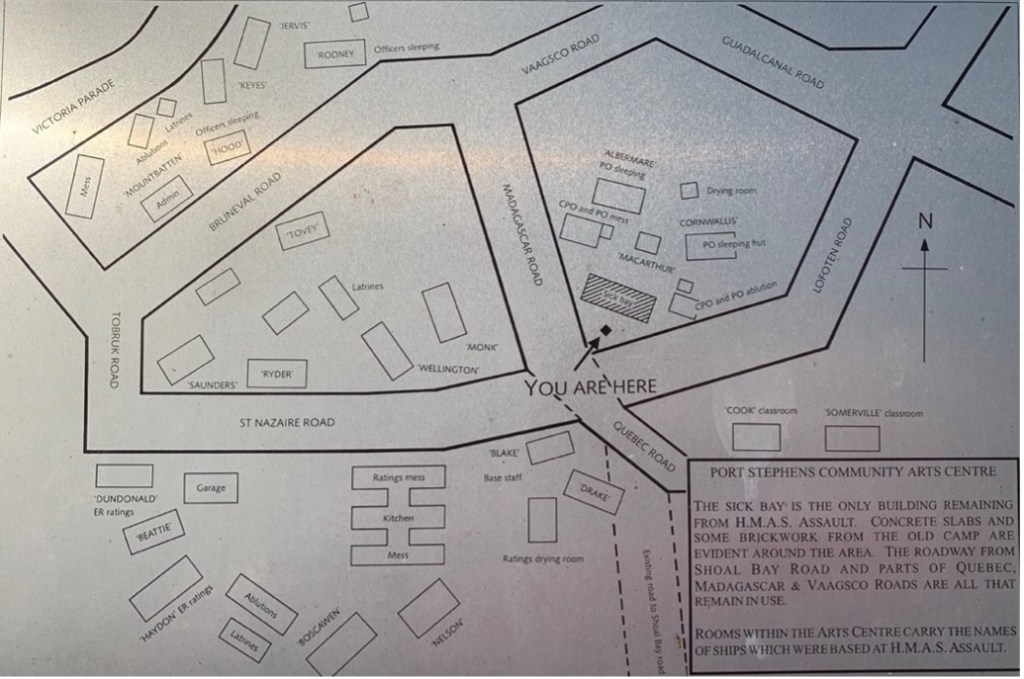
The above map of the military camp, which is displayed outside the Port Stephens Community Arts Centre (formerly the HMAS Assault sick bay building), showing many of the former streets, and buildings.
CONCLUDING COMMENTS
Much of the area previously occupied by HMAS Assault Military Camp and the later the Nelson Bay Migrant Camp is now the site of the Fly Point Nature Reserve.
Visitors can walk over various trails surrounded by native vegetation to obtain a perspective of the size and topography of the site. Numerous building remains are evident but they are generally in state of decline as no conservation works have been undertaken to preserve them.
Researched and compiled by Kevin McGuinness
June 2022

 Port Stephens - a history exploration