
Introduction
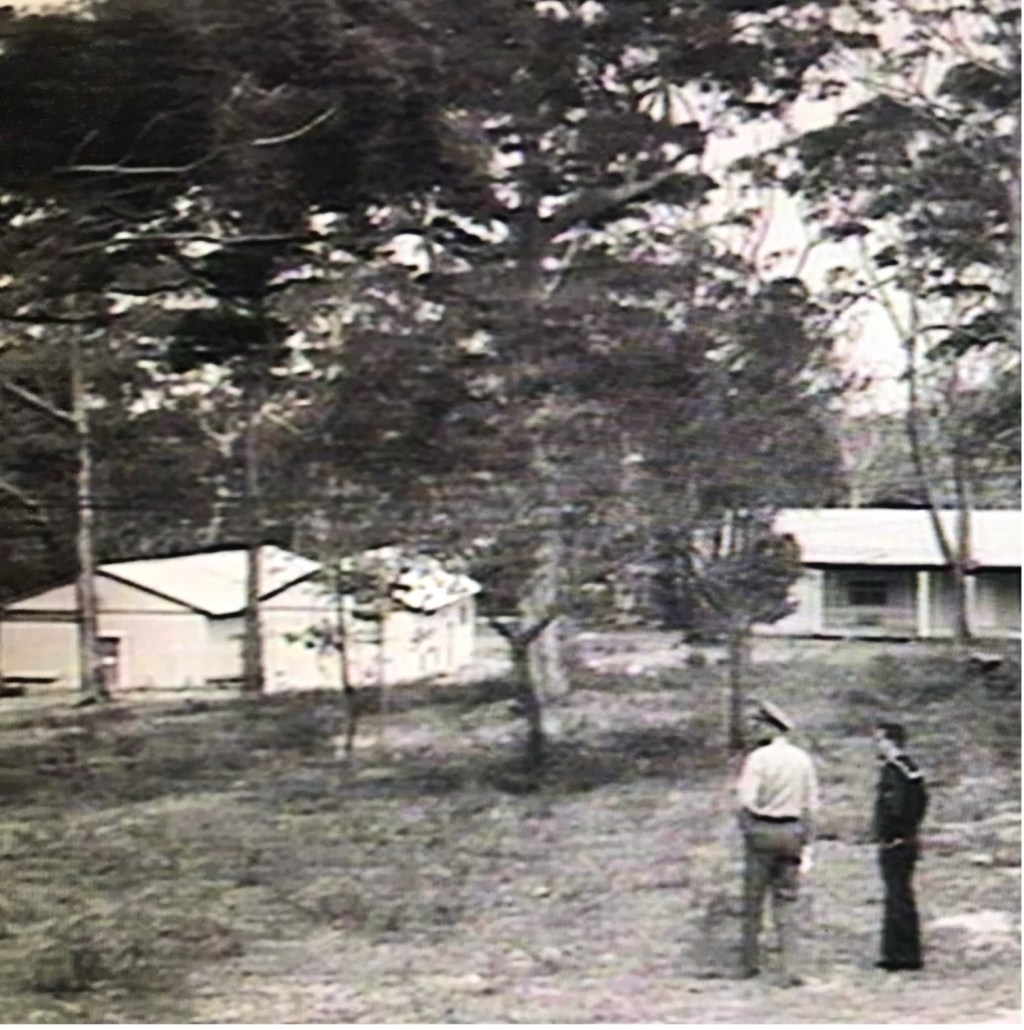
In 1942, under the auspices of a Joint Overseas Operational Training School (JOOTS), the Australian and United States Governments established a combined amphibious training facility for miliary personnel from both countries to prepare them for joint service in the Pacific region, as the Second World War encroached.
The site chosen was the Fly Point area of Nelson Bay at Port Stephens. It was ideally located close to numerous beaches and well as the calmer waters of Port Stephens, where troop landings and boat skills could be taught.
On 1 September 1942, the Royal Australian Navy commissioned HMAS Assault as the main base at Fly Point. See also HMAS Assault and JOOTS.
Adjacent to this site, United States Navy established their own base, Landing Force Equipment Depot of the Seventh Amphibious Force.
The United States Army also established an Amphibious Training Centre [ATC] at Gan Gan for both Australian and American service personnel. The Gan Gan training facility was situated about four kilometres from Nelson Bay.
The following map shows the locations of the three military establishments:
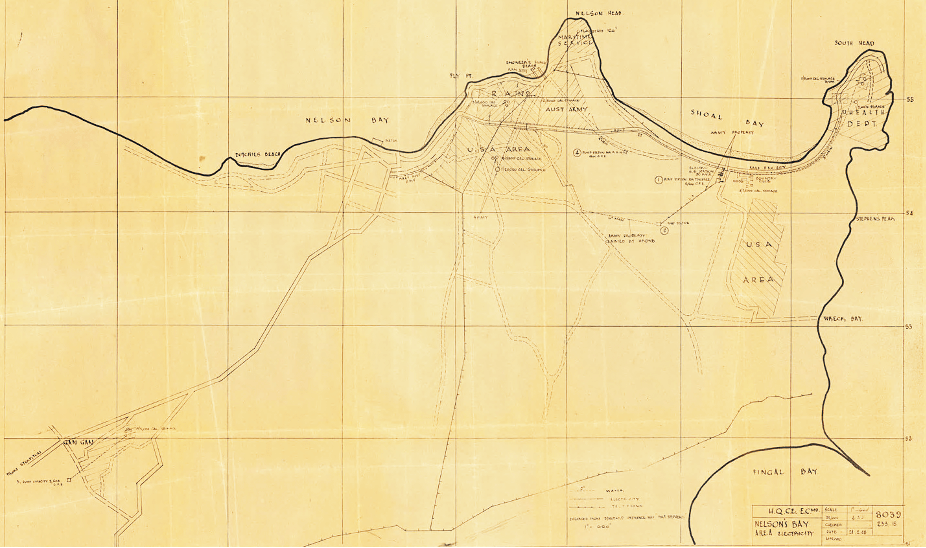
Map dated 24 February 1948 showing locations of HMAS Assault marked as R.A.N; U.S.A. area occupied by the United States Landing Force Equipment Depot; and Gan Gan (at the bottom left of the map) [University of Newcastle Library – Living Histories Collection].
The American National Archives holds Department of Navy Records.
One such record of a War Diary maintained by the Landing Force Equipment Depot of the Seventh Amphibious Force [LFED] is reproduced, in the majority, as below, with the addition of some relevant photos.
It covers the period, 27 May 1943 to 13 August 1943, reporting on the activity at the depot at Fly Point, adjacent to HMAS Assault and outlines the problems encountered.
The diary also provides an insight into the close working relationship between the American and Australian forces.
AMERICAN WAR DIARY EXTRACT- 27 MAY 1943 to 13 AUGUST 1943
STATION PERSONNEL: 27 May 1943 to 29 May 1943 inclusive.
On 27 May 1943, Captain J. W. Jamison, USN, reported aboard and assumed Command. At that time the station personnel consisted of 42 Officers and 443 Enlisted Men.
The Roster of Officers and their duties were listed thereafter.
MEDICAL DATA:
Details of patients in the hospital were listed thereafter.
On 24 May 1943 an RAAF flying boat (Catalina Type) crashed, killing seven, all RAAF Personnel. At the request of ‘HMAS Assault’, our ambulance was employed was employed to take the injured to their dispensary and two of the bodies to our hospital. One of the huts in the Hospital area was used as a morgue.
The services of Lieut. Maynard C. Nelson, (MC) V-(S), UNNR, were also enlisted by the ‘HMAS Assault’. He performed two operations on the injured men, both of which were successful. It was also necessary for this activity to furnish some equipment and medical supplies to the ‘Assault’ dispensary before the initial surgical operation could be performed.
The Personnel and equipment of this Depot have been offered to the ‘Assault’ to assist in any way in the recovery of the other five bodies, but we have been informed our services will not be needed.
CONSTRUCTION: 27 May 1943 to 29 May 1943, inclusive.
Officers mess hall completed with the exception of hanging doors, painting and placing trim.
Inside plumbing, electrical wiring and painting was continued in the hospital area.
Civilian workers completed the installation of hot water in two of the enlisted men’s huts. Officers’ ablution hut was temporarily connected to men’s head for hot water. The effluent line from sewerage treatment tank was completed. As soon as the weir, over which the effluent from the tank flows, can be checked for elevation, the sewerage disposal plant will be in operation.
Work continued on the pier at Engineer’s Beach [present day Little Beach] with the placing of stringers and cross-bracing on the piles driven. Considerable difficulty has been encountered in obtaining heavy timbers. Ten piles and two dolphins, each consisting of five piles, are yet to be driven.
Thirty yards of concrete were poured for the deck of the new 40 x 100 supply building.
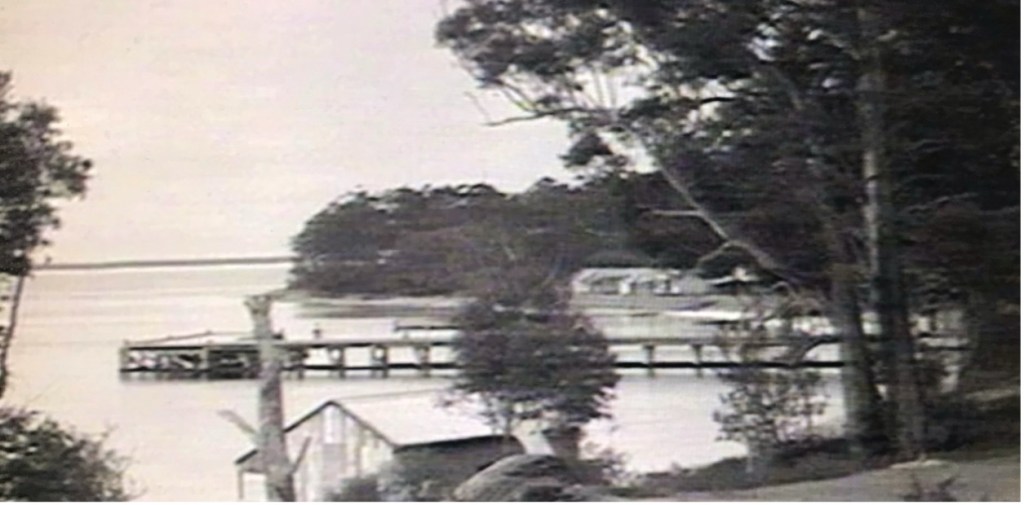
Pier built at Engineers’ Beach [now Little Beach] by the American military.
BOAT REPORT: 27 May 1943 to 29 May 1943, inclusive.
Details of boat statistics were listed thereafter.
On 17 May 1943, LCI [Landing Craft Infantry] no. 227 drifted on to the beach at Shoal Bay and during the week a large percentage of the personnel and equipment of this Depot continued to be employed in salvage operations, conducted day and night.
BOAT OPERATIONS: 27 May 1943 to 29 May 1943, inclusive
Salvage operations continued on LCI No. 227 and on (1) L.C.P.R. and (1) L.C.V.
Indoctrination and training of new boat crews.
STATION PERSONNEL: 27 May 1943 to 29 May 1943, inclusive.
During this period the receipt exceeded the transfers. On 30 May 1943, the balance of Standard Landing Craft, Unit No. 4, consisting of 5 officers and 95 enlisted men, and of Standard Landing Craft, unit No. 5, consisting of 11 officers and 290 enlisted men reported for duty.
On 5 June 1943, the Census of the Station was 60 officers and 216 enlisted men. This figure included officers away on temporary duty.
Details of the roster of officers reporting on 30 May 1943 and duties assigned them were listed thereafter.
Boat officers were assigned additional duties as assistants to the Chief Censor.
All new hands have been assigned duties and the process of orientation is well under way.
Details of officers who left the station on temporary duties were listed thereafter.
MEDICAL DATA: 30 May 1943 to 5 June 1943, inclusive.
Statistics of US Navy, US Army and Australian Army patients were listed hereafter.
The arrival of Units from the 23rd Division of the US Army required the turning over of huts to the Hospital Unit in order to accommodate Malaria cases. Four huts of twenty men were vacated and personnel placed in tents. These huts were immediately filled to capacity with patients.
CONSTRUCTION: 30 May 1943 to 5 June 1943, inclusive.
Work continued on the pier at Engineers Beach [present day Little Beach].
The concrete deck for the new 40 x 100 supply building was completed.
Three new Quonset huts were erected to house additional personnel and the Armory.
Officers mess hall was completed.
Plumbing and painting continued in the Hospital area.
Improved weather conditions allowed acceleration of construction work.

Examples of Quonset Huts
BOAT REPORT: 30 May 1943 to 5 June 1943, inclusive.
Statistics of boat movements were listed hereafter.
BOAT OPERATIONS: 30 May 1943 to 5 June 1943, inclusive
30 May 1943 to 5 June 1943, inclusive, indoctrination and training new boat officers and crews, L.C.P. – LC.V. – L.C.M.
4 June 1943, battalion landing demonstration in conjunction with the 18th Australian Demonstration Battalion. (5 June 1943, boat clean up and repair.)
31 May 1943. The following is a summary of, and also adds to, information relative to the history of the Station, as of this date.
CLIMATE: Since 19 May 1943 there has been considerable rainfall, in some instances amounting to as much as 2 1/2/ inches in a 24-hour period. Although the drainage has been in most places adequate, water is now standing in a low area at the edge of the Dispensary, at the north and east edge of the camp. The presence of this standing water is not considered detrimental to health at this time, but mention has been made of it to the Engineering Officer with the idea of having it drained. Drainage should not be difficult.
With the advent of the rains there has been considerable drop in the temperature both day and night. This has been associated, in many instances with a cold, westerly wind. Temperature at night has been recorded as low as 42 degrees. The Natives of this area state that even colder weather is to be anticipated.
With this in mind it seems probable that steps should be taken to provide heat for the living, eating, recreational, and hospital facilities of both Officers and men. Various types of heaters have been studied and it is thought that coke stoves will provide the best source of heat for the majority of the buildings with the exception of the hospital and Officers living quarters, where electric heat is essential.
Our present electrical supply is not adequate for this purpose. The existing Australian supply is adequate. The problem arises as to whether it would be better to augment our own supply, which is adequate, cheaper, and does not involve the use of precious diesel fuel. It the latter plan is adopted our generator would be used for an emergency stand by source of electricity.
In any event, heating of the dispensary, particularly the operating room (in which thermostatically controlled, electric heat has already been installed), the surgical wards and the wards to be used for the treatment of patients with upper respiratory disease is thought to be essential.
HOUSING: 19 Quonset huts are completed, none under construction. The present plan calls for a total of twenty-three Quonset huts to house 506 men.
The galley, already constructed of wood frame and transits with a rough cement deck, is considered to be inadequate for the feeding of the present number of personnel. This fact arises not from the size of the structure itself, but from the equipment therein, notably the lack of steam tables and steam jacketed copper cooking kettles. It is understood that every effort is being made to purchase this equipment and so rectify the condition.
One building housing officers is completed and another under construction. The Officers Mess and Wardroom is 98% complete.
There are at present 20 officers and 340 men who are living in portable houses at Fly Point (the original temporary camp for L.F.E.D.) or in tents scattered throughout the area both in the new and old camps. When new construction is complete all officers and all but a few men will be housed in semi-permanent buildings.
TOILET AND BATHING FACILITIES
A description of the toilet and bathing facilities were set out hereafter.
WATER SUPPLY: This camp still uses the HMAS Assault water supply. Our own supply has not been connected although it is within a quarter of a mile of our tanks. The reason for this is not fully understood, but the representative of the water department states, “water will be available in 10 days”. The supply seems to be adequate.

Water Tanks erected at the American base.
DISPOSAL OF SEWERAGE, REFUSE AND GARBAGE: Sewerage disposal is still carried into the bay through a temporary pipe. The septic tank is still under construction. Refuse is burned and garbage is removed by a civilian; tin cans are flattened, put in sacks, and dumped at sea.
MEDICAL SUPPLIES AND FACILITIES: Medical and surgical supplies are considered adequate with the exception of supplies of quinine, and intravenous quinine hydrochloride, and intramuscular stabrine mucinate. The influx of a division of U.S. Army. one third of whom have been in New Guinea, brings up the question as to whether our present meagre supplies of oral quinine and stabrine are adequate. Steps have been taken through District Contracts Board to acquire a supply of the intravenous and intramuscular types.
It is felt that the treatment of acute Malarial patients in tents in this climate is unwise. We are therefore prepared to use our facilities for the hospitalisation of such Army personnel as are considered ill enough to require it.
The Commanding Officer has authorised the expansion of the existing facilities, if necessary, by the use of two new Quonset huts now under construction in close proximity to the head facilities and dispensary proper. Arrangements have been made to draw Army personnel and equipment to help in caring for their additional patients if the circumstances should warrant it.
At the present time the following buildings are completed and operating. One dispensary, three ten-bed ward, one operating room, one administration building, one dentistry building, and one storeroom. In addition, the pharmacy, laboratory, and X-ray department will be completed in approximately a week, and two more wards will be ready in approximately a week at which time all units of the hospital should be functioning smoothly.
GENERAL HYGIENE CONDITIONS: The general hygiene and sanitation of the camp is improving. Much construction is still in progress and with the completion of construction still further improvement is to be anticipated.
NAVY RATION: The quantity, variety and preparation of the food is considered to be excellent. Fresh provisions some from Newcastle and are inspected daily on their arrival by a member of the medical staff. There have no serious illnesses which could be traced directly to unsanitary conditions existing in the sources of supply, or in the transportation of supplies.
RECREATION: There are no recreation facilities of any type available at present. Homer I. Smothers, a representative of the American Red Cross is stationed at the camp and reports that funds are available to be used for the construction of a recreation hall within the very near future.
MORALE: In spite of the fact that living condition cannot be maintained at the desired level until further construction is completed, from information gathered at all available sources, the morale of the station personnel, seems to be good.
STATION PERSONNEL: 6 June 1943 to 12 June 1943, inclusive.
There was very little variance in station personnel. The receipts slightly exceeded the transfers.
Various personnel changes were listed hereafter.
The station census on 12 June 1943 was 61 officers and 820 enlisted men. This figure includes officers away on temporary duties.
MEDICAL DATA: 6 June 1943 to 12 June 1943, inclusive.
Medical statistics were set out hereafter.
The hospital unit continues to handle capacity recurrent malaria cases from the 32nd Division, U.S. Army. As of 12 June 1943, they have treated a total of 106, of which 64 ate at present still hospitalised.
CONSTRUCTION: 6 June 1943 to 12 June 1943, inclusive.
Construction work on crew’s living quarters and the supply warehouse continued but has been hindered by the large amount of construction equipment tied up in connection with salvage of LCI No. 227.
All possible assistance in material and personnel is being provided Service Force Personnel in charge of these salvage operations. It is expected that these operations should be concluded by the twentieth of this month.
BOAT REPORT: 6 June 1943 to 12 June 1943, inclusive.
Details of boat statistics were listed thereafter.
Lack of spare parts and heavy use of landing craft attached to this activity has created a serious maintenance problem. In order to meet training demands it has been necessary to work continuous night shifts in both the machine and carpenter shops.
The ‘H.M.A.S. Manoora’ requested 10 LCV’s to replace craft out of commission. This loan was made in order to facilitate transport training. The disabled ‘Manoora’ craft are on our beach and are being repaired in the main by our personnel.
BOAT OPERATIONS: 6 June 1943 to 12 June 1942, inclusive.
Details of training activities were listed hereafter.
STATION PERSONNEL: 13 June 1943 to 19 June 1943, inclusive
During this period, there was very little change in station personnel. The receipts exceeded the transfers.
16 June 1943, Commander Crary Oswald Grattan, D-V(G), UNNR, reported aboard for temporary Duty.
The station census on 19 June 1943, was 62 officers and 830 enlisted men. This figure includes officers away on temporary duty.
MEDICAL DATA: 13 June 1943 to 19 June 1943, inclusive.
Details of patients in the hospital were listed thereafter.
As of 19 June 1943, seventy malaria cases were under care by our hospital unit.
CONSTRUCTION: 13 June 1943 to 19 June 1943, inclusive.
Work continues on the 40′ x 100′ supply hut, the running of water line to the pier at Engineers Beach [present day Little Beach] , and the sewer line connecting the Administration Building.
BOAT REPORT: 13 June 1943 to 19 June 1943, inclusive.
Details of boat statistics were listed thereafter.
BOAT OPERATIONS: 13 June 1943 to 19 June 1943, inclusive.
Details of boat movements and training were listed thereafter.
RECREATION: 13 June 1943 to 19 June 1943, inclusive.
On Tuesday, 15 June 1943, a canteen, serving draught beer only, was opened for the men and has been very successful. A committee headed by a Chief Petty Officer is in charge of its administration, reporting to the Personnel Officer. The canteen is open from 1830 to 2115 daily.
DESTRUCTION OF SURGERY HUT BY FIRE:
On 19 June 1943 between the hours of 0430 and 0515, the Surgery Quonset Hut was destroyed by fire. With the exception of the operating table all equipment was a total loss. Origin of the fire is unknown but in all probability was due to electrical wiring. A complete report is being made.
Construction of a new Surgery Building was commenced immediately and provided equipment is available will be ready in two week’s time.
On 19 June 1943 at 2030, KCI No. 227 was reported off the beach. These salvage operations caused considerable drain on station personnel and equipment and the successful completion of salvage operations will release needed personnel and equipment for other purposes.
STATION PERSONNEL: 20 June 1943 to 26 June 1943, inclusive, was reduced greatly due to transfer of Standard Landing Craft, Unit No, 4 on 22 June 1943, consisting of 13 officers and 319 enlisted men.
20 June 1941, Lt. (jg) Fred Holcomb, USN, temporary duty completed. detached.
Details of Standard Landing Craft officers and changes to assigned duties were listed hereafter.
The station census on 26 June 1943 consisted of 47 officers and 417 enlisted men.
MEDICAL DATA: 20 June 1943 to 26 June 1943, inclusive.
Details of patients in the hospital were listed thereafter.
The Hospital Unit at the end of the week was caring for 75 recurrent malaria cases for the 32nd Division of the US Army.
CONSTRUCTION: 20 June 1943 to 26 June 1943, inclusive.
Third refrigerator unit for galley placed on slab. Generator is being installed.
Water line extended to sewerage disposal plant. This water line enabled the plant to be cleaned daily.
Two 50 K.W. Generators put in place on slab for generating plant in Hospital Unit.
Five hundred feet of sewer reticulation line, 6″ diameter completed during past week. Two manholes of this length yet to complete.
Pier at Engineers Beach about 90% complete.
Surgery building under construction, 40% complete. Plumbing fixtures being installed as fast as building permits.
Foundation started for Red Cross Hut. Work being done by volunteer US Army personnel. There are no naval personnel available at this time.
BOAT REPORT: 20 June 1943 to 26 June 1943, inclusive.
Details of boat statistics are listed thereafter.
The intensive training programme continued to make inroads on boat availability, as indicated in the above boat report. The HMAS ‘Manoora’ has first call on all of our boats and their boat casualties have been heavy. Our artificers have by necessity had to do a good portion of their repair work in addition to our own. The weeks training again indicated the need for additional headquarters personnel to assist in carrying the load of boat repair and station upkeep.
BOAT OPERATIONS: 20 June 1943 to 26 June 1943, inclusive.
Details of boat movements and training were listed thereafter.
STATION PERSONNEL: 27 June 1943 to 3 July 1943, inclusive.
No change in officer personnel. Very little change in enlisted personnel. The receipts slightly exceeded the transfers.
The station census on 3 July 1943 consisted of 47 officers and 423 enlisted men. This figure included officers away on temporary duty.
MEDICAL DATA: 27 June 1943 to 3 July 1943, inclusive.
Details of patients in the hospital listed thereafter.
CONSTRUCTION: 27 June 1943 to 3 July 1943, inclusive.
Construction of the surgery building is about 95 percent complete. Electricians will be through in about a day. Plumbing has been installed.
About 500 feet of water line was installed. Water to head in Administration Building is ready to be connected.
One crew hut was completed.
Pier in Engineer’s Bay complete, except for trim.
Red Cross Hut foundation complete. Foot joists 50 percent complete. Work stopped due to lack of help.
Linoleum layed in dispensary and dental office. Two wards painted.
BOAT REPORT: 27 June 1943 to 3 July 1943, inclusive
Details of boat statistics were listed thereafter.
At the conclusion of training on Wednesday, 30 June 1943, a concentrated effort was initiated to repair and condition all craft attached to this activity. Of the craft loaned to the ‘Manora’ only four were returned in service. Lack of spares has of course made the repair and maintenance problem a most difficult one. However, unless unusually heavy demands for craft from the ‘HMAS Manoora’ or ‘HMAS Westralia’, are forthcoming, a sufficient number of the boats for the next period of training will be available.
30 June 1943. The following is a summary of, and also adds to, information relative to the history of the Station, as of this date.
CLIMATE: There has been very little rainfall during the month of June and the temperature has remained relatively constant averaging approximately 60 degrees during the day and 40 degrees at night.
HOUSING: Three additional Quonset huts have been built since the last report. At present 381 men are living in Quonset huts and 41 men are living in tents or shacks at the new camp. Eleven officers are still living in shacks at Fly Point. It is estimated that the new officers’ quarters will be ready for occupancy about 14 July. All officers will then be quartered in the new camp in the two buildings assigned to them. All men living quarters are heated by coke stoves and a comfortable temperature is maintained. It is planned that all new living quarters eventually will be similarly heated.
The galley, previously described, is considered adequate for feeding the number of men that are here at present. No additional equipment has been obtained so some cooking is still done on Army field stoves in G.I. cans. These definitely effect the taste of the food cooked therein, and their use should be abandoned with when new equipment can be obtained.
It is planned to replace the present rough galley deck with a smooth cement deck which will be easier to clean. This will be done when men and equipment can be spared from work now in progress.
TOILET AND BATHING FACILITIES:
A description of the toilet and bathing facilities were set out hereafter.
WATER SUPPLY: Water is now being supplied from our own well. The present well is temporary and a permanent well is now under construction. It is estimated that this will be completed in 3 or 4 weeks. Pumping and chlorinating machinery are to be housed in a permanent building now under construction. Due to the influx of Army personnel who are scattered throughout it was thought wise to resume chlorination of the water in our tanks. This method is not entirely satisfactory due to the varying demands on our water supply. It is, however, the only available method, at present.
We are assured by the water department that there is no chance of contamination of our water supply since the Army personnel are so distributed as to not affect the water shed. Bacteriological studies of samples of water taken from the source, the storage tank, and the galley are being done. The reports have not yet been received. The water is superior in taste and appearance to that previously provided to us by the ‘HMAS Assault’. The supply is adequate.
DISPOSAL OF SEWAGE, REFUSE AND GARBAGE: All sewage is emptied into a septic tank which is said to be efficient. The ban on swimming will not be lifted until further studies of this method of sewerage disposal have been made. There has been not change in the method of garbage and refuse disposal.
MEDICAL SUPLIES AND FACILITIES: Medical supplies and equipment are considered adequate with the exception of a few classes 3, 6 and 36 items which were destroyed by a fire which gutted the Surgery building on 19 June 1943. These will be replaced by 10 July 1943.
Atabrine and Quinine, including the intravenous, intramuscular and oral types have been acquired through the Army. Other medications are adequate.
Sine 7 June 1943, we have been caring for the more serious cases of malaria from the 32nd Division. We have also furnished hospital facilities for other types of diseases and injuries occurring in the same group. To date 402 Army personnel have been hospitalised of which 85% have been malaria. Malaria patients who have remained afebrile for three to four days are evacuated to the 118th US Army General Hospital in Sydney.
Four Quonset huts each holding twenty patients have been placed at the disposal of the Medical Department by the Commanding Officer for treatment of these patients. They are situated near the Dispensary proper and near head facilities.
The new Surgery building is 60% complete. Completion date is estimated as 14 July1943. It is of frame and transit construction and consists of two operating rooms 20 by 13 feet and a sterilising room 10 by 20 feet. It will have definite advantages as to ventilation, light and useable space over the previously used Quonset hut.
This activity still cares for all medical treatment and hospitalisation of personnel attached to Amphibious Training Centre at Gan Gan, NSW. From June 1 to June 30, thirty-three Australian Army personnel were hospitalised, and the following number of men were treated at the dispensary. Australian Army personnel: 372 patients seen, comprising a total of 1340 treatments. US personnel: 29 patients seen comprising a total of 33 treatments.
The deck for the hospital diet kitchen has been laid but no further work has been received from the Australian contractors regarding its construction. The construction of the Medical Officers of the Day building has not yet been authorised by the Australian authorities. Lieutenant Wright (EC) USNR is at present trying to expedite this project.
COMMUNICABLE DISEASES: No unusual communicable disease during the month of June.
List of inoculations were listed hereafter.
GENERAL HYGENIC CONDITIONS: They are considered adequate.
NAVY RATION: The quantity, quality and preparation of the food with the exception of the use of G.I. cans for the preparation of certain foods, is considered excellent. There have been no changes in the source of supply.
RECREATION: The new recreation hall is now under construction by Army personnel. No date has been set for its completion.
MORALE: The morale of the Station personnel continues good.
STATION PERSONNEL, 4 July 1943 to 10 July 1943, inclusive.
No change in Officer personnel. Very little change in Enlisted men. The figure included Officers away on temporary duty.
MEDICAL DATA, 4 July 1943 to 10 July 1943, inclusive.
Details of patients in the hospital were listed thereafter.
CONSTRUCTION, 4 July 1943 to 10 July 1943, inclusive.
New surgery painted inside.
Telephone booth and office completed on new pier at Engineer’s Beach.
Light and power on pier about 75 per cent complete. Pier completed.
Marine railway started at Engineer’s Beach. Toilets in ward for hospital unit 80 per cent complete.
Grease pit at motor pool completed. Work done by men assigned to motor pool.
B.O.Q. No. 2, 95 per cent completed.
468 feet of water line extended to new pier. Work done by civilian force.
BOAT REPORT, 4 July 1943 to 10 July 1943, inclusive.
Details of boat statistics were listed thereafter.
BOAT OPERATIONS, 4 July 1943 to 10 July 1943, inclusive.
Details of boat movements and training are listed thereafter.
During the week troops engaged in battalion landing exercises were embarked into boats over the side of an APC tied up to our new pier at Engineer’s Beach. Prior to this time it was necessary to embark them direct from the beach. The experiment proved to be successful and of value to the troops and this operation will be incorporated in our regular training programme.
MILITARY RELATIONS: On 8 July 1943, a number of Australian Army Officers as well as other Officer Personnel from ATC at Gan Gan were invited to a dinner at the Officers Mess. The purpose of the dinner was to promote a better acquaintance between the Officers of L.F.E.D. and those at ATC. This is highly desirable as a close working relationship must be carried on between the two stations. The dinner was very successful, and it is planned to have others in the future with Officers from HMAS ASSAULT as our guests.
In this connection, various US Army personnel have been guests of the mess. In connection with Boat Operations there has been close cooperation between Army and Navy personnel which has led to a very satisfactory training programme.
STATION PERSONNEL, 11 July 1943 to 17 July 1943, inclusive.
Details of various personnel movements were listed thereafter.
There was very little change in enlisted personnel. The transfers slightly exceeded the receipts.
The Station Census on 17 July 1943, was 47 Officers and 405 Enlisted men. This figure includes Officers away on temporary duty.
MEDICAL DATA, 11 July 1943 to 17 July 1943, inclusive.
Details of patients in the hospital listed thereafter.
CONSTRUCTION, 11 July 1943 to 17 July 1943, inclusive.
Excellent progress was made by the Australian Army Engineers on the construction of the marine railway at Engineer’s Beach. Seventeen wooden piles were driven and approximately 200 feet of stringers were placed, ready for the rails. Work was also initiated by the Australian engineers for the driving of seven piles of Varney Pier to be used as fenders for small boats coming along-side.
Civilians continued on the construction of a pump house at the water supply wells. No well points were driven. Work continued on the extension of the water line to the end of Varney Pier. Progress has been slow.
Station personnel completes B.O.Q. No. 2 on 14 July. Construction is approximately 50 per cent complete on the refrigeration building. A small amount of work was accomplished on the recreation hall with the laying of joists and decking.
The installation of lights on Varney Pier was completed. A temporary line was run to the American Army Camp for lighting ten tents in the administration area.
BOAT OPERATIONS: 11 July 1943 to 17 July 1943, inclusive.
Details of boat movements and training are listed thereafter.
STATION PERSONNEL: 18 July 1943 to 24 July 1943, inclusive.
The detaching of Ensigns, Horak, Gips and Root for temporary duty elsewhere caused a further shortage of Boat Officers than already existed and some readjustment of officer personnel was necessary in order to maintain the greatest emphasis on operations. To alleviate this shortage, on 19 July 1943, Lt (jg) J. A. Andrews, USNR, was made assistant Operations Officer to aid as Beach Master, and to take over the Control Boat. This change permitted the use of Boat Officers at all times in the Boats. Occasionally it had been necessary to use them as Beach Masters. During the time Lt (jg) J. A. Andrews, UNNR, was in the Control Boat, the best Coxswains, under his guidance, were used as Wave Commanders.
The Boat Officers available were used constantly in both day and night operations. It likewise made available as Wave Commander, a Boat Officer that had been used in the Control Boat.
Several personnel changes were listed hereafter.
There was no change in the number of enlisted personnel during this period. On 24 July 1943, the census at the station was 47 Officers and 405 enlisted men. This figure includes officers away on temporary duty.
MEDICAL DATA: 18 July 1943 to 24 July 1943, inclusive.
Details of patients in the hospital were listed thereafter.
CONSTRUCTION: 18 July 1943 to 24 July 1943, inclusive.
The work on the marine railway in Engineer’s Bay continued by the Australian Army Engineers. The underwater section was launched and approximately 250 feet of railway beyond the high water was completed. Also work was started on seven bays for receiving the boats.
Station personnel finished the refrigeration and bakery building except for hanging doors, windows, and painting interior.
Civilians continued work on the Red Cross educational building by completing the framework for roof and walls.
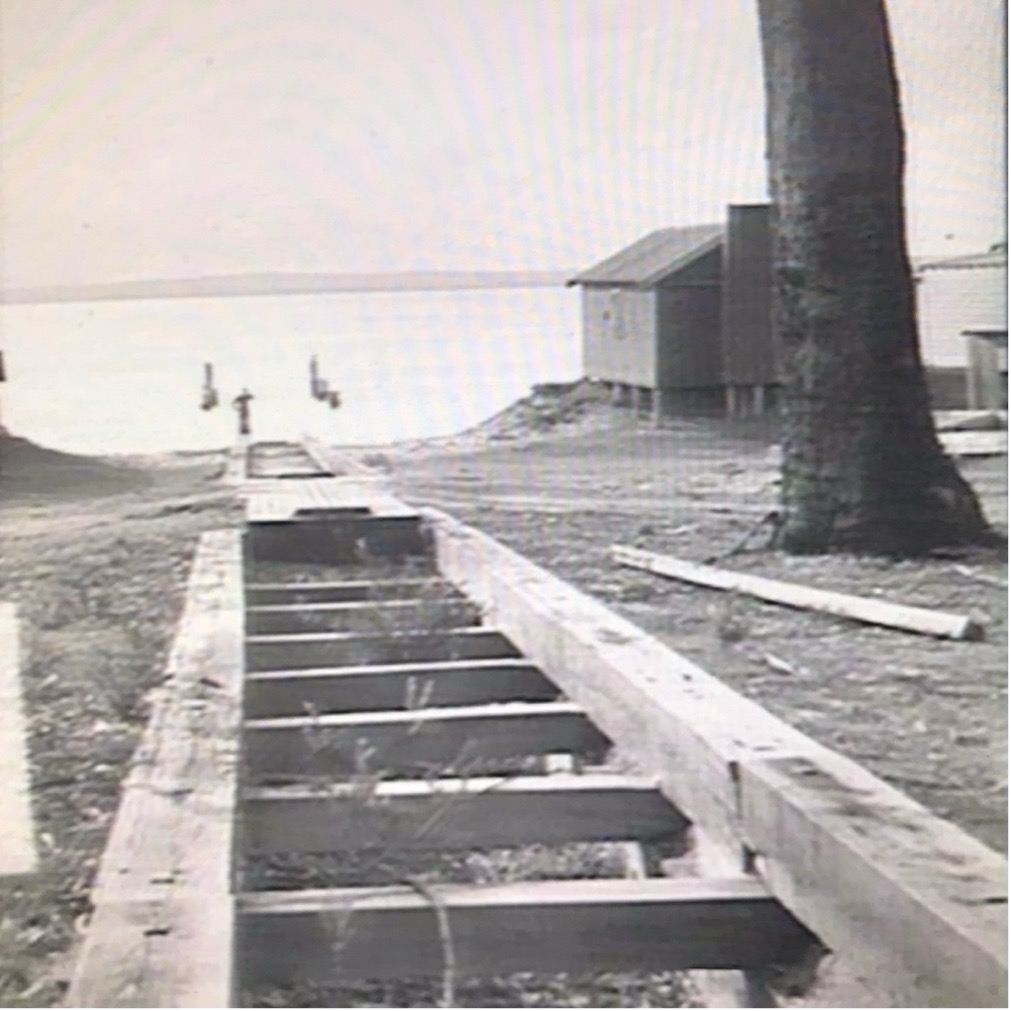
Marine Railway at Engineers’ Beach (now Little Beach) under construction, Nelson Bay.
BOAT REPORT: 18 July 1943 to 24 July 1943, inclusive.
Details of boat statistics were listed thereafter.
BOAT OPERATIONS: 18 July 1943 to 24 July 1943, inclusive.
Details of boat movements and training were listed thereafter.
STATION PERSONNEL: 25 July 1943 to 31 July 1943, inclusive
There was very little change in station personnel during this period. The receipts slightly exceeded the transfers.
The Census of the station on 31 July 1943, was 47 officers and 401 enlisted men. This figure includes the officers away on temporary duty.
MEDICAL DATA: 25 July 1943 to 31 July 1943, inclusive.
Details of patients in the hospital were listed thereafter.
CONSTRUCTION: 25 July 1943 to 31 July 1943, inclusive.
The marine railway in Engineer’s Beach was completed by the Australian Army engineers. Three boat skids were built for use in connection with the railway by station personnel.
Civilian workers continued on the Red Cross educational building. All roofing and siding material and approximately 25% of inside lining was placed.
The refrigeration building was completed by station personnel.
BOAT REPORT: 25 July 1943 to 31 July 1943, inclusive.
Details of boat statistics were listed thereafter.
BOAT OPERATIONS: 25 July 1943 to 31 July 1943, inclusive.
Details of boat movements and training were listed thereafter.
31 July 1943: The following is a summary of, and also adds to, information relative to the history of the Station, as of this date.
CLIMATE: There has been no change in Climate conditions.
HOUSING: There have been completed a total of 20 Quonset huts housing 400 men. All enlisted personnel are living in Quonset huts. The new Officers Quarters are completed, and all officers are living in two buildings assigned to them. No further construction is contemplated. There has been no change in the equipment of the galley.
TOILET AND BATHING FACILITIES: There has been no change.
WATER SUPPLY: Construction of the permanent well has been temporarily abandoned due to the inability on the part of the Water department to secure a motor for the pumping machinery. No estimate is given as to when this motor will be available. In the absence of this machinery no chlorination plant has been installed. Chlorination of the water done manually at our tanks, was continued until 6 July 1943 at which time our supply of Calcium Hypochlorite was exhausted and attempts to obtain additional supplies failed.
On 22 July 1943, reports from our laboratory showed that the water supply was not bacteriologically potable. Lister bags were immediately broken out and all hands cautioned not to drink any water except from the bags. These were emptied, refilled and chlorinated daily using the Ampoules of Calcium hypochlorite furnished for this purpose. The water department was notified, and attempts made to expedite the installation of the chlorination apparatus on the temporary water line. The water department has set 2 August 1943 for the installation of the planet. Until that time the use of lister bags for drinking water will continue. The supply is adequate.
DISPOSAL OF REFUSE, SEWAGE AND GARBAGE. There has been no change.
MEDICAL SUPPLIES AND FACILITIES: All class 3, 6 and 86 items destroyed by fire on 19 June 1943 have been adequately replaced. Supplies and facilities are considered adequate. The new surgery building is completed and has been in operation since 19 July 1943.
This activity still cares for the more severe cases of malaria and all other conditions requiring hospitalisation of personnel of the 32rd Division, U.S. Army. In addition this activity holds sick call and cares for hospitalisation of Officers and men attached to Amphibious Training Centre at Gan Gan, NSW. From 1 July to 31 July, twenty-five Australian Army personnel were hospitalised and the following number of men were treated at the dispensary: Australian Army personnel 388 patients seen, comprising a total of 848 treatments; US personnel 150 patients seen comprising a total of 300 treatments.
COMMUNICABLE DISEASES: No unusual communicable disease during period covered.
List of inoculations were listed hereafter.
GENERAL HYGENIC CONDITIONS: No change.
NAVY RATION: The food continues to be excellent.
RECREATION: On 20 July 1943 the Navy took over the building of the Red Cross recreation building under a land lease plan and construction is now proceeding rapidly. During the month of July three Red Cross workers, Mrs. Keller, Miss Evans and Miss Allen, were assigned to this field. They worked among the hospital patients, lending a hand in any way they possible could.
MORALE: The morale of the Station personnel continues to be good.
STATION PERSONNEL: 1 August 1943 to 7 August 1943, inclusive.
3 August 1943, Commander Frank A. Latham, USN, reported aboard for duty as senior Medical Officer.
There was very little variance in station personnel during this period. The transfers of enlisted personnel slightly exceeded the receipts.
The station census for 7 August 1943 was 48 officers and 407 enlisted men.
MEDICAL DATA: 1 August 1943 to 7 August 1943, inclusive.
Details of patients in the hospital were listed thereafter.
CONSTRUCTION: 1 August 1943 to 7 August 1943, inclusive.
Red Cross educational building was completed by civilian workers.
The Hunter District Water Board installed a chlorinator in the water supply system and also constructed a barbed wire fence around that part of the water shed where the well points and pump house are located.
General maintenance and repair work was performed by station personnel.
BOAT REPORT: 1 August 1943 to 7 August 1943, inclusive.
Details of boat statistics were listed thereafter.
BOAT OPERATIONS: 1 August 1943 to 7 August 1943, inclusive.
Details of boat movements and training were listed thereafter.
STATION PERSONNEL: 8 August 1943 to 14 August 1943, inclusive.
August 8, Ensign William Ramage, Jr., DV(G), USNR and Ensign Frank J. Jaronik, DV(G), USNR, reported aboard for duty. They were assigned duties as Boat Officers.
August 10, 1943, Ensign Robert M. Prestidge, DV(G), UNNR, Detached.
There was no change in enlisted personnel. The Station Census on 14 August 1943 was 49 officers and 407 enlisted men. This figure includes officers away on temporary duty.
MEDICAL DATA: 8 August 1943 to 14 August 1943, inclusive.
Details of patients in the hospital were listed thereafter.
CONSTRUCTION: 8 August 1943 to 14 August 1943, inclusive.
There is no new construction under way or contemplated.
The artificers are occupied with maintenance, repair, and upkeep of structures and landing craft at this station.
BOAT REPAIR: 8 August 1943 to 14 August 1943, inclusive.
Details of boat repairs were listed thereafter.
BOAT OPERATIONS: 8 August 1943 to 14 August 1943, inclusive.
Details of boat movements and training were listed thereafter.
RECREATION: 8 August 1943 to 14 August 1943, inclusive.
Initial plans were made in April between the Personnel Officer of L.F.E.D. and the Field Director of the American Red Cross for the development of a recreational programme commensurate with the needs of the Naval Base. Primarily the plans called for the erection of a recreational building, securing gear and the establishment of American Red Cross Personnel on the Base. It is understood the American Red Cross was to pay for all materials and gear to equip the recreational building and to adequately staff the same. The Navy agreed to procure building materials and erect the structure.
Construction operations began 25 June 1943, and the completion date was 10 August 1943. The delay in operations were due to three factors: weather conditions, a burdensome construction programme and a strenuous military programme. 25% of the initial construction was done by carpenters of the U.S. Army. This arrangement was made by the Field Director as a part of a cooperative force between the two military forces being served by American Red Cross under his assignment. On 20 July the Navy took over and the building was completed under land lease plans.
The building proper is 30 x 80 feet in dimensions. A ten-foot porch running the full length fronts the building. On both ends of the porch 10 x 15-foot rooms are enclosed. One is used for the Red Cross Office and the other for storing and issuing of recreational gear. An addition on one end of the building, 6 x 8 feet houses the toilet facilities on the 1st floor and the projector room is located above. The building is lined, has a 12-foot ceiling and is constructed in such a manner that it can be taken down and re-erected.
The following gear for recreational purpose is either now installed, enroute or ordered to serve the patrons of the recreational building: Piano, radio, movie projector, 4 ping pong tables, 6 folding card tables, 1 pool table, 24 folding writing desks, 236 canvas arm folding chairs, 4 leather upholstered davenports, 24 armchairs to match davenport, numerous table games.
Besides the above, $1000 worth of Navy athletic equipment has been placed in the custodianship of the ARC Field Director.
In addition to H.I. Smothers the Red Cross Field Director on this project, he is assisted by Miss Mandeville and Miss James, who are assigned to replace Mrs. Keller, Miss Evans and Miss Allen.
During the first week a careful check indicated 1315 individuals made use of the building in the following manner: two movies, dedication programme, Protestant and Catholic, Army, Navy church services, freelance recreational activities.
MILITARY RELATIONS: 8 August 1943 to 14 August 1943, inclusive.
On 12 August 1943 the officers from ‘HMAS Assault’, in accordance with a policy earlier developed, as hereinbefore mentioned were invited for dinner as guests of the Officers of L.F.E.D. The dinner was a big success.
Concluding Comments
The War Diary illustrates the massive efforts that the American Navy had to undertake to establish a new military facility in a relatively short time. Once established, the military camp was to have a relatively short life, before the United States transferred their war efforts from Port Stephens to other locations.
A Pictorial History of HMAS Assault – Nelson Bay is found at this link on the website. It provides numerous photos of the combined military facility at Fly Point.
Researched and compiled by Kevin McGuinness
March 2024

 Port Stephens - a history exploration