
Introduction
Following the closure of combined military training at HMAS Assault in August 1944, the facilities at Fly Point and Gan Gan, Port Stephens, were put into caretaker mode.
In April 1945, these facilities were allocated to the Royal Marines attached to the British Pacific Fleet for use as a depot facility.
HMAS Assault was then designated as HMS Assault.
With the end of the Second World War in the Pacific in August 1945, the need for a military presence of the Royal Marines at Port Stephens was no longer required, and their activities were wound down.
While based at Port Stephens, from April 1945 to May 1946, the Royal Marines actively engaged with the Newcastle and surrounding communities. This paper and looks at a number of their activities during this period.
An addendum includes an extract from the diary of Major Alfred Cecil Hood of the Royal Marines covering his time at the Gan Gan Military Camp in 1945 and the subsequent withdrawal of the British troops from Port Stephens.
Royal Marines Participate in Newcastle Procession
The Newcastle Sun of 13 April 1945, page 7, reported:
‘One hundred Royal Marines will head tomorrow’s procession from Pacific Street to the Sports Ground for the crowning of ‘Miss Newcastle’ in the War Memorial Hospital Ward appeal queen competition.
Originally A.I.F. troops were to have led the procession, but when it was announced today that the Royal Marines would participate, pride of place was given to them as the senior service. Approximately 4000 people will form a procession a mile and a half long. Given fine weather, it is believed that the procession and ceremony will be the largest and most colourful seen in Newcastle.
Newsreel cameramen will photograph the procession and ceremony and the newsreels will be shown throughout Australia. One of the highlights of the ceremony at the Sports Ground will be the presenting of arms by the 1400 troops while the National Anthem is being played.’
Royal Marines Billeted at Newcastle Homes
The Newcastle Morning Herald and Miners’ Advocate of 18 April 1945, page 2, reported:
‘So keen was demand for 150 Royal Marines who were being billeted for three days’ leave by Newcastle Hospitality Hut yesterday that many of them were “booked” for homes before they were even inside the hut. When the men arrived, they waited outside the hut while the first batch was allotted to homes. Hostesses, who were also waiting outside, made sure of getting a guest by inviting them home then and there. Armed with names and addresses the men went into the hut. The unorthodox system made the job of Mrs. Steggles and her helpers more difficult, but all such requests were granted. …….
It is expected that for the next few weeks, billets in private homes will have to be provided for 150 men every four days. Yesterday’s arrivals were the first batch to be accommodated.’
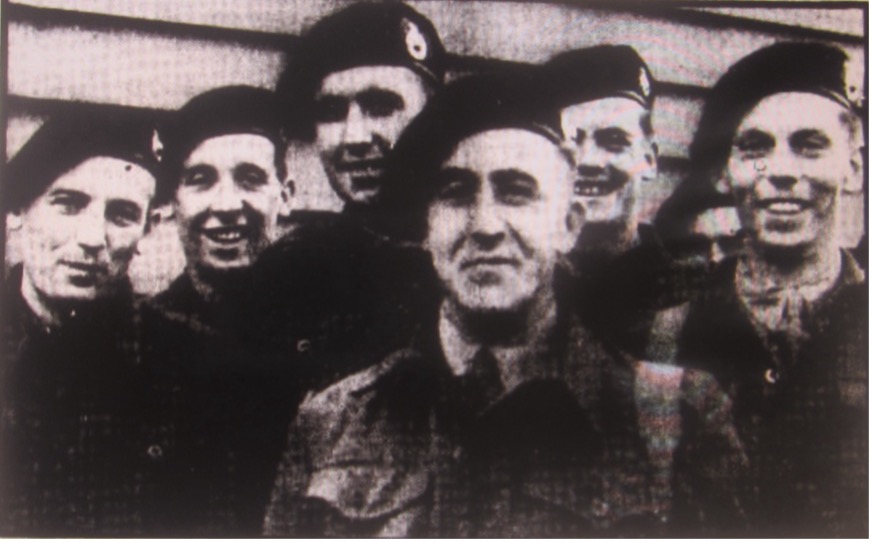
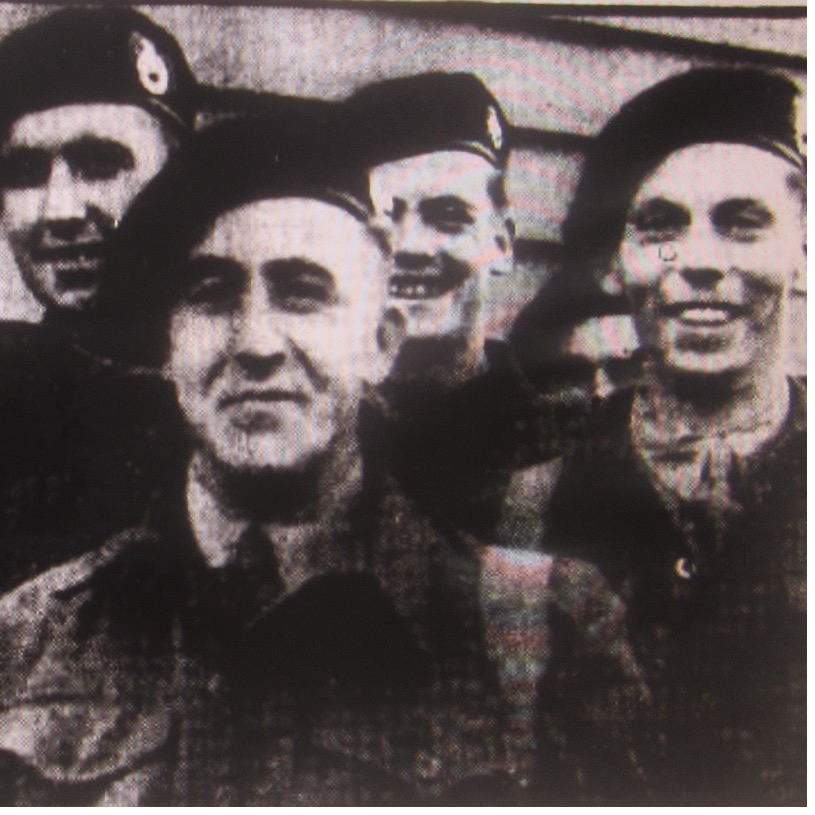
A group of Royal Marines waiting outside the A.C.F. Hospitality Hut before being introduced to their hosts and hostesses with whom they were billeted for three days’ leave [Newcastle Morning Herald and Miners’ Advocate, 18 April 1945]
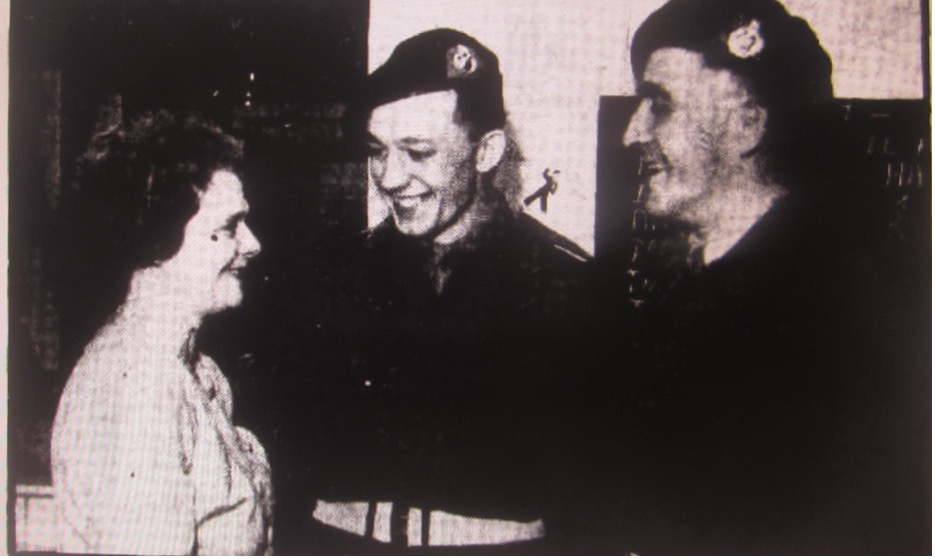
Marines Bill Bignell, from London, and Harry Bertram, from Newcastle-on-Tyne, billeted for three days’ leave, meeting their hostess, Mrs. F. Treasure, at the Hospitality Hut [Newcastle Morning Herald and Miners’ Advocate, 18 April 1945]
Royal Marine Drowned
The Border Morning Mail of 23 April 1945, page 2, reported:
‘A member of the Royal Marines. Leonard Lee, aged 22. was drowned at Ham’s Beach, near Newcastle. With another Marine, Stanley Drake, A. Gilford, of New Lambton, and a young girl, Lee wading in water …. when a swift current swept the four of them out to sea. After a hard struggle, Drake brought Lee ashore where artificial respiration was applied without success. Lee had a brother killed at Dunkirk.’
The Newcastle Morning Herald and Miners’ Advocate of 25 April 1945, page 4, further reported:
‘Leonard Lee, who was accidentally drowned on Sunday, was buried yesterday in Newcastle War Cemetery, Sandgate. A party of Royal Marines formed a guard of honour as the flag-draped casket was carried from a Darby Street funeral parlour to a hearse. Marine Lee’s black beret, white webbing belt and bayonet were on the casket. ……
Some Australian soldiers were among civilians who paid tribute at the cemetery. Led by a padre, the body was carried through rows of white crosses to its last resting place. ….. Marine Lee enlisted on December 3, 1941. He served in France.
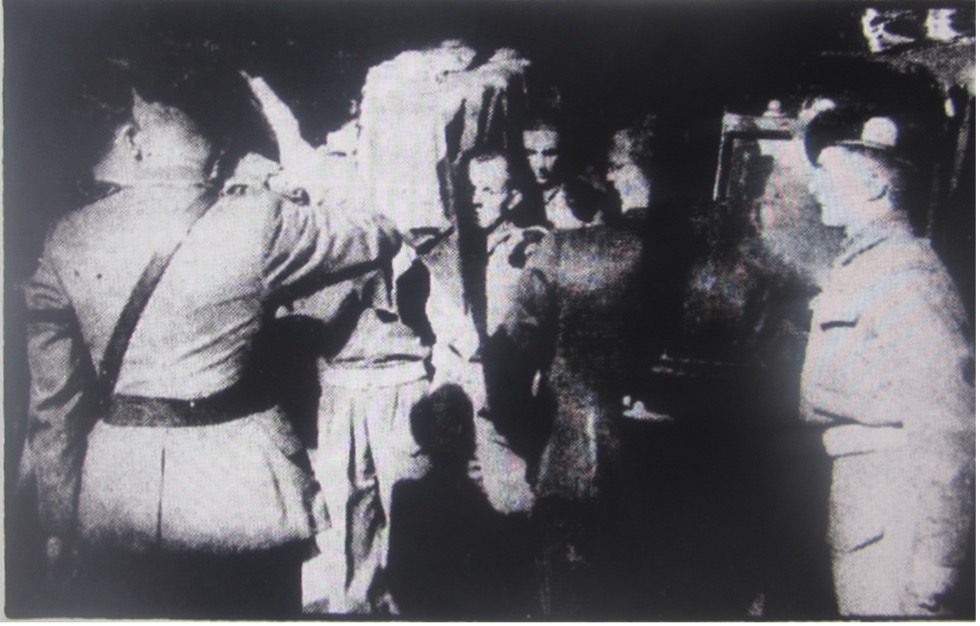
The casket bearing the remains of Leonard Lee leaving a Newcastle funeral parlour [Newcastle Morning Herald and Miners’ Advocate of 25 April 1945]
Royal Marines Participate in Anzac Day Ceremony
The Newcastle Morning Herald and Miners’ Advocate of 26 April 1945, page 1, reported:
‘Displaying the precision for which they are noted, Royal Marines participated in the Anzac Day march in Newcastle. Rain could not quench the spirit which the occasion emphasises. Umbrellas were carried by marching veterans, whose progress through the city was watched by a crowd which also refused to allow the weather to interfere with observance of the day.’
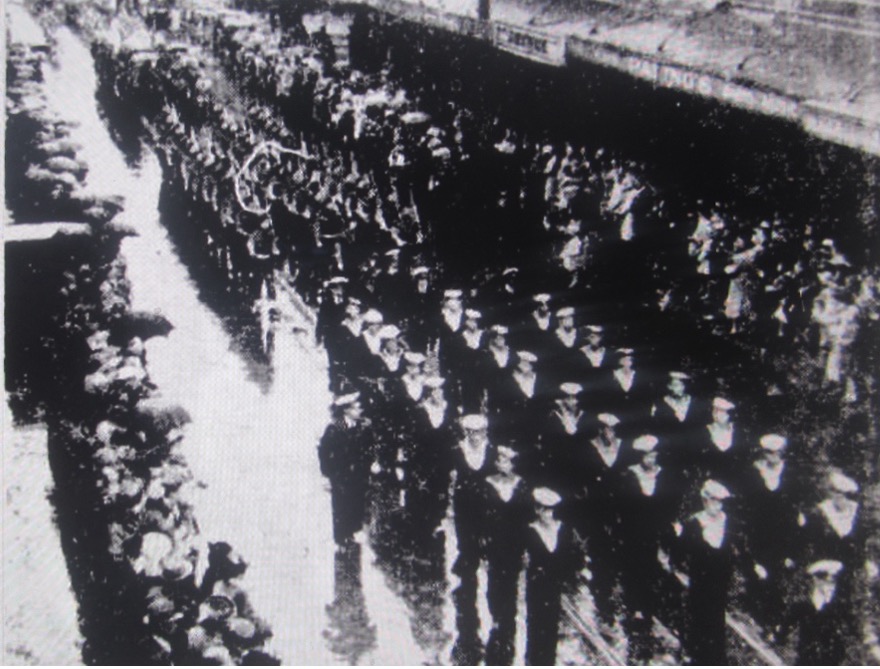
R.A.N. Personnel and a contingent of Royal Marines headed Anzac Day procession through Newcastle city on the march to the Cenotaph [Newcastle Sun of 25 April 1945, page 7]
Royal Marines Visit Newcastle Club
The Newcastle Morning Herald and Miners’ Advocate of 26 April 1945, page 2, reported:
“The hospitality extended to us in Australia has been simply amazing. I have only one reason for wanting to return to England and that is to let the people there know about it and then come back, no doubt with thousands of others,” said Colour Sergeant Prescott of the ‘Royal Marines, at the City Bowling Club yesterday. It was the occasion of the annual competition for the City Bowling Club Anzac trophy confined to the club and the Diggers, when the members of the Returned Soldiers’ League are the guests of the club for the day.’
Newcastle Man Returns with the Royal Marines and a British Empire Medal
The Newcastle Sun of 3 May 1945, page 8, reported:
‘After amazing adventures, Tom Wilkinson, a Newcastle lad, [was] back in Australia as a Royal Marine with the ribbon of the British Empire Medal on his tunic. He twice escaped from prison camps in Italy. Wilkinson joined the Merchant Navy in 1941 and found life a little on the slow side. At least the ship on which he signed on was, for it took six months, owing to breakdowns, to get from Australia to Britain. In Britain he joined the Royal Marines and, after a long spell …. he was sent on a raid on enemy held Tobruk in September, 1942. The destroyer on which he went in was sunk and many of his mates were killed. He was captured and taken across to Italy.
With three other Britons he managed to get into a working parity outside the camp. They collected as much food as they could, then awaited their chance. When it came, they overpowered an Italian officer and corporal properly and left them bound and gagged. ‘We were in British battledress, and we couldn’t ask Italians for food,’ he said. ‘We had to move stealthily and travelled from Bari to the end of the Gulf ‘of Taranto down towards Callabria. The Italians had a reward of £75 out for the capture of each of us. Several coastal patrols sighted us at night, but we got away. But then we ran into one patrol and were recaptured.’
The Italians told them that they were to be shot. The Swiss Red Cross intervened, however, and arranged for their trial. Wilkinson said that he never knew what the charges were, for, before the trial, Italy surrendered and the Germans kept whisking him farther north, throwing him into a cell at every town. While being moved, he escaped by himself at Teramo. He heard that some British prisoners of war and Yugoslav partisans were holding out against the Germans in the mountains not far away, and he tried to get to them. However, the day before he reached them, the British and Yugoslavs, having once driven off the Germans, were attacked by 800 mechanised German infantry, who burnt the village and killed everyone.
Walking alone along a track in the forest, he came upon a deep pit filled with bullet-riddled bodies. Alone he wandered over the countryside, ‘begging, borrowing and stealing food.’ He had acquired some battered clothes by this. He reached the Sengro River and then linked up with two South Africans.
‘For about three weeks we watched the progress of the battles from close to the German lines, waiting for a chance to get through to our troops,’ he added. ‘We were moving with caution among illiterate, ill-clad Italian peasants. We had learnt a smattering of Italian, and by keeping as quiet as possible we passed off as Italians. ‘Then came the time in Piedmont, on the side of a mountain, when we decided that we had to get through to our chaps. We tried to pass through at night, but German machine gun fire directed on the British lines pinned us down. ‘We spent that night sleeping in the German lines. I say sleeping, for we did actually sleep. ‘Then early on December 21, 1943, we were awakened by our own barrage, which was belting hell out of the Germans and incidentally getting pretty close to us.
As the barrage lifted, and with the Jerries still keeping their heads down, we got up and made a dash for it. We reached the positions held by the British paratroopers. ‘We were able to give them valuable information that they wanted about the German positions, with very satisfactory results for our chaps.’ It was for this feat that he was awarded the British Empire Medal.’
Royal Marines Attend Naval Ball
The Newcastle Sun of 24 May 1945, page 11, reported:
‘An officer of the British Royal Marines will receive the debutantes and British Marines will act as their partners at Scott’s staff ‘Navy Ball’ at the City Hall on Wednesday, June 6, proceeds from which will go to the A.C.F. [Australian Comforts Fund]. The ball will be presented with a brilliant decoration scheme, in which a nautical atmosphere will be the highlight.’
Royal Marines at Billeted at Newcastle
The Newcastle Morning Herald and Miners’ Advocate of 9 June 1945, page 8, reported:
‘Most of the 200 Royal Marines billeted with Newcastle citizens last night arrived at the British Centre in King-street on leave in the afternoon drenched to the skin and hungry. ….. The Marines were met by the
Mayor (Ald. Norris) and Secretary of Newcastle branch of the Australian Comforts Fund (Mr. Trebor Edmunds). The women’s committee of the
Ex-Navalmen’s Association arranged billets. Another group of Marines will arrive next Tuesday and Thursday.’
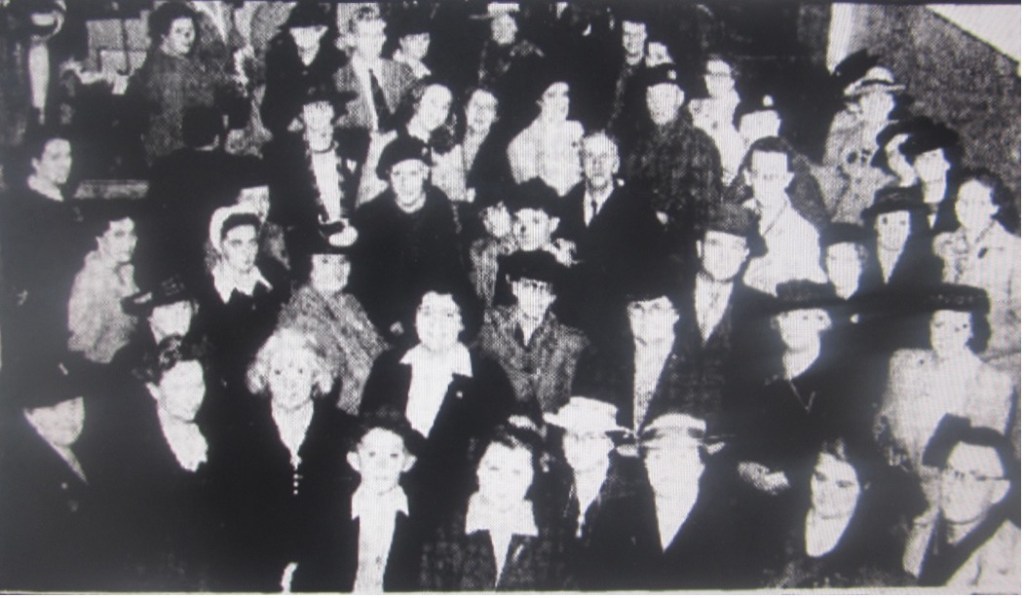
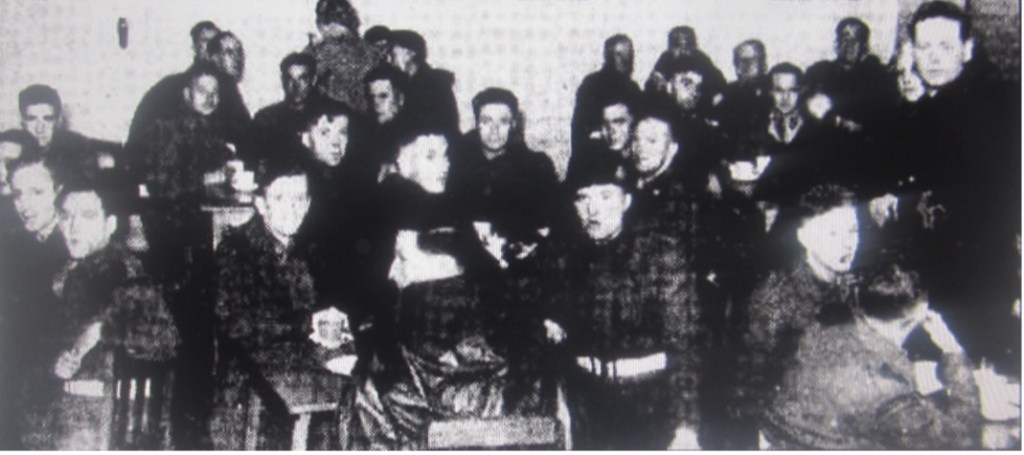
Royal Marines at the British Centre [Newcastle Morning Herald and Miners’ Advocate, 9 June 1945]. Top photo showing people at the Centre waiting to take their billets home. Below, Marines waiting allocation.
Royal Marines Attend Digger’s Ball at Dungog
The Dungog Chronicle of 12 June 1945, page 3, reported:
‘Early hopes for an outstanding Diggers’ Annual Ball were thought to be optimistic but the actual function at the James Theatre on Thursday night turned out to be even better than the optimists hoped for. There was a great crowd — over four hundred — and it included people from all the district centres. In addition, some eighty Servicemen were present, as guests of the Committee. These included the party of British Navy men on leave in the town, and another party of nearly thirty Royal Marines who came over from Port Stephens for the occasion. Added to these were a number of men from the Australian Services who were on leave, and they added up to a parade of martial uniforms such as Dungog has seldom witnessed.’
Three Royal Marines Join Lake Macquarie Soccer Club
The Newcastle Sun of 12 June 1945, page 11, reported:
‘Three Royal Marines, who recently arrived here from overseas have been signed on by Lake Macquarie Soccer Club. They are Marine Charles Potts, a versatile right winger from Chester, Marine F. Urquhart, a junior star from Glasgow, and Lance Corporal Arthur Pratt, from the Crystal Palace Club in London.
Potts will join a northern third division club when he returns home. Urquhart has had one season’s experience in the intermediate league and would have graduated into a first division club only for the intervention of the war. He impressed the crowd at Speers Point on Sunday when the Marines defeated Lake Macquarie by four goals to two. Well-known junior referee, Johnny Walker, said of this Marines’ team that it was the best team he had seen in Australia. On a wet ground they were unbeatable. Before and after the match the Marines were entertained by the Lake Macquarie club. So elated were the players that they have promised to field a stronger combination in a return match to be played at Speers Point on Sunday week.’
Royal Marines Trained as Surf Lifesavers
The Newcastle Sun of 20 June 1945, page 4, reported:
‘Royal Marines, the first visiting servicemen to be trained in lifesaving in Newcastle, will compete for their bronze medallions next Sunday. With an instructor and equipment lent by the Greater Newcastle Council, they began training last Wednesday.
Arrangements to have the men trained were put in hand after the Mayor (Alderman R. Norris) had visited their camp and received inquiries from the Marines about the safety of the nearby beaches. The Deputy Instructor of the Lifesaving Association’s northern branch (Mr. Wilson) was chosen to instruct the men, and equipment was made available by the council. Last Sunday Nobbys rescue and resuscitation team, who are the Northern District champions and also the country champions, went to the camp [at Nelson Bay] to give demonstrations and further instruction to the Marines. Their work was inspected by the Newcastle Branch Superintendent of the Lifesaving Association (Mr. A. Sutherland), the district supervisor of No. 1 zone (Mr. R. ‘Brydon) the president of the Surf Life Saving Association (Mr. C. J. Nightingale) and the Chief Health Officer (Mr. Meddows). ……
There are about 24 men training, Mr. Nightingale said. ‘For all of them it was their first experience of surf in Australia. One of them told me after his first dip in the Pacific that he had now swum in five oceans.’ The men will come to one of the Newcastle beaches next Sunday morning for their examination. Commenting on the readiness with which the project had been taken up, the Mayor paid tribute to the cooperation of the Life-Saving Association and particularly to Nobbys R. and R. team for its demonstration on Sunday.’
Royal Marines Compete in Soccer Competition at Kurri Kurri
The Cessnock Eagle and South Maitland Recorder of 22 June 1945, page 3, reported:
‘O Sunday, at Goold Park, Kurri, a team of Royal Marines will meet the local State League eleven. The game has been, arranged in aid of the club’s injured players’ fund. The English team is yet to be defeated and is claimed to be the best team in the North for a great many years.
Stationed in the Northern area, the players have had a good many matches in recent weeks, and exhibit great teamwork, and the type of football that appeals to Soccer followers. Recently they defeated Lake Macquarie State League team, and three of the players were signed on by that club and played last Saturday, when leaders. Adamstown were forced to a draw. Included in the visiting eleven are players with considerable experience in the Old Country….
The visitors are to be entertained by the club in conjunction with the local committee formed for the entertainment of English Servicemen. A party of 20 will make the visit, and arrangements are being made to billet them in homes of local residents. ….. Arrangements are also being made to entertain the visitors over, the weekend, and they will be taken on a tour of Richmond Main colliery on Sunday morning.’
Royal Marines entertained at Merewether
The Newcastle Sun of 25 June 1945, page 4, reported:
‘The Women’s Auxiliary of the Merewether sub-branch of the R.S.L., assisted by the Younger Set, entertained 50 Royal Marines at tea and a social evening in Merewether School of Arts last night. The president of the sub-branch (Mr. P. W. Rymer) and the president of the Women’s Auxiliary (Mrs. M. Lauder) welcomed the visitors. Warrant-Officer Simmonds responded. A musical programme … was given.’
Royal Marines Compete in Soccer Competition
The Newcastle Sun of 29 June 1945, page 16, reported:
‘Two teams of Royal Marine Engineers from a northern camp will play Lake Macquarie XI at Speers Point on Sunday.’
A Royal Marine Visits Raymond Terrace
The Raymond Terrace Examiner and Lower Hunter and Port Stephens Advertiser of 19 July 1945, page 3, reported:
‘Corp. Alf. Webb, of the Royal Marines from Nelsons Bay is on a visit to Raymond Terrace and is impressed with the locality. He expresses his thanks for the hospitality and kindness he has received from the residents both here and the Port Stephens area. The residents were pleased to see him.’
Royal Marines Qualify as Lifesavers
The Newcastle Morning Herald and Miners’ Advocate of 2 August 1945, page 4, reported:
‘In a mayoral minute to last night meeting of Greater Newcastle Council, Ald. Norris said he had presented 14 surf lifesaving medallions to Royal Marines this week. The Marines qualified as the result of the council making available a qualified instructor. All the men passed the test in three weeks.’
Royal Marines Visit Newcastle Cathedral
The Newcastle Morning Herald and Miners’ Advocate of 6 August 1945, page 4, reported:
‘The 127th anniversary of the first service held in Christ Church was commemorated by a thanksgiving service in the Cathedral yesterday morning. Contingents of the Royal Marines under Major Previte and Lieut. Ridge, attended. Commander Rowland represented the Navy, and the Mayor (Ald. Norris) with Ald. McDougall, Purdue, Rundle, Scott-Daisley and Thornton represented Greater Newcastle Council. “I cannot imagine that Governor Macquarie, who attended the first service in this diocese, and Rev. William Cowper, who conducted it, ever visualised the growth from that first church to today’s magnificent cathedral,” said Rev. Canon K. S. Single. ……….
It was fitting that the Royal Marines should be represented at the anniversary service because it was probable that at the first service the congregation was composed mainly of British troops.’
Royal Marines Visit Maitland
The Newcastle Morning Herald and Miners’ Advocate of 29 August 1945, page 5, reported:
‘Fifty members of the Royal Marines stationed at Nelson’s Bay will be the guests of the Maitland Rotary Club today. Arriving at West Maitland by bus, the marines will be taken by members on a car drive through East and West Maitland and the district farms to Paterson, where they will be given afternoon tea by the Paterson branch of the Red-Cross Society. They will have luncheon at the Rotary Club and will be entertained after dinner at the C.W.A. Rotary Hall by the C.W.A. Younger Set.’
Royal Marines Seek Cricket Match
The Newcastle Sun of 12 September 1945, page 16, reported:
‘Royal Marines stationed at Nelson’s Bay are so anxious for games of cricket that they have offered transport from Stockton any Sunday. They desire the games to commence at 11 a.m. and lunch will be provided on the ground. Arrangements have already been made for New Lambton to play them on September 23, and the following Sunday Hume Pipe C. and S. final winners in the A grade last year, will make the trip. The Marines eleven is a strong one and includes a Middlesex County player in Hughes. Any club desirous of playing the Royal Marines on a Sunday are asked to contact the secretary of the City and Suburban Association.’
The Newcastle Sun of 27 September 1945, page 16, further reported:
‘Hume Pipe C. and S. cricket club will have their second game of the season on Sunday when they make the trip to Nelson’s Bay to meet the Royal Marines. The club’s policy has always been to encourage the juniors, and this is in evidence for this game, several promising young players having been selected.’
Royal Marines Affected by Poison
The Newcastle Morning Herald and Miners’ Advocate of 13 September 1945, page 2, reported:
‘Twenty-five Royal Marine Engineers camped at Gan Gan, near Nelson’s Bay, were seriously affected by ptomaine poisoning at the camp last night. Newcastle Ambulance brought four to Newcastle Hospital, while an ambulance from Williamtown Air Force station took about 11 to an R.A.A.F. hospital. Others remained in sick bay at the camp. The condition of all men was satisfactory early this morning. Officials at the camp said that meat eaten at lunch might have been the cause of the trouble though some men who had the same lunch were not affected. Most of the marines were preparing to go on leave for the night when they took sick. They were attended by camp doctors. Many had left the camp to spend the evening in town. Camp officials feared that they might be overcome. Up till midnight there was no record of any other men attending Newcastle Hospital.’
Hostess Wanted for Royal Marines
The Newcastle Morning Herald and Miners’ Advocate of 21 September 1945, page 2, reported:
‘The Supervisor of the A.C.F. Hospitality Hut (Mrs. A. Steggles) would like to hear from hostesses who could billet Royal Marines for four days this week or next. So many marines, moved to other parts of the State, have been returning for leave to their original hostesses in Newcastle, that the number of homes available for local troops has been depleted. Some of the men have come from as far north at Evans Head to spend their leave here.’
Money Stolen from Marine Camp at Nelson Bay
The Newcastle Morning Herald and Miners’ Advocate of 31 October 1945, page 2, reported:
‘The sum of £103 was taken from the bedroom of the canteen attendant at Nelson’s Bay Royal Marine depot yesterday. Reporting the matter to Newcastle police, an officer said the attendant slept in a room at the rear of the canteen, the door of which was locked.’
Lifesaving Lessons Requested for Royal Marines
The Newcastle Morning Herald and Miners’ Advocate of 3 November 1945, page 2, reported:
‘On Thursday, Major Richards, of the Royal Marines, asked the Mayor (Ald. Norris) to arrange for the men of the corps at Nelson’s Bay to be trained in lifesaving. Yesterday, Major Richards was told that the Beaches Liaison Committee had made arrangements for a first contingent to be instructed in lifesaving and resuscitation at Nobbys Beach tomorrow morning at 10 o’clock. “The whole thing is unbelievable,” Major Richards told the Mayor yesterday. “I did not anticipate a favourable answer inside a week because of the necessary organisation. After this no one can tell me that New York or London has anything on Newcastle. Seriously, it is a very fine achievement.” Major Richards said that because of weekend leave, tomorrow would be too soon for a contingent of the men to take advantage of the Surf Association’s offer. “But it won’t be long before we do,” he added.’
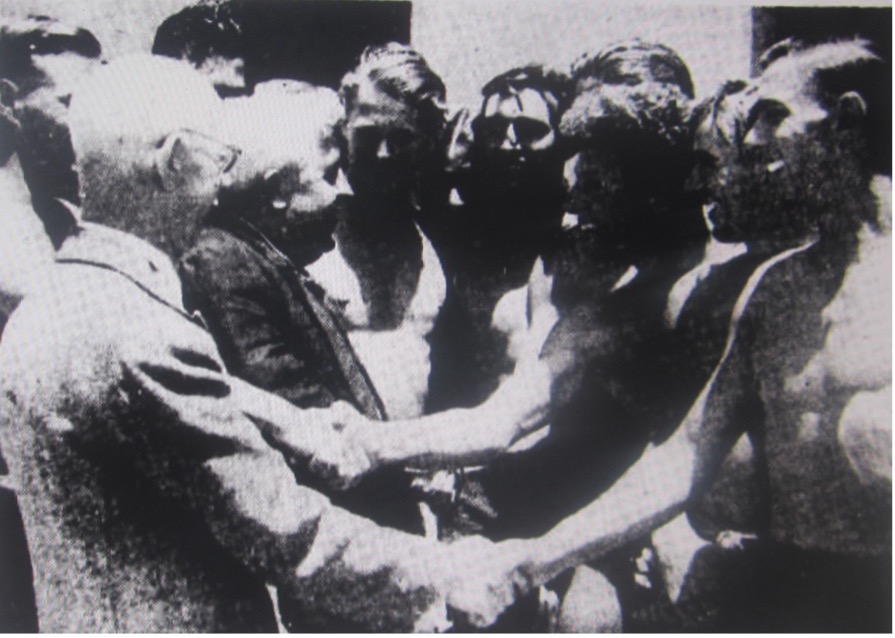
The President of Newcastle branch of the Surt Lifesaving Association (Mr. C. J. Nightingale), extreme left, and the Superintendent of the branch (Mr. A. Sutherland) congratulate Royal Marines who passed their surf bronze medallion examination at Nobbys Beach yesterday [Newcastle Morning Herald and Miners’ Advocate, 3 December 1945, page 6]
Royal Marines Thank Newcastle
The Newcastle Sun of 15 December 1945, page 6, reported:
‘Royal Marines now stationed at Hongkong have sent a Christmas card to Newcastle, expressing appreciation of the hospitality given them earlier this year by the Mayor and citizens of the district. The card, bearing the emblem of the Royal Marine depot at Hongkong, stated: “With thanks for the hospitality of yourself and the citizens of Newcastle during our stay at Gan Gan. — Signed, Major John Harvest.”
Ald. Norris said today: “It is pleasant indeed to know that Newcastle left such a happy impression with these members of the Royal Marines, also that they have remembered the city so appropriately.” The Mayor recalled that 14 of this section of Marines had been trained by an officer of Greater Newcastle Council in beach rescue and resuscitation work last July. They were the first Marines to win surf bronze medallion awards in Australia. Similar instruction had recently been given by Newcastle branch of the Surf Lifesaving Association to nine members of the Royal Marines now in camp at Nelson’s Bay.’
Royal Marines Play in Newcastle
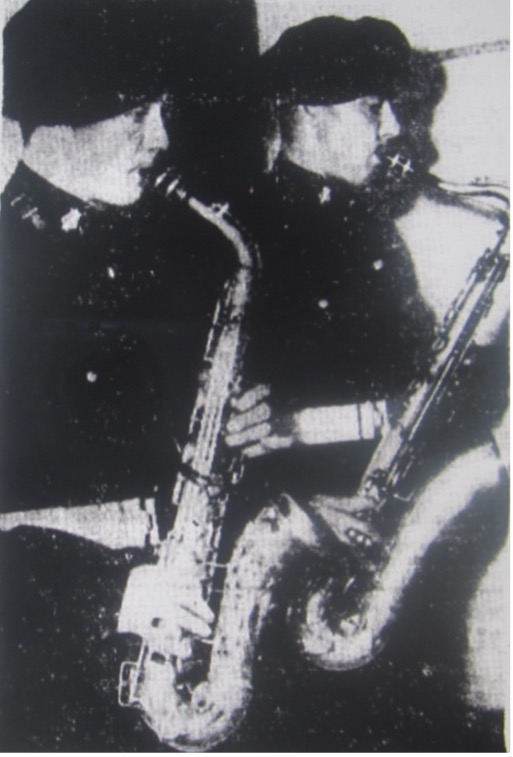
Two members of the Royal Marine Band who visited Newcastle in support of the Food for Britain Street Appeal [Newcastle Morning Herald and Miners’ Advocate, 2 March 1946, page 6]
Newcastle Farewells Royal Marines
The Newcastle Sun of 22 March 1946, page 3, reported:
‘Many of the Royal Marines who had passed through H.M.S. Assault, the shore station at Nelson’s Bay, were taking their discharges in Australia, the Commanding Officer (Major J. Richards) said today.
Major Richards was presenting to the Mayor (Ald. R. Norris) a shield bearing the Royal Marines coat of arms and the corps flag which had flown over H.M.S. Assault as a “token of gratitude and a symbol of our friendship.” The station, which was opened on April 1, 1945, is now being closed. Major Richards said that more than 8000 officers, N.C.O’s and marines had passed through the station during that period.
While at Nelson’s Bay they had enjoyed the liberal hospitality of the people of Newcastle and Nelson’s Bay. They were extremely grateful for the treatment they had received and were sorry to be leaving, he said.
The Mayor said that having the Royal Marines camp at Nelson’s Bay’ had given the city the opportunity to repay some or the hospitality that had been enjoyed by Australian servicemen in England in both world wars. Newcastle had been proud to have the Royal Marines stationed here, and as Mayor he greatly appreciated their fine behaviour.
The Mayor said the shield and the flag would take an honoured place alongside the plaque and ensign he had received from the captain of the H.M.S. Newcastle. The shield, which was painted by Marine P. Dams, bore the coat of arms of the Royal Marines— the world surrounded by laurel leaves, with a crown above and an anchor below. It bears the words: “Gibraltar. Per mare, per terrain.” When battle honours were first given by King George IV. the world was selected because of the widespread nature of the corps services. The laurel leaves were added in 1761 after Belle Isle and the word “Gibraltar” because of a three-year siege in which the corps participated.’
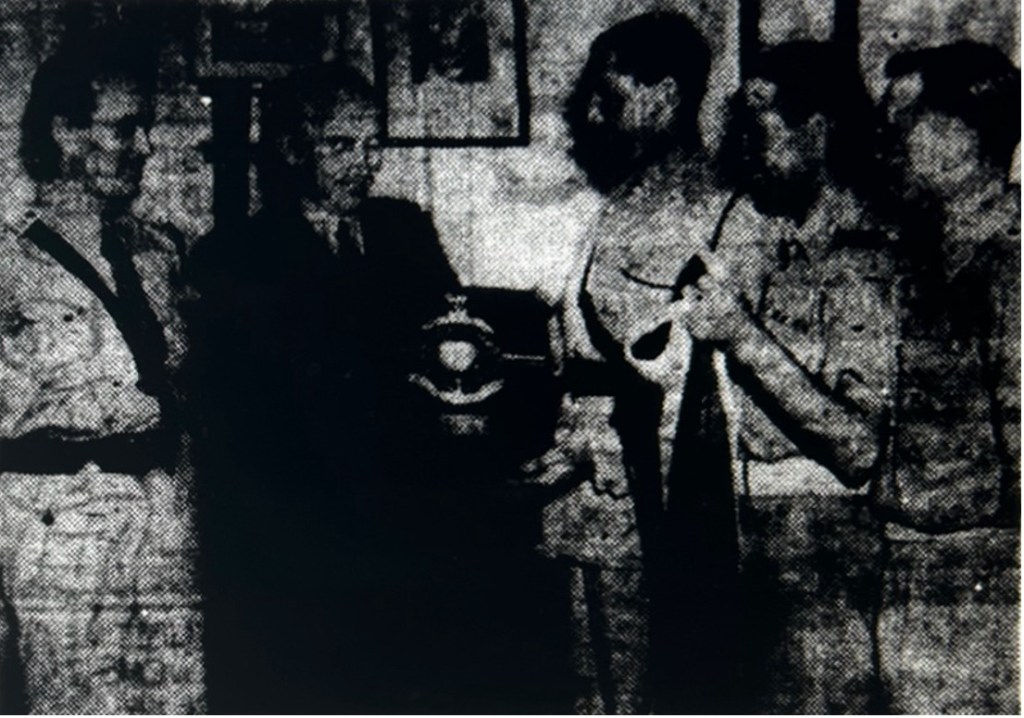
Major J. Richards, Commanding Officer of the Royal Marines’ Station at Nelson’s Bay, presenting a shield to the Mayor (Ald. R. Norris) this morning. Others are Captain C. W. Cary, Sergeant Major E. Graham and Marine P. Dams. The inscription on the shield reads: “Presented to his Worship the Mayor and citizens of the City of Newcastle by officers and men of the depot, Royal Marines, British Pacific Fleet, in commemoration of their stay from April 1, 1945, to March 1946 [Newcastle Sun, 22 March 1946, page 5]
Concluding Comments
HMAS Assault at Nelson Bay ceased to function as a military training base when the Royal Marines left there in March 1946. The Newcastle Morning Herald and Miners’ Advocate of 26 March 1946, page 4, summed up the situation in the following article:
‘Except for an R.A.N. maintenance unit, the Marines’ barracks at Fly Point, Nelson’s Bay, are now empty. The buildings and sleeping huts were built to accommodate 1000 men. Until the weekend, the establishment flew the Marines’ flag, as H.M.S. Assault. The Marines are now in Sydney, preparing to leave for Colombo. The future of the camp is still under consideration.’
Not all Royal Marines went home to the United Kingdom, with about 100 taking their military discharge in Australia and settling in the northern areas of NSW. The Newcastle Morning Herald and Miners’ Advocate of 29 May 1946, page 2, reported:
‘Newcastle branch of the Royal Marines Old Comrades Association wants former members of the Royal Marines who are in Newcastle to march with the association in the Victory Day celebrations in Newcastle. Mr. G. C. Pole, who is organising the branch, said at the branch’s meeting last night that the association existed to assist former members of the Royal Marines.’
Having arrived in Colombo [Sri Lanka] the Royal Marines had one last request to their friends in Newcastle. The Newcastle Sun of 26 June 1946, page 1, reported:
‘Members of the sergeants’ mess of H.M.S. Assault, the former base for Royal Marines at Nelson’s Bay, have written to the Mayor (Ald. R. Norris) from Colombo asking if food parcels could be sent to their families in England.
Accompanying the request was a bank draft for £52 10s and a list of 36 addresses to which parcels are to be forwarded. With the Mayor’s assistance, the member of the mess hope to make the forwarding of food parcels a regular feature. Arrangements are being made with a local firm of grocers to have suitable parcels forwarded as soon as possible The Mayor said today: “I am proud to be of assistance to these members of the British Pacific forces who were stationed in our district. “They came to Australia to help us, and I am pleased to have the opportunity of doing something to assist them and their families.”
The Newcastle Sun of 18 November 1946, page 6, further reported:
‘The Mayor of Greater Newcastle (Ald. R. Norris) has completed his task as ‘buying agent’ for Royal Marines formerly stationed at H.M.S. Assault on Port Stephens. Some months ago, a number of the members of the Sergeants’ Mess wrote to the Mayor from India ‘asking whether he would send food parcels to their families in England. They forwarded a draft for £65/12/6 to cover the cost. Four batches of 18 parcels have now been sent away at a cost of £65/12/8.’
During their stay at Port Stephens, with their association with Newcastle, a number of marriages between Royal Marines and local women took place, but not all were to be everlasting. Details of one unsuccessful marriage was published in the Truth of 21 December 1947, page 8:
‘Separated from her Royal Marine husband and stranded in London, an attractive Newcastle war bride has made an unusual plea for help in the hope that she may return to Australia and her people [they were married at Newcastle during 1945].
Desperate and friendless in a strange land, the war bride, Mrs. Betty Doreen Warrington, has appealed for someone to come forward with sufficient money to pay her passage home. Mrs. Warrington promises to repay the money by going into the service of the donor as a maid or waitress until such time as the amount is liquidated. She is also prepared to stay longer if required. ……. Mrs. Warrington has tried to get a passage through Australia House, but so far they have not been able to assist her.’
Prior to the Royal Marines vacating the HMAS Assault, it is noted that the NSW Government had earmarked the facility for conversion into a mental convalescence home.
Additional information on military activities at Port Stephens is published on this website at the following links:
HMAS Assault at Nelson Bay Port Stephens – 1942/43
A Pictorial History of HMAS Assault – Nelson Bay
Post War History of the Gan Gan Military Camp at Port Stephens
War Diary of Tomaree Coastal Artillery Battery Port Stephens – 1942/1944
United States Landing Force Equipment Depot at Nelson Bay – 1942/43
Tomaree Lodge Site at Port Stephens
Camouflage of Mount Tomaree – 1941/42
Port Stephens Council During the Second World War
ADDENDUM
Extract of Diary of Major Alfred Cecil Hood of the Royal Marines covering his time at the Gan Gan Military Camp at Port Ste phens in 1945 [National Library of Australia: https://nla.gov.au/nla.obj-2379385595/view].
The extract reads as below:
‘Gan Gan Camp was situated in a clearing of gum trees, inhabited by a large colony of Kookaburra (laughing Jackass) which kept up an incessant chatter, particularly early morning, which rendered the normal reveille bugle call unnecessary. It is said that the presence of this peculiar bird indicates also the near presence of snakes, the eggs of the latter being a delicacy of the Kookaburra. Indeed, I came across a number of the black variety of snakes during my frequent walks in the surrounding ‘bush’ where, also, the wallaby was very much in evidence. A short walk of a mile or so brought one to the pacific foreshore. A most peaceful interlude being the reward for one-pains. I did not encounter any snakes in the camp itself, however. A walk along the foreshore brought one to the R.M. Assault Camp at Nelson Bay, where, me being the only regular officer at Gan Gan, I had an open invitation to call in the Mess there, and meet many acquaintances.
Following the sudden and unforeseen early collapse of Japan, changes in disposal and functions for troops was to be expected, and, to a great extent, would depend upon the future activities of the British Pacific Fleet. Moreover, consideration would have to be given to the expected early release of ….. ranks to U.K. It had been decreed that the order of release would be ‘first in, first out’. Hence it follows that among the senior and most valuable N.C.O’s would be those selected for first release, and a consequent loss in efficiency and reliability and also a serious loss in morale among the junior and less useful members of any unit. The maintenance of morale would bring its problems, especially, especially in isolated camps such as Gan Gan, which would be regarded, in the changed circumstances, as a transit camp. Newcastle, some 20 miles away provided the of leave distraction. There was no suitable provision for sports and recreation, other than the canteen and mess.
Food was something of a problem, being provided by the Australian Army. Rations, although adequate, did not allow for much variation, and were not popular with the men. The method of transport of meat &c. was not of a high hygienic order, and condition of fresh foods required constant surveillance. Also, the camp generated refrigerator was somewhat temperamental, and in consequence I was constrained to have some supplies condemned as unfit for human consumption. even so, we had one serious outbreak of food poisoning which could have had fateful results had it not been for the attention of our medical officer and his treatment.
Having obtained the approval of our GOC. (Admin.), I called on the Royal Naval Base Captain (Supply) at Sydney, who approved our adoption of Naval Messing in lieu of Australian Army rations, whereby future supplies were made available from a Naval Depot in Newcastle.
Meanwhile, the first moves were put in operation for the return of personnel to U.K. via the R.E. Camp at Moore Park, Sydney, and one of the first to go was our C.O. (Bn 2/I.C) but before going he made his recommendations for promotion of some of the junior ranks to fill such vacancies as would be created by the loss of senior N.C.O’s earmarked for ‘release’ to U.K. A tricky business indeed!
The first draft for the United Kingdom left Sydney on 17th October 1945, sailing in the Dominion Monach. A few days later the main draft of our H.Q Company left Gan Gan for Sydney (Moore Park), to take over there in place of the 1st Bn. ……left for duties at Hong Kong whilst on 28th October out ‘B’ Company departed from Gan Gan for Singapore, via Brisbane-Colombo. By the end of October a composite battalion of 1st & 2nd battalions was established at Moore Park, Sydney, now under command of Lt. Col. Roberts. this arduous and frustrating operation. assisted by several plagues of black moths and flying ants, occupied some eight days, before returning finally to Sydney on 8 November.
On 14th November 1945 ‘C’ Company sailed for Singapore in ‘Stirling Castle’ via Bombay, and on 9th December certain groups for ‘release’ left in ‘Aquitania for’ U.K., followed by yet another party for Hong Kong on the 16th.’
Researched and compiled by Kevin McGuinness
March 2024

 Port Stephens - a history exploration