
Introduction
In 1942, under the auspices of a Joint Overseas Operational Training School (JOOTS), the Australian and United States Governments established a combined amphibious training facility for military personnel from both countries to prepare them for joint service in the Pacific region, as the Second World War encroached.
The site chosen was the Fly Point area of Nelson Bay at Port Stephens. It was ideally located close to numerous beaches and well as the calmer waters of Port Stephens, where troop landings and boat skills could be taught.
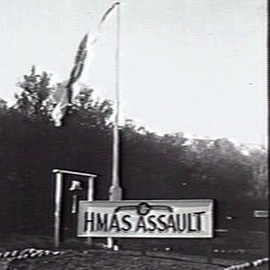
HMAS Assault, as the main base, was commissioned on 1 September 1942 and operated initially from onboard the accommodation ship, HMAS Westralia, which was moored in Port Stephens. On-shore facilities were constructed at Fly Point and became operational on 10 December 1942.
Adjacent to this site, the United States Navy established their own base, known as the Landing Force Equipment Depot of the Seventh Amphibious Force.
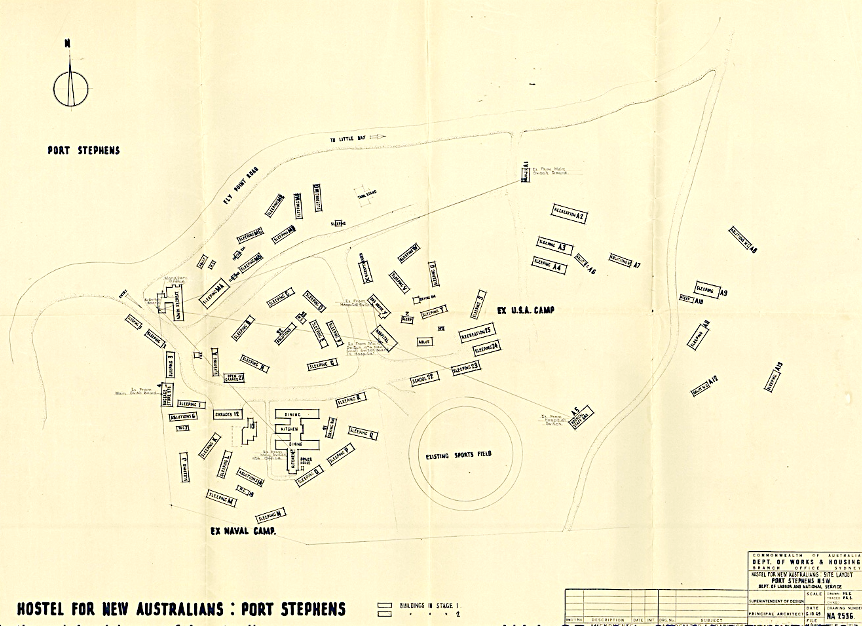
Plan of the former HMAS Assault site at Nelson Bay when taken over as a Commonwealth Migrant Hostel in 1949. The plan shows the former Naval Camp and the adjacent United States of America camp.
The United States Army also established an Amphibious Training Centre [ATC] at Gan Gan for both Australian and American service personnel. The Gan Gan training facility was situated about four kilometres from Nelson Bay.
While the JOOTS facility at Port Stephens was to have a short operational life, some 22,000 military personnel received training there – 20,000 American and 2000 Australian troops.
It closed in October 1943 and amphibious training was transferred to the Army facility at Toorbul Point, Queensland.
The Australian War Memorial holds a number of monthly reports from commanding officers at HMAS Assault which serve to provide a detailed history of its operations.
On 1 October 1943, the then commanding officer, F. N. Cook, Commander, RAN provided an Annual Report on the first year of operation of HMAS Assault, as set out below.
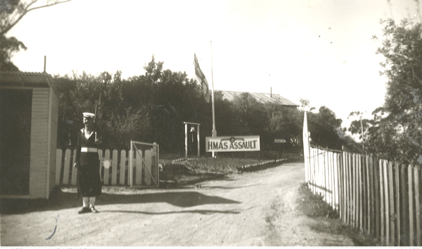
Entrance to HMAS ‘Assault’ at Nelson Bay, Port Stephens [Australian War Memorial]
Annual Report of HMAS Assault – October 1943
The following Memo prepared by the Commanding Officer sets out the first and only Annual Report that covers the establishment of the HMAS Assault training facility at Port Stephens and the first year of operation.
The report is as printed below with the addition of some relevant photos.
‘Memo from: The Commanding Officer, H.M.A.S. “Assault”.
Memo to: The Secretary, Naval Board, Navy Office, Melbourne.
Date: 1 October 1943
The report was marked ‘Secret’.
Subject: H.M.A.S. “Assault” – First Year of Commission
1. Submitted for the information of the Naval Board the following report of activities of H.M.A.S. “Assault” during the first year in commission. It includes a brief history and descriptions and achievements.
2. In March 1942 the Australian Government signalled to the United Kingdom for Combined Officers to inaugurate a Combined Training Centre in Australia, consequently I arrived in Melbourne by Air from the United Kingdom on 3rd June 1942, and began work immediately. Lieutenant Colonel Hope, R.A. Lieutenant Colonel Walker, R.M. Wing Commander (New Group Captain) Murdoch R.A.A.F., Lieutenant Commander George R.N.V.R. and Lieutenant Richardson R.A.N.V.R. all with combined Operations experience arrived and understood that we were to set up a Combined Operations Training Centre on British Lines.
3. In June 1942 a strong recommendation was made for the formation of an Australian Combined Operations Directorate in Melbourne, this however was not set up. On the 5th June, the Deputy Chief of Australian Naval Staff, Lieutenant Colonel Hope R.A. and I attended a meeting at General MacArthur’s Headquarters (then in Melbourne) Brigadier Chamberlain U.S. Army presiding and at which we were informed that Combined Operations in Australia were to come under General Headquarters General MacArthur. One Australian and two American Divisions were to be trained as soon as possible, the Australian Navy producing one third of the total number of crews required and providing the Naval requirements for Soldiers under training.
4. Lieutenant Colonel Hope and I after carrying out an inspection by air of the east coast of Australia, decided that Port Stephens was by far the most satisfactory place for combined training purely from Sea, Land and Air aspects (bearing in mind the Japanese Submarine menace in June 1942) and on our recommendations, it was decided to use this area.
5. As there were no facilities available to immediately commence operations at the site chosen, and to await the construction of a camp would have meant the loss of too much time, H.M.A.S. “Westralia” was loaned as accommodation ship from the 21st August 1942 and on the 1st September 1942 “Assault” commissioned in “Westralia” with 24 officers and 280 Seamen Trainees. The ship arrived in Port Stephens on 3rd September 1942 and training began from her.
6. In the general scheme it was hoped that three Australian Armed Merchant Cruisers “Manoora”, “Westralia” and “Kanimbla” were to be made available as L.S.I’s fitted out British fashion with L.C.A.’s as Landing Craft and keeping this in mind, immediate steps were taken to:-
(1). Indicate requirements of Australian Naval Crews. In this matter the greatest assistance was given and interest shown by the Personnel side of the Naval Board and the Naval Officer-in-Charge, Flinders Naval Depot, and we were not, and never have been, short of Trainees in any department.
(2). Draw up a training Syllabus and Programme
(3). Indicate requirements of Landing Craft. These were to have been built in Australia and consequently there was some delay in delivery, as construction of these craft had only just begun. To provide the Naval Trainees with elementary instruction in the handling of Combined Operations craft, nine motor boats were selected and requisitioned from civilian sources and folding boat equipment was provided by the Army.
(4). Draw up a scheme of complement for H.M.A.S. “Assault”.
(5). Design, lay out, and get underway the construction of the establishment which would have to include accommodation for personnel, boat moorings, pier, slipping, engine and general maintenance facilities all of which had to be provided in an almost uninhabited area 120 miles from Sydney.
7. As can be gathered from the foregoing, “Assault’s” primary function has been:
(a) to train new Officers and rating recruits for Assault Boats Crews.
(b) Naval Commandoes (Beach Parties).
(c) Combined Operational Signal Teams (Naval and Army) and spares for the above for the three L.S.I’s.
(d) To act as a base for the LS.I’s, arranging transport, victualling, spares and repairs.
(e) To act in all respects as Australian Naval Officer-in-Charge of the Port.
While “Assault” was in “Westralia” the following Officers and men were trained:
30 Officers
60 Coxswains
180 Boats Crews
90 Stokers
Of this number approximately 90 Officers and men were transferred to Toorbul Camp, Brisbane, which was then a small Combined Operations Camp training soldiers in certain phases of Amphibious Warfare. It was later taken over by the Americans and the “Assault” ratings returned and did a “Refresher” course here in the new training craft which had since arrived.
8. Since “Assault” transferred to the shore establishment on 10th December 1942, the following Officers and men have completed the various “Assault” courses:
70 Officers
40 Coxswains
120 Naval Commandoes (Beach Parties)
40 Landing Craft Signalmen
273 Boats Crews (not trained as coxswains)
160 Stokers (Drivers)
So that in all 100 Officers, 100 Coxswains, 120 Beach Commandos, 40 Flotilla Signalmen, 453 Boats Crews and 250 Stockers – of which 48 have completed an advanced course and 20 are undergoing same – have been trained and our original aim to train 100 Officers and 700 men and 200 Stokers has already been achieved and in some cases exceeded. Seamen Ratings are now undergoing or have undergone gunnery training for Able Seamen.
9. The three L.S.I’s now in commission – H.M.A. Ships “Manoora” – “Westalia” – “Kanimbla” – have been supplied with “Assault” Officers, Boats Crews complete and one party each of Beach Commandoes from trained personnel, plus 25% spares.
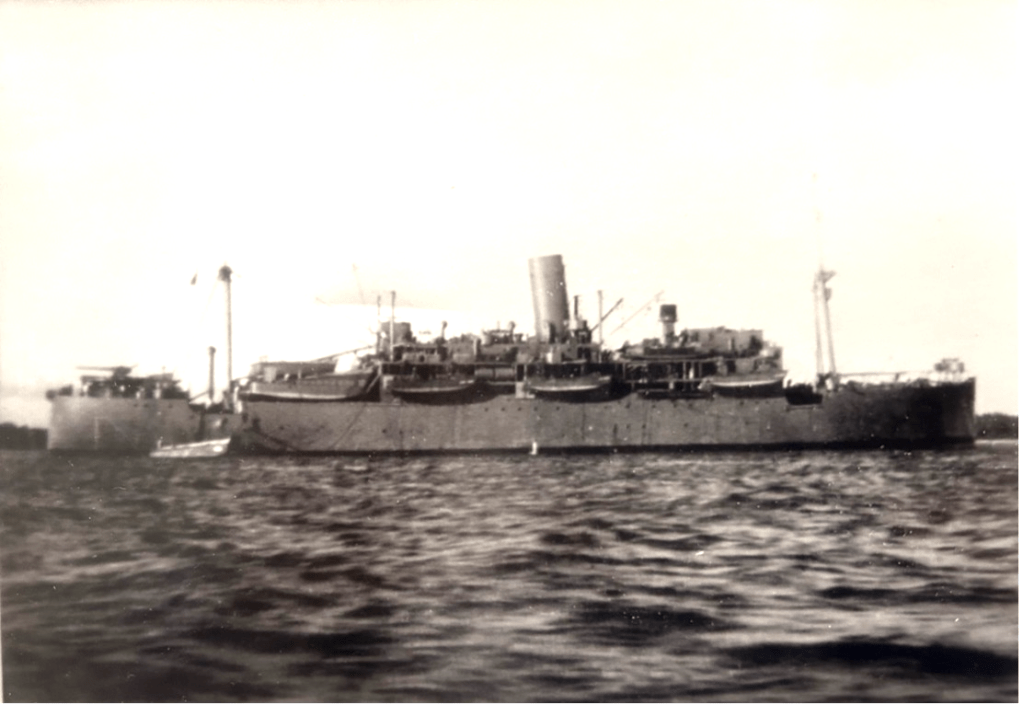
HMAS Westralia at anchor in Port Stephens 1943 [Nelson Bay RSL Sub-branch Photo Collection]
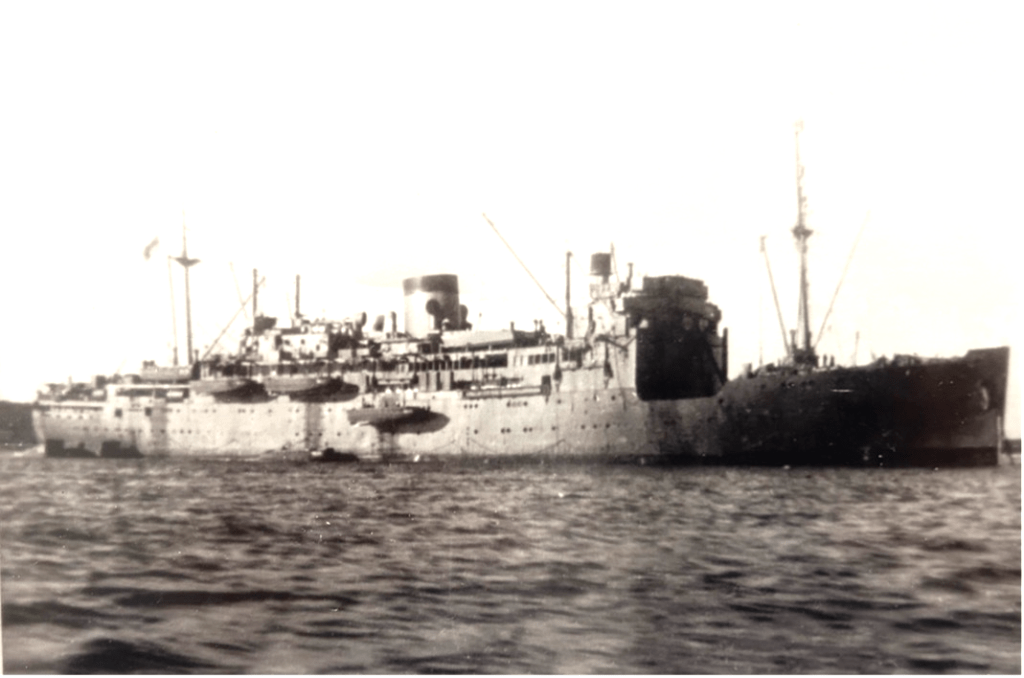
HMAS Manoora at anchor in Port Stephens 1943 [Nelson Bay RSL Sub-branch Photo Collection]
10. H.M.A.S. “Assault” – now that training has practically been completed enters her second phase, namely, to act:
(a) As a supply and “spare” base for stores etc., for Landing Craft carried in L.S.I.’s
(b) As a “Pool” Depot for reserve trained Combined Operations Personnel and to
(c) Assist with our trained boats crews in training the continuous stream of United States Soldiers passing through the Amphibious Training course – “A.T.C” – name given to the American Organisation which handles the training of assault troops and by whom “Assault” is operated.
11. As a matter of interest, since its inception of Army institutions here, “Assault” played a small part in the training of approximately 22,000 Army Personnel – 2,000 Australian and 20,000 American – in Amphibious Warfare.
12. It has been found that trained “Assault” ratings while waiting for L.S.I. appointments have naturally deteriorated in efficiency while marking time in Home Port Depots. They have been given refresher courses on their re-entry into “Assault” but this will not be necessary when trained personnel can be kept at “Assault” in new accommodation which is almost completed.
13. With reference to paragraph 6 – section 3 above, the expected delay in delivery of craft caused difficulty as training personnel were not able to obtain sufficient practice in the handling of landing craft in the early stages. Up to the end of 1942 only 2 L.C.A.’s were received and for quite some time all flotilla manoeuvres and large scale manoeuvres with the Army personnel under training were carried out by the motor boats (mentioned previously). These exercises while giving crews valuable experience in handling twin screw boats, did not fulfil the requirements of the syllabus which provided for the handling, running and beaching of landing craft in all conditions of wind and sea.
14. It was not until 14th December 1942 when sufficient American landing craft had arrived for the “U.S. Navy Advanced Landing Craft Base” – name for the American establishment in Port Stephens – that any exercises simulating actual operations could be undertaken. Since then, however excellent operational exercises, in which both Army and Air Force have figured, have been a regular feature.
15. In this regard the choice of Port Stephens as a Combined Operational Base has proved wise and advantages as all types of beaches are readily available in the immediate vicinity and the surrounding areas provide plenty of scope for the movement of Army personnel. Steep or shallow sandy beaches, with or without surf are available and rock, mud and mangroves are handy in the bay.
16. Australian built L.C.A.’s began to arrive early in the new year, so that on the 10th January 1943 we were able to return 5 motor boats to Sydney for other duties. Also on the 20th March 1943 19 American landing craft were handed over to “Assault” control by the American local authority now titled “L.F.E.D” (Landing Force Equipment Depot) so that trainees now have a wide range of craft in which to gain experience.
17. The numbers of boats in Port Stephens have gradually been built up and at present the following ships and craft are based here:
H.M.A.S. “Manoora”; H.M.A.S. “Westralia” – Being used as training L.S.I’s. landing troops
H.M.A.S. “Ping Wo” – Tender to “Assault for transportation of water and stores (for L.S.I’s.). Also used as training ship. Ex Chinese River Steamer of approx. 2,000 Tons.
H.M.A.S. “Gumleaf” – An ex Seine net trawler 55ft O.A., used for escort patrol, salvage and general drifter duties.
H.M.A.S. “Flying Cloud”; H.M.A.S. “Kweena” – Naval Auxiliary Patrol Vessels
H.M.A.S. “Kweena” )
L.S.T (Landing Ship Tank) – 1 in number (American)
L.C.I. (Landing Craft Infantry) – 12 in number (American)
L.C.T. (Landing Craft Tank) – 4 in number (American)
L.C.M. (Landing Craft Mechanised) – 7 in number (American) – 4 loaned to “Assault”
A.P.C. (Auxiliary Patrol Craft – 2 in number (American)
L.C.V. (Landing Craft Vehicle) – 67 in number (American) – 4 loaned to “Assault”
L.C.P. (Landing Craft Personnel) – 15 in number (American) – 1 loaned to “Assault”
L.C.P. (Ramp Boat) – 3 in number (American
L.C.S. (Landing Craft support). 7 in number (American)
L.C.A. (Landing Craft Assault) – 9 in number (Australian)
Motor Boats – 4 in number (Australian)
making the total number of craft under “Assault” control – 36.
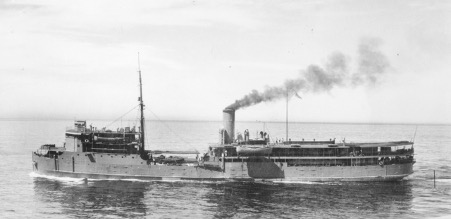
Ping Wo, steaming between Port Stephens and Sydney, September 1942 [Australian War Memorial]
18. With reference to paragraph 6 – section 5 – above, copy of the layout of the Depot and a chart showing general disposition of the establishment is enclosed. The “Assault camp consists of 67 buildings of “C” Series type unlined galvanised iron huts situated some 800 yards from the landing craft moorings and pier. It could be more comfortable as the extremes of winter and summer make conditions very trying, however on the whole it is very healthy.
19. The establishment was originally designed for 500 Officers and men, but as many as 70 Officers and 800 men have been borne, consequently, to allow for such a contingency in the future, further consideration is under construction.
20. With a view to associating our Australian effort more closely with British Combined Operations the roads in the establishment have been named commemorating successful operations in this and previous wars. Buildings have been named after Naval and Military Officers connected with successful combined operations including some who achieved distinction in this war. The scheme has proved popular.
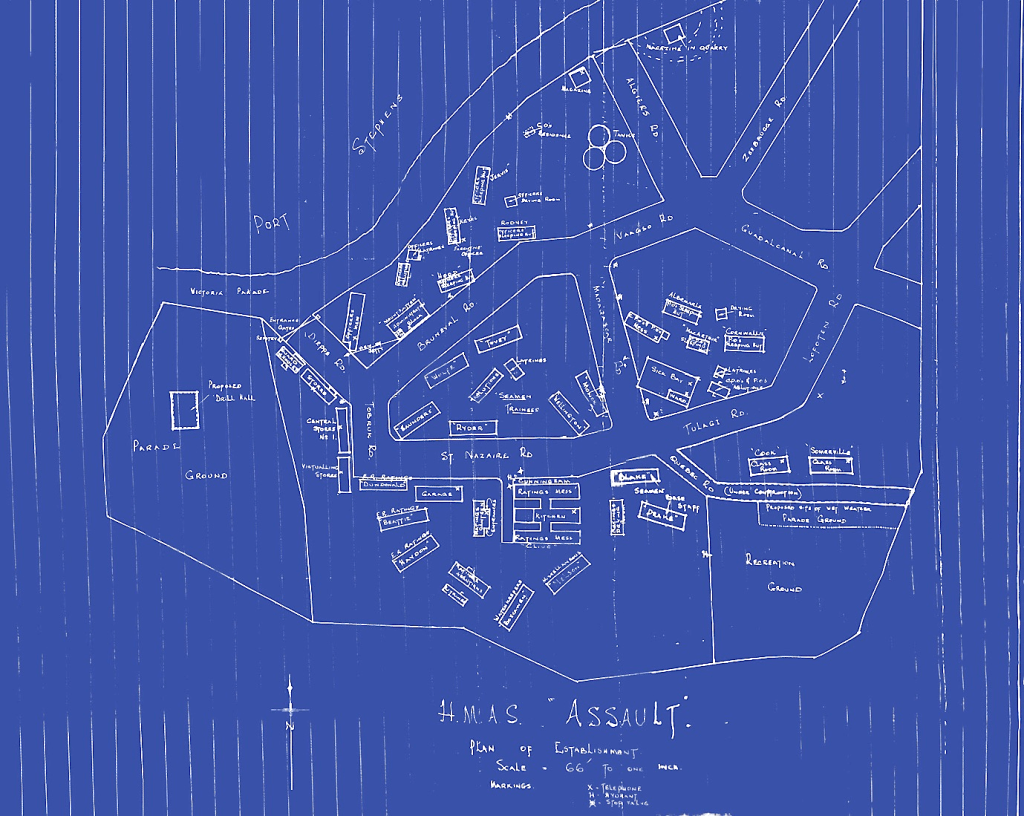
Plan of HMAS Assault 1941-1945 [University of Newcastle Living Histories Collection]
21. Six Boat moorings were originally laid to accommodate the Motor Boats and these moorings of anchors and chains – 2 anchors and a length of chain providing moorings for three boats – have proved most reliable. Concrete clump moorings made by the C.C.C. and laid by our own staff with wire mooring pendants have proved most unsuccessful under the heavy weather conditions that are experienced at different times. We have now abandoned their use and landing craft are moored to the jetty in the best compound where at no time has the weather caused much trouble under these circumstances.
22. The Naval Jetty now in use is a reconstruction of an old jetty that was on the site. Many alterations and additions were made however, and we now have a pier 510 ft. long – 12 ft. wide with an “L” shaped extension of 162 ft. which forms the boat compound. The outer perimeter of the wharf is closed in with vertical planking 3″ apart and this acts quite successfully as a breakwater and the sea in the Boat Harbour in heavy weather is considerably reduced. The greatest depth of water at low water alongside is 7ft. and the pier was designed for a capacity of 5 tons. 6 Fuelling points are available for petrol engine boats at present, however, there is no diesel fuel line though installation of this has been approved. On the whole, the wharf is quite adequate for our needs, the only disadvantage being its light construction which may withdraw from its durability.
23. One of the greatest drawbacks as far as boat maintenance is concerned has been the lack of slipping facilities for painting and repair of boats. This was caused by the difficulty in obtaining the services of a civilian diver to finish the slipway and the lack of hauling gear and machinery. These difficulties have now been overcome – the slipway being completed by Naval Divers – and both Boatshed and Slipway have been in full commission since 25th August 1943. Prior to that, boats had to be slipped at Tea Gardens, approx. 3 miles away and then only when facilities were available.
24. The Boatshed is 112 ft. long by 30 ft. wide and is very well set up with winch, Band and Circular Saws, Planing Machine, Drilling Machine and Grindstone all electrically powered. The slipway has a capacity of 25 ton but, unfortunately, owing to its restricted construction the depth of water available limits the size of the vessel which can be slipped. At High Water there is only 4 ft. 6 ins. of water over the seaward end and 2 ft. 6 ins. over the shore end of the cradle hence boats with an average draft of 3 ft 6 ins are all that can be slipped and then only at high water. This could be obviated if the slipway was extended 40 ft. Otherwise the construction has proved very effective and with a traversing position and 3 cradles three boats can be out of the water at one time which is a definite advantage.
25. From an engineering point of view “Assault” is now in a very good position as far as equipment is concerned, and we have the following machines in the Engineers Workshop, which is a building 114 ft long and 42 feet wide.
1 9 inch Nuttal Lathe
1 61/2/ inch Nuttal Lathe
1 2mh Cincinnate Milling Machine
1 J. S. Richardson – Drilling Machine 0 – 1/2″
1 18 inch Butler Shaping Machine
1 Servex 60 ton Hydraulic Press
1 W & B Valve Grinder
1 Black & Decker Bench Drill Stand
1 Turnbull Punch shears
1 Electric Welding Set.
26. Three machines, however, were very slow in delivery and before their arrival our mechanics had great difficulty keeping boats in running order with the limited facilities available.
27. As has always been the case the lack of spare parts is the greatest drawback in the general maintenance of boat engines. Several craft have been laid up for considerable periods purely because some small replacement is unavailable – this difficulty of course mainly arising in the American craft under our control, and at present there appears no solution.
28. With regard to road transport “Assault” has now twelve vehicles all in fairly good condition. There are three charabancs, two three-ton trucks, three cars, one utility truck, one 30cwt. truck, one panel van and one ambulance. These vehicles are in continuous service and despite heavy duties imposed on them, they are performing satisfactorily. All vehicles are regularly serviced and are mechanically efficient.
29. From a medical point of view we are very well situated. Due to the local healthy climate – which is temperate but inclined to be sub-tropical in the height of summer – sickness is reduced to a minimum. We have, however, had numerous minor casualties from the various “Assault” courses.
30. The hospital which was able to go into commission on 1st January, 1943, really excelled itself when a Catalina crashed in Port Stephen on 24th May 1943, and a major operation was performed on a badly shocked survivor.
31. We have very few mosquitoes due to the early precautions taken in stocking the surrounding swamps with minnows to combat the mosquito larvae.
32. There is an adequate supply of fresh water pumped from bores, but it is discoloured and has a purgative effect; there should however be some improvement when the storage tanks are covered, approval for which is awaited.
33. During the second quarter for a period of several weeks Sick Bay was the only medical establishment functioning at Port Stephens and numbers of A.M.F. and U.S.N. Forces personnel were accommodated.
34. As far as recreational facilities are concerned, excellent conditions exist for officers and men. In the summer the swimming, surfing and fishing are good, whilst cricket is played on our sports ground.
35. In the winter the ground is available for football and athletic meetings, and the “Assault” team this year won the 1st Grade Rugby Union championship in the Newcastle League.
36. Boxing contests are also held regularly – in fact, all branches of sport are well catered for.
37. The Y.M.C.A. and Australian Comforts Fund have produced an excellent Recreation Hut, at which regular concert parties provide entertainment.
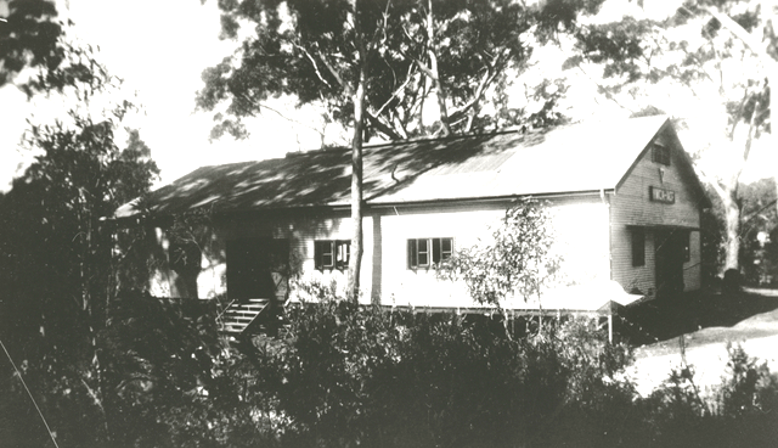
YMCA – Australian Comforts Fund Recreation Hut at HMAS ‘Assault’ [Australian War Memorial]
38. The following distinguished visitors have inspected H.M.A.S. “Assault” since occupation on 10th December 1942.
His Excellency The Governor-General.
His Excellency The Governor of New South Wales.
Rear Admiral G. C. Muirhead-Gould, R.N.
Rear Admiral D. E. Barbey, U.S.N.
Lieutenant-General Sir Iven G. Mackay, 2nd Aust. Army.
Lieutenant-General R. L. Eichelburger, U.S. Army.
Major-General W.H. Gill, U.S. Army.
Brigadier-General C. E. Byers. U.S. Army.
Brigadier-General R. Van Volkenburg, U.S. Army.
Air Commodore F. W. Lucias, R.A.A.F.
Brigadier J. Armstrong, R.A.N.
Captain J. W. Jamison, U.S.N.
Surgeon Captain L. Darby, R.A.N.
Paymaster Captain R. C. Negus, R.A.N.
Commander Salm, R.N.N.
Wing commander G. C. Fyfe, R.A.A.F.
Wing commander A. Cohen, R.A.A.F.
Engineer Commander C. w. Bridge. R.A.N.
Lieutenant-Colonel T. K.. Walker, R.M.
Lieutenant-colonel M. Hope, R.A.
MEMO SIGNED BY
F. N. Cook
Commander, R.A.N.
Commanding Officer.
Concluding Comments
The Royal Australian Navy (RAN) continued to operate training activities at HMAS Assault until August 1944, when the base was maintained in a caretaker mode.
In April 1945, HMAS Assault was handed over to the British Royal Marines who were then attached to the British Pacific Fleet. The Royal Marines remained at HMAS Assault from 1 April 1945 to March 1946.
The former HMAS Assault facilities were again maintained in a caretaker mode until 1948 when the Commonwealth Government established the Nelson Bay Migration Hostel on the site at Fly Point, Nelson Bay. The Hostel ceased operations in 1953.
A Pictorial History of HMAS Assault – Nelson Bay is found at this link on the website. It provides numerous photos of the combined military facility at Fly Point.
The Post War History of the Gan Gan Military Camp at Port Stephens can be viewed at this link on the website.
The War Diary of Tomaree Coastal Artillery Battery at Port Stephens – 1942/1944 is published at this link.
Researched and compiled by Kevin McGuinness
March 2024

 Port Stephens - a history exploration