
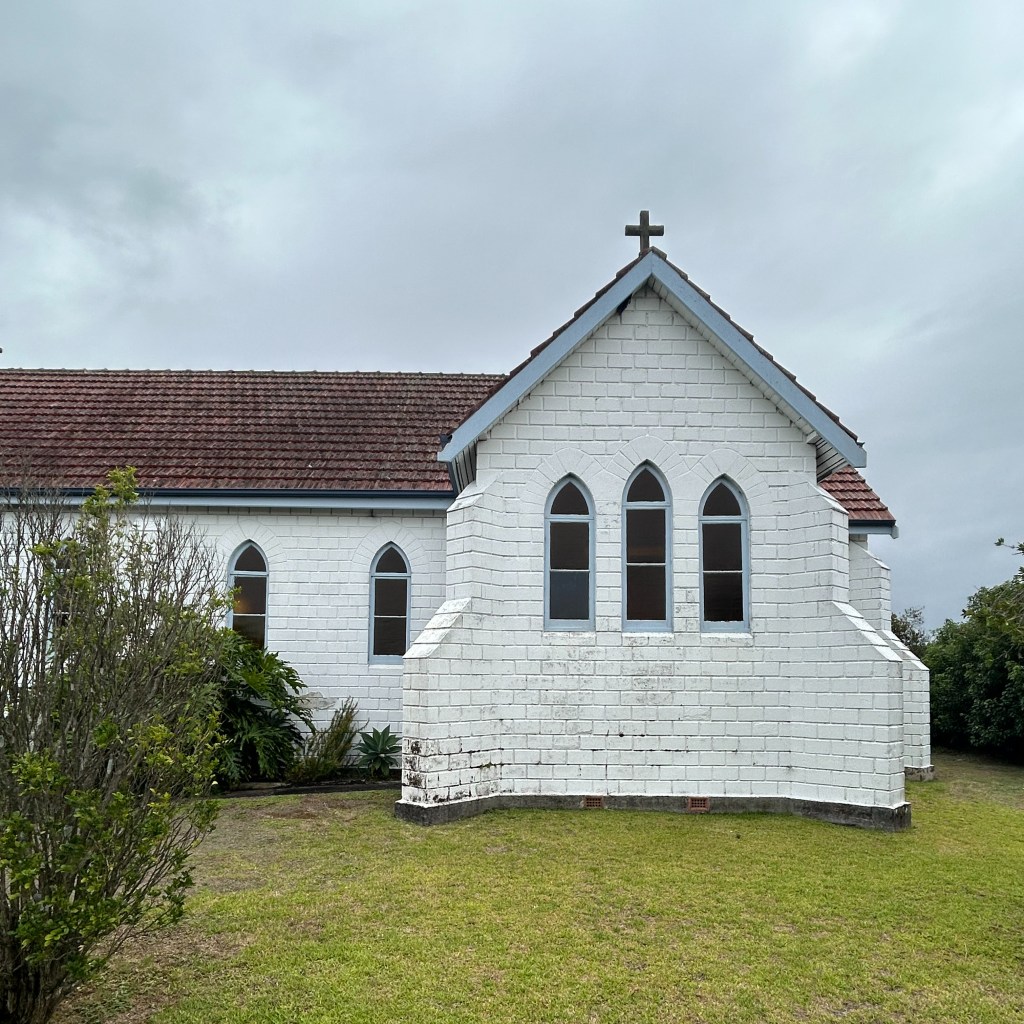
Worship by members of the Church of England (Anglican) in the Williamtown area of Port Stephens dates back to 1862.
St Saviour’s Anglican Church at Williamtown, which was built in 1912, has been the cornerstone of this congregation to the present day.
This history of St Saviour’s Church demonstrates how the members of its congregation were very active in raising funds for church needs and in supporting the activities of its various groups, such as the Young People’s Club.
The various church groups conducted many socials, dances, balls and fetes to raise funds for church activities, some of which are detailed in this paper.
This paper examines the history of St Saviour’s up to 1955, using the resources of the Australian National Library’s ‘Trove’ newspaper collection.
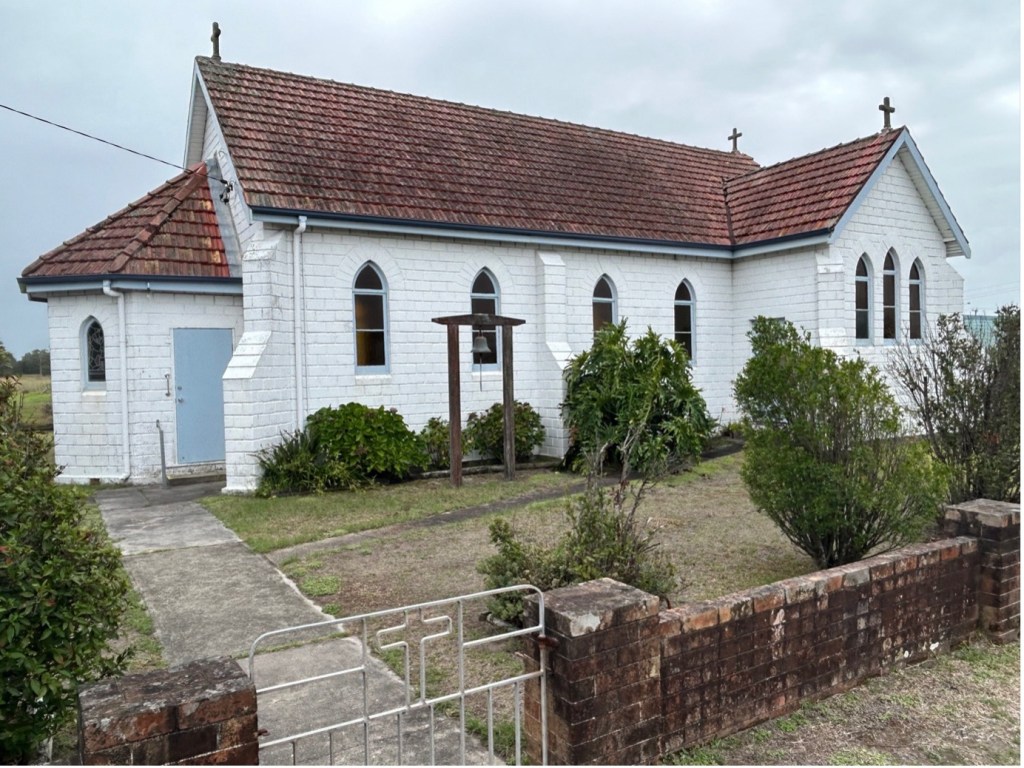
St Saviour’s Anglican Church, Williamtown [Author photo, 2024]
Early Days of the Church of England at Williamtown
The Newcastle Morning Herald and Miners’ Advocate of 25 June 1912, page 4, reported on the early history of Anglican Worship in the Williamtown area:
‘Half a century ago [about 1862] Williamtown was portion of the parish of Raymond Terrace. In those early days service was held in the house of Mr. W. Dawson, the Rev. S. Simm, afterwards Canon Simm, attending periodically, and preaching to the members of the scattered community who assembled there. Six years later [about 1868] a small wooden edifice was erected, and during the 44 years which has elapsed this building has been used by the adherents of the Church of England.
In 1894 Williamtown became merged into the parish of Stockton, and the services were conducted by the Rev. W. F. James, during his incumbency. In later years the Reverends P. S. Waddy and W. J. Ritchie, and the present curate, the Rev. F. V. Drake, have successively administered to St. Saviour’s Church in conjunction with the other parochial districts.
During recent years there has been a distinct advance in the progress of the church. For the past twelve months the church has been controlled by the Rev. F. V. Drake, and the period has been one of good work. Services are held three Sundays in each month; morning and afternoon, and communion is administered once each month.’
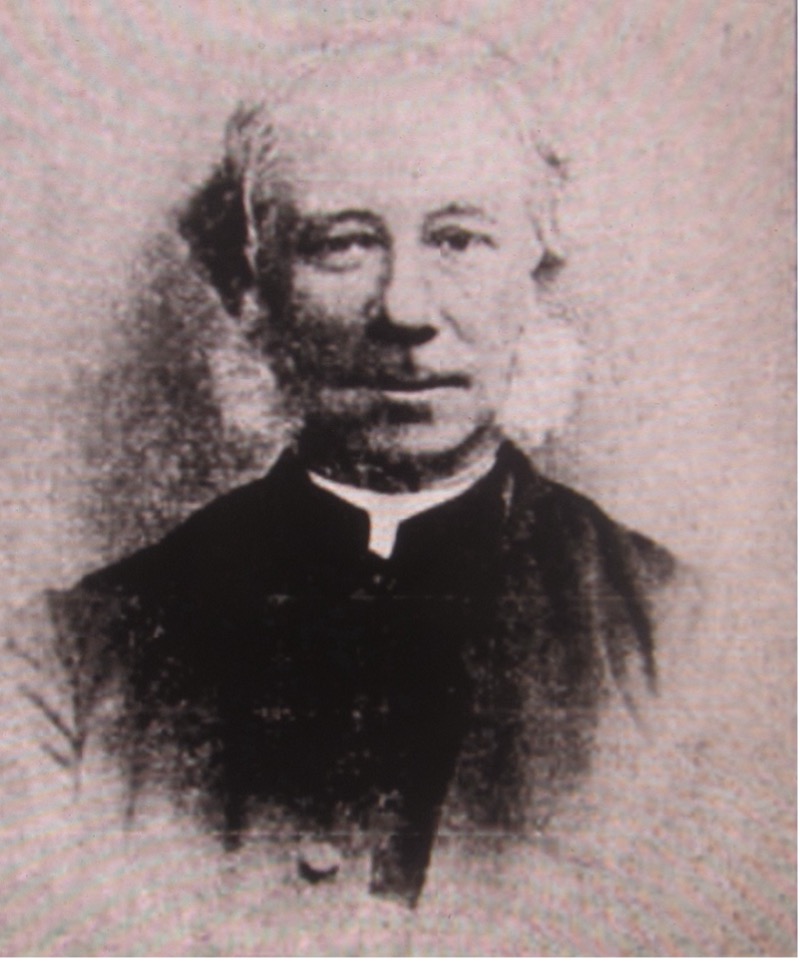
Rev. Samuel Simm, of Raymond Terrace, and Canon of Newcastle Anglican Cathedral. He died in 1894
Foundation Stone for New Church Laid – 1912
It is noted that at the time of the laying of the foundation stone, Mr Stanley William [Snr] was the Church secretary and clergyman’s warden. His wife, Mrs S W Smith Snr (Margaret nee Conoly) had the honour of laying the foundation stone. Margaret was also President of the Ladies Guild and Miss Florence Smith, her daughter was the Secretary. Stanley William Jnr, son, was also involved in the parish activities.
The Newcastle Morning Herald and Miners’ Advocate of 25 June 1912, page 4, reported:
‘The ceremony of laying the foundation stone of the new church building which is in course of erection for the parishioners of St. Saviour’s Church of England at Williamtown took place yesterday afternoon, in the presence of a large assemblage of adherents of the Anglican Church from all parts of the parish. A drag [horse drawn vehicle] conveyed a number of members of St. Paul’s Church, at Stockton, and buggies and other vehicles carried visitors from several districts. ……
Some time ago it was decided by the committee to erect a new building, and in one respect, particularly, they have accepted the latest device by having the new edifice built of cement bricks. The function held yesterday marked an epoch in the history of Williamtown Church. The church officials and the ladies of the guild had made extensive preparations for the reception of the visitors, but unfortunately, much of their efforts was discounted by heavy rain which fell at the close of the service. Happily, however, the elements were sufficiently propitious to allow the actual service to proceed without discomfort.
The Venerable Archdeacon Regg officiated, and the Reverends W. F. James and F. V. Drake assisted in the service. The choir of St. Paul’s Church, with Miss Hannell as organist, were present, and their singing beautified the service. The ceremony was performed in the prescribed form, the clergy with the church-wardens and officials of the church meeting at the site, where a platform had been erected. Following upon hymnal singing by the congregation, the Ven. Archdeacon Regg blessed the stone in the name of the Lord.
The ceremony of laying the stone was performed by Mrs. Stanley Smith, the marble slab bearing the inscription, “This stone was laid by Mrs. S. W. Smith, 24th June, 1912.” Bottles containing documentary evidence of the church’s history, with the names of the church and its associates, coins of the realm, and copies of the “Newcastle Morning Herald” of even date, were deposited by the rector, Rev. F. V. Drake, and Mr. S. W. Smith, the secretary and clergyman’s warden. Rev. F. V. Drake regretted that the silver trowel for the ceremony had not arrived, but it would be presented to Mrs. Smith at a later function.
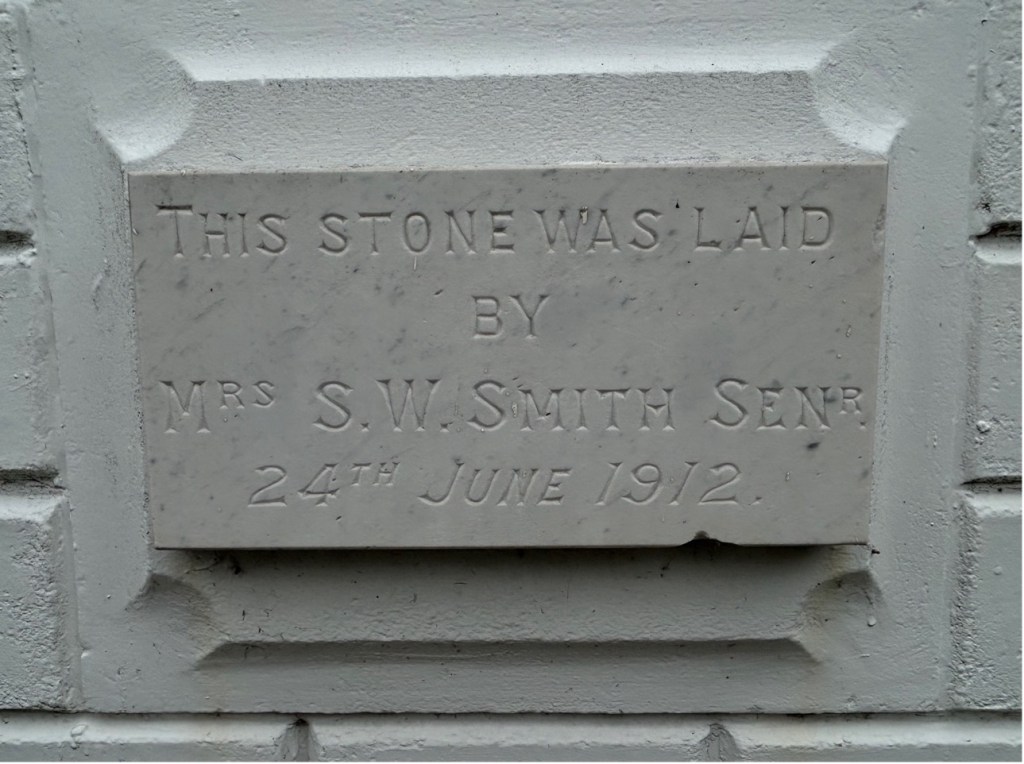
The foundation stone of St Saviour’s laid by Mrs S. W. (Margaret nee Conoly) Smith Snr – 24 June 1912 [Author photo – March 2024]
Ven. Archdeacon Regg expressed pleasure at being associated even in a small way, with the ceremony. It might not be uninteresting to know that the day, St. John the Baptist’s Day, was the anniversary of the consecration of their old and revered bishop the late Dr. Stanton, and also that the parish in which he served his curacy was that of St. Saviour, Fitzroy-square, London. The preacher based an interesting address upon the words “Built up in Him” from the second chapter of the Epistle of St. Paul to the Corinthians. He said the words found their source in building up the fabric like that in which they were engaged. Then they also found the meaning in its parallel of the building up of character. The building of character was the greatest element in the making of a nation. To have a fine country was good, but to have a fine people inhabiting that country was better. The advance of Australia was good, but the advance of Australians was better.
The moulding of character was the most important factor to them as a nation and as individuals. They needed to be always building, and like a well-built edifice to be able to withstand the assaults of all the evils that would be directed against them. Whether they would stand or fall, was according to the way in which their characters had been constructed. It was the early training which counted for so much, and the boys and girls needed the example set in their homes by the communion and the prayers of their parents. For 300 years English boys and girls had the sense of duty instilled into them by the Church of England Catechism.
The Church stood not simply for duty, but for grace. Both duty and grace being mentioned seven times in the Catechism. He wanted them to use the Church so that it would play no unimportant part in the building of each character, and he impressed the necessity for so shaping their lives that there would be evidence that they had been built in Him.
The offerings were then taken, resulting in the sum of £22. The blessing upon the stone having been pronounced, the visitors were entertained by the committee, comprising Mrs. Stanley Smith (president), Miss Smith (secretary), and members of the ladies’ guild and Messrs. W. Cox, G. Sansom, junr., S. W. Smith, F. Sansom, G. Sansom, senr., F. Sutton, and W. Sutton. Apologies were received from Revs. A. Renwick and M. Garbett.
Mr. R. Wilkins, of Newcastle, is the honorary architect, and Mr. C. M. Drinkwater is the builder. The new church will occupy a central position. It is being built in the Gothic style, and it will be some-what unique in consequence of its wall construction, the stones or bricks being of rusticated blocks composed of four parts of sand to one of cement. The blocks are 12 inches long, 6½inches high and 6 inches wide, with two-inch circular holes, which act as a cavity and make them damp-proof. At each end there in a small half-inch circle, so that two bricks are practically keyed together, with the result that the whole wall becomes so solidified that it is impossible for a brick to become loosened. It is affirmed that the period of duration cannot be calculated, as the blocks harden and improve with the passing of time.’
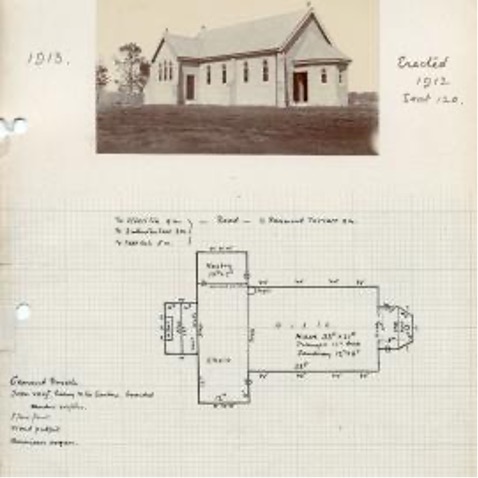
Plan and early photo (circa 1913) of the completed St. Saviour’s Church, Williamtown [University of Newcastle Library]
Dedication of St. Saviour’s Church – 1912
The Newcastle Morning Herald and Miners’ Advocate of 28 November 1912, page 6, reported:
‘The dedication of the new parish building erected by the parishioners of St. Saviour’s Church of England in Williamtown was performed by the Bishop of Newcastle yesterday afternoon. The Bishop, with the Dean, and a number of clergymen of the Newcastle district, in company with several members of the St. Paul’s Church, at Stockton, proceeded by drag to take part in the dedication ceremonies. Upon the arrival of the visitors they were received by Mr. Stanley Smith, clergyman’s warden, Messrs. William Cox and G. Sansom, people’s warden, and Messrs. T. and W. Sutton, F. Sansom, S. Cox, and S. W. Smith, jun., members of the committee, and the members of the Women’s Guild, of which Mrs. T. W. Smith is president, Miss F. Smith secretary, and Mesdames G., Sansom, sen., G. Sansom, jun., T. Sutton, F. Sansom, W. Sutton, — Brownlie, E. Maher, and J. Shearman are the committee.
Shortly after two o’clock the choir and clergy proceeded to the principal entrance of the church. The procession comprised the Reverends J. C. V. Mather, H. S. D. Portus, W. F. James, G. B. Statt, G. M. Garbett, C. M. Stretch, and W. J. Ritchie, Canon Wright, Very Rev. C. H. Golding-Bird, Dean of Newcastle, Rev. A. Renwick, Bishop’s chaplain, bearing the staff and the Bishop of Newcastle. The Bishop having signified his response to the request of the incumbent of the parish, the Rev. F. W. Drake, for him to bless and dedicate the church, the procession proceeded up the chancel, chanting Psalm xxiv.
Standing at the Holy Table, the Bishop offered up prayers for God’s blessing upon the church, and pronounced the dedication in the following words, “By virtue of our sacred office in the Church of God we do now dedicate and set apart, from all profane and common uses, this church, in the name of the Father, and of the Son, and of the Holy Ghost, Amen.”
The usual church service followed, the lessons being read by Rev. W. J. Ritchie and Canon Wright, and the setting being given by the Rev. F. V. Drake. The Bishop of Newcastle delivered a short address and said that the exhortation he had given had stated that the building of churches had two great objects. They advanced the honour of God’s holy name and quickened the devotion of his faithful people; and he wanted to speak on the first of them. He was glad to be there to sympathise with them in their work, and it was interesting that they should have their former incumbent as well as their present one with them at their service that day, associating the old history of the parish with the new.
There had been continuity, in spite of the changes. The church was for the honour of God, and they gave what they could. When people built churches, it meant self-devotion, and this brought the question—Why people built churches. Practical people wanted to know all that it meant. It was the acknowledgment of the fact, that they believed that God was with them, that they belonged to Him, and He to them. Nothing in the world mattered so much, whether their character was growing, so that they could come to be like God in Jesus Christ. They expressed their faith in Him, by building.
He congratulated the congregation of St. Saviour’s heartily on the courage with which they had conceived and carried out the plans of the building. Long might it stand, and testify to God, by their lives, their lips, and their deeds. They built a church, not because they expected to get the exclusive presence of God, but because they could come there specially to see God, and to take His presence away with them to their homes, and because the house was God’s honour and glory. He trusted that the church would be long spared for the worship and praise of God’s holy church.
The Dean of Newcastle added his congratulations to the people in erecting such a beautiful church. A fortnight ago, they were taking part in the magnificent service at the cathedral, but that big event was of no greater importance than their event that day at Williamtown. One was complimentary to the other, and both equally important in the sight of God. They in Newcastle, with their great cathedral building, were doing exactly the same thing as the people of Williamtown, for their objects were similar. Each was giving of their best, and God did not care who was the better off. They tried to make their cathedral beautiful by means of symbolism. They were not above taking the good things and dedicating them to God’s honour and glory. God never gave any beautiful thing that could not be used for His honour.
The dean referred to the various ornaments, each of which had a symbolical meaning, and in using them for the beautification of God’s house they were also stimulating the people in their worship. There was no such thing as staying still, and no one of sense ceased to learn. The fool said, “I know,” but the wise man said, “I think.” There was only one way of saying, “I know,” and that was by pointing to the Redeemer. They had still to learn the mysteries of divine truth, and he emphasised the necessity for constant devotion to acquire the knowledge that would reveal the mysteries and the truth. The Williamtown people had done their best, and they were holding the outposts for the church and their Father. He would say, in conclusion, bravely fight, and bravely would they be rewarded.
The proceedings concluded by the Bishop pronouncing the blessing. The choir, which was augmented by choralists from St. Paul’s Church, Stockton, beautified the service with their singing. Miss Florence Smith presided at the organ. The congregation and visitors afterwards inspected the pretty church, which is erected within a quarter-acre block of land, presented to the church by Mr. Henry Slade. The plans and specifications of the building were prepared by Mr. R. Wilkins, architect, of Newcastle, and the work has been carried out under his supervision. Mr. Wilkins gave the whole of the services without any recompense. Mr. G. H. Morton was the contractor.
The church occupies a central position in the township. It is built in the Gothic style, and the building covers a ground space of 56ft by 35ft. The church is constructed of rusticated cement blocks, composed of four parts of sand to one of cement. The blocks are 12in long, 6½in high, and 6in wide, with 2in circular holes, which act as a cavity and render them waterproof. The building is the first in the district to be built of this material. The bricks are practically keyed together by means of a small circular opening at the ends of the block. It is claimed that the walls become firmer by the passing of time, as the material hardens, and becomes practically impervious to the elements.
The architecture and the blocks have certainly given a finish to an excellent type of church building, which is a distinct acquisition to the place. The interior is also chastely finished and is quite in keeping with the general good exterior effect. The roof is composed of oregon lined with Richmond River pine and covered with corrugated iron. The floor is of hardwood. and the fittings in the carpentry work all though gives the required look.’
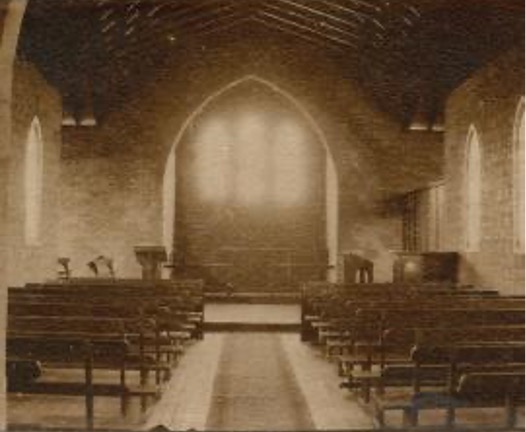
Interior of St Saviour’s Church, Williamtown [University of Newcastle Library]
Flower Show Raised Funds for Belgian Relief Fund – 1915
The Newcastle Morning Herald and Miners’ Advocate of 4 May 1915, page 5, reported:
‘A flower show held in Williamtown recently, inaugurated by the Church of England people of Williamtown, Salt Ash and Fullerton Cove, realised the sum of £61 16s 11d, and after deducting expenses amounting to £4 19s 2d, the balance of £56 17s 9d was forwarded to the secretaries of the National Belgian Relief Fund. The monthly collection for the Belgian Relief Fund for April amounted to £11.’
Port Stephens Parish, based at Williamtown, to be Inaugurated – 1921
The Newcastle Morning Herald and Miners’ Advocate of 17 May 1921, page 3, reported:
‘A new Church of England parish, to be known as that of the Port Stephens parish, with headquarters at Williamtown, is to be inaugurated shortly. This will embrace Fullerton Cove, Salt Ash, Anna Bay, Nelson’s Bay, and Williamtown, and the Rev. Mr. May, of Scone, will be the first clergyman of the parish.’
Church Bazaar – 1922
The Newcastle Sun of 11 May 1922, page 8, reported:
‘Yesterday afternoon, a bazaar in aid of the Church of England at Williamtown was held in the school hall, when the rector, the Rev. David R. May, presided. The fair was opened by the Rev. H. Crotty, Dean of Newcastle, who was presented with a box of sweets by two of the children.
Large crowds of visitors were present, including some from Stockton and Raymond Terrace. The Revs. H. Kitley (rector of Raymond Terrace), A. N. Williamson (rector of Stockton), and C. J. Macauley (Methodist) brought greetings from their respective churches. Vocal items were contributed by Miss Tottie Smith. The stallholders were members of the Ladies’ Church Aid. The fair was continued at night when several competitions were held.’
Construction of a Church of England Tennis Court – 1923
The Raymond Terrace Examiner and Lower Hunter and Port Stephens Advertiser of 23 November 1923, page 3, reported:
‘The making of the Church of England Tennis Court is being proceeded with, and will soon it is hoped, be in a state to play on. The material is being quarried from Feeney’s, and when completed this court should be amongst the best in the district.’
Easter Gifts Presented for the Church – 1924
The Raymond Terrace Examiner and Lower Hunter and Port Stephens Advertiser of 9 May 1924, page 2, reported:
‘The interior of St. Saviour’s Church of England has been greatly beautified by the addition of several Easter gifts. A handsome chancel chair was presented by Mrs G. Sansom (senr.), and a magnificent dorsal curtain, of proper church design and material, by Mrs. Fred Sansom. Mrs. Harold Moxey presented a beautiful set of altar linen, and Mrs. Maher a brass alms dish.
Other gifts included an oak hymn board from Mrs. T. Sutton, and a silver bread box from Mrs. G. Sansom (Junior); Book-markers from Miss A. Sansom; kneelers from Miss L. Sansom and Misses West (2), and Brownlee. The gifts were solemnly blessed and dedicated by the Priest-in-charge, Rev. David R. May. In addition to these gifts, Miss Smith undertook the renovation of the vestry, and after staining the floor with a suitable polish placed thereon a linoleum square.’
Social Held for Younger Members of the Parish – 1924
The Raymond Terrace Examiner and Lower Hunter and Port Stephens Advertiser of 25 July 1924, page 3, reported:
‘At a meeting of the members of the Church of England held recently it was unanimously decided to hold a social evening for the entertainment of the younger members of the congregation. A committee of young people was formed with Miss A. Sansom as secretary, and Miss O. Sandeman as Treasurer. They worked hard in preparation for the event and on Wednesday last, when the social took place in the Williamtown [Union] Hall, they had the satisfaction of seeing their labours crowned with success.
A great gathering of 200 people assembled from all parts of the district. The hall had been tastefully decorated by the young people, and punctually at 8 o’clock a start was. made with the evening’s fun — novelty dances, O’Grady drill, cards etc. …..
Whilst those assembled were partaking of the good things provided, the Rector (Rev. D. R. May) narrated several humorous incidents that took place at the war. For these he was loudly applauded, and in a few well-chosen words, he thanked all present for attending and making the evening the success that it was. Excellent music was supplied by Miss Lena Cox. ……. Although the aim of the committee was to provide social enjoyment and not to make money, we understand that they cleared nearly £6. As this event proved to be such a success, the committee have decided to hold a similar function next month.’
The Raymond Terrace Examiner and Lower Hunter and Port Stephens Advertiser of 31 October 1924, page 3, reported on another social conducted by the Young People’s Committee:
‘The social in aid of the Church of England funds in Williamtown district, promoted by the Young People’s Committee was a very successful affair. There was a large attendance, and keen enjoyment was experienced by those who attended. The music was excellent and was supplied by Rawlinson’s. Mr. Sid. Sansom was M. C., and his capacities in this direction are unbeatable. The waltzing contest was won by Mrs. Lavis, and the winners of the Monte Carlo were Miss George and Mr. Archibald. The social proved very popular and financially was more successful than expected. Some more will be held later when the season returns.’
Presentation to Pastor May – 1925
The Newcastle Morning Herald and Miners’ Advocate of 6 February 1925, page 3, reported:
‘Rev. D. R. May, who has been transferred from the Williamtown Church of England district to Terrigal, was, with Mrs. May, entertained by the parishioners in the Union Hall, on Tuesday evening. Mr. D. Sansom, who presided, said that Mr. May had done his best during his residence there, and there was everywhere a pronounced friendliness towards him, as well as to Mrs. May. They were leaving with the good wishes of everyone. Messrs. D. James, T. Banks. T Sutton, E. Windeyer, W. Brown, and W. Cox also spoke in eulogy of the guests, to each of whom suitable presentations were made.
In responding Mr. May expressed appreciation of what had been said of him, as well as of the gifts. His successor was the Rev. Mr. Brooks, who was a returned soldier, and was coming from Aberdare. Every assistance would, he hoped, be given to Mr. Brooks, without that no clergyman could succeed in his work. He referred to the Scout movement, the idea of which was to help young people to attain manhood equipped to do the best for themselves and for the country. He thanked all for what they had done and was pleased to see the neighbouring centres so well represented.
The Anna Bay and Nelson’s Bay people had already honoured him. At those places, all came to church, no matter to what denomination they belonged. When the Rev. Mr. Macaulay was there, he had given him the right to use the church of which he was the minister, and he wished that feeling could prevail everywhere. They should work together for God, for their country, and for the good of all.’
Dance Held by the Church Community – 1925
The Newcastle Morning Herald and Miners’ Advocate of 2 July 1925, page 6, reported:
‘A dance promoted by the Church of England was held in the Williamtown Town [Union] Hall last night, when there was a large attendance of residents of Williamtown, Raymond Terrace, Anna Bay, Salt Ash, and Fullerton Cove. Music for the dancing was supplied by Miss Mason (piano) and W. Lund (violin). Mr. Sandeman was M.C. Supper was served by the ladies’ committee.’
St. Saviour’s Rectory Dedicated – 1927
The Newcastle Morning Herald and Miners’ Advocate of 26 May 1927, page 7, reported:
‘The new rectory of St. Saviour’s Church of England, Williamtown, was opened and dedicated by the Right Rev. R. Stephen, D.D., Bishop of Newcastle, yesterday, in the presence of a large gathering. The Bishop was assisted in the service by Canons Kitley and Drake, Revs. W. H. G. Cochrane, H. K. Vickery, and R. E. Woodhouse, and Rev Wilber Brooke, rector of the parish. The clergy were accompanied by Messrs. G Sansom, S. W. Smith, D. Sansom. S. W. Smith, junr., W. H. Bryant, and J. Sherman, wardens of the church.
After prayer and the ceremony of dedication, the Bishop pronounced the blessing, the gathering at the close singing the hymn, “O God, Our Help in Ages Past.” Miss E. L. Smith accompanied at the organ. The new rectory, which confronts the main road, in close proximity to the church, is an attractive bungalow residence, with rusticated front. It is built of oregon and is set on brick foundations. The building contains lounge-room, study, breakfast-room, two bedrooms, kitchen, laundry and bathroom, with a motor garage adjoining. Mr. C. Cook was the architect and builder.
The church, which was built about fifteen years ago, is a beautiful building, and the rectory gives the completing touch to the area. The rectory is the result of an earnest desire on the part of the parishioners to provide their rector with a comfortable home. Rev. Wilber Brooke presided over the proceedings which followed the opening and dedication. He read apologies from the Very Rev. Crottyt, Dean of Newcastle, Archdeacon Woodd, the Revs. C. N. White and E. S. Robinson, and Rev. J. Henry, of the Free Kirk, Raymond Terrace, and Mr. C. A. Brown, register of the Newcastle diocese.
On behalf of the parishioners of St. Saviour’s he was very pleased to welcome the Bishop and Mrs. Stephen to the opening of the rectory which was a forward movement in the life of the parish. The sum of £230 had been subscribed in the district, and it left a debt of about £500, which had been guaranteed by the diocese. They had about ten years to pay it off, but the sooner it was paid off the better for everyone concerned. St. Saviour’s Women’s Guild had presented the rectory with the blinds for the windows, and the person, who was proverbially “as poor as a church mouse,” was glad to be saved that expense.
The wardens had displayed foresight, in erecting the rectory on the site, as the parish could be worked better from there than from anywhere else. Mr. Slade had sold the land to the church very cheaply, and Mr. Cook had faithfully carried out his work in the construction of the rectory, and he had put in some extras for which he had not charged.
The bishop said that it was a great pleasure to be there, although he must confess that visits were not encouraged by the state of the roads, and he was surprised to see so many people waiting for the dedication service. It must be a comfort for the rector and his wife to have a house. There was always a sense of satisfaction in having a house of one’s own. It gave him renewed courage and fresh hopes for the next day. It was also good for the parishioners to have a rectory. It restored their self-respect. They had their own homes and they tried to make them comfortable, but they could not hope to hold their self-respect if they did not provide a home for their clergy. It was also a vote of confidence in the rector. He personally appreciated that mark of confidence to understand and trust the rector, and that he would respect that trust. He congratulated the church upon the success of the work and hoped that the rector and his wife would be happy, and the parishioners be happy, in seeing them happy.
Short addresses of congratulation were also made by Canons Drake and Kitley, Rev. H. K. Vickery, Chelmsford Mission to Seamen, and Rev. G. Williams, representing the Methodist Church, Raymond Terrace. Mr. S. W. Smith, Jun., secretary to the Parochial Council, stated that the cost of the rectory, including the garage, pathways and fencing. was £754 15s, which added to £11 1s 2d legal costs for the transfer of the land and survey fee, made a total of £765 16s 2d. Against this the committee had in hand £500 loan from the diocese, and £235 11s contributions from the various centres, making a total of £735 11s. This left a deficiency of £30 4s 2d, which was required almost immediately to pay off the contract in full.
Messrs. G. Sansom, — Vernoon, and D. Sherman, and the Rev. W. Brooke, were the supervising committee for the building. The work had been well done. Mrs. Stephen was presented with a bouquet by Miss Monica Brooke, on behalf of Mrs. Sykes. Afternoon tea was provided by the members of St. Saviour’s Women’s Guild and other ladies of the parish.’
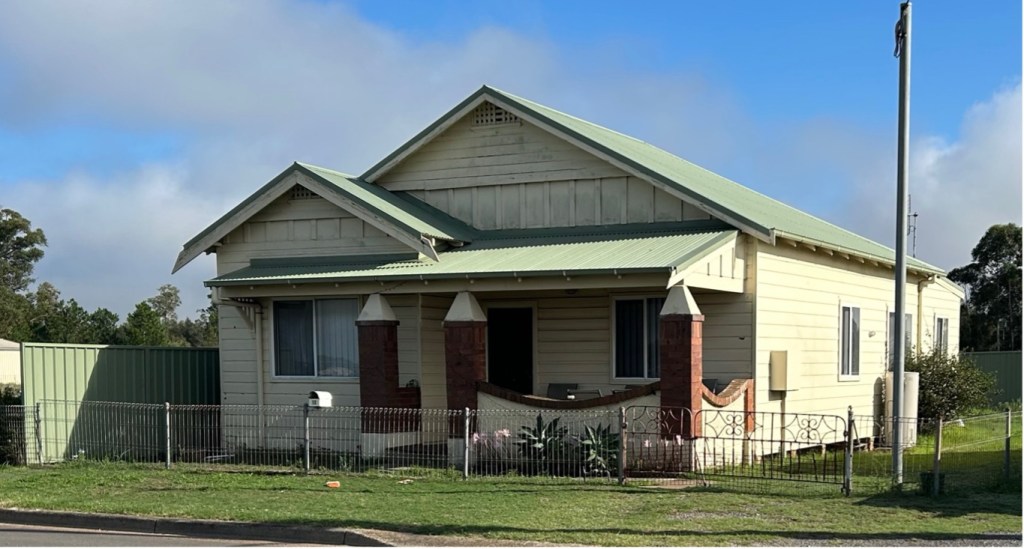
The rectory adjacent to St Saviour’s Church [Author photo -2024]
Rev. George Rooke Appointed as Rector – 1928
The Raymond Terrace Examiner and Lower Hunter and Port Stephens Advertiser of 5 April 1928, page 3, reported:
‘The Rev. G. L. W. Rooke has been appointed Rector of Williamtown. Padre Rooke served with the A. I. F. from 1914 to 1920. For the last two years he has been chaplain to the men on the Newcastle-Sydney road at Mooney Mooney camp.’
Young Peoples’ Ball – 1928 and 1929
The Church of England Young Peoples’ Club regularly held Balls at the Williamtown Union Hall. The following two newspaper reports provide an insight into two of those balls.
The Raymond Terrace Examiner and Lower Hunter and Port Stephens Advertiser of 25 October 1928, page 2, reported:
‘The Church of England Young Peoples’ Club Ball held on October 17th, was well attended. Supper was provided by parishioners. Music was by Guy’s orchestra. Messrs. Joe Lavis and E. C. Bingham members of the Club played extras. The President, Rev. George Rooke, thanked patrons and begged older people to allow for the gaiety of youth, and, by catching something of the cheerfulness of Christ to keep young in spirit if not in years.’
The Raymond Terrace Examiner and Lower Hunter and Port Stephens Advertiser of 18 April 1929, page 3, also reported on another social:
‘The Church of England Young Peoples’ Social was well attended on April 10th. Visitors came from Stockton and Bobs Farm. Music was supplied by the Devereaux orchestra.’
Lantern Lecture Presented in the Church – 1930
The Raymond Terrace Examiner and Lower Hunter and Port Stephens Advertiser of 2 January 1930, page 3, reported:
‘The Rev. H. Linton gave a lantern lecture at St. Saviour’s Church, on the Torres Strait Mission. He was accompanied by the Rev. A. N. Williamson.’
Church of England Fair – 1930
The Raymond Terrace Examiner and Lower Hunter and Port Stephens Advertiser of 22 May 1930, page 3, reported:
‘There was something like a record attendance at the Church of England Fair on May 14th. Mrs. Walter Sutton performed the opening ceremony. Mrs. Pritchard and her pupils contributed the harmony. Mr. Stanley Smith, jnr., thanked the judges, stallholders and others. Mr. Rees James eulogised the lady workers taking his cue from the gallant flight of Miss Amy Johnson [first woman to fly solo from London to Australia in 1930]. The Rector also spoke. Proceedings wound up with a dance at night with Miss Gwen Lavis, Mr. H. S. Sykes and Mr. Joe Lavis at the piano. ‘
Popular Girl Competition to Raise Church Funds – 1930
The Raymond Terrace Examiner and Lower Hunter and Port Stephens Advertiser of 13 November 1930, page 1, reported:
‘In furtherance of an effort to raise funds for St. Saviour’s Church of England, Williamtown, a popular girl competition is being held. The girls who have been nominated are Miss Eileen Sansom, (Salt Ash), Misses Mavis Sansom and Beryl Slade, (Williamtown) and Miss Mavis Cox, (Fullerton Cove).
In support of Miss Eileen Sansom’s candidature, a successful party was arranged at the home of Mr. and Mrs. Oscar Sansom, Salt Ash. Competitions were successfully conducted. Games and other forms of amusement added to the programme. Gifts for competitions were donated by Mr. and Mrs. Oscar Sansom, Mrs. Reg Sansom, Mrs. Arthur Sansom and Miss Ivy Sandeman. On behalf of the candidate Mr. R. James proposed a vote of thanks to all responsible for the success of the gathering. Mr. Sandeman supported the motion. Mrs. Clarrie Slade, made an efficient accompanist. The competition will close in December and the promoters anticipate a substantial addition to the church funds.’
Pageant of St. Nicholas Held at the Church – 1930
The Raymond Terrace Examiner and Lower Hunter and Port Stephens Advertiser of 1 January 1931, page 4, reported:
‘The Church of England had a service and pageant of St. Nicholas (Santa Claus), on December 18th, at 11 am. The rector celebrated the service assisted by Rev. E. S. Robinson (of Belmont), Garnett Sansom, Reg Dawson, Les Slade, John Dawson, and Ray West. Mr. Roy Russell conducted the pageant and the youngster’s eyes glistened with delight. Santa Claus gave gifts to 96 children and the teachers of Williamtown, and Long Bight Sunday schools off a Christmas tree. A picnic and games took place in the church yard after the pageant. The Young People’s Club organised things. Many parents of the children were at the service too.’
Church Bazaar – 1932
The Newcastle Morning Herald and Miners’ Advocate of 13 September 1932, page 3, reported:
‘A bazaar for Church of England funds was held in the Williamtown Hall, the rector, Rev. G. Rooke, presiding. Mr. W. Bennett, M.LA., who opened the fair, congratulated the ladies upon the appearance of the stalls. The pupils of Mrs. L. Pritchard, Stockton—Donald Richmond, Marjorie Nelmes, Una Pritchard, Valerie and Betty Edmond, and Molly Everitt—were heard in vocal and instrumental items. At the instance of Mr. H. S. Sykes, the parochial treasurer, a vote of thanks was accorded the artists and the workers. During the evening songs were contributed by Misses May Gildea and Jean Connor (Anna Bay) and Valerie Smith (Williamtown). Community singing and dancing occupied the remainder of the evening.’
Spring Fair Organised by Ladies Guild – 1933
The Raymond Terrace Examiner and Lower Hunter and Port Stephens Advertiser of 26 October 1933, page 4, reported:
‘Delightful weather prevailed for the annual spring fair organised by the Ladies Guild of the Fullerton Cove, Williamtown and Salt Ash Anglican Church, at the Union Hall, Williamtown on Wednesday afternoon last, in aid of the Rectory funds. The hall was tastefully decorated, and the wares displayed on the various stalls made a delightful attraction to the many visitors which attended from Newcastle, Stockton and Raymond Terrace districts.
Rev. G. Rooke, who occupied the chair, welcomed the many visitors who made it convenient to attend and offered apologies on behalf of Canon and Mrs. Kitley, Raymond Terrace, Mr. and Mrs. S. W. Smith, Wallsend, Rev. and Mrs. Webster, Maitland, Mayor and Mayoress of Raymond Terrace. The Dean of Newcastle in a few well-chosen words, complimented the Ladies Guild on their work for the Church and the brightness and fine display of articles on the various stalls, which meant many weeks of hard work and energy on their part. Rev. Canon Ritchie expressed his delight at being present as it brought happy recollections to him when he was minister of the parish and also complimented the ladies on their effort. Rev. W. G. Cochrane brought greetings from the Anglican Church, Stockton, Rev. Haxton from the Presbyterian Church, Stockton, and Rev. A. T. Newton, from the Raymond Terrace Methodist Circuit.
In declaring the fair open Mrs. Johnson wife of the Dean, paid a tribute to the ladies’ guild in their untiring efforts and wished the gathering a happy and successful afternoon. A pleasant musical programme arranged by Miss Harrison, was much appreciated. …..
The stalls were well patronised during the afternoon and continued into the night. A happy social function was held, and dancing was enjoyed by the younger people The gross takings amounted to £52.’
Williamtown Rector Organises Service in the Historic Carrington Church – 1933
The Newcastle Morning Herald and Miners’ Advocate of 21 November 1933, page 6, reported:
‘A combined service was held in the church at Carrington (Port Stephens) on Sunday. This was organised by the rector of the Anglican Church at Williamtown (Rev. G. Rooke) and was attended by visitors from surrounding centres. This little church is one of the oldest in New South Wales. Its earliest services were held upwards of 100 years ago, and were often conducted by Sir Edward Parry, who arrived in December 1912, to take charge of the estates of the Australian Agricultural Co. The church is a solidly constructed building, and although weatherworn, will stand for many years as a memorial to the faith of the pioneers who founded it and enjoyed the services that were held with more frequency when the headquarters of the company were located at Port Stephens.’
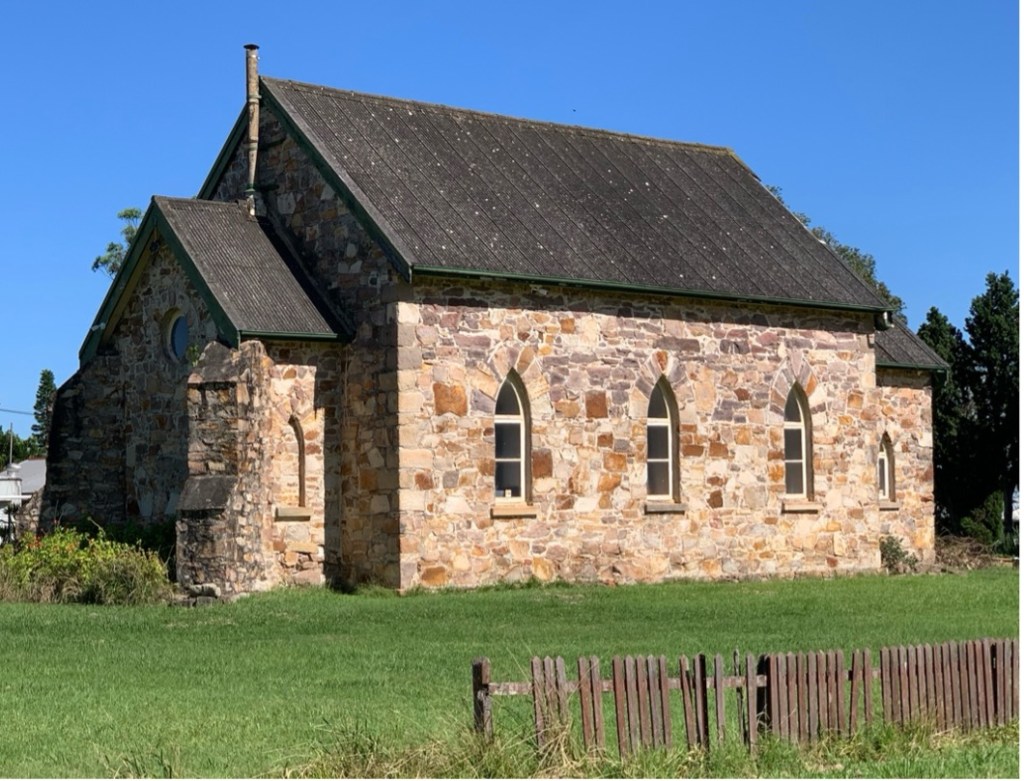
Historic Anglican Church building at Carrington, Port Stephens [Author photo]
Electric Lighting Installed in the Church – 1933
The Raymond Terrace Examiner and Lower Hunter and Port Stephens Advertiser of 7 December 1933, page 3, reported:
‘On Sunday night next, 10th, the installation of electric lighting will be introduced into the Church of England at 7.30 pm. This will be a wonderful improvement and will be appreciated by all church goers to this edifice. Mrs. E. Maher, senr, is asked to perform the office of switching on, and Miss Myrtle Scanlan will sing a solo at evensong. The Vicar General will preach the sermon.’
Masked International Ball – 1934
The Raymond Terrace Examiner and Lower Hunter and Port Stephens Advertiser of 16 August 1934, page 2, reported:
‘The Williamtown Church of England Young Peoples’ Social Club held a very successful masked international ball on August 9. The [Williamtown] hall was very tastefully decorated with bunting, representing all nations colours and together with the different costumes worn by the ladies was a very pleasing spectacle. Excellent music was provided by the Rialto orchestra, and the duties of M. C. were successfully carried out by Mr. R. Boyce.’
Rev. George Rooke Inducted as Rector of New Parish of Williamtown – 1934
The Raymond Terrace Examiner and Lower Hunter and Port Stephens Advertiser of 1 November 1934, page 1, reported:
‘At a service held at St. Saviour’s Church of England, Williamtown, on Wednesday night, Rev. G. L. W. Rooke was inducted as Rector of the new parish of Williamtown, which includes Port Stephens and Nelson’s Bay.
At the last Diocesan Anglican Synod, Williamtown was raised to the status of a parish. It is extensive and touches three Federal and two State electorates. Included in those present at the Induction service were the Bishop of Newcastle, (Rt. Rev. de Witt Batty), the Dean of Newcastle, (Very. Rev. W. H. Johnson), Archdeacon Wood, Canon Drake, Rev. D. May, (Jerrys Plains), Rev. Capell (Morpeth), Rev. J. B. Neville, and Mr. A. Rooke, (Williamtown) and Mr. R. M. Symons, (Jerrys Plains, lay readers) Rev.
Rooke was presented to the Bishop by Mr. G. Sansom, the rector’s warden and Messrs. R. James and T. A. Banks, peoples wardens, supported by Messrs. H. Sykes, A. Dawson, and H. J. Cox, churchwardens from Fullerton Cove. Mr. Rooke is an army chaplain on the reserve list and enlisted from the Newcastle diocese in 1914. He was educated at Moore College, Sydney, and Balliol College, Oxford, and has been at Williamtown for seven years.’
Church Social – 1935
The Maitland Daily Mercury of 26 October 1935, page 4, reported:
‘A variety entertainment organised by the Church of England Young People’s Social Club was presented in the Williamtown Union Hall, to a large audience. …… A dance followed the concert, music being supplied by Miss Lena Cox’s orchestra, Mr. G. Sternbeck acted as M.C. The club will benefit to the extent of about £7.’
Rainbow Fair – 1935
The Raymond Terrace Examiner and Lower Hunter and Port Stephens Advertiser of 14 November 1935, page 4, reported:
‘The Church of England Rainbow Fair, organised by the Ladies Guild, of Fullerton Cove, Williamtown and Salt Ash districts was held in the Union Hall, on 23rd October, last. The neatly laid out stalls were decorated in the colours of the rainbow, which made the hall look quite gay. Rev. G. Rooke occupied the chair and welcomed all to the fair. He was accompanied on the stage by several visiting clergymen. Rev. Canon Ritchie expressed delight at being present once again at another annual fair. He was always pleased to visit Williamtown as he met so many old friends. Rev. Hunt, Rev. Barnett, and Mr. Bowling, brought greetings from the various churches and missions they represented.
In opening the fair, Dr. Annetts, of Stockton, congratulated the ladies on the wonderful appearance of the stalls, and hoped that their efforts would meet with success.’
Popular Girl Competition – 1937
The Raymond Terrace Examiner and Lower Hunter and Port Stephens Advertiser of 15 July 1937, page 3, reported:
‘The Popular Girl Competition organised by the Church of England Young people’s Club, terminated last Wednesday night, after several weeks campaigning with a ball and supper, and was well patronised. The hall was decorated in coronation colours, red, white and blue streamers. At 9.30, Mr. R. James, who was chairman, announced the result of the poll, Miss D. Edwards, (Williamtown Social Club) 4553, £18/19/5; Miss S. Cox, (Fullerton Cove Younger Set), 1476 votes, £10/6/6; Miss L. Andrews, (Medowie), 2003 votes, £8/6/11.
The result was received with applause, Miss D. Edwards was declared Queen of the Competition, and on entering the hall, accompanied by her six trainbearers and two attendants, was presented by Miss S. Shearman with bouquets, and then escorted to the throne on the stage, where the crowning ceremony was performed by the Rev. W. G. Cochrane, of Stockton, who acted as enthroning bishop, for the occasion. He congratulated the Queen and her assistants on the wonderful success of their efforts. He also presented each competitor with a float bowl.
Dr. Annetts also paid a compliment to the competitors for their successful achievement. ….. The ceremony being completed dancing was indulged in and there were many beautiful evening gowns worn by the ladies. Supper was handed round by members of the various committees. Music was supplied by Miss Mannings’ orchestra. Mr. G. Steinbeck acted as M.C. About £45 will be the result of the effort for the benefit of the Williamtown Fullerton Cove and Medowie Church Committees.’
Spring Fair – 1938
The Raymond Terrace Examiner and Lower Hunter and Port Stephens Advertiser of 3 November 1938, page 4, reported:
‘On the 19th October, a very successful Spring Fair was held in the Williamtown Hall in aid of the Church of England funds. A very happy feature of the function was the large number of visitors who attended, including well-wishers from Wallsend, New Lambton, Waratah, Hamilton, Raymond Terrace, Newcastle and Stockton. The Rev. G. Rooke occupied the chair and welcomed the visitors. ………. The hall was prettily decorated with the colours of spring, whilst the stage was latticed with roses and fern, with baskets of beautiful flowers abounding.
Mrs. Batty in a very pleasing speech opened the Fair and preparatory to her speech was presented with a basket of roses by little Miss Lewis. The clergy present were all responsible for breezy and humorous speeches which were much enjoyed. A highly appreciated musical programme was arranged by Miss Ruby Grisdale, of Newcastle. ……
Games of skill and dancing added to the joy. For sheer enjoyment, for good will of workers patrons alike and for profit and commendable management, the Fair seemed to us all to be ahead of even the best that has ever been held. Mrs. Eric Smith and Miss Florrie Smith discharged the duties of joint hon. secretaries. The financial result of the Fair is £55.’
Death of Rev. George Rooke – 1941
The Newcastle Morning Herald and Miners’ Advocate of 20 September 1941, page 2, reported:
‘Rev. George Wallace Leslie Rooke, rector of Williamtown, died last night. He had been at Williamtown for 13 years. Trained at Moore College, Sydney, and Balliol College. Oxford, Rev. Rooke was at one time curate of Gordon, and later locum tenens at Cook’s River and St. George. He was on service with the A.I.F. from 1914 until 1920. He was rector at St. Alban’s from 1923 until 1928, and temporary camp missioner, at the Mooney Mooney road construction camp. The funeral will leave St. Saviour’s Church of England, Williamtown, tomorrow, after a service beginning at 1 o’clock.’
Rev. Rooke died at the Williamtown Rectory, aged 61 years, was buried at Stockton Cemetery.
Rev. B. E. Geary Appointed as Rector at Williamtown – 1941
The Singleton Argus of 17 October 1941, page 2, reported:
‘The Rev. B. E. Geary, senior curate of the Church of England at Singleton, with the charge of St. Luke’s Church, South Singleton, has been promoted to the position of Rector at Williamtown. He has been in Singleton for the past nine months, and during his stay has been very popular with his parishioners, as well as with townspeople generally. After two years at St. Francis College, Brisbane, Mr Geary was ordained at Newcastle Cathedral in 1938. He was then appointed senior curate at Hamilton, where he spent three years before coming to Singleton. He will leave for his new appointment about the middle of November.’
First Anniversary of Sunday School – 1946
The Raymond Terrace Examiner and Lower Hunter and Port Stephens Advertiser of 14 November 1946, page 2, reported:
‘A children’s service was conducted in St. Saviours’ Church, Williamtown, by the Rector, (Rev. B. E. Geary), on Sunday, October 13th, to mark the first anniversary of the Sunday School. During the service, lessons were read by the senior students of the Sunday School, Kevin Sutton, Milton Sansom and N. Turnbull acted as church wardens for the service…….
On Friday, October 18th, the Sunday school students enjoyed an anniversary party in conjunction with the Children’s’ Fancy Dress Ball in the Williamtown Hall. The party table was decorated in shades of pink and green to match the pink and green birthday cake. During the party, the one candle was lit and the cake cut by Narelle Sansom, the junior scholar of the Sunday School.’
Bushland Fair – 1947
The Raymond Terrace Examiner and Lower Hunter and Port Stephens Advertiser of 30 October 1947, page 4, reported:
‘Atmosphere was captured realistically at a “Bushland Fair” arranged by the Williamtown Parish Social Club, at Williamtown last Saturday. Characteristic posters by Mr. Sidney Sutton, colourful bush flowers and bush saplings used as a decorative scheme, were the first of many delightful surprises that awaited the visitors. Members of the “Ned Kelly” stall were dressed in traditional costume, and a cleverly made straw man depicted “Ned Kelly” holding up the bank at Jerilderie.
Visitors were directed through a side door of the bank where “Ned Kelly” (Mr. Monty Sansom) welcomed them and presented his museum of Australian bush animals and reptiles, together with relics of the “Kelly Gang.” The Fair was officially opened by the Rev D. May, Rector of Gloucester. The Rev. Hugh Linton represented Raymond Terrace and remarked that “he and Mrs. Linton had “humped their blueys” along to attend the Fair. Captain Young, Principal of the Church Army College at Stockton and Mrs. Young were also among the official guests.
The Rev. B. Geary, Rector of Williamtown introduced the guests and artists. Mrs. R. W. Campbell, of Bob’s Farm rendered pianoforte items of “Waltzing Matilda” and “The Road to Gundagai”. Mr Alan Douglas, from Medowie, played and sang a bracket of bush numbers, with guitar accompaniment. Mrs. A. H. Slade, who was responsible for the Refreshment Rooms — “While the Billy Boils”— arranged a striking tableau of a swaggie and kangaroo enjoying a billy of tea over a realistic bush fire. ……
A large gathering was present, from Newcastle, Stockton and other parts of the Port Stephens area. The proceeds are to assist the Church of England maintenance funds.’
‘All in a Garden Fayre’ – 1948
The Raymond Terrace Examiner and Lower Hunter and Port Stephens Advertiser of 18 November 1948, page 3, reported:
‘An old-fashioned garden motif was used by the Williamtown Church of England Social Club in staging the “All in a Garden Fayre” at Williamtown Union Hall, on Saturday 13th November, 1948. The stalls were gaily decorated with colourful flowers and a realistic rock garden was arranged on the stage. The approach to the rockery was up grass covered steps beneath an arch covered with climbing roses.
The Rev. R. Mawson, Rector of Raymond Terrace, was accompanied by Mrs. Mawson, opened the “Fayre” and the Rev. B. E. Geary, of Williamtown, welcomed the visitors. ……
The proceeds from the “Fayre” were over £100. A variety evening which concluded the happy social function featured a comedy presented by members of the Young Peoples’ Fellowship.’
‘Witchery Woo’ Dance – 1949
The Raymond Terrace Examiner and Lower Hunter and Port Stephens Advertiser of 25 August 1949, page 6, reported:
‘Weird designs and bright orange decorations in contrast with black, crepe made it possible to create a very talking and unusual effect for the “Witchery Woo” dance held at Williamtown on Friday last. Pumpkin cut outs attached to the walls and a large dangling spider on the stage helped to achieve an eerie atmosphere. The appearance of a “live witch” (Miss Elsie Upton), and a novelty “Black Cat Quiz”, enriched the evening’s entertainment.
A much-appreciated feature by the large crowd of young people was the cascade of streamers released from the ceiling. The party was arranged by the Church of England Young Peoples’ Fellowship and proved to be one of the most attractive held in the Williamtown Hall. The proceeds are for the Diocesan Childrens’ Homes. A very appetising supper was tastefully laid out and served by the members of Fellowship.’
Spanish ‘Fiesta’ Fair – 1949
The Raymond Terrace Examiner and Lower Hunter and Port Stephens Advertiser of 17 November 1949, page 2, reported:
‘The carefree and joyful spirit of old Spain was the delightful atmosphere cleverly created at Williamtown’s “Fiesta” Fair in the Union Hall recently. The preparation was an undertaking which meant much time and thought on the part of the Parish Social Club. An unusual arrangement of gay streamers and balloons marked each stall, surmounted by brightly painted “bulls” heads. The stage was decked with garlands of roses, reminding one of the Spanish custom of throwing roses to toreadors. Banner with symbolic bearings decorated the walls.
The variety of Spanish “costumes” displayed by the workers added colour and was enough to make any dress designer jealous. Mrs. F. deWitt Batty, opened the “Fiesta” and spoke of the pleasure it gave her to be at Williamtown on the occasion. The Rev. B. Davis, (Stockton), Cr. Richardson, (Shire President), Group Capt. Garing, (C. O. of Williamtown, R.A A.F.), gave messages of praise and good cheer. The Rev. B. E. Geary, rector, of Williamtown presided.
Cr. Rees James, in well-chosen words, moved a vote of thanks to Mrs. Batty and the artists for their contribution. The musical programme was arranged by Mrs. E. Wrightson, Miss Janet Sullivan and Master Maurice Wrightson, of Newcastle, Mr. Allan Douglas of Medowie and deserved the enthusiastic applause given them by the large audience.
Bouquets were presented to Mrs. Batty and the artists, by Dianne Ringland and Narelle Sansom. After the opening ceremony, Mrs. S. Sutton, in charge of the refreshment room, provided a dainty afternoon tea for the official guests and artists. An opportunity was taken to welcome Mrs. N. A. Pullin, wife of the newly appointed Rector of Raymond Terrace, and Mrs. Richardson, of Raymond Terrace, who were among the official guests.
In the evening a well-attended dance completed the “Fiesta.” The splendid spirit of cooperation and good will throughout the “Fiesta” was a credit to the Social Club members, under the capable leadership of Mrs. H. Sansom, (Social Secretary). The financial result is expected to be a goodly sum and will be divided up for Church needs.’
Corroboree Fete – 1951
The Raymond Terrace Examiner and Lower Hunter and Port Stephens Advertiser of 11 October 1951, page 6, reported:
‘The Williamtown Hall was transformed into a realistic “Corroboree” scene for the annual Church of England fete last Saturday. The stage was arranged into a clever aborigine setting and was appreciated by the many guests that attended the fete. A full-size figure of an aborigine in full corroboree paint was silhouetted against a gunyah and bush scene. The greens of tree and bush mingled with the browner old leaves of the gunyah provided a pleasing harmony of colour. Wildlife was depicted in the bush and a very much alive ‘spring roo’ in a homemade pouch attracted the attention of the children.
The stalls represented gunyahs, ringed with cut-out figures of aborginies in corroboree dress. Bark shields with appropriate markings and crossed spears completed the effective setting. Bright bush flowers provided a colourful background. A feature of the decorative scheme was a large bush gunyah erected in the tearoom. The specially arranged table for the official guests, arranged by Mrs. Bees James and Mrs. S. Sutton was praised by many people present. The place-cards were small maps of Australia cut out of paper bark. The corroboree setting was very cleverly thought out and created a realistic Australian atmosphere.
Members of the Parish Social Club, Young peoples’ Fellowship, and Sunday School staffed the stalls, and did a brisk trade. The proceeds, which are expected to break all records are for church funds. …..
The afternoon programme was arranged by Mrs. R. Campbell, of Bob’s Farm, and a humorous’ sketch was provided by Miss Roma Campbell and Master N. Sansom. ….. A “Festive Dance” at night concluded the corroboree.’
Coronation Ball – 1953
The Raymond Terrace Examiner and Lower Hunter and Port Stephens Advertiser of 2 July 1953, page 2, reported:
‘Williamtown Church of England held a Coronation Ball on Wednesday, June 24th in the Union Hall. It was a great success and reflected much credit on the Committee who arranged the decorations and supper. The hall was brightly decorated with streamers of red, white and blue, pictures from the life of the Queen, posters and flowers. At the top of the arch of the stage a large crown was suspended, from which fell red, white and blue bunting.
The stage itself was backed by a huge Union Jack, over which was a portrait of the Queen and the Duke of Edinburgh. Red poinsettias made a colourful splash in the flower decorations. A beautiful crown on red velvet occupied a central position on the stage. This crown was used for the ceremony of Crowning of the Queen. The honour falling to Miss Mackay of Raymond Terrace. The Queen of the Ball was presented on the stage to the Rev. E. V. Dyer who performed the crowning ceremony and presented the winning prize. The Rev. Mr. Dyer then asked Miss Mackay to lead the dancers in the waltz, and her beautiful frock and graceful deportment were shown then to full advantage. …..
Musically too, the evening was a delight. The music was provided by the Stardusters’ Orchestra who from time to time gave a stirring and frolicsome note to the night by the use of the Scottish bagpipes. Mr. Keith Sutton was master of ceremonies and kept the evening alive and moving, allowing no time, for enjoyment to dissipate and wane between dances. …… The beautiful crown used in the crowning ceremony was made by Mrs. Garney Sansom, with evidence of much forethought, attention to detail and regal beauty.’
Autumn Twilight Ball – 1955
The Raymond Terrace Examiner and Lower Hunter and Port Stephens Advertiser of 9 June 1955, page 4, reported:
‘St. Saviours’ Church of England, Williamtown held the Annual Ball on Friday evening June 3. This year the theme of the Ball was “Autumn twilight”. The ball was a greater success than ever and provided a splendid night’s entertainment for a large gathering of dancers. The hall was beautifully decorated with gay streamers and balloons in autumn toning’s. Wall brackets filled with autumn leaves, made bright with small butterflies adorned the walls.
Two large butterflies made a central point of visual interest in the stage which was also bright with trees and shrubs of autumn colours. A garland of autumn leaves stretched across the stage. The red, gold and brown autumn shades were most effectively made prominent by additional stage lighting. The highlight of the evening was the selection of the Belle of the Ball and Matron of the Ball. The honour of being adjudged ‘Belle’ went to Miss Joy Sansom who was presented with a rose bowl. The Matron of the Ball was chosen to be Mrs. Davis, who was presented with a set comprising teapot, sugar bowl and milk jug. ….
The Rector presented the trophies to the winners. Much credit for a wonderful evening is reflected upon the Williamtown Social Club for providing such a gay night’s entertainment, climaxed by a wonderful supper. …..
The ball came to a climax with the releasing of a shower of balloons, effectively concluding a splendid gala occasion. Mr. K. Sutton made an excellent master of ceremonies for the evening’s dancing, the music being provided by Leech’s orchestra.’
Concluding Comments
A second church was built at Williamtown and this was the Wesleyan Church which opened for worship in 1878 but ceased to be used as such from the early 2000’s. A history of this church is available at Former Uniting Church at Williamtown link on this website.
In 1953, a Church of England Chapel was opened at the nearby Williamtown RAAF Base. The Newcastle Sun of 26 November 1953, page 1, reported:
‘The Bishop of Newcastle (the Right Rev. F. de Witt Batty) will bless the recently completed Church of England Chapel at Williamtown R.A.A.F. Station at 2 p.m. next Sunday.
The Coadjutor Bishop of Maitland (Most Rev. Dr. J. Toohey) blessed the Roman Catholic Chapel. Both chapels are housed in the same building, one at either end, with various denominational offices in the middle. The weatherboard structure was completed about a year ago, but the furnishing and fitting out of the chapels was finished only recently. They are now considered to be the best-appointed chapels in the service.
At Sunday’s ceremony, Bishop Batty will be assisted by Chaplain L. B. Smith, staff chaplain from Air Force Headquarters in Melbourne. The bishop will be welcomed on the steps of the chapel by the Station Commandant (Air Commodore E. G. Knox-Knight).
A current threat hangs over the St Saviour’s Church, which is heritage listed.
It was reported by ‘The News of the Area‘ (NOTA) of 5 April 2023 that the church site lies within the ‘Williamtown Special Activation Precinct’ and this could impact on its future use.
The precinct area, which is adjacent to the Williamtown RAAF Base, is earmarked to be developed for the aerospace industry. The church site may be impacted by the precinct’s planned flood mitigation strategies, but final decisions have yet to be made.
The histories of several other churches in the Port Stephens region are published on this website and can be viewed at the following links:
The Carrington Church at Port Stephens
St. Andrew’s Anglican Church at Tea Gardens
St. Michael’s Catholic Church at Nelson Bay
History of the Methodist Church at Nelson Bay
Former Uniting Church at Williamtown
Early History of All Saints Church at Nelson Bay
Researched and compiled by Kevin McGuinness
March 2024

 Port Stephens - a history exploration