
Introduction
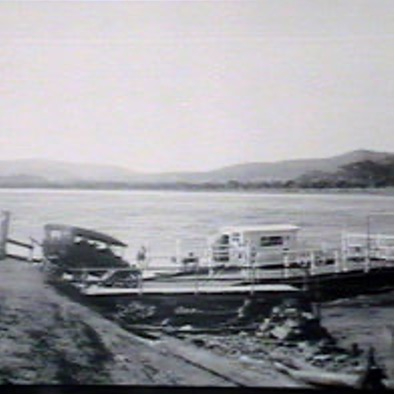
The Karuah Ferry was one of several ferries that operated in the Port Stephens area before the construction of road bridges over the major waterways.
Prior to 1907, the ferry was known as the Sawyers Point Ferry. The first reference to a ferry (or punt) at Karuah was in 1849. The ferry ceased operation in December 1957, after some one hundred and eight years, when the Karuah Bridge opened to road traffic.
The ferry service evolved from the earliest days when the ferry comprised a boat to take passengers across the river for a fee. In later years, this service was upgraded to a hand drawn barge capable of taking horse drawn and motor vehicles, and finally to a powered vehicular ferry that ceased operation in 1957.
The Karuah Ferry was an important connection point for Karuah and the nearby Tea Gardens area, as well as for those travelling north and south along the coast on the Pacific Highway.
For most of its years, the ferry service was jointly operated by the Stroud Shire and Port Stephens Shire Councils. The operation of the ferry was always a financial burden on both councils and there were multiple breakdowns and accidents over the years.
When the ferry was out of action, transport difficulties were not only experienced by individual travellers, but also for the nearby timber industry which used the ferry to transport timber to markets.
This paper examines a history of the ferry together with the major issues that rose during its operational life. It is the story of the life of a small country ferry which provided a vital service.
First Reference to a Sawyers Point Punt – 1849
The People’s Advocate and New South Wales Vindicator of 6 October 1849, page 4, reported on the capture of the felon, James Davidson:
‘The public will be somewhat gratified to learn that this man, who with his accomplice made his escape from the Maitland gaol, has been re-taken at the Australian Agricultural Company’s station, Bundobah, by Mr. Charles King, of Tahlee, assisted by his groom, Edward Stacey, and two stockmen, and after a most determined and obstinate resistance. On Monday, the 24th September, he crossed the ferry at Sawyer’s Point, and, passing through Carrington the following morning, reached Bundobah in the afternoon. At Sawyer’s Point ferry he said his name was Young, at Tahlee, he said his name was Cook, but at Bundobah, being recognised by some of his old acquaintances, he said his name was James Davidson. On Tuesday evening Mr. Charles King and his groom proceeded to Bundobah, and there, lying on a bed in the hut, discovered a stranger, who stoutly denied that he was the robber of the Singleton mail, although his name was Davidson. Mr. Charles King, however, felt convinced that he was so, and presenting a pistol at him, demanded his surrender.’
Sawyers Point Punt Washed Away – 1857
The Sydney Morning Herald of 28 August 1857, page 5, published the following extract of a letter dated 24 August 1857 that referred to the Sawyers Point punt at Port Stephens:
‘Since your brother left we have had tremendous rains, and I fear a great deal of damage has occurred in the interior. The shores of this harbour are covered with thousands of loads of drift wood—we had none of this in the former floods ; some houses have been carried away. I picked up some window frames, doors, &c. The punt at Sawyer’s Point was carried away, but fortunately got again, and the rope taken over, which could not have been done but for my boat ; the punt is on a rock and cannot be got off till next spring tide. I shall swim the horses over behind the boat.’
Collection of Sawyers Point Ferry Dues – 1885 to 1906
In 1885, the NSW Government began regulating ferry services which charged a toll. In the New South Wales Government Gazette of 30 January 1885 (No.45), page 845, the following notice was published:
‘Department of Roads and Bridges, Sydney, 20th January, 1885. Sale of Ferry Dues for 1885. The Tolls and Dues to be taken at the undermentioned ferry from 3rd February to 31st December, 1885, will be sold by Public Auction, at noon, on Tuesday, the 3rd day of February, at the Court-house, Stroud: — Sawyer’s Point Ferry, Karuah River.’
The Australian Town and Country Journal of 17 January 1885, page 17, had previously referred to a Government Gazette notice that a ferry service had been established at Sawyers Point on the Karuah River, at which tolls or dues shall be levied.
The sale of annual ferry dues for the Karuah River was ended in 1898. Thereafter, three-year leases were advertised by Department of Public Works from 1 July 1900 to 30 June 1903, and 1903 to 1906 for Sawyers Point, Karuah River.
The ferry used at this time was a small hand powered punt, which was to remain operational for over 40 years.
Government Funds allocated for Ferry Improvement – 1895
The Dungog Chronicle of 20 September 1895, page 2, reported on correspondence from the Public Works Department, dated 16th September 1895, concerning the Sawyers Point ferry:
‘I am directed to inform you that the Secretary for Public Works has approved of the sum of £8,500 being granted for the purpose of meeting the cost of over-hauling the punt, erection of gates thereon, providing boat landings and erection of a yard to enable stock to be driven into the punt. — I have the honor to be, &c., J. Barling, Under Secretary.’
The Dungog Chronicle of 29 May 1896, page 2, reported that A. McNiven and A. Stokes, had been granted the licence to operate the ferry for 1896.
Karuah Progress Association Formed and Raised Concerns About the Ferry -1907
In 1907 the Stroud and Port Stephens Councils took joint control and funding of the ferry operations.
The Dungog Chronicle of 22 February 1907, page 1, reported:
‘A well attended meeting of the residents of Karuah took place at the Public School on Saturday evening last, 16th inst. ….. Hence a series of resolutions were carried unanimously, which gave birth to a new public body which is to be known as the “Karuah Progress Association.” The name “Karuah” provoked a spirited discussion, as the rising little township is especially well powered with names. The Education Department calls the school Aliceton, the Post and Telegraph Office is known as Karuah, the land maps designate the surveyed township Tarean, while the countryside people, the pleasure seekers of Dungog, Clarence Town, Raymond Terrace, etc., popularly term it Sawyer’s Point. Quite an embarrassing vocabulary! …
The Secretary, was instructed to write to the Port Stephens and Stroud Shire Councils calling their attention to the urgent need of boat landing places at each side of the river in connection with the punt ferry, and also to the dangerous condition of the ferry boat. It was also decided to invite the cooperation of Tea Gardens Progress Association in securing much needed alterations to the punt approaches.’
Ferry Sinks – 1909
The Maitland Daily Mercury of 21 June 1909, page 3, reported on the sinking of the ferry, which, it appears had happened previously:
‘One of our local residents had a peculiar escape last week. Mr. P. Mova, telegraph line repairer, whilst on his rounds arrived at Sawyer’s Point punt just as that vessel had left the landing place. Pat was bewailing his bad luck, but the punt sank in front of his eye, so now he thinks he was befriended by a lucky star, as his horse, which was in the sulky, would assuredly have been drowned.’
Engineer’s Report on the Hand Powered Ferry – 1910
The Dungog Chronicle of 14 October 1910, page 3, published the following report of the Stroud Shire Council Engineer:
‘At Sawyers Point, the Stroud Council by mutual arrangement has charge of a ferry service on behalf of this and the Port Stephens Shire. The punt in use is of the river type, and clearly not suitable for the site, the punt which measures only 12 feet by 35 feet being too small for so exposed a situation as the head of Port Stephens. It is also too old for present day needs, and has been capsized and sunk on several occasions.
The suggestion is made that the two Council’s ask the Public Works Department to supply plans, specification and estimate of an approved punt of not less than 18 feet beam, fitted with a sheltered shed for the man, and an oil engine instead of hand power as at present. In case of a breakdown of the engine, hand power should also be furnished.’
Ferry in Danger of Sinking – 1914
The Dungog Chronicle of 8 December 1914, page 3, published a report by the Stroud Shire Council engineer about the Karuah Ferry:
‘On the 6th ultimo on her return trip [the ferry] after taking a truck loaded with 2,000 feet of timber, sprang a leak, the ferryman, being in distress called for help but no one was there to come to his assistance, and he had great difficulty in reaching shore, and having obtained help got her beached to save her from sinking.
On receipt of the news I went as soon as possible to inspect her, and found that there was a gaping crack at one of the corners. Mr Engel, owner of the slip at Tea Gardens, happened to be at Sawyer ‘s Point, and I arranged with him to tow her round, put her on the slip, and reported the matter to the [Shire] President. It was not possible to slip the punt till the 13th. The President and I travelled together to Tea Gardens, and inspected her after she was put on the slip, and found that she was not in as bad a state as could be expected, considering that she had not been out of the water for over 10 years.’
Ferry Sinks and Cattle Are Drowned – 1919
The Dungog Chronicle of 24 June 1919, page 3, reported:
‘Owing to the total block in vehicular traffic at Karuah, on account of the sinking of the punt, the Member for Durham, Mr Bennett, has sent the following letter to the Hon. Minister for Works: —
Dear Mr Ball,— Owing to drought conditions in various parts of the State, there has been an enormous influx of starving stock to the Port Stephens district, and a few weeks ago the hand punt at the Karuah River, which ply’s across at Karuah, sank with a load of stock, most of which were drowned. This punt has since been at the bottom of the river and all vehicular traffic between Pindimar, Tea Gardens and a vast area of land on the east side of the river and harbor has been cut off from the main road leading to Maitland, Raymond Terrace, etc.
The punt is an old one and totally inadequate for the requirements of this fast developing locality. The Port Stephens and Stroud Shires are comparatively poor and are unable to finance a new punt. As this punt is more extensively used by the people living outside the district, than ratepayers, I respectfully appeal to you for assistance as a matter of urgency. Could you loan a steam punt or supply one? There are thousands of head of stock belonging to the Upper Hunter and the north western districts, that will have to return home via this route, and the total block in transit is a serious one. Under the circumstances I think the Government should come to the assistance of the shires in this matter.’
The Dungog Chronicle of 8 August 1919, page 3, published a letter written by S. Cantle, a returned soldier from Swan Bay, who stated:
‘He has had experience of salvage operations and was with the Engineers in the Army. The writer stated he could perform the task of raising the punt at a reasonable cost, and the plant necessary is at the moment available. — Cr. Dun [of Stroud Shire Council] moved that the writer be asked what he will quote for floating the punt. Seconded by Cr. Abbott and carried.’
The ferry was to remain out of action for several months.
The Macleay Argus of 4 May 1920, page 2, reported on the result of court action concerning the drowned cattle:
‘At the Maitland Circuit Court last week, John Taylor, of Murrurundi, sued the Council of the Shire of Stroud, for the alleged negligent management of a punt at Karuah, which was also alleged to have been in a dangerous defective and unsafe condition and unsuitable for cattle passing over it, as a result of which plaintiff claimed that the punt sank and certain cattle belonging to him were drowned and others injured. Plaintiff claimed £153 damages. The defendant shire pleaded not guilty.
There was a cross action, in which the Council of the Shire of Stroud alleged that John Taylor so negligently, carelessly and improperly conducted himself in and about driving certain cattle on the punt, and loading same and controlling and managing the cattle, that the punt was sunk and damaged, and the plaintiff Council claimed £73 damages. To that defendant pleaded not guilty.
The jury gave a verdict for the defendant in the case of the Council against Taylor. In the case of Taylor versus the Council a majority verdict was given for the defendant Council.’

Ferry sinks as cattle move to one side
Further information on this court case is set out in the Addendum at the end of this paper.
Ferry Out of Service for Over Three Months – 1919
The Dungog Chronicle of 24 October 1919, page 2, reported:
‘Mr Bennett asked the Secretary for Public Works, — (1) Is it a fact that the punt which has been doing service at Karuah River is over 40 years old, and is in a state of decay? (2) Is it a fact that it has been out of commission for over three months, and that traffic at this important point has been suspended? (3) Will he, in view of the large amount of traffic at this point, and the rapid development of this part of Port Stephens, supply the impecunious shires concerned with a new punt, or erect a bridge as a national work over the river? Answer, — I am informed by my colleague the Minister of Local Government: (1 and 2) The punt at Karuah has been under the sole control of the Stroud and Port Stephens shire councils since January, 1907 — a period of twelve and three-quarter years. Its present condition is therefore not known to the department, and if in bad order or out of commission, responsibility rests entirely with the two councils concerned. These have a combined general revenue of £10,000 per annum, towards which the State contributes 60 per cent., notwithstanding that one council has a reserve rating power of about £800. (3) No.’
Costing For a New Ferry to be Obtained – 1921
The Newcastle Morning Herald and Miners Advocate of 10 May 1921, page 5, reported:
‘The Port Stephens Shire has decided to obtain an estimate of the price of a new punt for Karuah. Application for this was made by the Stroud Shire, on the basis of quarter contribution by each council and half by the Local Government Department.’
Ferry Disabled by Possible Unauthorised Use – 1923
The Newcastle Sun of 29 August 1923, page 5, reported:
‘The travelling public are handicapped at present at Karuah owing to the punt not running, as it is high and dry at one side, having broken away or been set adrift by people using the punt late at night without permission of the puntman.’
New Powered Ferry Installed at Karuah – 1923
Utilising loan funds from the NSW State Government the Stroud and Port Stephens Councils installed a larger powered ferry in 1923.
The Newcastle Sun of 13 November 1923, page 5, reported:
‘After years of waiting and agitating, Port Stephens and Stroud Shire councils have installed a new motor punt across the Karuah River at Karuah. The punt was officially opened for traffic by the three engineers, Mr. Alexander (Government engineer), Mr. Thomas Davoren (Port Stephens Shire), Mr. Grey (Stroud Shire).
On a trial run the punt crossed the river in three minutes, the engine running at only half speed. The engineers expressed their approval of both engine and punt, but condemned the present approaches, and decided to get a price from the local puntman, Mr. D. Lyal, for new approaches on both sides, and the removal and reconstruction of the foot-passengers’ wharfs. When the work is complete the punt should be one of the finest in the State.
It is built of hardwood, covered with Muntz metal, and is 76 feet by 34 feet over all. The main deck is 48 feet by 20 feet seven inches and is four feet six inches deep. It is fitted with all galvanised iron fastenings and is capable of carrying eight cars at once. It was built by Messrs. Engel Bros., of Tea Gardens, and reflects great credit on the firm. The engine motor is run on benzine, and was made by Mr. Dalgleish, of Karuah, where he has a large engineering work. It is rated at 10 h.p., but overloaded has been tested to 17 h.p. The punt is driven by direct drive from two pulley wheels to the rope wheel. The people of Karuah are proud of this new acquisition.’
The new ferry remained in operation until 1957, a period of 34 years.
Additional Government Financial Assistance for Ferry Sought – 1925
The Newcastle Sun of 10 February 1925, page 6, reported:
‘Port Stephens Shire Council has been informed by Mr. Vincent M.L.A. for Oxley, that the Minister for Works has refused a request by the shire for an increased contribution towards the working of the Karuah ferry.
The ferry is maintained by two shires (Stroud and Port Stephens) and carries a lot of tourist traffic to Tea Gardens, which, it is stated, is a big expense for the councils’ finances as on all-night service is run. The councillors consider that the department should pay more of the working costs of the ferry, which is used for the convenience of people who go fishing and holiday making. A further application will be made to the Minister for an increased contribution.’
Ferry Traffic Count – 1925
The Maitland Daily Mercury of 7 July 1925, page 4, reported:
‘The ferry master at Karuah has furnished the Port Stephens Shire with a return of the traffic from May 8 to June 7. This showed that there were ferried across the river 322 motor cars, 43 motorcycles, 287 two-wheel vehicles, 7 four-wheel vehicles; 149 horses, and 2572 foot passengers.’
Toll Proposed for Karuah Ferry – 1926
Due to the increasing financial cost of operation the ferry a toll was proposed. The Maitland Daily Mercury of 5 July 1926, page 4, reported:
‘A conference was recently held between representatives of the Stroud and Port Stephens shires in connection with the Karuah Punt. The working costs of the service amount to over £400 and the Government pay £237, leaving the councils to find the balance, it was decided to impose a toll and the matter of drawing up the schedule has been referred to the Stroud Shire.’
The Raymond Terrace Examiner and Lower Hunter and Port Stephens Advertiser of 9 July 1926, page 3, reported:
‘A toll will be placed on Karuah Ferry. On Friday last the Stroud Shire Council conferred with the Port Stephens Shire Council, on the question whether a toll should be imposed or otherwise. The Port Stephens Shire had not agreed to impose any toll, but Stroud were in favour if it. Cr. Flannery, President of the Stroud Shire, said he favoured the toll, as the people of Tea Gardens were quite satisfied that a toll should be imposed as it would give more funds for expenditure on the road, and so help to make a better and quicker access to Tea Gardens. He thought that a toll was a fair tax on this ferry, as no public funds were spent in the provviding of the ferry. It was different to a bridge that had been built with public money, and which all paid towards, and which should be free.
The tourist traffic over the punt would pay most, and from the tally taken by the shire, it would amount to about £50 a month. Crs. Kesteven, O’Brien, Barnes, and Turner also supported the toll. Cr. Mertedith, Port Stephens Shire, said he was opposed to a toll in any shape or form. They had more experience of tolls here than they had at Stroud. ……
The move to impose a ferry toll immediately resulted in much opposition from the local community. The following letter published in the Raymond Terrace Examiner and Lower Hunter and Port Stephens Advertiser of 16 July 1926, page 2, reflects the opposition views of the Karuah community:
‘Sir,— We, of Karuah, have noted with especial interest the result of the conference between the Stroud Shire and the Port Stephens Shire Councils concerning the proposed toll on the local ferry. We note that the Port Stephens Councillors voted solidly against the proposed toll, with the exception of Councillor Ralston, who voted with the Stroud Shire in opposition to his own council. Surely Councillor Ralston, who knows evidently nothing about the situation himself, could have relied on his fellow councillor’s, especially Councillor Meredith, who knew what they were taking about.’
The toll was never imposed, as the Minister for Local Government refused to approve the proposal.
Service of Ferryman, George Neal, praised – 1928
The Dungog Chronicle of 7 December 1928, page 2, reported:
‘The Karuah Punt has put up a record by running continuously for nearly two years without a break. All repairs and overhauls to the engine are done by the popular puntmen, Mr. George Neal, who is an expert mechanic. The Shire is fortunate in having the services of such a capable mechanic and it is to be hoped that George will be able to hold his responsible position for many years to come.’
At a previous meeting of the Port Stephens Council in May 1926, George Neal sought approval to build a 2 or 3 room residence adjacent to the ferry, which was later approved. He was given a permissive occupancy of the land. George Neal remained as the ferry contractor at Karuah for over 24 years.
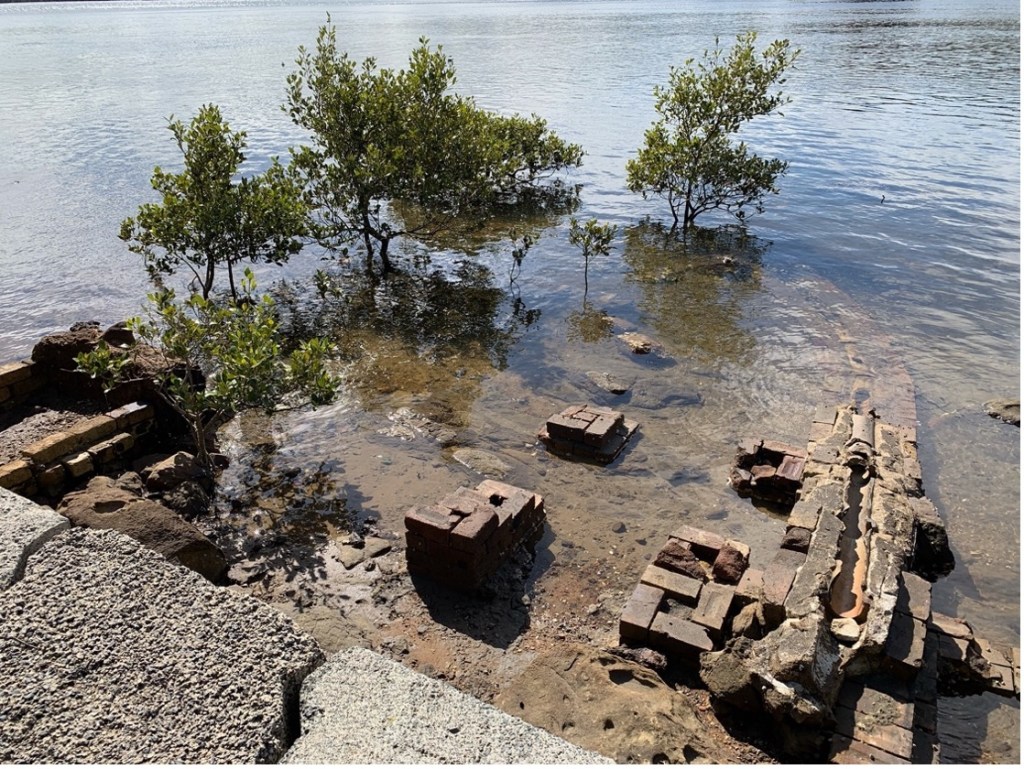
Remnants of the home of George Neal on the Karuah River, adjacent to the ferry [Author photo]
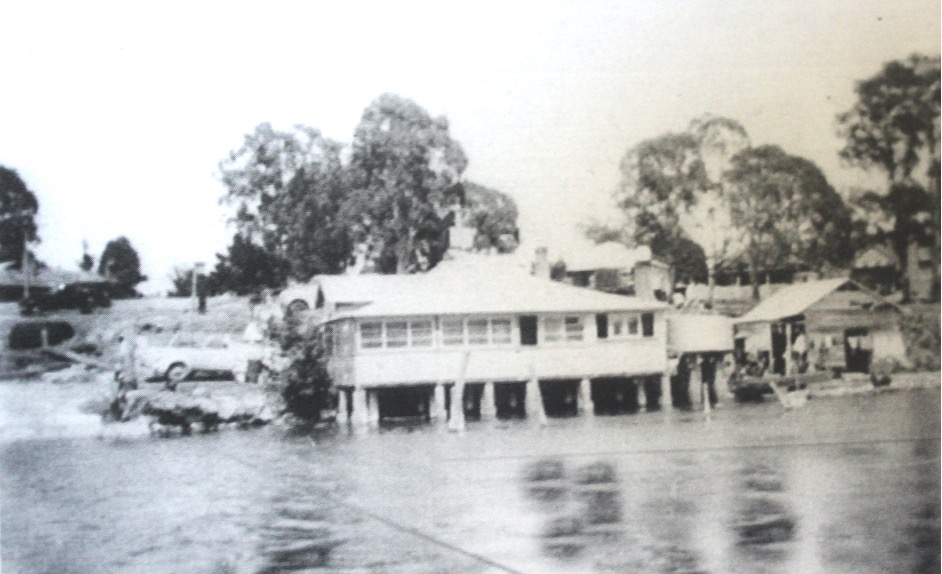
Home of George Neal (since demolished) on the Karuah River, adjacent to the ferry
Ferry Broke From Wire Rope – 1930
The Dungog Chronicle of 12 December 1930, page 4, reported:
‘When the punt broke from her wire ropes last Saturday with 20 head of cattle the ferryman [George Neal] was treated to an anxious time. A number of launches went to the rescue, but not before the ferry had drifted down stream to a point opposite Longworth’s about a quarter of a mile. Service was quickly restored, and it is fortunate that nothing untoward happened — beyond the excitement occasioned by a temporary plight.’
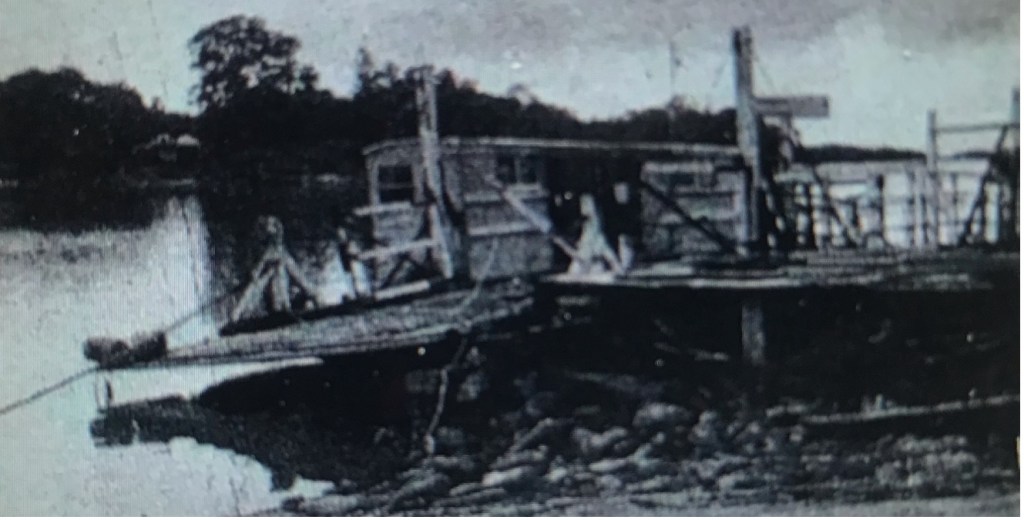
Ferry pushed onto land after a storm
Disagreement Concerning Awarding of Contract to George Neal – 1932
The Dungog Chronicle of 20 May 1932, page 4 reported:
‘At the monthly meeting of the Port Stephens Shire Council, the matter of the acceptance of a tender for the running of the ferry was discussed. Stroud Shire Clerk wrote in reply to an inquiry by the Port Stephens Council, why the lowest tender was not accepted by the council, and also forwarded a copy of the letter to the Local Government Department.
The tender of Mr. Neal was accepted on account of the fact that when in charge of the ferry he had saved the council a sum estimated at £100 in one year by doing necessary repairs. During his previous contract he had given every satisfaction to the travelling public. In the circumstances the council thought the difference would be more than compensated. The amount of tender is £52 per year less than previously. The subsidy from the department is £237 per annum. In discussing the matter, councillors contended that there were several tenderers much lower who were more competent mechanically. The council had no cause to complain of the previous tenderer, but as the ratepayers had to pay the difference they thought that in their interest the best lowest tender should be accepted. The President moved that the Stroud Council be informed that in future tenders, all things being equal, the lowest tender should always be accepted; that there were other tenderers at a lower price who could have carried out the work equally well. This was agreed to.’
Complaint Against Ferryman, George Neal – 1932
The Raymond Terrace Examiner and Lower Hunter and Port Stephens Advertiser of 16 June 1932, page 1, published a letter written by Richard Pile concerning his complaint against the puntman, George Neal:
‘Sir. — Permit me through your columns to draw attention to the unsatisfactory, state of the Karuah ferry; both in regard to the plant and the manner in which the contractor serves the public. I shall deal first with the latter subject.
Despite every consideration by users of the ferry he is attempting to make their trips coincide with those of other passengers and to row themselves across on all possible occasions without troubling the puntman, it is very seldom that he returns the courtesy by answering the bell promptly, generally the work of wood-chopping, bagging or culling oysters interferes with a prompt service. In parenthesis, it may be mentioned that the contractor is allowed to have free, first class advertising space on the punt, advertising to travellers that he sells oysters. It would also be considered that the punt is a first class business site for the disposal of oysters and is to him rent free. This however is in passing.
On Tuesday morning after giving a signal of two claps of the bell and repeating it twice after reasonable intervals the puntman emerged from the engine room. A few minutes later I was surprised to find that he was not in sight. Twenty minutes after continually advising him that I needed the boat. I had to cross by other means. Prior to this a group of school children had been compelled to wait for a considerable time, and subsequently another passenger was compelled to wait. This matter is not one that has arisen during the past few weeks; rather it has been going on for several years.
At night time it is not sufficient to clang the bell once or twice. It is absolutely necessary, to make such a noise that half the town is awakened. Such delay is maddening when it occurs in the early evening and the puntman answers the signal by opening his door so that the light shows on his wall, then retires till repeated clangs from the bell re-disturb him. It is also very annoying when in rowing oneself across one has to attempt to moor the boat with inadequate gear. The ropes provided are generally in a very frayed and knotty condition with the result that clothes becomes covered with brine. There are no adequate mooring bitts provided either.
Steps, too, are in a bad condition. No attempt is ever made to remove the slime that congregates on the lower rungs, and this coupled with the fact that on the Karuah side the steps are practically perpendicular and the rungs are not on a level gives the impression that it is more by good fortune than good management that no one has been injured while attempting to negotiate them. Some time ago the steps on the opposite shore were partly destroyed. At no time was a light placed near to warn passengers of this danger. Recently a launch is to be found moored at the steps with the punt boat on the outside. As this boat is what is known as “crazy” an attempt to get to the punt boat is accompanied by a grave risk of pitching into the water. The risk is accentuated at night time.
A long suffering public has put up with great inconvenience for some time, but that is no reason why such a state of affairs as exists should be allowed to continue. Ratepayers especially, are entitled to demand that the Councils concerned should’ compel the contractor to honour his obligations’.
The Raymond Terrace Examiner and Lower Hunter and Port Stephens Advertiser of 30 June 1932, page 3, carried the reply by George Neal:
‘Sir. — Please allow me space in your paper to reply to Mr. R. Pile’s letter of the 16th inst criticising the Karuah ferry and its working generally. Your correspondent has voiced complaints at length which are mostly frivolous and could be ignored, only for the fact that readers unacquainted with the work of this ferry might gather a wrong impression. The plant which he has criticised is the product of the brains and labour of Port Stephens and is equal to anything of its class. As to the charge of neglect of the public interest extending over many years does it not seem, in view of the fact that the present contractor has performed six year’s service a reflection on the local governing bodies who, when called upon to deal with the tenders lately received, decided after exhaustive enquiries to accept mine for another term, chiefly on the grounds of the very satisfactory way in which the duties appertaining to the punt workings had been discharged.
The writer has in his possession letters from the travelling public giving expression to their views as to the prompt and satisfactory service that invariably awaited them. On the Tuesday that the young man did all the bell ringing the punt was off for overhaul and a notice was posted to that effect. It might be stated that to ferry any person across is a matter left entirely, by the controlling shire, to the punt man’s discretion. It might be stated that some persons make a practice of clanging the bell while the ferry is being brought across for them and the puntman is powerless to restrain them.
The puntman does a hundred and one things for the public that could not by any stretch of imagination be said to be embraced in the contract, this is recognised and appreciated by most of the public but it is apparent that there are odd ones who do not appreciate them. The puntman was not responsible for the construction of the landing steps but endeavours to keep them free from slime and would suggest that your correspondent urge the necessity of having it laid down in future contracts that the steps be scrubbed at low tide every 12 hours, if only to make safer the midnight peregrinations of amorous youths.’
Car Accident at the Ferry – 1933
The Dungog Chronicle of 3 February 1933, page 4, reported:
‘Prompt action on the part of several citizens undoubtedly saved the life of George Salvage, 26, of Vine street, Mayfield, when the car in which he and Miss M. Robertson, of Maud street, Mayfield, were travelling from Tea Gardens to Newcastle, crashed through the gates of the Karuah punt, and settled in about 35 feet of water.
The punt was in the charge of J. Morante, who immediately after the accident, set out in the punt boat to get assistance, but in the meantime, the contractor, Mr. G. Neal and Messrs. Arch Aubrey, and Harold Farley were racing to the scene in other boats. Mr. Neal, who arrived first, plunged into the water and supported Salvage, who had just appeared at the surface in an unconscious condition, while the other occupant of the car clung desperately to the punt wire. Not a minute too soon the second boat arrived and the unconscious man was lifted to the flap of the ferry.
Several of the rescuers tried methods of artificial respiration, which were hampered by the patient’s great build. After some minutes the workers were rewarded by signs of life being displayed, and later the sufferer began to speak. In the meantime the woman passenger of the doomed car had had torniquets applied to arrest the flow of blood from a deep gash in her wrist. When Dr. Meredith, of Raymond Terrace arrived, he immediately ordered the man to hospital, where on the arrival of the ambulance, he was transported to undergo treatment for shock.’
Fatality Linked to Accident at Ferry Landing – 1934
The Dungog Chronicle of 2 March 1934, page 4, reported on an accident that was to lead to a fatality:
‘The recent fatality at Karuah, wherein Mrs. Theo. Neville lost her life from shock following an accident at the ferry landing, draws attention to the need for an improvement of conditions at this spot. Mr. and Mrs. Neville and daughter were motoring to the approach when the brakes failed to hold and the car ran into the water. The three regained the shore but the shock was too great for the unfortunate woman, who died next day. The approach to the ferry is far too steep and far too narrow. There are very few obstacles which expert minds cannot overcome these days and this one should be set before them. On both sides of the river the approach is unsatisfactory and many cars are damaged whilst negotiating them.’
The Newcastle Morning Herald and Miners’ Advocate of 8 March 1934, page 5, reported on the Coroner’s examination:
‘The evidence before me indicates that it was purely an accident, and that probably, the brake-rod broke when the car was pulled up to avoid a cow, said the Coroner. (Mr. A. G. Chiplin), at the inquest held at Newcastle Courthouse yesterday into the circumstances of the death of Mrs. Matilda Ann Neville, 34, of Russell road, New Lambton, on February 24. Sergeant G. G. Noble, of New Lambton, represented the police.
While Mrs. Neville was returning from Tea Gardens with her husband and daughter on the night of February 23, the brakes on the car failed, and the vehicle plunged into the river at the punt approach at Karuah. The Coroner found that death was due to heart failure caused by a dilated heart secondary to goitre, probably accelerated by immersion and exhaustion caused by a car, in which she was a passenger, falling into the river. …….
Theodore Neville, foreman, of 10 Russell road, New Lambton, said that about 8.45 a.m. on February 23, in company with his wife and daughter, he drove to Tea Gardens to inspect timber for the company by which he was employed. About 8 p.m. the return journey was begun. His wife and daughter sat on the front seat with him. Prior to reaching where the road turned towards the Karuah ferry, he applied the brakes suddenly to avoid some cattle on the roadway. He then proceeded towards the ferry, which he noticed was on the opposite side of the river. There was an incline of 50 to 60 yards to the approach to the ferry. He put the engine in second gear, and was driving the car slowly down the road to the ferry. He applied the brakes and found that they would not act. He was then half-way down the incline. He then tried to change into low gear, but could not do so. The car continued on into the river, and came to a standstill in about 10 feet of water. His wife was nursing the daughter, aged 3 years. He caught hold of the child and struggled out of the river.
He returned to the rescue of his wife, who was holding on to the steel guide rope of the ferry. She was semi-conscious when brought ashore. Replying to the Coroner, witness said that the car came to a standstill about 30 feet from the shore. Mr. Neal, the driver of the ferry, took them across the river in a boat. His wife went to bed in Neal’s home, and appeared to be all right after having had a cup of hot tea. Later she complained that she did not feel too well, and that she had pains in her head. The family stayed at Karuah for the night, and returned home about 10.30 a.m. the next day.
His wife still complained of severe pains in the head, but said that she would be all right when he suggested calling a doctor. He went to Newcastle on business. Returning home about 12.30 p.m. he found that his wife had died during his absence.’
Hawks Nest Punt Used as Temporary Replacement – 1934
The Dungog Chronicle of 14 September 1934, page 4, reported:
‘After undergoing an overhaul on Engel’s slip, the Karuah ferry punt has been taken back and placed on the wire again. Whilst being under repairs, the connection was kept going with the ferry punt used between Tea Gardens and Hawk’s Nest. Being a punt not powered, it was towed back-wards and forwards by an oil launch, there being only a day-light service maintained.’
When the Hawks Nest ferry was used as a replacement it stopped vehicular traffic between Tea Gardens and Hawks Nest, resulting in hardship for the two communities.
Need for Bridge Over Karuah River Proposed – 1934
The Dungog Chronicle of 9 November 1934, page 4, reported:
‘In company with the President of the Stroud Shire Council (Cr. Harris), the Newcastle City Council Publicity Director (Mr. F. J. Cahill) urged upon the Minister for Local Government (Mr. E. S. Spooner) the necessity for the provision of a bridge over the Karuah River on the road leading from the Pacific Highway to Tea Gardens.
At present a punt provides inadequate facilities. In his address at Tea Gardens on Saturday, Mr. Spooner stated that £10,000 had been set aside for bridges on roads under the control of his department, as separate from roads controlled by the Main Roads Department. Mr. Spooner told Cr. Harris and Mr. Cahill that if the local governing bodies in the district, including the Newcastle City Council, made representations, he would give the request serious consideration. Mr. Cahill brought the matter before the Newcastle council on Monday night, when the council agreed to cooperate. Aldermen expressed the view that the Council should also move towards securing the provision of a bridge over the Hunter River at Hexham.’
It would be another 23 years before a bridge was constructed over the Karuah River.
Complaints Against Ferry Operation – 1936
The Dungog Chronicle of 20 November 1936, page 6, reported:
‘[Correspondence] From W. Pointer, Karuah, stating that on one occasion he had been kept waiting 20 minutes at the Karuah ferry before being taken across. Cars were also kept waiting until the arrival of the service car from Tea Gardens.
The Clerk stated that the Postmaster at Raymond Terrace had phoned him, saying that the mailman on 3rd inst., had been delayed considerably at the punt, and as a result had very nearly missed connecting with the other mails at Raymond Terrace. He had been delayed from 3.45 till 5.15 p.m., while the punt had been due at 4 p.m. The Engineer stated that the ferryman had been good enough to wait for him on that occasion, he being late arriving. On the motion of Crs. Zeininger and Turner it was resolved that the ferry man be advised of the several complaints lodged.’
The Dungog Chronicle of 18 December 1936, page 6, published the response by the ferry man, George Neal:
‘From Geo. Neil, Karuah, in reply to Mr. W. Pointer’s complaint that his boy was kept waiting at the punt. It was advised that the boy was never kept waiting but did not go home when put across. He had been put across five times in the one afternoon and on one occasion had been seen playing with another boy at 5 p.m. When the writer went on his shift at 5.30 p.m. recently the boy was still on the ferry and informed him that his bike was out of order. The writer mended the bike and it would be after dark when the boy arrived home. If, as Mr. Pointer had stated, cars had been kept waiting, the Council would have had complaints from car owners. The writer had seen Mr. Pointer at Karuah only three times in 12 years. He was always pleased to explain complaints, but indicated that the engine being old some delays were un-avoidable. He stated that he would like the ferry put off from 6 to 6 on a Tuesday prior to Christmas. The flap was broken and he had limited the loads to two tons. The explanation was received and permission to take the ferry off the service on Tuesday 22nd inst. was granted.’
Condition of Ferry Causes Problems for the Timber Industry – 1937
The Dungog Chronicle of 22 January 1937, page 4, reported:
‘[Corrsponence] From C. J. Hough asking that the Karuah ferry be put in order to convey loaded timber lorries. Because of the fact that such did not apply at present he could not get his timber to market and as a consequence several men were out of work. He was forced to decline future orders in addition to being unable to fulfil present ones. —The matter was referred to the Engineer with power to impose a reasonable load limit on the punt.’
The Dungog Chronicle of 21 December 1937, page 6, reported on further representation on the weight limit:
‘[Correspondence] From Pindimar Port Stephens, Ltd., asking that the notices exhibited on Karuah Ferry, limiting the load to 2 tons be removed, as the company is concerned with the sale of timber which would have to be carried over the punt, and although heavier loads were carried on the punt, the position was being affected by the fear that the maximum load of two tons may at some time be enforced. The engineer stated that the flaps on the punt had at times been abused and the notices were now serving a good purpose.
The Tea Gardens-Karuah Road was a light traffic road and it would be better from Council’s point of view if the Company could find some other means of transporting their timber. Cr. Zeininger said that the Company was trying to make a contract for haulage of timber from their property and the only practicable means of transport was over the Karuah Ferry. The Council must consider the ratepayers. At the same time he realised that the flaps on the punt would not stand up to extremely heavy loads, and did not think that Council could accept responsibility for transporting these. He moved that the notices be altered to extend the load limit to 3 tons. Seconded by Cr. Wilson and carried.’
Temporary Ferry Sinks – 1938
The Dungog Chronicle of 1 April 1938, page 6, reported on a replacement ferry that sank while being towed to Karuah:
‘A full report was submitted to the Department of Main Roads regarding the sinking of the ferry which the Council hired from that Department. …. In view of the urgency of the slipping of the Karuah Ferry it was found necessary to stop traffic on the Karuah-Tea Gardens road from 10 o’clock on Monday night, 7th instant, until 6 o’clock on Thursday morning, 10th instant. The ferry was towed to Tea Gardens and slipped for inspection on Tuesday, 8th March. Repairs were effected to the sheathing and to portions of the flaps, and the punt duly returned to Karuah.’
George Neal’s Contract as a Puntman Raises Concerns – 1938
A report in the Raymond Terrace Examiner and Lower Hunter and Port Stephens Advertiser of 23 June 1938, page 4, showed that the Port Stephens Shire Council did not approve of the appointment of George Neal for a further three year period:
‘At the meeting of Stroud Shire Council on 10th inst, the President, Councillors, Clerk and Engineer of Port Stephens Shire Council attended for the purpose of conferring on the matter of tenders for the working of the Karuah ferry. The President of the Stroud Shire said that Port Stephens Shire Council had asked for this conference. Tenders had been called for the working of the Karuah ferry, and although the tender of the present ferryman was slightly higher than two of the others, the Council had recognised the good service he had given in the past, and had considered it to be in the interests of both Councils and the public to accept his tender. The department had agreed to the acceptance of this tender.
The President of Port Stephens Shire said that Neal’s tender for the previous term was £30 higher than another tender and that Stroud Shire had accepted it on that occasion. When Port Stephens Shire Council had protested, it had been agreed that in future tenders would be submitted to that Council for approval before acceptance, and an agreement to that effect had been drawn up and signed. Stroud Shire Council had not complied with the conditions of that agreement, and had accepted Neal’s tender on this occasion without giving the Port Stephens Shire Council a chance to object or to submit the matter for arbitration as agreed. He wanted it clearly understood that his Council had nothing against Neal, but there was nothing to show that the other tenderers would not have done the job just as efficiently. His Council considered that the tender at a lower price should, have been accepted, and as a total sum of £78 for the three years would be involved, it considered that Stroud Shire should bear the difference in cost. Crs. Meredith and Upton, of Port Stephens Shire, also spoke in the matter and supported the remarks of the President.
Cr. Flannery said that as the mover of the motion that Neal’s tender be accepted, he felt a certain amount of responsibilty in the matter. However, he did not know at the time of the agreement that the matter should be submitted to Port Stephens Shire, and in the light of his information, he could see that Stroud Shire had been at fault in not complying with the agreement. At the same time he considered that the Council had been quite right in its attitude to the tenders. Neal had been running the ferry for some years, and shown himself thoroughly efficient. The other tenderers may be all right, but the Council had not had the experience with them it had had with Neal.
Neal also had some of his own equipment on the punt, which the Council would have to replace if his tender had not been accepted. Cr. Meredith said that the Council had no right to allow Neal to put his own plant on the punt. One of the other tenderers had a marine engineers’ certificate, and that should show he was capable of handling the punt. Cr. Flannery said that the fact that he was in possession of a marine engineer’s certificate did not prove that he could run a ferry more efficiently than the man who had been running it for years. Cr. Flannery said that in fairness to himself, he would say that he opposed the motion for the acceptance of the higher tender. He had nothing whatever against the present contractor, but he thought that at least one of the other tenderers would be able to do the work satisfactorily. There was nothing to show that the other tenderers were not equally efficient. He did not think that councils should show any preference whatsoever. They were doing wrong in accepting the higher tender. He was aware that Neal had probably done some work in anticipation of the contract, but apart from that aspect, he would certainly support any move to alter the acceptance of Neal’s tender.
The Clerk said that the contract had been signed by Neal. He, (the Clerk) would accept a certain amount of the blame for the position that had arisen. He had overlooked the fact that the agreement was in existence providing for the tenders to be referred to the Port Stephens Shire Council and had worked under the provisions of the previous agreement. The members of the Stroud Shire Council all stated that they had either not known of the existence of the agreement or had forgotten it. The members of the Port Stephens Shire then adjourned for a few minutes, and on their return stated that they were asking the Stroud Shire Council to either call fresh tenders for the contract, pay the whole of the difference between the amount of the lowest tender and the accepted one, or submit the matter to arbitration.
The meeting was then adjourned for lunch and on resuming, Cr. Flannery moved that the Council does not accept the suggestion of the Port Stephens Shire Council that fresh tenders be called, and that this Council does not agree to pay the difference in the amount of the tenders. Cr. Flannery said that in his opinion the only thing open to question was that the tenders had not been referred to the Port Stephens Shire Council, and he thought that Neal was the right man for the job. If the Port Stephens Shire was not satisfied, it was up to it to take action to have the matter settled by arbitration. Cr. Wilson seconded Cr. Flannery’s motion, which was carried.’
Ferry Upgraded for Timber Trucks – 1938
The Dungog Chronicle of 24 June 1938, page 4, reported:
‘[Correspondence] from Pindimar Port Stephens Ltd., regarding a proposal by Mr. Phillips for the strengthening of the flaps on the Karuah ferry. Cr. Zeininger outlined Mr. Phillips’ plan, which was to provide special runways of heavy timber on each end of the punt, Mr. Phillips to provide the timber and carry out the work, if the Council provides the bolts for fastening the planks together. He moved that the offer be accepted on these terms. Seconded by Cr. Wilson and carried.’
Possibility of a New Ferry – 1939
The Dungog Chronicle of 17 November 1939, page 4, reported:
‘On receiving advice from the Department of Main Roads that a new ferry might be provided for the Karuah crossing on the new main roads in about 12 month’s time, Stroud Shire Council, at Friday’s meeting, decided to ask the department to retain the present vessel there is a relief.
The department’s letter stated that in view of the probable increase in the volume of traffic over M.R. 506 and having regard to the size and condition of the existing Karuah ferry, it is thought desirable that consideration should be given to the possible necessity of replacing it, and in this event, the department may be in a position to make available a suitable vessel in 12 months’ time. Accordingly, it appeared that it would be advisable to limit the proposed repairs to the existing vessel as far as possible.
It was noted that the Council had ordered a new engine, and advice regarding the possibility of cancelling the order if warranted would be appreciated. To determine the extent of repairs necessary to keep the vessel in commission, it was desired that an inspection should be made by Foreman Pybus, of the department, who supervised repair work on all ferries in the district. A time and date might be arranged. The question of providing a relief vessel was being considered, and Council would be advised further in this regard. At present it did not appear that a vessel could be made available before Christmas.
The clerk stated that the new engine had already been despatched from Scotland. The president said the purchase could hardly be cancelled because Council was under contract. He was in favour of proceeding with the proposed repairs and improvements, however, because, if they were gone on with the ferry could be retained as a relief. The clerk said this could be done if the department sanctioned it.
The president said he thought the Council could convince the department of the advisability of this course, pointing out the cost of bringing a relief from another centre when necessary. Cr. Flannery: apparently, from the fate of the last relief ferry sent on their ferries can’t survive a sea trip. A motion in terms of the president’s suggestion was carried by the meeting. It was decided to point out the great difficulty experienced in the past in obtaining a relief vessel when required.’
Timber Merchants Again Raise Concern With Ferry – 1940
The Newcastle Morning Herald and Miners’ Advocate of 16 April 1940, page 8, reported:
‘The condition of Karuah ferry caused a stoppage of timber traffic last week. A letter from the Divisional Engineer, Main Roads Department, advised Stroud Shire Council that Messrs. J. Holmeth, R. Berry, and L. Campbell, accompanied by Cr. Elkin, of Port Stephens Shire, waited upon him complaining that timber haulage over the ferry carried by the three firms represented had been prohibited since April 2, and that this prohibition would deprive them of their livelihood, and probably result in the closing down of five mills supplied by them. The Engineer stated he had since put in hand the construction of new flaps on the ferry, estimated to cost £96.’
Accident on the Karuah Ferry – 1942
The Raymond Terrace Examiner and Lower Hunter and Port Stephens Advertiser of 5 March 1942, page 4, reported:
‘At the recent Stroud Shire Council meeting a letter was read from Mackenzie and Cunningham, Raymond Terrace with reference to Council’s claim on Melmeth and Sons for the cost of damage to the Karuah ferry when a timber lorry ran backwards on to the ferry. The letter advised that the lorry was owned by Mrs. J. Melmeth, of Raymond Terrace, who claimed that the damages were due to hole in the punt approach causing a broken axle, and that after the matter had been reported to the Council at Raymond Terrace the hole had been filled in. Cr. Flannery moved that the Port Stephens Shire Council be asked whether they had filled in a hole, and if so, for what reason. Seconded by Cr. Zeininger and carried.’
George Neal’s Contract Terminated – 1943
The Raymond Terrace Examiner and Lower Hunter and Port Stephens Advertiser of 29 July 1943, page 2, reported:
‘The Stroud Shire Council adopted the following recommendation of the Works Committee as resolved in meeting on July 9th, 1943. That the specification for the working of Karuah ferry prepared by the Acting Engineer as directed at last meeting be approved after making provision therein for the Council to provide the paint and caulking materials. That Mr. G. Neil be given 28 days’ notice of the termination of the arrangement under which he is working. That tenders be called for the working of the ferry in accordance with the terms of the specification approved …. . That the President be authorised to employ a ferryman between the date that Mr. Neil’s services are terminated and the commencing date of the new contract.’
The Raymond Terrace Examiner and Lower Hunter and Port Stephens Advertiser of 12 August 1943, page 3, further reported:
‘At the Shire Council meeting on Friday a letter was before the Council from the Stroud Shire Council regarding the work on the Karuah ferry. The work is estimated to cost £780, exclusive of the engine, which is estimated to cost £100. While the Karuah ferry is off, the punt at Tea Gardens will be used. The engine is a Lister 10 h.p. Mr. Neil the present ferrymaster will be given 28 day’s notice, and will be asked to remove his engine from the ferry by the 1st September.’
The new engine fitted was later found to have mechanical problems.
The Raymond Terrace Examiner and Lower Hunter and Port Stephens Advertiser of 14 October 1943, page 2, reported on the appointment of the new ferryman:
‘Stroud Council advised that three tenders had been received for Karuah ferry. viz: W. T. Porter £1521; G. Neil, £1560: and V. Farley £1872. The tender of W. T. Porter was recommended for acceptance. The Port Stephens Shire Council approved of the recommendation.’
Mr. Porter terminated his contract within a year of his acceptance.
Problems With New Ferry Engine – 1943
The Raymond Terrace Examiner and Lower Hunter and Port Stephens Advertiser of 23 December 1943, page 2, reported:
‘At the recent Shire Council meeting, the Engineer of Stroud Shire reported that on 30th November, 1943, the bearing of the guide wheel was carried away and the wheel thrown about 12 feet along the floor of the engine house. The Department was notified and arrangements made for Mr. G. Neil to have repairs made. In the meantime, the ferry was towed by a launch, the service being carried out only in daylight hours. The repairs were effected later. Cr. Abbott proposed and Cr. Flannery seconded that the Main Roads Department be advised concerning the unsatisfactory condition of the engine recently installed in the Karuah Ferry that it is impossible to carry on the service with the engine in its present condition and that the Department also be asked whether the engine was inspected after installation. The motion was carried.’
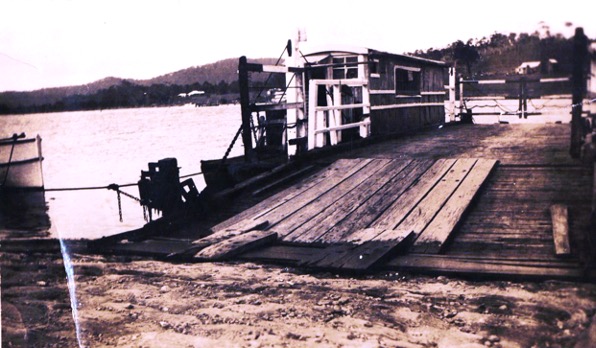
Additional wood was required on the Ferry ramps – circa 1940
New Ferry Contractor Terminates Contract – 1944
The Dungog Chronicle of 22 February 1944, page 4, reported:
‘[Contractor] From W. T. Porter giving notice of termination of his contract for the operation of the Karuah Ferry as from 30th April, 1944. The letter said that Mr. Porter was not satisfied with the conditions, seeing that no home is available for his family or a storeroom for oil and lubricants. He was sleeping aboard, which was contrary to the Maritime Regulations. Council had broken the contract first by not paying as agreed on the 30th of each month. The Clerk said the contract made no provision for paying on the 30th each month, but provided that the contractor should be paid by monthly instalments. The usual practice had been to make the payments after the monthly Council meeting, but the contractor was being paid now at the same time as the wages staff on the first pay day after the end of each month.
On the motion of Crs. Flannery and Miles, fresh tenders are to be called for the operation of the ferry, and on the motion of the President and Cr. Abbott the right of a contractor to give three months notice of termination of his contract is to be eliminated from the specification.’

Early version of Karuah Ferry with the residence of George Neal, ferryman, at left

Great care was needed with placing a caravan on the Karuah Ferry, circa 1950
Alleged Neglect of the Ferry – 1945
The Raymond Terrace Examiner and Lower Hunter and Port Stephens Advertiser of 26 July 1945, page 3, reported:
‘At the last meeting of the Stroud Shire Council the Department of Main Roads drew attention to various matters in connection with the running of the Karuah ferry and asking Council to insist on the operation of the ferry in accordance with the contract. Cr. Zeininger said the ferry was not being looked after as it should be. He had noticed that morning that the wire had jumped out of the rollers and the wire would soon be worn out if this was not attended to immediately. The whole ferry was neglected and the fact that this was allowed to go on reflected on the Council.
The trouble was that the present ferryman did what he liked because he knew that the Council did not have a suitable site for a residence for another contractor. Some drastic action should be taken to see that the ferry is run properly. It was left to the Engineer to take up the matters referred to by the Department with the contractor.’
Ferry Brreaks its Moorings – 1946
The Dungog Chronicle of 29 March 1946, page 3, reported:
‘During the recent heavy weather, Karuah punt broke from its moorings and floated downstream. Traffic was interrupted for two days. During that time mails were brought to Karuah and then taken across by launch and carried on from the other side by service car. Goods lorry traffic was completely held up. Everyone will be pleased when the proposed bridge, now scheduled to be built, is a reality.’
The new bridge was not built for another eleven years.
Ferry Breaks its Moorings – 1949
The Dungog Chronicle of 22 June 1949, page 2, reported:
‘Last Friday the Karuah punt broke its moorings and was swept down the river out of sight. Later it was recovered and towed back by launch.’
New Contract awarded to W.K. Buie – 1950
The Dungog Chronicle of 24 May 1950, page 4, reported:
‘The Department of Main Roads and the Port Stephens Shire Council having approved, it is resolved that the tender of Mr. W. K. Buie in the sum of £1800 per annum for the operation of the Karuah Ferry for a period of three years be accepted. Resolved that Mr. G. Neil operate the Karuah Ferry from the termination of his contract (30/4/50) until the night of 21/5/50, at £40 per week.’
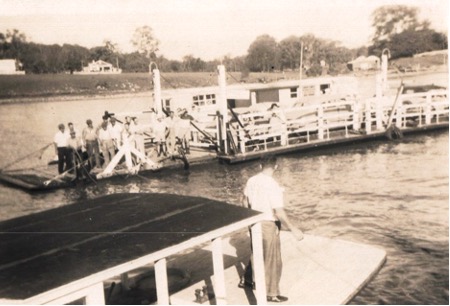
Karuah Ferry carrying pedestrians – circa 1950
Ferry maintenance to be limited – 1951
The Raymond Terrace Examiner and Lower Hunter and Port Stephens Advertiser of 25 January 1951, page 2, reported:
‘At the last meeting of the Port Stephens Shire Council the Main Roads Department informed the Council that no improvement in the ferry service at Karuah would be given as no relief vessel was available.
The letter also said that in view of the proposal to bridge the river at Karuah no additional service will be given. The letter was a reply to a request by the Shire for an improved ferry service there. In relation to the ferry, Cr. Richardson said the Shire spent more on the ferry than was collected in rates in the area. The Main Roads Department also referred to the widening of the road through Karuah township. The width will be increased, to 99 feet.’
Representations Made on Behalf of Timber Industry – 1951
The Dungog Chronicle of 24 February 1951, page 3, reported:
‘At the recent meeting of the Port Stephens Shire Council, Stroud Shire forwarded a letter that they had received at their last meeting. Stroud Shire proposed a conference of representatives of Main Rands Department, Port Stephens and Stroud Shire.
The letter was from Mr. George Neil and read as follows. — “I wish to bring under your notice, the traffic delay and inconvenience, caused by Karuah ferry. I, myself worked the ferry for 24 years. I had a load limit fixed at super feet of logs on truck and trailer, the gross weight of which was approximately 15 tons. Table top trucks, which cause more damage to the flaps than trailers, were fixed at 10 tons gross weight, and as the ferry is a 40-ton vessel, these loads can do no harm whatever. I feel sure if Council will go through records they will find that general repairs were practically nil during the time I had charge of the ferry.
Up to the breaking of the flap (caused by the hinges having never been greased) after I left the job, we have had all sorts of restrictions, which will, if continued, reduce all timber carriers to bankruptcy. I am speaking for all timber men, concerned here. On their behalf I ask your Council to hold a conference at the ferry (including Stroud and Port Stephens Shire Mine and Timber Workers’ Unions, Transport Workers’ Unions and Truck Owners). We will demonstrate to you, a lorry and trailer weighing 10 tons gross weight, also table top lorries weighing 10 tons gross weight.
There are thousands of pounds put into timber rights and unless something is done, all hands will go broke. We repaired the broken flap, which is stronger than ever. Still we will not be allowed to go over with our trailers on although a bus weighing up to 10 tons, goes over twice daily. Has the timber man (the main stay of the country) to suffer all the time ? In conclusion I ask on behalf of the timber men to see for yourselves.” — Sgd. George Neil.
Cr. Rodgers said there was a good deal of feeling engendered by the man in charge. Mr. Buie [current ferry contractor] had passengers removed from the bus and timber removed off lorries. He had on occasions exceeded his authority. Some haulers are going round in preference to crossing the ferry. In the past we never had as much repairs, etc., on the ferry. There is general dissatisfaction from all users of the punt. In reply to a question, Cr. Monkley stated that Mr. Buie’s term was for three years at £1800 a year. Crs. Richardson and James moved that the P. S. Shire confer and that the President (Cr. Rodgers) be their delegate. This was carried.’
The Dungog Chronicle of 14 March 1951, page 4, further reported:
‘[Correspondence from] Department of Main Roads advising that no good purpose would be served by having the suggested conference at Karuah Ferry. — Resolved on the motion of Crs. Zeininger and Lowrey that the Council fix a load limit of 3,000 super feet of timber with a variation of 200 super feet (plus weight of vehicle) for semi-trailer vehicles and a limit of 10 tons (plus weight of vehicle) for table top lorries and that the Department of Main Roads and Port Stephens Shire Council be asked for their concurrence.’
Ferry Contract to be Terminated – 1952
The Dungog Chronicle of 16 February 1952, page 1, reported:
‘Stroud Shire informed Port Stephens Shire that following a deputation from timber haulers, sawmill proprietors and local residents, it had decided to terminate the present contract in three months. The reason was that the service desired by the travelllng public was not being given. Stroud Shire Council asked for the opinion of the Port Stephens Shire in the matter. Cr. Adam said the contractor should be asked for his version of the position. Council agreed and will inform Stroud Shire accordingly.’
The Dungog Chronicle of 11 October 1952, page 3, further reported:
‘Mr. G. Neil interviewed the Council and complained of the manner, in which the subject ferry is being operated. Resolved on the motion of Crs. Lowrey and Moore that three months’ notice be given to the Contractor, Mr. W. K. Buie, of the termination of the Contract and that fresh tenders be called.’
Ferry Rope Breaks – 1954
The Dungog Chronicle of 13 January 1954, page 1, reported:
‘Traffic was held up for many hours last Friday when a cable on the Karuah ferry snapped while the vessel was in mid-stream. The ferry, loaded with a timber lorry, drifted helplessly downstream for half a mile and finished up on a sand bank. The fisheries inspector’s launch towed the ferry back to safe anchorage. A new wire cable had to be obtained from Nelsons Plains from which crossing the ferry originally came to act as relief vessel whilst the Karuah ferry is undergoing repairs at Tea Gardens. Motor traffic to and from Tea Gardens was diverted to the round route via Booral, along Bulahdelah road and then down to Tea Gardens — an extra 30 – 40 miles.’
Accident at Ferry Delays Orchestra – 1954
The Dungog Chronicle of 12 June 1954, page 1, reported:
‘A heavy gravel truck crashed into 14 feet of water when the mooring line of the Karuah Ferry broke on Thursday afternoon. The owner-driver of the truck, Mr. W. Atkins, of Stroud, struggled out of the submerged vehicle uninjured and swam ashore. The truck, carrying five tons of gravel, broke through the boarding ramp and pushed the ferry away, breaking the mooring cables. Two other trucks were marooned on the ferry which was jammed against the submerged truck to prevent it falling into deeper water. The ferry came back into service today (Friday). Two trucks with winches pulled the submerged vehicle to safety.’
Delay at Ferry – 1954
The Dungog Chronicle of 2 October 1954, page 6, reported:
‘Portion of the Karuah ferry’s rope broke at 11 a.m. on Friday and the happening was reported to Stroud Shire. However, it was 5 p.m. before the repair gang arrived to attend to the trouble. Mr. C. Hill and party arrived at about the same time. They were on their way to the Masonic Ball at Tea Gardens. After waiting five hours they got across and arrived at the ball at 10.45 p.m. Many others were similarly placed. The orchestra was taken over the river by launch and then by car to Tea Gardens. They were very late when they struck up.’
George Neil Recommended as New Ferryman – 1955
The Raymond Terrace Examiner and Lower Hunter and Port Stephens Advertiser of 10 March 1955, page 3, reported:
‘Stroud Shire Council recently terminated the contract held by Mr. W. K. Buie, for the maintenance and operation of the Karuah ferry by reason of the many complaints which have been recently received with regard to the control of the ferry, and invited fresh tenders closing on 26th January.
This information was conveyed to the Port Stephens Shire Council by the Stroud Shire Council, in a letter read at the meeting on Tuesday last. The letter stated also that the only tenders received by the Stroud Shire Council were, Robert Buie, £3800 per annum, £73/1/7 per week; G. Neil £50 per week. The Stroud Shire Council has recommended to the Department of Main Roads that the tender of Mr. Neil should be accepted, and asking that this Council’s comments be given as soon as possible. Council agreed to the acceptance of Neil’s tender.’
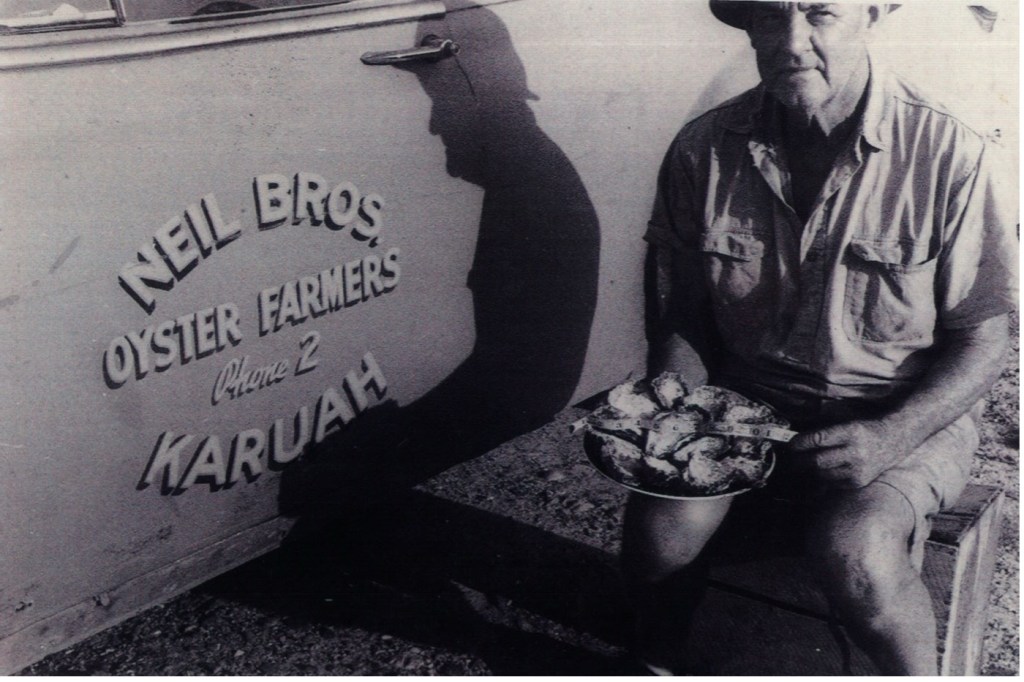
Oyster farmer George Neil – the last Karuah ferryman before the opening of the bridge on 15 December 1957.
Karuah Bridge – 1957
On 14 December 1957, the ferry was taken out of service at Karuah, following the opening of the new road bridge over the Karuah River.
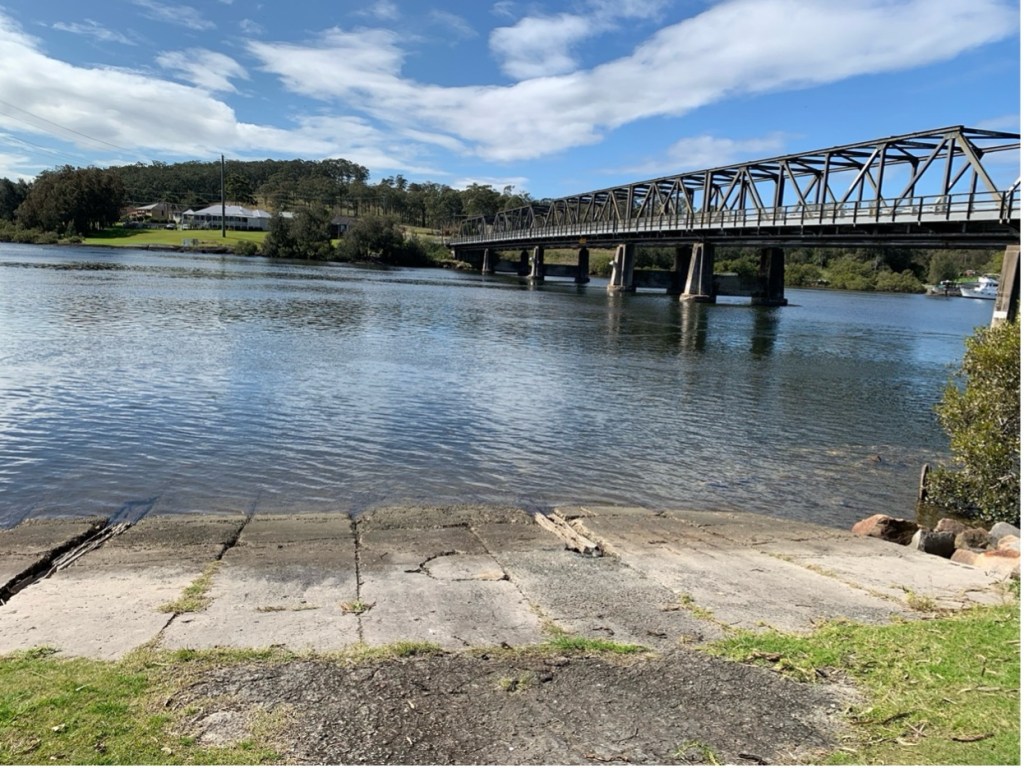
Karuah Bridge today adjacent to the remains of the ferry wharf [Author photo – 2023]
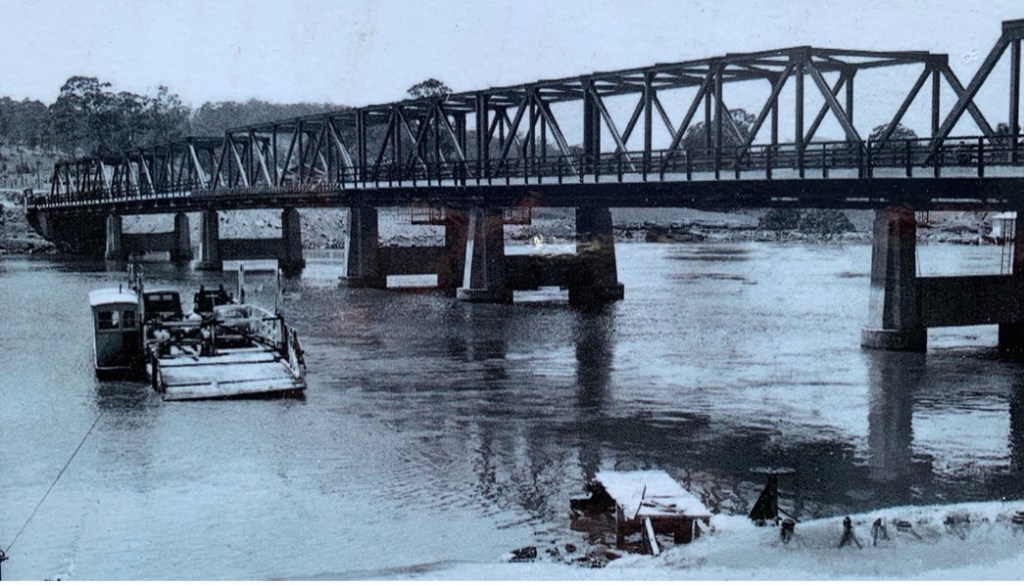
Karuah Ferry on last day of service – December 1957
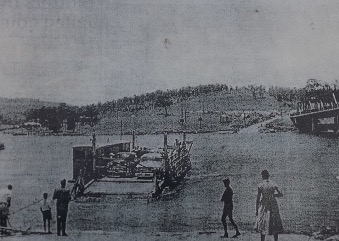
Karuah Ferry on last day of service – December 1957
Concluding Comments
Following a major service, the ferry was taken to Williams River, and operated between Seaham and East Seaham until the early 1970’s, and so took on a new role.

Seaham Ferry (formerly Karuah Ferry), 1973 [Newcastle Library]

Seaham Ferry (formerly Karuah Ferry), 1973 [Newcastle Library]
The history of the Tea Gardens – Hawks Nest Ferry is also available on this website.
ADDENDUM : Court Case Concerning the Sinking of the Karuah Ferry – 1920
The Maitland Weekly Mercury of 1 May 1920, page 8, reported of a court case concerning an accident on the Karuah punt that occurred on 17 May 1919:
‘The sittings of the Maitland Circuit Court continued yesterday afternoon, before His Honor Justice Ferguson …. John Taylor, of Murrurundi, sued the Council of the Shire of Stroud, for the alleged negligent management of a punt at Karuah, which was also alleged to have been in a dangerous, defective, and unsafe condition and unsuitable for cattle passing over it, as a result of which plaintiff claimed that the punt sank and certain cattle belonging to him were drowned and others injured.
Plaintiff claimed £153 damages. The defendant shire pleaded not guilty. There was a cross action in which the council of the Shire of Stroud alleged that John Taylor so negligently, carelessly and improperly conducted himself in and about driving certain cattle on to the punt, and loading same and controlling and managing the cattle, that the punt was sunk and damaged, and the plaintiff council claimed £73 damages. To that the defendant pleaded not guilty. …
Clarence Horace Seivl, a drover, residing at Murrurundi, stated that on May 17 last [1919] he received cattle from plaintiff to take to Karuah. They were trucked to Wallsend Junction and driven to the Karuah punt. He had 409 head. He arrived at the punt about 3 a.m. on May 21st. He was accompanied by a man named Feeney. In the first load 52 cows and calves were taken across; the same number was put in the second trip. A similar number was put on for the third journey. After they came back Burns, the punt man told him not to put so many on. Forty-six were then taken. For the next lot 48 came down, but the punt man told him to let some go back. Seven were out, and 41 taken.
He took about 40 over for the next trip, and at the punt man’s request let four go back. He had 36 on board. As soon as the punt started, the cattle rushed to the left-hand corner, and the punt tilted forward and sideways. He pushed to the gates, but found they were fixed with a bar. The punt was then about 20 ft out from the shore. The punt man jumped into the water, and reached the bank, leaving witness on board. Witness swam ashore, got an axe, and worked for three-quarters of an hour to release the cattle by breaking the gate. Seven cows and five calves were drowned. He valued the cows at £12 per head, and the calves at £5/ 10. Two cows and a calf died afterwards.
The punt man had charge of the loading. Nothing was said by the punt man until fourth load, when he said not to put so many on. — [Responding] to Mr. Curtis: The cattle were starving stock and were going to Hough’s for grass. Hough’s paddock was seven or eight miles from the Tea Gardens. He had to drive the cattle 5 miles from the punt. It would take about three hours to do that distance. He did not say he was in a hurry when punting the cattle. The mob was pulled up about 200 yards from the entrance of the punt. He did not remember anything being said about the cattle being wild. No reference was made, about the number to be brought down to the punt in, the first, in-stance. Nobody drew his attention to the fact that he was trying to put too many on the punt. The punt did not sink at its moorings; it was 20 ft out.
[Responding] to his Honor: When he put the 52 on they pretty well filled the punt, and there was no opportunity for them to move about. The 36 only about half-filled the deck. Patrick Feeney, of Raymond Terrace deposed to having met Seivl at Wallsend Junction; he had nothing to do with the cattle, except to assist in droving them. After some of the cattle were taken across, the puntman said there were too many, and let some go back. On the last trip the punt was not full by a long way. The cattle seemed to be frightened at the water. When the punt tilted, the puntman jumped in among the cattle and then ashore; the punt was then about 20 ft from the shore. The punt man did not make any effort to get the punt back to shore.
[Responding] to Mr. Curtis: He had taken cattle across on the punt before. He did not say anything to Burns about the cattle being wild or man-eaters. Nothing was said at the outset not to bring down more than 30 or 40, so far as he could remember. He did not remember James Callnghan, senr., saying that he had too many cattle there when he was taking some of the cattle down; Seivl came up and told him that Burns reckoned they were putting too many on; some were put off two or three times. There were no service yards, and it was impossible to prevent more than required going down. Burns did not say on one trip “Open the gates soon as you can, or the punt will sink; You’ve got too many on board. When Burns got ashore he helped witness in trying , to hold the guiding wire of the punt. [Responding] to Mr. Rogers: No attempt was made to rail the cattle off; they had the full deck space.
John Taylor, the plaintiff stated that he had a lot of stud cows amongst the cattle, but he valued them at an average price, the cows at £12 and their calves at £5/10/-. Robert Andrew Elkin, auctioneer at Raymond Terrace, stated that he had known the Karuah punt over 20 years, and had used it. The punt was a narrow structure about 10 ft wide and 30ft long. That was where the trouble came in; it was too long and too narrow, to his mind. Plaintiff’s cattle were a splendid lot, and the cows in May last were worth £12 or £13, and the calves £5 or £6.
Jacob Hough, a grazier, residing at the Tea Gardens who had known the Karuah Punt over 40 years, stated that he had one very bad experience 30 years ago. He had recently, to take his horse off the vehicle owing to the rolling of the punt. He considered the punt was too narrow. It was much safer to have the punt pretty well filled when taking cuttle over, as it prevented them moving about and the punt tipping over. He had seen poles put across to prevent cattle surging about. — To Mr. Curtis: The punt was still in use.
William Hough, a grazier, residing at the Tea Gardens, stated that if the cattle were not too heavy, he preferred filling the punt. James Henry Callaghan, storekeeper at Karuah and residing in the vicinity of the punt, stated that in his opinion the punt was not in a very good condition at the time of the accident; he was going by the length of time the punt was in use. He had no personal experience. Seven or eight years ago it capsized and drifted up the river. — To Mr. Curtis: He did not know what was the cause of that accident. At times there was strong wind and tide at the spot.
George Davis, a shipwright, residing at Swan Bay, stated that after the accident in Mav he assisted to repair the punt. The hull was in a very bad state. One plank had a hole in it, and in others the caulking had given way. The punt had apparently been leaking for some time. — To his Honor: There was nothing wrong with the punt except that she was leaking. Witness produced two pieces of wood taken out of a plank on one side of the punt – To Mr Curtis: The punt had been in the water four months when he examined it. The plank was damaged in the accident. It was the strain at the corner that caused the plank to come out — To his Honor: Where the caulking was gone it was above the waterline and would not let in any water unless the punt tilted over. The rails were practically on the outside of the punt.
Ernest Symons, of Karuah, stated that had often seen the punt being pumped. He saw the punt capsized in 1914: cattle were on her then. It was safer to carry a full than a half load. The punt was far from being steady for carrying cattle. He saw the punt after she was lifted; the timber was anything but sound.
John Davis, son of a previous witness, stated that the timbers in the punt were in bad condition due to old age. — To his Honor: the seams so far as he could see seemed to be properly caulked. He did not work on the repairs. David Stuart Johnston, schoolteacher at Karuah, regarded the punt as unstable, and said it was very liable to roll. This was plaintiff’s case.
Edward Burns, employed by Mr. J. Johnston, contractor for the running of the Karuah punt, stated that he had been working it for about four months. He had taken over about 3500 head in that time, about 30 or 40 at a time. Feeney had taken cattle over before. Feeney told him the cattle were wild, regular man-eaters, and witness accordingly told him not to bring down more than 30 or 40 at a time. The mob was 400 or 500 yards away from the punt. Forty odd were brought down the first time, large and small. On the second trip about 49 head were taken; the punt was much lower in the water. Another lot was brought down to the third trip, but when he was moving out the punt began to go down and several were cut out. Forty-three were taken across and the punt was very low in the water. On the fourth trip he was about two feet from the shore when the punt began to go down. The inner end struck the approach, and punt dipped on the outer end.
As she tipped the cattle went into one corner and the punt turned on her side. Witness made for the shore, swimming. He afterwards went back amongst the cattle and tried to free them; they were tangled in the wires. The cattle were pretty wild. There, was no water in the punt when he started to take the cattle over. — To Mr. Rogers: … There were about 55 head on board when the punt sank. None were turned back on that trip. If there had been 55 head on they would have been pretty well packed. They were pretty well as big as the previous trip, when 53 were taken over. There was nothing wrong with the punt; he did not remember Mr Enright that the punt was dangerous. He told him that the yard, meaning the deck of the punt, was too large for the punt for conveying cattle. The cattle did not shift until the water end went down. Seivl did not leave the punt at first; somebody brought an axe to him. Seivl did not have to wade.
About a ton of ballast (loose stones) was carried on the side opposite the wheel to balance and keep her steady. He pumped the punt out every morning but did not get more than a kerosene tinful. The punt was steady when leaded the right way, except that when a big sea was blowing. He had made a mistake; he carried four loads before the accident. — To Mr. Curtis: The punt sank after all the cattle had been released. Witness, after going back, remained on board to the last.
Herbert Adcock, clerk to the Stroud Shire; produced the contract for the running of the punt. The punt was last repaired in July 1918. James Callaghan, sen., a puntman for about twelve years, remembered the accident. He was there after the accident. He saw Feeney and Seivl before the punting. The most he had taken over at a time was 30 and 35 head; he reckoned that as a fair load for mixed cattle. He saw Feeney with 40 or more head detached from the main in lot and he told him he had too many there. Feeney said they would cut them out down below. He went home and was there about half an hour, when he heard a great noise and saw the punt. One, end of the punt, the flap, was on the approach, the other end was under water. The cattle had been got off. The punt remained in a half sunken position for a fortnight or three weeks. — To Mr. Rogers: He used rails on the punt to prevent them straying about.
Richard Percy Hicks, engineer for Stroud Shire, stated, that no matter how good the caulking in a punt a certain amount of water always leaked through. After the punt was repaired, he thoroughly examined it and found it thoroughly sound, despite the fact that the timber was old and worn. One plank along the side and the corner pieces had been repaired. The only caulking done was where the repairs had been done. There was nothing unusual about the construction and proportions of the punt. He considered the punt perfectly suitable for ordinary loads. — To Mr. Rogers: He would not admit that it was a rickety punt; the fact of putting ballast on one side was to counter-balance the weight of the winch. The piece of timber produced had been affected by the borer, but not sufficient to make it defective; it certainly was not rotten.
This was defendant’s case. Mr. Johnston (recalled) remembered a conversation Mr. Enright had with Burns. When questioned regarding the condition of the punt he said, “Of course, you know she’s not safe: she’s dangerous.” Mr. Seivl (recalled) stated that 248 cattle had been punted across, and 146 were taken round. Twelve were lost in the accident, and three were left in a paddock, being injured.
Counsel then entered upon their addresses. The jury retired at 4.47 p.m. to consider their verdict, and, at 5.53 inquired if a majority verdict would be acceptable to the parties. Counsel and the parties conferred and agreed to accept a majority verdict. After some further consideration, the jury subsequently returned into court and announced, a verdict for the defendant in the case of the council against Taylor. In the case of Taylor versus the council a majority verdict was given for the defendant council. This concluded the business, and the court adjourned sine die.’
The Macleay Argus of 4 May 1920, page 2, also reported on the court cross actions:
‘At the Maitland Circuit Court last week, John Taylor, of Murrurundi, sued the Council of the Shire of Stroud, for the alleged negligent management of a punt at Karuah, which was also alleged to have been in a dangerous defective and unsafe condition and unsuitable for cattle passing over it, as a result of which plaintiff claimed that the punt sank and certain cattle belonging to him were drowned and others injured. Plaintiff claimed £153 damages. The defendant shire pleaded not guilty.
There was a cross action, in which the Council of the Shire of Stroud alleged that John Taylor so negligently, carelessly and improperly conducted himself in and about driving certain cattle on the punt, and loading same and controlling and managing the cattle, that the punt was sunk and damaged, and the plaintiff Council claimed £73 damages. To that defendant pleaded not guilty. The jury gave a verdict for the defendant in the case of the Council against Taylor. In the case of Taylor versus the Council a majority verdict was given for the defendant Council.’
Researched and compiled by Kevin McGuinness
August 2023

 Port Stephens - a history exploration