
Part One: Introduction
In the late 1880’s, Nelson Bay was popular as a haunt for recreational fishermen. At that time, there were several cottages along Victoria Parade at Fly Point which were used as guest houses to cater for visitors.
The first licensed premises in Nelson Bay, Bayview Hotel, was run by Mr W Dent in one of the cottages.
He sold the license to Mr Henry Thompson for £20, for a term of six months, (circa 1890).
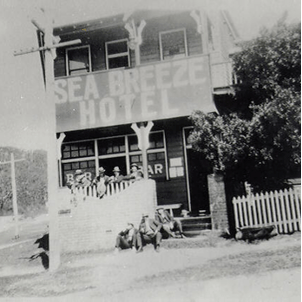
Henry Thompson then built a small hotel opposite the wharf area. As the Sea Breeze Hotel, it opened in April 1893 with Thompson as the licensee.
The Raymond Terrace Examiner and Lower Hunter and Port Stephens Advertiser of 25 March 1954, page 1 reflects on the early days of the hospitality industry at Nelson Bay:
‘The issuing of a second license for Nelson Bay for the Shoal Bay Guest House, of which Mr. Randall is proprietor recalls the issuing of the first license. The first licensed house in Nelson Bay was kept by the late W. Dent in the lower cottage of the three attached cottages along Victoria Parade towards Fly Point. Mr. Dent sold the license to Mr. Harry [Henry] Thompson for £20 [circa 1890]. Early visitors to the Bay can remember with gratitude and appreciation Mr. and Mrs. Thompson’s care and attention to their guests. It helped to popularise the Bay.’
The Australian Town and Country Journal of 23 July 1892, page 11, reported on the Minister for Works being weather bound at Nelson Bay, in which Mr Dent was referred to as the proprietor of the only hotel at Nelson Bay:
‘The New South Wales Government steamer ‘Thetis’, with Mr. Lyne, Minister for Works, and others on board, left Sydney on July 14 for the Macleay [River]. The Minister was to have opened the Sherwood Bridge at Kempsey, but as events turned out Mr. Danbar, M.L.A., performed the ceremony. The steamer from the time it left Sydney encountered very bad weather, and after several attempts to make the passage, including a fruitless endeavour to land at Trial Bay, the ‘Thetis’ put into Nelson’s Bay.
Our special correspondent on board the ‘Thetis’ gives the following account of the steamer’s stay at this settlement: …….
The village of Nelson’s Bay is composed of one hotel, well conducted by a most attentive host, Mr. Dent, who with his good wife did all in his power to make our stay in the village as pleasant as possible. There is an accommodation house well conducted by Mr. Thompson, who also keeps the general store and newsagency. The post and telegraph offices are suitable buildings—the other residences comprise fishermen’s huts and the refrigerating rooms of the defunct Fish Preserving Company.
Part Two: Life and Times of the Sea Breeze Hotel – 1893 to 1954
From the resources of the National Library’s Trove newspaper collections, this paper tells the story of the Seabreeze Hotel until the early 1950’s when the previous wooden two-storey hotel was demolished and replaced by modern brick premises.
It is a valuable social history of Nelson Bay from its humble beginnings to the prominent tourist town we have today.
The main primary sources cited in this paper record the name of the hotel as ‘Sea Breeze Hotel’, whereas the ‘Seabreeze Hotel’ is that currently used.
Several hotels were established on the northern side of Port Stephens at Hawks Nest and Tea Gardens, prior to the establishment of the hotel at Nelson Bay and their history can be viewed at the following link.
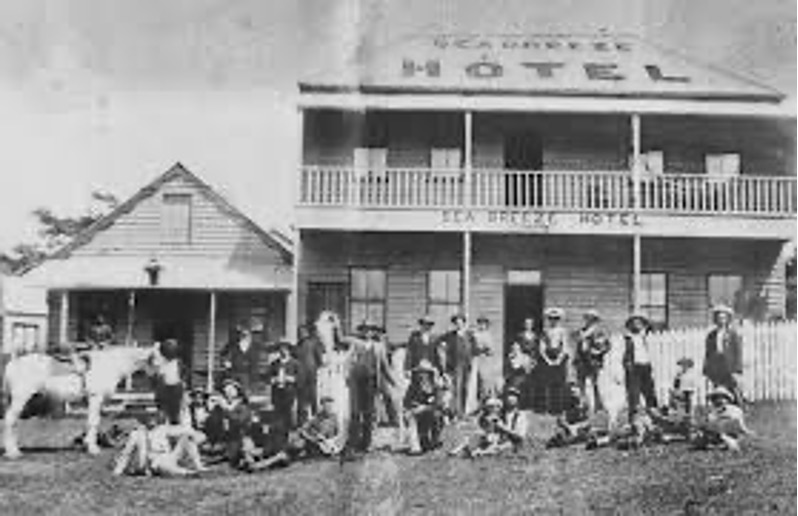
First Sea Breeze Hotel, in Laman Street, Nelson Bay, circa 1890, with attached accommodation building.
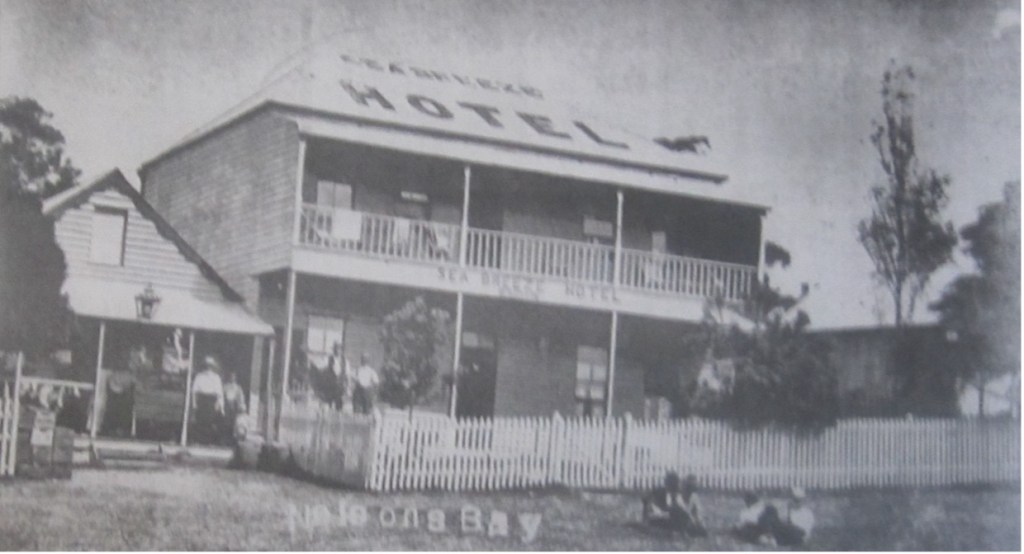
Another view of the early Sea Breeze Hotel – [Tomaree Family History Group Nelson Bay NSW Inc.]
Fisheries Industry Meeting – 1893
The Newcastle Morning Herald and Miners’ Advocate of 24 April 1893, page 5, reported:
‘Messrs. E. W. O’Sullivan, M.P., and R. A. Price arrived here yesterday, and in the evening delivered addresses on the fisheries industry at the Seabreeze Hotel. Mr. O’Sullivan dealt with the subject at great length, and pointed out several defects in the Fisheries Act, and from the appearances of his listeners it was apparent that there are many defects in the existing Act.’
Bush Fires Pose Threat to the Sea Breeze Hotel – 1894
On several occasions bushfires posed a threat to the Sea Breeze Hotel. The first occasion was reported in the Sydney Morning Herald of 13 November 1894, page 5:
‘A very large bush fire reached Nelson’s Bay about 12 o’clock today, and threatened the total destruction of Thompson’s Sea Breeze Hotel, the telegraph office, and the public school. Only for the way in which the citizens of the Bay worked the three places named would have been destroyed, as a southerly gale was blowing at the time. The country for about five miles around is all burnt, the telegraph poles being burnt down, causing an interruption of the line. The fire was burning at 8 p.m., but all danger is over. The newly fenced cemetery has suffered severely by the fire.’
Bushfires Again Threaten the Hotel – 1897
The Newcastle Morning Herald and Miners’ Advocate of 17 February 1897, page 7, reported:
‘Large bush fires have been raging here for the past four days, making the district very miserable with smoke. The fire has burnt the bush for miles around. On Sunday the Seabreeze Hotel had to be protected. The inhabitants and a party from Stroud were beating back the fire with green bushes, and a strong wind from south-east made things very uncomfortable. Some of the fencing of the cottages belonging to the Customs Department was burnt down.’
Cycling Group Dine at the Hotel – 1897
The Maitland Daily Mercury of 22 February 1897, page 2, reported on nearly 100 cyclists visiting Nelson Bay:
‘The district members of the New South Wales Cyclists’ Touring Union some few weeks ago chartered an ocean-going steamer for a day’s excursion at Port Stephens. …..
The main party left Raymond Terrace at seven o’clock in the morning, and the cavalcade especially along the Stroud Road looked splendid. Sawyer’s Point [Karuah], where the steamer ‘Tahlee’ was in waiting, was reached at quarter past nine o’clock. Bikes having been stored, the steamer was boarded and lunch at once served. A splendid run was made with a good tide and ripping breeze to the Tea Gardens, and then to Nelson’s Bay, where the party disembarked and had dinner at the Sea Breeze Hotel. The steamer then took a special trip to the outer lighthouse, where landing arrangements had been made for the occasion.’
Licensee of Hotel Seeks Reduction of Licensing Fee – 1897
The following advertisement was placed in the Dungog Chronicle of 16 March 1897, page 3, by the licensee of the Seabreeze Hotel, Henry Thompson, advising of his intention to seek a reduction of his licensing fee:
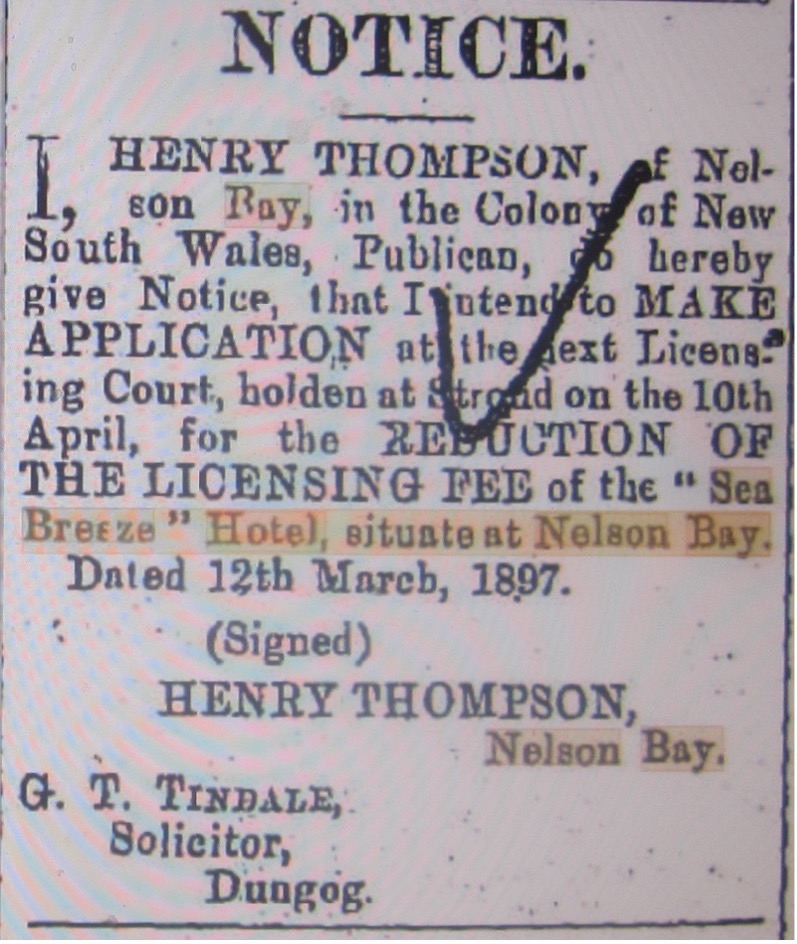
Advertisement place by Henry Thompson in the Dungog Chronicle of 16 March 1897, page 3
Myall Lakes Travellers Visit the Hotel – 1897
The Newcastle Morning Herald and Miners’ Advocate of 28 April 1897, page 6, reported:
‘On Thursday, the eve of Good Friday, a party of 21 from Newcastle, Stockton, Wallsend, Sydney, Raymond Terrace, and elsewhere, met at Morgan’s Cosmopolitan Hotel, Raymond Terrace, and thence proceeded, early on Friday by coach, buggy, and bicycle, to Sawyer’s Point [Karuah], 18 miles distant, where they embarked upon the ‘Allyn’ and proceeded upon a four days’ cruise on the Myall Lakes. At midday Nelson’s Bay was reached, and here the anchor was dropped off the inner light, and for an hour or two an attempt was made to catch fish. ……
Nelson’s Bay was safely made at about five in the afternoon. Here the party put up at Mr. Thompson’s Sea Breeze Hotel, where they received every kindness and consideration, and despite the fact that there were already a large number of visitors in the house, beds were found for all of the party except three, and even these were comfortably “shaken down” [in temporary beds]. …..
Next morning ample justice was done to a hearty breakfast, the excursionists, after most of them had indulged in a dip in the briny, being seen sitting in a row with very expectant countenances awaiting the tinkling of the breakfast bell. After breakfast the company divided, about half remaining at Nelson’s Bay to while away a few hours fishing and otherwise enjoying themselves till the excursion steamer ‘Gosford’ should be ready to take them back to Newcastle in the afternoon, the rest returning to the point of Sawyer, whence they came.’
A Group of Visitors to Port Stephens Stay at the Hotel – 1897
The Dungog Chronicle of 21 May 1897, page 3, reported:
‘Last week a number of gentlemen at Stroud arranged with the proprietor of the steamer ‘Gosford’ to come to Booral wharf one evening and take a number of excursionists out to the Port Stephens heads schnapper fishing. ……
Not much time was wasted, and we were soon steaming down the Karuah, watching a glorious crimson sunset on the water. Songs, recitations, &c., were indulged in until Nelson’s Bay was reached. After we all landed, and, host Thompson, having been previously apprised of our intended visit, had a tempting tea waiting for us. A 22lb. schnapper adorned one end of the board, and it is needless to say that the table did not long groan under the weight of the good things provided. …..
A concert was arranged for the [next] evening at the Sea Breeze Hotel, and an enjoyable time was spent there, whilst the more romantic members of the party strolled out in the moonlight’s mystic beams, along the sandy shore.’
The Hotel Advertises for a ‘Respectable Girl’ – 1897
The Dungog Chronicle of 19 October 1897, page 2, carried the following advertisement:
‘WANTED— A RESPECTABLE GIRL, to make herself generally useful, References required. Apply SEA-BREEZE HOTEL, Nelson’s Bay.’
Fishing Industry Meeting at the Hotel – 1897
The Newcastle Morning Herald and Miners’ Advocate of 2 December 1897, page 6, reported:
‘A well-attended meeting of Port Stephens fishermen was held at Thompson’s Hotel on Saturday, for the purpose of trying to devise some plan of getting their fish to market in good condition, which, under the present state of affairs, is next to an impossibility, as the steamer timed to leave here at 2 p.m., is frequently several hours late in starting. This delay (which is fatal to the interests of fishermen) is caused by the steamer waiting for the river boats, consequently when she reaches Newcastle, she has missed the train, and the fish do not reach Sydney in proper time.’
Survivors of the Fitzroy Wreck Assisted – 1897
The Newcastle Morning Herald and Miners’ Advocate of 14 December 1897, page 5, reported:
‘Latest reports from the scene of the wrecked steamer ‘Fitzroy‘ show that the vessel is settling in the sand …..
Some of the little ones cried nearly the whole time as they clung to their helpless parents, a circumstance not to be wondered at when the surroundings are taken into consideration. Mrs. Jarrett and her fellow-passengers speak in the highest terms of the kindness shown to them by the people of Port Stephens, especially Mr. and Mrs. Thompson, of the Sea Breeze Hotel, Nelson’s Bay, and the officials of the A.U.S.N. Co., who provided clothing, &c. Mr. John Reid, jun., local agent for Messrs. Fenwick and Co., accompanied the ‘Leveret’ to Port Stephens yesterday, and did all in his power to make the passage across as comfortable as possible.’
Newly Established Progress Committee Meets at the Hotel – 1898
The Newcastle Morning Herald and Miners’ Advocate of 19 February 1898, page 5, reported of the formation of a Progress Committee at the hotel:
‘A Progress Committee for Nelson’s Bay, Port Stephen’s, has just been appointed in order to promote local interests and the general development of the district. The committee consists of Mr. Thomas Laman (president), Mr. Samuel Lilley (secretary), Messrs. W. Thompson, J. Korsman, W. Laman, M. Thompson, sen., H. Thompson, jun., A. Leman, O. Laman, and E. Garner. The first business meeting of the committee was held on Saturday at Thompson’s Sea Breeze Hotel, Nelson’ Bay, when there was a full attendance of members.’
Meeting of the Nelson Bay Regatta Committee Held at Hotel – 1898
The Newcastle Morning Herald and Miners’ Advocate of 1 November 1898, page 7, reported:
‘At a meeting of the committee of Nelson’s Bay regatta, held at Thompson’s hotel on Saturday night, Mr. Noble, the secretary, announced that about £20 would be in hand by the day of the regatta, besides a few trophies, and that large entries were sure to be the order of the day.’
Seabreeze Hotel Sold – 1899
The Dungog Chronicle of 30 May 1899, page 2, reported:’
‘The Sea Breeze Hotel at Nelson’s Bay has been sold by Mr H Thompson to Mr J. Lund, for £1000.’
Survivors of the Schnapper Wreck Assisted at the Hotel – 1899
The Maitland Daily Mercury of 4 July 1899, page 6, reported:
‘Captains J. W. Carpenter and E. Cain, who composed the crew of the yawl Schnapper which proceeded to Broughton Island for the purpose of fishing for schnapper, but which was wreaked at that place on the 14th alt., arrived here [Newcastle] on Friday night last from Port Stephens by the s.s. ‘Gosford’. They are still suffering from the effects of their long exposure on the island, and they expressed their heartfelt thanks to Mr. Harry Steinmer, of Nelson’s Bay, for his timely rescue of them, and also for his kindness to them after their arrival in Port Stephens. They also expressed their deep gratitude to Mr. and Mrs. Lund, of the Sea Breeze Hotel, Nelson’s Bay, for their generous help to them during their stay at this hotel.’
Excursion to Nelson Bay – 1900
The Dungog Chronicle of 18 September 1900, page 2, reported:
‘One of the most popular and interesting excursions of the season was entered upon on Saturday 8th inst., when some twenty-four of Dungog’s most prominent citizens met together and boarded Mr Welsh’s coaches to journey to Sawyer’s Point [Karuah] thence on to Nelson’s Bay. ……Arriving at Sawyer’s Point, Mr Pitt’s steam launch, ‘The Pearl,’ was standing out to convey the party to the bay and a little pearl she proved herself to be before the journey finished. …..
The Sea Breeze Hotel was reached in due course, and a hearty welcome extended to the party by host and hostess Mr and Mrs Lund who, with their valuable staff of assistants, paid every attention to the wants of the company as they took their seats around the festive board, and showed that they had appetites that never before existed. The evening was spent in many ways, several taking advantage of the bright moonlight night walked around to the inner light house, much to the surprise of the keeper, and viewed the heads; others took possession of a dancing pavilion [adjacent to the hotel], and although their fair partners were absent seemed to enjoy themselves to their hearts content, making the night weird with their loud, rollicking, jovial ways.’
Bush Fire Nears Hotel – 1906
The Sydney Morning Herald of 17 February 1903, page 5, reported:
‘On Sunday the heat was 102, and it was very dusty, a north-west wind prevailing, A fire started on Bagnall’s farm, three miles out, destroying all the crops and grass, and a horse was burnt. The damage is estimated at about £500. The fire reached within 200 yards of the hotel, telegraph-office, and other premises, when it was stopped by a strip of bush that was burnt off last week.’
Dentist Consults at the Hotel – 1906
As no dentist was located at Nelson Bay, residents had to rely on travelling dentists, and the Hotel was used by them when visiting the area. The Dungog Chronicle of 27 March 1906, page 2, reported:
‘Mr J. Spencer Nolan, dental surgeon, of Dungog, and 43 Oxford Street, Sydney, will visit Clarence Town on Thursday, 29th March, and may be consulted at Robards’ bearding house. Also, Nelsons Bay on Saturday 31st March, at Sea Breeze Hotel.’

Advertisement placed in the Gloucester Advocate of 18 August 1906, page 4:
Survivors of the Willinga Wreck Assisted at the Hotel – 1908
The Newcastle Morning Herald and Miners’ Advocate of 29 May 1908, page 5, reported:
‘The captain and crew of the schooner ‘Willinga‘, which was wrecked at Point Stephens on Wednesday morning, have been provided for by the proprietor of the Sea Breeze Hotel. They left today for Sydney by the steamer ‘Commonwealth’, which, owing to the heavy sea outside, had to return.’
Hotel Advertised for Sale – 1909
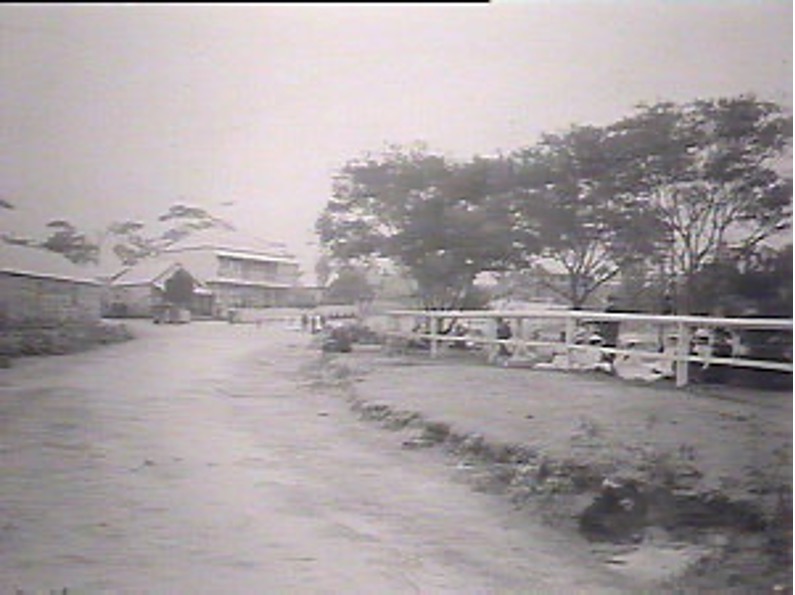
View of the Nelson Bay waterfront area with the Seabreeze Hotel in the background – [NSW State Library circa 1909]
The following advertisement for the sale of the Sea Breeze Hotel, with a detailed description of the hotel premises, was placed in the Newcastle Morning Herald and Miners’ Advocate of 23 January 1909, page 7:
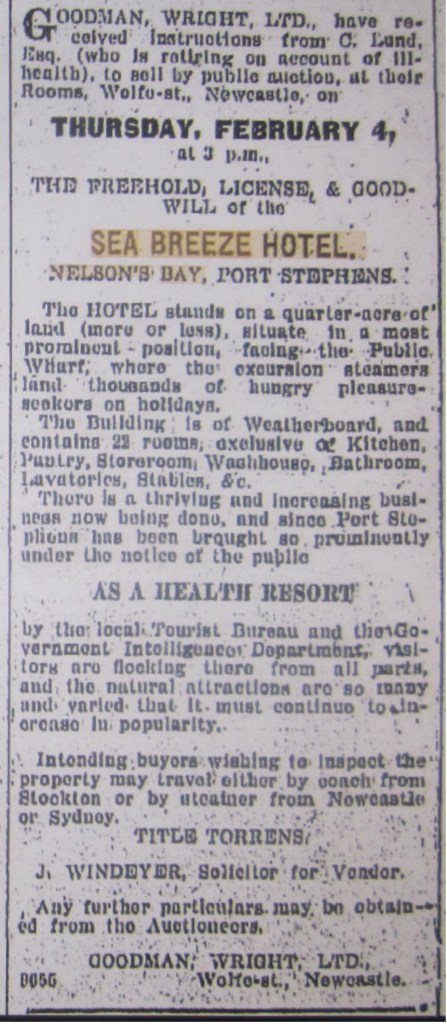
Newcastle Morning Herald and Miners’ Advocate of 23 January 1909, page 7
Hotel Licensee Leaves Nelson Bay – 1909
The Newcastle Morning Herald and Miners’ Advocate of 20 February 1909, page 3, reported:
‘Mr. and Mrs. Lund, who for a number of years have been familiar figures at the Sea Breeze Hotel, Nelson’s Bay, are leaving the locality. Mr. Lund’s health demands a complete change of climate, which is his reason for disposing of his business. Mr. and Mrs. Lund will take with them the best wishes of the residents.’
Additions Planned for the Hotel – 1909
The Newcastle Morning Herald and Miners’ Advocate of 3 September 1909, page 6, reported:
‘A contract is let and will be started as soon as the necessary permission is granted by the Licensing Bench, for extensive additions in wood to the Sea Breeze Hotel, Nelson’s Bay, Port Stephens, for Mr. C. Tilley [owner of the building].’
Sea Breeze Hotel Changes Hands to Mr W Thompson – 1910
The Newcastle Morning Herald and Miners’ Advocate of 7 May 1910, page 5, reported:
‘The Sea Breeze Hotel has changed hands, Mr. W. Thompson, late of West Maitland having bought the goodwill of it. Mr. Thompson is s son of Mr. Henry Thompson, who had the hotel built to his order 18 or 20 years ago and was the first hotelkeeper at Nelson’s Bay.’
The Maitland Daily Mercury of 19 May 1910, page 2, also reported:
‘Mr. William Thompson, late licensee of the Centennial Hotel, West Maitland, intimates in this issue that he has taken over the Sea Breeze Hotel at Nelson’s Bay, where he guarantees the best accommodation to visitors, and where fishing boats may always be obtained.’
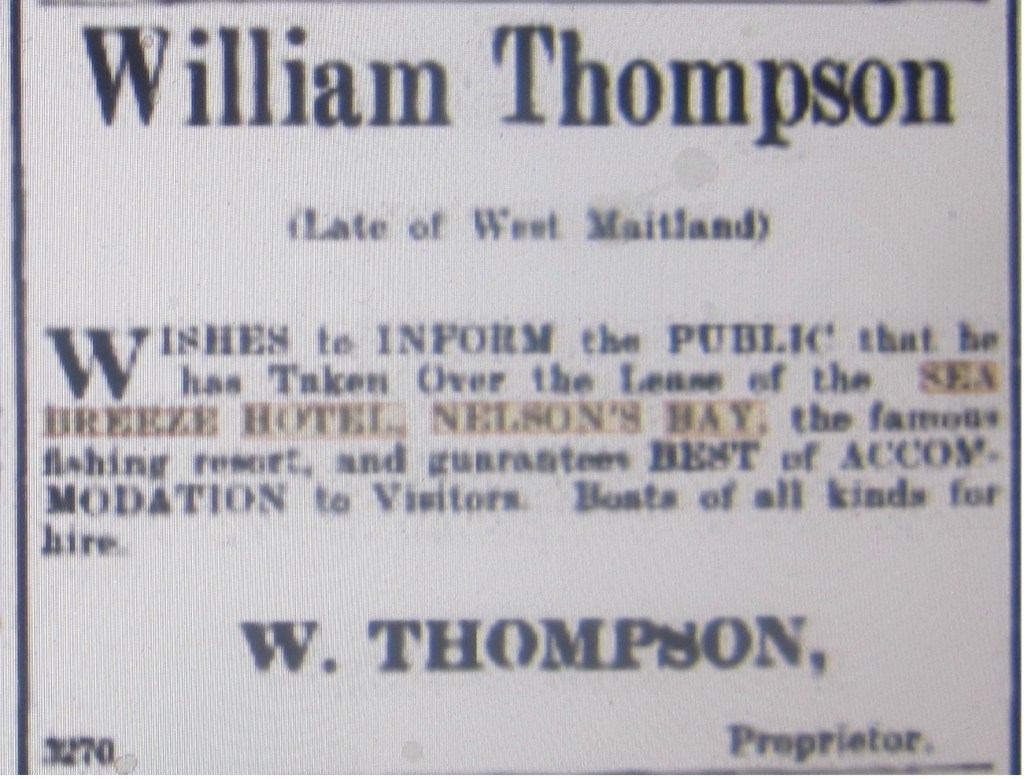
Advertisement placed by William Thompson in the Maitland Daily Mercury of 26 May 1910, page 1
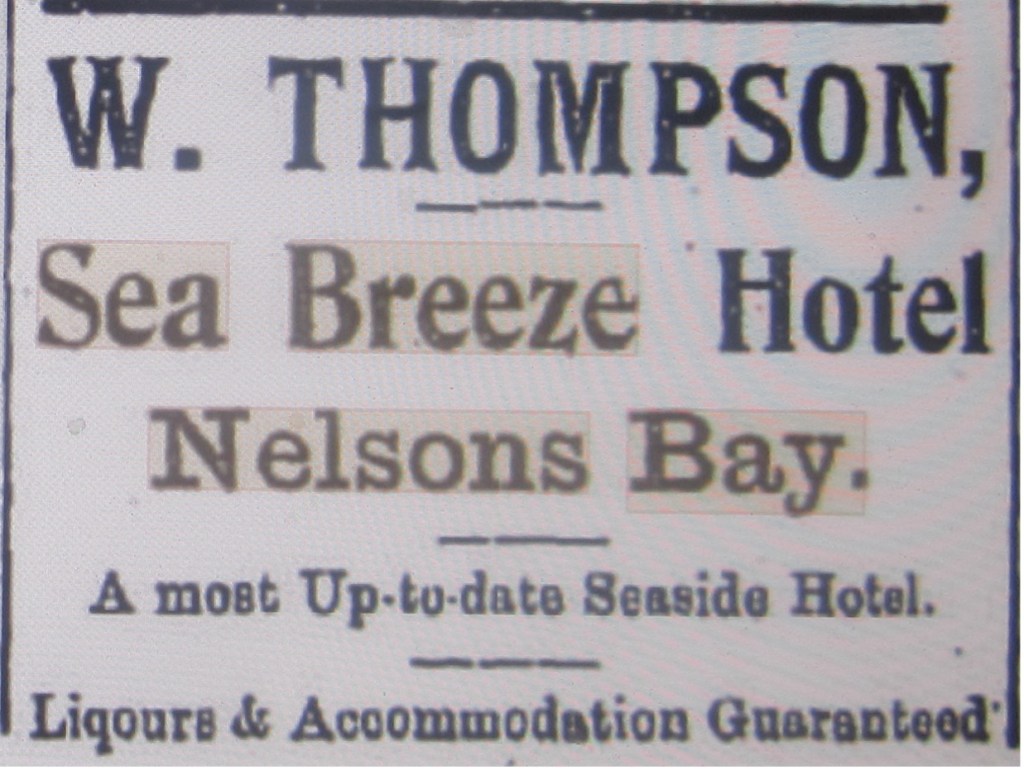
Advertisement placed by William Thompson in the Dungog Chronicle of 10 June 1910, page 7.
Sea Breeze Hotel Changes Hands – 1913
The Coffs Harbour Advocate of 23 April 1913, page 2, reported:
‘We have it on good authority that Mr. Rush has leased the Seabreeze Hotel at Nelson’s Bay, Port Stephens, and that he will take possession of same on or about the 14th May. We wish oar departing townsman every good fortune in his new home.’
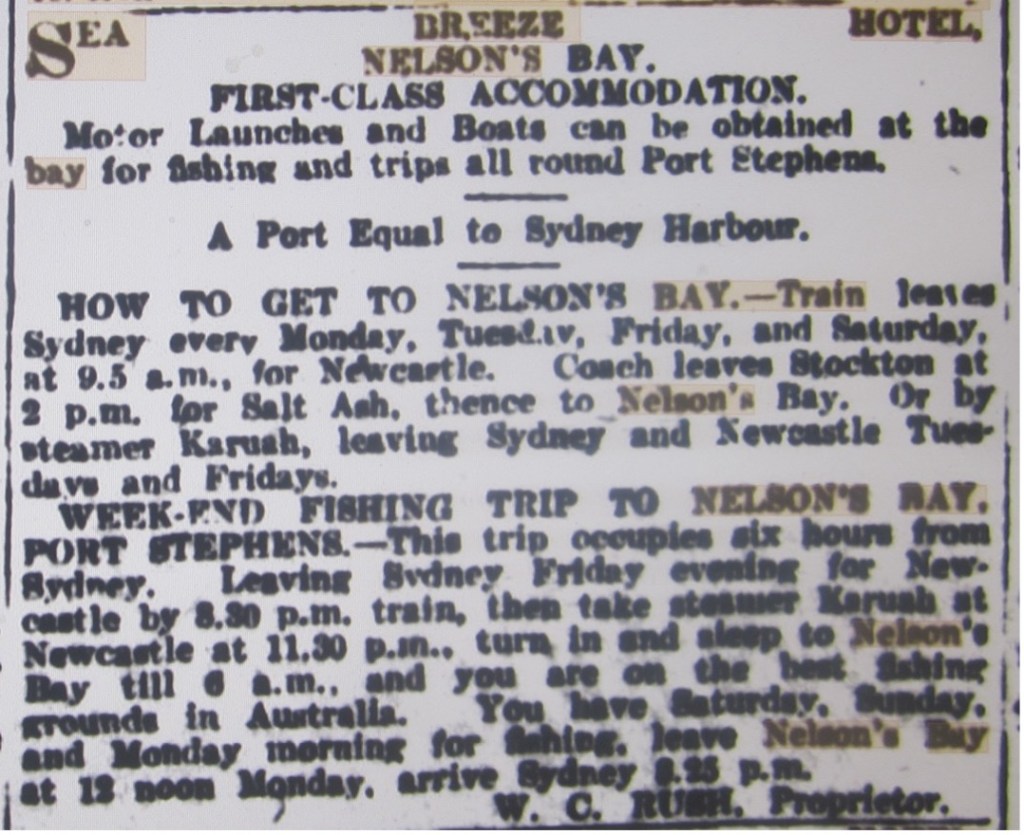
Advertisement placed by the new licensee, W. Rush, in the Sydney Morning Herald of 30 September 1913, page 14.
Party of ‘Gentlemen’ Stay at the Hotel – 1914
The agitation for a New State within New South Wales and for Port Stephens to be its port began in Tamworth in 1914. The following trip to Port Stephens formed part of preparatory actions by the New State Movement.
The Raymond Terrace Examiner and Lower Hunter and Port Stephens Advertiser of 24 July 1914, page 3, reported:
‘On Sunday last a party of gentlemen interested in seeing the development of additional ports along the coast of New South Wales, and particularly Port Stephens, visited the latter port for the purpose of seeing for themselves what nature of a place was Port Stephens in order that they would be in a better position, from personal observation on the spot, to see how much justification there may be for the expenditure of public money in Port Stephens, and as to whether it could be made a port suitable for oversea traffic and capable of accommodating large ocean going vessels. …..
Messrs. Thurlow’s coach met the party at Stockton, and conveyed them to Salt Ash, where the s.s. ‘Reliance‘, of the same company, carried them on to Nelson’s Bay, where they arrived at lunch time, and were hospitably treated by Mr. Rush, of the Sea Breeze Hotel. After lunch a run down as far as the Heads was taken in order that the visitors would be able to get a grasp of the nature of the entrance and its accessibility at all times and in all weathers. ……
More than satisfied that there were no difficulties of any serious character to be overcome here, the party then steamed back up the Bay, traversing round Salamander, where the proposed location of the wharves and railway compound were pointed out.’
Seabreeze Hotel Changes Hands – 1918
The Raymond Terrace Examiner and Lower Hunter and Port Stephens Advertiser of 9 August 1918, page 3, reported:
‘The Sea Breeze hotel has changed hands and is now being conducted by Mr Frank Howell of Newcastle. Extensive repairs are being carried out, and when finished the old hostelry should present a commanding appearance.’
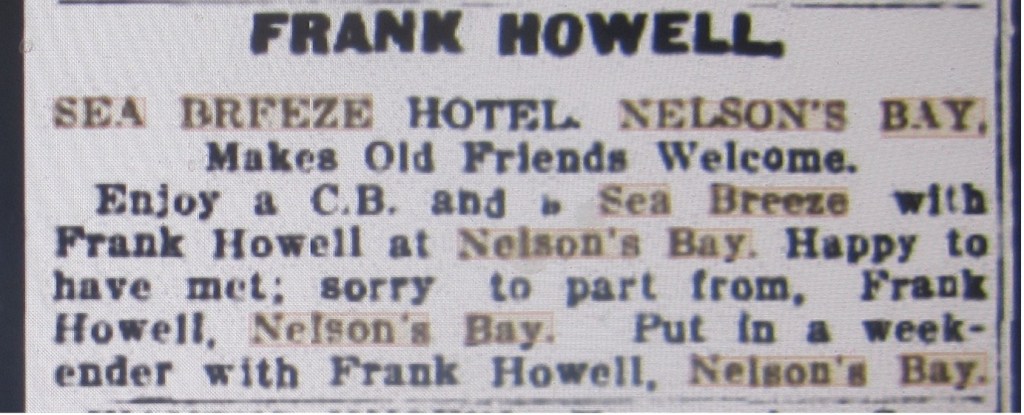
Advertisement placed by Frank Howell in the in the Newcastle Morning Herald and Miners’ Advocate of 23 May 1918, page 6:
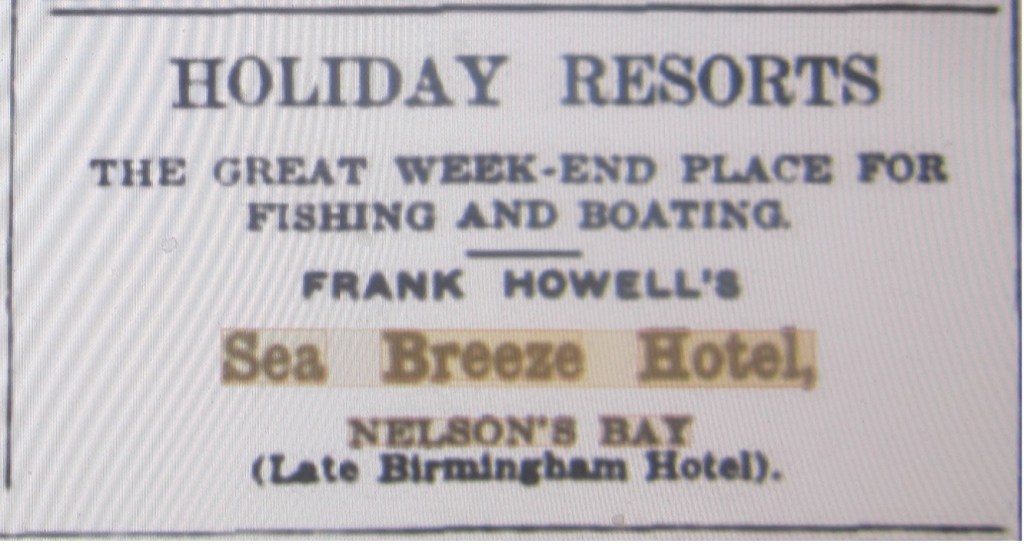
Advertisement placed by Frank Howell in the Newcastle Sun, 22 June 1918, page 4:
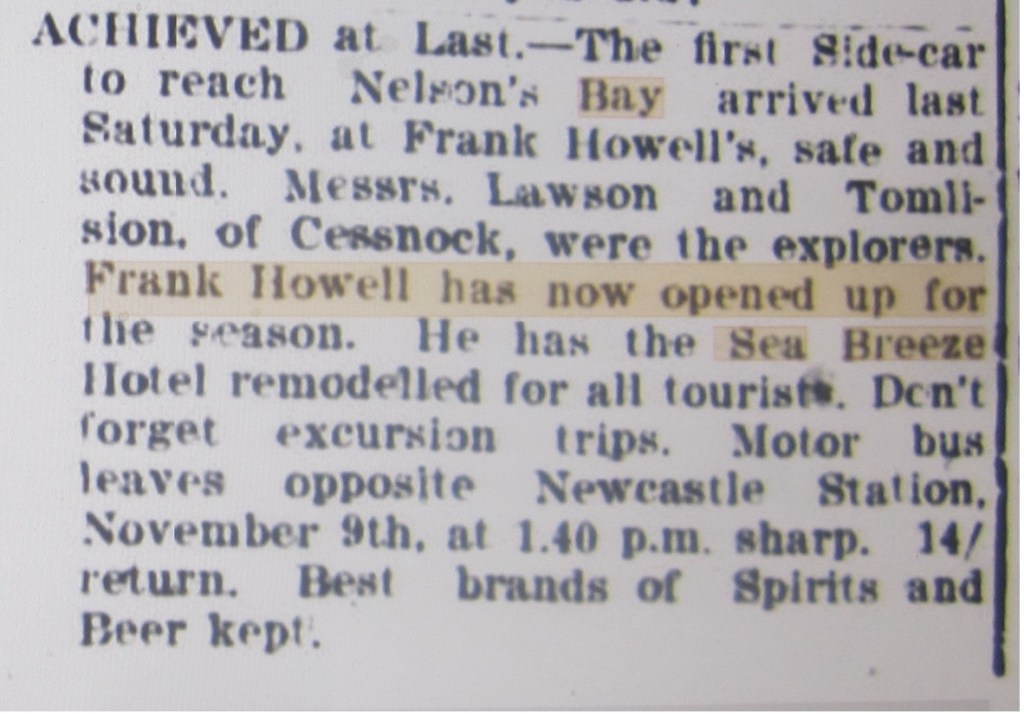
Advertisement featuring Frank Howell, and his Seabreeze Hotel, was placed in the Daily Observer of 5 November 1918, page 1:

Advertisement placed by Frank Howell in the Newcastle Sun, 16 April 1919, page 4:
New Oil Lamps Fitted at the Hotel – 1918
Electricity did not arrive in Nelson Bay and surrounding areas until the Second World War. Before that residents and business proprietors had to rely on oil and kerosene lighting or electrical generators.
The Raymond Terrace Examiner and Lower Hunter and Port Stephens Advertiser of 18 October 1918, page 3, reported:
‘Nelson’s Bay is advancing gradually, several business places have recently been fitted up with the ‘Gloria Light,’ including Mr. Frank Howell’s Sea Breeze Hotel, Mrs. Lund’s Boarding house, and Mr. H. F. Lacy’s general store, while others intend having it installed.’
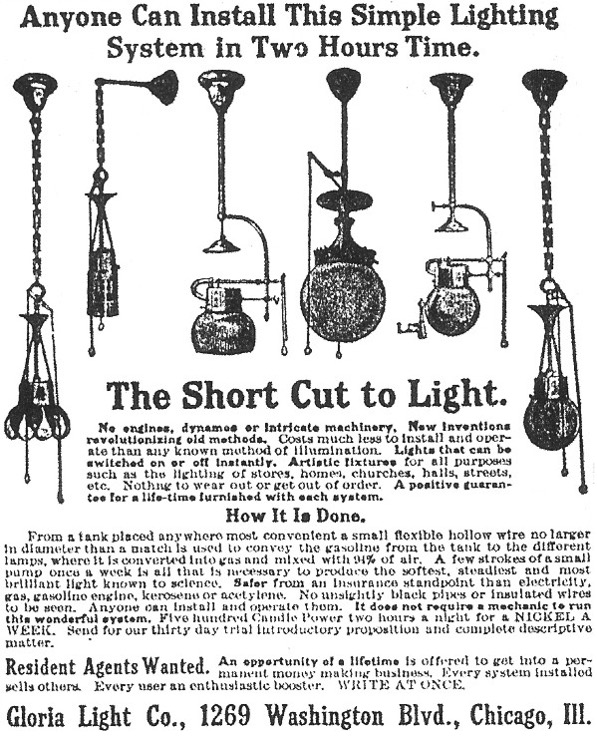
Examples of ‘Gloria Lights’ that may have been installed at the Sea Breeze Hotel.
Lease, Licence and Goodwill of the Hotel Offered for Sale – 1919
The following ‘For Sale’ advertisement was published in the Newcastle Sun of 2 May 1919:
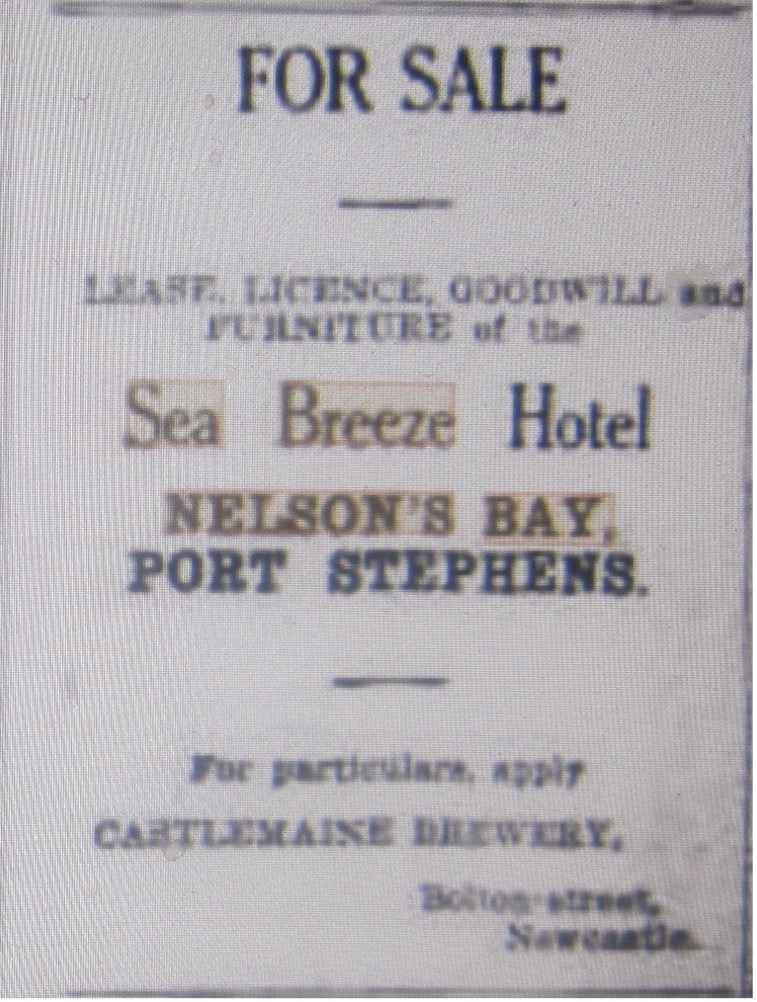
Newcastle Sun, 2 May 1919:
Shooting at the Seabreeze Hotel – 1919
In June 1919, a fatal shooting occurred at the Sea Breeze Hotel that was to capture nationwide interest. Details of the shooting and subsequent trial were widely reported in the newspapers of the day, involving a returned soldier to find his wife has a new lover.
The details of the case are relayed, as reported in the Addendum to this paper.
Advertisement by New Licensee – 1919
The following advertisements were placed by the new licensee, William Howell:
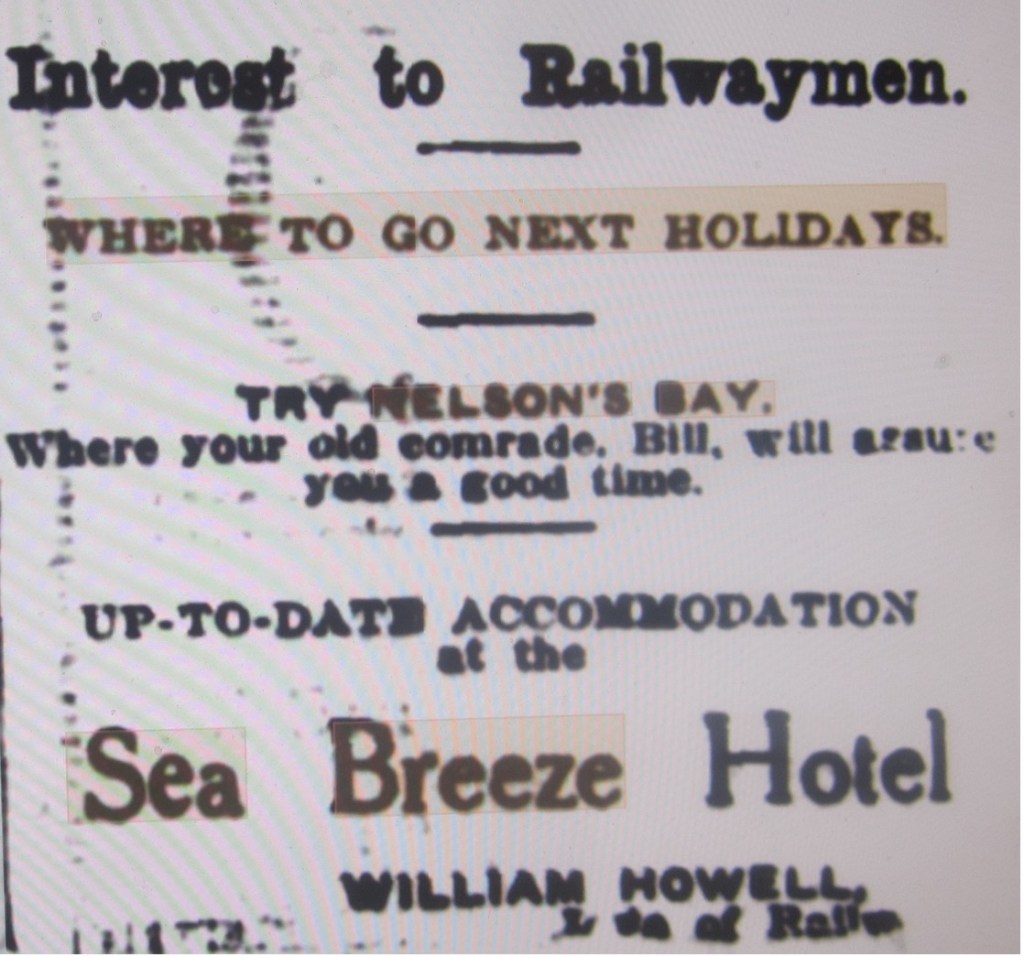
Newcastle Sun, 30 August 1919, page 1
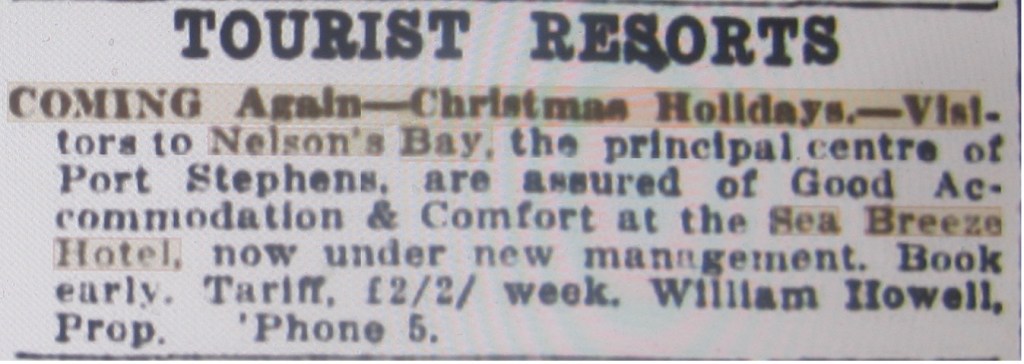
The Sun of 28 November 1919, page 7:
Licensees of the Seabreeze Hotel, 1920 to 1937
The following registration card lists the publican licensees of the Seabreeze Hotel from 1920 to 1937.
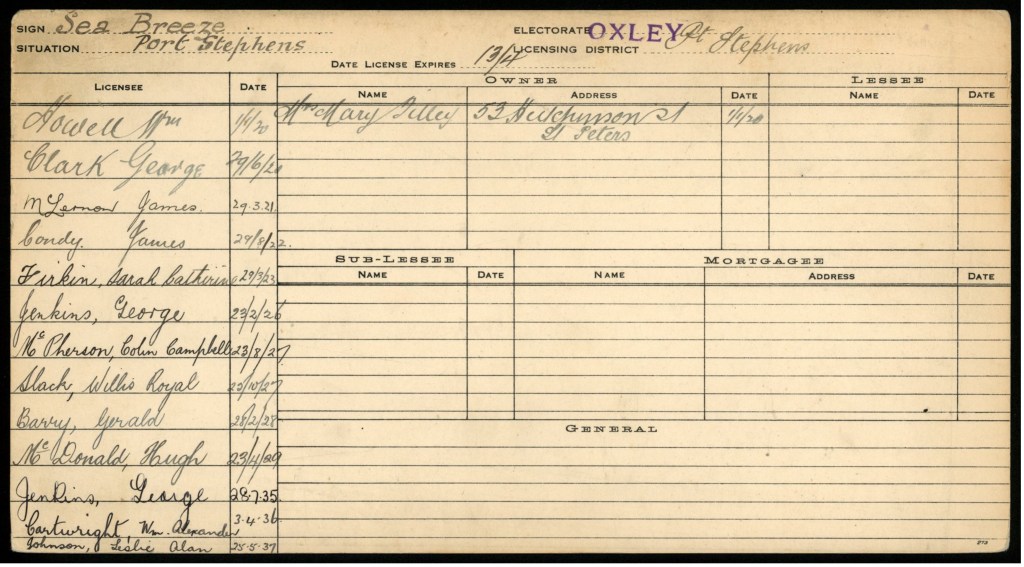
Seabreeze Hotel Registration Card [Museums of History NSW]
The registration card contains the following information:
The owner of the Seabreeze Hotel in 1920 listed as Mrs Mary Tilley, of 53 Hutchinson Street, St. Peters.
Publican licensees listed on registration card were:
William Howell, 1 January 1920;
George Clark, 29 June 1920;
James McLernon, 29 March 1921;
James Condy, 29 August 1922;
Sarah Catherine Firkin, 29 March 1923;
George Jenkins, 23 February 1926
Colin Campbell McPherson, 23 August 1927;
Willis Royal Slack, 25 October 1927;
Gerald Barry, 28 February 1928
Hugh McDonald, 23 April 1929
George Jenkins, 28 July 1935
William Alexander Cartwright, 3 April 1936
Leslie Alan Johnson, 25 My 1937.
Hotel Under New Management – 1920
The following advertisements were placed by the new licensee, G. Clark:
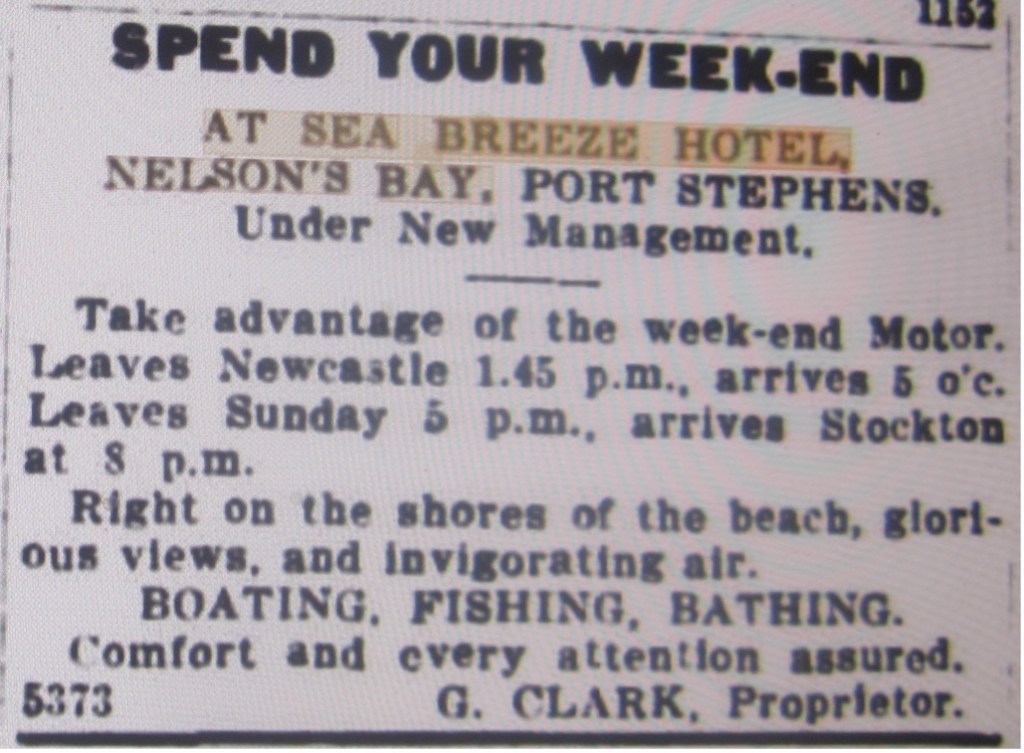
Newcastle Morning Herald and Miner’s Advocate of 11 December 1920, page 5:

Northern Daily Leader of 12 January 1921, page 5:
Seabreeze Hotel Changes Hands – 1921
The Raymond Terrace Examiner and Lower Hunter and Port Stephens Advertiser of 29 April 1921, page 3, reported:
‘The Sea Breeze Hotel has again changed hands, and is now under the management of Mr. McLernon, late of Tamworth. ‘Mac’ gives promise of being a ‘live wire’ in the village, so far as progress matters are concerned.’
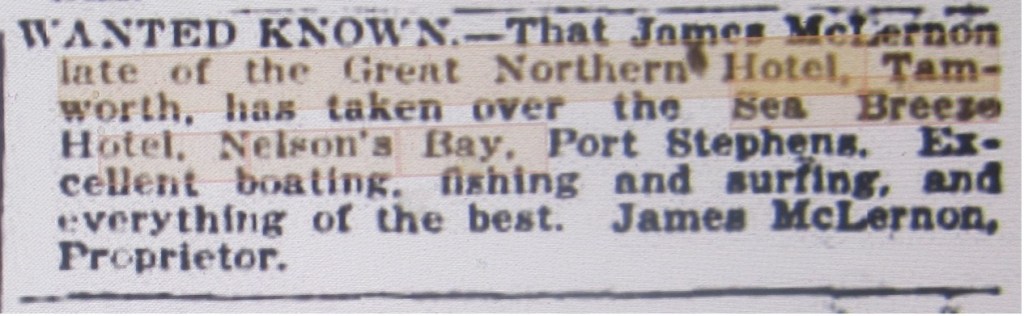
Advertisement placed by James McLernon in the Northern Leader of 7 May 1921, page 5:
Meeting of the Port Stephens Ice Works at the Hotel – 1922
The Raymond Terrace Examiner and Lower Hunter and Port Stephens Advertiser of 10 March 1922, page 3, reported:
‘Representatives of the Port Stephens Ice Works Ltd., held a public meeting at Nelson’s Bay, on Friday, March 2nd, by special request of the Nelson’s Bay fisherman. …. It was requested that application forms for shares be made available at Nelson’s Bay, and Mr. McLernon, Hotel Proprietor, undertook to take, charge of these.’
Group of Motorists Visit the Hotel – 1923
The Newcastle Sun of 13 March 1923, page 8, reported:
‘A party of 100 journeyed to Nelson’s Bay, under the management of Young and Green, the motor firm of Hunter-street West. Leaving Newcastle at 9.30, cars proceeded via Stockton to Salt Ash, where the steamer ‘Reliance’ was chartered to convey the party to Port Stephens, where they arrived at 1.30. Entertainment on the trip up Tilligerry Creek was given by the orchestra, whose every item was encored. The next move was to the Sea Breeze Hotel, where Mr. W. Young had arranged for a first-class lunch. Leaving at four o’clock, song and harmony prevailed on the trip home to Newcastle, and the journey was completed at 7.45.’
Sea Breeze Hotel Changes Hands – 1923
The Raymond Terrace Examiner and Lower Hunter and Port Stephens Advertiser of 27 April 1923, page 3, reported:
‘The monthly meeting of the Progress, and Tourist Association, was held on Friday evening last, the president, Mr. W. Thompson presiding. …
Mr. H. Firkin, son the new proprietress of Sea Breeze Hotel, was elected Treasurer, vice Mr. J. Condy, who resigned upon leaving the district. The Sea Breeze Hotel has again changed hands. The late proprietor Mr. J. Condy having relinquished the business to Mrs. Firkin. Mr. Condy has taken up a business in Annandale, Sydney.’
State Governor and Party Stay at the Hotel – 1925
The Newcastle Morning Herald and Miners’ Advocate of 20 October 1925, page 5, reported:
‘Sir Dudley de Chair, the State Governor, and Lady de Chair stayed at the Sea Breeze Hotel, Nelson’s Bay, during the whole of their visit to Port Stephens.’
The Raymond Terrace Examiner and Lower Hunter and Port Stephens Advertiser of 23 October 1925, page 2, also reported:
‘His Excellency the Governor, Sir Dudley de Chair, accompanied by Lady De Chair, Miss Elaine De Chair, and Flight-Lieut. M. H. Coote, A.D.C. to the Governor, paid an unofficial visit, and spent four days at Nelson Bay, on a quiet holiday. The party made several trips with Inspector Hinchman, of the fisheries Department, and had good sport line fishing.
His Excellency made himself very popular, and during the day visited the wharf and conversed freely with the fishermen. He specially sent for Mr. G. H. Pepper, with whom he had a long conversation. Miss De Chair enjoyed herself immensely in the new swimming baths, and is a good exponent of the natatorial art. As an appreciation the following reference speaks for itself. His Excellency, Lady De Chair, and Miss De Chair have immensely enjoyed a really restful holiday at the Sea Breeze Hotel, Nelson Bay, and especially Mrs. Firkin’s excellent cuisine.’
Tourist Group Lunchs at the Hotel – 1927
The Newcastle Morning Herald and Miners’ Advocate of 22 February 1927, page 3, reported:
‘Korsmann and Co. ran an excursion of residents from Newcastle and Maitland districts round Port Stephens on Sunday last, over 100 persons joining the party. Engel Bros.’ new launch, Super Dreadnought, was requisitioned for the outing. The tourists lunched at the Sea Breeze Hotel, then returned to Salt Ash, via Tea Gardens.’

Two-storey Sea Breeze Hotel – 1927 [University of Newcastle Library’s ‘Living Histories’ Collection]

Holiday excursionists in the park opposite the Sea Breeze Hotel.
Sea Breeze Hotel Changes Hands – 1928
The Dungog Chronicle of 6 March 1928, page 2, reported:
‘The Sea Breeze hotel at Nelson’s Bay has changed hands, the new proprietor being Mr. [Gerald] Barry. Mr. Barry has had a wide experience in hotel-keeping and hopes to keep everything up to the same high standard as it was when the popular Geo. Jenkins was in-charge.’
Sea Breeze Hotel Changes Hands – 1929
The Raymond Terrace Examiner and Lower Hunter and Port Stephens Advertiser of 2 May 1929, page 4, reported:
‘Mr Barry has sold the license of the hotel to Mr. McDonald and a transfer will be made this month.’

Sea Breeze Hotel – 1930 [University of Newcastle Library’s ‘Living Histories’ Collection]
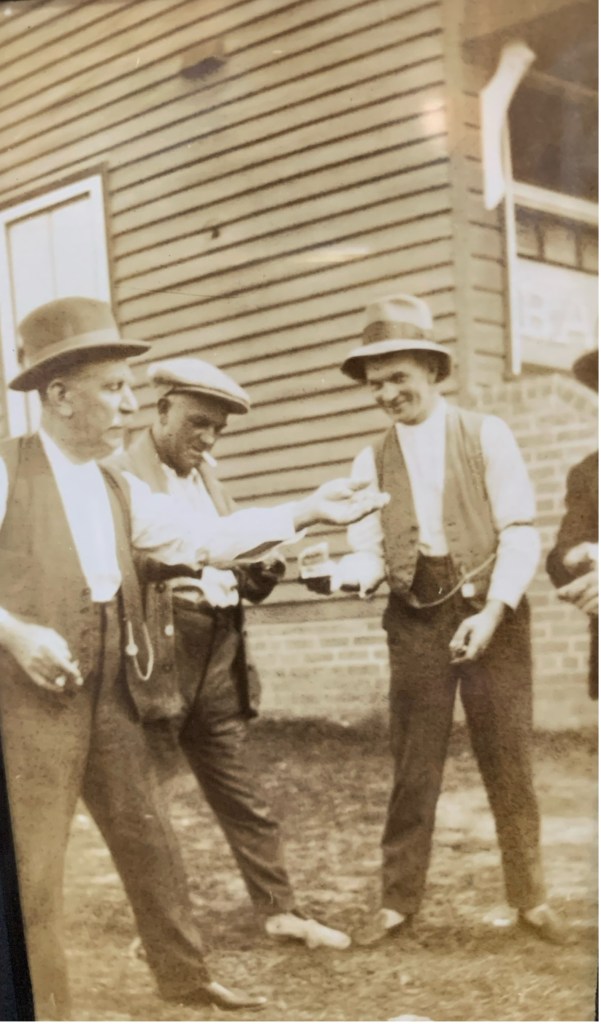
Port Stephens residents beside the Sea Breeze Hotel – circa 1930’s
Proposal for the Memorial Steps to be Illuminated by the Hotel – 1929
The Newcastle Morning Herald and Miners’ Advocate of 8 October 1929, page 7, reported:
‘It was announced that the Nelson’s Bay Memorial Steps were almost completed, and it was decided that the unveiling ceremony in connection with the honour roll be held on Friday….
A request was made by the Progress Committee that on their completion, the Memorial Steps should be lighted up at night, the power for this to be procured from the plant it the Sea Breeze Hotel. Due consideration was promised to the matter.’
It appears that no further action on the proposed lighting plan eventuated.
Proposal to Ban Hotel from Using Tank Water – 1936
The Raymond Terrace Examiner and Lower Hunter and Port Stephens Advertiser of 19 March 1936, page 4, reported:
‘George Jenkins, Sea Breeze Hotel, Nelson’s Bay, stated that he only used the water from the well for hosing down lavatories, paths etc, and not for any domestic purpose. The loss of this supply would be a serious and inconvenient matter to him. He asked that the matter be left in abeyance for three months. Council will forward his letter on to the Board of Health.’
The outcome of this matter was not reported in any newspaper.
Fight in the Hotel Yard – 1939
The Maitland Daily Mercury of 11 April 1939, page 5, reported:
‘On Good Friday a disturbance in the yard of the Sea Breeze Hotel, Nelson’s Bay, attracted the attention of Constable Kidd, who arrested a man. In the Police Court to-day, a fisherman, pleaded guilty to offensive behaviour and to using indecent language. He was fined 10/ or a day on the first charge, and £3 or six days for the language, which the magistrate said was very filthy. Constable Kidd said that – was fighting in the hotel yard, and when spoken to by witness shaped up to him. He also attempted to fight some men who had advised him to go away. Witness then arrested him, and he used the language.’
Sea Breeze Hotel Changes Hands – 1939
The Cessnock Eagle and South Maitland Recorder of 11 August 1939, page 7, reported:
‘Mr. Mel Jurd has disposed of his interest in the Australia Hotel at West Cessnock, and next week he will become the proprietor of the Sea Breeze Hotel, Nelson’s Bay.’
The Cessnock Eagle and South Maitland Recorder of 7 November 1939, page 5, further reported:
Mr. Mel Jurd, whose name now adorns the Sea Breeze Hotel at Nelson’s Bay, was in Cessnock over the weekend. Mel is making the old hostelry popular at the Bay. He was quite disturbed over the rumours that were abroad that campers were barred at Nelson’s Bay this year. He states that this report is incorrect and that campers are permitted to erect tents on the main beach.’
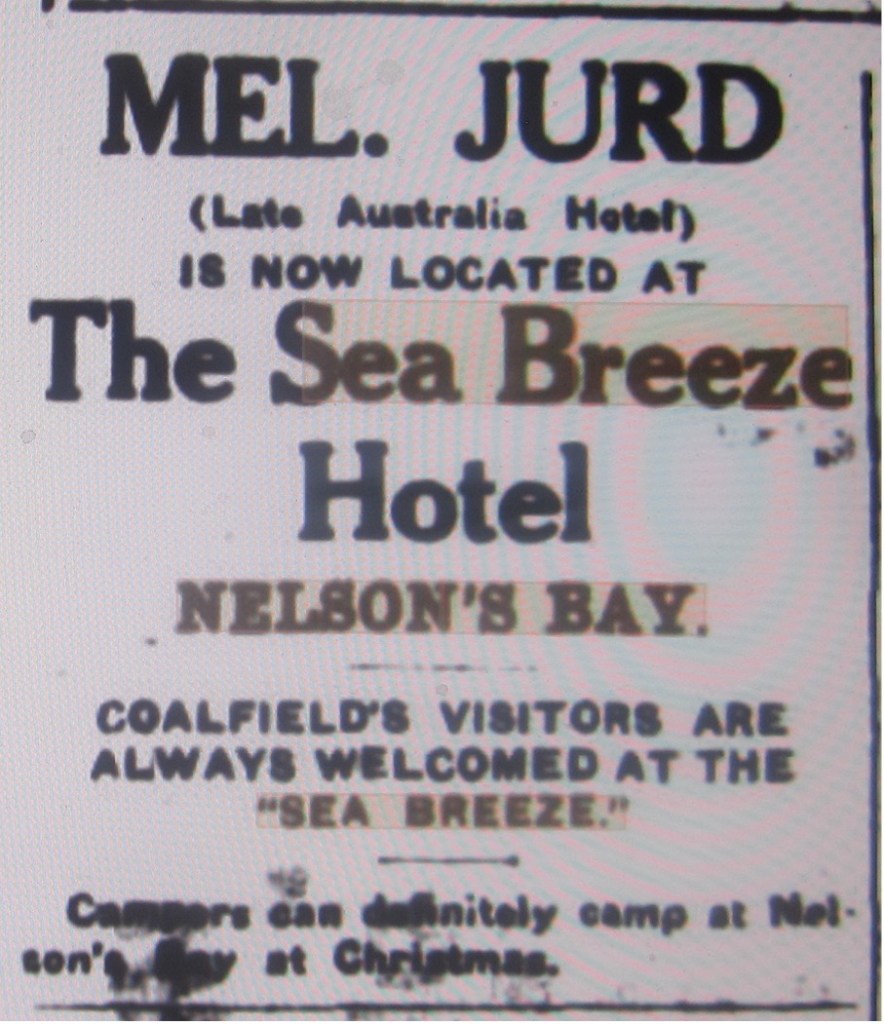
Advertisement placed by Mel Jurd in the Cessnock Eagle and South Maitland Recorder of 10 November 1939:
Lunch for the Opening of the New Swimming Baths Held at the Hotel – 1939
The Dungog Chronicle of 17 November 1939, page 4, reported:
‘The completion of a new motor road into Nelson’s Bay, branching from the Pacific Highway at Raymond Terrace, the provision of modern swimming baths, and electric lighting for the area about to follow are three big developments that must immediately bring Nelson’s Bay into prominence as a tourist holiday centre…..
At midday the president of Port Stephens Shire Council, Dr. J. B. Meredith, entertained the official visitors [from the Swimming Baths opening] at luncheon at the Sea Breeze Hotel, but at this function speeches were dispensed with.’
Stabbing at the Hotel – 1940
The Newcastle Sun of 4 September 1940, page 2, reported:
‘An alleged stabbing incident at Nelson’s Bay on August 18 was described at the Newcastle Police Court today when A-, 52, labourer, was charged with having maliciously wounded Harold William Kafer.
A-, who pleaded not guilty and reserved his defence, was committed for trial at Newcastle Quarter Sessions next Monday. Bail in £60 was allowed. Kafer, a shopkeeper, of Nelson’s Bay, said that about 6.30 p.m. he was at the Nelson’s Bay Hotel and saw A- there. A- was complaining about missing the bus and witness offered him a ride. A- was unsteady on his feet and witness took his arm to steady him. A- had a bottle in his other hand. Outside, A- asked him to let him go as he could walk all right. Kafer said that A- then put his left hand towards his pocket and witness saw a knife flash. He felt a stinging pain in the side and went back into the hotel for assistance. He was taken to Newcastle Hospital, where he remained for six days.
William George Donnelly, market gardener, of Anna Bay, said that he was with Kafer at the hotel when he saw A-, who was “pretty drunk.” Kafer was leading A- to the door when witness saw a knife flash. A- told them not to push. Witness said, “Nobody is pushing.” A- then whirled round and put the knife, into Kafer. Replying to Mr. Soane, Donnelly said that he saw the flash of the knife, or a bit of steel in Kafer’s direction. A- ran away and witness chased him. He put his back against a door and then witness saw the knife in his hand. He told A- to give the knife up to avoid further trouble. A- lunged at him and swore. He backed away and A- went up the street and ran into the bush.
Francis George Williams, a fisherman, of Nelson’s Bay, gave evidence similar to Donnelly’s. He said he saw the knife in A-‘s hand. He and Donnelly tried to take the knife from A- but he flashed it, and they stood back.
William Davis, a laborer, of Nelson’s Bay, said he was near the hotel on the footpath and saw a couple of chaps bringing A- out of the hotel to get him a lift to the aerodrome, where he was working. When they let him go, A- put a knife into Kafer. To Mr. Soane, Davis said it was in the dark and he did not actually see A- stab Kafer. He saw a flash in the direction in which Kafer was standing.
Detective C. E. D. Evans said that on August 18 at midnight he saw A- in a room at the Nelson’s Bay Hotel. He was very much under the influence of liquor and said he knew nothing about the stabbing. He was taken to Newcastle Police Station and next morning was questioned. In reply, A- said that Kafer had tried to take a bottle of beer away from him, and he ran away. He had no knife and did not stab Kafer at all. This morning, Evans said, he showed A- a shirt and singlet belonging to Kafer and pointed out a rip in each. The cuts were on the right side.
Dr. Thomas Le Gay Brereton, of Newcastle Hospital, said that on August 18 he examined Kafer and found him suffering from a perforated wound in the chest wall, about half an inch deep.’
Volunteer Defence Corps Interviews Held at Hotel – 1943
The Newcastle Morning Herald and Miners’ Advocate of 3 April 1943, page 2, reported:
‘Preparations are in hand for a parade of the Volunteer Defence Corps through Newcastle on April 11. …. It will be the most comprehensive parade of V.D.C. personnel yet held. …..The Army is anxious to build up units as quickly as possible. Many more men are required to fill the quota sought for coastal defence and ack-ack batteries.
Lieutenant Salter, of the 5th Battalion, V.D.C., will visit Anna Bay and Nelson’s Bay on Monday and Tuesday of next week. He will be at the Sea Breeze Hotel. Nelson’s Bay, between 7 and 9 p.m. on those dates to interview recruits for coastal artillery and heavy anti-aircraft guns. Lieutenant Salter will also attend a meeting at the Anna Bay Hall at 8 p.m. on Tuesday. A substitute will be in attendance at Nelson’s Bay in his absence.’
Bush Fires Pose Threat to the Sea Breeze Hotel – 1944
The Newcastle Sun of 21 November 1944, page 3, reported:
‘Weary after a night of fire-fighting and standing by in case of further danger, soldiers and civilians at the seaside township of Nelson’s Bay had to turn out again this morning to fight a fresh outbreak which brought danger to the township from a new quarter.
Last night, three hundred soldiers and residents fought fires and kept vigil until early this morning. …. Early this afternoon the wife of the licensee of the Sea Breeze Hotel, Nelson’s Bay, said she had packed clothing and linen in readiness to move in case the fresh outbreak, which could be seen from the hotel, got out of control. “The men are fighting the fire now, but it is only half a mile away and there is a strong southerly blowing,” she said. “People living nearby have also made preparations to move in case the fire reaches us.”
Alterations Approved to the Hotel – 1946
The Raymond Terrace Examiner and Lower Hunter and Port Stephens Advertiser of 29 August 1946, page 3, reported:
‘Edmund Rose was granted permission at the Stroud Court, on the 15th to carry out alterations and additions at “Sea Breeze” Hotel, Nelson Bay.’
Alterations to the Hotel Approved – 1948
The Newcastle Morning Herald and Miners’ Advocate of 21 January 1948, page 3, reported:
‘A permit was granted to Herbert E. Rose, licensee of the Sea Breeze Hotel, Nelson’s Bay, for building alterations and additions. A second application to construct an additional bar in the hotel premises was adjourned indefinitely.’
Licence Renewed for Hotel – 1948
The Dungog Chronicle of 26 June 1948, page 1, reported:
‘H. E. Rose, Sea Breeze Hotel, Nelson Bay; and A. G. Rawlinson, Tea Gardens Hotel, Tea Gardens, for renewal of their respective publican’s licenses were also granted.’
Sale of Seabreeze Hotel and Rebuilding Plans – 1948
The Newcastle Morning Herald and Miners’ Advocate of 1 September 1948, page 2, reported:
‘The sale of the Seabreeze Hotel, Nelson’s Bay, to a syndicate is expected to be completed within a few days. It is stated that the syndicate plans to rebuild the hotel when conditions permit. The hotel was offered for sale by auction in Sydney yesterday. Bidding began at £15,000 and reached £27,000 without the reserve figure being attained. The property was passed in and private negotiations began. The Seabreeze is the only hotel in Nelson’s Bay. The nearest others are at Tea Gardens, Raymond Terrace and Stockton. It is weather-hoard, two-storied, and has 14 bedrooms. Its improved capital value is £12,500. The owner and licensee is Mr. H. E. Rose.’
The Dungog Chronicle of 4 September 1948, page 5, also reported:
‘This hotel [Seabreeze] was submitted to auction in Sydney on Tuesday but did not reach the reserve. Bidding started at £15,000 and reached £27,022 but was withdrawn as the price was not up to the owner’s estimate. Private treaty was then entered upon by a syndicate, and it is expected they will come to terms. If they do they will rebuild on a modern plan.
The present building has been up about 45 years when Mr. Harry Thompson was the owner and licensee. The license in those early days cost around £20. The visitors to Nelson Bay then were few but the place was gaining popularity as each year went by and is still gaining. The number of weekenders and holiday visitors now run into thousands.’
Advertisement for the Seabreeze Hotel – 1952
The licensee of the Seabreeze Hotel, L. Fines, placed the following advertisement in the Newcastle Morning Herald and Miners’ Advocate of 13 December 1952:
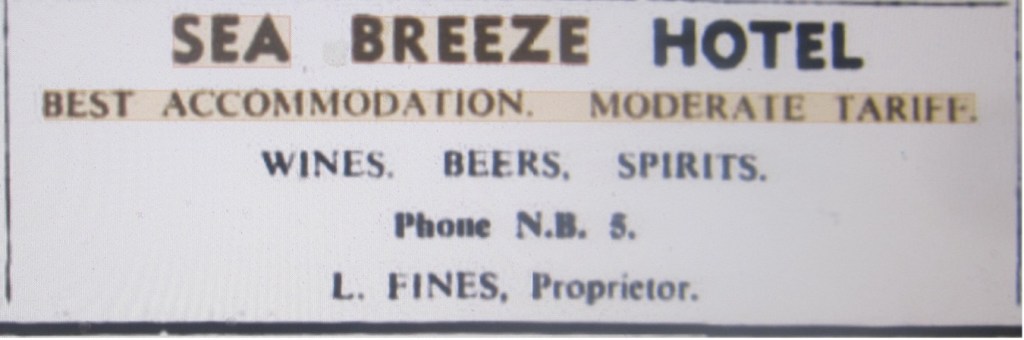
Newcastle Morning Herald and Miners’ Advocate of 13 December 1952
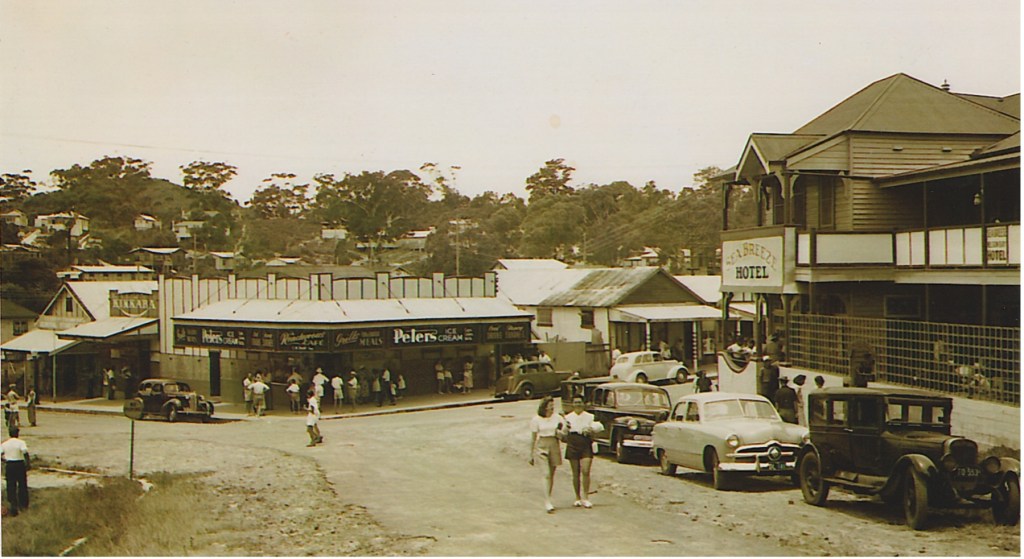
Corner of Government Road and Stockton Street, Nelson Bay, showing Sea Breeze Hotel – circa 1950
New Hotel Licence Proposed for Shoal Bay Country Club – 1953
The days of the Seabreeze Hotel being the only licensed hotel one on the southern side of Port Stephens were coming to an end. The Dungog Chronicle of 5 September 1953, page 1, reported:
‘For some time, many of the local residents of Nelson Bay as well as visitors to the Bay have raised the question that Nelson Bay has now increased in population and attracts on holiday seasons such a large number of visitors that the demands for more accommodation must be considered, says “Raymond Terrace Examiner.”
A meeting was held at Shoal Bay on Sunday, presided over by Mr. H. W. Morgan, manager of the Masonite Corp. at Raymond Terrace, and a vote of the well-attended meeting was taken. The vote was declared even and after some argument as to whether the question should be postponed it was agreed to take another vote at that meeting again. This was done, and the result was the motion for another hotel was carried by one vote. Plans for the new hotel were on exhibition and were favourably commented on. Further efforts are being made.’
The Shoal Bay Country Club was refurbished and upgraded as the Country Club Hotel which opened on 31 December 1954.
Construction of New Seabreeze Hotel Approved – 1954
The Newcastle Morning Herald and Miners’ Advocate of 9 June 1954, page 5, reported on the approval by Port Stephens Shire council of Construction of the new Seabreeze Hotel:
‘Among building applications passed by Port Stephens Shire Council yesterday was one from L. and R. Fines for an hotel, to cost £35,000, at Nelson’s Bay.’
Concluding Comments
This history of the Seabreeze Hotel illustrates how it played a key role in the development of Nelson Bay from the 1890’s.
During the early part of its life few people resided at Nelson Bay, and it would have survived by catering to tourists who visited the area.
Like many hotels, it had many licensees who stayed for varying periods, and each left their own mark on its history and development.
For a period in the 1960’s the name of the Seabreeze Hotel was changed to the Sundowner Motor Hotel.
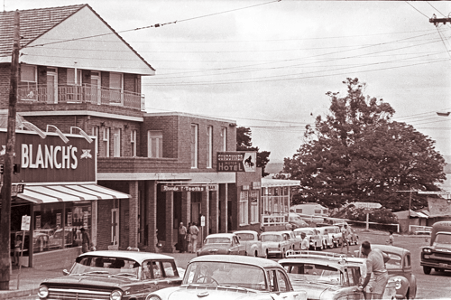
Sundowner Motor Hotel [circa 1960’s [Tomaree Museum Association]
Researched and compiled by Kevin McGuinness
February 2024
ADDENDUM
SHOOTINGS AT THE SEA BREEZE HOTEL IN 1919
The Sea Breeze Hotel at Nelson Bay received considerable publicity in June 1919 when it was the location of three shootings. The action that was of most interest concerned the alleged fatal shooting of Elsie Langford by her husband, Herbert Edgar Langford, who had recently returned from active service abroad after World War One.
Herbert Langford and Elsie Erickson married on 5 December 1911, at Manly. On 16 September 1914 Herbert enlisted for military service. He sailed on 22 December 1914 from Melbourne on board the HMAT ‘Ceramic’, with the 301st (Mechanical Transport), 8th Company, Army Service Corps. He returned to Australia on 2 March 1919.
While Herbert was away on active service, his wife Elsie began a relationship with Frank Howell, the licensee of the Sea Breeze Hotel at Nelson Bay. When Herbert returned to Australia he immediately went in search of his wife, who by then had ceased communicating with him. Herbert’s enquiries revealed that his wife was living at the Nelson Bay Sea Breeze Hotel.
The following is the story, as reported, of the events that led to Herbert Langford shooting both his wife, Elsie Langford and Frank Howell at the Sea Breeze Hotel on 20 June 1919.

Herbert Edgar Langford [Ancestry.com]
Report of the Shootings
The Newcastle Sun of 21 June 1919, page 5, reported on the ‘shooting sensation’:
‘Nelson’s Bay, on the southern side of Port Stephens, was the scene of a threefold shooting sensation last night, as the result of which a returned soldier and a woman are now lying in a serious condition in the Newcastle Hospital. Constable J. H. Deane, stationed at the Tea Gardens, received word of the affair at 11 p.m., when a fisherman named Jack Lambourne arrived by launch from Nelson’s Bay with news to the effect that Frank Howell, described as a hotelkeeper at the bay, had been shot.
The officer summoned Dr. Robinson, of the Tea Gardens, and the two were taken across the port by Lambourne and directed to the Sea Breeze Hotel, of which Howell was said to be the licensee. Howell was found walking about nursing a bullet wound in the upper part of the right arm. In his report to police headquarters, the constable states that Howell said a woman had been shot. Howell conducted the officer into a bedroom, where a woman whose name was given as Mrs. Langford, was in bed, apparently paralysed from the effects of two serious bullet wounds in the neck.
It is alleged that Howell accused the woman’s husband, who is believed to have recently returned from the war, of the shooting, and directed the constable to a certain house [Lund’s Boarding House], where the man, who was also suffering from bullet-wounds, could be found. A resident of the bay, named Lacey, handed the officer a revolver, which is stated to have been found on the parlour floor of the hotel. It was a new, five-chambered, .32-calibre weapon, covered with blood, and contained one empty shell. Five empty shells were picked up by the officer from the parlour floor. There was a great deal of blood about the parlour. Proceeding to the house where he had been directed, Constable Deane found a man in civilian clothes, said to be a returned soldier, lying in a very serious condition, on a shake-down [improvised bed] on the floor. His name was given as Herbert Edgar Langford.
Examination revealed that his throat was cut on the right and left side, and that he had two bullet wounds — one in the head and the other in the left breast. The cuts in the throat were about two inches long, and from their jagged nature the officer concluded that they had been made by a pocketknife, though the weapon that had caused them could not be found. The man was semi-conscious. Dr. Robinson dressed the woman’s wounds, and then attended to Langford. Before his arrival, Howell had summoned Dr. Meredith from Raymond Terrace; and this doctor arrived while Dr. Robinson was at work and attended to Howell.
The doctors agreed that Langford and the woman should be removed to hospital without delay. This task was rendered exceptionally awkward by reason of a gale having sprung up, so that the water became too rough, for the small launches, which were available. Dr. Meredith, however, had secured Mr. Longworth’s launch, and he and the constable took the two serious patients along the creek to Salt Ash, where an ambulance from Newcastle Hospital met them early this morning. The constable accompanied the ambulance to the hospital.
A military discharge found on Langford, and dated June 24, 1919 (next Tuesday), shows that the owner, No. 1529, Driver Herbert Edgar Langford, of the Divisional Ammunition Park, was born near London, is an engineer by trade, and was attested at Sydney on September 26, 1914. His height is given as 5ft 9in. and his present age as 29 years. He has had four years and 273 days’ military service, of which four years and 125 days has been spent on active service abroad; and he has been discharged in consequence of the termination of his period of enlistment. His intended place of residence is shown as 46 Pacific Parade, Manly.’
The Newcastle Morning Herald and Miners’ Advocate of 23 June 1919, page 4, further reported:
‘Yesterday an attempt was made to extract the bullet that had lodged in Mrs, Langford’s neck, but without success. On inquiry at the hospital last night, it was reported that both the patients were in a serious condition. Howell was for a time licensee of the hotel at the corner of Bolton and King streets, Newcastle, which was formerly known as the Birmingham, and is now known as the Selborne Hotel. It is stated that when he held that license Mrs. Langford was in his employ. When he sold the lease of the Newcastle Hotel and went to Port Stephens, Mrs. Langford continued in his employ.’
Inquest Into the Death of Elsie Langford
The Newcastle Sun of 22 July 1919, page 5, reported:
‘An inquest was held before Mr. C. Hibble, this morning, into the death of Elsie Langford, who was alleged to have been wounded by a revolver shot at Port Stephens on June 20 and died in Newcastle hospital on July 15. Mr. Cohen appeared for deceased’s husband.
Beatrice Hoggarty, a widow, deposed that deceased was her sister and had married Herbert Edgar Langford. The latter was an engineer and had been away with the A.I.F.
To Mr. Cohen: Langford went away in 1914 and deceased had lived in Manly with a sister and after her death had gone to the Birmingham Hotel. Frank Howell, licensee of the Sea Breeze Hotel, Nelson’s Bay, said that he first met Elsie Langford about 18 months ago at her sister’s house at Manly. He knew she was married and that her husband was at the war. Twelve months after becoming acquainted with deceased he took the Birmingham Hotel in Bolton-street [Newcastle]. A fortnight after he took the hotel Mrs. Langford became his housekeeper. He paid her £1 a week and she remained with him for 18 months.
Subsequently, he took the Sea Breeze Hotel and Mrs. Langford came to the hotel as housekeeper. A lot of people at the hotel called her Mrs. Howell. About eight or nine months ago their relationships changed. After that they lived together as man and wife. From that time to June 20 they occupied the same bedroom. He did not know Langford then, but on June 20 met him for the first time. On the evening of that day, at about 9.30, he was resting on a couch in the private parlour. Mrs. Langford and a woman named Gertrude Dries were in the room. Mrs. Langford was sitting on a table.
He went to shut the front door and while doing so a stranger rushed past him, saying something about his wife. The stranger went into the private parlour and slammed the door. Witness rushed to the parlour door and opened it. The women were screaming and calling for him. He opened the door and saw Langford in the room. When Langford came Langford asked: “Are you Frank Howell?” and witness answered “Yes.” With that Langford pointed a revolver at him. The revolver went off and he was struck in the right arm. He went to the bar and got his own revolver. As he was closing the door Mrs. Dries called out: “Oh, they are both shot!” Witness’s revolver had three bullets in it, but he did not use it. He ran out and telephoned the doctor and the police. Mrs. Langford owned a bedroom at the hotel and witness looked after £100 which belonged to her.
To Mr. Cohen: He got his last licence from the court on the understanding that his sister would be his housekeeper. Mrs. Langford had been called Mrs. Howell at the Birmingham Hotel. Mr. Cohen: When you were at the Birmingham Hotel, is it not a fact that you and she were carrying on immoral intercourse. Witness: Yes: we were.
Mr. Cohen: During the 12 months you knew her at Manly your friendship was not of a purely platonic nature. Witness: No. Under further examination witness said that he knew that Mrs. Langford got money from the military. He volunteered to leave her when her husband came back if she wished it. Dr. John Harris said that he had examined Mrs. Langford’s body and discovered one bullet in the neck against the spine, and another in the right temple.
Gertrude Dries, a single woman who had been employed as cook at the Sea Breeze Hotel, Nelson’s Bay, for three months, stated that on June 20 she sat with Mrs. Langford and Howell in the hotel parlour. She had known Mrs. Langford for two years, and always thought she was Mrs. Howell. On the night in question, when Howell left the room, Langford entered it. He shut the door behind him, and said: “Oh, is this where, you are?” He said to witness, “This is my wife.” He came towards her and said, “Go on, get out.” She went over and stood alongside Mrs. Langford. Witness said to Mrs. Langford, “Do you know him?” She replied “No, I don’t.”
Mrs. Langford asked her where was Howell. Langford said, “If you fetch Frank Howell here, he’s a dead man.” Witness called for Howell. When he came, Langford said: “Oh, are you Frank Howell?” Howell replied, “Yes,” and Langford pulled out a revolver. Howell ran and Langford shot him. Langford then turned and fired at his wife, who was sitting down. As she was falling, he fired another shot. She fell to the floor. Langford then pointed the revolver at his own temple and fired. He fell to the ground. Witness then ran in the direction in which Howell had gone, screaming for help. She heard something moving in the parlour, and then another shot.
To Mr. Cohen: When Langford first came into the room, he looked very excited. Harold Lacy, storekeeper at Nelson’s Bay, said that he heard a noise on June 20, and entered the Sea Breeze Hotel. He heard “Mrs. Howell” say, “Take that revolver away.” Witness entered the parlour and saw her lying in a pool of blood. He helped to take her to her room.
Walter Lance, a commercial traveller, said that he met Langford at tea time on June 20 at Lund’s boarding-house. He seemed preoccupied. He met him again about 10 o’clock. Langford then had a cut in the neck, and bad bullet wounds in his head and body. He said, “Howell took my wife away. I don’t want to live.”
Alfred Chiplin, Chamber Magistrate, stated that he went to the hospital on July 12 and saw Elsie Langford. He asked her if she would make any statement. She refused to do so. Herbert Edgar Langford, called by the Coroner to give evidence, stated that he would rather not make any statement.
The coroner returned a verdict of death from the effects of bullet wounds which were wilfully inflicted on her by her husband, Herbert Edgar Langford, at Nelson’s Bay, on June 20. Langford was committed for trial at the next Circuit Court in October, on a charge of murder.’
Langford Committed Again
The Daily Telegraph of 24 July 1919, page 7, reported:
‘Herbert Edgar Longford (27), engineer, who the coroner yesterday committed for trial on a charge of wife murder, appeared before Mr. A. O. Butler, D.S.M., in the Newcastle Police Court today charged with shooting at Frank Howell with intent to murder. Mr. A. H. James appeared for the prosecution, and Mr. H. M. Cohen for accused. The evidence for the prosecution was that on the occasion when Mrs. Langford was shot at the Sea Breeze Hotel, Nelson’s Bay, accused shot Howell. The injury was not serious, a flesh wound only being inflicted. The accused, who reserved his defence, was committed for trial, bail being allowed, self in £100 and two sureties of £50 each, or one of £100. There was a further charge of attempting to commit suicide. The evidence was that after shooting his wife and Howell accused shot himself in the temple. Accused, who elected to be summarily dealt with, pleaded guilty, and was sentenced to seven days’ imprisonment.’
Langford Tried for Murder
The Sydney Morning Herald of 8 October 1919, page 11, reported:
‘The facts of the shooting affray which took place at the Sea Breeze Hotel, Nelson’s Bay on the night of June 20, were related before the Chief Justice, Sir William Cullen, at the Circuit Court held at Newcastle today, when Herbert Edgar Langford was charged with having feloniously murdered his wife, Elsie Langford.
Mr. S. Jacques prosecuted; while Mr. Cowan (instructed by Messrs. Braye and Cohen) appeared for the accused, who pleaded not guilty.
Mr. Jacques, in outlining the case, stated that the accused was a returned soldier, and was husband of the dead woman. On his return from the front accused discovered that his wife had been living at the Sea Breeze Hotel, Nelson’s Bay, as the wife of the licensee. He went to the hotel, fatally shot his wife, and wounded the licensee, Frank Howell.
Bertha Gertrude Dries, cook at the Sea Breeze Hotel, stated that she was in the parlour of the hotel on the night of the shooting. Langford entered the room, and, turning to his wife, said: “This is where you are.” Shortly afterwards Frank Howell, the licensee, entered the room. Langford drew a revolver, fired towards Howell, who fell, and then shot his wife, who was sitting at a table. Mrs. Langford fell from the chair, and accused fired again at her, after which he turned the revolver on himself.
In reply to Mr. Cowan, witness said she knew deceased by the name of Mrs. Howell and did not know that she was not married to Howell.
Frank Howell, licensee of the Sea Breeze Hotel, told the Court that he was a single man, and knew Elsie Langford. He was living with her as man and wife, and knew that she was married, and that her husband was away at the front.
After leaving the court the jury returned and asked whether in the event of the accused being considered insane during the time the shooting actually took place and sane immediately afterwards, he could be found not guilty on the grounds of insanity.
The Judge replied in the affirmative and the jury returned a verdict of not guilty on the ground of insanity. Langford was ordered to be detained in his former custody during the Governor’s pleasure.’
The Newcastle Morning Herald and Miners’ Advocate of 8 October 1919, page 2, provided further background information on evidence presented to the court:
‘The accused elected to make a statement from the dock. He said that he was born in London and came to Sydney in 1912. He met his future wife in 1913, and a courtship was struck up about the middle of 1914, and it was agreed that they should marry about Christmas of that year. The war, however, broke out in August. He joined the A.I.F. in September, 1914, and while in camp corresponded with his fiancee. As he was going to sail in December he suggested that they should be married before he left, as he considered he owed that duty to the girl, as well as his duty to his country.
“I returned.” said Langford, “in April of this year.” No one came to meet me and I did not know where my wife was. The first thing I did in getting ashore was to ask the paymaster at the Victoria Barracks. and I asked him where I could find my wife. The last address he gave me was the Sea Breeze Hotel, Nelson’s Bay. I made inquiries of some friends in Sydney, and eventually I found her staying with her sister at Paddington. I asked her for an explanation. I explained that I had heard a lot about her conduct. She did not make any answer at first. I tried to persuade her to return to me and said I would make a home for her. Anyway, she said she would, and I left her at that.”
The accused next said that for some reason his wife seemed to alter her mind, and during their last conversation she said that she was going back to Nelson’s Bay. He told her that he would go up and get her away. His wife replied, “If you go up there, Howell will shoot you.” Langford said, “I was determined I would not spare any effort to get her away. Before I went, I put a revolver in my pocket, knowing how Howell had treated me, and to be prepared to defend myself if necessary.
I arrived at Nelson’s Bay at five o’clock in the evening. I went to Lund’s boarding house. I had tea, and afterwards went out. Where I went to then I do not know. The whole of the rest seems a horrible dream. I have a fair recollection of going into the hotel, and seeing Elsie, and, as far as I remember, of seeing Howell put his hand in his pocket. It seemed as if he had a revolver. I found myself in Lund’s boarding house and was taken from there to the Newcastle Hospital.
Dr. J. B. Meredith deposed to the wound’s borne by the accused. The accused’s only concern was the condition of his wife. He could not say what was the state of his mind. He was in a very serious condition, physically, and it was then questionable whether he would live an hour. Dr. J. L. Beeston stated that he saw the accused just after his admission to Newcastle Hospital. The man was completely unhinged in his mind and remained so for three or four days. He did not think he was sane at the time.
While in the institution he managed to obtain a small piece of glass and opened a blood-vessel in the arm. He followed this with a hunger strike. This went on for three or four days. He came out of this condition and began to take an interest in things. He continually asked for his wife. He was suffering from a sense of a very great wrong. Such a wrong would make a man run amuck.’
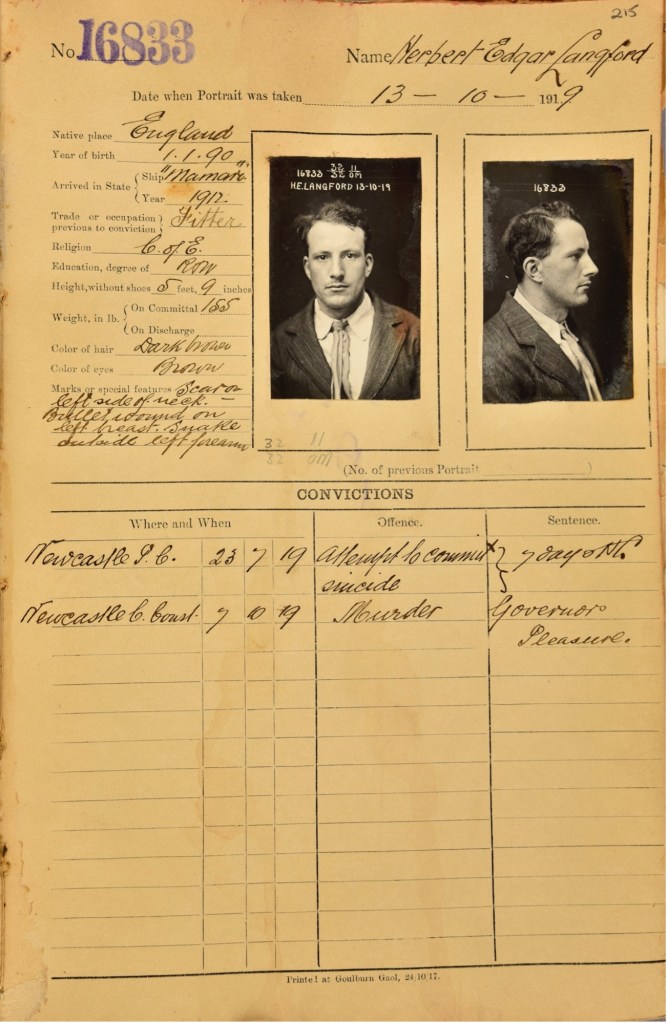
Long Bay Jail Record and Photo, 13 October 1919. The self-inflicted bullet wound on his chest is noted. [Museums of Sydney]
After completing custodial time at Long Bay Jail, Herbert Langford married Annie Hawkins in 1928 at Coonabarabran and by 1949 he had moved to Annandale in Sydney. His second wife Annie, died on 26 November 1950. Herbert died on 7 February 1951 at St. Vincent’s Hospital, Sydney.
Researched and compiled by Kevin McGuinness
February 2024

 Port Stephens - a history exploration