
Part One: Introduction
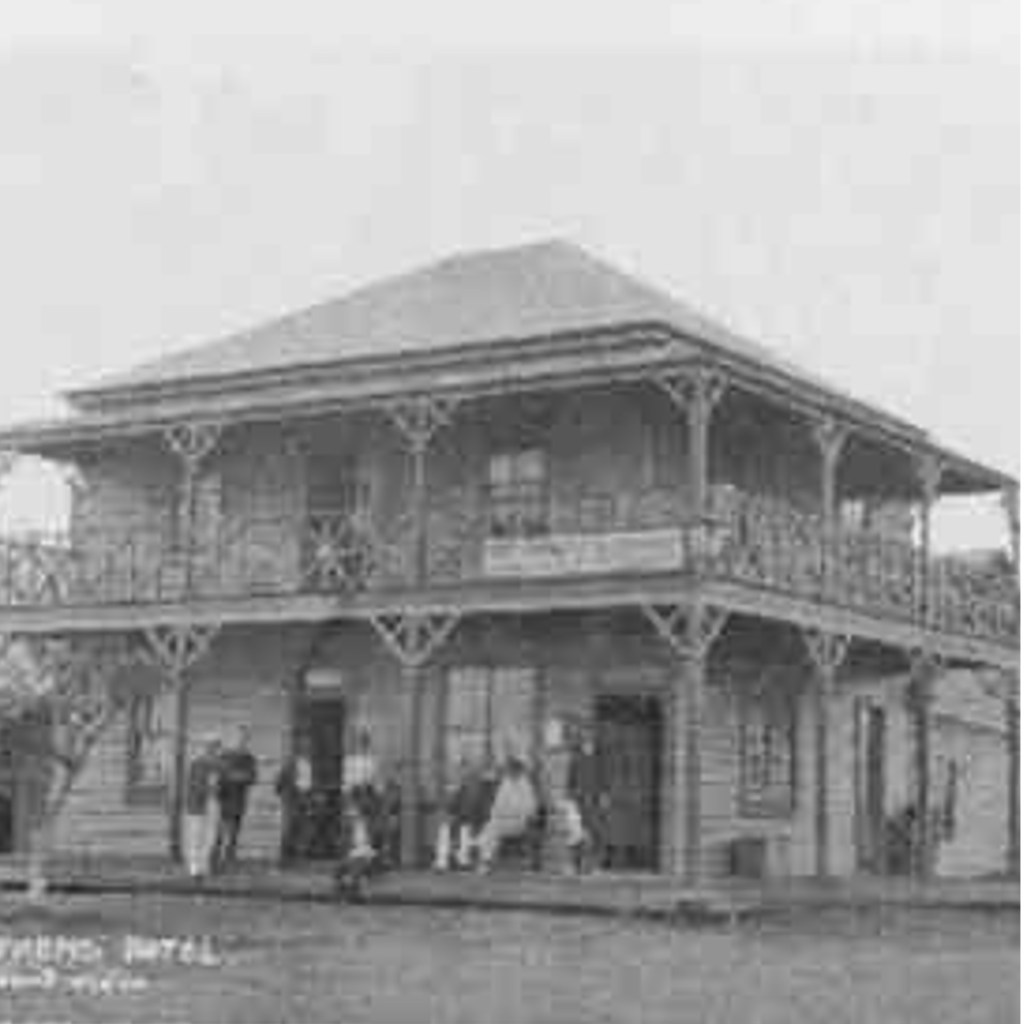
In the late 1800’s, three new hotels were established in the Hawks Nest/Tea Gardens area of Port Stephens viz: Hawks Nest Hotel, Witt’s Hotel (also referred to as the Tea Gardens Hotel), and the Port Stephens Hotel.
The Port Stephens Hotel is the only one remaining and is now the present day Tea Gardens Hotel. It is the one located opposite the ferry wharf on Marine Drive. This building dates from the 1950’s.
A brief timeline of the establishment of the three hotels in the Hawks Nest/Tea Gardens area is as follows:
Hawks Nest Hotel – circa 1866
Stewart Smith built the first hotel on the northern side of Port Stephens in 1866 at Hawks Nest. Most of the population of the area resided there at that time and not at Tea Gardens which developed later.
The hotel was situated near the present day Mermaid Street. Around 1876 the licence was transferred to Richard Flood, who held it for a couple of years, until 1878. The next licensee was Mr J Kinnaird.
The Hawks Nest Hotel was closed around 1883 and the licence transferred to one of the new hotels to builtt at Tea Gardens.
The hotel building was later used as an accommodation house managed by Mrs Stewart Smith
Witt’s Tea Gardens Hotel – circa 1875
The second hotel in the area was that built by John Witt at Tea Gardens around 1875. This hotel was known the Tea Gardens Hotel, and John Witt held the licence for many years until shortly before his death in 1903.
This hotel is not associated with the present-day hotel at Tea Gardens of the same name.
Port Stephens Hotel – circa 1887
The third hotel in the area was the Port Stephens Hotel at Tea Gardens established by Charles Thomas (Hagan) Hagon in around 1887.
Charles Hagon moved to Tea Gardens, where he opened a wine-salon in 1884 and later a hotel on the site. The original wine-salon was a single storey building that could accommodate 40 persons. This was later extended and became the Port Stephens Hotel.
While the three original hotels had three long standing respective owners, there were numerous licensees who managed the publican responsibilities for them over the years. Often the hotels were referred to as the name of the licensee instead of the hotel’s registered name.
The Dungog Chronicle of 4 December 1936, page 3, published a short history of the Port Stephens Hotel at Tea Gardens, up to that date. It mentions the names of various persons in the early hotel industry in Tea Gardens and Hawks Nest.
‘This [the Port Stephens Hotel] was first built in 1884 as a wine saloon for Mr. C. Hagon. In 1887 it was added to and made into the Port Stephens Hotel. Other hosts since that time have been Messrs W. Thomas, Barney Dougherty, J. Dives, Wallace, Hennessey, Bushman, Akins, Langbridge, W. F. Harris, J. Vaughan, and at present M. H. Elders who is keeping up the good name of the hotel. From time to time the hostelry has been changed and rebuilt and is now a two storey building with electric light, up-to-date bathrooms, hot water service, and all modern conveniences installed. Mr. Witt had the Tea Gardens Hotel in the early days and there was also an hotel at Hawks Nest and the names of Messrs J. Kinnaird and Stewart Smith are well remembered as hosts of this hotel.’
Early hotels were important to the general well-being of the local communities. They were not only places for quenching one’s thirst, but also served as places where important community and business events were celebrated and as a meeting place to discuss important political issues of the time.
Part Two: Witt’s Tea Gardens Hotel and Hagon’s Port Stephens Hotel
From the resources of the National Library’s Trove Newspaper collection, Part Two of this paper tells the story of the two early hotels in Tea Gardens and the many events that were held ttere.
Electors Meeting at Witt’s Hotel, Tea Gardens – 1882
The Maitland Mercury and Hunter River General Advertiser of 19 December 1882, page 5, reported:
‘Mr. White addressed the electors at Witt’s Hotel, Tea Gardens. There was a good attendance. He was well received, and every confidence expressed, and he received great promise of support. The polling day, Thursday, 21st, will prove the value of the promises.’
Visitors Entertained at Witt’s Hotel – 1884
A group of travellers undertook a pleasure trip from Clarence Town to the Myall River and return and published a diary of their trip. The story of their trip was published in the Maitland Mercury and Hunter River General Advertiser of 22 January 1884, page 3, and the following portion referred to their visit to Mr. Witt’s hotel at Tea Gardens:
‘Beating up against the wind we at length entered the Myall River and passing the Hawke’s Nest dropped anchor at the Tea Gardens, and were soon discussing the quality of Mr. Witt’s liquor, which was duly pronounced to be first-class. We had to wait for some hours here for the tide, as from this point we should have to use the oars. Host Witt treated us well, and the best he had was placed at our disposal …… Mr. Witt after tea entertained us by performances on a musical instrument which seemed to be a cross between a hurdy gurdy and a concertina, which played “Tommy make room for your uncle,” and ” Safe in the arms of Jesus,” and several other soul stirring melodies.
Another distinguished visitor at the hotel stirred up to emulation by the musical instrument, favoured the company with several songs, accompanied by the most appropriate action; also an Irish recitation which was both interesting and astonishing. At 10 p.m. we left the Tea Gardens and started with the song “Row Brothers Row.” The entrance to the Myall and for many miles up its course had better be passed at nighttime or when the traveller sleeps.’
Cycling Group Entertained at Witt’s Hotel – 1897
A group of cyclists on a tour of Port Stephens recorded their experience in passing through Tea Gardens in the Maitland Daily Mercury of 4 October 1897, page 4:
‘One of the most successful cycling trips inaugurated under the auspices of the New South Wales Cyclists’ Touring Union took place yesterday in a trip to Port Stephens. …. At 6.30 sharp a start was made from Morgan’s Hotel, Raymond Terrace, for Mr. McNiven’s, 11½ miles distant, where breakfast was provided, to which, as Mr. McNiven can testify, ample justice was done, an 11 mile run creating a vacuum that needed a deal of filling up. Breakfast over, a start was made for Sawyer’s Point, (7½ miles), which was reached in short order. Here bikes were stored, and all boarded the s.s. Tahlee, and a start made for Mr. Witts’ of the Tea Gardens, Port Stephens.
The trip down to the Port was splendid, a rather stiff breeze making the water rough enough to give the Tahlee a roll that bade fair to make vacancies at dinner time, but true to contract, everyone was on hand to respond to Mr. John Witts’ announcement that dinner was ready, and from a first experience of Mr. Witts’ culinary establishment, we hope to soon have a second opportunity. Everything possible to devise in the shape of eatables was there, and whoever gets what was left will soon be hungry again.’
School Concert Held at Port Stephens Hotel, Tea Gardens – 1898
The Dungog Chronicle of 7 October 1898, page 2, reported:
‘On Friday evening, the 30th September, a very successful concert in aid of the Tea Gardens Public School Library was held in Mr. Hagon’s hotel, Tea Gardens, and reflected great credit on the teacher, Miss Connolly, to whom too much praise cannot be given for the way in which she worked to make it a succour. The hall was beautifully decorated with flowers.’
Presentation Held at Port Stephens Hotel – 1901
The Newcastle Morning Herald and Miners’ Advocate of 22 August 1901, page 8, reported:
‘A pleasant evening was spent on Saturday last, when the friends of Mr. J. McRae. assembled at Mr. Thompson’s Hotel, Tea Gardens, to present that gentleman with a purse of sovereigns and a nicely bound pocketbook suitably, inscribed, in recognition of his many and valuable services, to the township for many years.’
During 1902 James Dives became the licensee of the Port Stephens Hotel.
Lund’s Hotel [formerly known as Witts Hotel] Welcomes Visitors – 1904
John Witt, the former owner of this hotel died during April 1903.
The Dungog Chronicle of 25 November 1904, page 2, reported:
‘The average resident of the Dungog district is unaware of the complete change which can be enjoyed by a visit to this splendid harbor [Port Stephens] …… A well-equipped steamer, the “Hawke,” leaves Booral wharf every Monday and Thursday for Port Stephens, and from thence for Sydney, so that parties on holiday bent could be landed at the Port, after a pleasurable run down the Karuah river and the harbor, without trouble. ….. The hotel is well conducted by Mr H. O. Lund and his good wife, and among the residents who are over courteous to visitors are the popular postmaster Mr J. W. Noble.’
Two Hotels at Tea Gardens – 1906
The Sunday Times of 30 December 1906, page 4, reported:
‘In my opinion, Port Stephens is about the best place to spend a holiday. The way to reach it is by boat either from Sydney or Newcastle. ……. Proceeding further up the river is a very nice, healthy town ship called Tea Gardens, the population numbering about 300 in all, principally timber workers. There are two hotels here and two stores. The cost of the holiday would depend on the length of stay, and if boarded or not. Board and residence can be obtained for £1 per week.’
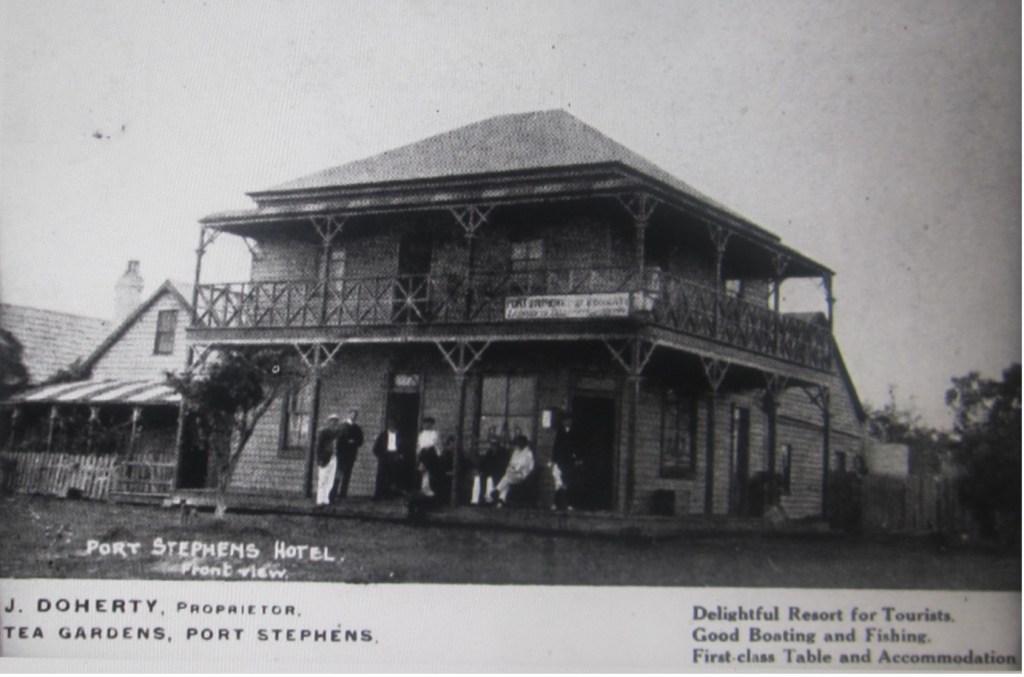
Port Stephens Hotel, 1911 – Barney Doherty licensee [Newcastle Library]
Description of Tea Gardens Hotel and Port Stephens Hotel – 1910
The Dungog Chronicle of 14 January 1910, page 3, reported on a visitor’s impressions of Tea Gardens, and of its two hotels:
‘The boom, boom of the surf and the glimmering lights of Tea Gardens, brings glad tidings to the worried; and the drenched overcoat is for the moment forgotten. Then for tea at Mr. Stephen Smith’s Hotel, with a cheery fire and homely comfort. The trade at this hotel, and indeed, at all the places in Tea Gardens, has increased marvellously since the Lakes route was fairly opened and passengers commenced to pour through (tourists to the number of about 280 per week pass through), either to or from Sydney and Newcastle ; and they must stay a night at Tea Gardens, with the result that probably more is spent here than in any stop in the itinerary, terminals excepted.
Mr. Smith, with his breezy manner, suggests a welcome, even before a greeting is extended, and Mrs Smith is kindness itself. Mrs. Smith has a general store in the building, adjoining the hotel, and an American organ of tonial beauty occupies portion thereof, On the other side of the hotel is the School of Arts, whilst the Post Office is in a cheery cottage, presided over by a cheery lady. ….
Directly opposite Tea Gardens, at Hawk’s Nest, is a largish building, formerly a hotel, but now an accommodation house, kept, by Mrs. Stewart Smith, a resident of many years standing, and one universally respected. And again, I am brought back to the Port Stephens Hotel, at Tea Gardens, kept for many years by Mr. B. J. Doherty. The building, lately added to, is two storied and encloses over 20 rooms. Its proprietor is’ as well-known as any on the North Coast. It is not a little due to him that the Lakes Route was first projected, and Tea Gardens as a whole is reaping the benefit. In this hotel, everything is done possible for the comfort of the guests, while Mr. Doherty prides himself upon the quality of his liquors, etc. Mrs. Doherty’s superintendence of the cuisine and household generally is of a high order.’
Mrs Smith’s Hotel at Tea Gardens Ordered to Close in Three Years – 1911
The Dungog Chronicle of 30 May 1911, page 2, reported:
‘The operation of the Licensing Act in the Gloucester’ electorate is vitally affecting some of the hotels in the area. Reduction being carried at last election, it became necessary to close eight hotels, and the Court sat last week at Taree for the consideration of the various cases. After lengthy evidence it was decided to close Mrs Flood’s Australian Hotel, Stroud; Mrs Carnell’s Booral Hotel; and Mrs Smith’s hotel at Tea Gardens. Several others on the Manning side were also ordered to be closed. The closing will take effect from about three years hence in the enumerated instances, and needless to say, the effect on the various localities in which the hotels are situated will be keenly felt.’
Smoke Concert Held at Smith’s Hotel – 1912
The Dungog Chronicle of 26 March 1912, page 3, reported:
‘During the evening a large crowd assembled at Mr Smith’s Hotel [at Tea Gardens] to take part in a smoke concert, and witness a presentation given to Captain E. Williams. The presentation consisted of a valuable gold watch, suitably inscribed. At 8.30 p.m. Mr Hugh Thurlow was voted to the chair, and after a very able speech, made the presentation. The recipient, Capt. Williams, responded in a very able manner, and spoke both politically and in complimentary terms of the district, finally winding up with asking those present to drink success to the district. …… After the usual formality of speeches were done with, songs and recitations were rendered until 11 o’clock, which came only too soon, when all had to, according to law, seek their respective couches.’
Ceremony Held at Port Stephens Hotel – 1913
The Newcastle Morning Herald and Miners’ Advocate of 11 February 1913, page 6, reported:
‘A send-off was tendered Mr. S. A. Saddler, the Port Stephens representative of the Newcastle and Hunter River Steamship Company, on the eve of his departure from Tea Gardens to Booral, at which latter place Mr. Saddler is now stationed. The function, which took the form of a social evening, was held at Mr. B. J. Doherty’s Port Stephens Hotel, and was opened by Mr. D. J. Williams, dredge master. ……. A vote of thanks to the chairman, Mr. Williams, and host, Mr. Doherty, was passed, and a most enjoyable evening was spent in harmony.’
Timber Industry Dinner Held at Port Stephens Hotel – 1913
The Dungog Chronicle of 9 May 1913, page 5, reported:
‘An interesting ceremony took place at Tea Gardens, Port Stephens, on Saturday, when the new hardwood sawmill of Messrs Andrew Cook Limited, was formally opened. …… A dinner took place in the evening, which was catered for by Mr B. Doherty, of the Port Stephens Hotel. The loyal toast was proposed and responded to heartily.’
Boat Launch Dinner Held at Port Stephens Hotel – 1913
The Evening News of 25 September 1913, page 2, reported:
‘Last weekend saw Tea Gardens, Port Stephens, filled with visitors. A locally built motorboat [Crescent 1], designed and made by Mr. I. Gronfers, a Swedish shipbuilder, who has lately made his home in New South Wales, and whose yard is in the Tea Gardens, was transferred from the skids on Saturday, and now floats in front of the esplanade.
A large party sat down to luncheon in the dining-rooms of the Port Stephens Hotel, when the owners presented Mr. Gronfers with a very handsome gold watch to mark their appreciation of the excellence of his workmanship in providing a large passenger motorboat on the same scale as those used in Sweden for similar tourist work.’
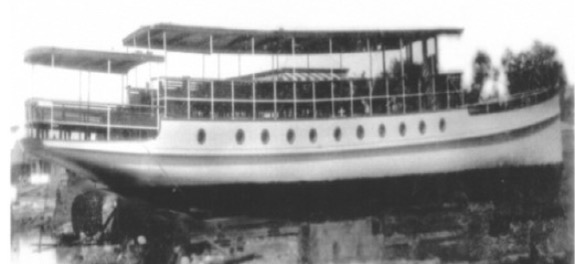
‘Crescent 1′ – Prior to Launch
Doherty’s Hotel Site offered for Sale – 1913
As indicated in the following advertisement the various land holdings of the late John Witt at Tea Gardens, including the Doherty’s Hotel site, was offered for sale by his Executor. The land sale did not affect the hotel licence then in place, which was separate from the hotel site ownership.
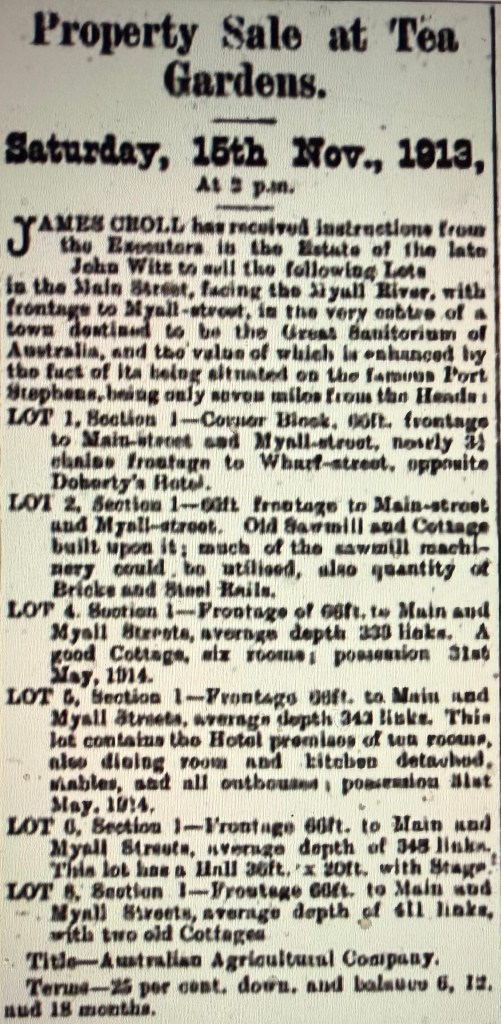
Land sale advertisement, Raymond Terrace Examiner and Port Stephens Examiner, 7 November 1913
Presentation Held at Port Stephens Hotel – 1914
The Maitland Daily Mercury of 4 July 1914, page 5, reported:
‘A large gathering of residents was held last night at Doherty’s Hotel [Port Stephens Hotel], when Mr. T. E. Pyman, who has been in temporary charge of the local school for the past six months, was made the recipient of a hand-some silver-mounted walking stick. The presentation was made by Captain Sadler, whilst Mr. McRae was chairman.’
Fire Inquiry Held at Port Stephens Hotel – 1917
George Vivian Wallace was the licensee of the wine shop referred to in the following article and the adjacent Port Stephens Hotel.
The Dungog Chronicle of 14 December 1917, page 8, reported:
‘An inquiry was held by Mr F. J. Callow, Coroner, as to the cause of a fire which took place, at the Port Stephens Hotel, Tea Gardens, on the 2nd November, by which a detached building used as a spirit store was destroyed. The licensee of the premises is George Vivian Wallace, who has held the license since June 1916. …… At the conclusion of the inquiry, which lasted from 10 a.m. to 6 p.m., the Coroner returned an open verdict, but said that he considered the amount of stock claimed for was not in the store room at the time of the fire.’
Licensees of Port Stephens Hotel, 1920 to 1937
The following registration card lists the publican licensees of the Port Stephens Hotel from 1920 to 1937.
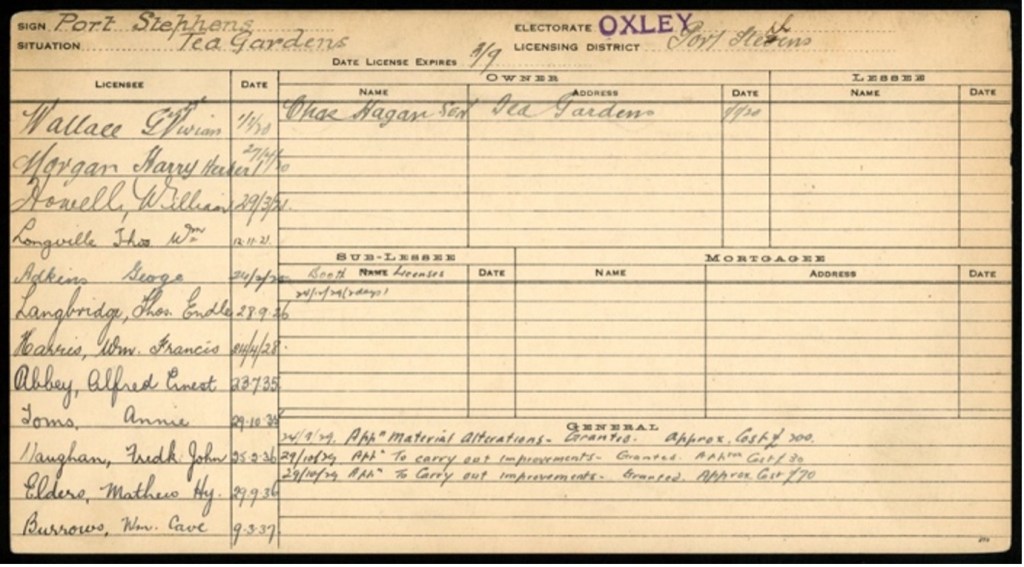
Port Stephens Hotel Registration Card [Museums of History NSW]
The registration card contains the following information:
The owner of the Port Stephens Hotel in 1920 was listed as Charles Hagan, Senior, of Tea Gardens. Charles (Hagan) Hagon died in December 1930
Publican licensees listed on registration card were:
George Vivian Wallace 1 January 1920;
Harry Herbert Morgan 27 April 1920;
William Howell, 29 March 1921;
Thomas William Longville, 12 November 1921;
George Adkins, 24 February 1925;
Thomas Endle Langbridge, 28 September 1926;
William Francis Harris, 24 April 1928;
Alfred Ernest Abbey, 23 July 1935;
Annie Toms, 29 October 1935;
Frederick John Vaughan, 25 February 1936;
Mathew Henry Elders, 29 September 1936;
William Cave Burrows, 9 March 1937.
Application of 24 September 1929 for alterations to the hotel costing 200 pounds was approved. Two applications of 29 October 1939 to carry out improvements costing 30 pounds and 70 pounds were also approved.
Visitors Comments on the Tea Gardens Hotel – 1927
The Newcastle Morning Herald and Miners’ Advocate of 22 January 1927, page 12, reported:
‘The way narrows [on the Myall River] as the boat takes a more westerly turn toward the Tea Gardens, and shortly is seen in the distance the roofs of the buildings which comprise this pretty and beautifully situated township. We arrived here about 5.30 after a most delightful and interesting run of about five hours from Newcastle. As the boat is tied up to the wharf we are met by the porter from the Port Stephens Hotel, who takes charge of our baggage.” The hotel is situated “across the street”- but it is not a street in the ordinary sense of the word, but is veritable lawn of thick, rich grass. delightful to walk on, and reaching as far as the eye can see along the waterfront, which is lined, just here, with wharves, sheds. boat-houses, and stores for the stowing of merchandise …..
The hotel at the Tea Gardens is a large two-storeyed building, built on old-fashioned lines. The present host is well awake to the comfort of his guests. We were shown on arrival to a very comfortable bedroom. From the room is a beautiful view, for miles either way, of the waterfront, and away to the northwest one can trace the windings of the inlet towards Myall Lakes. Time did not permit of a visit up to the Lakes. Of these more anon.
The township of the Tea Gardens comprises the one hotel, several boarding-houses, a number of stores, one or two quite up-to-date, and lit by a locally driven electric light plant. There are several refreshment rooms and lounges, and there are also a couple of billiard parlours.
At the hotel oysters and fish are served with every meal. A long wide balcony is on the front or water side, of the house, and to sit there after sunset and survey the quiet beauty of the scene is a delight. ….. Morning breaks at the Tea Gardens with the singing of birds and the distant splash of oars plied by early fishing, parties – for there are enthusiasts staying at the hotel who have been up since four o’clock, and away to the fishing grounds’ and are returning with plenty. Two or three parties, some of whom came via Salt Ash, and some via road through Raymond Terrace, were staying over the weekend and all obtained fish and oysters, and to spare. …..
After a long walk towards the Terrace, and back one is ready for dinner – especially such a dinner as is served at the hotel at the gardens. Thus with swimming, fishing, and walking amid the delightful surroundings, do two or three days pass all too quickly; and on the last evening we lingered long on the balcony surveying the scene and the glorious sunset, after which “The candles in heaven were lit.” ….. Awakening on the morning of the return day brings a pleasure and a sadness, but one must return to the “sacred duty of daily toil.” After a good breakfast and a final lounge round the pretty township, we leave after an early lunch per steamer about 1.30, and so return, via water through Port Stephens, and on to Salt Ash, where we catch the car. Thence by road to Stockton.’
Death of Former Licensee, James Dives – 1927
The Dungog Chronicle of 28 June 1927, page 4, reported:
‘The death occurred at Hurlstone Park, Sydney, on Saturday, June 18th, 1927, of James D. Dives, of Tea Gardens. The deceased who was 60 years of age was born in the Gosford district but came to the Myall with his parents at an early age and has been in that and the Port Stephens district ever since. ……
Afterwards he took over the Bungwahl Hotel and about 24 years ago came to Tea Gardens and became proprietor of the Port Stephens Hotel. After selling out he gradually got back to the timber and for a great many years has been supplying the boat building trade with tie-tree knees, crooks, etc.’
Advertisement for Port Stephens Hotel Following Improved Road Access – 1930
The Dungog Chronicle of 5 December 1930, page 4, reported:
‘We would draw readers attention to this hotel’s change of advisement. Tea Gardens in recent times has been made more accessible to traffic through the construction of good roads from all centres. The road from the main State Highway to Tea Gardens, via Karuah, which was formerly regarded as a “nightmare” is now a proverbial speedway. Tea Gardens has been made still more attractive to visitors since a ferry service has been installed between Tea Gardens and Hawkes Nest giving access to the famous ocean beach. The town swimming baths have been made shark proof and generally the comfort and pleasure of visitors to Tea Gardens has been considered. Engel and Sons’ Store Boat makes a bi-weekly trip as far as Bungwahl, and tourists desiring to see the famous Myall Lakes can do so at a very small cost.’
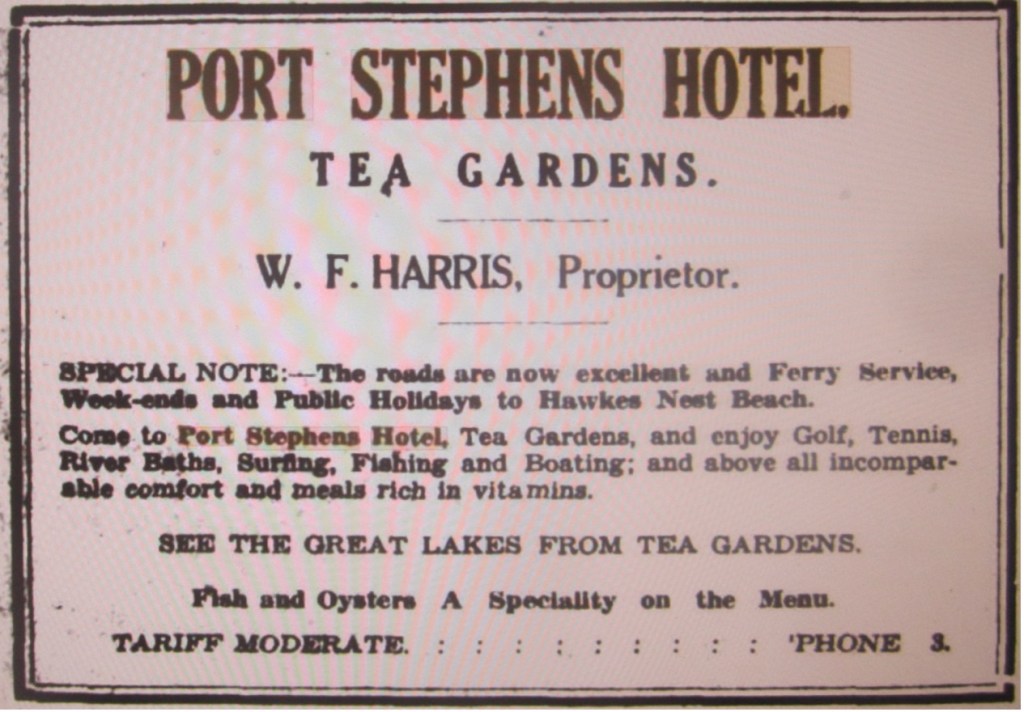
New advertisement for Port Stephens Hotel [Dungog chronicle, 12 December 1930]
New Golf Course Constructed near Port Stephens Hotel – 1930
The Newcastle Morning Herald and Miners’ Advocate of 5 December 1930, page 13, reported:
‘Mr. Harris, of the Port Stephens Hotel, Tea Gardens has laid out an ideal golf course close to the hotel. It should prove an added attraction to visitors. It is intended to establish a second links on Mr. E. White’s property, a few miles out of town where the country lends it-self in an ideal manner for golf.’
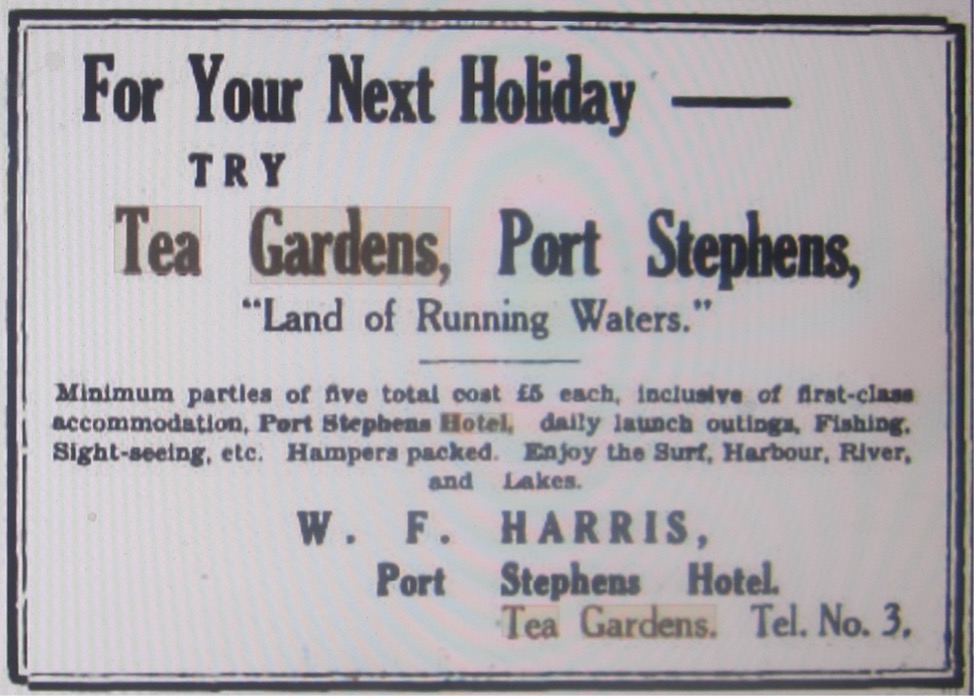
Advertisement for Port Stephens Hotel [Dungog Chronicle 17 June 1932]
Woodchop Promoted by Licensee of Port Stephens Hotel – 1933
The Dungog Chronicle of 5 May 1933, page 4, reported:
‘Attention is drawn to the announcement in this issue of a woodchop at Tea Gardens on 20th May. Mr. W. F. Harris, of the Port Stephens Hotel, Tea Gardens, the sporting publican, is the promoter. It will be a 12inch underhand cut, first prize £5, 2nd. £1, 3rd. 10/-. Nominations close Tuesday 16th. The entry fee of 5/- and last three performances must accompany nomination. Late entries will be taken up till 10 a.m. on day of chop. First heat 11 a.m. Axemen of Wallarobba, Gloucester and Stroud Shires are asked to take notice. The champions of the North Coast will be seen in action there. It is good clean sport at a good seaside resort. The promoters ‘phone number is Tea Gardens 3.’
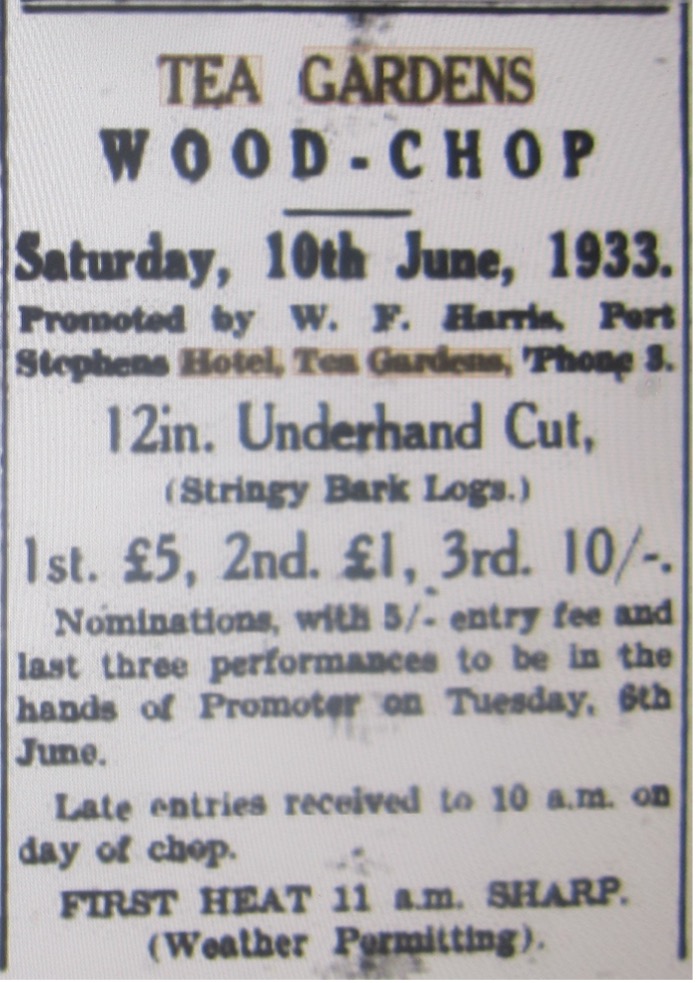
Woodchop advertisement [Dungog Chronicle, 30 May 1933]
Further information on Wood Chopping Events at Port Stephens is available at this link on the website.
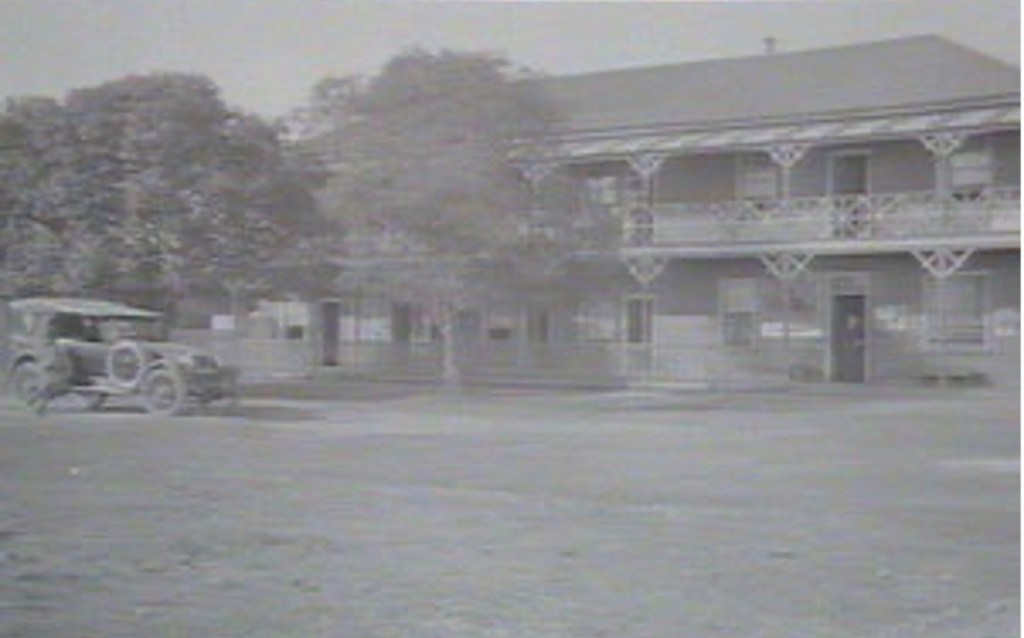
Port Stephens Hotel [State Library NSW]
Port Stephens Hotel Improvements – 1934
The Dungog Chronicle of 12 January 1934, page 4, reported:
‘Additions to the Port Stephens Hotel include three new bathrooms and storerooms, the bathrooms having a hot and cold water service. The exterior walls of the building are of fibro cement and the interior are of Tilux, the bathtubs also are set in with Tilux. A special feature is the modern type of ball-bearing showers and fittings. All those who have inspected the work are loud in their praise, which bestows great credit upon the architect and builders, also the proprietor who is doing all in his power to give service to his patrons.
Mr. Harris is also arranging to instal a new electric light engine of greater power, together with a pump to provide against a shortage of water to his bathrooms. The improvements are estimated to cost about £500. This is regarded as a token of confidence in the future.’

Advertisement of the many improvements at the Port Stephens Hotel [Dungog chronicle, 11 May 1934]
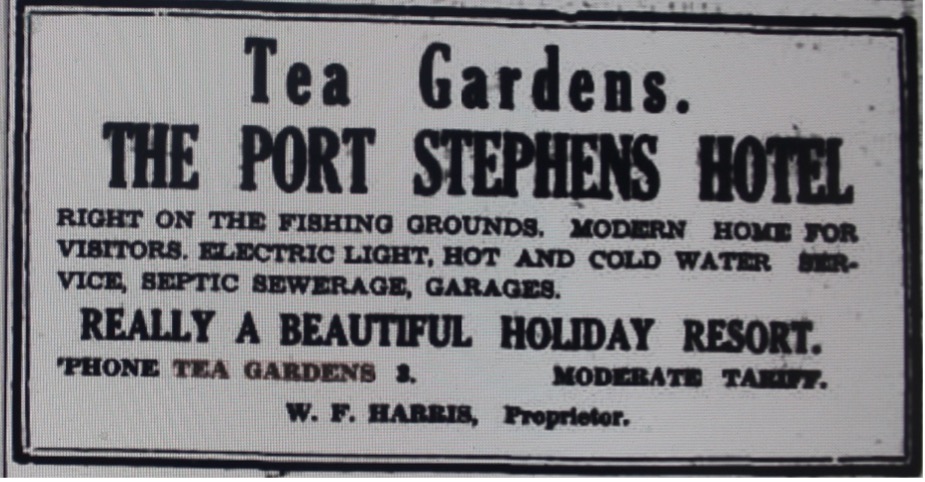
Advertisement for the Port Stephens Hotel, prior to the retirement of W. F. Harris as licensee [Dungog Chronicle, 24 May 1935]
Port Stephens Hotel to Change Hands – 1935
The Dungog Chronicle of 16 July 1935, page 4, reported:
‘Mr. W. F. Harris, licensee of the Port Stephens Hotel, Tea Gardens, announces that he is retiring as licensee of the Port Stephen’s hotel as from July 23. The application for the transfer of the premises will come before the licensing Court this week. His prospective successor at the popular hostelry will be Mr. A. E. Abbey, who has been a frequent visitor to Tea Gardens over a number of years.
Mr. Abbey has been a wireless officer on various ocean-going steamers for a number of years. His latest appointment was with the South African Government steamer, Erica, which was a frequent visitor to Australian ports. On every available opportunity, Mr. Abbey spent his holidays at Tea Gardens and has been so impressed with the district that he has decided to take over the hotel. Mr. Harris, who is also President of the Stroud Shire Council, states that he is not yet in the position to announce his future movements.’
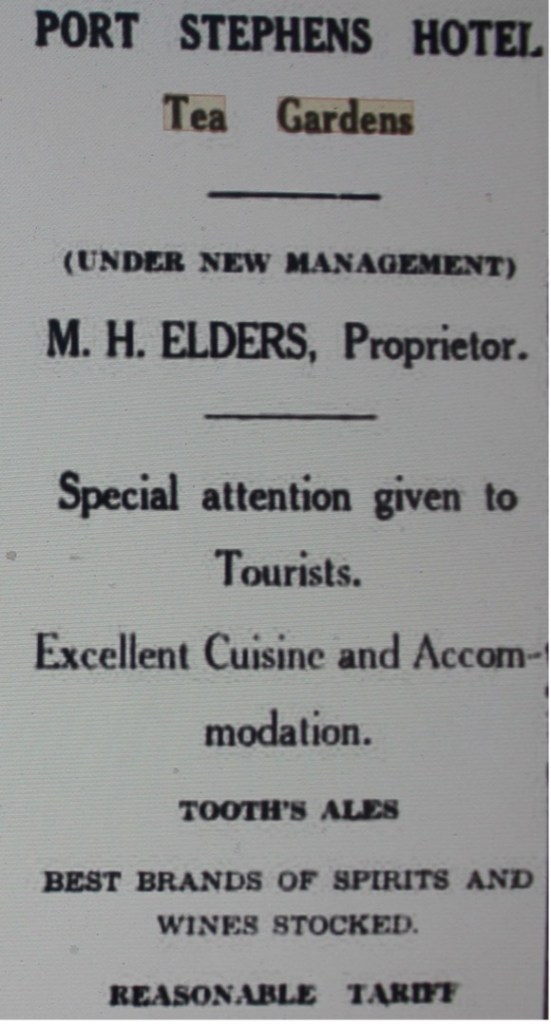
Change of Licensee Advertisement [Dungog Chronicle, 4 December 1936]
Port Stephens Hotel Licence Transfer – 1937
The Dungog Chronicle of 12 March 1937, page 4, reported:
‘At Dungog Licensing Court on Tuesday last, before Mr. Soiling, P.M., an application was granted for the transfer of the license of the Port Stephens Hotel at Tea Gardens from M. H. Elder to W. C. Burrows, the necessary fee to be paid at Stroud.’
The new licensee must have decided to update the hotel building as the Dungog Chronicle of 6 August 1937, page 4, reported:
‘Mr. H. Maw and his staff have been busy painting and renovating the Hotel Port Stephens.’
Port Stephens Hotel Ordered to be Demolished – 1939
The Maitland Daily Mercury of 19 July 1939, page 10, reported:
‘At a sitting of the Licensing Court, the owner of the Port Stephens Hotel, Tea Gardens, was ordered to demolish that building, and to erect within 12 months a modern building of 25 bedrooms.’
New Licensee for Port Stephens Hotel – 1941
During 1941, William Francis Harris regains control of the Port Stephens Hotel.
The Dungog Chronicle of 1 August 1941, page 3, reported:
‘Port Stephens Hotel changed hands last Tuesday. Mr. W. F. Harris has again taken over the hotel and Mr. and Mrs. Higgs left for Newcastle.’
Improvements to the Port Stephens Hotel – 1941
The Dungog Chronicle of 19 September 1941, page 3, reported:
‘Since Mr. Harris has taken over the Port Stephens Hotel, he has been busy making improvements to it. It has been painted, brick pillars have been placed around the verandah, a new lavatory has been built, and the electric light connected to the Shire main. The hotel formerly had its own electric light plant.’
Visitors’ Impression of the Port Stephens Hotel – 1943
The Dungog Chronicle of 26 March 1943, page 3, reported:
‘A tired city businessman, working in a war department fourteen hours a day, I ran into an old friend in Martin Place, who remarked that a spell would probably do my nerves the world of good, providing I spent a couple of weeks at some quiet seaside resort. ‘Where shall I go?’ His reply was pronto. ‘The Tea Gardens at Port Stephens is the ideal spot for you.’ So, after arranging leave and persuading the wife and soldier brother, we, a party of three, got away from the ‘big smoko’ and commenced our journey to a destination unknown to any of the party.
However, we duly arrived at a surprisingly modern hotel and I, as scribe, will endeavour to describe our experiences. This, our first visit to the Tea Gardens, has left an indelible memory of a peaceful little hamlet, fringing the waters of a very beautiful estuary, where everything seems to be at peace with the world. Fishing is good and bathing in the cool clear waters is delightful. Enough to make one ravenously hungry for the splendid dishes provided by a very well-appointed hotel. ….. The ‘pub,’ a very modem one, where we reside, is built right on the water’s edge, and caters very well indeed for both guests and localities. Nature has been kind to this village, having endowed it with more than its share of natural gifts.
Port Stephens Hotel Changes Management – 1944
The Dungog Chronicle of 3 March 1944, page 3, reported:
‘The Port Stephens Hotel has again changed hands in as far as its management is concerned. The many friends of Mrs. Watkins will be glad to call on her and renew their association with her as proprietress. Mr. and Mrs. Ackland, who were recently managing the hotel for the owner, the well-known Mr. W. F. Harris, like our little town so well they are taking up residence in the locality at least for several months.’
New Furniture for the Port Stephens Hotel – 1949
The Dungog Chronicle of 12 November 1949, page 3, reported:
‘Tea Gardens Hotel had a real turn out during the week. A furniture lorry arrived with a load of new inner spring beds, and took the old ones away; also lino for the floor. The private lounge is having a rout, with a new rubber covering for the floor. The management is arranging to have an extra staff of girls for the holidays.’

View of the main street of Tea Gardens with the Port Stephens Hotel , top right, in early 1950’s.
Plans for a New Port Stephens Hotel – 1950
The Dungog Chronicle of 22 April 1950, page 3, reported:
‘With the lifting of [war time] building restrictions it is expected plans for a new hotel will be before contractors at Tea Gardens. A new hotel with accommodation for not less than 200 is greatly needed.’
New Port Stephens Hotel Under Construction – 1952
The Dungog Chronicle of 13 September 1952, page 6, reported:
‘The new portion of the new hotel at Tea Gardens is taking shape. It is expected some sections will be ready for use by November. Mr. Joe Lowe, manager for the syndicate seems to be quite happy about it.’
The original Port Stephens Hotel was demolished in 1956 and replaced by the present-day Tea Gardens Hotel.
Concluding Comments.
Prior to the Second World War, Tea Gardens was the prominent town in the Port Stephens area and could support several hotels.
Nelson Bay, on the southern side of Port Stephens, having a much smaller population prior to the War only ever had one hotel, the Sea Breeze Hotel, which is still in business.
Researched and compiled by Kevin McGuinness
February 2024

 Port Stephens - a history exploration