
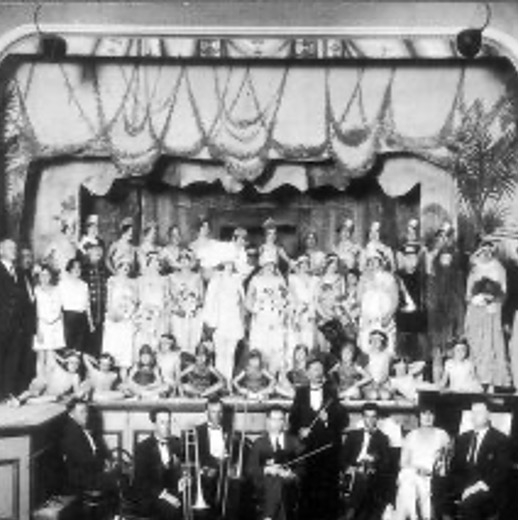
The 1930’s was a progressive decade at Tea Gardens. The town was transitioning from its shipping, fishing and timber industry activities into an area where tourism was gaining more importance.
Despite the increasingly harsh economic times of the Great Depression, new community groups were forming such as the Tea Gardens Amateur Dramatic Society and a local branch of the Country Women’s Association.
This paper looks at the story of the Tea Gardens Amateur Dramatic Society which was very active during its short existence and was responsible for discovering much local talent.
All information is obtained from various editions of the Dungog Chronicle: Durham and Gloucester Advertiser.
Recently Formed Amateur Dramatic Society Practices for Concert – 1931
The Newcastle Morning Herald and Miners’ Advocate of 4 July 1931, page 3, reported:
‘The recently formed Amateur Dramatic Club at Tea Gardens is practising assiduously under the leadership of Mr. Austen Cook. The proceeds of the forthcoming entertainment will be to augment the funds of the local Oddfellows’ Lodge.
A well-attended meeting of ladies was held recently in the Australia Hall, for the purpose of forming a branch of the Country Women’s Association. Cr. Harris presided, and it was unanimously decided to form a branch.’
The Dungog Chronicle of 7 August 1931, page 4, also reported:
‘Dr. K. Shallard spoke [to the Country Women’s Association] and told of his experience with the Association in the many centres where he had been and felt certain that Tea Gardens would benefit largely by the formation of a branch. There was, he said, a great deal of latent talent in town as a recent concert had demonstrated. Having a recently formed dramatic society in their midst it would be an easy matter to join forces and on occasion produce entertainments of high order for the supplementing of funds.’
First Concert staged by the Dramatic Society – 1931
The Dungog Chronicle of 31 July 1931, page 4, reported:
‘The recently formed Tea Gardens Dramatic Society assisted by artists from Pindimar, staged a grand concert in Australia Hall on Saturday last in aid of the Tea Gardens G. U. Oddfellows’. An exceptionally large audience greatly appreciated each item of the programme. The stage decorations were splendid, and credit is due to Mr. George Ribaut and assistants. Although the price of admission was adults 1/6 and children 6d about £18 was taken at the door. Between items Mr. Wills gave mandolin numbers.
The items rendered were as follows: — Bag pipes, Mr. Malcolm McLeod, in full dress kilts. Opening chorus “Keep a song in your heart,” company. Recitation, the kindergarten school children. Piano solo, Mrs. Connell, Pindimar. Monologue, Joyce Ripley. Song, “Up the airy mountain,” Tea Gardens school children. Song, “When Irish eyes are smileing,” Pindimar girls. Entertainment (sleight of hand), Trevor Burrows. Recitation, “If,” Miss Robinson, Pindimar. Part song, “Good night, good night, my beloved,” choir. Dialogue, “Cupid in the kitchen,” Misses Jean and Muriel Motum and Mr. Russell Watters. Song and ballet, “Give yourself a pat on the back.” Comic song, “Burlington Bertie,” Miss Joyce Ripley. Recitation, “The Hero,” Miss Jean Motum. Solo (song) “Flowers of old,” Mrs. E. Holbert; encore, “Is it love.” Song, “Swinging in a hammock,” Misses Minnie Motum, Beryl Engel, Messrs. C. Robards, Stewart Engel. Dialogue, “Ici on Parle Francais,” Misses J. Goddard, B. Scott, E. Nash, J. Harris, Messrs. Austin Cook, C. Motum and T. Burrows. Song, “Keep a song in your heart,” the company.
Bouquets were presented to several of the artists and Messrs. Vaisey and Edmonds praised the work of the artists. Dancing was indulged in after the concert till midnight. The dramatic society has been responsible for discovering much latent local talent, and no doubt will be responsible for further pleasing programmes.’

Australia Hall, Tea Gardens, where concerts were held [News of the Area].
Society Plans a Trip to Bulahdelah – 1931
The Dungog Chronicle of 28 August 1931, page 4, reported:
‘The local dramatic society intend making a trip to Bulahdelah in the near future. The dramatic society will be taking about forty artists. Judging by their former production they should make a good impression at Bulahdelah. It is understood the society are cooperating and sharing the profits with the Bulahdelah football club. After the concert a dance will be held.’
The Dungog Chronicle of 4 September 1931, page 4, also reported:
‘The Tea Gardens musical and dramatic society visited here [Bulahdelah] last Saturday night and staged a very enjoyable function in the interests of the football club. The journey up was made by launch and there were many visitors from the “Gardens.” The programme was a very good one and the items were received well and the efforts applauded. The weather was against securing a bumper house for a cold westerly raged during the whole of the weekend.
The cold accompanying it also was very disagreeable and the fire being cosy it was not likely that anything would coax out anyone who had a fire to sit at. Had the weather been milder there would have been a large attendance at the show. The society and artists certainly deserve the best thanks for their enthusiasm in travelling so far with their concert party. We hope to have the pleasure of receiving another visit.’
The Dungog Chronicle of 4 September 1931, page 4, reported:
‘The Tea Gardens dramatic society consisting of about 40 artists paid Bulahdelah a visit on Saturday last and rendered an interesting and appreciated programme. The principal cast being ‘Ici on Parle Francais ‘[French phrase: French is spoken here]. The ballet items were particularly attractive, and it is considered that the performers displayed their talents to better advantage than on the recent occasion at Tea Gardens.
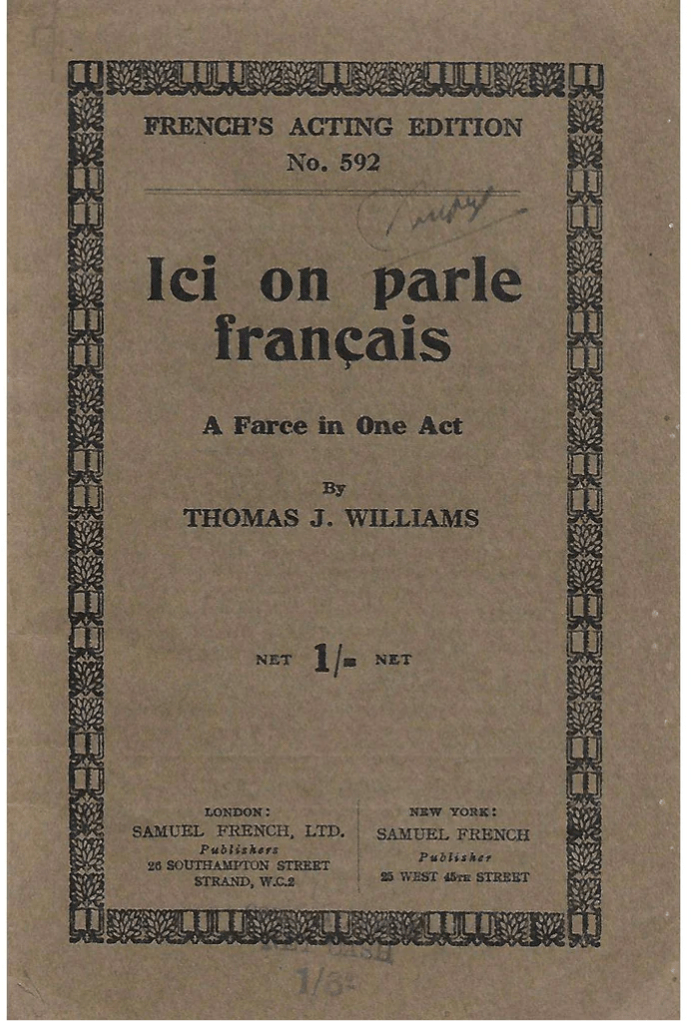
Program for ‘Ici on parle francais – A farce in one act’
At the last moment a number of the members of the dramatic society were unable to take their parts on account of sickness and it was found necessary to supply understudies. The attendance was disappointing to the society due, we understand, to baseless rumours that the show was not worth patronising. The impression conveyed was so influential that the Bulhdelah organisation did not consider it worthwhile to advertise the programme or give prominence to the dramatic society. The result proved that the financial receipts were small and not in keeping with the merits of the artists.
The artists have, by merit, proved their own advertisement and it is admitted by Bulahdelah critics that should the society make another visit a bumper house may be expected. The door takings were about £9. The “Yoothapoona” conveyed the company leaving Tea Gardens 1.30 p.m. Saturday, arriving home at 5 a.m. Sunday.
Apart from the concert the outing proved a social success. Advantage was taken of the moon-light night and a halt was declared at the picturesque spot Tamboi at about 2 a.m. where the billy was boiled. A truly romantic touch was imparted to the unique occasion truly Australian in its incidence of picnic life. Young and old blended in happy fashion, the ladies raced races, and the gentlemen performed blondon turns on the fishermen’s net poles. Many indulged in happy reminiscence and gave life and feeling to the pastoral scene by worthy representation of Indian war dances in true eurythmic style to the accompaniment of that soul inspiring Australian coo-ee. These moonlight sonatas were as a chapter from Fairyland.
During the boat’s journey across the vast Myall Lake and along the waterways of running waters of this district the happy folk were oblivious to anything in the nature of depression and gave their care-free spirit poise and character. The four hours’ journey was an opportunity to play bridge and other games, and the cleanliness of the Yoothapoona tempted the more restive to indulge in sleep and others enlivened the countryside with happy song. Summed up there were no “narks” in this happy Australian party.’
Surf Club to Raise Funds for Dramatic Society – 1931
The Dungog Chronicle of 20 November 1931, page 4, reported:
A meeting of the Tea Gardens Surf’s Club was held in Australia Hall. ….. It was decided to assist the local Dramatic club by providing labour, ticket collector and usher, in connection with the forthcoming concert on the 28th instant. The surf club is benefitting to the extent of 50 per cent. of the nett takings.’
Concert Held – 1931
The Dungog Chronicle of 4 December 1931, page 4, reported:
‘The dramatic society concert was held in Australia Hall on Saturday night last before a crowded house, and it was proclaimed as the best ever given in Tea Gardens. The local artists were assisted by Mr. Leich of the Australian Pine Products Ltd., who is the proud possessor of a cultured voice. The success of this concert demonstrated that there is genuine talent in Tea Gardens and that there is no need to import entertainers in order to provide healthy entertainment.’
Meeting of the Re-constructed Society – 1932
The Dungog Chronicle of 2 September 1932, page 4 reported:
‘The following are the office holders of the re-constructed Society:— Dr. Bell, President; Nurse Avery and Mr. Geo. Ribot, vice-presidents; Mr. Reg. Burrows, secretary and Miss Brown, treasurer.’
Concert Programme – 1932
The Dungog Chronicle of 2 September 1932, page 4, reported:
‘The recently reconstructed Dramatic Society was responsible for staging a very attractive and entertaining programme in Australia Hall on Friday evening last. From first to last there was order and precision which reflected great credit upon those responsible. The quality of each item confirmed the fact that Tea Gardens has talent of an order that would do credit to centres much larger than Tea Gardens. The continued applause was only a proper recognition of the many artists. The proceeds £6/18/6 is, we understand, to be devoted to the dramatic society’s financial needs, but in future the activities of the society will be devoted to worthy public causes.
We are certain that any future entertainments will receive wholehearted support, and this is as it should be because quite apart from the purpose of funds raised, the influence of such a society fulfills an important community role in any country town. Apart from developing local talent such a society provides healthy amusement and makes country towns worth living in, which has a natural way of bringing the people together in a manner that binds the memory of the present with the future. The generation that will follow will be able to speak of the present as “the good old days” despite the depression which we hope will soon pass away before the will of a determined people. The programme was marked with originality, and Jim Bremell is handed the palm as a master comedian and his repertoire would appear to be inexhaustible.’
Possibility of the Society Reforming Again – 1935.
By 1935 the Dramatic Society no longer performing. The Dungog Chronicle of 18 October 1935, page 4, reported:
‘Since the last concert there has been a lot of talk about reforming the old Dramatic Club. As there is plenty of talent in Tea Gardens this should be an easy matter. Mr. P. Ward suggests that a concert be organised to raise funds for the Mungo Brush Regatta. What about it, Tea Gardens?’
Concluding Comments
It is not clear why the Dramatic Society ceased its activities, but it would not have been lack of talent among the residents of Tea Gardens and surrounding areas. Despite the enthusiasm of the society members, perhaps the harsh depression years proved too much.
The Dramatic Society was still being remembered in 1938, as Australia was emerging from the Great Depression years, when the Dungog Chronicle of 28 January 1938, page 2, reported:
‘The Tourist League is forming a committee to arrange a concert with local talent to provide the league with funds. A few years ago, Tea Gardens had a Dramatic Society which produced some very fine shows and should be able to do so again.’
Researched and compiled by Kevin McGuinness
January 2024

 Port Stephens - a history exploration