
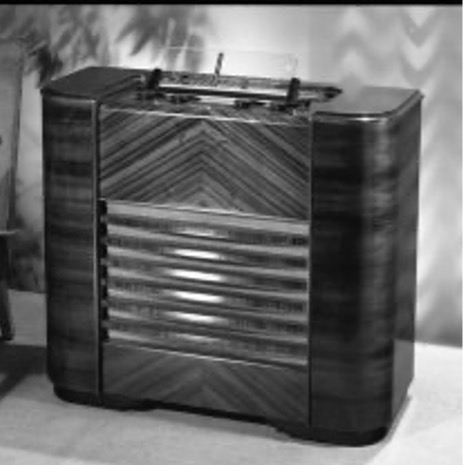
This paper is the story of the development of a distribution network to supply electricity to Tea Gardens and Hawks Nest on the northern shore of Port Stephens.
It stands in contrast to the story of the supply of electricity on the southern shore which can be found at the link Installation of an Electricity Supply to Nelson Bay and Surrounding Areas
PART ONE: Prior to the Supply of Electricity in the Tea Gardens and Hawks Nest
Before the supply of electricity to the Tea Gardens area, generators were used to supply power to particular facilities or for special community occasions, some of which are summarised below.
Electricity Generated for the Opening of the Swimming Baths at Tea Gardens – 1922
The Raymond Terrace Examiner and Lower Hunter and Port Stephens Advertiser of 3 February 1922, page 3, reported:
‘The carnival arranged to emphasise the opening of the Baths was held on Friday afternoon, evening and on the following day. …..
Tip top lighting arrangements were supplied by Thurlow and Co., a full electric voltage being kept up during the carnival. On board the Myall River kindly lent by the N. & H. R. S. S. Co. a concert was held, and the programme was fully enjoyed.’
Electricity Generated for the Opening of Australia Hall at Tea Gardens – 1924
The Newcastle Sun of 11 March 1924, page 3, reported:
‘On Friday evening, Tea Gardens, in the Port Stephens district, was en fete, the occasion being the opening of the new hall. …… Mr. Geo. Engel is the owner of the hall, which is a wooden structure, 120ft. by 25 ft. and cost £1500. ….. The building is brilliantly illuminated with electricity generated on the premises.’
Lighting of the Main Street at Tea Gardens for a Tennis Party – 1930
The Dungog Chronicle of 26 December 1930, page 4, reported:
‘A private tennis party was held on Australia Hall tennis court [at Tea Gardens] on Sunday evening. The weather conditions were ideal, and all who participated thoroughly enjoyed themselves. ….. Mr. Engel lighted up the main street for the occasion, and it gave an idea what the modern convenience of street lighting would mean to a tourist centre such as Tea Gardens. The effect was magic. The cost of lighting the main portion of the town with powerful electric lights would not be excessive, while its effect as an advertising medium for the town would be more than justified.
Strangers visiting Tea Gardens are not impressed with the darkness of the town and are denied the pleasure of walking during the cool hours of the evening. It has been seriously suggested that there is an opening locally for ice making and electric lighting. There are signs and tokens that Tea Gardens is fast becoming a popular tourist centre, particularly since the beach has been opened up.’
Electricity Supply Proposal by a Private Supplier – 1932
The Dungog Chronicle of 2 September 1932, page 4, reported:
‘A large and enthusiastic meeting of the residents and ratepayers was held in Australia hall, on Thursday, 25th ult., to give consideration to the proposal to establish an electric light and ice works in Tea Gardens. Mr. C. H. Hill, the Manager of the Dungog Electric Light Supply Co. addressed the meeting and placed the whole of the facts before the meeting. The meeting decided in favour of the people being canvassed with a view of determining the project.
Cr. W. F. Harris occupied the chair, and in the course of his opening remarks said: — It was a pleasure to him to introduce Mr. Hill, the manager of the Dungog Electric Supply Co., and welcome him to Tea Gardens for the purpose of placing the facts of the proposal before the people, and hoped that he had committed no offence in the minds of the people for any encouragement that he had given Mr. Hill in advancing the proposal to the present stage. He said that he knew of nothing more urgently required in Tea Gardens than an electric light service and ice works. They were two public utilities that have always justified their creation, from a business, health and domestic point of view.
All that was required to make the project a matter of practical politics was for everyone to give it their enthusiasm and financial support by becoming shareholders in the proposed company’s operations in Tea Gardens. Mr. Hill would no doubt place all the facts concerning the proposal before the people, that would justify their support in this direction. The investing public of the district had an opportunity of performing a dual function, firstly to their town in its development and secondly, by earning an interest on their investment which appeared to be better than the Government Savings Bank. Unless the local people gave their support in this direction, they could hardly expect outsiders to regard the investment as a sound one.
Continuing the chairman said that Tea Gardens, if he may say so, was in a state of flux — it was bordering on that margin of either forging ahead in the march of progress or falling back to the tideless waters of time. Electric light and ice works would mean much to Tea Gardens from a tourist point, and the fishing industry felt the need for a local ice works and this industry would be the means of a big save to fishermen, particularly during the travelling fish season. Viewing the proposition from the tourist angle the speaker said that he came in close contact with many visitors to the town, and was impressed with the town’s need in the matter of street lighting, while the visitors enjoyed the day outlook, nighttime to visitors was a nightmare, and if they ventured out at night they were lucky if they did not stumble over the domestic cow.
The beauty of the waterfront could be best appreciated under the influence of street lighting. The town was becoming known as a tourist centre and could not come into its own unless those responsible made up their minds to follow in the lead of modern progress. Anyone who had experienced the benefits of electric light would not, unless forced to do so, fall back to the kerosene wick. Mr. Hill would prove that the electric light would not be any dearer than kerosene illuminate, besides its convenience and laboursaving devices, electric power would be the means of local development.
Proof of the soundness of the proposal he was prepared to scrap his own home lighting plant and felt that Messrs. G. A. Engel and Sons would do the same. ….. Mr. Hill then addressed the meeting and explained the project fully. Mr. H. M. Engel, Managing Director of G. A. Engel and. Sons., Ltd., supported the proposition. A vote of thanks, moved by Mr. G. Davies (Chairman. Urban Committee) to Mr. Hill for his address was carried by acclamation.’
The proposed supply of electricity to Tea Gardens by the private operator did not eventuate. The great depression was underway, and most people would not have available funds to financially speculate with a power supply firm.
Electric Generator Installed at the Camping Pavilion at Hawks Nest – 1936
The Dungog Chronicle of 4 December 1936, page 2, published the following description of the camping ground pavilion building at Hawks Nest:
‘The building is constructed of fibro cement, throughout. …. The plant consists of diesel engine and generator for electric power, and light, from which will also run the refrigerator and radio gramophone music.’
PART TWO: Electricity Extensions Subsidy
In 1935, the NSW State Government’s Electricity Extensions Subsidy was introduced to aid the roll-out of electricity to regional areas.
Tea Gardens was an early beneficiary of the Scheme.
The Dungog Chronicle of 10 December 1952, page 1, published the following summary of the background to the extension of electricity to rural areas through NSW, including the Tea Gardens and Hawks Nest area:
‘Much credit is due to the Premier, Hon. J. J. Cahill, for his activity in extending lines into rural areas under the Act which he introduced in 1945. Some credit must also be given to the previous Administration, the Stevens – Bruxner Government, which introduced the first original bill covering the subsidising of rural extensions. This Act [Electricity Subsidy] was limited to a period of five years, and was of an experimental nature. It was administered by the late Hon. E. S. Spooner, the then Minister for Local Government. It came into force in 1935 and terminated in 1941.
Under this Act the high-tension line was taken from Dungog to Gloucester and later to Taree. The first rural extension in N.S.W was from Stroud Road to Stroud, to Bulahdelah and on to Tea Gardens. In quick time other extensions followed in Stroud and Gloucester Shires, and also in Port Stephens Shire, the line going to Nelson Bay.
It was in James Theatre in 1934 that the idea of the Government subsidising the extension of lines into rural areas was announced by Mr. C. E. Bennett, in his opening address as a candidate for the Gloucester seat. Premier Stevens was present on that occasion. When elected to Parliament the idea was carried further and approved of. The government’s actuaries worked out the rate of subsidy and the Bill introduced and placed on the Statute Book. It was under this first Act that much of Gloucester electorate was served with rural lines. “I am happy to see what benefits have come to country people from a scheme which I originated,” said Mr. Bennett.’
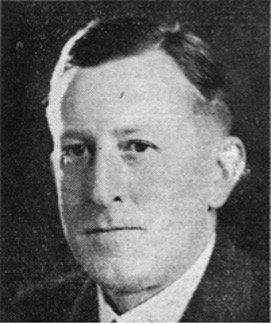
Charles Edward Bennett, Member for Gloucester [Parliament of NSW]
PART THREE: Lighting up Tea Gardens and Hawks Nest
Tea Gardens Progress Association Seeks Information about Power Supply – 1936
The Newcastle Sun of 15 February 1936, page 3, reported:
‘Tea Gardens Progress Association has written to the Newcastle Publicity Director (Mr. F. J. Cahill) seeking information concerning an electric supply for Karuah and Tea Gardens. The lines would run from Raymond Terrace ….. a distance of 32 miles, the letter stated. Electricity is a considerable factor in the matter of tourist development, said Mr. Cahill, adding that he would place the letter before the Electric Supply Department for information in regard to the guarantors required and the amount involved.’
Electricity Extension Proposal – 1937
The Gloucester Advocate of 27 July 1937, page 3, reported:
‘At a recent meeting of Stroud Shire Council, the Engineer (Mr. F. G. D. Stone) presented a lengthy and detailed report upon proposed electricity extensions to Bulahdelah, Tea Gardens, Ward’s River, and services to the rural consumers situated in the Karuah River valley. Following a discussion, during which the immense benefits to be derived from such extensions were stressed by all councillors, the report was adopted.’
Electricity finally arrived at Tea Gardens in 1939. Between 1937 and 1939 much newspaper coverage was given to the pros and cons of various supply routes and also about the financial viability of the electricity extension, given that much of the area that had to be covered was sparsely populated. The Stroud Shire Council also had to be sure that they could fund the electricity extension as they had to raise a loan to cover expenses, which had to be covered by rates charged.’
Stroud Shire Council Approves Electricity Scheme – 1938
The Maitland Daily Mercury of 19 February 1938, page 4, reported:
‘The Stroud Shire Council has adopted a scheme for the supply of electricity to Bulahdelah, Tea Gardens, and intermediate rural consumers at a cost of £14,289. The proposal is an extension of the Stroud scheme completed by the shire last year.
A further £1000 to provide supply to consumers in the Karuah River Valley was approved. The Government is to be asked for its usual subsidy.’
The Dungog Chronicle of 15 March 1938, page 2, further reported:
‘The Member for Gloucester, Mr. C. E. Bennett, M.L.A., who was responsible for the extension of the bulk electricity transmission lines through the heart of the Gloucester electorate, has been actively engaged in organising the extension of spur lines into rural areas. The latest achievement is the approval of the Minister for Local Government (Hon. E. S. Spooner) to continue the line from Stroud to Bulahdelah and thence to Tea Gardens. This will be a benefit to the residents of Bulahdelah and Tea Gardens districts, and to the sawmillers along the route, several of whom have agreed to use the power.
It may also be the first step in the opening up of one of the finest ports in Australia, Port Stephens. Already a company has signified its intention of building a pulping factory there as soon as bulk electricity is available. Mr. Spooner, in his letter to Mr. Bennett, has made available a subsidy extending over a period of 10 years commencing at 5 per cent, of the estimated capital expenditure and diminishing gradually to one half of one per cent, in the tenth year, the initial year’s subsidy being £714/10/, subject to the usual conditions. Workmen must be engaged from the State Labour Exchange [Dole workers] up to at least 90 per cent. The plans and specifications were prepared by F. G. D. Stone, Engineer to Stroud Shire Council. That progressive Council intends to proceed with the work as soon as possible.’
Stroud Shire Council Approves Loan for Electricity Extension – 1938
The Dungog Chronicle of 18 November 1938, page 4, reported:
‘It was resolved, on the motion of Crs. Zeininger and Miles, that signature and seal be affixed to the application for a loan of £14,300, intended for the electricity extension to Bulahdelah and Tea Gardens.’
Electricians Prepare for Electricity at Tea Gardens – 1939
The Dungog Chronicle of 28 July 1939, page 4, reported:
‘Electricians have made a start on some of the Tea Gardens homes, preparing for the power and light when it comes.’
Switching on Electricity at Tea Gardens – 1939
The Dungog Chronicle of 27 October 1939, page 2, reported:
‘Today is an historic day for Tea Gardens and district by the fact that the official switching-on of electricity to the town will take place at 7.30 this evening. The ceremony will be performed by Ald. Geo. W. Genner, Mayor of Greater Newcastle, and among the other visitors of note who will be present will be Mr. C. E. Bennett, M.L.A., and Cr. J. B. Carlton, president of Wallarobba Shire. Mr. Bennett has played an important part in the scheme under which the town is being supplied with current, being one of those who brought about the Government subsidy on electricity extensions. The event will be further commemorated by a Civic Ball at night [at the Australia Hall], under the auspices of Stroud Shire Council, which has undertaken the extension and of which Cr. R. E. Zeininger, representing Tea Gardens district, is the president.’
The Newcastle Sun of 28 October 1939, page 7, reported:
“Now that the electric light has been extended to Tea Gardens and the route to the town has been proclaimed a Main Road it should become one of the most popular tourist resorts in the State,” said the Mayor of Newcastle (Alderman G. W. Jenner) today.
His remarks were prompted by the fact that last night he performed the official switching-on ceremony for the electric lighting of Tea Gardens. “This ought to have been done years ago,” Ald. Jenner told a crowd of about 1000, who attended the function at Tea Gardens last night. “Now that the lighting has been extended to this town it should go ahead by leaps and bounds.” As an example of such progress, he quoted Belmont, which, he said, had risen rapidly after the lights were installed. He congratulated the residents of Tea Gardens on the natural advantages of the district and such improvements as the Marine Drive and the excellent public baths.
At 6 o’clock the Mayor and Mrs Jenner attended an official dinner at Tea Gardens, and then a function at which 58 permanent employees of the Stroud Shire Council were entertained. Others who spoke at the official opening ceremony included the President of the Stroud Shire Council (Cr. R. E. Zeininger), the President of the Wallarobba Shire Council (Cr. J. Carlton), an ex-President of the Stroud Shire (Mr. Abbott), and Mr. C. Bennett, M.L.A. Ald. Jenner was presented with an electric clock to mark the occasion. A tablet commemorating his opening of the lights is also placed in the electric sub-station at Tea Gardens. The programme last night concluded with a ball and a supper to the visitors.’
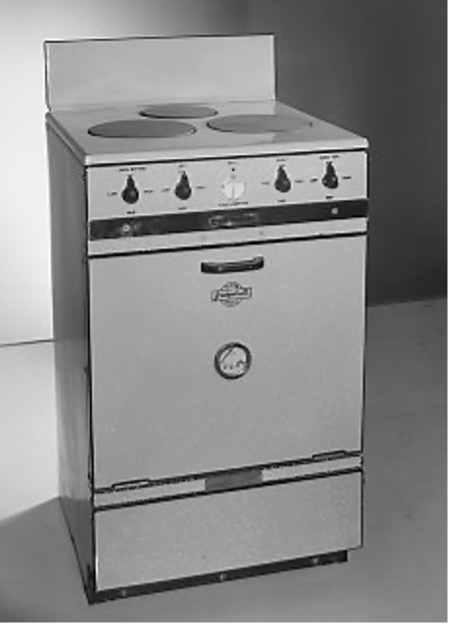
Type of modern electric stove available to Tea Gardens residents during the 1940’s.
Council Loan to be Increased for Electricity Extension to Hawks Nest – 1940
With the commencement of World War Two the supply of copper for electrical wiring become scarce.
The Dungog Chronicle of Friday 19 January 1940, page 4, reported:
‘Because of substantial increases in the cost of copper and other necessary materials, Stroud Shire Council, at its meeting on Friday, decided to increase its loan application to cover electricity extensions to Hawks Nest, Markwell and Booral by £600— from £3600 to £4200. …..
The Engineer explained that the application would have to be increased in order to make a first-class job of the extensions, Copper had risen in price by £11 per ton and other materials had risen also. However, the estimated revenue was more than sufficient to cover the 10 per cent, on capital cost, required by law. If the application was not granted the scheme would have to be cut down to bring it within £3600.
Stating that the works had to proceed and that the increase in cost was unavoidable, Cr. Zeininger moved that an amended application be made for a loan of £4200, and that in the event of this application being refused, the Shire Clerk be authorised to seek approval of the original £3600 loan. The motion was carried. It was further resolved on a motion by Crs. Zeininger and Turner that Mr. C. E. Bennett, M.L.A., and Sir Earle Page, M.H.R., be asked to use their best influence in support of Council’s application. The Engineer’s recommendation that the copper wire be purchased immediately, in view of further possible increases, was adopted.’
Great Success in Electricity Usage – 1940
The Dungog Chronicle of 12 March 1940, page 1, reported:
‘Reporting to Stroud Shire Council on Friday, the Shire Engineer, Mr. F. G. D. Stone, referring to the success of recent electricity extensions within the Shire, said that at Bulahdelah the estimated number of consumers required had already been obtained, and it appeared that this service would directly show a big surplus. Similarly, the installation at Tea Gardens was proving very popular and the service would pay easily.’
Cable for Hawks Nest Electricity Extension Damaged by War Activity – 1941
The Dungog Chronicle of 15 August 1941, page 4, reported:
‘Several new connections have been made during the month and the scheme is proceeding satisfactorily. Council is aware that the submarine cable for the Myall River crossing [to Hawks Nest] was damaged in transit from England and that only a length of 748 feet has been tested to be in good order. …. The Maritime Services Board has been requested to give permission for the cable to be taken from a pile driven in the river in order to utilise the shorter length of cable.’
The Dungog Chronicle of 19 September 1941, page 3, further reported:
‘Maritime Services Board advised that no objection would be raised to a combined submarine and overhead electric transmission cable across the Myall River between Hawks Nest and Tea Gardens.’
Subsequently the salvaged cable was deemed to be too damaged for use, and Hawks Nest had to wait until the Second World War had ended before it could receive electricity.
Hawks Nest Awaits Electricity Supply – 1945
The Dungog Chronicle of 26 October 1945, page 3, reported:
‘The growing population at Hawks Nest, Tea Gardens, is crying out for electric current. Stroud Shire Council was one of the most progressive in the State in the matter electricity extensions. The Council took mains to Bulahdeah and to Tea Gardens and provided a benefit that the public appreciates.
The Council purchased an underwater cable to take the current across to Hawks Nest, but the ship carrying it was sunk and when the cable was salvaged it was considered too damaged to be used. The cable was sold, and the extension of electricity delayed.
The time has now come for Stroud Shire Council to proceed with its original intention. An order for another cable could be placed. If electricity were provided for the many homes in that locality there would be a feeling of sincere gratitude. And also there would be a rapid increase in houses along the line. Let it be remembered that what was a good policy then, must be a good policy now; in fact, a better one, because many more houses have been erected, and many allotments sold in anticipation of better conveniences being available.’
Council Seeks Loan to Cover Hawks Nest Electricity Extension – 1946
The Dungog Chronicle of 4 January 1946, page 4, reported:
‘Cr. Zeininger said he thought that it should be possible to import submarine cable now and he moved that application be made for permission to borrow the necessary money to extend electricity supply to Hawks Nest. Council would remember that this work was approved before the war but when cable was not available the loan money had been diverted to give supply to sawmills in the Bulahdelah district. The motion was seconded by Cr. Wilson and carried.’
Preparations Made for Hawks Nest Electricity Installation – 1948
The Dungog Chronicle of 6 November 1948, page 3, reported:
‘Mr. F. G. D. Stone, Engineer to the Stroud Shire, informed us [the newspaper] on Tuesday that poles to carry electricity wires will be erected at Hawk’s Nest within a fortnight. The submarine cable is expected any time and supply should be available before Christmas. This will be heartening news for Hawk’s Nest residents and owners of weekend cottages. There are about thirty houses on the line of route, with the Pavilion at the beach end. For refrigerators and pumping purposes, as well as illuminating the camping area, the advent of electricity will be a boon. Hawk’s Nest will leap ahead now.’
The Dungog Chronicle of 18 December 1948, page 3, also reported:
‘The submarine cable has been laid across the bed of the Myall River to link up with the transmission lines from the punt approach leading out to the ocean beach a distance of three quarters of a mile. At the beach, Mr. Joe Lowe, lessee of the Pavilion, has £75 worth of poles for use in flood lighting the big camping area. He has an electric pump ready to fill the huge tank so that there will be plenty of fresh water for campers. Refrigeration will also be provided. Later he hopes to have a large freezing room.
Three homes have already had light and power points installed in readiness for the switching on ceremony. The first was that of Mr. C. E. Bennett, next Mr Jim Stuart’s, and then Mr. Darby Worth’s. There are some 18 or 20 awaiting the electricians, Messrs. Harry Payne, Cec. Hawes and Ron Hepworth, who are flat out and who are also searching for materials.
Mr. Bennett said he was pleased to be the first to have the light and power installed at Hawk’s Nest because he has been somewhat a pioneer of the locality and also because he was instrumental in having the Electricity Subsidy Bill put on the Statute Book when he was Member for Gloucester, which made the extension possible to Port Stephens. Mr. Bennett said Stroud Shire is to be complimented on its foresight in making the extension from Stroud Road to Stroud, Booral, Bulahdelah and Tea Gardens, a very sparsely populated area. That shire was the first to avail itself of the new Act and was the first Council to make a rural extension under it in N.S.W.’
Electricity Troubles – 1950
While the installation of electricity to the Tea Gardens and Hawks Nest proved a much-appreciated amenity, problems with the supply quickly became apparent. The Dungog Chronicle of 21 January 1950, page 3, reported:
‘Electric power off’ has been giving Tea Gardens regular turns during the last few weeks and causing dissension among the tourists in furnished cottages who have electric cooking utensils, also among the residents with refrigerators, who have had the experience of losing all their foods through the power being off for hours and the loss of their motors, which have been burnt out by reduced power. These losses are borne by the consumers and will be till one day some person is in a position to test the validity of the ‘take or leave’ method that now exists.’
The Dungog Chronicle of 2 September 1950, page 3, further reported:
‘The failure in electric power again put Tea Gardens in darkness on Saturday, also motors of freezing plants were burnt out. It’s all very well for those in charge to say it was a break-down or give some other excuse. The fact remains that power is charged for. In addition to shortage of power, breakdowns are as common now as the bad weather. Consumers of power place plants for their use in all good faith that power will be supplied to be paid for as the officials make their own rules and regulations only to find the supplies default and there is no redress. Just place the boot on the other foot and see who rules with an iron hand. It’s about time the Shire chiefs made some provision to protect their consumers whose losses are now growing into big figures by the failure of power.’
Concluding Comments
The introduction of electricity to Tea Gardens and Hawks Nest proved to be a boon to both towns. Local entrepreneurs were quick to supply electrical products to residents. The Dungog Chronicle of 21January 1950 reported:
‘Mr. Ken Avery will shortly open the doors to a new business in Tea Gardens. It will be a radio and electrical sales and service station. Ken has also taken over the Tea Gardens Picture show.’
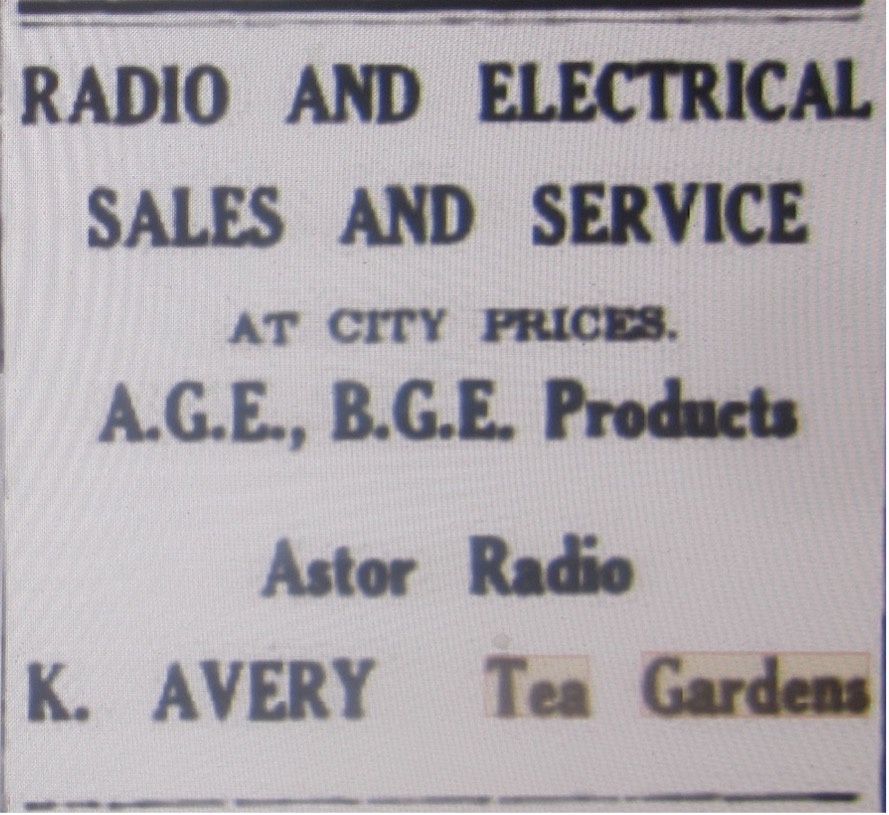
Advertisement for new electrical appliance store at Tea Gardens [Dungog Chronicle, 21 January 1950]
Researched and compiled by Kevin McGuinness
January 2024

 Port Stephens - a history exploration