
Introduction
The first power station in New South Wales was constructed at Pyrmont in Sydney in 1904.
The Local Government Act 1919 gave local councils the power to establish, acquire and conduct trading enterprises, including the supply of electricity and the provision and installation of electrical infrastructure. Local councils also had the power to delegate this authority to County Councils, or alternatively a council had the right to grant a franchise to a private operator for the provision of electric supply. By 30 June 1949, there were 157 suppliers, generating and/or distributing electricity supply to the public within NSW.
This paper examines the development of an electricity distribution network to Nelson Bay and surrounding areas. It offers a snapshot of the early challenges in the roll-out of the present-day electricity supply.
In 1937, the NSW Government commissioned a study into the electricity industry’s development. It recommended that state-wide interconnection occur and the industry be centralised. The recommendations failed to be acted upon, mainly through a lack of political will by various state governments to counter the vested interests of local government authorities.
Regulation of the electricity network in NSW occurred in 1950 with the formation of the Electricity Commission of NSW which acquired power stations and gained control over distribution networks.
Prior to 1950, the Port Stephens Shire Council was able to choose between establishing its own power generation facility, as many other larger councils had done, or to contract out to another body to supply selected towns or districts in Port Stephens. In the Newcastle area, the Newcastle Council and the Railway Commissioners were such suppliers.
Before a third party would contract with the Port Stephens Shire Council to construct the distribution network and supply electricity over that network, the Council had to guarantee to the supplier that the electricity provided would achieve a specified percentage profit over the cost of supply. If the amount of electricity rates did not reach the required level of financial return, then the Council had to make up the deficiency. This requirement served as a constraint to roll out of an electrical infrastructure in regional areas.
This paper summarises in four parts, the main periods in the provision an electrical supply to Nelson Bay and surrounding areas.
The story of the Installation of an Electricity Supply to Tea Gardens and Hawks Nest can be found at this link on the website.
PART ONE: Prior to the Supply of Electricity in the Port Stephens Region
Before the provision of an electricity supply, several methods of generating power were utilised in Port Stephens.
Farmers and residents had to make do with using candles or kerosene and other fuels for lighting and to drive machinery, such as milking machines.
Larger commercial operators such as hotel proprietors, had the option of using fuels to generate their own electricity.
First ‘Electric Light’ in Port Stephens – 1888
The first reported generation of electricity within the Port Stephens area occurred at the homestead ‘Tahlee’, at Carrington, Port Stephens. The Maitland Mercury and Hunter River General Advertiser of 26 June 1888, page 4, reported:
‘Tahlee, the beautiful and historical maison de campaign of the Hon. R. H. D, White, M.L.C., is pleasantly situated on the banks of the harbour of Port Stephens, some ten miles above Nelson’s Bay. Six years ago it became the property of the present owner, who lost no time in setting about to make it one of the most commodious and comfortable marine residences in the northern district.
The visitor, being landed on the extensive wharf which projects a long way into the river, wends his way towards the mansion, which is reached by winding stairs of brickwork studded with large ornamental vases out of which are growing flowers of the choicest description. …….. In addition to the usual outbuildings, such as servants’ rooms, kitchens, and store rooms, carpenter’s shop, tool house, harness room, there is also an engine house, in which is erected the necessary machinery for lighting the whole premises with electricity ; the engine (which is driven with gasoline), besides driving the dynamo, turns a lathe, saw bench, and grindstone. In an adjoining room are placed the accumulators for storing the electric fluid.’
Use of ‘Gloria Lights’ in Nelson Bay – 1918
The Raymond Terrace Examiner and Lower Hunter and Port Stephens Advertiser of 18 October 1918, page 3, reported:
‘Nelson’s Bay is advancing gradually, several business places have recently been fitted up with the ‘Gloria Light,’ including Mr. Frank Howell’s Sea Breeze Hotel, Mrs. Lund’s Boarding house, and Mr. H. F. Lacy’s general store, while others intend having it installed.’
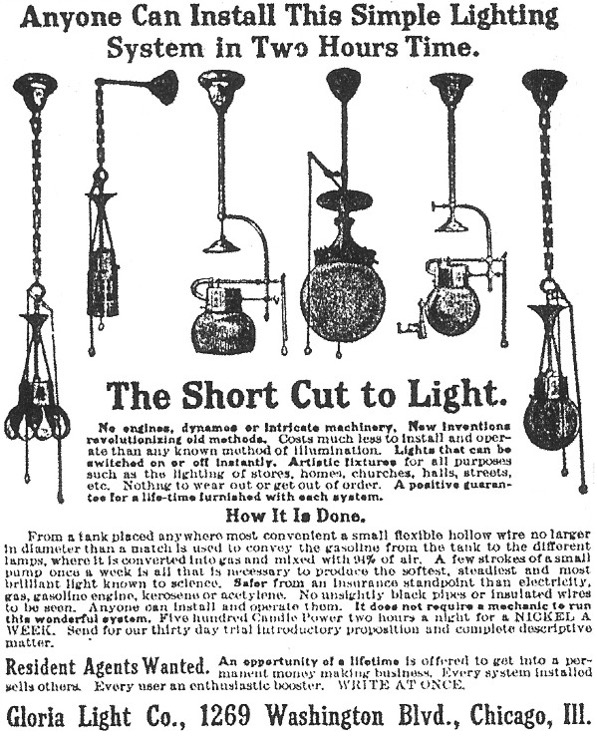
Examples of ‘Gloria Lights’ that may have been installed in Nelson Bay
Introduction of Oil Street Lamps in Nelson Bay – 1924
The Newcastle Morning Herald and Miners’ Advocate of 4 March 1924, page 5, reported:
‘The monthly meeting of the local progress association was held on Saturday evening …… The shire is also to be asked to provide two lamps for street lighting-one at the corner of Laman-street and Government-road, and one at the steps leading from the park to the beach’ [in the current Apex Park].
The Newcastle Morning Herald and Miners’ Advocate of 8 August 1924, page 2, further reported:
‘Mr. W. Thompson presided at the monthly meeting of Nelson’s Bay Progress Association. The question of street lighting at Nelson’s Bay was again brought up. It was stated the lamps and frames supplied by the progress association were on hand, but the two poles promised by the Port Stephens Shire Council months ago had not yet been received. The lamps will be erected by voluntary labour, and the oil supplied by the association.
An unsuccessful attempt to update the oil lamp at the steps leading to the Nelson Bay wharf was reported in the the Raymond Terrace Examiner and Lower Hunter and Port Stephens Advertiser of 26 September 1929, page 3:
‘The Nelsons Bay Urban Area Committee held a meeting on 21st September, last. …. A request was made by the Progress Association that on completion of the Memorial Steps [opposite the present day d’Albora Marina] to light them up at night by procuring power from the electrical power plant at the Sea Breeze Hotel. This matter will have due consideration.’
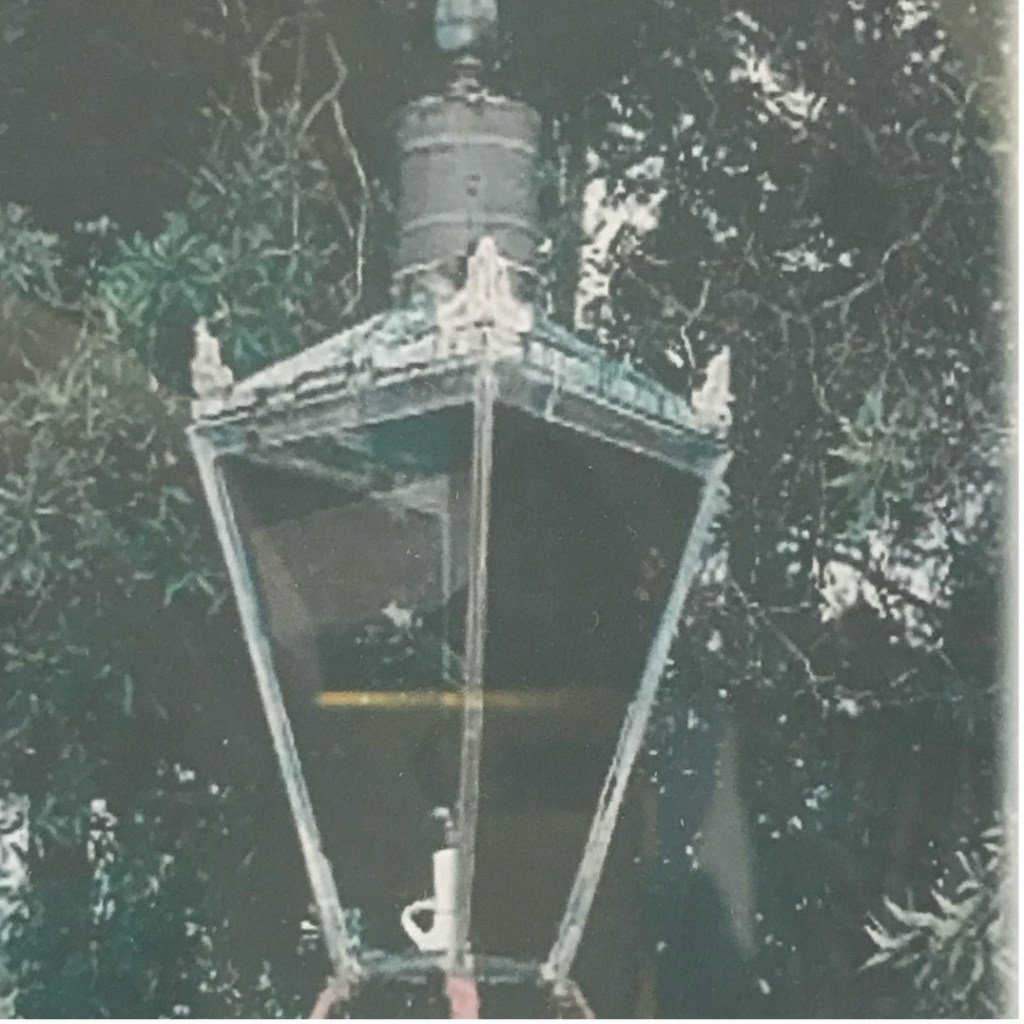
The handcrafted oil lamp that was originally installed in Apex Park, Nelson Bay, was used until 1945. The light was tendered by Martin Roche of the nearby Ocean View Guest House. The next owner of the guesthouse Ben Norburn was given the lamp in 1945 after it became redundant following the installation of electric street lights. He re-erected it outside the Dutchies Motor Lodge, where it remained for many years . The lamp was restoredi by the Port Stephens Historical Society in 1979 and displayed at the Inner Light Museum at Nelson Head.
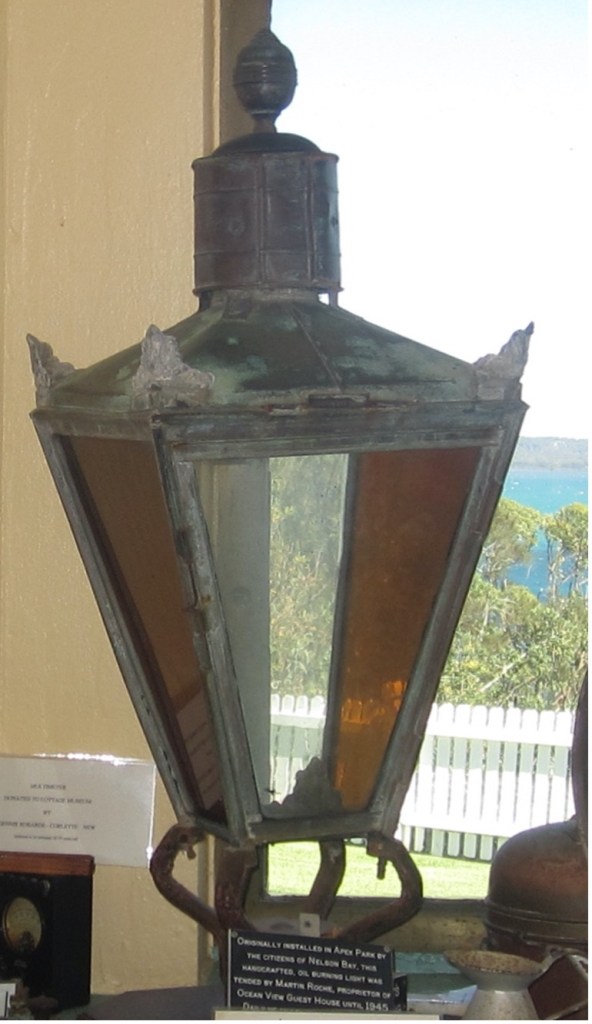
Oil lamp on display at the Inner Light Museum at Nelson Bay [Author photo]
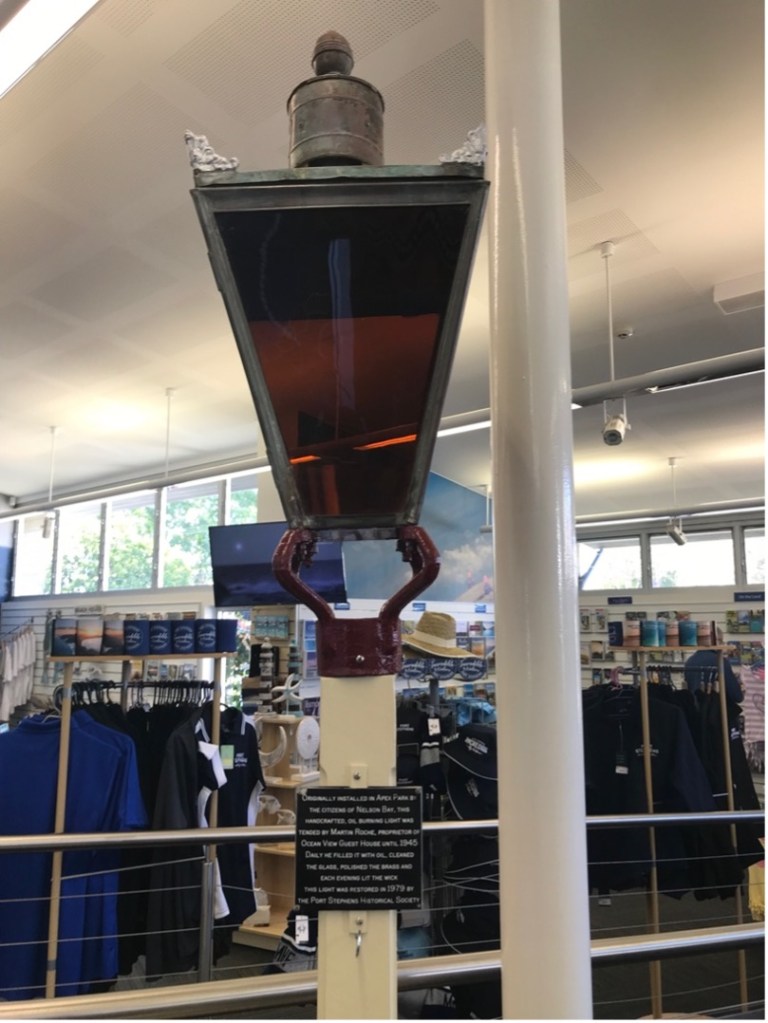
The oil lamp on display at the Nelson Bay Tourist Information Centre following refurbishment by the Tomaree Museum Association [Author photo, August 2023]
Electricity Generated on Empire Day – 1929
The Newcastle Morning Herald and Miners’ Advocate of 1 June 1929, page 4, reported:
‘The Empire Day celebrations in connection with the Nelson’s Bay Public School attracted a large attendance to Arcadia Hall, which had been extensively decorated and lighted by electricity, the current being supplied free of charge by Mr. H. Donald.’
PART TWO: Action for the Supply of Electricity to Nelson Bay and Surrounds
Agitation for an Electricity Supply – 1935
Agitation for the supply of electricity to Nelson Bay commenced in 1935. The Maitland Daily Mercury of 26 March 1935, page 5, reported:
‘The Electric Supply Department [at Newcastle] has been authorised by Newcastle City Council to comply with the request of the Port Stephens Shire that estimates should be prepared of the cost of extending supply to Nelson’s Bay.’
The Maitland Daily Mercury of 11 April 1935, page 9, reported:
‘The Newcastle Council stated it would put in hand at an early date estimates to see what would be the cost of supplying electric light to Nelson’s Bay, and no promise was given that the extension would be undertaken.’
The Newcastle Morning Herald and Miners’ Advocate of 27 April 1935, page 14, reported:
‘Cr. G. J. Russell, of Williamtown, and other residents, are moving for the extension of the electric light to other parts of the district. The [Newcastle] City Council was communicated with, and an assurance has been given by the City Electrical Engineer and Manager (Mr. G. Allbut) that an inspection of the area will be made. An estimate of the cost of supplying the light to Nelson’s Bay is to be made, although the department has given no promise that the extension will be undertaken.’
Further action concerning the electric supply was reported in the Maitland Daily Mercury of 10 August 1935, page 11:
‘The Port Stephens Shire Council has been endeavouring for some time to have the electric light service extended to Nelson’s Bay and centres in that part of the area. Arrangements have been made for an officer of the Electric Supply Department to visit the locality, in company with the councillors. The visit has been fixed for August 14.’
The issue of supplying electricity to Nelson Bay continued into 1936 with the Maitland Daily Mercury of 7 May 1936, page 10, reporting that a private operator sought approval to supply electricity to Nelson Bay:
‘The usual meeting of the Port Stephens Shire Council was held on Friday, in the offices at Raymond Terrace …..
N. Light, Nelson’s Bay, asked for a franchise to supply electric light to Nelson’s Bay. Cr. Markey said they should do nothing in the matter until they had definite information from Newcastle Council. Cr. Russell said Anna Bay was anxious to get the light from Newcastle. If they granted a franchise at Nelson’s Bay the City Council might not take over the supply. The clerk said that would be a matter for the interested parties. The engineer said if a franchise were given for Nelson’s Bay, Anna Bay may not get the extension from Newcastle. Cr. Parish: We must be careful how we go about it. Cr. Russell moved that until final arrangements are known of what the City Council will do, no other action be taken. This was agreed to.’
Newcastle City Council Sets Terms To Supply Electricity to Nelson Bay – 1936
The Raymond Terrace Examiner and Lower Hunter and Port Stephens Advertiser of 12 November 1936, page 1, reported on the following complex agreement:
‘The acting Electrical Engineer to Newcastle City Council wrote the Port Stephens Shire Council in connection with the above matter that the minimum return indicated in letter of 25th May represents the very lowest the Council could go to make the scheme eligible for relief subsidy from the Government.
The revenue to be derived from the sale of electricity and other charges, if any, to private consumers and for street lighting purposes, has to cover interest on the capital outlay, depreciation, maintenance, the cost of the electricity supplied and a small amount for overhead or administrative charges, apart from any consideration of any net surplus whatever and the fact that a gross amount of ten per cent on the capital outlay is too little to cover the charges detailed is clearly, indicated by the Government’s offer to subsidise approved schemes where the initial estimated return is 10 per cent of the estimated capital cost of the extension, to the extent of a further 5 per cent providing a total return of 15 per cent, which would, in all normal cases, be maintained, as increased sales, once the supply is established should more than take care of the ½ per cent by which the Government subsidy is reduced each year as indicated in the circular of the Department.
If the necessary minimum revenue could be provided by reducing the amount per consumer and obtaining a greater number of consumers, or by the inclusion of a certain amount of street lighting, the matter will be given further consideration, but it is necessary to indicate that the provision of street lighting will increase initial cost of the extension, and would therefore, necessitate some adjustment to the annual revenue indicated as being necessary to provide supply to private consumers only.
The City Engineer hoped the information would enable the Council to give the matter further attention, and any further information required would be furnished with pleasure. Cr. Markey said a lighting rate would have to be levied to pay the cost. The clerk said yes it would. Before the Government would give assistance there must be a 10 per cent return on capital. The Government then give an additonal 5 per cent. Cr. Tranter, thought Mr. Light should be informed of the substance of the letter, as he had been advised that the Council could not entertain his scheme till further information was to hand from the City Council. Cr. Markey asked if Council could not write to some of the people on the route to see if was possible to get the number that would enable the lighting to be installed. Cr. Russell said there so many of them who lived off the road that the cost was too great. It would cost some of them £50 to connect up with the road leads. The Council decided to send the letter on to the Urban Area Committee at Nelsons Bay for their further consideration.’
New Rural Electricity Development Policy – 1937
The Raymond Terrace Examiner and Lower Hunter and Port Stephens Advertiser of 14 October 1937, page 1, reported:
‘The Shire Council is in receipt of the following from the [Newcastle] City Council’s Electric Supply Department : Since the matter was last reviewed further developments have taken place in that the City Council has announced a rural development policy under which it will endeavour to assist in the development of rural areas, as far as electric supply will make it practicable. The intention is to make available to small farmers specially low rates for electricity for various purposes and to concentrate in this work by having a qualified electrical engineer trained in agriculture available to the farmers, dairymen, vegetable growers and others on the land within the Council’s territory.
It is therefore proposed that the whole matter of the supply to Nelson’s Bay shall be reconsidered in the light of this new policy which may profitably open the door to further extensions in other directions in your Shire and at an early date full publicity will be given to the scheme. It is believed that the time has come when those on the land in the vicinity of Newcastle should be assisted, and the Council earnestly desires to enlarge the field of its service to primary industries. A little time must elapse before a complete canvass can be made of the subject area, but this will be done as early as possible and steps will be taken in all probability to bring together those who are interested in the districts named by you so that a more wholehearted effort may be made to secure the extension of supply to Nelson’s Bay. Mr. Allbut desired the Port Stephens Council to be informed of the City Council’s wish to assist in any way within its power.’
Nelson Bay Still Awaits an Electricity Supply – 1938
The Raymond Terrace Examiner and Lower Hunter and Port Stephens Advertiser of 17 March 1938, page 3, reported:
‘The Nelsons Bay Progress Association asked the [Port Stephens] Shire Council as to what was being done regarding the extension of electric light to Nelsons Bay. The President said he had asked the electrical engineer how the matter was progressing. He said that a proposal was being considered to supply the rural areas with electricity. When a decision had been arrived at the Council would be informed how the matter stood. The Council will inform the P. A. to the effect. Cr. Upton thought a letter should be sent to the P. A. asking how many were prepared to take the supply. This may expedite the matter.’
The Dungog Chronicle of Friday 14 October 1938, page 2, reported:
‘On Wednesday last the Mayor of Newcastle (Ald. Griffiths) and the City Council’s Electrical Engineer (Mr. Allbutt) together with the President of Port Stephens Shire (Cr. G. J. Russell) and the Clerk (Mr. Monkley) met Mr. C. E. Bennett, M.L.A., and the President of Wallarobba Shire (Cr. J. B. Carlton) and the Clerk (Mr. F. W. Aldis) at the Shire Chambers, Dungog. A plan was tabled showing a proposed extension of a high tension line to Nelson’s Bay (Port Stephens) and to Clarence Town via Eagleton and Seaham. ….. It appears certain that important results will follow from the conference.’
Proposed Agreement to Extend Electric Lighting in the Shire – 1939
The Raymond Terrace Examiner and Lower Hunter and Port Stephens Advertiser of 9 February 1939, page 1, reported:
‘The Newcastle City Council informed [Port Stephens Shire] Council that the suggested extension of electric light in the Shire was under consideration and asked that the agreement be forwarded so that it could be submitted to the Department ……. provided that a minimum revenue of £4/16/ per annum must be guaranteed by every consumer requiring supply in the following areas: — Williamtown and Fullerton Cove, Nelson’s Plains, Hollow Tree and Kilcoy, Mt. Kanwary, Swan Reach, Salt Ash, Bobs Farm, Anna Bay, Eagleton, East Seaham, Greswick, Seaham, Nelsons Bay and Glen Oak. …. The motion for adopting the agreement was moved by Crs. Russell and Elkin and agreed to.’
Electric Supply Agreement Approved – 1939
The Raymond Terrace Examiner and Lower Hunter and Port Stephens Advertiser of 13 July 1939, page 1, reported:
‘At the last [Port Stephens] Shire Council meeting, Mr. Allbut, Chief Electrical Engineer for Greater Newcastle attended at the meeting and discussed with the Council the proposals, at various times, submitted to extend electric light to other parts of the Shire. After some discussion it was decided that the light should be carried on to Anna Bay, Nelsons Bay, Motto, Tomago Seaham, in fact a general extension wherever at all possible.’
The Dungog Chronicle of 13 October 1939, page 3, further reported:
‘Regarding Greater Newcastle Council’s proposal to extend electricity to the Shires of Port Stephens and Wallarobba, the Department of Works and Local Government advised that on the recommendation of the Electricity Advisory Committee, his Excellency the Governor has now approved of the agreements. The instrument of approval, with the agreements, has been forwarded to the Greater Newcastle Council. The Council decided on a motion by Crs. Fitzgerald and Flannery to request the Greater Newcastle Council to proceed as early as possible with the supply to Clarence Town. It was stated that Clarence Town residents were most anxious to be connected.’
Finance Approved for Electricity Extension – 1939
The Newcastle Morning Herald and Miners’ Advocate of 19 October 1939, page 11, reported:
‘A loan of £100 000 to the Greater Newcastle Council for extension of electricity from Newcastle to Nelson’s Bay and from Newcastle to a point five miles south of Dungog, has been approved. Everything is in readiness for the work to be proceeded with, but the question of a start hinged upon approval being given to the loan. Mr. C. E. Bennett, M.L.A., for Gloucester, stated tonight that the Treasurer (Mr. A. Richardson) had informed him that the loan had been approved by the Loan Council. He added that a start should be made with the work straight away, and he hoped that the areas mentioned would have electricity at an early date.’
Necessity of Extension of Electricity to Nelson Bay Questioned – 1939
The Newcastle Morning Herald and Miners’ Advocate of 24 October 1939, page 2, reported the following viewpoint from a newspaper reader:
‘Sir,—There are two statements in your paper on October 19 that I think should the subject of some searching inquiry— Four hundred and fifty men are to be dismissed from their work on the construction of the Sandy Hollow railway because money is not available. About £100,000 is to be spent on supplying electricity to Nelson’s Bay. Apparently, money is available, and at a time like the present all funds should be used to the best advantage. Can it really be said that making electricity available to Nelson’s Bay is as important as keeping 450 men in constant employment? Apart from this, is it an economy to leave so much capital expenditure idle, incapable of earning anything, and also to allow the work already constructed to rapidly depreciate?’
Rural Electricity Given A Boost – 1939
The Dungog Chronicle of 5 December 1939, page 2, reported:
‘One of the most refreshing features in State Government administration in recent years has been its great change over to policy of country development. In comparison with works of earlier years, a truly remarkable amount of works in town water supplies, sewerage services, better roads and highways, and electricity extension to hundreds of towns and villages has been carried out in the past four to five years. With the advent of the member for Albury (Mr. Alex Mair) to the Premiership, an even stronger champion of country interests is now at the helm, and the only brake upon his activities at the moment is the uncertainty of international affairs. A number of projected big works are necessarily in abeyance, but there is one avenue for steady development that can still be carried on upon its own revenue, and that is in regard to expansion of the State’s electricity system.
Since it is a reproductive work of high value, both directly and indirectly to the State, the Government is taking the proper course in backing electricity extensions throughout the country districts. Six months ago there were fears that even these works might have to stand over, but, happily, the Government has been able to see its way clear to renew the State subsidy system in respect of rural lines for a further twelve months until June 30 next.
With the towns all served within reach of the high transmission cables, the department had been enabled to now concentrate upon spur lines to serve the farming settlements. With the linking up of Port Kembla and Burrenjuck electricity systems, and the Snowy River installation well on the way, it might be anticipated that the Newcastle and Nymboida systems will also soon be connected with the one great power system, and thus it becomes a matter of economic benefit to develop the electricity load to greatest limits, whilst, in doing so a higher degree of production from the farms will be of national benefit.
The Mid-North Coast in the past twelve months has had probably more attention than any other quarter of the State— a lot has been done in the way of new lines, and the Mair Government indicates its willingness to do a lot more. Under this policy the next twelve months will probably see the completion of a grid system covering the coastline from Newcastle to Taree, and 75 miles inland in a line northerly from Singleton to West of Gloucester. Recently Stroud Shire extended the Gloucester circuit to Tea Gardens, on Port Stephens, and put in a spur line north-east to Bullahdelah. Newcastle railways are extending their system to Nelson’s Bay, on Port Stephens, with other spur lines to develop the Port Stephens district.’
Early Start to Nelson Bay Electricity Supply Expected – 1940
The Dungog Chronicle of 8 March 1940, page 2, reported:
‘A visit was made to Nelson’s Bay on Sunday by Mr. C. E. Bennett, M.L.A., when he met a number of residents and discussed with them the proposed electricity extension from Newcastle. Mr. Bennett was able to inform them that he had been in touch with Mr. Allbut, Electrical Engineer to the City of Newcastle Council, and the Mayor of Newcastle, Ald. Wiggins, who had informed him that all arrangements for the extension of the line were practically finalised and that the work was likely to be commenced in the very near future.’
Unfortunately, with the advent of the Second World War, the above plans failed to materialise as planned.
The Dungog Chronicle of 7 January 1941, page 3, reported:
‘Newcastle Council is making every effort to make as early a start as possible on the extension of electricity supply to the Wallarobba and Port Stephens Shires. This assurance was given Mr. C. E. Bennett, M.L.A. (Gloucester), when he interviewed the Mayor (Ald. Young) and the manager of the Council’s electricity supply department (Mr. Allbut) at the City Hall. Some time ago the Council approved of the extension of the supply to the two Shires and the necessary loan arrangements were made. The outbreak of war, however, has made copper cable difficult to obtain, and the work has been held up. Mr. Allbut said that he could not say definitely when the work would begin, but every effort was being made for an early start. The proposed extension covers the area in Wallarobba Shire from Wirragulla to Raymond Terrace, and in Port Stephens Shire from Williamtown to Nelson’s Bay.’
The Dungog Chronicle of 2 May 1941, page 3, further reported:
‘Mr. Bennett proudly referred to the extension of the high-tension electricity mains through the electorate and to the spreading out of spur lines into rural areas. Only recently tenders had been called for poles for the line to Nelson’s Bay (Port Stephens), and it had also been finally decided to call tenders for poles for the proposed line from Raymond Terrace through Clarence Town, Glen William, Brookfield, to Thalaba bridge.’
PART THREE: Second World War Period
The years 1942-45 of the Second World War however saw a halt to the widespread extension of the supply of electricity throughout the Port Stephens region.
The State Government’s Electricty Extensions Subsidy introduced in 1935 to aid the roll-out of eleceticity in regional areas was terminated in 1941.
Further with the rationing of resources to support the war effort, many items used in electricity reticulation were in short supply and their use was rationed by Commonwealth authorities. Poles, copper wire and transformers were in particular short supply.
Electricity extension during the war years was limited to providing power for military installations and essential manufacturing enterprises, particularly in the Newcastle area.
In the Port Stephens Shire region, an electricity supply was extended to the military facilities at Tomago and at Nelson Bay. The frustrating thing for the local residents in areas such as Nelson Bay, where power lines had been installed, was that they were not allowed to connect to the power supply for domestic purposes as the infrastructure was owned by the military authorities.
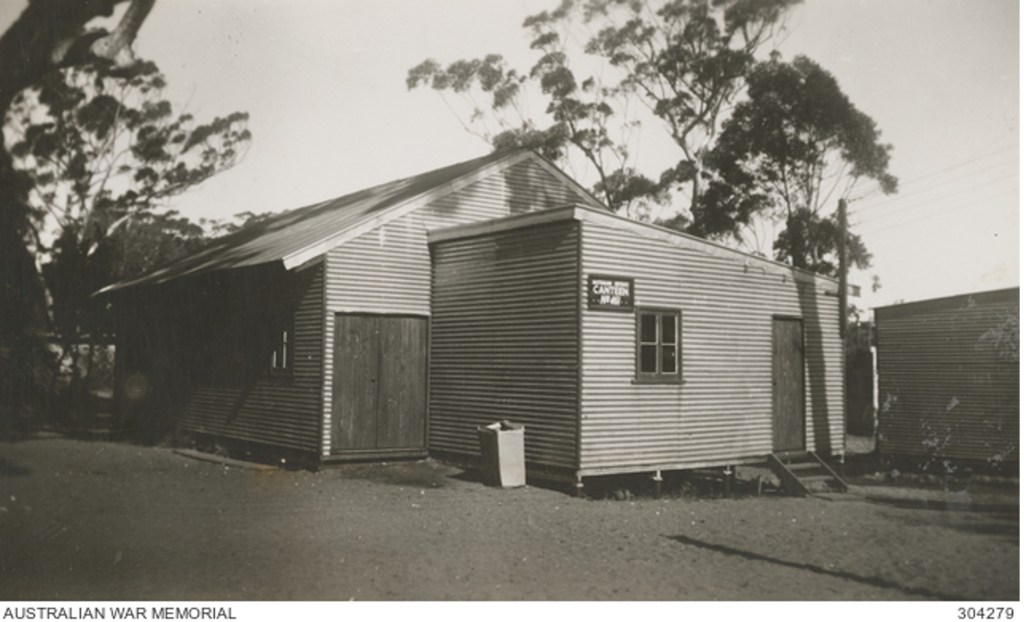
Exterior of the wet and dry canteen, at HMAS Assault, Nelson Bay. The electrical supply to the canteen is visible. The electrical supply was for military use only.
Electricity Extensions to Military Sites – 1942
The Dungog Chronicle of 17 April 1942, page 3, reported:
‘Owing to the exigencies of war, the [Newcastle] Electricity Department had been called upon to make extensions to South Head, Port Stephens, to many annexes and camps. ….. Mr. Allbut detailed the activities of his department since they had had their talks about the proposed extension. They had been working at the behest of the Defence Department. Their men worked seven days a week and ten hours daily and did it willingly in order to help defence work. Camps in a dozen or more places were linked up with light and power. Port Stephens was connected; industrial undertakings doing war work were catered for. His department had been very busy.’
Economic Hardship Caused by Lack of Electricity Supply – 1942
The Raymond Terrace Examiner and Lower Hunter and Port Stephens Advertiser of 14 May 1942, page 4, reported:
‘Mr. Simmons, Picture show proprietor, Nelson’s Bay wrote urging the Council to have the electric light installed at Nelson’s Bay without delay. He would have to close down unless electricity was available. The Clerk said Mr. Allbut, chief electrical engineer had stated that the delay was in getting material and men to go on with the work. Cr. Upton said the electricity was wanted for installing milking machines. Some were waiting with the machines ready to start. He has seen Mr. Allbut on the matter also, and he had said the difficulty was to get material. It was thought if the military made a request for it, something may be done. The President said the Council could back up the request of the letter by writing and supporting Simmon’s request. This was agreed to.’
Supply of Electricity to Nelson’s Bay District Suffers Setback – 1942
The Raymond Terrace Examiner and Lower Hunter and Port Stephens Advertiser of 9 July 1942, page 2, reported:
‘At the [Port Stephens Shire] Council meeting on Friday last, the manager for Electric Supply Dept, Newcastle City Council said it would not be feasible financially to make supply available at Nelson’s Bay unless it is to be given generally, as otherwise the energy consumed by the transformer would exceed that sold to the public and he was sure that would be evident to the Council.
The matter largely hinges now on what material can be obtained for installation work, as it would be useless to go to the expense of providing a substation and overhead mains, if customers could not get their installations, and he feared that priorities may only be given where it can be shown to the Minister of Munitions that the connecting up of the installations would aid in production in some way or another. You will also recognise that electrical contractors are unwilling to go any distance from the city on a new venture and are doing their utmost to care for existing customers and to complete work covered by commitments made many months ago.
He will look into the whole situation and in all probability would come to a meeting of the Council. A later letter stated that firms supplying material for contractors would not release it unless the contract was approved before 1st December, 1941. He was therefore at a loss to know how to help the Nelson’s Bay people, as a further shortage of material was now manifest, and the war position had deteriorated. Illustrating the position, he advised that low tension mains have been provided since the 2nd December, 1941 to 14 residences and farms at Salt Ash. All efforts to get contractors to carry out the work have been without success. If the Council could locate contractors, he would do his best to get material.’
Proposed Extension of Electricity to Bobs Farm and Other Areas – 1943
The Raymond Terrace Examiner and Lower Hunter and Port Stephens Advertiser of 13 May 1943, page 4, reported:
‘The Agricultural Department referred to the extension of electricity to Bob’s Farm, Anna Bay, Seaham and Glen Oak. The President said it appeared that the Agricultural Department had to inform the Public Works, in order that the material could be supplied. The [Newcastle] City Council was anxious to have the connections made and to get on with it. The Agricultural Department had apparently to assure the Works Department that increased production would accrue before they would allow the material to be used. Cr. Upton said he had been rung up about it also. Cr. Parish said he thought the reference by the Agricultural Department to the Public Works was to get the work done.’
The Newcastle Morning Herald and Miners’ Advocate of 10 June 1943, page 2, further reported:
‘Extension of electricity to areas in Port Stephens and Wallarobba Shires would shortly be carried out, the Manager (Mr. Allbut) told Greater Newcastle Electric Supply Committee last night. Mr. Allbut said the extension of electricity would increase the supply of milk, vegetables and farm products generally in the valley of the Williams River. The council will enter into agreements with the shire councils concerned.’
Promised Electricity Subsidy Not Granted – 1943
The Raymond Terrace Examiner and Lower Hunter and Port Stephens Advertiser of 12 August 1943, page 4, reported:
‘The President [of Port Stephens Shire Council] reported that the subsidy promised for electricity had not been granted and the cost may fall on the consumers.’
Residential Electricity Connections Not Supported – 1945
The Raymond Terrace Examiner and Lower Hunter and Port Stephens Advertiser of 31 May 1945, page 4, reported:
‘Mr. J. P. Abbot, M. H. R. states that he has received a letter from the Hon. H. P. Lazzarini, Minister for Works, in reply to representations for the connection of electric light and power to the homes of residents at Port Stephens. Mr. Lazzarini states in his letter that the power line is owned by the Department of the Army and the matter of obtaining permission to tap this line for the purpose of house connections is now proceeding. No difficulty is anticipated in obtaining this permission, subject to certain conditions.
The Newcastle Electric Supply Department has advised that no difficulty would be experienced in complying with the proposed conditions for the electric supply but points out that continuity of service could not be guaranteed and under these conditions the persons concerned might possibly seek compensation in connection with installation costs. The Electric Supply Department is therefore not at all anxious to connect the local residents to the power line.
Mr. Lazzarini states that in the circumstances, as the question of retailing electric supply is one that directly concerns the Newcastle Electric Supply Department prospective customers should communicate direct with the Electric Supply Department. Mr. Abbott further states that he will be glad to do what he can to assist any resident of Port Stephens in the matter.’
Street Lighting to be Installed in Nelson Bay – 1945
The Raymond Terrace Examiner and Lower Hunter and Port Stephens Advertiser of 9 August 1945, page 4, reported:
‘The Electric Light branch, Newcastle stated 18 streetlights £7 per light per year would be put in at Nelson Bay. The Urban Area Secretary wrote stating the offer would be accepted. Council agreed to the conditions.’
The Newcastle Sun of 9 April 1946, page 13, further reported:
‘Although it is barely a month since the street lights were switched on at Nelson’s Bay, a request is to be made to the Newcastle Council for six additional lights. The Urban Area Committee has asked for the extra lighting and has suggested that the urban area rate for 1947 be increased by ½d in the £ to meet the extra cost.’
The Raymond Terrace Examiner and Lower Hunter and Port Stephens Advertiser of 21 October 1948, page 6, further reported:
‘Electric Supply Department told the Council by letter that they were unable to state when the extra street lights at Nelson Bay would be provided.’
PART FOUR: Post War Period
Inspection of Electricity Extension Areas – 1946
The Newcastle Morning Herald and Miners’ Advocate of 16 December 1946, page 2, reported on a difficult tour of inspection of electricity extension areas in Port Stephens by 14 Aldermen, that did not go according to plan:
‘Fourteen aldermen of Greater Newcastle Council, with executive officers of the Electric Supply Department, were caught in a launch in a 60-mile-an-hour gale, at Port Stephens on Saturday. ….. They were travelling from Oyster Cove to Nelson’s Bay when the storm broke. Sending the passengers below, the pilot turned into the wind and ran for the shelter of an island. [After being] made fast to a mooring post in Salamander Bay, the launch was torn adrift by the gale. It was eventually made fast again to ride the storm out. The aldermen were not seasick, but most of them were wet by the spray, blown in clouds over the launch. Inspecting the proposed electricity extension areas, the aldermen travelled by car to Clarencetown and Karuah. There they joined one of the large passenger-carrying launches owned by Messrs. C. W. and F. Phillips. They travelled to Oyster Cove for lunch, and then set out on the last lap of the trip to Nelson’s Bay, where cars were waiting. …… Cars travelling from Karuah to Nelson’s Bay to pick up the older men were delayed by tree limbs and saplings blown across the road.’
Electricity Extensions Subsidy Reinstated – 1947
The Newcastle Morning Herald and Miners’ Advocate of 15 October 1947, page 2, reported:
‘The State Electricity Authority had agreed to pay the [Newcastle] Electric Supply Department a subsidy of £61,875 towards the cost of electricity extensions to six country areas, the total estimated cost being £136,325, the Electrical Engineer and Manager (Mr. Allbut) reported to Greater Newcastle Council. The areas to benefit are Salt Ash and Nelson’s Bay, Pipe Clay Creek, Martinsville and Wyee, Miller’s Forest, Catherine Hill Bay, and Raymond Terrace, Chichester and Salisbury. Mr. Allbut said the advice from the authority was of historic value, as well as of monetary importance, since it was the first sum to be contributed to aid the council in its long history of electric supply development in outside districts. The first instalment of the subsidy would be £11,250. The balance would be paid in yearly instalments over 10 years. The report was adopted.’
Electrical Assets at Nelson Bay to be Purchased from the Military- 1948
The Newcastle Morning Herald and Miners’ Advocate of 2 June 1948, page 6, reported:
‘The Electrical Engineer and Manager of the [Newcastle] Electric Supply Department (Mr. Allbut) reported agreement with the Disposals Commission for the purchase of Army and Navy electrical assets at Nelson’s Bay for £,1040. From the council’s viewpoint it was a favour able price, he said.’
Price of Nelson Bay Electricity Challenged – 1948
The Newcastle Morning Herald and Miners’ Advocate of 30 September 1948, page 2, reported:
‘Nelson’s Bay Progress Association will ask Newcastle Electric Supply Department to confirm or deny a report that the Navy Department was charged 5d a unit for electricity while other Nelson’s Bay consumers were charged 10d a unit, plus a 10 per cent surcharge. Members said they were dissatisfied generally with electricity charges.’
Electricity For Hawks Nest – 1948
The Dungog Chronicle of 6 November 1948, page 3, reported:
‘Mr. F. G. D. Stone, Engineer to the Stroud Shire, informed us on Tuesday that poles to carry electricity wires will be erected at Hawk’s Nest within a fortnight. The submarine cable is expected any time and supply should be available before Christmas. This will be heartening news for Hawk’s Nest residents and owners of week-end cottages. There are about thirty houses on the line of route, with the Pavilion at the beach end. For refrigerators and pumping purposes, as well as illuminating the camping area, the advent of electricity will be a boon. Hawk’s Nest will leap ahead now.’
Supply of Electricity to Soldiers Point Delayed
The Newcastle Morning Herald and Miners’ Advocate of 15 July 1953, page 6, reported:
‘Nesca [Newcastle Electric Supply Committee] advised that electricity extension to Soldier’s Point could not be undertaken at present. It said more had to be done at the inner core of the distribution system before outer loads could be assured of satisfactory service and the limited finance available must be allocated primarily to this purpose.’
Karuah Electricity Supply Progressed – 1954
The Dungog Chronicle of 23 January 1954, page 1, reported:
‘Port Stephens Shire Council had before it a letter from the Electricity Commission of N.S.W. The letter stated a personal inspection of the route through the village of Karuah has been carried out by the District Electrical Superintendent at Newcastle, and it has been reported that the route as selected is in the best possible location and that no alternative is available. One of the principal difficulties to be met with is the spanning of the river at Karuah and the present route is the only means of ensuring that the required clearance of 78 feet above the river is obtained. The present location will cause the least amount of inconvenience to property owners concerned. The letter was received [by Council].’
Concluding Comments
The extension of a widespread electricity supply to Nelson Bay and the surrounding Port Stephens districts took over ten years to achieve, from the first community agitation for it 1935.
The coming of the Second World War to the area mitigated against a more expedient roll-out of an electricity supply to the local residents.
For many years, residents and farmers in the region had to deal with no electricity causing them much hardship and disadvantage.
Farmers were particularly affected, as their efficiency suffered through lack of access to modern electrical equipment, keeping their labour costs higher than those faced by competitors in other regions with electricity.
Researched and compiled by Kevin McGuinness
January 2024

 Port Stephens - a history exploration