
Introduction
The Dungog Chronicle, in its issues of 13, 20 and 27 January 1951, published three articles on the early days of Hawks Nest from the reminiscences of Bill Clayton, who was a former mariner, then aged 79 years.
The articles provide an interesting personal insight into the early days of Hawks Nest area and its residents.
In this paper, the articles have been combined and reproduced in a block presentation under various headings. The content is as originally reported and published without any moderation. It may reflect the prejudices of the time and be offensive to some persons.
With that caveat, the material does provide a valuable insight into the history of the Hawks Nest area of Port Stephens.
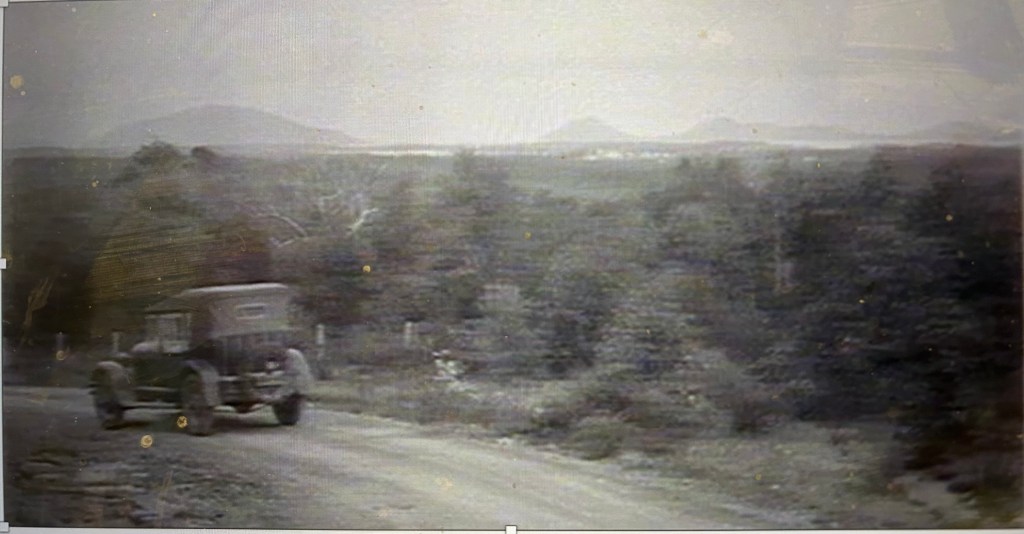
Overlooking Tea Gardens and Hawks Nest area, circa 1948 [State Library of NSW]
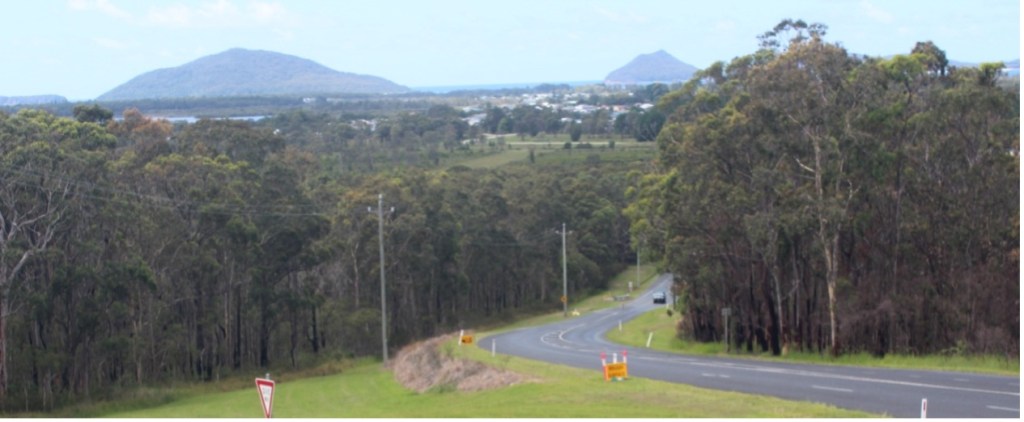
Road to Tea Gardens and Hawks Nest today [Author photo]
The Combined Articles
Introductory remarks about Bill Clayton
‘When you mention the words Hawks Nest, Myall River, Port Stephens, the eyes of old Bill Clayton fairly glisten and he rubs his hand over his head, still well covered with hair, and says, “Don’t I know ’em!” Bill is 79 years of age and went to Hawks Nest with his parents when a lad. His father was a seafaring man who had various boats. There was nothing else to interest the youths or even the adults in those days. Just as in these times we talk about Fords, Vauxhalls, Chevs., etc., they then discussed the ships that passed in and out of the port’.
The Topics……
Boats
‘Windy Whoppa [at Tea Gardens, Port Stephens] was an important place 70 years ago. The bigger boats came that far up. There were the “two posters” (two masts) which ran from Sydney and Newcastle to pick up timber. They brought up ballast and that accounts for all the stones along the bank of the Myall River thereabouts. “The Prince Alfred was the last I saw unload ballast,” said Bill Clayton. “That was over 70 years ago and she discharged her ballast at Hawks Nest.” Other similar boats were the Caledonia, the Joker, (her captain was “Corn Beef Harry,” and that name explains itself), the Oscar Robertson, the Free Trade (owned by John Witt, of Tea Gardens), the Agnes Rose, Huntley Castle, and Jane (she ran as far as Corrie Island).
At Hawkes Nest there was the May, a small boat owned by Mr. Jock Henderson, who had a sawmill at Hawks Nest. The same owner had Maggie. Hacket Bros., of Williams River, Hughie; and Tom, had a steamer, the Shelbourne. The Budgeree also ran up to Windy Whoppa. The first small launch on the Myall River was the Wanderer, owned by John Witt and run by a boy named Joseph Pearse……
A “three poster” (a barquentine) ran to Hawkes Nest on behalf of Allen Taylor. It was called the Myall River. Then came the Mosquito Fleet which traded between Newcastle and Port Stephens. These comprised s.s. Dauntless, Williams (owned by Alf Green), Idant (Alf Green and a part owner), Dauntless (Callen’s), Wyalong (Newcastle Co.), and Seagull 11 (Viggers), Magdelene (owned by Croll Bros, and Farrelley). She was the biggest timber trader to Sydney. The others only ran to Newcastle.
The Newcastle tug, Storm King was chartered by J. Clayton taking fish to Newcastle for a couple of years. He finished the rest of his time with the Gosford. Harry Waddington was Captain and part owner. J. Clayton was Engineer and part owner. The Gosford ran from Port Stephens to Newcastle and then from Sydney to Cape Hawke, carrying passengers and fish. She is now in New Zealand, a river passenger boat.
The Dauntless mentioned above was owned by Peter Caller and the engineer was Bill Clayton. There was keen racing amongst the Mosquito Fleet but the Dauntless beat them all, says Bill Clayton. The first largest boat that went up to Bulahdelah was the Emma Piers, piloted by Capt. John Clayton, Bill’s father. They said he would never get there but he did. John Clayton had a mill at Hawks Nest, a store and log punt, Alpha. Her remains lie on Hawks Nest shore. She was put there by Bill. The mill was in front of Darby Worth’s house. A dance hall was nearby, a little further east than Engel’s branch shop. When you danced it used to shake, it had plenty of spring, says Bill. Crowds filled the hall for dances, concerts and gymnastics. The chief dances were First sets, Lancers, Schottische and Barn Dances. Crowds came over from Nelson’s Bay and often there would be 200 people present’.
Hawks Nest
‘There were not too many people in Tea Gardens then. Hawkes Nest was the capital city. In those days the only method of transport was by water, no road existed. People went by boat to Tellegherry (now called Lemon Tree Passage) where they were met by Mr. John Rooke who drove a spring cart far as Raymond Terrace and then with three horses. He travelled as you caught a little boat named Matilda, owned by Hart and partner. The Matilda landed you at Newcastle’.
Ship Explosion
‘John Croll, sawmill owner, of Bungwahl, came down the Myall River to Tea Gardens in his punt Tam o’ Shanter. He went to boil his billy and when the water spilt it caused an explosion, the boiler blowing up. There was no water in the boiler ….. . Mr. Croll escaped injury. The inside shell of the upright boiler was blown to Hawks Nest and can still be seen. The shell is up at the old de-licensed hotel, now Richard’s accommodation house and is used as a tank, “And the water in it is good,” says Bill. That was the end of the Tam o’ Shanter. She was the fastest punt on the river’.
Jimmys Beach
‘How did the inner beach come to be called “Jimmies,” Bill was asked. He said it was named after James Levi, a Jamaican black, a very tall man. He had run away from a ship and had come to Hawks Nest. Mr. J. Clayton and Mr. Stewart Small looked after him. He built a hut out of wreckage off the beach. There was plenty of it about. He lived there and had a garden. “In fact, as a lad, I shook his tomatoes,” says Bill. He lived there until he died.’
Sport
‘Sport was not neglected. Foot-running was a great attraction. Then there was Rounders, which attracted both boys and girls, and adults too. Cricket was the serious sport. Sandy and Johnny McCrea were the champions.’
The Cemeteries
‘People lived in Hawk’s Nest, and of course, people died there. The sites of the cemeteries is not known to many. The enclosing fence of one is falling down, but one is still definite. With shells on top of the grave of Robert Smith, uncle of the late well-known Bill Smith. Mr. Andrews, of North Sydney is buried there; others are Coulter, who was drowned “poling” a punt at Tea Gardens; Mr. and Mrs. Gamble; one of Stewart Smith’s daughters, who was burned to death. She was playing round the fire as a child and her clothes became ignited. The bodies of a woman, a child, and three men who were coming from Salt Ash to attend a fancy-dress ball at Hawk’s Nest, are buried at Hawk’s Nest. They were in a sailing boat and the centre board stuck in the mud and there was a capsize. In the squall and storm they did not know where they were. The tragedy of it all was that they were only 20 yards offshore and could have walked out safely. Their resting place is near the Telegraph pole where Yamba Street now is. Some of them were named Buckman’.
The Aborigines
‘Some 400 blacks were camped at Hawks Nest, at the back of the mill. Old Mr. Barnes was the “boss.” They got honey for him [Mr. Barnes] and he exchanged for honey, beer, flour and sugar……. Some of the blacks were nearly 7 feet tall. There was Yellow George, Jack Bacchus (a treacherous one), James Governor, Billy Barracks (the Rocks are named after him), and Charlie the cricketer. There was the King and Queen, Billy and Fanny Price.
Into a big tree they had spikes taken from Hawks Nest, driven at regular intervals. On each was hung a billy can. Each knew his own spike and billy.
Of the gins, Fanny Price was Queen. There was Princess Maria, Maggie Bullock, Charlotte, Mrs. George Price, Caroline …. and piccaninny Luna, daughter of the King and Queen. She was a lovely child and died after eating berries from the beach. Blacks from Cape Hawke used to pay visits.
A visitor was once camped at Windy Whoppa and showed Bill Clayton some strange stones where his camp was. Bill told him he was camped where a Black was buried. The visitor was gone next day. Two ladies had laid a kind of table over an orderly heap of stones at North Head. “I hope you enjoyed your meal,” said Bill when he saw the situation. “We did,” one said. “You should have,” added Bill, “You had company. There’s a man buried there, French Frank. He was drowned coming from Broughton Island and was washed ashore. I picked him up and put the stones round his grave’.
Wrecks
‘There is little more fascinating than the story of wrecks. They seem to capture the imagination. It is just the same with a big rail smash or a mine disaster. Newspapers feature every aspect. Stories of wrecks always had good listeners in the early days and they were impressed on listeners’ minds.
The Emperor was wrecked on North Head about 72 years ago [on 30 March 1886], says Bill Clayton. He and his older sister, Anna, saw the wreck and ran down. A heaving line was thrown, and they, though young, had sense enough to haul the rope ashore. They wound the main rope around a tree and made it fast. The crew and the captain came ashore safely. The coal that she carried was washed ashore, and even today, if you get up early enough, you will see Old Bill with a sack of coal on his shoulders collected from the self-same wreck.
Says Bill: The Ann went down [on 6 June 1900] between the Heads and all hands were drowned. The Jane also went down on the bar [on 25 July 1875], but all were saved. The Stag, carrying coal, was wrecked [on 27 January 1885]. Her captain was “Beef Steak” Tom [Captain Thomas Kehoe]. All hands saved. Norwegian steamer, Thordus, half loaded with coal, went ashore on Billy Barracks Rocks [on 4 March 1906]. There are some of her remains there today’.
Butchers
‘The first butcher was Mrs. Hough, of Tea Gardens, then Alfred Blanch, an uncle of Bill Clayton. He came up from Anna Bay in a rowing boat. His two sons did the rowing. There was a little bit of dissatisfaction about the beef situation and Stewart Smith and John Clayton each imported a cask of New Zealand horsemeat, says Bill, it was red and lovely.
Then came the Engels. They went up the river to Tea Tree ridge and killed meat there. There were Mr. Adolphus Engel, Mr. Willie Engel, Mr. George Engel and Mrs. Henry Engel. They pulled a double oared rowing boat down to Hawk’s Nest and served customers, and then pulled to Nelson Bay and pulled back to Tea Tree ridge’.
Bakers
‘There was no such person as a baker. The camp oven was every-one’s baker. Bill smacked his lips as he said: “Those loaves of lovely bread, dripping and black treacle.” There was plenty of honey in all the trees. Fowls and pigs were plentiful and wild game. No one went short of tucker. Shell digging was another industry that gave employment and brought in money. Shell was burnt for lime’.
Boat Building
‘The first boats built in Tea Gardens were on slips near where the baths now are. I saw them launched, says Bill. The builders were C. Burrows and Pat Holme, for the owner, Mr. Weston. There was the Maude Weston (after his wife), Maggie L. Weston (after his daughter), and the Advance (built for Peter Cullen). They also built the Shamrock for Joe Weston, and she ran for timber’.
First Wharf
‘The first wharf was built for Alex Croll. The builders were John Clayton, Charles Burrows, and Bill Clayton. The piles are still sticking out of the water at the mouth of Corrie Creek. It was 80-90ft. long and £80 was paid to build it. The job took three weeks. The builders had a 14-ton monkey [crane] and used the red punt Alpha, to do the job.
Next wharf built was at Tahlee for Hon. R. H. D. White. Then a 2-piler wharf from the island off Tahlee. Mr. White had a yacht, White Star. She afterwards went to the Fiji Government. Bill Clayton was one of the crew and Mr. White also had a small pleasure yacht, the Kingfisher, which he used in the rivers. Bill says the White Star went to Hobart once and pulled in to a two-posted wharf like a jetty. But look at Hobart now. Other boats of memory were the Admiral, a fish boat and the Invincible, another fish boat. Both were controlled by John Clayton’.
Researched and compiled by Kevin McGuinness
September 2023

 Port Stephens - a history exploration