
After the First World War, action was taken by regional groups to advocate for the decentralisation of economic activities away from Sydney to New South Wales country regions.
It was felt by the regions that all significant economic development was centred on Sydney, at the expense of the rest of the State
In the late 1940’s, the New State Movement was formed to advocate for the formation of a new state in the northern area of NSW, with many proposing that its harbour should be Port Stephens. This new state area, it was argued, would then be free to pursue its own economic advancement without control from Sydney.
In 1951, Caltex Oil (Australasia) Pty. Ltd. announced plans to build a new oil refinery in which various sites in Sydney and elsewhere were under consideration. Port Stephens was one of the areas mentioned. Lobby groups quickly mobilised for Port Stephens to be the chosen location.
Port Stephens was not chosen by Caltex Oil or backed by the State government, as the new site for the refinery was Kurnell at Botany Bay in Sydney.
This paper tells the story of a lost opportunity for the decentralisation of economic activity in New South Wales. It is also a reflection of community attitudes and government policy in previous times.
Search for the Refinery Site – 1951
The Daily Advertiser of 26 July 1951, page 2, reported:
‘All possible sites in Australia would be explored before a decision on the building of the new £25,000,000 refinery was made, director of the Caltex Oil (Australasia) Pty. Ltd. (Mr. W. E. Field) said today.
It would take between two and three years to build the refinery, he said. We expect the plant to produce about 750,000 gallons of petrol and other products daily, he said.’
Uncertainty on Refinery – 1951
The Observer of 15 November 1951, page 1, reported:
‘The possible erection of a £25,000,000 oil refinery by the Caltex Oil Co., on land situated between Cronulla and Kurnell has aroused much interest among local residents. Some view the proposed development with alarm, others are quite in favour and welcome the project. Investigation to see whether the site is suitable and other factors to be considered, are as yet in the preliminary stage and the following details are taken from Council minutes: — “The Shire Clerk reported that he had been contacted by Mr. Flood of Secondary Industries Department seeking Council’s views on the establishment of an oil refinery at Kurnell by Caltex Oil Company. They proposed establishing thereon the whole of their Sydney Works which would necessitate the acquisition of 300 acres and the ultimate expenditure of some £25,000,000.
A trafficable road would be required within four months between Cronulla and Kurnell. A letter from the Secretary of the Department of Secondary Industries and Building Materials was read by the Shire Clerk to the Council. In it the Department outlined the proposals and asked for the Council’s reaction to the scheme. The Department asked for certain information which it felt could be obtained from the Council’s officers and it indicated that the proposal to construct a modern refinery would use some 600 persons in continual employment although for the first eighteen months of construction, between 1,500 and 2,000 would be employed.
Modern refinery design would do away with smoke nuisance and drainage would not be contaminated because water is used principally only for condensation purposes. The type of plant would either be separate container vessels or erected as integral parts of industrial buildings. Berthing facilities would be necessary, requiring major dredging work near Silver Beach not far from the present boathouse and a jetty and pipelines would be constructed. The Department requested that the Council give consideration to a personal meeting between its officers and the Council to more fully discuss the matter.
The next move came when Council met these officers in Committee last Monday week and no details are available for publication. At last Monday night’s Council meeting, the Caltex Oil Co. forwarded to Council a map showing the approximate areas on which they would like to build the refinery and also asking Council to permit boring equipment to be placed on land and borings made, so plans can progress towards ascertaining whether Kurnell is suitable for purpose from engineering standpoint. ……
After much debate, it was decided to permit the Co. to bore (subject to the conditions set out above) without prejudice to Council’s final decision on the matter. Which means a full-scale debate on the matter very shortly.’
Company Asked to Reconsider Refinery Location – 1952
The Newcastle Morning Herald and Miners’ Advocate of 20 March 1952, page 2, reported:
‘Newcastle Chamber of Commerce executive has asked Caltex Oil (Aust.) Pty. Ltd. to make a further examination of areas at Newcastle for a suitable site for a proposed £25 million oil refinery. The company said recently that it had examined all possible ports in New South Wales and had found that only Botany Bay would suit.
On Monday the Cumberland County Council decided to urge the Caltex Company to investigate an area recommended near Gosford. The Cumberland Chief County Planner (Mr. S. L. Luker) said he objected to a site at Kur-nell Peninsula, Botany Bay, because a refinery there would be against the Cumberland master-plan decentralisation principles. In a letter to Mr. W. F. Field, Chairman of Directors of Caltex Oil (Aust.) Pty. Ltd. yesterday, the executive of the Chamber of Commerce asked for a further examination of areas on the Hunter River at Newcastle and north to the foreshores of Port Stephens.
The executive’s letter said the industrial potentialities of Newcastle were promising. Recent conferences attended by the Director of Transport and Highways (Mr. Winsor) and the Minister for Public Works (Mr. Cahill) indicated that proposed development schemes would be given priority by the State Government. It was believed the Federal Government was anxious for the development of the vast industrial enterprises that could be accommodated in or near Newcastle.’
The Newcastle Sun of 18 April 1952, page 2. further reported:
‘The Caltex Oil Co. will be asked for a list of difficulties that might prevent it establishing a proposed multi-million pound oil refinery on the Hunter River or at Port Stephens. Newcastle Chamber of Commerce Council decided this today. …… The president (Mr. Saddington) said Caltex’s reason for not giving the local site consideration might be that there was not sufficient bar depth for their tankers. “I understand they intend to bring the crude oil to the proposed refinery in large tankers, treat it and ship it elsewhere in Australia in other tankers.” he said. “If the bar depth is the trouble, it might be overcome when the new Lobnitz rockbreaker starts operations soon. If not, Port Stephens would be a good place.”
The Minister for the Interior (Mr. W. Kent Hughes) told the chamber that the refinery’s siting was not a federal matter but one for Caltex and the N.S.W. Government. He said that to build the refinery along the Hunter would involve land reclamation expenditure by the Commonwealth and delay construction too long.’
Additional Proposal for Oil Refinery to be Located at Port Stephens – 1952
The Singleton Argus of 12 May 1952, page 1, reported:
‘Another effort to have Caltex Oil (Australia) Ltd’s. proposed £25 million refinery established in the Newcastle region will be made by Northumberland County Council. The County Council’s panel, which was formed to attract industry to the area, has asked the company to send representatives again to Newcastle to confer with its planning staff. The panel consists of the County Chairman (Cr. Butler), County Clerk (Mr. Wells) and Chief County Planner (Mr. Stone). Mr. Stone said yesterday that the panel had suggested Port Stephens as a possible site.’
The Dungog Chronicle of 31 May 1952, page 1, further reported:
‘Two sites at Port Stephens for Caltex Oil Refinery had been recommended to the Government the Chief County Planner (Mr. F. G. D. Stone) said in Newcastle on Thursday.
He still believed Port Stephens was the logical site for the proposed £25 million refinery, he said. The locations had been recommended by the County Council’s industrial panel. The site favoured most was at Salamander Bay, on the southern side of Port Stephens. A second choice was Pindimar, on the northern side. Mr. Stone said Port Stephens had tremendous possibilities as a deep-sea port. It must ultimately be developed in any programme to decentralise industry. The channel from the entrance would bring large ships right to the site proposed at Salamander Bay.
Any objections on the grounds of labour and housing required for the project could be met by providing temporary hostels at Nelson Bay and the establishment of a satellite town. …… The Pindimar side of Port Stephens would become much more accessible with construction of the road bridge at Hexham. This would eliminate one of the two ferries between Newcastle and Pindimar. It was understood that a bridge over the Karuah River at Karuah was a priority work of the Department of Main Roads.’
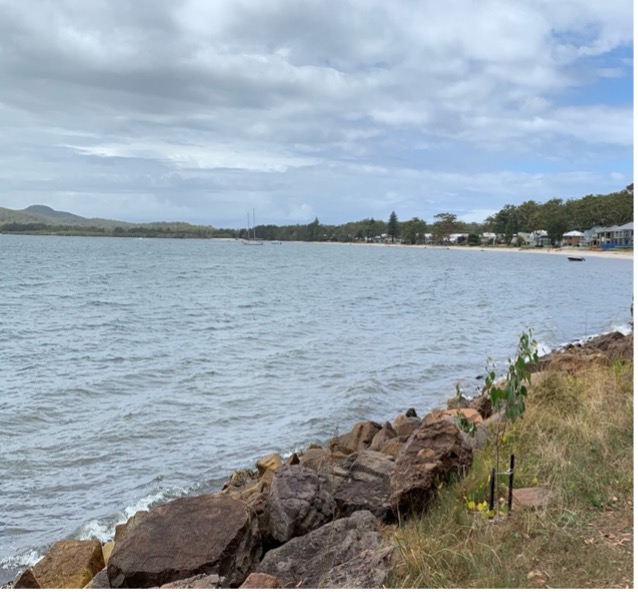
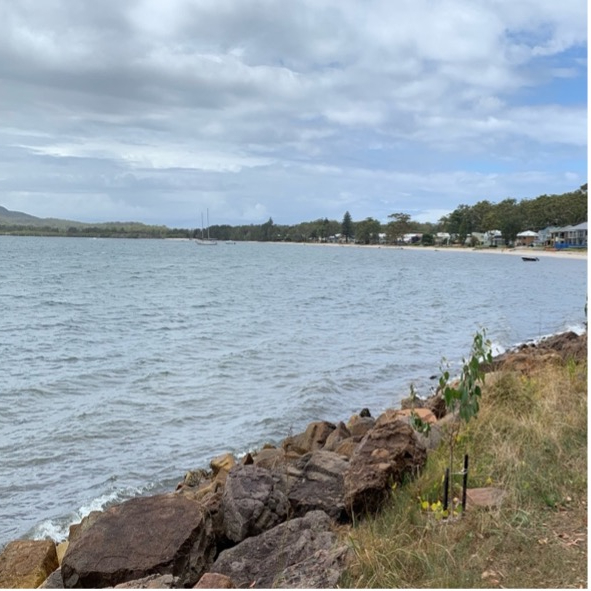
Salamander Bay, Port Stephens [Author photo]
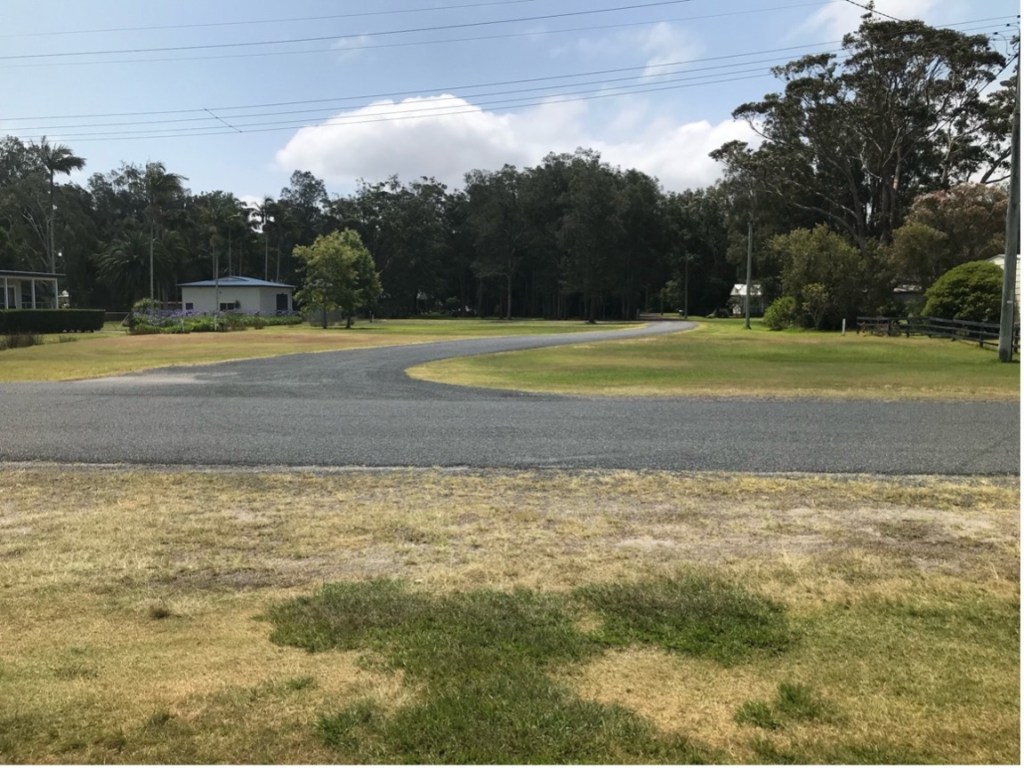
The Avenue, Pindimar, adjacent to the Port Stephens waterfront [Author photo]
State Government Approved Kurnell as the Site for Refinery – 1952
The Sun of 10 June 1952, page 4, reported:
‘State Cabinet today approved in principle the establishment by Caltex Oil Pty. Ltd., of a oil refinery at Kurnell. Premier Cahill said that the company proposed to establish a £25-million plant there and hoped to have its refinery in operation in two years. Cabinet’s decision was subject to certain covenants and to an investigation to decide whether the 400 acres sought by the company at Kurnell was required, he said.
Cabinet would finally approve of the matter when conditions laid down today had been reported upon and dealt with at a later meeting. ….. Mr. Cahill said that three sites had been recommended: Kurnell. Port Kembla and Port Stephens. The company had stated it would cost £2 million more to establish its refinery at Port Stephens.’
Stroud Shire Council Sought to Have Refinery Built at Port Stephens – 1952
Following the State Government’s approval to have the refinery constructed at Kurnell in Sydney, the Stroud Shire Council sought to have the decision reconsidered. The Dungog Chronicle of 9 July 1952, page 1, reported:
‘At last meeting of Stroud Shire Council, it was resolved on the motion of Crs. Zeininger and Moore that Council approach Messrs. Caltex Oil Limited and urge them to make a further inspection of the northern side of Port Stephens for the purpose of establishing the proposed oil refinery and offer all possible assistance to make the inspection.’
The Daily Examiner of 17 October 1952, page 2, further reported:
‘Australasian Oil Refinery Pty. Ltd. has advised the Stroud Shire Council that Port Stephens was inspected about a year ago and found unsuitable as a site for an oil refinery.’
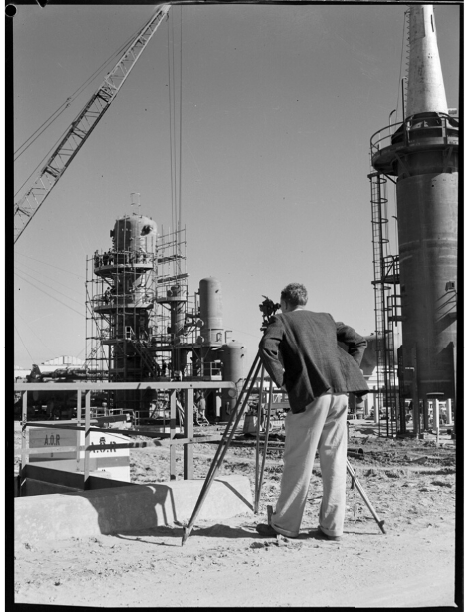
Construction of the Kurnell Oil Refinery, September 1954 [State Library New South Wales]
New England New State Movement Advocates Port Stephens Site – 1952
The Daily Advertiser of 4 October 1952, page 2, reported:
‘An oil refinery should be established at Port Stephens or Clarence River, the New England New State Movement conference decided today. The conference decided to protest strongly to the State Government at the Government’s action in encouraging the establishment of a huge oil refinery at Kurnell. The Kurnell refinery would be next to many other vital targets, said chairman Ald. Moorhead, of Grafton. He said the Clarence River was not yet deep enough for big tankers, but the same fault existed at Botany Bay. The conference decided re-direction of capital expenditure was the first essential towards expansion of production of food and raw materials in order to develop natural resources in fertile country regions. A resolution was adopted claiming country representation should be increased commensurate with country interests.’
The Dubbo Liberal and Macquarie Advocate of 23 October 1952, page 2, further reported:
‘Grafton City Council, will renew its protest against a decision to build the new oil refinery at Kurnell instead of the Clarence River or Port Stephens. Other Local Government bodies on the Clarence River will also protest. The protest follows agitation by the New England New State Movement to have the refinery erected within the Clarence River area.’
Grafton City Council Disappointed with Governments’ Refinery Decision – 1953
The Daily Examiner of 21 January 1953, page 6, reported:
‘Aldermen of Grafton City Council ex-pressed disappointment on Monday night at the reply of the Premier, Mr. J. J. Cahill, to questions asked about the Kurnell oil re-finery. Council decided to ask for direct answers to its queries.
Ald. L. W. Bowtell described the Premier’s reply as “a glorious exhibition of political ethics,” stating that the issue had been side stepped most graciously. The Premier informed council that it had apparently misapprehended the position regarding the establishment of an oil refinery at Kurnell. The venture was not a government concern, the Government being involved solely because of the purchase or lease of Crown land and because it was responsible for port facilities and concerned with town planning considerations.
The company had rejected, after survey, several sites because of technical and other reasons. As the company’s super-tankers drew 36ft. of water, Kurnell was the only site to meet requirements. The site was favoured by the Commonwealth Government after close consideration of all de-fence aspects. The Government had taken into consideration the decentralisation aspect. The Town and Country Advisory Committee, on which the Local Government and Shires’ Associations were represented, had recommended the Kurnell site. As much as the Government would have preferred the refinery elsewhere, it was found impracticable in the reasonably near future.
From the company’s angle, it was a question of Kurnell, or no refinery at all. The Government was not in a position to direct the company as to site. It was regretted that council, notwithstanding its disappointment at the unsuitability of the Clarence River, should have criticised the Government. The Government would have preferred to establish the refinery on the Clarence, or anywhere rather than Sydney, but it simply, could not be done.
Ald. Bowtell said council’s motion asked that Mr. C. G. Wingfield, M.L.A., have laid on the table of the House full details of the project. It appeared Mr. Cahill did not think that necessary so far as council was concerned. The Premier had taken the opportunity to involve the Federal Government. “It is another one of these cases where the people of the country are beating the air in an effort to do something for their own particular region,” he said. Ald. Bowtell moved that the letter be “received!” Ald. Garratt said council had not at any time criticised the Government, although possibly the Minister had read something like that into council’s letter. The Mayor, Ald J. I. Moorhead, assured Ald. Garratt there was nothing in the letter to which offence could be taken. Council had written to Mr. Wingfield, not direct to the Premier.
Ald. Mavis McClymont: We still have not been supplied with the information we sought. We are quite at liberty to ask for information of that nature. We should write back to the Premier and tell him council should at least have the courtesy of a reply to its questions. There is no mention of the money being spent by the Government. Ald. McClymont moved an amendment, that the Premier be again asked to reply to questions as to the likely cost to the Government of the development of Botany Bay, and why Port Stephens was not considered a suitable site. Ald. Bowtell withdrew his motion. Ald. McClymont’s amendment became the motion and was carried unanimously.’
Reflections on the Opportunity Lost for Port Stephens – 1953
The Dungog Chronicle of 31 January 1953, page 6, reported:
‘An instance of what the port is up against has been furnished by the case of the £25,000,000 oil refinery over the site for which a controversy has been raging in Sydney. As far as Port Stephens was concerned, here was an opportunity missed, for by this one stroke the foundations could have been laid for rapid development of the port and its hinterland. That this is generally realised is supported by the evidence of the southern people themselves, who tell the visitor that the opening of the new Hexham bridge is welcome as providing a key to the development of the huge area of potential industrial sites north of the Hunter River between Hexham and Port Stephens.
“The development of Port Stephens must come,” Cr. L. G. Randall, president of Port Stephens Shire Council, told a “Leader” representative. “A few years ago, Nelson Bay and the centres on the port’s shores were practically un-known, but all that was changed by the war, when a main road was put through in no time and electric light was extended to the bay. We look upon these amenities as the beginnings of what may be real development in the future. We consider that eventually it will become a port surrounded by industrial sites and recent events have made this a distinctly promising possibility. …..
It seems, therefore, that Port Stephens is destined to progress in spite of Government apathy. It costs a fortune to keep Newcastle Harbour operating, and I consider Port Stephens the natural alternative. “We have been told that one section of the port — Salamander Bay — our main deep-water channel — is sufficiently deep to take the greatest ships of the British Fleet at the one time. That being the case, we feel a harbour like this is being allowed to go to waste. Historically, I believe, this would have been the natural port but for the fact of the finding of coal at Newcastle. However, one feels that the taking of the coal the extra few miles to Port Stephens would have been of little economic significance. Now it is costing a fortune to keep Newcastle open. “Today Port Stephens, instead of being in the full flush of development, is merely in its infancy. It is only hoped that the pressure of economic growth will force some action on the part of the Governments.’
Criticisms of Location of Refinery Raised in Parliament – 1954
The Sydney Morning Herald of 6 October 1954, page 4, reported:
‘Opposition members in the Legislative Assembly yesterday criticised the Government for allowing the construction of an oil refinery at Kurnell. They said the Government had failed to carry out its stated policy of decentralisation. The members were speaking on the first reading of the Australian Oil Refining Ltd. Agreement Ratification Bill.
The Minister for Public Works, Mr. J. B. Renshaw introduced the bill. Its purpose is to ratify the Governments agreement to the Company’s establishment of a refinery at Kurnell, and to the sale of Crown land for this purpose.
The Leader of the Country Party, Mr. M. F. Bruxner said “It is extraordinary in these days when we talk so much about decentralisation of industry that, we find this large and dangerous undertaking being built alongside the greatest city in the Southern Hemisphere. He said he had hoped that the refinery would have been built in another part of New South Wales where it could have started a new industrial and commercial centre. Many people were concerned about the construction of the refinery at historic Kurnell which was the birthplace of Australia he said. It would destroy the natural flora and fauna there.
Mr. Bruxner added: However, the Government made up its mind on the refinery long ago and there is little that can be done now. Dr. L. J. Parr (Lib. Burwood) said the Government had bungled and had discouraged decentralisation by failing to suggest another site for the refinery Port Stephens was a site which could have been suitable.
Mr. E. Willis (Lib Earlwood) said: “There has been a regrettable tendency by this socialist Government in the last two years to regard Parliament as a rubber stamp.” The Government has flouted its own Cumberland County Council plan – the refinery was on land zoned as open space and rural area under the plan.
Mr. Renshaw said when introducing the bill that the Australian Oil Refining Ltd. was a subsidiary of Caltex (Australia) Pty. Ltd. It had made an exhaustive survey of the coast to find a suitable place for the refinery and had finally selected Botany Bay. Three essential requirements for the refinery were economic location, a large area of land and a deep-water frontage.’
Failure to Choose Port Stephens for Refinery Raised Again in Parliament – 1954
The Newcastle Morning Herald and Miners’ Advocate of 11 November 1954, page 3, reported:
‘Claims that Port Stephens was too shallow to take tankers were denied in the Legislative Assembly today by the Leader of the Country Party (Mr. Bruxner). Mr. Bruxner was speaking in the second reading debate on a bill to ratify an agreement with Australian Oil Refining Ltd. and the Minister for Lands (Mr. Hawkins). The agreement included the transfer to the company of 400 acres of land at Kurnell, on which to build a refinery.
In an earlier debate, the Minister for Public Works (Mr. Renshaw) said that possible sites for the refinery had included Port Stephens, but this port had been found to be only 25 feet deep, and the Company’s tankers needed 32 feet depth. Mr. Bruxner quoted from a geography book, which said the port was 30 feet deep and could be increased to 40 feet with dredging. The port was stated to have a navigable width of a quarter mile. Mr. Bruxner said the port was once a naval base. If it could be used as such, it should not have been difficult to make it suitable for tankers.
Port Stephens had also once been described by an authority as a very good coastal port which could easily be developed as all oversea port. He added: Because of Government policy, every decent port in the State will stagnate. People will come to them someday, but they won’t be Australians.
The Leader of the Opposition (Mr. Robson) said the transfer of the Kurnell site was a glaring example of centralisation. Port Stephens evidently was uneconomic from the company’s point of view, but from a decentralisation aspect any expenditure to provide adequate railways and other facilities, to make it economic would have been worthwhile, he said. Mr. Renshaw said today the Navy, Army and Air Force had been consulted on the site and had agreed that Kurnell was the most suitable. Mr. Robson said he would like to know what actuated the three services to give Kurnell priority as a suitable site for a refinery. The second reading was passed on the voices.’
Concluding Comments
While advocating for the importance of decentralisation of economic activity, the State Government seemingly had little intention of following through on that policy. The decision to build the oil refinery at Kurnell appears to have been made quickly and before regional groups had a chance to adequately advocate for their interests.
In hindsight and on a positive note, the State Government’s desire to protect the economic interests of Sydney, led to the preservation of the beautiful harbour of Port Stephens.
Researched and compiled by Kevin McGuinness
January 2024

 Port Stephens - a history exploration