

In 1936, the Stroud Shire Council began planning for the construction of an Art Deco style pavilion at Hawks Nest Beach, Port Stephens.
The pavilion was essentially a large amenities building with an adjacent camping site to serve the needs of the hundreds of campers who regularly travelled to the seaside location. It comprised amenities for campers, including a store and a dance hall, referred to as a casino.
The design of the building was ahead of its time for such a camping facility and proved immensely popular.
Site Chosen for the Pavilion- 1936
The Dungog Chronicle of 24 July 1936, page 4, reported:
‘Mr. Stone, accompanied by Cr. Zeininger paid a visit to the [Hawks Nest] Beach last week, and selected the site for the pavilion that is to be erected on the park. After viewing the different spots and going into the question of drift sand from the beach and discussing the advantages and disadvantages of several sites they eventually chose a spot facing the road [Booner Street] about 100 yards from the present weather shed on the Hawks Nest side. No doubt there will be much criticism on the spot chosen, but, although it is some little distance from the beach it must be remembered that Mr. Stone is an Engineer and Architect and Cr. Zeininger is a practical builder with experience of shifting sands, and their judgment should be good. Judging by the plans the building will be a splendid structure and will be an ornament and acquisition wherever it is.’
Building Tender Accepted – 1936
The Newcastle Morning Herald and Miners’ Advocate of 27 June 1936, page 20, reported:
‘The tender of Mr. H. J. Thwaites of Newcastle has been accepted for the erection of the public pavilion and other structures at Hawks Nest, in the Shire of Stroud. The plans and specifications have been prepared by the Engineer (Mr. F. G. Stone), and the work is to be put in hand shortly.’
The Dungog Chronicle of 4 September 1936, page 4, further reported:
‘The beach pavilion is well under way, the frame work being up. The tank stand and tank are ready, and the windmill is in action. It will not be long before the official opening will take place. Several Ministers are to be invited to the opening and it will be a gala day. Metal has been put down on the road halfway out to the beach and the road is now in fair order.’
Government Grant for Construction of the Pavilion – 1936
The Dungog Chronicle of 20 November 1936, page 4, reported:
‘[Correspondence] from Department of Works and Local Government regarding grant of £250 for Hawks Nest pavilion to cost £2,150. Approval was given to the contract work provided that 90 per cent of the labour required was taken from the local labour exchange [of unemployed workers].’
Luxurious Building for Campers – 1936
The Newcastle Sun of 23 November 1936, page 2, reported:
‘The recently completed pavilion at Hawk’s Nest, Tea Gardens, shown in the photograph, is considered to be one of the most modern and luxurious of its kind in Australia. It is an enterprise of the Stroud Shire Council and the Tea Gardens Urban Committee.
The building was erected on the Hawk’s Nest reserve, which is situated between the Myall River entrance to Port Stephens and the Ocean Beach. It has accommodation to meet all the requirements of the camper. The pavilion contains a large public lounge, cafe, store, hot and cold plunge baths, shower rooms, public wash houses with wash basins and showers, and a large dance floor, with radio-gramophone music provided. It has its own electric generating plant. The Minister for Local Government (Mr. E. S. Spooner) will open the building next Saturday. Mr. F. G. D. Stone was the architect and Messrs. Clark and Thwaites were the builders.’
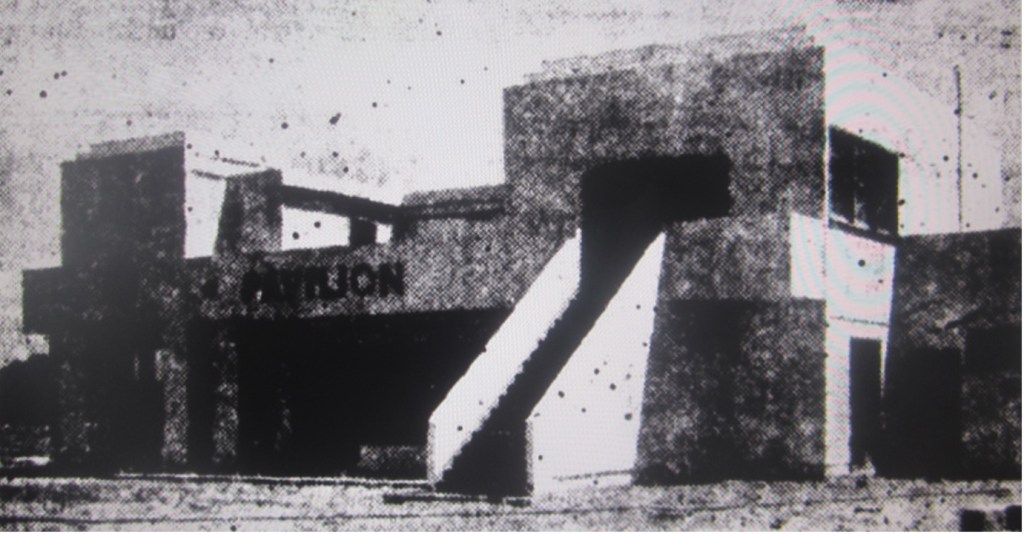
The Pavilion [Newcastle Sun, 23 November 1936]
Description of the Pavilion – 1936
The Dungog Chronicle of 4 December 1936, page 2, published the following description of the pavilion building:
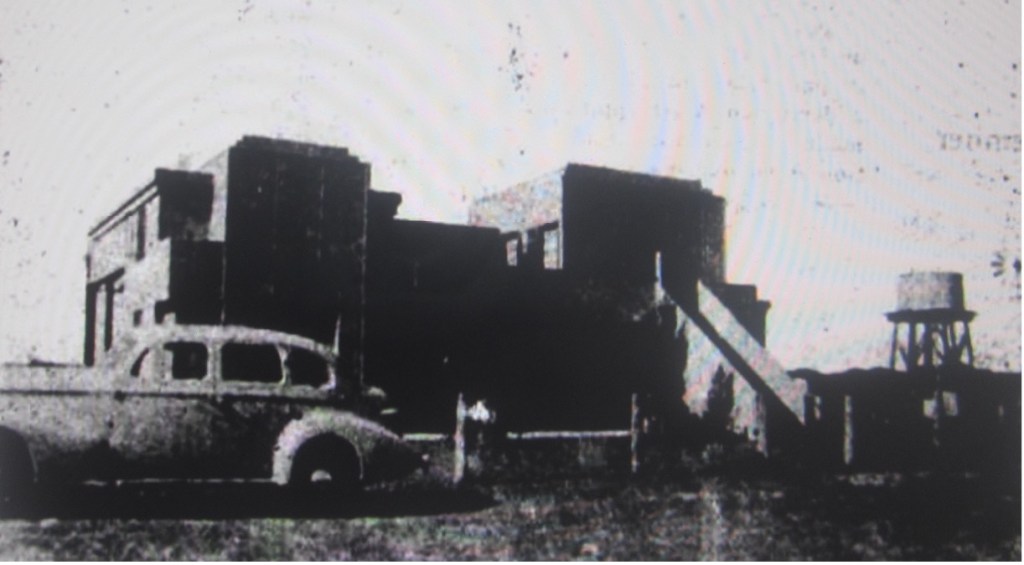
‘Designed on modern lines the pavilion incorporates all the facilities for campers and tourists. Its accommodation includes a cafe 33ft x 12ft.; lounge; outer promenade for service of refreshments along continental lines; a sun balcony on the first floor; crush lobby leading to dance pavilion 34ft 6in. x 19ft., whilst the utilitarian section comprises enclosed private bathrooms and shower rooms with hot and cold water supply; public wash houses with shower enclosures; kitchen, laundry, engine room and sanitary accommodation.
The building is constructed of fibro cement, throughout, including all mouldings and roofing. The colour scheme is cream with orange and blue trimmings. The plant consists of diesel engine and generator for electric power, and light, from which will also run the refrigerator and radio gramophone music. The hot water supply system consists of a No. C.D.2 rustless boiler with capacity of 100,000 B.T.U. per hour with 80 gallon cylinder, etc. The water supply consists of an 8ft enclosed double gear mill on 25ft steel tower and one 4000 gallon tank.
The building is well equipped with the necessary fittings, accessories and furniture to provide every comfort for those for which the building is designed to serve. The architect was Mr. F. G. D. Stone, A.R.I.B.A. of Council Chambers, Stroud and the builders, Messrs Clark and Thwaites of Darby Street, Newcastle. The ultimate completion of the scheme includes the grassing and tree planting of the reserve which is now in progress. The Council invited, tenders for the lease of the Cafe and administration of the Tourist Park. Messrs G. A. Engel & Sons were the successful tenderers and now have everything in good running order.
The new pavilion is the first of its kind in Australia. It is a pioneering movement by the Stroud Shire Council and Tea Gardens Urban Committee to encourage and attract tourists to the district. The financing of the scheme is based on sound business principles and with such luxurious appointments it is considered that it will not only be a successful financial venture but will bring tourists from all parts and as described by one prominent speaker will be talked of all over Australia: thus advertising this magnificent Port and seaside holiday resort.’
Official Opening of Pavilion – 1936
The Newcastle Morning Herald and Miners’ Advocate of 30 November 1936, page 5, reported:
‘The Minister for Works and Local Government (Mr. E. S. Spooner) officially opened the new pavilion at Hawk’s Nest, Tea Gardens, on Saturday afternoon in the presence of a large gathering representing all parts of the Port Stephens district. It was a gala day for the locality. The Minister, who was accompanied by Mr. E. R. Sanders, member for Willoughby, in the State Parliament, was welcomed by the President of the Stroud Shire (Cr. C. T. Abbott), Mr. C. E. Bennett. M.L.A., the President of the Wallarobba Shire (Cr. J. Carlton), and the President of the Port Stephens Shire (Cr. H. F. Clode), Cr. R. E. Zeininger (representative of the A riding of Stroud Shire, in which the pavilion is erected), the Chairman of the Tea Gardens Urban Area Committee (Mr. E. Motum), and Mr. R. A. Elkin (Raymond Terrace). The Mayor of Raymond Terrace (Ald. E. L. Markey), the District Surveyor (Mr. H. G. Barrie), Clerk of Port Stephens Shire (Mr. C. L. Monkley), and the Shire Clerk of Stroud (Mr. H. Adcock) were also present.
A gold key, as a memento of the occasion, was presented to the Minister, who, in declaring the pavilion open, said he wished to congratulate the Stroud Shire Council on its far-sightedness in making such ample provision for the recreation of the community. He asked the council to accept his assurance that the Government was interested in the progress of these northern centres, as it was in the advancement of the State as a whole. He indicated that he would put a proposition to the councillors for their consideration in connection with the Bulahdelah Road. The opening ceremony was followed by sports and dancing, the proceedings being enlivened by the music of the Gloucester Town Band.
The Minister and visitors were the guests of the Stroud Shire Council and the Urban Area Committee at a dinner, when a number of toasts were honoured. Cr. Zeininger proposed “Progress and Prosperity to Port Stephens and District,” which was supported by Dr. N. Pern (Sydney), who for many years has been an advocate of the opening up and development of the port. Mr. E. C. Hill, a former resident of the North, and now of Sydney, also supported the toast. The President of the Mungo Brush Regatta Committee (Mr. H. M. Engel) responded.
Replying to the toast of Parliament, proposed by the President, Mr. Spooner said he would appeal for continued cooperation between the councils and the Local Government Department, which, in combination, were working for the good of the people. The power line supplying electricity would, it was hoped, be pushed through from Dungog next year. The neighbouring town of Gloucester was to put in a sewerage scheme, and Dungog, he trusted, would follow. Mr. Sanders and Mr. Bennett also responded to the toast.
The work accomplished by the Stroud Shire was spoken of in appreciative terms by Mr. Bennett, in proposing its further success, coupled with the names of the councillors and staff. Cr. Abbott responded. The new pavilion was designed by the Engineer of the Stroud Shire (Mr. F. G. D. Stone) and built by Mr. H. J. Thwaites at a cost of £2100, towards which the Government granted a subsidy of £250. There are the usual appointments and facilities for bathers, with shop, lounge and dancing floor, electric light being generated by a local plant. The Minister remained at Port Stephens over the weekend.’
Surf Demonstration – 1936
The Dungog Chronicle of 4 December 1936, page 2, reported:
‘Following the opening of the Pavilion at Hawks Nest, the assemblage adjourned to the Ocean Beach nearby to witness a surf demonstration by members of the Newcastle District Surf Club. It was a very interesting and instructive item of the programme. Those taking part were: A. Sargeant (patient), B. Brownjohn, H. Scott, Captain (resuscitator), T. Coleman. K. Hancock and C. Scale. Mr. A. Sutherland, superintendent and instructor of the Surf Life Saving Association supervised the demonstration. Officials of the Club were V. Cronin (President), J. O’Reilly (Assistant Secretary) and J. L. Preston (Examiner).’
First Lessee of the Pavilion – 1936
The Dungog Chronicle of 4 December 1936, page 3, provided the following commentary on G. A. Engel and Sons, Limited, the first lessee of the Hawks Nest pavilion:
‘This firm was established at the Fens in 1888 as butchers and bakers. In 1893 they moved to Tea Gardens and five years later moved to their present site and opened a general store as well. A branch was opened at Nelsons Bay twenty years ago and later on was sold to Blanch Bros. The present brick store was built 14 years ago.
The “Yalinbah,” a floating store, goes up the lakes and around the harbour twice weekly. The first store boat the firm had was towed by a steamer “The Pearl.” Later the “Kate Thompson” was made into a store boat and later was replaced by the “Nepean.” The “Yalinbah” was first called the “Super Dreadnaught.” This firm has branches at Mayer’s Flat, and Hawks Nest. The head office and stores are at Tea Gardens. Shipping plays a big part in the business and the fleet includes the “Coweambah” (built by themselves), “Myall River,” “Anambah” and “Nepean.” The firm has the lease of the new pavilion at Hawks Nest.’
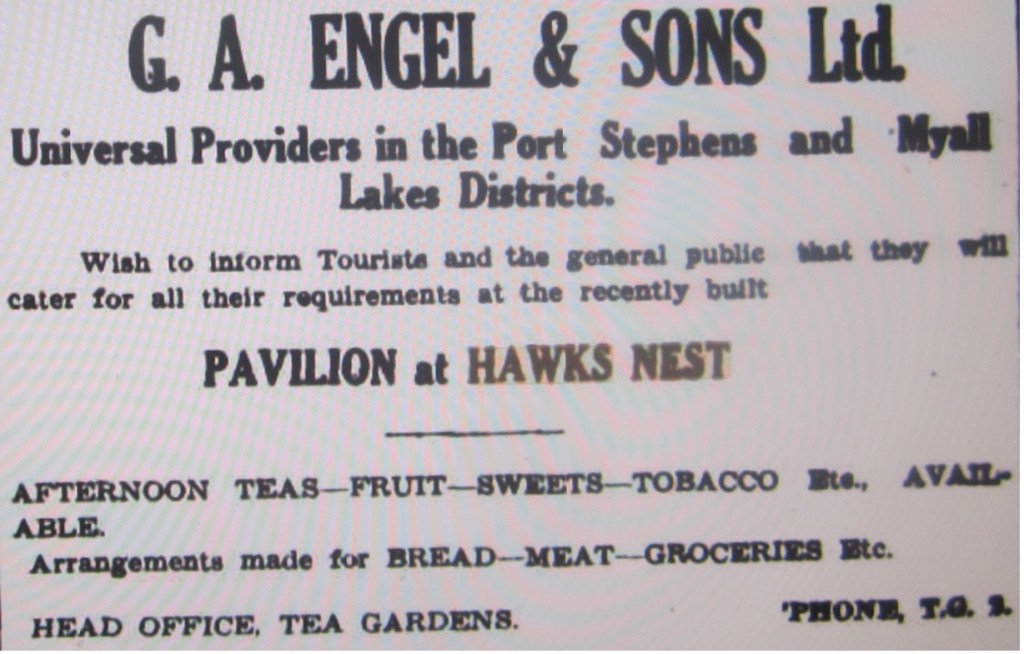
Advertisement by G. A. Engel and Son Limited about the Pavilion [Dungog Chronicle, 4 December 1936]
Popularity of the Pavilion – 1936
The Dungog Chronicle 18 December 1936, page 4, reported on the use of the pavilion following its opening:
‘Great use is being made of the Pavilion at Hawks Nest. Dances were held there last Monday afternoon and evening.’
Expression of Appreciation to Ladies Committee – 1937
The Dungog Chronicle of 8 January 1937, page 4, reported:
‘Mrs. Casey of Hawks Nest, Tea Gardens, president of the ladies committee in connection with the dinner provided at the recent opening of the pavilion at Hawks Nest, has received the following letter from Mr. H. H. Adcock, Shire Clerk, Stroud, under date 16th Dec., 1936:— At the monthly meeting of my Council held on Friday last, congratulatory remarks were passed at the very excellent manner in which you and your Committee worked and the excellent dinner provided in connection with the Official Opening of the Pavilion at Hawks Nest on November 28th, and I was directed to convey to you the Council’s appreciation and thanks for such service so efficiently and effectively carried out.
The Minister for Works and Local Government, the Hon. E. S. Spooner, and other guests spoke in very high praise of the work performed, the very high class dinner provided, and the beautiful appearance of the tables, and it is consequently felt that the occasion could not be allowed to pass without complimenting you and your co-workers on the very excellent result obtained. My Council desires that you will convey the message contained herein to each of the workers concerned.’
Holiday Season at Hawks Nest and Tea Gardens – 1937
The Dungog Chronicle of 8 January 1937, page 4, reported:
‘Tea Gardens had a busy Christmas but many of the campers were disappointed with the weather. Many made use of the improvements provided at the pavilion at Hawks Nest. “Talkies” and dances were held regularly as
Holiday Season at Hawks Nest and Tea Gardens – 1938
The Dungog Chronicle of 7 January 1938, page 4, reported:
‘Christmas this year was a very busy one for everybody. There were many campers at Tea Gardens, Hawks Nest, the Pavilion and Windy Whoppa [Winda Woppa]. The stores have been busy, likewise the hotel and boarding houses. The punt has been travelling to and fro night and day. Dances have been held at Tea Gardens and the Pavilion. Pictures have been shown several times during the holidays. Fishing has claimed many of the visitors, but no big catches have been recorded. King Sol was unkind to many who went about in shorts and bathing costumes. The regattas at Mungo Brush and Nelsons Bay provided amusement for some and the excursions on the ‘Yalinbah’ around the Lakes and Harbour were popular.’ The crowd had the Christmas spirit but were orderly and caused no trouble. Accidents were nil.’
Coronation Celebrations Held at the Pavilion – 1937
To celebrate the coronation of King George VI and his wife, Elizabeth, as King and Queen of the United Kingdom and the Dominions, the Dungog Chronicle of 21 May 1937, page 4, reported on festivities held at the Hawks Nest Pavilion:
‘Quite a large gathering of Tea Gardens people were conveyed to Hawks Nest pavilion by Ward’s ‘bus on the evening of the Coronation Day. During the earlier part of the evening the principal amusement was dancing, while those who did not participate in this pastime played euchre in the comfortable lounge room of the pavilion. At a given signal from the M.C. the young people congregated in front of the pavilion and a carnival hour was spent in a fire works’ display, in which even the card players were forced to indulge as some of the more daring ones invaded the quietness of the lounge room with their noisy exhibition.
When the cracker display had ceased the lawn presented a much littered appearance, and sympathy was expressed for those who had to restore it to its usual trim appearance. Dancing was then continued by the younger people, whilst the thoughts of the card players, and other non-dancers turned to the supper room where coffee, sandwiches and other edibles were tastefully served by Mrs. Casey. The happy party returned to Tea Gardens in the small hours of the morning after having voted it one of the best times spent at the pavilion, and all are looking forward to the next such occasion which, will probably be during June.’
Pioneers Reunion at the Pavilion – 1937
The Dungog Chronicle of 13 August 1937, page 4, reported:
‘The pioneers are to have a reunion in Tea Gardens very shortly; and it is to be an exceedingly pleasant one. The ladies of the C.W. A. [Country Women’s Association], with Mrs. Casey as mistress of ceremonies, are organising the event which is to take the form of a complimentary dinner at which all residents who have reached or past the Goth milestone of their life’s journey, will be entertained.
The dinner will be held at the pavilion, Hawks Nest, and after full justice has been done to the repast, which will be the best ever prepared in Port Stephens, the guests will be asked to plant a tree in the camping area, so that in years to come their children’s children will be able to point with pride to the tree that their forefathers planted. The object of the dinner is chiefly to bring the old people together so that they can talk over old times and live again, in spirit, some of the many pleasant moments of their youth. If the reunion is the success anticipated an effort will be made to make it an annual event.
The C.W.A. are to be congratulated on their pleasant thought of trying to bring sunshine to those who are in the autumn and winter of their lives, and it goes without saying that the movement will receive the hearty support and help of all the residents. It is expected that a huge crowd will attend the tree-planting, but the dinner will be solely for the sixty-fives and over.’
Council Funds Improvements to the Pavilion – 1937
The Dungog Chronicle of 15 October 1937, page 6, reported:
‘[Correspondence ] from the Minister for Works and Local Government stating that he will be pleased to look into the Council’s request for some financial assistance to enable it to borrow by way of ordinary loan for the purpose of making improvements to the Pavilion at Hawks Nest, Tea Gardens.’
The Dungog Chronicle of 19 November 1937, page 3, further reported:
‘[Correspondence] from the Hon. E. S. Spooner in connection with an ordinary loan of £100 for improvements to the Hawks Nest Pavilion, and advising that he would recommend the payment by the Government for a period of 5 years, of interest on the loan at the rate in excess of 3½ per cent, per annum to a maximum of 1 per cent. — In reply to a question by Cr. Zeininger, the Clerk stated that he had made arrangements some time ago for the raising of the loan and thought that such arrangements still held good. Cr. Zeininger moved and Cr. Turner seconded that the loan be taken out as soon as practicable.
The mover stated that improvements were essential. The two rooms must be lined and ceiled, he said, expressing the opinion that the Department of Health would require it if an inspection were made. Other equipment also was needed, such as tables and a fireplace in the camping area. The motion was carried.’
With regard to the management of the Pavilion, the Dungog Chronicle of 21 December 1937, page 6, also reported:
‘The President [of the shire council] was authorised to sign the agreement covering the lease of the Hawks Nest Pavilion to G. A. Engel & Sons. In reply to a question by Cr. Flannery, the engineer explained that this building was leased to Messrs G. A. Engel & Sons., Ltd., who conducted a shop on the premises, and also acted as caretakers and collectors on behalf of the Council. Messrs Engel & Sons paid a rental of £52 per year, and also paid to Council all camping fees collected. The Urban Committee had to make up any difference in the amount of revenue and that required to meet repayments.’
Aeroplane Makes Emergency Landing Near the Pavilion – 1938
The forced landing of a Qantas Tiger Moth aeroplane on the beach adjacent to the Pavilion created much newspaper coverage in New South Wales and Queensland.
The Newcastle Sun of 22 January 1938, page 5, reported:
‘A Qantas ‘plane piloted by J. Connor and carrying one passenger is reported from Hawk’s Nest today to have effected a forced landing on the ocean beach in front of the pavilion in the camping reserve.
It was stated that the landing was necessary because of bad visibility due to cloudy and foggy conditions. The ‘plane was not damaged and the occupants uninjured. The ‘plane was on its way from Brisbane to Sydney and will resume the flight when weather conditions are more favourable.’
The Dungog Chronicle of 28 January 1938, page 4, also reported:
‘It was like reaching Heaven said one of the airmen who, with his companion, landed on the beach at Hawks Nest Tea Gardens, on Saturday, when the weather became too bad to continue the journey. Flying down from Mackay (Queensland) in order to spend three weeks in Sydney where they will attend the celebrations, they struck wet cloudy weather. It was their first trip down the coast and the country was new to them. The beach was thought safest, although the tide was high, and a skilful landing was made on the edge of the water. ‘
We saw a big white building and thought it was an observatory, or something of the kind, and we decided to come down nearby, the pilot continued. The actual landing took place l½ miles along the beach, but the plane was taxied to where the road leads to the beach near the pavilion. When asked what he meant by reaching Heaven, the pilot replied, ‘When we inquired of the lady in charge of the building (Mrs. Casey) how we would go about sending telephonic and telegraphic messages, she said we could do it right there. Then we had hot baths and a meal, and we did not expect any of these benefits and conveniences at such an outpost as it seemed to us from the air.’
Mr. Conway, the pilot, is known in Queensland as the Flying Tailor, and his companion is Mr. Shambrook who is a cordial manufacturer at Mackay. They left next morning (Sunday) and proceeded direct to Sydney. The airmen said there were insufficient landing grounds along the coast, and many of those that wore in existence were dangerous in wet weather.’
Holiday Season at Hawks Nest and Tea Gardens – 1939
The Dungog Chronicle of 6 January 1939, page 4, reported:
‘Tea Gardens had a record year for campers. Every available spot had a tent. Hawks Nest broke all records, and attention will have to be given this spot to cater for the campers. Windy Whoppa had camps and ‘Jimmies’ was well patronised also. The Pavilion ground was packed. Bombah Point and Mungo Brush had more camps than before. Business was brisk everywhere. Boarding houses were full. Tea Gardens had a wonderful Christmas.’
The Dungog Chronicle of 20 January 1939, page 6, further reported:
‘There was a record holiday crowd at Hawks Nest and Tea Gardens, and the locality is rapidly becoming popular as a tourist resort. The engineer added verbally that takings at the baths and pavilion casino at Christmas and New Year amounted to £914.’
Hawks Nest Pavilion and Tourist Camp – 1939
The Dungog Chronicle of 12 May 1939, page 4, reported:
‘The increasing popularity of this holiday camp was amply demonstrated during the eight-hour weekend, if the number of camps is any indication. The area was liberally dotted with canvas structures of various kinds and all were pleased with the fishing, as some large catches were reported. …..
It will be imperative that the local Urban Committed take steps to increase the capacity of this area, as otherwise it will be impossible to cope with the requirements of campers. We are advised that the Lands Department intends to dedicate a large area in the vicinity of the inner beach, which is now largely used as a camp. The area will then be used as an adjunct to the existing camp, and will no doubt add. to its popularity.’
Repairs Required at the Pavilion – 1939
The Dungog Chronicle of 16 June 1939, page 4, reported:
‘G. A. Engel & Sons Ltd., lessees of the Hawks Nest pavilion, advised that the windmill at the camping reserve did not ensure a constant supply of water, resulting in inconvenience to campers. The letter suggested the provision of a tank at the pavilion. The necessity for several repairs at the pavilion was emphasised by the letter. — The president and engineer were deputed to make investigations with a view to attending to the requests.’
The Pavilion [Dungog Chronicle, 3 November 1939]
Farewell and Dance for a Soldier – 1940
The Dungog Chronicle of 12 January 1940, page 4, reported:
‘A public farewell was tendered to Private John Casey at the Hawks Nest Pavilion prior to his departure. Mr. Geo. Godwin was M.C. and had a crowded floor to manage. Cr. R. E. Zcininger was chairman. Other speakers were Mr. Robinson (Dungog), uncle of J. Casey; and Mr. Carlton, Dungog. Mr. C. E. Bennett, M.L.A., made the presentation of a watch and asked John’s grandfather to put it on John’s wrist. A wallet was sent to Ken Avery, who had to leave home before the function was held. Both boys were given the best of good wishes.’
Management Problems with the Pavilion – 1940
G. A. Engel and Sons, Limited ended their lease and management of the pavilion at the end of 1939 and removed some plant that they had installed there during their lease.
The Dungog Chronicle of 19 April 1940, page 4, reported:
‘In regard to the Pavilion at Hawks Nest, the Urban Committee asked that Council take it over, and leave the general rates to the Committee. — This was allowed to stand over until Cr. Zeininger was present. The Engineer reported that the committee appointed to go into the operation of the matter hired a refrigerator with engine from Messrs. Davey and Olsen. As the previous lessee had taken his plant out, he would recommend that tenders be called for the purchase of a suitable refrigerator on terms. The Committee also erected certain shelves for storage purposes requested by Mrs. Casey.’
Stroud Shire Council Resumed Control of the Pavilion and Other Works – 1940
The Dungog Chronicle of 17 September 1940, page 3, reported:
‘In its meeting, on Friday Stroud Shire Council decided to resume control of tourist developmental works such as Forster baths, cafe and casino, and the Hawks Nest Pavilion and ferry, taking these undertakings out of the hands of Urban Committees.’
The Dungog Chronicle of 18 October 1940, page 4, also reported:
‘At friday’s meeting of Stroud Shire Council, the Shire Clerk reported that Mrs. Casey, manageress of the pavilion, had vacated the pavilion and was leaving the district. Council delegated authority to the President, Engineer and Clerk to visit Tea Gardens with power to arrange for an in-going lessee and to reopen the pavilion at earliest opportunity.’
Pavilion Remains Closed While a new Tenant is Sought – 1940
The Dungog Chronicle of 15 November 1940, page 4, reported:
‘Stroud Shire Councillors were perturbed at their meeting on Friday that no suitable arrangements had as yet been made for the reopening of the Pavilion at Hawks Nest.
It was reported by the Shire Clerk that revenue returns from the Tea Gardens-Hawks Nest ferry indicated a revival of traffic to Hawks Nest, and there were at present no local facilities for campers to obtain supplies. Moreover, Council should be promoting its revenue from camping fees. Council eventually appointed a committee with power to act in the matter of reopening the Pavilion at the earliest possible time.’
The Dungog Chronicle of 20 December 1940, page 4, further reported:
‘Cr. Zeininger reported that only that morning he had got finality in regard to Messrs. Engel and Co’s. offer to lease the Pavilion at Hawks Nest. They agreed a rental of £60′ per annum. They would close the pavilion over May, June and July, and wanted permission to reopen at their own option, and then to open weekends only over September, October, and November, and open full time for the other six months of the year. Council to provide lighting and power. The matter is in the hands of Cr. Zeininger and the Shire Clerk to finalise.’
Advertisement for a Holiday at Hawks Nest – 1941
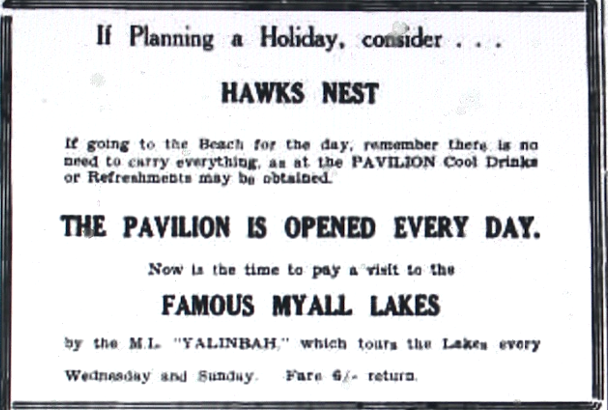
[Dungog Chronicle, 31 January 1941]
Proposal to Hand Over the Pavilion to the National Fitness Council – 1944
The Dungog Chronicle of 19 May 1944, page 3, reported:
‘Subject to the approval of the Lands Department, Hawk’s Nest camping reserve and pavilion will be handed over to the National Fitness Council for the establishment of a hostel.
This decision was made at the monthly meeting of Stroud Shire Council. …… The Hawk’s Nest building would be ideal for the establishment of a hostel and it was suggested that the council might consider handing over the camping area to the National Fitness Council under suitable conditions. There also seemed to be great possibilities for further development of National Fitness camps and Hostels along the strip of coast between Tea Gardens and Forster.
After discussion the council decided to offer to hand over the assets and equipment on the reserve, subject to the approval of the Lands Department to the National Fitness Council, provided that the Council would be relieved of all future liabilities for repayment of principal and interest in connection with the building on the following conditions, and that provision be made for campers other than those controlled by the National Fitness Movement, under no less favourable conditions than those previously existing; that council’s equity of approximately £1400 be duly acknowledged as the council’s contribution towards the development of the area until a similar amount has been expended by the National Fitness Council within the shire; in the event of the National Fitness Council ceasing to function the assets will revert to the Council.’
The Dungog Chronicle of 21 November 1944, page 3, further reported:
‘[Correspondence] from the National Fitness Office, Newcastle, advising that the Regional Officer was unable to supply any further information regarding further details associated with the Hawk’s Nest Camp. The estimates for the year had not yet been passed by Parliament, and while there was no lack of interest by the Regional Council, it was impracticable to give any decision until the question of finance had been considered by the authorities.’
New Lessee for the Pavilion – 1945
Following the failure of the National Fitness Council to take over the pavilion as a hostel, the Dungog Chronicle of 24 April 1945, page 3, reported on a new lessee being appointed by the council:
‘Cr. Zeininger said that the Hawk’s Nest Pavilion had been offered to the National Fitness Movement under certain conditions some time ago but so far, no decision had been reached on the matter. Mr. Pascoe, of Dungog, wished to interview Council with a view to obtaining a lease of the Pavilion and he suggested that the Council should hear Mr Pascoe’s proposal.
The Council then interviewed Mr. Pascoe in committee and adopted the following resolution proposed by Cr. Zeininger and seconded by Mr. Gibbons: That Mr. H. Pascoe be granted a lease of the Hawk’s Nest Pavilion for a period of two years commencing on June 1st, 1945, free of rent, in return for which he shall effect as soon as may be practically possible such repairs, renewals and replacements as may be decided by Cr. Zeininger, the Acting Shire Engineer and himself in conjunction, which repairs, renewals and replacement, shall become the property of the Council, the lessee to also provide at his own expense all necessary provision for electric lighting, generating power, for same and power for compressor of refrigerator, the engine and generator employed to remain the property of the lessee, and at the expiration of such period of two year, the lessee to have an option of lease for a further period of three years at a rental to be fixed by mutual agreement but not exceeding £210 per annum (being 10 per cent. of the capital cost of the Pavilion), the lessee to give the Council the right to examine his books from time to time to enable it to arrive at a suitable rent, the lessee to also collect all camping or other fees within the reserve and elsewhere as may be agreed, of which he shall retain 25 per cent. as his revenue.’
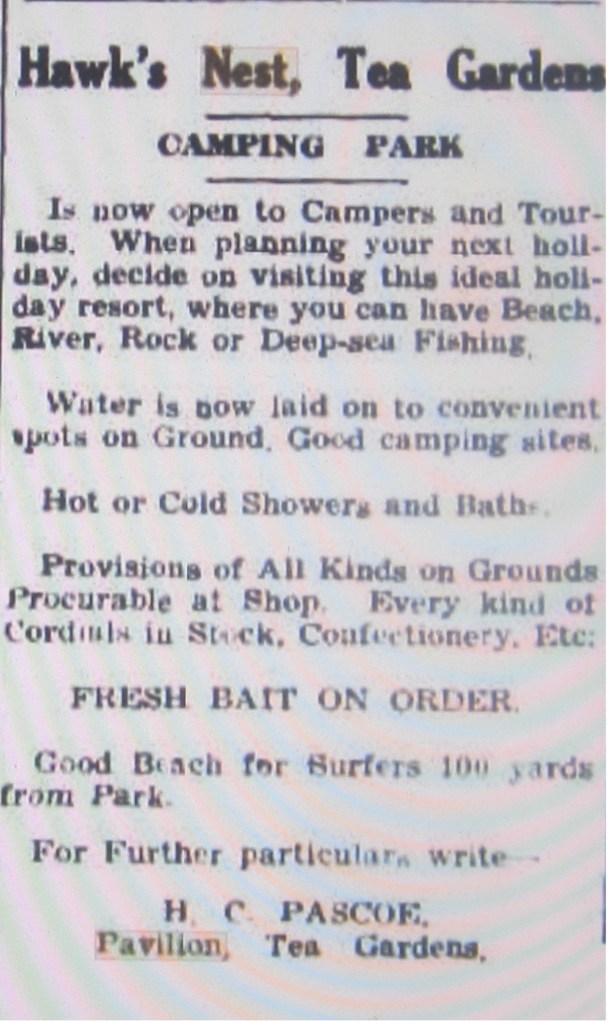
Advertisement announcing the re-opening of the pavilion [Dungog Chronicle, 9 November 1945]
Proposed Restoration of a Public Telephone at the Pavilion – 1945
The Dungog Chronicle of 26 October 1945, page 3, reported:
‘When the Postmaster-General, Senator Donald Cameron, was in Dungog on Tuesday, Mr. C. E. Bennett brought under his notice the need for the restoration of the telephone office at the Hawks Nest Pavilion, Tea Gardens. This was closed during the war period when, owing to lack of petrol and tyres, and to enlistments and war work generally, that seaside resort languished.
There are over twenty cottages on Hawk’s Nest, and these alone justify a public telephone. In normal times there are hundreds of campers, and they are entitled to have telephonic communication with the outside world. In any case, the cost involved would be amply repaid, as it was before the war, so that on a business base alone, the reinstallation of the phone is justifiable. Stroud Shire Council is moving in the matter and it is to be hoped that it is successful in having this modern necessity made available for the public.’
A public telephone had been installed by the end of 1947.
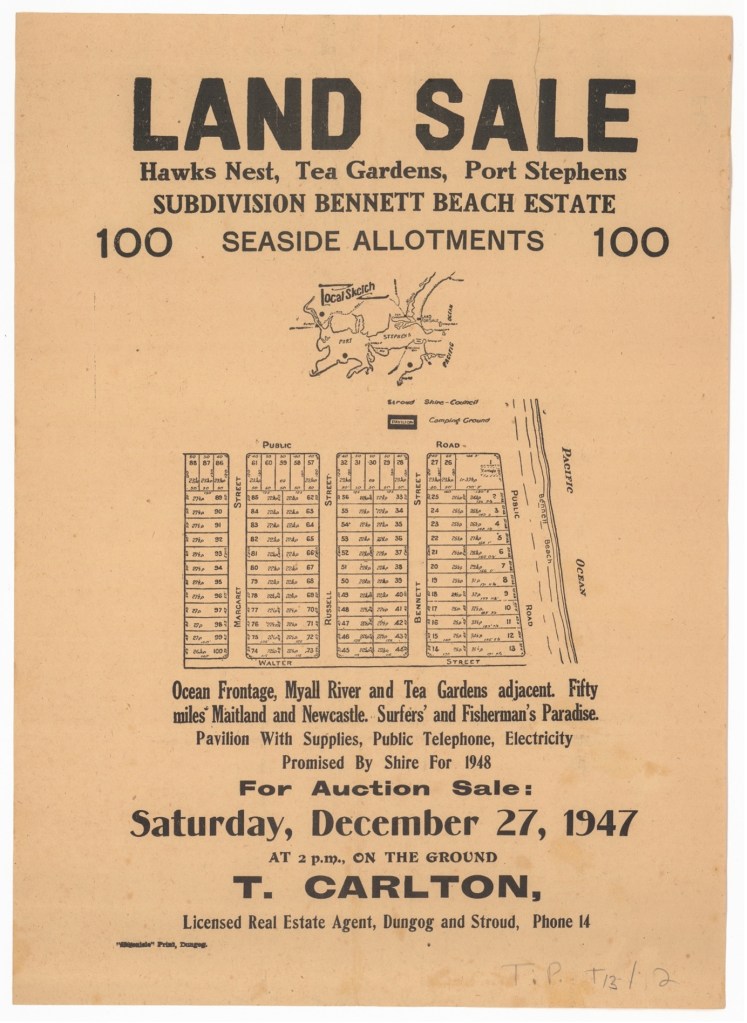
Land subdivision advertisement from December 1947 with the location of the adjacent pavilion and camping ground, shown above the allotment diagram.
Pavilion Vacant – 1948
The Dungog Chronicle of 21 August 1948, page 2, reported:
‘Stroud Shire Council is calling fresh tenders for the lease of Hawks Nest Pavilion. Details appear in our advertising columns. At present the building is vacant and when this was the position some years ago, vandals did a lot of damage.’
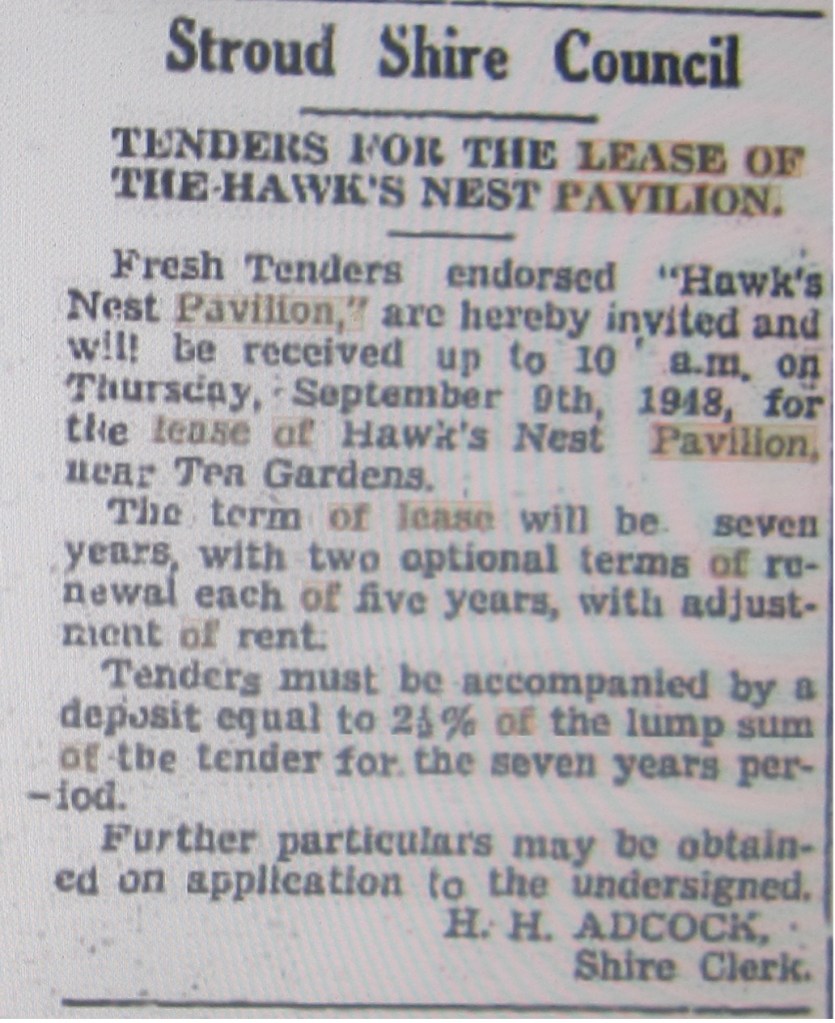
Advertisement for Tender[Dungog Chronicle, 21 August 1948]
Easter Holiday Season at Hawks Nest and Tea Gardens – 1949
The Dungog Chronicle of 30 April 1949, page 3, reported:
‘The Easter season of 1949 will be remembered by all those who stayed at the pavilion, Hawks Nest, as a very memorable one. Weather was nearly perfect and it was indeed a great pleasure to see such a crowd of people, all in high spirits, enjoying to the full the few days break from the daily routine.
The Ocean Beach proved, to be a very popular place with visitors and a great number of picnickers were noted making the best of the surf and other attractions which were to be discovered around the area. In this connection full marks must be awarded to those responsible for the operation of the Hawk’s Nest ferry, as they carried across the river and returned safely to Tea Gardens what is understood to be a record number of passengers and vehicles.
One of the highlights of the holiday was the dance held on Easter Saturday night at the Pavilion dance floor, to which all comers were invited by the management. It was voted a great success by those who attended, and it is hoped that this function will be the forerunner of many more such good nights in the very near future. ……
The ‘Pavilion’ was pleased to welcome a new fishing club to the area, namely, the Junction Fishing Club. These boys got off to a flying start by catching what seemed to be nearly every fish along this strip of coast, as by the time they had been fishing for a while the fish definitely seemed to go off. However, it was nice to see that some were getting amongst the fish and it goes to prove that no matter how poor the fishing seems to be, some are there for the angler who keeps trying and looks for them.’
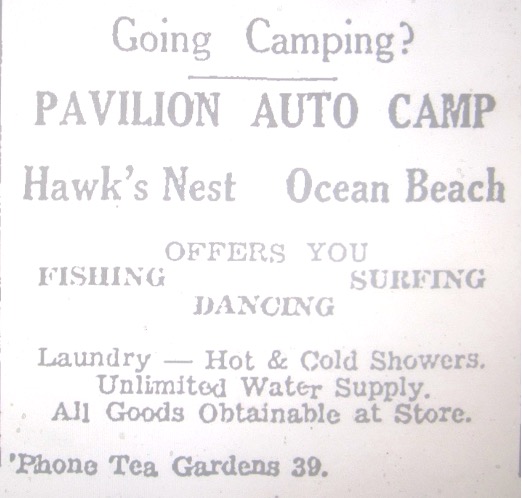
Advertisement for the Pavilion – Dungog Chronicle, 21 May 1949
Tram Carriages Converted to Accommodation Cabins at the Pavilion – 1949
The Dungog Chronicle of 17 September 1949, page 3, reported:
‘Considerable progress has been made at the Ocean Beach Pavilion with the building of cabins for campers and tourists. Manager Col. Clarke has almost completed the equipping of the tram cars purchased from the Department. He had a busy time securing materials and converting the cars into comfortable cabins. The first “cabin-car” is expected to be ready in about two weeks’ time. The school holidays enticed a number of campers and numerous visitors to the Ocean Beach. The beach and pavilion are becoming established in public favour as “the place to go” and a busy season can be expected this Christmas. ‘
Preparations Made at the Pavilion for Holiday Period – 1951
The Dungog Chronicle of 17 November 1951, page 3, reported:
‘At Hawks Nest paint brushes are splashing and hammers whirling in many quarters. A busy Christmas season is expected. Mr. Joe Lowe, who is lessee of the Beach Pavilion, and has some ten self-contained cabins, has been very active. Mr. and Mrs. Judge, jnr., are looking after his interests there, and are most obliging to visitors. There is no doubt about the ‘enterprising Joe.’
The Pavilion Remained a Popular Tourist Venue – 1953
The Dungog Chronicle of 28 March 1953, page 6, reported:
‘The ocean beach pavilion at Haw’s Nest has become a popular spot. There are about 15 cabins in the area, well furnished, electric stove, fuel stove, refrigerator, shower, electric fan, jug, etc. These are so much in demand that they are booked out until May. The nine miles of ocean beach are the attraction for swimming and fishing. …… There are many tourists dropping into the pavilion for cool drinks, sweets, morning and afternoon tea.’
Concluding Comments
In June 1954, the Stroud Shire Council commenced negotiations with the current lessee of the pavilion, Mr. J. Lowe, concerning a ten-year extension of his current lease.
The following photo of the Pavilion, circa 1955 was published in the News of the Area on 1 April 1974.
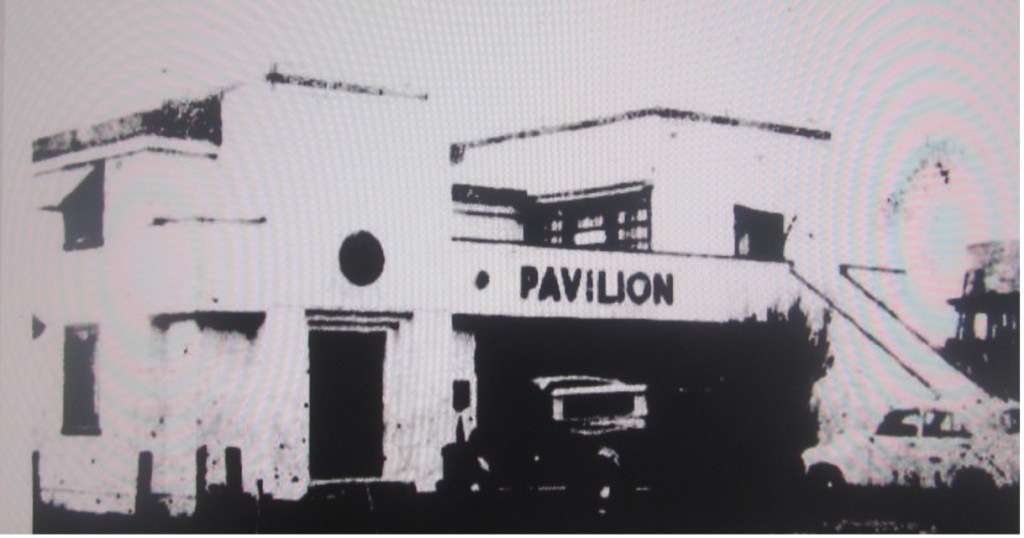
Hawks Nest Pavilion, circa 1955 [NOTA, 1 April 1974]
Beyond this point little information is available on the operation of the Pavilion.
While undertaking its construction, Stroud Shire Council was also actively undertaking planning and financing the construction of improved swimming baths at Tea Gardens, which opened in December 1838.
These two major tourism initiatives demonstrated the vision of the Stroud Shire Council and the local communities.
The Reflections Holiday Park, Hawks Nest, now stands on the site of the former Pavilion. and camping ground.
Researched and compiled by Kevin McGuinness
December 2023
POSTSCRIPT
A brochure was published, circa 1950, advertising both The Pavilion at Hawks Nest and the Swimming Baths at Tea Gardens. It is held in the New South Wales State Library Collection.
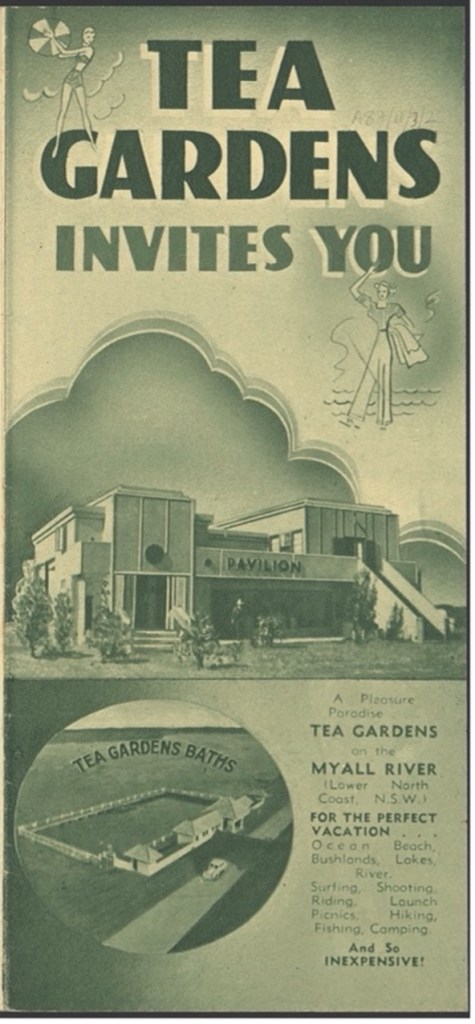
Cover Photo of Brochure [NSW State Library]

 Port Stephens - a history exploration