
Introduction
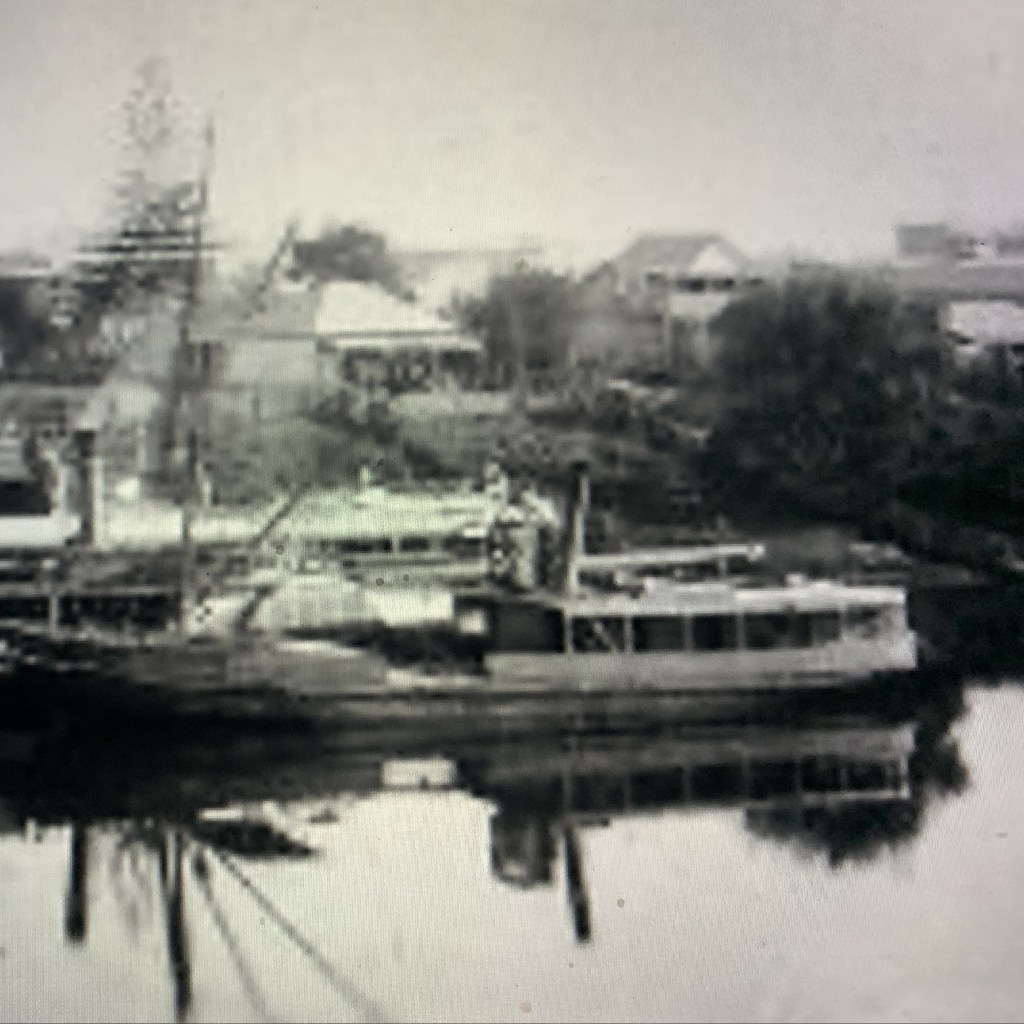
The Terara was an iron steam driven drogher (small cargo steam boat) built in Sydney by Atlas Engineering Works in 1885.
The craft was originally operated on the NSW South Coast and was owned by the Illawarra Steam Navigation Company. In 1896 the craft was sold to the North Coast Steam Navigation Company and operated on the North coast.
By 1916, the Terara was used as a ferry to transport workers from Newcastle to the Walsh Island Dockyard. In 1924 the Terara was refitted to transport timber in the Port Stephens area.
The Terara ended its days at Port Stephens where it was dismantled, after its useful life had ended.
This paper is the story of the working life of the Terara, whose hulk remains in the waters of Port Stephens.
Construction of the Terara – 1885
The Sydney Morning Herald of 25 February 1885, page 8, reported:
‘The Atlas Engineering Company have just finished an iron steam drogher for the Illawarra Steam Navigation Company. The vessel, which has been named the Terara, measures 125 feet in length, 20 feet beam, and 6 feet 7 inches deep.’
The Australian Star of 30 September 1893, page 9, gave a further description of the tonnage and engine capacity :
‘iron paddle steamer of 152 tons gross and 96 tons net, built and engined by the Atlas Engineering Co., of Sydney, in 1885. Her engines are compound, of 30 horse-power nominal, the cylinders being 14½ and 25in., with stroke of 48in.’
The craft was probably named after the small settlement of that name on the NSW South Coast.
Charter Work – 1885
Soon after the launch of the Terara it was chartered on numerous occasions for recreational excursions on the South Coast. Two examples are set out below.
The Evening News of 30 April 1885, page 6, reported:
‘In connection with the banquet to Mr. F. T. Humphrey, M.L.A., given by his constituents on Tuesday night, the Hon. W. J. Trickett and Dr. Tarrant came down from Sydney with others. They were met at Moss’s Central Hotel, Green Hills, by a number of gentlemen of the town and district. The first event on the programme was a pleasure trip up the Shoalhaven River. The fine new steamer Terara, under the command of Captain Buchanan, was placed at their disposal, and the party proceeded some fifteen miles up. The number on the steamer was about twenty-five, and during the excursion the bagpipes were creditably performed upon by Mr. Shaw, to the evident delight of the Scotsmen present.’
The Shoalhaven Telegraph of 19 November 1885, page 2, also reported:
‘On Thursday last the members of the Abercorn Lodge, celebrated their Anniversary by a picnic. It was decided that the picnic should be held up the river, and the steamer Terara, was chartered for that purpose. ……. About 300 availed themselves of the hospitality of the brethren. The steamer reached her destination — Bundanoon; the homestead of H. McKenzie Esq about 11.30 a.m., when preparations were at once in full swing for dinner; after which, croquet, rounders and light flotation were indulged in until 3.30. p.m., when the whistle sounded for tea at 4. p.m. All were on board and the Captain steered for home; one of the steamers boats here got too near the paddle wheel and came off minus a few planks. The steamer arriving at Nowra about 6 o’clock, and three cheers having been given for the Abercorn Lodge, the visitors and brethren wended their way home, everyone appearing to have thoroughly enjoyed the day’s outing. ‘
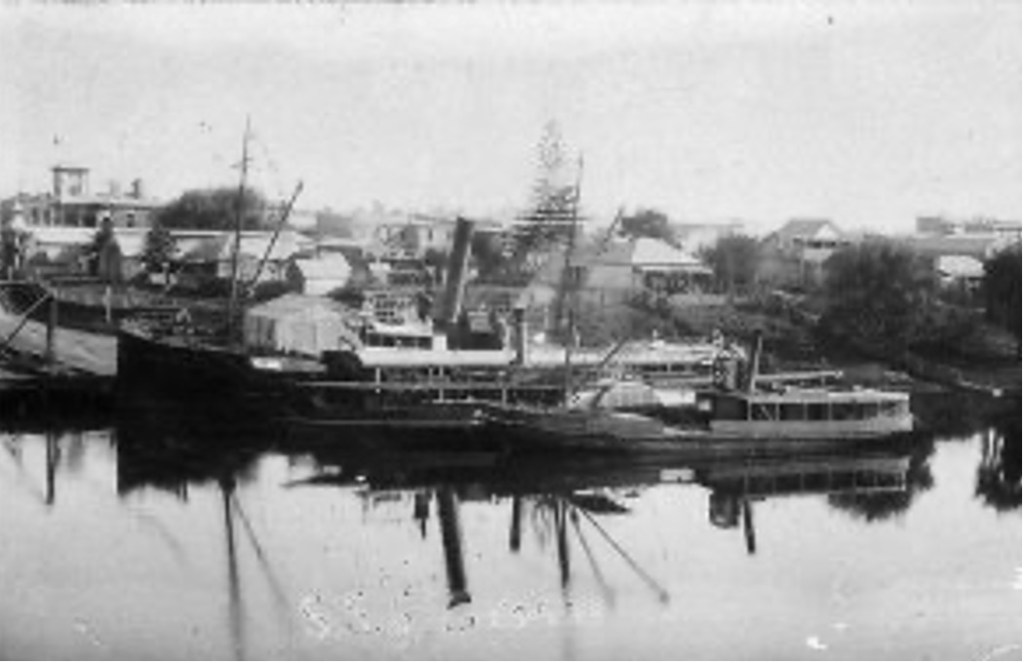
Steam ships St. George and Terara (in front) on Macleay River [State Library of NSW]
Terara operated by the North Coast Steam Navigation Company – 1896
The Northern Star of 8 July 1896, page 2, reported:
‘In the Macleay trade the whole of the maize has now to be droghed down to the mouth of the river to be shipped on the steamer for Sydney, and naturally at the short notice of the river trouble the company was a bit handicapped. This has now been remedied by the company [North Coast Steam Navigation Company] purchasing the paddle steamer Terara, of 152 tons, to perform the work.’
The Daily Telegraph of 3 July 1896, page 5, further reported:
‘The Macleay River trade is also receiving attention. The river is now only navigable for light draft droghers, the ocean steamers having to anchor at the mouth to complete loading. To meet the requirements the company [North Coast Steam Navigation Company], have at considerable expense, purchased the paddle drogher Terara, which, with her speed and deck space, must materially benefit shippers in the delivery of their produce.’
Terara goes Ashore – 1897
The Australian Star of 22 June 1897, page 6, reported:
‘The drogher Terara went ashore yesterday while crossing the bar with 900 bags of maize for the steamer Wyrallah. She was floated with last night’s tide and is now in the river.’
Charter Work – 1889
The Macleay Chronicle of 5 January 1899, page 3, reported:
‘The river excursion promoted by the local Good Templars, on Monday, January 2 was one of the greatest successes of the season. The Terara with her roomy deck space is admirably adapted for passenger excursion accommodation. The principal objection to her utility in this direction is the iron roofing. Probably the suggestion that if it were fitted with ventilators of an inexpensive sort, there would be a better circulation of air along the deck on hot days like last Monday, is one that will receive the favourable consideration of the N.C.Co., when that portion of her is next being overhauled.’
The Macleay Argus of 28 January 1899, page 12, also reported:
‘The Macleay River Farmers’ Union is to be congratulated on the great success which attended its first annual celebration. After several rather animated discussions, the majority decided upon a steam excursion to the New Entrance, and it is only fair to say that those who favoured a picnic accepted the decision with good grace and worked just as zealously as if they had got their own way.
On Thursday the steamers Terara and Pelican were well filled with a good humored crowd of both sexes and there was a great muster of little ones. Each member of the Union wore a badge of blue ribbon, and it was made very evident that the Farmers’ Union is a power in the district, if we can judge from the number of badges worn. Both the Pelican and Terara are well adapted for excursion purposes, more especially the latter, which would prove an ideal boat if she was twice as speedy.
As it is the journey is a trifle monotonous. The new channel was reached about noon, and the people were landed at a very desirable spot for picnic purposes, but too far away from the beach. The journey to and from the margin of the “ever-restless sea” was certainly a very trying undertaking, especially for ladies and children, and we would suggest that at future excursions passengers on the return journey should be embarked at the wharf or coaling place. …… The return journey started soon after three and the excursionists were safely landed at their respective wharves without mishap of any description.
There was a piano on the Terara and songs were indulged in and a few dancers were so enthusiastic as to trip the light fantastic toe in a space of about 10 feet square.’

Terara at Strong’s wharf, Kempsey district, 1894
Accident on the Terara – 1899
The Evening News of 9 September 1899, page 4, reported:
‘In No. 1 Jury Court on Friday, before Mr. Justice Stephen and a jury of four, William James Lancaster, a farmer, residing at Frederickton, in the Hastings and Macleay electorate, sued the North Coast Steam Navigation Company, Limited, for the recovery of £3000 damages for the loss of an arm through an accident on board the steamer Terara. …..
The statement of the plaintiff’s case was that on September 17 the steamer Terara called at several townships on the Macleay River. The Premier was to address a political meeting at Kempsey that night. Amongst the passengers from Frederickton were the plaintiff and his wife. On the return journey the steamer arrived at Frederickton, and it was claimed that sufficient time was not allowed the plaintiff to get ashore. His wife was helped ashore, but he was carried beyond his destination.
He lay down on some maize, and had a sleep, waking up about 3 o’clock. The deck was then dark. Plaintiff walked toward the stern of the steamer. When he arrived between the paddle-boxes, he fell through an unprotected hatch into the engine-room, the result of his fall being an injury to his arm which necessitated amputation in the Kempsey Hospital. The plaintiff, therefore, charged the company’s servants with negligence in leaving the hatchway unprotected, and claimed £3000. The defendant company pleaded not guilty, and evidence was entered into.’
The Australian Star of 12 September 1899, page 5, further reported:
‘The hearing was concluded this morning of the action brought by William James Lancaster, a farmer, of Frederickton, against the North Coast Steam Navigation Company, Ltd., to recover £3000 damages for this loss of an arm through an accident on board the steamer Terara. ……. His Honor had practically concluded his summing-up and upon a few additional words from the bench the Jury retired. After brief deliberation a verdict was returned for the defendant company.’
Charter Work – 1901
The Macleay Argus of 30 November 1901, page 8, reported:
‘The moonlight excursion under the auspices of the Ladies Benevolent Society on Wednesday night attracted a fair number. The Terara was engaged and is an ideal boat for an excursion of this kind, being very roomy and comfortable. The steamer went as far as Smithtown and Kempsey was reached on the return journey at a reasonable hour. …… Altogether a most enjoyable and social time was spent.’
replaces a Clarence River Drodger – 1901
The Macleay Argus of 14 December 1901, page 9 reported:
‘The North Coast Co.’s paddle wheel drogher Terara was taken round to the Clarence last week by Captain Ricketts. The Terara, it is said, is intended to replace the Clarence drogher Ramornie, which goes to the Richmond.’
Passenger on the Terard drowned – 1903
The Macleay Chronicle of 5 February 1903, page 6, reported:
‘A further inquiry was held on Monday last at the Court House before the P.M., as to the circumstances attending the death of Reginald Coleman, who was drowned on the previous day whilst attempting to swim the river near the Kempsey bridge. …………
Michael Kennedy, residing with his parents, was on the steamer Terara, about 9.30 on Sunday morning, and saw Lee and Coleman dive off the boat into the river; he had on trousers only, and swam out toward the opposite side; when about half way be turned to come back, and about 20 yards from the wharf he sang out; he cried out, ‘ help ! help ! ‘ and went down; William Andrews and Mark Perrin got into a boat from the Terara and rowed to where he sank he had gone down for the third time when they reached the place. ……..
Mark Perrin, employed on the Terara, saw deceased on board at 9.30; he was then preparing to have a bathe; afterwards left the deck, and a little later heard William Andrews call out there was a man drowned …… The P.M. [Police Magistrate] found that deceased died from drowning, as the result of an accident.’
Concerns about the safety of Newcastle workers on the Terara remain – 1919
The Newcastle Sun of 5 May 1919, page 1, reported:
‘C. A. Naudin directs the attention to the mothers and wives of those who go to and from Walsh Island [Dockyard] to the “danger” that is staring them in the face from time to time, on that old-time out-of-date ship, Terara, a disgrace to Greater Newcastle, and an offence to navigation. To me and others who travel by her the trip across the harbor is like riding on a snail’s back, with a pair of paddles to help her along.
When she gets into a roll from a passing steamer we turn our eyes to the life belts, in case the brown paper shell might tear and many go down into the water. She is the first to leave Market wharf [at Newcastle] in the morning, and the last to arrive at Walsh Island. There is always a gangway at Market wharf, but it is get on and off the best way you can at Walsh Island. We are packed on board like a lot of sardines — some standing and many down below in a confined space — a danger in these days of epidemics.
Above all, we are like a lot of convicts, with a policeman to shove us down. There are two policemen to keep guard in case we should escape on No. 1 or the other boats. When it is raining, we get wet through, and if we catch a cold we are in danger of getting run in for having the ‘flu. The “snail” carries a policeman on board every trip. He knows that there are more on board than she should carry. She has no licence number — that class of boat never had. The day may come when it will be asked who is to blame, like others, when it is too, late. She was near to her death on Tuesday right last, when she crossed the bows of the ‘Hexham’ so that No. 1 could get in before her.’
The Terara fitted to carry timber – 1924
The Newcastle Morning Herald and Miners’ Advocate of 12 April 1924, page 4, reported:
‘The old iron paddle steamer Terara, which was used for some time in connection with the workmen’s ferry service from Walsh Island to Newcastle, has lately been on the slips of Mr. J. C. Ross, at North Stockton, and fitted with new masts, derricks, and winches, for the handling of timber. She is now owned by Mr. J. Ruttley, of Newcastle, and will probably be used to carry timber from Port Stephens. She did her trials very satisfactorily during the week. The Terara, which is 152 tons gross, was built at Sydney in 1885, by the Atlas Engineering Company.’
Union concerns on the danger posed to workers on the Terara – 1925
The Workers’ Weekly of 6 March 1925, page 3, reported:
‘The year 1923 provided the workers of Newcastle with a lesson in the art of applying industrial might to gain an objective. The B.H.P., realising that certain militant Trade Unions were hampering the company’s programme of white coolie labour at the steel works, decided to employ starvation to beat the workers to their knees. Every Newcastle worker will remember the fourteen months’ lock-out, the treacherous conduct, of corrupt officials, and the concessions extorted by the steel sharks. …..
Transport arrangements to the Dockyard are disgraceful. The s.s. Terara, a paddle wheel monstrosity, was condemned by the shipping authorities as being unfit to carry pigs from the Hunter Valley farms to Newcastle, and was employed to convey the Walsh Island slaves to work. But, taking advantage of the depression, the management bullied the men into accepting a levy to charter Peter Gallen’s indescribable tubs, the “Wattle” and “Guthrie,” which have now displaced the “pig boat.” …..
The present period of temporary trade boom in the iron trade provides the workers with an admirable chance to get back some of the things lost by tie recent unsatisfactory Federal Awards, which are the cause of much disappointment in the iron trade.’
Terara broken-up at Port Stephens – 1935
The Dungog Chronicle of 19 July 1935, page 4, reported:
‘The old paddle wheel steamer “Terara” has passed the age of usefulness and has passed into the hands of the shipbreakers. Messrs Engel and Sons have acquired her and are dismantling her. Probably the greater part will go into the melting pot for scrap iron, but it is rumoured that her engines and boilers are in good condition after nearly half a century in use.’
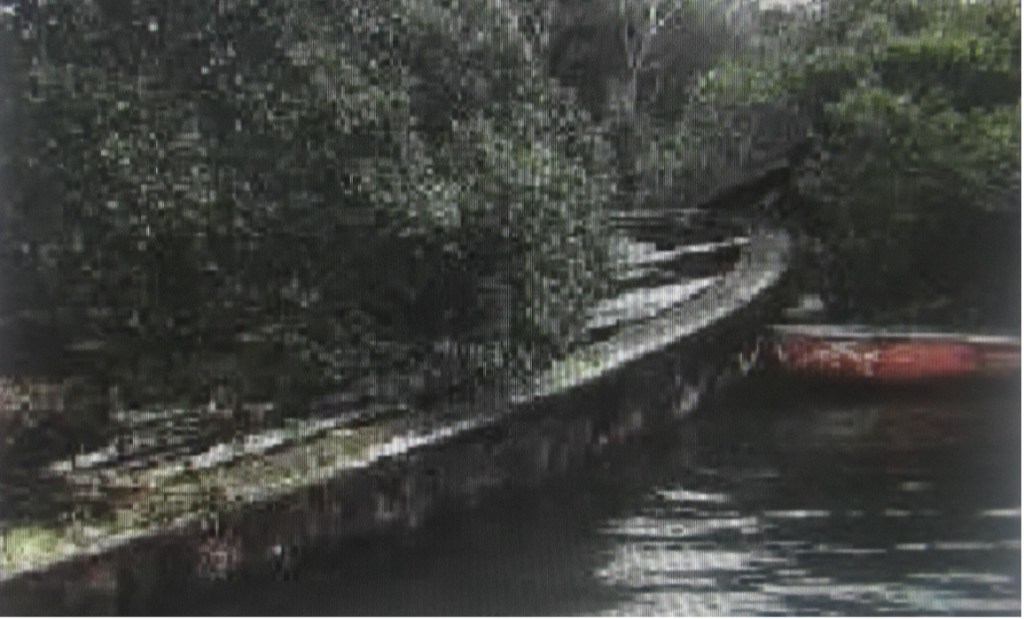
Hulk of the Terara at Port Stephens [The Maritime Archaeology of Myall Lakes / Tea Gardens: Area Conservation Plan. Heritage Office, June 1999]
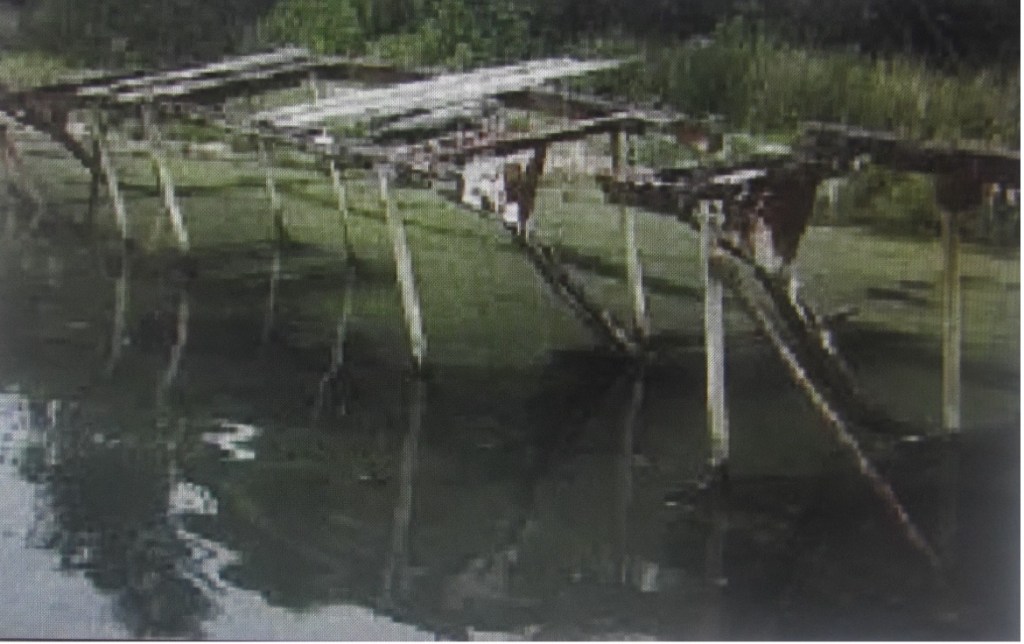
Iron framework of the Terara at Port Stephens [The Maritime Archaeology of Myall Lakes / Tea Gardens: Area Conservation Plan. Heritage Office, June 1999]
Concluding Comments
The hulk of the Terara is one of several that remain within the waters of Port Stephens.
Information on other boat hulks in Port Stephens is published on this website and can be found at the following links:
Hulk of the Salamander Drogher at Port Stephens
Hulk of the ‘Iluka’ Drogher at Port Stephens
Hulk of the ‘Brighton’ Ferry at Port Stephens
Researched and compiled by Kevin McGuinness
December 2023

 Port Stephens - a history exploration