
Introduction
The 1920’s and 1930’s witnessed great advancements in the field of aviation. field and on occasions Port Stephens was visited by aviators.
One such occasion was in 1930, when a famous sportsman and aviator, Ernest (Ernie) Joseph Buck visited Tea Gardens with a ‘Tiger Moth’ aeroplane. He landed on the then Tea Gardens Horse Racing Track, situated on the level moor at the rear of the present Tea Gardens Public School.
With his co-pilot, Berry Litlejohn, the offered joy flights to Tea Gardens residents which elicited great interest.
This is the story of Ernie Buck, motorcycle racing champion and aviator, and the time he spent in Tea Gardens.
Tea Gardens Residents Enjoy the Thrills of Flying – 1930
The Dungog Chronicle of 14 February 1930, page 4, reported:
‘On Saturday last Mr. Ernie Buck, accompanied by his pilot, Mr. Berry Littlejohn, flew over Port Stephens, and finally landed on the moor at Tea Gardens. He had come up in his Moth from Newcastle, a matter of 14 minutes. The airman found the moor a splendid landing ground, Mr. Buck expressed the opinion that Mascot and Newcastle could not come up to it. In its present state it gives one the feeling of running over velvet. Mr. Littlejohn endorsed these views and expressed the opinion that if deep drains were dug around the ground, it might mean that the area would remain permanently good as the spring tides would thus get away quicker.
The arrival of the Moth gave the residents of Port Stephens an opportunity long awaited. They rushed to make flights and were sorry they could not stop in the air longer. Every flight ended perfectly and some 40 odd were made. It was late in the afternoon when the airmen left for Newcastle.
On Sunday afternoon the ‘plane returned and again the residents rushed the airmen for flights. There were many who could not secure a ride, but, no doubt, the Moth will return at some future date. Mr. Frank Motum went up with Pilot Littlejohn and was treated to some thrilling stunts, side slips, looping-the-loop, etc. The crowd was fascinated and thrilled.
Mr. Ted Ball, part owner of the ‘plane made the journey up on Sunday with the Pilot. During its stay in Tea Gardens, Messrs. G. A. Engel and Sons supplied the necessary oil and benzine. The venture was profitable to the airmen and thoroughly enjoyed by the residents. Many children also had flights. One and all were astounded at the beautiful views below them, the ocean, harbour, Myall and Karuah rivers, the Myall Lakes and the background of hills.’
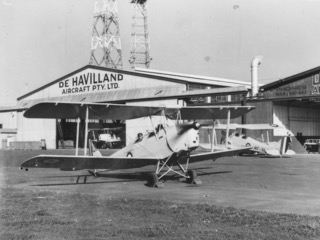
‘Tiger Moth’ plane at the De Havilland Factory, Sydney [Australian War Memorial]
Ernie Buck Dies in Air Crash – 1939
The Raymond Terrace Examiner and Lower Hunter and Port Stephens Advertiser of 2 February 1939, page 1, reported the tragic death of Ernie Buck during an Air Show at Orange, and also reflected on his long career as a motorcycle racing champion.
‘The residents of Raymond Terrace, in association with everyone else, who knew him will regret extremely the untoward and dreadful accident which cost him [Buck] his life on Monday last. He was taking part in an air pageant at Orange.
He was flying in a Tiger Moth machine at the time and was giving an exhibition of ‘bombing the fort’ The fort consisted of a wooden structure erected in the centre of the aerodrome and Buck’s objective was to drop the bombs on it. He had released three bombs, all of which had missed the target. The crowd of 2000, which was watching Buck’s manoeuvring with keen interest, noticed a puff of smoke from the pilot’s cockpit and almost immediately a report was heard. The pilot appeared to lose control and the machine crashed to the ground. The undercarriage was smashed, the fuselage crushed, and the wings twisted beyond recognition.
Ambulance officers and police released Buck, who was shockingly injured and it was seen that the bomb had blown his right hand off. He died on the way to hospital The death of Chief Instructor Buck will be a severe loss to the Newcastle Aero Club where he was held in high esteem as a brilliant aerobatic pilot and careful and competent instructor.
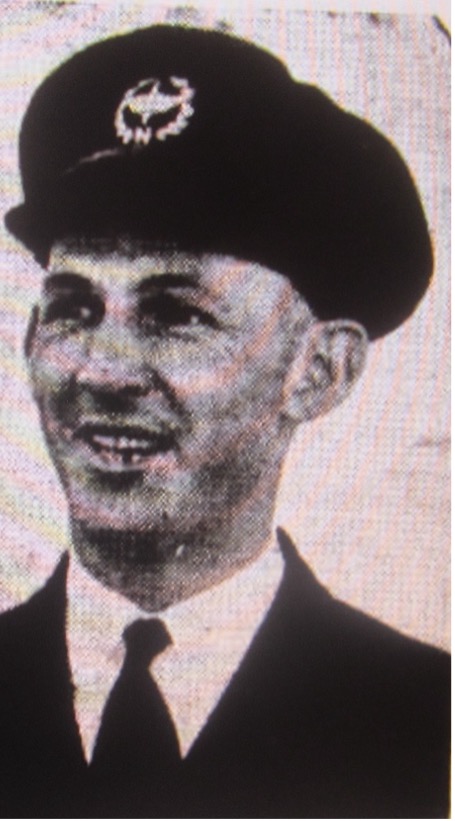
Ernie Buck [The Gloucester Advocate, 3 July 1939]
Pilot Buck first made a reputation for himself as a dirt track motor-cyclist and raced against some of the world’s best riders [His success in motorcycle racing was frequently reported in newspaper reports].
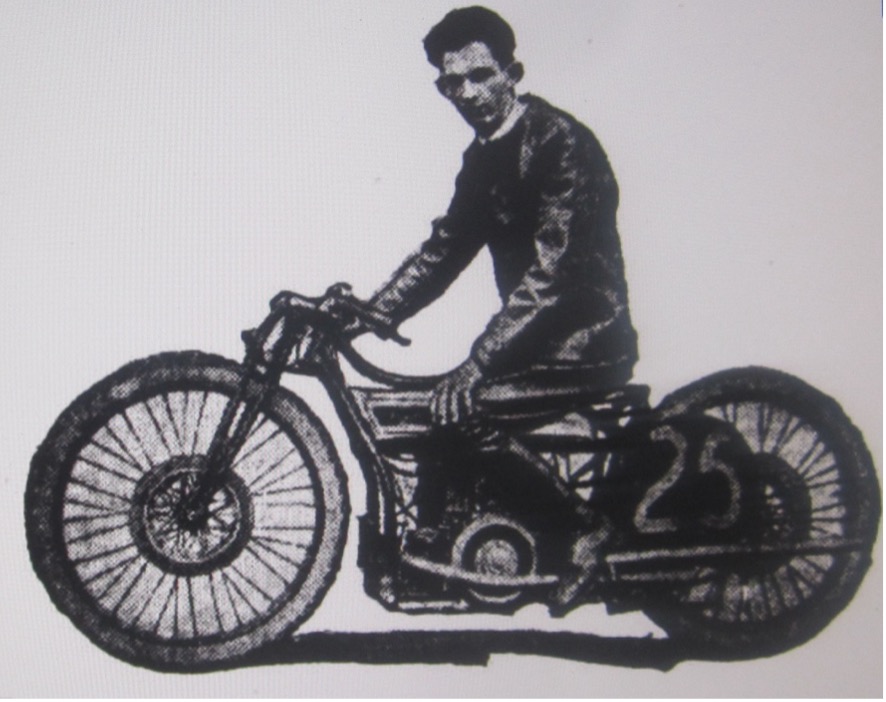
Ernie Buck, who, on his Douglas Motorcycle, rode in great form at Newcastle Speedway on Saturday Night, Winning the All Powers Handicap, from scratch, and breaking his own standing start record [Referee, 14 April 1926]
About seven or eight years ago, in partnership with Mr. E. O. Ball, he purchased a DH [De Havilland] Mark 11 Cirrus Moth ‘plane and Pilot Norman Littlejohn was engaged to teach the joint owners to fly. Later Pilot Buck made an aerial tour of New South Wales giving joy flights. He has been associated with the Newcastle Aero Club since its inception, and in November 1935, was appointed honorary instructor. In the following year he became Chief Instructor of the Clarence River Aero Club at Grafton and on March 7, 1937 he returned to Newcastle as Assistant Instructor to Flight-Lieutenant I.C.C. Thomson. Seven months later, Flight Lieutenant Thomson resigned to take a position with Australian National Airways in Melbourne and Pilot Buck was promoted to Chief Instructor.
At the time of his death, he had flown ap proximately for 3000 hours. Pilot Buck was a natural pilot and quickly mastered the various aerobatic manoeuvres. He became well known throughout the North West were he gave demonstrations of inverted flying at the various air pageants. Last year, he won the Sydney-Moree air race, flying Mr. G. Ryder’s Peicival Gull. He registered the fastest time for the event, which was divided into speed and handicap sections.
Quiet and unassuming, Pilot Buck was popular with all members of the club. Although he was fearless in the air, he never took unnecessary risks and always insisted on his pupils observing the rules of safety first. In addition to being an able pilot he was a competent ground engineer and was licensed in C and D categories.
He is survived by a widow [Amy Eileen Buck, nee Yates] and three children ranging in age between six and 12 years. One of his brothers, Mr. Alec. Buck, is an aircraftsman in the Royal Australian Air Force, stationed at Laverton (Victoria), and another brother, Mr. Les. Buck, resides at Dungog.
The tragedy was one of those extremely rare accidents against which it would be difficult to guard. It was not caused by any fault in the machine nor any mistake on the part of the pilot, but purely by the premature explosion of what is known as a five second time bomb. Such an accident may never occur again, but it is probable that the Civil Aviation Department will ban the use of these bombs at all future air pageants.
The flying manoeuvre which was being earned out by Instructor Buck at the time of the explosion was straightforward and not dangerous in any way. A ‘fort’ had been erected on the aerodrome and he and Pilot W. Smith, in another Tiger Moth were giving a spectacular interpretation of what would happen if the fort was being bombed from the air. Each pilot was equipped with a number of these time bombs, which were exploded in the air to create the impression of anti-aircraft shells bursting around the plane The usual procedure is for the pilots to dive at the fort and appear to release bombs which explode in close proximity to the target. In reality no bombs are dropped from the machines but are thrown over the side of the fort by a man on the ground who is hidden from public view.
The time bombs which are used to represent the anti-aircraft fire are about six inches long, and shaped like a thick candle. They are ignited by the pilot rubbing the ‘wick’ against a rough surface affixed to the outside of the plane, after the manner of a safety match. The explosion occurs five seconds later These bombs have been used at air pageants for a great many years, and the accident yesterday is the first recorded instance of one exploding prematurely in an aeroplane.’
Aviation Possibilities for Tea Gardens – 1948
The possibilities for the future development of Tea Gardens as an aviation centre were published in the Dungog Chronicle 27 November 1948, page 3:
‘It is easy now to visualise that the old Tea Gardens racecourse, or better known as Hall’s Estate, will be an airport. For years planes have landed there. The late Ernie Buck used this ground for flying excursions — 10/- in the air for 10 minutes. With the progress that is taking place with air travel, any person living at Hawk’s Nest or Tea Gardens can be landed at Mascot in 35 to 45 minutes from leaving home. Many people will say that will never be, just as they have said there will never be electric light at Hawk’s Nest or tarred roads in this area. But those people have forgotten, or never knew, that this portion of the globe has everything the people need. And this generation is going to use it.’
Concluding Comments
Other papers on the early aviation history in the Port Stephens region are published on this website and can be found at the following links:
History of Seaplanes at Port Stephens
Landing of a Sea Plane in Port Stephens – 1926
Early History of Newcastle Civil Aviation Airport
Bert Hinkler Lands His Baby Avro Plane at Anna Bay – Port Stephens
Crash of Catalina Flying Boat in Port Stephens – May 1943
Geoffrey Wikner and Halifax Park – Nelson Bay
For many years motorcycle racing was conducted at Morna Point Beach, Port Stephens and is also featured on this website
Researched and compiled by Kevin McGuinness
December 2023

 Port Stephens - a history exploration