

A Beach Racetrack Where Speed Records Were Broken
From 1927 to 1946, motorcycle racing events were regularly conducted on Morna Point Beach at Anna Bay at the northern end of the Stockton Beach. The area today is known as Birubi Beach.
The beach was an ideal location for motorcycle racing because of its straight length and wide expanse of sand. Providing the weather was satisfactory and at low tide, it was very suitable for both cyclists and spectators.
Some racing championship events would attract up to 4000 spectators. Competitors were either commercially sponsored or private riders. Motorcycles of many brands were raced but A.J.S. and Velocotte cycles were particularly popular at the Morna Point track.
In addition to racing, bike clubs regularly conducted recreational drives to the beach where they would camp overnight on grassed areas near the sand dunes, and sometimes conduct novelty bike events on the beach.
In this paper, speed is expressed in the imperial measurement system applicable at the time, as miles per hour. In metric terms for comparative purposes,100 m.p.h. is equivalent to 160 k.p.h. Electric timing of events was introduced in 1937.
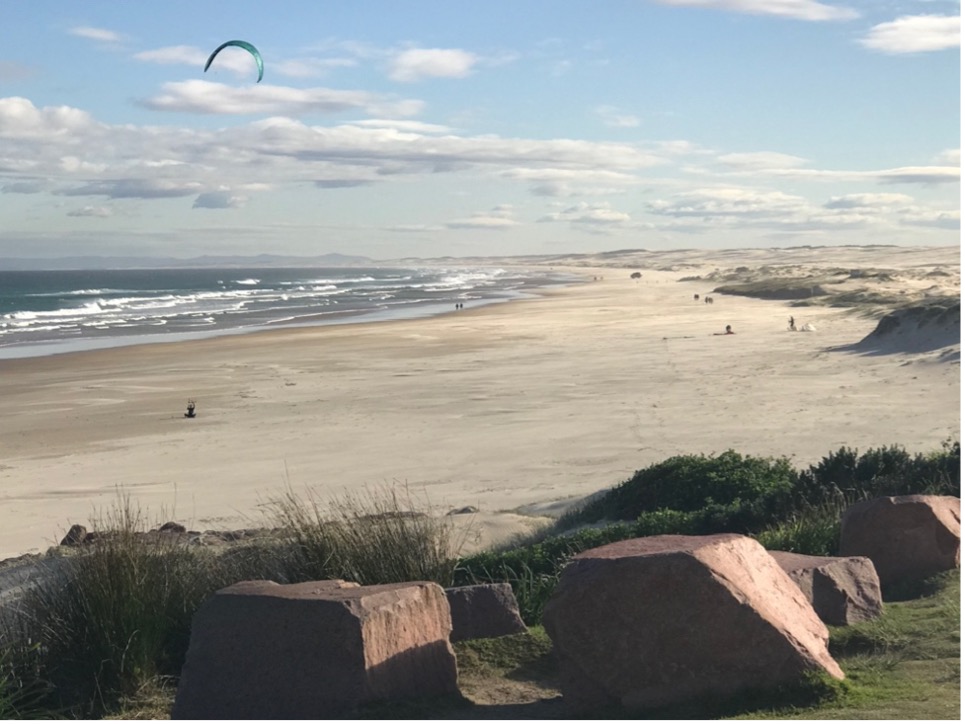
Morna Point Beach (aka Birubi Beach) [Author photo]
Let the Racing Commence – 1927
The Maitland Motorcycle Club was the first organisation to recognise Morna Point Beach as a great place for motorcycle events. The Maitland Daily Mercury of 19 December 1927, page 4, reported on a successful weekend spent at Morna Point Beach by the club members:
‘Twenty-one members joined in the weekend run to Morna Point on Saturday and Sunday, and a most enjoyable time was spent in swimming, fishing and motor races on the beach. Some of the riders attained a speed of 75 miles an hour. The beach is an ideal one for races, there being a straight run of five miles.’
Speed Trials Commence – 1928
The first quarter mile speed trials held at Morna Point Beach were conducted by the Maitland Motorcycle Club in August 1928. There were two classes of machines, over and under 350cc, with gold medals for first place and a tin of benzine for the runner up.
The Singleton Argus of 1 September 1928, page 7, reported:
‘The Maitland Motorcycle Club held two events on the beach at Morna Point during the week, and in the first one F. Cridland finished up in the ocean, but did not suffer any consequences. Results: Flying Quarter-mile for 2¼ h.p. machines: W. Beavis (Harley), 13 2-5 sec, 1; W. Stevenson (Harley), 13 4-5 sec, 2; J. Pilgrim (Raleigh), 14 4-5sec, 3.’
Indian Motorcycle Club Run to Morna Point Beach – 1935
The Newcastle Morning Herald and Miners’ Advocate of 12 February 1935, page 12, reported on a cycle run to Morna Point Beach by the Indian Club. Indian was a brand of motorcycle:
‘Members of the Newcastle Indian Motorcycle Club and their friends held another successful club run last Sunday week to Morna Point. After the competitions, Gordon Hoffman and W. Campbell picked sides for a game of cricket, which resulted in an outright win, for Campbell’s team by 109 runs. A distance judging contest was held en route, over a course of 12½ miles, which resulted in a win for W. Campbell.’
A.J.S and Velocette Motorcycle Club Championships – 1937
The A.J.S. and Velocette Motorcycle Club held its first championships at Morna Point Beach in 1937. The Newcastle Sun of 21 September 1937, page 5, reported on the upcoming event:
‘The Sports Committee of the A.J.S. and Velo. Motorcycle Club journeyed to Morna Point on Sunday to inspect the beach for the club’s speed trials to be held on October 17. Officials are enthusiastic about Morna Point, and think that the beach is ideal for high speeds. In view of this, it was decided, instead of running a flying quarter-mile event, to make the distance for the speed trials one mile. It is recognised by competition men that quarter-mile events are inaccurate. Timing over one mile from the flying start will be more satisfactory. It was also decided that a camp would be made at Morna Point on the Saturday afternoon, October 16, and the event would be decided whenever the tide is suitable on the Sunday morning. The event is expected to be one of the biggest of its kind held in the north. All motor cyclists will be welcome at this camp.’
The Newcastle Sun of 19 October 1937, page 5, reported on the club championship at Morna Point Beach on Sunday 17 October:
‘Last Sunday 2000 people attended the A.J.S. and Velocette Motorcycle Club’s speed championships at the beach at Morna Point.
Several competitors went to Morna Point on Saturday afternoon and spent a wet night in the vicinity of the beach. Bill Jeffers, holder of the N.S.W. 440 acceleration record in the 350 c.c. class, kept the crowd well amused. Everybody suffered on the Sunday morning from want of sleep. Rain fell most of the night, and at daylight the weather did not look promising. About 7.30 the sun broke through and the camp was soon the centre of activity, with club members busy getting their motors ready.
Art Senior travelled all night from Sydney, and arrived complete with a smart model, but was unable to ride, as he had not received sanction from the A.C.U. Hundreds of cars and motorcycles arrived, and by 9.30 there were more people at Morna Point than ever before. About this time the Newcastle Aero Club ‘planes passed over and gave the club a salute.
The Cessnock Motorcycle Club and the Royal Enfield Motorcycle Club gave valuable assistance. The beach was rather soggy, and did not favour high speeds. Several competition men expressed the opinion that if the beach had been better it would have resulted in up to 10 per cent. improvement in speed. The timing was done with an electrical apparatus. It was the first time that a motor cycle flying quarter had been timed this way for years. As this is the only accurate method, the times of the fastest rider in each class are now recognised as being the records for the Northern District. It was originally intended to give each rider two runs over the course, the first run to determine the handicap, but after 52 riders had been over the course once, the officials decided, in the interests of safety, to omit handicapping. ……… The electric timing did not miss once. It was operated by Messrs. Harry Lewis, Bill Quinn, Les Lee, and Harry Sams. Mr. Jeffers and Mr. Jemison have both had extensive experience in events of this type and gave the club valuable information. Mr. Young, of “Motorcycling in New South Wales,” was present and express-ed surprise at the popularity of motor cycling in the North.’
The following events were contested: Unlimited C.C. Northern District Championship; Northern District Championship; 250 C.C. Northern District Championship; and Northern District Sidecar Championship.
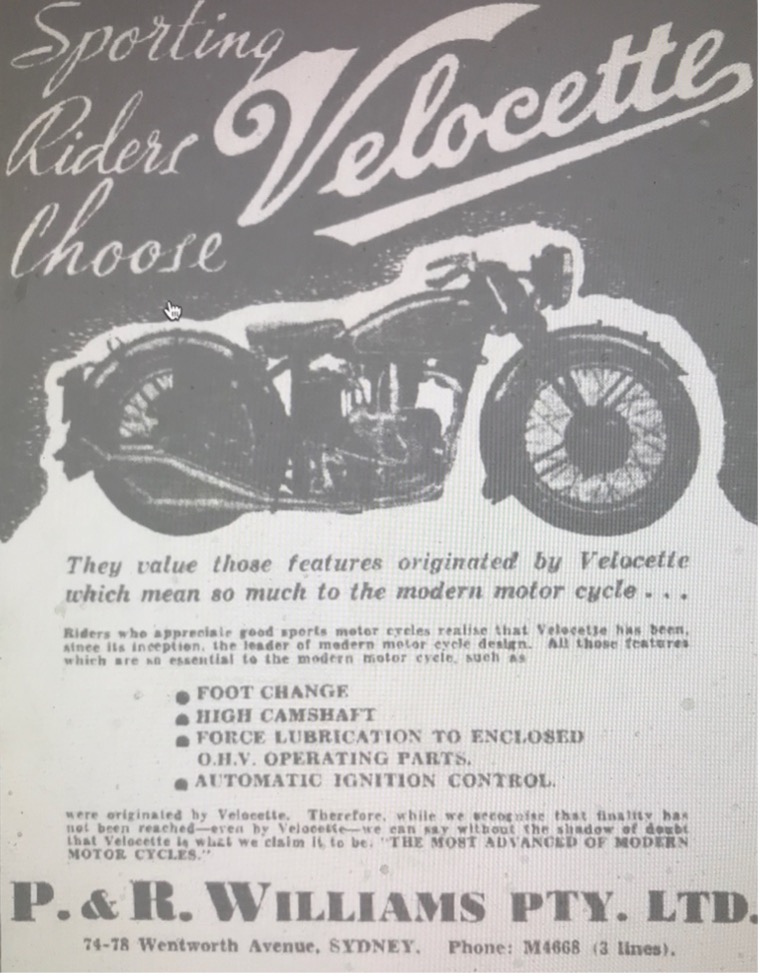
An advertisement for a Velocette cycle, of the type raced at Morna Point Beach, as published in the Daily Telegraph of 22 October, 1937. P. & R. Williams Pty Ltd, were a sponsor of cycle clubs that raced at Morna Point Beach.
The Newcastle Morning Herald and Miners’ Advocate of 18 October 1937, page 5, published the following two photos of the championship:
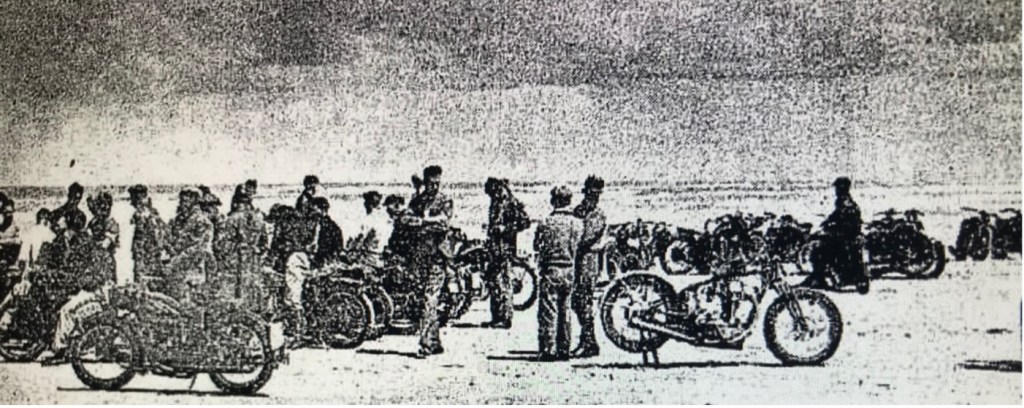
Competitors waiting for the start of the A.J.S. and Velocette Motor-cycle Club’s flying quarter mile at Morna Point Beach
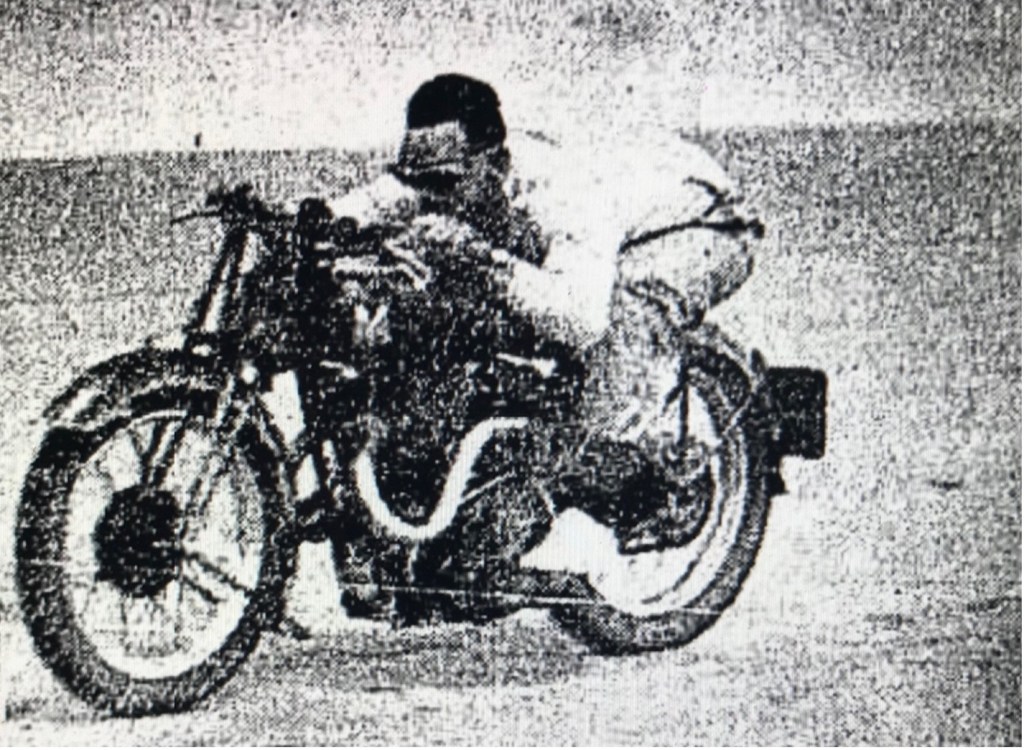
Human streamlining on a race bike at Morna Point Beach
The Newcastle Sun of 19 October 1937, page 4, published the following two photos of the championships:
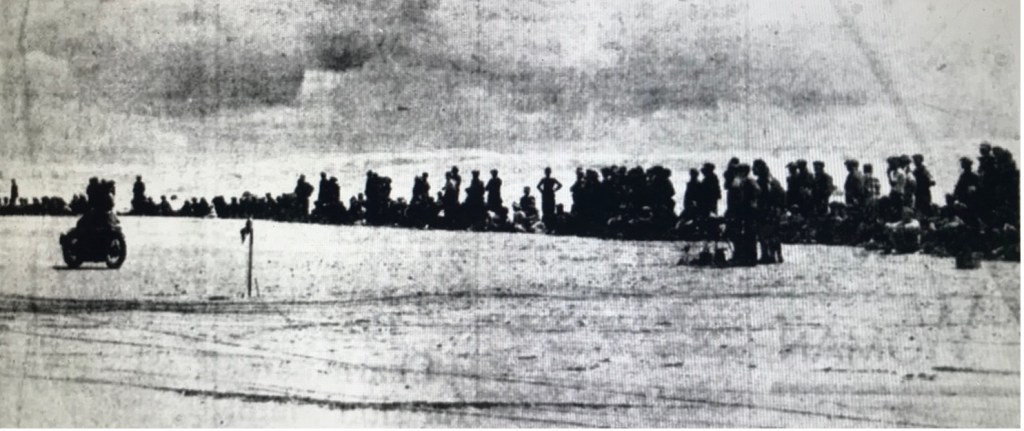
C. Edden just before he crossed the finishing line in one of the events at the motorcycle rally held on the beach near Morna Point at the weekend. The run attracted a big crowd from Newcastle
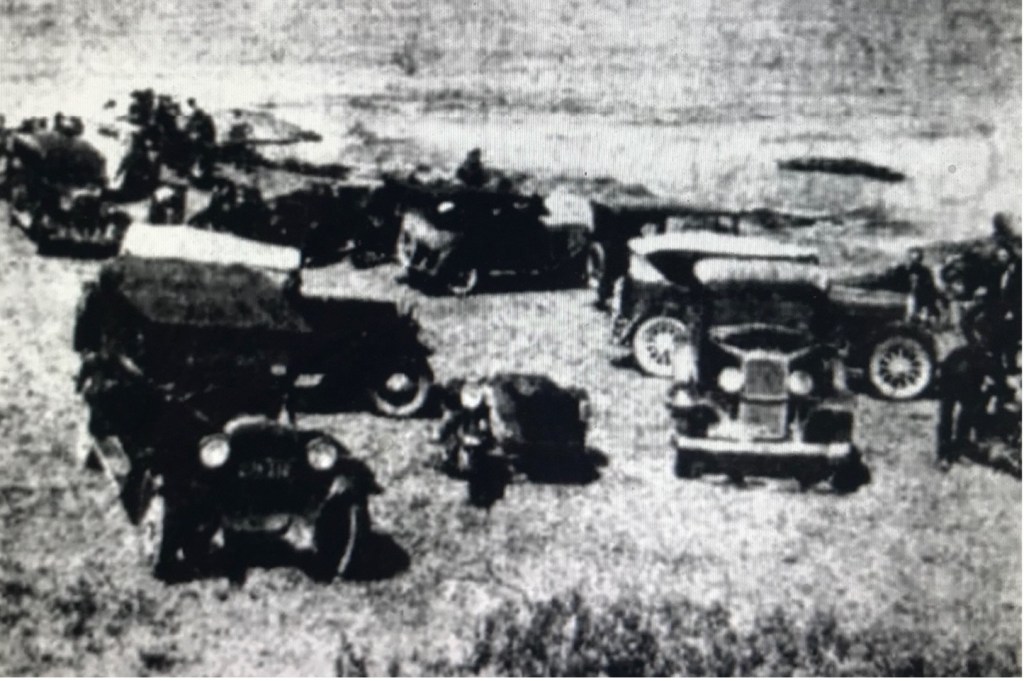
Some of the cars and motorcycles at Morna Point Beach for the motorcycle rally
Flying Quarter Mile Championship – 1938
The Newcastle Morning Herald and Miners’ Advocate of 11 October 1938, page 2, reported:
‘Newcastle motorcyclists were active throughout winter, and with the coming of spring the A.J.S. and Velocotte Club set aside last Sunday for fun and speed at Morna Point beach. The beach was in perfect condition, and a slight north-easterly was blowing. Many riders and their friends made a weekend trip and camped at Morna Point on Saturday night. A record crowd of spectators, estimated at 4000, attended. Hundreds of cars and motorcycles were parked on the grassy head lands. Since it was low tide at 2 p.m., the officials inspected the beach at noon, marked off a smooth stretch of sand, and issued numbers to the riders. Forty-eight riders competed, and the speeds were much higher than in last year’s championships.
All records were broken. Len Holliday (Rudge) was the fastest rider of the day with a speed of 109.7 miles an hour and won the over 500 Northern district championship. Jack Towner also on a Rudge, was second with 108.4 miles an hour, and Lance Wilson was third at 105.8 miles an hour. The 3.50 championship was won by Frank Bortkovitch, on a Triumph, at the surprising speed of 95.7 miles per hour. Ken Low (Velocette) was second at 91.8 miles per hour, and Reg. Corbett (Velocetta) was third at 87.3 miles per hour. The 2.50 championship was won by Inn Cameron (Velecette) at 77.5 miles per hour, with W Allanson (Rudge) second at 70.3 miles per hour, and Albert Prescott (A.J.S.) third at 69.2 miles an hour. The sidecar championship went to J. Nolan (Rudge) at 90 miles per hour, with Art. Nicoll (A.J.S.) second at 73 miles per hour, and F. Cowan (Velocette) third at 69.2 miles per hour. The handicap event resulted in a dead-heat between Ken Low (Velocette) and J. Nolan (Rudge and sidecar), with F. Bortkevitch (Triumph) third.’
Flying Quarter Mile Championships – 1939
On 5 March 1939 a handicap flying quarter-mile championship was held at Morna Point Beach.The Newcastle Sun of 7 March 1939, page 4, reported:
‘Despite unfavourable conditions on the beach there were some fast runs in the flying quarter-mile held by the Newcastle Club at Morna Point. During part of his run in the 350 c.c. championship, Frank Bortkevitch (m.a.c. Velocette) was clocked to reach a speed of 97.8 m.p.h., a remarkable pace for a 350 machine. Results of the tests were:— Unlimited c.c. Northern District championship: J. Towner (Rudge), 104 m.p.h., 1; B. Grahame (Rudge), 104 m.p.h., 2; H. Rainger (racing Norton), 88 m.p.h., 3. 350 c.c. championship: F. Bortkevitch (Velo.). 94 m.p.h., 1; J. Pringle (racing Norton), 90 m.p.h., 2; H. Rainger (racing Norton), 88 m.p.h., 3. Handicap: B. Grahame, 104 m.p.h., 1; F. Bortkevitch, 94 m.p.h. and W. Coxon, 85 m.p.h., dead-heat, 2.’
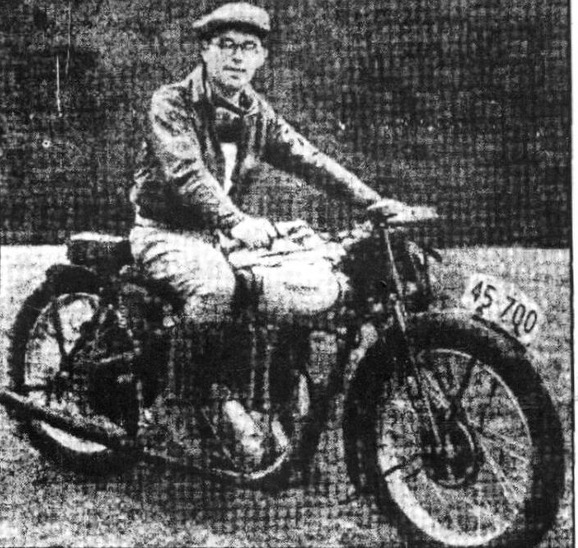
Frank Bortkevitch, was a frequent competitor at Morna Point Beach
Time Trials – 1939
The Newcastle Sun of 8 November 1939, page 7, reported on a cycle competition held at Morna Point beach by the Royal Enfield Motorcycle Club on 5 November 1939:
‘The beach at Morna Point is still retaining its popularity as a course for speed trials and championship events. Last Sunday the Royal Enfield Motorcycle Club held trials on a T.T. [time trial], which provided interesting and spectacular racing.’
Speed Championship – 1939
The Newcastle Morning Herald and Miners’ Advocate of 21 November 1939, page 12, reported:
‘The Northern District speed championships to be decided by the A.J.S. and Velocette Motorcycle Club at Morna Point Beach next Sunday are creating interest. Don Bain, the Sydney rider, who is one of the most consistent road racers in New South Wales, will be mounted on the 500 c.c. o.h.c. Velocette he has used at Panorama circuit, Bathurst. Tom Jemison, who holds the 2.50-c.c. Australasian records at more than 100 miles per hour, will be astride a 3.50 M.A.C. Velocette. Entries may be received from other Sydney riders. …… As it is anticipated there will be a large crowd, visitors are advised to catch an early punt to Stockton. The tests will be over a measured quarter mile. They will be electrically timed.’
The Newcastle Sun of 29 November 1939, page 6, reported on Don Bain’s new record at the championship held on Sunday 26 November:
‘Over two thousand people made the trip to Morna Point Beach on Sunday last, to witness the most successful speed championships ever held in the Northern Districts. Chief interest was centred in the appearance of the two well-known Velocette riders. Don Bain, who has been consistently placed in road racing events throughout Australia over the last ten years — and Tom Jemison, winner of many light-weight races, and holder of the Australasian 2.50 c.c. motorcycle record.
Those who made the journey expecting to see these two riders perform were not disappointed as Bain hurtled down the measured stretch at 115.38 miles per hour shattering the Northern District record by six m.p.h.— winning the all powers’ championship. Tom Jemison, riding a 3.50 machine, broke the 3.50 record (previously held by Cec Weatherby, at 100 m.p.h.) by over 7 m.p.h.. easily winning the 3.50 championship. The 2.50 c.c. championship was won by the Maitland rider, Ian Cameron. Len Holliday, the Rudge rider, was the fastest local, with 111.11 m.p.h., being 3 m.p.h. better than his teammate, Jack Towner. The handicap resulted in a dead heat for first place between Frank Sheddon, Sunbeam, and E. Charlesworth, Velocette, with Bain and Jemison dead heat second.
The Newcastle Morning Herald and Miners’ Advocate of 28 November 1939, page 2, published the following photo of the event:
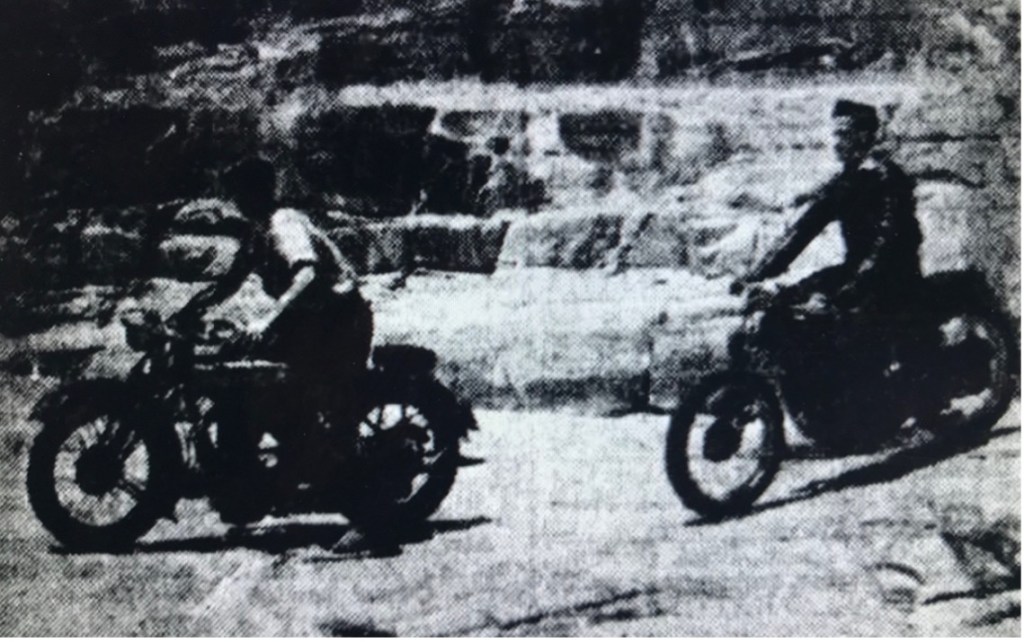
Morna Point motorcycle meeting. Two riders racing over bad ground in the motor-cycle races in which records were broken
Acceleration Championship – 1940
The Newcastle Morning Herald and Miners’ Advocate of 12 November 1940, page 7, reported on the Acceleration Championship held at Morna Point on 9 November 1940:
‘A good crowd of motorcyclists braved the bad road to see the 440 yards Northern District acceleration championship at Morna Point Beach on Sunday. The beach was in good condition, but a strong wind was against competitors. …. The all-powers championship was won by J. Towner (Rudge). His time was 16 1-5sec. G. Hoffman, who rode a Tiger 100 Triumph, competed for the first time, and carried off the handicap from the 5yd. mark. J. Donald (Velocette) won the 3.50 championship.’
Racing Suspended During the Second World War – 1940 TO 1945
Motorcycle racing was suspended at Morna Point Beach from 1941 to 1945 due to the Second World War. From December 1942 to November 1943, persons were prohibited from travelling to the Port Stephens region by the military authorities. Further disruption to motorcycle racing was caused by many cyclists enlisting in the armed services, and also that the military authorities requisitioned many private motorcycles for their use.
Speed Championship Meeting – 1946
Motorcycling speed trials were due to recommence at Morna Point Beach on Sunday, 8 September 1946, but were cancelled due to treacherous conditions on the beach.
The Newcastle Sun of 10 September 1946, page 15, reported as follows:
‘Between 4000 and 5000 people visited Morna Point Beach on Sunday for the A.J.S. and Velocette Cycle Club’s speed championships, but because of the treacherous condition of the beach, which was covered with slimy weed, the officials, after conferring with the riders and A.C.U. [Auto-Cycle Union] steward, cancelled the events. To keep faith with the public, about 20 riders made speed tests over a measured quarter of a mile and best runs were those of Don Bain (2¾ Velocette) 101.1 miles per hour; S. Holliday (3½ Rudge), 100 m.p.h., and R. Kessing (2¾ Velocette), 96.7 m.p.h. The incoming tide made further attempts impossible. A meeting will be held at P. and R. Williams on Thursday, when riders and officials will decide on another date for the championship meeting.’
The Newcastle Sun of 16 September 1946, page 16, reported on the new date for the cycle championship:
‘The [A.J.S. and Velocette Club] meeting held at the club rooms decided on December 8 as the date for the running of the Northern N.S.W. speed championships at Morna Point beach. Tide will be low at 2 p.m., and a rise and fall of 5ft. 71n. will give approximately twice the sand that was available last Sunday week when the event was postponed owing to unfavourable conditions.’
The Newcastle Sun of 30 October 1946, page 15, further reported:
‘Much advance interest is being created by the motorcycle speed championships to be held at Morna Point Beach on December 8. The Auto-Cycle Union of N.S.W has granted the A.J.S. and Velocette Motorcycle Club an open licence for the event. It will be run under open competition rules. All competitors must be members of an affiliated club and have current competition licenses. It is also planned to arrange a camp at Morna Point on the night before the event.’
The Newcastle Sun of 4 December 1946, page 5, provided further details of the planned Motorcycle Speed Championship:
‘Motorcyclists from all parts of northern New South Wales are preparing for the A.J.S. and Velocette Motorcycle Club’s Grand Gipsy run and speed championships meeting at Morna Point next weekend. This will be the first weekend that the club will be under canvas for many years. Saturday night’s items start at 8 o’clock. A concert programme will be held among the ti-trees and sandhills around the beach. All riders and visitors are asked to report to the camp marshal on arrival. Selection of “Miss Motor-cycle 1947” will be made on Sunday morning. The speed championships will be decided in three classes and spectators are assured of a feast of speed, with motorcyclists hurtling along the sand at more than 100 m.p.h. with the sea as a background.’
The Newcastle Sun of 10 December 1946, page 14, reported on the re-scheduled speed championship, held on Sunday 8 December:
‘The open speed championships conducted by the A.J.S. and Velocette Motorcycle Club at Morna Point beach on Sunday was attended by over 3000 spectators, despite a nasty wind that made conditions very unpleasant.
The beach was very heavy, and times generally were approximately 10 miles an hour slower. Ron Kessing (Velocette) with a speed of 105.8 m.p.h. won the senior championship by a narrow margin from Len Holliday (Rudge). 104.6 m.p.h. and Jack Towner, Ray Taylor and Bob Grahame, all mounted on Rudges, dead-heated for third place. The junior championship was won by a new rider, Ron Renfrew (Velocette) 83.2. The lightweight championship was taken by Doug Cohen (Velocette) at 76.9 m.p.h. The handicap resulted in a dead-heat for first between G. Engel and B. Taylor on Rudges and C. Munns (B.S.A.) was third. A meritorious performance was Keith Wilson’s 76 m.p.h from an ex-army side valve B.S.A. Miss Jessie Griffiths was selected as Miss Motorcycle for 1947. The Gipsy run was a real success and competitions resulted: Rider coming longest distance. Fred Sampson, Gunnedah; oldest rider, Bill Thomas; oldest machine, Mr. Blane; lowest licence number, Bill Thomas: motorcycle quiz, Mr. Goodman.’
End of Motorcycle Racing at Morna Point Beach – 1947
The speed championship meeting held on 8 September 1946 was the last to be held at Morna Point Beach.
At various periods after the conclusion of the Second World War, the military used the Stockton Bight, which included the Morna Point Beach for military live fire exercises which were incompatible with the organisation of speed races and associated large crowds. The possible presence of unexploded ammunition over the speed course would also have posed a high risk.
EPILOGUE
Motorcycle racing was predominately a male sport. There were several women enthusiasts one of whom was Linda McKenzie. She claimed to have equalled the speed record at Morna Point Beach of 123 m.p.h. but this was not verified.
The Newcastle Sun of 23 February 1950, page 3, reported on how Linda McKenzie’s life was bound up in motorcycles:
‘Some young women are interested in careers and some in marriage, while others are simply just “not interested.” But if you ask 22-year-old Englishwoman Linda McKenzie where her interests lie, she will not be long in answering — “motor cycles.”
With Miss McKenzie they are a mania. This really is not surprising, for all the members of her family were riders. Literally speaking, she was brought up on a motor bike, as she started riding at the age of 14. …..Before migrating, Miss McKenzie gained her “wheels and wings” as a member of the Rochester Cycling Club. She has raced on many tracks in England, and also has ridden on the famous TT [time trial] course on the Isle of Man. But by her accounts she seems to have gained her real experience in Australia. ……
Recently she clocked her fastest speed. She claims she reached 123 miles an hour on the Morna Point track near Nelson’s Bay. But even that hasn’t satisfied her. Her ambition is to be a speedway rider, and to travel round the country by motorcycle. Miss McKenzie is an enthusiastic member of the Wollongong and Lake Illawarra Motorcycle Clubs and is waiting to join a Newcastle organisation. When interviewed by a “Newcastle Sun” reporter, Miss McKenzie was bravely struggling with a large new motorcycle she had just bought, one could see that, though only small, she was no amateur in the saddle.’
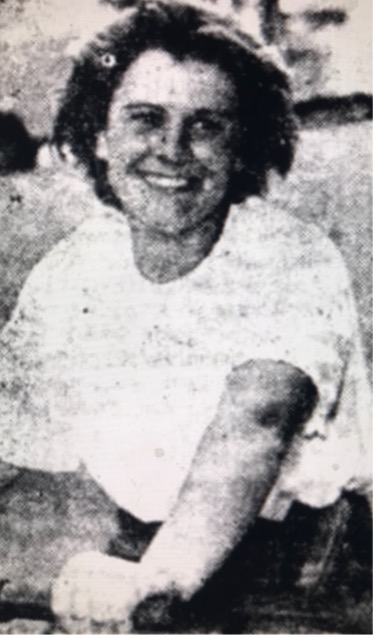
Linda McKenzie
Linda McKenzie’s record attempt was the last racing activity reported at Morna Point Beach.
The Maitland Motorcycle Club planned a meeting on the beach for the 28 October 1951, but it appears that the event did not take place.
Researched and compiled by Kevin McGuinness
June 2022

 Port Stephens - a history exploration