
The need for safe enclosed swimming baths, to attract tourism and to cater for the local residents, was widely recognised throughout the Port Stephens area in the 1920’s.
The need for swimming baths at Tea Gardens was first recognised in 1902 as revealed in the Dungog Chronicle of 23 December 1902, page 3:
‘The Progress Committee have received a lease from the Lands Department of a portion of the river to erect baths thereon. Such a thing is greatly needed, and when erected will be much prized by local residents and visitors during the hot weather. It is the intention of the Committee to hold a ball shortly to raise funds, so as to procure the necessary funds for material.’
It appears that nothing came of this proposal.
This paper is the Is story of the history of the two swimming baths facilities that were built on the same site on the foreshore of the Myall River at Tea Gardens, near the present day ferry wharves.
FIRST SWIMMING BATHS
Construction of New Swimming Baths Commenced – 1921
The Newcastle Morning Herald and Miners’ Advocate of 23 November 1921, page 2, reported:
‘A movement was recently started at Tea Gardens to raise funds for the construction of swimming baths. It was taken up with enthusiasm, and over £50 has already been raised. The baths are now in course of construction. They should prove a convenience to tourists and will permit of children learning to swim without being exposed to the shark danger.
The Raymond Terrace Examiner and Lower Hunter and Port Stephens Advertiser of 25 November 1921, page 2, also reported:
‘Swimming baths at Tea Gardens are now in course of construction, and it is hoped will be completed for the Christmas holidays. The baths will prove a great acquisition to the Tea Gardens, which is fast becoming a most popular tourist resort, but this aspect is not so important as compared to the necessity of providing safe bathing for children who, under present conditions daily run the risk of being taken by sharks. Contributions will be received by H. Engel, Jnr., Hon. Treasurer, and if forwarded through the Post should be addressed Tea Gardens.’
New Baths Illuminated by Electric Light for the Annual Carnival – 1922
The Maitland Daily Mercury of 24 January 1922, page 4, reported:
‘The first grand annual carnival under the electric light will be held at the public baths, Tea Gardens, on Friday next, and there will be a programme of horse racing on the Saturday. Father Neptune will appear from the depths to open the carnival at 7.50.
The programme will include swimming races, tub races, diving competitions, life-saving exhibitions, competition for undressing in the water, walking the greasy pole, riding the barrel, fancy swimming and diving and other aquatic sports. There will be a fancy dress parade, and the steamship ‘Myall River’ will be moored to the baths to provide a concert during the progress of the carnival. The baths will be illuminated by electric light, supplied by the s.s. Reliance. The Tea Gardens Rowing Club will hold their annual carnival championship for a trophy, valued at £10/10/ (a medal). Entrance is free, and the event is open to allcomers. There will also be sculling races, which will be handicapped by W. Ripley, champion sculler.’
Official Opening of the Swimming Baths – January 1922
The Raymond Terrace Examiner and Lower Hunter and Port Stephens Advertiser of 3 February 1922, page 3, reported:
‘The carnival arranged to emphasise the opening of the Baths was held on Friday afternoon, evening and on the following day. The attendance was one of the best that has been seen at Tea Gardens, and everything passed off satisfactorily. Rowing events in the afternoon were well contested and produced considerable interest. The events more closely associated with the baths were held at night.
Prior to the programme Mr. R. A. Price who was present opened the Baths and expressed many compliments to the promoters of the movement for the Baths, and to the public who subscribed. The baths he though a great acquisition and would serve to popularise Tea Gardens and make it a prominent watering place. He wished success to the natatorial venture.
As Father Neptune arose from the grimy depths of the baths, robed in his sea mantle and trident, the opening of the baths was announced by Mr. Price, who further explained the origination of such a time-honoured god of the deep as Neptune. The large attendance applauded the opening. The events of the programme were tub races, riding the barrel, diving and swimming. for boys, youths, and adults, and some close finishes resulted, though no champions competed. They will come along at the next annual fete.
Tip top lighting arrangements were supplied by Thurlow and Co., a full electric voltage being kept up during the carnival. On board the Myall River kindly lent by the N. & H. R. S. S. Co. a concert was held, and the programme was fully enjoyed. The evening passed off very satisfactorily, and creditable to the committee and the activity of the secretary On Saturday horse racing was held on a new track, 5 furlongs, near the town, and it proved very convenient, and a fine course.’
Swimming Baths in a Dangerous Condition – 1926
The Dungog Chronicle of 30 November 1926, page 2, reported:
‘The public baths at Tea Gardens are still in a dangerous state. Five piles have been driven, but between them the biggest shark may enter and attack the bathers. Christmas is almost upon us and visitors to the town will not relish risking their lives for the sake of a dip in the Myall River. The wire netting for the baths is on the public wharf, and it is hoped the shire will get men to do the work forthwith.’
Repairs Required at Swimming Baths – 1930
The Dungog Chronicle of 19 September 1930, page 4, reported:
‘The baths came before the Stroud Shire at its meeting on Friday last, when the Engineer reported regarding cost [of repair]. Now that the Urban Area Committee is functioning it was resolved to refer the matter to this body for consideration as to whether the proposal meets with local requirements. It is desirable that this question is not unduly delayed as summer will be decreed any week, and the need of the baths will be in great demand. If the surf beach at Hawks Nest was accessible by means of a ferry service, there would not be the same insistent demand for the baths. The Urban Area Committee will be fully competent to say whether the proposed expenditure will be justified, or make a concrete suggestion for satisfactory repairs on an economic basis that will be justified in accordance with income from the Urban Area.’
The Dungog Chronicle of 17 October 1930, page 4, further reported:
‘The question of repairs and cost was before Stroud Shire last meeting, and it was decided to refer the matter to the Urban Committee for further consideration with a view of submitting a more economical proposition [for repairs].’
Swimming Baths Repaired – 1930
The Dungog Chronicle of 12 December 1930, page 4, reported:
‘Messrs. G. A. Engel and, Sons, who secured the contract for repairs to the Tea Gardens swimming baths, expect to have the work completed this week. The baths were safe for bathers during the whole of the week, and many have enjoyed a daily dip in the salt water of the Myall.’
The Dungog Chronicle of 26 December 1930, page 4, further reported:
‘The Urban Area Committee and the Stroud Shire are popular over being responsible for making the baths safe. Sunday morning last a great crowd congregated at the baths, and various forms of diving were displayed by the younger bipod of Tea Gardens.’
Swimming Baths Fall into Disrepair – 1937
A letter to the editor of the Dungog Chronicle 19 November 1937, page 4, states that the swimming baths had fallen into disrepair, thus requiring new baths to be constructed:
‘The Tea Gardens swimming baths, originally constructed entirely by public enterprise and at the expense of local residents were, when completed, handed over to the Stroud Shire Council in good working order and free of debt. During the last twelve months the baths have been allowed to fall into such an advanced state of disrepair as to become positively dangerous to bathers, who are not only liable to shark attack, but might be severely injured by diving upon the broken pile edges some feet under water.’
SECOND SWIMMING BATHS
New Swimming Baths Required – 1937
The Dungog Chronicle of 21 May 1937, page 6, reported:
‘The Tea Gardens Urban Committee’s Secretary, Mr. V. Edmonds, advised that the President, Mr. E. W. Motum was unable to attend the meeting [with Stroud Shire Council] as had been suggested and deputed Cr. Zeininger to act in the Committee’s stead in the matter of the provision of baths at Tea Gardens. The letter intimated that if Council could raise £700 for the purpose, the Committee would be agreeable to an additional rate of one penny in the £. Cr. Zeininger stated that the matter had been discussed exhaustively and he had come to the conclusion that 1d. in the £ would be insufficient to repay all the money required to finance the project but the number of visitors was increasing and had doubled in the last 12 months.
There was now a great demand for public baths. He suggested that the special rate be used primarily for general improvements and then diverted to other matters. Cr. Zeininger said it was a matter for decision between the Engineer and the Committee. Mr. Stone said that he would endeavour to meet the Committee on Tuesday 25th inst. The Engineer added that Mr. Spooner had given £800 towards £1500 baths for Tuncurry and may act similarly in regard to Tea Gardens. The Engineer was instructed, on the motion of Crs. Zeininger and Higgins, to meet the Urban Committee at an early date to investigate the proposition.’
Plans for New Swimming Baths Displayed – 1937
The Dungog Chronicle of 25 June 1937, page 4, reported:
‘A plan of the proposed baths, dressing sheds, etc. for Tea Gardens were displayed in Engel’s window last week. The plan was elaborate and judging by the standard of other structures erected by the Stroud Shire, the cost may be in the vicinity of a couple of thousand pounds.’
The Dungog Chronicle of 20 August 1937, page 4, further reported:
‘The Clerk [of Stroud Shire Council] stated that the matter [of the new baths] was now in the hands of the department [of Local Government] and on the motion of Crs. Zeininger and Wilson, it was resolved that the department be asked to deal with it expeditiously.’
Government Representative Visits Baths Site – 1937
The Dungog Chronicle of 27 August 1937, page 4, reported:
‘Mr. H. G. Harmer of the Local Government Department, accompanied by Mr. F. Stone, Shire Engineer paid a visit to Tea Gardens on Wednesday, 18th inst to inspect the site for the proposed new baths. They were met by members of the Urban Committee and the plans were discussed.’
Loan Obtained for the New Swimming Baths – 1937
The Dungog Chronicle of 17 September 1937, page 6, reported:
‘[Stroud Shire Council received correspondence] from the Mutual Life and Citizens’ Association advising that it was prepared to make available to Council a loan of £750 towards the construction of baths at Tea Gardens, estimated to cost £1500. The terms of the loan were at 4½ per cent. over 15 years, repayable in 30 half-yearly instalments of £34/13/.
Cr. Zeininger moved that application be made under seal for permission to take out a loan of £750 for the purpose stated. He added that he would like it understood that the special rate to be levied was not to be for repayments only but was for general improvements. The Clerk mentioned that he was required to state on the application the rate proposed to be levied and the total amount it was expected to yield. Cr. Zeininger’s motion was seconded by Cr. Higgins and carried. On the motion of Crs. Turner and Higgins it was resolved that the President, Cr. Zeininger and the Clerk be authorised to finalise the matter with the Tea Gardens Urban Committee.’
The Dungog Chronicle of 15 October 1937, page 6, further reported:
‘Correspondence to the Stroud Shire Council] from Tea Gardens Urban Committee agreeing to the Council raising a loan of £750 towards the cost of construction of baths at Tea Gardens, and also agreeing to make the repayments of principal and interest of £34/13/ each half year; also desiring the Council to make a rate levy of 2d in the £ in the Urban Area for general improvements.’
Swimming Baths to be constructed at Nelson Bay – 1937
The Newcastle Morning Herald and Miners’ Advocate of 25 December 1937, page 12, reported that tenders had been called for the supply of piles for the Tea Gardens pool. It noted that construction of swimming baths was also in progress at Nelson ‘s Bay on the southern shore of Port Stephens.
‘Nelson’s Bay and Tea Gardens are to have public baths. Work is in progress on the former, at the entrance to Port Stephens. In anticipation of the approval of the loan with which to carry out the work at Tea Gardens, the Shire Engineer (Mr. F. G. Stone) has called tenders for the supply of 32 piles, each 35ft. long, and 175 piles 33ft. long, delivered at the site of the baths.’
Plans for Swimming Baths Amended – 1938
The Dungog Chronicle of June 1938, page 4, reported:
‘The Engineer [of Stroud Shire Council] submitted an amended plan for the proposed river baths at Tea Gardens. He said that the amendments had been made at the request of the Department’s Engineer. Cr. Zeininger moved that the amendments be approved. The amended scheme was an improvement on the previous one, and he moved further that the plan be submitted by the President and Engineer when waiting on the Minister in connection with the Forster tourist camp proposal. Seconded by Cr. Miles and carried.’
Opening of Swimming Baths – December 1938
The Maitland Daily Mercury of 3 December 1938, page 6, reported:
‘To-day was a red-letter day for Tea Gardens, when Mr. C. E. Bennett, M.L.A., officially opened the Tea Gardens swimming baths, which were constructed in conjunction with the marine drive and Bulahdelah -Tea Gardens scenic road, at a total estimates cost of £14,300. Portion of this money was provided under the Spooner scheme for tourist development.
The sunny weather attracted a large number of visitors. The baths adjoin the marine drive and are centrally situated. They are on the Myall River and are tidal. The swimming pool is 150ft. by 90ft. at high tide. The enclosure includes a promenade around the whole of the pool. The buildings, which are colourful, are timber framed with outside walls covered with 11 in. round edge tallow-wood weatherboards, specially cut from local timber and with mitred corners. Two massive round concrete columns form the pillars to the main entrance, which is elevated above the wings containing the dressing sheds. The main entrance is lined with masonite dado and has a canite ceiling.
The dressing sheds are lined with fibro-cement. The whole of the inside and outside promenade immediately surrounding the building has been turfed. The colour scheme is cream walls, white eaves, carmine shutters and bright blue doors. The roof is covered with blue Marseilles tiles. The pool surround is painted white. The new marine drive opens up a new outlook for the increasingly popular tourist resorts of Tea Gardens and Bulahdelah.”
The Dungog Chronicle of 9 December 1938, page 4, also reported:
‘Visitors from Gloucester, Stroud, Bulahdelah, Dungog, Maitland, Newcastle and intervening centres were present at the opening of the new baths and road at Tea Gardens on Saturday last. The baths cost approximately £1800, and the road and Marine Drive about £12,500. Designed by Mr. Engineer Stone, the baths are an architectural ornament, and will be a great boon both to local residents and visitors.
The new, road links Tea Gardens with Bulahdelah, some 20 miles in length, and eventually will link Gloucester district with this popular seaside resort when the remaining few miles on the Bulahdelah-Gloucester road are completed. With an electricity supply to be instituted in Tea Gardens in the near future, the town should achieve greater popularity.
Cr. A. Turner, President of Stroud Shire Council, presided at the official opening. He was supported by Cr. R. E. Zeininger (Stroud Shire), Cr. H. Bignell (Gloucester Shire), Mr. E. Motum (Tea Gardens Urban Committee), Mr. W. Cutcher and Mr. H. Travis (Forster Urban Committee), Mr. H. H. Adcock (Stroud Shire Clerk), Mr. F. G. D. Stone (Stroud Shire Engineer), and Hon. J. R. Lee (member for Drummoyne). The speakers referred to the progress of the town and district, and to its wonderful attractions. The Shire Council and Urban Committee were praised, and complimentary reference was made to the local member (Mr. Bennett), and to the Minister for Works and Local Government (Mr. Spooner).
The Government provided 60 per cent. of the money involved in the improvements. Hon. J. R. Lee said that this was his first visit to the locality, and he was charmed with it. He was pleased to find that the people and the Council and Urban Committee were progressive, and that opportunity had been taken to make use of the Spooner scheme to advance the town and district. They had a sympathetic Minister in Mr. Spooner, who was very sorry that he could not be present that day. Mr. Lee also referred to the good work done by Mr. Bennett, who was ably following, the footsteps of his revered father.
A ribbon was stretched across the roadway and was cut by Mrs. Bennett, who expressed the hope that many folk would pass along the road and find happiness and good health in Tea Gardens. In performing the official opening, Mr. C. E. Bennett, M.L.A., said it was a day that never should be forgotten. There was provided not only a good road, but modern and artistically constructed swimming baths. He said he and Mrs. Bennett were present at the opening of the old baths some sixteen years ago, and did not dream that they would be present at the opening of the new baths that were to come.
Mr. Bennett referred to the pioneering efforts by local citizens and himself to popularise Tea Gardens as a tourist resort and to the success that had been achieved. He hoped that in the defence proposals the great harbour of Port Stephens would not be forgotten. Naval experts from Great Britain had stated that Port Stephens was of strategic importance and constituted a very vulnerable spot on the coast of this State. A good road or railway was needed if only for defence purposes, and there should be improvements to the naval base and arrangements for a seaplane base. Mr. Bennett complimented the Shire Council and its staff, and the workmen engaged on the job, and said that their efforts were sincerely appreciated. He trusted that when the baths were in full swing a determined effort would be made to teach each child in Tea Gardens to swim. Mr. Bennett then declared the baths officially open. The big crowd inspected the bath, and many enjoyed a pleasant swim. On the river eight sailing boats were gracefully racing along to the delight of the onlookers.’
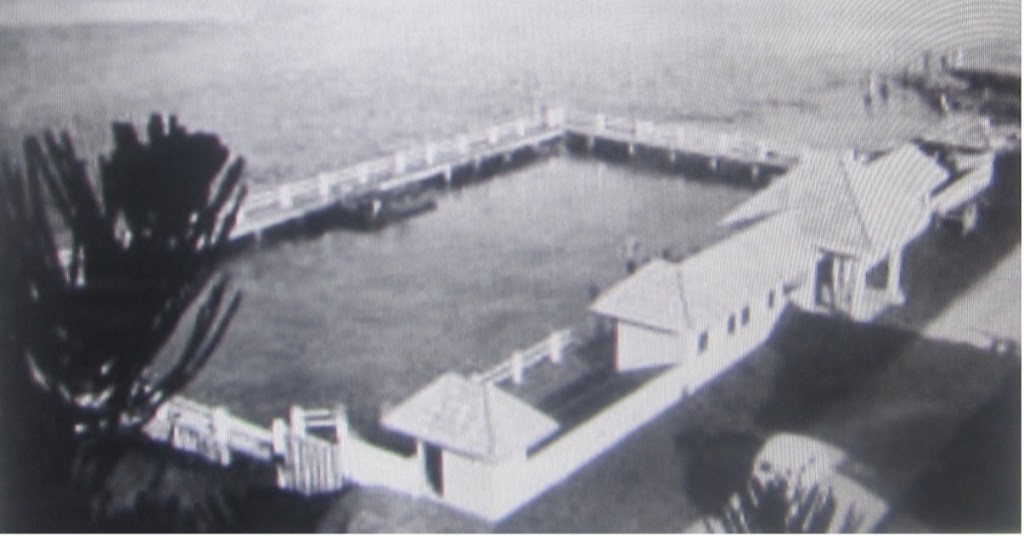
Swimming Baths at Tea Gardens, as illustrated on the plaque on the foreshore of the Myall River and published in the Newcastle Morning Herald and Miners’ Advocate, 1 December 1938
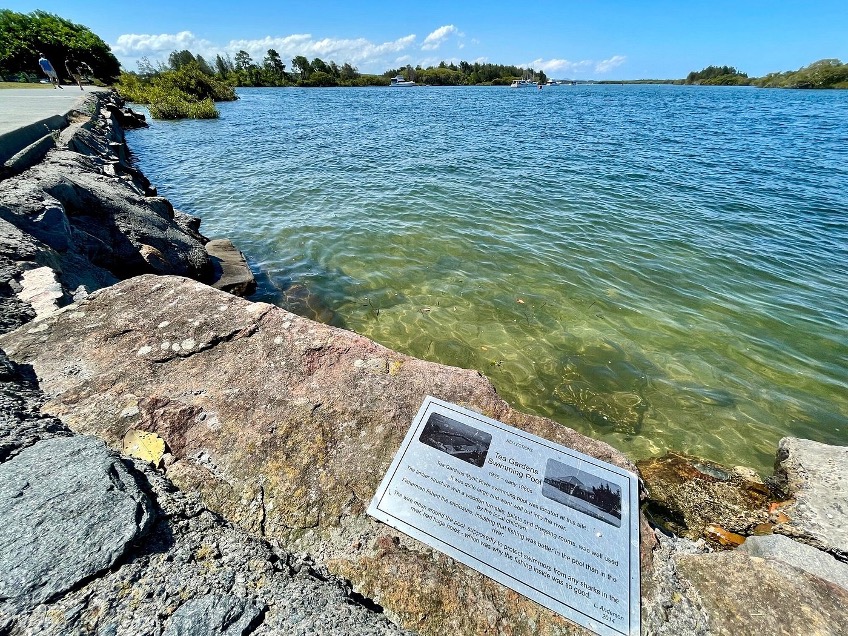
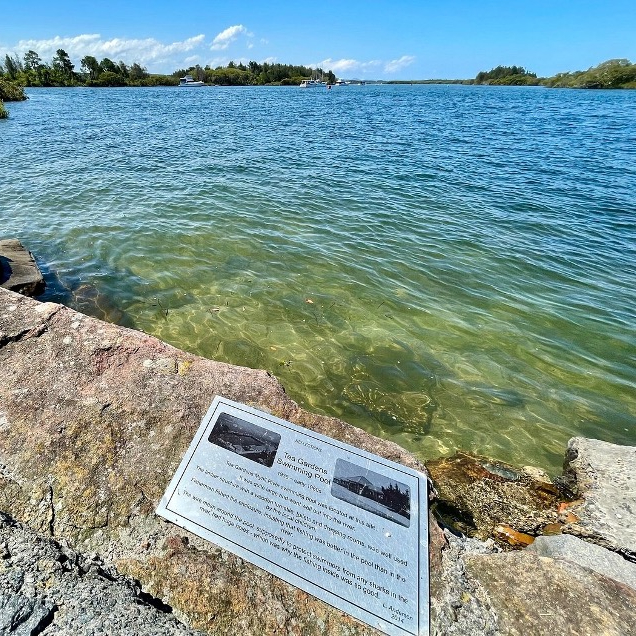
Site location of the Tea Gardens Swimming Baths and the plaque [Author photo]
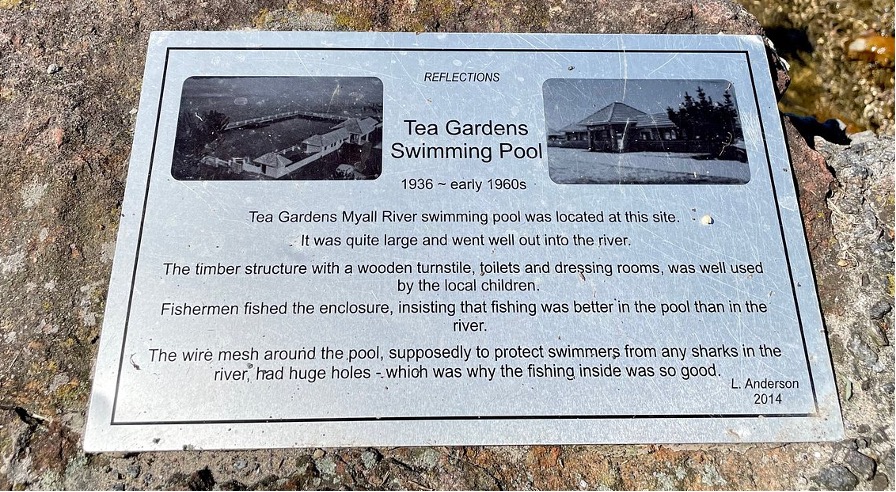
Plaque on site of the Tea Gardens Swimming Baths [Author photo]
Loan for Swimming Baths to Cover Over-expenditure – 1939
The Dungog Chronicle of 15 December 1939, page 6, reported:
‘Regarding Council’s proposed loan of £500 to cover over-expenditure on the Tea Gardens baths, and the Council’s application for Government assistance in this regard, the Department of Works and Local Government, through Mr. C. E. Bennett, M.L.A., advised that the Minister could not see his way to approving of any further Government assistance. It was pointed out, however, that the absence of assistance would not prevent the Council proceeding to borrow £500 by way of ordinary loan, as the provisions of the Act had been complied with by virtue of the grant of £500 already made towards the work. In the circumstances, therefore, action was now proceeding on Council’s application with a view to obtaining the Governor’s approval to the proposed ordinary loan. The clerk advised that in conversation with Mr. Havilland, of the department, he had been assured that the ordinary loan would be made available.’
Vandalism at the Swimming Baths – 1941
The Dungog Chronicle of 17 January 1941, page 4, reported:
‘At Stroud Shire Council meeting on Friday Cr. Zeininger complained of vandalism at Tea Gardens baths, where asbestos lining had been torn out and light globes smashed. Council decided to post notices that offenders if apprehended would be prosecuted.’
Defects at the Swimming Baths – 1945
The Dungog Chronicle of 24 July 1945, page 3, reported:
‘[Correspondence to Stroud Shire Council] from R. E. Schuck drawing attention to defects at the Tea Gardens Baths and asking Council to have them attended to, also suggesting that Council erect a man-proof fence around the baths. Cr. Zeininger moved that the Engineer inspect and report in regard to the matter referred to and also that he be instructed to ascertain the legal position of the Council and if in order to take definite action against people responsible for using the baths for a mooring place for boats. The motion was seconded by Cr. Abbott and carried.’
Management Problems – 1945 and 1946
The Dungog Chronicle of 20 November 1945, page 4, reported:
‘[Correspondence to Stroud Shire Council] from Tea Gardens Chamber of Commerce and also from R. F. Cripps, Headmaster, Public School, Tea Gardens, referring to matters in connection with the Tea Gardens Baths. On the motion of Crs. Abbott and Tunnock, a copy of the letters are to be forwarded to the caretaker of the baths.
Cr. Zeininger said that this would not get over the trouble. Mr. Schuck did his very best for the baths but he had his own business to look after and the baths needed somebody permanently on the job. He felt sure that it would be quite successful if some provisions were made for a kiosk in the baths enclosure so that a caretaker could have some business to supplement the income from the baths. He was not thinking of anything as expensive as had been visualised by the Acting Engineer in a recent report but a small kiosk that could be fitted up by the person concerned. Cr. Gibbons moved that Council call tenders for the lease of the baths with a right to the lessee to open a kiosk at no expense to the Council. Seconded by Cr. Green and carried.’
The Dungog Chronicle of 26 February 1946, page 4, further reported:
[Correspondence to Stroud Shire Council ] from T. G. Tudor proposing that if Council would extend on the present Tea Gardens baths building and erect a shop he would take responsibility for the whole supervision of the baths. Cr. Zeininger said his idea was that the Council should put accommodation in there so that the baths could be rented. The Council was losing revenue because the baths were not being looked after. This was no fault of the caretaker, who received a very small remuneration and who had his own business to attend to.
The President said that, he thought the matter might be allowed to stand over until Mr. Stone returns. Mr. Stone had designed the baths and would no doubt have some idea as to the best means of extension. Cr. Zeininger moved that the Engineer be asked, to make an inspection and prepare an estimate for a suitable building. He also moved that he, Cr. Zeininger, be authorised to obtain small mesh wire netting at a reasonable price to be erected to keep weed out of the baths instead of timbering as previously erected. The motion was seconded by Cr. Green and carried.’
A kiosk was constructed at the swimming baths later in 1946.
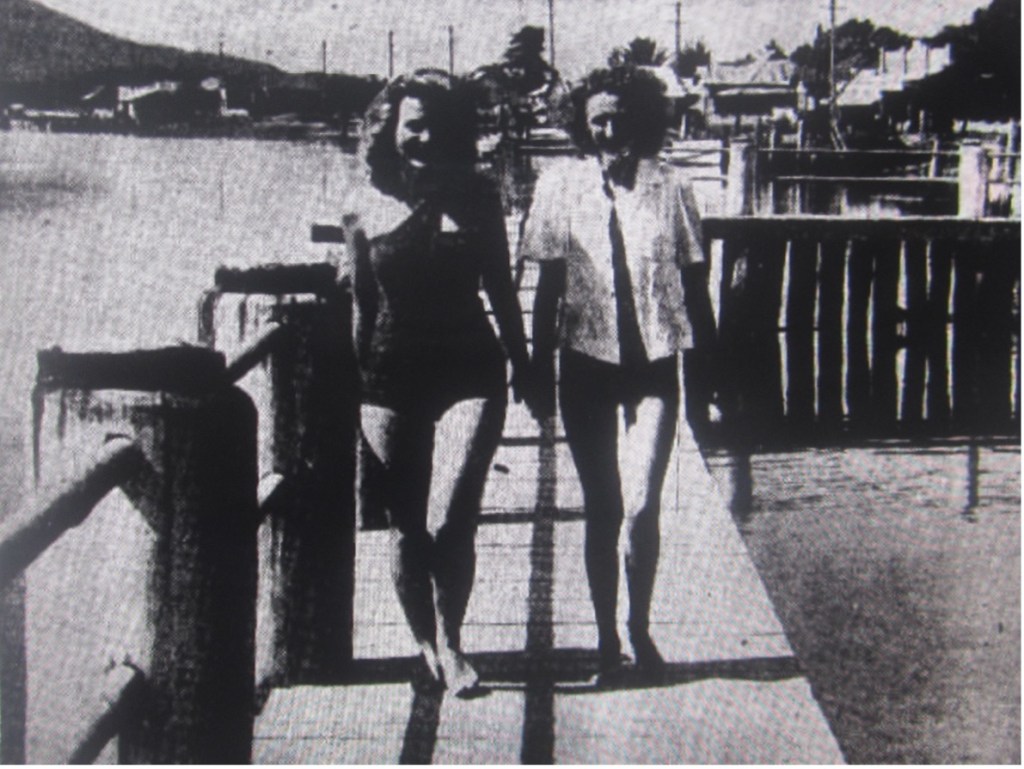
Two Bathers leaving the water at Tea Gardens Swimming Baths. Yacaaba Headland in the background at Left [Newcastle Morning Herald and Miners’ Advocate, 19 March 1947]
Fencing Required at the Swimming Baths – 1948
The Dungog Chronicle of 24 March 1948, page 4, reported:
[Correspondence to Stroud Shire Council] from T. Tudor requesting finalisation of lease of the cafe at Tea Gardens baths as soon as possible and also requesting that provisions be made to prevent people entering the baths enclosure other than through the entrance door. — On the motion of Crs. Abbott and Moore the Council decided that the matter of fencing be attended to as soon as possible.’
The Dungog Chronicle of 23 June 1948, page 4, further reported:
‘That when requesting payment of rent from Mr. Tudor in connection with the lease of Tea Gardens baths, the fact that the improvements to the buildings have not been completed, be taken into consideration.’
Epilogue
The Tea Gardens Swimming Baths continued in operation until the 1960’s.
A proposal for the construction of a new swimming pool away from the river’s edge, in nearby Marine Parade, was made in 1974. Fund raising activities were undertaken by the a Swimming Pool Committee. These included an Art Union and later a ‘Buy a Brick’ campaign.
In 1977, the Great Lakes Shire Council resolved to construct a 25m 6 lane swimming pool, together with necessary facilities and amenities. Construction commenced in 1979 and the swimming centre became operational in 1982.
Today the Tea Gardens Swimming Pool is a community partnership between the MidCoast Council and ‘the Y NSW’.
Researched and compiled by Kevin McGuinness
December 2023.
POSTSCRIPT
A brochure was published, circa 1950, advertising both The Pavilion at Hawks Nest and the Swimming Baths at Tea Gardens. It is held in the New South Wales State Library Collection.
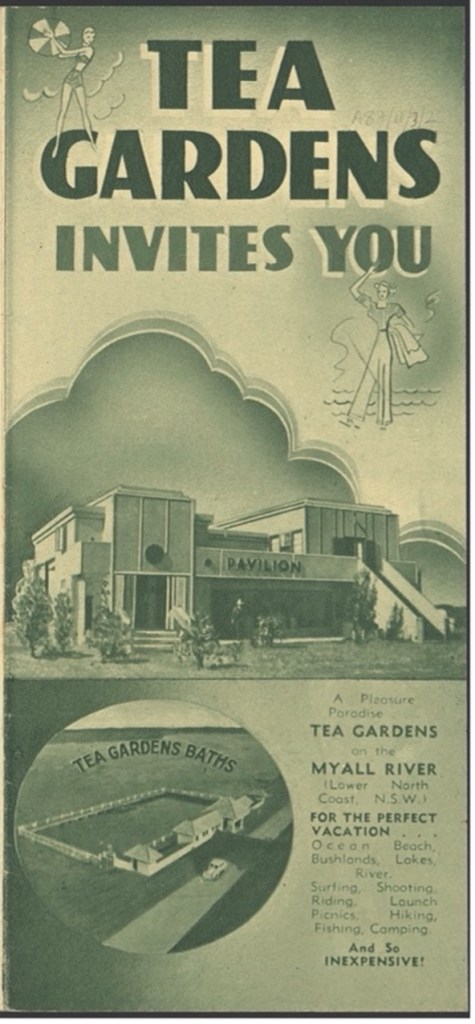
Cover Photo of Brochure [NSW State Library]

 Port Stephens - a history exploration