
Introduction
The 1920’s and 1930’s were the golden years for inaugural aviation activity in Australia.
Qantas [Queensland and Northern Territory Aerial Services Limited) was founded in 1920 and the Royal Australian Air Force (RAAF) in 1921.
The First World War was the catalyst for the rapid development of aircraft. After the War, many military pilots returned to Australia. Some continued their careers in the Services while others sought work in the nascent civil aviation industry.
Given the lack of landing fields across Australia, the increasing use of seaplanes that could land on our vast waterways, was logical.
The residents of Port Stephens recognised the opportunities posed by the expanding use of seaplanes and lobbied over several years for the establishment of a local seaplane base.
While a seaplane base was never established at Port Stephens, it did have several visits by such aircraft. This paper tells the story of Port Stephens’ various encounters with seaplanes and the lobbying to have a base established here.
Seaplane Damaged at Port Stephens – 1923
The Barrier Miner of 25 July 1923, page 4, reported:
‘A Curtis’ seaplane which is to inaugurate an air service between Adelaide and Port Lincoln arrived at Port Adelaide this morning by the ‘Corrimal’. The plane was put aboard in Sydney and the ‘Corrimal’ afterwards called at Port Stephens where she took aboard a shipment of telegraph piles. “While loading these a wire sling broke and the pole fell on the hulk of the flying boat breaking off 16ins. of the after portion. Lieutenant Miller, owner of the plane, stated that the accident was most unfortunate as it will necessitate intricate repairs after its assembly.’
Port Stephens and other sites examined for a Seaplane Base – 1923
The Sun of 27 November 1923, page 11, reported:
‘Since their arrival from Melbourne the crew of the seaplane which recently flew to Sydney has been spying out the land and the water for seaplane bases. There are plenty of possible bases on the New South Wales coast. There is Port Stephens, Lake Macquarie, and the lower Hawkesbury, all of which have been overhauled, while Jervis Bay is to be looked over. With the existing means of communication, however, such places as the lower Hawkesbury or Port Stephens, which offer good sites, are difficult of access by other means than the air. That is where a base on Sydney Harbor has the advantage. …… A base will probably be established either at Rushcutters or at some other suitable inlet of Port Jackson.’
First landing of a Seaplane at Port Stephens – 1924
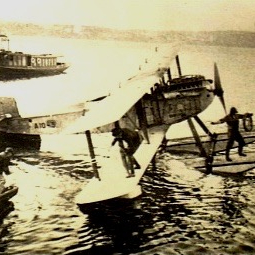
Wing Commander Stanley Goble, in his capacity as Chief of Air Staff, RAAF, in company with Flying Officer Ivor McIntyre, circumnavigated Australia by air in 1924
in a single-engined Fairey IIID floatplane. The purpose of the trip was for defence planning and to test the capabilities of the Fairey.
Due to bad weather, the seaplane was forced to land at Port Stephens en route to Southport. This was the first seaplane to land in the Bay.
The Daily Examiner of 8 April 1924, page 4, reported:
‘The Navigation Department ‘s seaplane, which is cruising round the Australian coast, left Sydney at 1. p.m. yesterday for Southport, via Yamba, but owing to the rough weather along the coast the machine put in at Port Stephens. The flight will be continued today if the weather conditions are favourable.’
The Singleton Argus of 12 April 1924, page 8, also reported:
‘Wing-Commander Goble, who was compelled to land in Myall River, in front of Tea Gardens on Monday owing to bad weather, left for Brisbane on Wednesday at 12.30. The seaplane alighted on the water at Southport (Q.), late in the afternoon.’
The Newcastle Morning Herald and Miners’ Advocate of 9 April 1924, page 7, further reported:
‘Wing-Commander Goble, who is engaged on a seaplane survey of the coast of Australia, arrived at Southport from Port Stephens this morning. It is expected that the aviator will spend the night at Southport. He will hug the coast and proposes to make Gladstone his next landing place.
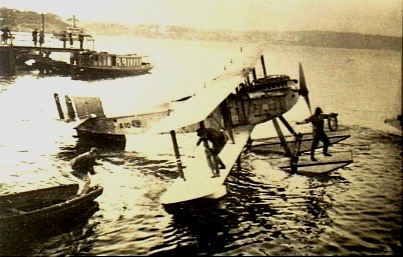
Fairey IIID seaplane flown by Wing-commander Goble that landed at Port Stephens in 1924 [Wikipedia].
Seaplane on Pacific Islands Expedition lands at Port Stephens – 1926
In 1926, Group Captain Richard Williams of RAAF, while on an exploratory mission to the Pacifc Islands, twice landed his seaplane in Port Stephens.
The Sydney Morning Herald of 6 December 1926, page 11, reported:
‘For unexplained reasons Sydney was unexpectedly omitted as a stopping place by Group Captain Williams in his return flight from the Pacific Islands. No intimation of this plan was conveyed to officials responsible for arrangements at Sydney yesterday, and a party waited to welcome him until it was nearly dark. When Port Stephens reported that Captain Williams had left there shortly before one o’clock, and no further news was received of his progress anxiety was felt as to the safety of the airmen. This was dispelled by official news during the night that the seaplane had been sighted over the Naval College at Jervis Bay during the afternoon.’
Further information on the Pacific Island Expedition of Group Captain Williams is available on this website.
Excursions by Seaplane proposed for Port Stephens – 1928
The Newcastle Sun of 5 November 1928, page 5, reported:
‘Within six months Newcastle will be the base for seaplane passenger services between Newcastle and Sydney, and Newcastle and Port Stephens, if the plans of a company (Sydney-Newcastle Airways, Ltd,) now being formed, are realised. …..
Plans for the Newcastle-Sydney service are well advanced. A tentative timetable has been prepared. It is proposed to run three return trips from Newcastle Harbor (near Walsh Island) to Sydney Harbor (near Rose Bay). Thee timetable allows an hour for the single journey, but the actual flying time will be only about 40 minutes. It takes almost three and a half hours in a “fast” train. The trip to Port Stephens will take only 15 minutes.
Only one return trip is intended at first — from Port Stephens early in the morning, and back after business hours. It takes between four and five hours to get there now. …. Eight passengers would be carried and each would have a big leather armchair, a table, a rack and a window. They would be in a cabin immediately aft of the pilot’s cockpit. It is proposed to run two of Short Bros. single-engined all-metal mono-plane seaplanes capable of 130 miles an hour and a minimum speed of 63 miles an hour. Less than 1000 yards, it is said, is needed for them to take off from, and they can do it in 10 seconds.
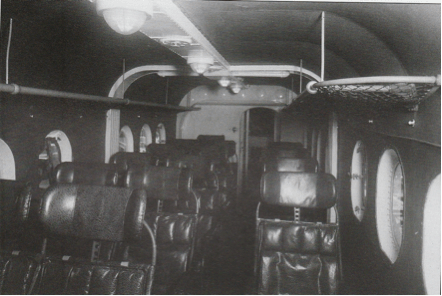
Interior of a Short Bros. seaplane, circa 1928
Safety is assured by the chain of lakes between Newcastle and Sydney, where the planes could “land” if anything went wrong. The ‘planes are seaworthy also. Flight-Lieutenant Schopper, who, it is hoped, will pilot one of the machines, once in one of these machines came down in the North Sea, it is said, and taxied 500 miles safely to port at Belfast.’
Intention to construct a Seaplane at Tea Gardens Port Stephens – 1929
The Dungog Chronicle of 10 September 1929, page 2, reported:
‘We understand that it is the intention of “Chips” Gronfors, of Tea Gardens, at a later date, of building a seaplane under the supervision of Flight Lieut. Curzon F. de Hamel, late A.F.C. [Australian Flying Corps], oyster lessee, Port Stephens, now resident at the charming spot, Bundabah, Port Stephens. The introduction of a locally constructed seaplane with its ideal base on the Myall River at Tea Gardens will be quite a modern innovation. Mr. de Hamel won his wings in the big war and will pilot the ‘plane.
This is the kind of local enterprise which more than anything else, will place Tea Gardens on the aerial map. Of course, Tea Gardens is quite familiar with ‘planes because this pretty “burg” is on the Sydney-Brisbane route. In Mr. de Hamel’s considered opinion the Myall River along Reservation Street is eminently suitable for the landing and security of seaplanes. No doubt this activity will preface the establishment of an aero club locally and bring into being other clubs along the coast. Tea Gardens should feel proud of its enterprising citizens for the publicity which will be created thereby, and it is that class of publicity that may be spelt with a big P. When the day of christening comes it is the intention of host Harris Port Stephens Hotel, of supplying the necessary potions of baptismal waters.’
There is no record of a seaplane being constructed at Tea Gardens.
Continued hopes for Seaplanes to visit Port Stephens – 1930/31
The Dungog Chronicle of 21 February 1930, page 4, reported:
‘Following, on the recent financial success of the aeroplane visit to Tea Gardens, we understand, that a seaplane will visit the port in the near future. The vast expanse of water makes this centre ideal for seaplanes, and we devoutly hope that in the not far distant future Port Stephens will be chosen as a government base.’
The Dungog Chronicle of 2 October 1931, page 4, also reported:
‘There is some talk locally that a section of the Australian Squadron will visit Port Stephens in the near future. It is some considerable time since the majestic waters of this port have had a visit from the Navy. It will be remembered that Salamander Bay, Port Stephens, gave promise of being the Naval Base, and after much had been done in this direction all was scrapped and this strategic spot was abandoned. Anyway, a flying visit would be appreciated even as a reminder of what might have been. To level things up Port Stephens waters should be decided upon as a seaplane base. Sheer merit alone should commend the idea.’
Seaplane Flights planned for Tanilba Regatta – 1934
The Maitland Daily Mercury of 25 October 1934, page 8, reported:
‘The third general meeting of the Port Stephens Aquatic and Land Sports Club was held at Tanilba House on Sunday last when, Mr. H. E. Devereux presided over an excellent attendance. ……… Landing facilities have been arranged for the benefit of those arriving by water and the road to Tanilba House is now in excellent order…… Efforts are being made to have a seaplane in attendance for flights by the visitors over the beautiful harbour of Port Stephens.’
Possibility of a Military Seaplane Base at Port Stephens – 1937
The Northern Star of 7 April 1937, page 7, reported:
‘An expansion of the Commonwealth defence plans is contemplated by the Federal Government, which has already given instructions, under sealed orders, for an enlargement of this year’s programme. The new proposals, which are being guarded with the closest secrecy, are believed to have been inspired by cabled discussions between the Australian and British defence authorities, who aim to make the Commonwealth the strongest defence outpost of the British Empire.
Commercial seaplane bases and airports encircling almost the whole of the continent and a considerable enlargement of the system of coastal defence, coordinated with strategically placed Royal Australian Air Force bases for the protection of important commercial centres, represents the main point of the programme. ……
Apart from the capital cities, Port Stephens is being examined as a likely position for a flying boat and land ‘plane base. If it is selected a battery of 9.2 inch guns may be installed and provision may be made for the establishment of a squadron of Air Force fighting ‘planes.’
The Newcastle Morning Herald and Miners’ Advocate of 1 July 1937, page 8, also reported:
‘The Defence Department has undertaken to consider Pindimar Bay, Port Stephens, as a possible site for one of the Australian civil aviation and defence air bases, as part of the chain of bases which the Government proposes to establish. Recently Newcastle City Council suggested to the Acting Minister for Defence (Mr. H. V. C. Thorby) that Pindimar Bay should be considered when sites were being selected. The advantages of the locality were explained. A reply from the Minister, received yesterday, stated that a committee of experts was examining the claims of all bases within a suitable distance of Sydney, likely to prove of value. Arrangements had been made to ensure that the council’s representations in reference to Pindimar Bay received careful attention.’
The Dungog Chronicle of 16 July 1937, page 4, further reported:
‘At the meeting of Stroud Shire Council on Friday a communication was received from Pindimar-Port Stephens, Ltd. [Land Development company], as follows:— Your Council will be aware of the lengthy discussions which have been taking place in regard to the difficulties attending the establishment of a seaplane base in Sydney Harbour, and the search for suitable locations in Sydney for this base. Port Stephens, while a considerable distance by land is within a half hour’s flight from Sydney and has numerous advantages as a site for a seaplane base in conjunction with the aerodrome, land for which is available contiguous to the suggested base in Pindimar Bay.
I am sure your council will realise that it would be of material advantage to the whole shire if this proposed base were adopted as a base for the English-Australian sea-plane route and also as a point of junction with the trans-Tasma route. Enclosed I forward a diagram showing a suggested location of the base and aerodrome site at Pindimar and would ask the cooperation of your Council in every possible way to secure a thorough investigation of this proposal. As you will no doubt have noticed from reports in the Newcastle “Herald,” Pindimar Bay, Port Stephens, is under consideration by the Defence Department, and the Newcastle City Council is taking an active interest in forwarding the claims of this site.
May I suggest that the matter may be considered by a committee of your council so as to facilitate a report to the full council in due course. I understand that Councillor Zeininger has discussed the matter with Mr. Phillips at Pindimar and will be seized with the possibilities of the proposal. This company would be prepared to donate free to the Government, land held by it in the proposed area. A portion of the land, however, would need to be resumed from individuals who have purchased from this company. Cr. Zeininger stated that he had been over the proposed site. It was perfectly flat and in his opinion was eminently suitable for the intended purpose. Opposite it was a natural harbour, smooth watered except in southeast weather, when it was more or less rough. A small area required to be resumed, a matter for the Federal authorities.
Cr. Zeininger moved that Council cooperate with the Newcastle City Council and Pindimar-Port Stephens Ltd., with a view to having the base provided at Port Stephens in preference to other places. And that the Federal Member of Parliament be communicated with and asked to lend his cooperation. The motion was seconded by Cr. Wilmen and carried. Cr. Zeininger added that the establishment of the proposed base at Port Stephens would be a good thing for this district.’

Pindimar City Map, marketed by Pindimar-Port Stephens Ltd, which proposed the establishment of a seaplane base adjacent to the planned Pindimar city development. Neither the City development nor the seaplane base ever eventuated [University of Newcastle].
Inspection of Port Stephens for a Seaplane Base – 1937
The Dungog Chronicle of 27 July 1937, page 3, reported:
‘The necessity for a seaplane base at Port Stephens has been urged upon the Federal Government and there is every possibility of the establishment there at least of an emergency base. The outer harbour, the inner harbour and the bay of Pindimar should provide all that is required for seaplane landing purposes, and there are also many sites for land plane aerodromes.
We are informed by Mr. C. Bemnett, M.L.A. that the Acting Minister for Defence (Mr. Thorby), Dr. Earle Page M.H.R. and Mr. Victor Thompson, M.H.R. will inspect the Port during the weekend. Mr. Bennett will accompany them. It is expected that arrangements will be finalised for the proposal to be discussed at Tea Gardens on Saturday afternoon and at Nelson’s Bay at night.
It is not necessary to have the base adjacent to the city. In fact, many contend that it is inadvisable from a defence point of view. Southampton is about the same distance from London as Port Stephens is from Sydney. This great port has been denied it’s just rights to development in the past. Let us hope that the growth of aerial traffic will result in the opening up of the magnificent harbour.’
The Dungog Chronicle of 6 August 1937, page 4, also reported:
‘Two new developments in Australia are likely to bring Port Stephens into the prominence that its wonderful qualities as a harbour deserve,’ he [Dr. Page] added. ‘These are the development of the air mail service by flying-boats and the development of the work of the Australian National Travel Association. The Empire air mail will bring to Australia, inside 10 days to begin with, and probably within a week soon afterwards, travellers from Europe. Thus will be annihilated the tremendous bar that our remote distance has imposed on the acquisition of a general knowledge of Australia, because not merely will many new travellers and busy commercial men now be able to make the trip owing to the saving of time, but the Influence that their letters and their contacts will have in making Australia better known can scarcely be calculated.
From the point of view of Port Stephens, which had suffered by reason of inadequate land access the use of seaplanes is going to be revolutionary.’ Already emergency landing grounds had been chosen by the Defence Department at Port Stephens and the Clarence River for use in connection with the air route between Sydney and Brisbane. ‘It is rather remarkable,’ continued Dr. Page, ‘that these are two great potential ports of Australia to have been most neglected. In my view the future progress of commercial aviation along the coastal parts of Australia is most likely to be by seaplanes when the great oceans of the world are traversed by air clippers.
The route from Sydney to Cairns is already admirably provided by Nature with ideal areas of water for alighting places for seaplanes. These water areas require little expenditure to make them perfectly efficient. It is obvious that in the development of means of aerial transport that will carry in each unit a large number of people the contest will be between seaplanes and airships, because when a land ‘plane attains a certain size the amount of weight that is necessarily required in its wheels and landing apparatus becomes so great proportionately as to reduce its pay load excessively. In a flying-boat, because of the absence of this very apparatus, ever so much more room is available for passengers and freight as the size increases.’ Dr. Page said that such a development would make places like Port Stephens definitely ports of call, and put them right ‘on the map,’ so far as air transport was concerned. ‘It will not be long,’ he said, ‘after that before they are definitely ‘on the map’ insofar as water is concerned as well. All this will increase the general knowledge of our facilities, of our scenery and our wonderful opportunities for pleasure, and will give the quick and comfortable access that has too long been denied.’
Seaplane Base at Port Stephens Rejected by Government – 1937
The hopes of the Port Stephens residents concerning the establishment of a seaplane base there were quickly dashed. The Dungog Chronicle of 20 August 1937, page 3, reported:
‘[Correspondence] From the Defence Department, per Dr. Earle Page, M.H.R., advising that the proposal to establish a seaplane base at Tea Gardens had been considered by officers who were members of the Survey Committee. A decision had been readied that Pindimar Bay was not suitable for that purpose.’
Seaplane lands on Myall Lakes to escape storm – 1939
The Dungog Chronicle of 1 December 1939, page 4, reported:
‘When a seaplane ran into a storm over Tea Gardens last Monday, it turned about, raced the storm, and landed on the Myall Lakes. After waiting 1½ hours, it took off again and proceeded on its journey.’
Crash of Catalina Flying Boat in Port Stephens – 1943
On the morning of 24 May 1943, while attempting a landing on rough seas opposite Wonderrabah Knob (present day Wanderrebah Beach) at Port Stephens, a RAAF Catalina flying boat crashed. It was on a training exercise and seven airmen on board were killed, while another two were uninjured.
A Memorial on the summit of Nelson Head, Port Stephens (adjacent to the Inner Lighthouse) faces the spot where the crash occurred.
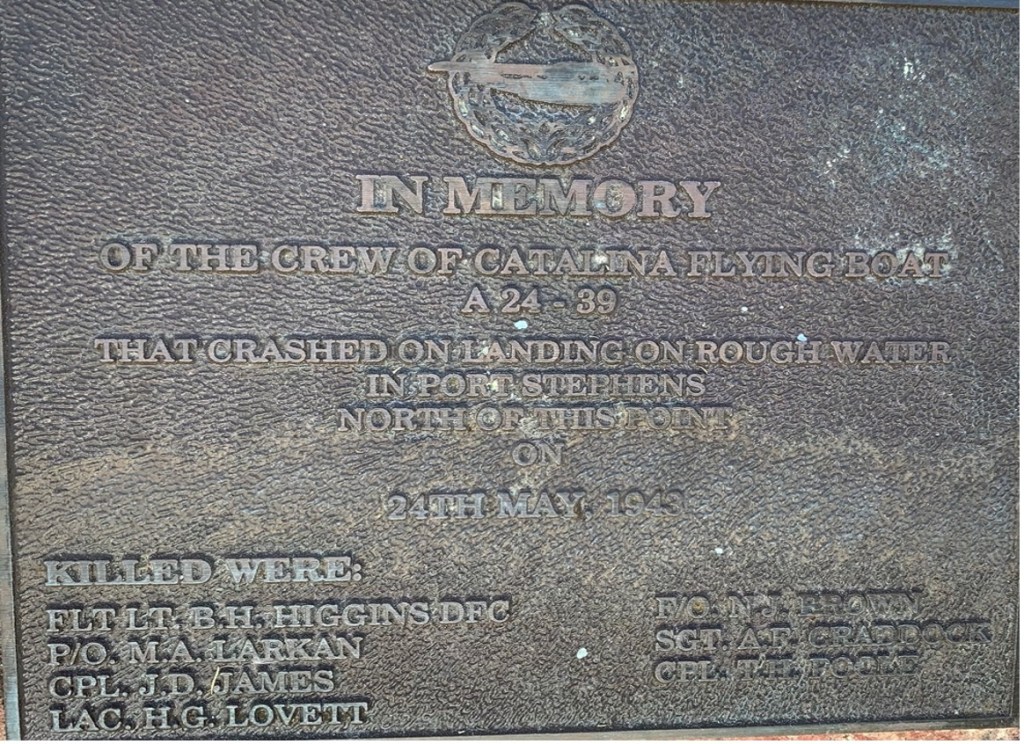
Nelson Head Memorial.
Further information on the crash of the Catalina at Port Stephens is available on this website.
Camp Operator plans to establish a Seaplane Service – 1946
The Newcastle Morning Herald and Miners’ Advocate of 25 December 1946, page 2, reported:
‘Mr. and Mrs. Geoffrey Wikner left a palatial English home surrounded by its own parklands, bought an R.A.F. Halifax bomber — ‘Waltzing Matilda’ — and flew to Australia. They now live in tents on the camping ground at Nelson Bay, where they are establishing a model camping area and pleasure resort. For 15 years Mr. Wikner was flying and designing aircraft. …… On six acres, behind the inner lighthouse at Port Stephens, Mr. Wikner has a number of men employed. ……
When Mr. and Mrs. Wikner arrived at Nelson’s Bay to establish a model camping area, they decided to name the settlement “Halifax Park” after the bomber they bought in England and flew to Australia. When he acquired a motor truck, Mr. Wikner had the name “Waltzing Matilda” painted on the side. That was the name of their Halifax seaplane base at Port Stephens.
Mr. Wikner hopes to establish a seaplane base at Port Stephens. If this can be achieved he expects to make arrangements for planes to operate between Rose Bay and Port Stephens at weekends and on holidays.’
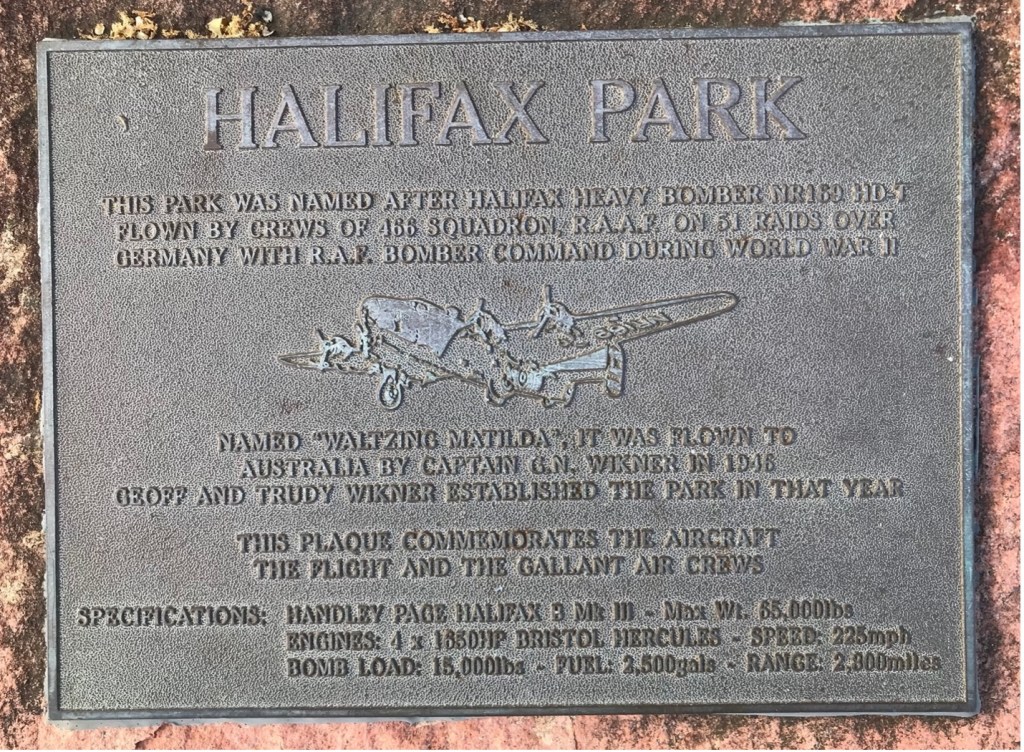
Plaque at Halifax Holiday Park at Nelson Bay commemorating the R.A.F. Halifax bomber, one of which was owned by Mr. and Mrs. Geoffrey Wikner [Author photo]
Seaplane makes forced landing after leaving Port Stephens – 1951
The Northern Star of 24 March 1951, page 4, reported:
‘A single motored Vickers Super Marine Walruss seaplane made a forced landing on the Tweed River at Murwillumbah late yesterday afternoon after it was battered in a violent storm. …..
The plane was being flown from Sydney to Rabaul for Amphibious Airways. It left Sydney on Thursday with another plane of the same type. The two aircraft landed at Port Stephens on Thursday night and continued the flight yesterday morning. After leaving Port Stephens, the planes ran into a severe storm and became separated.
Captain McIllree said the storm seemed to be drawing his plane towards its centre at about 50 miles an hour. He said he tried to get below the storm and dropped from 3,500 feet to 500 feet. As the plane came through a break in the clouds, he saw an expanse of water and landed. The plane made a perfect landing near the Murwillumbah township.’
Concluding Comments
While the residents of the Port Stephens area were not successful in having a seaplane base established there, the local inhabitants would have been delighted to have seaplanes land at their port.
This website contains the following histories relating to early aviation activity in the Port Stephens region and can be found at the following links:
Landing of a Seaplane in Port Stephens – 1926
Bert Hinkler Lands His Baby Arvo Plane at Anna Bay – 1921
Tea Gardens Aerial Plane Thrills – 1930
Crash of a Catalina Flying Boat in Port Stephens – 1943
Researched and compiled by Kevin McGuinness
December 2023

 Port Stephens - a history exploration