
Introduction
In 1916, the first Anzac Day commemorations were held in the Sydney. It was not until the 1950’s that similar ceremonies were officially held in the Port Stephens area.
The first commemoration of Anzac Day was held at Lemon Tree Passage on 1950, followed by Tea Gardens in 1951, and then Nelson Bay in 1952. In those years Karuah residents participated in the Tea Gardens ceremonies.
These early ceremonies in Port Stephens were organised by the local service clubs.
The Raymond Terrace Examiner and Lower Hunter and Port Stephens Advertiser of 28 April 1955, page 1, reported on the commemorations in Raymond Terrace in 1955. The article invoked the spirit of such Anzac Day ceremonies and the order of proceedings:
‘The commemoration of Anzac Day is carried out in a manner symbolical of a Soldiers’ funeral. First the party came with arms reversed, muffled drums and solemn step. The grave is reached, the chaplain recites the burial service, a volley is fired, and the party moves away with arms in correct order and to a quick step. The rest of the day is spent in relaxation and thought. Having honoured their dead, they would spend the afternoon in relaxation and association, with old comrades in remembering experiences and recapturing old friendships.’
This paper tells the stories of several Anzac Day ceremonies held in the Port Stephens area in the early 1950’s which laid the foundations for the present day commemorations.
Information on the Nelson Bay and Karuah War Memorials is found at these on the website.
Anzac Day Service at Lemon Tree Passage – 1950
The Newcastle Morning Herald and Miners’ Advocate of 21 April 1950, page 4, reported on the first Anzac Day commemoration held in the Port Stephens area:
‘Lemon Tree Passage R.S.L. sub-branch, one of the smallest in the Newcastle district, hopes to have one of the most impressive out-of-town ceremonies. It has invited ex-servicemen and other residents, in a wide area from Williamtown to Nelson’s Bay, to attend a service beginning at 3 p.m. The service will be held on a water’s edge reservation, looking out on the bay, at the end of Lemon Tree Passage Road. It will be conducted by Padre Geary, of Williamtown.’
The Newcastle Morning Herald and Miners’ Advocate of 28 April 1950, page 7, further reported:
‘Lemon Tree Passage R.S.L. sub-branch has only 15 members. Fourteen attended the Anzac Day ceremony conducted in front of the temporary sub-branch hall. About 150, including a number of visitors from Pipeclay Creek, took part. Cadet Wayne Cant, of Tanilba Bay, whose father was killed in Malaya, was flag attendant. He wore his father’s medals and ribbons. Padre Geary, of Williamtown, gave an address and Mr. J. Christopherson was bugler. After the ceremony, visitors were entertained by the sub-branch women’s auxiliary.
This weekend, sub-branch members will work with forest devils and tree-pullers, clearing a block on which it is hoped to erect permanent clubrooms. The land was donated by Port Stephens Development Company.’
Construction (journal) of 20 May 1953, page 9, reported on moves to construct a permanent R.S.L. sub-branch clubrooms at Lemon Tree Passage:
‘Applications for building permits to the Port Stephens Shire Council include plans for a memorial hall at Lemon Tree Passage for the R.S.L. sub-branch.’
Formation of Ex-servicemen’s Club at Tea Gardens – 1951
The Dungog Chronicle of 24 March 1951, page 3, reported on the formation of an Ex-serviceman’s Club at Tea Gardens:
‘At long last the Ex-servicemen of this town have seen eye to eye and have formed an Ex-servicemen’s Club with the final aim to become a sub-branch of the R.S.L. It was not until the passing of the late Tobruk Rat ‘Doc’ Frost that they thought of the idea to form a club where each one of them could come along and get to know each other better, where personal feelings could be left outside and only harmony and friendship be the feeling inside.
The election of Provisional Officers resulted in all three services being represented, namely, Provisional President, Mr. Gordon Rawlinson, Army; Provisional Secretary, Mr. Ken Avery, Navy; and Provisional Treasurer, Mr. Johnnie Walker, R.A.A.F. Correspondence has now been entered into in regards to be recognised as a sub-branch, and it is sincerely hoped that the thirty members who attended this inaugural meeting will sponsor the club for evermore.
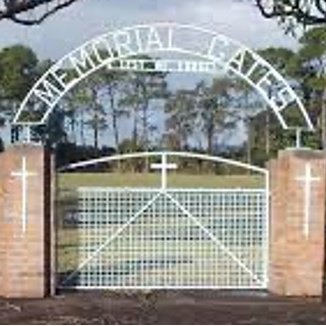
One of the questions that was raised at the meeting was in regards to the Memorial Gates which are to be hung at the park, and it was the unanimous feeling of the meeting to enquire as to whether these gates could be hung in time to be commemorated on Anzac Day when the Ex-servicemen of Tea Gardens would have a march and culminate in the commemorating of the gates. It would be a glorious moment for the people to have those gates commemorated on that day, and also for Ex-servicemen who in particular will remember the one man from Tea Gardens who paid the supreme sacrifice during World War II. Please let this request fall upon willing ears and that every assistance and opportunity will be taken to ensure that the gates will be hung in time to be commemorated on Anzac Day, 1951.’
First Anzac Day March at Tea Gardens – 1951
The Dungog Chronicle of 5 May 1951, page 3, also reported:
‘Tea Gardens had a Memorial Anzac Day when 38 ex-servicemen, led by World War I. Digger “Uncle” Ernie Williams, marched along the streets to the Memorial Gates which have now been hung at the park. A very impressive public service was held at which some 67 people attended. The Rev. Weston, of the Protestant religion, and Mr. E. Hopkins, representing the Salvation Army, conducted the service.
The Anzac Epilogue was read by K. Avery and the Anzac Commemoration delivered by Mr. Jack Blackstone. Wreaths were then laid and some of them showed that at least on one day in the year people do not forget those who paid the greatest tribute that one can pay to one’s country. Ex-servicemen placed a wreath at the headstone of our last departed digger of World War II., “Doc” Frost’s grave. The Ex-servicemen then proceeded to the hotel, where our host and president, Mr. Gordon Rawlinson, had prepared the Anzac dinner. The toast to the King was given by Mr. Rawlinson, who assured those present of this Association’s allegiance to the King. Mr J. Blackstone proposed the toast to the spirit of Anzac, and he said, ‘The spirit of Anzac will live forever, so long as ex-servicemen can get together like this, for they spread the gospel of what Anzac really means and we achieve that knowledge from the real Anzacs of the Great War. Their fighting determination, which has earned them the title of the fighting Anzacs, was one of the main features which inspired the present day Diggers to such a great fighting machine.”
It was regretted that as each year has gone by, even though we have not ”ad a march here before, the ranks of diggers have blank spaces, but we will always remember them. Mrs. Dennis thanked those present on behalf of all mothers who had lost their sons and hoped that the ex-servicemen would live long and keep their health, their wisdom, and gain great happiness.’
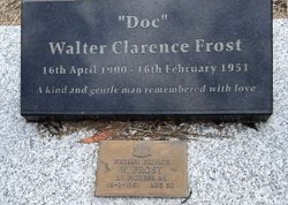
Gravestone of Walter Clarence ‘Doc’ Frost, Tea Gardens Cemetery
Reflection on the Tea Gardens Memorial Gates and the First Anzac Parade – 1951
The Newcastle Morning Herald and Miners’ Advocate of 12 May 1951, page 5, reported on a visit by the newspaper’s correspondent to Tea Gardens:
‘An application for a charter for the R.S.L sub-branch was made after a meeting of local ex-servicemen last month. The meeting was called by three men who served in World War II. — the Postmaster (Mr. John Walker), who was a sergeant, in the R.A.A.F.; Mr. John Blackstone, a storekeeper, who was an A.I.F. captain; and Mr. Ken Avery, another storekeeper who was a Petty Officer in the R.A.N. On the Friday before April 25, the trio decided an effort should be made to introduce an annual Anzac Day ceremony. They called another meeting on the Monday, and two days later, Tea Gardens saw what is believed to have been its first Anzac Day march.
Almost the entire village turned out to watch 40 ex-servicemen parade from the post-office in Myall Street, down Maxwell Street, Marine Drive and Hough Street to the Memorial Park. There, a visitor, Mr. A. Searl, had worked overtime to complete construction of a set of memorial gates. The men marched at 8.15 a.m. without band or drum. They were led by 72-year-old Mr. E. E. Williams, a gassed and thrice-wounded Gallipoli veteran, who would normally have gone to take part in the big march in Sydney. “We had one New Zealander, so it was truly representative of Anzac,” Mr. Walker said. The New Zealander was Mr. J. Robinson, from the pine plantation.
At the park, a Church of England minister from Clarencetown conducted the service from a dais built up on petrol drums, under fluttering flags borrowed from H.M.A.S. Assault, Nelson’s Bay, and from Tea Gardens school. After the service, the men adjourned to the hotel for a reunion dinner. “Next year, we hope to be able to find a pipe band and a bugler,” said Mr. Blackstone.
We went down one morning to look at the memorial gates and on the way were hailed by a young man, somewhere in the neighbourhood of five, who was straddling the top rail of a road bridge at the junction of Myall and Hough Streets.
“G’day,” he shouted. “G’day,” we answered, and continued along the road. We were almost to the gates when a familiar voice piped up behind us. “These are spears,” it said. Its owner was the same freckle-faced, matey youngster, who now had a small, silent girl in tow. Each was carrying what looked suspiciously like a cricket stump. They were the spears. We asked the lad his name. “Nicky Pearson,” he said. “She’s, my sister. See if you can spear the grass.” “No, you have a go,” we said. “All right, I will.” He tossed the “spear” at the grass near the gates. It failed to stick. “Oh, I missed, I missed,” he said. “I couldn’t spear a flea. Now you have a go.” So, we “speared” the grass and wound up pushing the youngsters around a razzle dazzle in the park (not going fast enough, in Nicky’s opinion) before he was finally content to let us go.
On the way back, we remembered our conversation with Mr. Walker and Mr. Blackstone. They had, told us that Nicky’s father, Mr. Jack Pearson, took part in the Anzac Day march, that he was a former prisoner-of-war who knew what a Japanese “hell-ship” was like and that, living up to a self-promise, he had named his son for a P.O.W. mate who had died at the hands of the Japanese but whose heroism he would never forget.’
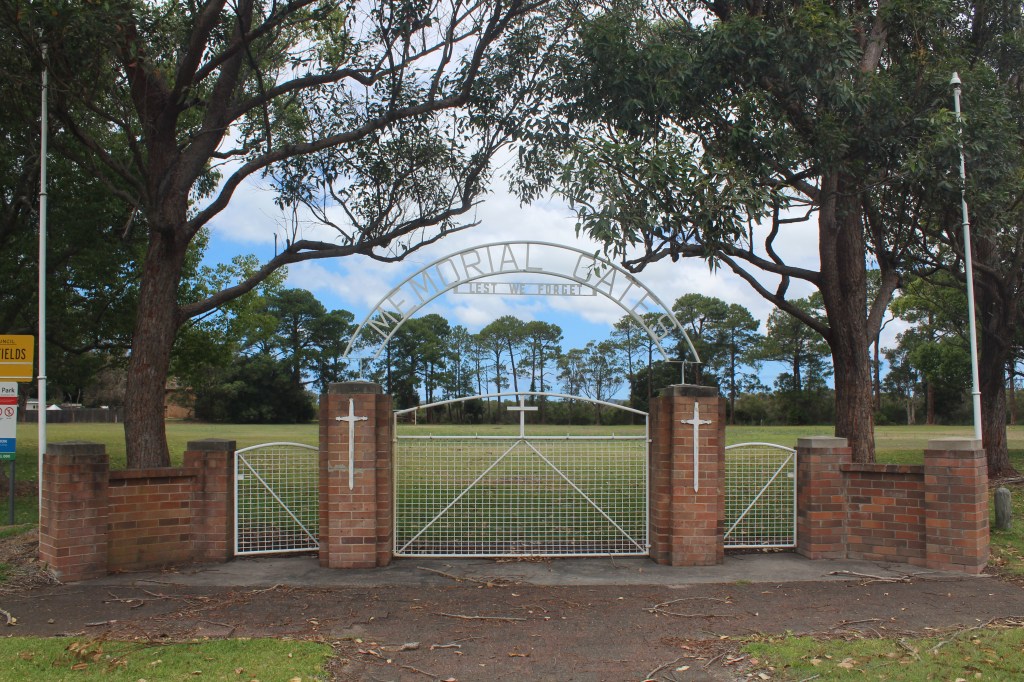
Tea Gardens Memorial Gates, corner of Witt and Hough Streets [Author Photo]
Second Tea Gardens Anzac Day March – 1952
The Newcastle Morning Herald and Miners’ Advocate of 23 April 1952, page 5, reported on a combined Anzac commemoration by ex-service personnel from Karuah and Tea Gardens:
‘Ex-servicemen and women visiting Tea Gardens will be invited to take part in a march and service arranged by Tea Gardens and Karuah R.S.L. sub-branches. Marchers will assemble at the post-office at 10.30 a.m., moving off at 10.40, via Myall Street. Marine Drive and Jacob Street, to Tea Gardens Park memorial gates. Service at the gates will start at 10.58, with Bulahdelah and Tea Gardens clergymen participating. Ex-service personnel will be entertained at lunch in Australia Hall by Tea Gardens sub-branch women’s auxiliary.’
First Nelson Bay Anzac Day March – 1952
The Newcastle Morning Herald and Miners’ Advocate of 26 April 1952, page 6, reported:
‘Nelson’s Bay yesterday held its first organised Anzac Day celebration. The Dawn Service was conducted at the Memorial steps by Mr. Alfred Johnson, a lay preacher. About 70 people attended. Fifteen members of the R.A.A.F. in uniform, 50 Junior Red Cross members, and about 70 members of ex-servicemen’s organisation marched in a procession before the 11 o’clock observance. Cr. L. R. Randall, Deputy President of Port Stephens Shire Council, represented the President (Cr. Nichols).
The service was conducted by Rev. Buckley, Presbyterian Minister at Mayfield. About 500 attended. At a dinner given by the Women’s Auxiliary of the Nelson’s Bay sub-branch of the R.S.L., the Commander of 14 Infantry Brigade (Brigadier J. W. Main) addressed 120 ex-servicemen. Mr. R. Francis expressed appreciation of the response of the people of the district in making the first organised commemoration of Anzac Day in Nelson’s Bay a success.’
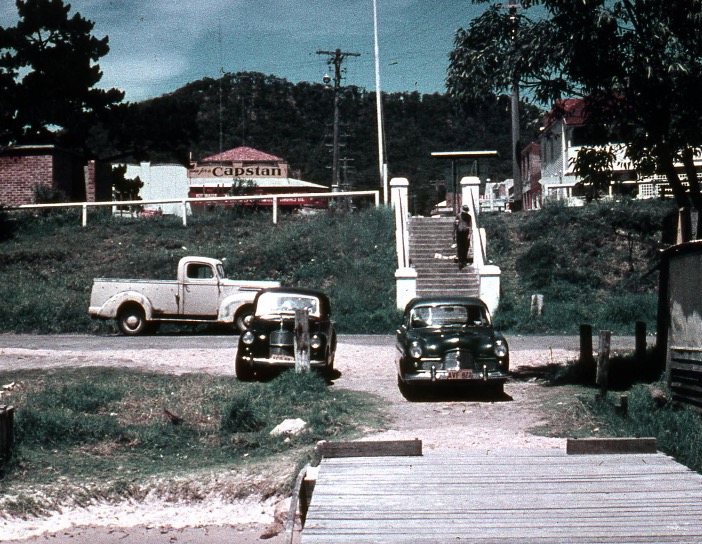
Memorial Steps at Nelson Bay – 1960
Second Anzac Day March at Nelson Bay – 1953
The Newcastle Morning Herald and Miners’ Advocate of 27 April 1953, page 4, further reported:
‘Two Boer War veterans led the ex-servicemen’s section of the Anzac Day march along Stockton-road, Nelson’s Bay, on Saturday. They are Messrs. Frank Evans and Victor Whitney. About 100 ex-servicemen took part in the march, which was led by a flight of R.A.A.F. personnel from Williamtown. More than 30 members of the Junior Red Cross and about 20 Boy Scouts marched behind the servicemen. A record crowd of about 200 people attended the Dawn Service at the Memorial steps. The service and another after the march was conducted by Rev. Dyer.’
Third Anzac Day March at Tea Gardens – 1953
The Dungog Chronicle of 2 May 1953, page 6, reported:
‘Anzac Day last Saturday saw the largest gathering in the history of the town. Over 50 ex-servicemen — from Boer War to World Wars 1 and 2 marched from the Post Office via Myall Street to Maxwell Street, Marine Drive to the Memorial Gates at the corner of Hough and Witt Streets where a Combined Service was conducted by the Rev. Tom Mathers (World War I. veteran). Scotch pipers in charge of Mrs. Graham supplied music for the March. Organisers were Mr Ford Pearson (a Captain in World War I.), president of the Tea Gardens R.S.L. branch and Mr Gordon Armstrong, secretary of the branch, who also had service in World Wars I. and 11.
Organist at the service was Miss Lola Korsman. During the Rev. Mathers’ address he stressed the point of the loyalty shown by Australians in their increased attendance on Anzac Day.
The “Last Post” was sounded by Mr. Herbert, of Karuah, who also sounded “Reveille.” Many wreaths were placed on the Memorial Gates. After “God Save the Queen,” the troops marched to the R.S.L. Hall for lunch and an afternoon’s entertainment. During the evening the president (Mr Ford Pearson) said he was proud to know that this dinner was the first function in the new place. He asked that the visitors not be misled in thinking it was just the R.S.L. boys that had the fine building ready. It was equally the residents of Tea Gardens and the support of the Ladies’ Auxiliary that had brought about its success. He thanked the ladies for their fine work in seeing the dinner was not only of the best, but that the whole hall was bright with every appearance of happiness.
It was a happy afternoon for the R.S.L. boys, songs, a little old, old, and very old, were sung. At 8 p.m. a big crowd of residents and visitors had the hall full, dancing and singing. Music from the pipers, accordion and drums and piano kept every minute full till midnight. The writer congratulates the president and secretary for the happy dreams, that they must have had when they went to sleep after the 25th April, 1953.’
Third Anzac Day March at Nelson Bay – 1954
The Newcastle Morning Herald and Miners’ Advocate of 26 April 1954, page 3, further reported:
‘Nelson’s Bay R.S.L. subbranch held a morning service at the Memorial Steps. The service was attended by 150 members of the W.R.A.A.C. Company in camp at Gan Gan. R.A.A.F. men from Williamtown air base, ex-servicemen, Junior Red Cross and Boy Scouts also took part in the service.’
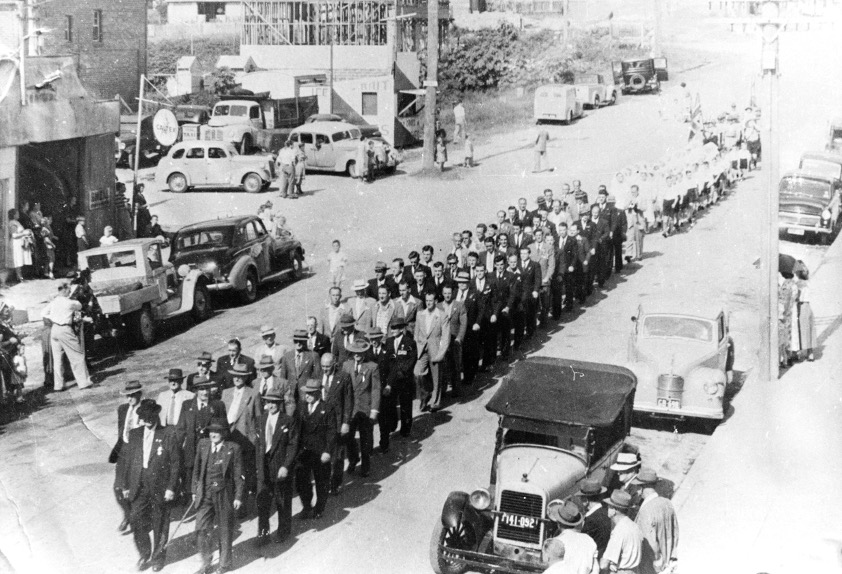
Anzac Day march down Stockton Street, Nelson Bay – early 1950’s
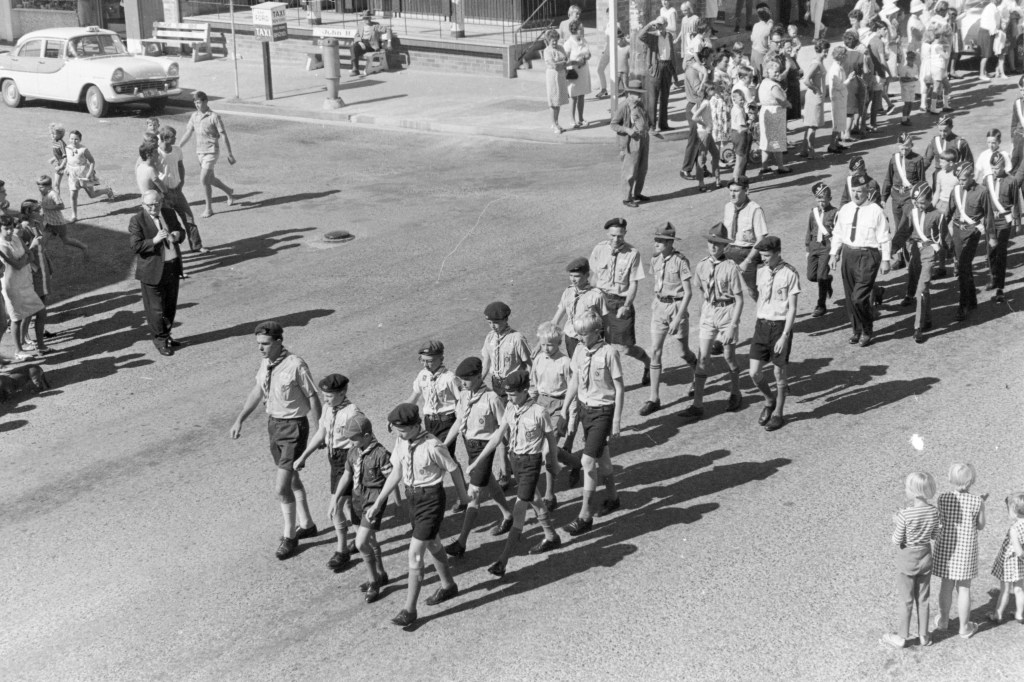
Later Anzac Day march down Stockton Street, Nelson Bay – 1970’s
Fourth Anzac Day March at Tea Gardens – 1954
The Dungog Chronicle of 1 May 1954, page 6, reported:
‘Anzac Day was solemnly observed in Tea Gardens. The march was impressive. Wreaths were laid at the Memorial Gates and were particularly beautiful. The local R.S.L. wreath is made each year by Mrs. Phil Worth and is always admired. Later the wreaths were placed on the graves of Diggers in the cemetery. The ladies prepared a fine repast for the Diggers at the Bowling Club where they all had a happy time.’
Epilogue
Some years before Anzac Day was officially commemorated in the Port Stephens area, a ceremony was held at the Tea Gardens Public School in 1941. The Dungog Chronicle of 2 May 1941, page 4, reported:
‘Anzac Day at Tea Gardens Public School was celebrated on Thursday 24th instant. The ceremony was unique because of the presence of Captain Frazer, other officers, and a body of troops drawn up around the flagpole in the form of a hollow square.
After Kathleen Frost had placed a wreath, made by the senior girls, onto the school honour roll, the two minutes’ silence was observed. Jack Holbert (3rd class), Ruth McLeanan and Bruce Ward (4th class) Pam Crawford and George Engel (5th class), and Jean Hill and Tony Engel (6th class) read suitable passage from their magazines. Noellie Duffy, at the piano, accompanied the children in the singing ‘O God, Our Help in Ages Past, Kipling’s Recessional, and the National Anthem.
The headmaster, Mr. Cripps, thanked Captain Frazer and his command for participating in the ceremony and affording the children an opportunity of witnessing the efficient work of his men. The children, who were impressed by the splendid marching and military bearing of the men, viewed with delight the precision with which the soldiers’ sloped arms, ordered arms and stood at ease. Captain Frazer thanked the headmaster for affording him an opportunity of bringing his troops to a school to participate in the Anzac Day service. He congratulated the children on their morning’s work, he expressed his pleasure at the children’s interest in his command.’
Ode of Remembrance
‘They shall not grow old, as those that are left grow old;
Age shall not weary them, nor the years condemn.
And with the going down of the sun and in the morning
We will remember them.’
Researched and compiled by Kevin McGuinness
November 2023

 Port Stephens - a history exploration