
Introduction
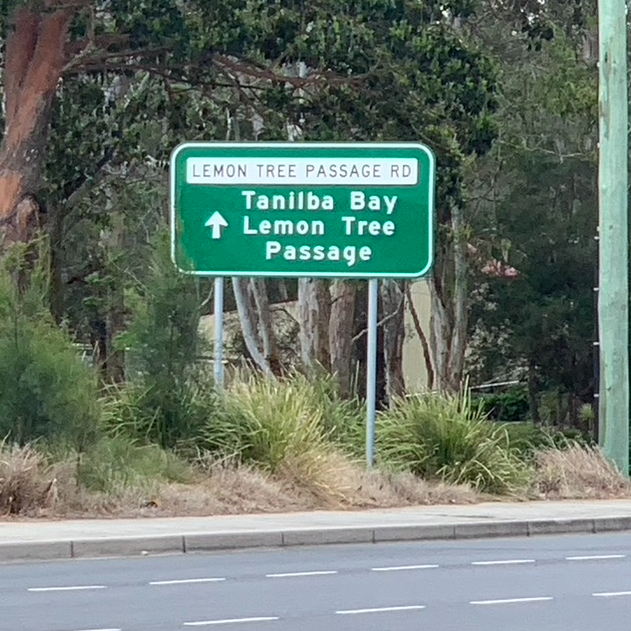
The early 1920’s marked the beginning of several land developments at Tanilba Bay and Lemon Tree Passage on the Tilligerry Peninsula at Port Stephens.
In 1924, as there was no road into the area, the developer of a land syndicate at Lemon Tree Passage (Kooindah) sought the assistance of the Port Stephens Shire Council to construct a road that would connect to the existing Nelson Bay Road at Salt Ash.
The Council recognised the necessity of building a road to allow the Lemon Tree area to be opened up for residential settlement. But the road building project was to cause it considerable financial stress.
The first problem, before construction began, was unfounded allegations by Stroud Shire Council that a grant issued by the Commonwealth Government for the road project was illegal. It alleged that the road was to be constructed for the benefit of the private land developer to the detriment of other roads deemed to be more important.
Financial troubles commenced soon after construction began. The contractor appointed to construct the road quit after only completing a small section of the road, as the construction cost was greater than he had budgeted for. The contract then had to be re-let to another road contractor resulting in an increased cost.
During the construction phase, the road suffered several flooding problems which necessitated costly remedial work. The plans and specifications for the new road were prepared by an engineer engaged by the land developer which were later found to be inadequate, leading to additional remedial work being necessary.
The final issue causing financial problems for the council stemmed from the land developer refusing to provide additional financial assistance to cover the increased cost of the road over the initial contract price. This was contrary to council’s belief that any such shortfall had been promised in the contract.
This paper examines the problems faced during the initial construction of the Lemon Tree Passage Road (Lemon Tree Road) and the financial considerations that had to be managed by Port Stephens Shire Council in 1920’s.
Overview of the roads in the Port Stephens – 1924
The Newcastle Sun of 10 June 1924, page 4, published the following review of the roads in the Port Stephens area that went to the water’s edge at the time of the proposal for the need of new road to Lemon Tree Passage:
‘There are at present only two roads to Port Stephens. One touches the port at Karuah, the other at Salt Ash. From Salt Ash it is necessary to take a launch and go down Tillegerry Creek, 10 miles, to reach Port Stephens. The road to Karuah passes along the water’s edge at Karuah, and one is immediately at the port. For a great many years residents of Nelson’s Bay have clamoured for road connection with Newcastle. At present a road runs from Salt Ash to Nelson’s Bay, but for vehicular traffic it is almost impassable. The last six miles is through sand, in which one sinks six to eight inches. In the last road grant from the Federal Government £16,000 was allocated to the road from Salt Ash to Nelson’s Bay. It is estimated that this amount will serve to complete the road only as far as Anna Bay, leaving the six miles of sand untouched. A tender for the road from Salt Ash to Anna Bay has been accepted at £16,000. Another grant of £20,000 is necessary to complete the road, and then Newcastle will have a famous tourist resort at Nelson’s Bay.
The whole of the roads leading to Port Stephens are embraced in the Port Stephens Shire Council, which has been spending small amounts on this road, but it is a huge problem which can only be solved by the supply of thousands of pounds. The road leading to Salt Ash comes from Newcastle through Stockton and Williamtown, 14 miles. Motor ‘buses ply between these places daily and connect with the steamer Reliance, which carries mails and passengers for Anna Bay, Nelson’s Bay and Tea Gardens. The road is in a bad state, and it is no pleasure to travel over it.
Another £12,000 has been granted for the construction of a new road from Salt Ash to Lemon Tree Passage. Living at Lemon Tree Passage is only one family. The country through which the road will pass is of poor nature and not suited for agriculture. It may serve for poultry-runs. The only reason apparent for the allocation of this £12.000 is that some time ago the huge land-owning companies around Lemon Tree Passage and Tenilba offered £ for £ for the construction of a road. However, the road will be a fine opening to Port Stephens, as the run from Newcastle will then be only about 25 miles.
Doubtless a nice little township will form at Lemon Tree Passage, and there Port Stephens will reap an advantage. The other, and at present only practicable route to Port Stephens direct, is over the Hunter at Hexham punt, through Raymond Terrace, along the Stroud Road 12 miles, and thence by main road six miles to Karuah. The road to Hexham is in Tarro Shire and is in a disgraceful state. Lately, however, a deal of patching is being done, and it is not as bad as formerly. However, with the work of the Trades and Commerce Association, and Government assistance, this main road should be put in good order.
The road from Hexham to Raymond Terrace, and thence to Karuah, lies wholly in the Port Stephens shire, through the municipality of Raymond Terrace. From Hexham, through Raymond Terrace, to the 12 miles’ post, the road is in very fair condition, and motorists say that it is one of the best in the shire. A good deal of money has been expended on this road within the past 12 months, but the heavy traffic, especially the large milk lorry from the Terrace factory to Newcastle, is playing havoc. Unless the road is given attention, within the next 12 months it will be as bad as the Hexham road.
From the 12 miles to Karuah the road is only fair, and in parts is bad. It is anything but a credit to the shire, though the council is at present placing 1000 yards of gravel on the worst part. This is a road leading to settled district, such as Tea Gardens and Karuah. Hundreds of motor vehicles pass over this road during the week, and it should receive much more attention. The Progress Associations have repeatedly and continuously approached the shire in the matter, but the cry is the old one, “No money.” It is still a fact that when there is money, this road is neglected.
The road passes through Karuah over a ferry punt across the Karuah River, and thence 14 miles to Tea Gardens, on the Myall River, which empties into Port Stephens at Pindimar. These 14 miles lies in the Stroud Shire, and right through is in very fair order. During the past 12 months over £4000 has been spent.’
First Proposal for the Lemon Tree Road – 1923
The Raymond Terrace Examiner and Lower Hunter and Port Stephens Advertiser of 7 September 1923, page 3, reported on a deputation by a land developer to Port Stephens Shire Council to make a road to service their new land development at Lemon Tree Passage. At this stage the area could only be accessed by road:
‘A deputation from Newcastle headed by A. Cook stated they were desirous of making a road from Salt Ash to Lemon Tree passage to give access to land there, and to open up a quicker route to Port Stephens. They were prepared to spend £6000 in making the road and asked the council to agree to making an application to obtain £6000 from the Federal loan for roads. There would be no cost to the council, but the money must be applied for by the council. The council after discussion decided on the motion of Crs. Cromarty and Graham to accept the offer. Mr. Cook stated that in all probability the Minister would come and view the road.’
Unfortunately, the ‘no cost to council’ clause was to become a false promise.
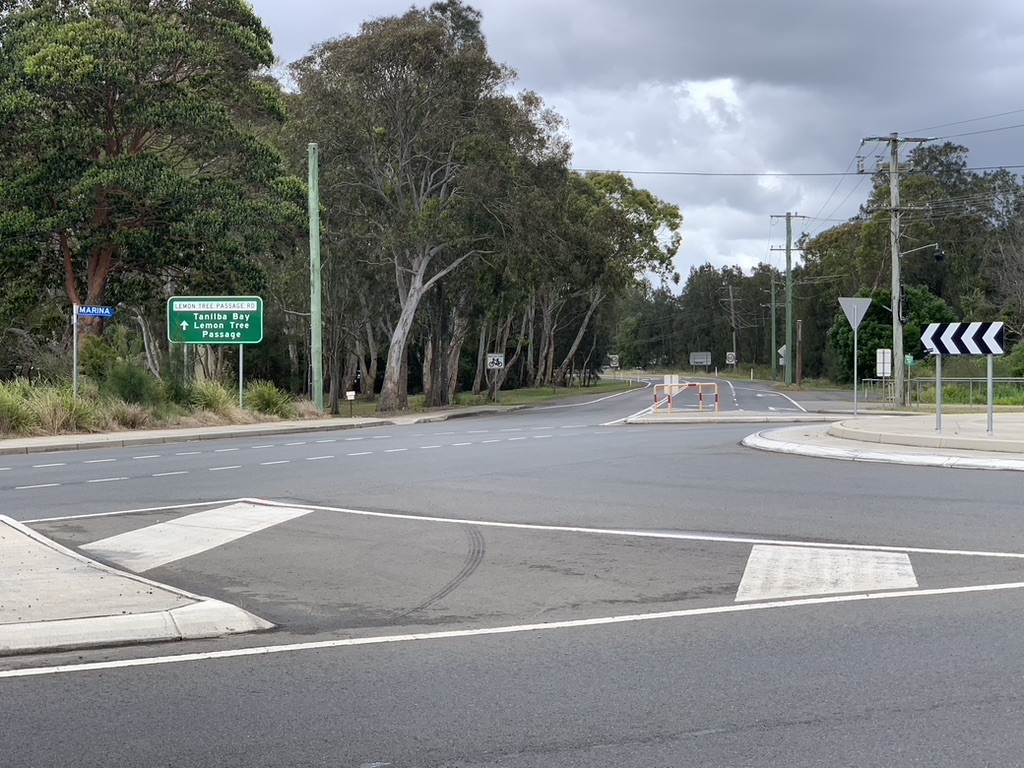
The intersection of Lemon Tree Passage Road and Nelson Bay Road at Salt Ash, [Author photo -October 2023}
Council Received a Commonwealth Grant for a road to Lemon Tree Passage – 1924
The Maitland Daily Mercury of 16 February 1924, page 3, reported on the following letter received by Port Stephens Shire Council:
‘Letters from Messrs Vincent and Hill, Ms.L.A. were received informing of the road grants of £16,157 for Salt Ash-Nelson’s Bay road, and £12,000 for Lemon Tree Passage road.’
Signs of future problems with the funding of the road by the land developer – 1924
The Raymond Terrace Examiner and Lower Hunter and Port Stephens Advertiser of 6 June 1924, page 3, reported:
‘R. S. Adam said the Syndicate interested in Lemon Tree passage road had been delayed in making payment, in waiting for H. P. Halloran and Co. who were subscribing to the road. He expected a reply in a week or so. He suggested that the syndicate should pay down £1000 as soon as the Government had payed in. The council thought this impracticable, as the Government would not pay at all until the syndicate had payed in the quota.’
Stroud Shire Council claims Commonwealth Grant was illegal – 1924
The Raymond Terrace Examiner and Lower Hunter and Port Stephens Advertiser of Friday 18 July 1924, page 3, published a report concerning the legality of the Commonwealth Government grant:
‘At the last meeting of the Stroud Shire, the President Cr. W. Flannery tabled the following minute, arising out of the recent Ministerial visit, and deputation to the Minister: — Gentlemen, — At the deputation to Mr. Ley at Tea Gardens on June 21st, I drew attention to what I call the illegal granting of £6000 of the Commonwealth cum State Vote for developmental roads to assist a land syndicate, to build a road from Salt Ash to Lemon Creek Subdivision; I stated that in my opinion this money was wrongfully allotted, and did not comply with the terms of the Grant, also that the Port Stephens Shire did not make an application for it, and in my opinion the Department showed great laxity in dealing with this application to let it go through.
It seems an extraordinary thing that a body of land speculators could obtain the public funds to build a road to their subdivision, when there were genuine applications from Shires throughout the country turned down. Councillor Franklin and several land agents who were present, and who were interested in subdivisions in the Port, opposed me, and stated that the Port Stephens Shire did make application, and that the Stroud Shire supported it. In reply I said I would like to see the application produced. Only this afternoon the President of the Port Stephens Shire, in the presence of Mr. Ley told us that they did not make the application, that a syndicate made it; he also went as far as to give the names of the members of the syndicate.
If I am wrong the President of the Shire is in the room now, and as he supplied the information he can say if it is correct or not, ask him. Regarding Stroud Shire’s support I myself did not support it. I now find that Councillor Franklin moved a motion last September as follows —Proposed by Cr. Franklin, seconded by Cr. Callow, that although unofficially before us, this Council is prepared to cooperate with them for a special grant from the Federal Government of £6000 towards the construction of a road from Salt Ash to Tilligerry Creek.” This was not supported by me and I am quite sure that none of the other Councillors would have entertained it had they known the true nature of it. Apart from all this I still contend that the money was wrongfully allotted and requires investigation in my opinion.
I now ask the Council to move a motion instructing the clerk to write to our Members requesting that all the papers in connection with the Commonwealth grant be laid on the Table of the House together with all the correspondence relating to this £6000, and also that the Department’s reasons for granting this amount to a body of land speculators pound for pound, to build a road into their subdivision, when there were genuine applications from shires to assist pioneer settlers on Crown lands to get their produce to market and to stop the human drift to the city.
In conclusion, gentlemen, I submit that the whole of the foregoing is amply borne out by the resolution passed by the Port Stephens Shire Council at the meeting held on Wednesday last 2nd inst., which reads as follows:— ”In regard to Lemon Tree Passage Road, it was agreed on the motion of Cr. Ralston to write informing the principals that the £6000 promised for the road must be paid in, or the Council will take no further action. No further comment is necessary.’
The Raymond Terrace Examiner and Lower Hunter and Port Stephens Advertiser of 19 September 1924, page 4, further reported:
‘The Local Government Department has forwarded to Mr. M. Cromarty, M.L.A. the following letter: — Deputation which recently waited upon the Hon. T. J. Ley, M.L.A., Minister for Justice, at Tea Gardens, at which mention was made of a grant to the Port Stephens Shire Council from the Commonwealth cum-State Main and Developmental Roads Vote for the Lemon Tree Passage Road.
Dear Sir, — The Honourable T. J. Ley. M.L.A., has referred the notes of the above deputation on to the Minister for Local Government (Honourable J. C. L. Fitzpatrick) for attention, and has asked that you be communicated with directly in the matter. At such deputation Councillor Flannery, President of the Stroud Shire Council, is reported to have said. “Then there was a grant for the road to Lemon Tree. The Stroud Shire contends that the money was illegally granted to the Port Stephens Shire. The President of the Port Stephens Shire Council is here today, and he says he did not apply for it. I therefore want to know why this money was granted to them.”
It is found on looking up the papers that the Port Stephens Shire Council submitted an application on 28/9/23 for a grant of £6,000 for this road from the Commonwealth cum-State Vote for Main and Developmental Roads, the Council at the same time intimating that if the application were granted the owners of property at Lemon Tree Passage would contribute a further £6,000 towards the carrying out of the work.
The allocation of the grant was not made by this Department but by the Commonwealth Authorities, and what was done by this department in the case was simply to send the Council’s request to Melbourne for determination with an intimation that the State Government would contribute an amount equal to any grant which might be given by the Federal Government. The Federal Government approved of the grant asked for by the Council.’
The Dungog Chronicle of 17 October 1924, page 3, also reported:
‘Local Government Department wrote regarding the statement of President Flannery who said that he was informed by the president of Port Stephens Shire, that no application had been made for a grant for the Lemon Tree Road. The department’s letter showed that Port Stephen’s Shire had made the application for the money. The matter of the grant was, however, one for the Federal Government, as the State Government merely forwarded on the applications made to it. The president drew attention to the letter from the Federal Minister (Mr. Stuart) in which it was stated that the matter of the grant was purely the State Government’s business.
The speaker said there was a distinct contradiction between the two statements. Cr. Franklin said that Stroud Shire’s president was led to make a public statement at the instigation of the president of Port Stephens Shire when the latter knew he was entirely wrong. He thought that Mr. Pearse, the Port Stephens president, should be called upon for an explanation in the matter. The president stated that there was no need for that because he said it was specifically pointed out in the department’s letter that he (Cr. Flannery) gave as his authority for the statement, the president of Port Stephens Shire. It was Cr. Pearse’s pigeon and not his.
At the same time he still maintained that the money was illegally granted. There was no developmental purpose at Lemon Tree. Cr. Callow: What about tourists? The president: How many are there? Cr. Callow: Four. President: If that expenditure is to benefit such a few it is not fair when there are other more deserving cases. I would like to know whether the road has been started and whether the syndicate has paid in its £6,000. Cr. Franklin asked whether the president had accepted the invitation extended to him to go down and see the road in question.
At last meeting of Port Stephens Shire, he said, plans and specifications had been accepted and tenders’ are to be called. Cr. Callow said he took exception to the remarks made in explaining Cr. Pearce’s statement, those remarks being “Cr. Pearce was pulling the president’s (Cr. Flannery’s) leg.” If Cr. Pearce made these remarks he was an ass. Cr. Callow said he was present and can say definitely that Cr. Pearse said that his shire did not apply for a grant for Lemon Tree Road. Yet he told his own council that he did not make any such statement. President said it was for the public to see who was telling the truth. He did not intend to push the matter further, but would leave it to the public.
Cr. Franklin contended that it was discourteous to Stroud Shire to have Port Stephens Shire president make a statement to Stroud Shire’s president, and then say he was pulling his leg. The president said he was not concerned about the matter because he mentioned Cr. Pearce as his authority for the statement he made. Cr. Franklin suggested that Cr. Pearce be called upon to apologise. President: I will go further and say that Mr. Ley heard him make the statement and Mr. Ley said the matter seemed very irregular and he asked to bring it up so as it could investigated. Engineer Dee said Mr. Ley made that statement. The president moved that the Minister be asked whether the grant has been proceeded with and whether the company had paid its share (£6000).’
Tenders called – 1924
The Raymond Terrace Examiner and Lower Hunter and Port Stephens Advertiser of 3 October 1924, page 3, reported:
‘Plans and specifications of the Lemon Tree road were forwarded by L. T. Roberts for the syndicate. The plans were accepted, and Crs. Shearman and Cromarty moved that tenders be called. The syndicate asked that one of their representatives may be present when tenders were accepted. Agreed to.’
During construction the plans and specifications proved inadequate, leading to expensive remedial work.
Tender accepted – 1924
The Maitland Daily Mercury of 23 December 1924, page 4, reported:
‘At a special meeting of the Port Stephens Shire Council, presided over by Councillor Pearse, consideration was given to the question of tenders for Lemon Tree Passage road, Port Stephens. The highest was £19,734, and the lowest £11,743, The latter was that of W. V. Hereen, of Teralba. Failing his signing the contract, it was agreed to accept the next tender, that of N. Callen, £11,856.’
Port Stephens Council suffers financial trouble – 1925
The Dungog Chronicle of 9 June 1925, page 5, reported on a public meeting concerning the Port Stephens Shire council financial situation:
‘Matters in connection with the administration of the affairs of Port Stephens Shire are in a state of turmoil. Faced with many difficulties the councillors are up against it. After much wrangling and worry they decided to call a meeting of ratepayers and “tell them all about it.”…..
It was a dismal failure, from the ratepayers’ point of view, and ended in disorder. Feeling was so high at one stage of the strange meeting that a pressman had to jump between Councillor Grahame and the shire engineer to prevent them from coming to blows. A few of the councillors tried to explain the position that they were in, in the manner of servant to master, but the general opinion of members of the audience seemed to be that they were not being told everything.
One section wanted to know the inside story of the Anna Bay and Lemon Tree Passage road contracts, which, it was alleged, had been responsible for a good deal of the present trouble, as well as a certain estrangement between some of the councillors and the shire engineer (Mr. Davoren). It was stated that the construction work on one of these contracts had been delayed, owing to difficulties on the part of the contractor in carrying on with the funds at his disposal, and that he had applied to the council for an additional grant, which had been withheld by the engineer until such time as more ground had been covered by the contractor. This, it is claimed, has now been paid.
Another dispute is said to have arisen regarding the payment of certain employees on one of the contracts who, it is said, have complained and been paid by the council out of the grant. There was a feeling of expectancy in the Council Chambers, which perhaps had attracted the majority of the listeners, when Councillor Boag told his story of disillusionment. “When I first became a shire councillor,” he said, “I thought that government locally was a good thing; that the man on the spot would know the conditions governing the shire area, but I found a good deal of disillusionment, and that it was a position in name only, particularly in the matter of money. “Considering the circumstances arising out of the two-road construction contracts at Anna Bay and Lemon Tree Passage,” continued Councillor Boag, “although the council took them over, the superior central local governing authorities are taking them away and putting on us the responsibility.
“We have been restricted too much and are fairly fed up with the whole matter. “Therefore, we thought that it would be a good thing to call a meeting of ratepayers and put the whole position before them. We find ourselves in a very disagreeable and unsatisfactory position. It seems scandalous that people on the land are put to such disability in getting their produce on the markets owing to the bad roads. “The time has arrived,” he continued, “to do some very plain speaking, and some definite action must be taken. “We are not going to be treated as six puppets for a central body to pull the strings while we do the dancing.” Another pernicious system, he said, was the local government arrangement whereby the salaries of the engineer and shire clerk were determined by the amount of income and expenditure.
“This then leads to amalgamation,” declared Councillor Boag. “The administrative expenses are unreasonably high and an amalgamation of say, Port Stephens Shire with Bolwarra and Wallarobba would provide scope for an engineer, a clerk and a couple of assistants — an ample staff for the three shires. “When we complain of having no money, there are cries of “Why don’t you get a loan.” Well, that sounds very nice, but we would have to pay the money back and at a high rate of interest, and I think that is unsatisfactory.’
Road construction contract cancelled – 1925
The Raymond Terrace Examiner and Lower Hunter and Port Stephens Advertiser of 17 July 1925, page 3, reported:
‘In conjunction with cancellation of the contract for Lemon Tree Passage road, Mr. Bray one of the contractors was present, and interviewed the Council in regard to the work done. He claimed that a great deal more should have been allowed for clearing. The engineer pointed out by the plan portions he thought that had not been done satisfactorily and maintained that his estimate of the work done was all that could be allowed. Mr. Bray was requested to visit the road and see for himself, which he agreed to do. The president and engineer will meet Mr. Bray, and further action was held over till after the inspection, when possibly the contract may be continued by Mr. Bray, on his own account.’
New contract awarded – 1925
The Raymond Terrace Examiner and Lower Hunter and Port Stephens Advertiser of 21 August 1925, page 3, reported:
‘An extraordinary meeting of the [Port Stephens Shire] Council was held on Wednesday …… Tenders were considered for the Lemon Tree Passage Road. Three tenders were sent in, namely: — Slade and Morris, £15,900; N. Callen, £15,000, H. Armitage £12651. The last named was accepted conditionally on the syndicate finding the difference between this and the cancelled tender. This amount would mean an additional £1159. Some of the work to the extent of £508 has been paid for by the Council out of the grant.’
Land syndicate refuses to pay additional road funding – 1925
The Raymond Terrace Examiner and Lower Hunter and Port Stephens Advertiser of 4 September 1925, page 3, reported:
‘The secretary of the Lemon Tree Passage Road Syndicate stated that they were not prepared to pay the additional £1190 required under the new contract. They thought the Council should find the extra. The clerk said the Council only agreed to the first contract price.
The Council, on the motion of Crs. Ralston and Shearman will take the case to the Shires’ Association for its opinion, as to the council’s liability for the balance. And if the Company refuse to pay the difference the contract be cancelled.’
Port Stephens Shire Council applies for an additional grant – 1925
The Raymond Terrace Examiner and Lower Hunter and Port Stephens Advertiser of 23 October 1925, page 2, reported:
‘It was also decided on the motion of Crs. Shearman and Ralston to apply to the Government for a grant to make up the difference between the contract price and the amount first granted for the Lemon Tree Passage road. This was held to be a reasonable request, on account of the Crown lands that would benefit by the road and would be immediately saleable. The Engineer was empowered to employ, whatever labour will be necessary in carrying out work up till the end of the year.’
Work progresses – 1926
The Dungog Chronicle of 20 July 1926, page 2, reported:
‘Contractor Harry Armitage is pushing on with the road from Salt Ash to Lemon Tree Passage, and all going well it should be available for traffic next summer. This road opens up direct communication between Newcastle and the harbor of Port Stephens, and incidentally a large tract of land along the foreshores, all of which is sub-divided and ready for sale.’
Land developer raises issues with Council – 1926
The Dungog Chronicle of 12 October 1926, page 5, reported:
‘Port Stephens Central Land Co. wrote in connection with the road contract at Lemon Tree Passage, also asking the council to reconsider its decision in regard to the amendment to the subdivision plan. — Cr. Ralston moved that the company be informed that the council is doing its best to have the road contract carried out, and that they resent the tone of their letter. Seconded by Cr. Russell and carried. Cr. Pearse moved that the matter be held over till next meeting, and that the directors of the company be asked to to present. Seconded by Cr. Russell and carried. H. Armitage, contractor, at Lemon Tree Passage, was present, and gave a list of complaints against the engineer, etc. Argument continued for over an hour, nothing of any importance being done.’
Main Roads Board raises concern about the road contractor – 1927
The Raymond Terrace Examiner and Lower Hunter and Port Stephens Advertiser of 21 January 1927, page 3, reported:
‘The Main Roads Board intimated that with Armitage’s contract at Lemon Tree Passage cancellation of the contract should be considered unless the contractor undertakes to complete the work in three months. The Main Roads Engineer reported the metal too large; boxing out is not properly done before putting on metal, and progress was unsatisfactory generally. The Council decided to inform the contractor of the Board’s complaints, and will be given till 1st April, after that a penalty will be imposed for overtime in completion. In reply to Cr. Russell the engineer said he did not think the contract would be done in 12 months.’
The Dungog Chronicle of 25 January 1927, page 6, reported the contractor’s response:
‘[Correspondence from] H. Armitage, regarding his contract at Lemon Tree Passage, and asking if council would pay for 3,000 yards of of spawl if put at Salt Ash end, to be crushed later; also, if council would pass mile lengths of the contract, etc. — Decided to pay for the metal, etc., when passed according to the contract, and the mile lengths would be passed providing the contractor kept them in order and maintain them till contract is completed.’
Lemon Tree Road flooded – 1927
The Raymond Terrace Examiner and Lower Hunter and Port Stephens Advertiser of 12 May 1927, page 4, reported on the monthly meeting of the Port Stephens Shire Council:
‘The President reported that he had visited Armitage’s contract since the heavy rainstorm, and most of the work had been under water. Culverts would be required, where pipes, were specified. The pipes were washed bare in one place and in another water was across the road to a depth of three feet. Not nearly enough get away was provided for the water. Council decided on the motion of Crs. Meredith and Pearse that the Main Roads Board be asked to send an officer up to inspect the damage done by the flood rain and an application be made for a grant to repair the damage as it was impossible for the Council to find the money. Agreed to.’
The Raymond Terrace Examiner and Lower Hunter and Port Stephens Advertiser of 11 August 1927, page 3, further reported:
‘In connection with the Lemon Tree passage road contract, and the accumulation of water there, it was decided to write the company [the land developer] concerned in the construction of the road, whether it was prepared to contribute further towards the cost of drainage.’
The Raymond Terrace Examiner and Lower Hunter and Port Stephens Advertiser of 17 November 1927, page 2, further reported:
‘Port Stephens Central Land Development Company wrote [to council] stating that it would not contribute towards additional culverts on Lemon Tree Passage road as it was a matter for Council to provide proper drainage. Referred back to the Company as Council considered their engineer had made the error first.’
Further financial assistance sought for the road– 1927
The Dungog Chronicle of 13 December 1927, page 6, reported:
‘A deputation from the Lemon Tree road syndicate urged the Council to agree to a deputation representing the Council and the syndicate interviewing the Minister for Lands with the object of inducing him to contribute towards the road on account of the Crown lands which would benefit. They thought the Lands Department should contribute £6000. Mr. Cook for the syndicate said he had learned that the Crown contemplated putting the land into subdivision and there may be a chance to get a contribution towards the road. Council agreed to the suggestion. The President and Crs. Pearse and Russell were appointed to represent the Council.’
The Road is completed – 1928
The Raymond Terrace Examiner and Lower Hunter and Port Stephens Advertiser of 15 March 1928, page 1, reported:
‘The Shire Clerk reported (for the Engineer) that Cr. Russell and he had inspected Lemon Tree road which was almost completed. The contractor (Mr. Armitage) had since advised that he had finished, and the Clerk stated that he (the Clerk) had asked the Main Roads Board to send an engineer to inspect the road. Council decided to send an urgent wire to the Board as there was a good deal of traffic on the road and it would be cut up, which would be unfair to the contractor. Cr. Russell and the Clerk will accompany the engineer over the road.’
The Cessnock Eagle and South Maitland Recorder of 3 April 1928, page 7, further reported:
‘The road from Salt Ash to Lemon Tree Passage is now completed and car owners who have made the trip state that the surface is in an excellent condition. Motorists can now reach Port Stephens by a main road without a water crossing and the trip from Stockton to Kooindah [the new subdivision] at Lemon Tree Passage, a total distance of 24 miles can be made comfortably within the hour.’
Funding shortfall remains for the new road – 1928
The Raymond Terrace Examiner and Lower Hunter and Port Stephens Advertiser of 19 April 1928, page 3, reported:
‘The President [of Port Stephens Shire Council], Cr. Meredith, reported that he had seen the Main Roads Board with regard to Lemon Tree Road and had not been able to get any grant. He pointed out the position the Council was in. ….. The Main Roads Board wrote the Council regarding Lemon Tree, forwarding a copy of the engineer’s report which stated that the road would want attention and also a report would later be required with regard to drainage. The Council agreed to pay the balance of the contract money £1190.’
The Dungog Chronicle of 27 April 1928, page 6, also reported:
‘The acting-Engineer reported that the Main Roads Board engineer had inspected the Lemon Tree Passage Road and appeared satisfied. One or two small matters of clearing had been attended to by the contractor since. ….
Port Stephens Land Co. asked that attention be given Lemon Tree Road as some soft spots were developing in it. In another letter they refused to contribute more. Council will ask for a sum to finalise payment, or a loan will be raised and a loan rate placed on the land.’
Land Developer expresses dissatisfaction with the Council – 1928
The Dungog Chronicle of 17 July 1928, page 4, reported:
‘The solicitor to the Port Stephens Development Co. wrote stating that the Company had not agreed to find additional money to complete the contract. The Council was mainly responsible for having accepted the tender. There was no breach of faith by the company. They also objected to the proposed loan rate on lands adjoining Lemon Tree road. The Council disapproved of the contents of the letter and Councillors agreed that a definite understanding had been given verbally by one of the Company who waited on the Council that whatever money was required to complete the road it would be forthcoming. Cr. Shearman moved that the Council proceed with levying of the rate on the land as agreed upon at last meeting. Cr. Pearse seconded. It was adopted.’
Drainage Problems with the road continue – 1928
The Raymond Terrace Examiner and Lower Hunter and Port Stephens Advertiser of 9 August 1928, page 1, reported:
‘The Port Stephens Land Development Co. also wrote directing attention to the damage done by the recent rain on the Lemon Tree Road and asked Council to make good the damage by providing more drainage and repairing the washouts. Cr. Shearman said he told Council from the first that the culverts were not large enough as a large body of water came from the moors. The Council would not incur the extra expense at that time as they thought the company should do it. He thought the banking up of the water had caused a greater flow on the properties near the road. He thought they must do as the engineer suggested —make provision for the water to get across the road by causeways.
Cr. Ralston wanted to know whether a Departmental engineer had seen and agreed to the plans for this road. The Clerk said they had. The company’s engineer had drawn up the plans. The President said he was not there when the plans were accepted; but if the company’s engineer drew up the plans, they should be responsible for the damage.’
The Raymond Terrace Examiner and Lower Hunter and Port Stephens Advertiser of 9 August 1928, page 4, further reported:
‘The ratepayers in the area of Lemon Tree road petitioned that a poll should be taken as to whether the proposed loan of £1200 should be raised [by the council] as they intend to vote against it. Council decided some time ago to obtain a loan to pay for the balance of the contract of making the road. They agreed to the poll being taken but if the loan is outvoted the onus of keeping the road maintained will be thrown entirely on such rates as are collected in the area.’
The Raymond Terrace Examiner and Lower Hunter and Port Stephens Advertiser of 20 September 1928, page 2, also reported:
‘At the last Shire Council meeting the Port Stephens Land Development Co. wrote regarding the cause of washaways on the road and referred to the road having been altered by the Council from the Company’s plans. The company were having a wharf built at a cost of £308 and there would be much increased traffic over the road as a result and asked, that attention be given the road generally.
Cr. Shearman said the route selected by the Council was the best: it was far higher now than the ground where the Company proposed. But that made no difference to the drainage.’
Lemon Tree Road construction a burden on Council’s budget – 1928
The Raymond Terrace Examiner and Lower Hunter and Port Stephens Advertiser of 13 December 1928, page 3, reported:
‘The estimates for the next year were considered on a report submitted by the Clerk. He stated that the Council had spent over its funds £740 and this with the Lemon Tree Passage payment of £1120, meant a deficit on the year’s operations of £1860. The overdraft at the end of the year will be £6000 and as the limit allowed according to the Act will be about £4000 next year, it meant that the Council must reduce it by £2000 next year. In order to finance the Shire the Council must either increase the rate to meet the strain or reduce the amount provided for main roads and if this were done there would still be no money for minor roads. If the Council did not propose to increase the rate it would be necessary to discharge 12 men. …..
Cr. Ralston said the reduction of the overdraft placed the Council in an awkward position. Cr. Pearse said if it were not for the Lemon Tree vote they would have been able to manage. The Clerk said the overdraft must be reduced to £4000 next year. The total rate now including loan rate was 2 3/8d.
Lemon Tree road had landed us in the difficulty we are today. Cr. Ralston moved that the rate be the same as last year, 2d, and that the President interview the Minister and place the whole facts before him. Cr. Tranter seconded. He had promised not to increase the rate. The tourist traffic tore the roads to pieces and the local people had to pay for it. Cr. Russell said he was not in favour of increasing the rate but had he known the position he would have told the ratepayers.
The traffic was enormous on the roads by tourists especially on the Nelsons Bay road. There were 100 cars at Lemon Tree on Sunday; before the the road was made there was not one. Cr. Clode said he was not in favour of raising the rate, especially as he was a new Councillor. He. had promised that he would not raise the rate. Cr. Pearse said they were only postponing the evil day. The traffic was not only bad on the main roads but also on the ordinary roads, for which they could not get a penny for. It was a monstrous thing that the local people had to pay for so much motor traffic. He hoped something may come of the President’s interview with the Minister.’
Council fails to obtain an additional financial grant – 1929
The Raymond Terrace Examiner and Lower Hunter and Port Stephens Advertiser of 7 February 1929, page 3, reported:
‘The Local Government Department said they could not recommend any grant to the Council to enable it to get out of its financial trouble. They noticed that it was agreed to raise a loan to repay the balance on the Lemon Tree road, but the matter appeared to have been dropped. Also the amount required to reduce the overdraft could be met by an increased rate. Cr. Ralston said he had seen one of the members of the Lemon Tree road syndicate, and he had promised that he would try and influence the company in contributing something towards the payment. The Local Government Department notified the Council that Mr. Neilley of the Public Works office, Newcastle was appointed to enquire into the matter of the proposed increased rate and would hold the enquiry on February 14th, at the Council Offices, Raymond Terrace. The President and Clerk were appointed to attend the enquiry.’
The Raymond Terrace Examiner and Lower Hunter and Port Stephens Advertiser of 14 February 1929, page 4, further reported:
‘An enquiry into the question of whether the increased rate from 2d to 2½d in the £ was warranted, was held at the Shire Offices, Raymond Terrace, on Monday morning last, by Mr. Neilley, Public Works, Office, Newcastle.
If we don’t increase the rate it means that we will have only £38 to spend on the minor roads, and there are 200 miles of them. These roads would get into such a state of disrepair that another 2d in the £ would be necessary to bring them back to what they are now.
Our position is due to the excess payment on Lemon Tree road, and having to reduce the overdraft through the amending Act, which we were not aware of at the time, as it was only passed in December. Then the Council had expense over the early part of the contract for Lemon Tree road. The first contractor threw up the job and the second tender left the Council to pay more than they received.
The syndicate after promising to find the balance repudiated their promise. Mr. Neilley: “Didn’t the Council budget for this?” The President: — “We didn’t expect to have to pay the excess. In my opinion the contract should never have been let.’
Land development company refuses to assist the council further – 1929
The Dungog Chronicle of 17 December 1929, page 6, reported:
‘The Port Stephens Land Co. asked Council to apply for a grant of £300 out of the proposed Federal roads grant, for the purpose of more effectively draining Lemon Tree road in parts. Council will reply that if the Company will carry out its obligations with regard to the promised amount to finish the first contract the Council would carry out the request. Crs. Ralston and Tranter moved to this effect. The President said the Council would be prepared to do the lot for them if they paid up the £1200. He was not in Council at the time, but he knew all about the promise that had been made.’
Concluding Comments
Port Stephens Shire Council and the Stroud Shire Council both experienced difficulties in constructing roads. The construction of the Lemon Tree Passage Road is but one example.
During those early years both shires were primarily rural with low population numbers upon which to levy rates on. In addition, both areas required the construction of many miles of new roads in order to open up areas for residential and tourist purposes.
Another paper covering the history of the Tilligerry Peninsula can be viewed at the following link:
Henry F. Halloran – Town Planner at Tanilba Bay, Port Stephens
Researched and compiled by Kevin McGuinness
November 2023

 Port Stephens - a history exploration