

Introduction
The New South Wales Fish Company was established in February 1880. Its aim was to buy fish from the fisherman of the Port Stephens region and freeze the catches at its facility in Nelson Bay. It would then ship the frozen fish to the company’s fish shop in Pitt Street, Sydney, for retail sale.
At this time, only limited fresh supplies of fish were available to Sydney and country areas. The transport of fresh fish to the Sydney markets from distant fishing grounds resulted in considerable amounts of fish spoil before retail sale.
The company identified an opportunity to meet a considerable retail demand and solve the waste problem.
As this was a start-up business, the company had to spend considerable funds on constructing several facilities, including a freezing works, at Nelson Bay and also the fitting out a new fish shop in Sydney.
The company utilised areas of land around the Nelson Bay waterfront that had previously been native bush land, in roughly the area of the current Nelson Bay Marina.
The initial cost of construction was high and left little in the company accounts to cover following operating costs. In addition, some consumers in Sydney were cautious about eating fish that had been caught weeks before thinking that freezing may cause fish to deteriorate.
The company failed within two years, and the shareholders voted to wind-up the company in October 1881. Although the company failed, Nelson Bay benefited as facilities constructed remained for re-purposing.
Site selected for Company Operations at Nelson Bay.
The Evening News of 8 September 1880, page 3, reported:
‘Mr. Alderman Withers, one of the directors, and Mr. Huntley, manager, of the New South Wales Fish Company, recently paid a visit to Port Stephens with the object of selecting a site for the necessary buildings to carry on the work of refrigerating in connection with their operations. They returned to Sydney yesterday, and report having been very successful in obtaining a suitable site. Arrangements have already been entered into for the commencement of the work of putting up the buildings and supplying machinery, the contract for which is in the hands of Hudson Bros. The business of the company is being energetically pushed forward by the directors and their manager, and they expect to be able to commence supplying fresh fish about the middle of November. If their expectations in this respect are realised, it will be smart work.’
Construction at Nelson Bay commences
The Evening News of 14 September 1880, page 2, reported:
‘Mr. Huntly, manager of the newly-formed Fish Company, left Sydney last night for Port Stephens, with a staff of 25 or 30 workmen, to erect the necessary refrigerating buildings for the company.’
Progress Report on the construction of facilities
The Evening News of 29 December 1880, page 3, reported:
‘A meeting of the shareholders of the New South Wales Fish Company, Limited, was held in Mears’ Chambers, pitt-street, yesterday. Alderman G. Withers, M.L.A., in the chair. There was a large attendance. The chairman read the clause in the by-law for calling a meeting of the shareholders, and stated that the business of the meeting was to consider the report of the progress of the company up to date, to adopt the balance sheet, and to discuss future prospects.
The secretary (Mr. Bryant) read the following report :— Your directors commenced operations by registering the company on the 2nd day of September last, and on the 13th of the same month they sent the manager and 25 artisans and labourers up to Port Stephens to erect the necessary buildings and machinery, and to construct a wharf. These buildings, &c., are now completed, with the exception of sundry small items; they consist of a cooling or freezing house of three chambers, in all 91ft long and 23ft broad, by 15ft high, the walls being 18in thick, filled with sawdust, of which 67 tons have been used for this purpose; a machinery house, 36ft by 19ft, by 24ft high, with brick foundations for machinery upon a concrete floor cemented, containing an eight horse power engine, a complete set of machinery for making ice equal to about four tons every 24 hours, connected by a pump to over 2000 feet of 2in pipes in the cooling rooms, and a well capable of giving 1000 gallons of water per hour, at a very low temperature.
A smoke house 36 x 20 x 21, constructed in small and large chambers, and designed to do a large amount of work. Cleaning and packing sheds, 55 x 20 each; two three-roomed cottages for fish curers and chief engineer; a manager or overseer’s house of seven rooms (two of which are let to the Government as a post and telegraph office, at 10s a week), an accommodation house containing 20 bunks, to be let to fishermen and members of our own stuff at 2s per week each. And last, but not least, a wharf 406ft long, having a depth of water at the ‘T’ end of 6ft 6in at low water and 12ft at high water, upon which has been constructed a tramway into and around the works.
The construction of those works have involved a vast amount of labour, everything at the outset having to be landed upon an open beach, and the site for the works and dwellings cleared from bush and scrub. In the construction of those works we have not found it necessary to call in the assistance of any contractor, consulting engineer, or architect.
We were a long time before a lease could be secured of suitable premises, but after much trouble and annoyance we were able to obtain the lease of 154, Pitt-street, which was signed on November 12 and on the 22nd of the same month, a staff of men here employed under a competent clerk of works, acting under instruction from Messrs. Blackman and Parkes, architects, to make the necessary alterations. These works are now progressing satisfactorily, and, when completed, will contain dry-air refrigerating machinery by the “Atlas Engine Company, of Birmingham.”
The secretary also read the Balance-sheets, which showed the amount paid in calls to be £4948 19s 6d; the expenses at Port Stephens, £2700; the expenses at the city depot, in Pitt-street, £1100; and the cash balance at present in the bank, £1550. Mr. C. J. Hughes, of the Coffee Palace, moved the adoption of the report and the balance-sheet. He stated that he had recently visited the works at Port Stephens, and he was agreeably surprised at their completeness, and the comparatively small sum they had cost in erection. He had found the harbour teeming with fish, is fact there was an unlimited supply, and every means had been brought to bear, in order to facilitate operations on a large and economical scale, and he had not the slightest doubt of the ultimate success of the company. Mr. Powell seconded the resolution, which was carried unanimously.
In reply to several questions asked by shareholders, the chairman stated that all the shares of the company were taken up, that the Board had secured a 10 years’ lease of the premises in Pitt-street, and had paid a bonus of £400 to Mr. Solomon; the rental was 10 guineas per week, and the depot would be ready for opening in about three weeks. The money at present in the bank would be sufficient to put the concern afloat, and a further call would not be necessary. Arrangements had been made for running steamers three times weekly from Sydney to Port Stephens. And it was probable a charge for passengers of 10s per trip would be made.
The directors had in consideration the purchase of the freehold of the wharf at Port Stephens. They had received good encouragement from Melbourne, and it was probable the first shipload of fish would be sent there next week. Some discussion ensued as to the formal inauguration of the company, and it was left in the hands of the directors to make arrangements. Mr. W. J. Hobbs moved, and Mr. F. J. Thomas seconded, a vote of thanks to the chairman, which was carried with exclamation. Mr. Withers duly responded.’
Experimental shipment of frozen fish received in Sydney
The Goulburn Herald and Chronicle of 31 January 1881, page 2, reported:
‘An experimental shipment of frozen fish has been received in Sydney from the establishment of the New South Wales Fish Company at Nelson’s Bay, Port Stephens. The fish, which weighed about 500 lb., and consisted of schnapper, saltwater cod, flathead, whiting, bream, and nanniguy, were caught nine days ago. They were placed in ordinary dry boxes without packing of any kind [after freezing], and sent via Tilligerry Creek to Newcastle, where they lay on a wharf exposed to the open air for twelve hours, after which they were shipped on board the Kembla. Fifty-eight hours elapsed between the time they left Nelson’s Bay and their arrival in Sydney, which is about forty-eight hours longer than it is thought shipments generally will require.
It was the object of the shippers to make the transit longer than usual in order to thoroughly test the processes they have adopted for preserving fish. The Echo says:—The arrival in good condition of a shipment of frozen fish from Port Stephens marks the successful establishment of an industry likely to meet a general want. Fish has abounded on our coasts, and yet the supplies to the city have been intermittent and comparatively insignificant; and it is therefore satisfactory to learn that, in consequence of the action taken by the New South Wales Fish Company, the supplies are likely to equal the demand.’
Australian Museum Researchers visit the Company’s Operations at Nelson Bay
A group of marine researchers from the Australian Museum visited Nelson Bay while conducting an expedition along the coast in the vicinity of Port Stephens and Broughton Island, aboard the steamer ‘Prince of Wales’ during February 1881.
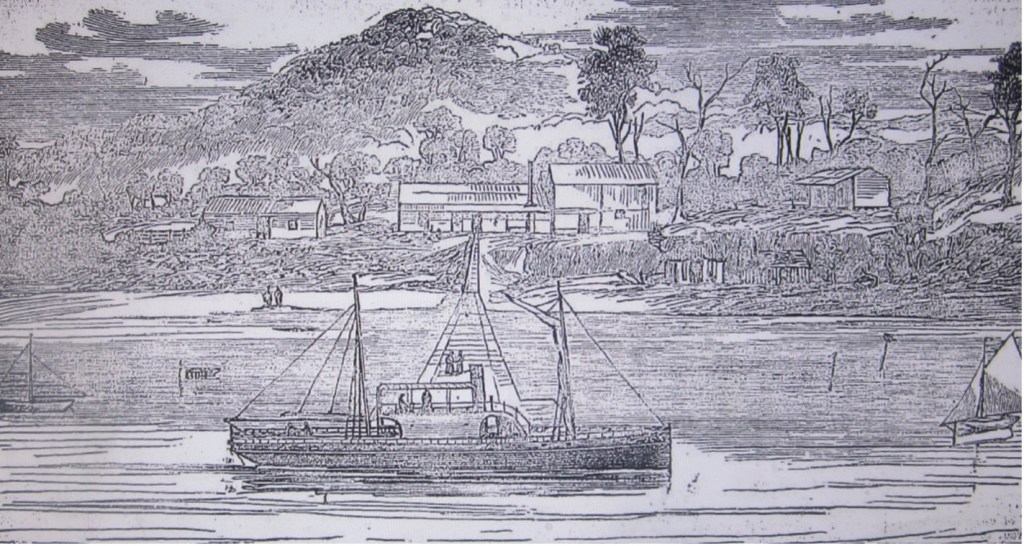
Facilities comprising accommodation and a factory of the New South Wales Fish Company at Nelson Bay as illustrated by an Australian Museum expedition member. The steamer ‘Prince of Wales’ is shown in the forefront adjacent to the new ‘T’ shaped wharf. The seven room managers house, which included two rooms rented to the government as the Nelson Bay post and telegraph office, are not shown in the illustration [Australian Town and Country Journal, 5 February 1881].
While at Nelson Bay the researchers visited the newly completed facilities of the New South Wales Fish Company. The Australian Town and Country Journal of 5 February 1881, page 24, reported on the visit in the following manner:
‘Skirting the southern shore we passed the inner or harbour light and signal station, the pretty and substantial buildings connected therewith being perched on a steep well-wooded little bluff; a telegraph station is established here, but until the Sydney Fish Supply Company selected this spot for their fishing grounds, the operator’s principal employment was to transmit weather reports to the head office, and yarn with his fellow sufferer at the outer light.
A few fishermen’s huts, scattered along the shores of Nelson’s Bay, next came in view. Arriving off the Company’s newly-erected works, situated at the far end of this sandy bight, we ran alongside the long jetty. Mr. Huntly, the manager (the same gentleman who in a similar capacity contributed largely towards making the Coffee Palace [in Sydney] the success it is) was standing on the end of the wharf when we made fast.
On learning the nature of our business, Mr. Huntly welcomed us heartily, kindly proffering us every assistance that lay in his power. After breakfast we went ashore to inspect the works, the engine room with the machinery for the production of dry cold air, or ice, as might be required, coming first; a well within the building furnishes an ample supply of excellent cold fresh water in every way adapted for the purpose required; we then passed round to the right hand side of the main building and entered through a pair of solid and think double doors, a spacious apartment floored with a thick layer of cement, the walls and roof were lined with sawdust, closely packed, and between tongued and grooved pine linings, the roof was traversed by cold air pipes, capable of lowering the temperature as far as it was desirable for the operatives to work in; two small double framed windows admitted sufficient light to enable them to clean, open, and sort the fish.
Passing through two more similar doors, we found ourselves in the cold storage chambers; on every side, above and below, 18in of the same non-conducting material, sawdust, of which over 80 tons had been brought from Sydney for the purpose, divided the seasons, and a double quantity of cold air pipes overhead were expected to be capable of reducing the temperature many degrees below zero. Here the stock was to be kept, and when wanted the supplies would be run out into the cleaning-room, there packed carefully in the company’s cases and safes, placed on the trolly, and run down the tram to the vessel, which will discharge her consignment at the branch cold store-house in Sydney, where less powerful machinery will conserve it for any reasonable length of time. It is proposed from there to send supplies to the up-country towns.
At the rear, but attached to the main building, is a large iron shed for drying, salting, and smoking fish, the firing arrangements for the six furnaces being very convenient. The cottages on the slope are for the employees. Mr. Huntly has built himself a very nice roomy weatherboard cottage (not shown on the sketch) on the crest of the hill, on the right hand side overlooking the works ; nor are the wants of the fisherman, who bring their fish often from a considerable distance, forgotten. The building on the left is devoted to them entirely, and has bunks rigged up all round the walls for the use of lone fishermen and those who do not feel inclined, or are prevented by either wind or tide, which runs in this port very swiftly, from returning to the bosoms of their families until the following day.
The Company do not intend to fish on their own account, at all events within the harbour, but have agreed to purchase from the local piscators at a fixed price of 4s 6d a bushel for all net fish, which ought to pay everybody. Mr. Huntly accompanied us aboard the vessel in order to see the first fruits of our labour, and sent on board one of his men, a local fisherman, to act as pilot.’
Second Shareholder Meeting
The Evening News of 1 February 1881, page 3, reported:
‘A second general meeting of the shareholders of the New South Wales Fish Company was held yesterday afternoon at Mear’s-chambers, Pitt-street. There was a good attendance, and the Hon. J. F. Burns, M.L.A., occupied the chair. The chairman stated that it had been ascertained that the title, and the time had arrived when the operations of the company should be commenced. The secretary (Mr. Bryant) then read the minutes of the previous meeting, which were confirmed. The balance-sheet showed the receipts to be £6577 8s; expenditure, £4527 10s 8d, leaving a balance of £2049 17s 4d on hand and at bank.
Mr. T. S. Huntley, the manager, said that since the last meeting the machinery had been tested and had met every expectation. At Port Stephens they had already taken a quantity of fish, and would take more when the depot was finished. On Tuesday last be had conveyed from Port Stephens three boxes of fish whereby they had been subject to a very critical test, being carried in open boats and carts in the hot weather. These had been distributed to several gentlemen, and some were cooked after having left the freezing-room 58 hours. They were only subjected to two or three degrees of frost instead of 14 as provided for, and were pronounced excellent by all who partook of them.
It had been stated before the Fish Commission, held in Sydney some time since, that freezing had a deleterious effect on the fish; but in point of fact, it improved it, adding to the firmness. Mr. Huntley estimated that the machinery would be open for inspection on Thursday, and he hoped within a fortnight to be in good working order. It was stated that the company would appoint agents in the country for furthering their operations. The meeting then adjourned.’
Company to be Wound-up.
Less than two years of the founding of the company in February 1880, shareholders approved that it be wound up. The New South Wales Government Gazette of 7 October 1881 (No.389), page 5122, published the following notice:
Notice is herewith given, that a Meeting of the Shareholders of the New South Wales Fish Company (Limited), will be held at the Temperance Hall, Pitt-street, Sydney, on Monday, the 10th October, at 4 p.m., to receive the report of the Board, and consider the expediency of winding up the Company.
By order of the Board, H. J. A Herman, Acting-Manager, New South Wales Fish Company. Dated 23rd September, 1881.’
A notice published in the New South Wales Government Gazette of 21 March 1882 (No.122), page 1621, confirmed that the winding up had been completed.
Sale of land at Nelson Bay owned by the Company
Prior to the winding up of the company, land which it held at Nelson Bay was advertised for sale by auction, as shown in the following advertisement.
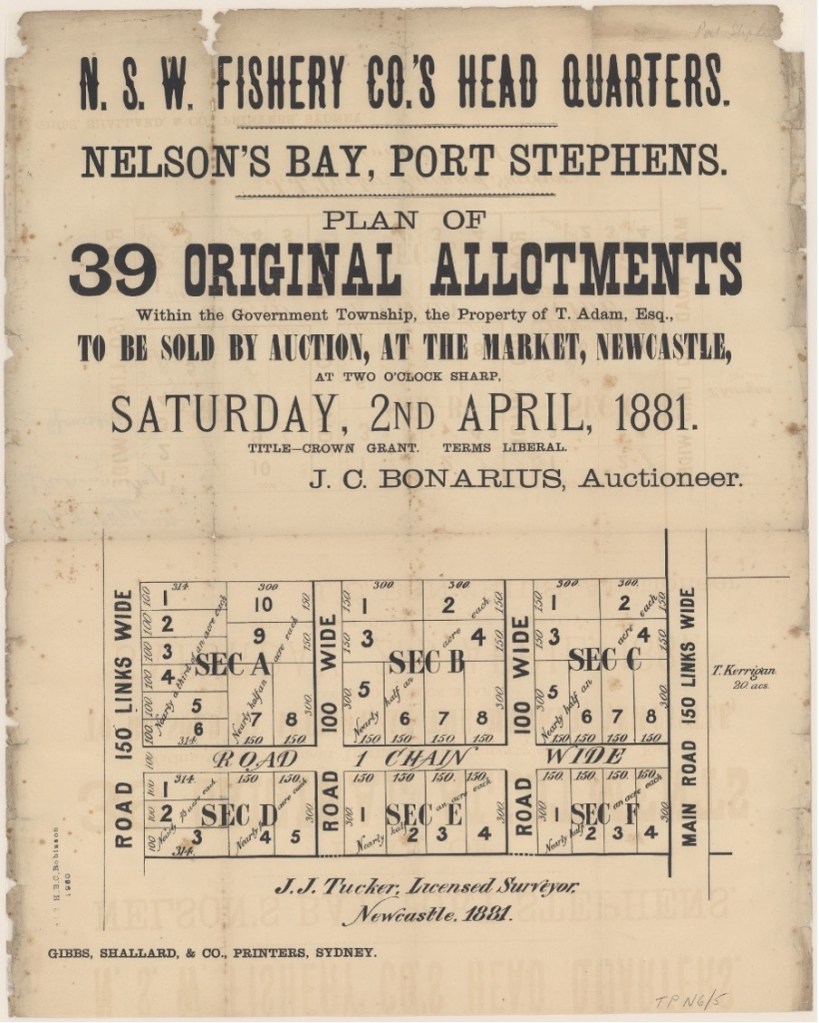
[NSW State Library].
Concluding Comments
Based on the following comments published in the Sydney Mail and New South Wales Advertiser of 6 September 1884, page 489, the company failed due to poor management:
‘Our past experience of fishing companies must not and will not be forgotten. Shareholders in the company which collapsed a short time ago are not likely to forget the Nelson Bay establishment, and the blundering management which made such quick havoc of their capital and accomplished nothing, unless perhaps to give Sydney fish-eaters a rooted dislike of the frozen fish exposed for sale at the company’s shop in Pitt-street. I remember, and so must many of my readers, the failures of several fishing adventures before the fish-freezing business came to grief, and I know why disaster generally followed the well-meaning efforts of their promoters.’
History was to repeat itself with the New South Wales Government establishing another fish processing plant in 1917 on the northern side of Port Stephens at Pindimar. This company Pindimar State Fish Receiving Station also had an extensive freezing capability, but by 1922 it had also failed.
Researched and compiled by Kevin McGuinness
March 2023

 Port Stephens - a history exploration