
Introduction
In 1890’s, the Port Stephens region was one of fascination to many people in Sydney as the area was largely undeveloped and few people had visited there.
It was during this period that steamboat excursions to the area were organised to introduce visitors to the river, lakes and small settlement areas of Port Stephens. As a result, the region was also viewed as suitable for economic development.
In this vein, a group of Sydney entrepreneurs saw the possibility of establishing a butter factory at Karuah, with several smaller creameries, to serve dairy farmers in an area extending from Bulahdelah to Stroud. They formed the North Coast Pastoral and Dairying Company in January 1894.
This paper gives the background of this short-lived venture.
Announcement of the Prospectus for the Butter Factory
The Australian Star of 2 March 1894, page 2, reported:
‘Messrs. T. M. Hall and Co. announce the prospectus of the North Coast Pastoral and Dairying Co., which has been formed under the Limited Liability Act. The capital is fixed at £15,000 in 150 syndicate shares of £100 each, of which 60 shares, fully paid-up, are to be paid to the vendor, and the remainder are offered to the public on terms stated in the prospectus.
The object of the company is to secure a holding of 8228 acres on the Karuah River, a property which is pronounced by experts to be exceptionally suited for dairying. The land has a freshwater frontage of nine miles, and the soil is particularly rich, while the rainfall gives a good average, and the climatic conditions are all that could be desired for successful operations. The situation is 31 miles from Newcastle and 96 miles from Sydney, so that large markets are comparatively close, and the cost of carriage would be small.’
The Evening News of 1 March 1894, page 5, provided the following information, as set out in an advertisement, seeking investors in the company:
‘This Company has been formed and registered under the Public Companies Act to work and further develop, as a large dairying property, a rich tract of country on the Karuah River, consisting of eight thousand two hundred and eighty-eight acres, having a navigable water frontage of nine miles, and is situated within 31 miles steam from Newcastle and 96 miles from Sydney. Expert reports speak very highly of this Estate as most suitable for dairying purposes. The climate is mild and equable, and the annual rainfall aggregates 55in, with an average of one hundred and thirty-one rainy days in the year; while the general water supply (provided by the foresight of the former proprietor) is ample, and includes an artificial lake of over sixteen acres in extent. Considerable improvements have already been made in clearing, fencing, and generally preparing the Estate for dairying purposes, and at an early date tenders will be invited for the supply and erection of machinery and plant, so that business may be in full operation early in the coming season.
Immediately adjoining the Estate, and on all the heads of the tributaries of Port Stephens, Creameries will be erected, and a steam launch will be employed to collect cream from the settlers of Booral, Bulahdelah, and Tellegarie, as well as for collecting general farm produce for forwarding to the central market. The operations of the Company will open up an immense tract of fertile country, intersected by rivers and lakes, and dotted here and there with pioneer farmers, who have been waiting for direct communication with good markets, so that they may be encouraged to increase their output. The brokers have every confidence in recommending this property, having gone to considerable trouble to satisfy themselves of its suitability for the dairying industry, and they would direct the special attention of intending investors to the opportunity this affords of a sound and highly remunerative investment at a minimum of risk. As a good proportion of the shares have been applied for, early application is necessary, as only a limited number are open for allotment.’
Overview of the Proposed Butter Factory
The Australian Star of 28 March 1894, page 3, reported:
‘The dairy farmers in the rich and fertile Port Stephens district will soon have a splendid opportunity of increasing the returns they get from their cattle and lands by the establishment of the North Coast Pastoral and Dairying Co.’s factories and creameries. The proposal to bring into operation next spring a dairy farming business at the head of that magnificent harbor known as Port Stephens should be carried to a high degree of success. It is with that object in view that the North Coast Pastoral and Dairying Co., Limited, has been formed and registered. The company intend to establish creameries in various parts of the port. The development of this industry and the establishment of an export trade of dairy produce should ensure much higher returns from the fertile properties on the shores of Port Stephens and its tributaries, the greater part of which are now idle.
The estate comprises 8288 acres of church and school lands in the county of Gloucester, parish of Tarean. It is held at a low rental from periods of from about 14 to 20 years under lease. It is situated on the Karuah River within four hours’ steam from Newcastle. The name of the estate is Aliceton [now part of Karuah], which has been substituted for the part of the shores of Port Stephens formerly called Sawyer’s Point. From Aliceton to Sydney the distance by water is about 97 miles. The land has about nine miles of water frontage and is subdivided into large paddocks by about nine miles of wire and split post fences.
The water supply is ample for all requirements, a large dam having been constructed near the homestead, and it is well supplied. The rainfall averages 55 inches per annum, with 131 rainy days. A large amount of ring fencing has been done, about four miles more requiring to be done to completely enclose it. The holder, Mrs. Muston, placed the whole of the property under offer to the company. A considerable part of the land has been cleared, and there is a splendid growth of grass over the greater portion of it. The property is admirably suited for dairying, and the best results are predicted by experts to be derived from efficient management of it.
A report on the land by Mr. Wm. Neilley after he inspected it says the estate would form a grand centre for a general creamery, but with its own vast extent of grazing land he should prefer to aim at a dairy of 2000 cows, which would be creamery enough of itself to employ all the energy of those who would control the company. Much of the land that has not been touched is clear, open forest, well grassed, the native award being strong and succulent, while the extensive rainfall keeps it green for the greater part of the year. Fully 6000 acres that he saw he considers to consist of valuable country for dairying or fattening. An area of about 300 acres of swamp land, which it is proposed to drain shortly, would make a splendid stand-by for water and grass.
The timber and scrub on the cleared parts have been thoroughly killed, the scrub as well as the ti-tree having been got rid of by a process of poisoning with the scrub-exterminator. It is considered that the suckers will not be troublesome, and once properly gone over, the land will increase rapidly in value for the purposes of dairy-farming. For fully 18 acres in extent water is conserved at depths of from 8 feet to 10 feet to the shallow parts at the edges of the dam which has been made across what was once a tidal inlet. There are permanent supplies in the house and home paddocks. There is no doubt, as the Hon. R. H. D. White, M.L.C., who resides on the northern shores of Port Stephens, a few miles from Aliceton, says, that the properly is well suited for dairying purposes, is splendidly situated, well-watered and in every way adapted for it, and it ought to be one of the best dairy farms in the colony.
The land in its unimproved natural state is coated, in some portions, very heavily with kangaroo grass. There is an abundant supply of the best of timbers, including ironbark, on the ground. There are already buildings up sufficient for the residential requirements of the manager. These are a few yards away from the shore of the port, and in a line running due west from the heads the length of the port from east to west is 14 miles. It is proposed to erect next winter, near the manager’s house, the principal creamery, with one set of milking sheds close by, where 200 cows can be handled. At a short distance off, on the freshwater conservation lake, another milking station can be built, thus enabling a start to be made for expending about £900 for houses. About £2000 in addition will be required for purchasing 400 milking cows and erecting machinery.
It is intended to establish creameries on all the heads of navigation of the tributaries of Port Stephens, viz., at Tellegarrie, on the southern shores; at Booral, 18 miles up the Karuah (which empties itself into the harbor, where the head buildings will be), and at Bulahdelah, about 50 miles up the Myall River, which flows into the port on the northern side a few miles from its entrance. Cream will be collected from the farmers there, and conveyed to the factory in a steam launch, which will also carry general farm produce for the purpose of being sent on to the markets.
The company’s prospectus sets forth that the factory will cost £600; outside creamery, £300; milking sheds, £300; fencing, £200; steam launch, £300; houses for milkers, £200 preparing land for fodder, £200; 400 cows, £1600; 300 heifers, £375; breeding sows, £100. This will absorb about £4200, leaving the rest of the capital and a sum drawn from the profits annually to be spent in effecting further improvements and developing the industry. It is assumed that if operations are started next spring with 300 cows there should be available a net profit of £2000 for dividends. The second year, with 500 cows at work, the net profits are estimated to reach £3000, and to increase to £12,000 a year when the company has 2000 milkers in use.
The grass is recommended by the Government Botanist as being specially adapted to swampy lands as the most healthful fodder for cattle. The manager of the concern is Mr. C. J. Muston, who has had a considerable experience in dairying, and lived at Port Stephens for a long period. The secretary of the company is Mr. Joseph Stevens, of 55 York-street, and the brokers are Messrs. T. M. Hall and Co., 55 York-street, from whom persons desirous of taking up shares can obtain all particulars they require.’
A Site Inspection
The Sydney Morning Herald of 28 March 1894, page 8, reported:
‘A number of gentlemen who are interested in the North Coast Pastoral and Dairying Company, Limited, spent Monday and Tuesday on the Karuah and Myall rivers, with the intention of seeing the estate belonging to the company, and also of judging for themselves the character of the district in which the operations of the company are to be conducted The party was accompanied by representatives of the metropolitan journals. The estate belonging to the company is situated on the southern bank, of the River Karuah, and is said to embrace upwards of 8000 acres of leased property, comprising a portion of the Church and School Lands.
The head station is named Aliceton. It is reached in two ways – by steamer via Port Stephens, whence it is distant about 14 miles, and by train and coach or buggy, about 24 miles of road intervening between it and Hexham, which is the nearest station on the railway. Most of the visitors journeyed by train and thence by coach, travelling from Hexham to Raymond Terrace, thence for a distance of 12 miles in a northerly direction along the main road going towards Stroud and thence by a road leading easterly towards Sawyers’ Point, which is on the opposite side of the river to Aliceton. The last six miles of roadway was up till comparatively recently in a state of nature, but, it is stated, the Hon R. H. D. White, M. L. C., who passes over it occasionally, has been an advocate of it, with the result that parts of it have been formed and drained, and a few chains have been metalled. This has made the road much more tolerable than hitherto, but the recent rains have softened many patches of the soil, and travelling over it is slow and tedious.
On arriving at Aliceton on Monday morning the visitors saw in readiness for them a steam launch. The Karuah is a very fine river, being in some parts from seven to eight miles in width, and towards the heads exceedingly picturesque, some bold mountainous, timber-covered lands being prominent features. The launch first made a run westward for a distance of about four miles, visitors noticing on the opposite side of the river some sawmills which by reason of the depressed condition of the colonial timber trade, had fallen into decay. Old sawmills are very numerous in the whole of the district serving as reminders of the extent of the trade in timber-getting at one time done in that part of the colony. This change is the subject par excellence which the old residents delight to descant upon.
Soon after leaving the wharf the attention of the visitors was directed to a plantain plantation which has been chosen as the site of the butter factory which the company has in contemplation. Near it was a clearing which was used as a permanent aboriginals’ camp [at Karuah]. The steam launch having reached a point in the river called “Humbug” Reach, because of the perversity of the winds at that point (a favourable wind almost invariably becoming unfavourable here, and vice versa), some of the party landed for the purpose of traversing a portion of the estate which was covered with a remarkable growth of grass. Unfortunately, there were timber and shrubs to crowd the grass in, but to make it available for cattle it is intended to do some clearing.
The party toiled up one side of a hill and down the other, with the object of seeing some alluvial flats which it is intended to convert into pasturage. A network of mangroves on the lower of these flats testifies to the incursions of the river, but it is in contemplation to erect a dyke so as to keep the river within proper limits. The visitors had already trudged over about 1½ mile of bush land, being besieged all the while by swarms of ravenous and persistent mosquitoes, which seized many opportunities for irritating the strangers and indulging their taste for new blood. Wearying as was this trudge in the heat it was followed by another even more trying through scrub, rankly-grown grass and rushes, and swamps, everyone thinking of the reptiles which might naturally be looked for in such wild country.
Returning to the boat, the party was taken seaward to a point four miles from Port Stephens and then the launch turned up the Myall River This river is as sinuous as it is possible to imagine. It was in flood which has been its condition for the last three weeks. The waters were from 5ft to 6ft above the ordinary summer level, the volume altogether being so great that it was said that the flowing away of the surplus waters would occupy at least four months. The party was taken up the river to a distance of about 34 miles, where the township of Bulahdelah in situated, a romantic little village, overlooking which is a huge mountain, and above which is a picturesque semicircle or ranges.
Near its junction with the Karuah the Myall has on its banks two interesting little villages on opposite sides – one being a sleepy – looking settlement called the Tea Gardens which is often resorted to by pleasure-seekers, and the other an even more sleepy little settlement called the Hawks Nest. The river courses through or communicates with a series of lakes, the scenery of which strongly resembles that of Lake Illawarra, on the South Coast. The Myall is or the most part hemmed in with thick forests of timber. Above Bulahdelah there is a considerable amount of settlement, and with a view to establishing business relations with the farmers there the company contemplates erecting a creamery in the township. After the party had returned to Aliceton attention was directed to a dam which had been erected in a hollow, with the result that a considerable reservoir of fresh water had thus been created, and visitors also saw clearing operations in progress. It is in contemplation by the company to erect creameries at Tellegarrie, Stroud, and Booral in addition to that proposed for Bulahdelah, and to convey all the cream from those places to the factory at Aliceton, and there to conduct the whole of the butter making operations. The idea is to export the butter to England and to Belgium.’
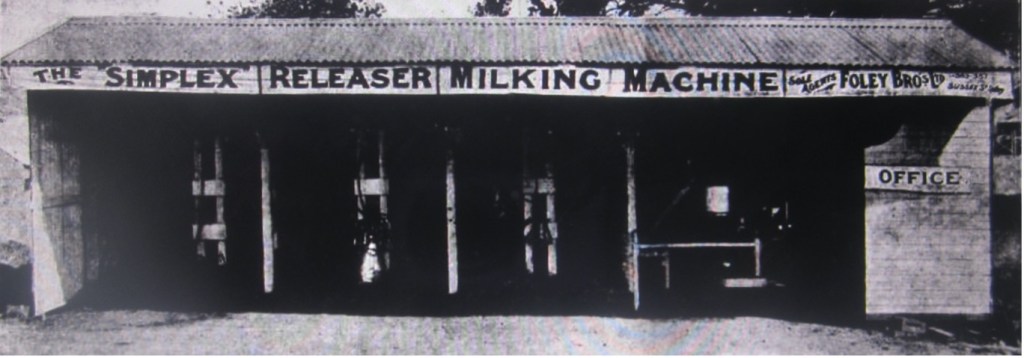
The type of milking apparatus that would have been installed at the proposed Karuah Butter Factory [The Land, 26 April 1912]
An Alternative View
The Daily Telegraph of 28 March 1894, page 5, reported:
“The cattle kings are evidently to give place to the butter kings,” said Sir Patrick Jennings at a public banquet a few weeks ago. And if we are to judge by the developments which are taking place in the industry then, in good sooth, the prophesy is likely to be fulfilled. There is this distinction to be drawn, however. The big squattages were, and indeed are, in the hands of one or two men; but the large and growing creameries and butter factories are conducted mainly on the cooperative principle as recognised under the Companies Act. The latest addition to the list is the North Coast Pastoral and Dairying Company, which has just undergone the process of registration.
The company which, when all the shares have been taken up, will have a capital of £15,000, has acquired a lease of 8300 acres of church and school lands at the head of Port Stephens, and having for nine miles a frontage to the Karuah River. At present, of course, the enterprise is entirely in its initiatory stage. The land has been obtained on all but a 21 years’ lease under the provisions of the Act regulating the letting of Church and School Lands, which carries with it what is practically the right to a renewal. The original lessee had exhausted two or three years of the term, but as there is not thought to be any difficulty in securing whatever extension may afterwards be required, the company really holds possession of the land at a very small rental for what is believed to be an unlimited period. It is, indeed, one of the instances in which Crown lands held under a rental tenure will be occupied for that class of settlement on the soil which is supposed to be the ideal of advanced democracy.
Having secured the property, the company is now devising the most suitable means for putting it to the very best purpose. The Port Stephens country is almost unknown to the average resident of the metropolis. Leaving the northern railway, and traversing via Raymond Terrace some 18 miles, one finds oneself on the shores of a harbor which, for magnitude and variety of scenery, is a sort of combination of the River Derwent and the port of Rio Janeiro. The facilities for navigation are not so magnificent, but there is the splendid sheet of water stretching 14 miles out to the heads, and about half the distance from shore to shore, and there are the islands beautifully green, and with names representative of their special characteristics, dotting the port, and adding immensely to its picturesqueness. On the northern side is a channel sufficiently deep to allow ordinary steamers to come alongside the pier at the homestead, which hereafter will be the manager’s residence, on the company’s property.
To the north are the house and grounds of Mr. R. H. D White, M.L.C., who may be called the squire of the district, and adjoining the little village of Carrington. Then there is the far extending area of real estate known as the Australian Agricultural Company’s land. Tradition says that in the old days the company had 100 prisoners working on the ground, and that they were accustomed on the Sunday to attend the little church which now stands out a conspicuous feature on the landscape. Local gossips aver that this is the first, or at least one of the first churches in which the present Dean Cowper preached. Villagers the world over are notoriously loose in the matter of historical detail, so that perhaps, after all, the Dean did not play so prominent a part in the early days of this almost forgotten settlement as the oldest inhabitant or his veracious survivor would have one suppose. This, to be sure, has not much to do with dairying. But on the southern side of the port are a number of small graziers, and on the north there probably would be also, if the aspiring cow-keeper and pig-breeder could only get hold of a few of the many unoccupied broad acres.
Port Stephens seems cut out by nature for dairy farming purposes. There is abundance of feed, which, in the shape of kangaroo and other grasses, flourishes luxuriantly everywhere. Cattle thrive splendidly. Poultry find a suitable and inexpensive home. Rain falls at an average which exceeds that of most of the best-favoured localities in the colony. The drawbacks are the stretches of enormously thick timber, and the liability of the lands along the Myall to heavy and destructive floods. On the company’s estate, however, the protection from inundation is ample. The land is high. The Karuah River, which sweeps round it on the north-western side, has a splendid outlet in Port Stephens, so that the rise is never sufficient to affect detrimentally more than an insignificant portion of the property. There are about 300a., along which an abnormal quantity of flood waters or even a very high tide may flow, though only to a comparatively trifling extent. This area the managing director, Mr. C. J. Muston proposes to safeguard from undesired inroads by constructing a cheap but adequate embankment.
A lake of permanent fresh water for stock purposes has been made by running a small dam across a lagoon at the opening from the river and taking advantage of the catchment area. The water from the river is generally brackish. In the dry season it is quite salt. By the process of dilution, coupled with the constant outflow, the salt formerly in the lagoon has been effectually got rid of, and now a really admirable supply of fresh water is available. A fair amount of clearing has also been done, and most of the fencing has been erected. It is intended shortly to stock a certain proportion of the ground. A site has been selected for a butter factory, and for cold storage chambers, the latter of which are to be cut out of the banks on the Sydney side of the river.
The appliances for butter making, for storing, and for exporting that the company will possess will obviously be of the utmost value to the smaller dairy farmers in the district as well as to the company itself. In order at once to increase the supply, and to extend the advantages of an easily accessible market to the settlers in the districts along the rivers which have their outlet in Port Stephens, creameries will probably be established at several points, and a steamer provided to receive and convey the produce to the chief depot. In order to obtain a glimpse of the country likely to be served by the company, Messrs. James Best, J. Stimson, J. G. Purves (directors), J. Stevens (secretary), and C. J. [Charles John] Muston (managing director) started on Monday morning on a trip by steamer from the homestead at Aliceton, proceeded up the port, and then along the Myall River through the Upper Myall Lake, and again along the Myall River to Bulahdelah. The entrance to the Myall is immediately opposite to Nelson’s Bay, and about 10 miles from Aliceton.
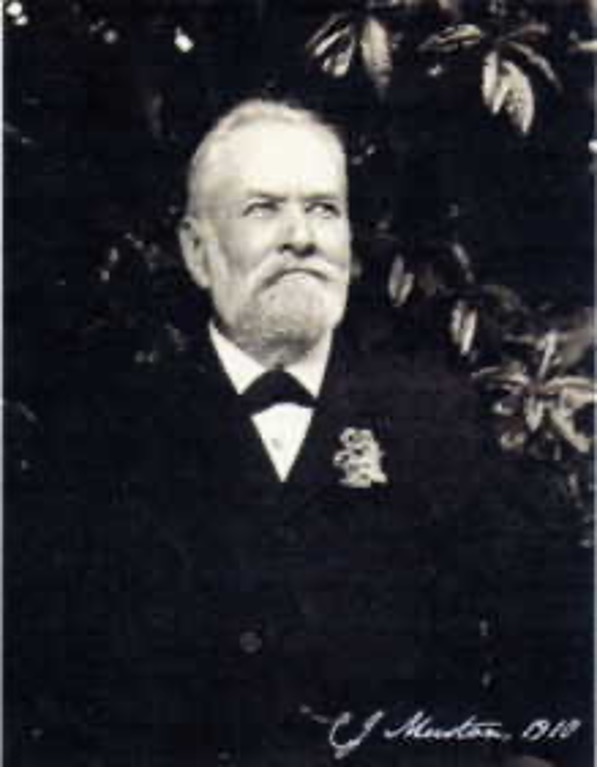
Charles John Muston [Ancestry.com]
Beyond the fishing village of Hawke’s Nest, and the slightly more pretentious township of the Tea Gardens, the settlement along the bank of the river for 30 miles to Bulahdelah is extremely meagre. On the right bank of the stream there are Crown lands in thousands of acres, and on the other is still the Australian Agricultural Company’s property. The greater part of the land on both sides seems to be uninhabited and uncultivated.
Evidence of what no doubt used to be thriving sawmills occur here and there on the Crown Estate, but licensed fees and royalties and bad times have taken the industry by the throat and strangled it. As to the rest, the country seems to be in exactly the condition that it was when the first explorer made his slow, and devious way around the bonds, and over the sandbanks, and past the snags of the Myall. The season was about the most unpropitious that could have been selected for a favourable inspection of the locality. The river was in flood, an entirely phenomenal flood, and down the current came in great torrents, sweeping over the plains and excluding everything from view, save the eternal eucalyptus and an occasional cabbage-tree. A more uninviting spot for settlement the eye of man could scarcely conceive.
For miles the country was so heavily timbered and so covered with thick undergrowth that one would require literally to cut his way through. Then fine open lands, above the flood level and thickly grassed, would catch the view, and after that and around it, and indeed with few exceptions everywhere there was nothing but water. It was Martin Chuzzlewit’s Eden over again, with perhaps the malaria excluded. The scene was one of utter desolation, relieved by the occasional patches of the better and lighter ground. Just as the evening shadows were closing in the steamer entered Lake Myall, known as the No. 1 Lake, and picked its way five miles across to the upper branch of the river. By the time that the other side was readied the night was pitch dark.
The difficulty of navigating a narrow stream with thick clouds overhead and not a light to be seen, and the black and spectral forms of the trees obscuring the bends from view can easily be imagined. Progress was extremely slow. The pilot, Mr. Garner, who was skipper of the Boat, was happily no chum to the stream. But he had nevertheless to keep her down to three knots, and occasionally to two, with a spurt to four whenever a clear waterway along one of the reaches permitted. The cry of “Stop her! stop her !” “astern ! astern !” and a hundred of the pilot’s technicalities to indicate the proximity of a snag or the overhanging branches of a tree, or a treacherous sand bank just beneath the surface, rang out every few seconds in the deep silence. There was only one mishap. In rounding a bend the steamer just shaved a huge dead tree trunk. The boat, however, was not so lucky, and in attempting to follow broke away. Fortunately she was recovered without difficulty.
The party remained at Bulahdelah for the night and left again shortly after 6 o’clock yesterday morning. Bulahdelah is at the head of navigation on the Myall and is the outlet for a large number of settlers who live higher up the river. It is proposed to establish the principal district creamery here, and to erect others at Booral, Tellegarrie, with probably one at Stroud. There is undoubtedly some splendid paying country all along the stream, though the liability to floods and the distance from a market has hitherto no doubt retarded settlement. The company hopes to induce persons to take up much of the Crown lands, and with the facilities which it will have for storing produce, and then for distributing and exporting it, should succeed in giving to the Port Stephens country a larger amount of prosperity than it has yet, apparently, attained.
The visitors reached Sydney at 11.30 p.m., having been travelling continuously by steamer, coach, and train since 6 a.m.’
The Company is wound up
The proposed butter factory at Karuah, with associated milking and cattle handling facilities and three creameries at Booral, Tellegarrie and Stroud was a complex financial and logistical undertaking.
The expenditure of large sums of money up-front on infrastructure development was required with uncertain financial returns into the future.
The project also involved seeking the cooperation of farmers located over a large area to change their marketing practices to accommodate the company’s processing operations.
Despite the grand plans and sales pitch, the venture quickly failed due to the uneconomic costs of setting up the entire operation over various sites.
The following notice was published in the New South Wales Government Gazette of 11 June 1895 (No.376), page 3811, by Ceeakles James Budd, Liquidator of the Company:
‘Notice is hereby given that at an Extraordinary Genera] Meeting of the North Coast Pastoral and Dairying Company (Limited), held at the Office of the said Company, 55 York street, Sydney, on Friday, the 7th June, 1895, the following Extraordinary Resolution was passed:—
“That it has been proved to the satisfaction of the Company that the Company cannot, by reason of its liabilities, continue its business, and that it is advisable to wind up the same, and that the same be voluntarily wound up accordingly.”
Researched and compiled by Kevin McGuinness
September 2023

 Port Stephens - a history exploration