
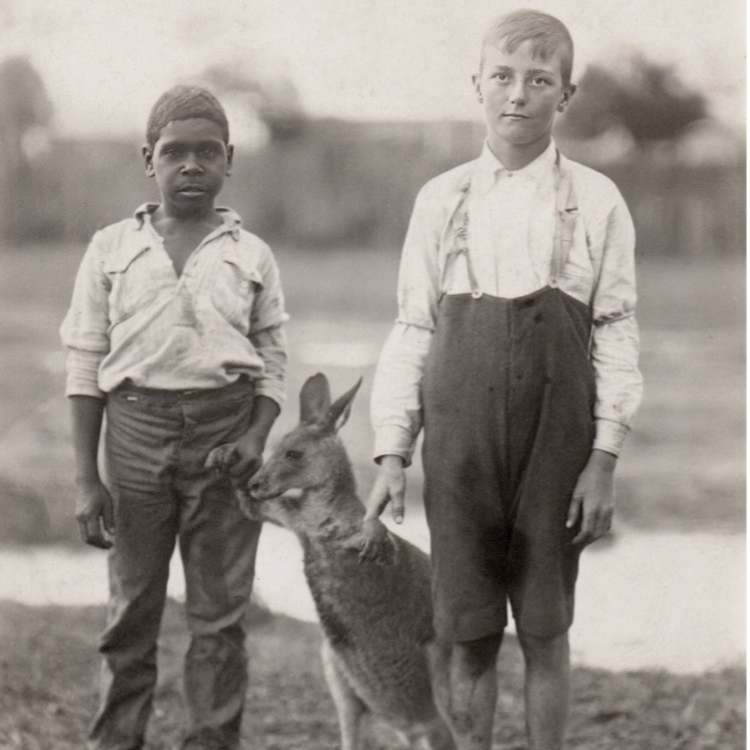
In 1928 and 1929, the Dungog Chronicle: Durham and Gloucester Advertiser published a series of articles written by William Scott on his reminiscences as a young boy living at Carrington, Port Stephens.
As a child, William spent much time with the local aboriginal people who lived close to the Australian Agricultural Company settlement at Carrington.
Scott wrote the articles as an adult when he lived in Queensland. He was concerned that little information had been recorded on the aboriginal people of Port Stephens and believed that his articles would help to remedy that deficiency.
The series of articles was published by The Dungog Chronicle: Durham and Gloucester Advertiser as follows:
2 November 1928, page 4; 16 November 1928, page 1; 23 November 1928, page 3; 30 November 1928, page 1; 7 December 1928, page 6; 24 December 1928, page 1; 11 January 1929, page 4; 18 January 1929, page 6; 25 January 1929, page 4; 1 February 1929, page 4; 8 February 1929, page 6; 19 February 1929, page 3; 22 February 1929, page 3; 1 March 1929, page 5; 8 March 1929, page 5; 15 March 1929, page 5; 22 March 1929, page 3; 29 March 1929, page 1; 12 April 1929, page 1; 23 April 1929, page 6; 21 May 1929, page 4; 24 May 1929, page 3; 7 June 1929, page 4.
In this research paper, William Scott’s articles have been reproduced in a block presentation under various headings.
Readers may find some of expressions used, as referring to aborigines, as offensive. The articles are published here in full without any form of moderation or exclusion. To alter that material would be akin to altering history.
With this caveat, the articles provide an extensive review of the Aboriginal community in the Port Stephens region covering issues such as superstitions, ceremonies, fishing methods, hunting and burial arrangements.
Scott’s writings demonstrate a genuine admiration for the aboriginal community and of his aboriginal playmates. He also recognises the great damage that the operations of the Australian Agricultural Company at Carrington did to the Aboriginal community.
Of particular importance, Scott provided a list of common English words, with the corresponding Aboriginal word, which is set out at the end of this paper.
The Dungog Chronicle: Durham and Gloucester Advertiser also published a booklet titled ‘The Port Stephens Blacks, Recollections of William Scott’ in 1929, which was based on the articles published in the newspaper. The foreword to the book, as prepared by Gordon Bennett, is set out below:
‘When Mr. William Scott consented to permit me to prepare his reminiscences of the Port Stephens Aborigines for publication, I felt that I had been afforded the opportunity of contributing something of especial value to the scant store of literature extant that deals with the lives and customs of the earliest inhabitants of a little known, but historic, part of New South Wales. It is with the hope that the public will appreciate the recording of facts that might otherwise have gone unnoted that I present this booklet to the world.’
Where discrepancies occur between material published in the newspapers and the book, those contained in the book are used in this paper.
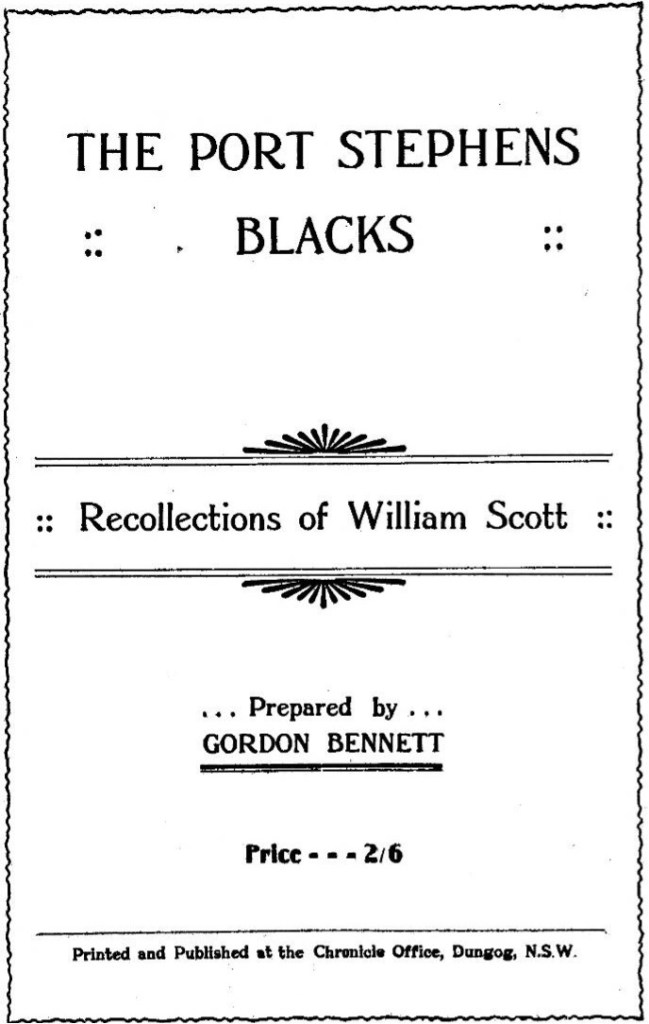
Cover of the booklet published by the Dungog Chronicle: Durham and Gloucester Advertiser Published in 1929
The author of this paper acknowledges the Worimi people the traditional owners of the Port Stephens region and recognises their continuing connection to Land, Waters and Culture, and pays respects to their Elders Past, Present and Emerging.
Aboriginal and Torres Strait Islander peoples are advised that this paper contains a range of material which may be culturally sensitive including records of people who may have passed away.
This paper supplements two other papers at these links on this website:
- Aboriginal People of Port Stephens, Dungog and Gresford, by Gordon Bennett.
- Aspects of Aboriginal History at Port Stephens
- Evidence of Early Aboriginal Settlement at Port Stephens
The Newspaper Articles – Reminiscences of William Scott
Introduction by William Scott
Because so few of the aboriginal inhabitants of coastal New South Wales remain, and because so little has been recorded of their habits and customs, I have felt that, for the enlightenment of future generations it is a duty devolving on me to commit to paper some of my early recollections of the Port Stephens tribe, which, when I knew it, had not been greatly subjected to what unfortunately has proved to be the degenerating influence of the white race.
So far as I am aware there is no one extant today in a position to describe the habits and customs of the aborigines who lived their simple lives on the shores of that magnificent harbor, and my regret is that, when I was among them, I did not carefully record every single thing connected with their manners, however small and seemingly insignificant it may have appeared at the time. For even now, scientists and humanitarians are awakening to the value of precise descriptions of a race that has become well-nigh extinct. Historians many years ago realised the tragedy of permitting facts concerning the blacks to become lost and buried with the passing pioneers, and are now combining in a praiseworthy effort to preserve whatever is possible from the memories of the old generation still alive.
Background of William Scott
I was born at Carrington, Port Stephens, on September 19, 1844, my father, John Scott, being employed in a secretarial capacity at Carrington by the Australian Agricultural Company, a wealthy English corporation, which had secured a million acres of land in that part of the country. Of matters relating to the district, and the activities carried on thereabout I will have somewhat to say at a later stage, but my preliminary dissertations will deal almost exclusively with the blacks who were there in large numbers in my boyhood days.
Records William Scott Prepared
It will be as well for me to state at the outset that I am not depending entirely on memory for the facts I intend to present. Before I left Port Stephens for Queensland, in 1873 I went to a good deal of trouble to make a written record of many incidents and descriptions of customs and ceremonies, besides preparing a considerable vocabulary of words and phrases common in the tribe. These, I fortunately kept by me through the years, and with their aid I have been able to refresh my recollection on some points. The list of aboriginal words used by the tribe is probably the only one in the world, for none other, to my knowledge, ever troubled to commit a glossary to paper.
Lads of the Tribe Were His Playfellows
At the date of my birth, Carrington was a considerable establishment, although declining in importance, as the Company by that time was transferring the main centre of its activities elsewhere. But the blacks remained, and many of my earliest recollections are of them. The lads of the tribe were my playfellows. I learned to speak their language with a certain degree of fluency as did my sister to a greater extent — and we mastered those difficult labials and gutterals that few white men have been able to catch correctly, as is evidenced by the discordant corruption of many beautifully euphonious native names.
From my sable playfellow I learned to appreciate the innate character of the black, his simplicity, his honesty, his hardihood, his resourcefulness, his courage. And I was taught much of his skill in bushcraft.
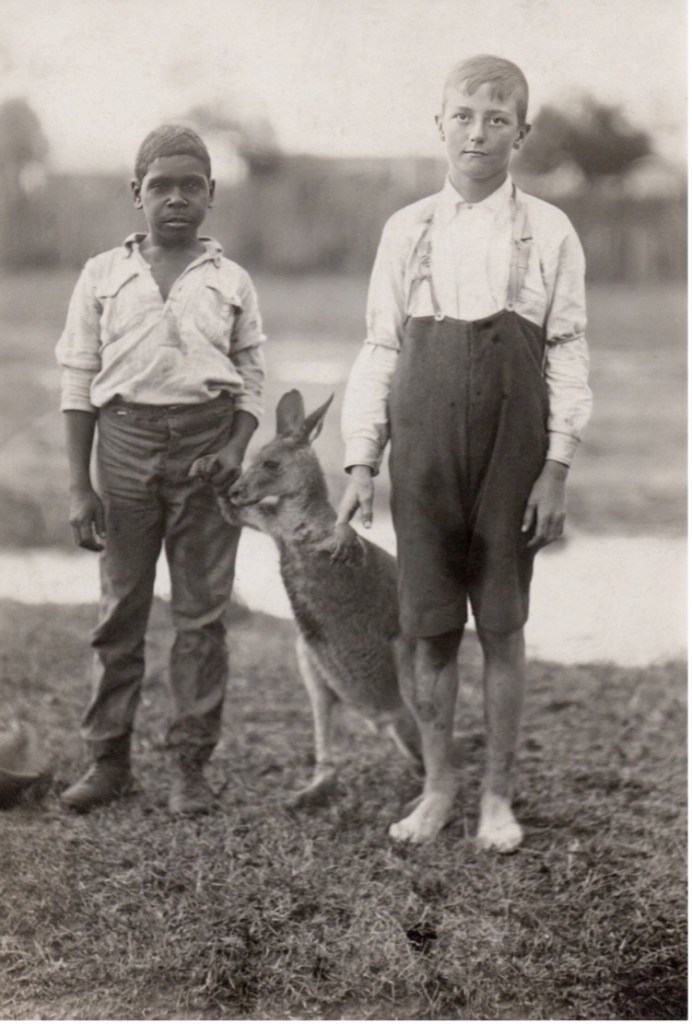
The details of this photo are unknown but show the comradeship between two playmates. [Source: John Clarke, Fingal Bay].
Superstitions
They were primitive people indeed those earliest inhabitants of the district. Religion they had none, but withal, there were certain rigid codes of honesty and morals that were seldom violated. It could hardly be said that they had any conception of a God, yet they faced, and feared profoundly, some terrible, invisible being they named Cooen supposedly capable of exercising a maleficent influence over their lives.
This mighty unknown was not in any way associated with such natural phenomena as thunder or lightning, nor did he seem to have any particular dwelling place. But he was about somewhere — intangible and dread conveying. The blacks would not, or could not say anything definite of him that one could advance as an explanation of his whereabouts or his potency, but clearly he had some influence on or associated with the spirits of the departed.
I remember, on one occasion, a young black-boy, who used to be about our place a good deal, being deeply grieved over the death of a comrade to whom he had been greatly attached. After the burial ceremony, Billy, as the lad was named, made it a practice to visit his friend’s grave on frequent occasions and deposit thereon small offerings of food and tobacco, plainly as a propitiary offering to the spirit of the deceased. As time went on and Billy’s grief abated, the time between the visits lengthened, until eventually they ceased altogether. One night however, Billy when passing the grave of his forgotten friend, felt a sudden pang of terrifying remorse.
What caused it cannot be explained, perhaps, save to suggest that some sub-conscious cell in his brain became suddenly active. But Billy, with the speed of an arrow, made for our house. Into the kitchen he hurled himself quaking with the most apparent terror. We asked him what was wrong. “That feller bin run-im me.” he answered. We knew he referred to the spirit of his departed friend, whose name he would not mention, for the name of a dead person was never spoken after he has passed to the Great Un known. Billy did not recover from his fright for many a day.
The belief in a spirit existence is again exemplified in connection with the burial customs of the Port Stephens tribe. One of a small camp of blacks about a quarter of a mile from our house died of some sickness. To dig his grave a spade was borrowed from us, and the excavation was made on the foreshores, a few yards above high-water mark. The time of burial was fixed for floodtide (killoongmundi) for they believed that if the interment took place at ebb-tide (wittung), the spirit of the departed would be carried out to sea (wombal) and lost in the great waters.
The corpse was neatly encased in a sheet of bark (paper-bark) stripped from the giant ti-tree (Meleluca) and bound with vines from the scrub. About this again was an outer casing of a freshly stripped sheet of stringy-bark, also bound with vines. When these preparations had been made, the next thing was to find out who was responsible for the man’s death, it being believed that all sickness was brought about by the machinations of an enemy. “That feller been puttem stone,” or else “that feller been pattern bone,” they would say.
The plan adopted to discover the death dealer was as follows: —The coffin was lifted upon the shoulders of two men. A third, holding a green branch, stood at the side calling out the names of everyone of whom he could apparently think, at the same time lightly striking the coffin with the wand. It was the belief that when the name of the guilty person was called the corpse would start. My father’s name was called first, followed by quite a number of others, when suddenly, on a certain name being mentioned, the bearers of the body lurched forward as though the corpse had moved. Thus was the culprit found. How he, or she, was dealt with I was never able to discover.
Without more ado the corpse was lowered into the grave, which was filled and carefully levelled. The man’s widow then made her camp fire by the grave-side, and every evening as the sun was sinking, she began her loud mournful wailing for the dead. This continued until the grass began to shoot on the grave, and then one night the tribe suddenly disappeared and we saw nothing of them for several months. Never at any time could we get them to mention the name of anyone who had died.
The mourning for the dead sometimes was extended to favourite animals. We had a little black and tan terrier, a splendid snake killer, that like most dogs that pit their cunning and skill against serpents, was at last bitten beyond hope of recovery. One of the gins “Old Mammy,” discovering the body of the faithful little animal in the yard, sat down beside it and began a mourning howl that she maintained for an interminable time. At last, to our relief, she desisted. Coming up to the house she demanded payment. We naturally demanded to know what the payment was for. “Oh,” she exclaimed. “For crying for your dog.” We explained that she had not been asked to perform this sad rite for the dead. “That doesn’t matter,” she said. “I did it.” To get rid of her we complied with her demand for some “plour, chugar and tea.”
If religion played no part in their daily life, and If in some things only they were oppressed by a dread of the unknown spirit, it may he said that many of their actions were regulated very definitely by superstition. This, no doubt, in common with all primitive peoples, is an Inheritance from primordial man, so that it Is not surprising to discover its influence among the Australian aborigines.
Some of these superstitions were extraordinary. For instance, a party of us were preparing to go fishing in Fame Cove under the guidance of Billy Steward, a man who had once been steward on a boat. I happened to have a few emu feathers stuck in the band of my hat us an ornament. On perceiving these Billy flatly refused to accompany us. “Ball catch fish,” he said. “Take ’em feathers out.” When the offending plume was removed Billy was immediately placated and was ready to start. Another fishing superstition was in connection with eating fruit. No black would dream of going fishing after having partaken of a feed of fruit, nor would he accompany anyone who had been similarly guilty. One of the most remarkable beliefs I remember, also concerns the same piscatorial sport, and it involved a peculiar rite worthy of description.
An aboriginal woman, Fanny, who was a servant of our family for many years, was in her girlhood days dedicated to the art of fishing. When quite young, a ligature was tied about the first joint of her little finger very tightly and being left there for a considerable time the top portion mortified and, in time, fell off. This was carefully secured, taken out into the bay, and, with great solemnity, committed to the deep. The belief was that the fish would eat this part of the girl’s finger and would ever, thereafter, be attracted to the rest of the hand from which it had come. Thus Fanny would always have success at fishing because of the peculiar lure in her fingers. She was indeed a wonderfully lucky fisher.
One woman of each small tribe was usually dedicated this way, and to her was entrusted the task of fashioning the fishing lines, the virtues accruing from her innate powers over fish being of course communicated to the lines she made.
Clothes
I am afraid that I cannot give any very lengthy description of the clothes that adorned the robust frames of my early friends for the very sufficient reason that they seldom wore any. For the most part full dress consisted of a possum-fur belt, with narrow strips of skin pendant therefrom both in front and at the back. This was all their bodily protection against the elements, and their fullest concession to the conventions imposed by the white people about. A complete outfit could almost be held in the hollow of the hand, but we saw nothing unusual in it.
Some of the women were more adequately clad in any cast-of clothes they could secure or enfolded in an old rug or blanket. Strangely enough neither men nor women adorned themselves with ornaments of any description, being content to present themselves to the world as Nature so fashioned them.
The rugs they used were made of animals’ skins, principally those of ‘opossums. They were very neatly made and provided both warmth and protection from rain when occasion arose. Blankets they obtained from the Government, from time to time, but they preferred their own home-made coverlets usually.
The men invariably carried their tomahawks in their belts, and a piece of grass-tree gum, which latter seemed to be an indispensable part of their equipment This exudation of the pummirri had so many uses that no blackfellow could by without his supply ready at hand.
The tribe had no special leader or chief during my memory of them, the older men acting as general advisers, but by what authority I never knew. It may have had something to do with the “mystery bags” that formed part of the equipment of the adults.
My father had been admitted as an honorary blood-brother of the
tribe and was regarded by them with a sort of veneration. It was their custom to seek his advice and assistance in almost every emergency that arose.
The mystery bags carried by the men evidently held some significant superstitious meaning, the profundity of which I was never able to fathom, despite careful inquiry on the subject. Always my requests to be informed what they contained or what they meant were met with blank refusals. Indeed, the men would never discuss them at all. These bags were attached to the waist-belt when the men were in ceremonial undress, some of them being attractively made. My curiosity as to their contents was gratified on one occasion in an unexpected manner, while I was still quite young. We children were out for a walk with our faithful servant Fanny when I, noticing a big mangrove tree on the edge of the bay climbed to its top-most branches. In a hollow fork I discovered one of these mystery bags and displayed my prize excitedly to the group on the ground. Fanny, on seeing it, became greatly agitated and ordered me to restore it to its hiding place at once. Before doing so, however, I peered into it and saw only a piece of rock crystal. Fanny implored us to maintain silence about the find, her perturbation being so intense and impressing us so strongly, that we never mentioned the matter afterwards.
Another superstition was in regard to the treatment of a sufferer from internal pains. Sometimes when a man was wracked with an internal spasm, he would have his wife “pere-ally” for him, an operation carried out in the following manner. The patient was seated or placed in a reclining position on the ground. A canoe-shaped vessel of bark a couple of feet long, was half filled with water and placed near him. A cord, made of possum hide was passed around his body a couple of times. The ends being held by the woman who knelt on the ground, leaning over the little canoe of water. She then passed the crossed ends of the cords rapidly to and fro between her closed lips until the blood, drawn by the friction dropped freely into the water, discolouring it to a crimson fluid. It was confidently believed that the pain would leave the man’s body by way of the cord and passing down with the blood from the woman’s mouth, dissipate itself in the water.
I was too young when observing these practices to inquire deeply into their full significance, but I presume that suggestion played a great part in the cure, even as it does with the most approved medical treatment in these modern days. What subsequently became of the blood-tinted water I never learned.
Although I could never ascertain definitely that a system of totemism, on the complicated and intricate basis common with some of the inland and Northern Territory tribes existed among our blacks at Port Stephens, nevertheless, I am convinced that something of the kind obtained. In some other tribes there are series of sub-branches identified distinctively with their animal or bird totem, these groups being subject to rigid rules as regards inter-marriage, food taboos, and other things. The animal or bird representing the respective totem is of course sacred to the particular person to whom it belongs, and though he may not kill or eat it, those in other groups are free to do so.
At Port Stephens, where the tribe numbered in the vicinity of a hundred persons men, women and children, two totems did duty for the community. The men had as theirs the tiny bat that flies about at dusk, and this little winged sprite was regarded with deep veneration. He was “gimbi,” the friend of the males. With equal reverence the gins looked upon the small wood-pecker, hailing his appearance with delight as presaging good fortune while he lingered in the vicinity, busy with his sharp strong bill seeking grubs under the bark of the trees.
The men look a mischievous pleasure in killing the wood-pecker which represented the totem of the women. They would often knock the feathered forager from a tree trunk with a “purahmirre” (the throwing-stick), or a stone, laughing uproariously at the feat. But they seldom did this in the presence of the women. If a wanton slayer of the gins’ sacred bird were detected in his crime, the women would give way to outbursts of furious passion and direct savage attacks at the offender, beating him with their sticks until he was glad to fly in precipitate confusion, offering no retaliation or resistance.
I am inclined to believe that these sacred totems had, in earlier times, some bearing on intricate tribal rites unknown to us and which probably had fallen into desuetude owing to the influence of the white people. Whether such was the case will never now be known.
No definite conception of an existence after death appeared to exist among the members of the tribe. In some vague fashion they sensed a spirit existence, but in the ‘fifties and ‘sixties it was generally accepted that a dead native would “go down blackfellow, jump up white-fellow.” This, obviously, could have been no part of the creed of the forefathers of the tribe who must have had very fixed notions of their own on this subject, as I have been able to conclude from many incidents that were seemingly unimportant. I have mentioned Billy’s terror when he fancied, he had been pursued by the spirit of his deceased friend, which in itself predicted an instinctive belief in a super-natural existence. Then there was the fear of darkness, general among all members of the tribe. There was also a fear of certain localities, for no given reason; there was the disinclination to do certain things at certain times; there was the strange refusal to speak of or mention the name of one that had passed away.
Probably the tribe when I knew it was in the transitionary stage between outright savagery and semi-civilisation, for it must be remembered that Carrington became a settlement in 1824, and from that time onward the natives had been in constant contact with white people and their ways. Three decades is a long period in the life of a black, and the racial and conventional domination of the whites have been most marked at all times in their influence on uncivilised tribes.
The fear of darkness is not common to savage peoples by any means, but at Port Stephens the black would move from the camp after dark, even on the shortest journey, without providing himself with a very large fire-stick that he would whirl assiduously and keep blazing all the time to ward off the demons of the night.
Fame Cove was taboo after the sun had fallen, and no native would linger in that vicinity when the shadows began to lengthen. I once inquired the reason of this fear of the place and was quaintly informed that “too many shark” were there. There was, I knew, another and more pregnant reason that no one would disclose.
I recall on one occasion the result of a practical joke played by my father on the tribe at their camp. Always ready for fun, and knowing the timidity of the natives, he hollowed out a large pumpkin one night, making holes in it to represent eyes, nose and mouth. Taking this down to the vicinity of the camp he lit a candle and put it inside the huge vegetable. Then strolling to the camp-fires, he began to converse with the men. Suddenly stopping in the middle of a sentence, he stared fixedly at the spot where the pumpkin glowed in the darkness. The blacks turned too, and beheld what was certainly an eerie spectacle, and something which, to them, represented a very terrifying object. In an instant there was pandemonium. Men howled, women shrieked, children screamed in the greatest accesses of fright. Hither and thither the blacks rushed, stumbling, and scrambling about the fires, all in a terrible turmoil. Peace was not restored until my father removed the illuminated pumpkin.
Another fear was always paramount in their minds, — one that could be readily traced back to its genesis, — and that way dread of attack by other tribes. The blacks were always fearful of a raid by the Myall River natives, who were reputed to be very warlike and aggressive. They also feared other blacks who came from further north, and of whom they spoke in a vague way. This fear was undoubtedly bred in their bones, and was probably there for very good reasons, as in the earlier periods of history raids by bloodthirsty marauders from other districts may not have been uncommon. It is likely that in some past generation the Port Stephens tribe had suffered bitterly by the spears and waddies of other sable enemies.
Sickness Remedies
In the matter of sickness and the endurance of pain the blacks were singularly fatalistic, as are most savage tribes. Civilisation has sharpened the sensibilities of white people in the realisation of suffering, but the aboriginal remained much as his pristine relatives had been, wholly resigned to whatever ills beheld him in the nature of accident or malady.
I recollect a very terrible time in my youth, when an outbreak of measles decimated the tribe in a most tragic manner. The congestion, the insanitary conditions that obtained, and an entire lack of appreciation of the necessity for isolation caused the disease to spread with disturbing rapidity. It wrought great havoc, the mortality being exceedingly heavy.
The stricken sufferers would make no attempt to help themselves, exhibiting a pitifully complete resignation as soon as the first symptoms became manifest, being seemingly content to sit and await the coming of death. My mother proved an angel of mercy to the unfortunate people. Day after day she would visit the camp, with a maid bearing a bucket of gruel, and she would feed the sustaining compound to the listless patients. I verily believe that, but for her daily visitations, the tribe would have been practically wiped out. The blacks, not understanding anything of the treatment required, would at the first signs of fever, rush to the water and plunge into the bay. Those sudden immersions were no doubt responsible for the majority of the deaths.
Fortunately, sickness troubled them but little. Nature appeared to have safeguarded them in her own inscrutable fashion against most of the ailments that afflict civilised man, but she bad not prepared them against the diseases that the white man brought in his train.
In the endurance of pain, the blackfellow invariably exhibited the most surprising fortitude. Knocks and bumps, cuts and scratches, sustained in the ordinary course of daily life, troubled them not whit. Even in moments of most poignant agony they would evince stoicism that was heroic. I can furnish one instance that will illustrate this trait in the aboriginal character in striking fashion. An elderly native, named “Fisherman,” fell from a tree on the southern side of the harbor, sustaining a compound comminated fracture of the shin bone. His companions brought him across the bay in a bark canoe, carrying him to our house, as was their custom when any trouble assailed them.
My father, perceiving that the fracture was a bad one, dispatched a messenger to Stroud, twenty-four miles distant, to summon Dr. Harris a capable medico who practiced in the district at that time. In due course the doctor arrived at Carrington, and, after, examining the injury, laid out “Fisherman” on a table in the garden. My youthful curiosity properly aroused, I loitered in the vicinity to watch every detail of what followed, and what I saw shook my nerves considerably, young though I was.
The bone was protruding through the flesh, and the dead portion of which the doctor began to remove with a saw. Such things as anaesthetics were unknown, nor was anything used to deaden the pain. Although “Fisherman” must have suffered excruciating agony, not a moan or whimper escaped his tight shut lips.
After the leg had been placed in splints, my father, who was a clever amateur carpenter, fashioned a wooden frame, open at one side in which the shattered limb was fixed to keep everything in position. Prior to taking his departure, Dr. Harris strictly enjoined “Fisherman” to rest the leg in the frame until he paid him another visit later.
The very next morning, on my father’s going to the camp to inquire after the patient, he was as astonished to see “Fisherman” calmly squatted before a fire with the frame off his leg and actually leaning across the point of the fracture. On being upbraided for his disobedience to medical orders, the old black grinned. “Beal coolah, marser,” (don’t be angry), he said. “Mary look out, an ‘spose see it dockiter come, me put-tem bokkis long em leg “d’recly.”
Marvellous to relate, within a few weeks the old chap was quite able to go out fishing again. But the leg was bent, as was to be expected, a circumstance that, however, gave him little concern. Afterwards we used to tease him by telling him that he had a leg like a ‘burracan” (boomerang).
Character of the Blacks
As to the behaviour and character of our dusky friends at Port Stephens I can only speak in the most glowing terms. From earliest childhood I was closely associated with them under all manner of conditions and in all sorts of circumstances. I found them to be wonderfully courteous, with a code of etiquette that many white people, supposedly more enlightened might well copy to advantage. They had a fine sense of delicacy in the matter of behaviour to white, and strangers of their own colour, find their tact and forbearance on occasions were truly remarkable. They were honest in so far as the greater things of life were concerned, with a naivety of the untutored savage who, while he may envy most of your possessions, will seldom purloin anything more than food. They were kind to one another, and to those with whom they came in contact, their generosity being proverbial. They were happy, simple in their ways of living, and more prune to laughter than to tears.
During my long experience with them I always found that they treated those with whom they associated with the greatest deference and consideration. The members of our family could command any service from any one of the tribe and it would be cheerfully rendered, even at the cost of great personal inconvenience.
Their attitude towards visiting blacks was also worthy of note. I remember on one occasion conversing with a group of natives at their camp when there was a sudden hissing whisper: “Cooree Cooree!” (Blackfellow! blackfellow!). Glancing about I saw a strange aboriginal walking across a cleared space and approaching the camp. He came straight up to the group, and within a dozen or so paces of us, threw on the ground his spears and boomerangs. Then he came forward to the fire, no one speaking to him, nor apparently looking at him. The stranger produced a small pipe from his belt, stooped down to the fire, lit the tobacco with a coal, and took a few puffs. As the smoke swirled and eddied about his curly head, the silence was broken as though this had been the signal for speech. The newcomer announced his name and business, and within a few seconds the whole crowd were jabbering excitedly and happily. Thus, their visitor was put at his ease, and in a most tactful manner.
Among themselves there were seldom any disputes or quarrels. They seemed always to regard life as a huge joke to be enjoyed to the utmost. With their children they were patient, affectionate and marvellously forbearing. Never once in all my life at Carrington did I ever see a picaninny slapped or chastised, and the younger fry could be mischievous and very trying on occasions.
Children were not weaned until six or seven years of age, and it was quite a common thing to see a boy or girl of that age suddenly leave off playing about the camp to obtain a little refreshment from Nature’s fount, the mother’s breast.
They were fond, too, of pets, for the place was always alive with parrots, bears, opossums, squirrels, kangaroo rats and bandicoots that had been caught in the hush and tamed to the domesticity of camp life. With these birds and animals, usually well trained, they would amuse themselves for hours, indulging in fits of mirth at the antics and feats of their pets.
A people that could treat their children and their pets in this fashion could have little guile or evil in their hearts. And so, I always found it.
But as is so often the case with the human race all the world over, jealousy sometimes caused serious disputes in the camp, the inevitable woman being at the root of the trouble. On one occasion the flirtatious inclinations of a dusky belle and an ardent swain were responsible for a duel, conducted according to the strict code of aboriginal chivalry.
The two men in the case were Big Jimmie and Little Jimmie. The first named possessed a wife who was coveted by his diminutive namesake, and the ensuing complications provoked a challenge from the incensed husband. Little Jimmie had to accept or be branded forever as a coward, and so arrangements were made for the affair of honour to be decided.
The two principals took their stand at positions some twenty yards apart. Big Jimmie being equipped with only a short stick, some eighteen inches long and of the thickness of a broom-handle. His opponent, at the other end of the lists, was armed with a boomerang and a fighting spear, and the usual womerah to throw it.
Hostilities were opened by Little Jimmie delivering a vehement harangue about the whole business, interrupting himself at a quite unexpected moment to throw the boomerang at his enemy’s throat. The curved missile flew with terrific speed straight at the mark, but Big Jimmie ducking his bend in time, it passed harmlessly by.
The covetous lover then commenced another loud and violent dissertation on his wrongs, concluding by fitting the spear in the womerah and hurling it at his antagonist’s breast. Swift as a flash flew the deadly lance, but Big Jimmie, never shifting from his place, deftly turned it aside with the short stick he held.
That was the end of the duel, for honour apparently being satisfied, the men went off to the camp on the friendliest terms.
Although there was some kind of communal ownership of everything about the camp, there was a distinct proprietary interest by individuals in certain things, particularly weapons. Each owned his favourite spears; clubs, (cooterah); shield, (cooreel); throwing-stick, (purrah-mirre); and boomerangs. These were sacred to the owner. Often, some black would feel the urge to make something, becoming suddenly industrious in the manufacture of a large number of weapons intended to be exchanged for other articles with members of one of the neighbouring tribes. For weeks and weeks, he would labour, fashioning with the crude tools at his command, such things as he believed would bring him the best return in his bartering. When he had finished the required number, he would cache them in the bush, either in a hollow log or cave, until such time as opportunity arrived for their disposal. And no matter where he deposited his store, nor how many knew of its existence, the weapons were never touched again until the owner removed them.
I never knew the blacks to steal anything from our premises except watermelons, of which they were extremely fond. On one occasion my father, having caught several of the youths in the act of purloining some of these delectables, remonstrated with them, and upbraided them sternly for stealing. They were astonished and indignant. “Bail” steal ’em, master” they protested vigorously, “We only take It.” This naive explanation was their manner of discriminating between something taken with malicious intent, and something taken merely to gratify a fancy.
There never was anything of permanency about a blackfellow’s home. He did not plant his roots deep in the soil as does a white man and his house was not constructed to withstand the ravaging hand of time nor to defy the fury of the elements. A few sheets of bark, leaning on a pole against a tree, served him as shelter through days of sunshine or nights of storm and rain. There was no pretend at architecture or even orderly erection of the crude break-wind. But the summers (kurrawarn) were temperate and the winters (tuckerah) genial for the most part, so that constitutions inured through centuries of experience to vagaries of the seasons took no hurt from the changes of temperature when they did come.
Sanitation was unknown to the tribe, with most unpleasant consequences when a camp had been established at one spot for some length of time. Any danger that might have arisen through residence in malodorous and unhygienic environment was avoided in a very simple and practical fashion. When the camp became so noisome that even the accustomed noses of the inhabitants revolted, the tribe would gather up its wares and penates and move in a body to another site, distant beyond smell of old homes. Nor would they return to the original spot for months.
Fires were always kept burning about the camp. In most seasons the blacks slept between two small fires, getting the warmth on both sides of their bodies so that they could slumber in a reasonable degree of comfort. To maintain the blaze the simple expedient was adopted of pushing a long pole into the flames and shoving it forward from time to time as the top was consumed.
It needed but little to divert the simple minds of the natives. As I have said before, life was a joke, and the more laughter they could crowd into it the merrier passed the days. Good temper pervaded their whole conduct, and it was hard to put any of them out of countenance. Naturally there was someone or other among them who had a striking physical peculiarity, either an over-emphasised feature, a deformity, a trick of gait or speech common to himself. With their inimitable mimicry the deficiencies and idiosyncrasies of the others would be copied and mocked by strutting youths and old men, and even sometimes the women. Their antics provoking the immoderate mirth of the whole tribe, including the very object of their humour. He more than anyone, seemed to enjoy the joke best.
Music
It has often been said that the blacks had neither music nor melody in the corroboree songs they so often sang. Such is far from being the case, for they had as keen an ear for melody as many of those that today profess to be far advanced in the beaux arts. That they understood harmonisation I am able to vouch for, and there were popular melodies, some quite catchy, in their repertoire.
It is true that they had no musical instruments nor did they make use of any pipe or reed from which melody could be extracted. This, nevertheless, does not indicate that they were devoid of a musical sense or that they lacked an appreciation of melody. What, accompaniment was played to their songs was contributed by means of the gentle clashing together of boomerangs or spears the rhythmic beating making a not unpleasant obligate to the lusty choruses they sang. Certainly they liked noise, but then many of our modern singers are as noisy as musical.
Even at this far distant date I can recall with vivid pleasure the campfire concerts of my early friends. And they did roar out their lusty choruses until the very echoes trembled on far-away Yacaaba Head. If there was really more enthusiasm than melody in all their performances it was due to excitability of temperament, as their songs consisted mostly of a few lines, repeated over and over again, with a loudly shouted ‘wy-yahng’ as a refrain. Each singer seemed to be trying to outdo his neighbour in vociferation, and the only cessation was when all burst into screams of laughter.
There is one chorus that I well remember, for it was sung nightly, over and over again, by the whole tribe. The words were: —
Pindi pindeingy pindreingl coua-yana poon-maree wygneahn
Yangaronga gnaralonga cou-a-yana poon-maree wygneahn.
What it meant I could never discover; perhaps the singers did not know themselves. But in it there must have been some rare morsel of humor that they relished immensely, for at the end of the song they would burst into shrieks of raucous merriment
It was no uncommon thing for some wandering visitor from another tribe to come along at certain intervals to teach our blacks another song, probably one of his own composition. This nomadic minstrel was a most important individual, regarded as being specially gifted by what stood for the aboriginal Muses. Posturing, gesticulating and leaping about the fitful flames of the camp fire he would sing, over and over again, his latest melody, which usually had to do with some well-known incident. His audience would listen intently until they had mastered the words, the tune and all the business that went with it. Then they would begin on their own account. And for many moons after the musical bard had departed to his own camping ground, his song would be roared and shouted with delight along the picturesque shores of our beautiful harbor, disturbing the peace of nature but bringing great joy to the happy singers.
The Port Stephens tribe had its own bard, a maker of many songs that probably did the rounds of many a camp over the wide range of the Gringai country. I remember particularly one of his masterpieces, which, in its way, was an achievement not at all lacking in true artistic merit. The chant was a musical description of all the animals and birds that had been imported to the district and a mimicry of their noises and movements. It portrayed the horse, cow, cat, dog, sheep, and even the fowls of the barn-yard were brought into it. As a piece of mimicry, it was singularly clever, and excited the greatest mirth. Its popularity did not wane for many years, and provided the tribe with more pleasure than the modern world gets nowadays from the best of the music hall hits.
And the bard was not above incorporating in his choruses some sly references to the characteristics of some of the white folk of the district, those of us that knew the language being easily able to identify the object of his gentle ridicule.
I must give the singers the credit for not having ever imported malice or bitterness into their songs, whether they related to white or black people. Their minstrelsy was to amuse, and they extracted from it the maximum of pleasure.
The sports of the children were the daily labours of their parents in miniature. They played at warlike games with spear and boomerang, fashioned for their own youthful and harmless purpose, acquiring in their irresponsible sportiveness that proficiency that was so needful to them when the realities of life had to be faced. They could swim almost as soon as they could walk. They could throw their little spears with deadly accuracy; they could use a shield with the skill of their fathers. They learned to track the native animals, became wise in the ways of fish and bird, and made a game of life generally. They were a happy lot, the children, tumbling about with little regard to cleanliness as we knew it, and as healthy as could be.
They liked noise. One toy with which they delighted to play was a contrivance that gave out a deep booming din like the “bull-roarers” the elders used, in the initiation ceremonies. It is made of a flat piece of wood, a few inches in length, in which two holes were bored. Through these holes two cords were threaded. By working the cords, the wood was made to revolve rapidly, giving out the noise that gladdened their young hearts.
Manners and Ways
Nevertheless, they had strange manners and ways, incomprehensible to the ordinary run of white folk. There was old Mammy, for instance, and her son Joey, of whom she was passionately fond. This lad, a lively, spirited boy was my particular playmate and trusty henchman. He liked horses better perhaps than anything else, and nothing delighted him more than to accompany me on my riding excursions perched behind my saddle. Mammy was terrified of horses, and whenever Joey was about to set out on a riding trip, would create a great fuss and endeavour to prevent his departure, wailing loudly that someday a horse would kill him.
On one occasion as we were mounted, about to ride forth to the hills, Mammy began her usual out-cries, but more lamentable than ever. Joey was terribly incensed, “Wait a bit, Marser Willie,” he said. “I’ soon stop that feller.” And slipping from the saddle he began to rain kicks and blows on the body of his fond parent, soon bringing her to a reasonable frame of mind. The old woman did not flinch under the attack, nor did she resent it or appear to see anything untoward in such a happening.
I may mention that in the course of a few years Joey grew to he a big lad and a first-class horseman. He found employment at Mr. Russell’s station, on the Upper Myall, and one day, when driving a cranky old horse before him, the animal lashed out and kicked him on the shin. Lockjaw supervened, and Joey, as his mother had predicted, died through the instrumentality of a horse.
Family Life
There did not appear to be any particular set of tribal laws regarding marriage during my years of association with the Port Stephens blacks. Probably marriages were arranged by the old men of the tribe, as was the case in earlier times, and as was general among the Gringais, to which general tribe our branch belonged. When the youthful swain decided to take unto himself a wife, he usually laid strong hands on the object of his choice and dragged her to his camp. If she showed any disinclination to accompany him, as was sometimes the case, his effective persuasion took the form of some heavy blows over the head with his cooteerah (club). This always decided the maiden.
Men sometimes took wives from other tribes, usually going in peace about their matrimonial mission, and meeting neither repulse nor interference from the relatives of the woman. No doubt if she proved coy, she was clubbed into submission in the time-honoured fashion.
Once a couple became man and wife they were singularly faithful to each other, and appeared to have no cares nor troubles in the world. The man would hunt for meat and honey, the woman gather yams and what fell to her share of maintaining life in the camp. Disputes never arose about food, and all had full and plenty.
An old woman of the camp, Mammy, was credited with being the medium by which unwanted babies were removed. Whether there was any truth in rumour over this matter we never bad any proof. My father, however, told me of one singular instance of infanticide that came under his notice in earlier years. Twin girls were born to a gin, and as the task of rearing two babies was apparently too great for the mother, it was decided that one should die. Some difficulty arose about deciding which of the unfortunate babies was to be the sacrifice, but this was surmounted in a novel fashion. Their brother, a lad of seven or eight years of age, was summoned from his play to decide. He looked at the two black morsels of humanity as they lay on the grass. One gave a querulous whine as be gazed. That settled the matter. He pointed to the disturber and toddled back to bis game. And the baby disappeared.
Food Provision
At Port Stephens the tribe was happily situated in the matter of provender. The waters of the bay teemed with fish of every description, easily taken at all times. The foreshores were covered with oysters, which formed a staple part of the diet. The bush abounded with game jn the form of kangaroos, wallabies, ‘possums, emus, flying-foxes, wild duck, swans, parrots, pigeons. There were edible roots In the gullies, wild-fruits in the brushes. It required but little effort to keep the communal larder filled to repletion.
The business of fishing was perhaps the most important of all to the natives. In the piscatorial art they were highly proficient, using both lines and spears. Fishing lines were cleverly made from the inner bark of young kurrajong trees, the finished article being of extraordinary strength and capable of landing the heaviest of edible fish. I verily believe that they would have held a shark.
As previously stated, it was the function of selected women specially dedicated to the fishing to prepare the lines. The bark would be stripped carefully from the tree and soaked in water until the outer portions could be readily scraped off with a shell. This left a white, flax-like fibre, very tough and strong. The women twisted this fibre to the required thickness and length, by rolling it on the front part of the thigh with the hands. Where the line was rolled the skin of the operative was hardened by the application of hot ashes, and in time became calloused, smooth, and as hard as dried leather. These fibre strings were also used to make dilly-bags in which piccaninies were carried as well as articles of food, and puppies.
The fishing line was called “yirra-warn,” and the hook “pirrewuy.” Some of the hooks were fashioned of bone after the primitive style, but they usually preferred the hooks that my father was able to supply.
The other method of securing fish was by spearing them. While the women used the lines, the men mostly fished with the spear, and they were extraordinarily skilful. The fish, spear (tutti), was made in three distinct parts. The main shaft was the dried stem of the gigantic lily (pooloongearn) , and into this was fitted a secondary portion, a part of the dried flower stem of the grass tree (pummirri). The head was of four prongs made of iron-bark and hardened by fire. The weight and strength of the whole spear was regulated according to the purpose for which it was specifically intend-ed, thus the heaviest of them were utilised only for spearing the big sea mullet which swarm into the harbor in countless millions at certain seasons of the year.
The fashioning of these prongs was an important piece of work. The section of the tree intended to be used for the purpose was first shaped in the rough and then put in the sea water for a lengthy period until the sap had gone and the tissue toughened. This also made it easier for the maker, to scrape the billet down to the required thickness with the crude tools at his command. A piece of glass bottle was greatly prized for this work, its superiority over a broken shell having soon been appreciated by the blacks.
When the prongs were properly fashioned and barbed, the head would be fitted to the shaft with fibre cord and gum from the grass tree. The fitting was done so cleverly that the whole would be as solid as though in one piece. Other spears, of smaller size, were made for other fish and called “mooting.”
It was interesting to watch the onslaught on the sea mullet when they came into the harbor. By some unerring instinct the blacks knew to within a day when the first of the great shoals would appear through the heads. The women would be on the lookout for the shining, shimmering mass of fish to come round some wooded headland, and, when their shrill outcries told of the approach of the finny prey, the men would rush to the shore.
The fish always travelled from west to east, and close inshore, on the northern side of the harbor, usually making their appearance off Carrington about the time of “wokercoopa,” or high-water. At the given signal the men would dash into the water until up to their middles and stand motionless, spear poised on woomerah, ready to launch the fatal dart. The leader, scanning the water with eager eyes, would watch until the shoal came. within striking distance. ”Muh!” (Now) he would cry. Hissing into the water would hurtle the heavy spears, and next, instant excited natives would be tossing great gleaming fish to the beach.
What huge quantities of fish those blacks could eat! They never seemed to tire of the diet, and the schools of mullet yielded them more than enough for their wants during the period they would be in the harbor. They were not over-particular about the thoroughness with which the delicacy was cooked. So long as it was well warmed in the fire, they would eat it with avidity.
They had a clever and simple method of cleaning any fish they caught, and one that I have not seen practiced elsewhere. They would take a fish, thrust a finger through the soft flesh just beneath a side fin, and through that small orifice withdraw all the entrails. The fish after being cleaned appeared as though it had just come out of the water. That this method was a good one I can bear strong testimony, for the natural juices were preserved within the fish, and the flesh tasted better than when treated any other way. Removing the scales was, of course, never thought of. The fire got rid of those.
Oysters were to be had for the gathering, and the blacks appreciated the succulent shell-fish mightily. But very seldom did they eat them raw. They would knock them off the rocks or carry the rocks away, and roast the oysters over a fire. Very often as a lad I would sit on the foreshore opening the bivalves for my own refreshment, to be warned on every occasion by some sable friend that “bad eat too many raw. You cook ’em.” I have often wondered since then just why they found the oysters better roasted than au naturel.
The tribe did not by any means confine their fishing to the vicinity of Carrington, the whole waters of the harbor being their grounds. At fixed seasons they would set off to the heads to catch lobsters, and this indeed was a mighty task, when it is considered that they had no equipment for the sport. The lobsters were caught by the gins who, on the sea front, dived down among the rocks for them. Their men folk played a somewhat important, if commendably cautious, part in the business by throwing stones into the water as the gins dived, the purpose being to scare away the sharks. It was a risky game for the women, but I never heard of one being tackled by the ravening monsters which were certainly plentiful on that part of the coast.
The canoe was an essential part of the fishing operations, and these crude but effective craft were greatly in evidence. I will later describe the method of their manufacture, but at this juncture I would mention that the crazy vessels enabled many a meal to be obtained by the fisherwomen when the great schools of fish were not in evidence.
It was no uncommon sight to see a dozen or so out on the waters of the bay, a little fire, built on a heap of clay in the centre, glowing and smoking, and sable fishers plying their calling for sheer necessity’s sake.
There was a marvellous variety of fish in the harbor in those days, and if might be interesting to record the native names of the different species. Fish, as a general term, was ”muckeroo.” Then came the individual sorts as follows; Porpoise, cooprar; shark, toorarcle; turtle, coorahcumarn; snapper, kurrang-cum; jew-fish, turrahwurrah; mullet, peewah; bream, coopere; stingray, billorn; torpedo-fish, kirrepoontoo; eel, toonang; flathead, tarrahwarng; oysters, nonnung; cray-fish, wirrah; crab, beerah; shrimp, punnoong.
Flesh Foods
When it became necessary to change the fish diet, the blacks had a wide expanse of bush whereover to forage, a territory at that time teeming with game of all descriptions. Marsupials were in abundance among the ridges and on the flat lands; there were birds in the trees and on the swamps. It was really a land of plenty. Even the casual white man, uninitiated Into the ways of the chase, could have gleaned a living with little difficulty in that land of milk and honey.
The kangaroo, practically extinct about Port Stephens now was in the middle decade of last century, the favourite food of the blacks. The marsupials ran in large mobs, easily driven by the nimble natives to a point where waiting groups could spear them with ease. It was a very simple process for the tribe to kill all they needed. The men of the tribe, armed with spears, boomerangs and throwing-sticks, would seek out a certain spot where it was known the kangaroos could be found at a particular period. A few would be detailed as beaters, driving the mob towards the armed hunters hidden in the bushes. When the kangaroos came hopping along, a cloud of spears and purrahmirre would be launched, wreaking deadly destruction in the ranks of the unsuspecting prey.
It was no pleasant sight to witness the banquet that invariably followed a kangaroo hunt. The men, exultant over the result of their prowess and urged by that extraordinary instinct that seems to impel an aboriginal to feed when and where he can, would immediately proceed to make a fire. Whatever number of animals were required for the feast would be selected and opened. Before tasting the flesh there, were other parts that furnished rare delicacies to the primitive huntsmen. The paunch would be ripped open and its contents of undigested grass devoured with the greatest relish. If it chanced the long white worms commonly found in bush animals, these repulsive parasites would be swallowed that the marsupial was infested with rare gusto as the greatest delicacy of all.
After these singular appetisers, the chief would throw the carcase on the fire and leave the game to cook. The appetising odours of the roasting flesh would be too much for the patience of the bright-eyed band about the fire, and it was seldom they waited until the viand was properly done. Half raw, or burnt up to cinders they gobbled the dish down with the greatest delight, and it was remarkable how much each man could stow away.
The kangaroos that were to be taken back to the camp were usually thrust into the fire and half roasted. This stiffened the carcase fairly effectively, thus making it more convenient to carry over the shoulders, a factor appreciated by the man that had to bear the burden for perhaps many a weary mile. They always declared that it was far easier to carry the rigid body than one that was limp and flopping.
The opossum, with his pronounced eucalyptus flavour, was also esteemed a great delicacy, and these dainty little arboreal citizens received scant consideration when the tribe was on a foraging expedition. The blacks had an unerring instinct for “spotting” a tree that harboured a ‘possum. By scratches on the bark and other signs not comprehensible to a white person, they would select the forest giant in which the little animal had made his home. One would be deputed to climb for the quarry, and with his tomahawk would set about making toeholds in the bark up the straight pole. It was marvellous how swiftly the blacks could climb by means of these tiny notches, literally swarming up the smooth tall trunk. The ‘possum was hauled from his hole in a rotted limb or spout and tossed to the ground. Sometimes a blow on the head ere he fell would kill him, or if he were thrown down alive, those beneath would perform the final ceremony of dispatch. I have been informed that in some tribes the blacks use a vine to aid in climbing, putting it round the tree and working it upwards to form a continual support. The men at Port Stephens did not employ this method the toe-bold affording them all the assistance necessary.
Snakes were greatly esteemed by our epicurean friends, their flesh, when roasted, being beautifully white and apparently very tasty. As they were fairly plentiful in the bush, they were often on the menu.
In the matter of tree climbing, I once saw a black named Charlie Dee mount a huge turpentine tree, more than 100-feet to the first limb, by simply using toe holds, cut with his ready tomahawk. As a feat of agility, it was more than ordinarily remarkable.
Another favourite food was the cobra found in decaying logs on the banks of the tidal watercourses. These were particular favourites, and it was no uncommon sight to see a group of excited blacks hacking at a log and dragging out the long-squirming worms which they would swallow raw and wriggling. They would eat them in the manner of a Mediterranean peasant with his spaghetti; the head would be thrown back, the mouth opened to receive the end of the dainty, and then there would be sucking sounds denoting a fine gusto.
Birds were easily secured and were an abundant part of the daily meal. Little trouble was taken over their preparation, it seeming to be a point of practice to scorch feathers and flesh into a delectable outer covering, and no matter how repugnant it may have appeared to while folk, the blacks relished their food when it had a sharp and acrid flavour of burnt ashes.
One of the most fancied foods was the flying-fox (kundewung), and great was the excitement that prevailed when these evil-smelling, repulsive creatures were about. In those days the flying-foxes were plentiful around Port Stephens, there being a densely populated harbourage on Cabbage Tree Island, and on Low Island, near the head of navigation of the Karuah River. The blacks would capture their prey by tugging downlines and limbs to which the huge bats clung, knocking them on the head when they tumbled to the ground.
The flying-foxes would be thrown on a fire to cook, and strangely enough when roasted properly in aboriginal fashion, proved quite tasty. The flesh was a delicate white colour, and I confess that I tasted it on one occasion only and found it good.
Since those times the flying-fox has changed his habits considerably much to the loss of orchardists and those that cultivate fruit. In the days of which I speak the great bats subsisted entirely on gum blossoms and what native fruits were available in the brushes. Cabbage Tree Island was literally covered with them then, and I recall dropping fourteen in one discharge of my little double-barrelled gun. The foxes soon learned to raid fruit trees in gardens, and seemed to abandon their original diet of gum-blossoms when cultivated fruits became available.
The only occasion when I ever saw food cooked in what might be described as a blackfellow’s oven was on the occasion of a whaling vessel to the port. Capt. Rogers was skipper of the ship and his crew composed largely of Kanakas, recruited from some island in the South Pacific seas. These men were not Australian blacks and they used heated stones for their cooking. I remember them steaming a lot of cabbages my father had given them from the garden. They excavated a hole in which a fire was lighted. Stones were heated, and when everything was in readiness the cabbages were placed in the cavity and covered with the hot stones. When they were done they had a beautiful appearance, and I recollect my father remarking that he had never before tasted cabbage so well cooked.
While the men procured meat from the chase, it was the particular function of the gins to provide what represented the vegetables of the daily dietetic regimen. Principal of these was wombie, a species of yam, the root of a slender vine that flourished in the scrubby gullies, which the gins dug up with their wombie sticks, pieces of round hardwood, three feet long, pointed and toughened by fire. The tubers varied in thickness from an inch to an inch and-a-half, and were a few inches in length. When baked in the ashes these yams were very palatable; and we, as children partook of them on every occasion that offered.
The young, tender stalks of the gigantic lily (pooloongearn), was another form of vegetable delicacy, only procurable, however, at certain seasons of the year. These stalks were soaked in water for some time, probably to remove any toxic properties that might be present, and then roasted in the coals.
Another bush dainty, easily procurable in the right season, was the curramali, a fruit that grew on a little vine in the bush. These tasty morsels were shaped like tiny puddings, and when ripe would be eaten raw. When green, if the camp needed vegetables for the menu, they were roasted and eaten in that fashion.
The children, even from the tenderest years, appeared to have appetites as voracious as their elders. It was amazing the quantity of food the toddlers could consume, and it was astonishing that it did them no harm. The manner in which they ate fish was always a marvel to me. Whereas my parents were always careful to remove bones from any fish served to us at our table, the aboriginal mothers tossed their imps great slices of fish and let them manage as best they could. The little ones would cram into their capacious mouths as much as could be managed, bones and all, and I never knew of one of them suffering inconvenience or trouble. Probably they had better digestion than us white children, or perchance Nature protected them otherwise in her own inscrutable fashion.
Honey
The Introduction of the English honey bee proved an inestimable boon to the blacks. Swarms escaping from imported hives multiplied in the bush with amazing rapidity until in all the forest about Port Stephens there were bees’ nests in abundance. Prior to the advent of the whites the natives took the honey of the native bees, which, however, were not very plentiful.
So numerous were the bees’ nests about our harbor that when I left Port Stephens for Queensland in 1873 that, I, myself, knew of over a hundred locations, some of the trees having two swarms in their shelter.
The blacks seldom troubled to cut down a tree for the honey it contained, — the usual prodigal method of the white man. Plying a tomahawk the seeker would chop his toe-holds and climb straight up the trunk of the tree in which the nest was situated. Finding the site of the busy colony, he would cut open a hole large enough to enable him to reach the comb. Then hauling out great handfuls, he would drop it, the women waiting expectantly underneath catching it deftly in their bark, canoe-shaped bowls.
The honey seekers never appeared to trouble about the number of the stings inflicted by the angry swarm, and that they were stung often and severely was a common place of the task. Probably their epidermis was less susceptible to the poison of the stings than ours, for the tiny barbs caused them no ill concern.
Strangely enough for a people whose daily diet so lacked the sweet things that white people seem to demand, the aboriginals ate very sparingly of the honey they robbed from the nests. The young brood combs were regarded as a great delicacy, and these were eaten avidly. But the honey itself did not greatly appeal to their taste.
Despite the fact that they did not eat any great deal of the tasty comestible, they gathered huge quantities in the season to trade with the white families of the district who were always eager to purchase it. The paternal Government had given them a stout boat in the early sixties and this they utilised to travel all over the harbor to reach spots where bees were plentiful. They would supply a quarter cask of strained honey, with the clarified wax from which it had been extracted, for the small sum of £1.
Fire
In those early days the blacks knew little of matches, and certainly never used them for the purpose of lighting their fires. They had a simple and quick method of their own, they used by their forefathers through centuries of time, one indeed common to savage peoples all over the world, — the creating of a spark by the friction of two pieces of wood rubbed together.
The fire-making sticks they used were usually parts of the dried stem of the grasstree (pummirri). The principal piece would be about two feet in length and about half-an-inch in diameter, from the front of which would be removed a narrow, strip of the outer shell exposing the hardened pith. The other piece would be thinner and rounded in a blunt point.
The fire-maker would squat himself on the ground, the soles of his feet on the larger length of wood to hold it firm, the thinner section between the palms of his hands, its tapered point on the exposed pith of the under piece. Rubbing the palms together he would cause the upright stick he held to revolve rapidly, the point gradually boring its way through the pith beneath. When nearly through, smoke would begin to rise, whereupon the efforts of the operator would be redoubled. Whirling the stick with amazing speed its hardened point, would emerge from the pith, spilling a fiery dust that dropped on a little heap of soft, fine bark placed to catch it. The sparks would be gently blown upon until a flame appeared, when thereafter it was no trouble to build up a roaring fire.
The operation took but very few minutes when carried out by expert natives, but although I tried on many occasions to light a fire by this method I never quite succeeded, much to the amusement of my aboriginal companions. When we had to use the old flint and steel at home, with indifferent success, I often envied the blacks their facility in making a fire with such crude and apparently ineffective means as they had at command.
Naturally they avoided as much as possible the necessity of going through this process. Once a fire was made it was kept burning as long as could be contrived, and even in their bark canoes they maintained a small blaze on a mound of clay so that cooking operations could be begin ashore whenever necessary. In travelling from place to place a fire stick, was always carried, the brand being whirled and twisted so that it would not go out.
As I have mentioned before the natives never moved off camp at night without carrying a fire-stick to ward off attacks of evil spirit’s, Coo-in the ubiquitous “debbil-deb-bil” whom, they seemed to imagine was always on the alert to seize them.
Fire-sticks had another virtue, which, after all, was in the nature of a superstition. In times of wet weather when long continued rain (Kueywon) made everyone and everything miserable and gloomy, the old men of the tribe would perform a remarkable ceremony to ensure a recurrence of fine weather. Snatching fire-sticks from the camp fire, they would hurl the blazing brands in the air, presumably the clouds (yarreel), at the same time puffing loudly with the mouth (kurracar). No doubt the idea was that the fire would dry up the teeming heavens, and the artificial gusts from their mouths blow the storms away. I cannot say that their efforts were always attended with success.
Fire they called “wuttar”; the flame of the fire was “kille”; smoke, “poot-too”; heat “wirrin-wirrin”; cold, “kur-kur.”
Alcohol
Intoxicating drinks such as white folk so often indulge in were unknown to the blacks in their earlier days. Contact with the white race however, created in many a taste for ardent waters, although at Port Stephens they were seldom able to obtain anything sufficiently potent to provoke any evil alcoholic manifestation. But they managed to achieve a condition of exaltation in another manner.
Obtaining a freshly emptied sugar-bag from my father, they would soak it in water to make what they called ‘bull’ which, after all, was merely sweetened water. A vessel would be filled with the concoction and about this the men of the tribe would squat. A sponge, made of the pounded inner bark of a stringy-bark (punnah) tree would be utilised to dip out each man’s share of the mixture. The sponge would be soaked; then the reveller would tilt back his head, open wide his mouth, and squeeze hard until a stream of liquid gushed down his throat. Then the next man in the circle would repeat the performance. After a few rounds of the sponge the men would reach a condition of extreme hilarity very closely resembling the cheerful stages of liquor intoxication.
Ceremonies.
Throughout the entire length and breadth of Australia Aboriginal tribes have held mysterious ceremonies in connection with the initiation of youth into the state or condition of manhood. Speaking generally the same fundamental principles are observed in the performance of these strange rites, the significance and inner meaning of which even the participants have long ago forgotten. How and when the ceremonies originated has not yet been discovered by scientists, nor is it safe for the ordinary observer to hazard a guess as to when these things begun.
That they were founded on a strong basis of superstition is evident. The symbolic dances and rites undoubtedly were designed to convey some hidden truth and teach some vital lesson to the initiate. That they were designed to preserve discipline, health and tribal integrity cannot be disputed. But to proffer definite reasons for each and every thing done at the bora ceremonies is beyond my ability. For in those days, with the carelessness of youth, I did not trouble to make any effort to probe beneath the surface of things.
I am convinced that few white men have ever seen the whole of the bora ceremonies of any tribe of blacks, despite frequent assertions by travellers to the contrary. Many of the corroborees were performed in the presence of white spectators, but the more secret and intimate rites were celebrated far beyond the gaze of the idly curious or the inquisitively prying.
At Port Stephens it was the custom, when some of the boys had reached that stage of adolescence that their admission to the full privileges and prerogatives of the adult men of the tribe was deemed advisable by the older wiseacres, to segregate them for preparation for the ceremonies.
What this initiatory preparation was I never learned, for the boys maintained a strict silence on the subject. But there were ceremonies in the bush, wherefrom the women were rigidly excluded. The men would decorate themselves with pipeclay and ochre, painting fantastic patterns about their faces and bodies, and they would wear head-dresses of weird and wonderful designs. While the ceremonies were in progress, there would be an incessant noise of the bull-roarers, flat notched sticks whirled at the end of a cord to drive off “debbil-debbils,” keep the women at a distance, and impart the correct amount of terror to the trembling lads who were soon to become men.
Of the ceremonies that they did permit white people to see, I was the fortunate spectator on one occasion, when I was about eleven years of age. At Port Stephens they called it the ‘poombit’ though generally it is spoken of us the “bora.”
Walking with my father and sister to a scrubby fiat, about two miles distant from our home at Carrington, we reached the poombit ground. Although the men made it a hard and fast rule to exclude the females from most of their ceremonies, on this occasion an exception was made in favour of my sister, as a very special favour. She was about seventeen years of age at the time, and being able to speak their language with great fluency was a particular favourite with one and all of the tribe. But they laid down one condition, a concession to their own conventions, and that was that she should wear a thick black veil. This was swathed about her face, but it had a convenient peep-hole through which she was able to view the proceedings. Whether the blacks were aware of this I cannot say, but if they were they purposely overlooked the infraction of their rules.
Probably no other white woman has ever seen what my sister beheld on that occasion. On the flat there was an oval cleared space with banked-up margin, and in the centre of it a heaped-up conical shaped fire. The gins, who played a part in this ceremony were made to lie down around the edge of the oval, although whether within or outside the defined ring I am not able to say with certainty. As soon as they had prostrated themselves, they were covered up with blankets and ‘possum skin rugs by an old black who kept guard over them with a heavy waddy in his hand, ready to knock any of the women on the head if they evinced signs of restlessness or undue curiosity in the proceedings.
There was a good deal of make believe in the business that followed, probably carried on for the benefit of the women. A troop of painted savages would bound into the magic circle, and prancing about and clashing their spears, would announce in hoarse tones that they could not find the poombits, (the boys who were being initiates). This appeared to cause great confusion among the women, who probably believed that their off-spring had been captured by the evil spirit.
After a great deal of fuss, the men announced that they would make another attempt to find the poombits, and to the accompaniment of clashing spears and hoarse shoutings, dashed out into the screen of bushes again. There followed a quiet space for a little time when suddenly the men returned, with loud triumphal cries, having in their midst the boys they had supposedly sought. Holding the lads firmly, the men then began a mad, wild dance, about the fire, working themselves up to a pitch of terrific excitement until they suddenly sprang on the blazing coals and began to stamp them out. Amid dust, sparks and smoke this wild revel went on until the fire was completely obliterated. At this stage the coverings were removed from the women, all of whom were covered in perspiration, as much the sweat of fear probably as of the heat of the day. But one and all appeared greatly relieved to see the boys safe and sound in the midst of the men.
The boys then went through a strange and most symbolic ceremony. Each lad approached his mother or in default, his nearest female relative, and kneeling before her simulated the act of suckling nourishment from her breasts; this it being explained to us later, signifying the putting aside for ever of all childish things. That, so far as I can recollect, concluded that particular ceremony.
On another occasion, at a much later date, I came across another initiation ceremony when proceeding through the bush. I had been riding over the hills after kangaroos, and at a spot about a mile from where the ceremony previously described took place, I saw that a number of blacks were camped at the foot of a hill, the camp being in the form of al half circle, round an oval cleared space some thirty or forty feet in area. The edges of the space were raised about nine inches. This cleared space was connected with the top of a hill and another cleared space by a narrow path. The women were not allowed to go up this path nor approach the top of the hill at all. When going to the creek for water they were careful to look in some other direction. When riding past the camp I heard the most extraordinary noises proceeding from the top of the hill, — a bellowing, or booming sound, continuing for a long time, then demolishing in volume to a low humming monotone, from which it would gradually swell again into a terrifying crescendo of dissonance.
As some of the blacks to whom I addressed questions as to the cause of the noise refused to furnish me with any satisfactory explanation, I made up my mind to investigate for myself. Turning my horse, I rode quietly around the hill and up its opposite side from the camp. From my point of observation, I beheld a conical fire burning in the midst of a cleared space, very similar to the one I have described as being at the foot of the hill. About this fire, and in lines radiating from the centre like spokes of a wheel, were a number of naked blacks, their heads bowed to the earth. Their bodies were painted in grotesque patterns so that they resembled weird and wonderful skeletons.
Within the cleared space, and on one side of it was a crude wooden effigy, coloured vividly with some red pigment, having a cross-piece for arms, and a striking headdress of grass and bark similar to the pattern used by The blacks when stalking kangaroos. So absorbed, were the men in the ceremonies in which they were participating that my presence passed unnoticed for some considerable time, a circumstance that afforded me a splendid opportunity of observing all that went on.
I was discovered at last. When the sharp eyes of a devotee espied me there was a sudden hush. The men remained though they had suddenly been turned into stone. But presently there were angry murmurs and I realised that my intrusion was deeply resented.
One of our own blacks came over to me and explained that he did not mind my presence, because I was his ‘gimbi’ (friend), but that the visiting blacks, who were strangers to me, refused to proceed with the ceremony so long as I remained in the neighbourhood. In deference to the very evident wish of my friend that I should depart, I rode away. A few days later, this same black approached me, and apparently as some reward for my acquiescence to his wishes on the former occasion, extended an invitation to me to witness the great finishing ceremony.
Naturally I was eager to see this interesting spectacle and rode once more to the camp at the foot of the hill some days later. There I saw a large fire burning in the centre of a cleared oval space. The booming noise from the top of the hill was again to be heard, and it seemed to become louder and louder. As it reached a terrific climax it ceased suddenly, to be succeeded by great shouting and yelling from the men.
This appeared to be a signal for the next part of the proceedings, for soon after some two hundred leaping blackfellows appeared over the brow of the hill. They were painted grotesquely, and armed with boomerangs, shields and spears, which they clashed together in a barbaric rhythm as they ran. They were formed in two divisions, and kept crossing and recrossing the path, interlacing as they met at the run, and descending the hill rapidly, all the time yelling at the top of their voices. The effect was both singular and startling, so much so in fact that my horse took fright and could only be controlled with difficulty.
Arriving at the foot of the hill the men threw down their weapons on the ground, and springing on to the cleared space, danced on the fire with their bare feet until it was extinguished. In their midst, throughout the duration of this fantastic dance, remained the youths who were being made “poombit.” The women were covered as in the other ceremony before mentioned. They were always so covered while the fire dancing was on.
When the last spark of the fire had been extinguished and the last wreath of smoke had eddied into nothingness, the women were uncovered and the Port Stephens blacks, accompanied by the “poombits,” ran up the nearby trees like so many monkeys and began breaking small branches off the limbs. These they threw down to the ground among the women who scrambled and struggled for them with a great eagerness, each gin on securing a piece placing it in her woven dillybag. The upcountry blacks took no part in this part of the ceremony, one of them informing me that the branch breaking was never done in his part of the district at the “poombit” making.
This seemed to conclude one definite part of the ceremonies, for the women were not permitted to witness what followed. They were made to lie prostrate on the ground, and were covered with rugs and blankets, an old man guarding them, waddy in hand, as I had seen many years before. Just as preparations were being made for a continuation of the rites, some of the strange blacks raised an objection to my being present with a gun, for I had with me a small sixteen-bore fowling piece I invariably carried on my excursions in the bush. One of our blacks asked me to give it up, but rather than part with it I decided to let them finish their celebrations in peace and so took my departure. I have since often regretted that I did not wait to see the inclusion of what would no doubt have been a most interesting event, for it was probably the last of the great “poombits” ever held at Port Stephens. When I passed the place an hour or so later the camp was quite deserted.
When I was about to leave Port Stephens in the early seventies the bora ceremonies had practically died out. The tribe did not multiply as it must have done in earlier times. There were few young boys growing into adolescence, and the attenuated “poombits” attempted on a few occasions were poor affairs. The boys initiated were very young; the pomp and ceremony of former occasions had disappeared. Such was the influence of civilisation.
But when I was a lad, such was not the case, and the initiation of the novices was a memorable and important event. The young boys on whom the mantle of manhood was to be bestowed were carefully instructed by the elders of the tribe for long periods before the actual ceremonies began. What was the nature of this preliminary induction I was never able to learn, as I have before mentioned for the lads, closely attached to me though they were, would lapse into stolid silence whenever I tried to probe, their mysteries. But their period of probation must have been a trying one indeed. When they would emerge from the ordeal eventually, they would be haggard, thin, and worn. Their hair would be closely cropped; they would be covered with grease and charcoal, and their whole appearance would be as though they had indeed undergone some tremendous mental and physical strain. Perchance they had in all truth.
I have been told that circumcision was practiced among the coastal blacks in the early days, but during my time at Port Stephens this was never part of the ceremonies, nor was it ever the custom to knock out one of the front teeth of the initiates, although this was done in the early twenties when the A. A. Company first established itself on the shores of the harbor. Mutilation of the arms and chest was not practised at the ‘poombit’ ceremonies, although men and women usually had repellant cicatrices on arms and torso, caused by gushing with shells or knives. These disfigurements were regarded as personal adornment more than anything else and seemed to have no particular significance in any other respect.
Weapons and Equipment
Considering the crude tools they had at their disposal to perform work requiring any degree of skill whatever, it is marvellous hat the blacks were able to fashion in the way of weapons and equipment of various kinds. With no knowledge of science to aid them, with only the most primitive ideas of handicraft as white men comprehend it, they could do a vast quantity of very excellent work in a very brief space of time. Instinct and necessity no doubt guided their deft hands, for the art of fashioning their weapons was inherited from countless generations who had to pit their wits against Nature in the battle for survival.
Like the aboriginals all over Australia they used what tools they found ready at hand, or which were adaptable from the material Nature had strewn so liberally about. And because on the reliability of their weapons they had to depend for their very livelihood, necessity compelled them to achieve a sort of crude perfection that even today is the admiration and envy of our more enightened people.
The spears were really wonderful weapons; long, slender and graceful, and fashioned with a balance that was amazingly perfect. I have already described how the fishing spears were made, and have told something of the skill with which they were used. There were other types of spears, of course, for hunting purposes, and perhaps war. These were called “cumiml,” and varied considerably in size and construction according to the purpose for which they were designed. Some had straight, long shafts tipped with pointed bone, either of fish or animal; others were pointed and barbed. I have seen small nails used for tipping spears, lances made in this fashion being particularly deadly.
The shafts of the spears were made of various hardwood, scraped carefully to the required thickness with shells or pieces of broken bottles. The ironbark (teekurah), was mostly favored for making them. A straight young sapling would be chosen, cut to the required length, and set to soak in water for some three or four weeks. This would take out the sap and render the wood reasonably soft for application of the tools used as scrapers. The hardening was, of course, done by fire later on.
The end piece, comprising the barb, or pointed tip, was affixed to the main shaft very skilfully, considering that the hole for its reception had to be bored with a piece of hardwood, twirled between the hands, the best substitute for an auger procurable. The top, fitted into this slot, would be made firm and solid with cords of animal sinews or fibre and coated over with gum from the grass-tree.
I have mentioned that the blacks were very accurate in the use of the spear, being able to hurl this weapon for remarkably long distances. It would be no exaggeration to say that their aim was very accurate up to a hundred yards, and it was possible for them to throw the lance farther than this. With a woomera to aid the cast, they could hit a mark at almost every throw up to a distance of 50 to 75 yards.
The boomerang, a weapon universal throughout Australia among aboriginal tribes, naturally held a prominent place in the communal arsenal. At Port Stephens there were two varieties in general use. The slightly curved weapon, utilised for striking down game of all descriptions, and the sharply curved variety which would return to the thrower. These weapons were usually made of wood from the wild myrtle, hardened, like all their other wooden implements, by fire. The throwers had marvellous command over them and could actually direct and control their flight in any direction.
It was no light task to make a boomerang, for a good deal of skill and more than an ordinary amount of patience was necessary. A piece of suitable wood had to be found, curved as much as possible in the rough shape to be assumed by the finished article. This would be chipped and shaved with extreme care until the desired curve had been obtained, when the finishing touches would be put on it with scrapers made of shells or glass. How they worked out the mathematics of the curve and balance was ever a puzzle to me, as it has been to anthropologists all over the world, but though they always seemed to be making boomerangs, one never heard of any being spoiled or made in such fashion as to prove useless when put to the crucial test.
The womerah, also common to most aboriginal tribes, was used to give further impetus to the flight of a spear. It was a well-balanced flat or round piece of hardwood, notched at the end to receive the spear shaft, the added leverage launching the lance with incredible swiftness. Most of these womera’s were highly polished by fat and ashes rubbed into them.
The waddies, or ‘watties’ as the blacks at Port Stephens called them, were very neatly fashioned and perfectly balanced. They ranged in length from three-feet to three-feet six-inches, being shaped like a club and having a slightly tapering end. Some of them were notched at intervals along their whole length, or else carved in fantastic patterns. These weapons were said to be very effective in a fight. Their appearance certainly gave them every indication of the justice of this claim for them.
The nullah nullah was another weapon in the same category as the ‘wattie,’ but of different shape. It usually had a head of some description at one end, shaped either like a hammer or a ball. Ironbark was used in their manufacture, and the bulging knob was capable of putting an enemy out of action with little trouble. I remember one old black discoursing on the merits of the nullah as against the ‘wattie’ in a fight. He explained that he never felt a hit from a nullah, and only realised he had been struck when he noticed the blood streaming down his countenance. The ‘wattie,’ however, was deadly in its execution, and there was never any doubt about it when it fell. Clubs (cootarah) were also used, roughly fashioned from any suitable piece of timber.
The shield (cooreel), was an important article of warlike equipment to the warriors. It was a narrow piece of hardwood, with a hand grip on the back. With this seemingly ineffective guard, they could ward off with extraordinary dexterity spears and stones hurled at them from any angle. Indeed, it seemed almost impossible to hit a black with lance or missile it he had his cooreel in his hand. Of course, they were endowed by Nature with eyesight far keener than white men can boast. They could discern objects at a distance that I could never detect, and often would roar with laughter when I was unable to see some animal or bird to which they would point. Even the children were adepts with the shield, one of their favourite sports being to pelt each other with stones and ward off the flying missiles with a tiny piece of board or bark. I often tried to hit one of my young black playmates when at this game, and swift and accurate though I was, I never remember having succeeded.
In fashioning their canoes the blacks showed a skill and craftsmanship that was surprising, considering that any form of building was to them practically an unknown art. Living as they did on the shores of a spacious harbor from the waters of which they gleaned so much of their daily diet, it was imperative, for necessity’s sake, that they should have some means of conveying themselves from bay to bay, or from one side of the port to the other. Thus, Nature, in some far-off century, taught their ancestors how to construct a craft that would bear them upon the fare of the waters.
The method adopted to make a canoe was crude but very clever in its way. The hull of the little vessel was made of a single sheet of bark of the stringy-bark (punnah) tree, obtained from a tall, straight clean hole. Great care was exercised in selecting the right tree for the purpose, as any fault, caused by a knot or protuberance, would spoil the value of the sheet when stripped. The stripping operation was carried out with an exact judgment, lines being cut cross-wise with a tomahawk around and across the tree so that the section removed would be of the required size and shape. Very carefully was the length of bark separated from its hold so that not a crack appeared in its tough surface.
As soon as it was taken off, the blacks would pass it back and forth across the flames of a fire to turn up the ends, which would he tied into position with sections of vine and fibre. The rough, outside bark, the exterior of the canoe, would be carefully trimmed away with the blade of a tomahawk until the surface was smooth and clean. The inner part, the inside of the craft, would of course be the naturally smooth sappy portion.
The gaps between the ties of the vines at stem and stern would be plugged with clay, so skilfully introduced that the whole craft would be absolutely watertight. To give the canoe rigidity so that it could bear its passengers safely, stretchers were ingeniously fitted at intervals along its length somewhat after the manner one sees in an ordinary clinker-built boat.
Several of these projecting over the sides carried a sort of out-rigger that enabled the canoe to stand up to the waves that often rose to a considerable height on the harbor.
On the floor of the canoe, usually at the stern, there would he the inevitable mound of clay, the floating fireplace, on which n few embers were always burning. I never r-member any black starting out on a voyage, however short, without this fire burning.
It was amazing the speed at which these seemingly cumbersome craft could be driven through the water by their owners, their lightness and shallow draught having a good deal to do with this. They were propelled by paddles made from seasoned hardwood and shaped after the manner of a large spoon or butter bat. Kneeling in the middle of his canoe, the sable mariner would dip deeply on one side and then, swinging with rhythmic grace and perfect poise, half turn and dip on the other side. I do not recall ever having seen a double-ended paddle used at any time.
There were a large number of canoes in use about Carrington in my youthful days, and many a voyage I undertook in one of them. They were not over comfortable to be sure, and although generally 15 feet long, and with a fair beam, required some handling by an amateur. It was often the occasion of wonderment among the white folk of the place to see these canoes, with their dusky crew, braving wind and waves that would have daunted many accustomed to stout well-built ship’s boats. The blacks thought nothing of faring across the harbor, from one point to another, or even crossing the heads, when a good stiff breeze was blowing and heavy seas running.
There were, of course, capsizes, and sometimes a fatality, but these occurrences were rare. I recollect on an occasion that fate overtook one daring fisherman who had ventured out in bad weather. I cannot recall the man’s name, but he was singular in that he had one eye and was always followed by a one-eyed dog. The pair were inseparable, and on this tragic day were together in a canoe on the south side of the harbor.
Setting out for Carrington, in the teeth of a howling nor’-easter, the black attempted to make a passage across the narrowest part, just below Middle Island. A particularly heavy sea swamped the craft, tossing its two passengers into the water. Man and dog set out to swin for the shore, — not a very difficult task for either, — but fate interposed in the shape of a ravenous shark.
The darting scavenger of the seas dashed at the unfortunate blackfellow and tore one of his legs clean off. What followed thereafter was never known, but presumably he was aided by his canine friend in his struggle for safety, as he was found later on a sandbank, — the stump of his leg buried in the sand. What terrible agonies he endured in that fight against the waters and the snapping demon of the deep can be conjectured, but he did reach the sands, dragged himself ashore, only to die from loss of blood. And when his body was discovered, the faithful hound stood guarding it.
Sharks were about the only thing the blacks feared in the water. The fury of the elements seldom disturbed them. As an instance of their attitude to the weather, I might mention a voyage I took with a number of sable companions from Carrington to Cabbage Tree Island on one occasion for the purpose of gathering a few baskets full of wild Cape Gooseberries which grew there abundantly in those days and which were useful for jam making.
As we were returning, a fierce southerly struck up, the wind howling as it whipped the tops off the rising waves, and bringing with it heavy scuds of rain and flashes of lightning. Although I did not like the look of the weather by any means, the blacks were quite unconcerned, and only exhibited signs of perturbation when there appeared some danger of the fruit we had gathered at so much pains becoming sodden and ruined.
The Tomahawk
An implement greatly in use among all the members of the tribe, or at least most of the men folk, was the tomahawk. In my days they had progressed beyond the stage when they used the old stone tool, the most primitive form of this Implement the world knows. The advent of the white man, with his ready-made iron axes, relieved them of dependence on their cruder article.
The tomahawk of the early days was a good deal different from the one in common use now. It was longer and narrower, shaped more like a wedge than the axe of today. As soon as a black got hold of a white man’s tomahawk, he would remove the handle to substitute it with one of his own fashioning. It would be made of a long, flat piece of hardwood, pointed at one end, fitted loosely into the eye and made firm with a wooden wedge driven along the side. There was a good reason for this, as the longer handle gave more weight to the head when it was wielded, and its flat form enabled it to be thrust easily and firmly under the owner’s possum fur belt, thus leaving his hands free when climbing a tree or carrying a burden.
They would never accept the broad bladed implement when they became common, as those with the narrow blades enabled them to cut out a possum, bandicoot or kangaroo rat from a tree or log with far greater facility than the other sort.
Messages and Signals
I have mentioned that our tribe was frequently visited by strangers from other districts, some of them wandering minstrels, and others who came either in connection with the “poombit” ceremonies or for the purpose of hearing and telling news. I believe that in earlier times strange blacks coming to Port Stephens carried message sticks that guaranteed them immunity from attack during their travels. These passports had gone out of use by the time I was able to note their customs, for the presence of so many white people in the district had undoubtedly removed all cause of fear from the aboriginal mind in this regard. They had a wholesome respect for the laws of the superior race.
But if they carried no message sticks, they could certainly communicate with each other at long distances, and impart tidings, by means of smoke signals, the inner meaning of which I was never able to discover. They evidently had a code of some sort. Intelligible to their own race, for by this form of telegraphy they could summon each other all over the harbor.
The signals were made in simple fashion. A fire was lighted at a prominent coign of vantage probably a recognised spot for the purpose and one looked to regularly by members of the tribe far afield. When the blaze was glowing merrily green branches would be piled on the flames which would soon disappear in a cloud of smoke. Across the billowing cloud of blackish-grey smoke another heavy leafy branch would be interposed at definite intervals, so that there ascended a series of eddying puffs, visible at great distances. That a regular dot-dash system was used was clear, but I was never told the secret of the code.
Miscellaneous Reminiscences
I have mentioned that the aboriginals possessed a keen sense of humour and were marvellously clever mimics. Their good temper and childish relish of run was never more exemplified than when someone made a present to a stalwart black of an old hat, coat, or other discarded garment. The recipient would don the gift, usually after a fashion never originally intended, and would strut proudly about the camp displaying himself and his adornment.
After the owner had spent some time in exhibiting his prize, a comrade would calmly approach him and secure possession of it to go through the same performance. Then, quickly it would pass from one to another, and each man in turn would extract a maximum of merriment from its possession. Afterwards the gift, whatever it was, never seemed to have any particular owner, for it would be free for all the tribe. The first recipient never troubled about being deprived of possession, and enjoyed more the uses to which it was put by his friends.
Tobacco was greatly prized by the men and women of the tribe when I knew it. They smoked the fragrant weed whenever they could get it, generally in pipes they made themselves. They were great mendicants where tobacco was concerned and would make veritable nuisances of themselves at times to obtain a small supply. The gins were very persistent. With wheedling tones they would approach my father, and waving a cold and empty pipe, would exclaim in tragic tones: “Pipe very hungry, marsa.”
Very rarely did an aboriginal stoop down to pick up any article from the ground. Having long, prehensile toes they would use them as a white man does his fingers to grasp the object needed and thus would rise it to within reach of the hands. When riding, the men never put their feet right through the stirrups, as we did but would grasp the outer side between the great and second toes. This gave them all the support needed, and many of them were first-rate horsemen.
There was one old aboriginal of the tribe, whose name I cannot now recall, who apparently resented the intrusion of white people and the adoption of their customs by his tribe. Religiously he followed the old order of things that had obtained on the peaceful shores of the harbor before the advent of the invaders, refusing steadfastly to participate in anything that savoured of an infringement of the old tribal laws and observances.
He was a tragic and at the same time a pitiable figure, the relic of a decaying race making a lone-handed fight against the catastrophe his ignorant mind but dimly sensed and which he vaguely knew would ultimately cause the extinction of all his people. His singular attitude was not understood by the rest of the aboriginals and consequently he lived a solitary life, but seldom mixing with the others.
When I departed from Port Stephens in 1873 to go to Queensland the tribe had dwindled to about fifty members. Perhaps there were fewer than that. I often wonder nowadays whether there are any surviving of that once happy care-free companionship of the woods.
During the year 1922 I paid a visit to Forster and there found a full-blooded aboriginal named George working at the hotel. He belonged to the Myall Lakes tribe and knew the aboriginal names of most of the fishes and birds and seemed delight-ed that I was able to pronounce them in his half-forgotten language.
At the same time I was taken to visit an old gin named Old Mary, who was nearly ninety years of age. She had Maori blood in her veins and had lived at Port Stephens when I was a lad. She remembered me perfectly and was delighted to talk over old times.
I often wonder if any of the carved trees still remain that were about the old “bora” rings near Bulga Creek on the crown of the ridge some half a mile from Bundabah station. I can recall many such trees in my time, their huge boles scored with crude representations of snakes and mystic curves that evidently had a particular significance in connection with the man-making ceremonies of the older times. Perhaps a search by some interested historian would locate these trees if the axe of the timber cutter has not been busy or bush fires have destroyed these mute evidences of a race that has passed away.
My father was made a member of the Port Stephens tribe before I was born, probably somewhere about the beginning of the ’40’s. His tribal name was “Murritan,” but I never heard the meaning of it.
Before leaving Port Stephens it occurred to me that it would be well to compile a list of native words and ordinary phrases. To make it as reliable as possible I wrote it as I got the words from the lips of the two most intelligent aboriginals I knew, Fanny and Billy Steward. The first named was laundress at our home for over fifteen years.
It is very difficult to convey the correct pronunciation of many of the words by means of our alphabet, but my acquaintance, with the language, was of great assistance in enabling me to get as near as possible to the exact sound. Following is the vocabulary I compiled in 1873: —
English Aboriginal
Earth Purri
Ship Moorookoo
Thunder Mullee
Lightning Tinum & Weenum
Mountain Pulcra & Yoongoo
Plains Ghurrawun
Rocks Willah
Stones Willah
Trees Watty
Leaves Yille
Ironbark Teekurah
Oak Kooraru
Stringybark Punnah
Grasstree Pummirri
Grass Tooroong
Flowers Moorapun
Gigantic Lily Pooloongearn
Birds Kooyeeng & Ripping
Emu Wittarkee
Swan Koolwunnung
Duck Pyrrahmah
Laughing Jackass Kookandy
Eggs Ghiyoong & Kuppin
Kangaroo Wombourne
‘Possum Wottoo
Flying Fox Kundewung
Platypus Yappee
Native Dog Tuppin
Native Cat Kindeeng
Porcupine Miccarree
Bandicoot Doocan
Squirrel Pilloo
Fish Mackeroo
Porpoise Cooprar
Shark Toorarcle
Turtle Coorahcumarn
Schnapper Kurrangeun
Jewfish Turrahwurrah
Mullet Peewah
Bream Coopere
Stingray Billoru
Torpedofish Kirrepoontoo
Eel Toonang
Flathead Tarrahwarng
Oysters Ninnung
Crayflsh Wirrah
Crabs Teerah (also means teeth)
Shrimps Punnoong
High water Killoongmundi (mundi means great or many)
Low water Wittung
Floodtide Wockercoopa
Ebbtide Barracoopa
Sea-beach Poonah
Waves Ghullui
Boat Murrowey
Canoe Cooeyung
Paddle Wolloong
Fish spear Tutti
Fishing line Yirrawarn
Fish hook Pirrewuy
Common spea Cummi
Throwing stick Purrahmirre
Club Cooteerah
Shield Cooreel
Native Bear Coolah
Head Wolluck
Hair Kiltuck
Eyes Mecarek
Nose Gharng
Mouth Kurracar
Ears Ghuooreark
Chin Tarpee
Lips Willick
Teeth irrah
Tongue Miyarl
Arms Curran
Hands Mutterah
Fingers Mutterah
Nails Cooreeng
Legs Kuttra
Feet Tinnah
Toes Tinnah
Eyebrows Yinderee
Eyelashes Wooepeen
Day Ghurracum
Night Koorah
Today Bunghi
Yesterday Coombah
Tomorrow Coombah
Light or Dark (no word for)
Sun Wingin & Toocan
Moon Keewuk
Stars Munni & Mereen
Comet (no word for)
Heat Wirrinwirrin
Cold Kurkur
Thief Minmingmoon
Murderer Poong-gie-coorn
Poison Tuttarkari
Devil Cooin
Spirit Murrie
Flesh Yooun
Blood Coorah & Kungera
Bones Ghimbick
White man Kirrimbullah
Woman Kin
Boy Poon
Girl Murrakean
Baby Wunni
Male Kuwirree
Female Kin
Father Peeyah
Mother Ghiyah
Brother Binghi and Whoombarrah
Sister Ghurreen
Uncle Gowan
Aunt Barn
Grandfather Puppoo
Grandmother Gimppee
Blackfellow Cooree
Black gin Kin
Widow (no word for)
Orphan (no word for)
Summer Kurrawarn
Winter Tuckerah
Rain Kueywon
Wind Carreark
Rainbow Too-roo-mee-ry
Good Murroong
Bad Yirrekey
Small Mitte
Big Tookai (tookal)
Old Coonnoon
Young Cooroomool
Tall Poorah
Short Ghoodool
Long Poorah
Broad Pirrin
Thick Muttoo
Thin Kuppirree
White Poorah
Black Pootoong or Pootook
Blue (no word for)
Red Kunggerah
Green (no word for)
Yellow (no word for)
Brown (no word for)
Hot Winnallin
Cold Kurkur
Grey-headed Tinkerbark
Bald Wallung-peereekin
Hard Kooroong
Clouds Yarreel
Water Ghuttook
Air Woopee
Fire Wuttar
Flame Kille
Smoke Poottoo
Sea Wombal & Kroowar
River Pummie
Soft Millwoo or Pootoong
Rough Nurriwirri
Smooth Toorool
Heavy Poorol
Light Wirron or Whirwhin
Angry Buccar
Pleased Kinnarng
Dead Tuttee
Living Kirrumboo
Sick Yirrokee
Well Purkurblar
Drowned Kurreelah
Ravage Buccar (see also angry)
Many Munti
Few Warrin
Full Willimboo
Empty Ghurruk
Hollow Woorroon
Solid Kooroong
Deaf Wombai
Dumb Ghookoong
Blind Toomong
Lame Booting-Booting
Naked Poondi (doondi)
Mad Wombun-Wombun
English Aboriginal
To Come Korkoi
To Go Kutti
To Stop Kuppoo
To Turn Tooyouk
To Sit Yallerwah
To Kneel Pucker-bin-bulleer
To Run Kooperleer
To Jump Kurroongee
To Fall Pumba-poondeela
To Stand Wurrawah
To Laugh Kinder
To Cry Toonggillin
To Strike Poongah
To Lift Wockerboomergee
To Throw Carpee
To Kill Toorah
To Catch Yarroo
To Play Neeghallee
To Fight Toorallf
To Bury Puppalikee
To Burn Kimmahkee
To Spear Tooralli
To Drink Pittahmar
To Eat Tuckah
To Sweat Carool
To Hunt Kittymulletah
To Fish Marner-muckeroo
To Dance Wongergee
To Race Wunnumah
To Talk Mikeen
To Sing Wittee & Coottee
To Shout Coolpee
To Work Wahpungah
To Rest Yallarwah
To Wait Kuppoo
To Lie down Poopahkee
To Rise up Wockerleen
To Listen Ghurrungkee
To Look Narker
To Steal Minneelmoon
Here Apoo
There Yee
Yes Ghickee
No Ghowy
I don’t know Ghuttee
Who Gharner
Look here Narker
Let me see Yuckhi Narker
Further on Yooyook
Where Wunnah
Come back Yoollinbullear
To sleep Nappoo Bai
I was dreaming Poorun Ghutteer
Sentences in the Aboriginal Dialect of Port Stephens Tribe:
English Aboriginal
Who are you (?) Gharner bai (or heay)
Where are you going (?) Wonder Beay
What is your name (?) Gharner Beay
Where do you come from? Wonder tin Beay
Will you come with me ? (or let us go together) Kutif Barley
Let us go fishing Muckeroo Batley
What did you say (?) Minnah beay weeahlin
Let us go kangarooing Kutti barley buckoorah
Wait a bit Kuppoo
Go further on Youyoong
Hide yourself Yompulleer
I am tired Ghuttoo mooroo mooroo
Look at the snake Biteer narker
Kill him with a stick Poongah wattykee
He has escaped Kuttarah
I was frightened Kinder Ghuttoor
It is thundering Mulloo
I hear it Ghurrahtin
Let us make haste Kurry-Kurry
The lightning has struck a tree Weemuntoo poonggililin watty
There will be a flood Pullcemah tookal
I see the camp fire Wuttah Ghuttoor narkillin
The dogs are barking Mirreekoo yirrumbulling
The children are crying Poorl Toong-killing
I feel very hungry Mullah Ghuttoor
Give me something to eat Wee! Ghooker purrcer (*i.e. I say)
I want some water Ghuttoong purreer
The blacks could not count beyond five. Their numerals were as follows: —
One – Wakool
Two – Bullora
Three – Bullora Kooti
Four – Bullora bullora
Five – Bullora bullora Kooti
More than five – Mundi.
In concluding these reminiscences, I wish to say that I have been particularly careful to give a faithful and accurate account of things that I saw and the details of which I could recollect clearly. I have not over-stated anything, nor have I drawn on my imagination to supply any links that might have been missing. I trust that this brief history of a forgotten people will have proved of interest to many, and that it will have its uses at some future date when a complete history of the aboriginals of Australia comes to be written’.
POSTSCRIPT
The Sydney Morning Herald of 1 October 1930, page 17, published the following obituary on William Scott:
Mr William Scott, whose death occurred recently at the age of 86 years, was an interesting personality. He was born at Carrington, on Port Stephens, the original headquarters of the Australian Agricultural Company. Food being plentiful, the district aborigines were a strong, virile tribe, and being an ardent sportsman, Mr Scott was constantly amongst them on their fishing and hunting expeditions. In time he gained their complete confidence and was actually permitted to attend certain of their ceremonies. He also obtained an insight into their tribal life, and a knowledge of their language.
Subsequently Mr Scott entered the service of the A. J. S. Bank, and in due time attained to management of the branches in Queensland at Copperfield and Clermont. In 1882 he opened the bank’s branch at Bega and managed it for 19 years. Promotion to Bathurst followed, and after 11 years there he retired. The rest of his life was spent at Cremorne. Mr Scott actively participated in almost all branches of sport, and 35 years ago was considered to be one of the leading rifle shots of the time. In recent years he was prevailed upon to place on record his unique knowledge and memories of the blacks, their language, customs, and ceremonies. This has been embodied in a booklet, a copy of which has been lodged with the Mitchell Library. Mr Scott is survived by Mrs Scott, two daughters, and a son.
Researched and compiled by Kevin McGuinness
August 2023

 Port Stephens - a history exploration