
Introduction
Alunite, or alum stone, is a hydrated sulphate rock-forming mineral found in certain volcanic rocks and from which alum is processed.
Large deposits of alunite were discovered at the Bulahdelah Mountain in 1880’s. These were later recognised as the largest above ground alunite deposits in the world.
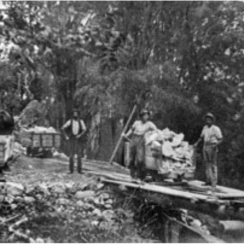
The Australian Alum Company commenced mining and processing of alunite at Alum Mountain (as it became known locally) in 1887. Due to the lack of roads from Bulahdelah to port facilities, the alum stone was sent via the Myall River to Tea Gardens from where It was stockpiled for transfer by ship to export markets.
During its operation, the Company went through various peaks and troughs of activity. The early processing of alum on site did not prove financially viable and was discontinued. During First World War, mining operations waned as Germany had been a major buyer. Australian Alum closed its operations in 1927.
Despite some new ventures in 1930’s, eventually alum was no longer needed by foreign buyers in great quantities, with the result that the mining operations became unsustainable.
Mining at Alum Mountain ceased in 1952.
This paper looks at the history of mining and processing at Alum Mountain at Bulahdelah. Some of the newspaper reports featured provide excellent descriptions of the various mining methods.
First lease granted for mining of alunite – 1886
The Daily Telegraph of 23 December 1886, page 7, reported:
‘Last week we were informed that the large mountain at Buladelah which has been so remarkable for its shining and glossy appearance in the distance, has been found to be a mass, as it were, of alum, containing 60 or 70 per cent, of that material. This discovery was recently made through the action of fires on the sides of the mountain, and the result is that a large company in Sydney has leased the whole mountain, with the object, it is said, of floating a company, and commencing operations immediately with a view to working it.’
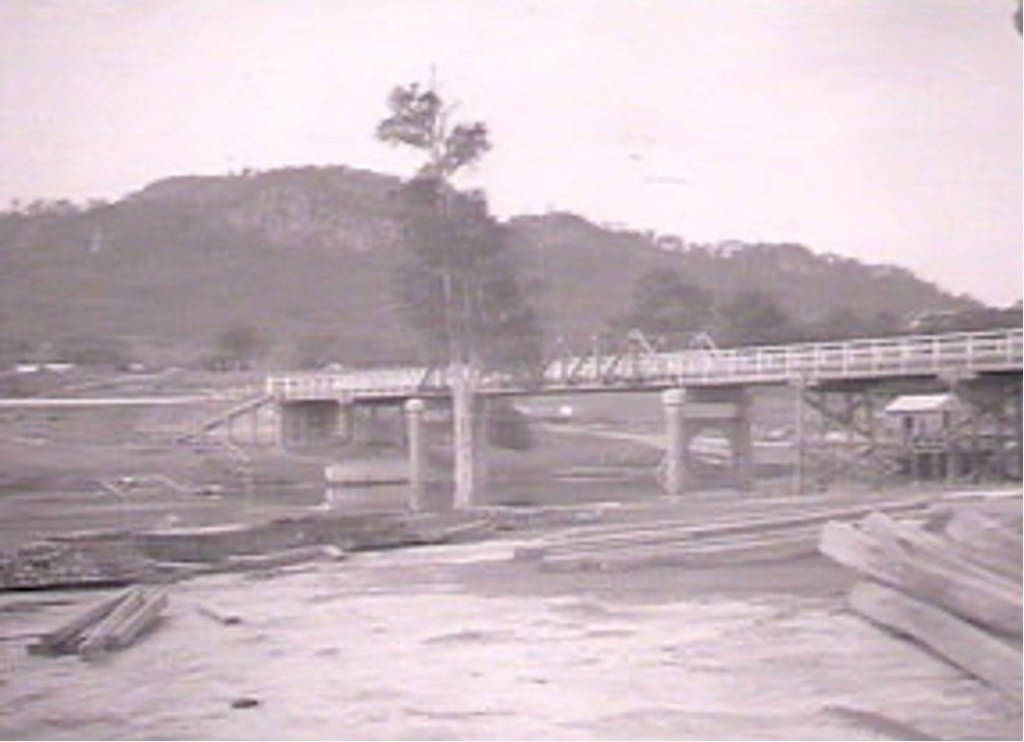
Old Bulahdelah Bridge with the Alum Mountain (Bulahdelah Mountain) in the background [State Library of New South Wales]
Formation of the Australian Alum Company – 1887
The Gundagai Times and Tumut, Adelong and Murrumbidgee District Advertiser of 5 April 1887, page 4, reported:
‘Some time ago some specimens of stone, apparently lime-stone, were submitted to Messrs. Cox and Seaver, the well-known geological reporters. These gentlemen visited the place where the mineral was found, and effected a purchase of the site. A company was then privately floated, the proprietors holding two-thirds of the interest, and allowing some other Sydney gentlemen in as partners for a sum between £8000 and £10,000 for the remaining one-third interest. The company is now making a tramway from the hill where the mineral is found to the shore of Port Stephens [actually the shore of Myall River], for shipping purposes.
Alumite has not hitherto been found in any part of the world, except in one or two localities in Europe. Alum is much used in dyeing, calico-printing, paper making, as a mordant in colours, in medicine, and for a variety of purposes. There can be no doubt that half the mineral treasures in New South Wales have not yet been unlocked.’
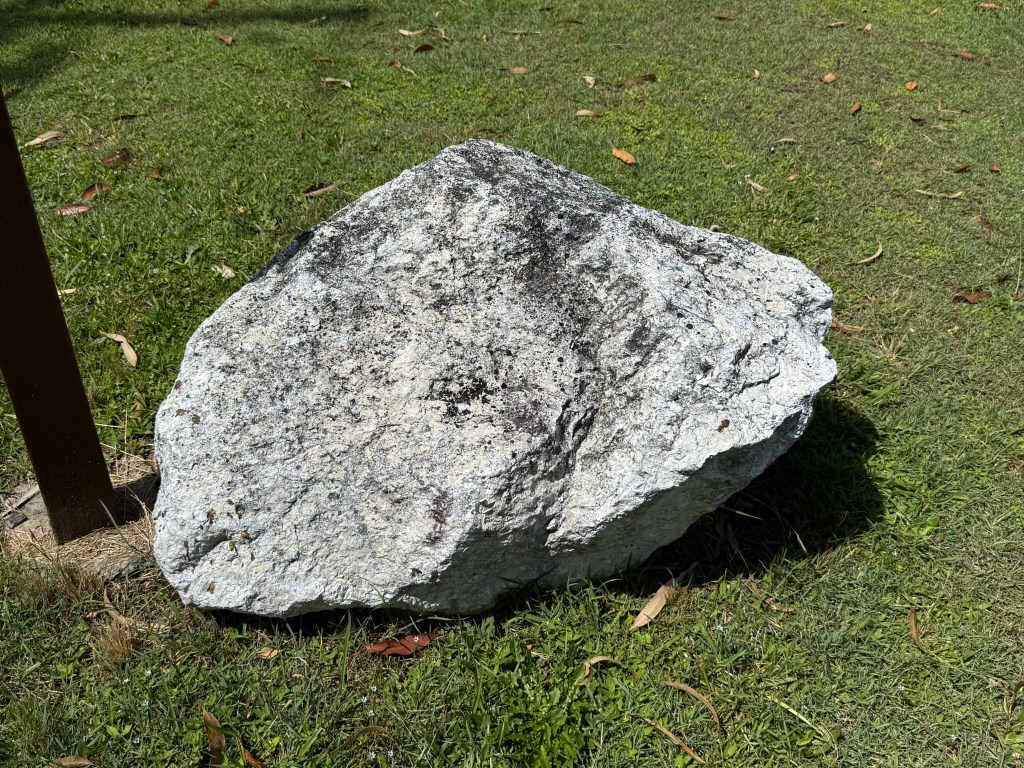
An Alunite rock from Alum Mountain – extracted during the construction of the Pacific Highway by-pass in 2011 on display at the Bulahdelah Courthouse Museum [Author photo November 2024]
The Newcastle Morning Herald and Miners’ Advocate of 13 May 1887, page 3, reported:
‘We are glad to notice that the Australian Alum Company, which includes such names as Messrs. Seaver, Clarke, Dobie, Goodlet, and other shareholders are vigorously taking action for the purpose of developing the value of the alum mountain at Buladelah. Under the very able and active manager, Mr. Abbott, contracts have been let for laying a permanent line of rails from the mountain to the river, and other contracts have been let for clearing and grubbing portions of other leasehold property, upon which it is intended to erect machinery forthwith. This splendid enterprise is giving a good impetus to business in the whole district and were it not for the shocking state of the roads, which at present are altogether impassable, the prospects of Bulahdelah would certainly be more advancing.’
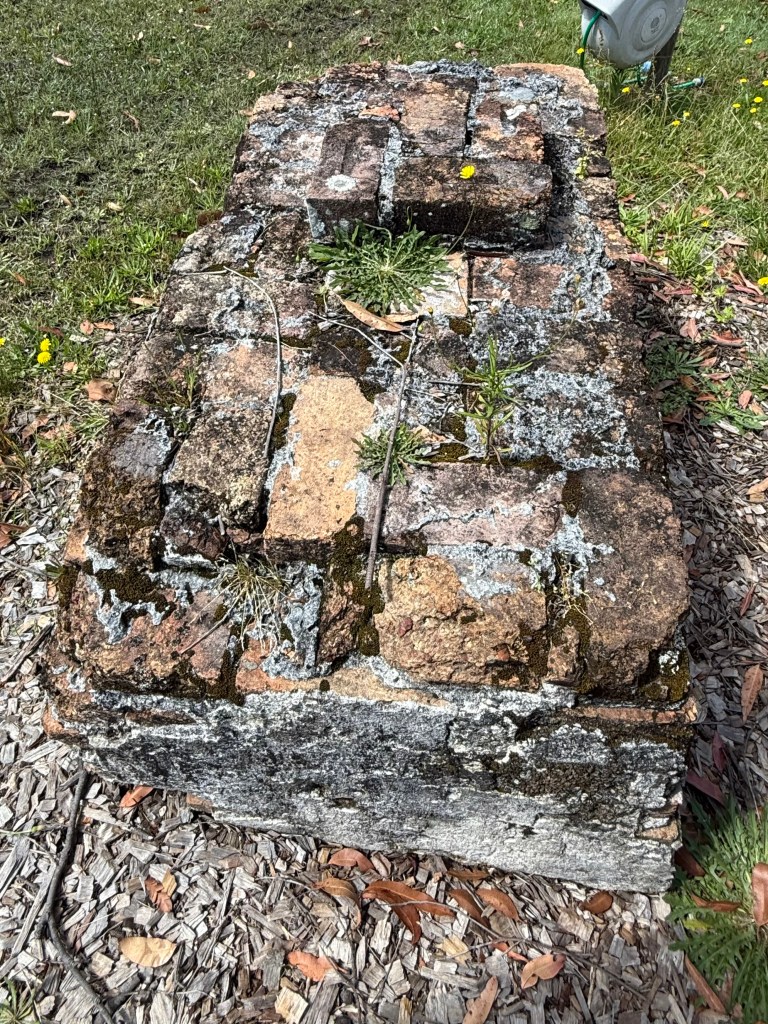
Brick foundation of an old Alum Mountain Explosive Magazine, circa 1880. Originally contained an old wooden lined compartment which stored explosives used in Alunite quarrying. On display at the Bulahdelah Courthouse Museum. [ Author Photo November 2024]
Tenders called for transport of the alum – 1888
In the Tenders Section of the Clarence and Richmond Examiner and New England Advertiser 28 August 1888, page 1, the following advertisement appeared:
‘Tenders are invited for the conveyance of Alum from Bulahdelah to Sydney, or from Bulahdelah to Port Stephens, and from Port Stephens to Sydney. Preference given to tenders for through trip to Sydney. A steamer drawing 5ft. 6in., recently made a successful trip up the Myall River to Bulahdelah. Tenders to be addressed to the Secretary Australian Alum Co., Limited, Bond-street, Sydney, marked ” Tender for Shipping,” not later than the 8th September.’
A visitor’s description of the mining operation – 1904
The Manning River Times and Advocate for the Northern Coast Districts of New South Wales of 18 June 1904, page 4, reported:
‘The Alum Mountain at Bulahdelah, on account of its seemingly inexhaustible nature and the scarcity of this particular stone, is now world-famous. A leading authority, writing on the mineral resources of this State, has given it as his opinion that it is the richest and largest deposit on the globe. And it would appear as if this sweeping assertion were true, as for many years past enormous quantities of the stone have been sent away to England for treatment— there being no facilities, we believe, in this State for so doing— and yet the output shows no appreciable diminution.
It is true that several leads have been worked out, but fresh ones are continually being located, showing that this precipitous rocky mountain, at the foot of which the small township of Bulahdelah is situated, is one enormous deposit of alum stone. The bluff, rocky sides of this great hill never fail to impress the visitor with a sense of their grandeur. At the present time about 20 men, in all, are employed in quarrying and loading the stone on the punts. It is then taken down the Myall River to Port Stephens, where it is transhipped on to steamers for Sydney. On arrival there the large cargo steamers for Liverpool [England] take it on board as ballast for a very small charge. The stone is treated at a small town named Runcorn, situated on the canal between Liverpool and Manchester.
To a visitor the work of quarrying on the steep sides of the mountain appears to be particularly dangerous, but we were informed that since the opening of the mines several years ago the workmen have been remarkably fortunate in not having a single accident to record. They have apparently become inured to the dangers and heights at which they work, and are as sure-footed as mountain goats —if they will kindly pardon the illustration. The men receive 7s per day as wages, which is little enough, considering the work which they perform.
The quarry at which the men have been engaged for about four years has at last given out, and prospecting is now being carried on round the mountain sides, without, however, as yet striking anything in sufficiently payable quantities to warrant the commencement of continued operations. One lead which was shown us was wedge-shaped— being about 3ft in width at the base, and tapering off at the top-but as the blasting and drilling which would have to be performed before the first-class stone could be picked out would occupy too much time, and not warrant the expense, this lead will probably be abandoned.
Blasting has frequently to be resorted to, and it is indeed a splendid sight to see the mountain shaken, and huge stones thrown into the air, to fall crashing down the mountain sides. It is said that thousands of pounds worth of good stone lies at the foot of the hill on the eastern side. The tramline, which was very faithfully constructed, is on the side facing the town, and extends for a considerable distance up the mountain, the upper portion of the line being duplicated, to allow of one truck being let down and another drawn up at the same time, by means of wire hawsers attached to a large windlass.
Above this windlass the men are at present engaged, and from this spot a magnificent view of the surrounding country is obtained, including the ocean and entrance to Port Stephens (30 miles distant), the lighthouse at Nelsons Bay, and the Myall Lakes. It needs a very steady head to take in the situation calmly, but to those who have had experience in mountain climbing, it is indeed well worth a visit. Higher up again than the quarry is the boiler house, and farther on still (almost at the summit) is the blacksmith’s shop— mere specs when viewed from below. The raising of a boiler to such a height must have been a great undertaking, and the scaling of the hill alone will give some idea to those who make the attempt of what the troops had to accomplish in the recent South African war. The boiler is used for driving the drills, etc. The first-class stone is pink in colour, but the great bulk of the stone obtained is of second-class quality. The shareholders, we were informed, are well satisfied with the manner in which the operations are panning out.’
Second mining lease granted – 1907
The Wingham Chronicle and Manning River Observer of 21 August 1907, page 2, reported:
‘Some time ago a mineral lease for 80 acres on the Alum Mountain, Bulahdelah, was granted to Mr. G. V. Collins. This lease adjoins the leases held by the [Australian] Alum Co, which company has worked the Alum Mountain for many years, and is still working it. The promoters of the new company have started a staff of men prospecting on the lease, Mr. J. McKim, late manager of Rubicon Alum Company being manager. Should the prospects be favourable the necessary capital for the extensive working of the lease is assured.’
The Sydney Morning Herald of 20 September 1907, page 10, further reported:
‘Acting under cable advice the Sydney representative of the Anglo-French syndicate has instructed their resident manager, Mr. John McKim, to peg out 40 acres of additional alunite land. Recently this syndicate took up a 40-acre block. Both blocks adjoin leases held by the Australian Alum Company, on Alum Mountain, Bulahdelah.’
A visitor’s description of the mining operation – 1907
The Gloucester Advocate of 5 October 1907, page 8, reported:
‘A writer speaking of a trip to the Bulahdelah Alum Mountain, says : — A start was made for the Alum Mountain about 4 p.m., but the day was very hot, the ascent undoubtedly steep; an intelligent old man was in charge at the foot of the tramline, where there were heaps of stone ready for carting to the river, and so one contented oneself with the information afforded, and a distant view of the workings half-way up the steep. The geological structure of the whole mountain appears to be aluminite but only the richest pockets and veins are worked for export, the poorer rock being unprofitable.
The original company tried treatment on the spot, and it is said spent £90,000 thereon, without satisfactory result. Some of the crushers and rollers still remain in situ, and also large heaps of dazzlingly white treated material, and these, together with the tramline, are all that remains to show for the expenditure, besides the actual work of mine development. This is partly by an open quarry. The rock is sent down the tramline, a truck at a time, the loading one in descent pulling up an empty one to take its place; At the post-office a formal notice was tacked up on the wall of the pegging’ out of a 40-acre lease adjoining the original one, so it appears, as if the industry was profitable enough to induce others to take a hand as well.’
Mining operations suspended due to water shortage – 1908
The Wingham Chronicle and Manning River Observer of 11 March 1908, page 3, reported:
‘The Australian Alum Company’s mine here has resumed operations now there is plenty of water.’
New Anglo-French Syndicate Prepares for Mining – 1908
The Sydney Morning Herald of 9 October 1908, page 11, reported:
‘The newly-formed Anglo-French syndicate, which has taken up leases on Alum Mountain, Bulahdelah, adjoining the leases held by the Australian Alum Company, has purchased a diamond drill, and several sites have been selected for drilling, to test the depths of the deposits on Bulahdelah Alum Mountain.‘
Tramway extended – 1909
The Dungog Chronicle of 15 June 1909, page 2, reported:
‘The new tramline from the Australian Alum Co’s. works at the Alum Mountain, to the wharf, has been completed, and is working successfully. The distance of the line is three quarters of a mile, and it enables the Company to handle their stone much more cheaply and expeditiously. Previously the ore was carted to the wharf by drays.’
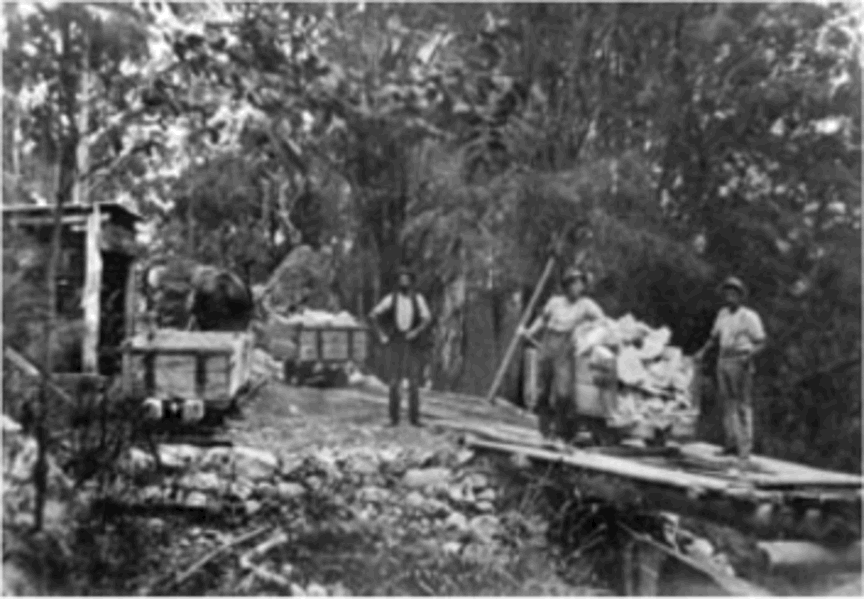
Alum Mountain Tramway [Alunite Mine Site Management Plan, Bulahdelah Highway Upgrade Consultants]
Fatal mining accident – 1909
The Maitland Weekly Mercury of 21 August 1909, page 7, reported:
‘A Bulahdelah telegram states that a fatal accident occurred at the Alum Mountain on Friday [on 13 August 1909]. While the men were working in the tunnel, part of it fell in. One of the miners was entombed, and two others were seriously injured. Charles Keel was killed outright. Stephen Crockford sustained shocking injuries. He was dragged out of the debris in a dying condition, and expired last evening. Patrick Kelly sustained a broken leg and other injuries. Dr. Bowker has ordered his removal to Dungog Hospital.’
The Nambucca News of 27 August 1909, page 5, also reported:
‘Bulahdelah was electrified on Friday afternoon last by a report that portion of the celebrated Alum Mountain had fallen in and entombed one man, besides inflicting injuries upon two others, sufficient, in one of these cases, to cause, death. We say, “the celebrated Alum Mountain,” because there are but two in the world— the other is in Japan. First-class Constable Williams was first to come to town with the news, and most of the populace trooped up the hill at express speed. It is nearly certain that every man in Bulahdelah was on the scene. Conspicuous were two clergymen— Revs. Bongers and Perry— who rendered exceptional service, getting their hands imbued in blood.’
The Sydney Morning Herald of 17 August 1909, page 8, reported on the funeral held at Bulahdelah for the two miners:
‘The funeral of Stephen Crockford and Charles Keel, who were killed in the mining accident, took place yesterday afternoon. The remains were brought to the Church of England, where an impressive sermon was preached by the Rev. A. J. Bongers. The cortege to the cemetery was the largest ever seen here, being three-quarters of a mile long. The funeral service at the grave was conducted by the Rev. A. J. Bongers, assisted by the Rev. Mr. Perry (Methodist). The Rev. A. J. Bongers referred to the heroic conduct of the deceased’s fellow-workmen in their efforts to recover the bodies from the mass of rocks to the great danger of their own lives. The scene at the grave side was heartrending.’
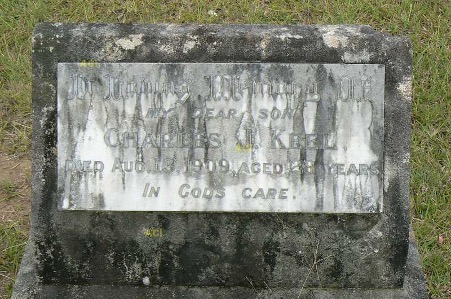
Grave of Charles J. Keel at Bulahdelah Cemetery [Australian Cemetery Index]
Decision of the Inquest – 1909
The Dungog Chronicle of 27 August 1909, page 8, reported:
‘The inquest concerning the death of Stephen Crockford and Charles Keel, the victims of the mining accident, commenced on Monday last, before the Coroner, Mr Mclntyre. Mr G. P. Collins, of Stroud, watched the interests of the widow. Mr A. G. F. James, M. L. A., appeared as counsel for the Australian Alum Company, and Mr Inspector Milne represented the Mines Department. The witnesses examined stated that, they had not complained to the manager that the quarry was dangerous, but had spoken among themselves, and regarded it as dangerous. Mr J. Edwards, general manager for the company, stated that he gave instructions for the men to be withdrawn from that part of the quarry where the fall occurred.’
The Dungog Chronicle of 27 August 1909, page 2, further reported:
‘The inquest was resumed on Tuesday last concerning the men killed in the Alum Tunnel collapse. Cassidy, foreman of the Alum Company, deposed that he was on the mountain the day of the accident. He was called to the tunnel and saw there had been a fall. He saw the deceased Crockford, and sent for the manager, a doctor, and the police. He was on the top of the tunnel with Mr. Edwards, the mine manager, the day previous to the accident. He saw a crack six inches long immediately over the place where the fall took place. He did not think that the crack indicated that the rock underneath was unsafe. “We then went to the mouth of the tunnel together. Mr. Edwards instructed me to tell the ganger to work on the bottom of the quarry, away from the wall. The men were all present and might have heard me tell the ganger. I was not in the quarry till after the fall. My wages as foreman are 8s 4d per day,”
D. Milne, Inspector of Mines, said he inspected the quarry on Alum Mountain. He found that the cause of the collapse was from a head extending north for some distance intersecting a breasthead extending from the western side, these two heads forming what was termed a boxhead. He also found that the face of the quarry was undercut to a certain extent. He came to the conclusion that the fall of ground was due to the presence of these two heads, the toe of which was cut away at the face before the fall took place. It would be hard to tell whether it was dangerous. If the work of the quarry had been more skilfully carried out the accident might have been prevented. A verdict of accidental death was recorded. It was also recorded as a rider: — “These and all similar quarries should be placed under Government supervision.”
The Dungog Chronicle of 22 April 1910, page 2, reported on the compensation payable to the families of the two deceased miners:
‘Mr P. J. Kelly, asked Justice Cohen and a jury at Maitland, this week, to say how much the Australian Alum Company was responsible for injuries sustained by him through falling stone last August. The jury thought £200 of the £500 claimed, would be sufficient solatium.’
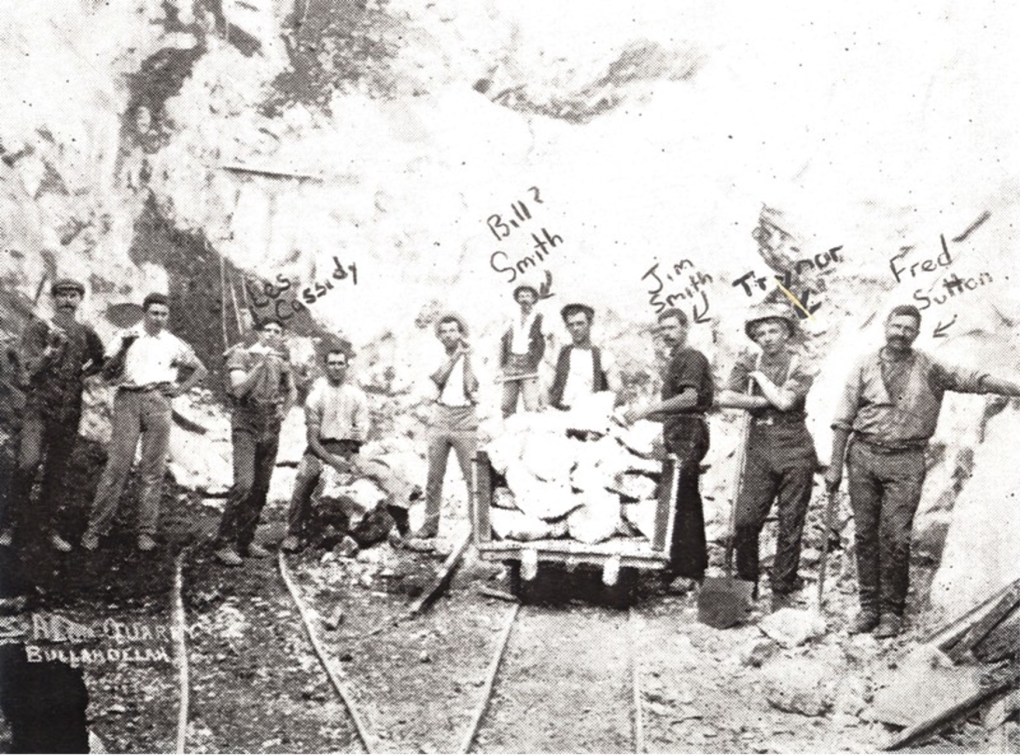
Miners at Alum Mountain – Les Cassidy, foreman, who gave evidence at the Inquest is shown on the left of the photo [Bulahdelah Historical Society]
Another fatality on the Alum Mountain – 1915
The Farmer and Settler of 6 October 1915, page 4, reported:
‘A party was returning home along the Alum Mountain tram line, near Bulahdelah, on Friday, when two trucks, loaded with stone, started. Georgie Woods, aged five, was crushed, his legs being almost severed from his body. The child died two hours later. Jack Stokes, a child of the same age, while trying to save his mate, was also knocked down, and had his arm and shoulder shattered. The doctor ordered this patient, who is in a serious condition, to the Newcastle Hospital. Mrs. Dave Stokes saved three other children.’
Mining operations resume after suspension – 1918
The Raymond Terrace Examiner and Lower Hunter and Port Stephens Advertiser of 30 August 1918, page 3, reported:
‘The Bulahdelah Alum Company have commenced shipping stone again, and is endeavouring to secure a market in Newcastle, which will be a good thing for the district.’
Alum Mining referred to in NSW Year Book of Statistics – 1921
The Newcastle Morning Herald and Miners’ Advocate of 3 February 1921, page 5, reported:
‘Alunites, or limestone, occurs at Bulahdelah, about thirty-five miles from Port Stephens, in a narrow mountain range which for more than a mile of its length is composed almost entirely of alunite of greater or less purity. In the latest official Year Book of New South Wales the following reference is made to the industry in that area: “Four varieties of alunite are recognised at the mines, but working is confined mainly to the light-pink ore, the yield averaging about 80 per cent. alum.
During 1910 and 1911 prospecting by means of diamond-drilling was carried on at Bulahdelah with a view to locating further bodies of alunite of payable grade, so as to maintain the export trade; as a result there was a large increase in the quantity exported. In 1919 the production was 2485 tons, valued at £14,910, and since the year 1890 the quantity and value of alunite, the produce of New South Wales, exported have been 53,733 tons, value £190,971.’
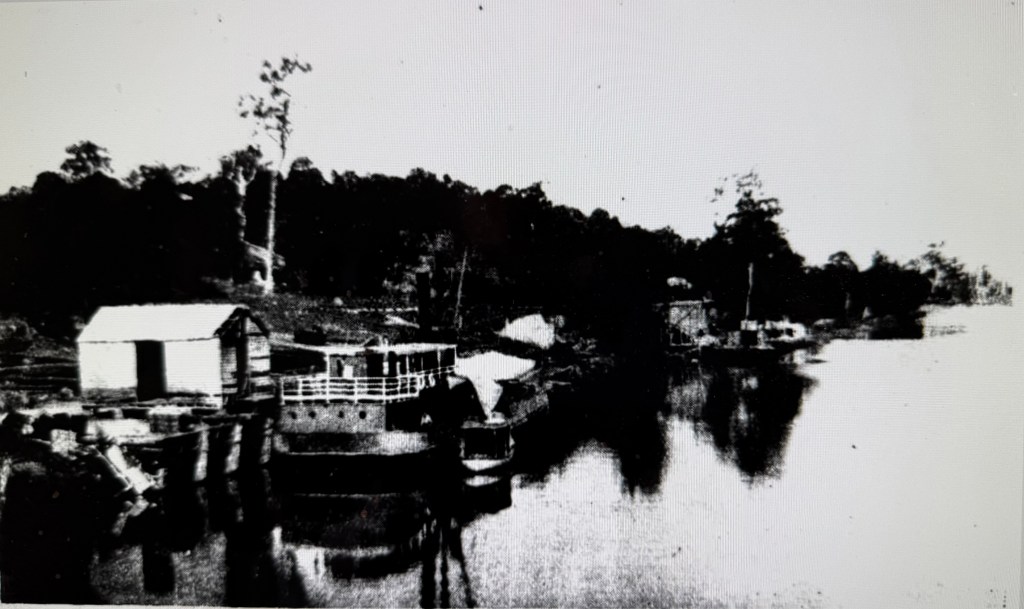
Waterfront at Bulahdelah showing a drogher which plied to Tea Gardens, and also two loaded alunite hoppers [Sydney Mail, 20 August 1924, page 37]
Output of mining operations at Alum Mountain – 1923
The Newcastle Morning Herald and Miners’ Advocate of 18 August 1923, page 12, reported:
‘An area of 375 acres was taken up by the Australian Alum Company, Ltd., about thirty years ago and the work of exploiting the alunite was entered upon by quarrying on the town side of the range, which was not only more convenient but gave more assurances of success. In 1890, the company quarried 220 tons for which the return of £3000, and operations have since been carried on with varying success, the greatest output for any year being that of 1902, with 3644 tons, with a return of £10,930. The average output, yearly for the 33 years working stands at 1667 tons, and the average return, £3 11s 3d per ton. The total yield for the whole period up to June 1922, was 55,072 tons and the total return was £106,327. During the war period the output was good, 1916 being a bad year with 325 tons, but the other years from 1914 to 1919 gave from 1420 to 3406 tons. In 1920 the output was mostly very high-grade quality alunite, £740, or £4 per ton.
There are four varieties of alunite of varying value: Light Pink, Chalk White, Purple, and Granular. Of these the Light Pink is the most valuable, so far as per-centage of alunite is concerned, but it is very brittle and breaks up into “small” in transit, making it costly to handle. …. Preference is given to alunite, with a low percentage of silica, and consequently alunite with silica contents below ten per cent. is most in demand. In the quarries [at Alum Mountain] the Light Pink is separated from the other varieties, and loaded into skips, which are taken to the base of the central escarpment, thence down the incline and along a tramway to the wharf on the Myall River, for shipment into small vessels for transport to Sydney, thence to England.’

Alum Mountain workings [State Library of New South Wales]
Mining operations gear up again – 1926
The Maitland Daily Mercury of 21 July 1926, page 4, reported:
‘Practically since the war commenced in 1914, the Alum Mountain, Bulahdelah, has not been worked to any extent, however, things have brightened up again, and the manager, Mr. Heighway, is putting on additional men and the output will soon be as large as ever it was. The company’s punt, ‘Paterson’, has been thoroughly overhauled and is now running large quantities of alum stone from Bulahdelah to Port Stephens [at Tea Gardens], where it is transhipped for export.’
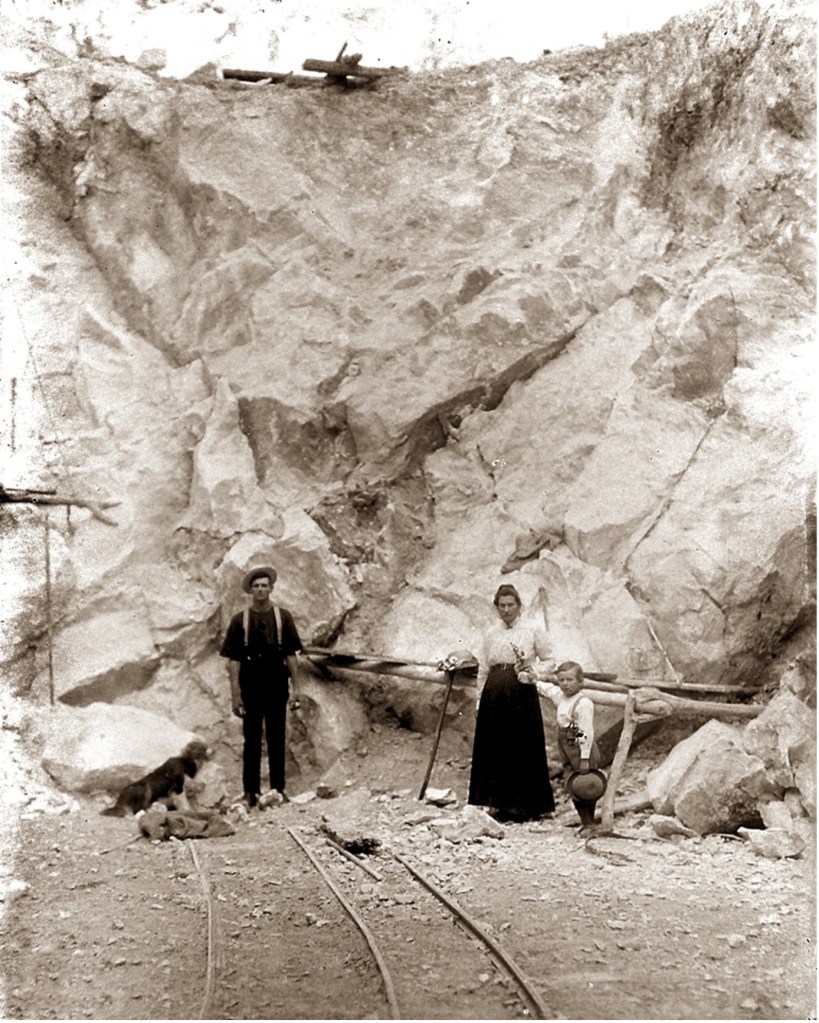
At the face of the alum mining operation [Bulahdelah Historical Society]
Mining operations suspended – 1927
The Dungog Chronicle of 15 March 1927, page 2, reported:
‘Almost ever since the war, 1914, the Alum Mountain in Bulahdelah has been worked in a half-hearted sort of way, sometimes half handed, other times only a couple of men on the job, but seldom ever has it been working at its full capacity. Recently the works have closed down practically altogether, and at present no one is employed except the manager. The workmen have all gone to other parts in search of work, with a consequence that the town is suffering. It is a great pity that the company does not work this mountain of alum as it should be worked, because in no other part of the world is there such a rich deposit of this mineral.’
The Daily Examiner of 16 March 1927, page 4, also reported:
‘The Alum Mountain mine at Bulahdelah has closed down, the Mines Department having granted a suspension of labour conditions for six months. The miners are leaving the district seeking work . Alum Mountain rises to a height of 1000ft. above the town. It is a rich deposit of alum stone, and in no other part of the world are there such quantities. Since the war there has been little demand for this mineral, and consequently the mine has employed only a few hands.’
The Newcastle Morning Herald and Miners’ Advocate of 14 March 1931, page 14, reviewed the previous mining operations:
‘The business activities of the town [Bulahdelah] were added to by work being commenced at the Alum Mountain. At one time about 30 men were engaged refining the crude ore and producing the alum. Although mining operations have been carried out for about 40 years, old residents state that there does not seem to be any of the mineral removed from the mountain. Various methods have been adopted in the extraction of the alum from the cliff face. By one system a tram line, of 3ft. 6ins. gauge, was gradually laid to the working face. On an endless chain, the laden skip was the motive power to haul the empty receptacle to where it was required, about 600 feet up the side of the mountain. From this level, a cutting was made from west to east around the cliff, the mineral, meanwhile, being extracted as the work progressed. The ore was hauled to the river punts, transported to Port Stephens, and thence to various ports.
Prior to the war, Germany was one of the largest foreign buyers of the product. The alum, it is stated, was one of the principal ingredients used in the manufacture of dyes. After the war the mining was continued for some time, but gradually diminished. At the present time mining operations have ceased, although the residents are looking forward to an early resumption.’
Plans to recommence mining and ore processing operations- 1932
The Daily Examiner of 28 September 1932, page 4, reported:
‘The Alum Mountain, at Bulahdelah, is showing signs of activity……. A new company is negotiating with the present company and has taken up leases formerly held.
It is proposed to erect new and modern machinery at Bulahdelah should experiments now being undertaken prove successful. The company anticipates full activity in the course of several months. There is about 500 tons of alunite at Tea Gardens. This is being consigned to Melbourne for experimental purposes.’
The Dungog Chronicle of 2 December 1932, page 6, further reported:
‘Buoyed up by the prospect of the opening of the Alum Mountain everyone was interested in the opening of the industry again. Nothing seems to be doing in that quarter so far, and we wonder if this good thing for the district will make a commencement.’
The Illawarra Mercury of 16 June 1933, page 10, reported on further plans:
‘A new company has obtained the sole rights to the alum deposits of the alum mountain, near Bulahdelah, and any plant on the site. A recent consignment of about 500 tons of ore from Tea Gardens to Melbourne for testing on a major basis has resulted in the transfer from the old company [to the new owners].
Arrangements are being made for the development of the ore. Modern machinery and scientific methods have enabled the ore to be treated as a whole. The company has established a treatment plant at Bulahdelah, and it is expected that the works will be large. In addition to alum, by-products will be obtained. A recent survey of a new lease brings into operation what is known as the old quarry, on the eastern side of the mountain. In addition to ore which will be won at the face, there are many thousands of tons of spoil which will be recovered and used.’
Considerable activity at Alum Mountain – 1934
The Dungog Chronicle of 17 July 1934, page 2, reported:
‘There is considerable activity at the Alum Mountain, Bulahdelah, where mining for alum ore is being carried out on a fairly big scale. Mr. J. Leary has already dumped 150 tons on the wharf ready for loading into a drogher preliminary to shipping to Melbourne. Another parcel of 150 tons is ready as soon as the wharf is cleared.’
Little mining activity at Alum Mountain – 1945
The Northern Champion of 5 May 1945, page 1, reported:
‘Said to be one of few such outcrops in the world, the Alum Mountain at Bulahdelah provides an illustration of an ambitious mining venture that ended long before the deposits were exhausted. The alunite deposits are now being worked by a company employing five men. The ore is trucked through a tunnel to a chute and slides to the bottom of the mountain to be loaded into motor-lorries to be taken to the railway for transhipment to Melbourne.
Activity was on a much larger scale 40 years ago when the industry approached in importance the great timber business of the district. Disjointed railway lines, rotting skips, and abandoned pieces of machinery are scattered about the side of the mountain, giving evidence of the earlier venture. Down on the banks of the winding Myall River there is evidence of where treatment works were once situated, and large deposits of alunite stood. The forest is gradually taking over the area wrested from it by the ambitious company. Here and there a tree has grown 30 or 40 feet with its trunk between the railway lines which run almost perpendicularly up the side of the mountain.
The company treated the alunite to manufacture alum. …… It is hard to take your eyes from this panorama to concentrate on workmen several hundred feet below. There are five of them toiling in a large open cut on the side of the mountain. The white ore glares in the bright sunlight. While you watch you notice the men are getting ready to put a charge into one of the huge rocks. From your position you are safe and when the blast goes off you are amazed when hundreds of birds, startled from their trees by the noise, fly in all directions.
The men are not interested in the view — they have seen it too often. Daily they climb up the sides of the mountain to tear down tons of alunite. On some days they are all engaged in the open cut winning the ore, but several days a week two work in the tunnel, taking out the ore from the open cut by means of a chute and trucking it to the chute on the side of the mountain. To get to their working place they either slide down the very steep sides holding on to ropes, or go through the tunnel.
The men claim they are working in a mine; the company says they are in an open cut. The tunnel to the ore face is 150 feet long and 60 feet down. In summer it becomes almost unbearably hot in the open cut, where there is no breeze. In winter the men work in the rain and walk in water in the tunnel.
Alunite (Aus.) Pty., Ltd., has been mining at the mountain for four years. Before that it took over the thousands of tons of the ore at grass on the banks of the river. This ore was taken by lighter down the Myall River and then by ship to Melbourne, where it was treated. The deposits were not worked between 1914 and 1940. The start of the last war put an end to shipping the ore overseas. The ore was deposited at the foot of the mountain, taken to Port Stephens by lighter and shipped overseas as ballast, being treated in Germany for refinement. The deposits of alunite on the mountain were first discovered in 1886. A firm set up its own treatment plant on the banks of the river, but it did not operate for long.
Geologists have taken a keen interest in the Alum Mountain, and many students have visited there to note the formation. When the mountain was erupted from the sea the alunite deposits were developed in the faults in the crust. This accounts for the ore being found in pockets. Diamond drilling was carried out early in the century, and the cores can still be seen at the company’s house at the foot of the mountain. But there are no records of where the drilling was done. It is generally agreed that there is much more alunite in the mountain than has been taken out since the mountain was first worked in 1886. In pockets among the alunite are to be found specimens of rock commonly known as flummery, used to make ornaments, such as paperweights, serviette rings, ink wells, and frames for small clocks. The pink and grey stone is soft and can easily be cut to any shape. Rubbed with sandpaper and polished with a rag, it takes on a smooth surface and a valuable appearance.’
Concluding Comments
Despite the early prospects that the Alum Mountain would deliver continuing prosperity to its owners and the Bulahdelah area, these hopes were only really fulfilled in the years leading up to the First World War.
Mining at the Alum Mountain had ceased by 1952.
Today the mountain is known as Bulahdelah Mountain and has lookouts and walking tracks from where remnants of the mining operations can be still seen.

Bulahdelah Mountain (also referred to as Alum Mountain) [Author photo]
Two interesting discoveries cement the memories of the Alum Mountain.
The Sydney Morning Herald of 7 January 1952, page 1, reported:
‘About 4½ years ago a news item appeared stating that workmen on the Bulahdelah Alum Mountain had dug up a clay pipe from under 14 feet of earth at a spot where it was never suspected anyone had dug before.
Embossed on the bowl of the pipe was the representation of a man’s face with a long beard. On the side of it was stamped the name of “Sir John Robinson.” Miss M. Robertson, Bellevue Street, Cammeray, was given the cutting recently. She wrote to the mine manager, who sent her the pipe. As she suspected – despite the wrong spelling – the embossed face is that of her great-uncle, Sir John Robertson, who was five times Premier of N.S.W.’
In July 2007, during excavation for the Bulahdelah Bypass on M1 motorway, a large chunk of rock was unearthed. It was identified as typical of the alunite stone that was mined at Alum Mountain.
In 2015, the Bulahdelah Historical Society donated the nine ton rock to the National Rock Garden (NRG) in Canberra.
The Bulahdelah Alunite rock was officially placed in the NRG on 9 February 2022 for public display.
The Karuah LALC, representing the Worimi people, supported the placement of the rock in the NRG.
Researched and compiled by Kevin McGuinness
August 2023

 Port Stephens - a history exploration