
Introduction
This paper tells the stories of various events in the aboriginal history of the Port Stephens region in the period from 1795-1951.
It is not a prescriptive history of the Worimi people who inhabited the Port Stephens area for thousands of years, for theirs is an oral history of a rich heritage handed down by their elders from generation to generation.
The material presented in this paper is sourced from the National Library’s Trove newspaper collection. The newspaper articles are written by correspondents based on their observations and their prejudices of the times.
Readers may find some of expressions used, as referring to aborigines, as offensive. The articles are published here in full without any form of moderation or exclusion. To alter that material would be akin to altering history.
With this caveat, the articles provide a valuable insight into aspects of aboriginal life which was permanently changed by the spread of settlers in the Port Stephens region.
The dignity of the aboriginal people in dealing with their changed circumstances is clear. Most of the articles present the aboriginal community in a positives light and some acknowledge the damage inflicted on that community by European settlement.
The story of the Aborigines Inland Mission at Karuah is also covered in some detail.
The author of this paper acknowledges the Worimi people the traditional owners of the Port Stephens region and recognises their continuing connection to Land, Waters and Culture, and pays respects to their Elders Past, Present and Emerging.
Aboriginal and Torres Strait Islander peoples are advised that this paper contains a range of material which may be culturally sensitive including records of people who may have passed away.
This paper supplements other papers found at the following links on this website:
Aboriginal People of Port Stephens, Dungog and Gresford – Gordon Bennett
Port Stephens Aborigines – Reminiscences of William Scott
Evidence of Early Aboriginal Settlement at Port Stephens
Aboriginal Artefacts at Morna Point, Port Stephens 1926-28
Port Stephens Aboriginal Artefacts in the British Museum
The Early Days of European Settlement
The Newcastle Morning Herald and Miners’ Advocate of 7 March 1936, page 5, published the following commentary on the European discovery of Port Stephens and cites the first encounters with the indigenous inhabitants.
‘Much of the history of Port Stephens since the establishment of the settlement there by the Australian Agricultural Company is fairly well known, but the history of the period prior to the advent of the company is fragmentary, but very interesting, is not generally known.
The first historical reference to Port Stephens is to be found in Captain Cook’s log. This shows that Cook’s ship, the Endeavour, was sailing along the coast after having passed the harbour, now known as Port Hunter. On 11 May, 1770 (naval reckoning), the Endeavour was off the port [Port Stephens], and Cook made the following entry in his log: “Past a low point, to the northward of which is an inlet into the land, before which lay three small islands. At ½ past the northernmost land in sight bore N. 36deg. west, being distant 2 or 3 miles.” According to naval information, “36deg. west” should have read “36deg. east.”
In the journal of Richard Pickersgill, master’s mate of the Endeavour, appears the following entry in reference to the discovery: “At 2 p.m., passed by several islands and a fine harbour, which lies round a bluff point, and within the islands: this harbour seemed to be very commodious, and the country round it looked rich and fertile.” Captain Cook named the inlet of his log Port Stephens, after Philip Stephens, Secretary to the Admiralty.
The Endeavour sailed on, and no further reference was made to the discovery of the port by Cook, or in the records of the newly-found colony until early in 1795, when Lieutenant-colonel William Paterson, then acting as Lieutenant-Governor, pending the arrival of Governor John Hunter to succeed Governor Phillip, issued instructions to the deputy surveyor (Charles Grimes) to proceed to Port Stephens to make an examination of it for settlement purposes, and to report on its value as a harbour.
Grimes sailed from Sydney in the schooner Francis, and spent from February 21 to February 28, 1795, in Port Stephens, carrying out his instructions from Paterson. He must have had ample opportunities of examining the port and the country about it, but his report was decidedly against the port being regarded as a probable or even possible site for a new settlement. Grimes returned to Sydney on March 1, 1795, and submitted his report, and a sketch plan, to Lieutenant-Governor Paterson.
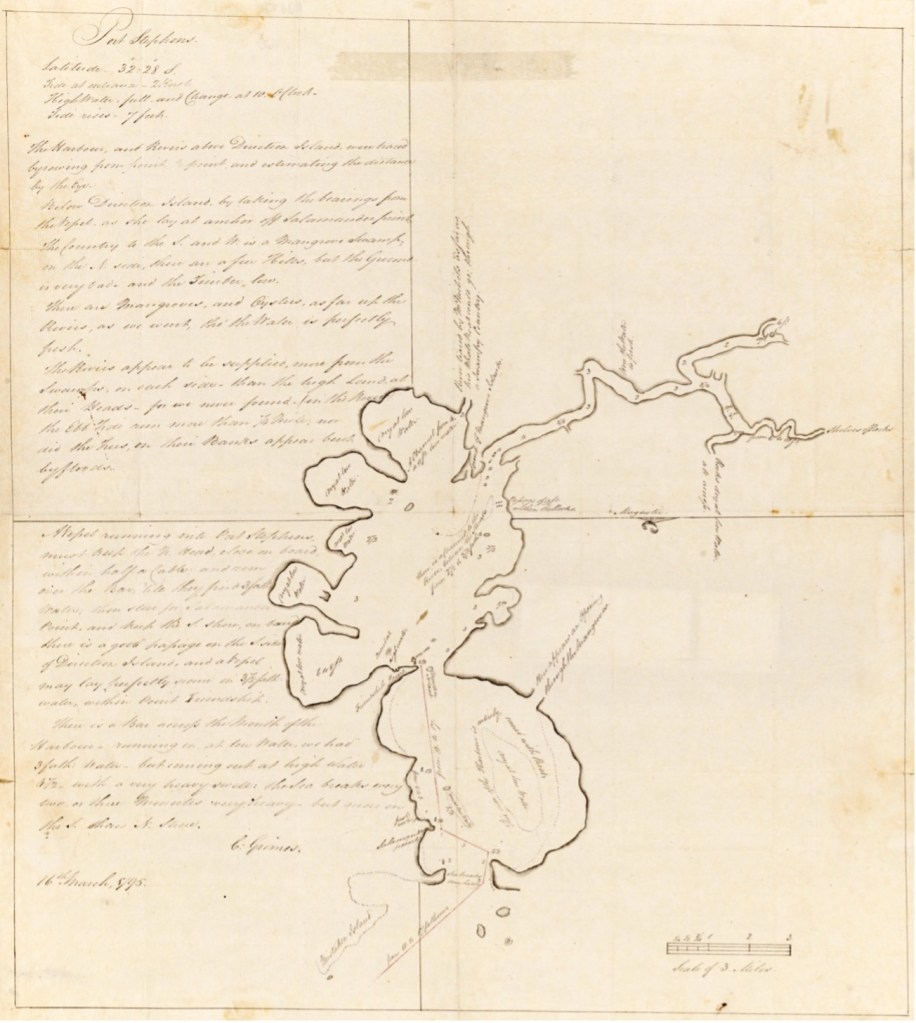
Grimes map of Port Stephens, 1795 [State Library of NSW]
An interesting reference to Grimes’s visit to and inspection of Port Stephens may be seen in David Collins’s “An Account of the English Colony in New South Wales,” in the following terms—”On March 1 the Francis returned from Port Stephens, when the master reported that he went into two freshwater branches, up which he rowed until at no very great distance from the entrance he found them terminate in a swamp. He described the land on each side to be low and sandy, and had seen nothing while in that harbour which in his opinion would render a second visit necessary. The natives were so unfriendly that they made few observations on them, other than that they were somewhat taller and a stouter race of people than those about Sydney. Their language was entirely different. Their huts and canoes were somewhat larger, and their weapons were just the same.
They welcomed him on shore with a dance, joining hand in hand around a tree to express, perhaps, their amity: but one of them afterwards, drawing Mr. Grimes into the wood, poised a spear and was on the point of throwing it when prevented by young Wilson, who, having followed Mr. Grimes with a double-barrelled gun, levelled at the native and fired it. He was supposed to be wounded, for he fell, but rising again he made a second attempt to throw the spear, and was again prevented by Wilson. The effect of this second shot was supposed to be conclusive, for he was not seen to rise any more. Mr. Grimes got back to his boat without further interruption.”
Sketch Plan of Port It would appear from an examination of Grimes’s sketch plan of the port that he sailed round the port. He must have made a detailed sketch, because many headlands are noted, and the contour work appears to be fairly complete. The branch or river up which he proceeded, and the two freshwater branches, appear to be the river now known as the Karuah, up which he rowed until swamps were reached. The point known as Soldiers’ Point appears as Friendship Point. Salamander Bay was named by Grimes, and the name appears on his plan. Tilligerry Creek is not noted on the plan, and the only reference to Broadwater is a note, “Here appears an opening through the mangroves.” The plan shows Direction Isle, which corresponds with Bundabah of modern maps.
Grimes explains that distances were estimated by the eye. He noted that mangroves and oysters were growing as far up the rivers as he could go, though the water was perfectly fresh, and that the rivers appeared to be supplied more from swamps on each side than from the high land at their heads. Grimes’s adverse report to Paterson appears to be unaccountable unless one takes the view that the inspection was carried out in “slipshod” fashion. The report certainly handicapped Port Stephens with the authorities.
Lieutenant-colonel Paterson, in a letter to the Minister-in-Charge in England under date March 21, 1795, wrote as follows —”Wishing to obtain some information which I could depend upon respecting the harbour at Port Stephens (that lies to the northward of this place). I sent the colonial vessel under the direction of Mr. Grimes, Deputy Surveyor. He remained in it about a week, and from his report I have no reason to conclude it will be necessary to send a second time to it.”
Some months after Grimes’s visit to Port Stephens, on August 23, 1795, Captain W. R. Broughton, of H.M.S. Providence, which had escorted two convict transport ships, the Reliance, and the Supply, from England via Brazil, struck a gale south of Port Jackson, and was forced to run before the gale past Port Jackson. The gale eased slightly, and, seeing the opening of Port Stephens, Broughton ran the Providence into the port. To his amazement he found four white men, survivors of a party of five convicts who had escaped from Rose Hill (Parramatta) in September 1700, in a flat bottom boat. They rowed from Rose Hill to Look Out Post Bay, now Watson’s Bay, where they took possession of the station boat, transferred their stock of provisions to it, and made for the open sea.
They followed the coast northward and entered Port Stephens, where they remained with the natives for nearly five years. The story of their stay at Port Stephens is reviewed in David Collins’s historical work, already quoted. It is as follows— “This vessel (the Providence) met with bad weather on her voyage from Brazil and was driven past the harbour of Port Jackson as far to the northward as Port Stephens, in which she anchored, and where to the great surprise of Captain Broughton, he found and received on board four white men (if miserable, naked, dirty, and smoke-dried men could be called white), runaways from Parramatta in the month of September, 1790, by name John Tarwood, George Lee, George Connoway, and John Watson. Their fifth companion in the escape had died.
“They told a melancholy tale of their sufferings in the boat in which they had escaped, and for many days after their arrival they had passed their time in detailing to the crowds, both of black and white people, in Sydney, their adventures in Port Stephens, the first harbour they had made. Having lived like savages among whom they dwelt their change of food on arrival at Sydney soon disagreed with them, and they were all taken ill, appearing to be principally affected with abdominal swellings. They spoke in high terms of the pacific disposition and gentle manners of the natives. Each of them had a name given him and given with several ceremonies. Wives were also allotted them, and one or two had children. They were never required to go out on any occasion of hostility and were in general supplied by the natives with fish or other food, being considered by them (for so their situation could only be construed) as unfortunate strangers thrown upon their shore from the mouth of the yawning deep, and therefore entitled to their protection.
“They told a ridiculous story that the natives appeared to worship them, often assuring them when they began to understand each other that they were undoubtedly the ancestors of some of them who had fallen in battle and had returned from the sea to visit them again; and one native appeared firmly to believe that his father had come back in the person of either Lee or Connoway, and took them to the spot where his body had been burnt. On being told that immense numbers of people existed far beyond their little knowledge, they instantly pronounced them to be the spirits of their countrymen which after death had migrated to other regions.
‘It appeared from the account of these four men that the language to the northward differed wholly from any that had been known at Port Jackson. Among the natives who resided there, there were none who understood all that they said: and of the blacks who occasionally visited Sydney only one could converse with them. He had been reared about the Hawkesbury, and being of a roving disposition, had caught all the different dialects from Botany Bay to Port Stephens.”
After the Providence episode no records concerning Port Stephens appear to have been made, but in June 1801, while Paterson and his party were engaged on investigation work at Port Hunter, Lieutenant Grant and Ensign Barrallier, who had been taking soundings at the entrance of Port Hunter, were walking along the shore, a half-starved man appeared before them and told them a pitiful story of his sufferings as a castaway from the wreck of one of Underwood’s vessels on the coast north of Port Stephens. The date of his meeting with Grant and Barrallier was June 22. As he explained that he had been walking from the scene of the wreck for 32 days, it would appear that the wreck occurred between May 18 and 20. Of his two companions one was killed by the natives and the other died after having eaten a toadfish. His name was John Loft, and he was taken into Paterson’s camp.
Some time after the establishment of the settlement at Port Hunter in 1801, trouble was caused by escapes of convicts who made north for Port Stephens. To meet that phase of trouble the commandant at Newcastle established a small military post of a corporal and four or five soldiers on the south shore of Port Stephens, on a point which was named after the soldiers’ camp, Soldiers’ Point. The duty of the military post was to capture escaped convicts.
Port Stephens appears again in history with the arrival at the port of John Oxley’s exploring expedition from Port Macquarie. The members of the expedition waited at the port until the commandant at Newcastle sent a boat to convey them to Newcastle. The port became a centre of attraction to the representatives of the Agricultural Company in 1825 and early in 1826 the work of establishing the company’s settlement at Port Stephens was entered upon under the direction of the company’s agent, Robert Dawson. Between the arrival of Oxley’s expedition at the port in 1818 and the advent of the company, Port Stephens was a closed book so far as history was concerned.’
Governor Macquarie encounters aboriginals at Port Stephens – 1811
While his ship, the Lady Nelson was moored in Port Stephens on 31 December 1811, Governor Lachlan Macquarie wrote in his journal of two encounters he had with aboriginal people. His two journal entries are set out below:
‘At half past 7 a.m. we anchored in Port Stephens – in the first Bason [present day Shoal Bay] – in 51/2 fathom water, very fine anchorage and protected from all winds. At 8 a.m. we saw some natives on shore on the south side of the bay, and four of them came off in their canoes (there being two in each) soon afterwards to the vessel, came on board, eat some biscuit, and seemed void of any fear or apprehension of us. They were stout, tall and well-made people.’
‘After walking for about an hour on [northern] shore we returned on board again; but just as we had set out in our boat from the beach, a single native came running after us, holding up a fish in his hand, which he seemed disposed to give us. We put back to the shore to speak to him; he approached towards the boat with great caution, and apparently under fear of being molested. He however ventured near enough to the boat to hand his fish to Mrs. Macquarie, who gave him a piece of tobacco in return, with which he seemed much pleased, but would by no means either come into the boat or shake hands with any of us. After the boat had put off from the beach he strutted and walked about on it in a very conceited fantastical manner, dancing and capering and making a number of signs which we did not understand.’
Crew of the Hawkesbury Packet encounter aboriginals – 1816
In 1816, two crew members of the Hawkesbury Packet, that had taken shelter in Port Stephens, had a distressing experience with some local aboriginal men. The Sydney Gazette and New South Wales Advertiser of 6 July 1816, page 2, reported:
‘The Hawkesbury Packet, belonging to Mr. Solomon Wiseman, of Sydney, and commanded by Mr. Edward Watson, was driven considerably to the northward, and it was obliged to take shelter in Port Stephens, where she anchored the 20th ult. [20 June] when her provisions being nearly expended, without a prospect of soon getting out again, or any chance of a supply, two of the crew, George Yates and Nicholas Thompson, tendered themselves to walk in to the settlement of Newcastle to procure a supply for the vessel, in which Mr. Watson and two other men remained.
Taking with them a small proportion of the slender stock of provisions that remained, they set out in the morning under the guidance of a native, in whose friendly disposition they thought they might confide; but he treacherously conducted them towards an encampment of his tribe, by whom the unfortunate men were immediately seized and stripped naked, plundered of their food, and compelled without a guide to resume their journey, in the best manner they were able, at a most inclement season, which was rendered excessive by incessant torrents of rain.
Having travelled some distance towards the seacoast, Thompson sunk beneath the weight of cold, fatigue, and famine; was seized with a violent shivering, and could proceed no further. In that deplorable condition his eyes were closed in death; and his companion, reduced to nearly an equally feeble and perishing condition, unable to stand erect, crawled three miles through a bush, and reaching the sea side after dark, was taken up by some people belonging to a lime boat, and conveyed to Newcastle, where his distresses were amply relieved by the Commandant, who also ordered an immediate supply to be dispatched round to the vessel.’
The Sydney Gazette and New South Wales Advertiser of 20 July 1816, page 2, further reported:
‘We regret to state that the account of the Hawkesbury Packet, belonging to Mr. Solomon Wiseman, having gone ashore at Port Stephens, is confirmed, the master being on board the Lady Nelson. The apparel of the vessel was taken into Newcastle by the directions of the Commandant, who dispatched a party of natives for that purpose.’
Four convicts sentenced to death for murder of an aboriginal at Port Stephens – 1826
The Sydney Gazette and New South Wales Advertiser of 23 September 1826, page 3, reported on proceedings at the Supreme Criminal Court on 12 September:
‘John Ridgway, Samuel Chip, Edward Colthurst, and one Stanly, not before the Court, were indicted for the wilful murder of an aboriginal native youth, called Tommy, at Miau [Myall] River, near Port Stephens, on the 8th day of May last.
The following are the circumstances detailed in evidence: – It appeared that at a station near Port Stephens, where a person named Pennington acted as overseer to Mr. Lord, there were three huts – one occupied by Pennington, one used as a store, and the third at some short distance from the others, with a small creek between, was the dwelling of the three prisoners, a man named Stanly who has since absconded, and another man. A day or two before the 8th of May, the deceased boy had been about the place, and on the 8th was in Pennington’s hut, when some of the prisoners were sent in search of some strayed cattle. They returned about 12 o’clock the same day, stating that they had not been able to find them, and, as they were crossing the creek on the way to their own hut, Mr Pennington, who was confined with a bad leg, heard one of them say, “let us drown the little b—g—r.”
The deceased was in Pennington’s hut at the time. Shortly after the prisoner Colthurst came in, telling the deceased that “white man wanted to give him something to eat,” took him away to the prisoners’ hut, and when he came there Stanly went out, and returned with some wet curryjong, which was described by the witness to be a bark used instead of rope for various purposes, asking Chip if that would do? Chip replied “yes,” and soon after he and Stanly went on board the boat, to proceed, as they said, to the cedar raft, taking with them the deceased, and leaving Ridgway, and some others, on shore. As the boat pushed off, Ridgway called out, “mind the young b—g—r does not jump over the bows,” when someone of the party on board replied, “Oh! we’ll take care of that.”
The party who remained on shore then proceeded into the bush, as they said, to look for a kangaroo, taking the same direction as the boat, but refusing to allow one of the men, the same who gave evidence to this effect, to accompany them: after the lapse of about an hour the boat returned, but without the deceased, and nearly at the same time the other party also came back. Mr. Pennington stated, that when the boat came back, he distinctly heard, from the hut where he sat, Stanly say, “do not say anything about it,” and that he felt convinced the boy had been put an end to, but he was afraid to make any enquiries, from an apprehension that some plot would be laid for him if he did so. It was also in evidence, that in two or three days after this occurrence, the native who had brought the boy to the station, came several times and made enquiries after him, and not receiving any satisfactory account, manifested extreme dissatisfaction and anger.
About nine days after, on the 17th of the month, a drowned body was seen floating in the river, and on a report being made to Mr. Pennington, he gave directions that it should be drawn ashore and buried, which was accordingly done. The witness, who deposed to this fact, stated that he believed the body to be that of the deceased boy, Tommy, but that it was much disfigured from being eaten, as he thought by the crows. Stanly, who was present when the body was brought on shore, observed, that “it looked very like himself,” and that he supposed he had been crossing the river by a tree, had fallen in and been drowned; and on a subsequent occasion observed to another witness, that he did not think the blacks would come again about the place to be used as guides, on account of the boy being put aside.
The Chief Justice, in putting the case, depending as it did on circumstances, to the Jury, observed, it was hardly necessary for him to say that his Majesty’s white subjects in this Colony were as amenable to the laws, for violence committed on the persons of the natives as if it were perpetrated on any other of the inhabitants. His Honour had seen some of the natives brought before the Court for outrages committed on the white people, and if, therefore, the blacks were liable to the penal consequences attendant on a breach of the laws towards the whites, certainly the whites were responsible for acts of violence towards them; and surely in no case more than murder. …..
His Honour then minutely recapitulated the evidence, remarking on the various points as they affected the prisoners, and the man Stanly, who, though not before the Court was equally prosecuted with them, and stated that as all were engaged in one common transaction, what one said or did, was to be taken as evidence against the whole. The accounts given by the prisoners also at their examinations before the Magistrate, was evidently untrue. They then stated that, on the day charged in the information, they had none of them seen the boy about the place, and that in direct contradiction of the positive testimony given by the witnesses, some of whom were of their own party. His Honour did not wish to put the case to the Jury stronger against the prisoners than the circumstances required, but most certainly it impressed itself strongly upon his mind, throughout the whole of the case, that the boy had been made away with. It was entirely for the consideration of the Jury, whether the facts detailed in evidence were strong enough to warrant their pronouncing the awful verdict of guilty; if they had any doubts they would give the prisoners the benefit of them; if not, they would discharge their conscience.
The Jury, after a short consultation, returned a verdict of Guilty. His Honour then proceeded to pass the sentence of the law upon the prisoners. He observed that the Court had in vain looked for anything like a motive which could have induced them to perpetrate the crime of which they had been convicted. It was proper that, if the natives were to be kept in subjection, and to pay the dear penalty which they sometimes do for some small crime, that they should also be protected from outrage, and His Honour hoped that the example of the prisoners would show others that they could not destroy the natives with impunity. They were ordered for execution on the 23d instant.’
Three of the four convicts who committed the offence, were: Samuel Chipp, arrived per Guildford in 1822; John Ridgway, arrived per Atlas in 1819; and Thomas Stanley, arrived per Fortune in 1813. The four persons were in the service of Simeon Lord (a wealthy Sydney merchant), cutting timber in the Myall Lakes area. Instead of receiving execution, they were instead sent to Norfolk Island, under a sentence of life in chains.
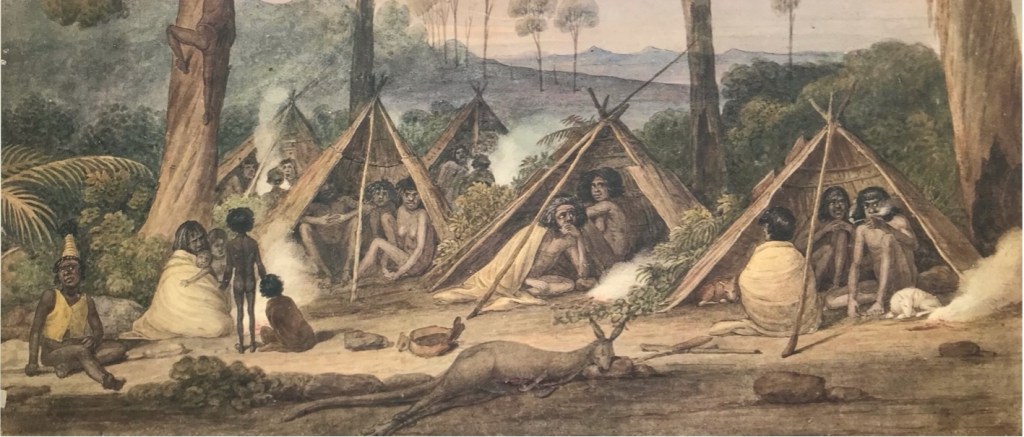
Aboriginal Families camped in the Port Stephens area, 1826 [National Library of Australia]
Troubles with aboriginals on the Myall River – circa 1826
Around the time that the Australian Agricultural Company established operations at Carrington, Port Stephens, William Cromarty a well-known mariner of the time, regularly travelled into Port Stephens and then along the Karuah River with his boat, to obtain sawn timber from timber mills owned by Sydney merchant Simeon Lord, for transport back to Sydney.
The Dungog Chronicle of 25 November 1938, page 4, reported on problems encountered by William Cromarty with aborigines while transporting timber by boat and his remedy to keep them at bay:
‘Though he built a home at Soldiers’ Point, Captain Cromarty remained a sailor to the last. With the brig “Fame,” of 139 tons, he engaged in a coastal run between Sydney and the headquarters of the A.A. Co., situated at Stroud. In addition to passengers, provisions were conveyed from Sydney and Newcastle to Booral, and on the return large quantities of cedar were shipped. One of the earliest timber mills in Sydney, owned by Mr. Lord, was regularly supplied from this source. The aborigines of the Karuah River were hostile, and members of the crew had been injured by spears thrown from behind cover whilst the brig lay moored. As it was feared that the blacks might try to rush the vessel at such a time, Captain Cromarty fitted an iron cannon to the brig, and this was loaded with grape shot. During one desperate affray it was fired point-blank.’
Aboriginal from Port Stephens sent to trial for murder – 1828
The Monitor of 21 June 1828, page 7, reported:
‘An Aboriginal native, heavily ironed, has been brought up to Sydney, on the cutter Lambton, from Port Stephens, one day last week, charged with murdering a white person at that settlement.’
The outcome of the trial of the aborigine was not reported by the newspapers of the time.
Hostilities Between Aboriginal Tribes – 1844
The Australian of 16 April 1844, page 3, reported:
‘Great hostilities have long existed and still exist among the different tribes of the aborigines in this quarter, to the great annoyance of the authorities, and continual jeopardy on the part of the natives. Some few nights back a body of blacks from the Dungog and Gloucester tribes came to a camp of the Stroud and Booral tribes in the dead hour of the night, and having first fired a gun to awaken and alarm, immediately discharged a volley of musketry and spears into the camp, and killed one man and wounded five others, among whom was a woman and a boy. This is the eighth murder committed by these savages within the last five months, nor is it likely to end with this. Orders have been given by the magistrates to the police to disarm all the natives found with firearms, till such time as a reconciliation can be effected among them.’
Aboriginals assist with capture of escaped convicts from Newcastle – 1844
The Star and Working Man’s Guardian of 18 May 1844, page 4, reported:
‘The convicts who absconded from Newcastle on the 21st ultimo, effected their escape from the Convict Hospital at that place by some means requiring explanation, inasmuch, as that the sergeant who sent them from the Stockade at Nobby’s, cautioned the people at the hospital, that they were desperate characters, and that he suspected they had some mischief in view. This information, however, it would appear, was unheeded — they escaped in irons, and got on board the cutter “Brothers,” which vessel had just arrived from Sydney with a small cargo of hardware and soft goods. Only two of the crew were on board at the time, but as two of the party had been seamen, the vessel was easily got underweigh and put to sea, and early in the day was seen steering to the southward; the wind however, changed south, and their being but a very small quantity of provisions on board, they bore up, and passing Port Stephens and Sugar Loaf Point (near South West Rocks), hauled in for the shore and landed, taking with them as much of the cargo as they could carry.
Their intention was, on meeting with a native, to get directed to the nearest station, where they thought to procure horses, firearms, and provisions, and then to proceed towards New England. The coast where they landed, is a narrow strip of low sandy land, separated from the interior by a succession of large lakes, connected by impassable rivers. Upon this narrow strip of land they wandered about for eight days, as they stated, without food; at last, being near the border of a lake, they saw a black woman in a canoe fishing, who paddled towards their cooey, supposing it proceeded from some of the blacks. They told her they had been shipwrecked, and wanted to be directed to Port Stephens, which she readily undertook to do, and in the afternoon reached Bundabah, a cattle station about six miles from Carrington.
Here they got refreshment; but as the alarm of their being in the neighbourhood had been given, and several parties were out in search, they were readily recognised; and whilst they were regaling themselves upon what cheer they could procure, and “bailing up” a stockman and robbing the hut, a black galloped into Carrington to report their presence. A party was immediately despatched, which reached the station about an hour after they left. They had taken the firearms and two horses. Their tracks were followed until dark, and the search was renewed the next morning by a strong party of the Company’s servants, (headed by Captain King and Dr. Buchanan,) two mounted police, and nine blacks, who, after following up the track for nearly twenty miles, succeeded in capturing them at their bivouac, just as they were preparing their repast.
They were lodged in the lock-up at Stroud the same evening, and next morning committed for robbery, and are now safely lodged in Newcastle lock-up, to answer the more serious charge of piracy.’
Commentary on Port Stephens Aboriginal People – 1869
The Newcastle Chronicle of 15 April 1869, page 3, published:
“On Monday there were upwards of 20 Port Stephens aborigines, including men, women and children, in town to receive their usual supply of Government blankets for the winter. Among these sable sons of the soil we noticed several fine, young stalwart fellows who, according to their own statements, have lately been employed as horse-breakers and farm servants in their own district but who, not being very fond of hard work, re-joined their tribe for the purpose of enjoying themselves for a time in those peculiar exercises and amusements of which the natives are fond. “With few exceptions the Port Stephens blacks can talk English well and some of them are said to be very expert cricketers”.
Aboriginal remains found – 1879
The Sydney Morning Herald of 7 July 1879, page 5, reported:
‘The human remains lately discovered near Port Stephens proved to be those of aboriginals buried long since.’
Illustrations of aboriginal people – 1884
The Sydney Mail and New South Wales Advertiser of 12 April 1884, page 689, published the following illustrations of aborigines in the Port Stephens area:
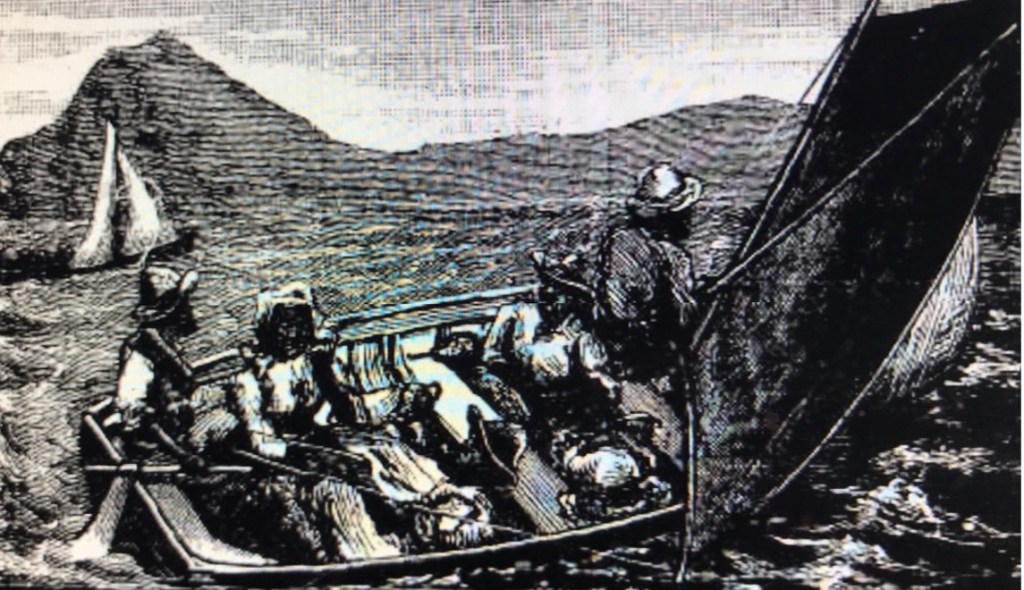
An Aboriginal Lobster Diving Party at Port Stephens (The boat was provided by the Government)
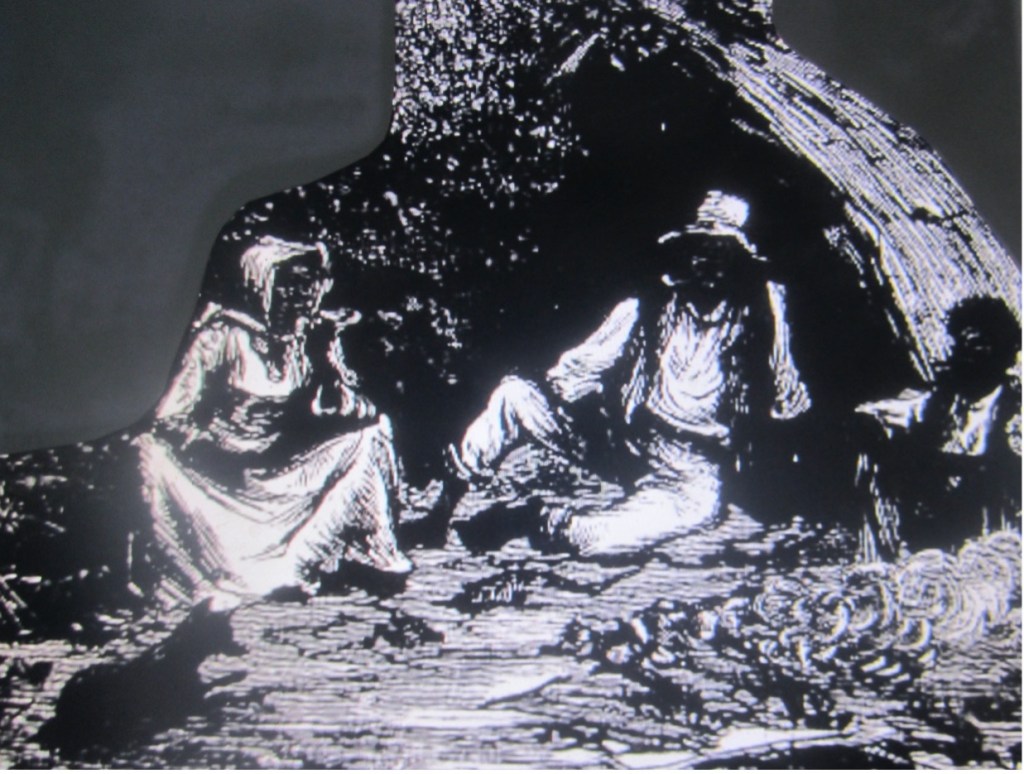
A Camp at Port Stephens
Arrest of an Aboriginal – 1884
The Newcastle Morning Herald and Miners’ Advocate of 4 October 1884, page 4, reported:
‘Yesterday afternoon the police brought to the lockup, closely handcuffed, a powerfully built Port Stephens aboriginal, named Billy Price. He stands charged with lunacy. His father died suddenly in the Newcastle cells several years ago; and Billy is a herculean specimen of his tribe; hard as nails, and tough as India rubber. For a while past report had been abroad as to his savage nature with the blacks of North Shore, Stockton; and although he has not been subject to drinking habits, his conduct has frightened those around him. He speaks English fluently, and for many years was a seamen employed in the whaling service.
Inspector Thorpe west to Stockton yesterday to inquire into certain reports as to his conduct; the result being that assistance was sent for to aid Constable Allen, of North Shore, in arresting him. W. P. Constables Harrison and Barr went over, and the three tracked Billy to his gunyah, about a mile from Stockton, in the scrub. He fought like a demon, but eventually was surrounded, and had his hands ironed behind his back. Even then he managed to drag his captors many yards before becoming worn out and breathless. It seems that he had attacked everyone right and left with a tomahawk and cut open the cheeks of a companion black. He also threatened and made an attempt to murder a settler named John Rinker, who had remonstrated with him. On arrival at the lock-up he appeared to have calmed down, but the moment that the handcuffs were unscrewed he had to be watched narrowly before being locked up in the cells.’
Aboriginal vagrants – 1888
The Newcastle Morning Herald and Miners’ Advocate of 18 August 1888, page 10, reported:
‘For some considerable time past a portion of a tribe of blackfellows, who came, it appears, from Port Stephens, has taken up its camp in this city, the principal headquarters of the natives being under the shelter of the roof of the steamers’ wharf and at the A.A. Company’s wharf. The number comprises about five men, three “gins,” and a “piccanniny,” and of this corps at least seven of the nine gain their living by begging.
And they seemed be fairly successful in their vagrant occupation, for they are all favoured with the appearance of the man who is reputed to have exclaimed, after indulging his epicurean propensities to his full satisfaction, “Fate cannot harm me; I have dined to-day!” Not only are the blackfellows and their black, but undecidedly uncomely female relations, able to secure for themselves ample food, the giving of which is a true charity, out some misguided and mistaken people, instead providing them with eatables, give them money and tobacco. Now, if there are any two things in the world that the aborigines more devoutly worship than others, they are tobacco and “grog,” and they testify their devotion by drinking and smoking most excessively whenever they get the opportunity. The consequence of their receiving money is naturally their expenditure of it upon “grog,” and what follows is often more oblivion and senselessness, though in a few cases the drunken blacks become most disorderly and annoying.
There is a law, as every publican knows, against the supply of liquor to these people, and yet the sale of it to them goes on. The police have been endeavouring to find out by what means and where the blacks obtain the liquor, but so far without success. An aboriginal woman, little more than a girl, was before the local bench yesterday, and was fined for being drunk and disorderly; and the P.M. and Mr. Thorn, J.P., expressed their regret that the persons who supplied liquor to these people could not be discovered and prosecuted. The police have been trying to break up the camp, but, so for, ineffectually. In a matter like this, as in all others, the public should do all they can to support the law, and it is to be hoped donations of any kind, save perhaps food and clothing, will not in future be given to the blacks who are so badly able to take care of themselves.’
Fishing Boat Given to Aboriginals – 1889
The Daily Telegraph of 10 May 1889, page 6, reported on a fishing boat given to the Port Stephens aborigines, that was referred to in the N.S.W. Legislative Assembly on 9 May 1889:
‘Mr. McMillan, in answer to Mr. Farnell, for Mr. Seaver, stated he had a report from the Inspector-General of Police that the boat sent to Port Stephens for the use of the aborigines was not taken from them and an inferior one substituted.’
Muster of aboriginals at Tahlee – 1891
The Daily Telegraph of 9 January 1891, page 6, reported:
‘The day was beautifully fine— was all that could be desired. A genuine bright blue Australian sky without a cloud and a pleasant cool breeze. Amongst the many out-of-door gatherings during the recent holidays I doubt if there was one more heartily enjoyed and more amply provided for than was a great muster of the blacks of Port Stephens. Tahlee, the residence of Mr. R. H. D. White, was the scene of the festivities.
For a day or two previously our sable brothers and sisters, with their numerous off-spring, began to assemble. Early in the morning of the day the place, close to the beach, at a short distance from the house, was all stir and bustle. The “sleeping apartments,” under spreading branches of the great gum trees and dense scrub were all left in a state of most perfect confusion and disorder, just as they had risen and shaken themselves after their delicious dreams of pudding and roast beef. Eat, drink and be merry was the order of the day.
Campfires were made, and the indispensable black billy, duly adjusted on forked sticks, hung over the flames. The hon. gentleman killed a fine young bullock, which when cut up was divided amongst them, together with an abundant supply of bread, tea, sugar, flour and, of course, the usual ingredients for the can’t-be-done-without pudding on such an occasion. It was a busy, animated scene, not altogether devoid of the grotesque. Here Lucy was busy with her pudding. There Fanny absorbed with the mysteries of a damper, while in a shady nook squatted Mary, nursing her sick child, while most of the men took in the picture with the most perfect composure, lay stretched full length on the grass or huddled all in a heap by a tree stump, smoking their short, black pipes.
On the whole it was an interesting gathering, what with the queer sounds of their strange language, the happy shouts of the more noisy, and I might add the more knowing ones, the glad faces of the children, who were all as merry as merry could be with the prospect of plenty to eat, for that day at least, without having to wait for the kangaroo-rat or bandicoot to be caught, killed and cooked. Of these sable visitors there were nearly 50, men, women and children, who had come to partake of the good things provided for them.
Breakfast was served at 9 o’clock. As they sat down, divided into several groups, under trees, bushes and in shady places, they presented a picture which will not be soon forgotten by those who witnessed it, as it certainly will not be by those who partook of the feast of fat things set before them. They had abundance of bread, and the joints from the bullock provided them with plenty nice bits for the morning meal, which were cooked in the way that pleased them best— some on the fire, some with sticks or improvised gridirons. One or two frying pans were in active use amongst them, but they all made a hearty breakfast.
At 11 o’clock, on Mr. White’s invitation, most of the men, a few of the women and several of the children and young people went up to the house and were led to the spacious organ-room, where they heard something about Christmas Day, how it was and what it was; saw themselves in the big looking-glasses— heard some music, such as many of them never heard before, and gazed with wonder on the beautiful pictures which adorn the room. The dinner was the event of the day, plenty of everything and to spare, which all enjoyed to their hearts’ content, and when fairly set at it speedily disappeared, as they all evidently knew that fingers were made before knives and forks, neither did they wait for tables-napkins or finger-glasses, nor even for “grace before meat,” but set to as if left to wash up and clear away the dinner things, while the children went to play and the men lay down, slept, laughed, roared, poked fun at each other and smoked.
During the day Mr. White, family and a number of their visitors went to the camp, and the ladies chatted with their dark-skinned sisters. In the afternoon the hon. gentleman was there, giving out sweets to the children and distributing cake in unlimited quantities to the women and men— all of whom, to their credit be it said, behaved with admirable civility and decorum. At this time Mr. White addressed a few sentences to those present, expressing the hope that they had had plenty to eat and had enjoyed themselves. Then, after Mr. White received a right good cheer three times repeated, a loud cheer for Paddy Marr, one of themselves, who had the control of the feast under his care and bad managed the details to the satisfaction of all concerned, and then three times three cheers for the Queen.
In the evening there was an attempt at a corrobboree, but it was a miserable failure, only a very few of the men taking part in it. The race is fast passing away, the old spirit is dead. Soon the original owners of the land we so proudly call our own will be numbered with the things that were, and while we proudly sing of our achievements:
Upon the hills that blaze today
With splendid dome and spire.
The naked hunter tracked his prey and slumbered by his fire.
Within the sound of shipless seas
The wild rose used to blow
About the foot of royal trees.
A hundred years ago.
While we do this, we should not forget that we have taken this delightsome land from them and have left them scarce room enough to bury their dead.’
Destitute aboriginals – 1892
The Daily Telegraph of 14 July 1892, page 4, reported:
‘When the Minister for Works (Nr. Lyne) was at Port Stephens a few days ago he proceeded to a place called Comus, on the Karuah River, where an aborigines’ camp is located. He found a number of blacks there almost in a starving condition. Amongst them were three very old men. Rations were obtained by the blacks from the police station at a place called the Tea Gardens, 12 miles distant, but in wet weather it was very difficult for some of the aborigines to travel so far for the food, and as a consequence they were often in need of it. Mr. Lyne, since his return, has forwarded a minute to the Colonial Secretary’s Department suggesting that the postmaster at Comus should be allowed to supply the rations.’
Suggested removal of aboriginals from Nelson Bay to Karuah – 1893
The Australian Star of 12 August 1893, page 3, reported:
‘The board for the protection of aborigines met on Thursday afternoon at its offices in Phillip-street [Sydney], Mr. Edward Fosbery (Inspector-General of Police) presiding. Messrs. R. Hill and W. Suttor, M.’s.L.C., and the secretary (Mr. A. Berckelman) were also present. ……
Mr. C. J. Muston, who wrote some time ago suggesting the removal of the blacks at Nelson’s Bay to Karuah, sent another communication, in which he again urged the board to adopt his recommendation. Regarding this matter, it was reported that the aboriginals had no desire to leave Nelson’s Bay, as they did very well there with their fishing industry. The board decided that if the blacks were willing to settle at Karuah they would be encouraged to do so and would be supplied with the necessary appliances to fence and cultivate their reserve.’
Commentary on aboriginals at Nelson Bay – 1892
The Australian Town and Country Journal of 23 July 1892, page 11, reported:
‘The New South Wales Government steamer Thetis, with Mr. Lyne, Minister for Works, and others on board, left Sydney on July 14 for the Macleay. …… The steamer from the time it left Sydney encountered very bad weather, and after several attempts to make the passage, including a fruitless endeavour to land at Trial Bay, the Thetis put into Nelson’s Bay.
Our special correspondent on board the Thetis gives the following account of the steamer’s stay at this settlement: ………. There were several camps of blacks, but more half-castes than aboriginals. Some of the children were almost white. These were provided with boats, rations, and blankets by the Government. The blacks travel about from one portion of the bay to another, never making a fixed home. Mr. Spain, who was one of our party, had two photo cameras, and managed to get several interesting groups of the blacks’ camps and other bits of interesting scenery.’
Commentary on Port Stephens Aboriginals – 1893
The Newcastle Morning Herald and Miners’ Advocate of 22 August 1893, page 5, further reported:
‘At a spot on the Karuah River, near Sawyer’s Point, about 18 miles from Port Stephens Heads, there is a reserve of 40 acres which has been set apart for the use of the blacks. There are three or four aborigines resident on the land, but the natives of the district frequently go there during the year. Some of the elderly men and women are supplied with rations by the Government, the goods being issued by the contractor under the supervision of the police officer in charge at the Tea Gardens.
Representations have recently been made at Port Stephens to the effect that it was desirable to settle a number of blacks from Nelson’s Bay on the reserve with the object of encouraging the clearing and cultivation of the land. The Aborigines Protective Society have consequently given instructions at Newcastle for the purchase of a quantity of tools requisite in carrying on the enterprise. The matter was placed in the hands of Inspector Lynch, who has bought the necessary tools and sent them on to Senior Constable Stone, at the Tea Gardens.
With the object of making himself personally acquainted with the requirements of the blacks, Mr. Lynch proceeded to Port Stephens during the latter part of last week and found that at Nelson’s Bay the native camp was situated at the rear of the light house [probably near the current Halifax Holiday Park]. There are three gunyahs, and the settlement consists of seven adults and five children. The children attend the Public School at Nelson’s Bay, and the adults gain a livelihood by fishing, but the old people and the juveniles are allowed Government rations. The fishing industry gives a collective return averaging from 15s to £1 per week, and the fish are sent to market by the steamer ‘Gosford’.
The Government recently authorised the building of a boat for these blacks, and they are anxiously awaiting its completion, as they hope by its aid to be able to fish outside. Mr. Lynch interrogated them on the subject of removing to Karuah and throwing in their lot with those on the reserve, but they declined to remove any great distance from the neighbourhood of the Heads. They expressed their willingness to go to a reserve situated about a mile and a half further up the bay [near Soldiers Point] and said that if supplied with tools similar to those which had been sent to Karuah they would cultivate the land, and build comfortable huts.
In all probability the Aborigines Board will comply with this request, and it is hoped that the natives will then be in position to make a more substantial livelihood. Mr. Lynch will probably visit the Karuah settlement within a couple of months to see how the work is progressing.’
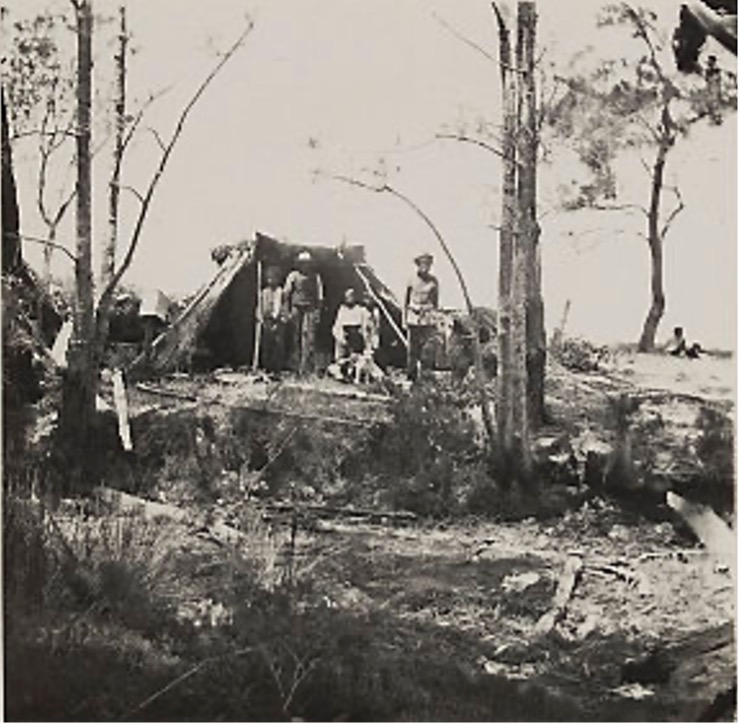
Aboriginal camp at Port Stephens [State Library of NSW]
Aboriginals at Nelson Bay take possession of a fishing boat – 1893
The Newcastle Morning Herald and Miners’ Advocate of 30 August 1893, page 5, reported:
‘Some time ago the Aborigines’ Protection Board authorised the building of a boat in Newcastle for the use of the blacks at Nelson’s Bay, who gain a livelihood by fishing. The work has been carried out, and the aborigines will be given a very stout and serviceable craft. The boat is supplied with sails, oars, and all necessary gear, and is well adapted to the work it is intended for. It will be handed over within a few days, and will be under the supervision of Constable Stone, of the Tea Gardens.’
The Newcastle Morning Herald and Miners’ Advocate of 7 September 1893, page 4, further reported:
‘Yesterday morning two of the blacks from Port Stephens took possession of the boat that was recently built in Newcastle for the use of the natives, and a start homewards was immediately made. The men were delighted with the craft and expressed their admiration repeatedly. The Aborigines Protection Board have authorised Inspector Lynch to purchase an adequate supply of tools to enable the backs to build huts and improve the land on the reserve at Port Stephens [at Karuah]. The things will be handed over in due course, and Mr. Lynch will visit the reserve in the course of a month or two to report the progress that is being made.’
Christmas treat for aboriginals – 1893
The Sydney Morning Herald of 15 December 1893, page 3, reported:
‘The weekly meeting of the Aborigines Protection Board was held at the offices of the Inspector General of Police yesterday afternoon. The secretary (Mr. Berckelman) announced that arrangements had been made for giving a Christmas treat to the whole of the aborigines in receipt of aid from the board.
The police inspector at Newcastle forwarded a report stating that he had paid a visit of inspection to the aboriginal settlement at Karuah, Nelson’s Bay, in the Port Stephens district, and found that the blacks were erecting comfortable huts on the reserve and had made fair progress in cleaning and cultivating the land. On the recommendation of the officer, the board resolved to supply the aborigines with additional tools and fishing tackle.’
Tourist Group comments on aboriginal group near Carrington – 1894
The Australian Star of 2 April 1894, page 5, in part reports on the sights observed by a tourist group near Carrington, Port Stephens:
‘The party of 15 picnickers, after navigating a few miles of the mouth of the Karuah River in the launch Elaine, started for a trip along the northern shores of Port Stephens, about halt-past 11 on the morning of Easter Monday, in delightfully calm weather, the vast expanse of water in the magnificent harbor being hardly broken by a ripple.
……..Nearby is a small row of untenanted cottages, which were in the milling days occupied by the timber cutters and getters. This embryo village is now deserted. A stone’s throw further away the little steamer passes a small patch of beach. A few boats are out on the water, but there is only a one-roomed shanty in proximity. A number of coloured boys are playing in the shallow water. A blackfellow squats near them, and an old gin keeps popping her head in an out of the door of the diminutive dwelling, apparently too bashful to allow the picnickers to get a good view of her, although they are several hundred yards off.
A local personage relates that amongst the little tribe of aborigines here a black woman has a white man for a partner to share her social joys and sorrows. Eleven or twelve children live with them in a wooden structure of the primitive order and of one room. The residential property, Tarlee, of the Hon. R. H. D. White, M.L.C., is next noticed.’
Karuah Aboriginal Reserve – 1894 and 1897
The Daily Telegraph of 21 May 1894, page 6, reported:
‘Mr. White reported that the work of fencing the reserve and hut-building at Karuah was being satisfactorily proceeded with by the aborigines. He also drew the attention of the board to complaints with regard to the condition of the flour supplied to the blacks. The secretary was directed to inquire into the matter.’
The Newcastle Morning Herald and Miners’ Advocate of 23 February 1897, page 8, further reported:
‘Although very much parched by the prolonged dry weather, the aboriginal settlement at the mouth of the Karuah River looks fairly well and indicates that the occupiers pay considerable attention to their work. Satisfactory crops of maize have been raised this season, but the low price of produce has proved a heavy handicap. Quantities of melons have been grown and have found ready sale among the men employed around Port Stephens. There has been a fair fruit yield, for which there has been a strong demand among visitors to Sawyer’s Point. The land is tilled in a thoroughly practical manner, and the holders appear to be well housed and are comfortable in all other respects. The boats provided by the Government are a great boon to them and prove a source of revenue.’
Karuah Aboriginal Reservation granted – 1898
The Evening News of 22 August 1898, page 3, reported:
‘A letter was received from the Department of Lands notifying the reservation, for the use of aborigines, of fifty acres on the Karuah River, Port Stephens. The board directed that the local police be requested to see that the aborigines were in no way molested in their occupancy, of the land.’
Aboriginal crew successful in the Nelson Bay Boat Regatta – 1898
The Newcastle Morning Herald and Miners’ Advocate of 10 November 1898, page 5, reported on the Nelson Bay regatta:
‘Considerable interest was evinced in the Nelson’s Bay regatta, which took place yesterday, and many aquatic men favoured the chances of the locally-owned sailing boat Federal. ….. In the principal race, only five of the ten boats entered started, and of those only two finished, the Federal dropping out, of the race, being evidently over-canvassed for the strength of the breeze blowing. The race eventually was won by the Florence, which was well sailed by her owner, Mr. Skelton. The second place fell to a boat sailed by an aboriginal crew, who handled the craft admirably.’
Initiation Ceremonies at Port Stephens – 1899
Before the 1950s, Aboriginal initiation ceremonies were frequently covered by newspapers, because of public curiosity due to their secretive nature. Since these rituals were private and exclusive to initiated males, some of what was reported was based on speculation.
A paper, entitled ‘The Initiation Ceremonies of the Aborigines of Port Stephens N. S. Wales’ by W.J. Enright was presented at the Royal Society of N.S.W. on 5 July 1899 , which spread some light on the issue.
The dissertation which also included the Stroud and Dungog areas, was published in full in the Dungog Chronicle of 5 October 1926, page 3.
‘The male aboriginal, on attaining the age of puberty, reaches the most eventful period of his life. Hitherto his place has been amongst the women and children, but he now passes through a ceremony admitting him to a brotherhood whose secrets are inviolable and whose power is more dreaded than any Vehmgericht [secret court]. Now filled with a sense of the dignity of manhood, he becomes entitled to greater privileges than previously enjoyed.
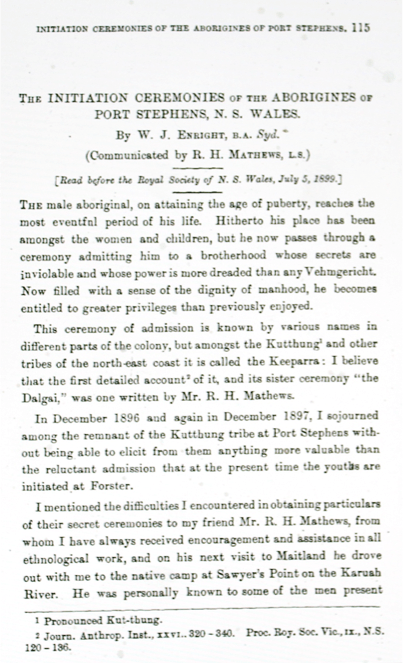
Page 1 of the dissertation
This ceremony of admission is known by various names in different parts of the colony, but amongst the Kutthung and other tribes of the north-east coast it is called the Kee-parra: I believe that the first detailed account of it, and its sister ceremony “the Dalgai,” was one written by Mr. R. H. Matthews.
In December 1896 and again in December 1897, I sojourned among the remnant of the Kutthung tribe at Port Stephens without being able to elicit from them anything more valuable than the reluctant admission that at the present time the youths are initiated at Forster. I mentioned the difficulties I encountered in obtaining particulars of their secret ceremonies to my friend, Mr. R. H. Matthews, from whom I have always received encouragement and assistance in all ethnological work, and on his next visit to Maitland he drove out with me to the native camp at Sawyer’s Point [Karuah] on the Karuah River.
He was personally known to some of the men present there and was at once received by them as one of the initiated. I remained in the camp ‘with the women and children,’ as they jocularly expressed it, while Mr. Matthews took all the initiated men into a secluded place in the bush nearby, where a Winggerah (a secret council of initiates) was held, at which he explained that he had told me all the secrets of the keeparra and had imposed upon me the usual obligations of secrecy. As soon as they were satisfied, I was summoned and shown the sacred goonauduckyer (bullroarer used in the keeparra), and was formally admitted as a member of the tribe entitled to all the privileges of an initiate.
With the help of Mr. R. H. Matthews, I have been able to obtain the following information, though not without considerable difficulty: — The place of initiation at Forster, N.S.W., consisted of a large circular space called ‘boolbung,’ about thirty feet in diameter, resembling a circus ring. This is connected with another smaller circle called “goonambung” situated in a very secluded part of the bush, by a pathway (goolga) about a quarter of a mile in length; the trees along which for some distance from the goonambung have geometrical figures and representations of various animals carved on their trunks.
In the centre of the goonambung a fire was lighted, and was kept burning. My enquiries proved that the ground at Forster differs but little from that described by Mr. Matthews in “The Keeparra Ceremony of Initiation,” to which I would refer my readers for more minute details. When a tribe has a number of youths who have attained the proper age for initiation, a messenger is sent out to summon the neighbouring tribes to the ceremony. The messenger, who is an initiate, carries with him as symbols of authority the bullroarer (goonanduckyer), the message stick, some tails and pieces of colourless stone.
The goonanduckyer and message stick must never be seen by a woman or an uninitiated person, and I have been assured that instant death would overtake a female or boy unfortunate enough to see one of these implements. When a messenger approaches a camp, be swings the goonanduckyer so that it may be heard by some of the older men, who immediately recognise the significance of the sound as soon as they hear it, and coming out of their camp they meet the messenger and conduct him into the camp; where he is entertained until the following day, when a winggerah is held to which his invitation is delivered.
If the invitation is, as usual, accepted, the whole tribe gets ready for the march, the women and boys, however, being kept in ignorance of the object of the journey. When the tribe arrives near the ground they halt, and the initiates proceed to paint their bodies in squares and circles with white and red colours, and go to the goonambung ring, which they enter in Indian file, and marching round take their seats on the wall, in such a position that they look towards the burri or country whence they have come.
Each man, who has a son to be initiated, bears a blotch of red ochre on his forehead, and by this means they indicate the number of youths they have brought to be initiated. The tribe which has issued the invitation are then summoned by the swinging of the goonanduckyer, at the sound of which they form in single file and march into the goonambung, thus making themselves known to the new arrivals, who arise and march to the boolbung circle, each carrying a small branch or bough of a tree in each hand. Here they dance with the women of the tribe to whom the ground belongs, and at the conclusion of it the men belonging to that tribe go into the ring and salute the newly arrived women by dancing around them.
All the men then strip the leaves off the branches they carry and scatter them over the ground. This portion of the ritual appears to be meaningless now, but it may perhaps have formerly symbolised the stripping of the youth of his old character preparatory to conferring on him the togo virilis [symbol of manhood].
The day for commencing the initiation having arrived, the men who are to act as the stewards go to the goonambung and assume the symbols of office in the shape of a smearing of grease and charred bark of the apple tree (goondary). The boys are prepared by their female relations, who cover them all over with a mixture of red ochre and grease, and they are also adorned with a belt from which is suspended two tails. The youths when their preparations have been completed proceed to the boolbung in company with the women and children. The latter, however, do not enter the ring but take their places outside, close to the youths belonging to their respective tribes, the youths standing inside the ring at the points nearest their respective burris.
The women and children who have been previously made to lie down with their faces to the ground are then covered with rugs and bushes, and the proponents for initiation with their heads enveloped in rugs are taken some distance along the goolga out of sight of the women, and then made to lie down with the rugs still covering them. Whilst in this position, the awful sound of the goonanduckyer, the voice of Goolumbra further impresses them with the solemnity of the occasion and serious nature of the step they are taking, and renders their minds better fitted to receive the lessons of the keeparra.
The youths having been taken out of sight as just stated, the women and children are permitted to rise, and are conducted to another camp, the site of which has previously been selected at a winggerah held prior to the commencement of the proceedings. Before leaving for the new camp a doolbhi (a forked piece of timber inserted in the ground with another piece tied at right angles to it a little distance from the ground pointing in the direction of the new camp. If there are any streams between the boolbung and the new camp, they are represented by twigs fastened across the pointer equal in number to the streams) is erected outside the ring to indicate to any other tribes who arrive later on, the direction in which it is situated.
Near this new camp, which is called Ulra, a piece of ground is neatly swept and two fires are lighted thereon some distance apart. On this playground which has been thus prepared, the women and girls dance every evening during the absence of the boys. The women having been taken away as just described the novices whom we have left lying down at the goolga are ordered to stand up and the rugs are then placed over their heads in the form of cowls. They are then taken along the goolga towards the goonambung, and on the way they are shown by the elders the teeroong or various geometrical and other figures carved on the trees. As far as I can learn, there are no figures carved on the earth at the keeparra ground used by the Kutthung. None of the aboriginals from whom I drew my information knew the meaning of the teeroong.
When the youths arrive at the goonambung they are taken around it, and then marched towards the bush, the boys alongside of their guardians, with their eyes intently fixed upon the ground until they reach a suitable place, where a camp is formed in the shape of a crescent or semicircle with two fires in front of it, and also a level space carefully cleared and swept. On this place every night the men mimic the actions of various native animals, and the goonanduckyer is sounded occasionally to impress the novices who are informed, that it is the voice of Goolumbra, of whose terrible powers they are warned.
During their stay at this camp which is called the keelaybang, the novice who is kept either in a lying or sitting position, must not communicate by word with his guardians, and is threatened with severe penalties if he does so. Should he desire anything he must touch one of the men who continues to question until he gets an affirmative nod from the boy. Often the man who has charge of the boy will at once know what is the novice’s desire, but in order to test him will refrain from putting the proper question.
During their stay in the keelayhang no meat is given to the boys until it has been cut into small pieces and the bone and sinew carefully removed. Should a boy desire to micturate [urinate] he is allowed to do so at one of the fires, alternating the operation at each fire. Any other call of nature is obeyed outside the camp, one of the initiates all the time keeping guard over him. After some days spent in this camp, the cry of a dingo (miree) will be heard near it. This noise or howl is uttered by men who have come from the women’s camp and is answered by a shout from the keelaybang.
When the new arrivals get in sight they march in single file towards the camp, with bushes in front of them which they throw down on their arrival and execute a dance. The men who have charge of the boys pick up these bushes and commence dancing with them in their hands, all the while stripping off the leaves. The object of this visit appears to be to ascertain when the novitiate will be completed and a return made to the camp. Several of such visits may possibly have to be made before the initiation is accomplished.
During their stay the boys are taught the sacred songs of the tribes and the laws relating to the class system; they also commence to learn an entirely new language. In this new language the returning boomerang (barrakun) is known as dulla, and the woomora (yukri) is called burrumba. The learning of this language is a matter of time, and the knowledge acquired of it is useful in ascertaining whether a man is an initiate.
On the morning before they depart to the women’s camp the boys are made to stand in a row, their heads remaining covered, and then the men form in line in front of them, and two of them swing the goonanduckyer. After it has been sounded sufficiently the coverings are removed from the boys heads, and they are permitted to see for the first lime the instrument whose sound has so impressed them. Some old men who are strangers to the boys then step forward and threaten them, that, if ever they reveal anything that has been shown them or taught them, they will be killed, and this is quite sufficient to deter them from revealing the secrets of the keeparra.
This concludes the ceremony in the bush, and a start is made for the camp where the women have been left, but on the way the whole party go into a waterhole or at some point along a stream of water previously agreed upon and wash themselves. At the conclusion of their ablutions, they singe the hair off the bodies of the novices, and then cover the whole of the party from head to foot with pipeclay before resuming their journey to the women’s camp.
On their way they are met by a number of men from the women’s camp, who announce their arrival by howling like dingoes, and this howling is answered by one of the men with the guardians swinging a goonanduckyer. Each member of the party from the women’s camp carries a green bough in his hand which is thrown down, when they form into line in front of the novices, and a short dance is gone through. The men with the novices then pick up the bushes and strip them of their leaves which are scattered about on the ground.
The new arrivals then return to the women’s camp and prepare for the return of the novices by making all the women lie down and covering them with bushes. After sufficient time has elapsed for these preparations to be completed, the novices and men, divested of all incumbrances, make a start for the camp, their approach to which is heralded by the sound of the barroway (a large bullroarer) by a man who has previously gone out of the camp. On the arrival of the novices with their guardians at the camp they form a complete circle around it, and then the women are permitted to rise and greet their sons whom in their disguise they have considerable difficulty in recognising.
On discovering their sons the mothers go forward to them and raise their breasts which the sons take hold of and pretend to suck. Amongst other tribes the sisters of the novices greet them by rubbing their feet on the feet, and ankles of the novices, but this custom did not appear to prevail amongst the Kutthung. After each mother has greeted her son in this fashion, the women pass out of the ring under the arms of the men who then throw bushes on the fires causing them to smoke. Each guardian then takes hold of the novice under his care and holds him for a time in the smoke, after which all the novices take their departure together with their hands linked, to the place where they have left their belongings, and they are soon followed thither by their guardians who remain with them for the night.
The next day the visiting tribes make preparations for departure, and on their journey the novices must not camp with the elders, but like those whom they have left behind they are kept in a ‘bachelor’s camp’ until their initiation is completed. Each night, however, they are allowed to approach a little nearer to the general camp, and at last are finally admitted into it. Before being allowed the privilege of marriage, they must attend more keeparras, the number of which, as far as I can ascertain is five, but it is possible that more regard is paid to the age of the youth than to the number of keeparras he has attended.
A new name is also given to him now which must never be used within the hearing of women; the raised scars (bheerammer), are made on his body. Prior to being initiated he was permitted to use as food all kinds of fish, honey, and the female of all land animals, but certain birds and the male of all land animals were forbidden him. After his first keeparra he is entitled to partake of the flesh of the male kangaroo-rat, and after the second he is permitted to eat the male opossum, and each succeeding keeparra increases his privileges in this respect.
The custom of knocking out one of the front teeth during the ceremony is not now in vogue amongst the Kutthung, nor is it certain that it ever existed amongst them, and of late years the practice of ornamenting the bodies with scars has fallen into disuse. It is more than probable that the last keeparra has been held by them; for as each year goes by their numbers dwindle, and in January 1899, they were not able to get a sufficient number of aborigines together to enable them to celebrate the ceremony.
Many of those I have met along the coast had never gone through the keeparra, but had been merely initiated into the dhalgai, a sister ceremony, much shorter however than the keeparra, and needing for its practice no assemblage of adjoining tribes nor any prepared ground; in fact it requires but a half dozen men who have passed through the keeparra, and the use of a goonanduckyer, to enable the youth to be initiated.
As the dhalgai ceremony amongst the Kutthung does not differ from that already described by Mr. R. H. Matthews, I will refer my readers to his work for an account of it. The burri (district) of the tribe whose initiation ceremony I have here described, extended along the Karuah River’s southern bank and the southern shore of Port Stephens to Pipeclay Creek [near Pindimar], whose western bank formed the eastern boundary of their territory; but the southern and western boundaries were uncertain or rather I perceived varying accounts from different individuals. These boundaries were no doubt strictly adhered to before the advent of Europeans, but afterwards when tribes were killed off or driven from their territories the boundaries of adjoining burris would be changed, and this would account for the discrepancies in the statements I have received.
The country on the north side of Port Stephens and the Karuah extending down to the right bank of the Myall River belonged to the Gummipingal (“People of the Spear”), the land lying between the Myall River, the Myall Lakes and the sea, was occupied by the Grewigerigal (“The People of the Sea”), and the district lying between Pipeclay and Tellegherry Creek was occupied by the Doowalligal (“People living between the two.”).
Amongst the Kutthung and neighbouring tribes there was no code of signs in use, as some believe amongst the initiates, and in a community such as that in which the aboriginals lived, where every male on attaining the proper age would be initiated, and in which all initiated would be known to the older men who played a leading part in the keeparra, the use of such signs for the purpose of distinguishing initiates except from adjoining tribes would be utterly unnecessary, and in the latter case the language previously referred to would furnish an infallible test.
In conclusion, I wish to refer to a description of the ‘Gaboora’ ceremony published in the Australian Anthropological Journal a year or two ago. Mr. Cohen, the writer of the article, says that “the youths to be initiated were kept apart from the other members of the tribe for a month previous to the inauguration ceremonies, and that if any female was detected holding conversation with them or touching them, she would be put to death. According to my investigations the novices remain in the general camp with their female friends until the final morning on which they are taken away by the old men.
It is also stated that the ‘gaboora’ ceremonies invariably occupied two days. From ten days to a fortnight is the shortcut time employed for this purpose among all the tribes of the north east coast. Mr. Cohen’s description of the scenes in the bush, while the novices are away with the chief men undergoing the ordeal of initiation, are to say the least disjointed and fragmentary. Moreover, some of the scenes which he narrates were never heard of by my native informants; whilst others were stated to be merely portions of ordinary corroborees, and in no way connected with the rites of the keeparra or “gaboora,” as it is called by the writer of the article in question.
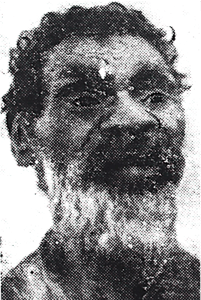
“Laughing Charlie’ one-time Wingham (North Coast) Aboriginal [Dungog Chronicle, 5 October 1926]
Alarm among aboriginal community at Port Stephens – 1900
The Maitland Weekly Mercury of 1 September 1900, page 3, reported:
‘Aborigines are reported to be assembling in large numbers in the Port Stephens district. It is said that they fear a visit from Jimmy and Joe Governor [Bushrangers]. At a meeting of the Manning River District Hospital on Saturday, it was stated that the matron and patients had complained of the bad locks on the doors of the institution, and as the black scare was on, they did not feel safe. Instructions were, therefore, given to have proper locks prepared.’
Brochures published on the Port Stephens aboriginals – 1900
The Newcastle Morning Herald and Miners’ Advocate of 14 November 1900, page 8, reported:
‘Mr. Walter J. Enright, of West Maitland, who has devoted much of his leisure hours to a study of Australian ethnology and who has already published two valuable brochures, the one dealing with “The rock paintings and carvings of the aboriginals of New South Wales,” and the other with ‘The initiation ceremonies of the aborigines of Port Stephens, New South Wales,” has published, under the auspices of the Royal Society of New South Wales, a more pretentious pamphlet, treating of “the language, weapons, and manufactures of the aborigines of Port Stephens, New South Wales.” [The three brochures are held by the State Library, New South Wales].
In his little work he endeavours and with a great degree of success, to supply a grammar and vocabulary of the Kutthung tribe, in order that the language of some of the native tribes of the coast might be preserved. The Kutthung dialect was spoken at one time by the tribes lying between Port Stephens, Maitland, and Paterson. The adjoining tribes were—The Gummigingal, inhabiting the district on the north shore of Port Stephens and the Karuah River; the Warringal, between Tilligerry and Pipeclay Creeks; the Warrimee. between Telegherry, Port Stephens, the seashore, and the Hunter; the Garawerigal, between the Myall River and the seashore; the Yeerunggal, about the Myall Lakes; the Birrimbai, in the neighbourhood of Rungwall Flat; and the Birroonggal, on the Myall River.
The pamphlet shows the grammatical construction of set sentences very clearly and provides very concise rules. The vocabulary includes 456 words of the language, representing common English equivalents. The second part of the pamphlet deals with the weapons and manufactures of the tribe. Each weapon, and some of the manufactures, are shown in the illustrations, and all are cleverly described by the author.’
Commentary on the Aboriginal Settlement at Karuah – 1906
The Maitland Daily Mercury of 29 December 1906, page 3, reported:
‘The nearest occupied aboriginal reserve to Maitland is, we believe, that situated at Sawyer’s Point, Karuah River, Port Stephens. …… The writer, on his recent Christmas visit, went to Hexham by train, ‘bus to Raymond Terrace, and tramped the remaining 18 miles. The reserve is occupied at intervals by about 50 aboriginals all told, the great majority of whom are half-castes. The reserve consists of 50 acres, with a frontage to the Karuah River. A purchaser would give very little for the improvements. Some fruit trees were planted some time ago, but they have been neglected, and the fences are all down, allowing stock to stray about, so that the value of the garden is almost nil.
There are three small cottages, and a few humpies. The men have been in the habit of partially earning their living by fishing, but latterly this has not proved very remunerative, and sleeper cutting has been their main occupation. A good work is being done amongst them by the Aborigines’ Inland Mission, which purposes doing its chief work in the interior, but has been led to take up this one coast mission. Sawyer’s Point will in the future probably prove an excellent place for missionaries from the interior to recuperate. Mr. C. H. Harrington, who has done much good work among the kanakas in Queensland, is in charge at Sawyer’s Point.
The dark people readily attend the services, and a marked change in conduct has resulted from the influence of Christian lives and teaching. Formerly much of what little was earnt was wasted in riotous living, but now there is sobriety and peace. With this there is a desire for cleaner and healthier conditions. It is intended to get the reserve securely fenced, in order that fruit and vegetables may be grown. The humpies are to be replaced by cottages, and it is also desired to house the missionary more comfortably, a much-needed work. The Board has just provided the settlement with a boat, which will still further help the men to help themselves.
The missionary is dependent upon the voluntary gifts of sympathisers, and it was therefore resolved by the ladies of the West Maitland L. M. S. Auxiliary at the Congregational Church to have a missionary gift night, and to send a box of Christmas gifts to Sawyer’s Point. These were despatched by the “Hawk” from Newcastle last Saturday, the case, through the good offices of Mr. J. C. Brown, of Morpeth, being conveyed by the H. R. S. N. Co. free of charge. The box gave great gladness. The groceries were a very acceptable addition to the missionary’s modest storehouse. The toys and school materials gave great delight to the young folk. They had never seen a Christmas tree, and their eyes glistened as a packet of gifts was distributed to each one. These were distributed at the Christmas morning service, and young and old received something. Mr. Harrington expressed the gratitude of all to the Maitland friends for their kind gifts.
In the evening, the company, which, included a number of visitors from the white people, were treated to a lantern service by Mr. Harrington. Acetylene gas was used and good pictures produced. A few amusing scenes were shown, and a number of views of kanakas and cane fields in Queensland. The greatest part of the evening was taken up with the exhibition and explanation of scenes from the Life of Christ. These gave good opportunities for simple and earliest talks and they were well used by Mr. Harrington. The aboriginals are fortunate in having the services of so capable and unselfish a worker as Mr. Harrington, and he well deserves the cooperation of Christians throughout the district in his heroic work.
Mrs. Harrington died a few weeks ago, and her remains were interred in the little private cemetery at Tahlee. The unselfishness and fidelity of the missionary in continuing the work under the trying circumstances compel admiration. The missionary, in bidding the writer good-bye, sent very, warm expressions of gratitude to the Maitland friends for their kindly and much appreciated expressions of goodwill.’
The funeral of Mrs Henrietta (Ettie) Harrington, aged 37 years, was reported in the Maitland Daily Mercury of 24 September 1906, page 4:
‘News was received in Maitland on Saturday of the death at Sawyer’s Point, Karuah, of Mrs. Harrington, wife of Mr. Charles H. Harrington, missionary to the aborigines. Mrs. Harrington worked for some time with her husband amongst the kanakas in Queensland, and in a very low state of health, suffering from consumption, went to Sawyer’s Point about three months ago. For a time, she rallied, and seemed much stronger, but evidently the change for the better was only temporary. The dark people will mourn the loss of a thorough friend and helper, and the Aborigines’ Island Mission, the headquarters of which are at Singleton, has lost one who with health and strength, would have been enabled to render great service. Mr. Leonard W. Long, of Singleton, went through Maitland en route to Sawyer’s Point on Saturday. The funeral took place yesterday afternoon, the remains being laid to rest in the burying ground near to the beautiful little church at Tahlee. Mr. W. Longworth placed his oil launch at the disposal of the mission party, and two sailing boats with the body and mourners were towed down by it on the Karuah River from Sawyer’s Point [Karuah] to Tahlee. The chief mourners were Mr. C. H. Harrington (husband) and Mr. J. Harrington (brother-in-law). The service at the grave was conducted by Mr. Long. Mrs. Harrington’s relatives reside at Ashfield, and her mother had only recently visited her at Sawyer’s Point.’
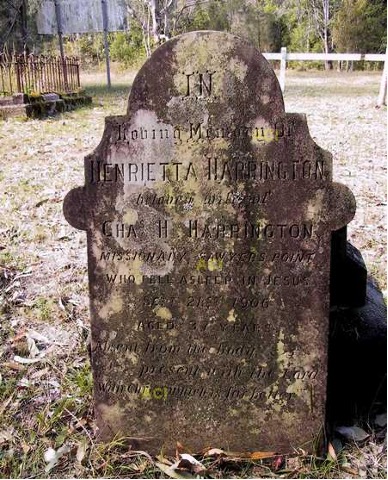
Grave of Henrietta Harrington at Carrington Cemetery – the gravestone states that she was a Missionary of Sawyers Point [Australian Cemetery index]
Aborigines rescue survivors from capsized boat – 1907
The Maitland Daily Mercury of 13 September 1907, page 5, reported:
‘An exciting boating experience befell two men and a girl at Port Stephens on Monday night. About midday on Tuesday a sailing boat drifted, bottom up, towards Nelson’s Bay. A heavy gale was blowing at the time. The boat was found to be the ‘Box’ belonging to Fame Cove, and on proceeding to the cove a search party found the party, consisting of Messrs. Davidson, Johnson, and Miss Johnson. It was ascertained that while sailing in the boat on the previous evening a sudden squall caused her to capsize, and the occupants were thrown into the water.
With difficulty they all got clear of the sails and managed to scramble on to the keel. The girl soon became exhausted and, several times slipped off the boat, but was each time dragged back again. After being in the water an hour, and when almost despairing of rescue, their cries were heard by a settler and two aborigines on shore. At great risk they put off in a skiff and effected a rescue.’
Work of Aborigines Inland Mission continues – 1907
The Maitland Daily Mercury of 24 December 1907, page 3, reported:
‘At Karuah (Port Stephens) Miss Ayers is continuing her good work. At Nelson’s Bay and Soldiers’ Point, as well as at Sawyer’s Point, evangelistic work is carried on both among the dark and the white people.’
Investiture of Billy Ridgway as a Tribal King – 1908
The Newcastle Morning Herald and Miners’ Advocate of 13 November 1908, page 4, reported:
‘… In those early days, before the civilisation of the white man had intruded itself into the customs and folklore of the aborigines, the investing of a tribal king with the dignity and authority of his office, was a ceremony characterised by much display. The traditions of the ceremony as not quite lost and were to some extent observed on Monday at Port Stephens, when Billy Ridgway, a full-blooded son of the soil was crowned as monarch of the dusky people of that district, and was invested with the crescent, the symbol of his authority. Billy reigns over the remnant of a once powerful tribe, the extinction of which will be accomplished by a very few more years of civilisation. ….’
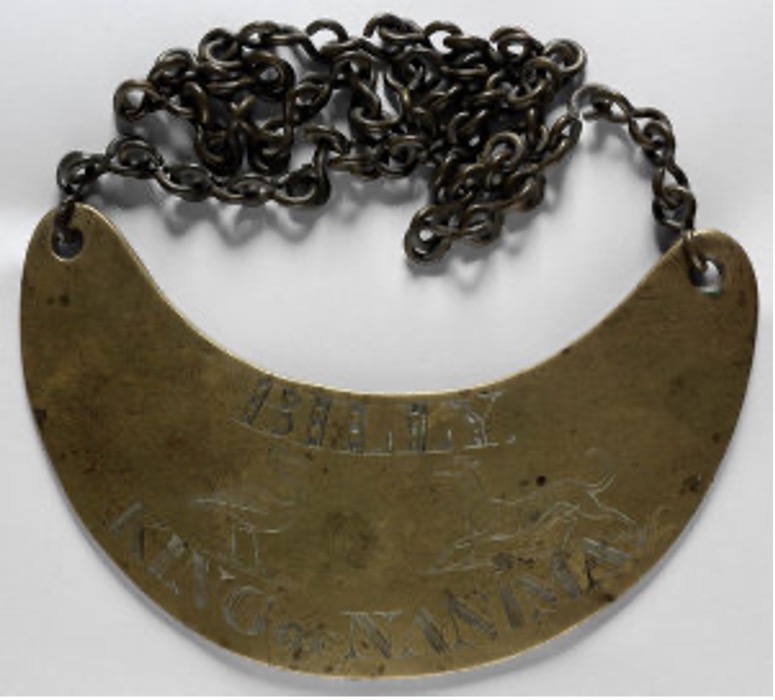
Aboriginal brass crescent of the type given to King Billy Ridgway [State Library New South Wales]
The Maitland Daily Mercury of 29 December 1908, page 6, also reported:
‘On the King’s Birthday Billy Ridgway was crowned King of Port Stephens, with due ceremony.’
King Billy Ridgway seeks new Reserve – 1908
The Newsletter: an Australian Paper for Australian People of 7 November 1908, page 4, published the following letter written by the Port Stephens Aboriginal king, Billy Ridgway:
‘The following remarkably well-written letter from an aboriginal king, at Soldier’s Point, Port Stephens, has recently been received by Mr. Garrett Barry, solicitor, of Curtiss and Barry. The native king’s handwriting is very good, plain, regular, and well set-out. King Billy is a pure-born Australian aboriginal and wears his royal honours with dignity. His letter is a long way more distinct and more grammatical than the epistles often received at the Departments from members of Parliament (both Houses).
Following is the letter : — Soldiers Point Oct. 16, 1908. Dear Sir Mr. Barry, — I received your letter, I thank you for your kindness and going to a little trouble. There are a great many of my own people are glad that I am King. I have been down to Sydney the time the Fleet were there. I got a pass from the secretary to come home again. The secretary is a very nice man. He asked me a few questions; he asked me where I was from, and he would not give me a pass until he knew my name. Then, when I told him, he gave me a pass without any trouble.
Just a few lines to see will it pass. It is done in a good many places. I have been right up the country as far as Darlington Mission, and I see that they are made comfortable by the Government. They have cows and horses, wagons and sleep, and a store with goods in it for the natives, and I think it is very nice for them to be so comfortable as they are. I was thinking that this place could be made the same for these natives here, and this is what I want to ask you, Sir Mr. Barry.
I would like to be a King over all my people that speak the one language. They are so scattered abroad, and it would be nice to get them all together. It would all amount to the one thing if they were all together. There are Forster, Taree, and Port Stephens; they all speak the one language, and I think that if they were all brought together to live, on one big reserve it would be far better off. Forster, they are trying to take the land from them there, and Karuah Reserve the same by many of the white people, and I want to see if the Government would allow it and see if the Government would help them with houses and cattle and other things, like they are in other places ; and I think it would be nice if they were all living together.
The children would get schooling, and we would have a government manager to look after the mission station, and we would have the missionaries to do their work amongst them and make them good people. So dear Sir Mr. Barry, I want you to see into this, and to think over it. Would it be a good idea to do for the poor natives in Port Stephens? And if you think that it will pass, Sir, I want you to write and let me know. I know that you are a very clever gentleman, and I want you to study over it and see if it could be done. So, I think this is all until I hear from you. — From King Billy Ridgway, Port Stephens. (Excuse the writing.)’
Construction of the Aboriginal Mission Church at Karuah – 1912
The Maitland Daily of 3 April 1912, page 4, reported:
‘The people belonging to the Karuah Aboriginal Mission, Port Stephens, are about to open a little church which they have had erected on their reserve on the Karuah River at Sawyer’s Point. On a recent Sunday at a special service they made their personal offerings, which were given in novel purses. The woodcutters made a ti-tree bark purse, the fishermens’ was in the form of a boat; and the missionaries presented theirs in the leaves of a Testament. The total amounted to £5/13/0½. Not much to many a reader of “Our Aim,” writes Mrs. Long, but a munificent gift from these poor people. We have no hesitancy in saying that many of them gave their all.’
The Maitland Daily Mercury of 13 December 1912, page 4, further reported:
‘At the West Maitland Congregational School Hall on Wednesday evening Miss Stewart, missionary of the Aborigines Inland Mission, stationed at Sawyer’s Point, Karuah, gave an interesting description of the building of a new church on the aboriginal reserve, upon which she resides.
In accordance with the lines upon which the mission works, no subscriptions were solicited, but the needs were made the subject of prayer. The dark people of the Port Stephens district themselves have made fine contributions in money and labour. One friend had provided roofing iron, another lining boards, and it was hoped in a few weeks’ time to be able to open a neat and substantial building, that would be a credit to the builders, the aborigines themselves, and serve a very useful purpose.’
The Maitland Weekly Mercury of 27 September 1913, page 14, reported additional information:
‘Miss Stewart and Miss Brown, of the Aborigines Inland Mission, are doing good service among the dark people of the Port Stephens district, and also in general home mission work. Their people have built a church on the aborigines’ reserve by voluntary labour and have been helped by many gifts from local friends. The men are now engaged in painting the building, and when seats are provided the little building will be ready for use. Last Sunday Rev. T. E. Peirce visited the mission and took part in a communion service.’
The First Aboriginal Queen in Australia crowned – 1912
The Daily Telegraph of 6 November 1912, page 11, reported:
‘At Booral Wharf, Karuah River, Port Stephens, on Saturday, Queen Charlotte, one of the first aborigine queens, was crowned. Five years ago her husband, King Billy, received his plate, but no recognition was made of the highly respected queen. However, Captain Phlllipson, of the s.s. Karuah, and other friends, recently decided that the time was ripe to crown Queen Charlotte. So on Saturday about 50 of the queen’s subjects erected gunyuhs amongst the bushes and put up a throne.
The queen was surrounded by her maids of honour and her bodyguard of portly young men. The crown was borne on a cushion by a little girl and placed on the queen’s head by Captain Phillipson. The National Anthem was sung, and all the subjects vowed allegiance to their queen, who spoke a few well-chosen words. The blacks entertained a large number of white visitors at tea, and a concert held afterwards on the wharf (lighted by the Karuah’s electric bulbs), in aid or the Karuah Aborigine Mission, realised about £4.’
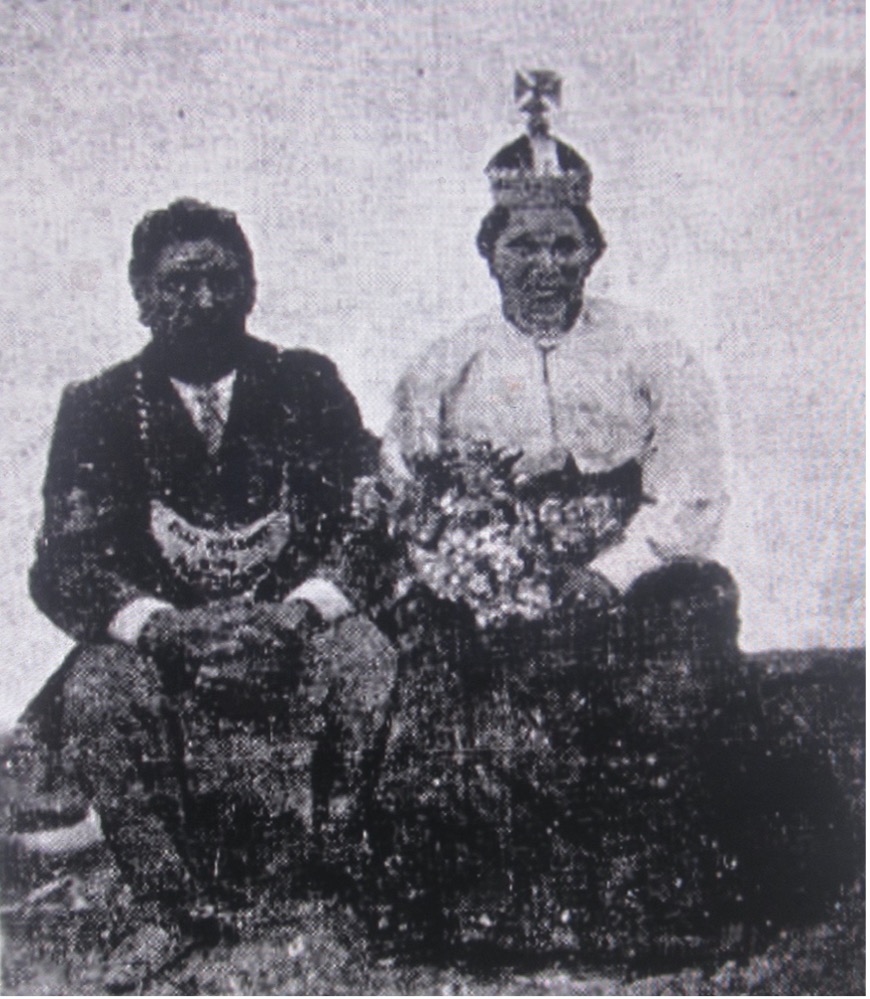
King Billy (wearing his brass crescent) and Queen Charlotte (wearing her crown) [The Sun, 10 November 1912]
The Raymond Terrace Examiner and Lower Hunter and Port Stephens Advertiser of 8 November 1912, page 3, also reported:
‘An interesting ceremony took place here on Saturday last, viz, the coronation of one of the aborigines as queen of the Port Stephens tribe. About 200 people were present, and Capt. Phillipson, of the s.s. Karuah, performed the ceremony. In a brief address he said that there was already a king of the aborigines — King Billy Ridgway — who was the successor to King Tommy [King Tommy of Grafton], whose death took place some five years ago [in 1907]. The Mission Society of the Aborigines thought there should be queen of the tribe, and a crown was therefore procured in Sydney, which was an artistic piece of work, and was very much admired when placed upon the queen’ s head.
The aborigines were much impressed with the ceremony, of whom there was a goodly number present from Port Stephens, Cape Hawke, and Manning district. Misses Stuart and Jackson, the two lady missionaries, had arranged a very nice programme in the form of a sacred concert, in which all the aborigines took part. Sacred songs were rendered by the aboriginal choir, also selections by male members of the gum leaf band. Mr. Marquet, representative of the Sydney Press, was present, and took a photo of the group of aborigines, the king and queen being seated in the centre robed in white gowns.
Miss Jackson gave an interesting account of the work done by the mission at Port Stephens since its inception some years ago, and at the conclusion of the entertainment Capt. Phillipson treated the aborigines to refreshments, for which he was afterwards thanked by King Billy Ridgway for his kindness and generosity.’
The Sun of 10 November 1912, page 17, further reported:
‘For the first time on record in Australia the crowning of an aboriginal queen took place at Booral Wharf, Karuah River, Port Stephens, on Saturday, the 2nd instant, when Queen Charlotte, the, consort of King Billy Ridgway, was crowned queen of the Port Stephens aborigines, in the presence of about thirty loyal subjects from the Karuah Inland Mission Station, and a large number of white visitors from the surrounding districts.
The blacks travelled from their homes at Soldier’s Point and Sawyer’s Point by the s.s. Karuah to Booral (or Allworth as it is now called) and camped under the gum trees on the banks of the Karuah River, where the ceremony took place. The crown was placed on the queen’s head by Captain Phillipson, of the s.s. Karuah, who declared her “Charlotte: Queen of Port Stephens. “Long may she reign!”.
A splendid musical programme and other events was arranged by Miss Stewart, superintendent of the mission, the most popular and novel portion of which was a number of selections by the Gumleaf Orchestra, who produced some excellent music from the simple gum leaf, accompanied by the accordion. In the evening the coronation and concert were repeated for the benefit of a number of visitors who arrived late, and refreshments were served to both performers and visitors by the officers of the Karuah.
Miss Stewart gave an interesting address on the work of the mission, and thanked Captain Phillipson for the pleasant time he had given the natives under her charge. King Billy, on behalf of his queen, thanked all those white people who attended the coronation, remarking that it had been the happiest day they had experienced in their lives. Votes of thanks to Miss Stewart and Mr. Claude Marquet (of Sydney, who procured the crown) brought the proceedings to a close. A collection was taken up in aid of the Aboriginal Church at Sawyer’s Point and realised about £4.’
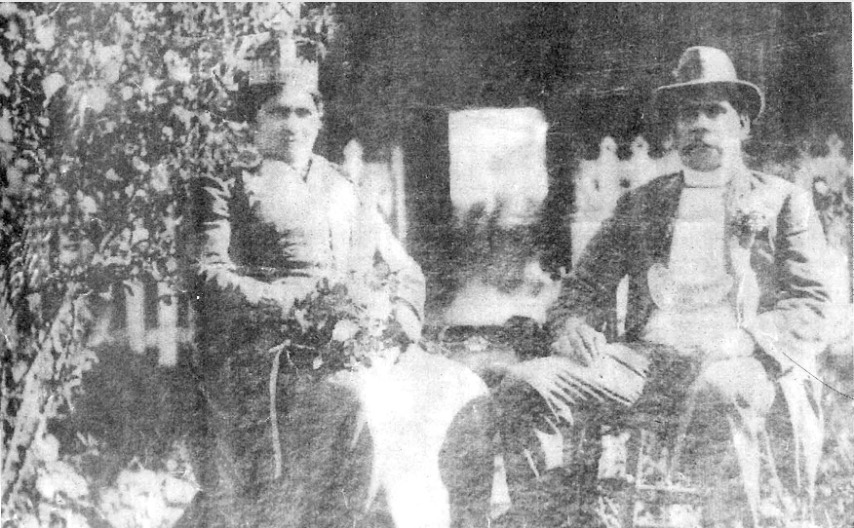
King Billy and Queen Charlotte [Boolah Dillah Art, Culture and Knowledge Centre]
Opening of Karuah Church – 1913
The Maitland Daily of 29 October 1913, page 6, reported:
‘The day has come and gone, which the people of Karuah Mission have been looking for a considerable time, and Karuah Church is now finished and dedicated to the worship of God (writes a correspondent). In March 1911, a proposal was made to build, and a year later, March, 1912, the first offering was made. The dark people made their offerings. A start was made, and little by little, sometimes working to support their wives and children, and then after, seeing that they were provided for for a few days, a little work would be added to the church.
Other special offerings meant every time extra efforts to earn money, and every addition to the building was made by the royal way of sacrifice. Two white friends, seeing their desire to build a church being carried into effect, gave the roofing iron, and lining boards, and others also encouraged them by smaller gifts. Now, after 19 months prayer and sacrifice and labour, the building stands as a memorial of God’s faith fulness to His people in hearing their prayers in strengthening their hands, and in causing them to finish what He prompted them to begin.
The building is of weatherboard, with iron roof. It is lined and ceiled, and very nicely painted; the inside colours being all in harmony; walls of pale metallic blue, and white celling, the mouldings and window frames picked out with green, and skirting and platform of nice grey. The platform railing and reading desk are varnished. The outside paint is home-made, a mixture of local clay and oil, which looks well. The dimensions are, viz., 25 x 15 1/2, and porch 7 x 5 1/2. As it stands the estimated value is £ 120.
The official opening took place on Saturday, October 18. Mr. and Mrs. Long were present to rejoice with the two resident missionaries, Miss Stewart and Miss Brown. Some of the young fellows, who are away working at Taree, came home for the occasion, and eight of the people from Purfleet Mission (A.A.M.) accompanied them. A good number of white residents from up and down the river accepted the invitation to attend, and the mission people from Soldier’s Point, Booral. and the Reserve, were present in full force. A picnic dinner was enjoyed under a booth, built by the men for the purpose.
The first portion of the service was held in the open air. Mr. Long presided over the gathering. The King of Karuah, Miss Brown, and Mr. Manton spoke words of welcome to the visitors, Mr. A. Russell, sen. (father of the A.I.M. Native Workers), Hugh Ridgeway (son of the King), and Bert Marr gave bright testimonies. A chorus, a solo, and selection on the leaves, were rendered by the young men. Miss Stewart presented the financial statement, which showed that the money received and spent on material was £ 26, most of this being contributed by the mission people themselves. Besides this there were donations of iron and lining boards, and personal work of much greater value than the actual money received.
Miss Stewart commended the loving, cheerful labour of men’s hands and brains, and hearts given at much personal cost and inconvenience, and stated the women also were willing participants in all the sacrifice. Mr. Brewer, who had shown sympathy with the work, also gave a short address. The final portion of the service was held inside the building. Miss Stewart, the Queen of Karuah said, ‘I have much pleasure in handing you the key to open the church.’ The honoured missionary accepted it and, turning the key, declared the building open for the public worship of God. The congregation entered, and remained standing while the Doxology was sung and Mr. Long read psalm 84 and prayed for the blessing of God upon the church and people. ‘All Hail the Power of Jesus Name’ was then sung.
Mrs. Long delivered the dedicatory address, basing it upon II Chron., 6-20, and closed it with a dedicatory prayer. ‘To God be the Glory’ and the Benediction closed a most solemn and impressive service. After tea, the people gathered together again, and enjoyed a happy hour and half looking at lantern pictures of their own countrymen in various parts of Australia and listening with intense interest to Mr. Long’s remarks about them. The Doxology closed the day’s proceedings, and weary but happy people wended their way to their little homes, satisfied that their hopes were now realised in the beautiful House they had now set apart for God.
Special interest was taken in the Sunday services. Mr. Long conducted the morning service, and ‘spoke particularly about ‘The Prayer-Life.’ At 3 p.m. two Sunday Schools assembled, viz., Miss Stewart’s School for white children, conducted. in the church at Sawyer’s Point, and Miss Brown’s Mission scholars. Each school repeated a portion of Scripture, and the little dark children sang, ‘Tell me the Stories of Jesus’ and ‘He’s My Friend.’ In the evening two children were dedicated to the Lord, and a helpful Gospel service followed, closing a happy and helpful day’s engagements.
The celebrations wound up with an outing on Monday. For this the picnic dinner, the women worked early and late, and their cooking was excellent. A launch and sailing boat carried the Karuah people, with their missionaries, down to Soldier’s Point, where the King and his family and two brothers and their families reside. The King’s cottage looked a picture. The Queen’s flower garden was ablaze with bloom. The fruit trees, grape vines, vegetable garden, and poultry were all in splendid condition and everything, around seemed to spell the word “home.”
Inside, all looked clean and comfortable, from the floor to the celling. The Queen’s crown under a glass shade attracted all the visitors and was much admired. Nearby was a boatshed, where the King’s brother builds splendid boats in his spare time, and turns them out a credit to any professional, the marvel being that he has never received a day’s tuition. ‘A sail awning was quickly erected, and under this 77 sat down to dinner and tea. Games, etc., were enjoyed, and toward sundown the party started for home. Everybody was tired out, for they had been going at high pressure from sunrise of Saturday morning.
Sunrise prayer meetings were a feature of the long-to-be-remembered event. These were held at 5:30 a.m. Somewhere about 1 a. m. on Tuesday morning, the people at the mission house were awakened by strains of music, ringing clear in the midnight air. The Taree party were pushing off from the shore to pull twelve miles up to Booral Wharf to catch the train from Stroud, and they pulled away, singing as they went. Then ringing cheers were exchanged, and the departing guests went off up the river, singing ‘God be with you till we come again.’ The weather was ideal, a spirit of cheerful ness prevailed, and the opening of the Karuah church proved a very happy event. A further gift has been received from Mrs. New, of Sawyer’s Point — six very nice seats, to accommodate 30 adults comfortably, which the mission people regard as a direct answer to prayer. The kind donor ordered them to arrive in time to surprise the people on the opening day but owing to the steamer not going on to Sydney, she was disappointed, but four days later they found their place in the newly erected building.’
King Ridgway Builds a Sailing Boat – 1915
The Maitland Daily Mercury of 1 February 1915, page 4, reported:
‘A well-known Maitland resident calls our attention to the cleverness of our Australian aborigines — no less a personage than King Ridgeway, of Soldier’s Point, Port Stephens, who some time ago completed the building of a sailing boat, which he has named “The Dove,” after the German Flying machine.
The boat is well constructed of beechwood, and beautifully finished. That it has not been inaptly named as a flying machine is proved by the fact that she is a very fast sailer, having given practical demonstrations at Mungo Brush and Cape Hawke this year. “The dove” was entered in seven races at regattas in the places named, and secured three first prizes, three seconds, and a third. King Ridgeway, who is not a stranger to Maitland, has been heartily congratulated on all sides on his handiwork, and on the success of his craft.’
Karuah’s Patriotic War Efforts – 1915
The Maitland Daily Mercury of 2 June 1915, page 4, reported:
‘A Sunday visitor to Karuah ascertained that the little community in that Port Stephens centre has been very busy in patriotic work, in which Mrs. New has proved a leading spirit. Two concerts, one for the Servians, had already provided £10 and £30 respectively, when Belgian Day was undertaken. A sports programme was got up, to which Mr. Longworth contributed prizes, and those were donated to the fund, so the sum of £10 was cleared. This did not prevent a good effort on Empire Day, when many gifts were sold and liberal offerings contributed, so that about £12 was raised. Some of the dark people from the aboriginal mission contributed their little “all” in cash, and commendable generosity was shown throughout on the collection of about £120 by the successive efforts. Several of the aborigines are to take part in Newcastle’s Belgian Day Carnival, for which they are making shell work and other curios.’
King Billy Weilds the Paint Brush – 1916
The Sun of 15 October 1916, page 9, reported:
‘Mr. Barry, of Messrs. Barry and Norris, had in his office during the week an oil painting the work of the present aboriginal King of Port Stephens, his Majesty Billy Ridgway. The subject is the steam yacht Northumbria off Soldiers’ Point, Port Stephens, with Middle Island in the distance. [The steamship ‘Northumbria’ was owned by Mr. William Longworth, who resided at Karuah].
The King may take this unction to himself, that there is no necessity to go to the catalogue to find out what his picture is all about. It is obvious on the face of it. In that respect he has the laugh at the impressionists and the cube artists. Mr. W. Longworth, who brought the picture down from Port Stephens, states that it was painted from memory, and that his Majesty had received no lessons. The production in those circumstances is certainly a remarkable one. When not engaged in works of art the painter is a boat-builder.’
Farewell to Aborigines Inland Mission Station Staff – 1917
The Raymond Terrace Examiner and Lower Hunter and Port Stephens Advertiser of 24 August 1917, page 3, reported:
‘A large number of people attended at Francis Hall on Saturday, at an afternoon tea, to say goodbye to Misses M. Stewart and B. Dedman, the former of whom has been in charge of the local Aborigines’ Mission Station for the past eight years, and the latter, her co-worker, for the last 3 years. Both ladies have volunteered for similar work in North Queensland and are soon to depart. The Rev. R. G. Knox, B.A., acted as chairman, and a lengthy programme of song and recitations was gone through.
The Reverend chairman spoke of the great services rendered to the locality by both ladies, and the great assistance they had been to him in his parish work. They had been unremitting in their attention to visiting the sick and had conducted Sunday School and classes for the children. They would be sorely missed from Karuah and their places would be hard to fill. Mrs. W. Longworth, Miss Hagan, and Mr. W. J. Hartcher also spoke in similar strain.
Mrs. J. Oliver, on behalf of Karuah friends, presented each lady with a purse of money, and Misses F. Witt and Phyllis Walsh presented Miss Stewart and Miss Dedman respectively, with a Teacher’s Bible and Hymn Book, on behalf of the Sunday school children. Miss Stewart in responding said it was eight years since she had come to Karuah, and twelve years since she had taken up missionary work. She had previously been a teacher, but the call had come, and she felt she must obey. She had never regretted the step and had spent the happiest years of her life in this, her chosen work. They received no fixed salary, and trusted to God alone to supply their needs, and often unknowingly their kind friends by their gifts had supplied their wants.
Volunteers had been called for missionaries in a wild area in North Queensland, where the natives were as yet without Christian teaching, and after earnest prayer she had decided to offer herself. Then a reliable helper being wanted, Miss Dedman had volunteered to go with her. She thanked them all for the gifts and said that the visiting they had done had been a great consolation and comfort to them. What they had done had been for the Master’s sake. She trusted God would bless them all. Miss Dedman said she hardly knew whether to laugh or cry, but she felt un-deserving of the gifts they had made her. She had not Miss Stewart’s great record. She had only spent three years here. There had been ups and downs, but they had been happy years, and she would never forget, the kindness she had received from the people of Karuah. Proceedings terminated with the National Anthem, and Auld Lang Syne, and cheers for Mrs. Longworth, all who had helped, and the chairman.’
Gum leaf Band Performs after Opening of Pindimar Fish Factory – 1917
The Newcastle Morning Herald and Miners’ Advocate of 17 November 1917, page 4, reported:
‘After the opening of the Pindimar fish receiving and refrigerating depot on Thursday, the Ministerial party was entertained at Nelson’s Bay by local residents. A large number attended the banquet in Mrs. Lund’s house. …… The members of the National party accompanying him [Mr. Fisher] were delighted with the reception Port Stephens had given them. One of the most delightful things to him was the aboriginal gum-leaf band [from Karuah], who be hoped to meet again.’
Further information of the Karuah Gum Leaf Band can be found at this link on the website.
Commentary on the Karuah Aboriginal Settlement – 1917
The Raymond Terrace Examiner and Lower Hunter and Port Stephens Advertiser of 14 September 1917, page 3, reported:
‘Half a mile up the river from Karuah is situated the Aboriginal Reserve of 50 acres, known familiarly as “Conners.” Here are now gathered the descendants of the original tribes who claimed Port Stephens as their hunting grounds. And here King Ridgway reigns over a hundred or more up-to-date subjects who have left the practices of their ancestors far behind and have advanced greatly in the paths of civilisation.
The King holds his court in a neat little residence faced by a wide and far reaching expanse of water, backed by the low hills on the eastern side. Surrounding the house is a nicely laid out garden, with a bright showing of flowers. Down on the water’s edge is the King’s boatshed, for the King is an expert boat builder. He has built some fliers in his time and is at present engaged on one that is designed to eclipse all previous records.
Nearby is the Mission Station, also gay with flowers, where Miss Stewart for eight years and Miss Dedman for three years have carried on their devoted labours. The church close at hand, like all other buildings on the Reserve, was built by the people themselves. It is well built, neatly lined, and has a nicely decorated interior, with raised altar dais, railings, and organ. Two features of the furniture specially noticeable are a table and flower pot stand carved out of forest oak by Sid Ridgway.
On the other side of a level grassy area from the church stands the schoolhouse, where Miss Hagan presides. Here a score or more of bright-faced and intelligent, if dark, faces congregate each day to imbibe at Learning’s font. Manual training occupations occupy a large share of the programme, basket making, raffia work, and the like. The building has been fenced, and the enclosed area laid out in flower beds, while a portion is devoted to vegetable culture. Altogether it is a tribute to the enthusiasm and taste of the teacher, and to the industry of the pupils. Dotted round the Reserve are the little homes, each with its plot of cultivated land, all showing evidence of taste and cleanliness.
The inspiration of the foregoing lines was a visit paid by the writer on the occasion of a farewell tendered by the people to their popular and capable missionary, Miss Stewart, on Saturday last.’
Commentary by King Billy Ridgway – 1918
The Dungog Chronicle of 24 September 1918, page 3, published an article on the early days of Port Stephens, in which the following commentary on King Billy Ridgway was provided:
‘King Billy Ridgway, aged 52, a religiously disposed native, who, with his wife and children, lives decently and respectably at Karuah, Port Stephens, told the writer that he is a direct descendant of the native King upon whom Sir Edward Parry conferred the brass plate engraved ‘Boatswain, King of South Head, Port Stephens and Nelson’s Bay,’ which symbol of authority he holds today.
King Billy spoke reverently of Kulunibra Wakal and of Morei the Holy Ghost, but deplored the fact that no Australian writer had taken the trouble to trace whence the aborigines came or migrated. Let us briefly reproduce King Billy’s own story of the moral laws of, and customs observed by, Ghatang speaking Australian aboriginals from time immemorial, and supplement it in a subsequent chapter by relating what is being done in the State of New South Wales for the natives by Aborigines Protection Board. Board. ‘Our mothers,’ proceeded King Billy, have the moral aim spiritual care of the girls. The young boys are allowed to mix with the girls until they reach the age of twelve years, whereupon they are called Warran or probationary celibates, and are placed under the strict control of the male elders until they reach the age of eighteen years. The probationers are then invited to a dance, and it they comport themselves to the satisfaction of the onlooking elders they are given free permission to move freely among the womenfolk and to choose their brides, but if they misbehave towards their partners or others looking on at the dance, they are then reproved by the elders and compelled to wait three years more for the privilege of mixing with the womenfolk and exercising their rights of manhood. The girls continue to live under parental, or the elder’s control until they marry or die.
Polygamy is unknown amongst Australian natives, their law being one man, one wife, and tribal community of property, thus providing tor children and the aged members of the tribe. Native marriages are regarded as spiritual unions, requiring no legal or formal registration to satisfy native laws, but out of respect to State law and in conformity with the requirements of the Aborigines Protection Board their marriages are now registered, mainly to compel the fathers of children to provide for them. In cases where unmarried native girls enter the service of European employers and are tempted on promises of marriage, and, as a result, give birth to illegitimate children’, both the mothers and children are received with every respect and consideration by the native people, who say that according to the aboriginal belief, Kulumbrah Kakkah or God above alone knows whether or not marriage certificates are passports to his other and happier realms. They add that the State Government’s attitude is identical with the aboriginal native attitude in that it does not discriminate against illegitimate children in want of nourishment who are-primarily in no manner responsible for their existence or dependence.
Some natives (such as Arthur Mar, who was born at Port Stephens) would not allow their girls to enter the service of Europeans, because the excitement of a changed environment from the country to towns, is regarded as being calculated to make them worldly wise and forgetful of their home ties. It seldom happens that a probationer of Warran who passes through the rigours of the elder’s moral instruction until he becomes a Boombun or approved graduate male member of the people, forgets his vows. Instances have been known of Boombuns fretting to death through the loss of the girls they had hoped, as Warrans, to have made their brides, but very few lapses occur.”
We think the State Government would be well advised to set apart a native reserve near Port Stephens, in which freehold titles to their allotments should be given the individual natives, all titles to be perpetual and not transferable to anyone except bona fide Australian aboriginals or persons allied to them by blood.’
Fifth Anniversary of Opening of Karuah Church – 1918
The Maitland Daily Mercury of 1 November 1918, page 3, reported:
‘The aboriginal settlement at Karuah, Port Stephens, gives evidence of improvement. Several of the cottages have fruit and vegetable gardens neatly fenced in. A public school has been provided on the settlement, of which Miss Hagan is teacher. Miss Hagan co-operates with the missionaries of the Aborigines’ Inland Mission, Miss Dedman and Miss Campbell, who are doing good work among the dark people.
The aborigines have their own church on the settlement, which is a credit to them, both in the building and the way in which it is looked after. Last Sunday was the fifth anniversary of the opening of the building. The morning prayer was taken by Rev. T. E. Peirce, who gave an address to the children, preached to the elders, and administered the communion. In the afternoon Miss Aston greatly interested young and old by telling of her experiences on a mission station in Samoa, her hearers being specially interested in her account of the Samoans’ boat building.
In the evening a praise and testimony meeting was conducted by Mr. Birt, of Newcastle, the missionaries, Miss Dedman an Campbell, taking part. The visitors’ services were much appreciated both by the missionaries and their people. Mrs. Long, writing in “Our Aim” about specimens of the people’s handiwork received for exhibition at the Ballarat Christian Endeavour Convention, says: —”While Karuah’s contribution consisted of the school children’s raffia work, and a most interest bag made by Granny Ridgeway, who is about 80 years of age. It was made from cotton drawn from coloured cotton material, and woven with the fingers into course thread, and then netted in the old native fashion. It has been greatly admired by all who have seen it. Another fine piece of work is a whip handle, beautifully carved by Sid Ridgway.”
A Devoted Husband who resided at Karuah – 1918
The Newcastle Sun of 14 December 1918, page 3, reported:
‘An example of faithfulness and devotion to his wife that all white men may admire, but few excel, is provided by a half-caste, and is exciting much attention at Newcastle Hospital. The half-caste is William Ping, 27 years old, who walks from the Karuah River to the institution to see his young wife, also a half-caste, who is seriously ill. He thus covers 54 miles — 27 each way — each trip, and comes every fortnight. Ping has received a good bush public school education; and though he appears in Newcastle in bush attire, he is always nevertheless spick and span.
“My grandfather,” he proudly says, “was an Englishman, who served in the Crimean war.” Ping’s grandmother was a half-caste aborigine. His father was a Japanese. Born at Tahlee, Port Stephens, where his father was a gardener employed by the White family. Ping was left an orphan at 9 years of age. By this time, he had had nine months schooling at Raymond Terrace. Some friends had him, and his sister and brother, placed under the care of the mission station at Karuah. Ping speaks highly of the mission and of Miss Dedman, of Newcastle, who is in charge. He is proud at having been reared a Christian like his wife. The mission sent him to Karuah Public School till he was 13. By this time, he had passed creditably through all the classes. Leaving school, he became a fisherman at Port Stephens, and continued at that occupation for three years. He is now an oyster fisherman, and still lives with his wife at the mission station.
He explains that he married a few years ago Miss Amelia Ridgeway, a native of Cape Hawke. “We made our home at the mission station,” he states, “but it is left pretty desolate now, with my wife in hospital. We had a lovely garden, but it has become neglected now that she is not there.” Mrs. Ping sustained a bruise of the right leg a year ago, and the bone decayed, so that she had to be admitted to Newcastle Hospital, where the leg was amputated between the knee and the hip. She had to leave her two children — one nine months old, the other three years.
Ping brought her 17 miles by horse and trap to Raymond Terrace and thence by motor car and train via Hexham, to the hospital on that occasion. He went back the same way. It cost him 10s a day for the horse and trap, apart from the other expenses; and as his earnings averaged only 5s a day the expense was a serious matter. It was not fair to his wife that he should waste money, so he borrowed a friend’s bicycle when next he visited her. This machine had to be ridden by the Cabbage Tree route instead of the Medowie way, and hence the journey was 37 miles long, or 10 miles more than the former. Thereafter he came down cheerfully every week for six weeks, coming over from Stockton by the ferry after bathing there.
Each trip cost him two days’ work — he came down on Saturday, saw his wife on Sunday, returned on Monday and resumed work on Tuesday. “My sister at the mission and I used to take it in turns to look after the children,” he explains. Then he took his wife home. “She now had to have a crutch; but she took everything in good part,” he proudly relates; “for it is better for her to be with us with one leg than away from us altogether.”
About two months ago his wife commenced ailing, and he took her to see Dr. Meredith at Raymond Terrace, who sent her to the hospital again, where now, as already stated, she is seriously ill. During that time Ping has made regular journeys to see her. A good walking feat was established by him and his brother Joe a week after her admittance. “We did the 27 miles in 7 1/2 hours,” he states. “We started at noon and finished at Stockton at 7.30. We went back in 6 1/2 hrs., leaving at six in the morning and getting home at 12.30. That is a record; for three or four miles of the way is all through sand, and on the whole, it is a bush track.”
The loss of wages entailed in his making his visits has made him determine to try to obtain temporary work at Cockle Creek pending his wife’s recovery. Leaving “The Newcastle Sun” office last night on the homeward tramp, Ping remarked: “There are plenty of black men with the white man’s heart. Plenty of white men with their wives in the hospital would be looking for somebody else instead of walking down. Not for me — I’m a Christian.”
Death of King Billy Ridgway – 1919
The Maitland Daily Mercury of 17 July 1919, page 4, reported on the death of King Billy Ridgway:
‘We learn that there have been a good many cases of influenza in the Karuah (Port Stephens) district and among the victims is Mr. Ridgway King, of the Port Stephens aboriginals. King was one of the best known and most respected residents of the district. Prior to its resumption for Federal purposes in connection with the naval station, his place at Soldier’s Point was one of the well-known places of the Bay, but of late years he had resided on the reserve at Sawyer’s Point. He was a most capable boat-builder and skilled in the management of sailing boats, frequently taking prizes against all-comers. We understand that two of the King’s grandsons also succumbed to the prevalent malady.’
The Albury Banner and Wodonga Express of 25 July 1919, page 27, further reported:
“King Billy,” the last full-blooded aboriginal of his tribe, is dead. He died of influenza at Port Stephens. “Billy,” whose name was William Ridgeway, was about 60 years of age. Standing 6ft. high, he was a perfect specimen of humanity. ‘Billy’ was created King of his tribe by the Government some years ago. He resided at a place in the Port Stephens district, known as Soldier’s Point, where he had built his own house.’
The Newcastle Morning Herald and Miners’ Advocate of 22 August 1919, page 3, reported on the late King Ridgway’s boat building and sailing expertise:
‘With the death of “King Billy Ridgway during the recent influenza epidemic, an old sailing identity passed out. Billy was the head of the native settlement at Karuah and was famous as a skilled builder of racing boats. They were good boats, too, as the performances of Wonga, Dove, Raven, and others attest. The three named were particularly well known having sailed at the North Coast regattas for a number of years past. Billy’s sons, Hugh and Sid, did well with them, on a couple of occasions winning all the races on the programme. Hugh won a championship race with Romp on his last appearance in Port Hunter. The Wallsend and Plattsburg annual regatta was a favourite fixture with the Ridgway family, and each year they made the long trip from Port Stephens to the lake with a couple of boats.
On their last trip Hugh Ridgeway sailed Amphion in the allcomers’ race, scoring a runaway win, and a year before that, at the same regatta, made a big hole in the prize money with Raven. Wonga’s performance at an Easter regatta in Newcastle a couple of years ago is well remembered by local sailing men. The Saturday allcomers’ race was sailed in half a gale of wind, and Wonga soon got a long lead, only to break down and fall behind. She regained the lead after repairs had been made, but carried away again, and was finally put out of the race by a third accident. Barring breakages, she would have won by a mile. Irex won the race from the Sydney 16-footer Valete.’
Port Stephens Aborigines’ Children’s Christmas – 1919
The Maitland Daily Mercury of 26 December 1919, page 4, reported:
‘The children at the public school on the aborigines’ settlement at Karuah (Port Stephens) shared fully in the enjoyment of the Christmas season. In addition to toys received from the Aborigines’ Protection Board they received a number of presents including medals from Mrs. D. S. Johnson (Karuah public School) and from their own teacher (Miss Ferguson).’
Naval Officers visit Karuah Aboriginals – 1920
In 1920, the Prince of Wales (later King Edward VIII) visited Australia for a three-month tour to thank the nation for its contributions during the World War, aboard the battle cruiser HMS Renown.
The Dungog Chronicle of 25 June 1920, page 6, published the following details of a tribute paid to the Prince of Wales by the Port Stephens aboriginal community:
‘From the “Austral-Briton” we take the following, which is the introduction to a long and patriotic tribute paid to the Prince of Wales. To His Royal Highness, Edward Albert Christian George Andrew Patrick David, Prince of Wales and Earl of Chester in the Peerage of the United Kingdom, …..
May it please your Royal Highness: I have the honour [person not named] to be commissioned by the Aborigines descended from the King of South Head and Port Stephens, whose person and property alike were respected by Sir W. Edward and Lady Parry, who formed the first British settlement at Tahlee, to convey their respectful greetings to you and your brother Officers, Staff and Ratings aboard H.M.S. Renown, upon your safe arrival in Australia.
They join with me in respectfully felicitating your Royal Highness upon this, the fifty-fifth anniversary of the birth of your illustrious father, our good George V., of the United Kingdom of Great Britain and the overseas British dominions, King; Emperor of India and further India; Guardian of their several religious and national ideals and liberties which focus in the ancient British Throne as the symbol of their clarified joint inspirations and aspirations (it being founded upon faith in Divine wisdom and justice).’
The Maitland Daily Mercury of 29 July 1920, page 4 reported on a visit by officers of the HMS Renown to Karuah:
‘On the occasion of her visit to Maitland on Sunday to see the Prince of Wales, Miss Ferguson, teacher of the aborigines’ school at Karuah, told us of an interesting visit paid last month by a party of officers from the Renown, including the commander, to the Karuah aborigines. On the arrival of the party the children sang the National Anthem. “The Allies’ Flag,” “Rule Britannia” and “They are Jolly Good Follows,” followed by cheers for King, the Prince of Wales, and the visitors.
Souvenirs were presented to the visitors, including basket work made by the children. After partaking of refreshments, the visitors went for a shooting expedition in Mr. Longworth’s launch, returning to Karuah at 6 p.m., and then left by car for Newcastle en route to Sydney. The visitors expressed their appreciation of their entertainment and loyal welcome of which they promised to tell the Prince. Mrs. Longworth gave great help to Miss Ferguson and the dark people in the entertainment of the officers, whose visit was greatly enjoyed. Miss Ferguson had invited the officers but did not know for certain that her invitation had been accepted until a day before they arrived, so that preparations were very hurried.’
HMS Renown – 1927
The Raymond Terrace Examiner and Lower Hunter and Port Stephens Advertiser of 30 July 1920, page 3, further reported:
‘Miss H. Ferguson, teacher in charge of the Aborigines’ School at Karuah, accompanied Queen Charlotte, (who is the last surviving member of the tribe of aborigines at Port Stephens,) to Maitland last Sunday to join in the welcome to the Prince of Wales. They were presented to His Royal Highness by the Mayor, (Ald. Fry,) at the top of the overhead bridge at High street. Station. The Prince shook hands with each, and graciously responded to a word of welcome which was given by Miss Ferguson on behalf of the Aborigines. Queen Charlotte, who wore her crown, was then escorted by her son to the car, and rode in the procession from High street, to West Maitland.’
The Albury Banner and Wodonga Express of 30 July 1920, page 41, also reported on Queen Charlotte’s visit to West Maitland to see the Prince of Wales, who was on a trip from New South Wales to Queensland:
‘The Prince arrived at the central railway station at 23 minutes past 12, and three minutes later he was on his way to Queensland. ……. At West Maitland the Prince had a great welcome. There was an immense crowd at High-street railway station. The Prince inspected the guard of honour, and noticed that a number of the bandsmen wore the returned soldiers’ badge. He had these men called before him, and to each he had a kindly word to say. On the overhead platform an unusual sight was witnessed. Standing at the door, holding herself proudly erect, was an elderly black lady, dressed in European clothes, but without a hat. In its place on her greyish black hair was a gilded and red plush crown. Beside her was her one-legged son, wearing the returned soldier’s badge. He lost his leg in the war. This couple was the queen of the Karuah blacks and her son.
It is said that the old lady had expressed her determination to see the Prince and intended to walk the whole of the 40 miles to West Maitland, but kindly people brought her in, and her wish was gratified. As the Prince acknowledged her, she gravely bowed.’
Anniversary of Karuah Aboriginal Mission – 1920
The Maitland Daily Mercury of 13 September 1920, page 4, reported:
‘Yesterday the anniversary of the Sunday School at the aboriginal reserve, Karuah, Port Stephens, was celebrated. In the morning a service was conducted by Rev. T. E. Peirce, followed by the communion service, in which Messrs. H. Kerr and W. S. Pender and the missionaries, Misses Acland and Tomkins also took part.
At the afternoon gathering, conducted by Mr. Pierce, the aboriginal gum leaf band, accompanied on the organ by Miss Tomkins, gave several musical selections, which greatly interested and delighted the visitors from Maitland. Books, donated by Mrs. D. Ley, of East Maitland, and by Mr. H. Kerr, were distributed by Mr. Kerr, who spoke very happily to the children and encouragingly to their teachers. The little ones had evidently been taught how to receive the books, but in the case of the youngest their native shyness overcame them, and the way in which they received their books amused those present.
The organ used for the day’s services was kindly lent by Mr. Manton. The offertories for the day were devoted to the fund for providing a picket fence for the little church, in which the dark people take a very genuine interest. The missionaries were much encouraged in their good work by the visit of many of their friends from Maitland.’
Visit of Karuah aboriginal children to H.M.S. Sydney at Port Stephens – 1921
The Raymond Terrace Examiner and Lower Hunter and Port Stephens Advertiser of 27 May 1921, page 2, reported:
‘On Wednesday, May 16th, the Children attending the Karuah Public and Aborigines School, accompanied by their teachers and missionaries, and 15, adults, spent a most enjoyable day visiting H.M.S. Sydney, at the Naval Base, Port Stephens.
Mr. and Mrs. Longworth, of Glenroy, Karuah, kindly entertained them on their yacht “Ena”. After arriving at the Naval Base, the children and visitors were shown round the vessel, and the children partook of refreshments provided by the officers of the Sydney, and which were thoroughly enjoyed. The visitors embarked again on the “Ena,” where afternoon tea had been provided, and kindly served by Mrs. Longworth.
On arriving at Karuah Miss Ackland, Aborigines’ Missionary, and Miss Ferguson, Aborigines’ Teacher thanked the host and hostess on behalf of the Aborigines children for the pleasant outing Mr. and Mrs. Longworth had accorded them, and a senior boy from the Karuah Public School also thanked Mr. and Mrs. Longworth, on behalf of the children of the Public School for the enjoyable day they had spent. Three cheers, were then given for Mr. and Mrs. Longworth, and a pleasant day was brought to a close by all joining in singing “For They are Jolly Good Fellows.”
H.M.S. Sydney
Anniversary of the Karuah Mission School – 1921
The Maitland Daily Mercury of 14 September 1921, page 4, reported:
‘A party from Maitland visited the aboriginal mission at Karuah on Sunday morning on the occasion of the anniversary of the A.I.M. Mission School. The little church had been made bright with giant lilies and other wildflowers, and the young people sang some of their school, pieces. The service was conducted by Rev. T. E. Peirce, and Mr. Henry Kerr gave a brief address and distributed testaments to the scholars. Miss Ackland, who is in charge of the mission, is being assisted at present by Mrs. Deuchar and Miss Evans. Mrs. McDonald sang a solo at the morning service.
In the afternoon a Bible Society open air service was held on the reserve at the ferry near to the soldiers’ monument. The aboriginals gum leaf band gave some pleasing selections. Rev. T. E. Peirce gave an address and was assisted at the service by Mr. Kerr and Mr. F. M. Peirce. The sum of £2/9/ was collected for the funds of the Bible Society. A number of testaments were left with Mrs. Deuchar for the white children’s Sunday School.’
Governor’s Visit to Port Stephens and Karuah – 1921
The Raymond Terrace Examiner and Lower Hunter and Port Stephens Advertiser of 9 December 1921, page 3, reported:
‘On Friday last the Governor of the State [Sir Walter Davidson], accompanied by Dame Margaret Davidson paid a visit to Port Stephens, and on reaching Karuah were met by the local residents and the Aboriginal School children. The latter were in charge of their teachers and missionaries Miss Ferguson, and Misses Acland and Evans. Their Excellencies were treated to the novel music of the Leaf Band, the children played the National Anthem, Rule Britannia, and Advance Australia Fair’.
Their excellencies were then presented with a boomerang, which was inscribed ‘Greetings from Karuah 1921’, The presentation was made by Tom Dillon, who is over 90 years of age. A beautiful basket of flowers was given to Dame Margaret by Annie Ridgway, the flowers being tied and dressed with the colours of the British flag. After these presentations their Excellencies alighted from the car and were introduced by Mr. Gazzard, (of Newcastle) to the school children, teachers, missionaries, and parents.
His Excellency expressed his thanks for Dame Margaret and himself for the gifts received and the cordial greetings extended them by the aboriginals of Karuah. After chatting for some time their Excellencies, shook hands all round and left for the residence of Mr. Longworth, ‘Glenroy,’ Karuah’ amidst hearty cheers for the King and his representatives. During their stay at Karuah their Excellencies visited Nelson’s Bay, Tea Gardens, Pindimar, and the Naval Base. Those who accompanied the party were Major Egerton, Private Lee, Mr. and Mrs. Baker, (Steelworks, Newcastle,) and Miss Parker. The party enjoyed the time spent at Karuah, and the outings on the Port, Mr. Longworth’s launch [‘Ena’] being available to meet every convenience.’
Presentation of Prizes at the Karuah Aboriginal School – 1921
The Raymond Terrace Examiner and Lower Hunter and Port Stephens Advertiser of 23 December 1921, page 3, reported:
‘On December 16th, the children of the Karuah Aboriginal School held their annual break up. Mrs. W. Longworth, of ‘Glenroy’, kindly presented the prizes, which consisted of 3 medals and toys from Messrs David Cohen and Co., Mr. Delacheur, Boys Home Raymond Terrace, and the Aborigines’ Protection Board, which were much appreciated by the children. Mrs. Longworth addressed the pupils and spoke of the good work that had been accomplished by the teacher among the children, after which Miss Ferguson thanked Mrs. Longworth for the kindly interest she had always taken in the aborigines.
Misses Acland and Evans, missionaries, were present and also addressed the children. Mrs. Gazzard, Mrs. Morton, Mrs Davis, and Miss Baker from Newcastle were present. After the distribution of prizes, the National Anthem and Auld Lang Syne were sung to music played by the gum-leaves, singing of ‘God be with you’ brought a pleasant evening with you brought a pleasant evening to a close.’
Conviction for the supply alcohol to an aboriginal from Tea Gardens – 1922
The Newcastle Sun of 17 May 1922, page 5, reported:
‘The law, under the Aborigines Protection Act,’ said Major Crane, P.M., at Kurri Police Court this morning, ‘is framed for the protection of aborigines. I have had a lot to do with these people, and I think they should be protected. The race is capable of a much better status than the members of that race adapt themselves, as the result or contact with the white people. Russell must remember he must not drink, or accept it from a white man, as he might get the latter into serious trouble.’
Two cases were listed: Robert Smith, barman at Sweeney’s hotel, for supplying intoxicants to a person having apparently an admixture of aborigine blood; and Archibald Russell, for aiding and abetting Smith. Russell seems to be a quarter-caste aborigine.
Constable Yeomans deposed, that he saw defendant, Robert Smith, served beer in the hotel parlour to Russell. Later, in reply to witness, he said he was not an aborigine, and that he always got liquor at the Tea Gardens Hotel. Witness said to Smith that he should not have served Russell. Smith contended that Russell was not an aborigine. A cricket match was being played between a local team and some aborigines from Karuah that day.
To Mr. Enright (for both defendants): He did not see Smith order the liquor. Defendant, Russell, manager of the oyster leases of J. A. Woods at Pindimar, deposed he received £4 a week, a residence, and certain perquisites, He did not live on the aborigines’ reserve at Port Stephens. The drink was ordered by a white man, but that man was not defendant, Smith. After the constable tasted the glass of liquor, witness drunk it. Witness’ wife, was an Australian girl, with Japanese blood. He had lived on the aborigines’ reserve once. The S.M. said it seemed a hardship that a man like Russell could not get a drink, but the new definition of aborigine’ in the Liquor Act was quite clear. The fine would be 5s, but costs were remitted. Defendant Smith was fined £1, with 3s costs, or a month’s gaol.’
Aboriginal Skull Found – 1922
The Dungog Chronicle of 16 June 1922, page 6, reported:
‘A human skull has been found embedded in the sand on the eastern side of Myall Point, Port Stephens. No other bones were found. It is supposed to be that of an aboriginal and has probably been buried in the sand for about 25 or 30 years.’
Donation of clothing to Karuah Aborigines Inland Mission – 1923
The Dungog Chronicle of 12 January 1923, page 2, reported:
‘A number of Christians who met at the Temperance Hall, Stroud, accompanied by Mr. A. E. Tripet, recently spent a very happy day at Karuah. The trip was made from Allworth by launch, kindly placed at their disposal by Mr. J. Bennett, who also formed one of the party. A parcel of new clothing, which entailed much self-sacrifice and hard work on the part of the sisters, had already gone overland by car, through the kind favour of Mr. A. Blows, of Booral.
On the “reserve” are about forty boys and girls of varying ages, and in the parcel of clothing were two garments for each child. The missionaries said that it was the best parcel of clothing they had ever seen anywhere in connection with missionary work.
The visitors were shown over the reserve by Mr. and Mrs. F. W. Evans, the missionaries labouring under the auspices of the Aborigines Inland Mission, an undenominational body, of which Mr. and Mrs. W. Long are the directors, and which has headquarters at 264 Pitt Street, Sydney. There certainly was much of an interesting and educational nature.
During the afternoon a meeting was held in the church house, during which Mr. Evans, on behalf of the dark people, thanked the ladies for their acceptable and useful gift. Mr. A. E. Tripet suitably responded, and also delivered an address on “The Ability of God” to meet every need of the Christian. One very striking feature of the meeting was the singing of the Aborigines, one young woman especially having a very beautiful voice.
The missionaries are well-fitted for their multitudinous and arduous labours, and are devoted to those to whom they minister. But it certainly is a standing miracle that a missionary family should manage to get along with one very small tank. It holds 250 gallons, and the party returned to Stroud believing that that tank of water would need to be as truly wonderful as the widow’s cruse of oil as recorded in II Kings iv. Christians, generally, should take a greater interest in the aborigines, and in those who minister the Gospel of God’s grace to them.’
Last survivor of the Hawkesbury tribe resident at Karuah – 1923
The Newcastle Sun of 23 January 1923, page 6, reported:
‘The last survivor of the Hawkesbury River tribe of Australian aboriginals is old Tom Dillon, who is now living in the aboriginal mission at Karuah. The Newcastle branch of the Australasian Society of Patriots sent him some comforts at Christmas. It also sent a collection of toys and sweets for distribution amongst the children in the reservation.’
Perceived Problems with aboriginal housing at Karuah – 1923
The Raymond Terrace Examiner and Lower Hunter and Port Stephens Advertiser of 16 March 1923, page 2, published a letter from an unnamed correspondent that attracted much angst in the aboriginal community:
‘A correspondent writes:— The attention of the Raymond Terrace police is drawn to the way three or four families of Aborigines are living on suburban holdings, when there is a reserve of 40 acres adjoining, set apart for them by the Government, and where they are under proper supervision of white people who are giving the best part of their lives for the betterment and care of the aborigines.
Since the allotments were granted them outside the Reserve they have got so defiant and vicious that it is not too safe to send white children to get water from a dam near where they are camping. More than one white child has been assaulted by the blacks or their children. The quicker this state of things is remedied the better. The residence of aborigines on allotments is detrimental to white settlement.
One aborigine received an expulsion notice to leave the place, or reserve, where she was living, for assaulting a white woman, and ordered to remain 5 miles away from any reserve. Why do not the police enforce the law against the aborigines. A white person is under a penalty if he trespasses on land set apart for aborigines or half-castes. Why should the aborigines at Port Stephens be so spoon fed. The writer has had considerable experience with Northern Territory natives, who are in their wild state, and they are far easier to deal with than those living on land too near the white population at Karuah.
It is not much encouragement for returned men who want allotments near Karuah to have to live alongside of blacks, and to be classed socially the same as them. The regulations governing them should be attended to, and that class of people be told by the Police (who appear to be the only persons they take notice of,) to either remove on to land set apart for them, or not to live in the vicinity of a reserve where they are a nuisance to the people.
Since they got away from their Reserve it is a common thing for constant bickerings and disputes to be heard by unfortunate white people who have to live near. If the Police do not take a speedy action in this matter, the aborigines will get the upper hand of things. Trusting that publishing this will be the means of helping oversea settlers or men who have done their bit for the country, to settle on allotments without being pestered by blacks on either side of them.’ [name of author not published].
The Raymond Terrace Examiner and Lower Hunter and Port Stephens Advertiser of 23 March 1923, page 3, published two replies to the above report:
‘Sir. — Being a half-cast myself, and a returned soldier, living on a suburban holding at Karuah, I protest very strongly to a letter in the Raymond Terrace “Examiner” concerning the coloured people of Karuah, Port Stephens.
I have been a resident here at Karuah for the last 25 years, and not at any time have I witnessed male or female, that have been attacked by any of the coloured people on the settlement and there are no whites that get water from the dam. The person who wrote that letter is a slanderer and back-biter, and one of a few people that has tried every device in their power to down the coloured people. The person that attacks the coloured people so viciously should stand out in the open, and give a fair fight, and not fight behind a tree.
There are a few parasites and blood-suckers living on the coloured people, that they could well do without, and all the hen picking and haggling that is going on is done by public paid servants. Those who trouble over a few coloured people that are living on a holding alongside the Reserve, are certain persons who have no jurisdiction over them, and as for the writer of that letter knowing a lot about the blacks in their wild state, out in Queensland he must be a stranger here for I never thought anyone about here had been 15 miles passed Raymond Terrace.
The writer referred to the police. Each family of coloured people living on the blocks outside the Reserve are law abiding, and if all the writers, slanderers, and backbiters paid as much attention to their work as the police do, we would not have much to complain about. It is very funny that story about the white girls being attacked by coloured people, and making out that the police are not doing their duty. That attack on the coloured people was most cowardly. If there was any truth about it, but there is not. The matter won’t end here for I intend to write to the Minister for Home and Territories and have an inquiry into the whole matter—for I don’t see why the coloured people should he persecuted, for out of this little settlement of coloured people here about 40 all told, 5 or 6 went to the war and I think there is a law under the British flag for us. [signed] Jack Milton
Sir.—Allow me space to correct several fabulous statements in regard to Port Stephens aborigines, which appeared in your paper. They are not detrimental to the community. The assault on the white woman spoken of, I witnessed. Now let that white woman go to the Northern Territory and treat a dark woman like this dark woman was treated, and I guess she will meet a worse fate, than simply having her wrists held.
Your correspondent complains of several families who are striving to better their condition by taking up suburban holdings. Now I ask to whom did the land belong originally but aborigines. They had it taken from them, and none given back, not even the 40 acres are their own. No instead of land being given them they were given white peoples’ vices. For were not some of the first people sent out convicts who didn’t teach them any good. There were no caste amongst them until then. They had a law of their own which they had to strictly keep or else die. In it there was no vice. If we white people intend them to keep our law, why not allow them to live like white people, and give them chances to keep the law?
The bickering’s etc., which are supposed to disturb near neighbours, allow me to contradict, as it is a false statement. I live on one of the holdings and can truthfully say there is nothing happening to disturb anyone. As to the white children coming to the dam for water, it seems a dark child is expected to take insults and stones that are thrown at them, and not take their own part. If the dark people are dangerous, how is it that they are only now showing it? If they want to better themselves why not allow them to do so? They were granted these holdings in a proper manner, and how is it when the suburban holdings have been available for several years that the returned soldier, (who thinks so much of his social position,) has only now realised that the aborigines are ahead of him? It is unfair of your correspondent to make untrue statements when he or she is afraid to divulge their name. An aboriginal has more principal than that. [signed, E. Dates].
The president of the Australian Aborigines Mission [Mr. T. E. Colebrook], also responded to the previous correspondence about Port Stephens aborigines, and his following letter was published in the Raymond Terrace Examiner and Lower Hunter and Port Stephens Advertiser of 6 April 1923, page 3:
‘Sir, — Am I presuming too much in asking space to say a word in defence of the aborigines of Port Stephens. First let me say that I am only an occasional visitor, and just happened to be in your district at a time when the nervous sensibilities of a nameless contributor led him to rush into print. Usually the nom-de-plume writer does not merit a reply. A man or woman who has not the courage to affix his own name can generally be credited with having a weak case and is certainly not entitled to serious notice. But the aborigine has very few friends, and mud slung, even by a nameless correspondent, is apt to stick.
Of the merits of case I know very little and were it not for the fact that your paper was put before me and the effusions contained therein pointed out, I would not have attempted to trespass upon your space. Your nameless correspondent first complains about aborigines living on suburban holdings, instead of a Government Reserve. This surely is not a great offence. I happen to know the Karuah Reserve, and I know something about the reserves in this and other States; and, to say the least, the land usually set apart for the use and benefit of the original owners of this big Commonwealth of ours does not seem to be to me anything like a fair compensation for that which we had dispossessed them.
God, in His wisdom, has permitted Australia to pass into the hands of a people who have put to better use this glorious land of ours. But God never intended the treatment meted out to the dark folk of Australia; Many in possession of land, from which an abundance of wealth has been secured, amounting in many cases to hundreds of thousands of pounds, see the dying race passing into eternity without a passing thought. Someday God will want to know why? But to get back to the nameless one, He says: “It is not safe to send white children to get water from a dam near where they are camping.” “More than one white child” he claims, has been alarmed by the blacks or their children. The quicker this state of things is remedied the better. “The residence of aboriginals on allotments is detrimental to white settlement. One aboriginal woman has been ordered to leave the place where she was living, and instructed to live miles away from the reserve because she assaulted a white woman.” Is that true? Was a woman banished from her people because she offended in this direction. If the nameless one were to come to the Metropolis he would find that white men and women are not similarly punished. A white man who batters a policeman with a bottle may be fined a few shillings but is never deported. He may be sent to gaol for a month but is allowed to return to his home in the heart of the city.
But I am writing at too great length and some of your subscribers may think that too much room is being given to the aborigine. Still, for all that, I must ask a little more space to make a suggestion or two to the “unknown brigade”. There are two or three ways to remedy the evil their leader complains of. First, and this may not seem advisable, let the unknown writer get together a corps of unknowns, arm them with machine guns, and see the men are properly trained, and then when the Port Stephens Aboriginals sweep down like a pack of wolves upon the peace abiding Karuah’s, they will be able to prevent the dark folk getting the upper hand.
Better still— let the unnamed one get out. For close upon half a century to my own knowledge dark folk have populated Port Stephens, and it surroundings. The dark folk have never offered any special inducement to white folk to settle down in their midst. If they have come it has been their own choice, and for their own benefit. But the dark population in many cases, have been benefited by some such settlers. Whited faced children have resulted, and these have been compelled to grow up to manhood and womanhood, debarred from attending white schools because of some supposed detrimental conditions, and bearing the mark of Cain, not because of the dark skin they possess, but because of the fact that they are the product of white folk who have sought their homes near the blackman’s camp.
I don’t want to be misunderstood. Thank God he has sent along many who have tried to help the dark men to a better life. And there is my third suggestion to the nameless one. If not prepared to ”get out,” don’t write silly letter to the press. Spend the time at your disposal in an effort to up-lift. Dark men, many of them, went to the front, as well as white men. Some lost their lives in defence of King and country, and some returned bearing the brand of brave soldiers of the King.
They are a drying race— only just a remnant of the dark natives remain. Not more than 2000 full-bloods in all New South Wales. Only a few hundred in Victoria, not one full-blood in Tasmania. True there are about 50,000 in Western Australia, and perhaps 20,000 in Queensland and the Northern Territory, but a big majority of these are dying without any knowledge of Christ and God. Perhaps the nameless one has time and opportunity to help the “white people who are giving the best part of their lives for the betterment and care of the Aborigines,” only such a course has never suggested itself to him. Something like this will do more good than trying to damn them in the eyes of an already prejudiced public. Try it, Mr. unnamed correspondent. If you do you will find that God can transform even the aborigine.
If your correspondent is prepared to donate £1 to your local hospital, I am prepared to do similarly should I fail to produce a dark man, who possesses ability as great as the unnamed writer, and is as good a citizen. And in the school life dark children who can qualify as successfully as the average white child taught under similar environment. You Mr. Editor can be the adjudicator. In our Little Home at Bomaderry, we have 43 aboriginal children, some unfortunately with very white skins, who are certainly no worse conducted than the average white child. P. S. — Just let me add this concerning the police. In very many the dark man has a staunch friend, for which we are thankful.’
Drought at Port Stephens affects the Karuah Aboriginal Reserve – 1923
The Maitland Daily Mercury of 11 April 1923, page 4, reported:
‘The latest number of the journal of the Aborigines’ Inland Mission “Our Aim” says “An unusual experience has been the lot of our Karuah Mission. The water supply has failed on account of the drought, and the people have been obliged to leave the reserve and go where water is obtainable, leaving only one family on the reserve at present.” It is to be expected that the recent rains have relieved the situation here as in so many other parts.’
Death of Tom Dillon, a Notable Aboriginal- 1923
The Newcastle Sun of 4 August 1923, page 1, reported:
‘A link with the past was broken when Tom Dillon died at Newcastle hospital recently at the age of 90 years. ‘Old Tom’ was a well-known figure in Newcastle, and had many friends, who not only respected the fine old man. but had learned to love him. He was born on the Hawkesbury River, but early in his life was taken ‘up country’ by one of the pastoralists of the upper Hunter. There he was taught station work and became an expert in handling blood stock. As a trusty farm hand his career in the Hunter valley is well-known.
In his declining years he entered the mission station at Karuah, where he received every care and attention, and always had a hut to himself. It was only when he reached eighty and was unable to do any further work, that he could be persuaded to leave farm life. This fine old native had many friends, who attended to his wants during the twilight of his life, and to many he proved an entertaining companion especially on the days of Governor Gipps, of which time he had a vivid recollection, and being an intelligent man was able to tell many stories of the early life in Australia.
When ‘Old Tom’ died, an effort was made to have him buried in one of the cemeteries accessible to the Hawksbury. But there was no public fund available which could spare a few pounds to mark the last resting place of the final representative of that great tribe of people, with whom’ Governor Phillip and his successors were so closely in touch for over 70 years. However, official callousness has conferred an historic favour on Newcastle, for Tom’s grave in Sandgate cemetery is being marked in such a substantial manner as will perpetuate his memory.’
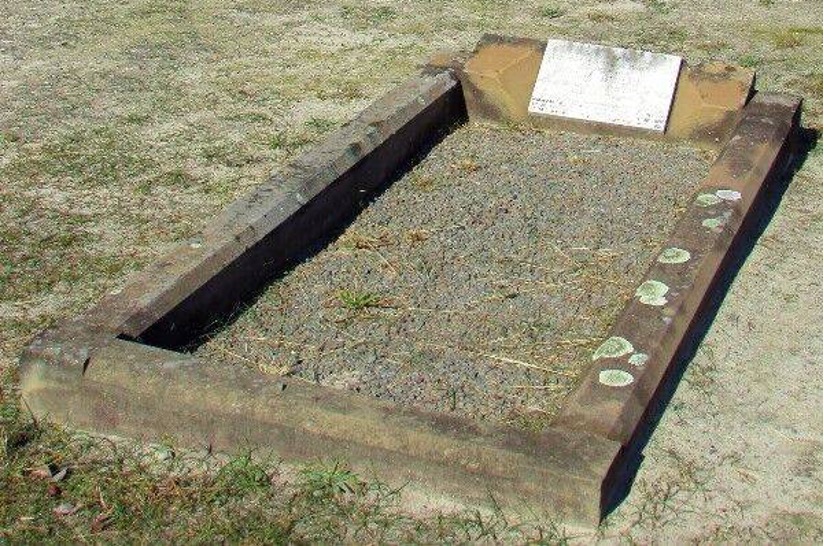
Grave of Tom Dillon at Sandgate Cemetery, Newcastle [section 19, lot 19] – the wording on the memorial tablet has worn away over the years [Monument Australia]
End of Year Celebrations at Aborigines School at Karuah – 1923
The Raymond Terrace Examiner and Lower Hunter and Port Stephens Advertiser of 28 December 1923, page 2, reported:
‘On December 14th the pupils of the Aborigines’ School had their annual break up. Mrs. W. Longworth distributed toys to each child, which were donated by the Aborigines Protection Board. Miss H. O. M. Ferguson, matron of the reserve, and other friends. Mrs. Gazzard, Newcastle.
Mr. and Mrs. F. W Evans and Miss Evans Aboriginal Missionaries, and the parents of the children were also present, to receive a small Xmas box. Mrs. W. Longworth, in her usual able manner, addressed the children, who appreciated her kind remarks. Mr. Evans, then thanked the lady for her kindness in presenting the prizes, and for the interest she always took in the Port Stephens Aborigines. After which several Xmas-carols were sung by the scholars. A pleasant morning closed with cheers for the King and visitors. All joined in singing “Auld Lang Syne,” the National Anthem, and “God be with you till we meet again.”
Funeral of Miss Ferguson at Karuah – 1924
The Newcastle Sun of 10 March 1924, page 7, reported:
‘The funeral of Miss H. O. M Ferguson, who was in charge of the aborigines’ school, at Karuah, and matron of the aboriginal reserve, took place in the Methodist part of the Karuah cemetery on Friday. Mr. Evans, missionary from the aboriginal reserve, conducted the service. The members of the local branch of the Grand United Order of Oddfellows of which deceased was a member, preceded the coffin, and also held their service at the graveside. The pupils of the aboriginal school also preceded the coffin and sang hymns at the graveside. The numerous wreaths and the long concourse which followed the coffin testified to the popularity of the deceased.’
The Dungog Chronicle of 11 March 1924, page 2, also reported:
‘Death occurred on Wednesday at the Newcastle Hospital of Miss Hilda Olga Maude Ferguson, who was schoolmistress at the Karuah aborigine’s station. On February 27 she was seized with a fit and fell, while visiting the home of Mr. F. W. Evans, missionary attached to the aborigine’s inland mission at Karuah. She was brought to the Newcastle Hospital on the same night. Miss Ferguson took great interest in the aboriginal children, and it was a pleasure to visit the well-kept garden and schoolroom, and to see the good work of the young people. Miss Ferguson accompanied the representative Port Stephens aboriginals who came to Maitland to meet the Prince of Wales.’
Background to aboriginal name for Karuah – 1924
The Voice of the North of 10 April 1924, page 18, reported:
‘Karuah is not an original Australian name. It would appear to have displaced the native name Cruba (the stinging fish). The place called Cruba is also on the opposite side of the river to the present village of Karuah. The native name of the aboriginal reserve at Karuah is Lundraweegun (free spelling of aboriginal pronunciation).’
Death of Teddy Herbert, an Old Aboriginal – 1924
The Newcastle Sun of 3 August 1925, page 5, reported:
‘One of the oldest aboriginals in the district, Teddy Herbert, of Karuah, has died in the Newcastle Hospital. He was born at Kempsey about 70 years ago, and was at one time a noted foot runner in the old Botany and Carrington days. He was a well-known figure at Karuah and Raymond Terrace, where he worked for a number of years.’
Aboriginal Relics Found at Morna Point – 1926
The Newcastle Sun of 27 April 1926, page 4, reported:
‘Driven by hunger, the result of a prolonged drought in the interior, a small party of aborigines, over a century ago, sought the shores of Port Stephens in search of food. Food was there in plenty, but no hospitality. Might was right in those days. The local blacks promptly killed the visitors, disregarding all modern ideas of fellowship, and what is more, buried them in a common grave. Rumours recently reached the Australian Museum authorities in Sydney that this historic spot at Morna Point, near Anna Bay, was being disturbed by the curious. As a result, Mr. W. W. Thorpe, on of the museum’s senior officers, was sent to Port Stephens to investigate.
Of the party of ravenous blacks, which were so promptly put out of their misery, Mr. Thorpe found a complete male skeleton, and three skulls, all in an excellent state of preservation. This was largely due, it would seem, to the quantities of shells in the proximity left by generations of shellfish consuming aboriginals. The lime in the shells had kept the bones in a well-preserved condition. But his discovery did not end with the historic grave. In the vicinity Mr. Thorpe collected a quantity of implements in various stages of manufacture. To the museum expert it was positively a treasure trove. He is returning to Sydney with many excellent examples.
One discovery recently made at Morna Point is considered of exceptional importance. The lucky finder of a stone knife of the Palaeolithic period [stone age] was Mr. D. P. Cooksey, of Mayfield. It is claimed to be the first knife made of flaked stone yet brought to light on this continent and is said to resemble Stone Ago implements found in the Old World. It is known as an aurignacian, and Mr. Thorpe considers that it will excite much interest in scientific circles. The trip to Morna Point resulted in the Australian Museum securing over 300 new specimens. Mr. Thorpe’s visit well repaid his labours. ‘
Skeleton found at Nelson Bay – 1926
The Newcastle Sun of 18 August 1926, page 7, reported:
‘The portion of a human skeleton found at Nelson’s Bay’ last week, is believed to be the remains of an aboriginal who died about 40 years ago. There will be no inquiry into the matter.’
Death of Sarah Ridgway at Karuah – 1926
The Raymond Terrace Examiner and Lower Hunter and Port Stephens Advertiser of 27 August 1926, page 2, reported:
‘The death occurred at Karuah last week of Sarah Ridgway, 92, the last of the full-blooded aboriginals.’
The Dungog Chronicle of 14 September 1926, page 4, further reported:
‘The residents of Port Stephens are joining in a movement at Soldier’s Point to erect a suitable memorial to ‘Granny Ridgeway,’ who died recently at the age of 85 years. She was practically the last of the old school of Australian aboriginals in these parts and was well-known to everyone in the Port and surrounding district. The Rev. Reeks is hon. secretary and Mr. D. K. Mitchell, hon. treasurer to the movement, and donations towards the cost of the memorial will be received by them.’
Port Stephens representative attends the conference of the Aborigines Inland Mission – 1927
The Sydney Morning Herald of 17 May 1927, page 12, reported:
‘The conference of the Australian Aborigines’ Inland Mission was opened at the City Temple, Campbell-street, yesterday, and a number of missionaries and those lately accepted for service in the field were present.
The report referring to aboriginal census disclosed that to June 21, 1920, there were 59,296 full-blooded aborigines and 15,102 half-castes in the Commonwealth. From a total of 62,394 aboriginal men, women, and children, on June 30, 1925, the figure fell by 3119. In the 12 months ended June 1926. The loss in the previous 12 months had been 12. Thus, the new figure presented a remarkable accelerated decline in the race during the year. Of the total of 74,308 aborigines, 23,329 were said to be nomadic, 9743 were in regular employment, 13,776 were in supervised camps, and 27,650 were listed as having no occupation. The conference will continue till May 27.’
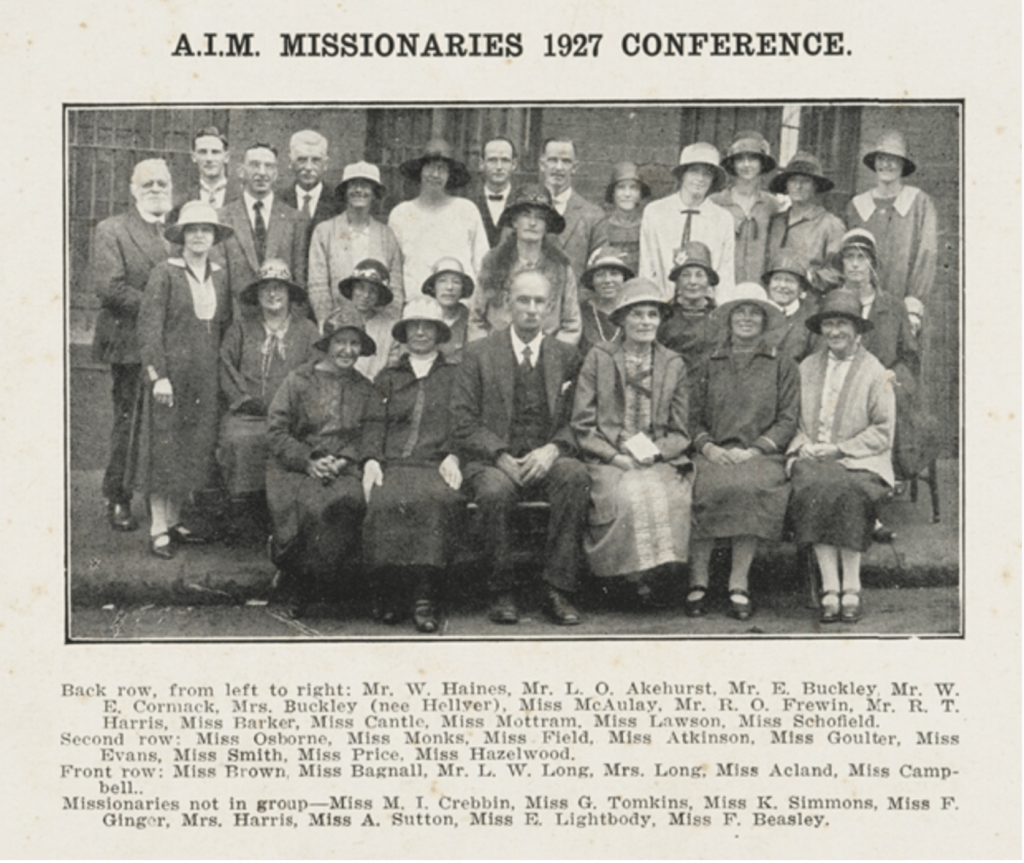
Australian Aborigines’ Inland Missionaries Conference, 1927. The Representative from Karuah, R. T. Harris, stood in the back row, fifth from the right [State Library, New South Wales]
More aboriginal relics found at Port Stephens – 1929
The Maitland Daily Mercury of 3 January 1929, page 2, reported:
‘Under the auspices of the Anthropological Society, an expedition was recently undertaken to the Port Stephens district by Messrs. W. W. Thorpe (ethnologist of the Australian Museum), R. H. Goddard, and C. C. Towle (secretary of the society), with a view to finding the northern boundary of the cultural area of certain aboriginal types of artifacts, as indicated by the recent discoveries of rare stone implements on the Hunter River and northwards. The areas visited by the party were Morna Point, One Mile Beach, Anna Bay, Fingal Bay, Shoal Bay, Tilligerry Creek, the Myall River, and northwards to Dark Point, near Broughton Island.
In each area thorough investigations were made, and striking evidence was found of the aborigines’ ingenuity with tools of stone. Several areas were discovered which were literally their workshops, and the party has returned with excellent specimens of delicate chipped back knives, axes, pounders, and the like. In making their implements the natives took a piece of siliceous stone and flaked it to the desired shape and size by dextrous blows with a rounded pebble. In the districts visited the knives were made largely of chert, and, as this material is found at Merewether, it was probably bartered by the local tribes to the sur-rounding country.
Great patience must have been required in fashioning these delicate instruments, and the aborigines must have been experts at gauging the effect of a blow. If a flake ran thick, it would not be used as a knife, but might be fashioned into a scraper. The aboriginal was economical in this respect, for all spoils were used for some purpose or another. A rare find by Mr. Thorpe at Dark Point was an adze, about 3¼ inches long and l½ inch wide, of a siliceous material foreign to this area. The relic is interesting in so far as it resembles a Maori implement. How it came there is largely conjecture. It is on record that a Polynesian canoe was found on the North Coast some years ago, having been blown there after a storm, and therefore this relic may have found its way there in the same manner. It is well known that the Australian aboriginal, never had implements of this sort.
Another interesting relic found was a small sandstone tool used in making fishhooks. The method of manufacture was to secure a suitable piece of shell, bore a hole in it with a burning stick, and gradually rasp it into shape with the sand tool. Other finds were axes and choppers, which fashioned in the same way as the delicate chipped-back knives and conform to the same type. The first discovery of the larger forms of chipped back implements was made by the late Mr. D. F. Cooksey in the Hunter River district, Mr. W. W. Thorpe in the Port Stephens district, and Mr. C. C. Towle in the Illawarra district. As New South Wales is such a large area, there is still a big scope for anthropological research work elsewhere, and further surveys are proposed.’
The Newcastle Sun of 9 April 1929, page 4, further reported:
‘The search for aboriginal relics, of which Newcastle has been the centre for some time, has been carried further afield. Some important finds are reported from the Port Stephens district.
Mr. W. W. Thorpe, ethnologist to the Australian Museum, has just returned. from another excursion to Port Stephens, where, with Mr. K. M. Cobb, of Vaucluse, he was the guest of Mr. and Mrs. Malcolm McLeod at Duress Station on the Myall River. Several shell mounds on the Myall River were dug over, but with little profit. Attention was then turned to Dark Point, to which a brief visit had been paid in December. Here, close on 100 specimens were found, including flaked-back choppers, axes of the flaked-bladed and ground bladed varieties, and siliceous pounders and knives.
Interest centres in the axes, being larger than the usual types found, and the large numbers of pounders. The latter are shaped into ‘cores,’ having a flat surface trimmed to an oval or circular shape and are fashioned so as to be held comfortably in the hand. Significance is attached to the similarity of these to a ‘core’ found recently outside Dubbo, on the Macquarie River.’
Request to move the Karuah Aboriginal Reserve to allow for subdivision – 1929
The Dungog Chronicle of 11 June 1929, page 2, reported:
‘A movement is on foot to have the aboriginal reserve at Karuah closed, and a more suitable location selected, in which the aboriginals may be able to cultivate a soil more suitable for the production of vegetables and fruit. A site is mentioned further up the Karuah River on the opposite shore. A deputation of Karuah residents will wait on the Chief Secretary shortly in Sydney and request his sanction to the removal and to provide the necessary funds. Mr. Joseph Palmer is arranging the deputation.’
The Newcastle Sun of 12 June 1929, page 5, further reported:
‘Declaring that the aboriginal reserve at Karuah, Port Stephens, had outlived its usefulness and was blocking the progress of the town, a deputation to the Chief Secretary (Mr. Chaffey) today asked for its abolition. Mr. Bennett, M.L.A., introduced the speakers, Mr. J. A. Palmer, secretary of the local Progress Association, and Mr. G. Simpson. Mr. Chaffey stated that the land at the station had been dedicated in 1898. He could not make any promises in those circumstances for he thought it would be very wrong of him to do anything before placing the facts before the Aborigines’ Protection Board. He would do this immediately.’
The Sydney Morning Herald of 14 June 1929, page 7, also reported:
‘A deputation representing the Karuah Progress Association, Port Stephens, which waited upon the Chief Secretary (Mr Chaffey) requested that an aboriginal reserve which is situated in the middle of the settlement should be made available for subdivision.
Mr. J A Palmer directed the Minister’s attention to the fact that only three families of half-castes lived on the reserve, and no use of it in the way of cultivation was being made.
The Minister, in reply, said that the Aborigines’ Protection Board recently inspected the area, and intimated that the persons living on it had claims to consideration. He could not see his way clear to take any action in the matter, except on the recommendation of the board.’
Social function held at Karuah Aboriginal Reserve – 1929
The Raymond Terrace Examiner and Lower Hunter and Port Stephens Advertiser of 26 September 1929, page 3, reported:
‘The Church [Karuah Mission Church] on Friday evening presented the appearance of a fairy spring bower. It was beautifully decorated with wildflowers, greenery (which the girls walked miles among the hills to procure), interspersed with coloured streamers. At the platform end “Welcome and Farewell” stood out in coloured letters on a white background.
The occasion was a social gathering of dark folk from Karuah, Pindimar and Soldiers’ Point, and some sixty were present to do honour to their departing Matron and welcome their new missionary. The chair was occupied by Mr. S. Manton and a splendid programme gone through. The leaf band was also in evidence. On behalf of her friends in the three above named places, with expressions of thanks for her kindness, especially in times of sickness and trouble, the chairman presented Miss Hughes with a beautiful xylonite dressing table set, wishing her every happiness in her new home.
Messrs. H. Ridgway and W. Manton also spoke. Miss Hughes, in replying gave a resume of her association with the Aborigines’ Protection Board and the dark folk, telling of some amusing, also pathetic scenes, connected therewith. The supper tables were decorated with white garden flowers, and coloured streamers, and bore a plentiful supply of provisions for every one present. After supper more solos and duets, then the singing of “God be with You” and Benediction closed the best gathering for many years, ‘ and the guests of the evening were taken to their homes by car.
To Miss Price the whole entertainment was a revelation. “To Miss Hughes it was a beautiful termination to her official life, extending over 20 years among dark folk, and as she looked into the faces — per chance tear dimmed, she realized that she was held in love, and no one would ever hold her place in their hearts. The whole proceedings reflected great credit on all those who took part in any way. During the evening Miss Hughes intimated that Miss Stewart, who lived in Karuah and did such good work years ago, was being appointed to the position she was vacating.’
The Karuah Gum Leaf Band performs at Newcastle – 1931
The Raymond Terrace Examiner and Lower Hunter and Port Stephens Advertiser of 13 August 1931, page 2, reported:
‘On Thursday night in the Oddfellows’ Hall, Raymond Terrace, there was a large attendance at the community singing and a more lustily and hearty attempt was noticed than in the first.
The aboriginals from Karuah gave several leaf band items too, and they were novel and welcome as the music extracted from the gum leaves is resonant and pleasing. Some items more so than others, just according to the item selected. The band also accompanied some of the items. Those who make up this musical leaf combination are Hugh Ridgway, Darby Ridgway, T. and P. Manton, J. McKinnon, B. Maher and W. Bate. Duet sketches were also given by H. and D. Ridgway and T. Manton and B. Maher and they were warmly applauded. So too were the banjo parts. Songs by D. Ridgway were also popular.
The performers have very good voices, but their repertoire of songs could be improved. But they roused the plaudits of the gathering. Mr. Cyril Adam was conductor and gave a round of the old favourites. There are more to be included in the next, concert. Miss P. Finlay and Miss M. Smith were pianists and acquitted themselves well. Miss Annie Todd gave a recitation very good style, and Mr. Cyril Adam was popularly acclaimed for his song. Thanks were given the Aborigines for their services, and Hugh Ridgway expressed, his appreciation of the thanks, and would come again, as they would do anything for the footballers. A dance was held afterwards. The sum of about £3 will be written down as profit.’
Death of Queen Charlotte – 1931
The Sydney Morning Herald of 31 October 1931, page 17, reported:
‘Queen Charlotte (Ridgeway), of Karuah, died on Tuesday last, at the Newcastle Hospital. She lived in the Port Stephens district and had a host of white friends as well as a large circle of relatives and friends of her own colour. The king died many years ago. Both the king and queen were good leaders of their tribe.
The funeral took place at Karuah. A large number of people assembled at the Methodist Church, where services were held. The services were conducted by the Rev. Mr. Newton (Methodist), assisted by Pastor Reid and Pastor Lewis (Baptist), and Mr Reiks (Church of England). Mrs Brown and other friends represented the Aborigine Inland Mission. Matron Stewart, teacher and matron of Karuah Reserve, and friends from Soldiers Point, were also present.’
The Newcastle Morning Herald and Miners’ Advocate of 28 October 1931, page 4, also reported:
‘A queen died in Newcastle Hospital yesterday. The sad event did not plunge the nation in mourning, for she was of a fast-vanishing race; the aborigines who roamed at will over Australia before the civilisation brought by the white settlers spelled their doom. She was Queen Ridgeway, of Karuah, whose wrinkled old face bore testimony to the ravages wrought by over 70 summers. Well known in Karuah, where she had dwelt for many years, she was one of the oldest aborigines in the district. Her remains are to be taken back there today, and, it was reported last night, will be placed on their last resting place in accordance with tribal rites.’
Aborigine’s skull found – 1937
The Newcastle Sun of 5 July 1937, page 4, reported:
‘Grim relic of some tragedy among the aborigines, perhaps 100 years ago, an aborigine’s skull was unearthed by a party of Newcastle men who were putting down foundations for a weekend dwelling at Rocky Point, Port Stephens, yesterday.
The skull was cracked, as if with a blow from a nulla-nulla. A rib bone was also unearthed, but the rest of the skeleton had disintegrated. The skull and bone were covered with a cairn of rocks, probably to protect the body from dingoes, but over the years the cairn had been covered with drifting sand. The skull was described as being particularly big. It was apparently of great age, and was crumbling in places. The teeth were well preserved. The lower jaw and teeth were saved with a view to examination by Sydney University authorities. The rest of the skull was reburied.’
Karuah Reserve Matron retires – 1937
The Maitland Daily Mercury of 30 October 1937, page 10, reported:
‘Practically the whole of the inhabitants of the aborigine’s reserve at Karuah assembled at the mission church on the aborigines reserve, to say farewell to Matron Stewart, who is retiring from the services of the Aborigines Protection Board. The church was tastefully decorated by the younger people.
Mr. Fred Dates, who, acted as chairman, said they had assembled to do honour to Miss Stewart, who, for many years had been their schoolteacher and matron of the reserve, and was now retiring from the service. They all very much regretted that Miss Stewart was leaving. She had given of her best to the children, on the reserve, and also to the adults, and they had a lot to thank her for. She has always been an example of straight-forwardness, fair and impartial in her discipline, and had been their friend and adviser in health or sickness.
The following contributed musical items and songs: Pupils of the aborigines’ school; Mrs. Alex Russell; Miss C. Ridgeway, Zoe Ping, E. Manton, C. Russell, Kath Dates and Mrs. Janey Ridgeway, while Mrs. Johnson, aged 80, who is totally blind, contributed an aborigine song in aborigine language.
Grandfather William Manton aged 72 years, then presented Miss Stewart with a boomerang which he had himself made. Miss Stewart, accepting the boomerang, said it would be placed with her treasures. The chairman then made a presentation of a beautiful cut-glass bedroom clock to Miss Stewart, on behalf of the people of the Reserve.
Sergeant Shipway said it was a pleasure to be associated with the function. He had only been acquainted with Miss Stewart for the past 2½ years, during which time he had regularly visited the school and inspected the Reserve. It was a pleasure to notice the interest Miss Stewart had taken in the training of the children and the discipline maintained not only in the school but outside. She had been fair and impartial to all and a good friend in sickness or in health, in losing Miss Stewart they were not only losing an excellent teacher but a stalwart friend and matron. Miss Stewart said she thanked them all very much for the beautiful clock. She would always remember the people.’
Missionary Training College for aboriginals opens at Pindimar – 1938
The Sun of 20 November 1938, page 13, reported:
‘The first training college for aborigines wishing to take up missionary work among their own people was opened last week at Pindimar, Port Stephens.
Outlining the objects at the annual meeting of the Aborigines’ Island Mission of Australia, Mrs. R. Long emphasised the remarkable fervour and enthusiasm of natives who became actively interested in the work of the mission. The mission had extended its operations to 41 centres and 78 out-stations in New South Wales, Queensland, Victoria, and the Northern Territory. There are at present, she said, a number of native preachers taking the pulpit before white congregations in some outback areas. Normanton congregations, for instance, were regular listeners to native preachers. The first two pupils at the new college are Robert Blair, of Cherbourg (Queensland), and Ralph Naden, from Bulgandramine (N.S.W.). They commenced their tuition last week.’
The Dungog Chronicle of 14 April 1939, page 4, reported on the official opening of the college:
‘The public opening and dedication of the Native Workers’ Training College at Pindimar was performed on Good Friday afternoon by Mrs. R. Long, in the presence of a large gathering from Karuah, Soldiers’ Point, Tea Gardens and elsewhere.
Mrs. R. Long, who presided, explained how Pindimar was selected as the site for the college, and of the object of the Aborigines Inland Mission of Australia. Greetings were conveyed by Mr. R. T. Harris (Sydney) from New South Wales; Mr. J. Leech (Cherbourg) from Queensland; Mr. G. W. Taylor (Darwin) from Northern Territory; Miss Bagnall from Victoria; and Mr. F. Phillips from the local district.
Mr. E. A. Collins, superintendent of the college, gave an outline of the work already performed there. Mr. W. A. Loner spoke of the studies that would be given to the students. Two students were now at the college and more would come along presently. Mrs. Long, in her address, said that Pindimar meant ”vessels for carrying water,’ and this would apply to the students going back to their own people carrying the ‘living water.” Mrs. W. A. Long presided at the organ for the hymns. Mr. Collins pronounced the Benediction. Afternoon tea was served on the lawn to the visitors.’
The Dungog Chronicle of 31 May 1940, page 3, reported:
‘At a meeting in the Baptist Church at Dungog on Monday night last, the aboriginal students from the A.I.M. Native Workers’ Training College at Pindimar told of missionary work being done amongst the aborigines of Australia, and also gave musical items.
The college is a new venture in the work amongst Australian aborigines and is the only one of its kind in Australia. It has been established recently at Pindimar, Port Stephens, and at present there are five aboriginal full bloods in residence at the college. These students are being taught building construction, agricultural work, in addition to being given a missionary training and such general knowledge as will be helpful amongst their own people. After they complete the college course, they will return to outback stations to work amongst their own people.
The latest census figures from Canberra given by the Government Statistician are as follow: Aboriginal population of Australia 77,269, of which 51,557 are full-bloods and 25,712 half-caste. New South Wales figures are 794 full-bloods and 10,069 half-caste. In 1938 the decrease in the full-blood population in Australia was 1456. The 1939 figures have not yet been published.’
Christian Endeavour Rally at Karuah – 1940
The Newcastle Morning Herald and Miners’ Advocate of 12 August 1940, page 3, reported:
‘The Newcastle District Christian Endeavour Union held a missionary rally at the aborigine’s reserve at Karuah on Saturday. More than 130 Endeavourers represented 14 district societies. The Endeavourers were met by Mr. Wilcox, Superintendent of the reserve. Mr. A. E. Collins, Pindimar Aborigines College, aboriginal mission students, and Mrs. and Mr. Dates.
A campfire meeting was opened by Mr. Wilcox. The District Secretary (Mr. H. W. Symes) responded to the welcome, and then Mr. E. Walsham acted as leader. The aborigines choir led by Mr. Barry Jones sang. Testimonies were given by aborigines and Endeavourers. Mr. Collins thanked the Endeavourers for their interest in the work. The union’s next activity in the quarterly rally on Monday, September 9, at the New Lambton Methodist Church.’
Native missionaries from Pindimar farewelled – 1940
The Newcastle Sun of 15 November 1940, page 5, reported:
‘Mr. L. Banks and Mr. H. Marsh, two Australian aborigines who have completed their terms at the Pindimar College, and who will take up mission work in Queensland, were farewelled at a function held in the Maitland Road Baptist Church, Islington.
Mrs. R. Long, who founded the Aborigines Inland Mission nearly 50 years ago, was present and gave an address. The principal of the Pindimar College (Mr. A. Collins) spoke of his association with the guests of honour. Aborigines from the college who were present were Mr. and Mrs. Demlin and Miss Rachel Demlin. The Inland Mission has 138 workers, 60 of whom are aborigines, stationed throughout Australia. It aims at having eventually five native workers for each white worker.’
Aboriginal Children at Karuah aid War Effort – 1942
The Newcastle Morning Herald and Miners’ Advocate of 23 November 1942, page 2, reported:
‘Sixteen aborigines attending school at Karuah are saving their pennies to help the war effort. The District Organiser of the National Savings Campaign (Mr. Cyril Adam) said yesterday that in one month the boys had bought £3/12/ worth of war savings stamps, 24/ worth of Red Cross penny seals, and had contributed 11/ to the Public Schools Appeal, a total effort of £5/7. The school is conducted by the Aborigines Welfare Board. Every one of the pupils is contributing.’
Closure of the Pindimar Training College – circa 1944
The Singleton Argus of 2 April 1947, page 8, reported:
‘This college [Pindimar Training College] was established in 1938, first at Pindimar, Port Stephens, but during the war years was transferred to Dalwood, near Branxton. It was felt by headquarters officials that the college should return to the Singleton district, and for this purpose Minimbah House was acquired, possession being taken on November 21, 1945. The Pindimar property was subsequently sold. Minimbah had been occupied for some time previously by the Portuguese evacuees from Timor. Selected students will from time to time be drawn from all parts of the Commonwealth and brought here for training preparatory to working amongst their own people. In addition, special parties will come for short term studies.’
Memories of Hawks Nest Aboriginals – 1951
In January 1951, the Dungog Chronicle published three articles outlining the memories of Bill Clayton of the early days in the Hawks Nest area. In the Dungog Chronicle of 27 January 1951, page 3, his memories of the local aborigines were published:
‘Some 400 blacks were camped at Hawks Nest, at the back of the mill. Old Mr. Barnes was the “boss. They got honey for him, and he exchanged for honey, beer, flour and sugar. His daughter is alive in Sydney now. Some of the blacks were nearly 7ft. tall. There was Yellow George, Jack Bacchus (a treacherous one), James Governor, Billy Barracks (the Rocks are named after him), and Charlie the cricketer. There was the King and Queen, Billy and Fanny Price.
Into a big tree they had spikes taken from Hawk’s Nest, driven at regular intervals. On each was hung a billy can. Each knew his own spike and billy. Of the gins, Fanny Price was Queen. There was Princess Maria, Maggie Bullock, Charlotte, Mrs. George Price, Caroline (a lovely looking gin) and piccaninny Luna, daughter of the King and Queen. She was a lovely child and died after eating berries from the beach.
Blacks from Cape Hawke used to pay visits. A visitor was once camped at Windy Whoppa [Windy Woppa] and showed Bill Clayton some strange stones where his camp was. Bill told him he was camped where a Black was buried. The visitor was gone next day.’
Researched and compiled by Kevin McGuinness
October 2023

 Port Stephens - a history exploration