

Introduction
In 1919, the Dungog Chronicle: Durham and Gloucester Advertiser, published a series of articles written by Gordon Bennett on the Aboriginal people of Port Stephens, Dungog and Gresford.
Bennett provided the following background to the series of newspaper articles:
‘Many of these tales and anecdotes have been collected by me at various times, and it is my purpose to publish them at some later date. I have therefore not included anything of what might be termed modern history in my articles, it being my desire to record such facts regarding the blacks as were observed when they were unused to the ways of white men and were still imbued with the beliefs and were still following the traditions and customs of their forefathers. There is none left now of the populous tribe that once inhabited the district, and the sole surviving relic, poor, unfortunate “Brandy” passed to the care of the great spirit, Coen, more than fifteen years ago. These few facts, therefore, may serve to enlighten the present inhabitants as to what were the conditions when the clank of the leg-iron and the ring of the settler’s axe was first heard among the wooded hills of picturesque Dungog.’
The articles were published in the following editions of the Dungog Chronicle: Durham and Gloucester Advertiser:
25 March 1919, page 3; 1 April 1919, page 3; 8 April 1919, page 3; 18 April 1919, page 3; 25 April 1919, page 3; 29 April 1919, page 3; 6 May 1919, page 3; 13 May 1919, page 3; 20 May 1919, page 3.
The same newspaper published the articles again in 1943.
In this research paper, Gordon Bennett’s articles have been reproduced in a block presentation under various headings.
Readers may find some of expressions used, as referring to aborigines, as offensive. The articles are published here in full without any form of moderation or exclusion. To alter that material would be akin to altering history.
With this caveat, the articles provide a valuable insight into the Aboriginal people of the Port Stephens, Dungog and Gresford areas and reflects many of the prejudices of the time.
The author of this paper acknowledges the Worimi people the traditional owners of the Port Stephens region and recognises their continuing connection to Land, Waters and Culture, and pays respects to their Elders Past, Present and Emerging.
Aboriginal and Torres Strait Islander peoples are advised that this paper contains a range of material which may be culturally sensitive including records of people who may have passed away.
This paper supplements two other papers on this website:
- Aborigial People of Port Stephens – Reminiscences of William Scott.
- Aspects of Aboriginal History of Port Stephens
- Evidence of Early Aboriginal Settlement at Port Stephens
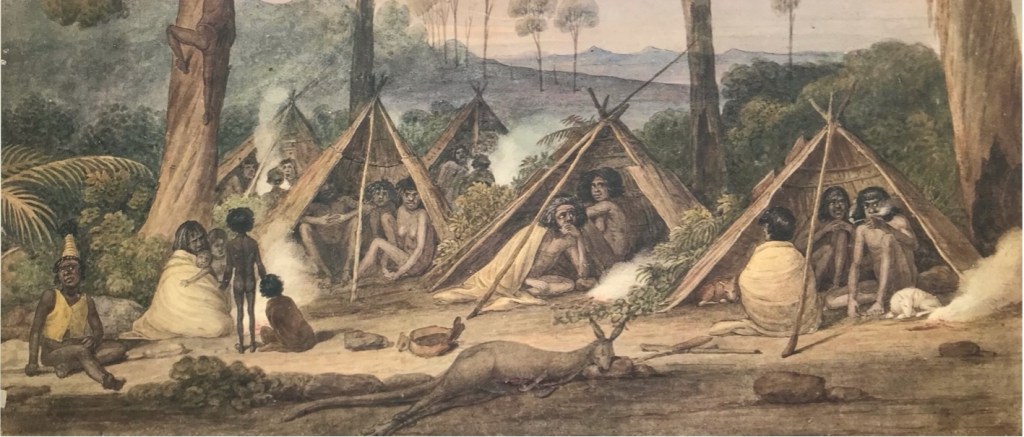
Aboriginal families camped in the Port Stephens area, 1826 [National Library of Australia]
The Newspaper Articles – by Gordon Bennett
Opening Article
Dungog and district looms largely in the history of the early settlement of New South Wales for many reasons. Some historians have been led to believe that the earliest settlement north of the Coal River, (or Newcastle, as we know it today), commenced at Port Stephens, when the Australian Agricultural Company formed its famous settlement in the early days of the first two decades of the nineteenth century. This idea is, however, erroneous, for the country was originally opened up northwards from Green Hills (Morpeth), and Dungog was the ultimate limit of settlement for ten years or more. In these articles I do not propose to deal with the history of the district and its development in so far as is concerned the English population and the mixed agglomeration of races and classes that subsequently helped to fill the vacant spaces between Hunter’s River and the headwaters of what is now known as the Manning. Neither is it my intention to deal in any way with the penal settlements, or the penal conditions that prevailed in those far-off days.
Impelled by a spirit of anthropological curiosity I have been tempted to make some researches concerning the people that inhabited the districts wherein the “Chronicle” circulates long before the clank of the leg-iron was heard in it’s primeval forests and long before modern civilisation wiped out of existence those uncultured savages to whom I refer. It is the result of my inquiries that I desire to publish in the hope that there are some that may be interested in learning what class of people dwelt along the banks of the Williams and on the foreshores of Port Stephens in those days when the battle of Waterloo was something to be talked of as a current event, and when malefactors were hanged by the neck to the limbs of the gum-tree whose roots may yet be seen near where the Dungog Public School now stands. Necessarily my investigations have included those different tribes of aborigines who were allied to, or connected with by totemism, those that inhabited the Dungog and Port Stephens districts, and if reference is made occasionally to localities distant from that centre where the headwaters of the Williams emerge to the flats of the lower land it may be taken that the anthropological data that I have garnered warrants the excursion.
I may say at the outset that most of my references are from Howitt’s very complete work regarding the aborigines of the eastern districts of the continent. In addition perhaps the most accurate particulars are taken from data collected by the late Dr E. McKellar McKinlay, that distinguished scientist, anthropologist and medico, that made Dungog his home during the best part of the first half of the last century. I had the good fortune to obtain access to many papers collated by this learned gentleman, whom, as a boy, I can perfectly remember, and I have considered them to be of such interest to Dungog folk that I make this my excuse for presenting them in this form.
In the far-off days of the first decade of the nineteenth century, the locality that we know as Dungog was called by its primitive inhabitants “Tunkok” or “Tungog,” both of which words mean, in the Awabakal dialect, the place of thinly wooded hills. The blacks living in the district that extends from just about where Brookfield now is to the headwaters of the Chichester and the Williams belonged to a tribe known as the Gringai. They were distributed over the district in local groups known as “Nurra” and were located at distances about eight miles apart in what the historians of those days termed villages. The mia-mias of those rude aborigines were of the most primitive description, being merely a few sheets of bark placed against a convenient log, or bushes roughly planted alongside some huge forest giant.
A census taken by Dr McKinlay in the early thirties showed that there were about 250 blacks in the valley of the Williams. Across the range, on the watershed of the Paterson, was another, and an important branch of this tribe with whom the natives of the Dungog district inter-married, and Dr McKinlay and Mr J. W. Boydell record that these tribes married also with those of the tribes on the Gloucester watershed. Below Dungog, and extending to Lake Macquarie, the Awabakal tribe was the most important and their language is recorded in interesting treatises written by the Rev. L. E. Threlkeld. Inland from the Awabakal was the Geawo-gal tribe, whose country was part of the valley of the Hunter River, extending to each lateral watershed and from twenty to thirty miles along the valley on each side of Glendon. These aborigines spoke the language of, and intermarried with those of Maitland, less frequently with those of the Paterson River and rarely with those of Mussel Brook.
They were always in dread of war with the Kamilaroi, a fierce and warlike tribe, who followed down the head-waters of the Hunter from the Talbragar to the Nunmurra waters, and even occasionally made raids as far as Jerry’s Plains. A section of the Kamilaroi occupied the upper waters flowing into the Hunter and Goulburn, and the easy gap from the west probably afforded them ready access for their raids. The fear that this race inspired in the natives of localities adjoining their boundaries reached as far as Dungog, and twenty years ago when “Brandy” was the last of his tribe in the district he would often mention, with apparently genuine fear, the possibility of a raid by the wild blacks from the west.
Family Organisation
From Port Stephens to the Queensland border, a stretch of many hundreds of miles, there were numerous tribes of blacks speaking dialects that were basically connected with that of the Gringais about Dungog. Very little has been recorded of their organisation, beliefs or customs, and apparently no true history of them will ever be written. With the aborigines of Australia, the marriage customs are the most interesting. Rude and uncivilised though they were, there was a rigid social organisation that has been the wonder of students of their mode of living. Intermarriage of families was strictly forbidden, and incest was a crime punishable with death. Each child, at birth, was placed in a certain class or totem, and could only marry some person from an entirely different class or totem, their particular classification being indicated by a distinguishing name.
Most of the Gringai were named Kumbo, but there were some Ipai, Kubbi and Murri among them. Dr McKinlay, in one of his notes, regrets that he was not able to obtain sufficient information to tabulate their class system under the sub-class, or totem rules, but he says that there were certain facts that were suggestive. One family of Kubbi took their names from their father, and not from their mother. Another family consisted of an Ipai married to a Kubbitha. In another case Kubbi was married to a Kubbitha, and again in another case a Kubbi married a Kubbitha, and their child was of the Kumbo sub-class. Two explanations, says the learned savant, may be suggested. These marriages and descents may indicate a complete breaking down of the old Kamilaroi organisation in a manner similar to that apparent in other coastal tribes, or it may have been the result of breaking up of the tribe under our civilisation. The only point that seems to be worth much consideration is that the child’s name was that of the father, or of a sub-class which, together with his, represented his class. There were also totems in these tribes, for instance such as Black-nake, Black crow, Eagle-hawk, and Stingaree.
Marriage
Marriages were arranged by the parents and kindred, and a wife was chosen from a neighbouring tribe; for instance a man living at Gresford obtained a wife from the Hunter River. The woman about to be married made a camp and a fire, to which the man was led by his father or any old man of the tribe. After they had camped together the ceremony was complete. Capture of women from other tribes and elopements were common. In regard to the captured women, if she belonged to the same sub-class or totem as the capturer, he would have to let her go or yield her up to someone of a different class. In regard to elopements, if a man and woman, of the same class ran off together they were punished by death if captured. It they did not belong to the same class the man had to fight some of the members of the tribe, and it he were successful in vanquishing their best fighting men in single combat he could retain his bride.
A man was not permitted to speak to his wife’s mother and could only do so through a third party. Before the advent of the whites to the district it was death for a man to speak to her, and for many years after settlement was first established the punishment was a temporary banishment from the camp. Mr R. Dawson, in 1830, writing of the Port Stephens tribes, said that they generally took their wives from other tribes, if they could find opportunities to steal them. The consent of the female was never made a question of the transaction. When the tribes appeared to be in a state of peace with each other, friendly visits were exchanged, at which times the unmarried females were carried off by either party. The friends of the girl never interfered, and in the event of her making any resistance, which was frequently the case, her abductor silenced it by a severe blow on the head with his club while carrying her off. He kept her at a distance till her friends were all gone, and then returned with her to his tribe. But if the girl had no objection to her suitor or had no one else in her eye that she liked better, she agreed to become his gin, thus rendering abduction unnecessary. The husband and wife were, in general, remarkably constant to each other, and it rarely happened that they separated after having considered themselves man and wife. When an elopement or the stealing of another man’s gin took place, it created a great and apparently lasting uneasiness in the husband, which is not altogether unnatural.
Chiefs or Headman
As with all savage tribes, there was one, or more, in a community that was in a position of authority. In regard to the southern tribes of the Kamilaroi, located to the north of Maitland, Dr McKinlay states that in 1830 he made some investigations and found that there were two or three head-men in each division of the tribe. Their position was one of influence and authority and depended on the valor and strength of the individual. None of these positions were hereditary and a man that distinguished himself as a warrior or orator would become a leader by force of character. His son, if valiant, would be highly thought of. These head-men, or the oldest of them, settled the disputes of the tribe and decided what white men were to be killed if a raid were to be engaged upon. The bora, or initiation ceremonies were also arranged by them.
In the Port Stephens tribes there were no chiefs, but certain leading characters had more influence than others among the communities when matters of common interest were being discussed, or arrangements made for important ceremonies or warlike excursions. No one was invested, however, with, or assumed any authority whatever in the tribe.
Settling Arguments
In the settlement of quarrels in the Gringai (Dungog) tribe those of a personal or private nature were settled by the individuals with any weapons near at hand. In cases of offences against the tribe or tribal customs, the offender had to stand out in the open, armed with a shield, or heilaman, while a certain number of spears, according to the gravity of the offence, were thrown at him. If he could defend himself successfully, well and good, and he was adjudged to have been proved innocent. If he could not, he was either severely injured, or killed outright.
One pleasant practice for the settlement of little differences was for the two aggrieved parties to take hits at each other’s head with a wadd, turn about, and the one that held out longest was acclaimed the victor to the sound of much noise from the assembled tribe.
Medicine-men and Superstitions
Naturally in a race where religion has no place in the social condition superstition and fantastic beliefs in the existence of evil spirits prevails to a great extent. The aborigines of Australia were no exception to this rule, and some of their beliefs are interesting to the modern reader. It may be taken as a generally accepted fact that the blacks of this country did not believe that death could be encompassed by natural causes, and this notion obtrudes itself in all the tribes, from the Arunta in the Northern Territory to the relics of the pristine Papuans that were left high and dry in Tasmania countless centuries ago.
Sickness was attributed to the influence of a medicine-man of another tribe or someone of the local community who was capable of exercising witchcraft. Thus, whenever a native developed a serious pain he usually hurried to the medicine-man of the tribe and learned from the wizard who was responsible. Sometimes the trouble was attributed to a spirit, but if the ancient doctor had a particular enemy he encompassed a neat revenge by attributing the nefarious powers of witchcraft to him thus generally involving him in death. Needless to say, the medicine-men were greatly feared.
Among the tribes in the Williams Valley it was not uncommon for the medicine-men of hostile tribes to sneak into a camp at night under cover of the darkness, or a cloud, and with a net of peculiar construction garrotte one of the tribe, drag him a few hundred yards from the camp, cut up his abdomen obliquely, take out the kidney and caul-fat and then stuff a handful of sand and grass into the wound. The strangling net was then unwound, and if the victim were not already dead, he would be a ghost inside twenty-four hours. Some are said to have survived the operation for three days. The fat so stolen was greatly prized and was divided among the adults who anointed their bodies with it, and generally carried portions with them in the belief that the prowess and virtues of the deceased would pass to them. His bad attributes remained with the corpse.
Around Dungog the blacks believed, when a man became ill with a wasting sickness, that one of these medicine-men had crept in under cover of darkness and removed the kidney fat without the painful operation above described. They called their nocturnal visitors “kroji” or “koradji,” and were in great terror of them. They also believed that the koradji were possessed of wonderful supernatural powers and besides bringing disaster to others could effect cures of all manner of ills among their own tribes. It may be taken generally that sickness of all kinds was believed to be caused by the incantations and magic of the koradjis or medicine-men of hostile tribes.
At Port Stephens an observer witnessed the treatment of a sick blackfellow by a koradji. The witch doctor wound round the body of the patient a cord of opossum fur and then passed it round the body of a female relative or friend, who held the end in her hands. She then passed the cord to and fro rapidly between her lips until the blood flowed. This was caught in a bowl over which the gin held her head and it was believed that the evil magic that caused the disease passed up the cord into the body of the operator and thence with the blood into the bowl.
Among the tribes that extended inland from Port Stephens it was also believed that the koradjis, or gradjis, as they were also called had curative powers that enabled them to suck out the evil magic projected into a man by a hostile operator. They would place their lips on the affected spot, and after incantations, would produce the thing of evil in the form of a piece of stone or charcoal. In one case noted by Mr Boydell, at Gresford, a blackfellow was under the belief that when passing a grave the ghost of the man that had been buried had magically thrown a pebble at him and he considered that he was thereby marked for death. A koradji, however, relieved his anxiety by sucking the spot and producing the pebble that was the cause of the mischief.
In another instance a koradji extracted the pain from a boy’s foot which had been burned, and it took the form of a piece of charcoal. These medicine men also claimed to possess powerful influence over the weather, and could make rain, create storms or bring on a drought. In the tribe at Port Stephens the koradjis used to drive away the rain by throwing fire sticks in the air and at the same time puffing and shouting. The tribesmen were greatly afraid of blood falling into lakes or rivers lest great storms should result and other evils be brought about, not the least of which would be the destruction of fish.
Among the Kamilaroi, if a black saw a whirlwind he rushed into a tree and clung to it until the blast had died away remembering “that blackfellows have been carried up by them and never came back.” If a Gringai were on a journey and it seemed as though night would overtake him he would place a stone in the fork of a tree believing that he would then be certain to finish the trip before darkness closed in. Like all others of his tribe he had a fear of travelling in the dark. The Yuin believed that the thunder was the voice of Daramulum. The Gringai had a great dread of thunder and believed it to be the demonstration of the anger of some supernatural being rebuking them for some impropriety. This being they knew as Coen.
Graves and Funeral Customs.
Death among most savage tribes is a matter of mystery and associated always with the supernatural. Among the Gringai it was believed that the ghost of a deceased took up its abode near the grave in which the body was buried and was able to injure strangers who incautiously ventured near it.
The Bigambul belief was that people after death went to and fro, the shadows of what they were in life. These glories they called “matu.” Throughout the Gringai country Dr McKinlay located many places where numbers of blacks were buried, and saw interments at least after the year 1830, so that what he described was probably a continuation of a very old custom.
The dead were carried from miles around to be buried in these places. Most of the older hands in Dungog can remember the old aboriginal cemetery near Mr William Abbott’s home at Violet Hill and at the rear of the Rectory, and I have very vivid recollections of having heard many old residents describe aboriginal burials there. Dr McKinlay furnishes some very interesting notes in this category. He describes that at Gresford when the grave, which was very neatly dug with the crudest implements, was considered to be of sufficient depth a man got into it and tried it by lying down at full length. The body, nicely tied up in bark, was carried to it by friends of the deceased. Before being lowered into the grave the medicine man, standing at the head, spoke to the corps to find out who caused its death, and he received answers from the other medicine men at the foot. All the articles of the deceased were buried with him, and every black present contributed something to the collection. All the things were placed at the dead man’s head, and the grave was then filled in.
The following was the practice at Dungog and relates to the customs that the learned scientist and medico noted about the year 1830. Venerable men, and men of distinction were buried with much ceremony, but ordinary members of the tribe, and females, were disposed of in a perfunctory manner. The body of man belonging to a strong family and with a big following would be buried in the manner that he thus describes: The body was doubled up, heels to hips and face to knees, and the arms folded. It was then wrapped in sheets of ti-tree secured by cords of string-bark fibre. A hole was dug in easy soil in a well shaded locality, about two-feet deep and circular. The body was dropped in sideways and after a stone hatchet and a club were placed beside it the grave was filled in and the ceremonies ended.
The grief displayed at the funeral of a venerable and honoured man was unquestionably great and genuine. The lamentation at the grave and the chopping of heads and burning of arms was something not easily to be forgotten. This grief, though violent, was not of long duration, and by the time the wounds were healed the sorrow ended.
At Port Stephens the body was neatly folded in bark and was placed in the grave at flood tide — never at the ebb, lest the retiring water should bear the spirit of the departed to some distant country. Before placing the corpse in the grave two men held it on their shoulders while a third struck the body lightly with a green bough, at the same time calling out the names of the acquaintances of the deceased and others. The belief was that when the name of the person that had caused his death was spoken the body would shake and cause the bearers to drop it, or to stagger. If the person responsible were thus discovered the tribe would seek revenge.
The doctor relates an interesting story of an old couple that lost by death an only daughter of whom they were very fond. After she died the parents built their hut over her grave close to the shore of the harbour and lived there for many months crying for her every evening at sunset. They then removed their but a few yards away and remained in it until the grass had completely covered the grave, when they left and never visited the spot again. It seems probable from the information available that the Gringai natives belonged to the Port Stephens tribe, for there are indications to show that they held the same belief that if the dead were not buried at flood tide the ebb would carry the spirit away. This is marked about Clarence Town, Seaham and Paterson, and recorded by Mr Boydell. All believed that the spirit lingered at the grave for some time.
The Great Spirits
Information as to the tribes further north along the coast is very fragmentary. Dr McKinlay, who apparently was a great traveller in those early days, wrote of these almost unknown people in 1830 and said “that they believed in evil spirits who disported themselves in the night, but also in a master spirit, in some unknown habitat, who ruled their destinies.” The investigator, however, was never able to learn from his rude informants the name given to this mystic deity, but they always indicated his whereabouts by pointing to the sky. They were convinced that this spirit settled them in their country, apportioned their hunting grounds gave them their laws and instituted the ceremony of “bumbat,” or “bora.”
To the anthropologist it is clear that Dr McKinlay gathered as much information from them as it was possible for them to impart to one uninitiated into their ceremonies, or to one not a “bumbat,” their name for those that had been through the ceremonies.
The blacks of Port Stephens, being of the same great tribal community as those at Dungog, believed in an evil being “Coen,” who could take the form of birds, and possibly of animals. Any mysterious noise at night was attributed to “Coen,” and they never moved after dark without a fire-stick to keep him off. In this connection it is worth noting what Dawson says of “Coen” when writing of his visit to Port Stephens prior to 1830. He says: “They (the blacks) are afraid of “Coen,” an evil spirit of the woods, which they say “crammer” (steals) blackfellows when “nangry” (asleep) in bush.” Speaking of a thunder-storm he says: “I could, however, learn nothing from them except that it was “coen” who was very angry, and was come to frighten them, but the origin or motives of “coen” I could not now, more than on former occasions, get any other explanation than that he was in form a blackfellow and an evil spirit who delighted in tormenting and carrying them away when he could get opportunities.”
I (the writer) remembering questioning “Brandy,” the last of Gringai tribe, on this subject together with the late Mr John Robson, some sixteen years ago, and according to my notes made at the time coen was responsible for the storms, floods, droughts and fires, and had carried off many blackfellows for offences against tribal laws. Mr Robson, who had an extensive knowledge of aboriginal lore extracted a story from the old fellow relating to the carrying off of a lubra who had spied on the secret bora ceremonies. According to our informant, who declared that he was an eye-witness of the occurrence, the gin was walking near the river when coen came in a crash of thunder and a flash of lightning, hurled the branches of trees over her and then carried her off. It is not unlikely that the unfortunate gin was killed by the limbs of a tree that had been struck with lightning, for according to “Brandy” none of the tribe ever went near the spot afterwards.
Some further light is thrown on coen by what Threlkeld says in his work on the language spoken at Lake Macquarie. He says: “Koin” (coen) is an imaginary male being who has now, and has always had, the appearance of a black; he resides in thick bushes or jungles, and he is seen occasionally by day, but mostly at night. In general, he precedes the coming of natives from distant parts, when they assemble to celebrate certain of their ceremonies, such as the knocking out of teeth in the mystic ring, or when they are performing some dance. He appears painted with pipeclay and carries a fire-stick in his hand; but generally it is the doctors (a kind of magician) who alone perceive him, and to whom he says “Fear not come and talk.”
At other times he comes when the blacks are asleep and takes them up, as an eagle his prey, and carries them away for a time. The shouts of the surrounding party often makes him drop his burden; otherwise he conveys them to his fireplace in the bush, where he deposits his load close to the fire. The person carried off tries to cry out, but cannot, feeling almost choked; at daylight Koin disappears, and the black finds himself conveyed safely to his own fireside.” This appears to indicate that Koin is identical with the Coen of the Gringai, and the Baiame or Duramulan of other tribes along the coast, for he holds the place in the ceremonies which the latter has in the other tribes of the south. Old men of the Yuin tribe have stated that their ceremonies, almost similar in form, extended right up to Newcastle — that is to Awabakal, or Lake Macquarie blacks.
Wild Aborigines
Along that extensive stretch of coast between the Port Stephens blacks and those known as the Chepra tribe, somewhere about the vicinity of Port Macquarie, early anthropologists had little opportunity of pursuing complete investigations. As a matter of fact when Dawson and Dr McKinlay were prosecuting their researches they applied the name Chepra to all those aborigines inhabiting the coastal areas north of the Stroud district. The savage characteristics of these tribesmen deterred explorers and settlers in those early days, and grim expeditions of extermination were frequently conducted from the settled districts against the uncivilised natives.
The story of the big massacre on the Manning watershed was recently reprinted at length in the “Chronicle,” the facts having been garnered by that industrious historian, Mr F. A. Fitzpatrick, of the Wingham “Chronicle.” In my possession I have some old records of the A. A. Company at Carrington, and of the late Captain Thomas Cook, of Auchentorlie, Dungog, that throw an interesting light on the condition of the country in the early twenties. As some of these records relate to the magisterial work of Capt. Cook, who was commandant of the whole of the country north of Newcastle at that period, it is interesting to piece together, from the fragmentary reports and documents, the stories of some of the wandering tribes of blacks that occasionally swooped down on the settled districts.
One statement, recorded in the stilted handwriting of Capt. Cook himself, describes how a band of blacks stole a child, the daughter of a Mrs Easterbrook, whose husband was a clerk of the A. A. Company at Stroud. They disappeared in a northerly direction but were pursued by a party of armed soldiers and assigned servants and overtaken some twenty miles away. Eleven blacks were killed and the child recovered. Writing his official report on the matter Capt. Cook said: ‘The native blacks are very savage in this locality and it is necessary that we should all carry arms when travelling. In company with the clerk of the peace, Mr Duncan F. Mackay, I was molested only last week by wild blacks between Dungog and Stroud and discharged my musket at several who threw spears at us.”
In passing I might mention that I have several letters, dated 1829, written by this early day magistrate to the Colonial Secretary, the Hon. E. Deas Thompson, in one of which he states “It is an arduous task that Mr Mackay and myself are called upon to perform each month, to wit, to walk to Stroud from Dungog for the purpose of administering justice, and as the way is beset with wild blacks, who frequently molest and threaten us, I have the honour to apply for the use of two saddle horses from His Majesty’s stores at Parramatta.” By a lucky chance I learned the outcome of this application from a letter written by Mr Mackay several months later. That first C.P.S. at Dungog said: “On behalf of Capt. Cook I respectfully withdraw the application for the services of two saddle horses from His Majesty’s stores. We are both greatly indebted to the courtesy of the officers of the Australian Agricultural Company for the use of two mules on which we are enabled to perform the journey with expedition, safety, and comfort.”
Reverting to these wild blacks, the Chepras, Dr McKinlay records that they believed in supernatural beings whom they called Maamba. These spirits were supposed to dwell in the bodies of the medicine men, or the “boogerum” as they designated them, and raised them to frenzy when the ceremonies were being performed.
Initiation Ceremonies
Perhaps the most important occasion in the life of a blackfellow was the initiation, or “bora” ceremonies. By means of weird rituals and weirder ceremonies he was told of the laws of his tribe and received a knowledge of the mysteries of life from the elders of the tribe. Certain painful operations were frequently performed on his body, he fasted, he went through strange performances and chanted stranger songs, and— was made a man. It is a noteworthy fact that throughout the whole of the continent the “bora” ceremony is the most important feature in the life of every tribe, speech, habits, marriage, customs, totems, may differ, but the essentials of the “bora” ceremonies are alike among the blacks of the Barcklay Tablelands, in the centre of Australia and the Gringais that a century ago lived and hunted in the hills and gullies around Dungog.
I have frequently heard many of the old hands about Dungog assert that they had been witnesses of the initiation ceremonies in Burnt Gully, behind the hospital, but I seriously doubt their statements. It is quite true that the blacks of the valley, and from the Gresford side, were in the habit of foregathering there on important occasions to hold corroborees, and these pageants were undoubtedly witnessed by many of the residents of the town in those days. In fact, less than fifty years ago corroborees were held there, as can be borne out by numbers of townfolk who were boys and girls that period of time since. In regard to the “bora” ceremonies, however, I questioned “Brandy” on this matter very carefully many years ago, and having some knowledge of aboriginal customs in other districts I was able to speak to him with a certain amount or authority on the subject. From this last relic of a tribe I gathered that the actual ceremonies were always performed at the back of what is now the town common, several miles from Burnt Gulley. ……….
A Gresford “Bora”
The following particulars relate to that portion of the Gringai tribe in the Gresford district and nearer to the Hunter, and were recorded by the late Mr Boydell. Describing the procedure of initiation, he wrote: “A large assemblage is called together to celebrate the ceremonies. The boy to be made a man is painted red all over and is taken to the centre of an earthen ring where he sits facing the track that leads to another ring about a quarter of a mile distant. The women, with their faces covered, lie around the large ring. An old man steps up to where the boy is sitting, and blowing in his face, bends down. Two other old men take him by the arms and lead him to the other ring where he sits down, all the time keeping his head bent and looking at the ground. The women now rise up and having sung and danced, go away to another camp and take no part in the ceremonies until their termination.
The trees that grow near to both of the circles have been carved and the boy is taken to each of them. He looks at them for a moment, when the old men give a great shout. He is then taken away to a place some miles distant, still keeping his face to the ground, even when eating. Here a large camp is made and the boy learns dances and songs, and is for the first time allowed to look up to see what is going on. He is kept here in this manner for about ten days, being placed by himself in lonely and secluded places, while at night the men make hideous noises at which he must not show the least sign of fear on pain of death. After this time they take the boy to a large waterhole where they wash off the red paint and on coming out he is painted white.
When the men return to camp the women are lying down by a large fire with their faces covered. The old men who took the boy away bring him back at a run towards the fire, the other men following, clattering their boomerangs, but not speaking or shouting. The men form a ring around the fire, and old man runs round inside the ring beating a shield (hellaman). At this signal the boy’s mother, or some other woman, comes out of the company of the women and taking the boy under the arm lifts him up, rubs her hands over him and then goes away. The fire has by this time burned down to red coals and the men, including the novice, extinguish them by jumping on them with their feet. The boy now camps in sight of where the women are and is allowed to eat food which was forbidden to him, such as kangaroo, snake, etc. The bull-roarer is called by the Gringai “toriketti,” and is used in these ceremonies. The young man is not allowed to marry until three years after the initiation.”
Other Bora Customs
Concerning the blacks in the Port Stephens district, Howitt provides some interesting facts. In this locality the blacks, when making a “bumbat,” that is, when initiating a boy, remove a tooth. This is done by one of the old men placing his bottom tooth against the boy’s upper tooth and by giving a sudden jerk snapping off the “bumbat’s” tooth. This practice is also common among many tribes and was observed among the coastal blacks to the north of Stroud and Dungog. The reason thereof, however, has never been discovered by investigators. The bull-roarers, or “torikotti,” played a somewhat important part in the ceremonies of initiation, and were supposed to represent the voice of Coen, or some other potent spirit who influenced the lives of the aboriginals. They were made from a flat piece of hardwood, from twelve to eighteen inches long, and notched at the side and frequently carved. They were attached to a piece of fibre and on being whirled rapidly gave out a roaring drone that was the voice of the spirit. They were particularly sacred, and were never shown by the owners to anyone.
If a woman heard the sound of the bull-roarer it was supposed to mean death to her. Among the Gringai, as with other tribes, an extraordinary mystery attached to pieces of quartz crystal. They are possessed only by the “koradjis,” or medicine men and wore supposed to have come into their possession through the instrumentality of a spirit. Sometimes the spirit dropped them by means of lightning into a pool, or on top of a hill, and informed the “koradji” of the fact. At an initiation ceremony one is presented to a “bumbat,” or novice, and it is wrapped up with the greatest solemnity, caution and secrecy, and concealed in his belt. If a woman saw one by chance her brains were knocked out with a nulla. Women, therefore, were always in great dread of seeing one of them.
Port Stephens “Bumbat”
An interesting description is furnished by Dr McKinlay, who writing in 1830 to a Sydney friend, explains that he accidentally came across an initiation ceremony when proceeding through the bush. He was not discovered for some time, and as he had been an eyewitness of the proceedings, and claimed to know something of the customs in other districts he was permitted to remain during certain parts of the ceremony.
He writes: “A number of blacks were camped at the foot of a hill, the camp being in the form of a half circle, round an oval, cleared space, about thirty or forty feet in area. The edges of the space were raised about nine inches. This cleared space was connected with the top of a hill, and another cleared space by a narrow path. The women were not allowed to go up this path or to approach the top of the hill at all. When going to the creek for water they were careful to look some other way.
On more than one occasion when riding past the camp I heard most extraordinary noises proceeding from the top of the hill, a kind of bellowing or booming sound, continuing for a long time, then sinking away at times, and then swelling out as loud as ever. The blacks would not tell me what it meant, so I determined to see for myself. I therefore rode carefully round the hill, and up the other side from the camp. I found that a conical fire was burning in the centre of a cleared space, similar to the one at the foot of the hill. Round this fire radiating from it like the spokes of a wheel, and painted like skeletons were a number of naked blacks on their faces. Within the cleared space, and on one side of it, was a rough figure painted red, made of wood, formed by a stake driven in the ground with a cross piece for arms and the top dressed up with grass and bark, in the style used by the blacks when prepared for hunting.
The blacks were so absorbed in what they were doing that I sat some time unobserved. When they did see me, they seemed much annoyed. One of our own blacks came to me and said that he did not mind, because I was ‘Gimba,’ but the up-country blacks would not go on with the ceremony while I remained. I then rode away, but in a few days after he told me that I could see the great finishing ceremony. I rode to the camp at the foot of the hill and saw a large fire burning in the centre of the wide, cleared space. The booming noise from the top of the hill was also going on, and grew louder and louder and at last was succeeded by great shouts and yells. Then about two hundred painted blackfellows appeared over the brow of the hill. They wore all armed with boomerangs, shields, and spears, which they clashed together in time as they ran. They were in two divisions, and kept crossing and recrossing the path, interlacing as they met at a run, while descending the hill, and yelling at the top of their voices. The effect was very startling, especially to my horse, which took fright.
Arriving at the foot of the hill they threw their weapons on the ground, and springing on to the clear space, danced on the fire with their bare feet till it was extinguished, all the time bearing up amongst them the youths who were being made ‘bumbat.’ “This part of the ceremony being over, the Port Stephens blacks accompanied by the ‘bumbats’ ran up the trees like monkeys and breaking off small branches threw them down on the ground, where they were eagerly scrambled for by the women who put them in their nets. The up-country blacks took no part in the branch breaking, and one of them told me that they never did that sort of thing in his part of the country. This concluded the first part of the ceremony, and the women were not allowed to see the next part. They were made to lie down, and were covered with blankets and bark, and a blackfellow was placed over them as a guard, waddy in hand. At this stage of the proceedings some of the up-country blacks objected to my being present with a gun, for I had a small one with me. One of our blacks asked me to give it up, and it would be all right, but I did not do so, and went away.”
The Dungog Ceremonies
Dr McKinlay, because of the fact that he resided in Dungog, had ample opportunity for close investigation of the habits and customs of the Gringai tribe, and although the information that he gathered indicates that his rude informants withheld much or what was important, his observations betokened a shrewd and sympathetic judgment.
He describes what he saw and ascertained about the ceremonies in an interesting note and writes as follows: “The juvenile males of this (the Dungog) tribe were, from the age of about twelve to eighteen, allowed to accompany their parents and friends in hunting excursions, and assisted in the incidental fagging necessary about the camps. In the course of time, they were, therefore, thoroughly disciplined and properly trained. When they are considered ready to be made full members of the tribe the elders hold a convention and decide on a ‘bumbat’ being held, generally when there are three or four youths to be initiated. “Messengers are despatched to summon tribes from far and near, and on their return full preparations are made for the celebration, a place being selected, and a day appointed.
As part of the ceremonies, the aspirants undergo the ordeal of having an upper front tooth either bitten off or knocked out with a stick prepared for the occasion. It is said that the youth’s mother is custodian of the tooth and takes great care of it. As everything relating to these ceremonies is kept very secret this is only hearsay. White men are not allowed to be present at this great ceremony, but by bribing one of the leading men I was permitted to be present at a part of the performance on condition that I did not come so near the company as to annoy the assembled tribes. On the eventful morning I went to the place indicated where I found about two hundred of the tribesmen differently, but tastefully, painted in red, white, and yellow, and armed to the teeth. They were in groups here and there in a little valley. On riding about I noticed a large gumtree deeply carved with hieroglyphics, which I was informed was a record for future generations that a bumbat had been celebrated in that locality.
A circle of eighty to ninety feet in diameter was dug, or scratched, on a level piece of ground, leaving a space of four or five feet undisturbed to enter the circle by. In the centre of this circle there was a fire of moderate dimensions and attended to by one of the men. Shortly there was a stir when a detachment entered the circle, and with dancing, yelling, and gesticulations, and brandishing of arms at intervals, all made a rush to the fire, yelling, and jumping on it until extinguished, when they retired. The spot where the fire had been being now cool, the embers and ashes were levelled, and boughs were brought and disposed of in the middle of the circle. Then two men proceeded to the camp of the females, two or three hundred yards’ distant, and marched them and the children with their heads prone to the circle, where they were made to lie down and be covered up with boughs, rugs, bark, and whatever was at hand. This being done, the whole force of the assembled tribes came up, running, shouting, and striking their shields with their clubs, and using a roarer which produced the most fearful and unnatural sounds. A sort of warlike pantomime was then enacted, and the women and children closely covered up, were frightened out of their wits, and cried out lustily. Suddenly the fearful noises ceased, and all the men rushed out of the ring, and seem to be engaged in a most fearful fight, spears and boomerangs flying about in hundreds.
This, I was told, was the end, but to me it now seems clear that it was the beginning of the ceremonies, being the time when the contingents have arrived, and before the final part when the boys who are initiated are taken from their mothers. However, it did not tally with what I had seen elsewhere or had been told by natives whose confidence I had won. It is difficult at this late date to secure positive information concerning the ceremonies in their various stages. From what has been observed in other parts of Australia, particularly by Sir Baldwin Spencer and his coadjutor, Mr Gillen, it is certain that the more important and secret parts of the “bumbat” were never witnessed by either Dr McKinlay, or the others that have written concerning the Gringai or the Port Stephens natives.
Mr Scott, who was also an observer in those early days, more particularly of the Maitland blacks, states definitely that he learned from native informants that there were secret ceremonies concerning which it was unlawful to speak to an uninitiated person. These, he asserts, were of such a character that a blackfellow would not reveal them to an outsider. This is readily understood by the latter-day student who has read Spencer and Gillen, Langloh-Parker, Howitt, Lang, Waitz, Matthews and others and has gained some idea of the sexual license that prevailed during these ceremonies. The circumcision ceremony was undoubtedly a part of the ritual of the Gringai, and I have had this confirmed by “Brandy,” and by many of the old settlers on the river who were more than ordinarily observant in the early days when the natives were plentiful in and around Dungog.
Messengers
The carrying of messages from one tribe to another in the early days was an important matter for the aboriginals. This was done particularly when the tribes were being summoned to a bumbat, and in different districts different methods were observed. The practice of the Kamilaroi tribes may be taken as that of the tribes that lived nearest to Maitland some seventy or eighty years ago. In each clan there was one man who, was a herald and had an official designation. He was well known in all the adjoining tribes and could go with safety between them, even when they were at war. When sent as an envoy to the enemies’ camp he might have to wait for a night to bring back a message from them. While there he made a camp by himself a little distance from their encampment. These heralds, being well known, did not need to carry any badge or emblem of office, but if a black were employed as a white man’s messenger, the message was written on a piece of paper which was fastened in the end of a split stick. Carrying this before him he might pass safely through the enemy’s country because he was seen to be the white man’s messenger, and if any harm were done him the tribe of the white man would be angry.
With the Gringai, wrote Mr Boydell, a messenger could pass in safety from one tribe to another. A red-coloured net was worn round the forehead if the messenger were on an errand to summon the tribes, together for a bumbat, or for any other great occasion such as a council of war. It was customary for a messenger, when within sound of the camp that was his destination to give a particular coo-ee. Immediately this is heard the whole tribe gathered together to hear what he had to say, but not a word was spoken to him until he thought it proper to deliver his message. Sometimes, for the sake of effect probably, the herald would sit silent for hours. When, however, he unburdened his mind his eloquence was wonderful and he was listened to with the greatest attention. No message sticks were used in this tribe.
Other Customs
The manner, in which the Gringai communicated their movements to following friends was noteworthy. Dr McKinlay relates an interesting anecdote in this connection that is worth repeating. He wished to see some blacks that had been camped near where Brookfield is now, but when he reached their settlement he found it deserted. His black boy said that he would see where they had gone, and going to the camp showed, a spear stuck in the ashes of the fire with a corn cob tied on the point. The spear was leaning in a certain direction, and the boy explained that they had gone to a place in the direction the spear pointed in order to pick corn, but they would be back shortly. This proved to be the case.
Speaking of the Port Stephens aborigines, Mr R. Dawson describes a meeting with some strange blacks. He told those that were with him, “to make the sign of peace with them which they did by waving the right hand over the head and then pointing to the ground. No return was made to this, and on repeating the sign an answer was returned in a loud and as it seemed menacing tone. The natives of each party harangued each other in turns, and then the strange blacks placed their spears against a tree and gave an invitation to join them.” This account is very characteristic of similar meetings observed by anthropologists in the Cooper’s Creek country.
Personal adornment among the natives of the Dungog and Port Stephens districts was not spoken of much by the early investigators. The attire, so it is noted, usually consisted of a kangaroo skin tied round the middle with a belt of fibre or sinews. Charms were worn round the neck and consisted of shells, seeds, pieces of quartz, etc. When it became the custom to carry blankets, they usually pinned them across their chests with a bone nose-peg. When not in use for this purpose the peg was kept in the cartilage of the nostrils which were pierced for the purpose.
A curious practice obtained among these tribes, that of flattening the children’s nose by the mother to improve its appearance. This was usually done immediately after birth by the mother or some of the old women of the tribe, and as the practice is common among blacks in all parts of the continent it can be accepted that this marked feature of the aboriginal physiognomy is thought to be beautiful. Along the coast, and particularly about Port Stephens it was the custom of the females to have one of their little fingers amputated. Mr Robert Dawson states that a mother amputates the little finger of the right hand of one of her female children as soon as it is born in token of its appointment to the office of fisherwoman to the family. Other observers speak of the practice as being general, but supply no reasons. One may, therefore safely accept Mr Dawson’s statement as being correct, and that the mutilation has a special significance.
In regard to the food supply of a camp, Dr McKinlay states that the aborigines lived well and happily about Dungog. In the early days of the settlement, they had not come into very close contact with civilisation and he speaks of them as refusing to eat bread when it was offered to them. They lived for the most part, he says, on opossums, kangaroos, wallabies, birds and fish. The chase was a big part of the lives of the males, and strange to relate the spoils were usually divided equally among the various members of the tribe. The meat was cooked in the most primitive fashion. A ‘possum or kangaroo would be placed on top of a glowing fire and when half cooked one of the older men would remove it and proceed to dismember it. The flesh was never more than half roasted — indeed it was sometimes almost raw. The men took their share first and the women and children made a meal of what was left.
Birds and fish, however, were cooked by being plastered with mud and placed amid hot coals or in a hole packed with heated stones. In this way they were deliciously cooked, and indeed the doctor relates that he frequently dealt with his own game and fish in this manner. Much, no doubt, could be added to the foregoing that would be of more than passing interest to residents of this district, such as stories of the aborigines as they were known to those still alive who spent their childhood more than half a century ago on the banks of the Williams River. ……
Contact with Whalers & Other Stories
In the next succeeding chapters dealing with the aboriginals of the Dungog, Gresford and Stroud districts I propose to set down a few facts that I have gathered from certain official sources regarding incidents that occurred in the early days in connection with their relations with the first white settlers. The narrative will necessarily be disjointed, but will, I believe, contain sufficient of interest to warrant its publication. I may state that much of my material has been gleaned from the records of the Mitchell Library, and from a few documents that I have come across in other quarters. No doubt throughout the Dungog and Stroud districts an assiduous collector would find more official papers that would throw a good deal of light on these first days of settlement in the north, but I will leave it to him to continue my investigations.
One of the earliest records of a conflict between the natives and white settlers occurs in 1833 when John Bear, who had 640-acres on the Upper Williams River, complained to the bench of magistrates at Dungog that an aboriginal named Mully had assaulted one of his assigned servants with a spear and stole half a bag of flour. Bear’s property is described as being bounded on the west by Windeyer’s grant, and on the south by Thompson’s grant, and would I suppose, be somewhere about where Bendolba is now.
The result of the case shows that the black-fellow had serious provocation, as the assigned servant had carried off his gin by force, and that stern, but just, magistrate, Thomas Cook, dismissed the charge against Mully and sent the convict to the treadmills at Parramatta for a month. It was about this time that Thomas Hanna opened a store at Dungog and was also appointed as postmaster at a salary of £12 per annum. I might state that in the early thirties it cost 1/6 to post a letter from the Williams to Sydney, and Capt. Cook, in one of his letters to the Colonial-Secretary, Mr Macleay, points out that the charge was altogether insufficient. The mails were dispatched by horseback to Green Hills (Morpeth) and conveyed thence by sloop to Sydney, the trip taking over a week. There was a regular service, however, and it was a busy mail day in Dungog every six weeks.
Harking back to Hanna’s store, the commodities therein, although probably of limited quantity and range, proved a source of attraction to the blacks and a raid was made on the premises during the darkness of a July night in 1833. Entrance to the premises was effected by the simple process of lifting the roof off, which, being of bark, offered no serious obstacle to the marauders. They got away with several bags of flour, a musket, two axes, and a number of blankets and bolts of winsey. A hue and cry was raised next day and two constables succeeded in effecting the arrest of Billy Foster, Cocky and Tommy’s Martha. They were brought for trial but managed to escape from the lock-up and were never seen afterwards. A reward of £2 was offered by the authorities for their apprehension, but I can find no record of its ever having been claimed. Probably they went north among the wild blacks on the Manning or joined another wandering tribe of the Gringais around Gresford.
In 1839, the distribution of blankets to the aboriginals was in full swing, and on April 17th of that year Capt. Cook addressed the Colonial Storekeeper at Sydney with a request that the regular supply should be forwarded at once. He says “the blacks are beginning to inquire seriously about them, and if they are not yet sent off please let the 200 for Port Stephens be shipped by the A. A. Company’s schooner, ‘Carrington,’ and the fifty for Dungog by the steamer Maitland for Clarence Town on the first Saturday of next month.”
In regard to the mall services between Dungog and Sydney, which at this time were considerably improved owing to steam packets being employed between Green Hills and the metropolis, a letter written by Capt. Cook, on Dec. 4th, 1839, is worth recording. He addressed himself to the Hon. E. Deas Thompson, and said: “As the postman running between Raymond Terrace and this place (Dungog) twice a week must leave a mail at Clarence Town each trip up and down, and to accomplish it make a detour of nearly six miles to catch a ford often impassable at flood tide, and where he has frequently been molested by wild blacks, I do myself the honour respectfully to suggest that the punt now plying on the Lower Williams, it not being necessary as heretofore, be removed to Clarence Town for the benefit of the public in that quarter. This would confer a real benefit to all in the district seeing that a bush carriage could be then formed without much difficulty or expense to carry passengers or goods direct from the mountains north of Dungog to Raymond Terrace, affording a resting place every sixteen miles, Dungog being that distance from the Underbank Estate. It would also lessen the danger from the blacks, who are at times, very menacing.”
The Captain’s letter was tangled in the red-tape that existed in even those days, for it is subsequently recorded that his request was refused owing to the fact that the regulations would not permit the punt to be removed. In January 1840, the aboriginals went through a bad time, and the records indicate that their natural food supplies were becoming extinct. Capt. Cook applied to the Colonial Storekeeper for a grant of flour to be distributed among the natives, and when asked if arrangements could not be made to secure sufficient locally he stated in reply that there was but one flour mill and one threshing mill in the district, besides one flour mill and two threshing mills on the Australian Agricultural Company’s estate at Stroud. He points out, however, that these mills were for private use only and supplies could not be drawn from them for the aboriginals. That he had a soft spot in his heart for the rude natives is evidenced by his voluminous correspondence on the subject, and the pertinacity with which he assailed the authorities in Sydney until the required relief was furnished.
In August of that year Captain Cook wrote as follows to the Hon. E. Deas Thompson: “I do myself the honour to return a list of the aboriginal natives who shared in the munificence of His Excellency the Governor’s present of blankets and to state that every attention was paid to character in selecting the recipient. At Port Stephens one hundred more blankets could have been well bestowed. The blacks in that part of the colony are numerous and are almost all well-disposed.” The list, unfortunately, is missing.
Shortly after this there was a move to abolish, or restrict, the distribution of blankets to the natives. In reply to an official letter from Sydney, Captain Cook wrote; I do myself the honour to acknowledge receipt of your letter of Sept. 11th, 1840, relative to the future distribution of blankets to the aboriginal natives of Port Stephens and Dungog districts, and in restricting those presents to this part of the district, His Excellency’s commands shall be strictly obeyed. The blacks in this quarter are generally honest and quiet, and if they do at any time purloin poultry or produce from the settlers, it is not for their own comfort and use that they do so but to please the white fellows on some distant stations who cohabit with their gins.
Eighty blankets could be issued here to as many useful and deserving blacks, making an addition of thirty to the former complement bestowed on us. I therefore hope that when the season again comes round the Governor will kindly order that quantity to be sent here. In November 1840, the whole district was in a state of turmoil owing to the appearance in Brookfield of “a band of mounted and armed bushrangers”. According to the official records they stuck up the Union Hotel, and Mr Chapman’s, at Wallarobba, and extra troopers were requisitioned from the authorities. Capt. Cook, referring to the matter in one of his letters to the Colonial Secretary, explains that he armed two aboriginal natives with muskets, he having instructed them in the use of firearms at his estate, Auchentorlie.
Unfortunately for the Captain’s good opinion of the blacks these two had no sooner obtained the guns and ammunition than they made off to join the bushrangers and were not recaptured until several weeks later. The description of the capture indicates that the natives profited little by their course of musketry instruction at the Captain’s home for they are recorded as having fired thirty shots at the constables and inflicted no injury to anyone. Their punishment for the escapade also throws an interesting sidelight on the character of the remarkable man that administered the laws in those troublous days. Reporting officially on the matter Captain Cook stated that “these rude, untutored savages are no more deserving of blame than I am myself, and I therefore admonished them both severely and informed them that they would be deprived of participation in the future distribution of blankets.
It was unwise on my part to give lethal weapons into their hands and the temptation of their possession was too great for the aboriginal mind. I trust that my leniency will meet with the approval and clemency of His Excellency.” This is one of the most remarkable expositions of justice tempered with mercy that I have ever encountered, and it speaks volumes for the kindly, spirit of this disciplinarian of the old regime. In February 1841, the blacks experienced another time of famine and official response to requisitions for supplies was so slow that Captain Cook took it upon himself to direct Mr Abbott, chief constable, to arrange for supplies to be given to the most destitute. When the modest account for the provisions was submitted the auditor-general, Mr William Lithgow, called the captain to task for the unauthorised expenditure.
The reply disclosed that twenty-nine blacks had been fed for three weeks for the sum of £1 11s 4d, whereas only, ten shillings had been allotted for the purpose. Captain Cook states that the amount charged “is trifling for such seasonable supplies to our sable guardians, and he eventually carried his point. The blanket distribution still troubled the gallant Captain in April, 1841, for I find that he writes as follows on the 9th of that month. He addressed himself to the Hon. E. Deas Thompson as follows: “Being at Stroud this week I had an opportunity of hearing some of the aboriginal natives inquire most anxiously for their blankets, which they seem to prize greatly. The mornings and evenings begin to get chilly on these mountains, and I fear that unless the blacks get some little shelter in the shape of a blanket or other covering they will get discontented. They are numerous here and have hitherto been quiet and harmless, many of the men proving useful to the overseers at the Company’s out-stations. But if deprived of their wonted present from His Excellency I will not answer for their continuing so.
I remember some five or six years ago going out with a party in search of nine pirates who, on being closely pursued at sea, had scuttled the vessel they stole at Sydney and landed on the beach at Port Stephens and were made an easy capture by the assistance of two female aboriginals who, themselves, told me they had tricked the white fellows knowing I was in quest of them and because the Governor had given them blankets. I do not think that the total withdrawal of Sir George Gipps’ wonted munificence towards that interesting race may operate on some unforseen occasion to the disadvantage of the district.
At all events I would recommend a supply of blankets for the use of the women and children who otherwise must be left naked and comfortless — it being a standing order of the Commissioner of the A. A. Company that no black girls be harboured at the huts of the company’s estate. If then, His Excellency the Governor would consent to send even one half (say 100) of the former quantity I shall take care that they are properly distributed among those most deserving and in greatest need of such a boon. The blankets would still up to time for distribution on May 1st by being put on board one of the steamers at Sydney and landed at Raymond Terrace whence they could be brought to Stroud by one of the Company’s pack bullocks.”
In June of 1841 a black fellow named Bobby met with a violent end near Stroud. From the records it appears that Bobby, with another black named Dick, approached the hut of an assigned servant who was known throughout the district as “Cranky,” and asked for some flour. The response was a gunshot and Bobby was killed outright. The murderer was apprehended at once, the crime having been committed in sight of a number of the officers of the Company, and he was brought before Captain Cook.
Commenting on the case to the Attorney-General in Sydney, Captain Cook wrote: “I feel very keenly over this case as the murdered aboriginal was of excellent character and has done me many valuable services. The murderer, from his nickname “Cranky” made me at first think that he might at times labour under an aberration of mind, but no great abnormality ever having been noticed in his conduct or behaviour I fear that the deed has altogether emanated from a naturally violent and ungovernable temper.” In a subsequent letter Captain Cook notes with pleasure that the death penalty had been carried out and that “Cranky” paid fully for his crime. At this stage I might mention that after 1835 this is the only record of a black having met his death by violence at the hands of a white man in either the Dungog or Stroud districts, and in 1842 Captain Cook speaks in congratulatory terms of the general attitude of the white inhabitants towards the natives.
There was an important law case in August, 1841, in which the integrity of an officer of the A. A. Company was involved. A blackfellow was the principal witness against him, and in order to see justice done Captain Cook took an unusual course in making an endeavor to get the aboriginal to realise the nature of an oath. Writing to Mr J. Moore Dillon, the Crown Solicitor of the time, he says: “Mr Therry having approved of my suggestion as to the propriety of instructing Billy, the aboriginal native, whose statements appear among the original depositions of this case, I requested that he might be put under the care of the clergyman at Stroud, when the Revd. Mr Cowper, of Port Stephens, kindly offered his services.
After persevering for some time he gives me but little hope of success, the blackfellow, though otherwise intelligent, being averse to instruction. I therefore despair of his being made conscious of the obligation of an oath so as to be sworn at the trial in September.” This furnishes another example of the innate sense of justice in the old army officer, who rather than accept the hearsay of a native endeavoured to bring to the rude mind a realisation of the basis of Christianity in order that the prisoner standing his trial should have every advantage.
After his experience with the two blackfellows who made off with his muskets, Captain Cook kept an eye open for armed aboriginals. On November 2nd he wrote to Matthew Chapman, then owner of “The Grange,” Wallarobba, as follows: A complaint having been made to me that two blacks, “Possum” and “Cocky,” were found near your place on Sunday last with arms in their possession contrary to law I have to request that, as it appears they acted under your orders, that the culprits be sent in on Friday next, or at farthest, Friday week to answer for the offence; and that you appear personally to give the necessary explanation. No white or black can now carry firearms on a Sunday for pleasure or profit with impunity. The fine is not more than £5 nor less than £2.”
It may be now related that Mr Chapman appeared in person at the Dungog court and explained that he had lent the arms to the blacks for the purpose of shooting wallabies. The aboriginals were admonished, and Mr Chapman was fined £4. The authorities at the end of 1841 were again undecided about issuing blankets, and Captain Cook made a strong appeal for 50 for Dungog and 200 for Port Stephens. Concluding his letter, he said: “That sable, but interesting race, are numerous in this district and all well conducted. Three of them discovered a quantity of goods lately in the bush near Wallarobba and brought them to this place. These things had been left, there is no doubt, by the bushrangers last year. They are now advertised in the Government “Gazette.” There was a robbery at the home of Mr Arthur Hogue, Clarence Town, on Feb. 9th, 1842, and the matter was reported to Captain Cook. Mr Hogue stated that among the goods stolen was a quantity of rum and that as a number of blacks in the neighbourhood had been found in a state of intoxication, he concluded that they were the culprits and asked that they should be arrested and brought to justice.
Capt. Cook, always the champion of the natives, declared that it was more than likely that some runaway convicts were the guilty persons as clothes and arms that had been stolen were not found with the blacks, and that the liquor was probably given them to divert suspicion. The matter was investigated, and subsequent events proved that the surmise of the magistrate was quite correct. The convicts were captured and went to the treadmills. In May 1842 the blacks of Dungog received their fifty blankets, but a supply for Port Stephens was refused altogether. A suggestion was sent from headquarters that the half hundred should be equally divided between the natives at both centres, but Captain Cook refused to do this. He said “it is scarcely worthwhile taking two bites at a cherry, and I will not be a party to it.” Just at this time some blacks were instrumental in capturing five runaways at Carrington and this was used in a further plea for the natives. The captain persisted in having the full supply and he again won.
A Chapter from the Manning
I have previously mentioned that very little was known in the very early days of the aboriginals in the Manning district by the residents of the Dungog district, and any contact with the northern natives was usually with officers and men employed by the A. A. Company at Stroud and Gloucester. From the reports of Captain Phillip Gidley King, the Rev. Mr Cowper, and Dr Mclntosh, all of Port Stephens, it may be taken that the tribes to the north were generally more fierce and warlike than those in the settled districts.
Grim stories have been told recently by old residents of wholesome slaughter of aboriginals in the forties as reprisals for assaults and murders, and none of these need be repeated by me. This serves to illustrate, however, that the temperament of the tribes differed considerably, as little or anything of the kind is recorded as having happened about Dungog.
In 1848, matters were somewhat serious in regard to the blacks about the Manning as the following letter, addressed to the Hon. E. Deas Thompson will show. Captain Cook wrote under date of January 10th: “I feel called upon, and do myself the honour, to state to you for the information of His Excellency the Governor, that there are now residing on the Manning River upwards of four hundred persons without protection or instruction of any kind and governed solely by ‘Lynch law.’ And the aborigines there being contaminated and emboldened by such example have lately become most troublesome at the different stations in the vicinity. They kill sheep and spear cattle without concealment and when spoken to threaten the lives of the shepherds.
Some time ago I despatched two of the mounted police to put in force a warrant issued by Mr G. Rowley against three black fellows who assaulted and beat a man in charge of sheep who was endeavouring to protect his master’s property. These sable thieves, being apprised of the approach of the troopers collected to the number of thirty or forty and having amongst them at least a dozen muskets and plenty of ammunition, which the settlers most improperly supply them with, they resisted.
The soldiers (one of them the brave Corporal Worsley) were fain to retreat, which they effected with difficulty and not until several shots were exchanged, the trooper’s cartridge box wrenched from his person and his arm wounded with a tomahawk. This unfortunate circumstance, having given the blacks more courage, has caused their degradations to become more formidable so that several respectable persons who have stations on the Manning have lately called on me and beseeched protection. I could only refer them to Captain King, the Commissioner for the A. A. Company, who, I believe, was in correspondence with you on the subject. It would be worse than useless to send back the small party of mounted police that are stationed at Dungog, but if an officer’s command were directed to proceed thither to scour the bush for a few days, and if possible, capture the offenders for whose apprehension a magistrate’s warrant has been issued, it would have a good effect by striking terror into the savage mind.
I would recommend earnestly the adoption of some such measure that peace and safety may be restored.” The above letter conveys some slight idea of what the pioneers of the Manning and Gloucester districts were encountering in the late ‘forties. It is interesting to learn the outcome of this position from Captain Cook, which, I may add, was supported by a strongly worded representation from Captain King, but unfortunately, as is the case with many of the records that I have inspected, the most important links are missing.
In March of that year a force comprising twenty-six soldiers, in charge of Capt. Reynolds (or a name that I deciphered as such) left Newcastle for Carrington to proceed under the direction of Capt. King to the Manning to inflict such punishment on the natives as may be deemed salutary.” I have found out that the expedition arrived at Port Stephens and was supplied with “adequate rations and the services of a number of mules,” but beyond that the records are silent. Whether they ever reached the Manning is a matter for conjecture, but I take it that both Captains Cook and King would certainly have seen that they carried out their work once they had embarked on their expedition of punishment. Perchance there are some of the old hands about the Gloucester and Manning that have heard of the result of this foray of armed forces and can supply some further particulars. I would gladly welcome any information on this source.
In April 1848, Captain Cook is still battering at the door of headquarters over the blankets for the aboriginals, and he wrote a strongly worded protest against the withdrawal of the issue. I gather that in the previous year the supplies were cut off altogether for he says in one of his letters “the withdrawal of the bounty proved fatal to many of the gins and over thirty children. I plead with His Excellency that he should sanction a return to his aforetime generous custom as it will afford that houseless race much real comfort and encourage them to do well and be more serviceable to the whites, from whom of late years they have been more estranged.”
During the following year Captain Cook took a very decided stand over the supply of blankets and rations to the blacks, and from thence onwards it appears that the consignments came regularly to hand. Port Stephens, about this time, was separated from the Dungog district in regard to the supply and Captain King continued the fight until he became Governor when the aboriginals were well cared for on the company’s estate. There is a record of a protest by Captain Cook against the practice of officers of the A. A. Company arming parties of blacks for the purpose of driving off marauding bands from the hostile districts to the north. He complains that frequently the blacks retain their weapons and use them with such carelessness in the vicinity of settled districts as to endanger the lives of the settlers. One incident that prompted this complaint is described by him in a private letter to the Colonial Secretary in which he describes a narrow escape that he had from death by gun shot. A black fellow was shooting at a bird in a tree when the gun exploded, and portions of the barrel knocked off the Captain’s hat. He attributes the whole thing to extreme carelessness, but his spirited protest was of little avail.
There are numerous other stories of the aboriginals of the district that are worth publishing, but as my investigations were only carried up to 1849, I will leave those dealing with a later period until some future date. …….
Before concluding I might, as a matter of interest, set out the wording of an advertisement that appeared in the Government Gazette on November 17, 1834. I have not been able to find any trace of the crime, and the notice speaks for itself. It reads as follows: Sixty Pounds reward. Whereas the undermentioned black natives stand charged on oath with having committed rape and robbery at the farm of John Lynch, at Sugar-loaf Creek, Williams River district, on Wednesday, the 5th inst.; Notice is hereby given that any person who shall apprehend, or cause to be apprehended, and lodged in any of His Majesty’s Gaols the whole or either of the said offenders, shall receive a reward of ten pounds for each of them who shall be secured: The men are Young Price, Charcoal’s Brother or Dicky Charcoal, Bill or Miserable Billy, Mickey, Jemmy Jackass, and Joe the Marine.
POSTSCRIPT
The Dungog Chronicle: Durham and Gloucester Advertiser of 23 November 1943, page 2, published an obituary on Gordon Bennett, the first part of which is set out below:
“Farmer and Settler” newspaper makes the following reference: — Mr. Gordon Bennett, managing editor of the “Farmer and Settler” from 1932 until his retirement, because of ill-health, on August 1 this year, died at his home at Cremorne early on Sunday week. He was 59 years of age.
Mr. Bennett had been in indifferent health for about three years and his condition became worse early this year. A son of the late Walter Bennett, M.L.A. for Gloucester, Mr. Gordon Bennett was born in Christchurch (N.Z.), but came to Australia with his parents at a very early age. He was educated at the Sacred Heart College, West Maitland, and early in life entered journalism. He was editor of his father’s newspaper, the Dungog “Chronicle,” and later acquired the “Lachlander” at Condobolin. He was editor of the “Lachlander” at 19 years of age. He joined the staff of the “Farmer and Settler” in 1912 and conducted the Information and Help Department for a long period. In the capacity of country commissioner for the “Farmer and Settler” he travelled hundreds of thousands of miles through New South Wales to keep in close contact with country people and their problems and to study production methods on farm and station. Few men have had the opportunity to obtain such an extensive and sound knowledge of the country and of primary production generally.
He had a sound grasp of the local problems of the man on the land and his knowledge of land conditions prompted the Wallarobba Shire to engage him and a partner to make the first valuation of holdings within that area on the inception of local government. He practised as land agent for many years on the Lachlan when he conducted his own newspaper at Condobolin. Mr. Bennett’s knowledge of western conditions was availed of by Sir George Fuller’s Government in 1923 when his survey of N.S.W. lands within the irrigation zone of the Lower Murray was published at the instance of Sir Joseph Carruthers, and considered by the committee of experts when formulating sections of the Murray waters scheme.
His wide experience and practical knowledge of the country and countryman’s problems was of the greatest benefit to readers of the “Farmer and Settler” during the many years he was associated with this newspaper. He was ever ready to take up the cudgels on behalf of the man on the land, and initiated many progressive movements designed to improve rural conditions. He was a brilliant journalist, with a fine literary style, and his stories, articles and verse were delightful to read. His vigorous style enhanced the reputation of the “Farmer and Settler” for forceful leading articles. Mr. Bennett was a prolific writer, and published two volumes, “The Boomerang of Destiny” and “The Port Stephens Blacks”. ……..
Researched and compiled by Kevin McGuinness
August 2023

 Port Stephens - a history exploration