
As a Christmas story goes, a tale from Tahlee House at Carrington, Port Stephens, from 1832 holds a special place.
In 1832, the original Tahlee House was the residence of Sir Edward Parry, Commissioner of the Australian Agricultural Company and his young family. Also working there, were convict labourers.
The story of Christmas at Tahlee, 1832, was first published in The Farmer and Settler newspaper of 23 December 1927, page 7 written by Mr. Gordon Bennett.
It is reproduced in full in this paper. While Gordon Bennett may have used a little journalistic licence in recording a special event that happened on a Christmas day over 190 years ago, it is describes life in the colonial society at Port Stephens in those early days and inspires some bonhomie.
The Christmas Tale
“Sir Edward Parry, a foretime post captain in his Britannic Majesty’s navy, and commissioner for the Australian Agricultural Company, stood, on that morning of Christmas Eve, 1832, on the long wide veranda of his residence, Tahlee House, gazing about him with deep interest.
The scene he surveyed was picturesque in the extreme. At the end of the garden which sloped steeply, in terraced flower-decked tiers, to the edge of a tiny bay a hundred feet below, two whale-boats bobbed buoyantly at their mooring posts. Beyond them a few fathoms distant, lay the company’s schooner, ‘Lambton,’ snug at anchor in the channel, and from her decks the cheery voices of her convict crew raised in lusty song, as they furled the whiter canvas sails.
Towards the east extended in a panorama of majestic beauty the wide, deep harbor of Port Stephens. A dozen miles away, sharply defined against the horizon, towered the sentinel peaks, Yacaaba and Tomaree, that guard the narrow entrance. The intervening space was filled with the glory of sparkling waters, low palm-clad islands shimmering bays edged with golden sands, and low tree-covered promontories thrusting tentatively in the great silent harbor. The spectator inhaled a deep breath of the fresh morning air and drew himself erect.
Then half turning, he withdrew his eyes from the peaceful seascape to look out over a tiny flat that extended in a hill-enclosed semicircle from the base of the eminence on which the house stood. In that little amphitheatre Tahlee House and the steps leading down to the Water’s Edge of land and inlet, a different scene presented itself. Along the margin of the rocky foreshore sprawled rambling groups of buildings — brick cottages, dazzling white with lime-plaster from new burnt oyster shells; stone storehouses and sheds; long slab convict barracks; tiny wooden sentry boxes; three crude triangles for the daily flagellations of refractory prisoners; smithies and boat-building docks; and an untidy array of huts and humpies made of bark and canvas. This was the village of Carrington, established by the Australian Agricultural Company, when, in 1824, it took possession of its million acres of land on the northern shore of Port Stephens, to begin the greatest colonisation experiment ever attempted in Australia.
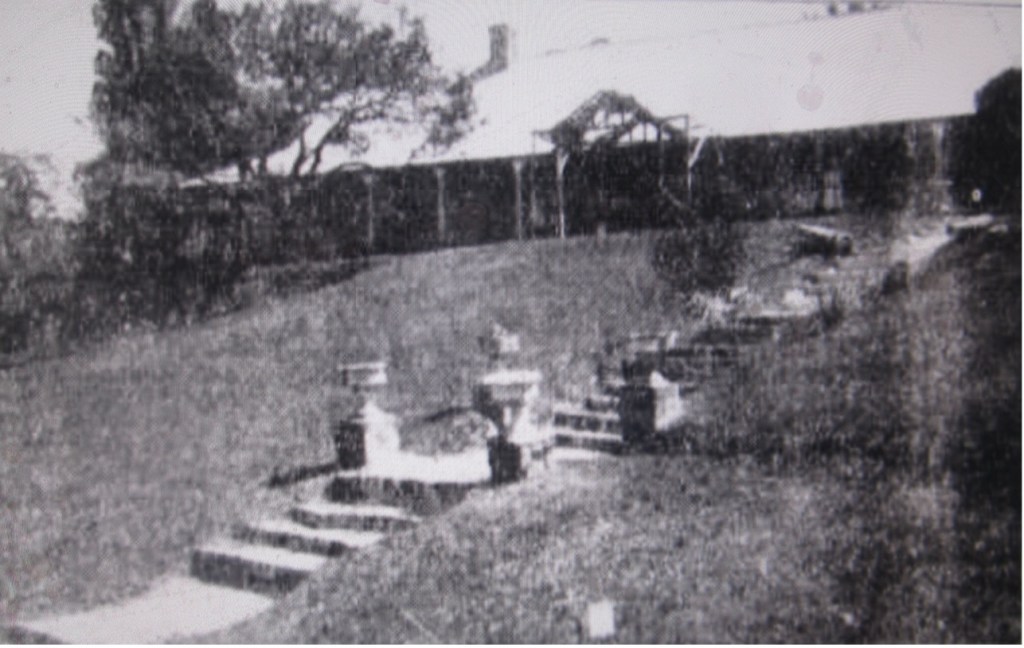
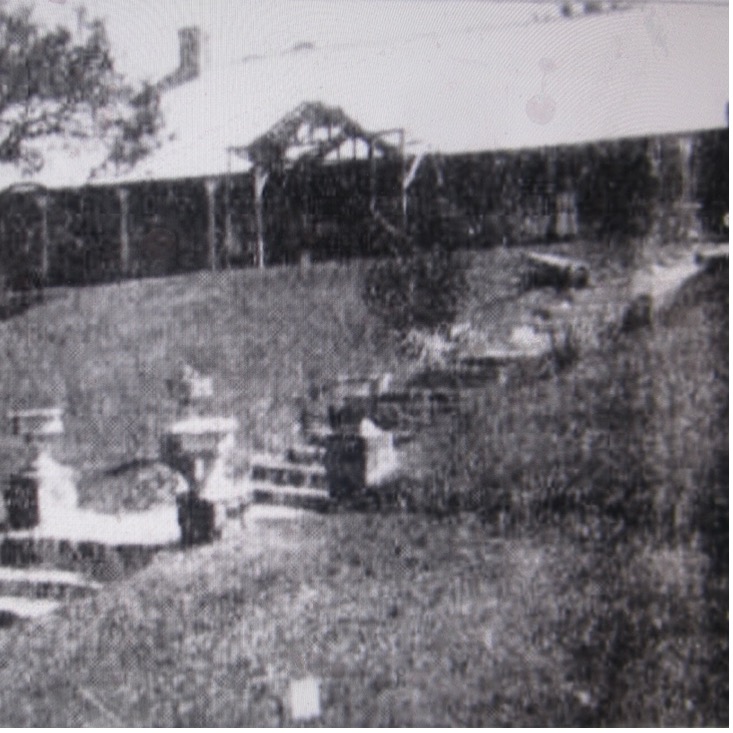
The present-day Tahlee House with the steps leading down to the waters edge, noting the two guns at the top of the steps. [Photo as per The Farmer and Settler, 23 December 1927]
Caribean, it had first been named from its native designation, but Mr. Dawson, a former commissioner, had corrupted that euphonious title. The population of this strange settlement was strikingly heterogeneous. There were men of noble families, the cadet officers of the company, ex-officers of the British army, from the rank of general downward, performing tasks bewildering in their unaccustomed variety; there were sturdy yeomen from the English downs, come across the world to pursue the work of Adam in the new land, farmers dairymen, shepherds, vignerons, gardeners, ploughmen, free servants all, brought out under long contracts to make the fruitful and of the new country produce and multiply.
And there was another class, by far the most numerous, the convict servants and their military guard. Of the soldiers, to whom it fell to herd the human slaves at work, most of the men had been recruited from the 3rd Regiment. The Buffs and had been chosen for their knowledge of the rural districts of England. Officered by Captain Moffatt, two lieutenants and an ensign, their duties were not over-onerous under the benevolent rule of the sailor commissioner.
The convicts, of whom there were nigh upon 300 were an amazing mixture of good and bad. They performed the heavy tasks of the huge establishment — some willingly, striving for early emancipation and the right to rehabilitate themselves in the eyes of society; others sullen, morose, rebellious hating the system that enslaved them and grudging every physical effort they made.
As Sir Edward looked down upon the little village, over whose destinies he held the terrible power of life and death, thoughts of the tremendous responsibility that had been placed upon his shoulders brought a look of stern solemnity to his face. Brave as he was and sternly just, as his later years at Port Stephens proved him to be, he quivered apprehensively as it was borne in upon his mind that few men in this new land were faced with such problems as confronted him. “You seem pensive this morning,” said a soft sweet voice behind him. Turning swiftly, he beheld his wife, standing in the open doorway, a smile parting her softly curved lips. Tall and gracious was Lady Isabella Parry, daughter of old Sir John Stanley, of Alderley, then in the glory of her womanhood. By her side stood their little son, he who had first opened his baby eyes on Australia’s glowing sunlight from the windows of Government House, Sydney, a little more than two years before, and who, in his manhood, was destined to become suffragan Bishop of Dover.
“Yes, my dear,” answered her husband, gently, “I have been troubled because of the great responsibility that has fallen upon me here. This vast estate has to be managed carefully—that is as nought. But my main concern is the spiritual welfare of these unfortunate creatures, bereft of hope and promise, whose services I am forced to use. There are good men among the convicts — men capable of great things; and there are others whose reformation, methinks, is impossible.” “We must do our best for both the good and the bad,” said Lady Parry, with deep sympathy vibrating her mellow voice. “If you will but let me assist, I can do much.” “None knows that better than I,” said her husband, as he tenderly fondled her golden hair.
And indeed, Lady Parry’s memory will live for ever about that pleasant countryside. Today. one may read on a simple marble tablet in the little church, at Stroud, which Sir Edward built a few years later, a loving tribute to her saintly virtues. And history tells of her wondrous courage and sublime resignation when, many years before she waited in her dumb sorrow as the seasons circled round, for the husband that had vanished into the wastes of the Arctic in the cause of science.
As husband and wife stood on the sun-drenched veranda of Tahlee House, each musing on the future, there came the sounds of hoarse shouting and the sharp crash of musket shots from the village. Looking down they saw a man in the hideous yellow of the convict uniform, run crouched and dodging, towards their home. Behind him rushed three red-coated soldiers, firing as they came. “Go inside, my dear,” said Sir Edward, quietly, ‘there is something seriously amiss here, I must go down.”
Striding swiftly along the pathway, Sir Edward made haste towards the running men. The convict perceiving him, began to shout loudly for his protection. The soldiers, noting that their quarry was plainly seeking the commissioner, rather than attempting to escape, slackened their pace and came on at a brisk walk. Their bayonets glittering in the sun, and their pipe-clayed belts gleamed dazzlingly against the red of their jackets. “For heaven’s’ sake, protect me,” gasped the convict, halting before Sir Edward Parry, and bringing his hand to the salute.
Sir Edward spoke not a word. With a frown on his brow, and his eyes stern, he waited the approach of the soldiers. Then he demanded to know what was the matter. “It so be, sir,” explained Corporal Hill, “as sir Robins here make for the bush, trying to bolt. When us challenges un, he runs. Then us shoots an’ chases un to here.”
“Is that so?” demanded Sir Edward of the convict. “I had no intention of escaping sir,” was the reply. “I had business in the bush; and after I had obtained what I was seeking I would have returned.” “And what was the nature of the business?” inquired the Admiral. “That I do not care to state,” was the answer, in flat, final tones. “Then,” said Sir Edward, “if you have no explanation you must put up with the consequences. It means fifty lashes, and they will be administered to-morrow morning at the usual time. Take him to the cells.” The prisoner stood aghast. He gazed at Sir Edward, his lips parted as though about to speak. Then, as though making up his mind to a great decision, he set his jaws and turned on his heel with a precise salute. The soldiers moved to his side.
As the corporal placed his hand on the convict’s arm there was an interruption. A childish voice piped out strange words, and a tiny toddler stumbled through the group to the convict’s side. “Oo,” cried Sir Edward’s little son, “has oo told Santa Claus to bring me pitty things.” There was an amazed silence among the men. The convict, a deep flush on his bronzed face, turned away, his eyes misty with unshed tears. The soldiers grounded their muskets. Sir Edward stood rigid, his face austere and frowning. It was a heinous offence at Port Stephens for any convict to speak to the commissioner’s children, and here was plain evidence of the fact.
“What is this talk of Santa Claus?’ said Sir Edward coldly, to the convict. “Have you been holding communication with the children, Robins.” “Yes, sir,” replied the prisoner, in tones so low that the child did not hear. “But take me away quickly. I am prepared to pay for my offence.” A moment later, Robins, marching in front of the levelled bayonets of the guard, was thrust towards the dark cells in the stockade, there to wait until next morning, Christmas Day, to receive his terrible scourging.
Day dawned, with a mellow glory of warming sun and fragrant breeze that Christmas of 1832. In the stockade, a brooding convict, fettered and manacled, shivered as he beheld the promise of the wondrous morn.

Rear-Admiral Sir W. Edward Parry [Farmer and Settler, 23 December 1927]
And in Tahlee House, a little toddler, ranged about the rambling rooms vainly seeking a special present that Santa Claus had promised to bring. At nine o’clock Sir Edward set out towards the penal establishment to superintend the flogging that had to be inflicted. It grieved him deeply to mar the solemnity of the day by such a sordid act; yet the law had to be obeyed. In his heart he believed that the convict had some good reason for his strange actions, yet, as the man had refused to speak, he would have to hear the consequences. Slowly he paced the broad, grassy path towards the triangles.
There were some formalities to be observed before the flagellation could begin, and these occupied nearly half an hour. At length Robins, white-lipped and quivering, was trussed to the triangles. The scourger stood by the corded flails of his ‘cat’ swinging idly at his side. Capt. Moffatt, military commandant sat on an upturned keg, book in hand to tally the strokes. “Begin!” ordered Sir Edward. “Oh! Stop, stop,” cried a soft, tremulous voice. Sir Edward swung on his heel to behold his wife, with their little son in her arms, standing at the nail-studded gate of the stockade. “Do not flog that man. I can tell you something that will make a difference.”
Sir Edward, who long since had directed his wife to remain far away from the settlement lest she witness deeds of horror, realised that some potent reasons must have impelled her to pay this unexpected visit to the flogging ground. Going swiftly to her side, he placed his arm about her shoulders, and, gazing into her tearful face, asked why she had come. “I have just learned of this punishment, and I have found out why Robins was going to the bush. The nurse girl had often taken our boy to the dock where the shipwrights work, and Robins, who is your most skilful artisan, there promised that Santa Claus should bring him a toy yacht to play with. The man had been making it in secret, as you know he would not be permitted to do it otherwise, and he had hidden it among the rocks on the hill. He was going to fetch it when the soldiers saw him. Cannot you spare him this time. He did it for our little one, and I am sure he meant no harm.”
Sir Edward stood in silent thought for many moments. Stern and just was he, and he knew that the convict had broken the law in doing what he had done. Yet the sentiment of the thing touched his heart. “I will spare him,” he said to his wife. “For the sake of our little boy.” Then, turning to the group about the triangles, he gave a curt order that Robins should be cast off. The convict’s arms were unbound, and the rough, shapeless yellow jacket that had been thrown across his shoulders was put on and buttoned up. Commanding all except the prisoner to retire out of earshot, Sir Edward spoke. “Why did you not tell me yesterday that you were making a toy ship for my little boy” he asked the abashed convict. “Had I spoken,” said the man, “the toddler would have heard and understood that Santa Claus, was on this occasion, an enslaved felon. I would gladly have died rather than that a child should have the simple faith of youth so ruthlessly destroyed.”
Sir Edward gazed in utter amazement at the shabby tattered figure that stood so bravely before them. “Would it be an impertinence if I asked what you were before you fell upon this plight?’ asked the commissioner, looking into the eyes of the convict. Robins met that inflexible gaze with a glance that did not waver. Then he looked across the compound where stood the child, smiling serenely info his mother’s face. “I was a gentleman once,” he said, simply. “And a father.” The great admiral clicked his heels together. His hand swept up to his cocked hat in a salute, and there was a flush on his face as he spoke. “And you are still a very gallant gentleman!” he said.”
The following papers are also published on this website about Sir Edward Parry, and the Australian Agricultural Company at Port Stephens:
Return journey of Sir Edward Parry to England.
Researched and compiled by Kevin McGuinness
September 2023

 Port Stephens - a history exploration