
In October 1835, a small boat sailed into Port Stephens, unnoticed by the locals. The small population of the area was accustomed to seeing craft enter the harbour seeking shelter from rough seas. They usually only stayed one night and left the next morning without attracting any local interest.
Little did the locals know that the small sailing craft, Alice’, had a crew of convict who had absconded from Sydney. They had indeed ‘pirated’ the 20 tonne sloop, Alice which belonged to William Charles Wentworth and stole property from his residence at Vaucluse House In Sydney. They then set sail up the east coast.
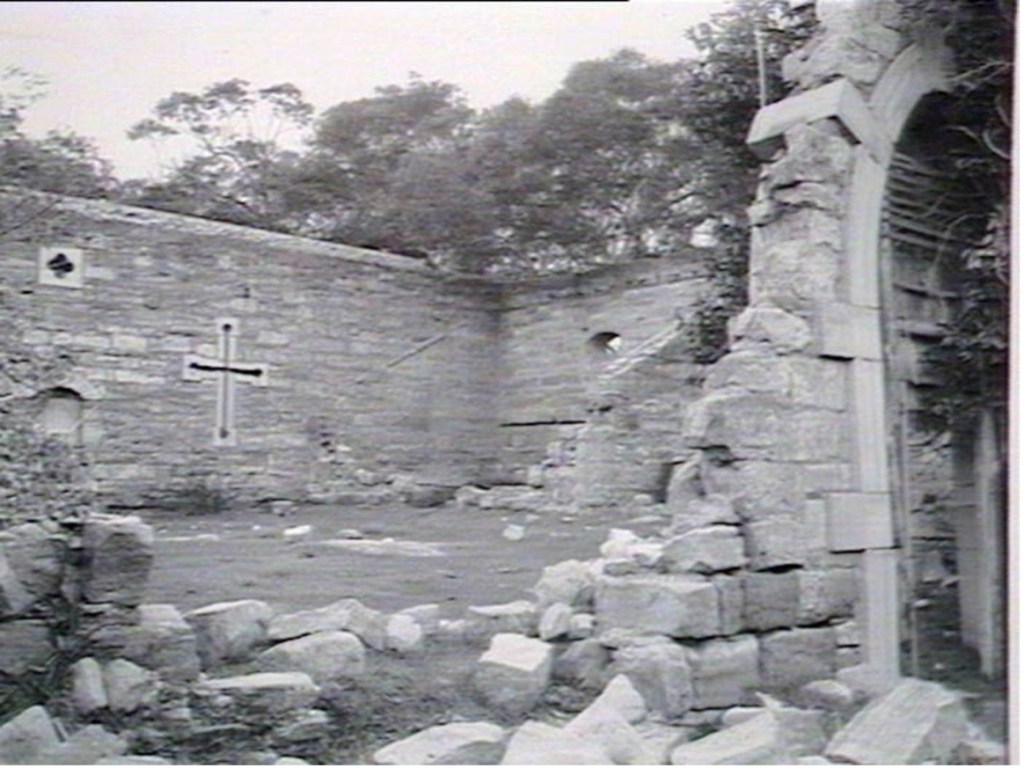
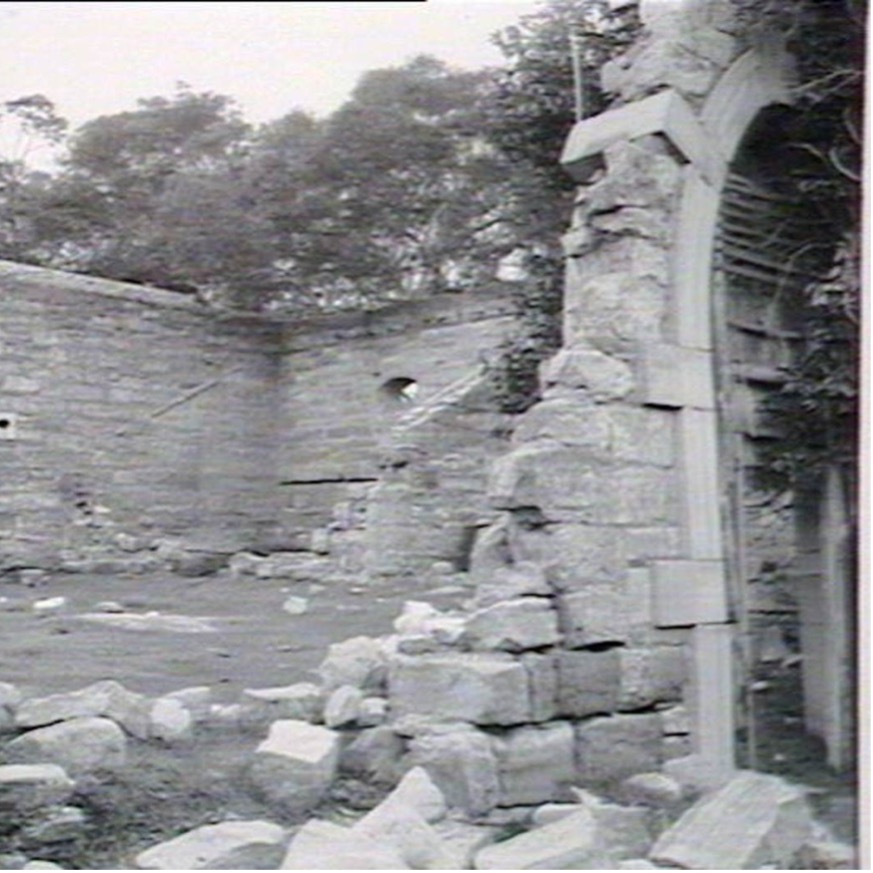
Ruins of the stores building at Vaucluse House, Sydney, also used as servant quarters [State Library of NSW]
This paper is the story of the convicts’ daring escape from Sydney Harbour, their visit to Port Stephens, their subsequent capture and trial.
Details of the escape
The Australian of 20 October 1835, page 2, reported:
‘On the morning of Friday last [16 October 1835], the inmates of Vaucluse, the property of Mr. Wentworth [William Charles Wentworth], discovered that the Alice, a sloop of about twenty tons belonging to that Gentleman, and which he had recently purchased for the sum of £100, had disappeared in the night; it was soon found that five of Mr. Wentworth’s convict servants, one of whom was the footman who had charge of the property in the house, two from Mr. Siddons’s at the Lighthouse, [Macquarie Lighthouse] and one from Mr. Wieland’s, the Pilot, together with a pilot boat belonging to the latter, had also vanished. A large quantity of property consisting of wine, spirits, provisions, plate, &c. to the value of £150 belonging to Mr. Wentworth was also missed, as well as Mr. Ross, the Master of the Alice, who it is supposed was forced to accompany the runaways as sailing-master.
The Revenue Cutter was immediately despatched in pursuit — but as several hours had elapsed before the loss was discovered, those who are authorities on the subject do not anticipate their capture. A. strong southerly gale was blowing during the night and till a late hour the next day — if then they escaped going to the bottom (which considering the size of the craft and the tremendous sea which must have been running at the time, is by no means certain) they had such a start as sets pursuit at defiance.
It is supposed that the runaways would have steered in a north-easterly direction, so as to fall in with some of the Islands in the direction of the friendly Islands, unless they were compelled by stress of weather to run up the coast, when they would probably be driven on shore in the neighbourhood of Port Macquarie. The Lucy Ann, a remarkably fast-sailing schooner which was built for the fruit trade in the Mediterranean, has also been despatched up the coast in pursuit—so that on the latter supposition some tidings may probably be heard of them. The pilot boat which was taken from Mr. Wieland is a very valuable one, with all her gear complete; it is a most serious loss, and one which we trust will be repaid to him from some source or other.’
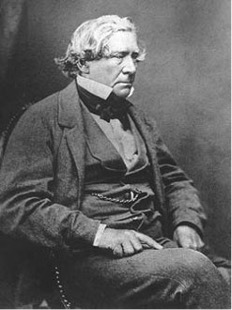
William Charles Wentworth [State Library of NSW]
The Sydney Herald of 22 October 1835, page 3, further reported:
‘The fellows who committed so many depreciations and eventually ran away with Mr. Wentworth’s sloop Alice, have been heard of on the coast, as we expected, in consequence of some of the parties making their escape. It appears that the master of the Alice, and another free person, were compelled to accompany the runaways on their unlawful expedition, holding out promises of reward if they would navigate them safely out of the Colony, and threatening something more unpleasant if they did not comply.
There were nine Convicts in the party of runaways on board the Alice, and who contrived to steal out of the harbour (it is supposed by towing the vessel) about half-past one in the morning of Friday last. On getting out to sea they cut adrift the boat they stole from Mr. Wielands, which if not gone to pieces, will be found within a few miles to the northward of the Heads. It being a rough night the runaways were attacked with sea-sickness, and being in want of water the fellows had the imprudence to put into Port Stephens for that purpose, when Mr. Ross, the master, requested they would permit him to go ashore, saying he would rather be thrown overboard there than proceed any further with them. They said they had plenty of property on board, and he should have his share.
Finding him resolved not to go any further with the sloop, to prevent any disturbance, they had a consultation and agreed to put him ashore upon the condition, that he should swear to proceed direct for Newcastle, which he did, and was landed. The other free person who had been forced into their service, they sent ashore with one of their party to procure water; but this man had the dexterity and good fortune to escape from his guard, and make the best of his way to Newcastle, and from thence to Sydney in the sloop Hyndes.
After landing the master, they left Port Stephens and bent their course in an easterly direction. In about two hours after the Alice sailed, the Prince George, Revenue Cutter, fortunately arrived at Port Stephens, and upon Captain Roach being informed of the circumstance he immediately started in chase of the runaways. It is therefore not improbable that they are all in the hands of justice by this time, and on their passage to Sydney. It appears too, that not one of the fellows on board the Alice, except the master, knew anything of navigation, or even the common utility of the compass, they will therefore be under the necessity of sailing in whatever direction the winds propel them, which removes all difficulty as to their capture.
The runaways had on board three hundred weight of flour, a keg of tobacco, and some tea, but no spirits, or any other provisions. Previous to leaving the harbour, it appears that the fellows had become acquainted with the fact of the Revenue Cutter being unrigged, for they mentioned the circumstance, and said they would be far enough away before that vessel could come up with them. All the plate the people saw on board were two silver spoons, but the rest might have been below, —but this was kept secret by the fellows. The pirates used no violence towards their prisoners except threatening language, and placing a centinel over them with a carving knife in his hand. They also, occasionally, boasted of firearms they had below, but none were exhibited. The runaways stated that if the Revenue Cutter came up with them they would scuttle the vessel rather than be taken to Sydney to be hanged. The Revenue Cutter is expected in Port either today or tomorrow.’
Security of Sydney Harbour examined
The Sydney Gazette and New South Wales Advertiser of 22 October 1835, page 2, published the following commentary following the piracy of the small sloop Alice:
‘We perfectly coincide with our contemporary on the propriety of censuring the Local Government’s apathetical indifference as to the present insecurity of our harbour against either foreign invasion, or internal piracy. We think that not only is the water police inefficient, and the preventive or revenue cutter ineffectual for the purposes for which they were intended; but that it is incumbent on the Executive to represent to the Home Government the absolute necessity of having an adequate marine force permanently established on this coast. It is not because we have never yet suffered very materially from the predatory attacks of pirates, or that we have never yet been invaded by a foreign foe, that we are to imagine it is not unnecessary we should adopt those measures for guarding against outward attack, for inward aggression, which the proper security of any port would naturally suggest itself to those charged with the defence of it.’
Alice found abandoned about 40 miles north of Port Stephens
The Australian of 30 October 1835, page 2, reported:
‘Mr. Wentworth’s, cutter, the Alice, which was seized some little time back by runaways in the Bay of Vaucluse has been found ashore about 40 miles north
of Port Stephens; it will be recollected that after putting the two free men on shore at Newcastle she proceeded on her way with the intention as was supposed of making for some of the Islands; want of knowledge, however, or of courage, has landed them on the coast, where they will either starve, be murdered by the natives or be captured.
It is a positive fact that persons on the hills bordering on the coast saw the Aiice and the Revenue cutter at the same time on the morning of the day they reached Newcastle — and had not the latter been obliged to put back for provisions, there is no doubt but that the capture of the runaways would have taken place before night. The Alice is said to have been scuttled and dismasted previously to being abandoned.’
Capture of the convict escapees and their subsequent trial.
The full story of the ill-fated adventure of the convict escapees is contained in the court proceedings of their trial, as reported in Sydney Herald of 2 November 1835, page 2:
‘The following prisoners of the Crown, who seized the Alice for the purpose of escaping from the colony, after having broken into the stores of W. C. Wentworth, Esq., of Vaucluse, on the night of Thursday, the 15th ultimo, from which they took a quantity of provisions, wine, and plate, were put to the bar [placed before the Court], having been captured by the crew of the Revenue Cutter, under the command of Mr. John Roach, near Port Stephens :— Joseph Kay, Joseph Hurst, James Brennan, Thomas Stodhart, Thomas Brennan, John Williams, John Hanson, Thomas Ford, and John Stockwell, prisoners of the Crown, five of whom were the assigned servants of Mr. Wentworth, two in the employ of Government at the Lighthouse, and two others assigned to Mr Weyland, Pilot of the Harbour.
Hamilton Ross deposed as follows:—I am a free subject, I and my mate, John House, had charge of the ketch Alice, belonging to Mr. Wentworth and lying in Vaucluse Bay, on the evening of Thursday, the 14th ult.; I was asleep on board that evening, when I was alarmed by the sound of a boat coming alongside, and a number of men boarding ; I immediately got up and called my men, and was proceeding on deck, when a man stopped me on the ladder, and desired me to remain below; he said they did not mean to hurt me, but would let me go at The Heads.
The prisoner Williams belonged to the vessel, he was then below with me, I called him, and he proceeded on deck ; I was not aware that he was a party in the transaction, the true nature of which I readily comprehended, seeing him allowed to pass on deck; I asked him if he were in the “concern”, he said he was; he was a ‘lifer’, and thought himself justified in trying to get away from the country; I remained below, and knew nothing of what passed on deck until I got outside the Heads.
I repeatedly requested them to put me ashore there, stating my apprehension for the vessel and pointing out the danger she ran from the heavy weather, they said we were not far enough to the eastward to render it prudent to allow me to go ashore, and refused to comply with my request. I still reasoned with the prisoner James Brennan, who was then at the helm, and endeavoured to induce him to keep in shore, and continued my solicitations to be allowed to leave the vessel, they said I could go ashore in the boat, to which I objected expressing myself apprehensive of danger in an open boat in such a sea; in looking aft, however, I found the boat was gone; Williams said I could take the small boat belonging to the Alice. Brennan appeared to have the command; as the best way of effecting my purpose, I suggested the propriety of taking in the mizen, I knew they were unable to steer the vessel, and would not understand my meaning.
I was ordered to take the helm, which I did, and gradually neared the land; perceiving what I was about, Brennan was put over me to watch my motions, and to make me steer off, I still continued to bear on the land, for which I was rebuked; I said I could not help doing so; I was then ordered to leave the helm, and Stockwell took it; before we reached Newcastle I was ordered below; there was a heavy sea running, and I was called up again to take the helm, when I went up I found we had passed Newcastle, but they had agreed to go into Port Stephens; we were then six or eight miles distance.
On going into Port Stephens, we were passed by the Company’s schooner; I dare not make any attempt to run her up to the schooner, as there were five of the pirates then on deck; we came to an anchor about dark in Nelson’s Bay or Salamander Bay; we anchored on the same side of the Bay as the schooner put in at, but she did not anchor, as she went on towards the settlement [at Carrington], and we lost sight of her, we then came to an anchor for the night and had supper ; the hatches were down in consequence of the heavy sea, and I did not see what provisions they had on board, but I heard them say they had three bags of flour, one bag of sugar, and a keg of tobacco; they had taken a case of wine from Mr. Wentworth’s store, but it fell overboard in taking it from the boat to the vessel in Vaucluse Bay.
Some of them called for the ‘sword’, when a large carving knife about two feet long was produced; there were silver spoons used at tea two of them kept watch on deck while the rest were at tea; on the following morning, the boat was got out for the purpose of going ashore for water; the prisoner Hurst and my mate, House, were appointed to go ashore; it was then about half past six o’clock; House was acquainted with the harbour, and knew where to find the water, which was the reason he was selected for that duty; after the boat put off, the prisoner Kay asked me if I would join them; I told him I would not, I was a free man, and was able to get a living in the Colony, and would not make myself a party in such a transaction; I was then ordered to go below; Stockdale made signs with his eyes as I was passing him, which I understood to mean that I would not be hurt.
I remained below about a quarter of an hour, when I was again called up and asked if I would volunteer to join them, and as a reward for my services the vessel would be mine the first foreign port we put into; I peremptorily refused, and said they might either allow me to go ashore or put me aside altogether, as I was determined not to leave that harbour with them; I was again ordered below, and a consultation was held; I could not hear what passed, this consultation was much longer than the first; at this time the boat which had been sent ashore for water returned to the vessel, with a native black who had some fish for sale; House did not come on board anymore; the vessels sent on shore for water were a small keg and an iron pot.
The result of the last consultation, which was, that I should go ashore was communicated to me by Williams and Stockdale; I put my things into the boat, and assisted them to put the water on board; before I went on shore the prisoner Kay called me aft and gave me a written discharge from the vessel, and an order on Mr Wentworth for my pay, to which he attached his signature as commander of the Alice; I then went ashore; the schooner was not then in sight, having passed on to the settlement.
I joined House, and we made the best of our way to a native camp at some distance in the bush, and requested them to furnish us with a guide to Newcastle, one man agreed to accompany us, and we gave him a blanket on starting; when, however, he found we were in distress, he demanded something at every four or five miles or refused to proceed, we reached Newcastle, and thence proceeded to Sydney; Stockdale and Williams took the most interest in our safety; Kay said they had plenty of plate on board, and we should have share of it if we consented to join them; I did not hear the particulars nor the quantity of the plate; Kay said it was taken from Mr. Wentworth’s house, but not in what way; I did not hear who were the parties by whom the robbery had been committed; I heard Brennan say he had been put as a guard on the overseer, I heard nothing about pistols ; according to their account I understood the robbery to have been committed by Mr. Wentworth’s men; Brennan was armed with a razor and a stone, and another of the prisoners was stationed on Mr. Wentworth’s bedroom door. John House, Mate of the Alice, corroborated the evidence of Ross.
Mr Wentworth deposed, that on the morning of Friday, the 16th ultimo, he was awoke by alarm that the store had been broken open during the night, and that the Alice was missing from the bay; four of the prisoners were also missing; Hanson was not missed until about two hours afterwards; on examining the store witness discovered that an entry had been effected by removing a bar from the window, and that the lock had been screwed off from the inside, in order to take away a quantity of flour, sugar, and tobacco, which were missed by the servants; witness also missed the plate chest which the prisoner Kay had charge of, the same of which was about £100, consisting merely of spoons, forks, ladles, and some other small articles; witness stated that the store was in fact a dwelling house, part of which was occupied by some of the servants and the children.
The prisoner Kay left his box behind, which on being searched by Mrs Wentworth and a maid servant, was found to contain a package of poison, which from his general conduct he (Mr. Wentworth) had no doubt was intended for him; he had had occasion to get him punished about six weeks ago for drunkenness and intolerable insolence, which he had borne for a considerable period, and he had no doubt that he had made himself the ringleader from a spirit of revenge. The witness Ross had confirmed that fact from the mouth of the prisoner himself.
Ross recalled. – The prisoner Kay desired me on leaving the vessel, to tell Mr Wentworth on my arrival at Sydney, that if he had not got this revenge, meaning the seizure of the vessel he would have ‘settled him’; I told him it was a foolish observation to make, and which I would be backward to communicate to Mr. Wentworth, requesting him to retract his words and relieve me from the task, but be said he was serious and insisted that I should inform Mr. Wentworth of it.
Captain Roach of the Revenue Cutter Prince George, deposed that on the morning of Friday the 18th ultimo, he received a note from Major Gibbs of the Customs, about eight o’clock, informing him of the piratical seizure of a vessel belonging to Mr Wentworth, and recommending him to proceed to sea with all possible despatch in pursuit; witness lay to in Broken Bay about three hours, but not seeing anything of the vessel he proceeded to Newcastle, and enquired if such a vessel had entered during the day, the pilot informed him that a vessel of the description named had been seen, standing away to the northward as if going to Port Stephens; witness left Newcastle and in about seven hours afterwards on looking from the masthead saw a sail ahead, to the north; there was a strong southerly wind, and the prisoners seeing them in chase, hauled wind and stood close in shore; a boat put off but there was a very heavy surf and witness supposed it was upset, for the vessel finding it did not return, ran ashore.
The men were seen to leave the vessel and betake themselves to the bush; from the heavy breakers at the place where the Alice lay, the Prince George was unable to approach her, and witness put her into a Bay at some distance, walking round to the ‘Alice’; three bags of flour, a bag of sugar and some tobacco were found in the vessel, which were thrown overboard so as to prevent the prisoners from getting supplies during the night;.
Witness and six of his men armed with cutlasses went in pursuit, and
tracked the pirates four of five miles; when further traces of them were lost; witness and his men returned to the ‘Alice’; she had been driven higher up on the beach, and was buried several feet in the sand, the sails were still bent, and to render her removal still more impossible, witness cut away the masts; a small box was found on board the ‘Alice’ with the key in it which was found to contain plate, and which was removed to the Cutter which then sailed for Port Stephens, where witness communicated with the Police Magistrate and who sent out a body of police to assist in the capture of the pirates; some native blacks were met by the parties in pursuit, who informed them that some whites ‘sat down’ at a place which they pointed out, about fifty miles from Port Stephens, and whither the parties directed their pursuit.
The cutter proceeded up the Miaul [Myall] River, where she was joined by the crew and prisoners in custody, they having captured them at the place pointed out by the blacks; they were surprised while sitting around a fire, and made no resistance. The prisoners were remanded until this day for further examination.’
Reward paid to the crew of the Revenue Cutter Prince George
The Colonist of 12 November 1835, page 3, reported:
‘His Excellency the Governor, we are happy to hear, has handsomely rewarded the crew of the Revenue Cutter, Prince George, for their exertions in capturing the pirates who attempted to escape by the Alice. ……His Excellency’s [gave] approbation [praise] of the conduct of Mr. Cook the Police Magistrate at Port Stephens, for the prompt and decisive measures adopted by him to aid the Revenue Cutter in her search ought certainly to be shown.’
Prisoners Sentenced to Execution
The Colonist of 26 November 1835, page 3, reported:
‘The pirates who were convicted of burglary and of feloniously seizing the ketch Alice, with the intention of making their escape from the colony, were sentenced to be executed.’
Concluding Comments
Only a small number of convicts absconded permanently from the Colony of New South Wales. The odds were stacked against convicts experiencing an extended taste of freedom, while still under a sentence of transportation. However those odds did not prevent them from continually trying.
The escaped convicts who visited Port Stephens were no different and were to pay with their lives for their small taste of freedom.
Further information regarding a number of convicts who spent time at Port Stephens is set out in this website under the subject heading of A Focus on the Convict History of Port Stephens.
Researched and compiled by Kevin McGuinness
June 2023

 Port Stephens - a history exploration