
Introduction
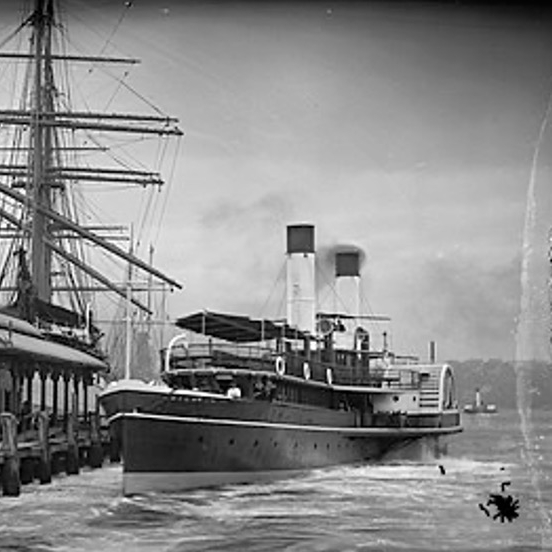
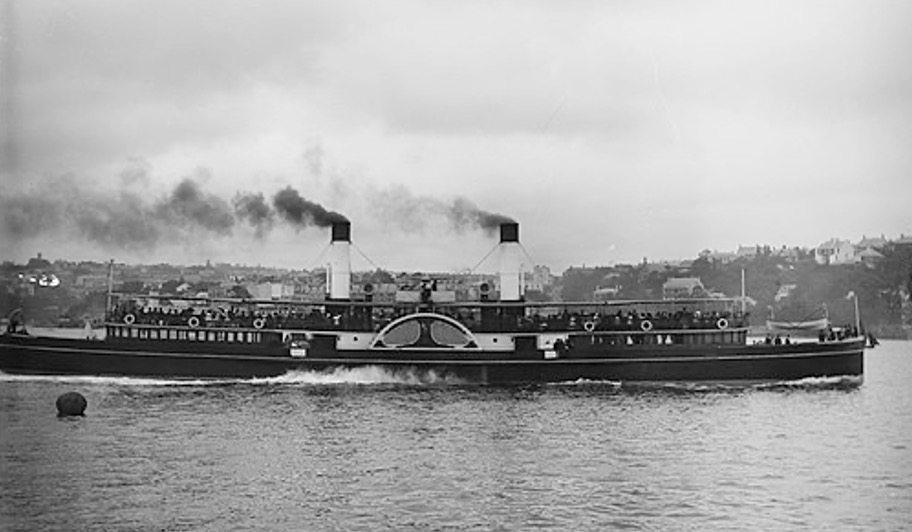
The paddle steamer, Brighton, was a ferry that operated on the Circular Quay to Manly run from 1883 to 1916. Over that time, it carried thousands of passengers.
It was built in Scotland and arrived in Sydney on 1 September 1883, with much fanfare, for service in the Port Jackson Company. It was the last paddle steamer to operate on the Manly run when it was retired from service in October 1916.
It was then sold and converted into a lighter and sent to Port Stephens in 1922 for use in the timber trade.
By 1928, the Brighton was no longer used in the timber trade and was moored as a hulk in the Duckhole area, near Pindimar, Port Stephens.
The story of the Brighton ferry is the subject of this paper.
Brighton in Port Jackson
The Brighton withdrawn from the Circular Quay to Manly Ferry Service – 1916
The Australian Town and Country Journal of 1 November 1916, page 49, reported on the history of the Brighton and its withdrawal from ferry service.
‘One of the best known of the Manly ferry steamers recently passed out of the service of the Port Jackson Company and has been handed over to the shipbreaker to be reduced to a hulk or lighter. Mr. W. Waugh, of Darling-street, Balmain, was the purchaser of the old vessel.
The Brighton, which has a history as far as the Sydney services are concerned, was launched on the Clyde, Scotland, in 1883, and was called the Port Jackson, but when the time came for her trial trip there, she was renamed the Brighton. That trial trip was made the occasion of a great event on the Clyde, as the Brighton was the first of her class to be built, despite the fact that the Fairlight was also constructed overseas and came out to Australia under her own steam and sail.
The company’s manager of that time was Mr. Richmond, and he was sent to Scotland to see the vessel built. When the speeches were made at the builders’ banquet on April 20, 1883, one said: “The station to which the Brighton would sail to from Sydney, was in the same relation as Brighton was to London, and the class of passengers that will travel on board is composed of the first grade of Colonial aristocracy.”
On September 24, in the same year, the Brighton, with flags flying and a distinguished company on board, ran her official trials in Sydney, and since then, probably no other ferry steamer has been more closely associated with the development of the port. She came out from the Clyde under steam and sail, just as the photo on this page shows her [see below]. She was schooner rigged, and made the voyage via the Suez Canal, Singapore, and Torres Straits.
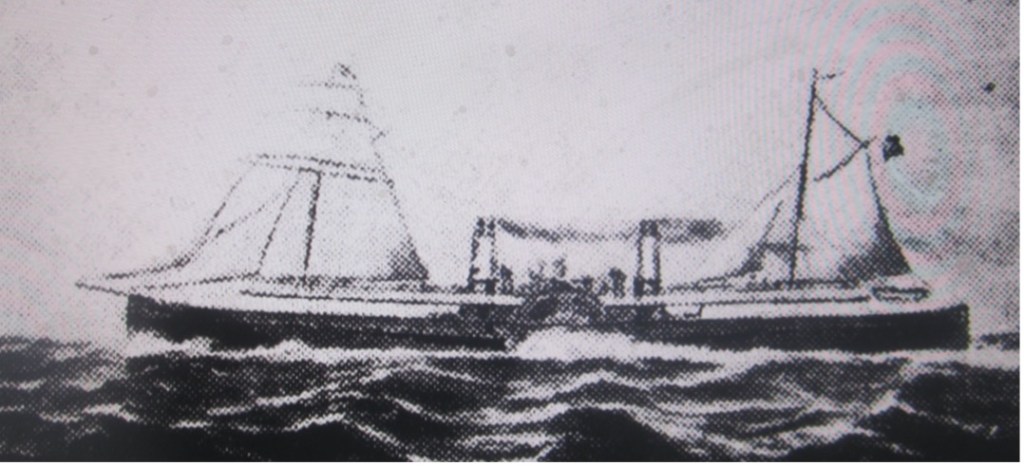
Brighton leaving Scotland for Sydney [Australian Town and Country Journal, 1 November 1916]
There is a story to the effect that the vessel had such a tempestuous trip that all her internal fittings had to be burned as fuel. This account is not true. The vessel did burn up a quantity of timber, but not because she had run short of fuel. She had been decked-in fore and aft to enable her to make the long voyage from the Tail of the Bank to Sydney, and if she had brought, all this extra dunnage into port, a heavy duty would have been imposed. It was cheaper, therefore, to burn it. The fact that it was disposed of in the ship’s furnaces no doubt gave rise to the story that she had run short in the bunkers.
A glance at the records shows that the Sydney trial trip, on September 20, 1883, was attended by W. B. Dalley, Q.C., M.L.C., J. P. Abbott, M.L.A., W. J. Trickett, M.L.A., Sir Patrick Jennings, M.L.A., T. M. Slattery M.L.A., J. Harris, M.L.A., J. C. Ellis, M.L.A., E. Barton, M.L.A., Captain T. Heselton, Captain Benj. Jenkins (President Marine Board), Lieutenant Lindeman (Marine Board), J. Woods, J. Carey, C. H. Hayes, Chas. Cowper; Alderman Playfair, and others.
Few of that company are alive today, but the speeches delivered indicate that the trip was an important one. Mr. Dalley spoke of the development of Sydney, and the enterprise of the company, Mr. John Woods and Mr. Carey replied, and Mr. Hayes, then Mayor of Manly, added his tribute to the work of the company. This speaker pointed out that the company had given Manly £900, towards certain improvements. The Brighton was described as a vessel far ahead of the times, and it is a fact that the first captain of the vessel did not take his ship alongside the wharf, as was done later on. He would lower his lifeboat and send a line asbore just as they do nowadays while, berthing a ten-thousand tonner. No one grumbled at the delay; it was thought that the skipper knew best, and so the Brighton was always breasted in as a big ship ought to be.
When the vessel came to Sydney 33 years ago, the Manly fleet comprised the Fairlight (since broken up), the Emu (Brightside), and the Royal Alfred. These steamers ran a timetable providing for a maximum of seven trips a day. They called at Woolloomooloo Bay en route. An advertisement of 1878 reads:— “Excursion to the sea side, in the drawing-room saloon steamers Emu and Royal Alfred.” The fares were 1s 6d return, as against 8d return charged nowadays. The Brighton was placed on the 8.10 a.m. trip from Manly. This trip, as it is now, was the popular trip, that is to say, more people caught the 8.10 than any other. The trip was placed on the timetable as far back as 1879, and has not been altered since.
During the last seven years of her active service between Sydney and Manly, the Brighton covered over 120,000 miles, A record of the number of passengers she carried is not available, but as she had a permit for over 1000 persons, it can easily be reckoned that she carried a great many persons, including all grades of “colonial aristocracy.” The company has long since given up the idea of sending to England for ships. They get all they want built at Sydney, the present fleet having been turned out by the Mort’s Dock Company. The paddle wheelers, with the exception of the locally built Narrabeen (now a cargo boat) are out of the running, the fleet comprising fine types of double-ended screw ships.
Instead of making seven trips a day — first at 7.15 a.m. and the last at 6 p.m., the company’s timetable now provides for 47 trips daily. The passing of the Brighton removes an old link of the past. She is 220 feet long, with a beam of 23ft between the paddle-boxes, and 45ft over the boxes; depth to the main deck, 11ft 3in; to the saloon deck, 18ft; and about 400 tons. In the long career which the old ship enjoyed in the Sydney-Manly service, the Brighton only had one serious smash. She was in collision on August 7, 1900, near Bradley’s Head, with the steamer Brunner, and had to be beached at Chowder Bay. She had a big hole in her side and settled down in the sand. The refloating was accomplished a few weeks later.’
The Daily Commercial News and Shipping List of 26 August 1922, page 8, reports that the tug ‘Glebe’ towed the Brighton arrived into Port Stephens on 25 August 1922, arriving at 10.40 a.m.
Brighton Ferry at Circular Quay, Sydney Harbour
Court Orders the removal of two hulks in Port Stephens – 1928
The Dungog Chronicle of 6 July 1928, page 1, reported:
‘Two hulks — the Brighton and the Sydney — are lying on the north end of the Duck Hole, Port Stephens, in such a position that they are considered a menace to punts navigating between Windiwappah [Winda Woppa] and Wendibin Creek. ……
Inspector Page ….. proceeded against G. L. Maslen for not removing the hulk Brighton when notice was served to do so. Defendant did not appear and the case was heard ex parte. It was stated by Inspector Page that Port Stephens was known as a very stable port, where the soundings did not vary in 50 years. As a result of the stranding of the hulk, however the depth of water in one part of the Duck Hole had been increased 11 or 12 feet, while in an-other part a shoal had been created. The magistrate ordered a warrant to issue which will enable the Navigation Department to take effective steps for the removal of the hulk. Court costs (3/6) were awarded against defendant.’
Hulks moored at Duckhole, Port Stephens, circa 1930 [State Library, New South Wales]
An unexpected meeting with the Brighton – 1931
The Sydney Mail of 14 October 1931, page 4, reported on an unexpected meeting by some Port Stephens visitors with the old Brighton:
‘At Pindimar, a little village on the northern shore of Port Stephens, we came across a group of hulks. Near the mangroves and hard and fast in the mud they were, resting after their years of battling with the seas. Two were of little interest to us; but the lines of the third were familiar, and on investigation we found a famous old ship, never seen by the present generation, but well known to the “oldsters.” Hunting about, we found the name “Brighton” under many coats of cracked black paint. And at the word what visions of Manly of the ‘eighties sprang to the mind!
Sitting there on her bow, a desire came to know more of the vessel’s early history, and an old issue of the “Illustrated London News,” dated April 28, 1883, gave construction details, which briefly are: — Length, 220ft; breadth, 23ft; depth, 18ft. She was equipped with paddles driven by compound diagonal oscillating engines of 1000 horsepower, and on her trials exceeded a speed of 17 miles per hour, a speed that even the newest boats would do well to equal.
For over forty years she gave faithful service to the public of Sydney and Manly, and, then being superseded on that cross-harbour service by more modern designs, she was sold as a hulk for use in the timber trade at Port Stephens. After many years at this she finally retired from business; but instead of being ignominiously scuttled at sea she was laid to rest on the mud at Pindimar. And there she now lies, her decks covered with hardwood telegraph poles and her sides a mass of fat oysters.’
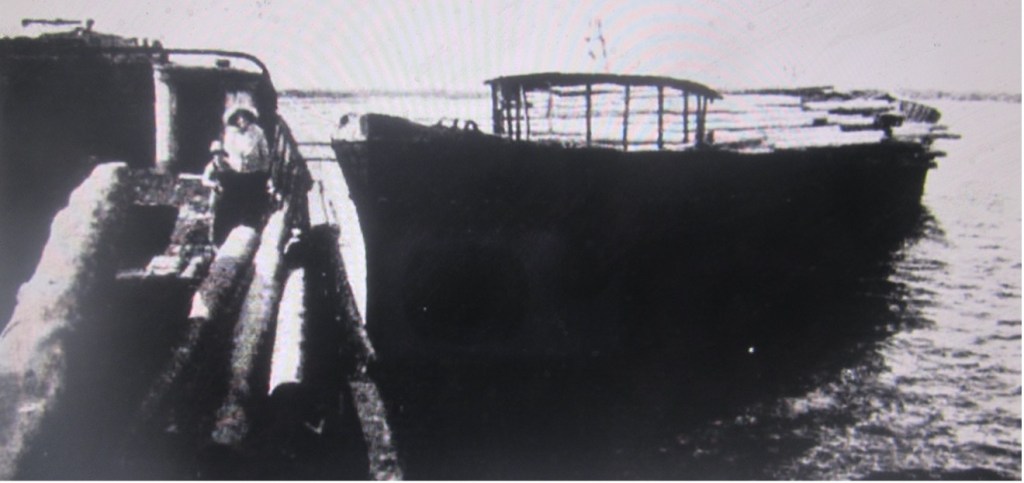
Telegraph poles on the Brighton hulk at Port Stephens [Sydney Mail, 14 October 1931]
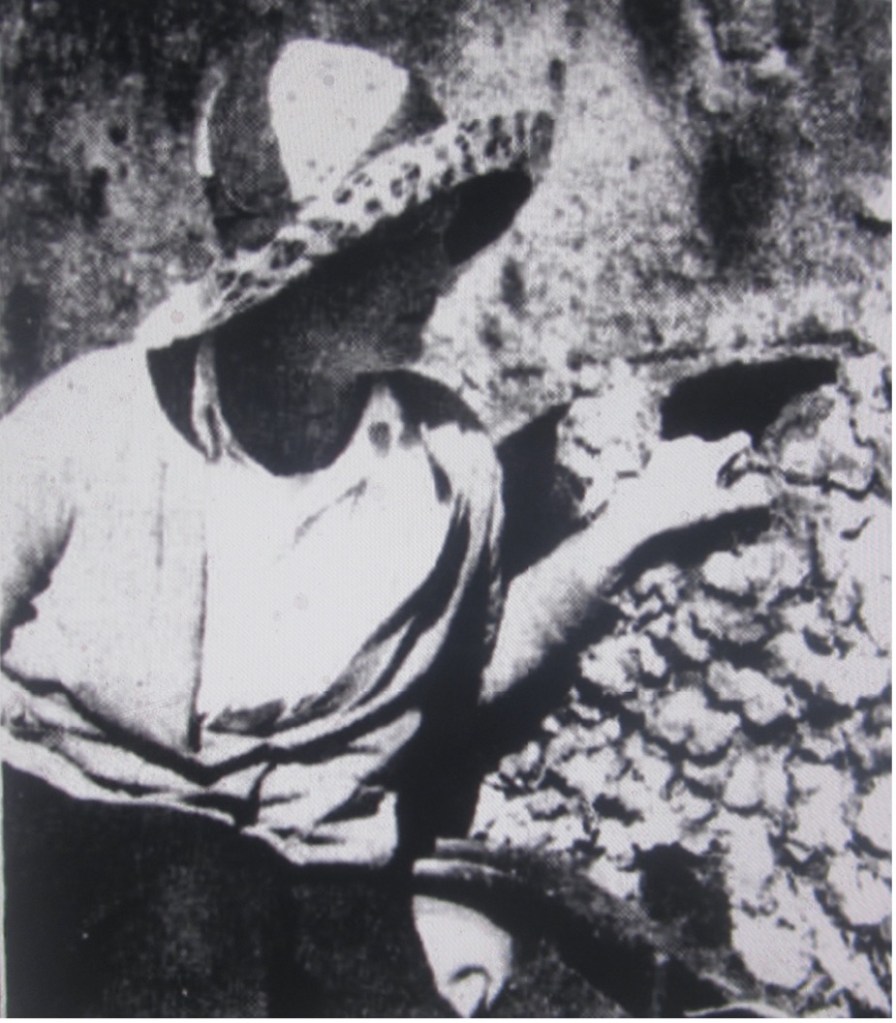
Oysters growing on the hulk of the Brighton [Sydney Mail, 14 October 1931]
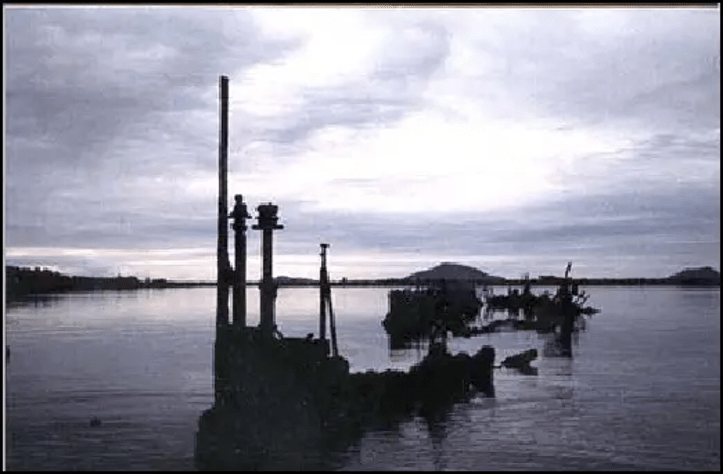
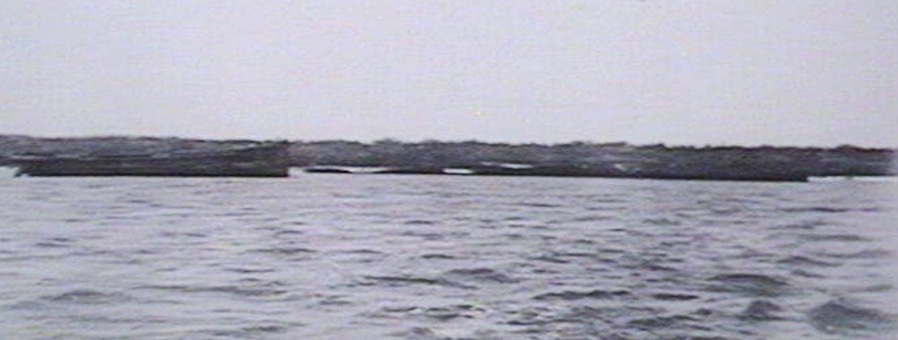
Hulk of the Brighton Ferry, 1999 [The Maritime Archaeology of Myall Lakes / Tea Gardens: Area Conservation Plan. Heritage Office, June 1999]
Concluding Comments
The story of the Brighton is just one of many told of ships of varying types and sizes that saw their final days in Port Stephens.
Information on other boat hulks on Port Stephens is published on this website and can be viewed at the following links:
Hulk of the ‘Salamander’ Drogher at Port Stephens
Hulk of the ‘Iluka’ Drogher at Port Stephens
Hulk of the ‘Terara’ Drogher at Port Stephens
Researched and compiled by Kevin McGuinness
September 2023

 Port Stephens - a history exploration