

Introduction
If you visited Little Beach at Nelson Bay in 1950, apart from the Inner Light House which was visible on top of the adjacent hill, a military wharf in the centre of the beach and numerous huts, of varying design, were the prominent features.
The history of these huts and the military wharf is explored in this paper.
THE HUTS
Construction of the huts
The first huts at Little Beach were established in 1926. The huts were mostly constructed by miners from the Kurri and Cessnock regions. To erect a hut, it was first necessary to obtain a ‘permissive occupancy’ from the Department of Lands. The procedure was simple and involved making an application to the Lands Department. This was then referred to the Port Stephens Shire Council and the Port Stephens Progress Association (or later to the Nelson Bay Urban Area Committee) for comment and finally back to the Lands Department for final decision.
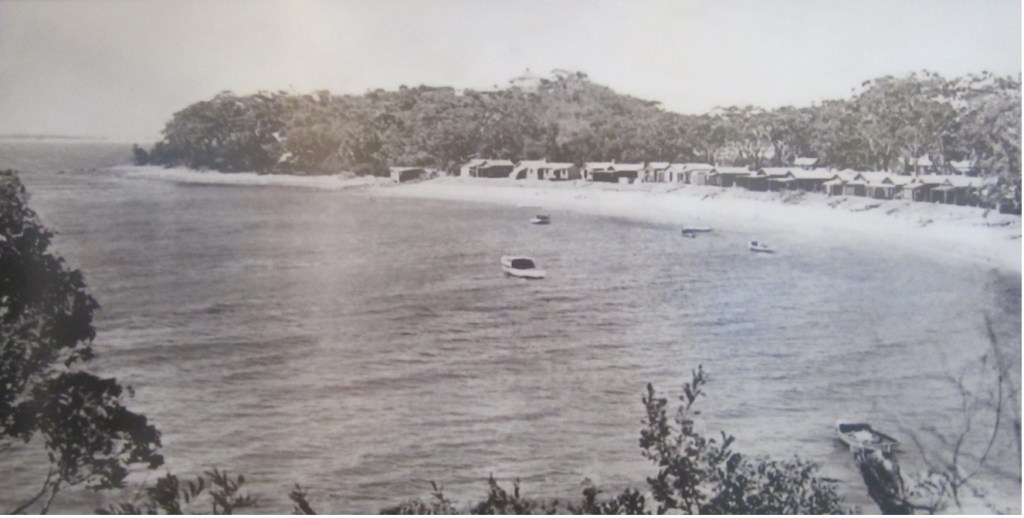
View of Little Beach Huts circa 1935
After receiving approval, the applicant was then entitled to occupy and build a hut on the selected site upon the payment of an annual lease fee. The Department of Lands reserved the right to cancel the occupancy approval at any time.
The majority of ‘Permissive Occupancies’ were granted at Little Beach over the period 1926 to 1934. Presumably, after 1934 all available plots had been leased. The huts were of simple construction and no two were alike. During peak holiday times, the huts would have been surrounded by numerous tents erected by miners and other who wished to also enjoy the bayside location in the same fashion as the lucky hut occupants.
The permissive occupancies were approved at a time when the permanent population of the Nelson Bay district was sparse, and sanitary arrangements were minimal. There was plenty of other bay foreshore available to anyone who visited the area, so there was no need to be concerned by the visual aspect of the huts on the foreshore.
It was reported in The Raymond Terrace Examiner and Lower Hunter and Port Stephens Advertiser of 15 March 1934, page 4, that Councillor Clode had commented that he thought there was not going to be any more permissive occupancies granted at Little Beach.
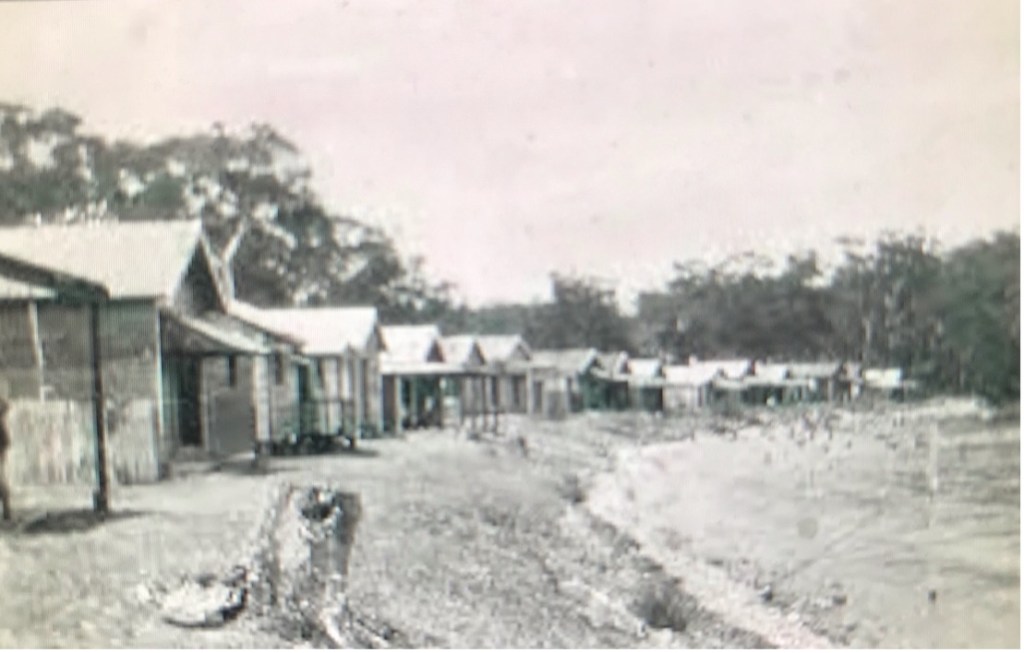
Little Beach huts prior to the construction of the military wharf
Personal contents of the huts cleared out
In the Second World War years with the military occupation of Nelson Bay and surrounding districts, the huts at Little Beach were taken over for military use and the occupants evacuated.
The Cessnock Eagle and South Maitland Recorder of 16 March 1943, page 2, reported:
‘Little Beach, at Nelson’s Bay, is to be evacuated on Saturday. Persons occupying sheds and weekenders are notified that military trucks will be present to take away their goods at 11 a.m. These are to be stacked outside the premises. The goods will be carried to whichever destination the owners decide. A military valuator will also be present to value the property. Most of these residencies are owned by miners from Cessnock and Kurri.’
Removal of the huts
After the huts were abandoned by the military around 1945, they soon began to deteriorate. Their removal was then an ongoing saga between government authorities and Port Stephens Shire Council.
The first intention of Port Stephens Shire Council to remove the huts from Little Beach was reported in The Raymond Terrace Examiner and Lower Hunter and Port Stephens Advertiser of 27 June 1946, page 3:
‘Notice will be given the permissive occupancy owners at Little Beach to vacate their occupancies if the Land Board is agreeable. They can remove their houses and weekenders.
The Raymond Terrace Examiner and Lower Hunter and Port Stephens Advertiser of 14 August 1947, page 2, reported:
‘The Health Inspector Mr. Conroy, reported: Recent inspection of this area revealed that the condition of the area is rapidly deteriorating. There are 16 small weekenders on the beach, 4 are occupied and locked up and the balance used by all and sundry for specific purposes which are likely to cause offence and disease. The buildings are being slowly demolished by unknown persons and the lavatory accommodation for most of them leaves much to be desired.
I have contacted the apparent owners of the buildings, the Department of the Army and the Department of Lands and requested some action to expedite their removal. This area can be made into a beauty spot at small cost, which could accommodate thousands of daily visitors, and I recommend the position to Council for discussion and appropriate action. The Clerk, Mr. Monkley said the lease of this area had expired last June. A representative of the Defence Department had interviewed him on the matter. On behalf of the Council he had recommended to the Department that buildings be sold and demolished. This was waiting a reply. The land belonged to the Crown. Crs. Parish and Morgan moved that the matter be thoroughly investigated with a view to having the area made into park lands. — Carried.’
The Raymond Terrace Examiner and Lower Hunter and Port Stephens Advertiser of 13 November 1947, page 2, reported:
‘The Department of Lands informed the Port Stephens Shire, at its last meeting that the buildings on Crown lands at Little Beach, Nelson Bay, would be removed. The matter had been taken up with the Commonwealth authorities and they had now advised that the cottages are being processed for disposal and removal at an early date.’
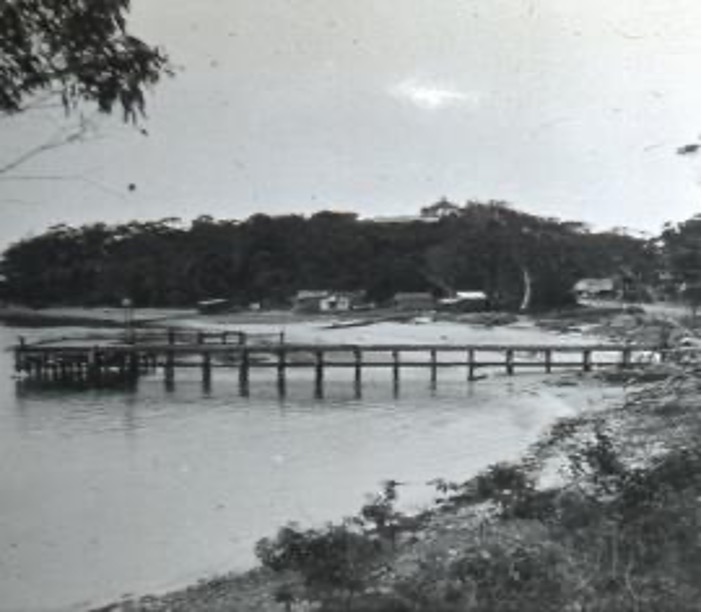
Little Beach circa 1954 showing five remianing huts and the wharf of its original length
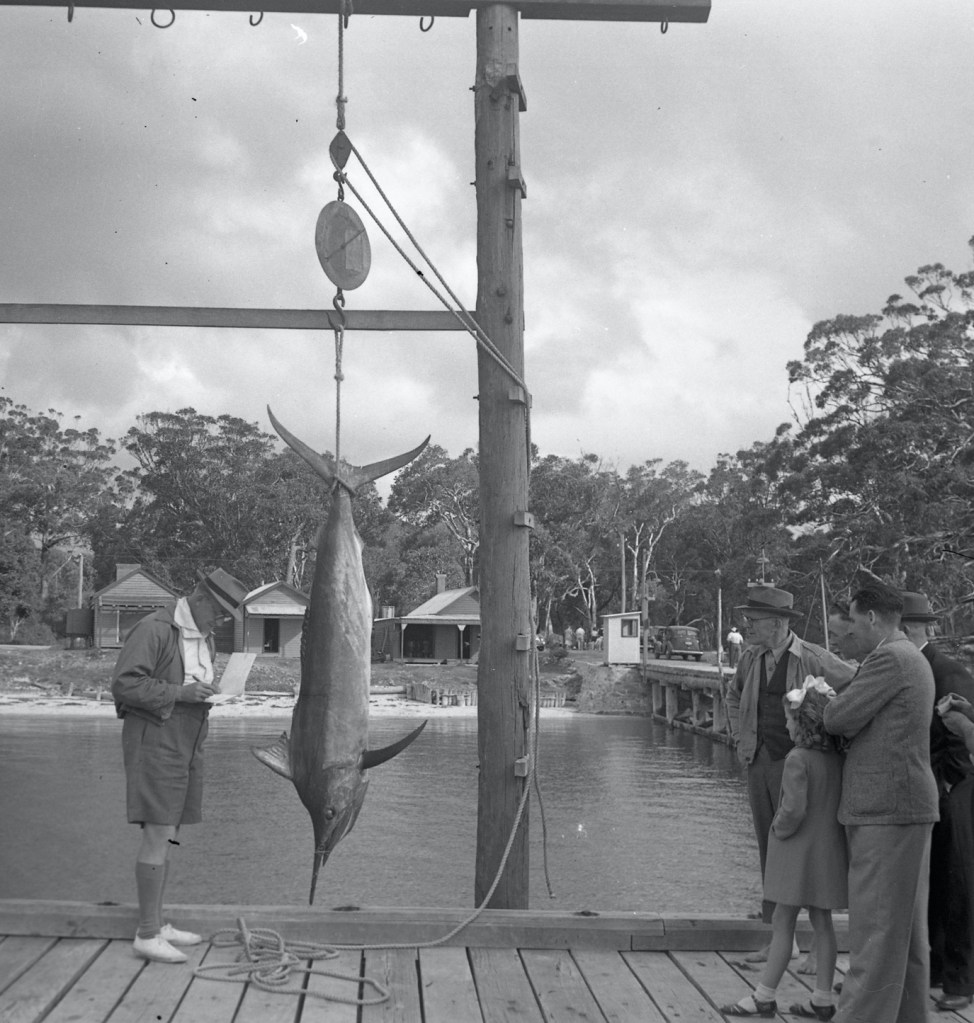
Weigh-in of a lack Marlin on the Little Beach Wharf with huts in the background [University of Newcastle Library]
Final notices issued for removal of huts at Little Beach
The Raymond Terrace Examiner and Lower Hunter and Port Stephens Advertiser of 16 September 1954, page 2, reported on the delivery of notice to quit the occupation of huts:
‘Five notices were …. delivered at Little Beach, four to the occupants on Little Beach waterfront, and one to the bark hut on ground owned by the Catholic Church. In reference to the latter building it would appear that the first step in its condemnation and removal would be to serve a notice on the owners of the ground. Apparently nobody owns the building …. has been claimed for occupation by a fairly named Thompson, but by some peculiar circumstances it is immediately disowned by the family whenever connection and removal is suggested.’
The Catholic Church land was located adjacent to Beach Road, opposite the Little Beach reserve. The bark hut referred to in the above article appears to have been on the site of the modern day unit block known as ‘Little Hut’.
The site is mentioned in the brochure titled ‘Nelson Bay Heritage Walk’ published by the Port Stephens Historical Society Inc. It is marked by peg number 36 (in the photo below) and described as ‘Charlie Morgan’s log cabin’ with the following information:
‘This gentleman was a union secretary in Newcastle and spent time in in the 1930’s at his ‘cabin’ which was one of the many huts in the vicinity of Little Beach housing mostly out of work people particularly from the coalfields and Newcastle.’
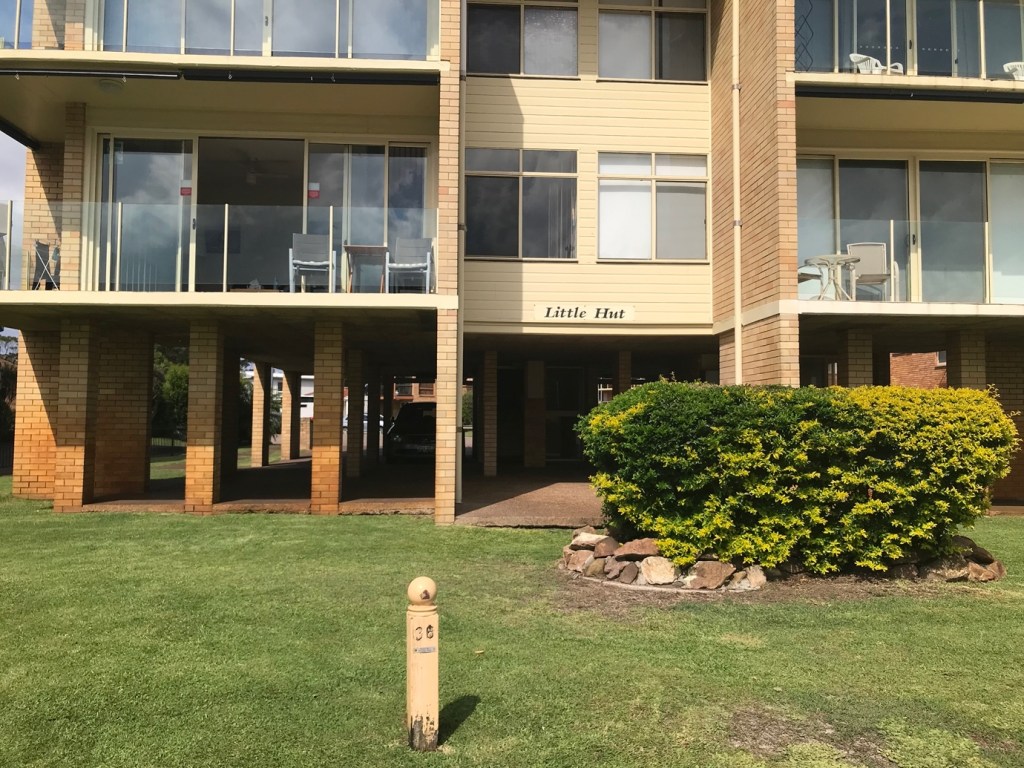
Former Heritage Walk site of the ‘Little Hut’ unit block at Little Beach
The existence of huts had become a problem in other parts of Port Stephens, in areas like Dutchmans [Dutchies] Beach, and Fingal Bay. The following article from the Raymond Terrace Examiner and Lower Hunter and Port Stephens Advertiser of 16 September 1954, page 2, provides an insight into the problem also faced at Fingal Bay with the huts:
‘My reception was mixed” said Mr. A. A. Conroy reporting to the Port Stephens Shire Council on the matter of sub-standard buildings at Fingal Bay. He further said it ranged from “philosphic acceptance to plain abuse.” The report continued: “During the month a further survey was carried out in the above area and 94 preliminary warning notices were delivered to each building. Warnings were given verbally to residents in occupation. Six of the buildings have been obviously erected within the last six months and two have been completed since I issued the first warning five weeks ago. …… Notices will be delivered to Dutchman’s Bay as soon as they are available.
THE WHARF
Construction of the Wartime Wharf
The wharf was built at the Little Beach by the military authorities in the Second World War. It may have only been built as a temporary facility, as only a few years were to pass before it suffered considerable structural issues. The wharf was located near where the current disability access jetty currently stands.
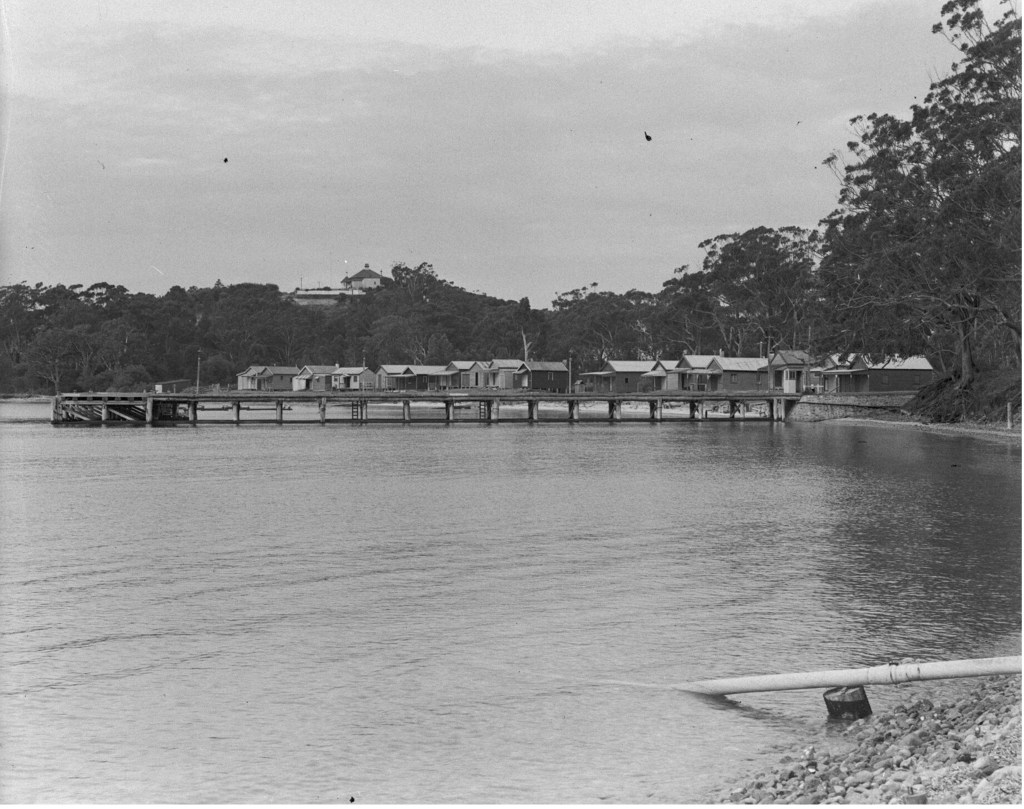
Little Beach in 1945 showing the new military wharf and huts
Port Stephens Shire Council decides to purchase the Wharf
Following the end of the military occupation at Nelson Bay the wharf was offered for purchase to the port Stephens Shire Council. The Raymond Terrace Examiner and Lower Hunter and Port Stephens Advertiser of 20 December 1945, page 2, reported:
‘At the Shire Council meeting on December 7th. the question of the purchase by the Shire Council from the Military authorities, of the wharf at Little Beach, Nelson Bay. The wharf is a good solid structure, but at present not much use can be made of it for the public, but the Council on the motion of Crs. Russell and Upton agreed to offer the military £50 for the wharf.’
The Raymond Terrace Examiner and Lower Hunter and Port Stephens Advertiser of 9 May 1946, page 1, further reported:
‘The military authorities refused the Council’s offer of £50 for the jetty at Little Beach, Nelson Bay. The jetty was erected by the military authorities during the war. The Council could not find any use for the jetty unless, the ice making and fish canning company used it, which has been mentioned. Cr. Morgan moved that the military authorities be informed that the Council was conferring with the Nelson Bay Urban Area, and those interested in the proposed ice works. Cr. Russell seconded and it was agreed to.’
The Raymond Terrace Examiner and Lower Hunter and Port Stephens Advertiser of 27 June 1946, page 3, reported:
‘The Urban Area Committee at Nelson Bay asked the Shire Council to increase their offer of £50 for the wharf at Little Beach, Nelson Bay, erected by the military to £100 as the wharf would be useful. This was agreed to on the motion of Crs. Russell and Morgan.’
Nothing came of the Council efforts to purchase the wharf. By 1949, the wharf had deteriorated to a stage where it was condemned and require removal.
Council Purchased Wharf for Salvage Purposes
The Raymond Terrace Examiner and Lower Hunter and Port Stephens Advertiser of 21 July 1949, page 4, reported:
‘The Commonwealth Disposals Commission have offered the material in the wharf at Little Beach, Nelson Bay to the Port Stephen Shire Council and asked the Council to submit a price. ……
Mr. Payten said the wharf was condemned. The piles are gone. Mr. Cooke said he had glanced over it. if the Council had in mind replacements to culvert decking it would be good buying. Demolition would be expensive. Cr. Rodgers suggested that Shire officials inspect and submit a price to the Commission. Council agreed to leave it in the hands of the Council’s officers to investigate and make an offer.’
The Raymond Terrace Examiner and Lower Hunter and Port Stephens Advertiser of 11 August 1949, page 5, reported:
‘Commonwealth Disposals Commission wrote to the Shire Council stating the Commission had accepted the Council’s offer of £50 for the naval wharf at Little Beach, Nelson Bay.’
Attempt to Save the Wharf
The Raymond Terrace Examiner and Lower Hunter and Port Stephens Advertiser of 25 January 1951, page 6, reported:
‘At the Port Stephens. Shire Council meeting Mr Cook, (engineer), said he thought the wharf at Little Beach which the Shire purchased from the Disposals Commission to be removed should now remain.
He recently counted over 100 people on it at holiday time. It was bought with the idea of using the planking for culverts. The urgent need for timber for that purpose has now vanished and pipes have been used in most culverts. The wharf was in good condition. He only wished all the wharves were in as good condition. Cr. Rodgers thought the wharf should be made a public wharf.
Cr. Dart said the wharf had been mentioned as unsafe. This was because it was used for heavy loads, such as supplying ice to trawlers and timber loads. It was not suitable for these loads, but was quite safe for foot traffic. A centre post could be erected to stop vehicles using it. This would do away with the unsightly barbed wire. He moved that the barbed wire be taken down and a post or posts erected to stop vehicular traffic using the wharf. Cr. Richardson seconded the motion which was carried.’
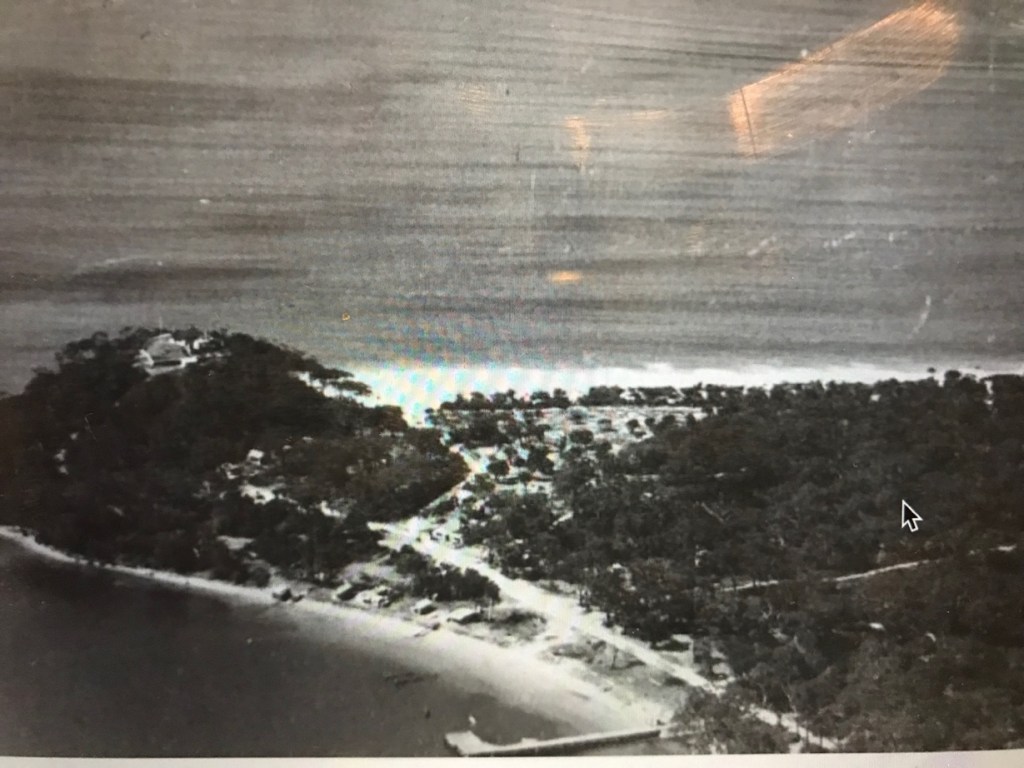
Aerial view of Little Beach in 1950 – the wharf and several of the huts are visible with the Inner Lighthouse on top of the hill and the Halifax Park camping area at its base
Second Attempt to Save the Wharf
The Raymond Terrace Examiner and Lower Hunter and Port Stephens Advertiser of 11 March 1954, page 3, reported:
‘At the Port Stephens Shire Council meeting on Tuesday, the Department of the Interior requested that the Council remove the wharf within 21 days in accordance with the conditions of the sale. The letter stated that the Department had received a report to the effect that the wharf piles are in a bad state and may cause a collapse of the wharf. This would cause a danger to navigation. It requested the Council to take action to have the action to have the defective portion removed.
Mr. Cook, (Engineer), said the wharf was used extensively the public. It was a pity to remove it. The Department only wanted it removed because it had a red tab on their files. Cr. Rodgers said they were loath to remove it. Council should de-clare it a public wharf. Mr. Monkley, (Clerk) said the wharf was bought for £50 by the Council for the timber. Council will contact the Department off the Interior with a view to wharf remaining. If the reply is unfavourable Council will consider having the wharf declared a public wharf. Mr. Monkley said under present circumstances Council could not spend money on repairs, it would have to be declared a public wharf before Council funds could be expended on it.’
Wharf partly dismantled
The Raymond Terrace Examiner and Lower Hunter and Port Stephens Advertiser of 19 August 1954, page 5, reported:
‘It is recommended that the decking of the ‘L’ head and approach span be removed for re-use in bridges back to about halfway between ‘L’ head and shore.’
The Raymond Terrace Examiner and Lower Hunter and Port Stephens Advertiser of 14 October 1954, page 5, reported that the Little Beach Wharf had been dismantled back to a ‘solid and safe section’.
The wharf was completely dismantled by the mid 1960’s.
Concluding Comments
With the removal of the huts and wharf, Little Beach was again able to reclaim its natural beauty.
Today, the huts have been replaced by gazebos erected by holiday makers in this very popular spot.
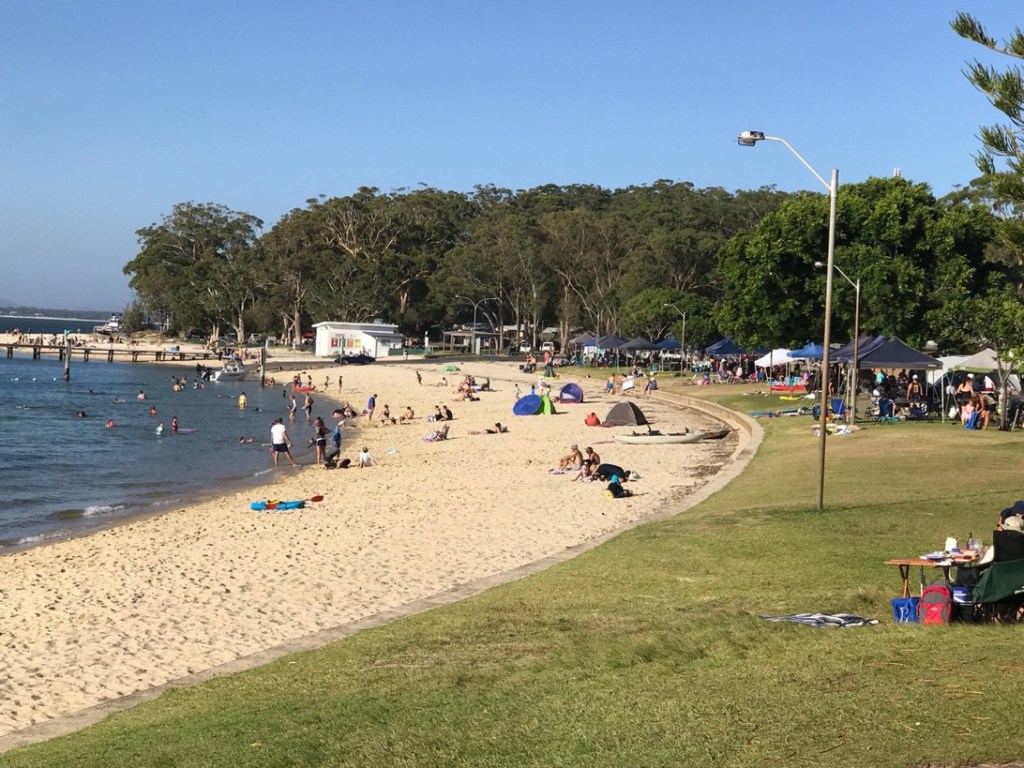
Little Beach with its modern gazebos at holiday time [Author photo]
Researched and compiled by Kevin McGuinness
June 2022

 Port Stephens - a history exploration