
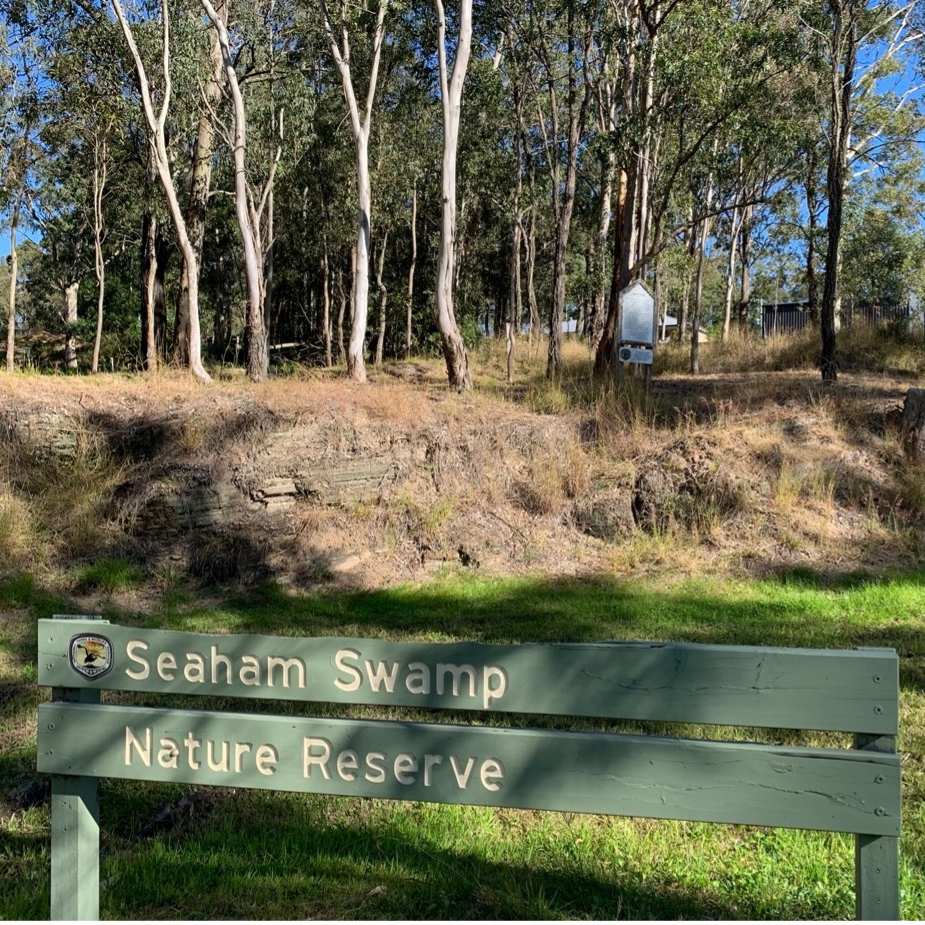
Introduction
in the early 1900’s, Port Stephens Shire Council was responsible for making new roads and maintaining the existing ones throughout the largely undeveloped Shire. In those days roads were mostly not tarred and sealed but had a road base of gravel. Great importance was placed on locating suitable stone quarries as close as possible to the various road undertakings.
One such stone quarry was established at Seaham, adjacent to the present-day Torrence Street.
Unearthed by the excavation for suitable road-making materials, a geological gem was discovered in the walls of the quarry with its “varve shale” deposits. These were unusual layers of wave-like rock structures which were laid down by glacial activity in the area many eons ago in the Ice Age.
In the early 1920’s, the Seaham quarry came to the notice of geologists. Professor Tannatt William Edgeworth David, Australian geologist and Antarctic explorer, was instrumental in calling for the preservation of the site.
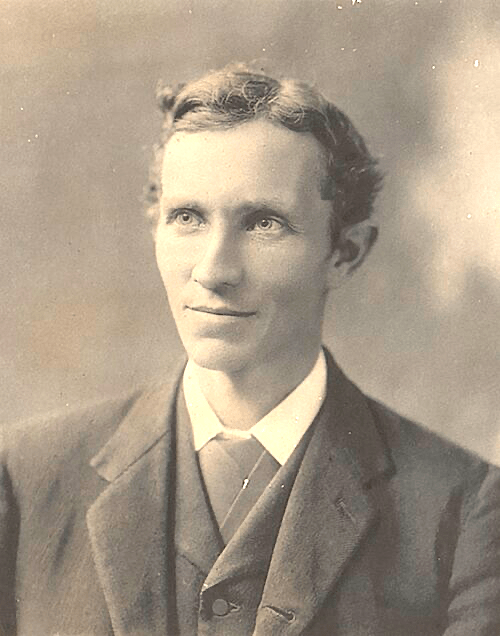
Tannatt William Edgeworth David
In 1925 the quarry was ‘dedicated to science’.
This paper examines the history of the site, which is unique in the Port Stephens region.
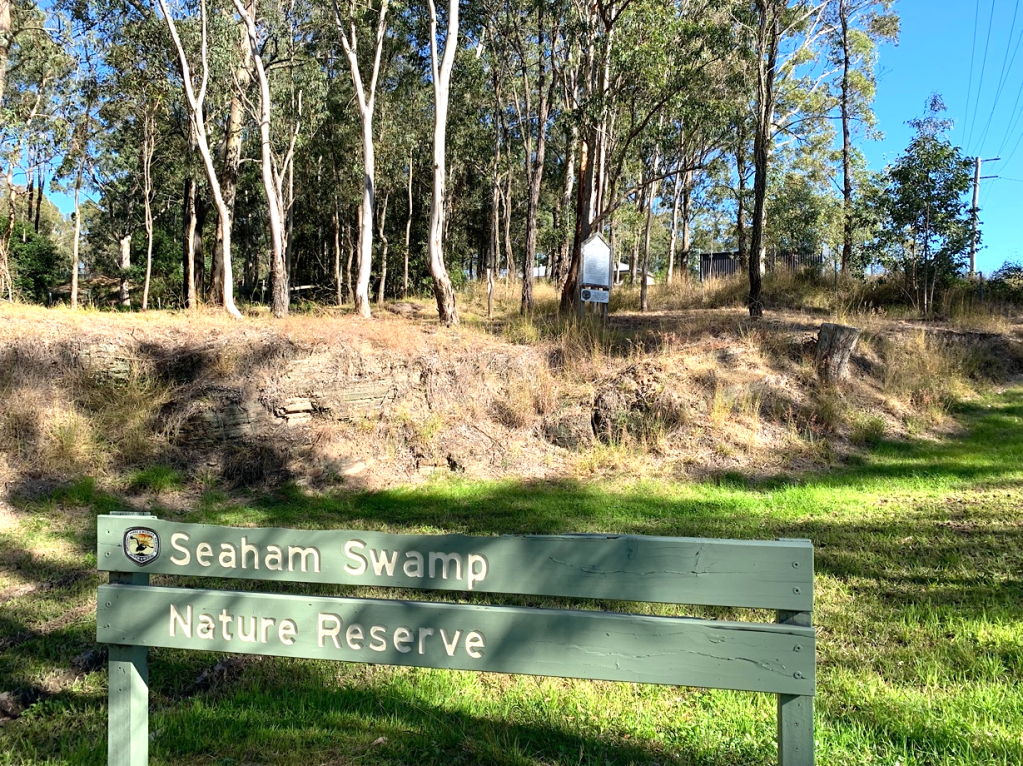
Site Seaham Quarry, Torrence St, Seaham [Author Photo – June 2023]
Student Geological Excursion to Seaham Quarry – 1920
The Maitland Weekly Mercury of Saturday 6 November 1920, page 6, reported:
‘On Saturday last about 30 students from the Newcastle and Maitland Technical Colleges, under the charge of Mr. C. A. Sussmilch, journeyed from West Maitland to Seaham per motor in order to inspect the intensely interesting glacial beds of that district. These beds have lately been thoroughly investigated by Mr. Sussmilch, and though previously thought to be of permo-carboniferous age, have now been definitely placed in the carboniferous period.
The first halt was called at Felspar Creek, a little north of Seaham. The roadside cutting here revealed the Paterson rhyolite at the base of the Seaham beds. Resting upon this, is a bed of fluvio-glacial conglomerate some 270 feet thick and containing an abundance of large boulders of quite a variety of rocks, ranging up to 12 feet in diameter, deposited there by the agency of ice. After obtaining specimens of the various types of rocks, a brief spell was made for luncheon. …….
The party next proceeded to Seaham quarry. Here are exposed a most interesting series of “varve” shales. These are always found associated with glacial deposits. They consist of exceedingly fine and relatively coarse-grained material, and it is reckoned that these beds alone must have taken 8000 years to deposit. Certain layers at intervals, are strongly contorted, in a similar manner to the Squanturn beds of U.S.A. This is accounted for by the stranding of an iceberg or the temporary moving forward of the ice-front. Occasional isolated pebbles up to 3 or 4 inches in diameter are found in the shales. It is supposed that these have been dropped by the melting of drifting icebergs.
A little further on at the turn of the Seaham-Maitland-road, just south of the township, the most typical tillite in the district was inspected. It consists of a fine glacial mud in which are embedded pebbles ranging up to two feet in diameter with little or no evidence of stratification. A few streated pebbles were found, thus lending further evidence to the glacial nature of the deposit. The party returned by way of Morpeth and East Maitland. Altogether a very interesting and enjoyable day was spent.’
Scientists visit Seaham Quarry – Protection sought for Quarry 1923
The Maitland Daily Mercury of 6 September 1923, page 6, reported:
‘The delegates from the Pan-Pacific Congress who have been on a visit to the Maitland district yesterday went to Seaham and Clarence Town, and in those localities were shown evidence of glacial and volcanic action that had taken place in these parts in the early ages. Professor [Edgeworth] David, Messrs. C. A. Sussmilch and G. Osborne acted as guides. ……..
A typical tillite bed outcropped on the main road near Seaham, and it consisted of consolidated glacial mud with, little or no stratification. Sporadic pebbles ranging up to two feet in diameter were embedded in it, and striated pebbles were fairly abundant in the bed. Mr. Sussmilch said he saw some of the rock about five weeks ago just after it had been taken from the cutting, and it was then quite hard. The weather in the meantime had turned it into mud.
Closer to Seaham some fine examples of varve shales were inspected, these being the most interesting of the rocks of the glacial stage. They consisted of a regularly alternating series of thin, coarse, and fine layers of material, so that they were built up of paired laminae. In the coarser layers were frequently found minute false bedding, and fragments of fossil plants. The alternating layers of coarse and fine material represented seasonal deposits of glacial material in a lake. Some of those formations had been traced for 100 miles. In those beds they occasionally found pebbles, and also occasionally pockets of pebbles. The pockets which occurred in fine-grained, thinly-bedded strata must have been deposited by the melting of a small stranded Iceberg. The isolated pebbles would have been dropped to the lake-floor by icebergs passing over the surface. On such pebbles were often found glacial striae. In the varve shales they frequently encountered layers which exhibited strong local contortions, these being found with a regular layer immediately above and a regular layer below. The contortions were contemporaneous and might have been caused by the stranding of masses of floating ice or in some cases by a forward movement of the ice-front itself.
In one small quarry inspected by the roadside in Seaham, an exceptionally fine example of varve shale was seen. It was dipping at about 12 degrees and displayed a bed two feet thick containing splendid instances of the contortions. The overseas delegates obtained a number of photographs and expressed the opinion that such a fine and interesting geological section should be preserved for all time. Other sections of varve shales, and rocks showing ice and volcanic action were seen between Seaham and Clarence Town, and then, passing through the latter town, Mr. Sussmilch led the party to the horizon of the Wallarobba conglomerates on the top of a hill on the road to Dungog. …….
Returning to Clarence Town, lunch was partaken of at the hotel, and, on the way back, as on the outward journey, many specimens were collected. They were particularly interesting to the overseas delegates, who said they would make valuable additions to the geological collections in the countries from which they came. At the Seaham School of Arts afternoon tea was kindly provided by a number of ladies of Seaham, whose action was greatly appreciated. The members of the party were welcomed by Councillor Boag who said they felt honoured at the visit of the scientists and in being able to do a little for them. “Mr. Fisher has mentioned to me,” he said, “that you would like to see a quarry preserved for geological research. As the representative of the part on the Shire Council, I will see that every effort is made to have it reserved. I will be pleased to do that little bit in the interests of science.” He referred to Professor David’s great work and ex-tended him and the other delegates a hearty welcome.
Professor David thanked Mr. Boag for his welcome and the ladles for their kindly forethought in providing the happy little function. Wherever he travelled in the country he found the same warm-hearted welcome. He would like to mention the great help always given him in that district in his geological work, a help to which Mr. Osborne and Mr. Sussmilch could also testify. He appreciated Mr. Boag’s promise very much. How very interesting such a reservation would be from a geological viewpoint, and it would be of great value.
Dr. Hovey (United States), on behalf of the overseas delegates, acknowledged the hospitality extended to them. They had seen much of geological interest in Australia, especially in this district. He expressed thanks for the promise in regard to the quarry. They had an interesting time in Australia and had experienced most wonderful hospitality. Speaking subsequently to a representative of the “Mercury,” Dr Hovey said they had had a most interesting time in this district and had been greatly impressed. They, had seen a great variety of formations. They had studied particularly that day the glacial beds and varve shales of Seaham. By varve was meant, those showing seasons. Each band showed a season.’
Port Stephens Shire Council agrees to protect the Quarry – 1923
The Newcastle Sun of 8 October 1923, page 3, reported:
‘At a meeting of Port Stephens Shire Council Councillor Boag [Councillor for Seaham area] asked that a quarry at Seaham, on the Williams River, be reserved and dedicated.
A photograph showing the remarkable folding of the rocks was forwarded by Professor David, who visited the locality recently. Councillor Boag said the quarry was one of the most interesting in the world. The council agreed to take action in the matter.’
The Daily Telegraph of 10 October 1923, page 6, further reported:
‘In the interests of science the Port Stephens Shire Council has decided to preserve the stone quarry at Seaham, which is one of the most valuable geologically. A remarkable folding of rocks is seed. A sample of the stone has been packed in concrete and sent to America.’
Professor appreciates Council’s preservation of Seaham Quarry – 1924
The Newcastle Morning Herald and Miners’ Advocate of 5 February 1924, page 5, reported:
‘It was recently reported in the “Newcastle Herald” that the Port Stephens Shire Council had resolved to place a reservation on the site at Seaham, from which its metal supplies had been obtained. Action in this matter had been taken at the instance of Councillor W. Boag, of Seaham, who has received the following letter of appreciation from Sir T. W. Edgeworth David, of the University of Sydney:—”Please allow me to thank you, and through yourself the Port Stephens Shire Council, for the generous action in reserving the Seaham quarry, with its beautiful folded rocks, in the interests of science.
Mr. G. D. Osborne has been telling me that some question has been raised as to the fencing of the reserve. Personally, I should doubt whether it would be advisable to fence it. One would not, of course, like to have the possibility of rubbish being dumped there, but I should think this could be guarded against by less costly means than that of fencing, as for example by means of a notice board with a suitable legend indicating why the quarry has been reserved (on account of its unique geological interest, as showing the intense folding of the strata due to the passage of former glacier ice over them). Once more thanking you and other members of the shire council for your kind action in the interests of science.”
Councillor Boag stated yesterday that it had been agreed to adopt Professor David’s suggestion, and he had been asked to prepare the board with suitable notice. He has also been invited to visit Seaham and perform the dedication ceremony. “We are proud of this bit of geology,” added Councillor Boag, “which appears to be the finest known in the world. When the Pan-Pacific section of the Congress visited the Hunter River they were like children with a new toy and were immensely delighted to know of the likelihood of the reservation.’
Seaham Quarry ‘dedicated to science’ – 1925
The Maitland Daily Mercury of 22 July 1925, page 6, reported:
‘The ceremony of dedicating to science portions of the Seaham quarries took place in the presence of a gathering representative of the surrounding district. Included in the visitors were: Mr. Osborne, B.Sc. (Sydney University), Mr. C. A. Sussmilch (Newcastle Technical College), and Mr. W. J. Enright (West Maitland). The function was organised by Mr. J. W. Boag, and proved interesting.
Mr. Sussmilch, in an address on the ice age, said that science trusts that the people of Seaham will kindly preserve this quarry for the benefit of the future generations. The extraordinary layers in the formation of the quarry were said to be from 90,000,000 to 120, 000,000 years old. Nature’s book in the reefs would preserve for Australia for all time a unique record of the ice age. Seaham deposits were of interest to scientists throughout the world. The materials of these rocks are deposited by thaw waters from glaciers in a lake. Each pair of streaks represented the winter and summer deposits of one year, so that by counting the number of pairs of streaks the time that they took to accumulate could be calculated. The formation of the layers was due to the contracting force of glacier ice or icebergs.
When the scientists were in Australia for the Pan-Pacific Conference in 1923 they visited the quarry, and agreed that the interesting folds caused by the pressure of former glacier ice in the rocks should be preserved in the interests of science, he said. Professor David then made representations to Councillor Boag that this should be done and that afternoon’s ceremony finalised the dedication. Messrs. Osborne and Enright also spoke. The latter deprecated the fact that the Lands and Mines Departments did not make more use of geologists. Councillor Boag formally handed over the quarry to Councillor T. H. Pearse, the president of the Port Stephens Shire Council, which will appoint three trustees.’
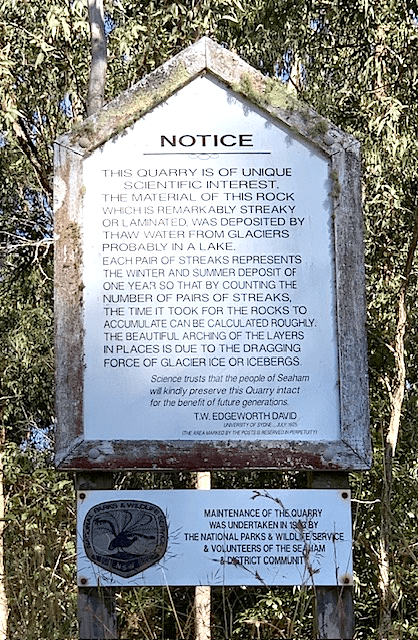
Signage placed at Seaham Quarry -1925 [Author photo – June 2023]
The Raymond Terrace Examiner and Lower Hunter and Port Stephens Advertiser of 24 July 1925, page 3, further reported comments made by Mr. Sussmilch during the dedication ceremony:
‘Mr. Sussmilch said the folding shown in the quarry was very rare, only another of the kind being at present known in Australia, and that was at Bondi, and this had been dedicated in a similar manner to the Seaham quarry that day. It was a remarkable formation, and had put Seaham on the map as far as the scientific world was concerned . It marked an important formation which had been described by Processor David and others as belonging to glacial origin. Such rocks had not previously been described as existing in Australia, and were known as varve shales. The layers showing in alternate thickness of fine and coarser material marked the summer and winter periods when during the melting of the ice in the summer the coarser material was laid down, and during winter when there was but little flow the finer material, or rock flour settled on the floor of the lake. De Giers, in Sweden estimated that it was 20,000 years since the ice age disappeared. These rocks were estimated of much older period, and roughly were from 90 to 120 million years. The example here was the finest in the world. He had brought scientists here to view it… from all over the world. The Seaham district was an interesting one geologically, and there were evidences where glacial ice had dropped boulders which could have only got where they were by that means. Half Australia, he said was covered with ice, during the glacial epoch, and nature’s book was a very interesting one as disclosed at Seaham.’
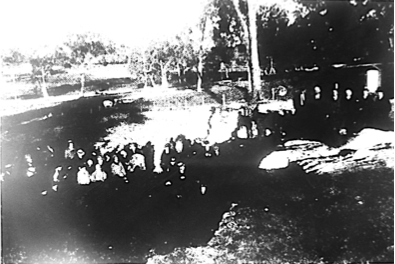
The Dedication Ceremony. The line of figures at the back is composed as follows (left to right).: W. J. Enright, B.A., Cr. T. H. Pearse, L. B. Fisher, Cr. J. W. Boag, G. D. Osborne, B.Sc., C. A. Sussmilch, F.G.S. [Sydney Mail, Wednesday 26 August 1925, page 2]
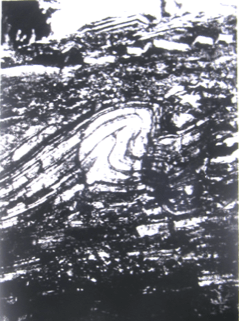
One of the ‘wave’ rock formations [Sydney Mail, Wednesday 26 August 1925, page 2]
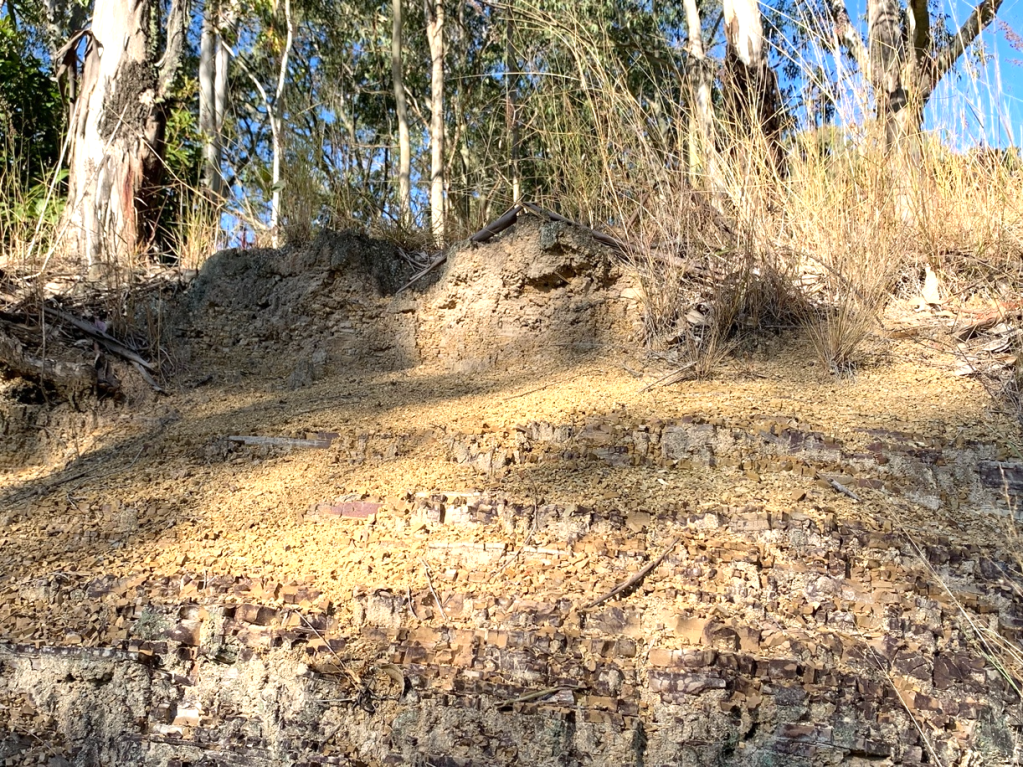
Rock Formations at the Seaham Quarry [Author Photo – June 2023]
Trustees Appointed for Seaham Glacial Quarry – 1925
The Dungog Chronicle of 14 August 1925, page 2, reported:
‘Messrs. L. B. Fisher, G. V. Ralston, and Councillor Boag have been appointed trustees of the glacial quarry at Seaham.
The [notice] board marking the portion dedicated at the quarry, bears the following inscription: “This quarry is of unique scientific interest. The material of this rock, which is remarkably streaky, or laminated, was deposited by thaw waters from glaciers, probably in a lake. Each pair of streaks represents the winter and summer deposits of one year, so that by counting the number of pairs of streaks the time it took for the rocks to accumulate can be calculated roughly. Science trusts that the people of Seaham will kindly preserve this quarry intact for the benefit of future generations.” The signature of Professor T. W. E. David, of the University of Sydney, is attached at the foot of the notice.’
Concluding Comments
Further protection and recognition of the scientific importance of the Seaham Quarry occurred on 2 April 1999, when the site was added to the NSW State Heritage Register.
On 23 December 2013, the Seaham Quarry, including the interpretive sign were made subject to a Local Environment Plan.
Seaham is a suburb of the Shire of Port Stephens today. It has a long heritage in both the history and geology of the region.
Further information on Port Stephens Council is published on this website and can be viewed at the following links:
History of the Formation of Port Stephens Council
Port Stephens Council During the Second World War
Researched and compiled by Kevin McGuinness
June 2023

 Port Stephens - a history exploration