
Introduction
The Catalina flying boat was one of the most versatile aircraft of the Second World War. It was operated by virtually every Allied nation in anti-submarine, air-sea rescue, patrol, and minelaying/bombing roles. The Royal Australian Air Force used more than 150 Catalinas between 1941 and 1945.
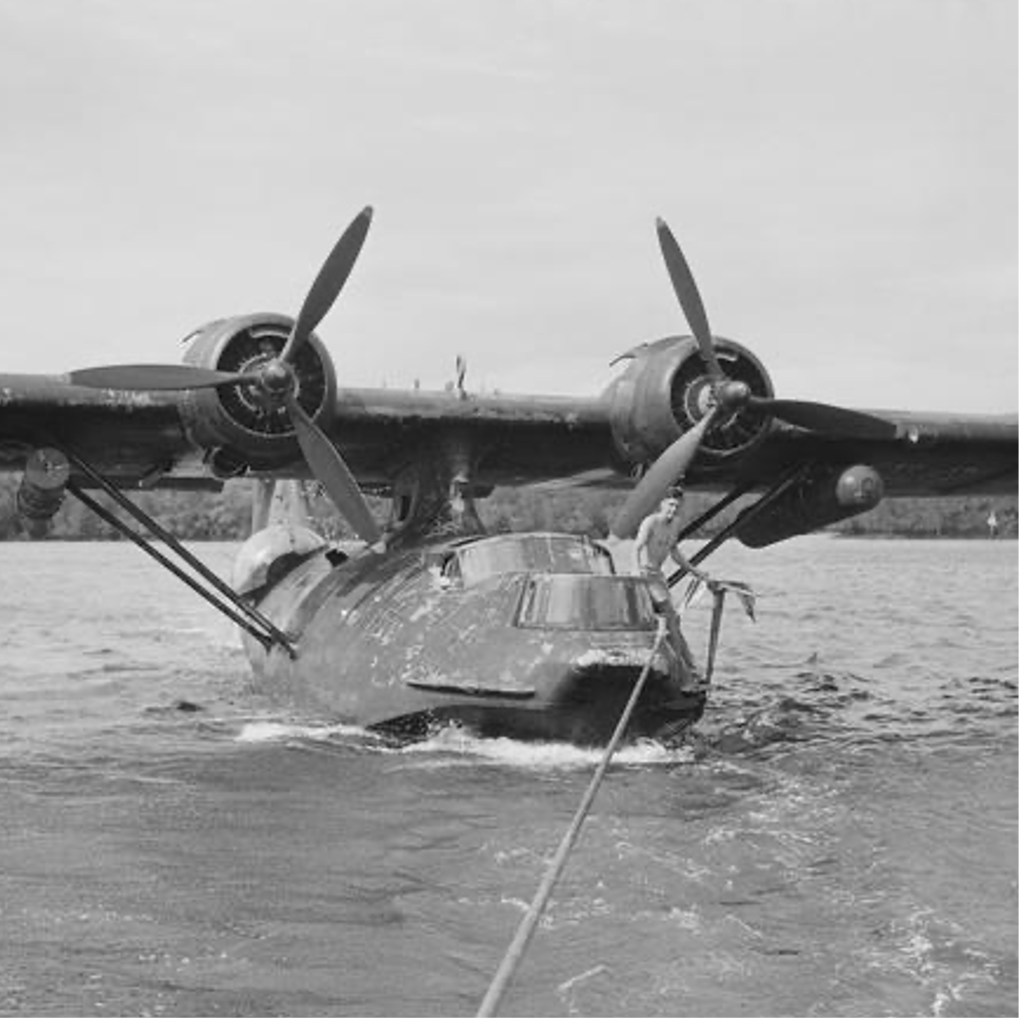
This is the story of one RAAF Catalina flying boat that crashed on the morning of 24 May 1943 while attempting a landing on rough seas opposite Wonderrabah Knob (present day Wanderrebah Beach) at Port Stephens. It was on a training exercise and seven airmen on board were killed.
The Catalina was stationed at Rathmines and the ill-fated flight was part of an inspection of the Broken Bay and Port Stephens areas. The captain, Flight Lieutenant Brian Hartley ‘Tubby’ Higgins was a well-known aviator with over 1500 operational flying hours to his credit.
F/Lt Higgins had flown to Port Stephens to carry out rough water landings. It is reported that he struck an usual wave and crashed while practicing circuits and landings.
A Catalina under tow [Australian War Memorial]
The nine aviators involved in the crash were:
Flight Lieutenant Brian Hartley “Tubby” Higgins – Pilot – Killed
Pilot Officer Max Alexander Larkan – 2nd Pilot – Killed
Sergeant Alan Fullerton Craddock – 2nd Pilot – Killed
Pilot Officer Norman John Brown – W.A. Gunner – Killed
Corporal Thomas Henry Poole – Fitter – Killed
LAC Henry George Lovett – Fitter – Killed
Corporal Joffre David James – Fitter – Killed
Sergeant John Johnson – W.A. Gunner – Seriously injured
AC Kenneth Carlyle Stow – Armourer – Slight Shock.
The two injured were taken to the HMAS Assault dispensary. The aviators who died were buried in the Sandgate War Cemetery, near Newcastle.
Story of the Pilot, Brian Hartley ‘Tubby’ Higgins
Several newspapers published tributes to the deceased pilot, and the following two are a selection of those.
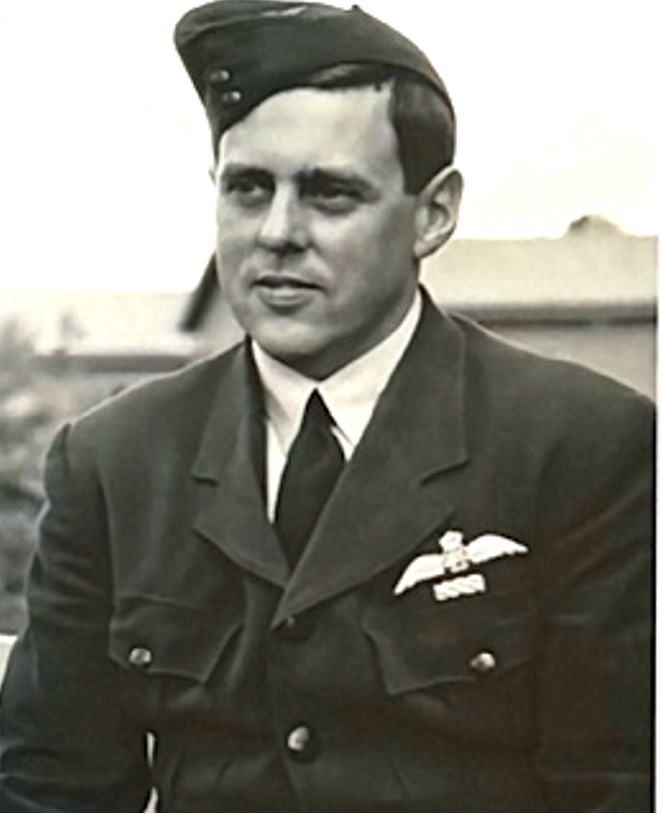
Flight Lieutenan Brian Hartley ‘Tubby’ Higgins
Newcastle Morning Herald and Miners’ Advocate of 26 May 1943, page 2:
‘They call him “Tubby,” but he doesn’t mind. No man with a flying record like Flight Lieutenant B. H. Higgins, D.F.C., would care what anybody called him—particularly if he had the jovial features and sparkling eyes of the flight lieutenant. I met him at an operational base recently. He had just come in from a reconnaissance flight. Everybody seemed to know him—mainly because of his genial manner and happy demeanour. Those who knew him best called him ‘Tubby,’ but all had a great respect for that medium size bronzed flying man. Flight Lieutenant Higgins has 1500 operational hours to his credit in territory where enemy machines might be encountered at any moment.
Like most men who have done things he is not very talkative. Flying his Catalina with a load of bombs for enemy bases, encountering Zeros now and then, and rescuing marooned fliers from almost certain death seemed to be all in the day’s work. Sometimes he flew through heavy ack ack fire, not because he liked it, but because the course on which his target lay was that way. Japanese Navy ack ack fire was pretty deadly and their searchlights were always probing about the sky for marauding “Cats” or other planes.
Going to one target through the darkness, ‘Tubby’ was astonished that he had not encountered ack ack fire or searchlights. He was beginning to think it was a sitting shot when Zeros came at him through the clouds. He saw the joke at once – if Zeros can be called a joke. That was the first time Higgins had encountered Zeros. He realised then why the anti-aircraft guns were not active. On another occasion ‘Tubby’ in his Catalina was roaming through the clouds with a full load of bombs intended for a certain ship in Rabaul Harbour. Through a break in the clouds the observer saw below an enemy plane carrier. It startled the crew. They had never seen one before. They unloaded the bombs intended for the other ship. Just what damage the carrier sustained could not be ascertained because the clouds closed up again. The ‘Cat’ got out of the area, anyway.
One of the outstanding feats credited to Higgins was the rescue from a sandspit of the crew of an American Flying Fortress which had crashed. The sandspit was between New Guinea and New Britain. It was no larger than a fair-sized dining table. The crew stranded there, by linking hands. could border the area. ‘Tubby,’ flying his ‘Cat’ on another mission in that locality, saw the men below and dropped down to rescue them. A heavy sea was running. At times it swept over the sand. That notwithstanding, the Catalina was landed some distance out from the marooned men. They were overjoyed, cheered the R.A.A.F. and came away in their dinghy. They were landed safely at another base.
Another outstanding rescue performed by Flight Lieutenant Higgins was the taking from a small island north of Milne Bay of a Liberator crew which had been either brought down or landed in the sea.’
Daily Telegraph of 27 May 1943, page 2:
‘Flight-Lieut. Brian Hartley Higgins, 28, D.F.C., and six other airmen were killed when an R.A.A.F. flying-boat crashed during training exercises off the New South Wales coast. Flight-Lieut. Higgins, who lived at Wangaratta (Vic.), was one of the R.A.A.F.’s most experienced Catalina pilots. …..
Flight-Lieut. Higgins was a member of the first R.A.A.F. Catalina squadron to go into action in the South-west Pacific. He was stationed at Rabaul before Japan entered the war. He participated in the only two raids R.A.AF. Catalinas have made on the Japanese island base at Truk.
He bombed Rabaul eight times in the first two weeks of Jap occupation. He was over Rabaul when the Japs first used night fighters in the South-west Pacific area. He escaped them by diving through the smoke of a volcano. In all he flew 25 bombing missions in Catalinas and 25 in Mitchell bombers. About a year ago he rescued Lieut. Walter Higgins, U.S. Liberator pilot and seven of his crew when they were forced down on a storm-swept reef near Trobriand Island while returning from bombing Rabaul. Higgins also had just returned from bombing Rabaul. He went out again landed in a rough sea near the reef and took the Americans on board. Lieut. Walter Higgins. while on reconnaissance in a Liberator, first sighted the Japanese convoy destroyed in the Bismarck Sea battle.
Brian Higgins later rescued the crew of a U.S. Flying Fortress who had parachuted into dense jungle near the Gulf of Carpentaria. Blacktrackers, who reluctantly took a ride in Higgins’ Catalina while Higgins pointed out parachutes tangled in trees, found four of the crew. Higgins located the four other missing men on a salt pan and landed his Catalina on what he thought was a coastal river. At dawn next morning, when he went to take off, he found the Catalina high and dry on a mud bank, the 20ft. tide having receded. He had to wait until late afternoon for the tide to come in before he could take off.’
Memorial to the Deceased Airmen
A Memorial on the summit of Nelson Head, Port Stephens (adjacent to the Inner Lighthouse) faces the spot where the crash occurred.
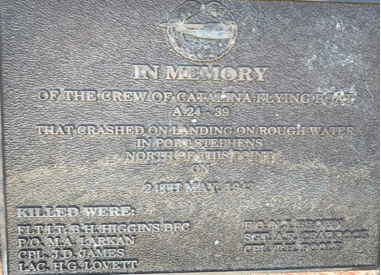
Nelson Head Memorial reads:
IN MEMORY
OF THE CREW OF CATALINA FLYING BOAT
24 – 39
THAT CRASHED ON LANDING ON ROUGH WATER
IN PORT STEPHENS
NORTH OF THIS POINT ON
24TH MAY, 1943
KILLED WERE: FLT. LT. B. H. HIGGINS DFC. – F/O. N. J. BROWN –
P/O. M. A. LARKAN – SGT. A. F. CRADDOCK –
CPL. J. D. JAMES – CPL. T. H. POOLE
LAC. H. G. LOVETT
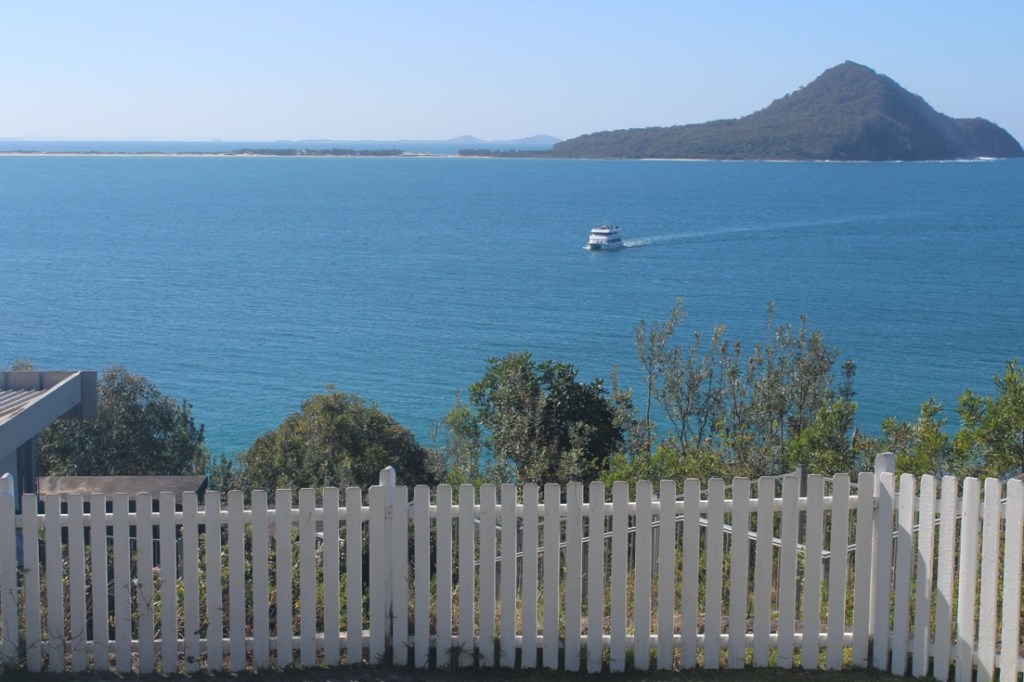
Looking north from the Memorial location towards Wanderrebah Beach, near Hawks Nest, in the vicinity of the crash site [Author Photo – July 2023]
On 24 May 2021, seventy-eight years after the Catalina’s disaster in Port Stephens, the deceased air crew were honoured in a remembrance ceremony held in the grounds of the Nelson Bay Inner Lighthouse overlooking the crash site. The event was organised by the Tomaree Museum Association.
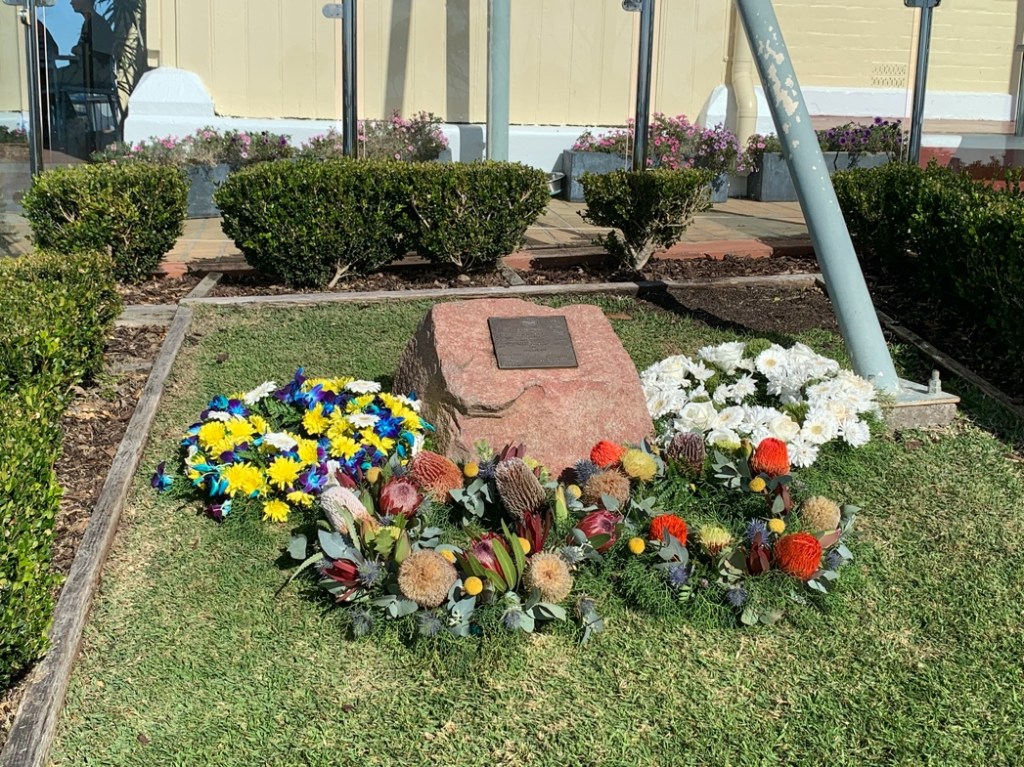
Floral tributes left at the Memorial site after the ceremony on 24 May 2021 [Author Photo]
Concluding Comments
The following papers on the military history of Port Stephens are published on this website and can be found at the following links:
When World War One Came to Anna Bay
Camouflage of Mount Tomaree – 1941/42
HMAS Assault at Nelson Bay Port Stephens – 1942/43
A Pictorial History of HMAS Assault – Nelson Bay
United States Landing Force Equipment Depot at Nelson Bay – 1942/43
Royal Marines at Port Stephens – 1945/46
‘Operation Boomerang’ at Port Stephens – March 1952
War Diary of Tomaree Coastal Artillery Battery Port Stephens – 1942/1944
Post War History of the Gan Gan Military Camp At Port Stephens
15th Northern Lancers at the Gan Gan Military Camp – 1949
Military Training Camp At Gan Gan – February 1951
School Cadets At The Gan Gan Military Camp – April 1951
Army Commando Training Exercises at Gan Gan – 1953 and 1955
First Army Camp for Women of the Citizen Military Forces at Gan Gan – April 1954
University Students at the Gan Gan Military Camp 1950 and 1962
Military Picnic at One Mile Beach, Port Stephens
Port Stephens Residents Serving in The Australian Military Forces in The Second World War
Letters from the Front Sent by a First World War Soldier of Port Stephens
Tank Traps at Birubi Beach – Port Stephens
Researched and compiled by Kevin McGuinness
July 2023

 Port Stephens - a history exploration