
Introduction
The coastline around Morna Point, south of Port Stephens, from the southern end of One Mile Beach to the northern end of Birubi Beach, is a rocky volcanic landscape both on land and undersea. It juts out into the ocean at the northern end of the Stockton Bight.
The formation of rock ledges and shoals that lie off the coastline, under the low tide water mark, make the area very dangerous for shipping. In the late 1800’s and early decades of 1900’s there were many shipping accidents and founderings.
When sailing along the coast near Morna Point, mariners would use sightings from Nobby’s (Newcastle) and Port Stephens lighthouses as an aid to determine if they were sailing at an adequate distance from the Morna Point shoreline.
So why did so many ships founder on that rocky coastline? The most common reasons were poor weather conditions, particularly at night which meant an accurate position could not always be determined, as the land and lighthouses could not always be seen; and large seas that could swamp a boat putting out its boiler fire, or damaging vital equipment, and leaving it to the mercy of the ocean swells.
Considering the large number of ships that have foundered on this stretch of coast, there was minimal loss of life. The most dangerous manoeuvre was the transfer of crew and passengers from a stricken ship into lifeboats. Lives were lost when these small boats upturned when hit by the same strong swells.
In several cases the lighthouse keeper at Port Stephens played a key role in telegraphing details of new wrecks to the authorities in Newcastle or in providing assistance to survivors.
This paper is the story of nine ships that struck that part of the rocky coastline, known to mariners as Morna Point, and also of the Fitzroy, that was wrecked immediately adjacent to Morna Point. It tells of the circumstances that led to each mishap and the fate of those on board. Many other ships have foundered on the coast between Newcastle and Port Stephens on that long stretch of Stockton Beach. These are stories for another time.
This paper also includes Postscripts on the Newcastle Rocket Brigade and Lifeboat Services; the Newcastle Sailors Home; and an Anna Bay resident, Jane Blanch.
Further information on shipwrecks in the Port Stephens area can also be found at the following links on this website:
A History of 110 Shipwrecks at Port Stephens 1800 – 1950
Shipwrecks Inside Port Stephens – 1869 to 1950
Morna Point – A Dangerous Rocky Coastline Between Newcastle and Port Stephens
The Daily Telegraph of 14 December 1897, page 5, describes of the dangerous coastline between Newcastle and Port Stephens, which contributed to many shipwrecks:
‘Morna Point has been the scene of several shipping disasters, principally sailing crafts, and in one or two cases loss of life occurred, but this was many years ago. The coast from the entrance of Newcastle to Stephen’s Point, near the entrance to Port Stephens, trends in a north-east by east direction for 23 miles, but a direct course between cannot be steered, as Morna Point, 18 miles from Newcastle, extends beyond that line of bearings. The land between Newcastle and Morna Point forms a bay with a low sandy shore, on which the surf at all times beats heavily, and, says a well-known authority, a vessel may be lost in the rollers, which, in some instances, extend to a distance of three miles off the shore. The land at the eastern part of this bay is of considerable height and continues so to Port Stephens. Due south of Morna Point, two and a half cables, is a shoal patch of rocky ground, named Telegraph Rock, having as little as 8ft. of water on it at high water springs. It breaks in bad weather, or with a southerly swell. The summit of Port Stephens, or Lighthouse Islands on, with the right extreme of Fingal Head, will take a vessel clear of the Telegraph Rock. Another patch dangerous to navigation bears south-west one mile from Morna Point, with two and a half fathoms over It. As the light at Port Stephens is shut out when in the vicinity of this shoal, steamers are cautioned against navigating near it. In fact, as a general rule, in bad weather, this point should be given a wide berth.’
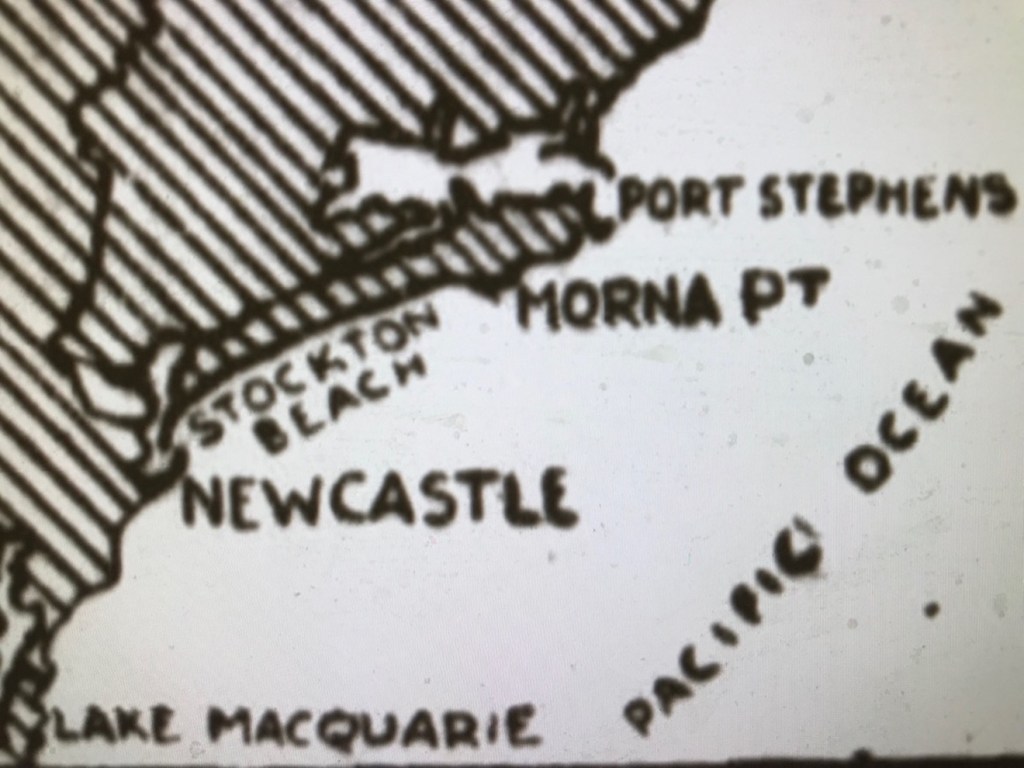
Map of the coastline between Newcastle and Port Stephens
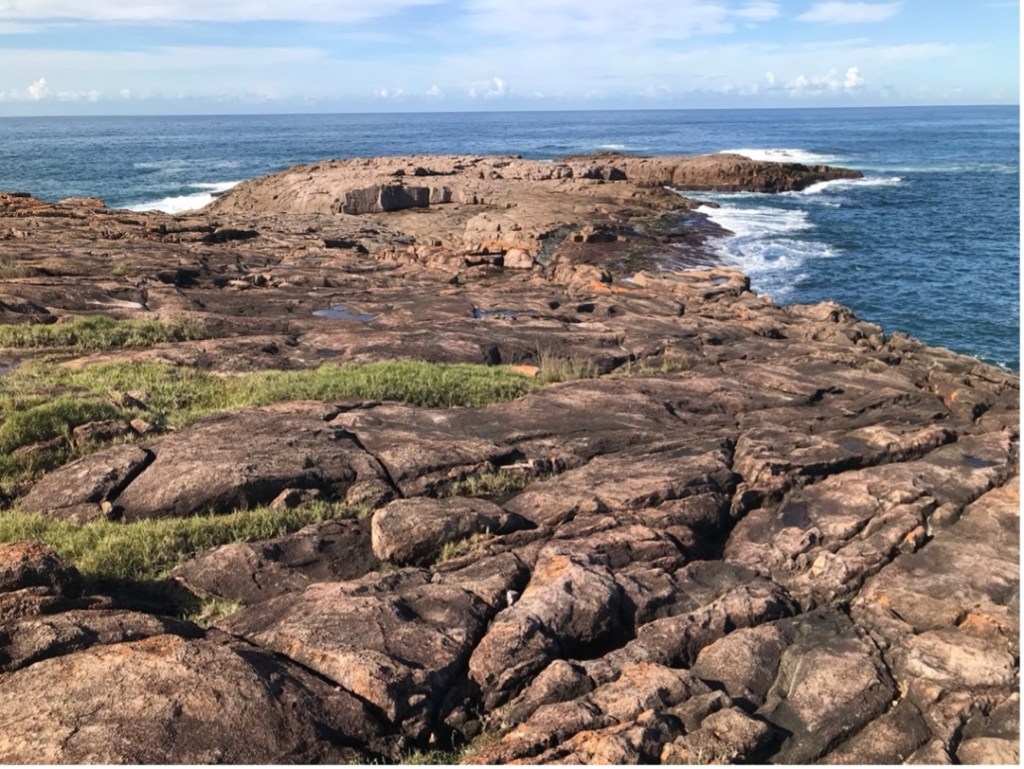
Morna Point coastline [Author photo – May 2022]
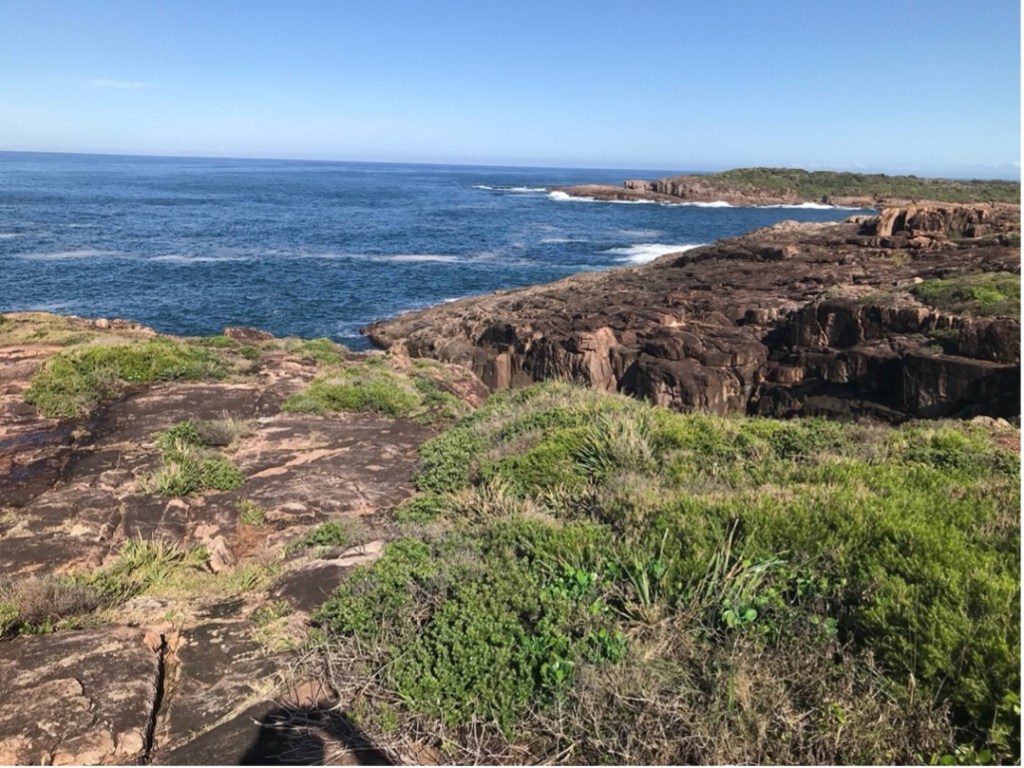
Morna Point coastline looking south [Author photo – May 2022]
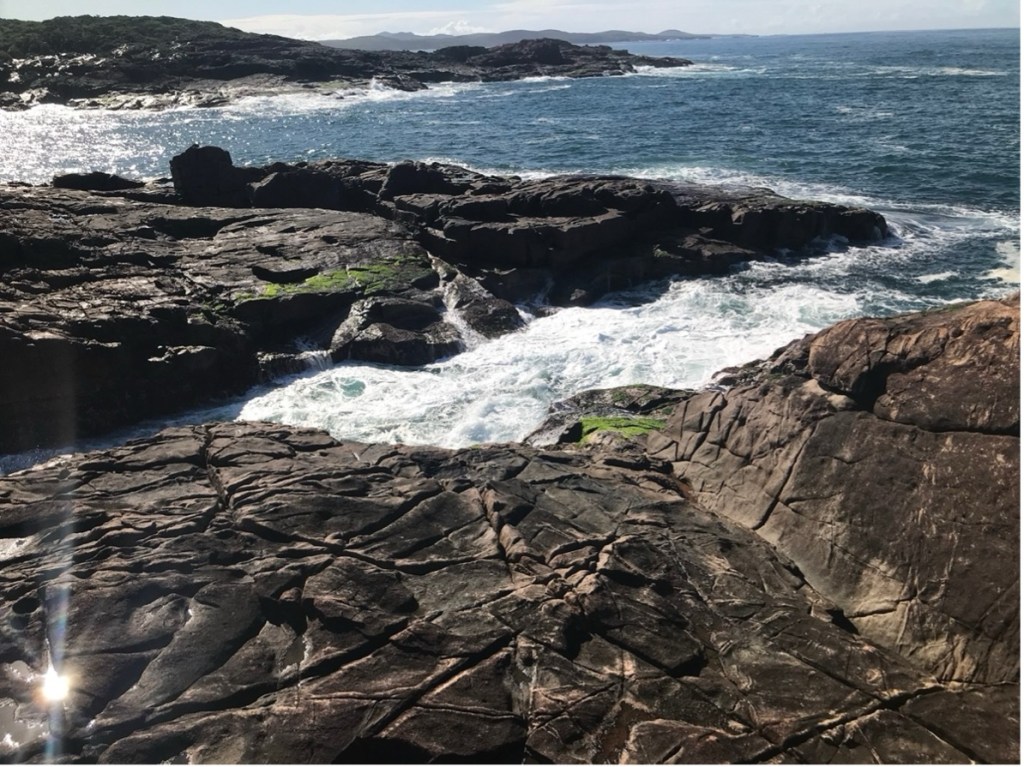
Morna Point coastline looking north. The Port Stephens Lighthouse is located on the headland situated at the top of the photo. [Author photo – May 2022]
1. Collision of the Steamer Telegraph With Rocks at Morna Point – December 1865
The first recorded incident of a ship coming into contact with rocks at Morna Point was that of the iron paddle steamer, Telegraph, which had a lucky escape from sinking. The Empire of 22 December 1865, page 4, reported:
‘The Australasian Steam Navigation Company’s steamship Telegraph has been beached in Nelson Bay, in consequence of having touched on a rock off Morna Point. A telegram received yesterday, from Newcastle, announced the news of the accident, and in the afternoon Mr. Powell, the chief officer, arrived by the Morpeth, steamer. We are indebted to him for a few particulars respecting the accident. The Telegraph left Sydney on Tuesday at 6 p.m., and was clear off the North Head at 6.13. It being calm and the weather fine, the vessel continued a northerly coarse during the night, and the weather became thick and hazy; at about 3 a.m. a shock was felt in the vessel, and she gave a heavy roll, at the same time shipping a sea over the starboard bow. The rock on which the vessel is supposed to have struck is off Morna Point, seven miles S.S.W. of Port Stephens. It was discovered that the water was making its way into the engine room, but the deck pumps being got to work, they were enabled to keep the water under, and the Telegraph bore up for Port Stephens, and Captain Page deemed it advisable to beach her, which was accordingly done in smooth water, in Nelson Bay, so that there is no danger to be apprehended for the safety of the vessel, and we are happy to say that no lives have been lost. The A.S.N. Co., immediately on receipt of the news, ordered the steamer Cawarra to be got ready, and she left last evening for the purpose of taking the cargo and passengers on to Brisbane.’
An examination of the vessel at Nelson Bay showed that the damage proved to be under the engines. Temporary repairs were completed, and the Telegraph returned to Sydney on the 24th. December 1865.
The paddle steamer’s luck ended on 9 October 1867, when it struck a rock off Camden Haven, Point Perpendicular, South of Port Macquarie. The twenty passengers and their luggage were landed but the vessel broke up completely within a week. The steamer was regarded as one of the finest and fastest operating on the coast.
2. Foundering of the Schooner Condong and the Barquentine Karoola – May 1896
Three ships founder during one storm
The Daily Telegraph of 25 May 1896, page 5, reported a fearsome night of gales that resulted in three ships being wrecked on the coast between Morna Point and Newcastle:
‘Three shipping disasters (all Sydney-owned vessels) are reported as a result of the howling southerly gale that has been raging along the coast during the past 48 hours, and in the case of one there was loss of life. The storm, described by a shipmaster who was out in it, as the heaviest he has experienced for some years, came up early on Saturday, and was attended by furious rains, squalls, and a high and dangerous sea. It is not to be wondered, therefore, that the small crafts suffered. With such wild weather raging off the coast there was nothing left for the coasting shipmaster but to run for shelter, and it was while making for a haven of safety that two of the wrecks occurred. The schooner Condong and the barquentine Karoola were the unfortunate vessels. They were driven by the hurricane squalls and mountainous seas on to Morna Point whilst endeavoring to make for the safe anchorage which Nelson’s Bay affords. ……… The third disaster was the foundering of the steamer Byron off Newcastle.’
Foundering of the Condong and Karoola
The Evening News of 25 May 1896, page 7, reported on the foundering of the schooner Condong and the barquentine Karoola near Morna Point. The Condong hit rocks before being driven ashore on present day Birubi Beach, while the Karoola was driven ashore, less than a mile to the south of the Condong:
‘At 3 p.m. yesterday a telegram reached Sydney from the Port Stephens light keeper saying that the schooner Condong and barquentine Karoola had been wrecked at Morna Point. Subsequent information was received to the effect that the Condong, a schooner of 96 tons, was wrecked on Saturday night during a southerly gale. The vessel left Sydney on Saturday morning for the Clarence River, and met the full force of the storm, and was driven on to Morna Point. The vessel struck during Saturday night, and with the heavy sea soon became a total wreck. The crew spent a very anxious night in the rigging, but landed safely at daylight. Her owner, Mr. Langley, of Balmain, has received a wire stating that her back is broken; she is sanded up, and half full of water. The Condong left here on Saturday morning for Townsville with 200 cases of dynamite intended for Charters Towers, and was to call enroute at the Clarence River to fill up with timber. The Condong was a topsail schooner of 96 tons, and comparatively new, being built about three years ago at the yards of Richard Lynn, Stockton, Newcastle. She was docked and thoroughly overhauled just before she left.
The barquetine Karoola was on her way from Lyttelton to Sydney with a cargo of produce, and went ashore at 10 a.m. yesterday near Morna Point. On Thursday the tug Newburgh spoke [communicated with] her off Wollongong. She was driven northward through stress of weather, and was seeking shelter in Nelson’s Bay when she was driven ashore, the gale then being at its height. The sails had all gone, and with the waves washing ever her decks the vessel was hurled on to the rocks. She struck with a terrific crash, and then swung round and settled down. The crew took to the rigging, and when a favorable opportunity occurred, launched the boat and made an attempt to land. The boat had, however, only just got clear of the ship’s side when she capsized, leaving the men struggling in the water.
Five of the crew, including the captain, reached the beach. They were all thoroughly exhausted, one so much, so that he died from the effects of the immersion. The mate was also drowned. He was not seen after the boat capsized. His body has not yet been recovered. ……. The Karoola was built for her owner, Mr. B. M. Corrigan, of Sydney, in 1884, by the late Mr. J. Stuart, at the Nambucca River. She is a wooden barquentine, 119ft 8in in length, 23ft 8in in depth, and of 201 tons register. She had been mostly engaged in the carrying trade between Johnstone’s River, Dungeness, and Sydney, and was on her initial voyage in the New Zealand trade, having taken coal from Newcastle to Lyttelton, which port she left on the 6th instant.’
The Clarence and Richmond Examiner of 30 May 1896, page 8, provided a further good description of the two wrecks:
‘The crew of the Condong who arrived in Sydney on Wednesday gave a full account of the wreck as she became stranded at Morna Point, on her voyage from Sydney to the Clarence. The Condong put to sea at midday on Saturday, and encountered a fearful southerly gale with blinding rains as soon as they cleared the Heads. The foresail and topsail were set, and they ran before the heavy sea for half an hour, when the foresheet carried away. They clewed up the foresail and made it fast and continued to run under the topsail. The sea was exceedingly heavy, the rain blinding, and Anderson, who was on the look-out, could not see the breakers until they were amongst them, the wind howling like fury, and gigantic seas breaking over them from stem to stern.
At 10 o’clock the little vessel shook like a reed, and those on board knew that she had struck something, but what it was they could not say. The master, Captain Harris, endeavoured to put out a boat, finding the vessel was fast. Finding that the vessel was not likely to break up just then, the men stood by for a while, and afterwards went ashore with some stores and some clothes, having in the meantime launched a boat. The sea was mountains high, and on that wild beach the waves broke with terrific force, and the result was that the little vessel had landed well upon the sand. In fact when the sea went down she was high and dry several feet from the water.
The men got the topsail ashore and improvised a tent near the rocks. Captain Harris and some of the men stood by the schooner until after midnight, and then a fire was lit and some coffee made, and the shipwrecked mariners made the best of their position till morning.
On Sunday morning they saw a schooner in difficulties. She was coming in towards the shore when they wore her round, but she was carried ashore. An anchor was thrown out before the beach was reached, and the schooner swung round and struck the beach stern first at 10 o’clock, about a mile south of where the Condong lay.
Seeing that the schooner was in distress, and that her seamen were likely to share a fate similar to theirs, the Condong crew at once ran down the beach, but were then unable to render any aid, when the vessel struck. The waves poured over her, and in a furious sea a boat was swung out for launching. Into this the crew of the Karoola put their clothes and other things. Six men got into the boat after she was loaded, and there were the captain and another still on the schooner when suddenly a huge wave struck the boat and it capsized, throwing occupants and contents into the water. The mate (Robert Stirratt) disappeared almost immediately, and appeared to go under the vessel. The other men fought bravely in the breakers, but one of their number was doomed, and it was seen that he was exhausted. He stood up in the breakers once and made a bold rush for safety, but the waves were fearful, and when he came up again he was knocked out. Once more he stood up and made a bold bid for life, but it was his last effort, for another wave struck him, and a few minutes later he was dragged ashore lifeless.
The other men were assisted ashore by the crew of the Condong. Subsequently Captain Richards and the cook of the Karoola got safely ashore. Gus Abramson, a seaman of the Condong, waited his chance and got aboard the Karoola, from which he sent ashore a cask to which was attached a fishing line. With this a heavy Manilla towrope was got ashore and made fast, and then the men were enabled to go aboard the Karoola. The men state that had there not been such haste all the crew could have been saved by these means.’
Interviews with crew members of the Condong
The Evening News of 26 May 1896, page 5, reported:
‘Otto Nobal, cook, and F. Anderson, A. B., survivors from the wrecked schooner Condong, reached Newcastle this morning from the scene of the wreck. They walked round the beach [Stockton Beach], a distance of eighteen miles. Nobal states that the Condong is high and dry on the sandy beach, about a mile southward from Morna Point, resting comfortably in the sand. The only damage sustained is that 8ft of the keel is broken off. She is, however, half full of water, but there are good prospects of floating her. The captain and mate are standing by the vessel. Anderson states that after the vessel left Sydney on Saturday, when the full force of the storm was encountered and the vessel was unable to weather Port Stephens, she struck at 10 p.m., and all hands took to the rigging, remaining there till 2 a.m. on Sunday, expecting every moment to be washed overboard.
Gus Abrahams, a seaman, swam ashore through the breakers with a line, and by this means the others reached the shore. Both speak highly of Abrahams’s pluck. As the water receded the schooner was left high and dry and the men were thus enabled to save their effects. The captain wanted the men to discharge the cargo, but they refused, fearing to handle the dynamite, of which there is a large quantity on board. Two topsails were taken ashore and a tent pitched on the beach, where all hands camped, having plenty provisions. The two men had a rough tramp through the sand, and had to leave their effects on the beach when about halfway. On arrival [at Newcastle] they were put up at the Sailors’ Home and supplied with passes to Sydney.
Two others of the men proceeded to Port Stephens, and will come on by boat. Whilst the Condong’s crew were standing by the vessel on Sunday morning the Karoola came ashore, about a mile nearer to Newcastle, and all hands went to her assistance. Mate Stryett, who leaves a wife and family at Paddington, was drowned, and another man died of exhaustion. The Karoola crew were taken care of by the Condong men, and all camped together. The Karoola’s back is broken, and the cabin fittings and large quantity of wreckage is floating. She was boarded yesterday morning, but nothing could be saved. She is settling down on the sand, and is now a total wreck. The master and men are still standing by. No cargo has as yet been washed ashore.’
Marine Board of Inquiry into the foundering of the Karoola
The Daily Telegraph of 9 June 1896, page 3, reported on the first day of deliberations by the Marine Board of Inquiry into the loss of the Karoola:
‘The Marine Board yesterday continued the inquiry into the circumstances attending the loss of the barquentine Karoolo at Morna Point on May 24. Albert Attenridge, the cook and steward on board the vessel at the time of her loss, stated that on the Saturday prior to the occurrence squally weather was the rule, and the sun was completely obscured. He did not, however, understand anything about the navigation of the vessel. The board reported that the wreck, whereby two lives were lost, was caused by the wrongful act, or default, of the master, John Richards, in carelessly navigating his vessel by shaping his course in a south-easterly gale for Sydney from an erroneous position on the chart. He was, therefore, called upon to appear on Monday next, and to show cause why his certificate should not be suspended or cancelled.’
The Newcastle Morning Herald and Miners’ Advocate of 16 June 1896, page 4, reported on the final decision of the Marine Board of Inquiry regarding the Karoola:
‘The decision of the Marine Board in regard to the loss of the schooner Karoola, off Morna Point, on May 24 last, was given by the president (Captain F. Hixson, R.N.) yesterday. The board having heard the evidence, decided to suspend the foreign-going certificate of the master, John Richards, for a period of three months. The president also said that the captain might in the meantime get a mate’s certificate from the Victorian Marine Board.’
Marine Board of Inquiry into the foundering of the Condong
The Sydney Morning Herald of 9 June 1896, page 3, reported on the Marine Board of Inquiry into the foundering of the Condong:
‘The board which commenced an inquiry into the wreck of the Condong, which went ashore near Morna Point on the 23rd May. Charles James Harris said that he was master of the Condong, and had been in charge since the 5th December. The Condong was a topsail schooner of 60 tons register. The Condong left Sydney about noon on the 23rd May. The weather at the time did not appear to be very bad, although it was overcast with slight showers. When they got opposite the Heads the weather became much heavier and moderate gale sprung up from south to south-west. At 7 p.m. he altered the vessel’s course to north-east by north. About 9.30 p.m he fancied he could see white foam near the vessel. A big sea struck the vessel at the time, and knocked her on her beam-ends; but she righted herself.
When the vessel struck the beach he shouted out to the men to save themselves. It was about 9.45 p.m. when the vessel was hard and fast on the beach, and about two hours later all hands had got out of her. No lives were lost, and the vessel was not then a total wreck. He sent to Sydney for assistance, and remained by the vessel. The Condong became a total wreck after the relief party from Sydney reached her. When the white foam—which afterwards turned out to be the beach—first became visible, he shouted out to the mate to heave the lead. No lights could be seen at the time, and he did not see the light at Port Stephens after he got ashore.
There were six hands on board the vessel and she was going at the rate of about eight knots an hour. Witness was keeping watch at the time, and expected to pass six or seven miles off Port Stephens. The Condong was bound from Sydney to Townsville, via the Clarence River. When he first noticed the dangerous position that the vessel was in it was too late to get out from the shore. The inquiry was adjourned until next Monday for the production of further evidence.’
The Australian Star of 23 June 1896, page 7, reported on the Marine Board of Inquiry into the loss of the Condong:
‘Captain C. J. Harris, whom the Marine Board last week adjudged responsible for the wreck of the schooner Condong, appeared before that tribunal this afternoon to show cause why his certificate should not be cancelled or suspended. The vessel went ashore near Morna Point on May 23 last, her loss being attributed to the wrongful act of the master in steering a course along the coast during thick heavy weather and with no land in sight. The board, after hearing Captain Harris, decided that his certificate should be suspended for a period of three months.’
3. Foundering of the Steamship Fitzroy – December 1897
Report on the foundering
The Daily Telegraph of 13 December 1897, page 5, carried the following comprehensive report on the foundering of the steel passenger steamship, Fitzroy:
‘Another of those unaccountable shipwrecks, by which the maritime history of the colony is frequently punctuated, occurred at an early hour on Saturday morning on the beach adjacent to Morna Point, 18 miles north of Newcastle, and seven miles by road south of Nelson’s Bay. The victim of this latest calamity was the A.U.S.N. Company’s passenger steamer Fitzroy, which left Sydney at 7 o’clock on Friday evening for Brisbane and Queensland ports, under the command of Captain Grahl, and with a complement of about 45 passengers and 35 of a crew. At 1.20 a.m. on Saturday, without any warning having previously been given of the ship’s dangerous position, she ran broadside on to a sandy beach, and remained there a permanent fixture.
For two hours and a half the passengers and crew clung to the vessel, many of them with nothing more round them than a nightdress and a blanket, waiting for daylight to disclose their whereabouts, and bring opportunity for rescue from their perilous plight. That all succeeded in getting ashore safely is a circumstance little short of the miraculous. How the wreck happened, how the Fitzroy got into the course which took her into her present position, is a mystery which will probably never be satisfactorily explained. With the Nobbys’ light behind, the Port Stephens light ahead, and with a distance of only 14¾ miles between them, it is difficult to understand the terrible suddenness of the stranding. The night was a moonlight one, but was rendered thick and murky by heavy banks of clouds, and occasionally inky black, by heavy showers of driving rain.
The ship was, it is stated, steered apparently in the same course which had carried her times out of number safely to her destination, and it can only be surmised, if this is the case, that the strong south-easterly wind which was blowing, striking her as it would, on her star-board quarter, and, perhaps, aided by changes in the currents, which experienced men say do occur on the coast after long spells of heavy southerly weather, gradually bore her on to land, all traces of which were for the time being lost in the haze. Several members of the crew account for the trouble in different ways.
One suggested that a couple of heavy girders and a quantity of chemicals, which were being carried on deck, must have affected the compasses. Others asserted that, by the compass, the vessel was going north-east when she struck, and must have been carried in shore by a very strong and unusual current. Morna Point is the termination of the long reach of sand known as the Stockton Bight, and a low, stony headland juts out a considerable distance at a rather sharp angle. The course generally steered by intercolonial coasters, bound north, takes them from three to five miles off the point, but it is understood that in thick weather masters sometimes make close to Port Stephens lighthouse, in order to the better gauge their positions. The locality is apparently a very dangerous one for shipping generally. Within a quarter of a mile of the Fitzroy, in a southerly direction, lie the remains of the schooners Karoola and Condong, which both went ashore there on the night of May 24, 1896. Still further southward a couple of miles may be seen portions of the hull of another vessel, marking the spot where the barque Adderley stranded on April 24 of the present year.
Serious as the Fitzroy wreck has been, still there was a Providence watching over it. Had she gone 200yds. further, she would have struck on the rocks of the point, and in the sea which was running it is not difficult to imagine what might have been the result to those on board. Instead, she was brought up on a soft, sandy bed, and in a position broadside on to the beach, which was, under the circumstances, decidedly the best that could have been found for her, as her hull acted as a breakwater, and enabled the landing of the passengers and crew to be effected with a great reduction in the amount of danger, which would have otherwise attended such a proceeding.
When the ship struck, and the position of affairs had been to a certain extent realised by the captain, the order was given for all hands to be brought on deck. It was obeyed with alacrity, and before many minutes had elapsed everyone was supplied with a lifebelt. It was too thick and murky for the position with regard to the land to be realised, and Captain Grahl came to an early determination to stand by the ship with her human freight till daylight. The whistle was kept blowing, and rockets and guns were fired off, but although the former was heard by a resident close by. It was regarded as but an ordinary occurrence in those parts, and failed to bring any assistance.
For a time the ship remained in an upright position, with the waves frequently breaking right over her. Then her starboard ports were smashed in, and she took a list to starboard, towards the breakers, and remained that way for a couple of hours, her decks being at an angle of about 35 degrees. The passengers had up to this time been huddled up together in the vicinity of the after-house. They were now ordered up on to the captain’s bridge and into the chart house. Meanwhile Captain Grahl and his crew, with the assistance of several of the more able-bodied passengers, were making endeavours to launch the boats. The task was a trying and perilous one. The heavy seas completely smashed the starboard boats, and the bumping of the snip, added to the list of the decks made the work in connection with those on the port side very heavy. They had to be lifted bodily over the vessel’s side, and many times everybody engaged in the work were thrown to the decks.
Ultimately the boats were got out and allowed to remain hanging down the side until they were required at daylight. When the dawn came, and the beach was made out, it was resolved that an immediate attempt should be made to land. The vessel had in the meantime bumped in about 75 yards from the position she originally occupied, and was still broadside on to the breakers about 100 yards out in the water. Although her hull broke the force of the waves somewhat, there was still a nasty sea on the sweep of the water round her bows and stern meeting and causing a dangerous chopping. A line was sent ashore in a boat, and an effort made to get a hawser after it, but the latter got in a bight, and the task proved too much for the limited number of men. The thin line was then made fast to a stake driven in the sand, and an attempt made to work the boats by means of it, but the stake soon gave way, and the paddles had to be resorted to.
All the ladies except two were put in the first boat, which landed without much difficulty. A rougher time awaited the second boat, the fate of which was for a time very uncertain. Five trips in all were made, and the captain and chief engineer were the last to leave the ship. Half an hour after all hands had been got ashore, the Fitzroy gave a lurch to port, and righting herself, began to settle down in the sand, with the seas breaking mercilessly over her. The work of getting ashore had not begun any too soon.
One of the crew managed, with great difficulty, to light a fire on the beach, and others were sent in search of habitations. About a quarter of a mile away was found the residence of Mr. G. Blanch, a butcher, whose wife readily consented to do her best for the ladies and children, and they were all removed to the cottage by 7 o’clock. Many of the ladies were in their nightdresses only, but the stewards had provided them with blankets in which to wrap themselves. All were wet with the spray and rain, and much fatigued by their exposure. Mrs. Blanch did what she could for them, and the news having spread around, the other settlers about rolled up with spring carts and drays, and nearly the whole of the party were conveyed to Nelson’s Bay.
The scenes on the vessel during the two and a half hours in which the passengers and crew were compelled to remain there after the stranding occurred were heartrending. Men and women prayed together, and children clung to them in terror. One lady wrapped her lifebelt round herself and her infant child, which was thus clasped securely to her breast. The conduct of everyone concerned is described as of the best possible description. There was no panic or confusion, and the women particularly behaved with marvellous resignation. The stewards were most attentive under the trying circumstances, and their thoughtfulness in providing blankets for the women and children mitigated to a very great extent their discomfort. ……
As soon an possible after the receipt of the news, I set out from Newcastle for the scene of the wreck. A start was made at noon, and the distance was negotiated in two hours’ riding from Stockton along the beach route. The vessel was then quite upright, rather down by the bows, and evidently settling down quickly in the sand. Heavy seas were breaking right over her, washing down the captain’s bridge, and splashing round the top of the funnel. Her distance from the dry sand was not much more than one hundred yards, and she was heading dead on for three or four large rocks, which stand out from the point not more than two hundred yards further on.
The deck was strewn with cases of fruit, bales of goods, and other deck cargo, as well as with the wrecks of the vessel’s boats and houses. A dead pig or two reminded one of the service rendered by the species on another and very similar recent occasion, and it was stated that this time also several porkers made their way alive on to the beach, and escaped into the scrub. A number of settlers from the surrounding homesteads were on the beach curiously surveying the scene.
At Mr. Blanch’s cottage were found the second mate of the Fitzroy, two or three of the crew, and Mr. and Mrs. John Gentleman, of Brisbane, and Captain Rothwell, saloon passengers. They were loud in praise of the kind treatment accorded them by Mr. and Mrs. Blanch, and appeared to be very comfortable. Mr. Blanch stated that he heard a steamer whistling through the night, and a noise which might have been a gunshot, but as fishing boats frequently had their whistles blowing at night around the locality be paid no attention to the signals.
The news of the wreck was first received by him at Nelson’s Bay, whither he went at an early hour to deliver meat. On arrival at Nelson’s Bay, I found that the tug Hero had just left with most of the crew and steerage passengers for Newcastle, as well as one lady (a Mrs. Grube), who is a member of the Salvation Army, and had important business to transact in Queensland. All the other ladies and children were in bed, waiting for their scanty clothing to dry, and Captain Grahl and the remaining members of the crew and male passengers were also enjoying the comforts of the blankets.
At 7.30 o’clock on Saturday evening, two hours before high water, the tide was awash with the forward bulwarks, and within a couple of feet of the quarter deck, while the seas were breaking completely over the hull. The vessel was still in an upright position, and appeared to be fast settling down into the sand, an absolutely irretrievable wreck. The once handsomely furnished after deck house was then a mere skeleton. In the dusk, it could be seen that a light was still burning in the forecastle head, the top of which was a couple of feet out of the reach of the tide. Senior-sergeant McVane, the head of the Newcastle water police, with Senior-constable Olsen and Constable Cook, of his force, and a trooper from Raymond Terrace, was then on the scene, together with Mr. W. Hickey, representing Dalgety and Co., the Newcastle agents for the A.U.S.N. Company. …..
I viewed the wreck to-day. The vessel is lying on her keel, heading about north. She is steadily sinking in the sand, with the head down, and covered to about the waterway. Seas are breaking right over her. It is a most fortunate thing that the vessel struck where she did, as another 300yds. would have put her on to the rocks, when nothing short of a miracle would have saved a life. Very little wreckage is coming ashore, which, perhaps, is owing to the vessel sinking in the sand. Captain Grahl is at the wreck, endeavouring to obtain some of the clothing and other effects of the passengers from among the things washed off the vessel. Several of the passengers who remained at the private residence near the scene of the wreck returned to Newcastle by ‘bus this morning. Among them were Mr. and Mrs. Gentleman. The tug Hero is expected from Newcastle tomorrow morning for the remainder of the passengers. At the wreck the Customs Department is represented by Messrs. Esmond and Hannell, assisted by Constables Fergus and Hannell, of the water police, and Senior-Constable Olsen and Constable Cook, whose quarters are a tent made of a sail of the wrecked steamer’s lifeboat, surrourded by cases of cargo washed up. The cargo washed ashore has been placed in safety. ….
Senior-sergeant McVane returned to Newcastle today, he having left the scene of the wreck at 8 a.m. He states that at half-tide the Fitzroy’ bows were out of sight, and seas were washing clean over her. All her deck houses were gone but the bridge, funnel and masts were still standing in upright positions. A good deal of wreckage had come ashore, but very little cargo. Captain Downes and a party went out to Morna Point this morning, and returned about half-past 9 tonight. At 6 p.m. they state that the hull of the ship seemed to have been broken at the mizzenmast. Captain Downes will go out to Nelson’s Bay at 6 o’clock to-morrow morning with the tug Leveret, to bring the balance of the passengers and crew to Newcastle, and he is taking a stock of clothing with him to supply their needs. Mr. Gentleman and his wife came into Newcastle by a private conveyance this afternoon, and proceed to Brisbane by the express.
In view of the stormy conditions prevailing on the coast on Saturday morning, the report of the wreck created considerable excitement in the city, but any fears that might have been felt for the safety of those on board were quickly allayed by the receipt of news that the passengers and crew had landed safely. Information as to the safe landing of all hands was posted outside “The Daily Telegraph” office, the Merchants’ Exchange, and the Post-office shipping board during the day.’

Map showing the site of the wreck of the Fitzroy
Marine Board of Inquiry on the foundering
The Sunday Times of 26 December 1897, page 8, reported on the Marine Board Inquiry:
‘At the Marine Board inquiry into the wreck of the steamer Fitzroy at Morna Point on December 11, it was shown that Thos. Francis James, second officer, was in charge at the time having relieved the third officer. James Grahl, master, said that after clearing the Heads at 6.45 p.m. on the 10th inst. he steered a course north-east by north-half-north. Witness went below after the steamer had passed Barranjoey. She passed the usual distance off shore. He was called by the second officer at about 1.20 a.m., after the vessel had struck. The land was then plainly visible. He asked the second officer how he got the vessel in that position, and he replied that he had not seen the land. It was a cloudy night, with passing showers ; but was not a bad night. When witness went below land was not visible.
The Board found that the wreck was caused — first, by the wrongful act and default of James Grahl, the master, in setting a course which led to the loss of the vessel ; and second, by the default of Thomas Francis James, the officer in charge of the watch, in allowing the ship to run into danger when the said danger should have been visible with the weather prevailing at the time. Subsequently the Board suspended the captain’s certificate for six months from the date of the wreck, and the second officer’s for three months. Captain Hixson added that the board desired to compliment Captain Grahl upon his action subsequent to the grounding of the vessel, which they considered had been the means of saving life, and to state that they were impressed by his manly bearing during the inquiry.’
Wreck of the Fitzroy destroyed
The Sydney Morning Herald of 28 February 1898, page 5, reported on the final end of the Fitzroy wreck:
‘The steamer Fitzroy, which was wrecked on Stockton beach, near Morna Point, in December last was blown up yesterday afternoon in order to enable the purchaser to recover the cargo. It was hoped in the first instance that a portion of the vessel’s machinery might be saved, but she went to pieces so rapidly that it became evident some time ago that it would be useless to attempt to secure anything except the cargo. The work of blowing up the vessel was carried out by a party of Submarine Engineers, under the supervision of Major Lee. The charge was exploded under the stern of the Fitzroy, with the result that the afterpart of the vessel was completely shattered. It is probable that another charge will be fired tomorrow. A quantity of cargo consisting of candles and tinned meat, as well as cabin and other fittings, has already been washed on the beach. It is confidently anticipated that the bulk of the vessel’s cargo will float ashore. Alderman W. B. Sharp is the purchaser of the wreck, and the price paid was £60.’
4. Narrow Escape of the Steel Steamer Tomki – May 1899
The Daily Telegraph of 3 May 1899, page 7, carried a report on the narrow escape that the steamer Tomki had after it struck Morna Point, but was able to be beached on Fingal Beach, to allow repairs to be undertaken:
‘Considerable excitement was occasioned in shipping circles yesterday morning on receipt of a telegram from Port Stephens stating that the steamer Tomki, of the North Coast Steam Navigation Company’s line, and well known in connection with the Richmond River trade, was ashore in Fingal Bay.
The Tomki left Sydney at 10 o’clock on Monday night, bound for the Richmond River, with mails, passengers, and cargo, and as the weather was beautifully fine along the coast, surprise was expressed that the vessel should meet with a mishap under such favourable conditions. It appears from the telegrams that the vessel struck on Morna Point, which lies just this side of Port Stephens, and close to the scene of the wreck of the A.U.S.N. Company’s steamer Fltzroy. Fortunately, there was no loss of life, a telegram from the Port Stephens station stating that all hands had been saved.
The first intimation of the disaster was received shortly after 9 o’clock in the morning from the lighthouse-keeper at Port Stephens. It was to the effect that “the steamer Tomki had been beached in Fingal Bay.” A later message reported that the Tomki had struck on Morna Point and had to be beached in Fingal Bay to prevent her from foundering. At this time the water had reached the engine room and after hold. From inquiries at the company’s office, it was gathered that telegrams had been received from Captain Paulson, master of the vessel, confirming the news of the stranding of the vessel and of her dangerous position in Fingal Bay. Captain Paulson asked that a boat, with a diver and salvage gear, should be sent to his assistance. The company immediately arranged for the steamer Macleay to be sent to the scene of the mishap, with the superintending engineer on board, in order to render any assistance possible, and to pick up the passengers from the Tomki.
Just as the Macleay was on the point of leaving, the following wire was received from the lighthouse-keeper at Port Stephens:— “Tomki floated; leak stopped; returning to Sydney for repairs.” Fingal Bay lies three miles and a half north of Morna Point, on southern side of Port Stephens, and there is a narrow strip of sand, which connects Mount Stephens with the mainland, and which has the Fly Roads, a well-known sheltering ground in Port Stephens, on its northern side. The last vessel wrecked at Morna Point was the A.U.S.N. Company’s steamer Fitzroy. This disaster occurred in December, 1897. Morna Point, which is four miles south of Port Stephens light, is a bluff, hilly headland, at the end of the long sandy beach, extending eighteen miles north eastward from Newcastle Harbor. Three-quarters of a mile south-west by south from its eastern point and a quarter of a mile off shore is Telegraph Shoal.’
The Clarence and Richmond Examiner of 6 May 1899, page 4, carried a further report on the near escape of the Tomki:
‘On Tuesday a wire came that the steamer Tomki was beached, and it was feared that another coastal calamity had occurred. The circumstances were that the steamer, bound from Sydney to the Richmond, with about 60 passengers and 26 of a crew, struck on the best known point, north of Sydney—Morna Point Reef. She was run some five or six miles into an adjacent bay and beached, came off and returned to Sydney. There was a scene at the wharf on her arrival, because by some means or other it had got about that the steamer was wrecked and that the survivors were about to land. Consequently a few hundreds of anxious people made for the North Coast wharf, some to hear the latest, others to meet friends. The scene there was interesting.
Directly the boat made fast the Company’s servants started to transfer the cargo from the Tomki to the Macleay, and a score of trucks were ploughing along vigorously carrying their burdens, of fruit, etc, to the Macleay, while the hurrying and scurrying of the passengers with their baggage lent not a little to the excitement. The ladies, of whom there were many amongst the Tomki’s passengers, were most to be pitied, with their children clinging about them and wondering what was going to happen next.
“We left Sydney,” said Captain Paulson, “for the Richmond at 10 p m. on Monday. It was a fine night and I turned in at daybreak and heard nothing after. But a sudden bump awoke me, and I sprang on deck to find the ship close into Morna Point. It was a bright, beautiful, quiet morning. How it happened I cannot say. The second mate, a man of many years experience in the company’s employ, was in charge. The first thing was to sound the well and find what water, if any, she was making. This showed that in the engine room the leak was severe, so I set the pumps going and headed the steamer into Fingal Bay, where I ran her bow on in smooth water. The most of the passengers had not turned out. After we beached her—the place is about five or six miles from where she struck—we set to work and plugged up the hole, which is under the engine-room, and then set her going astern, and came off.
The whole thing did not occupy more than two hours from the time I ran her ashore until I had her on a course to Sydney. We kept the pumps going, and came along at eight knots’ speed down the coast. None of the cargo is damaged—not a package.”
Mr McPhee, hotel proprietor at Broadwater, Richmond River, was a passenger by the Tomki. He had on board some stock, including the well-known racing pony Secret. At the time of the accident he was on deck attending to his stock, when suddenly the vessel gave a light bump. Her head was immediately turned seawards. She then bumped heavily, the shock being felt all over the ship. The concussion with the rock caused the two stays of the funnel to carry away. Mr McPhee speaks highly of the good seamanship displayed by Captain Paulsen. “The quick manner in which the vessel was beached, refloated, and brought into port,” he says, “equals anything on record”. Captain Paulson has been many years in the North Coast Company. He previously commanded the steamer Rosedale, and has the reputation of being one of the most careful and experienced skippers trading to the north coast.’
5. Foundering of the Steamer Kingsley – April 1902
Early report of the foundering
The Newcastle Morning Herald and Miners’ Advocate of 17 April 1902, page 5, reported:
‘Information reached Newcastle yesterday afternoon that the Hawkesbury Navigation Company’s steamer Kingsley, employed in the fish trade between Sydney and Cape Hawke, had been totally lost at Morna Point. The vessel ran on to Fisherman’s Reef during a dense fog, and was washed on to Crayfish Beach by the seas, but the crew all succeeded in escaping from the stranded vessel. Three of the crew and a passenger arrived here last night by the steamer Gosford from Nelson’s Bay. The party included a passenger named Antley Grey, Second Engineer ,Thomas Rose, Fireman T. Hughes, and the steward, Mahamedali. From the statements made by the men, who corroborate each other, it appears that the Kingsley left Sydney at 5.30 p.m. on Tuesday, bound for Cape Hawke. All went well until about 4.30 a.m. yesterday morning, when the master was at the wheel and the second engineer in charge of the engines, the passengers and other members of the crew being asleep.
The sea was smooth, but a dense fog had settled down during the night and apparently the vessel had got off her course, for just about the hour named she crashed on to Fisherman’s Reef, a submerged ledge of rocks about a mile and a quarter north of where the steamer Fitzroy went ashore some years ago. The second engineer, who had just finished “oiling round” when the steamer struck, at once called all hands, but there was little need for that, as the concussion fully aroused the sleepers, and in a few seconds they were on deck. The order was at once given to get the boats over the side, the first to be launched being a fishing boat owned by a party of three Italians, who were going to Cape Hawke for the winter fishing season.
In getting the boat over the steamer’s side the painter broke, and the boat drifted away, so the crew next turned their attention to the Kingsley’s lifeboat, which was got overboard safely. There was no confusion, although the darkness and fog were intense, but the fishermen were somewhat troubled at the loss of their property. When the lifeboat was launched and a compass and other gear put into it, the crew and passengers got on board and pulled away from the reef, standing by the vessel at a short distance to watch developments. The seas meantime were driving the vessel along and over the reef, and finally drove her into a narrow gap known as Crayfish Beach, where the steamer now lies on her port side, with her head pointing south and the tide flowing in and out of her hull.
On getting clear of the wreck the lifeboat proceeded seaward a short distance, when the fishermen’s boat was picked up, and as the lifeboat was leaking the master, mate, and engineer remained in it while the second engineer, fireman, and steward, with the four passengers, got into the fishermen’s boat. The latter then towed the lifeboat in towards the wreck to enable the master to make an inspection in the growing daylight. The steamer was then rolling about as the seas struck her, and the fish boxes, containing ice, which formed the deck cargo, were washing about alongside, and the seas breaking over the vessel. Captain Bain then decided to go seaward, where a couple of ketches could be seen, and motioned to those in the fishermen’s boat to do the same, but the crew of the latter decided to go ashore, and at 8.30 a.m. when last seen the captain’s boat was making in the direction of a steamer in the offing, which was thought to be the Defender.
The occupants of the fishing boat went ashore, landing at Boat Harbour, the three members of the crew and Mr. Grey walking into Nelson’s Bay, but the Italian fishermen went back to the vessel, and succeeded in rescuing their fishing nets, valued at about £200, which were stowed on the steamer’s bridge. The men removed nothing but their own property, and having secured that pulled round the point into Nelson’s Bay. When the party left the scene the vessel was nearly under water and a total wreck.’
Possible salvage of the Kingsley
The Newcastle Morning Herald and Miners’ Advocate of 21 April 1902, page 5, reported further on the salvage operations:
‘Messrs. J. Fenwick and Co.’s tug Vigilant proceeded early on Saturday morning to Morna Point, the scene of the wreck of the steamer Kingsley. Salvage operations, which on Friday night were regarded as likely to be attended by success, were resumed. The tug on Saturday morning took from Newcastle additional salvage gear, consisting of several extra pumps, and the salvage party diligently addressed itself to the task. About 20 men, directed by Mr. Graham, laboured arduously, and during the first few hours made an appreciable difference in the depth of water in the vessel’s hold. Everything went well, till about 10 a.m., when a heavy ground swell began with the strong nor’-easter. The wrecked vessel heaved a great deal, and, grating heavily on the rocks, the water rapidly returned to the level at which it stood before the pumping, and in spite of all efforts to reduce it, it continued to gain until it won absolute mastery. Mr. Graham and Captain Bain, master of the Kingsley, were present.
It was realised that nothing could be done but abandon salvage operations. With the exception of a small one, which was lost, the Kingsley’s anchors were recovered, and everything movable, lamps, &c., was taken from the wreck, placed on board the Vigilant and forwarded to Sydney on Saturday night. On Saturday, owing to the heavy swell, the Vigilant was not able to go in as close to the wreck as she had been on the preceding days. All hope of floating the Kingsley, has been abandoned by the salvage party.’
The Daily Telegraph of 23 April 1902, page 8, reported on renewed salvage operations:
‘The wreck of the steamer Kingsley, which went ashore at Morna Point last Wednesday was sold at auction by Messrs. Fraser, Uther, and Co. yesterday morning for the sum of £195. The purchaser was Mr. Steel. Salvage operations are to be started immediately, and an effort is to be made to recover the machinery from the wreck.’
The Australian Star of 10 May 1902, page 1, further reported:
‘The steamer Kingsley, which went ashore at Morna Point, while bound to Cape Hawke, from Sydney, a few weeks ago, fared badly in the recent rough weather off the coast. The hull broke completely up, and the wreckage lies piled up along the rocks in the vicinity of the wreck. Her engines and boiler went to the bottom, but the salvors are confident of saving them. A diver has been engaged since Monday last recovering the engines and boiler, but no news has reached Sydney yet as to whether he has been successful or not.’
Alleged theft of goods from the Kingsley
The Daily Telegraph of 25 April 1902, page 7, reported on an alleged theft of goods from the Kingsley wreck:
‘Two of the Italian fishermen who were on the steamer Kingsley when that vessel was wrecked on Morna Point last week appeared at the Newcastle Police Court yesterday, before Mr. M. S. Love, S.M., to answer a charge of having, on April 16, stolen from the wreck a box containing 21½b. of tobacco, and a vest containing £1 4s in money, the property of Norman Bain, the master of the Kingsley. The names of the men are Angelo Caputo and Francesco Visaggio. Constable Nowland, of Port Stephens, deposed to the arrest of the men and the recovery of the box of tobacco and the vest from the hut where they resided. Accused Caputo deposed that when he and his mates were getting their fishing nets from the Kingsley the members of the crew opened the box of tobacco, took some of the cakes out, and then threw the box overboard. He and his mates afterwards picked the box out of the water, together with the vest, which was also floating about. The accused were committed to take their trial at the Newcastle Quarter Sessions on June 2. Bail was allowed.’
The outcome of the theft case before the Newcastle Quarter Sessions was reported in the Sydney Morning Herald 18 June 1902, page 4:
‘Angelo Caputo and Francisco Visaggio, two Italian fisherman, pleaded not guilty to a charge of stealing from the wreck of the steamer Kingsley at Morna Point on April 16 a vest, tobacco, and money Mr James appeared for the defence. The jury found a verdict of not guilty and accused were discharged.’
Marine Court of Inquiry into the foundering
The Sydney Morning Herald of 16 May 1902, page 8, reported into the Marine Court of Inquiry into the foundering of the steamer Kingsley:
‘The Court of Marine Inquiry held an investigation into the circumstances attending the loss of the steamer Kingsley on Morna Point, whilst on a voyage from Sydney to Cape Hawke. Mr. Cockshott, instructed by the Crown Solicitor, appeared for the Superintendent of navigation and Mr Baxter Bruce appeared for the Hawkesbury Steam Navigation Company, the owners of the steamer. Norman Bain, master of the Kingsley, appeared in person.
Evidence was given to show that the Kingsley cleared Sydney Heads at 6 p.m. on April 15 bound for Cape Hawke. After clearing the Heads Captain Bain left the deck in charge of the second mate and returned to the deck again at 8 p.m. The vessel was then about three miles of Barrenjoey. Captain Bain remained in charge until midnight when he was relieved by the second mate. Captain Bain again took charge at 4 a.m on April 16. Twenty minutes after 4 o’clock the steamer ran on Morna Point and became a total wreck.
At the conclusion of the evidence the Court retired and after a brief consultation brought in the following finding:— The Court having carefully inquired into the circumstances attending the above mentioned shipping casualty, comes to the decision following :— 1. The British steamship Kingsley went ashore at Morna Point on the 16th day of April, 1902, and became a total wreck, when on a voyage from Sydney to Cape Hawke. 2. The weather was calm and the sea smooth. 3. The vessel was provided with the necessary life saving apparatus and signals, but whether she was at all respects well found there is not at present sufficient evidence before the Court. 4. Such shipwreck was caused by the default of Norman Bain, the master of the Kingsley, in not navigating his vessel with due caution, particularly in navigating without knowing the deviation of the compass, and in not using the lead to ascertain the proximity of the a vessel to the shore, and not slowing down when he found his vessel in a fog. 5. The mate (William Robrahn) should have called the master both when he altered the course and when the fog came on. The Court calls upon the said Norman Bain to show cause on Thursday, the 22nd May, 1902, at 12 noon, why his certificate of competency as master of a coast trade vessel numbered 504 and dated 22nd April, 1882, should not be suspended or cancelled.’
The Evening News of 23 May 1902, page 6, reported on the suspension of the captain:
‘At the inquiry held by the Marine Court— Judge Backhouse and Captains John Vine Hall and C. Taylor (assessors) — on the 15th instant into the circumstances attending the total wreck of the steamer Kingsley off Morna Point, beween Newcastle and Port Stephens, on April 16 last, the court found that the wreck had been caused by the default of Norman Bain, master of the Kingsley, in not navigating his vessel with due caution, particularly in navigating his vessel without knowing the deviation of the compass; in not using the lead to ascertain his proximity to the shore; and not slowing down when he found his vessel in a fog; and called upon him to show cause why his certificate should not be suspended or cancelled.
Bain appeared before the court for that purpose yesterday. Robert Arthur, master mariner, said he was captain of the Kingsley from July 16, 1901, to March 18 last, during which time the vessel was well found in everything. Captain Bain, in reply to his Honor, accounted for the accident by stating that the course he set had not been steered. The court ordered the certificate to be cancelled. His Honor remarked that the court had come to that decision with very great reluctance; but it had been called upon to take that extreme step because it considered Bain was not competent to be in charge of a vessel, whereby he might endanger the lives of the crew, to say nothing of the loss of valuable property.’
6. Foundering of yhe Iron Barquentine Oimara – September 1903
Various reports of the foundering
The Maitland Daily Mercury of 28 September 1903, page 3, reported on the foundering of the Oimara at Morna Point:
‘During the fierce gale and thick rain yesterday afternoon the barque Oimara was wrecked on Morna Point (the scene of the wreck of the steamer Fitzroy a couple of years ago). All hands have been saved, but the vessel is sure to become a total wreck.
As soon as the news of the wreck was received here [Newcastle] last night the usual signals were fired from Fort Scratchley, and the pilot steamer Ajax, and lifeboat, and several tugs, left for the scene, accompanied by the Water Police. The Rocket Brigade went from Stockton, and proceeded along the beach to the wreck. This morning at 10.30 the pilot steamer returned to port with the lifeboat, both having had a very trying night’s work in the gale and heavy rain. The very heavy sea that was running through the night made it impossible to get close to the stranded barque. On his return this morning, Captain Lucas, master of the Ajax, said that he found the remains of the wrecked steamer Fitzroy, the wrecked vessel lying on Morna Point.
When he left the barque she was lying …. with her starboard bilge up against the rocks, and her head up on the beach. Her bows were high and dry on the beach, but very heavy seas were breaking over her stern, and in his opinion she is bound to become a total wreck. The lifeboat, in charge of Coxswain, MacKinnon, made desperate efforts to reach the wreck, but owing to the exceptionally heavy sea and fierce gale was unable to do so. The lifeboat, Coxswain MacKinnon states, could not got within 500 feet of the wrecked Oimara. All hands got ashore safely in the ship’s boats, and on the beach made a rough shelter, in which they spent last night and to-day in comparative comfort.’
The Evening News of 28 September 1903, page 4, provided a report on the foundering:
‘Our Nelson’s Bay correspondent wired last evening, as follows: — “Just reported that a large iron sailing vessel, supposed name Oimara, is ashore, near Morna Point, close to the scene of the wreck of the Fitzroy. Up to the present, one boat is ashore, no lives lost, heavy sea running, vessel struck about 4 this afternoon.” The message points to the fact that the Oimara, an iron barque, of 1354 tons, built in 1875, at Glasgow, where she is owned, while bound from East London, South Africa, to Newcastle, has been caught in the Stockton Bight, and driven on to a dangerous patch of rocks, near Morna Point. The Oimara, in charge of Captain Brown, left East London (Africa), on August , in ballast. She is a vessel 241ft 4in long, 37ft 1in beam, and 21ft 4in depth, and is well-known at Sydney. At Morna Point, the scene of the disaster, there is a patch of rocky ground, not far from the spot where the A.U.S.N. steamer Fitzroy was lost on December 11, 1897. The Fitzroy missed the rocks, but was soon lying embedded over a sandbar on the southern side of Morna Point. The shore is exposed to southerly, south-easterly, and easterly weather.’
The Australian Star of 29 September 1903, page 6, further reported:
‘The barque Oimara, from East London (Cape), which went ashore at Morna Point last night, 10 miles north of Newcastle, is regarded as certain to become a total wreck. The sea is breaking over her.
The pilot steamer Ajax, which left for the scene of the wreck as soon as news was received, returned this morning, and reported that Captain Brown and crew were safe, but that it was impossible to reach them by boat, owing to the gale and rough sea. Later accounts state that the vessel’s crew got ashore in the ship’s boats, and are sheltering in a rig-up. Captain Lucas, of the steamer Ajax, states that the wreck lies near the remains of the wrecked steamer Fltzroy on the southern end of the rocks, with her starboard side up against the rocks, and her head upon the beach. Her bows are high and dry on the beach, and heavy seas are breaking over her stern. She is bound to become a total wreck. The lifeboat made several determined efforts to reach the wreck, but in consequence of the exceptionally boisterous wind and sea she was unable to do so.’
The Sydney Morning Herald of 29 September 1903, page 5, reported:
‘The barque Oimara, which was bound from East London to Newcastle, struck the coast on the south side of Morna Point at 4 p.m. yesterday, and is expected to become a total wreck. All hands were saved. The master, Captain G. Brown, arrived in Newcastle this afternoon, having been driven from Morna Point. He left the wreck at 8 o’clock this morning. The remainder of the ship’s company, with the exception of one man left in charge of the wreck, walked along the beach to Newcastle.
As anticipated, the Oimara got too far in during the thick weather yesterday, and was unable to clear Morna Point. She struck the beach a short distance to the north of where the steamer Fitzroy was wrecked, at the termination of the 18-mile beach, just where the rocks join the sand. Had the vessel struck the rocks the escape of the crew might not have been so fortunate. The barque is lying with her head straight in on the beach, with a heavy list to starboard, the deck being at an angle of about 45 deg. The vessel is full of water at the tide level. Being in light ballast her port side is not under water, but occasional seas wash right over her. Pending action by the underwriters, a man will be left in charge of the wreck on behalf of the captain.
The agents for the Oimara are Messrs. Scott, Fell, and Co., and their local representative, Mr. W. H. Dawson, sent a waggonette to meet the members of the crew on their way along the beach. He also made arrangements with Mr. Gardner, the local representative of the Shipwreck Relief Society, for the housing of the destitute sailors. Neither the crew nor the captain saved any of their effects; in fact, the only thing secured from the vessel was the ship’s papers.’
Statement by the Captain
The Evening News of 29 September 1903, page 6, reported on a statement made by the ship’s captain:
‘Further, particulars of the wreck of the Oimara have been received from Newcastle, including a statement by Captain Brown. It appears that the vessel was off Newcastle at midnight on Saturday last, but the weather was misty and thick, with a big sea. The ship was then put off the land. Suddenly, about 4 o’clock, land was reported, quite close by, and the captain saw the rocks of Morna Point. He made a prompt effort to haul the Oimara off to the eastward to clear the danger. Finding that course impossible, and being within a couple of minutes’ distance of the rocks, he swung the barque round, to the westward, with the intention of beaching, her and thus saying life and property. There was just room for him to effect his purpose.
The barque drove over the first break and then landed between the ribs of the old Fitzroy and the first ledge of the rocks forming the point. Between these two marks there is a distance of only about two hundred yards. Had the barque touched the latter further out, she must have been smashed to pieces and it is doubtful if anyone on board of her would have been left alive, as the sea was very rough.
The Daily Telegraph of 30 September 1903, page 9, reported:
‘Five more members of the crew of the wrecked barque Oimara reached the Sailors’ Home at Newcastle yesterday afternoon, and are now accommodated there. They put up at a farmhouse along the road from Morna Point on Monday night. Mr. Sydney, the mate, has returned to the wreck, it is stated, and the whole ship’s company is thus accounted for. Captain Brown, the master, intends to go down to Morna Point to-day to save what he can from the stranded vessel.’
The Newcastle Morning Herald and Miners’ Advocate of 1 October 1903, page 5, reported:
‘The barque Oimara, which was driven ashore near Morna Point on Sunday, remains in much the same position as when she was beached. The seas break over the vessel, which is now full of water, and has a fair-sized hole in her hull. There is no hope whatever of saving the barque, and it is considered that the cost of attempting to do so would be greater than the value of the ship. Mr. M. McDermott, Lloyd’s agent and representative of the London underwriters, returned from the scene of the wreck yesterday. He states that the vessel has not been abandoned, but he has very little hope that she will be got off the beach.’
Marine Court of Inquiry
The Evening News of 5 October 1903, page 5, reported on the Marine Court of Inquiry into the foundering:
‘The Marine Court, presided over by Judge Fitzhardinge, who had with him as assessors Captains Worrall and Boldchild, today inquired into the stranding of the barque Oimara, on Morna Point, on Sunday week last. George Brown, master of the Oimara, said that he had been in the vessel for thirteen years. About midnight on Saturday week last, Nobbys light came into view for a few minutes, bearing north-west. The weather at this time was very thick, and a strong south-easterly wind blew. He stood out till 8 o’clock on Sunday morning, under short sail. The speed of the vessel at this time was about 4 knots. Then he wore the vessel round, and stood in for about an hour, with the wind on the port quarter. The weather was too thick to come in, so he stood out again on the starboard tack till noon, close hauled. He stood in again till 2 o’clock on Sunday afternoon. The lead was cast, but no bottom was found at 90 fathoms, and, estimating that be was 20 miles off land, he stood in till half-past 3, when he saw land about a mile away. He then set more sail, and tried to get away, but seeing Morna Point rocks ahead, and realising there was no chance of saving the vessel, he beached her in order to save life.
He had sailed into Newcastle Harbour several times, and was familiar with the coast. Evidence was given by the mate, Frederick William Sydney, and members of the crew in regard to heaving the lead. The Court then retired to consider its finding. The Court found that the loss of the barque Oimara on the 27th ultimo was brought about by the negligence of Captain Brown in not having made use of the lead line in order to ascertain his distance from the lee shore, which he knew he was approaching. However, the Court did not think that the negligence was such that it made it incumbent upon the Court to call upon Captain Brown to show cause why his certificate should not be suspended. The Court censured Captain Brown, and ordered him to pay the costs of the inquiry.’
7. Foundering of the Wooden Steamship Wallamba – July 1923
Early report of the foundering
The Evening News of 12 July 1923, page 1, reported on the foundering of the Wallamba:
‘Late last evening the North Coast Company’s steamer Wallamba ran ashore at Morna Point, 18 miles north from Newcastle. The crew took to the boats, and landed safely at Port Stephens this morning after six hours’ rowing. They were picked up there by the steamer Yulgilbar of the same company and brought to Newcastle. The Yulgilbar should arrive in Sydney from Newcastle about 5 o’clock this afternoon.
Latest advices are that the Wallamba has become a total wreck. Her deck cargo, consisting mostly of benzine, is washing on the rocks. That the crew are safe is due largely to Mr. Priest, the light-house keeper at Port Stephens, who sent out Morse signals for assistance throughout the night.
The only advice received here by the owners is that the ship in ashore, and that the crew have landed safely and will arrive in Sydney this afternoon. It is believed that a moderate sea was running at the time, but it is not known how the vessel came to run on the rocks. The Wallamba was in charge of Captain Anderson, and carried a crew of fifteen.
The first indication of the wreck was received by some campers at Morna Point, who are said to have been the Wallamba on the rocks. They heard boats with the men approaching the shore, and as there was a fair sea running at the time, they called to the men not to land. The boats were then turned to the south towards Port Stephens and landed on the beach there. The Wallamba was bound from Newcastle to the Manning River. She was of the modern type of wooden coastal steamer, having been built for the North Coast Company at Tuncurry, not far from where she was wrecked, in 1917. She was a vessel of 331 tons, with a length of 142ft 8 in, a breadth of 34ft 8in. and a depth of 7ft 1in.
Information as to the stranding of the vessel was conveyed to the lighthouse keeper at Port Stephens by campers who were in the vicinity of Morna Point and saw the mishap. The pilot steamer Ajax hurried to the scene shortly after 1 a.m. and the North Coast steamer Malanbar, which arrived at Newcastle from Sydney at 1.30 a.m. was also despatched.
The Wallamba left this port [Newcastle] at 7.25 p.m. yesterday on her usual run north. The Wallamba sank in four minutes after the first alarm was given. The captain and crew, in taking to the boats, lost many belongings which had to be left on the ship. Mr. Priest, lighthouse-keeper at Port Stephens, performed wonderful work. The safety of the crew is due mainly to his efforts. He sat at a Morse key all night and sent calls for assistance to every ship within range. The North Coast Company’s office here has been informed that the Yulgilbar picked up a message and lowered a couple of boats. These cruised around, and eventually located and picked up the crew.
It appears that the vessel went on the rocks at 10 p.m., but no word reached the lighthouse till 12.55. The Wallamba is a total wreck. She was carrying coal and general cargo, and is the property of the North Coast S.N. Company. Her skipper is Andrew Anderson, and first mate W. A. Woolston. Only a moderate sea and slight southerly prevailed last night.’
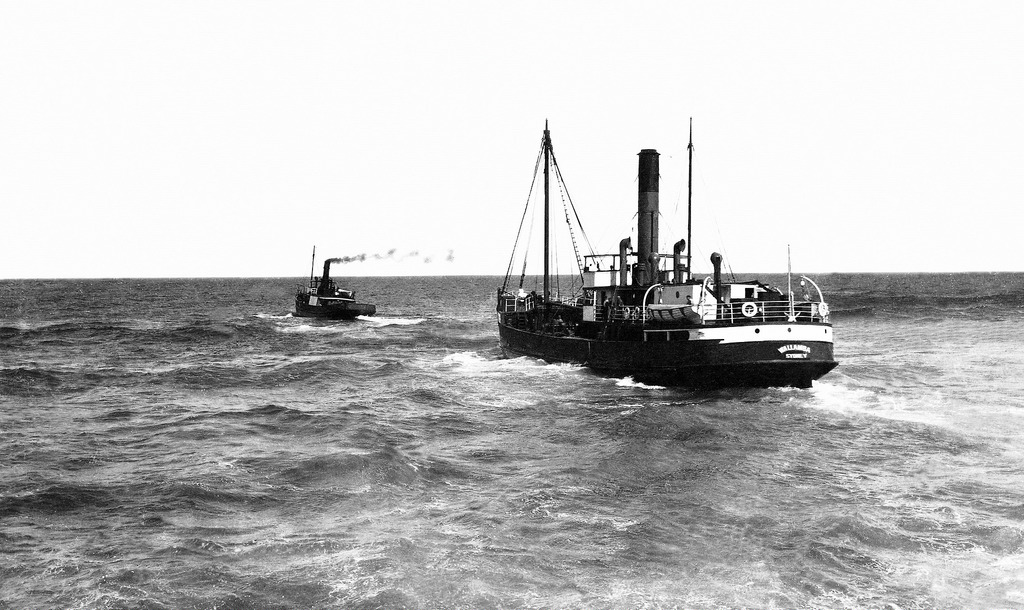
Wallamba
The Sun of 12 July 1923, page 9, reported:
‘When the crew of the vessel reached here [Newcastle] this afternoon they told of the difficulty they had in reaching the land. It was raining heavily at the time, and the sea was breaking fiercely on the shore. The boat was got away safely. It Is not known what the Wallamba struck that made her sink. When the crew found themselves in the boats their position was not a pleasant one. The shore was close at hand, but the night was dark, and it was impossible to tell where the entrance to Port Stephens was.
They pulled straight out to sea, as the water towards the land was very broken, and the danger of attempting to approach at this point was very great. There was no rest for anyone. Those not rowing were kept fully employed bailing the boats, and the rain was coming down heavily, and drenching them to the skin. Some did not have time to save their coats, but in any case they must have been wet through by the spray and flying water.
Some fishermen on the shore observed the plight of the boats, and built fires to warn them off the dangerous places. “I don’t know how they know we were there.” said a member of the crew. “We could see nothing in the darkness.” After a lot of trouble the boats made the entrance at Port Stephens, and rowed over fairly smooth water to a point near the lighthouse, where they landed. All the members of the shipwrecked crew speak in glowing terms of the assistance rendered by Mr. Priest, the lighthouse keeper at Port Stephens, and his assistant. “They couldn’t have done more for us if we had been their brothers,” said Captain Anderson. “They got up in the middle of the night and lit fires, prepared hot food, and generally acted as if they liked being turned out of bed on a cold, wet night to assist perfect strangers.”
Every member of the crew supported the captain’s statement. One seaman said he did not know what time the vessel struck, but it was not long before they were all in the boats and pulling out to sea. Asked whether it was cold, he replied that it was more than cold; it was freezing. E. Sorensen,” a cadet, who lives at Balmain, said he was asleep when the vessel struck. He just had time to get into a few clothes. In the rough sea it was not safe to change places in the boat, so the same men had to keep on rowing all the time. They must have been rowing for nearly six hours.
They made a good landing, the boat running up the sandy beach nearly high and dry. The unluckiest man on board was the chief engineer Rudder, who hurt his hand severely, and had to be attended to by the ambulance on his arrival here. This is his second shipwreck. He was one of the survivors of the ill-fated Our Jack, which foundered during a heavy storm on the north coast in June, 1921. Captain Anderson made no statement regarding the wreck. When the steamer Yulglibar reached Newcastle he was confined to his bed in the captain’s cabin.’
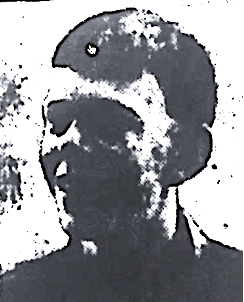
E. Sorenson, the youngest member of the steamer Wallamba. He was the steward. The photograph was taken on the Yulgilbar [Evening News, 14 July 1923, page 2]
The Daily Telegraph of 13 July 1923, page 8, further reported:
‘The first intimation of the Wallamba disaster was received by Captain Sangster, Deputy Superintendent of Navigation, at 1 o’clock this morning from the lighthouse-keeper at Point Stephens. Captain Sangster immediately ordered the pilot steamer to proceed to the scene of the stranding, and the North Coast Company’s steamer Yulgilbar called at Port Stephens and picked up the shipwrecked crew. The first move of the crew when the steamer struck was to try to get ashore, but campers warned them they would he smashed on the rocks. Captain Anderson, skipper of the wrecked vessel, then decided to try to reach
Port Stephens, and ordered the boats to be tied together. Heavy seas were met, and it was not until 3.30 this morning that the exhausted men were able to cover the distance between Morna Point and Fly Roads, which lie to the north-east of the outer light of Point Stephens. When the vessel struck, the mate. W. A. Woolston, was in charge. The night was dark, and visibility was very bad, owing to rain squalls. The damage to the vessel was so extensive that it sank in four minutes, and the crew had barely time to clamber into the boats, being quite unable to save any-thing beyond what they stood up in. When they reached Port Stephens they were completely exhausted with the six hours rowing, chilled to the bone with the wind and exposure, and drenched with rain. …..
The Wallamba was insured in the Eagle, Star, and British Dominion In-surance Company. She was a wooden vessel of 331 tons, built at Tuncurry in 1917. Her cargo consisted of coal and general merchandise for the Manning River.
“It was all over in five minutes. She went to pieces like a match-box,” said Captain Anderson, to a “Daily Telegraph” representative last night. The captain and crew of the Wallamba arrived in Sydney last night by the North Coast Company’s steamer Yugilbar. A big crowd of relatives and friends greeted them at the wharf. “Whatever it was she struck,” continued Captain Anderson, “it ripped the bottom clean out of her. The Wallamba went under in five minutes, but, thanks to the commendable conduct of all hands, the boats were lowered almost immediately. Notwithstanding this, we lost everything but what we stood up in. It was my first wreck, and I hope it is my last.” Upon arrival last night one of the crew, William Erickson, was taken to Sydney Hospital in an ambulance, suffering from exposure. The chief engineer, Herbert Rudder, who fell through the Wallamba’s skylight, and severely injured his left hand, received further medical attention, and was allowed to proceed to his home.
Captain Arkley Smith, of the Royal Shipwreck Relief Society, was on the wharf last night to do anything possible in the way of providing the crew with clothing. Captain Gibson has gone to Newcastle to investigate as to salvage and assessment. The insurance totals £10,500.
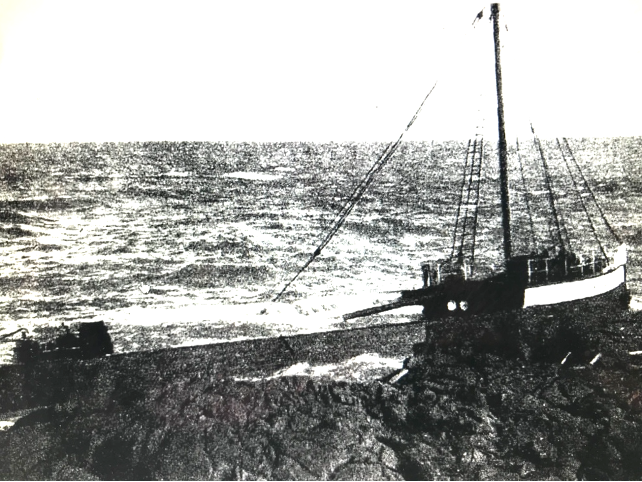
Photo taken the day after the wreck, showing the bulwark and foremast of the Wallamba still intact.
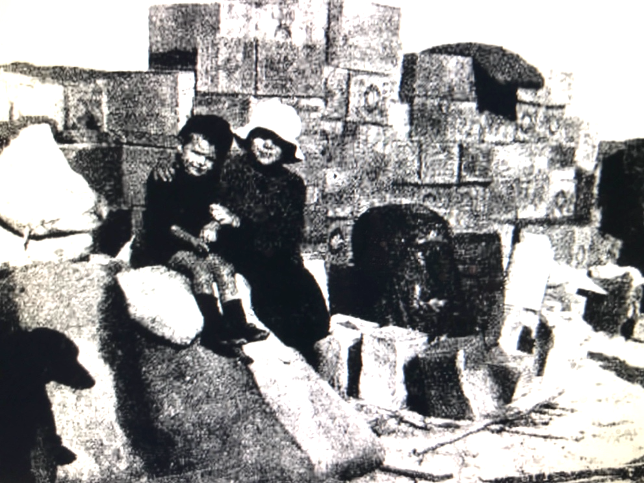
Some of the salvaged cargo at Morna Point. Several hundreds of cases of benzine and kerosene floated up on shore and were stacked above the reach of the waves.
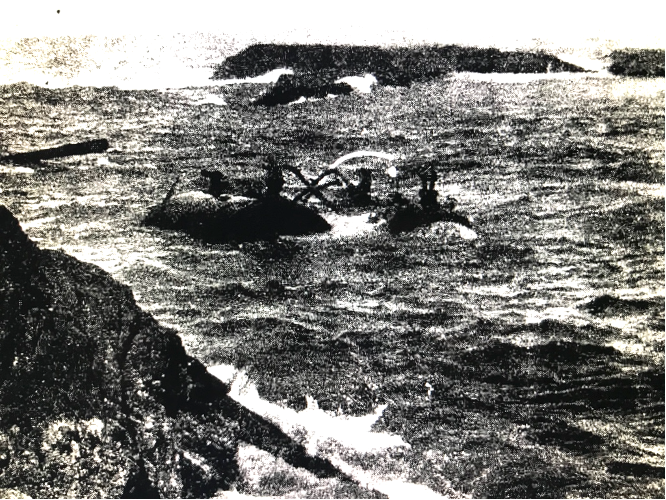
The boilers and davit of the Wallamba are visible above the sea, the superstructure having disappeared.
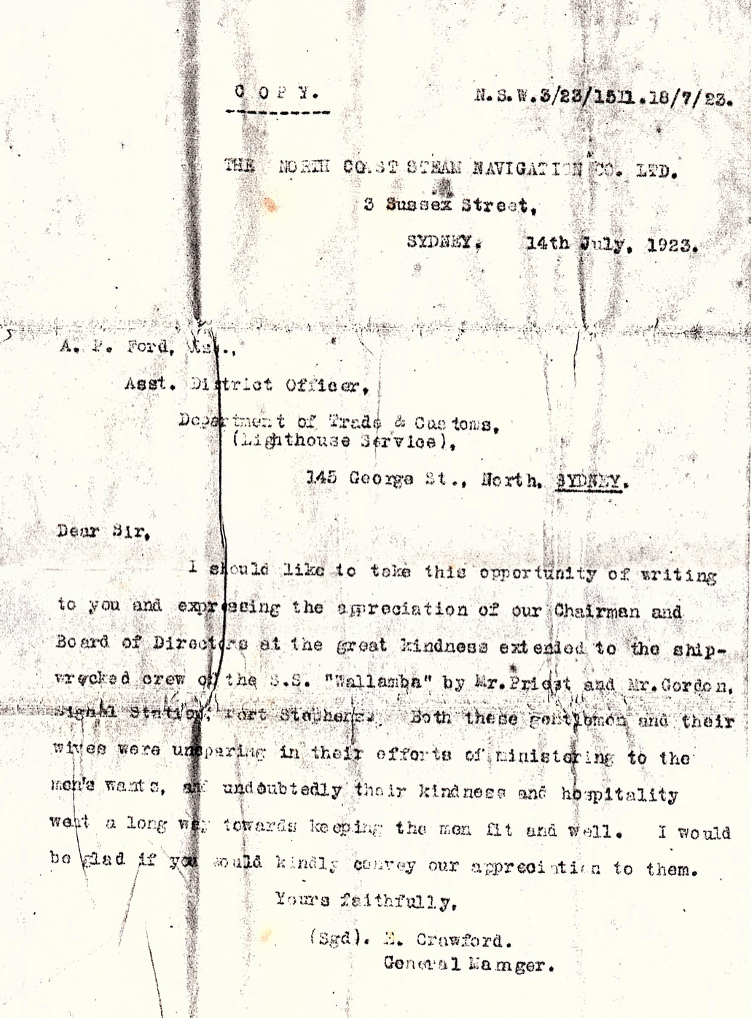
Letter of appreciation from The North Coast Steam Navigation Company, Limited, dated 14 July 1923
Marine Court of Inquiry
The Daily Commercial News and Shipping List of 2 August 1923, page 4, reported on the first stage of the Marine Board of Inquiry into the foundering of the Wallamba:
‘The stranding of the small steamer Wallamba, at Morna Point, on the night of July 11, 1923, was inquired into by the Marine Court, presided over by Judge Cohen, assisted by the assessors, Captains C. V. Wood and D. Reid, yesterday. Captain Anderson said he had been in charge of the Wallamba for eight months. This had been his first accident. Before turning in on the night of the 11th, he had set the vessel’s course at N.E. by E. by ½ E., which would take her 1¾ miles sea-ward from Morna Point. He was awakened by a grinding and bumping, and when he went on deck he saw that the vessel was on the rocks, and settling down. This was at 9.30. The boats were lowered, and all hands got clear. The weather was thick, and heavy showers were frequent. W. A. Woolston, the mate on the last voyage, stated that he held a foreign master’s certificate, and had sailed on the Wallamba for three and a half years. He had taken the course set by the captain, and had every confidence in the compass. At 8.10 p.m. the wind shifted to the south, so he altered the ship’s course by half a point. He had no uneasiness as to his course, until he noticed a phosphorescent glow, which turned out to be the breakers.
The court found that an error in judgment had been made by the mate in not altering the course after failure to pick up the Port Stephens light, but saw no necessity to deal with the certificates of either the master or mate.’
8. Foundering of the Hulk Alice – November 1927
Tow line parted
The Daily Telegraph of 18 November 1927, page 19, reported:
‘The timber hulk Alice, while being towed from Sydney to the Duck Hole, Port Stephens, by the coastal steamer Boambee, ran ashore today near Morna Point, a few miles to the south of the entrance of Port Stephens. The mishap was due to the towline parting. The Navigation Department at Newcastle received word to this effect this afternoon. The Alice was for many years a collier plying between here [Newcastle] and Sydney, and was owned by Messrs. J. and A. Brown until three or four years ago. She was purchased a couple of weeks ago in Sydney by Mr. A. C. Brown, timber merchant, of Newcastle, and was to be used in the timber trade. She was about 175ft. long, and when a collier had a gross registered tonnage of 552 tons and a net tonnage of 218 tons.’
Wreck of the Alice abandoned
The Daily Telegraph of 23 February 1928, page 17, reported:
‘A further effort to salvage the timber hulk Alice, which went ashore at Morna Point on November 17, was made on Monday. Previous attempts to pull the hulk off with tugs having failed, a forest devil was erected on the vessel, and large anchors let down out in the breakers. The hulk by this means was hauled about 50 feet seawards, but then it stuck on a sandbank, and, being unable to resist the strain, broke in two and filled with water. It has now been declared a total wreck.’
9. Foundering of the Collier Steamer White Bay – June 1928
Early report of the foundering
The Newcastle Morning Herald and Miners’ Advocate of 15 June 1928, page 5, reported on the foundering of the White Bay:
‘The small coastal steamer White Bay foundered on Morna Point, about 15 miles north of Newcastle, after a hopeless struggle in the hurricane. Only one member of the crew, an Italian seaman named Frandz Grieupero, reached shore alive. The body of another member of the crew was washed ashore. It has not yet been identified. The White Bay was a vessel of 134 tons gross register, owned by David Drake, Limited, and traded between Newcastle, Lake Macquarie and Sydney under charter to Mr. J. Harrison, coal merchant, of Sydney.
She left Sydney for Newcastle on Wednesday night, and was caught in the storm. At half-past eight yesterday morning the little craft was seen from Signal Hill battling in the heavy sea, and the pilot steamer Birubi, in the command of Captain D. McCrae, went out to her assistance. When the Birubi got outside no sign of the White Bay could be seen. The Birubi cruised round for a time, and went out again when word was received that the vessel had gone aground. The Birubi stayed outside for three hours, and searched along Stockton Bight for a distance of ten miles, but again without result. The visibility was very bad owing to the storm. The pilot steamer experienced a very rough time while thus engaged, and the dinghy was completely smashed by the heavy seas. One of the davits was broken. The boarding boat got adrift, but fortunately it was secured again, undamaged.
Immediately on receipt of information that the White Bay had been seen on Morna Point, Sergeants Rutherford and McGann and Constables Konza and Pender proceeded to the scene. They met with delay. They went by car to Hexham, but as the punt there was not running they had to return to Newcastle, where also the Stockton punt was out of commission. Taking the ferry to Stockton, they secured a car there and went on to Morna Point. Members of the rocket brigade, in the charge of Captain J. Devereux, also went to the scene. The State Navigation Department received word at midday that the vessel was ashore, and Captain B. Gerrard went to Morna Point.
Mr. Chesworth, who lives near Williamtown, and another resident heard rockets in the morning, and getting their horses went to the beach. In the afternoon they saw the body of a man lying face downwards on the sand. This, it was believed, was the body of a member of the crew of the ill-fated vessel. It was taken to the residence of Mr. Smith, Salt Ash-road. Two members of the Rocket Brigade, Lieutenant R. Bell, second in command, and Mr. J. Limeburner, left the main party and proceeded by Cox’s track up towards Morna Point, and begin a search of the beach. After two hours they saw a figure approaching. As it came closer they saw it was a man, who was staggering along, and was wet from head to foot. As he caught sight of them he raised his hands and cried out: “If I had not found you I would have died.”
The Newcastle Morning Herald and Miners’ Advocate of 16 June 1928, page 4, further reported:
‘The body which was washed ashore on Thursday from the foundered steamer White Bay, at Morna Point, was identified yesterday, as that of Alfrieda Badolati, aged 26 years, cook on the vessel. The deceased was a native of Genoa. The body, which was considerably knocked about, was brought down to Newcastle yesterday, and placed in the Newcastle morgue. There was a rumour current during the day that another body was washed ashore, but inquiry failed to elicit any foundation for this. Constable Konza, of the water police, who has been assisting in patrolling the beach, stated last night that no further bodies had been found.
The decking of the steamer which had been smashed to pieces, has been washed ashore. The vessel is lying keel up a short distance from the shore. Those who have seen the wreck are of the opinion that the other bodies will be found underneath the vessel. When the weather has moderated sufficiently, an attempt will be made to see if this theory is correct. Alderman R. Christie, Acting Mayor of Newcastle, who is the local representative of the Royal Shipwreck Relief Society, received the following telegram yesterday morning from the Sydney branch: “Do what you think necessary for survivor White Bay.” On receipt of the telegram, Alderman Christie went to Newcastle Hospital, where Grieupere was admitted on Thursday afternoon, and after inquiries, arranged with a local business firm to supply the shipwrecked sailor with clothing and other necessaries.’
The Sydney Morning Herald of 20 June 1928, page 15, reported:
‘Fraser, Uther, and Co., Ltd., stated yesterday that the hull and machinery of the wrecked steamer White Bay, on Stockton Beach, south of Morna Point, would be offered at auction to-morrow, at 11 a.m. There is no cargo aboard.’
Statement by sole survivor
The Tweed Daily of 16 June 1928, page 5, reported:
‘Draedse Guiseppi, sole survivor of the White Bay wreck, in a statement, said: “We didn’t have a chance when the ship hit. Some of my mates were injured by flying wood blocks, but they all grabbed lifebelts and made a dash for the shore. As far as I know, I was the only one to reach it. I waited a long time on that terrible beach, but the others didn’t come in.” Although the wind has eased considerably, heavy seas are still running through the Heads. The Secretary of the State Navigation Department (Mr. Faulks) said today that officially there were six men, including the master, on the steamer Whit -Bay. The whole matter would be investigated in view of the statement of the survivor, whose name did not appear in the official list, that there were eight men on board.’
Coroner’s Inquest
The Newcastle Morning Herald and Miners’ Advocate of 16 July 1928, page 8, reported on the proceedings of the Coroner into the death of the sole body recovered:
‘Only one of the bodies of the men who lost their lives in the wreck of the little steamer White Bay on June 14 was recovered. It was that of Alfredo Badolati, cook of the ill-fated vessel. The inquest was opened by Mr. C. Hibble, the district Coroner, at the Newcastle Court-house on July 5, and was resumed on Saturday. Captain A. Sangster, Acting Superintendent of Navigation, represented the Department of Navigation, and Sergeant F. C. Rutherford, the police. Mr. J. H. Harris, charterer of the White Bay, was also present. Francesco Ricupero, the sole survivor, through Mr. Molinas, the official interpreter, stated that he was a sailor on the steamer White Bay, and had traded between Sydney and Lake Macquarie, and sometimes came to Newcastle.
The vessel left Sydney about 10 p.m. on June 13, and was abreast of the entrance to Lake Macquarie about six o’clock on the following morning. The weather was bad. There was rain, with heavy seas, with the wind from the south. Captain Bond, the master, thought it inadvisable to endeavour to enter Lake Macquarie, and continued on towards the north, intending to make Port Hunter, which was reached about eight o’clock the same morning. The witness could not undertake to give the Court more than the approximate times, but the vessel had come along with the storm, and when off Newcastle signals of distress were hoisted. …….
The Coroner (to witness): Were there any rockets fired? Witness: Four or five at different times. Did you notice a steamer come out?— Yes. Did they come quite close?—No. We saw them in the distance. And all this time the White Bay was drifting towards the north from Newcastle?—Yes. Were the firemen down below keeping up steam?—Two firemen were down in the room, and were keeping up steam. As the steamer got closer to the beach the captain called the firemen from the hold, and they came up. He instructed all to pot on lifebelts. And did the captain further advise them —that is, those who had come up—to get off the deck on to the bridge?—Yes. Excepting the two firemen we were all on the bridge. The firemen had been on deck. It was at that moment that something happened. One of the firemen caught hold of the ship’s stays, but did not come up to the deck. The vessel was just at that time struck by a big sea and enveloped. We all went into the sea.
The witness explained what happened, sweeping his right hand round to show how the little vessel was trapped in the huge seas and turned turtle. He gave an illustration of this by holding his hands in front of him, and running the right quickly round the left. “When I came to the surface,” he continued, “I looked round, but could see no sign of anyone. I had felt someone, but cannot say who it was. The vessel was bottom upwards. I got on to the keel by swimming to it. but was washed off. I saw nothing of the others then, either. Shortly afterwards I got hold of a piece of timber, but this was driven from my grasp by the waves. All this time, I was swimming and struggling, trying to get to the shore. I eventually touched the bottom, but was so weakened that I could not stand up, and had to crawl on all fours up the beach. I again looked for some of the others, but saw none of them, neither did I see any bodies. The vessel was then about 150 yards from the shore.
I commenced to walk and crawl along the beach, and after going some distance, started to go back to where the vessel was when I met two men. They assisted me. They took me to a house and gave me dry clothes.” The witness, in mentioning this, spoke with animation, and showed unmistakably his appreciation of what had been done for him by his rescuers and the police. He had been afterwards taken to the hospital, where he had remained up to the present. The Coroner: Going back to the time that the vessel was off Newcastle, could you see the port distinctly, or was it a fact that everything was, with the rain and squalls, obscured in mist? It was eight o’clock in the morning. I want to get at the time of the wreck. Witness: We came along to the port of Newcastle. From a distance we could see the port. The storm had not obliterated the coastline. ……
Sergeant Rutherford: How far was the White Bay from the beach, when you were all washed overboard? Witness: Three hundred and fifty metres. The Coroner: Did the vessel actually strike the shore before that? No. She had not touched. You knew the deceased, Badolati?—He was the cook, and was born in Genoa. I do not know whether he was a married or a single man, but he was a man of 26 or 27 years. Sergeant Rutherford informed the court that that was all the evidence the police had to offer in connection with the matter.
The Coroner returned a verdict that the deceased, on June 14, met his death by drowning through shipwreck. “I have no doubt on the evidence,” he said, “that the captain and crew of the ill-fated White Bay put up a most courageous fight against the elements, and for even one man, in the circumstances, to be saved would seem to be almost providential; but in that regard, the fates, or fate, has favoured Francesco Ricupero. This vessel was no doubt seen by the port authorities off the coast here, and everything that could have been humanly done, I think, was done to have saved her. At imminent peril the pilot boat put out to sea, but with the tremendous sleet and haze, the vision would be necessarily extremely limited. I do not suppose it would be much more than a cable’s length from the ship herself. And after having been compelled to return to port on the first occasion the pilot steamer valiantly put out again.” He congratulated Ricupero on his good fortune in having been rescued.’
Marine Court of Inquiry
The Sydney Morning Herald of 11 August 1928, page 17, reported on the Marine Court of Inquiry into the foundering of the White Bay:
‘The circumstances of the wreck of the coastal steamer White Bay off Stockton Bight on July 14, when five out of the six members of the crew lost their lives were dealt with at a Marine Court Inquiry held yesterday before Judge Armstrong. His Honour was assisted by John M. Hart and William C. Howell, assessors.
The court found that the grounding and subsequent wreck was caused by exceptionally heavy weather and heavy sea, No blame was attachable to anyone on the vessel. The vessel was well-found and was provided with the necessary lifesaving apparatus.’
Wreckage of White Bay destroyed
The Newcastle Morning Herald and Miners’ Advocate of 13 August 1928, page 4, further reported that the wreckage of the White Bay was blown up:
‘Shipping men and others who for so long have contended that the bodies of the remainder of the crew of the ill-fated coastal steamer White Bay were imprisoned in the inverted hull of the wreck near Morna Point, were answered beyond doubt yesterday when the hull was blown up by Mr. B. S. Budrodeen, of Sydney, the owner. No bodies were recovered.
The work of preparing to destroy the vessel had been in hand for some time, and several holes had been made in the wooden hull. Yesterday morning Water Police Sergeant F. Rutherford went by car to Williamtown, and across to the scene of the wreck, and Mr. Budrodeen and his party brought down the explosives and gear in a cart from the stranded steamer Uralla, which is about five miles north of the White Bay. The announcement that the vessel was to be blown up aroused great interest in Williamtown and the country surrounding, and over 40 persons, some on horse-back and others on foot, came to the beach to watch the proceedings. Although it was low tide, it was impossible to walk out to the upturned hull, as the action of the sea since the day of the wreck, had cut a trench around the vessel fully six feet deep and fifteen feet wide at low tide. Mr. Budrodeen, who was described by one, of the eye-witnesses as being “like a seal in the water,” swam around the hull, and generally supervised the work. The charges were laid under the direction of Mr. P. W. Russell, of Newcastle.
The first charge, consisting of 26lb of gelignite, was placed in a sugar bag, and laid in the hull, about 15 feet from the bow. This was fired at 11.30 am., and the front portion of the vessel was completely shattered, some of the splintered timber being hurled 100 feet into the air. The second charge, which consisted of 25lb of gelignite, was laid about 20 feet from the stern. When this had been fired, the only section of the hull left clinging together was a small portion in the centre, and this was badly splintered. An inspection of the wreck was then made, but no bodies could be seen. It is certain that if they had been there, the explosion would have brought them up, even though they had been covered with sand. The boiler and engine appeared to be intact, and it is understood that these, together with any useful metal fittings, will be salvaged in due course. Shattered as the wreck now is, it needs only a strong south-easterly wind to remove all traces of what was once the White Bay. Those who were on the spot will not go short of fish for a day or two, as nearly 2000 deep-sea bream were stunned by the explosion, and these were eagerly collected.’
EPILOGUE
The rocky shoreline of Morna Point still remains a dangerous stretch of coast. With modern navigation equipment and stronger marine engines, the chance of future marine disasters is now minimised. However, the threat always remains.
The strong ocean swells, combined with a couple of episodes of dynamiting the remains, have removed much evidence of the shipwrecks. Some wreckage may still remain buried under the sand.
Over the years tonnes of coal have been washed overboard from the various shipwrecks and much of this would remain on the ocean floor.
A piece of such coal was seemingly washed up at Fishermans Bay, along the Morna Point coast, after the heavy weather of late. It was collected by the author of this paper and serves as a reminder of shipwrecks long ago.
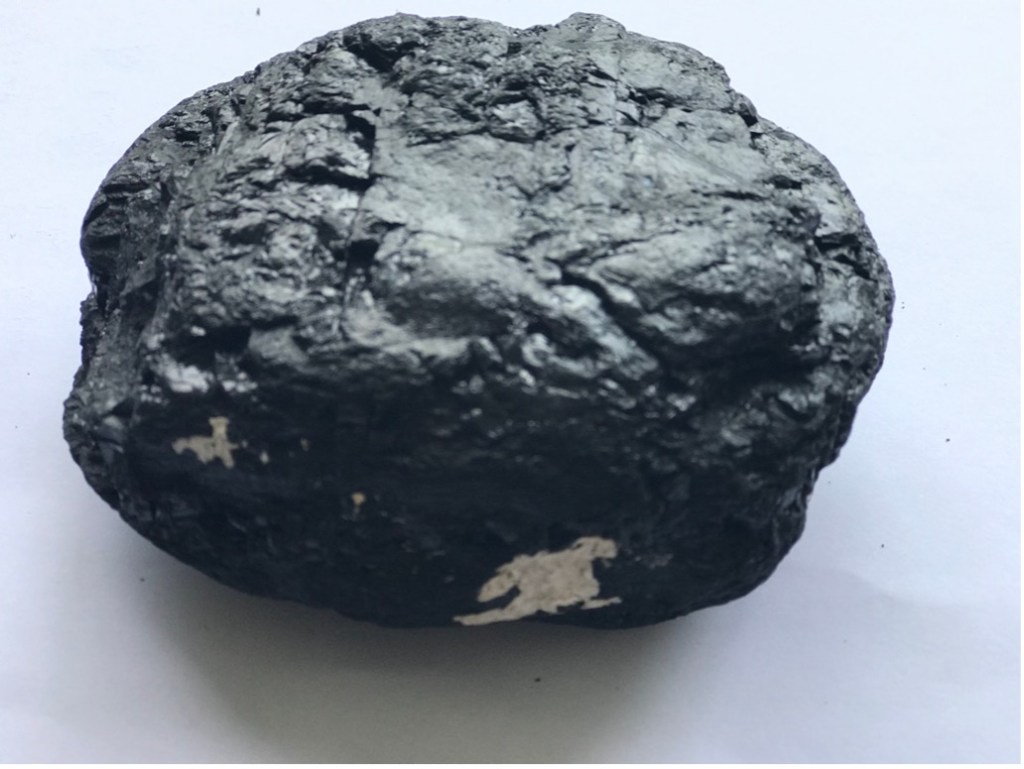
Lump of Coal washed ashore at Fishermans Bay [Author photo – May 2022]
Researched and compiled by Kevin McGuinness
May 2022
POSTSCRIPTS
1. Newcastle Rocket Brigades and Lifeboat Services
Reference was made in several articles featured in this paper, to the work of the Newcastle Rocket Brigade and Lifeboat Services that were despatched to render assistance to shipwrecked crews.
In the “Lost Newcastle” article on the Newcastle Rocket Brigade: [https://lostnewcastle.com.au/newcastle-rocket-brigade/] the following information on these volunteer groups was given:
‘The Newcastle Rocket Brigades were in operation from 1866 until 1974, often working alongside the lifeboat crews, and were a crucial part of trying to save the lives of those on board vessels that foundered along our coast.
The job of the Rocket Brigade was to attach a line from the beach to a distressed vessel in order to enable a ‘breeches buoy’ or other device to be hauled to the ship and return passengers and crew safely to the shore.
The Newcastle Lifeboat Service operated from 1838 until 1946, but the Rocket Brigade was still in service until 1974 and was last used on the Sygna.’
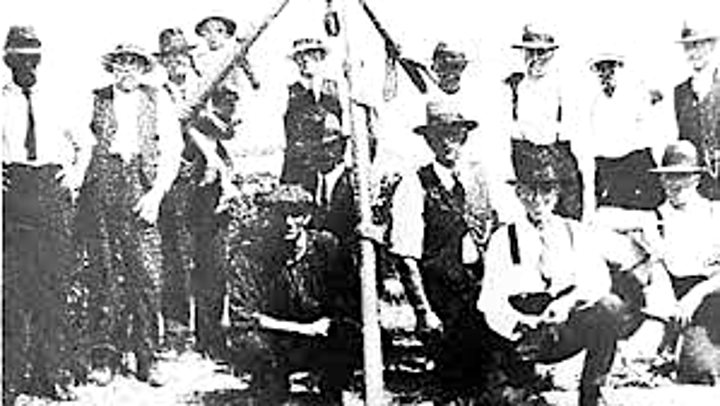
Newcastle Rocket Brigade
2. Newcastle Sailors Home
Crew members of various ships wrecked at Morna Point when returned to Newcastle, were provided with assistance by the Newcastle Sailors Home, which had been established by the early efforts of Rev. James Coutts. Many sailors when shipwrecked, generally only possessed the clothes they wore. The Sailors home provided accommodation, clothes, and tobacco, to destitute sailors, as well as assistance in travelling to Sydney. The Sailors Home opened in 1883 and closed in 1933. The building at 16 Bond Street, Newcastle, is now a heritage listed, private residence.
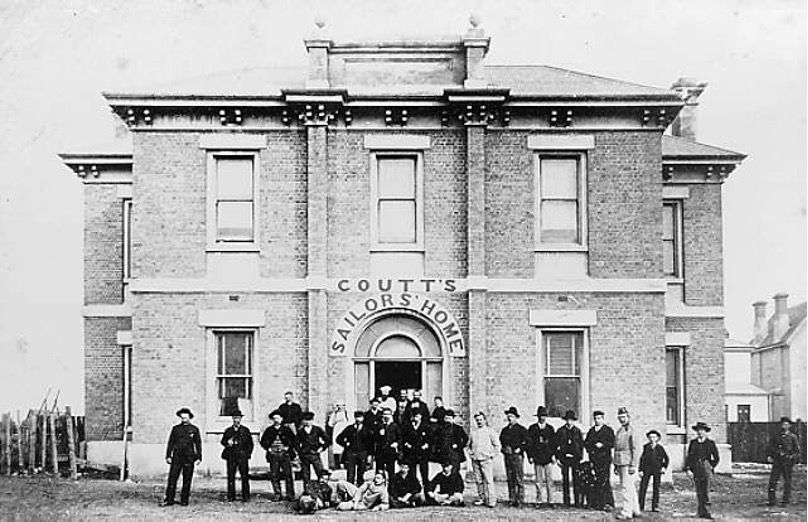
Newcastle Sailors’ Home, circa 1883
3. Jane Blanch
After being shipwrecked the crew and passengers of the Fitzroy steamer on 11 December 1897, arrived at the home of Mr. and Mrs. Blanch at Anna Bay to receive assistance. The following obituary of Mrs Jane Blanch published in the Raymond Terrace Examiner and Lower Hunter and Port Stephens Advertiser of 30 October 1941, page 3, referred to her association with the shipwrecks along the coast where she resided:
‘The death occurred at Gloucester on Friday afternoon, (October 17th), of Mrs Jane Blanch relict of the late Charles Blanch at the very advanced age of 94 years. The late Mrs Blanch whose maiden name was Miss Jane Keel, was born at the Duckhole, near Raymond Terrace and spent her earlier life at Anna Bay where her husband carried on butchering for many years. Their home stood in the cleared paddock which abuts on the Anna Bay cemetery and was the scene of many happy evenings when friends assembled from as far away as Raymond Terrace. …..
Wrecks were fairly frequent at Anna Bay, (Morna Point) in their early residence here, and shipwrecked crews were often tended till able to reach Nelson’s Bay or Newcastle. Standing alongside the house was the complete cabin of a sailing ship which failed to round Morna Point in a south east gale and became wrecked on the beach. Mr. Blanch with some assistance of neighbours had the cabin salvaged and with a team of bullocks transferred the building from the beach to his house, where it did duty for many years as part of the residence. The cabin was of comfortable dimensions, being about 12×12 and seven feet high. Some years ago the buildings were removed and the cabin with them. The family went to Gloucester from Anna Bay about 36 years ago and settled on a property on the Avon Flat adjacent to the town, this being purchased at one of the first subdivision sales of the Gloucester Estate lands.’ Blanch Street, Boat Harbour, was named in honour of the Blanch family.

 Port Stephens - a history exploration