

Introduction
William Longworth was a wealthy businessman, well known in Sydney, Newcastle and Port Stephens at the beginning of the 20th century. He had built up his wealth from his mining and industrial enterprises. He also had agricultural interests and was the owner of several racehorses.
He was a resident at Karuah at Port Stephens from about 1907. From this time, he became a major benefactor to various charities and community organisations.
At the time of his death on 5 December 1928, his estate was worth £363,363 ($AUS 32 million in today’s terms). He was a man of simple tastes though, and his homestead ‘Glenroy’ on the banks of the Karuah River at Karuah brought him and his wife, Mary Ellen, much pleasure. They regularly entertained their friends and acquaintances there, including NSW Governors and a Prime Minister.
William Longworth had first married Margaret Thornton in June 1901. After her death in August 1914, he married a widow, Mary Ellen New (nee Gilligan) on 5 April 1916 at Raymond Terrace.
This is the story of William Longworth and his wife, Mary Ellen, when resident at Karuah. They were participants and organisers of many community and social activities at ‘Glenroy’ and elsewhere, enhancing the lives of many citizens during the first twenty years of the 1900’s.
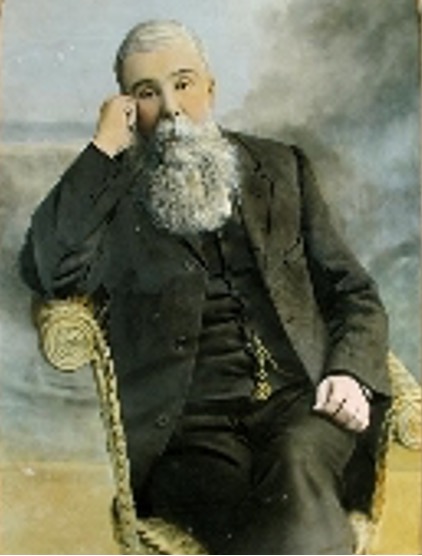
William Longworth [Newcastle Library]
This paper is sourced from the resources of the National Library’s Trove newspaper collection.
Overview of William Longworth and ‘Glenroy’
By 1913, William Longworth was a well-known person in the Sydney, Newcastle and Port Stephens areas, and he had been resident at Karuah for about six years. The Dungog Chronicle of 14 February 1913, page 8, published the following article by Edwin Howell on William Longworth and his homestead ‘Glenroy’. It provides a good starting point for this story.:
‘Mr Longworth was born in Lancashire 67 years ago and came to Australia when 3 years of age with his father, Thomas Longworth, who landed at Port Stephens and immediately fulfilled his engagement with the A.A. Co. [Australian Agricultural Company] going afterwards to the Lorisa and Tumbarumba gold-fields. Meeting with no success he reverted to coal mining, and cast his lot with fellow miners at Newcastle. He met his death at Singleton.
William Longworth was educated at Newcastle, and when 14 years of age worked in the pits there till 25 years ago. At that juncture, in conjunction with his brother Thomas, he opened a pit at Singleton, and shortly afterwards combined with Dr Reid in establishing the Singleton Coal and Coke Company. In January, 1894, the Cobar copper mines having been shut down for four years, William and Thomas Longworth and Dr Reid took a tribute lease and formed a syndicate, which, for the past fifteen years, has turned out amazingly well.
In April, 1907, Mr Longworth sold out his interest in Cobar and retired into private life. Acting as the general manager of the Buttai coal mining property, he then exploited the Shuttleton copper mine, some 50 miles south of Cobar, which, though originally placed in the hands of a colonial company, very shortly after came into the possession of an English company, which shut down, and 4 years after Mr Longworth bought the concern out. Two years after his venture at Cobar, Mr Longworth bought out all interests in the Nymagee Copper mine. He sold out this mine, as at the time he held a big share in the Great Cobar, the Chesney, and the Great Peak gold mine, Rix’s Creek coal mine, and the Refining and Electric Refinery Co. for separating gold from copper, and a coal mine at Lithgow. The Cobar syndicate in Mr Longworth’s time used to employ 1600 men. Mr Longworth, in partnership with his brother Thomas, opened the Adelaid copper mine at Drake, in the Tenterfield district.
Six years ago [1907], retiring from all active work, Mr William Longworth came to Karuah and buying out the lease of an outgoing tenant, proposed to establish a model agricultural farm, but through some misunderstanding, which nobody deplores more than the then acting Minister for Lands, the scheme was frustrated. ……
His innate modesty ….. precludes my giving any biography of this remarkable man, who to-day is called millionaire Longworth, and whose career would furnish an object lesson to the rising generation. However, it is as the Gods will, I can only record what facts I have gleaned. My visit to ‘Glenroy’ was of the most entertaining and enjoyable nature, for in no instance have I been brought to a better appreciation of the school boy quotation “Rus in urbe” than when sitting on the veranda of ‘Glenroy’ and contemplating the scene on the river with yachts and launches and sailing boats (the property of Mr Longworth) gracefully riding the waters.
‘Glenroy’ ……. consists of some 30 acres of the most delightful country one could contemplate. Nelson’s bay waters are not far distant, and a private jetty adds enchantment to the scene. The fishing …… is admirable. Whiting, rock cod, mullet and schnapper abound, some of the latter have been hooked to the weight of 28lbs.
The homestead is seen in our illustration, is an ideal one, with verandahs facing the water and beautified by flower gardens which cope with any laid out grounds in and about Sydney. Roses and carnations and stocks perfume the air and one could simply sit on a lounge chair and dream his life away.
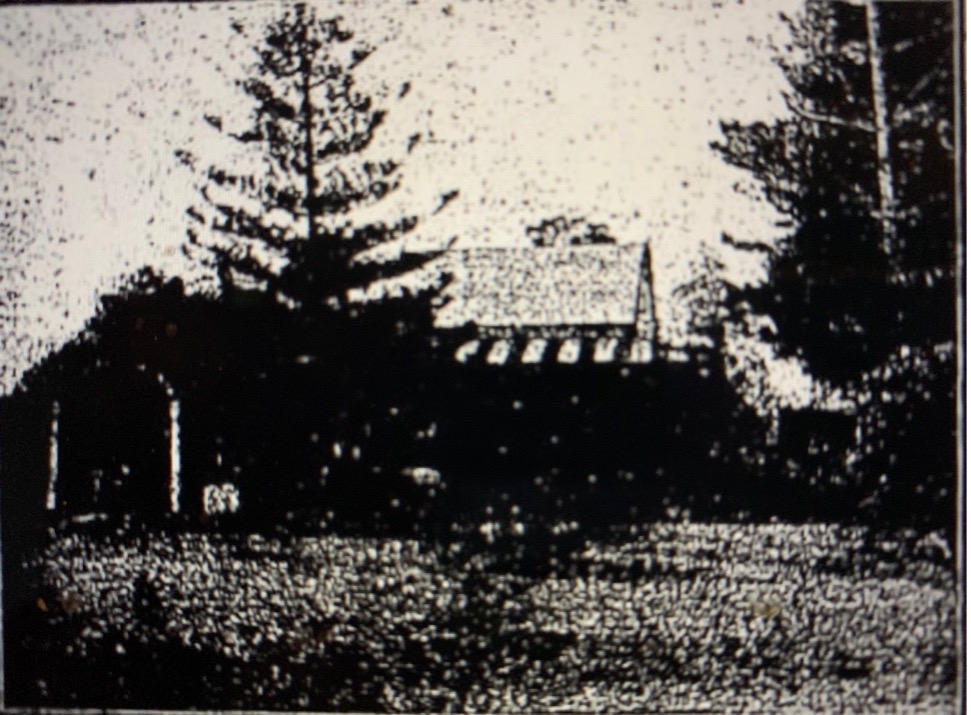
Glenroy
Mr. Longworth in addition to his labour interests which will presently be written of, possesses a saw mill, brick yard and colliery at Thornton, 4 miles from East Maitland where he has 5000 acres of land. The brickmaking industry is carried on, on the dry pressure system. The coal mine is said to have an abundance and the fact of Mr Longworth having a private line from the shaft to the main railway, justifies one in saying on rather writing the mine must be a payable one. The main portion of these coal lands is situated at what is known as Butti, where one seam is of a seven foot thickness dwindling to a 3ft. 4in. seam and then to 3 feet and averaging 6 feet seam. The Rosedale colliery, at Singleton is Mr Longworth’s own venture. The mine which finds employment for 100 men, supplies the fuel for the northern railway. …..
Mr Longworth has created for himself a home and surroundings which apart from the hackneyed expression of being a “cynocure to all eyes,” are what may be termed in the classics, “the graves of Paphos,” for no other place within fifty miles around could compare to the delightful scenery or the surroundings of ‘Glenroy’. Politically, Mr Longworth belongs to no party, but I opine that, if pressed on the matter, he would cast in his lot with that party which would endeavour to upheave the system which has persistently tried to centralise matters and beautify Sydney at the expense of the country which finds the pabulum.
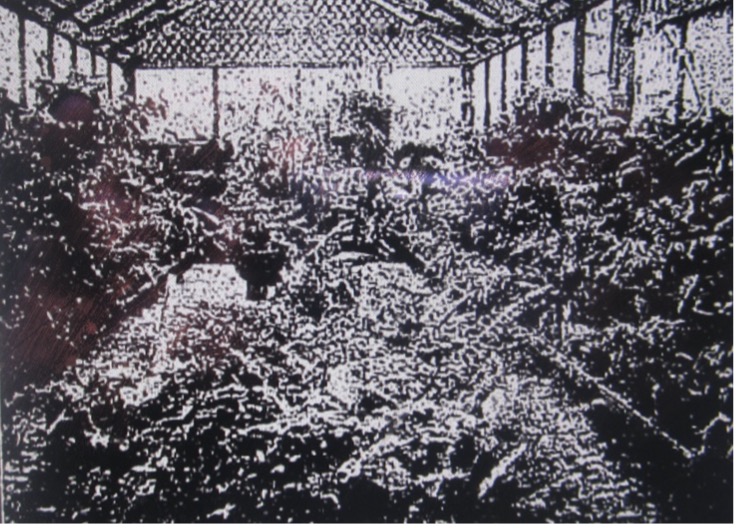
Greenhouse at Glenroy
Mr Longworth is an exceptionally modest and reticent man, and it was after a deal of probing that I could learn from others that he is a member of the Singleton, Newcastle, Lithgow and Cobar shows. ……. He does not neglect the industry, which is swaying the country today, and to that end has established a dairy farm at Thornton, where he is breeding up a pure Jersey herd. His pedigree bulls have taken the blue ribbon both in Sydney and Melbourne, and in 1911 his exhibit annexed the championship in Sydney and Maitland, and other centres.
Mr Longworth breeds some ponies, and these have also asserted themselves on several show arenas. ….. Mr Longworth, like all who do not “give hostages to fortune,” is passionately fond of birds, his aviary simply being one of the best I have seen in the State. ….. His pride centres on his flower beds and his pleasance which can only be appreciated after being seen.’

Aviary at Glenroy overlooking the Karuah River
The Northern Times of Monday 26 November 1917, page 4, also published an article that provided a summary of the interests and activities of Mr. Longworth:
‘Mr. William Longworth, of Karuah, is a notable personality. …. A native of Newcastle, he made his first big rise in the great Cobar copper mine, and is now interested in woollen mills, coal mines, copper mines, gold mines, timber mills, oyster culture, farming and horse breeding. He is a true Australian and believes in encouraging the establishment of local industries, and he thinks, with our native re-sources in coal, mineral ores, wool, etc., that we should, provided labour is sympathetic, become the greatest manufacturing country in the world. He visits the racecourse occasionally for diversion, and Satin Bird recently carried his colours to victory at Randwick. When at home at Karuah he indulges in fishing and shooting, and relates experiences of surprising quantities of duck bagged on Myall Lakes.’
NSW Governor entertained at ‘Glenroy’ – 1912
The Gloucester Examiner and Lower Hunter Advertiser of 24 May 1912, page 2
‘His Excellency the Governor (Lord Chelmsford) accompanied by Lady Chelmsford, Sir Thomas Lees, Captain de Moleyns, and Captain R. A. Price M.L.A., arrived at Hexham by the midday train and proceeded by motor car to Karuah, Port Stephens, on Wednesday. En route his Excellency met the school children of the Hexham and Raymond Terrace public schools, and delivered short addresses to the little ones.
The roads en route were gaily decorated with bunting and greenery. Upon arrival at Karuah, the party were met by the school children and the residents, the road being spanned by triumphal arches and festooned with flags, greenery, and streamers. The Raymond Terrace Brass Band played a series of selections upon the arrival of the party, who were the guests of Mr. William Longworth. His Excellency also delivered a short address to the children. The Governor and party proceeded, per Mr. Longworth’s steamer ‘Nortbumbria’, down the Karuah River to Port Stephens Heads, his Excellency expressing his admiration of the port and its picturesqueness. Returning to Karuah, the v vice regal party were entertained at dinner by Mr. Longworth, those present (besides the Governor and party) being Colonel and Mrs. Meredith and Mrs. New. During the afternoon a garden party of the children and residents was held on Mr. Longworth’s grounds. The Governor and party visited the Myall Lakes yesterday.’
Further information on the NSW Governor’s visit to Port Stephens is found at the link on this website.
Councillors entertained at ‘Glenroy’ – 1912
The Dungog Chronicle of 18 June 1912, page 4, reported:
‘At the invitation of Mr. Longworth, of Karuah, on Saturday last, members of the Bolwarra and Port Stephens shire councils were entertained to a day’s outing. The whole of the councillors, with a few other friends, accented, the invitation, and a party of about twenty was made up. A most enjoyable day was spent fishing and cruising round the bay in Mr Longworth’s splendid launch. Members of the party are loud in their praises of their host’s hospitality and unostentatious geniality.’
Presentation made to William Longworth by his staff at Glenroy – 1915
The Raymond Terrace Examiner and Lower Hunter and Port Stephens Advertiser of 19 February 1915, page 3, reported:
‘Mr. W. Longworth, on his return to Karuah after his recent severe illness, was made the recipient of an address of welcome from the staff at Glenroy. The address, which was beautifully illuminated, was read by the Rev. R. G. Knox on behalf of the signatories and was responded to by Mr. Longworth in his usual happy manner.’
Cattle exhibited at Show – 1917
The Northern Times of 28 February 1917, page 5, reported:
‘The outstanding feature of the cattle exhibited at Newcastle Show, is the fine display of Jersey’s. Mr. William Longworth, of Karuah, is the chief exhibitor and won for both bull and cow, three years and over. Both are very fine animals and were awarded champion ribbons.’
Sportsmen visit Karuah – 1917
The Newcastle Morning Herald and Miners’ Advocate of 3 April 1917, page 3, reported:
‘At the invitation of Mr. W. Longworth, a party of Newcastle and Wallsend sportsmen visited Karuah, Port Stephens, on Saturday last. An early start was made from Newcastle, and Karuah was reached shortly before noon, after a delightful motor drive. Mr. and Mrs. Longworth threw their beautiful residence open to visitors, and no time was lost in entering on the rounds of pleasure arranged.
Mr. Longworth’s launch was in readiness to convey the party on a fishing trip, and although the catch was nothing to boast about the outing was none the less enjoyable. The visitors were regaled with oysters and other delicacies while the fishing was going on, and on returning to the house they sat down to an excellent repast. In the evening musical items were provided by Miss Smith, of Stroud, who proved herself the life and soul of the party, and at the same time a most versatile entertainer.
A quiet Sunday was spent, but the visitors did not leave before expressing their thanks to Mr. and Mrs. Longworth for their hospitable treatment. Alderman Moroney, the Mayor of Newcastle, in proposing the health of Mr. and Mrs. Longworth, wished them long life and happiness, his remarks being endorsed by Messrs. H. Cameron, T. Abel, J. Grisdale, and others of the party.
Mr. Abel struck a reminiscent vein, and took his hearers back more than half a century ago, when he and Mr. Longworth carried “Matilda” [to carry a swag and travel the road]. Both Mr. and Mrs. Longworth acknowledged the toast. They said nothing gave them greater pleasure than to make their guests feel at home, and the fact that they had enjoyed their brief stay was all the thanks they required. Mr. Longworth’s residence is delightfully situated, and beautifully laid out. The Newcastle visitors, numbering twenty, were accommodated in the cottage, and only one of the number struck the wrong room after his morning tub. Newcastle was reached on the return journey about ten o’clock.’
Longworths entertain old friends at Newcastle – 1917
The Newcastle Morning Herald and Miners’ Advocate of 10 May 1917, page 3, reported:
‘There was a gathering of about 200 in the Coronation Hall [at Lambton] on Tuesday evening, and they were all the guests of Mr. and Mrs. W. Longworth, of Karuah. This is the second occasion that Mr. Longworth, who in his early days lived in the Lambton and Waratah district, has entertain his friends. He was in his young days noted as a good cricketer and foot runner, and a number of the “old sports,” such as Dave Dunlop, Billy Baker and Tom Abel, were strongly in evidence.
Before the programme commenced Mr and Mrs Longworth introduced themselves to those present, and many a reminiscent story was recalled as they went around the “old folks,” some of whom remembered Lambton before the township was surveyed. The hall had been decorated with foliage and flags, yellow and black, Mr. Longworth’s racing colours, predominating. The waitresses wore rosettes of the same colours. Pending the arrival of the Mayor of Lambton, Alderman E. Charlton, who was engaged at a meeting of the council, Alderman T. Abel, of Wallsend presided. …..
Mr. Longworth, in responding [to a number of toasts], referred to his early days in the district of Newcastle, when travelling facilities were not like they are now. Notwithstanding the fact that he was, fortunately, a successful man, neither him nor his wife would forget the old folks, whom, he was delighted to meet and shake hands with that night. The audience would not be content until Mrs. Longworth responded as hostess.
Mrs. Longworth said she was delighted with the attendance, and the night’s proceedings. She hoped to have shaken hands with all there that night. If she missed anyone it was not done intentionally and would like to greet them later. Her husband had decided to give all the old folks of his acquaintance a treat and the centre was Lambton, and for that matter she was a in full sympathy with her husband, and would support him in making, the old homes happy.
The musical programme was arranged by Mr. George Bell, which had an orchestra. …… The tables were tastefully laid and decorated with flowers, and the catering was in the hands of Mrs. George Smith, of the Northumberland Hotel.’
Mrs Longworth organises fund raising concert – 1918
The Dungog Chronicle of 29 March 1918, page 3, reported:
‘On Saturday night last, 23rd March, one of the most successful concerts ever held at Karuah eventuated and was organised by Mrs. W. Longworth, of ‘Glenroy,’ for the purpose of raising funds to erect a street Honor Roll to perpetuate the memory of the brave boys of Karuah, who have done and are doing their noble duty at the front. She was ably assisted by Miss Smith (Stroud) and an active committee.
The night was perfect and the attendance very large, and the hall was not large enough to hold those assembled. The Steel Works Band (under Mr. J. J. Kelly), who gave their services gratuitously, rendered some beautiful selections and also assisted Mrs. Longworth through with the refreshments and concert items, and if ever needed have offered their valuable services again. ……
During the evening presentation was made to Mrs. Longworth, by Rev R. G. Knox, on behalf of her friends and residents of Karuah. The rev. gentleman referred to Mrs. Longworth’s charity and goodness to the sick and needy of the district, and paid a high tribute to the hospitality of that lady and her good husband, of ‘Glenroy,’ whose doors were ever open to the traveller and friends. Miss Smith expressed her great appreciation of the many good qualities of Mrs. Longworth and said she really could be called everybody’s friend. The Hon. W. Bennett expressed also his appreciation of Mrs. Longworth, whose broadmindedness, hospitality and charity made her beloved by all. Karuah was fortunate in having Mr. and Mrs. Longworth as residents.
Mr. Longworth was a protectionist of the old school, who invested his money in local industries and the development of our primary resources, thus providing employment for the people and creating additional national wealth. The gift was a silver asparagus dish, and was handed to Mrs. Longworth by little Miss Phyllis Walsh, whose daddy is on active service. Mrs. Longworth suitably replied and said she was always delighted to do her best for one and all, and especially the brave lads at the front. Proceeds of the movement will amount to over £100. Collections by Mrs. Longworth amounted to £60. The Honor Roll will be erected near the government wharf, at Karuah, and will be of granite with sleeping lion on top, as Mr. and Mrs. Longworth think this appropriate, as England was certainly the sleeping lion until aroused by Germany. Among the many donations received, was a beautiful cloth worked by Mrs. Bennett, of Allworth.’
The World War One Memorial at Karuah was unveiled by Mrs Longworth on 21 December 1918. The Raymond Terrace Examiner and Lower Hunter and Port Stephens Advertiser of 27 December 1918, page 3, reported:
‘In the presence of a very good attendance, the Karuah Roll of Honor to men who had served at the front was unveiled by Mrs. Longworth on Saturday. Mrs. Longworth paid a high tribute to the men who had gone from Karuah and district to serve their country, and the sacrifices they had made was today reflected in the glorious victory which had come to the Allies, and in which the men of Australia had contributed such an important part.’
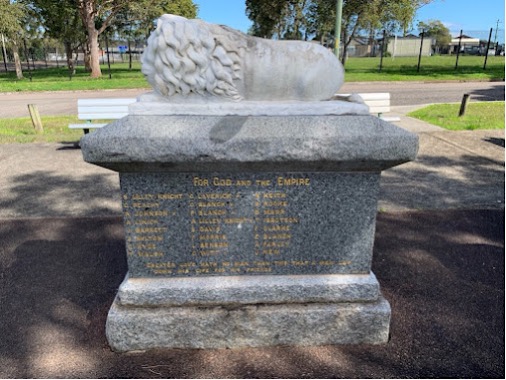
World War One Memorial at Karuah [Author photo]
Prime Minister Billy Hughes visits William Longworth at Karuah – 1920
The Newcastle Morning Herald and Miners’ Advocate of 29 June 1920, page 5, reported:
‘During his recent visit to Port Stephens Mr. W. M. Hughes, the Prime Minister, was the guest of Mr. W. Longworth, of ‘Glenroy’, Karuah. He was accompanied by Mrs. Hughes.’
Mrs Longworth presents prizes to Aboriginal children at Karuah – 1920
The Newcastle Morning Herald and Miners’ Advocate of 22 December 1920, page 8, reported:
‘At the annual break-up for the Christmas vacation prizes were presented to the aborigine children by Mrs. W. Longworth. Two medals were donated by Miss Ferguson and Mr. F. Arnold, of Arncliffe. Messrs. David Cohen and Co., of Newcastle, also gave toys. Miss Ayeres, Indian missionary, was present, along with Misses Acland and McCauley, aborigine missionaries. Short addresses were delivered by Mrs. Longworth and Miss Ayeres, and recitations and songs, accompanied to music supplied by the children greatly delighted the visitors. Miss Ferguson (teacher) thanked Mrs. Longworth for distributing the prizes, also for the interest she always took in the school.’

Mary Ellen Longworth
Financial gift to Wallsend Mining District Hospital – 1921
The Singleton Argus of 24 March 1921, page 3, reported:
‘Following the Minister for Public Health and Motherhood’s recent announcement of the generous gift of Mr T. E. Rofe to public hospitals and other institutions, he learns that the Wallsend Mining District Hospital has been the recipient of private benefactions of a substantial character. Mr William Longworth, of Karuah, has recently given a second £1000 to the hospital, in addition to his generous gifts to other institutions. Furthermore, the Collieries Proprietors’ Association has shown its practical sympathy on behalf of its employees, who benefit largely by treatment at the Wallsend Hospital, and has given £200 towards the purchase of an up-to-date X-ray equipment.’
Financial gift to Maitland Hospital – 1921
The Daily Examiner of 20 April 1921, page 4, reported:
‘Through his solicitor, Mr. William Longworth, of Karuah, who has already made several generous gifts to hospitals, has informed the committee of the Maitland Hospital of his desire of donating and transferring £1000 worth of his 3½ per cent. New South Wales Government Funded Stock, maturing in August next, to the hospital to be kept invested in perpetuity, the annual income to be devoted to the perpetual endowment of ‘The Ashtonfield’s Colliery Bed,’ and for the general purposes of the hospital.
This is Mr. Longworth’s second gift of £1000 to the Maitland Hospital, the other having been made under similar conditions some few months ago. Last week he intimated his intention of generously donating £1000 to the Dangar Cottage Hospital, Singleton, following upon a previous similar benefaction. Mr. Longworth also recently made a donation of £1000 to the Wallsend District Hospital.’
Longworths entertain children on their yacht, ‘Ena’ – 1921
The Raymond Terrace Examiner and Lower Hunter and Port Stephens Advertiser of 27 May 1921, page 2, reported:
‘On Wednesday, May 16th, the Children attending the Karuah Public and Aborigines School, accompanied by their teachers and missionaries, and 15, adults, spent a most enjoyable day visiting H.M.S. Sydney, at the Naval Base, Port Stephens.
Mr. and Mrs. Longworth, of Glenroy, Karuah, kindly entertained them on their yacht ‘Ena’. After arriving at the Naval Base the children and visitors were shown round the vessel, and the children partook of refreshments provided by the officers of the Sydney, and which were thoroughly enjoyed. The visitors embarked again on the ‘Ena,’ where afternoon tea had been provided, and kindly served by Mrs. Longworth. On arriving at Karuah Miss Ackland, Aborigines’ Missionary, and Miss Ferguson, Aborigines’ Teacher thanked the host and hostess on behalf of the Aborigine children for the pleasant outing Mr. and Mrs. Longworth had accorded them, and a senior boy from the Karuah Public School also thanked Mr. and Mrs. Longworth, on behalf of the children of the Public School for the enjoyable day they had spent. Three cheers, were then given for Mr. and Mrs. Longworth, and a pleasant day was brought to a close by all joining in singing “For They are Jolly Good Fellows.”
A history of the Port Stephens Naval Base is published in this web site.
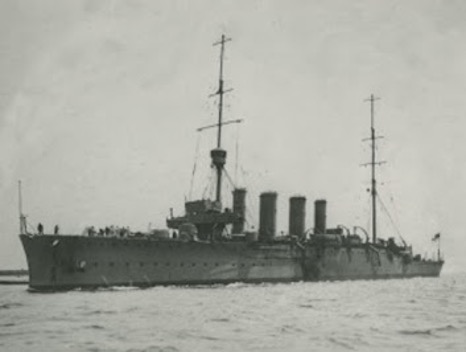
HMAS Sydney
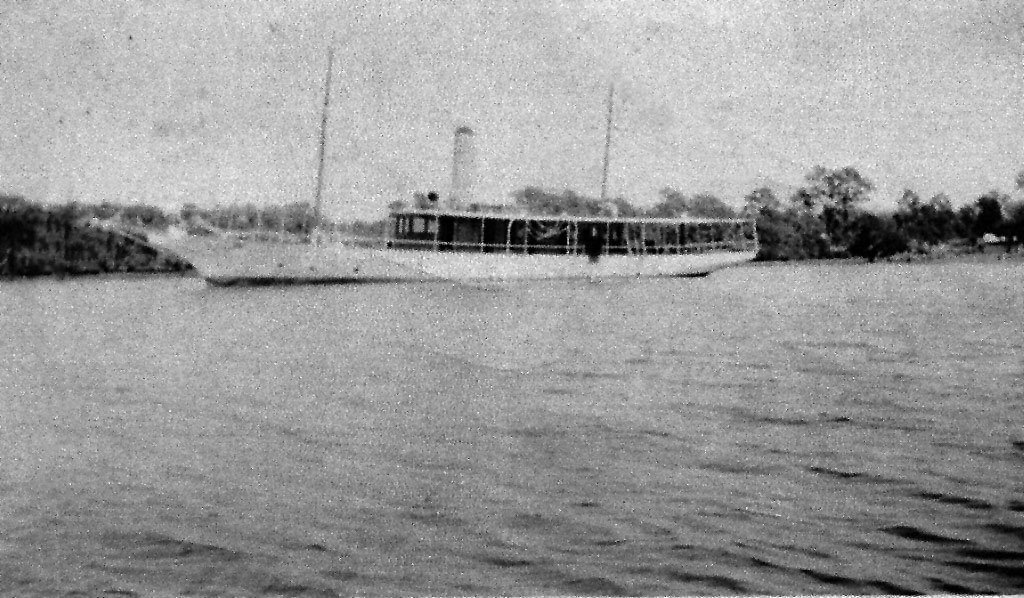
The Longworths’ launch – ‘Ena’
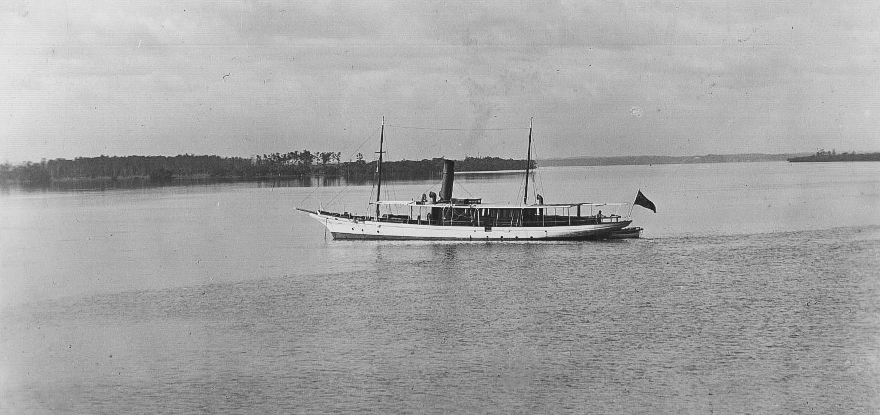
‘Ena’ looking towards Port Stephens Heads from Karuah
Gift to Women’s Hospital at Paddington – 1921
The Sydney Morning Herald of 15 June 1921, page 13, reported:
‘The Benevolent Society New South Wales had received a part of £1000 in perpetuity on behalf of Mr. William Longworth and Mrs. Mary Ellen Longworth, of Karuah, for the Royal Hospital for Women, Paddington. In recognition of their generosity, they have been made life governors of the society.’
Gift to Mater Misericordiae Hospital, Waratah – 1921
The Maitland Daily Mercury of 29 June 1921, page 3, reported:
‘Mr. William Longworth, of Karuah and Dulwich, through his solicitor, Mr. W. W. Robinson, has informed the Sisters of Mercy, Singleton, who are at present completing a building at Waratah to be known as the Mater Misericordiae Hospital, that he will endow the institution with £1000 Government stock. The hospital will be run on similar lines to St. Vincent’s and Lewisham Hospitals, where all classes and creeds are treated. This handsome donation will mean an annual income to the Mater Misericordiae Hospital of £60 odd.’
Longworth donates land to Catholic Church
William Longworth donated a parcel of land at Karuah to the Catholic Church, circa early 1920’s.
This was flagged in the Raymond Terrace Examiner and Lower Hunter and Port Stephens Advertiser, of 5 September 1935, page 2, on the occasion of the Church community deciding to erect a church building on the site
‘Recently the Roman Catholic portion of the community decided to erect a church on the site presented to the Church by the late Mr. William Long:worth. The campaign to raise the necessary funds was opened on Friday night, 30th ult., when the first R. C. ball ever held at Karuah eventuated.’
The Church was ultimately built and opened in April 1950. It was a testament to William Longworth’s financial generosity which was still remembered and appreciated in Karuah many years after his death.
The Dungog Chronicle of 6 May 1950, page 3, reported:.
‘A new Catholic Church was opened at Karuah on Sunday, April 23rd, by His Lordship Bishop Toohey. The land on which the church is built was a gift to the church by the late W. Longworth, over 30 years ago, and it is a favourable position facing the main road.’
NSW Governor guest of the Longworths at Karuah – 1921
The Newcastle Morning Herald and Miners’ Advocate of 3 December 1921, page 7, reported:
‘Sir Walter Davidson, the State Governor, accompanied by his private secretary and Lady Davidson, left Newcastle yesterday for Karuah. They will be the guests of Mr. W. Longworth, and will return to Sydney by the 3.40 p.m. train on Sunday. This they will catch at Hexham. In the course of an interview with a representative of the ‘”Newcastle Morning Herald,” before leaving for Karuah, the Governor said: “I am leaving hospitable Newcastle for two days’ idleness at Karuah. It is very rare for me to have a holiday like that.’
Further information on the NSW Governor’s visit to Port Stephens is found at this link on the website.
Christmas Festival held at ‘Glenroy’ – 1921
The Newcastle Sun of 22 December 1921, page 5, reported:
‘On Monday, Mr. and Mrs. W. Longworth, of ‘Glenroy’, invited the residents of Karuah to a Christmas tree festival. The fete was held on the lawn, and there were present about 300 people, including the children, and visitors from Raymond Terrace. A Christmas tree loaded with gifts from the host and hostess, intended for every person in the locality, was erected on the lawn. The grounds were illuminated by means of Chinese lanterns, and presented a most pleasing picture of shrubbery, flowers and shady alcoves. Father Christmas, who was attired in his traditional costume, arrived during the festivities, and presented the gifts and sweets. The whole function passed off most enjoyably.’

William Longworth (left) at the horse races, with Robert Fleming (middle) and John Roarty (right) [The Newcastle Sun, 9 May 1922]
Engineers visit to Karuah – 1922
The Newcastle Sun of 3 March 1922, page 8, reported:
‘At the invitation of Mr. and Mrs. Longworth, 50 members and friends of the Newcastle division of the Institution of Engineers, visited Karuah. The party wandered over the beautiful grounds and homestead, the gardens and lawns claiming the attention of some, the magnificent aviaries others, while the remainder interested themselves in a map showing the geological features of the neighbourhood.
Lunch was provided in the spacious dining-room which was bedecked with flags and bunting. One of the flags, which occupied almost one side of the wall, bore the word ‘Welcome.’ After the lunch the chairman (Mr. W. D. Wallace), proposed the toast of the King, and then called upon Mr. Purver, who is an old friend of Mr. Longworth, to give the health of the host and hostess, which was drunk with musical honours.
The party boarded the magnificent steam launch ‘Ena,’ and were taken right out to the heads. All items of interest were pointed out, and members were charmed by the beauty of the scenery, and many were the stories told by some of the older members of their first visits to different parts of the harbor.
Afternoon tea was served during the return trip, and upon landing all assembled on the lawn, where the party was photographed. The chairman thanked Mr. and Mrs. Longworth, and mentioned that the visit was the third they had made to their charming home, and no excursion was looked forward to with such anticipation as the visit to Karuah. That day was Newcastle’s show, and many members were interested in that event, but the memories of the former visits decided them that the day would be spent at Karuah.
Mr. McMeekan, who supported the chairman, spoke of the kindness of Mr. and Mrs. Longworth in entertaining the members of the institution so often, and assured them that every member deeply appreciated it. Mr. Longworth, in replying, said that it was a great pleasure to entertain the engineers, and he always looked forward to their visits. Mrs. Longworth was pressed to say a few words, and she said the best appreciation the institute could show would be to come again.’
The ‘Ena’ which was an Edwardian steamship once owned by William Longworth still survives and is listed on the Australian historic register of marine vessel. It is one of three that remain in Australia and is in the collection of the Australian National Maritime Museum in Sydney.
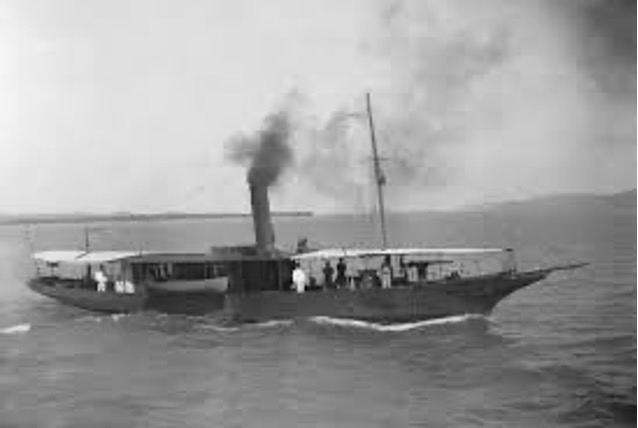
The Ena’ while in the service of the Australian Navy, carrying a naval gun
Donation to the Home for Boys, Morpeth – 1922
The Maitland Daily Mercury of 9 September 1922, page 4, reported:
‘The committee of the Diocesan Home for Boys, Morpeth, has been notified that Mr. W. Longworth, Karuah, has most generously donated £1000 worth of war bonds to the funds of the home. Such generosity is greatly appreciated and will be of valuable assistance in the upkeep of the home.’
Donations to an Orphanage and Boys Home – 1922
The Singleton Argus of 12 September 1922, page 2, reported:
‘Mr William Longworth, of Karuah, who recently donated £1000 worth of war bonds to the Dr. Murray Orphanage at Campbell’s Hill, has given a similar amount to the Church of England Home for Boys, at Morpeth. Substantial sums had previously been donated to the Singleton, Maitland and Wallsend hospitals by Mr Longworth, whose generosity is greatly appreciated.’
Donation of X-ray equipment for Maitland Hospital – 1923
The Maitland Daily Mercury of 7 June 1923, page 4, reported:
‘The generous offer of Mr. William Longworth, of Karuah, to supply an up-to-date X-ray plant, for the institution at an approximate cost of £500 was placed before the committee last evening by the secretary (Mr. Harold Mannall). He stated that Mr. Longworth had made the fullest inquiries regarding the installation, and was fully acquainted with the power available, the size of room, and other details. He also stated that it would not be necessary to employ a radiographer with the apparatus, which could be worked by members of the medical staff. The vice-president (Mr. Pilgrim) referred to Mr. Longworth’s practical interest in the hospital and his generous benefactions, and said that if they had more men of his calibre the sick and needy in the State would be much better off. On the motion of Mr. Taylor, seconded by Mr. Godfrey, Mr. Longworth’s very generous offer was accepted, and it was decided to, convey to him the committee’s gratitude and appreciation. The seconder remarked that if they had more gentlemen with Mr. Longworth’s altruistic spirit the hospital would be much better off.’
Church picnic at ‘Glenroy’ – 1923
The Raymond Terrace Examiner and Lower Hunter and Port Stephens Advertiser of 10 August 1923, page 3, reported:
‘A very pleasant afternoon was spent at the residence of Mrs W. Longworth ‘Glenroy’, Karuah on the 3rd inst. The occasion was an ‘Afternoon Tea’ given in honour of the Church of England Sunday school teachers, of which Mrs. Longworth has been president for some months. A present of a book was given to each teacher as a memento of the assistance they have given her, during her term of office, together with a bouquet, also other gifts were donated by Mrs Longworth, for the Sunday school children.
Master V. Dunstan, on behalf of the other Sunday School teachers, Misses Witt and Morante, thanked Mrs. Longworth for the gifts, also for the pleasant afternoon she had given them. ……. Afternoon tea was served, and more musical items and recitations rendered, after which the afternoon terminated with the singing of ‘For they are Jolly Good Fellows,’ and the National Anthem. At night Mrs. Longworth entertained the young people with cards and games.’
Bazaar held at ‘Glenroy’ for Church of England Fund – 1923
The Raymond Terrace Examiner and Lower Hunter and Port Stephens Advertiser of 26 October 1923, page 2, reported:
‘A bazaar and garden fete, which was organised by Mrs. Longworth, was held at ‘Glenroy’ House grounds, on October 20th, proved very successful, the proceeds amounting to over £60, and were donated to the Church of England fund. Owing to the unavoidable absence of the Bishop of Newcastle and the Rev. Canon Knox, the opening ceremony was performed by S. Dunstan Esq., J. P., who spoke of the worthy objects of the function, and the kindness of Mrs. Longworth in allowing her grounds for the occasion. ….. The function closed at 10 p.m. with the singing of the National Anthem.’
Presentation to Mr Longworth at ‘Glenroy’ – 1924
The Newcastle Morning Herald and Miners’ Advocate of 26 March 1924, page 5, reported:
‘At his residence, Karuah, on Monday, Mr. W. Longworth was presented with an enlarged photograph in sepia tones, of Wallsend Mining District Hospital, the gift of the board of management of the institution. Mr. E. Charlton, the hospital president, in making the presentation, said his board took into consideration Mr. Longworth’s munificent donations to the funds of the hospital, and the gift was intended to betoken the board’s gratitude for such. The remarks of’ the president were supported by Mr. J. Estell, M.L.C., and Mr. R. Cameron, the secretary. In acknowledging the gift, Mr. Longworth said they could never know how much he appreciated it. He would never turn a deaf ear to the needs of Wallsend Hospital, which he regarded as one of the best managed institutions in the Commonwealth. Mr. Leah supported Ms. Longworth’s remarks. Included in the party who made the visit were Mr. R. Hill, Senior, an old friend of Mr. Longworth, and Mr. A. J. Plumridge, who loaned his motor car for the occasion. Mr. and Mrs. Longworth entertained the visitors at dinner and afternoon tea, and also to an enjoyable run on the Karuah River in one of Mr. Longworth’s launches.’
Donation to Dangar Cottage Hospital – 1924
The Singleton Argus of 30 August 1924, page 6, reported:
‘The Secretary of the Dangar Cottage Hospital has received intimation from Mr W. W. Robinson, solicitor to Mr William Longworth, of Karuah, to the effect that that well-known benefactor to the hospital had issued instructions for the making over of £1000 in Commonwealth inscribed stock to be invested in perpetuity by the trustees of the hospital for the benefit of the institution. Mr. Longworth has now given the Singleton Hospital £3000 in invested stock. He is a keen supporter of the institution, and his latest gift is further evidence of his munificence. Donations to a similar amount, as well as a most modern X-ray plant, have been given by Mr Longworth to Maitland Hospital.’
Donation to Lithgow Hospital – 1924
The Maitland Daily Mercury of 6 September 1924, page 4, reported:
‘Mr. Williams Longworth, of Karuah, has again made a generous donation to Lithgow Hospital funds. Some time back he gave £500 in stock. Now he offers £1000 in Commonwealth inscribed stock to the trustees of the hospitals to remain invested in this stock or some other equally satisfactory security, in the names of the trustees.’
Donation to Royal North Shore Hospital – 1924
The Singleton Argus of 18 September 1924, page 2, reported:
‘Mr Walter M. Vindin (president of the Royal North Shore Hospital) has received an amount of £1000 from Mr William Longworth, of Karuah, for the endowment of a bed in perpetuity in the hospital in the name of his sister, Mrs W. W. Robinson, of Mosman.’
Mrs Longworth entertains friends at Lambton – 1924
The Newcastle Morning Herald and Miners’ Advocate of 26 September 1924, page 8, reported:
‘There was a happy gathering at the Coronation Hall, Lambton, last night, when Mr. and Mrs. W. Longworth, of Karuah, entertained about 250 friends, who had come from all parts of the northern district, and also some from Sydney. Mrs. Longworth was present, but, unfortunately, owing to indisposition, Mr. Longworth was unable to attend, a circumstance which was genuinely regretted. …..
The chairman [Alderman Johnson] said that Mr. Longworth deeply regretted that he was unable to be with his many friends that night, but he had sent them word that, although absent in body; he was with them in spirit. The gathering was one of old and young friends of Mr. and Mrs. Longworth. Mr. and Mrs. Longworth were universally known and esteemed for their kindness and generosity and their remembrance of old friends. On behalf of the gathering he wished their hosts health and happiness. The large and representative gathering was in it self suficient evidence of the esteem in which they were held.
Short speeches were made by old friends, who were reminiscent of their acquaintance with Mr. Longworth. Mr. W. Kerr had known their host for half a century and was sorry he was not with them. Mr. Longworth had come into some of the world’s wealth, but it had made no difference to him, except that by it he was able to make many people happy. Hospitals and many other worthy institutions had benefited by his wealth, while no one knew how many people he had helped in an individual way. Mr. Fellows, speaking from 52 years’ acquaintance with Mr. Longworth, said that he was proud to see such a gathering. It put now life in old friends to come together under such happy circumstances.
Rev. J. Penman said that his friendship with Mr. Longworth covered 56 years. They had worked together in the old Waratah Tunnel. He knew Mr. Longworth when he was one of the mass of workers in the Newcastle district. He was a little man but tremendously active. From an intimate acquaintance with their friend he could truly say that the changes in the fortunes of his life had made no changes in the disposition of the man. All he had to spare he gave for the good of the people. While they regretted very much Mr Longworth’s absence, they would be pleased to know his illness was only a passing one. He had, however, a splendid re presentative there in Mrs. Longworth. In his generosity and kindly deeds, he had always her support. He had also another representative in Mr. J. Leah. He was a confidential friend of Mr. Longworth, and they had been associated for very many years.
The gathering was unique, inasmuch as they would not find anything like it in the history of New South Wales. Usually when wealthy people gave functions of the kind, it was to people of their own social standing, and who would return them. Mr. Longworth invited among his friends very many who could never possibly invite him to anything of the kind. He did not know of any man who fulfilled the spirit of the scriptures than Mr. Longworth. He did not let one hand know what the other one gave away. He wished that Mr. Longworth might be long spared, and Mrs. Longworth also, to assist her husband in his charitable work.
Mrs. Longworth, by general request spoke at this juncture. She said that the friends of her husband were her own friends. Mr. Longworth had regretted very much he was unable to be present, but she did not think it was really anything serious. He had asked her, to say welcome to them all on his behalf. It gave Mr. Longworth and herself pleasure to have them all there, and they hoped it would not be long before they meet again under similar conditions.
Mr. W. Butler spoke of the great benefits that Mr. Longworth had conferred upon Cobar by his enterprise there. Mr. J. Estell, M.L.C., who proposed the health of “Mr. and Mrs. Longworth-Our Host and Hostess” said that 20 years’ acquaintance with them had given him a knowledge of their fine qualifications. Wallsend Hospital was grateful to Mr. Longworth for liberal donations from time to time, and for his recent gift of an X-ray plant, which was equal to that of any hospital in the State. Most people when they became wealthy forget their old-time poor friends. Not so Mr. Longworth. Mr. and Mrs. Longworth did not forget them, and that gathering appreciated the kindly feelings which had promoted them to bring their old friends together.
Mr. D. Watkins, M.H.R.. said that he had known Mr. Longworth all his life, and in honour of Mr. and Mrs. Longworth he had come over specially from Melbourne to attend the function. Mr. Longworth’s gifts, to which reference had been made, had been going on for many years, and his gifts went in many and wide directions. One thing he admired was the way he placed his money for the benefit of hospitals and other institutions. It was for their benefit for all time.
The gathering included, in addition to those who had worked in the mines with him, men who had been associated in sport and in other ways with him. There was Dove Dunlop, who had run in the miners’ handicaps of the early days, and the old-time champion runner, Bob Watson. They and many others he could see and mention had come to honour an old and true friend. “I once asked him,” said Mr. Watkins, “what he wanted now he was not working in the mine?” “I do not know, Dave,” Mr. Longworth replied.” I always liked a gun, a good horse, and a good dog. I don’t seem to want anything more now.” That showed the simple character of the man. He was using his wealth for the benefit of humanity, and he had never forgotten those he knew in humbler circumstances.
Mrs. Longworth had been a wonderful ally to her husband. He joined in wishing them long life and good health. The toast was enthusiastically honoured. Mr. J. Leah responded on behalf of Mr. Longworth, who had regretted being unable to enjoy the function and to shake hands with his friends. Speaking of Mr. Longworth’s benefactions, he said that no one knew to whom he gave and to what extent he gave. Mrs. Longworth also acknowledged the toast, and said that Mr. Longworth hoped to be able to meet, and shake hands with them on some future occasion. An excellent musical programme, interspersed the speeches.’
Mrs Longworth officially opens Nestor Hall at Karuah – 1924
The Raymond Terrace Examiner and Lower Hunter and Port Stephens Advertiser of 31 October 1924, page 3, reported:
‘The ball and supper promoted to mark the opening of Nestor Hall [at Karuah], was a complete success, over 300 being present, and sat down to supper. Motor, cars to the number of about 20 conveyed visitors from all the towns around. During the evening Mr. W. P. Gazzard presided over the opening function, and extended a hearty welcome to all. He then asked Mrs. W. Longworth to perform the opening ceremony, Mrs. Longworth complimented Mr. G. Peachey on his enterprise in having the hall built, and trusted that it would be a success both financially and socially. Dancing was kept up till 3 a.m., and all dispersed apparently well satisfied with their night’s outing. ‘
Mrs Longworth raises funds for Newcastle District Ambulance – 1924
The Newcastle Morning Herald and Miners’ Advocate of 19 November 1924, page 9, reported:
‘A successful ball, held at Karuah on Friday, was organised by Mrs. W. Longworth, in aid of the Newcastle District Ambulance, the net proceeds amounting to £37 14s 1d. The hall had been attractively decorated with Christmas bells and streamers of the ambulance colours, and an excellent supper was provided by the ladies. Everything passed off in an enjoyable and social manner, and Mrs. Longworth was heartily thanked for her assistance to the ambulance. Donations in connection with the function totalled £26 1s 3d.’
Large Donation for a Zoo or Museum at Newcastle – 1925
The Maitland Weekly Mercury of 4 April 1925, page 4, reported:
‘Mr. William Longworth, …. now comes along with an offer of £20,000 for the establishment of a zoological gardens or museum on the site occupied by the Mental Hospital in Newcastle. The Mayor of Newcastle, Alderman Light, accompanied by Aldermen Morony and Gibson, met Mr. Longworth at East Maitland yesterday. Mr. Longworth said he would give £20,000, conditionally on the grounds being handed over to the Newcastle Council as trustees. If necessary, he would give more. …..
There were large numbers of people who came into Newcastle from all parts of the northern district. They enjoyed its beauties — its baths and beaches — and it would be an additional pleasure, if there were established the gardens on the site, as had been suggested. The Mayor asked if, that in the event of the deputation going to the Minister on the matter, he had the consent of Mr. Longworth to repeat the remarks of the latter? Mr. Longworth said the Mayor had that permission, and added that if the Minister would not agree to the request, it should be made an election cry. The assistance of the Parliamentary representatives for the district would be necessary if what they sought was not granted.
The Mayor gave an assurance that the suggestion would be acted upon. He agreed with what Mr. Longworth had, said as to Newcastle never having been given its due from Governments, either past or present. Mr. Longworth considered that Newcastle had lagged behind Sydney in many things. It was but fair that Newcastle should get its proportion. The Mayor expressed, on behalf of the citizens, appreciation of the generosity of Mr. Longworth, the munificence of whose gift would be acclaimed by the people. He felt sure when the gardens were established as one of the institutions of Newcastle and the northern district, his decision to have them named after Mr. Longworth — “The Longworth Gardens” or “The Longworth Museum,” whichever was ultimately agreed to— would be unanimously endorsed.
It was pointed out that the Minister, on a previous occasion, had said that the Government could not give the grounds for nothing, but would require £27,000, as the Valuer-General’s estimate of compensation. All that was required was, with Mr. Longworth’s donation at the head of the list, to get another amount of £7000. That, the Mayor felt sure, would be readily forthcoming from some of Newcastle’s wealthy citizens. The Mayor explained that he would call the public meeting in due course, and was given an assurance by Mr. Longworth, that he would attend the meeting, provided he was made acquainted of the fact about a fortnight before its being held. He would also make an effort to accompany the deputation to Sir George Fuller, State Premier, in connection with the matter.’
Minerals donated to Newcastle Technological Museum – 1925
The Maitland Daily Mercury of 14 August 1925, page 4, reported:
‘Mr. William Longworth, of Karuah, has presented to the Technological Museum of Newcastle a fine collection of minerals from Cobar, Broken Hill, and other parts of Australia, also some fine specimens of silicified wood from Arizona (U.S.A.), and of fossils from the Hunter River Valley. Mr. Longworth has also provided a glass-table-case, in which to exhibit the collection. The presentation was made through Mr. J. Mitchell, formerly resident master of the Newcastle Technical College.’
Bazaar organised for Karuah Women’s Guild – 1926
The Newcastle Sun reported 29 April 1926, page 8:
‘To assist the funds of Karuah Women’s Guild, a sale of work organised by Mrs. William Longworth, was opened by Dr. Crotty, Dean of Newcastle, on Saturday afternoon. The hall and stalls were gaily decorated with vivid colours, all making a charming rainbow effect, extra attraction was added by the gay aprons and caps worn by the stallholders. …. At the close of the bazaar, Mrs. Longworth, on behalf of herself and the secretary, Mrs. C. Caldwell, thanked all for their attendance, and also those who had so liberally donated goods and money.’
Longworths entertain guests at Karuah – 1926
The Raymond Terrace Examiner and Lower Hunter and Port Stephens Advertiser of 18 June 1926, page 2, reported:
‘Mr. and Mrs. W. Longworth, of ‘Glenroy’, Karuah, entertained about eighty guests at a social evening in Nestor Hall, Karuah, on the 7th instant. The hall was prettily decorated with palms and streamers, and with the pretty dresses worn by the ladies gave a very pleasing effect. Mrs. Longworth who is a charming and most popular hostess, is to be complimented on her wonderful entertaining ability. Dancing and musical items were indulged in until the early hours of the morning.
Mrs. Longworth, Mrs. J. Dillon, Mrs. Caldwell, Miss T. San-derson and Miss T. Punch, (Newcastle), and Miss J. McLean, contributed musical items. …..
After supper, Mr. T. A. Walsh, who acted as M. C., said it gave him great pleasure in moving a hearty vote of thanks to Mr and Mrs. Longworth, and said that words failed him to express the appreciation of all present for the most enjoyable evening they had spent. Mr. Wooley, in seconding the resolution, said that he felt sure that all present had thoroughly enjoyed themselves, and felt greatly indebted to Mr. and Mrs. Longworth for the most enjoyable evening.
Mrs. Longworth, on rising to respond, was received by acclamation. She said that she was very sorry to have to apologise for Mr. Longworth’s absence, who unavoidably was away at Dulwich. Mrs. S. J. Bennett, of Raymond Terrace (daughter of Mrs. Longworth,) assisted Mrs. Longworth, in attending to the enjoyment of all present. Palmer’s Raymond, Terrace orchestra supplied the dance music. The singing of Auld Lang Syne brought the most enviable social evening ever held at Karuah to an end.’
Ball at Karuah to aid the Ambulance and Cancer Research Fund – 1926
The Raymond Terrace Examiner and Lower Hunter and Port Stephens Advertiser of 3 December 1926, page 3, reported:
‘The ball promoted by Mrs. Longworth in aid of the Ambulance and Cancer Research fund was a wonderful success. ….. Mrs. Longworth tendered her thanks to all those who had contributed towards the success of the function and mentioned that the sum of £84 had been taken, which would result in a net balance of about £74. £37 would go towards the ambulance and the balance to the Cancer Research Fund. Mr. March was present on behalf of Mr. Dolan, who was unable to be present, and he thanked those who had assisted on behalf of the ambulance. Mr. Gibson also extended his thanks. The people of Karuah are to be commended on the way they rally to such worthy objects, and Mrs. Longworth is entitled to the best thanks for her good organisation, which secured such a result.’
Donation to Boys Home at Morpeth – 1927
The Maitland Daily Mercury of 18 May 1927, page 4, reported:
‘St Alban’s Home for Boys, Morpeth had a wonderful gift last week. Package after package arrived at the Home, which, when opened, revealed mattresses, blankets, pillows, and sheeting for 42 beds, besides some charming bedspreads. The sisters in charge were delighted at such a generous gift, and the boys are well assured of cosy quarters, however, the storms may rage at night. Mr. Longworth, of Karuah, was the generous donor.’
Postal troubles at Karuah – 1927
The Dungog Chronicle of 26 July 1927, page 5, reported:
‘A public meeting convened by Mr. W. Longworth was held in Nestor Hall, Karuah to protest against the alteration of time of closing the mail. Mrs. Longworth, in the absence of Mr. Longworth was voted to the chair. The attendance was the largest at any meeting held in Karuah. It was agreed that Mrs. Longworth get in touch with the Postal Inspector and see if he could do anything in the matter. Originally the mall closed at 2 p.m., now it closes at 11.30, allowing only 30 minutes for anyone to answer urgent correspondence. In the event of an unsatisfactory reply from the Inspector another meeting will be held to force the Department to give the people a fair time to reply to their correspondence.
Donation to Mater Misericordiae Hospital, Waratah – 1927
The Singleton Argus of 22 November 1927, page 4, reported:
‘Mr. W. Longworth, of Karuah, has given £10,000 for the erection of a children’s ward block at the Mater Misericordiae Hospital, Waratah. The foundation-stone of the new ward was officially laid on Friday by Mrs. Hart, sister of Mr. Longworth. Dr. Gardiner, representing the medical and surgical staff of the hospital, said that the institution was destined to be the largest and most efficient hospital outside the metropolitan area. The ward would enable the children to secure the best nursing, and attendance that could be provided.’
The Singleton Argus of 15 December 1927, page 2, further reported:
‘Having donated £10,000 for the erection of a children’s block at the Mater Misericordiae Hospital, at Waratah, Mr. William Longworth, of Karuah, has given a further £5000 for the upkeep of the inmates. “What is the good of having a children’s hospital if you haven’t any food to give the patients,” he remarked in making available the further sum.’
Formation of Longworth Institute at Newcastle – 1927
The Newcastle Sun of 7 December 1927, page 9, reported:
‘At last night’s meeting of the Australasian Society of Patriots, the secretary (Mr. J. J. Maloney) announced that Mr. William Longworth, of ‘Glenroy,’ Karuah, had decided to found an institute in Newcastle which would enable the society to give full effect to its objectives, particularly in the promotion of the teaching of Australian history and the protection of the flora and fauna of the country.
Another objective of the society, the encouragement of art, science and literature, by the espousal of the causes of Australian sculptors, painters, scientists, and writers, would receive great assistance. “The institute,” said Mr. Maloney, “is to occupy a fine building in Scott street, the former office of “The Newcastle Sun,” and will contain a lecture hall and an art gallery and museum, to which Mr. Longworth is donating an extensive collection of valuable paintings.
There will also be a library fully equipped with educational volumes of rare value, as well as interesting exhibits of mineral specimens, curios, and other interesting subjects. Mr. Longworth has appointed trustees for the institute, who are authorised to make it of the greatest possible value to future generations. Mr. Longworth has been associated with the Newcastle district from boyhood, and his most recent action is evidence of his deep personal interest in the welfare of the citizens. The foundation of the institute is one of the finest acts of citizenship in the history of Newcastle.’
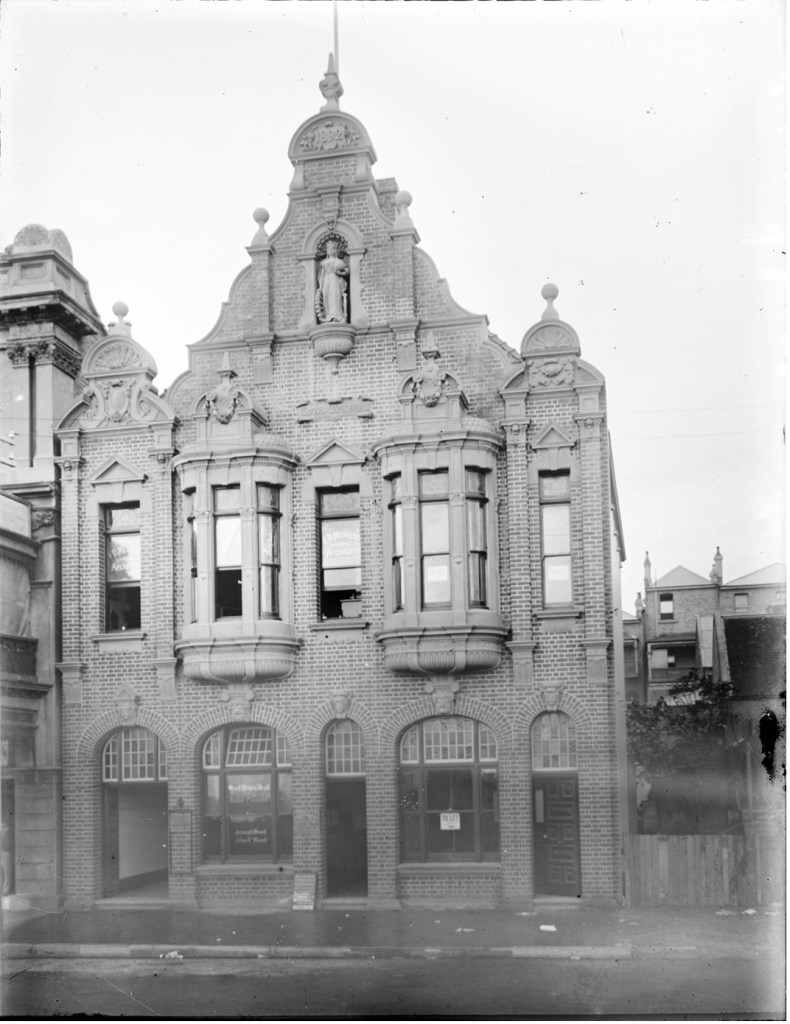
The Newcastle building [Woods Chambers] in which the Longworth Institute was established [Newcastle Library]
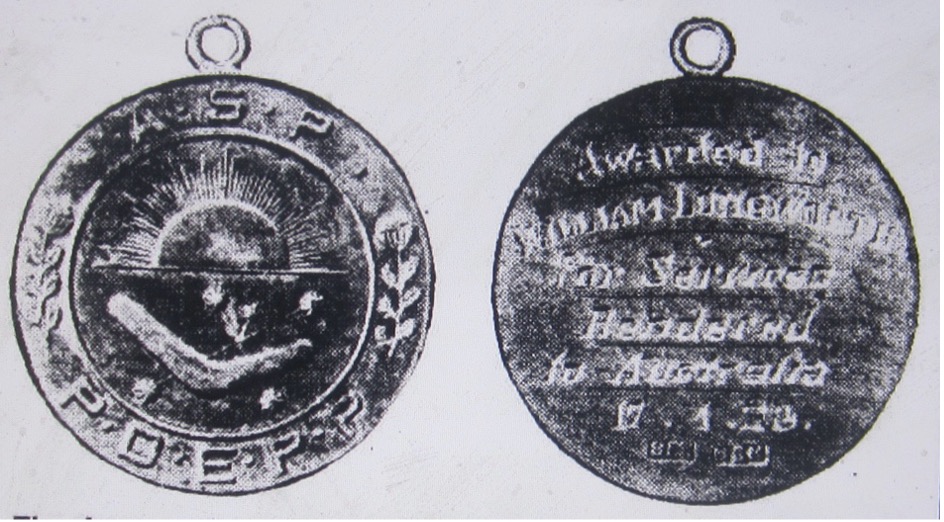
The obverse and reverse sides of the gold medal awarded by the Australasian Society of Patriots to William Longworth, philanthropist, of Karuah, for his munificent gifts to various Australian institutions, and to that society in particular. It is claimed by the society that ‘the medal cannot be brought; it must be earned.’ [The Daily Telegraph, 25 January 1928]
Death of William Longworth at ‘Glenroy’, Karuah – 1928
The Newcastle Sun of 6 December 1928, page 8, published the following report of the death of William Longworth:
‘The death of Mr. William Longworth occurred at his home at Karuah late yesterday afternoon [5 December 1928]. Mr. Longworth has left many monuments of his generosity in Newcastle, and the surrounding district, and his death, after an Illness of many months, was heard with regret by a large number of his friends. His generosity was unbounded. Not only did Mr. Longworth give in large sums and to big organisations, but he gave charity where charity was needed, and he made many homes and families happier.
In this he was helped by Mrs. Longworth. A man of simple tastes, Mr. Longworth spent the greater part of his life in his home, at Karuah, close to the first home he knew when he landed in Australia with his parents in 1846.
His father came from Bolton, Lanarkshire, under engagement to the A.A. Company, and for many years he worked in and around the mines of the Newcastle district. Mr. William Longworth and his brothers also worked in the mines round Newcastle. His first stroke of luck came with the Cobar copper mine, which was bought by a syndicate. The Longworth brothers, who were recognised as very capable miners, managed the mine. In 1907 it was sold for £1,000,000.
Mr. Longworth later bought woollen mills at Marrickville. These also were successful, and several other ventures followed, including many small mines. One of his last gifts to the district was the beautiful children’s hospital attached to the Mater Misericordiae Hospital at Waratah. The hospital has never been officially opened. It being the intention that Mr. Longworth should perform the opening ceremony.
Although not an Australian by birth, the late Mr. Longworth claimed New South Wales as his home, and his admiration for the early settlers was shown in his gift of the Longworth Institute to the Australasian Society of Patriots. His offer of £20,000 for the purpose of establishing a museum in Newcastle on the site where the Mental Hospital is situated, is well remembered, and his gifts to various hospitals, amounting in one year to £15,000, are among his many acts of generosity.
There is no charitable movement with which his name has not been associated, and in many hospitals are beds permanently endowed by him. His generosity was characterised by marked unselfishness. The funeral will take place tomorrow afternoon from Wood, Coffil’s parlours, Pacific-street.’
William Longworth buried at Singleton – 1928
The Newcastle Sun of 7 December 1928, page 6, reported:
‘Many men and women of Mr. Longworth’s generation, who had known him throughout his long and useful life, attended his funeral, which took place from the Newcastle Cathedral today. Many had travelled long distances.
The funeral was a large one, and the long procession, in which were noticed representatives of all sections of the community, was a very great tribute to the late Mr. Longworth. The service at the Cathedral was conducted by the Dean of Newcastle (Rev. W. Herbert Johnson), and Rev. C. S. Robinson, of Karuah, gave the address.
‘Having served his own generation well, by the will of God he fell asleep,” was the text used by Mr. Robinson. “Mr. Longworth,” he said, “may truly be said to have served his own generation well. He not only served his own generation, but two generations that followed. “Mr. Longworth was an asset to the State, and was a man a country could ill afford to lose. He was a genius,” he continued, “his constructive mind was a revelation. His generosity was at times unbelievable. He had not to be asked — he anticipated. He not only gave of his money, but he gave of himself, which was a very great thing for so great a man. His life was simple, and his home at Karuah was open to all.
“We must be thankful,” said Mr. Robinson, “that so fine a man was spared so long, and that he was given the opportunity to so serve his generation.” ….. The burial took place in the Church of England portion of Singleton cemetery.’
The Sydney Morning Herald of 8 December 1928, page 21, also reported:
‘The funeral of Mr. William Longworth, ot Karuah, took place this afternoon. A large number of mourners travelled by train to Singleton. The cortege, which was fully half a mile long, proceeded to All Saints’ Church of England, where a service was conducted by Canon H. I. D. Portus. Two motor cars were loaded with wreaths. The funeral then proceeded to the Church of England Cemetery at Whittingham, where the Interment was made, the Rev. E. Robinson, of Karuah, officiating.’

Grave of William Longworth at Singleton [Australian Cemetery Index]
Obituary – 1928
The Maitland Weekly Mercury of 8 December 1928, page 5, published the following obituary for William Longworth:
‘Mr. William Longworth, of Karuah, a noted benefactor, who generously supported Northern district hospitals during recent years, died on Wednesday, after an illness ex tending over six months. The late Mr. Longworth was a native of Bolton, Lancashire, England, where he was born on December 22, 1846. Arriving with his parents as a small boy, the family settled for many years at Port Stephens, near where Mr. Longworth lived up to the time of his death. His father came to Australia under engagement as a miner to the Australian Agricultural Company.
For some time Mr. Longworth, senior, worked in and around the collieries in the Newcastle district, including the mine on Shepherd’s Hill, the first to be worked by the Australian Agricultural Company in the Newcastle district. On Mr. Longworth, senior, opening a small mine at Rix’s Creek, near Singleton, the family moved to that centre, where Mr. Longworth, senior, was killed while working in the colliery.
The late Mr. Longworth then went to Cobar, where a syndicate, comprising Messrs. W. and T. Longworth, Sir Albert Gould, the late Mr. A. A. Dangar, the late Dr. Richard Read, and Mr. W. W. Robinson, of Sydney, brother-in-law of deceased, reopened, and worked the Great Cobar Copper Mine, which had been closed for some time. The Longworth brothers managed the mine for about 13 years, when it was sold in 1907 for approximately £1,000,000. On going to Cobar, deceased had practically no money, by hard work and business acumen he amassed a fortune.
Leaving Cobar, the brothers commenced the woollen mills at Marrickville, which are now known as the Australian Woollen Mills. Ltd. Deceased then moved to Karuah, where he resided up to the time of his death. Always possessed of a commercial spirit. Mr. Longworth purchased the Woodford and Buttai estates at Thornton, and established a timber mill, which is located near the Thornton railway station. He also purchased the brickyard at Thornton, and the Ashtonfield Colliery, in the same district.
Another mine purchased and worked for many years by deceased was the Rosedale Colliery, near Singleton. During his younger days deceased found time to engage in various branches of sport, and was trained for foot running by Mr. Dave Dunlop, of Hamilton. At that time Mr. R. Watson was in his prime on the running tracks at Wallsend and Waratah. Deceased also owned and raced a number of horses under the name ‘W. T. Nowlan.’ Included in the number were Satin Bird, winner of the Epsom Handicap in 1917, Blue Metal, Blairgour, Rose Dell, Land of Leisure, and Objected. Blairgour and Shadowland are at present doing stud duty at Dulwich, near Singleton.
Always a great benefactor to the district, deceased gave many large gifts. In one year he gave £17,000 to 17 hospitals, while he extended these benefactions by upwards of £50,000. The Maitland and Singleton Hospitals benefited largely by his charitable nature. He also gave, £15,000 for the erection of a brick cottage hospital for children adjoining the Mater Misericordiae Hospital at Waratah. An outstanding gift to the Newcastle district was the Longworth Institute, Scott street, to the Australasian Society of Patriots.
During the term of Ald. M. Light, as Mayor of Newcastle, deceased offered to give £20,000 for the purpose of establishing a museum and public park at the site of the Mental Hospital, but the Government, owing to the high cost of moving the hospital to another site, did not agree to the offer.
Deceased’s widow has long since been recognised as a most capable hostess, and any visitor to ‘Glenroy,’ Karuah, was always assured of a warm welcome. His benefactions were never ending as he gave to numerous families in the district continued support and sustenance. During Christmas seasons, it was always his practice to forward a number of cheques to Mr. McAuliffe. of Newcastle, to be distributed among old friends.’
The Dungog Chronicle of 11 December 1928, page 4, further reported:
‘Mr. Longworth was married twice. His first wife died many years ago. He is survived by Mrs. Longworth, a stepson (Mr. James New, of Sydney), and step-daughter (Mrs. Hazel Bennett, of Raymond Terrace) and many nieces and nephews. His sisters, all of whom reside in Sydney, include: — Mrs. Kelly, Mrs. Hart, Mrs Burns, Mrs. Skillen, Mrs. W. W. Robinson, and Miss Alice Longworth.’
Concluding Comments
Longworth Park at Karuah is dedicated to the memory of William and Mary Ellen Longworth. It is situated adjacent to the Karuah River, in proximity to the location of where their ‘Glenroy’ homestead stood.
Mary Ellen Longworth died on 26 May 1956 in Sydney, aged 81 years.
EPILOGUE
Probate granted on William Longworth’s Estate – 1929
William Longworth left an estate valued at £363, 363 in 1929, which equates to a 2022 value of $A32,329,708, according to the Reserve Bank of Australia Inflation Calculator.
The Raymond Terrace Examiner and Lower Hunter and Port Stephens Advertiser of 7 February 1929, page 2, reported:
‘Probate has been granted of the will and codicils of the late Mr. William Longworth, mine proprietor, of Karuah, Port Stephens. ….. The testator’s estate has been valued for probate purposes at £363, 363. Attached to the will are 12 codicils, and the deceased directed the payment of bequests of various amounts to many old friends, relatives and servants.’
Mrs Longworth Leaves Karuah – 1929
Three months after the death of her husband, Mrs. Longworth, left Karuah and moved to Sydney. The Raymond Terrace Examiner and Lower Hunter and Port Stephens Advertiser of 7 March 1929, page 1, reported:
‘Residents of Karuah filled the hall on Friday night, to do honour to Mrs. Longworth who is leaving the district. Mr. Harris, Aborigines Missionary presided, in the absence of Rev. Robinson. Mr. Harris spoke in felicitous terms of the worth of their guest but being a new arrival in Karuah left other speakers to testify to her sterling worth.
Mr. J. Palmer, on behalf of the residents expressed their sorrow at losing such a good citizen and wished her health and happiness. Mr. Gazzard spoke of the sterling worth of their guest who had been such a great worker for the village and a wonderful entertainer. Rich or poor were always welcome at ‘Glenroy’. Mr. Gazzard also referred to their guest’s many acts of kindness, especially, to the school children. Mr. Pile, on behalf of the young people thanked Mrs. Longworth for the many pleasant afternoons spent on her tennis courts. Mrs. Harris spoke on behalf of the Mission Workers’ class. Mrs. Gazzard on behalf of the Methodists also thanked Mrs. Longworth.
Rev. Mr. Robinson then arrived and look the chair. He spoke of the good Mrs. Longworth had done for the general welfare of the village and wished Mrs. Longworth God speed, health and happiness. Mrs. P. Peachey made the presentation and in a neat little speech presented Mrs. Longworth, on behalf of the residents, with an electric lamp and writing case. Mrs. Longworth thanked them all from the bottom of her heart for the many kind remarks, also for the handsome presents.
During the evening songs were rendered by Miss McLean, Mrs. K. Symonds, Mrs. Caldwell, Mr. Leamey and Mr. Dillon. Pianoforte solos by Miss Harris and Miss B. Dillon. A supper provided by the ladies was handed round. Dancing till 12 o’clock. All joined in singing ”God Save the King.” This ended one of the most enjoyable evenings ever held in Karuah.’
‘Glenroy’ Sold by Auction – 1929
The Newcastle Morning Herald and Miners’ Advocate of 2 November 1929, page 10, reported:
‘The homestead ‘Glenroy,’ of weatherboard construction, together with six acres, which has a frontage to a road adjacent to the Karuah River, at Karuah, and a subdivision of 26 acres on the main road, Karuah, the property of the late Mr. W. Longworth, will be offered for auction by Messrs. Creer and Berkeley at their rooms on November 21.’
The Maitland Daily Mercury of 23 November 1929, page 6, further reported:
‘Messrs. Creer and Berkeley submitted to auction the Karuah properties in the estate of the late William Longworth, at their rooms, Newcastle. There was a large attendance of buyers from for, Raymond Terrace, Maitland, also a number of Karuah residents. The bidding was spirited. ‘Glenroy,’ the homestead together with seven acres of land, was sold for £1600. The 26-acre block realised £37 per acre, totalling £962. The launch Rose was sold for £310. The total sales was £2872. All the lots were purchased by a Sydney client.’
The homestead was purchased by Edward ‘Ted’ Barclay from Barclays Island in Batemans Bay. Ted along with his brothers Bill and Walter were prominent in the oyster industry at Karuah.
The homestead was burnt to the ground in September 1952.
Mrs Longworth applies for a higher allowance – 1930
The Raymond Terrace Examiner and Lower Hunter and Port Stephens Advertiser of 27 March 1930, page 3, reported:
‘The hearing of the application by Mrs. Mary Ellen Longworth, widow of William Longworth, of Karuah, mine proprietor, for increased maintenance under the Testators’ Family Maintenance Act, was concluded before Mr. Justice Long Innes in the Equity Court in Sydney.
‘Mrs. Longworth, who is 54 years of age asked that she should be given a larger allowance than that provided for her in her late husband’s estate, which has been assessed at £394,450. His Honour held that the applicant had not made out her case and he accordingly made no order, other than that the applicant should pay the respondent’s costs of the application. ….
Under his will he bequeathed to her a legacy of £500, an annuity of £700 during life and widowhood, and the benefit of a mortgage over certain land at Moree, with the right to live in the home at Karuah, for the upkeep of which an amount was provided, or, if she chose to live elsewhere, the trustees were to spend £5000 upon another home for her.’
Researched and compiled by Kevin McGuinness
June 2023

 Port Stephens - a history exploration