
Introduction
Commercial whaling operations along the NSW coast commenced soon after the establishment of the Colony. Prior to that Aboriginal fishermen were known to have undertaken some whaling activity.
The first whaling station in NSW was established at Twofold Bay in 1828. Commercial whaling peaked in the 1830’s and had reduced considerably by the 1850’s due to depleted whale stock, and the manufacturing of petroleum products which lessened the need for whale oil for lighting and machine lubrication.
During the whaling years, Port Stephens was used as a port for the replenishment pf fresh provisions and where repairs could be undertaken.
A great beneficiary of the whaling industry was the Australian Agricultural Company, then situated at Carrington at the head of Port Stephens. The company benefited by selling produce supplies to the whale boats.
This paper provides an insight into the role played by Port Stephens in the early whaling industry.
Port Stephens proposed as a whaling station – 1830
At the peak of the whaling industry in 1830, Port Stephens was proposed as the possible site of a whaling station. The Sydney Monitor of 9 January 1830, page 3, reported:
‘It is generally understood, that Sir Edward Parry [Commissioner of the Australian Agricultural Company, based in Port Stephens] has directions to commence a whaling establishment at Port Stephens, or on the River Manning, on a scale commensurate with so rich and extensive a Corporation, and to let all the farms and buildings at Port Stephens to farmers, who in the crews of the whalers are to find a proximate market for their meat, grain, and other produce. We consider whaling to be a rational adventure; and that while it will remunerate the Company, it will at the same time accelerate the wealth, importance, and prosperity generally of New South Wales.’
Port Stephens used as a safe refitting and refreshment port – 1837
Whaling was a dangerous and tough occupation. The Sydney Herald of 28 September 1837, page 2, reported on the difficulties faced by Captains of whaling ships to maintain a crew of skilled whalers:
‘We call the attention of merchants to a very important notice respecting the harbour of Port Stephens which appears in another column. The greatest advantage which would accrue to whalers putting into Port Stephens to refit, would be the comparative ease with which the discipline of the crew could be maintained in the absence of those banes to seamen public houses. When in Sydney masters of merchant and whaling vessels are continually losing the services of their men through their getting into gaol for assaults arising out of drunken squabbles with constables, and there are many public houses in the vicinity of the wharfs where men who are likely to have heavy ‘lays’ to receive are decoyed and kept drunk for days at a time in order that as much as possible of the money due to them may be forestalled by the publican, and if there is any predisposition on the part of the sailor to disease, the general result of these ‘sprees’ is a few weeks ‘spell’ in the hospital, the unfortunate master being in the meantime worried out of his life to procure men to refit the ship.
These evils will in a great measure be obviated at Port Stephens where there are no public houses and where the population in is small, and very differently constituted from the population of Sydney. Under these circumstances we have no doubt the recommendation of the Company’s Commissioner [Australian Agricultural Company] to masters of whalers will be found to their interests to pay attention to especially as meat and vegetables can be procured from the Company’s establishment at Carrington, and wood and water can easily be procured without expense.’
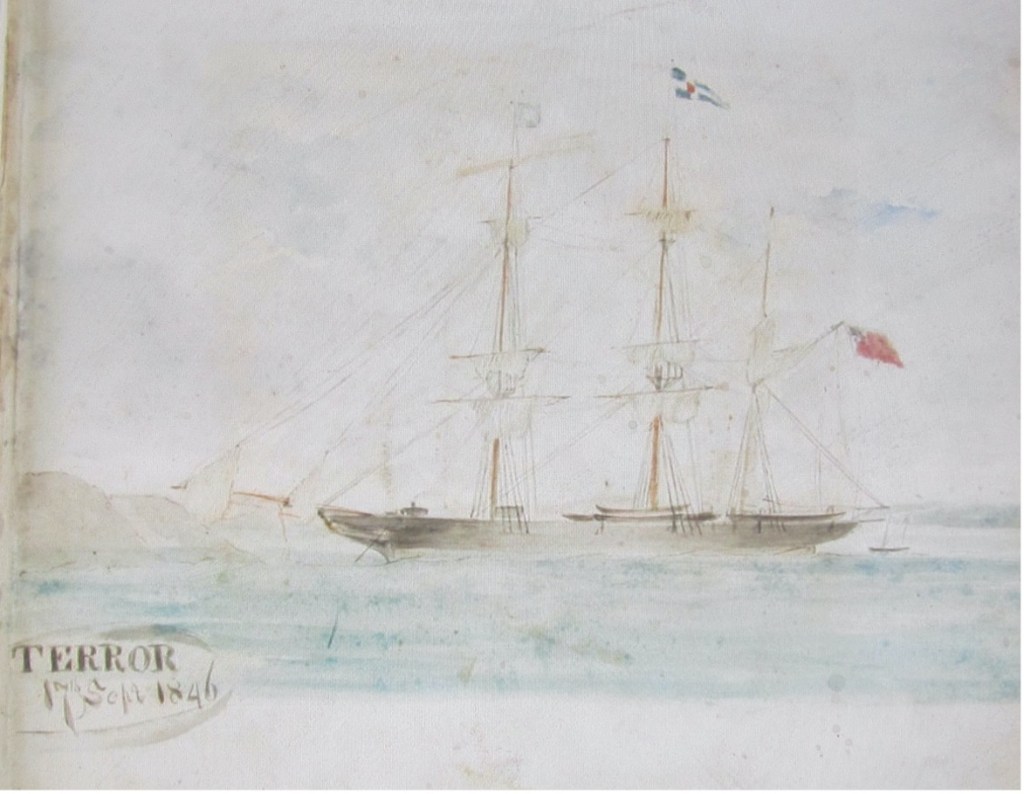
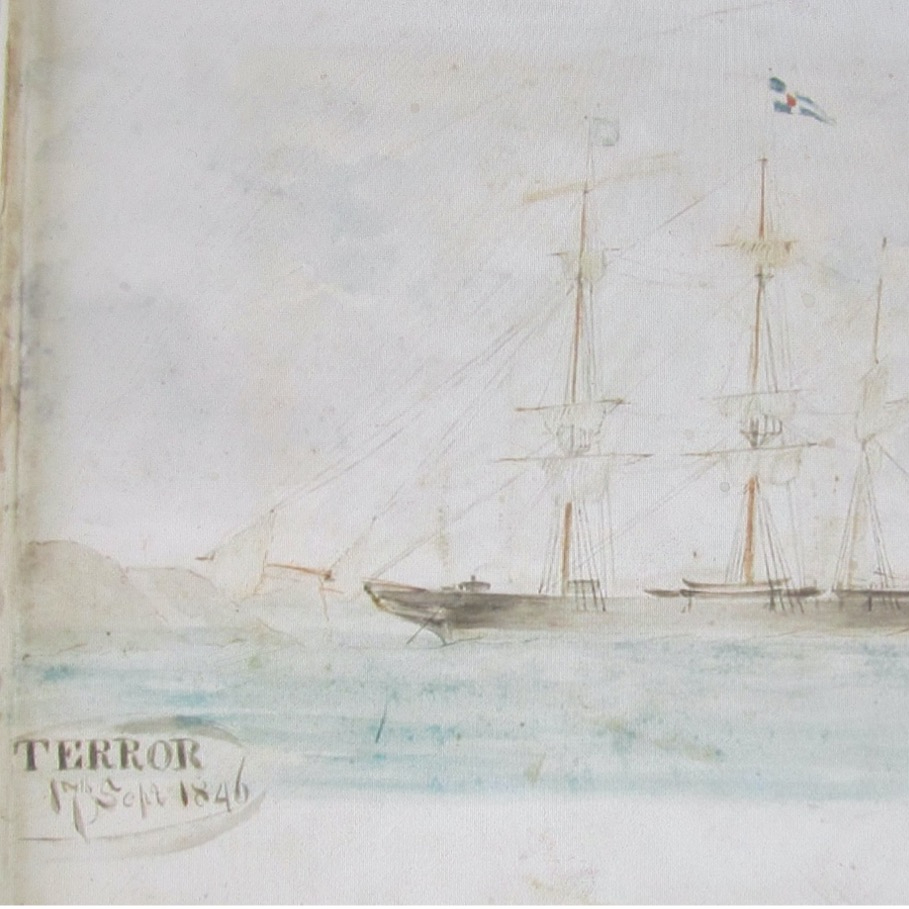
Illustration of the barque ‘Terror’ (dated 17 September 1846) which was one of many whaling ships that entered Port Stephens for repairs and provisions [Australian National Maritime Museum]
Australian Agricultural Company Advertises Services to Whalers – 1837
The Sydney Monitor of 4 October 1837, page 3, carried the following advertisement for services offered by the Australian Agricultural Company to whaling ships:
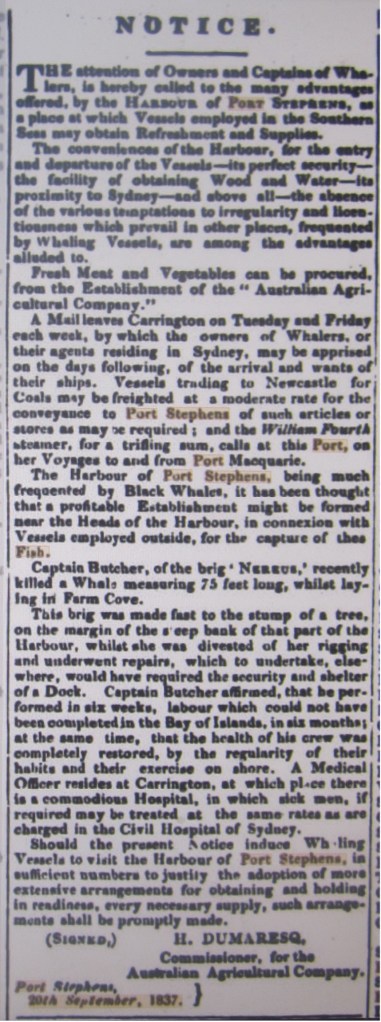
Advertisement placed by the Australian Agricultural Company [Sydney Monitor, 4 October 1837]
It reads;
‘The attention of Owners and Captains of Whalers is hereby called to the many advantages offered by the Harbour of Port Stephens, as a place at which Vessels employed in the Southern Seas may obtain Refreshment and Supplies.
The conveniences of the Harbour, for the entry and departure of the Vessels—its perfect security the facility of obtaining Wood and Water—its proximity to Sydney—and above all—the absence of the various temptations to irregularity and licentiousness which prevail in other places, frequented by Whaling Vessels, are among the advantages alluded to.
Fresh Meat and Vegetables can be procured from the Establishment of the “Australian Agricultural Company.”
A Mail leaves Carrington on Tuesday and Friday each week, by which the owners of Whalers, or their agents residing in Sydney, may be apprised on the days following, of the arrival and wants of their ships. Vessels trading to Newcastle for Coals may be freighted at a moderate rate for the conveyance to Port Stephens of such articles or stores as may be required; and the William Fourth steamer, for a trifling sum, calls at this Port, on her Voyages to and from Port Macquarie.
The Harbour of Port Stephens, being much frequented by Black Whales, it has been thought. that a profitable Establishment might be formed near the Heads of the Harbour, in connexion with Vessels employed outside, for the capture of these Fish.
Captain Butcher, of the brig ‘NEREUS,’ recently killed a Whale measuring 75 feet long, whilst laying in Farm Cove [currently known as Fame Cove, Port Stephens].
This brig was made fast to the stump of a tree, on the margin of the steep bank of that part of the Harbour, whilst she was divested of her rigging and underwent repairs, which to undertake, elsewhere, would have required the security and shelter of a Dock.
Captain Butcher affirmed, that he performed in six weeks, labour which could not have been completed in the Bay of Islands, in six months; at the same time, that the health of his crew was completely restored, by the regularity of their habits and their exercise on shore. A Medical Officer resides at Carrington, at which place there is a commodious Hospital, in which sick men, if required may be treated at the same’, rates as are charged in the Civil Hospital of Sydney.
Should the present Notice induce Whaling Vessels to visit the Harbour of Port Stephens, in sufficient numbers to justify the adoption of more extensive arrangements for obtaining and holding in readiness, every necessary supply, such arrangements shall be promptly made.
(Signed,) H. DUMARESQ, Commissioner, for the Australian Agricultural Company. Port Stephens, 20th September, 1837.’
Wale ship strikes a sand spit at Port Stephens – 1839
The Sydney Monitor and Commercial Advertiser of 29 April 1839, page 4, reported on the arrival of the whaling ship ‘Jane Eliza’ at Port Stephens carrying 1,450 barrels of black oil and 160 barrels of sperm oil:
‘This vessel in entering the harbour of Port Stephens, where there is neither buoy to warn the mariner of danger, nor pilot to conduct his vessel, (though becoming the refreshing port for whalers), struck upon a sand spit, and in consequence has become leaky, making 30 or 40 inches of water in 24 hours. …. The Jane Eliza wanting about 400 or 600 barrels to fill up, is expected to refresh and refit at Port Stephens, and then proceed to England, endeavouring to fill up by the way.’
Description of a whaling crew at Port Stephens
The Wingham Chronicle and Manning River Observer of 8 March 1929, page 7, carried an article on early recollections of Port Stephens, by a correspondent who wrote about a whaling boat that had visited Port Stephens:
‘The only occasion when I ever saw food cooked in what might be described as a blackfellow’s oven was on the occasion of a whaling vessel to the port. Capt. Rogers was skipper of the ship and his crew composed largely of Kanakas, recruited from some island in the South Pacific seas. These ravens were not Australian blacks and they used heated stones for their cooking. I remember them steaming a lot of cabbages my father had given them from the garden. They excavated a hole in which a fire was lighted. Stones were heated, and when everything was in readiness the cabbages were placed in the cavity and covered with the hot stones. When they were done they had a beautiful appearance, and I recollect my father remarking that he had never before tasted cabbage so well cooked.’
Whalers introduce local aborigines to alcohol
An unfortunate effect of the whaling industry was the introduction of alcohol to the local aboriginal community. The captain of the survey ship HMS Beagle recorded in his journal the following comments about his visit to the Tahlee homestead, situated at the head of Port Stephens:
These fairy boats, stealing along the water on a fine calm morning, greatly enhance the beauty of the scene [at Tahlee]. They belong to a party of natives who have taken up their quarters near Tahlee, and who ….. have always been well disposed towards Europeans. Unfortunately, they are much addicted to the use of ardent spirits, having acquired the habit from the whalers who frequent the place.’
Whale ship enters Port Stephens due to desertion of Its crew – 1840
The Sydney Gazette and New South Wales Advertiser of 12 March 1840, page 2, reported:
‘The whaling barque Sir William Wallace which left this port [Sydney] about three months since was compelled to put into Port Stephens, owing to the desertion of several of the crew, and the death of the captain. She has obtained 160 barrels of sperm oil during her absence, and arrived in this port on Monday.’
The same Newspaper reported: ‘The brig Geni out 12 months [from Sydney], with 400 barrels sperm oil was refreshing at Port Stephens when the Sir William Wallace sailed.’
Concluding Comments
It is heartening to watch the yearly increase in the whale population that twice each year pass Port Stephens travelling north around May and June and south again between August and November. Those participation in recreational boating activities outside the Port Stephens Heads have reported instances where whales have now become very inquisitive and can come very close to the smaller boats.
POSTSCRIPT
On the shore of Port Stephens at Soldiers Point stands a well that is believed to have been used by the crews of whaling and other ships to replenish their water supply.
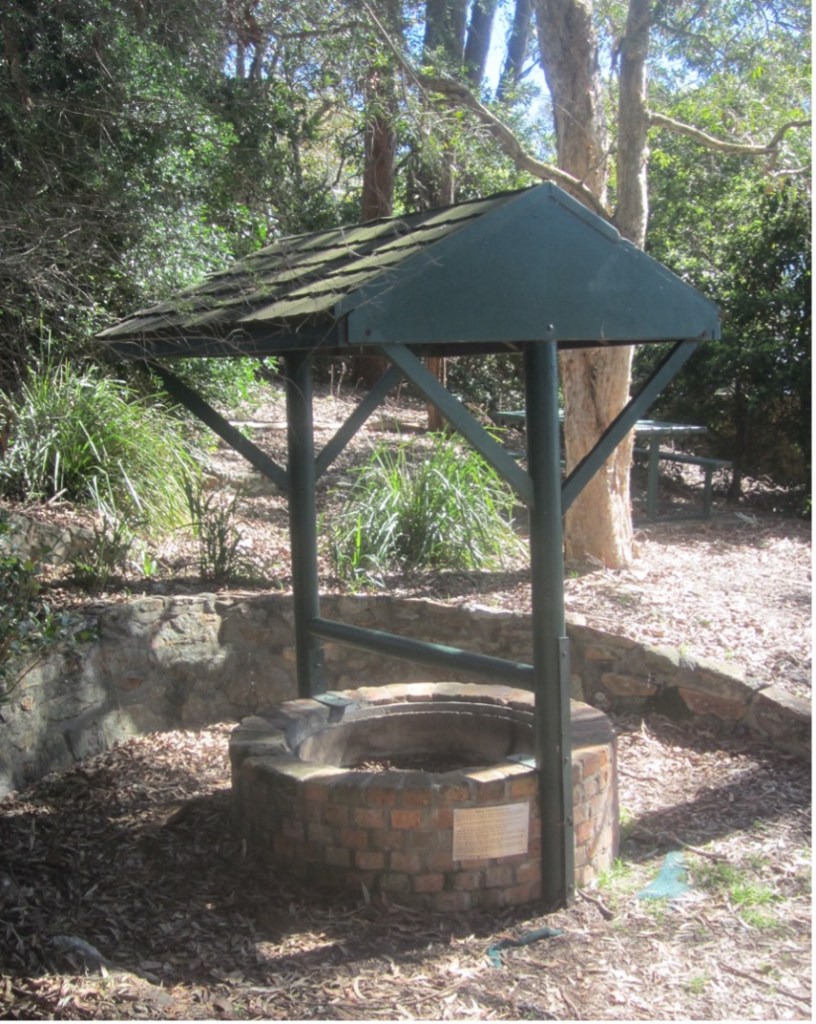
Johnny’s Well at Soldiers Point, Port Stephens [Author photo]
The plaque on the side of the restored well reads in part:
‘This construction marks the approximate location of Johnny’s Well, which was a spring located nearby. …..
“Johnny’s Well was not a well in the accepted sense but was a spring. Also, we cannot be sure of the spelling, as the name has been passed down by word of mouth only. Finally we do not know the identity of Johnny, as early references go well back in time, indications are that Johnny was very likely an aborigine.
What we do know is that the spring gave up beautiful clean water and had extraordinary keeping qualities. It kept much longer in ship’s tanks than water from other sources. Ships from all over the world refilled here. American whalers were frequent visitors.’
Researched and compiled by Kevin McGuinness
June 2023

 Port Stephens - a history exploration