
Introduction
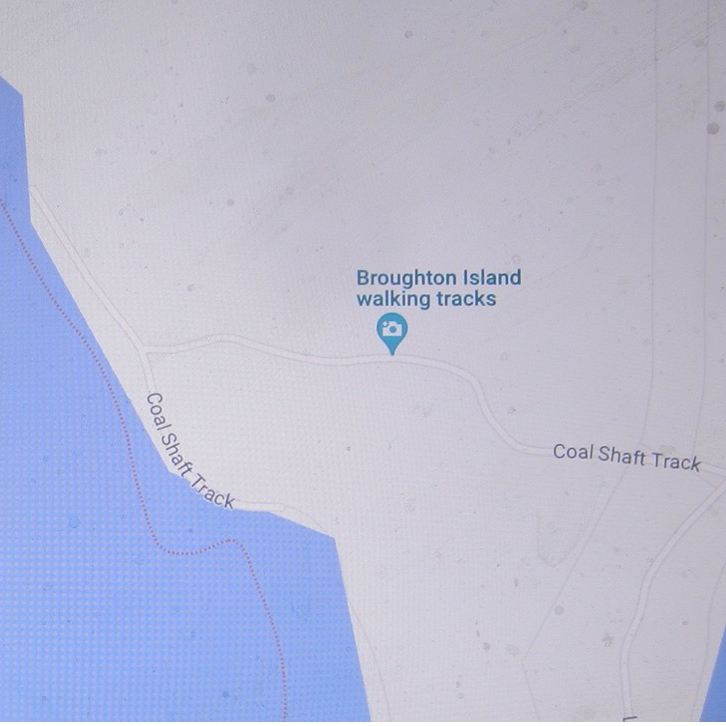
Coal Shaft Bay and the Coal Shaft Track are located on the western side of Broughton Island, off Port Stephens.
These place names are a reminder of attempts made in the late 1800’s to find coal deposits on Broughton Island that would be suitable for mining.
An excursion party from the Australian Museum, passed Coal Shaft Bay in February 1881 in a boat, and their comments were published in the Australian Town and Country Journal of 12 February 1881, page 23:
‘Passing inside the Broughtons, a group of bold rocky islets, sparsely clothed with stunted sombre-tinted vegetation, lying just off the entrance to the [Port Stephens] harbour; and steaming rapidly up the coast we were soon abreast of Long Island, on which not a tree of the size of a gooseberry bush was to be seen, the only prominent object that met the eye on its wide expanse of undulating grassy surface, girdled by cliffs and sand beaches of pearly whiteness, being a small hut erected near a permanent spring of good water by a prospecting party engaged there some time ago in boring for coal.’
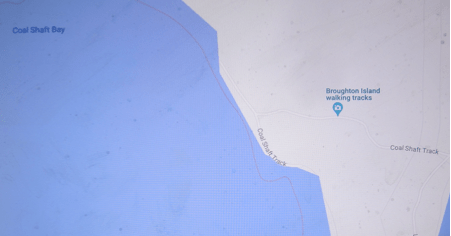
Map of Coal Shaft Bay at Broughton Island, near Port Stephens. The Coal Shaft Track is also shown [Google Maps]
An article published in the Newcastle Morning Herald and Miners’ Advocate of 22 October 1925, page 7, referred to the remains of an old coal shaft:
‘A party, …… left Nelson’s Bay last Sunday week in the launch Kelang for Broughton Island, which is situated about 11 miles north, and was reached in about two hours, after a pleasant trip. A landing was made at Eastern Harbour, the only buildings being three fishermen’s huts, which were used by the party. …..
Some years ago a shaft was sunk at a spot now known as Coal Shaft Bay, in an endeavour to locate a coal seam. There is now but little trace of the work which was done.’
The possibility of finding coal at Myall Point and Broughton Island featured in a civil court case in 1890 which received much newspaper interest. Details of the case are covered in this paper.
Court Proceedings Commence
The Evening News of 14 November 1890, page 5, reported:
‘At the Central Police Court yesterday, before Mr. W. Johnson, S.M., Joseph Tarrant was charged on remand with having obtained valuable securities by means of false pretences in Victoria. Detective W. Tindall stated that he arrested the accused at his office in Phillip street, and charged him with having obtained three promissory notes, two for £600 each and one for £1000 from George Oswald Hyde.
In reply, the accused [Tarrant] remarked that he was surprised at the proceedings being taken as the matter was a civil one. He [Detective Tindall] asked for the accused to be remanded to Melbourne. Thomas McCauley, a constable from Melbourne, identified the warrant signed by Mr. Shooter, a Victorian magistrate. Mr. G. H. Reid appeared for the prosecution, and Mr. W. Roberts, sen., for the defence. Mr. Roberts explained that the affair arose out of a coal-mining transaction. George Oswald Hyde stated that he knew accused, and laid the information in Victoria. He had transactions with accused in Victoria. Accused told him that he was part owner of some land at Port Stephens, and induced him to enter into the contract. In reply to Mr. Roberts witness said there was no coal land at north Port Stephens, but it was supposed to be there. The case was further adjourned till Wednesday next for the production of the contract from Victoria, bail being allowed.’
Court Proceedings Resume
The Evening News of 20 November 1890, page 2, reported:
‘At the Central Police Court, yesterday, before Mr. Johnson, S.M., Joseph Tarrant was charged, on remand, with having obtained certain valuable securities by means of false pretences in the colony of Victoria. Mr. G. H. Reid appeared for the prosecution, and Mr. W. Roberts, sen., for the defence. The case was called on last week, when George O. Hyde gave evidence as to the affair having arisen in connection with some supposed coal land at Port Stephens, in this colony.
Cross-examined by Mr. Roberts : Witness [Hyde] said that he had floated companies in Melbourne for working coal mines which existed in New South Wales. He resided in the Maitland district, and only went to Victoria for business purposes. Accused had several times promised to give him certain documents. Mr. Roberts put in the following contract: — “Melbourne, April 17, I have this day sold to Mr. G. O. Hyde, of West Maitland, N.S.W., for the sum or price of £2000 sterling, one half share or interest in the coal property situate at North Head, Port Stephens, N.S.W., comprising a total area of 3980 acres, or thereabouts, applied for from the Government of N.S.W., and leases ready to issue. The date will also carry with it the right to one half share in the purchase of a freehold block of 40 acres, fronting the Myall Creek, on which is a wharf of about 600yds long, the same being under offer for the sum of £600, half of this sum to be paid by Mr. Hyde, if purchased. Rent on lease for 12 months now paid in advance, which is not a charge against purchaser.
In the event of Mr. Hyde not being satisfied after inspection, the promissory notes given to me to be returned. In the event of his being satisfied, I hereby agree and undertake to renew the said promissory notes for a further period until such time as we mutually agree to sell the property, and I hereby acknowledge to have received promissory notes for the sum of £2000 sterling, due four months after date thereof, no commission for renewals; but Mr. Hyde had to pay half bank rate for renewals — say, 4 per cent. Joseph Tarrant.”
His Worship remarked that according to that document a charge of larceny as a bailee might be had. During the cross-examination which followed, Mr. Hyde stated that he was positive that he saw no coal on the land. All he could see there was sand. He did not sink any shafts to see if there was coal on the land. Accused told him that there was a seam of coal near the wharf, which was not true. He wrote to the accused in May stating that he had visited the land, and as he was net satisfied with the transaction he asked for the return of the promissory notes, which request was not complied with. The land mentioned in the contract was principally under water. Accused represented himself as a member of the Upper House and also represented that a gold mine had been floated in London in which he was interested. Accused also told him that he had a telegram, from Sir Henry Parkes [N.S.W. Premier] asking him to take a position in the Upper House, which he declined to do. In the face of all that he gave him the documents, as he thought him a man to be trusted.
In cross-examination prosecutor stated [Hyde] that he went to the place and found a wharf composed of ballast and boards. It was not a proper wharf and was useless for the purpose of loading coal. The structure was about 20ft deep. That was the Myall Point named in the agreement. The place is all sand, with the exception of the North Head. There was no sign of coal. All the coal he found there were some small pieces, which had evidently been washed ashore. An hotelkeeper in the place told him that he had been there for 25 years, and had heard nothing of coal in the district. When he asked accused about his having said that he was an M.L.C., he replied that he knew that he had made a lot of statements which were not correct, and told him that he was not to worry about the p.n.’s, as he would get them back. Accused told him two or three times after the contract was signed that there was coal there. The whole of the transactions occurred in Melbourne, and it was on the accused’s representations that he was induced to part with his money. The further hearing of the case was postponed till next day at 2 p.m., bail being allowed.’
The Evening News of 21 November 1890, page 3, reported on the next day of proceedings:
‘The charge against Joseph Tarrant of having obtained certain valuable securities by means of false pretences, in the colony of Victoria, was again proceeded with before Mr. W. Johnson, S.M., at the Central Police Court on Thursday afternoon. Mr. J. W. E. David, of the Government Geological Department, stated that it would be something quite exceptional if coal were found on the land at Port Stephens. As far as he knew, coal had never been found there. The mineral produced was iron-stained clay shale, with a small streak of coal. It was quite useless as a coal, and was evidently a water-worn pebble. The character of the land at Myall Creek was sandy. He picked up a piece of water-worn coal, which did not appear to be broken off from an outcrop of coal. Captain John Hall gave evidence to the effect that he knew Myall Point but did not know of any coal having been found there. Two ships laden with coal had been lost on the point.
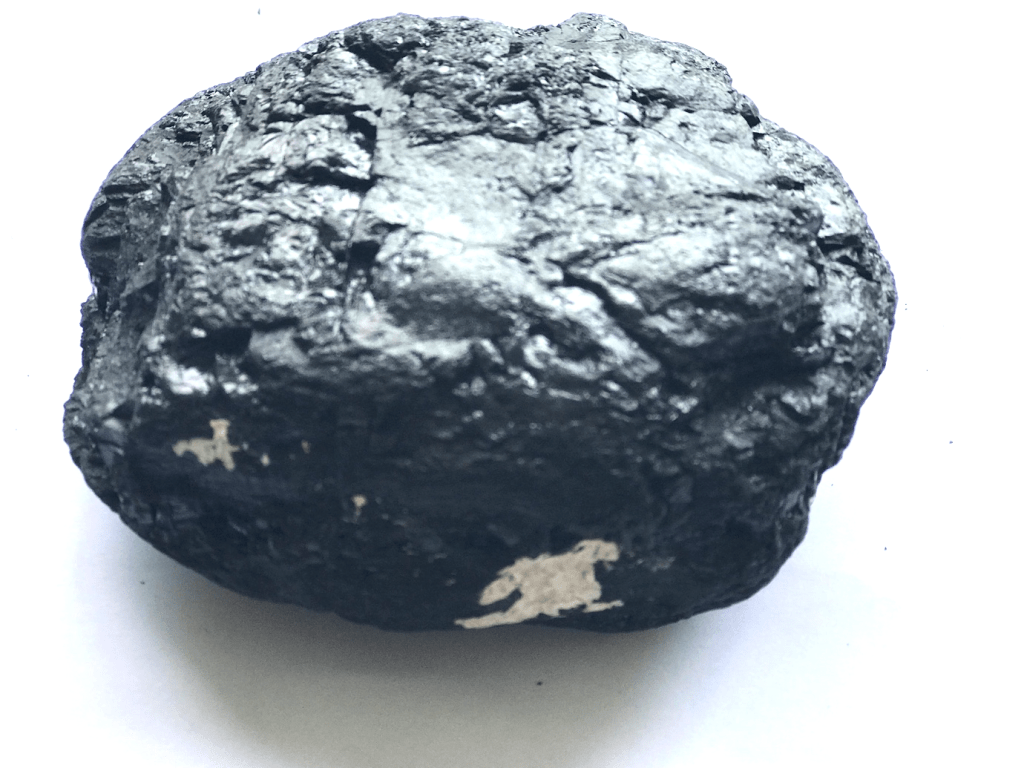
Example of water-worn piece of coal likely from a shipwreck [Collected by Author at Boat Harbour, Port Stephens in 2022]
The prosecutor, Mr. Hyde, was then re-called and cross-examined at some length by Mr. W. Roberts, sen., who appeared for the defence, but his former evidence was unshaken. Constable McCauley, of Melbourne, in answer to Mr. G. H. Reid, said that the offence with which the accused was charged was punishable in Victoria by imprisonment not exceeding five years. His Worship held that a prima facie case had been made out, but he could not commit the accused here. The question was whether or not the case should be sent to Victoria to be heard. His Worship pointed out that he could only remand the accused, but was open to hear argument or evidence for the defence.
By consent the defendant made a statement. He said that when he had the first interview with Mr. Hyde on business matters Hyde told him that he was floating a coal property at Maitland, and the syndicate was nearly completed. He asked him to take a share in it and gave the names of gentlemen who had taken shares, but he declined to take shares, as he was interested largely in coal properties himself, mentioning a property at Jervis Bay of about 50,000 shares, of which he held a third. Hyde asked him if he was interested in properties near Port Stephens, and he said he was, and was then trying to dispose of 11,000 acres of church and school lands. He also told Hyde that he had a half-interest in something like 3000 acres at North Head, Port Stephens. He was also interested in Broughton Island, about five or six miles north-west of the property. In reply to a question, he told the prosecutor that the property had not been hawked about Melbourne, and Hyde said that he’d like to join him if it had not. He told Hyde about the property, which had been offered for sale twice, and one of the gentlemen who offered it was the American Consul, but he had refused it. He told Hyde that he was well known in Melbourne, and was interested in tin mines, as well as gold and silver mines. He told him (Hyde) that any information he could give was obtained from others who had seen the property. Hyde told him that they might make up a party. He (Hyde) could not pay cash till his own colliery matters had been settled, and if he (accused) would take his bills he would come into the mine. The price asked first was £3000 for the half interest. Hyde suggested £2000, and 10 days afterwards he saw Hyde in Melbourne. The further hearing was adjourned till to-day at 11 a.m.’
The Australian Star of 22 November 1890, page 6, continued with the reporting:
‘The hearing of the charge against Joseph Tarrant of having, by means of a false representation, obtained promissory notes to the value of £2000 from George Oswald Hyde was resumed before Mr. Johnson, S. M., at the Central Police Court. The same counsel appeared as on previous occasions. Gilderoy Wells Griffin, American Consul in this city, stated that he did not know the accused, and had not at any time had any transactions with him with respect to a coal property or any other sort of property.
Evelyn Stephen, clerk in the lease branch of the Mines Department, produced two applications in the name of the accused. One was for a lease of land at Myall Point, Port Stephens, of 640 acres, and the other was for 640 acres at Broughton Island. They were both applied for as coal and shale lands. The Broughton Island lease had already been issued, but the Myall Point one was not yet ready for issue. They were the only two in the name of Joseph Tarrant, but there were also two applications for leases in the names of Barry and W. Tarrant respectively. Joseph Tarrant (continuing his statement) said he declined to purchase any of the shares offered, and the matter of the North Head property was again brought up. An appointment was made for that evening, when Hyde attended at his hotel and remained some two hours. They went fully into the matter with maps and charts before them. He (Tarrant) showed Hyde two reports written by Mr. Will Sweeney, one on the North Head property and the other on the Broughton Island land. (Tarrant produced the reports and they were “put in.”) The position of Broughton Island with the North Head property was very carefully noted on a map before them.
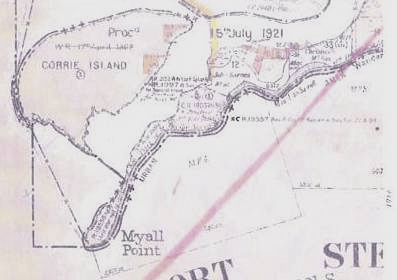
An early map of Myall Point, at the end of the Myall River, to the east of the North Head of Port Stephens [Yacaaba]. Due to erosion, Myall Point is no longer a prominent feature in the Port.
He impressed on Hyde that all the information he had given him as to the North Head and Broughton Island properties was only what had keen told him by others. He had never seen them himself. The probable existence of coal on Broughton Island was fully gone into. The statement with regard to the existence of a tunnel or shaft at North Head was entirely untrue. He produced a batch of telegrams and letters sent from Nelson’s Bay eulogising the rich existence of coal on Broughton Island. With reference to the statement made by Hyde that he (Tarrant) showed him a cablegram from London signed by Baring Brothers it was utterly false. He did show him a cable from London, but it was signed by G. Lovett, with whom he had had some mining transactions. With reference to the mention of Sir Henry Parkes’ name, a paragraph appeared in the Melbourne Age under the Sydney telegrams which set out that the “Dr. Harman and Joseph Tarrant” were amongst those nominated for positions in the New South Wales Legislative Council. Hyde asked him if that referred to him, but he (Tarrant) replied that he did not think so; there must be some mistake. They looked in the Argus and found that the name appeared “Dr. Harman J. Tarrant.” He never at any time told Mr. Hyde that he had been offered any seat in the Council.
William Swiney deposed he was a mining examiner and member of the Royal Geographical Society of Australasia. He was agent for the accused and had obtained leases of mineral coal land at Port Stephens and Broughton Island for him. He considered the land a valuable mineral property. He did not understand how Tarrant was so foolish as to sell it for such a small amount.
Richard Barry stated he was one of a syndicate with accused who purchased land at Myall, Port Stephens. It was through his recommendation that the land was taken up. He believed that portion of the land was a coal-producing district. He got so disgusted with the whole business that he told his brother (G. J. Barry) to do what he liked with it. Myall Point was a sandy point at the junction of the bay and river. There was no geological evidence of coal being there. About a mile to the eastward, however, there was a strong indication of coal. If the seam of coal was on the land there, he considered the property would be worth about £25,000, considering the facilities for shipping. He reported everything relative to the property truthfully to both Tarrant and his brother. Theodore Ramft stated he was a mining engineer. He knew of a seam of coal 18ft. deep existing about 15 miles from the Myall. He knew nothing of the Myall or of the ground in dispute.
Mr. Roberts contended that the accused was entitled to a discharge on the following grounds:— (1) That the information was not sworn, according to the law of the colony of Victoria, to warrant the apprehension of the defendant, and that the information was otherwise defective. (2) That the defendant being illegally arrested and under a defective warrant he was entitled to his discharge. (3) That no legal warrant was issued on the information in this case to warrant apprehension or remand of defendant. The bench considered that a prima facie case had been made out. He would remand the accused to Victoria and make an order that he should not be taken there until a certain period to allow the accused to appeal to the Supreme Court. A lengthy argument then ensued relative to bail being allowed before returning the accused into the custody of Constable McCauley, of Victoria. Mr. Reid contended that his Worship must deliver the accused into the custody of the constable, otherwise he would not have the power after he once leaves the bench. Arguments having concluded the bench decided to adjourn until Tuesday when his final decision will be announced.’
Accused failed to appear at Court
The Sydney Mail and New South Wales Advertiser of 29 November 1890, page 1226, reported:
‘A mining case of more than ordinary importance was heard in the Central Police Court last week. It was against Joseph Tarrant, of Sydney, for having obtained by means of a false pretence certain valuable securities, to wit, three promissory notes for the sum of £2000, from the person of George Oswald Hyde, of Melbourne and Maitland, a dealer in coal mines. According to the evidence it appears that Tarrant sold to Hyde a mining lease of land near Port Stephens. All the transactions about the property took place in Victoria. The principal statements said to have been made by accused which induced Hyde to enter into the contract were that there was a seam of coal cropping out near the wharf which he could go into, and that the Government Geologist had seen the property and thought a great deal of it; it was the same coal as the Greta coal; there was a wharf there 600 yards long which could be used for shipping; the coal could be brought out of the tunnel and put on to the wharf and into large steamers, as there was 30ft. of water there, and the San Francisco mail boats could go right alongside the wharf, for which reason the American consuls of Sydney and Melbourne had offered him £1000 for the property. Also, that the Government Geologist would bear out the statements made about the property.
Accused also said that Sir Henry Parkes had twice offered him a seat in the Upper House. Accused showed Hyde a paragraph in a newspaper stating that among others nominated to the Legislative Council was J. Tarrant. When Hyde got to the property a little boat drawing about 4ft. of water could hardly get along without grounding. As for the wharf, there was a little jetty about 50 yards long, supported by stones. The evidence was conflicting. There were several experts as witnesses in the case, which lasted four days, and concluded by the Bench stating that a prima facie case had been made out and that the accused would be remanded to Melbourne for trial. The case, however, was remanded to Tuesday of this week, to fix a date at which the accused should return to Melbourne to be tried, and to fix the amount of bail. Bail, the accused £1000 and two sureties £500 each, was in the meanwhile allowed. On Tuesday the accused failed to appear, and the bail was estreated [bail forfeited].’
Issue of Bondsmen
The Newcastle Morning Herald and Miners’ Advocate of 6 January 1891, page 5, reported:
‘Word has come along from the Detective Office, Melbourne, to the Detective Office, Sydney, to the effect that Joseph Tarrant, mining agent, who absconded from his bail recently, is no longer wanted. The presumption is that matters have been settled some way down in Melbourne, where, it will be remembered, the prosecuting parties resided. An interesting question arises in this matter respecting his bondsmen. Tarrant, it appears, absconded from his Sydney bail, his bondsmen being Mr. H. H. Brown, M.P., and Mr. Thomas Walker, M.P., in the amount of £500. The question is, whether the bondsmen have paid up, or are to pay up. The Crown here cannot take notice of the fact that Tarrant is no longer wanted in Melbourne, and it would appear that they can only be relieved by Tarrant’s surrender. The case is a curious one, but probably the bond will not be enforced.’
Last Reported Comment
The Newcastle Morning Herald and Miners’ Advocate of 7 January 1891, page 6, carried the final report on the case in the form of a letter to the editor from the prosecutor, Mr. Hyde:
‘Sir,—I notice in your issue of today, under the heading as above, “Tarrant not wanted.” The presumption that “Matters have been settled some way down in Melbourne,” and the allusion to the prosecuting parties residing there, is incorrect. No settlement has been made with me, directly or indirectly; nor have I withdrawn the original warrant for his apprehension.—I am, &c., G. O. HYDE. East Maitland, January 6.’
No further reports on this case were reported in the newspapers.
Further information on Broughton Island is published on this website and can be found at the following links:
A History of Broughton Island – Port Stephens
Rabbit Extermination Experiments on Broughton Island by Dr. Jean Danysz
Concluding Comments
During the late 1890’s and early 1900’s, several efforts were made by individuals and companies to find marketable quantities of coal, gold, and minerals in the Port Stephens area. None of the efforts were to be successful.
Researched and Compiled by Kevin McGuinness
March 2023

 Port Stephens - a history exploration