
Introduction
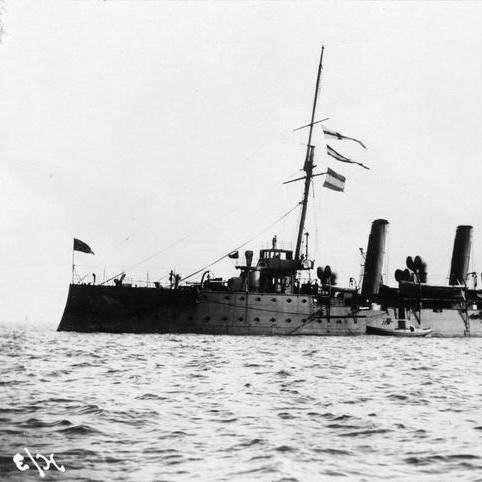
HMAS Psyche (formerly HMS Psyche) was a light cruiser built for the Royal Navy at the end of the 19th century. It ended its days as timber lighter before sinking in Salamander Bay at Port Stephens in December 1924.
Five ships of the Royal Navy were named HMS Psyche, the first being built in 1805. The last two ships of the name, both served on the Australia Station viz:
(1) HMS Psyche, launched in 1889 and renamed HMS Ringaromma in 1890 and sold in 1906; and
(2) HMS Psyche, launched in 1898 and commissioned into the Royal Australian Navy as HMAS Psyche in 1915. It was sold in 1922.
This paper is the story HMAS Pysche.
Part One examines its operational life as a escort ship in the Royal Australian Navy during the First World War from 1914-1917, and later as a training ship in Sydney Harbour.
Part Two examines its later years as a timber hulk and its sinking at Port Stephens in December 1924.
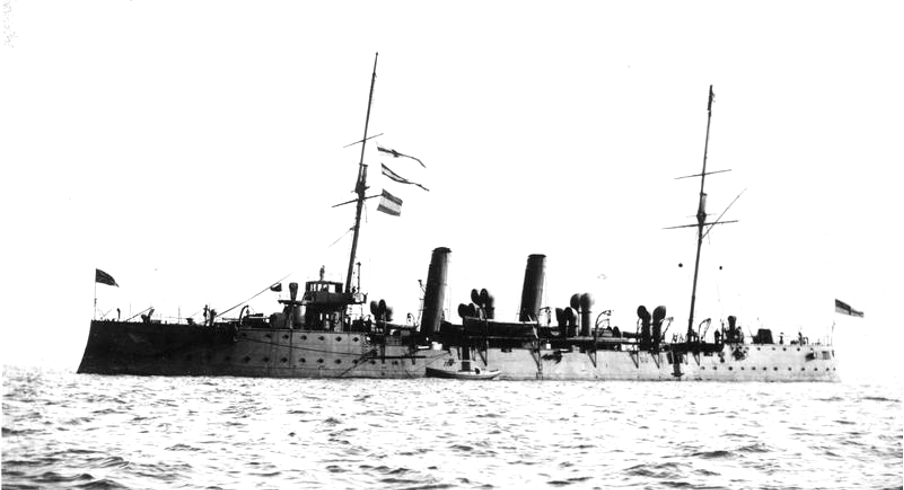
HMS Psyche [Imperial War Museum]
PART ONE – HMAS PSYCHE
First World War Service from 1914 – 1917
At the outbreak of the First World War in August 1914, as HMS Psyche, the ship took part in the operations to capture German Pacific territories and undertook escort duties. It returned to Sydney in late 1914.
In July 1915, it was commissioned into the Royal Australian Navy as HMAS Psyche (henceforth referred to as the Psyche) and ordered to the Bay of Bengal. Based at Rangoon, it carried out patrols along the Burma Coast and Malay Archipelago. Psyche was recalled to Singapore and an enquiry was held into problems experienced by the sailors on board the warship. There had been ongoing problems with the climate, poor food and disease.
Psyche returned to patrol duty in the Bay of Bengal in April 1916 and in June 1916 was redeployed to Hong Kong to patrol off the South Coast of China and Indo-China. By July 1916 almost half the crew were suffering from illness.
Psyche returned to the Bay of Bengal in October 1916 for further patrol work. The warship war recalled to Australia in September 1917. It was decommissioned as a Royal Australian Naval vessel in March 1918 and then used as a training ship.
Psyche and the German Raider, Wolf – 1917
The Sydney Morning Herald of 18 August 1923, page 7, printed an extract of Captain Donaldson’s book, “The Cruise of the Wolf”, in which certain patrol activities of the Psyche were first made public:
“During the night of September 3 (1917) the Wolf was steaming up Karimatta Straits, no lights showing. Suddenly a suspicious looking craft was sighted, immediately the alarm bells went; everyone was pitched to the highest key of excitement. Everything was ready. Should the cruiser [the Psyche] see the Wolf, at once two torpedoes would have been launched at her. However, Nerger’s [captain of the Wolf] luck held good—and she passed [the Psyche] within three miles.” The above is an extract from Captain Donaldson’s book, “The Cruise of the Wolf,” and it is now for the first time made public that the cruiser mentioned above was H.M.A.S. Psyche.
In view of the fact that she is at this moment being broken up [in 1923], it is interesting to recall that she was the only British warship to approach so close to the Wolf. Few ships of the R.A.N. saw so many and varied activities. Early in the war she was present at the capture of Samoa. Later she was sent to Burma to act as flagship of the Burma Coast Patrol, having as its duty the suppression of gun-running and any rebellion which might arise. From the confessions of captured seditionists, it was learned that her presence in Rangoon nipped in the bud a rising similar to that at Singapore earlier in the year. The Psyche was given the task of transporting these seditionists from Rangoon to a penal settlement on the north coast of Burma. She was the first warship to visit Madras after its bombardment by the Emden [German warship], and was consequently feted during her stay. The shell holes in the great oil tanks could plainly be seen from her decks.
In 1916 the Psyche was sent on a special mission to put down the running of contraband out of Bangkok, in Siam, chiefly wolfram, which at that time was worth its weight in gold to the Germans. She anchored off the island of Pulo Panjong, and on receiving a wireless from the shore authorities that a contraband cargo was to be run, steamed quietly out and neatly captured the contraband runner, whom she then took into Singapore, for disposal by the British authorities. Later she convoyed many thousands of Russian troops on their famous journey of 20,000 miles from Moscow to the Western front. During this time a cable was received from the Navy Office, stating: “We are following with great interest the movements of H.M.A.S. Psyche carrying out the important duties entrusted to her.”
The Psyche was then sent round to the China coast, calling at Pulo Condor, off French Cochin China, and paid a courtesy visit to the French settlements on the way. For many months she patrolled the Straits of Formosa, bringing in any ships carrying contraband to Hong Kong, and relieving them of their German passengers. During this time, she was forced to run for shelter to Swatow, and rode out a typhoon in the harbour there. On patrol here she passed out of the tropics for the first time in two years. ……
Again she was transferred to the Bay of Bengal, and patrolled from Rangoon to Calcutta, where she docked, and down to Madras and Colombo, visiting also the little known Andamans and Nicobars, where at this time the Wolf had just made her appearance, and the Psyche was sent in search of her. Although the Wolf could have blown her out of the water, the Psyche had the heels of her, having touched 21 knots after overhaul in Hong Kong, and was ordered to keep out of range and wireless for a Japanese battleship, with whom she was cooperating.
In the search, Sumatra was visited, and the carriage of German mails and passengers from one Dutch island to another put down. The Wolf then went off to Australia and New Zealand, and the Psyche was employed between Calcutta and Rangoon, in the carriage of German and Turkish prisoners, bound for up-country internment camps in Burma. At the close of this duty, the Psyche sailed for Singapore, and later for Sydney, having covered close on 100,000 miles.’
It is noted that the German merchant steamer, Wolf, was believed to have laid mines in an extensive area in both the Indian and Pacific Oceans from 1916 to 1918, including the eastern seaboard of Australia. In sweeping operations, German mines were recovered along the coast including the one that washed ashore at Birubi Beach at Anna Bay. For further information see ‘When the First World War Came to Port Stephens’.
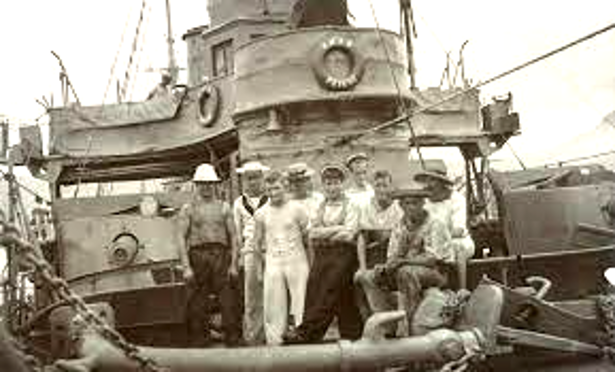
Sailors on board HMAS Psyche [Royal Australian Navy]
Harsh conditions on Psyche while used as a training ship in Sydney – 1919
The following report in the Sun of 17 April 1919, page 4, provides an excellent insight into the harsh and isolated life experienced by young trainees on board the training ships Psyche and Tingira in Sydney Harbour during the influenza epidemic:
‘More than 200 boys aboard … training ships Tingira and Psyche have been isolated on the ship since the end of January owing to the influenza epidemic. The epidemic apparently found its way to the training ships before it had anything like a hold on the city, and since the first case was reported from the Tingira the boys have been subjected to conditions unknown in any other quarantine areas. It is only in the case of boys, however, that such extraordinary precautions are taken. Though the trainees are not allowed ashore, the officers and petty officers are in no way isolated. They go ashore now, as they did before there was any ‘flu.
The boys became so tired of ship life after being eight weeks in isolation that the captain of the ship decided to give them an airing and exercise on Lyne Park, on the foreshore of Rose Bay, and close to the Tingira and Psyche. There was great jubilation aboard the ships when this became known. It was another armistice day for the boys. Then, when they got ashore, some of them made up their minds to visit the city. The officers and petty officers did so, and there did not appear to the lads to be any good reason why they should not do the same. If the officers could not catch the ‘flu in the town, then they could not. So some of them made out the gate.
For their visit to the city the naval boys had to pay. To their credit, it is said, they all returned to the quarantined vessels, and there they were dealt with after the manner of their institution. The cane was freely used on those who broke bounds. In some cases 12 strokes were given, the total number administered being 280. It is clear that the patience of the boys is being severely tried by their isolation, and the prospects of its indefinite continuation. If the officers and petty officers were kept aboard in the same way as the rank and file there would be no cause for complaint, but run as they are, the boys say, the Tingira and Psyche will never be out of quarantine.’
PART TWO – PSYCHE FOUNDERS AT PORT STEPHENS
The Psyche remained in the service of the Admiralty until it was sold in 1922 to William Waugh of Balmain. He converted it to a timber hulk and later sold it for use in Port Stephens. It was towed there in November 1924 but sank within the month with a heavy load of logs in Salamander Bay.
Psyche to be sold on behalf of the Admiralty – 1922
The Sydney Morning Herald of 25 January 1922, page 14, reported:
‘The light cruiser Psyche, now lying in Sydney, is to be sold on behalf of the Admiralty.’
Psyche to be broken Up – 1922
The Daily Telegraph of 17 August 1922, page 7, reported:
‘H.M.S. Psyche, which has been lying idle In Sydney Harbor for some time past, has been sold out of the service. She has been purchased by Mr. William Waugh,of Balmain, and will be broken up. The Psyche will be moved to Berry’s Bay, where the work of dismantling the old cruiser will be carried out. The Psyche served several commissions on the Australian Station, being employed chiefly on patrol work among the Southh Sea Islands. She was afterwards lent to the New Zealand Government as a training ship.’
The Sunday Times of 3 September 1922, page 3, further reported:
‘H.M.A.S. Psyche has fallen into the hands of a band of wreckers. Towed from Garden Island to Berry’s Bay, the gunboat, after 25 years’ service, is being dismantled, and in a week or two there will remain little above deck to recall her trim appearance.
The Psyche’s career on the Australian station was peaceful, but useful. She made many important survey cruises. Obsolete in 1914, the gunboat did not have any war work to perform. While the bigger and newer ships were searching for the enemy, the Psyche rested safely at anchor in harbor. It is many years since she went outside the Heads; so long, in fact, that the Signal Station staff cannot recall her last departure. Originally the vessel was attached to the British Fleet, but was presented to the Commonwealth when the Australian Navy was born. The Psyche, in her seagoing days, was manned by a crew of 234 men.’
Psyche’s last voyage – 1924
The Sun of 10 November 1924, page 6, reported:
‘In tow of the tug St. Giles, the old British warship Psyche left Sydney yesterday for Port Stephens. The vessel had been dismantled before her departure, and the hulk is going to the ship breakers.’
The Daily Telegraph of 13 November 1924, page 1, further reported:
‘Naked and forlorn, H.M.A.S. Psyche has been towed to Port Stephens, where the shipbreakers will complete the obsequies of a once proud cruiser. The Psyche came to Australia from Great Britain many years ago and had seen her best days even before 1914. During the years of stress, however, she had a new lease of life. Now, unhonored and unsung, she follows in the wake of many a veteran who missed the glory of death in action.’
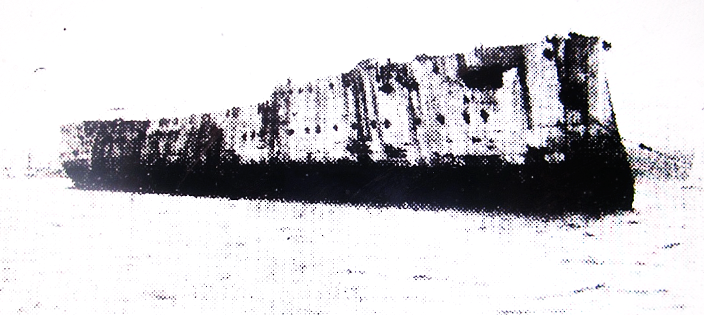
Hulk of the Psyche in Sydney Harbour [Daily Telegraph, 13 November 1924]
Psyche founders in Port Stephens – 1924
The Sydney Morning Herald of 9 December 1924, page 9, reported:
‘A report received yesterday by the Department of Navigation from the Lighthouse keeper at Nelson’s Bay intimated that the hulk Psyche, formerly a warship, had sunk in Salamander Bay, Port Stephens. The cause is not known.
In her prime a British warship, the Psyche was recently a hulk, and at the time of her sinking was used for the storage of timber. She had on board a quantity of hardwood, which was awaiting shipment. The vessel has been in use at Port Stephens as a hulk for a few months. Prior to that she was laid up in Sydney Harbour for about two years.
The Psyche was built In England in 1898, and was for many years stationed in Australian and New Zealand waters. During the war she carried on a large amount of work in the Indian and Pacific Oceans, and at one time, in 1917, encountered the German raider ‘Wolf’.
In August 1922, the Psyche was disposed of to Mr. William Waugh, who dismantled the vessel and converted her into a hulk. She was sold for use at Port Stephens a few months ago. Shipping has been warned of the sinking, as the submerged vessel is a menace to navigation.’
The Raymond Terrace Examiner and Lower Hunter and Port Stephens Advertiser of 12 December 1924, page 3, further reported:
‘The ‘Psyche used as a floating pole wharf hulk, and lying in Salamander Bay, Port Stephens, sank at her moorings on Saturday night during the storm. She was owned by Messrs. Mills and Rigby, of Newcastle, timber exporters, and had on board ready for shipment to New Zealand 800 poles. She was a recent purchase, and was formerly a gun boat, proudly patrolling Australian waters, with many records of useful service to her name. How or what caused the hulk to sink is only surmised, but it is thought that being moored fore and aft, and with a heavy load of poles on deck, she turned turtle. Had she been able to swing head on to the wind no doubt she would have survived. The loss to the owners will be heavy and run into some thousands. An effort will be made by divers to raise the poles, which ought not to be too difficult as the depth is from 50 to 60 feet. Whether the hull will be raised is not known.’
Graveyard of the Psyche – 1924
The Evening News of 19 December 1924, page 14, reported:
‘The Psyche, …. is now embedded in thick black mud in Salamander Bay, Port Stephens. The hulk rests in eight fathoms of water. Diver A. Albert, of Sydney, has just returned from a visit to the scene, and to a “News”‘ man today he described his experiences.
He descended eight fathoms and found the old ship firmly in the mud, canted to port. Part of the cargo of timber and telephone poles had been tipped out. and was strewn about. He had great difficulty in moving about the bottom of the sea, owing to its muddy character, and at times was unable to see more than 3 or 4 feet. He had rather a lively time finding his way about. Diver Albert found that the Psyche had opened up in in many places, and in his opinion, it would be almost impossible to seal her for pumping out. He is convinced, therefore, that the Psyche has finished her career. But she shall not he allowed to remain there for ever, as the spot is really the anchorage for cruisers and other large ships. The only way to get rid of the wreck will be to blow it up.’
Salvage operations underway – 1925
The Daily Telegraph of 12 January 1925, page 3, reported:
‘Salvage operations are now proceeding on the old warship hulk Psyche, which sank at Salamander Bay, Port Stephens, several weeks ago with a cargo of over two thousand poles. After the poles have been raised, an effort will be made to shift the hulk, which in its present position is a menace to shipping.’
The Newcastle Sun of 6 June 1925, page 8, further reported:
‘A small fortune in lumber went down with the storeship Psyche when she foundered during a gale last January and embedded herself in six feet of silt, 60 feet below the surface of Salamander Bay, Port Stephens. After a six weeks’ struggle against tides, rough weather, and innumerable other difficulties, divers Saalfled and Luxton, of the Newcastle Patent Slipway and Engineering Co., were the principals in salvaging the cargo, valued at about £4000. It comprised 2044 hardwood poles, 30 to 40 feet long and 18 inches in diameter, and a number of wooden girders.
Considering that the Psyche had listed heavily when she settled down, and also that the logs had become slimy und heavier through their long immersion, the salvage contractors feel justified in claiming that it is the biggest successful salvage in Newcastle waters for years. The divers’ task was a difficult one. Owing to the enormous pressure on the body at a depth of 60 feet, they worked in shifts of three hours each. They were lowered into the hold of the sunken ex-warship from the deck of the company’s steam lighter, and did all their work in darkness. The slippery conditions of the logs rendered their movements dangerous, especially so owing to the possibility of the lifelines and the air pipes becoming fouled in the event of a fall.
Then, when the diver on duty had cleared away any obstruction to the log, he had to lift it alone by hand sufficiently to get the derrick chain around it. This done he would give the signal, and the log would be hauled to the surface by a steam crane. Often, he had to steer the heavy beam out of the hold, as the angle of the wreck precluded a perpendicular lift. He often had to grope in the dark in doing this. The redeemed logs were then dumped on the foreshore. Many of them are now on their way to New Zealand for delivery to electric lighting people.
Great difficulty was experienced in salvaging the logs that had gone overboard as the hulk had tilted and sat on them. Eventually, however, most of them were rescued. The Psyche, of 4000 tons register and once a unit of the Australian Navy, is owned by Messrs. Mills and Rigby, timber merchants of Newcastle who used her as a store ship from which deep-sea vessels could load. She sank at her. moorings in the naval anchorage about three miles inside the heads. The Newcastle Patent Slipway and Engineering Co., which was the successful tenderer for her salvage, completed the job this week. Both the divers concerned in this work were employed on repairs to the U.S.S. Waihemo when she went aground on the southern breakwater at Newcastle, and on many other big salvage jobs. The manager of the company (Mr. Leeder) and the manager of the New Zealand Insurance Co., (Mr. Doylan) have congratulated the men on their good work. The operations were superintended by Mr. Leeder.’
Second Timber Hulk Sinks at Salamander Bay – 1925
The Daily Telegraph of 8 October 1925, page 5, reported:
‘The hulk Mahinapua, laden with long telegraph poles, which was moored in Salamander Bay, Port Stephens, foundered at her moorings yesterday morning. News of the mishap reached Sydney underwriters yesterday. No particulars are available, but it would appear that the vessel suddenly sprang a leak during Tuesday night, and gradually settled down.
This is the second hulk that has met a similar fate in Salamander Bay. Some months back the Psyche, an old warship, which was sold out of the service and converted into a timber hulk, disappeared from her anchorage, and was found submerged in many fathoms of water.
The SS Mahinapua, which, after being turned into a hulk, was renamed Sydney, was an old Union liner, and for many years was running on the New Zealand coast. Later she traded between Melbourne and Tasmania. She is a vessel of 458 tons, and was built at Dumbarton in 1882. Captain Gibson, of the Sydney Marine Underwriters’ Association, will proceed to Port Stephens today to arrange for salvage operations. It will be a long and tedious job, as the poles will have to be recovered before any attempt can be made to lift the vessel.’

SS Mahinapua
Memories of the Psyche – 1927
The Sun of 12 June 1927, page 3, published a correspondent’s comments on the remains of ships and those of the Psyche at a Balmain shipyard:
‘To the casual observer, a shipbreaker’s yard appears to be just a gigantic collection of old iron and timber — ship’s junk. But there is a strange spirit of romance and adventure always present in all things allied to the sea. …..
In an old shipyard — there is one at Balmain — the eye constantly meets every screw and fitting that goes to the making of a ship, and the fancy is captured and charmed. There are strange fragments of old-time craft which stir the memory vividly, and bring back tales read in the dim long ago. ….. Every kind of ship has contributed to the accumulation. Grim man o’war, barque, schooner, yacht, and coaster have all fallen under the hand of the shipbreaker. And the parts — sorted, piled, and valued — are waiting to serve a further period of usefulness. …….
The great funnels of H.M.A.S. Psyche lean drunkenly against the storeroom wall. They have fallen to lowly estate. Time was when, grey and grim, they belched forth smoke from the great forces below, and proudly the great ship swept the seas.’
Psyche Memorial at Roy Wood Reserve
A memorial to the ‘forgotten’ cruiser, HMAS Psyche, and those who served on her, stands in Roy Wood Reserve at Corlette, Port Stephens. It was unveiled on 1 July 2015 to honour the 100th anniversary of the commissioning of the ship.
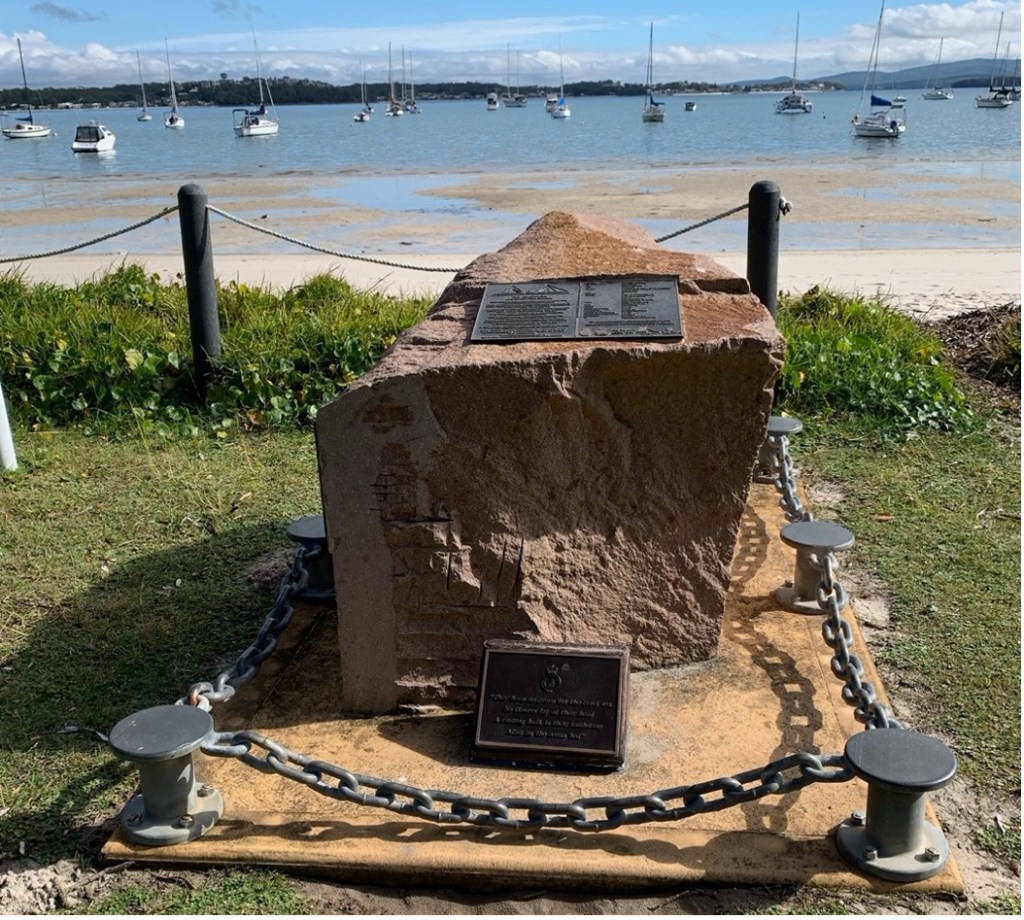
The wreck lies 1400 metres opposite the memorial in Port Stephens [Author Photo, May 2023]
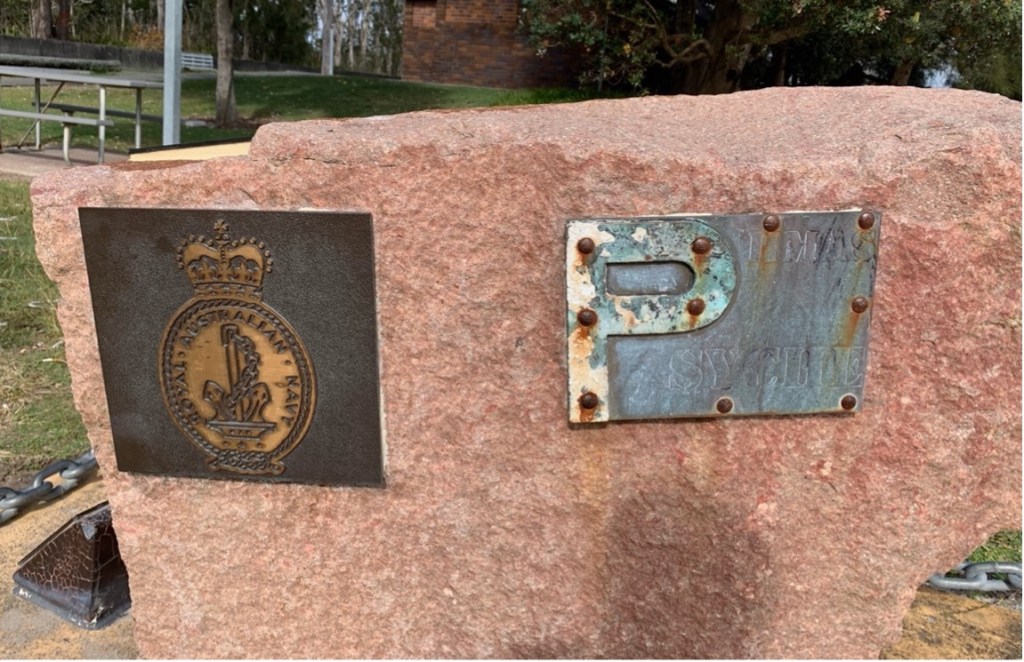
Side view of the memorial with the Pysche’s nameplate [Author Photo, May 2023]
A plaque on the memorial states:
‘Commissioned in 1899 as a light cruiser, H.M.S. Psyche served with the Royal Navy on the Australian station prior to the First World War. Following the outbreak of the war in August 1914, she took part in operations to capture Germany’s Pacific colonies and undertook escort duties. Returning to Australian waters H.M.S. Psyche was laid up in Sydney in late 1914.
In July 1915, Psyche was commissioned into the Royal Australian Navy and was ordered to the Bay of Bengal. Based at Rangoon in Burma (now Myanmar), she carried out routine patrols along the Burma coast and Malay Archipelago. In June 1916 she was redeployed to Hong Kong to patrol off the south coast of China and Indo-China (South East Asia).
H.M.A.S. Psyche returned to the Bay of Bengal in October 1916 and continued patrol work until she was recalled to Australia in September 1917.
She was engaged in patrol work off the eastern Australian coast in November 1917 and remained a commissioned vessel of the Royal Australian Navy until March 1918.
Psyche was sold to the Moreland Metal Company on 21 July 1922 who used her as a timber lighter. Psyche sank on Monday 8 December 1924 during a storm in Salamander Bay. ….
Although H.M.A.S. Psyche did not participate in any major action during her time in the R.A.N., she should always be remembered as being one of the first ships of the Royal Australian Navy.
Concluding Comments
The wording of the Naval Association of Australia’s plaque laid in the front of the Psyche memorial at Port Stephens is a fitting tribute:
“They have no grave but the cruel sea.
No flowers lay at their head
A rusting hulk is their tombstone
Afast on the ocean bed”
Information on other shipwrecks in the Port Stephens region is published on this website and can be found at the following links:
A History of 110 Shipwrecks at Port Stephens 1800 – 1950
Shipwrecks Inside Port Stephens 1869 – 1950
Morna Point – A Graveyard of Shipwrecks
Wreck of SS Florence Irving at Port Stephens – 1877
Wreck of SS Macleay near Port Stephens – October 1911
Foundering of SS Oakland off Cabbage Tree Island – 1903
Wreck of SS Uralla Near Birubi Beach Port Stephens – 1928
Wreck of HMAS Psyche in Port Stephens – 1924
Wreck of the Cora Lynn off Port Stephens – 1914
Researched and compiled by Kevin McGuinness
May 2023

 Port Stephens - a history exploration