

Introduction
The steam ship Allyn River was built in the Balmain shipyard of H A Washington for the Newcastle and Hunter Steamship Company.
It was launched in August 1915 and became one of the more well-known coastal cargo steamers that operated primarily in the Newcastle and Port Stephens regions. The steam ship was named after the Allyn River which is located in the Hunter Region.
During its operational life the Allyn River had a colourful history, surviving to be one of the last steamers on the river trade in the Port Stephens region.
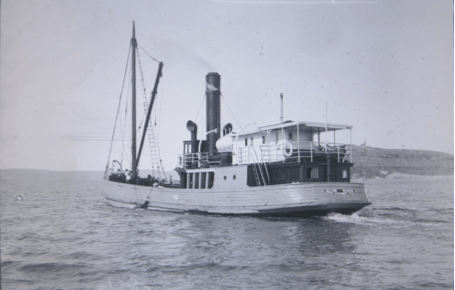
SS Allyn River in Sydney Harbour, circa 1920 [Fairfax Archive of Photos]
Part One of this paper relates the history of the steamer, Allyn River.
Part Two takes the reader on a voyage of Port Stephens aboard the steamer in 1926. The author provides a very interesting history of the early days in the Port.
PART ONE: History of the SS Allyn River
Launch of steamer – 1915
The steam ship was originally called the Allyn, but a few months after its launch it had become known as the Allyn River. The Maitland Daily Mercury of 13 August 1915, page 4, reported:
‘Mr. H. A. Washington has built at his shipyard, Balmain, a single steamer to the order of the Newcastle and Hunter River Steamship Company, Limited, to be employed on the Hunter and Paterson rivers. The dimensions of the vessel, which has been designed by Messrs. J. R. Thomson and Sons, naval architects, Pitt-street, are:— Length, 100 feet; depth, moulded, 7ft.; breadth moulded, 24ft. The vessel was christened “Allyn,” by Mrs. W. N. Cuthbertson, as she left the ways yesterday morning. Engines and boilers supplied by Morison and Bearby, of Newcastle, will be placed on board to-day.’
Allyn River replaces the steamer Karuah in Port Stephens trading – 1916
The Sydney Morning Herald of 31 May 1916, page 13, reported:
‘The new steamer Allyn River, which has been in commission on the Hunter River, will take up the running of the Newcastle and Hunter River Company’s steamer Karuah in the Sydney, Newcastle, and Port Stephens trade, leaving Sydney with cargo only at noon on Friday. The Karuah will be taken over by the Federal Government on that day for use in connection with lighthouse work. The Allyn River will leave Sydney and Newcastle every Tuesday and Friday for Port Stephens.’
Presentation to Captain of the Allyn River – 1919
The steamers and associated crews were an important component of the well-being of isolated communities, such as those in the Port Stephens region. The Newcastle Morning Herald and Miners’ Advocate of 5 February 1919, page 7, reported on a presentation made to the captain of the Allyn River that demonstrated the importance of the coastal trading ships to isolated communities:
‘At Karuah on Saturday night, Captain Bell, of the steamer Allyn River (who is leaving to take up a position in the Government service) was presented with a gold watch chain and trinklet by the residents of Port Stephens as a token of regard and esteem. The chair was occupied by Mr. L. S. Johnston, who made eulogistic reference to Captain Bell, the esteem he was held in, his efficiency, and attention to duty, and the interest he took in the welfare of the port. Speeches were interspersed with songs, and visitors from Stroud, Allworth, Nelson’s Bay, Newcastle, and Raymond Terrace were present. Songs were rendered by Miss Phyllis Thompson, Misses Katie Jonhnstone and Elsie Linich, Mrs. W. Longworth, Miss Hazel New, Miss Eilee Stiffe.
Mr. E. J. Paton, inspector of fisheries, (Nelson’s Bay), Rev. R. Knox (Stroud), Mr. J. H. Callaghan (Karuah), Captain Middleton, and Mr. Ellis, engineer of the Allyn River, all spoke in appreciation of the guest. The chairman then called on Mrs. Longworth to make the presentation. Mrs. Longworth, in complimenting Captain Bell on the efficient way he had served his company and the residents, asked him to accept the gold watch, chain, and trinket as a token of regard from the residents of Port Stephens and crew of the Allyn River, and wished him success in his new position.
Captain Bell suitably responded. He contended that he had only done his duty and he would never forget the good treatment meted out to him by everybody with whom he had come in contact, officially and socially. At the conclusion the Gum Leaf Band gave a couple of selections. The members of the band comprised Messrs. Hugh Ridgeway, Sid Ridgeway, Ernest Melmeth, Ronald Marr, William Ping, and Archie Russell. Dancing was engaged in, and refreshments were served. The chairman suitably thanked everyone for help rendered’
Seaman of the Allyn River drowned – 1921
The Newcastle Morning Herald and Miners’ Advocate of 12 December 1921, page 5, reported:
‘While the steamer Allyn River was towing a launch from Newcastle to Port Stephens early on Saturday morning the launch foundered. A seaman, member of the crew of the Allyn River, whose name is said to be Christianson, was on the launch at the time, and was drowned. At present very little is known in Newcastle of the details of the accident, the only information to hand up to a late hour last night having been received by telephone on Saturday. This message stated that the body of the unfortunate seaman was recovered by the crew of the Allyn River, and taken to Port Stephens. It will be brought to Newcastle today by the steamer. The Allyn River left Newcastle at 2.15 o’clock on Saturday morning.’
The Allyn River declared ‘black’ by unions in Sydney – 1924
The Sun of 5 December 1924, page 14, reported:
‘Yet another unit of the fleet of the Newcastle and H.R. S.N, Co, has been abandoned by her union crew. This vessel is the steamer Allyn River, which arrived at Sydney from North Coast ports yesterday. The crew stated their intention of ceasing work when the vessel tied up at the wharf last night, and immediately a crew, independent of unions, was engaged. The Allyn River will sail again according to schedule. Her trade is chiefly on the North Coast. She is not a regular visitor to Sydney.’
Allyn River beached to stop it sinking – 1925
The Newcastle Morning Herald and Miners’ Advocate of 14 April 1925, page 5, reported:
‘The steamer Allyn River, which is owned by the Newcastle and Hunter River Steamship Company and trades between Newcastle and Port Stephens, was beached at Wickham yesterday morning. The steamer had been lying at her moorings over the holidays, and had apparently been leaking. When the company’s steamer Hunter entered port from Sydney it was noticed by Captain De Lucy that the Allyn River had a heavy list. Mr. B. F. Bolt, chief officer of the steamer Hunter, was sent along, and it was found necessary to place the little vessel on the bank. This was done with the assistance of Messrs. J. and A. Brown’s tug St. Olaves. The Allyn River was pumped out by the tug Lily, and was later in the day taken back undamaged, to her original berth, westward of Lee Wharf.’
The Daily Telegraph of 17 April 1925, page 3, further reported:
‘The coastal steamer Allyn River, which had to be beached on Monday to prevent her sinking at the wharf in Newcastle Harbor, was slipped today to ascertain the reason why the vessel made so much water. It was found that some of the caulking had become loose owing to the vessel lying idle over the holidays, and this is now being attended to. It is expected that the Allyn River will be ready for service again between Newcastle and Port Stephens at the end of the week.’
Allyn River again affected by union action – 1925
The Newcastle Sun of 17 June 1925, page 5, reported on continuing union action against the use of non-union labour on coastal steamers:
‘Another determined effort by the unions to force the Newcastle and Hunter River S.S. Company to employ unionists on board its ships and wharves is in progress. ……
Free labor will work the ships and the cargo on the wharves, and the company says, “We shall not be troubled.” Should the unions remain firm in their refusal to touch the Hunter, this vessel is likely to be laid up for a long time. The steamer Allyn River is also at the dock. Her run to Port Stephens is to be taken up by the Paterson, and the Archer, another steamer of the company, is maintaining the Newcastle cargo service.’
The Sydney Morning Herald of 9 July 1925, page 11, reported:
‘Mr. R. R. King, works manager at Mort’s Dock, said last night that the gates were open for the men to return to their work provided they promised to work on the Hunter and the Allyn River vessels, both of which are owned by the Newcastle and Hunter River Company. “The bell is rung every morning, and they can start as soon as they like,” Mr. King concluded.’
Grim fight to save the Allyn River from sinking – 1929
The Sun of 22 January 1929, page 13, carried the following report on the grim fight by crew members to save the Allyn River from sinking off the coast of Sydney:
‘With a black flood swirling about their legs, and falling in cascades, with every lurch of the ship, over a cargo of sugar, wire netting, and barrels of beer, ten men worked desperately at the pumps for two hours last night to save the Hunter River Co.’s steamer Allyn River, which sprang a leak off Collaroy. Working until they were exhausted, the crew managed to win the race against the water that lashed about the hole with such violence that it appeared likely that the steamer, which was well down by the head would founder. Had the water, which gained steadily in spite of the pumping, risen another 6 inches in the hold and the stokehold, the Allyn River would never have reached Broken Bay, where she is now beached in about four feet of water.
A thrilling story of the crew’s two hours’ fight against the water and the disaster was told when the “Sun” representative rowed out to the stranded steamer, which is about 300 yards offshore. The Allyn River was bound from Sydney to Newcastle and carried a general cargo. She left the wharf at 10 o’clock, and, soon after passing through the heads, the mate, Mr. S. Hawkesford, took a sounding in the forward hold. The ship was then bone dry. Towards 11 o’clock a second sounding was taken, it being the practice in wooden steamers to take frequent soundings in the hold. When Mr. Hawkesford took the second sounding, water was trickling in into the forward hold, apparently through a timber joint that had happened. He dis-covered several rivulets along the length of the hold, showing that it was not only an isolated leak that could have been handled effectively. Within a few minutes the rivulet, which had rolled into the hold, turned into a cascade.
A nasty south-east sea was running at the time, and the Allyn River was rolling heavily. Several green seas swept across the deck. As the mate put it today, it was not exactly a dirty night for a steamer of considerable size, but it was rough weather for a vessel of the size of the Allyn River, a wooden steamer of 143 tons gross. By half-past 11 Capt. Redgrove had to order all hands to the pumps to check the inflow of water into the forward hold. When the mate went round the third time, he discovered that the black flood had crept above the two kelsons on the forward hold. This meant that the water swirling over the floor of the hold had free play and surged through the cargo. It meant, too, that, with every roll of the vessel, a wall of water rushed from side to side, shifting rolls of wire-netting and soaking bags of sugar.
It was then that a grim battle began. First a black stream penetrated the stokehold floor, but it grew with astonishing rapidity until a foot of water was slopping about the feet of the two stokers who were feeding the fires. To turn back and run for Sydney would have involved a desperate struggle, and the distance was so great that the ship would never have got back. Captain Redgrove decided to run for Barrenjoey, to get round the point, and beach the vessel if possible, near a sheltered beach behind the lighthouse. After midnight, however, the water began to gain headway in spite of the pumping. Big seas smote the vessel, and it began to roll more heavily.
When Mr. Hawkesford peered into the hold with a lantern, he gazed down on to a savage torrent of sea water that raced back and forth with every lurch and was now 3ft. 6in. deep. The position was growing more serious with every quarter of an hour. Two feet of water now swirled through the stokehold, and one of the firemen had to keep pumping while the other shovelled coal. Mr. George Saggers, the engineer, had many anxious moments as the black flood crept towards the mouth of the furnace. Had the fires been put out nothing could have saved the Allyn River. The whole of the ship’s complement of ten now took turns at the pumps, but the rushing cascade in the forward hold defeated all their efforts to lower the height of water among the cargo. Towards 12.45 a.m. Barrenjoey lights were picked up by the stricken vessel.
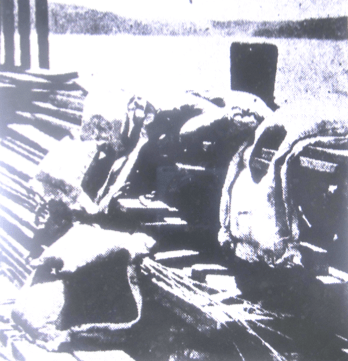
Life belts spread out ready for use in case of emergency when the Allyn River sprang a leak [Sun, 22 January 1929]
The Allyn River had been steaming up the coast three miles out from land, and in running for Broken Bay she had to turn through the south-east sea, which then became a cross sea. This helped the leakage. The vessel got further down at the head, and her stern rose. From that point onward it became a desperate race against the surging water. One man on board declared that the water strayed through into the forward hold as from a line of fountains. “We were decidedly lucky to get here at all,” said the mate, Mr. Hawkesford. After the Barrenjoey light had been signalled, the stokehold became completely awash, and lumps of coal began to move with the lurching of the ship. It was a very tense time for George Saggers and his firemen. There was great danger of the vessel becoming waterlogged through the rolling of the water among the cargo in the forward hold.
Three or four enamel baths were among this cargo, but they remained firm. All of those on board were confident that six inches more of water in the forward hold would have prevented the vessel from reaching Broken Bay. As she sunk lower in the water, several more green seas crashed aboard, and swept the forward deck where a reaper and binder, and a dozen casks of beer were lashed as deck cargo. The two stokers worked with frenzy at the furnaces, and the pumping efforts were redoubled. The Barrenjoey lights gradually grew nearer and nearer. A fierce bushfire, raging around Ettalong, flung its glare across the Pittwater Basin, and this helped to guide the stricken steamer.
In the last quarter of an hour, when the Allyn River was practically in the shadow of Barrenjoey Point, it seemed as if the rush of water would win at last. The lifeboats were made ready in case the crew had to abandon the ship. As she rounded the point and the seas ceased to pound her, the tide of fortune turned for the crew. The inflow of water was held long enough to allow the vessel to get into the calm water of the bay. The pumping was continued all night to prevent the steamer settling down, and the very weary men saw the sun rise over Lion Island. A portion of the crew of the Allyn River had been transferred from the steamer Keindur to take the Allyn River up to Newcastle. This afternoon the steamer Gosford will take off the Allyn River’s cargo, and it is expected that when she is lightened it will be possible for the leak to be repaired.
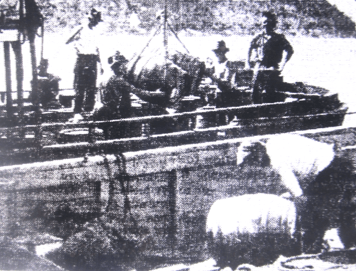
Transferring barrels of beer from the ‘Allyn River’ to the steamer ‘Gosford’ [Sun, 23 January 1919]
At present the Allyn River is lying on the sand in four feet of water. Captain Redgrove got his first sleep for 24 hours at 11.30 this morning. “It was a very nasty night,” said the mate, Mr. Hawkesford, “but we have saved the ship and cargo.” The Allyn River only came out of dock yesterday. Following on the sale of the Warraneen the Newcastle and Hunter River Company proposed using her in the Newcastle and Morpeth trade with an occasional voyage to Sydney. Captain Redgrove is master of the Kindur, of the same company. The Allyn River is a wooden steamer of 143 tons gross. She was built in 1915. She has a complement of eight. The secretary of the State Department of Navigation (Mr. Faulks) said today that the Allyn River had 80 tons of general cargo. The cargo would be transferred to another vessel, and the Allyn River would be conveyed to Sydney for repairs.’
Allyn River recommissioned – 1933
The Sydney Morning Herald of 17 March 1933, page 13, reported:
‘The Newcastle and Hunter River S. S. Co.s’ coastal vessel Allyn River has been recommissioned after a lengthy period of idleness. The vessel left yesterday evening for Newcastle under charter to Kerr and Sons coal merchants at Botany. She is to be used as a collier, plying between Newcastle, Port Macquarie and Botany Bay.’
Allyn River adrift in Newcastle Harbour – 1936
The Newcastle Sun of 8 July 1936, page 9, reported:
‘It was learned today that no damage had been sustained by the Hunter River Company’s steamer Allyn River and the Public Works Department’s steam barge Orestes, which were adrift together about an hour on the harbor late last night.
The Allyn River arrived last night from Morpeth to transfer cargo to and load cargo from the steamer Hunter when it berthed at the wharf this morning. The barge Orestes, which is engaged in removing silt from the harbour, was moored to the Stockton dolphins, and the Allyn River was moored to the Orestes pending the arrival of the Hunter. When the Orestes was caught by the strong tide last night and parted from the dolphins, the Allyn River drifted with the barge. The master of the Stockton ferry noticed the drifting vessels and notified Hunter River Company officials, who arranged to have the vessels secured.
When the two vessels were in the vicinity of No. 1 beacon on the river flats the Orestes was boarded and its anchor dropped. Later the crew of the Allyn River were taken on board. By midnight the Allyn River was taken back to the Stockton dolphins under its own steam. Examinations of the Allyn River and the Orestes this morning revealed that no damage had been done to either vessel.’
End of the Steam Ship era
By the 1940’s new and improved roads had made the coastal and river steam ships largely redundant, as freight and tourists could be transported more efficiently by road. The Allyn River was destined to keep chugging away for a further period when many other steam ships had ceased to operate. The Newcastle Morning Herald and Miners’ Advocate of 30 November 1943, page 2, reported:
‘The old river steamer which since June had been partly submerged in the Newcastle harbour has been lifted and removed to shallower water, well out of the fairway. The vessel was one of two owned by the Lower Hunter Steamship Co. Ltd. and plied for years between Newcastle and Upper Hunter towns, catering principally for the farmers’ trade. The other steamer was sunk near its moorings at Raymond Terrace in February. It lies there. Both decks are above water. Except for the steamer Allyn River, trading between Morpeth and Newcastle, river traffic has entirely gone.’
PART TWO: A Journey to Port Stephens on the Allyn River – 1926
Early transport in the Port Stephens Region was mainly by boat.
The journal, World News featured a series of articles in its editions of 13 March 1926, page 10 and 20 March 1926, page 10, written by the correspondent, Mr. J. H. M. Abbott. He described the sights he encountered while on a visit to Port Stephens aboard the Allyn River and provided a very insightful history of the region.He noted its beauty but alsothe lack of its development as to what might have been.
His story starts on the King’s Wharf in Newcastle Harbour:
‘Down onto the King’s Wharf at Newcastle people were descending in twos and threes, and singly, from, the overhead bridge that crosses above the western end of the railway station from Scott Street to the riverside, and calling in at the Newcastle and Hunter River Company’s booking office to make sure of their berths by the steamer that would be sailing in half an hour — it was 11 p.m. then — for Sydney. It was the Hunter that evening — heaving slightly in the “send” from the nor’easter blowing hard out in Stockton Bight — that lay all lit up and ready for the passengers armed with bags and suitcases, who walked along the broad decking of the wharf, to climb the gangway, and be received by white-coated stewards at its top. Very neat and trim and bright she looked, in the glare of the electric lights along her flush deck, and supremely comfortable and luxurious and modern. One thought of the old ships that used to lie where she was lying with their big white paddle-boxes — the Kemla, the Morpeth, the Sydney, the Maitland, the Namoi, the Newcastle, and the others of which none but the last-named is now afloat—and reflected a little mournfully that it was many years since one had first sailed from this spot for Port Jackson and that many thousands of tides had ebbed and flowed since those days. The chief officer hailed from where he stood near the forehatch, under the high bridge.
“Hullo — where are you off to? Not coming down to-night?” With a shake of the head, one pointed to the Allyn River, and called back: — “No—Port Stephens.”
He waved farewell, and one walked on past the bows of his ship to where the little steamer …. also heaved gently, a few yards ahead of her big sister. She was all in darkness as one climbed aboard, and the only sign that she was alive was the thin wisp of smoke drifting upward into the moonlight from her tall funnel. One sat down on deck and waited, watching the Hunter swing out into the stream at half past eleven, and head out to sea between the breakwaters. A little before midnight the captain came aboard, and woke up the engineer, and turned out the sleepy crew, and, in the first hour of the new day, we also slipped out of the river, swung round the northern breakwater, and headed away nor’ eastward into the teeth of a stiff breeze, towards Point Stephens, leaving the flashing light on Nobby’s behind us. Twenty-five miles, or so, we had to roll across the Bight, past Anna Bay, and Morna Point, before we should have another lighthouse on our beam, and alter our course to enter the big harbor where Newcastle should have been.
The little ship is a cargo carrier, broad of beam, and shallow of draught, and has no accommodation for passengers, but knowing the company and the captain, the writer was given a passage, and found a bed on the settee in the latter’s cabin. Passengers may travel by her if they like, provided that they are willing to ”doss down’ wherever they may find a suitable place to do so. Aft of the little house on the upper deck, that extends from the stern to the wheelhouse amidships, there is a space of about three yards square that is at their convenience. But it is not very often that people go to Port Stephens this way. They usually take the motorcoach that leaves Newcastle every morning for Salt Ash, near the head of Tilligerry Creek, the long southern arm which enters the great bay to the westward of Soldiers’ Point. From here a small steamer conveys them to Nelson’s Bay, near the Heads, thence across to Pindimar at the western of the two mouths of the Myall River and a further couple of miles or so up the river to the quaintly named township of Tea Gardens. Thence, they may make a day’s voyage by the steamer Myall River, up the lovely watercourse she is named after, to Bulahdelah, forty miles away.
The strong head wind had checked our passage across the tumbling, moonlit waters of the Bight, and by the time we were off the steep, basaltic face of Tomaree, Port Stephens’ South Head, the dawn was lightening the sky to seaward with all the promise of a glorious clay. As we rolled round on to a westerly course to enter the harbor, the sun rose up out of the wide, grey waters behind, and we entered into the splendid beauties of Port Stephens under conditions that were perfect for their appreciation. The yellow scarp of Tomaree, split from summit to base by a deep chasm into which the swells heave and surge interminably, became a buttress of shining gold: the dark green crest of Yacaaba — the North Head — surmounted similar golden walls, with a line of pink foam at their foundations, and the wide waters of the great bay spread west and nor’-west before us to distant wooded shorelines of gleaming beaches, backed by dark, forest-clad hills, with far-off blue ranges behind them, shilling and glowing in the light of the new morning, like the inside of mother-o’-pearl.
On our port side, when we had rounded Tomaree, white beach of Shoal Bay curved to Nelson’s Head, on whose summit stands the Inner Light, and beyond which the tiny settlement of Nelson’s Bay — hotel, post office, and scattered handful of houses — is almost all that a century of occupation by the white man has done for Port Stephens. Nowhere else can there be such a glaring instance of opportunities neglected as is presented by the wild and lonely aspect of this splendid harbor in 1926.
But it is impossible to suppose, in spite of the years of neglect from which it has suffered, that one of the finest ports on the Australian coast will very much longer remain unused. Not alone to chance visitors must it seem inexplicable that the great city a score of miles to the southward should not be here, instead of where it is. Even to the people of Newcastle itself, this is a very puzzling problem. The existence of the B.H.P. Co.’s Steel Works at Port Waratah, and the subsidiary industries springing up about it, make it inevitable that better facilities for the accommodation of deep-sea shipping than are to be found in the tremendously expensive, semi-artificial Port Hunter will be required for the expanding trade of Newcastle. Here they are ready-made, and connection with the mouth of the Hunter, either by canal or railway, has no difficulties that are worth mentioning.
Having landed an extraordinary variety of cargo on the wharf at Nelson’s Bay, we steam westward up the harbor, en route for Pindimar — which pleasant name is pronounced with the accent on the second syllable. A long shoal — the Manton Bank — extends up the northern side of the bay, and it is necessary to get round this before we turn northward. Pindimar — or Duck Hole, as it is nautically referred to — lies opposite the mouth of the Myall that is navigable. The other mouth enters the bay through a series of shoals far over to the east.
The scenery of Port Stephens is incomparable, and even the most truculently boastful “booster” of Port Jackson, having once seen the place, cannot but admit that in this splendid haven there exists a worthy rival to Our Beautiful Harbour. It has always seemed to the writer that, in their natural state, any comparison of the beauties of the two inlets must have resulted in favour of Port Stephens. Sydney Harbor has been immensely improved in appearance by the growth of the city about its shores — you need only look at Broken Bay, which is today a fair sample of the original Port Jackson scenery, to realise this. The low ridges of Hawkesbury sandstone, monotonously uniform in height and contours, of the two big bays down the coast cannot be compared to the tall hills that surround Port Stephens in ever-varying shape and form, and the tall blue ranges behind them provide a background that is missing in Broken Bay and Port Jackson. Of course, it can never be seriously contended that Port Stephens is as good a harbor as Port Jackson as regards universal deep water and navigability — but for good looks, at any rate, it is easily its equal, and possibly its superior.
Pindimar consists of an ice-factory, once a State fish depot, which now supplies the local fishermen with ice for the packing and preservation of their catches on the voyage to Newcastle and Sydney—a store, a few little houses, many square miles of eucalyptus, and a long jetty. Here the river steamer meets the Allyn River, and transfers from her capacious hold and broad deck a miscellaneous cargo — ranging between furniture, kegs of ice-cream, beer, groceries, and machinery — for transport to Bulahdelah, and the scanty settlement about the coasts of the Myall Lakes. And it is here that you first come in contact with the oyster culture which is the principal means of subsistence, besides timber-getting, for the handful of inhabitants of this sparsely populated province.
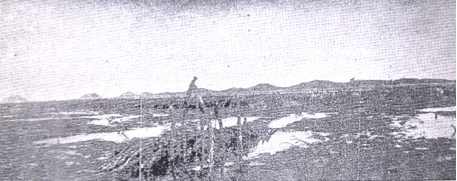
Entrance to Port Stephens as viewed from Pindimar. The heads are on the far left; with black mangrove oyster-beds in foreground. [The World News, 13 March 1926]
On the whole, oyster-farming, is nowadays the principal industry of Port Stephens. Along the extensive coastline of the bay and its many branches—including the mouths of the Myall and Karuah Rivers, there are over 500 miles of oyster leases, and every foot of suitable frontage — even round the mangrove islands—has been taken up. People who do not know are very apt to regard oyster culture as an easy, lazy, care-free, and profitable method of making a living—just as many others regard poultry-farming. But there could never be any greater mistake. Teaching Ostrea Cucullata how to domesticate himself in certain places, how to behave when there, how to keep his health and grow fat and palatable to the ogres who eat him alive, and how to return a reasonable profit to his exploiters, is almost as complicated a job as stud sheep-breeding. He is a good fellow. Ostrea Cucullata — it is peculiarly fitting in this country — but he has succeeded in breaking more than one of his cultivators who made the mistake of not taking him seriously.
Our course lies more or less along the northern coast of the great bay — which is really two immense basins connected by a narrow passage, in the midst of which lies the beautiful tree-clad gem of Middle Island, between Soldiers’ Point and the high hills of the north side. The outer basin is fed by the Myall River, and the larger inner one by the Karuah and Tilligerry Creek, which enters it to the westward of Soldiers Point. (In the Admiralty chart this central landmark is spelled in the singular, but there can be no doubt that the correct version is the plural.) The mouth of the Karuah is the head of the harbor proper.
It is most usual to pass Middle Island by the southern passage; but today we are taking the Inner Channel, which runs close in-shore to Carrington, the site of the Australian Agricultural Company’s first settlement hereabout, so we go by the other. We pass close by the mouth of the North Arm, and then make a more or less straight run across to Sawyers’ Point, where the Township of Karuah is situated, and the road from Raymond Terrace, on the Hunter, to Tea Gardens crosses the river. We proceed up the Karuah for about ten miles, to Booral Wharf where lies the village of Allworth, the port of Booral, which is situated four or five miles away. Then back to Sawyers’ Point, to tie up there for the night and all-day Sunday, sailing on our return voyage to Newcastle, by way of Pindimar and Nelson’s Bay, at 6 o’clock on Monday morning. It will be sufficient to say here that no quarter mile of the voyage is without interest and beauty — what space we have must be given to the story of Port Stephens. This year is the centenary of its settlement [1926] — though it has hardly yet begun to be settled in the right sense of the word.
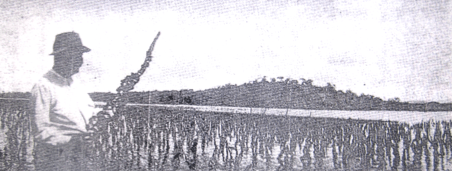
Harvesting the oyster – a typical scene in Port Stephens. [The World News, 20 March 1926]
The first attempt at settlement on Port Stephens was made more than a century ago, during the reign of Major Morrissett at Newcastle. The penal colony at Port Macquarie had been established during the later years of Governor Macquarie’s administration of the Government of New South Wales, and, to prevent runaway convicts from that place making back towards Newcastle and Sydney, a guard of soldiers was established at Soldiers’ Point — hence the name. A few years later, the A.A. Company which was formed in London in 1824, took up its immense grant of 1,000,000 acres between Port Stephens and the Manning River, and in 1826 established its headquarters, and disembarked its stock and its servants, over at Carrington, on the north-western side of the inner basin, not far from the mouth of the Karuah River. Here, for a while, was great activity — until the company discovered that it had been ill-advised in putting all its eggs into one basket, and that the existence of a fine port wherefrom to ship its produce did not altogether compensate for inferior country for stock-raising, such as the land in the vicinity of Port Stephens proved to be.
So it made its famous exchanges of much of its infertile tract of mountain and forest for the rich pastures of Warrah and Goonoo Goonoo, out on the Liverpool Plains. Carrington faded away, and never since has any serious attempt been made to turn Port Stephens to its best account. For a hundred years its immense forests have been exploited for timber, and all the valuable red cedar, which, used to abound in the ranges, has been cut out — but to-day the shores of the great harbor remain much the same in aspect as when Mr. Superintendent Dawson set out, and failed, to make a fortune for the English shareholders of the A.A. Company. The fortune has been made since from the coalbeds of Newcastle and the grasses of the plains beyond the Dividing Range — but the Port Stephens venture contributed little to it but a negative or minus quantity. Civilisation here made a bad start — but that it will before long make a good one is quite certain and inevitable.
The first of the company’s settlers, with valuable stock, arrived in Sydney in the ships York and Brothers, at the end of 1825, and by May, 1826, a substantial settlement had been formed at Carrington, under Mr. Robert Dawson, the first local superintendent — a gentleman of no colonial experience, to whom too much was left, and who seems to have been in many ways unfitted for his job. “At any rate,” writes Mr. Jesse Gregson, general superintendent of the company, 1875-1905, in his valuable work, “The Australian Agricultural Company, 1824-1875”, …. “this wealthy corporation, bringing advantages to a community whose very existence depended on the assistance of capital, was pitch-forked into a district wholly untried, and quite different in soil and vegetation from any which had been tried, and its settlement there was so far determined upon that by October, 1826, 1000 head of cattle and 2000 sheep had been purchased and brought to Port Stephens, and the establishment then had grown to the number of 250 souls.”
One cannot do better here than to quote from Mr. Gregson’s book as to the condition of the settlement about six or eight years later, during the administration of Captain Sir Edward Parry, R.N., the famous Arctic explorer, who had succeeded Mr. Dawson and Mr. James Ebsworth as the company’s commissioner in New South Wales. It gives a picture of Old Port Stephens, and a description of the working of the establishment that cannot be improved upon. The book is a most fascinating record of the many failures, and ultimate successes, of a great corporation, which has, on the whole, done great things for Australian civilisation. Tahlee House still stands, the property of the widow of the late Hon. R. H. D. White. “Tahlee House,” he says, “was then the residence of the commissioner. It was prettily situated on rising ground, overlooking the harbor, near the mouth of the Karuah River, surrounded by a garden which has been described to me as one of the best in the district.
Less than half a mile east of it a township named Carrington had been laid out on flat ground near the water’s edge. Here were the storehouses, the residences of the officials, the cottages of the men and of the military guard. It was the place of business, the headquarters of the establishment. In the other direction, on the left bank of the Karuah, was No. 1 farm; and further on another farm called Booral had been formed on a rather extensive flat bordering the river. At these two farms small parties of prisoners and the overseers under whom they worked were living. Four miles farther on, a considerable area of undulating land at the confluence of Mill Creek had been cleared and cultivated, employing many laborers. Already the residence of one of the superintendents, a township had been laid out here called Stroud, which eventually became one of the most important and populous of the company’s settlements, and subsequently the chief place of business of the district, and the seat of the Court of Petty Sessions.
Two miles beyond Stroud, on the Karuah, was Telligherry, the residence of the superintendent of stock, overlooking a beautiful reach of the river; and nearby was the woolshed. Sheep stations had been formed in Mr. Dawson’s time in various places on the Karuah River and the Mill Creek, to a distance of 12 miles from Stroud, and had since been pushed on, till the valleys of the Avon and Gloucester Rivers had also become sheep runs, where, by 1834, most of the flocks appear to have been stationed. In those days flocks of sheep averaged from 300 to 500 in number. Two flocks were usually stationed at one place, where was the hut for the Shepherds, and a yard for each flock to camp in at night. Each flock had two shepherds with it by day, and, on returning to the yard, was throughout the night in charge of a watchman, whose duty it was to see that the sheep were not attacked by native dogs. There were, therefore, six men at each station, generally, if not invariably, assigned prisoners, and, therefore, not costing much for wages.
This, it must be understood, was then the general practice in the colony, which the company’s officials had adopted at their first landing and had since followed. In an elaborate paper prepared by Mr. Henry Dangar in 1832, for submission to the court of directors, he states the number of people engaged in looking after the sheep, then nearly 25,000 was no fewer than 121, besides three superintendents; and he enumerates them as follows: — Thirteen free overseers: three prisoner overseers, one chief overseer, two free shepherds, and 102 prisoner shepherds. The cost of this part of the establishment he estimates at £3160 per annum, exclusive of shearing expenses.”
It is quite evident that Sir Edward Parry, despite his universal popularity, and the high character for benevolence which he enjoyed in the colony, was not a man to be trifled with.’
Concluding Comments
Other papers, on several of the steam ships that operated in the Port Stephens region, are published on this website. These can be viewed at the following links:
SS Reliance – A Popular Steamship on Port Stephens
SS Karuah and her master, Captain Charles Phillipson
History of SS Coweambah of Tea Gardens
SS Sophia Jane – First paddle steamer in Australia
Researched and compiled by Kevin McGuinness
March 2023

 Port Stephens - a history exploration