
Introduction
Timber has been harvested in the Myall and Port Stephens areas for over 200 years. The first timber cutting commenced in the 1820’s when convicts holding Tickets of Leave were assigned to several wealthy Sydney merchants, to cut native timber in the Myall River area.
John Finnigan who arrived in New South Wales in 1818 on the convict ship, Guildford, and John Kelly on the Canada in 1825, were two convicts employed at Port Stephens as timber-getters in the 1820’s. The timber that was felled at that time would have been growing close to the Myall River and would then been transported to Port Stephens for transfer to sailing ships for the Sydney market.
The second phase of timber cutting and milling, which is the subject of this paper, commenced in the 1850’s when large areas of native forests were cut and transported to local sawmills for initial processing. From here the timber was transferred to steam craft to be taken to Port Stephens for loading onto sailing and steam vessels for distribution to both the domestic and international markets.
This history, which has been compiled using newspaper articles published by the National Library of Australia on ‘Trove’, focuses on the timber industry after the convict labourers had left the region.
The timber industry was a major employer of men in the Myall and Port Stephens area and brought much prosperity. The stories from Trove provide an insight into the hardships of those employed in the cutting and processing of the timber. They also tell how the local timber was distributed to markets both throughout Australia and internationally.
Timber mills were opened and closed regularly in response to the availability of a suitable timber supply and to the demand for it. The milling machinery was capable of being relocated to a new area with ease. The majority of timber cut was transported to market via the Myall River and onto Tea Gardens and nearby Winda Woppa for transfer to a transport ship.
For all the wealth extracted from the Myall and Port Stephens areas, very little was reinvested at the time in infrastructure development, such as road and port improvements.
Timber Industry established in Port Stephens area – circa 1855
An obituary notice provides information about the start of the second wave of timber processing in the Port Stephens region. The Maitland Weekly Mercury of 27 November 1915, page 8, published an obituary on Mrs. Agnes Breckenridge, of Wyrallah Estate, Richmond River:
‘Deceased married Mr. James Breckenridge at Ballarat in 1854, and shortly afterwards they went to Port Stephens, where the husband erected the first sawmill in the North Coast district.’
Vessels travel Up the Myall River for Timber – 1859
The Australian Home Companion and Band of Hope of 26 February 1859, page 116, reported:
‘Small vessels from Sydney come a considerable way up the Myall River for cedar and hard timber, the latter being for the knees [bracing] of vessels in process of building. This wood it appears the crews are permitted to carry off without any licence whatever.’
Two steam sawmills on Myall River – 1867
The Maitland Mercury and Hunter River General Advertiser of 27 April 1867, page 3, reported that there were two steam saw mills, and another one in course of erection on the Myall River.
Number of sawmills on the Myall River grows to three – 1869
The Maitland Mercury and Hunter River General Advertiser of 31 August 1869, page 3, reported:
‘There are three saw mills at work here, employing a great number of men, and we have three, and sometimes four, vessels carrying weekly close up to three hundred tons of timber and produce, which is taken down the river to the Tea Gardens in punts of an average of forty tons ; and one steam punt plying, and shortly will be another.’
Four sawmills operate in the Greater Myall River Region – 1872
The Maitland Mercury and Hunter River General Advertiser of 8 February 1872, page 3, reported on the increasing number of timber mills:
‘We have four saw mills in the district—viz., one owned by J. Booth & Co., of Balmain, at Cape Hicks ; one owned by Mr. McRae, at the Beilimbit, one at the Tea Garden, by Mr. Livingston, of Sydney, and one near Bulahdelah, owned by Messrs Beverley & Dickson, who have also a steam punt. A great many men are employed in various ways about these mills. Forty seven timber licenses have already been granted this year.’
Sawmill destroyed by fire – 1875
The Australian Town and Country Journal of 27 November 1875, page 5, reported:
‘Hendersons, steam sawmills at Myall, Port Stephens, caught fire yesterday morning, about 1 o’clock, and are said to be totally destroyed.’
Myall River dredged to facilitate timber industry – 1877
The Evening News of 19 May 1877, page 4, reported:
‘It may not be generally known that Mr. Dalton owner of the steam launch ‘Waratah’, left Newcastle in February last with all necessary appliances to commence the cutting of a channel designed to open up communication between the chain of lakes known as the Myall and the river of the same name, the intent being to enable punts laden with the produce of the country round about the lakes to discharge timber into vessels trading to the river.
The work referred to is being carried out at the cost of some enterprising parties engaged in the timber trade between the Myall and Sydney, and Mr. Dalton’s contract is to clear a channel 200 yards long and 10 yards wide, also to deepen the same 2 feet 6 inches, so as to secure 3 feet 6 inches draught at low water. Mr. Dalton has, we understand, very nearly completed the work, and already punts laden with timber go through the passage without trouble or stoppage. Tamboy is one of the Myall Lakes, about 25 to 30 miles from Port Stephens, up the Myall River, and the establishment of communication with the river must prove of great importance to the timber trade.’
Five steam mills operate on the Myall River – 1876
The Maitland Mercury and Hunter River General Advertiser of 13 June 1876, page 5, reported:
‘This district evidences some life and bustle. Some four steam punts are plying up and down the river and lakes, conveying logs for the saw mills. There are five sawmills constantly working, giving employment to a large number of men.
Timber reserve at Port Stephens – 1878
The Australian Town and Country Journal of 19 January 1878, page 31, reported on the call for additional timber reserves:
‘A deputation, consisting of Messrs. Booth, Hudson, Blair, Donaldson, McRae, Phegan, and Wright, the latter gentlemen from the district interested, on Friday waited on the Secretary for Lands, in reference to the timber reserve in the district of Port Stephens and Cape Hawke. The deputation was accompanied and introduced by Mr. H. H. Brown, M. P.
After hearing the views expressed by the deputation with regard to this reserve, Mr. Parnell stated that he would prevent any proceedings being taken against the persons who had fellers of timber employed, and would bring the reserve in question under the notice of the Cabinet on Monday. He also said that he believed this reserve would be thrown open, and all licenses for the cutting of timber would, with the sanction of Parliament, be raised to a uniform rate. After thanking the Minister for his courtesy, the deputation withdrew.’
Up to eight mills operate of Myall River – 1883
The Australian Town and Country Journal of 30 June 1883, page 38, reported:
‘There are seven or eight saw mills in full swing in the district, each cutting on an average about 30,000ft of timber per week it is easy to estimate the amount of revenue obtained from timber-cutters and haulers alone, not to speak of the revenue derived from conditional purchases, &c, yet our roads are simply a disgrace, and we must not have a bridge at all. It is no doubt our own fault for not making our wants known more frequently and demanding our share of public money for public improvements.’
Impressions from a cruise passenger on the Upper Myall Lakes – 1884
The Sydney Mail and New South Wales Advertiser of 25 October 1884, page 850, reported on the surroundings of a deserted timber mill on the Myall Lakes:
‘The only high land is on the Bulahdelah or western side, but there the timber is very fine and keeps a sawmill in constant work in a corner known as Dirty Creek, euphony being no more studied in this part of the colony than in any other rural districts. …..
At the head of “Reedy Lake,” as we christened this sheet of water for want of a more descriptive name, and in ignorance of its proper one, are the ruins of a large sawmill, which when I was last in these waters was the centre of a thriving colony of Scotch sawyers, employed by a tall red-haired Highlander named McCrae or McCraw [McRae], I forget which, but as fine a specimen of a white man as one could desire. But there was no Highlander here during this visit of ours, and everything had a dismal look of desertion about it.
The machinery was gone, and everything that could be removed. The chimney alone remained to show where the “circulars” and the “verticals” used once to provide sawn stuff in unlimited thousands of feet, as witness the mountain of sawdust and stripping’s projecting into the lake from the spot where the mill was fed with logs in bygone years ; a curious memorial of the splendid forest which once clothed these hills, but has left no second growth behind it as yet fit for the saw, if ever it will be. Two or three rotting punts, the bottoms riddled with carbro, lay in the ooze near the sawdust, but the only animation visible was on the water.’
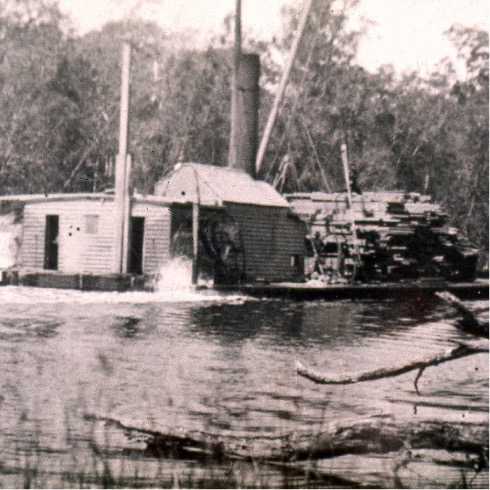
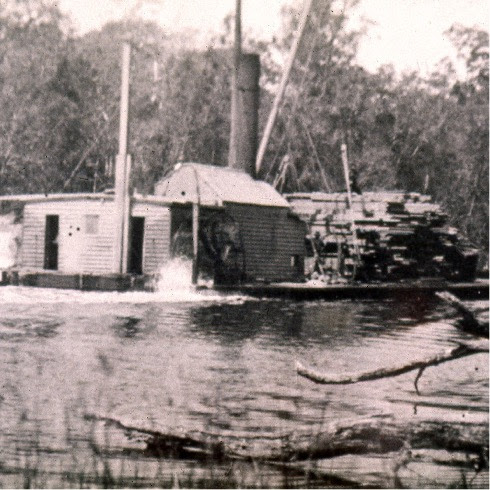
Timber Drogher on Myall River
Sawmill at Tea Gardens causes problems for Public School – 1893
The Maitland Mercury and Hunter River General Advertiser of 29 July 1893, page 8, reported on the proximity of a sawmill to the Tea Gadens public school:
‘Duties in the Public School have been resumed. Before the holidays, some of the residents threatened to withdraw their children on account of the unsuitableness of the building; but the personal influence of the teacher prevailed, and all are attending as usual at present. The building is anything but a desirable place for either teacher or children. The stained appearance of the walls shows that it is not waterproof. In bad weather the wind and rain must render it very uncomfortable. A few yards distant from the school is a sawmill from which a heap of sawdust advances almost to the door.’
Sawmill keeps Tea Gardens financially viable – 1894
The Maitland Daily Mercury of 14 April 1894, page 4, reported:
‘Industrial matters here are at a very low ebb, and the much-hoped-for improvement with the advent of the new year shows no prospect of being realised. Were it not for the pluck of Mr. Witt in keeping his sawmill going, notwithstanding the low condition of the timber trade, our little hamlet would collapse altogether.’
Girder haulers busy in Upper Myall Area – 1899
The Wingham Chronicle and Manning River Observer of 12 April 1899, page 2, reported:
‘Work is pretty brisk in this part with the girder haulers, the mills having been closed on account of most of the teams drawing girders. There has also been horse and bullock teams from other parts drawing from over the Manning hill to Bulahdelah. The wood ranger stationed at Bulahdelah has also been busy among the timber getters.’
Timber for export to New Zealand – 1899
The Newcastle Morning Herald and Miners’ Advocate of 19 May 1899, page 3, reported of the export of timber from Port Stephens:
‘Considerable activity still exists in the timber trade. Messrs. Murray Bros. now have two vessels, the ‘St. Kilda’ and ‘Pelotas’, loading hardwood for New Zealand. The former vessel will be despatched to Dunedin this week, and the latter will complete her loading early next week for Lyttelton. The Norwegian barquentine ‘Volodar’ is chartered to load for the Bluff, on behalf of W. Flannery, and is expected to arrive very shortly. Most of this timber is being sent to the New Zealand Government.’
Commentary on timber industry between Stroud and Myall River – 1900
The Sydney Mail and New South Wales Advertiser of 28 July 1900, page 206, reported on observations made about the timber industry in the Myall River and surrounding areas:
‘For roughness and typical Australian scenery one has but to spend a few weeks in the Myall district, and if then not convinced of the true weirdness of the Australian bush his case. …… Taking roughly a stretch of country between the great A A. Company’s boundaries and the Myall and Wallis Lakes on the east with an imaginary line due east from the Myall River, we get a little plot of something like 270,000 acres. It is a piece of country hardly to be recommended to touring cyclists, but with plenty of spare time and a good horse or two, perhaps no finer scenery can he found on our coastline. ……
In 1899 the total output from the combined Myall sawmills averaged nearly 180,000 super feet per week. Such a heavy drain on the forest spells “going further out” to the timber haulers. Five or six years ago most of the timber worked up at the Bulahdelah mills was obtained within, say, an eight-mile radius. Now, however, many haulers are trucking their gliders and logs as far as 18 miles, and when it is considered some of the logs run to a length of from 70 to 150ft. it is no easy matter. From this, however, it must not be inferred that the supply is running out. Nothing of the kind. There are still some millions of feet of good marketable timbers, which can stand the drain for many years to come. ……
A feature which must strike the traveller in this great timber district is the apparently primitive method of getting the timber to the sawmills — barely a tramline is to be seen, the sawmillers being apparently content to get their logs per medium of timber trucks. These timber trucks do immense damage to the roads, the wheels being mostly of the “block” type, with very narrow tires, and in wet weather the roads are simply ploughed. As in the near future the Australian Agricultural Company intend selling their extensive properties, there is every probability of the timber industries in these districts being opened up on a gigantic scale.’
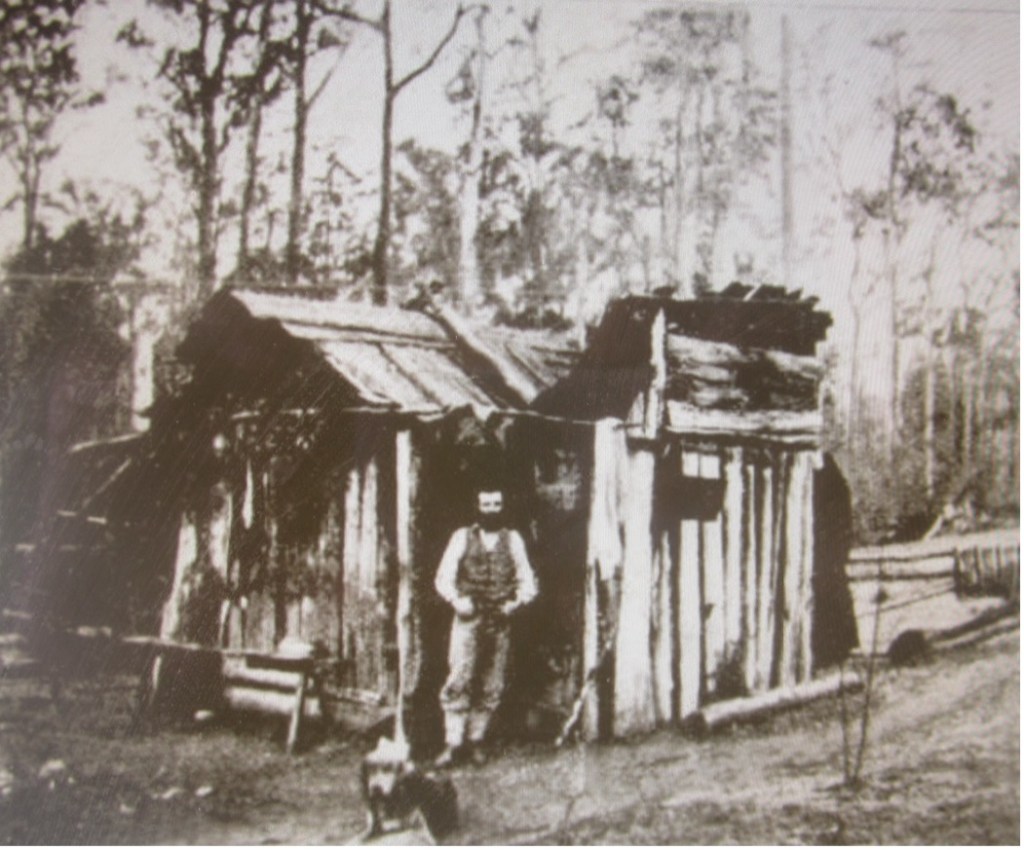
A timber-cutters hut, typical of those found around the Myall River [Sydney Mail and New South Wales Advertiser, 28 July 1900].
Considerable timber traffic at Tea Gardens – 1903
The Dungog Chronicle of 30 January 1903, page 2, reported:
‘I notice there has been a lot of traffic on the river [at Tea Gardens] this last week, steam punts loaded with timber coming and going. The timber trade seems to be booming over here, and up Bulahdelah way, and it appears that in spite of the regulations the timber men are making a fair thing and their howling seems inconsistent. The sailing vessel ‘Hilda’ passed down yesterday after taking up machinery for the new saw mill at Upper Myall.’
Timber Trades Conference held at Myall Lakes – 1903
The Macleay Chronicle of 12 February 1903, page 3, reported:
‘A timber trades conference was held at Myall Lakes, when representatives were present from Bunghwahl, Myall Lakes, Smith Lakes, Port Stephens, Buladelah, Boolambayte, Cooloongolook and sourrounding districts. Mr. George Mitchell was the chairman. The general trend of the speeches by the delegates was condemnatory of the action of the Government. Complaint was made of the Minister’s vacillating attitude, and his action in enforcing the royalty upon sleepers where the contracts were entered into prior to the royalty being charged. The regulation obliging personal application for a license was denounced as absurd and unbusinesslike. Various speakers attacked the existing administration of the Forestry Department.
Mr. E. A. Price, M.L.A., delivered an address, in which be traced the history of the administration of the Forestry Department. He contended that the Land Act of 1881 conferred ample power on the Government to carry out the necessary reforms, and that the bill lately submitted was unnecessary. He urged united action along the North Coast, and combination with the southern and western timber-getters to force the Government to carry out urgently needed amendments. The following resolutions were carried : — “That royalties should be charged on the output of mills, such royalties not to exceed 4d per hundred superficial feet”; “That personal application for licenses should be dispensed with, and greater facilities given for the issue of licenses to enable men to carry on the industry”; and “That a branch of the association be formed, with a view to securing united action in making representations to the Government.”
Sleepers shipped from Port Stephens to South Africa – 1907
The Daily Telegraph of 1 June 1907, page 10, reported:
‘Interest attaches to the arrival of the Federal-Houlder-Shire liner ‘Surrey’ at Port Stephens yesterday, from the fact that she is the largest vessel to visit that port. The Surrey, which came from New Zealand via Brisbane, anchored in Nelson’s Bay at 11.45 a.m. yesterday. The object of her visit is to load 1500 tons of sleepers for South Africa. The ‘Surrey’ is a steamer of 5455 tons, in command of Captain Aitcheson. Messrs. Birt and Co. are the agents, and they expect the steamer here next week to complete her loading.’
The Sydney Morning Herald of 5 June 1907, page 10, further reported on the departure of the ‘Surrey’ from Port Stephens:
‘The Federal liner Surrey, having loaded 1200 tons of hardwood sleepers, left Port Stephens at 4.20 p.m. yesterday, and was safely piloted out of the port by Captain Nelson, the master of the small coasting steamer ‘Stormking’ who navigated the vessel into Salamander Bay last week. The Surrey is proceeding direct to Port Kembla for bunker coal on account of the coal lumpers’ difficulty at Sydney and is due there at daylight this morning. After loading about 3000 tons of coal she will leave Port Kembla tomorrow night, and on arrival at Sydney on Friday morning will berth at the Federal-Houlder-Shire line wharf at Darling Island to load sugar and frozen meat for South Africa. It is expected that the ‘Surrey’ will be despatched from Sydney on Sunday next, or at the latest on Monday for Adelaide, where she will compete loading She will then proceed direct to Durban, calling afterwards at Algoa Bay and Capetown.’
Timber-getters not receiving fair pay – 1908
The Worker of 12 November 1908, page 17, reported:
‘A correspondent working at timber-getting in the Myall Lakes district, writes to The Worker, pointing out that men engaged in the work do not get a fair rate of pay considering the way they have to rough it, the price they have to pay for food and tools, and the outlandish places they have to go to. He thinks that the man who at his ease surveys his employees toiling can pay more than he does, and advocates organization among the workers in this industry, wherein he strikes the keynote of the situation. It is no good asking employers to be fair and reasonable. Organize and make them be so.’
Chilian barquentine Alta at Port Stephens to load timber- 1910
The Newcastle Morning Herald and Miners’ Advocate of 30 December 1910, page 4, reported:
‘The Chilian four-masted barquentine ‘Alta’, which was expected to come to Newcastle to load a coal cargo, arrived off the port [Newcastle] yesterday afternoon, and signalled for a tug. Messrs. J. Fenwick and Co.’s tug ‘Victoria’ went out, and taking the sailer in tow, proceeded north with her, to the surprise of many. It transpired that the vessel had received orders to go to Port Stephens to load timber instead of coming to Newcastle for coal as was anticipated. The ‘Alta’, in tow of the ‘Victoria’, entered Port Stephens at ten minutes past six last evening. The ‘Alta’ is a vessel of 1289 tons net register, and is the largest sailing vessel to enter Port Stephens for some time past. The quarantine regulations, introduced some time ago, provide that the Alta must be fumigated, and further, any person leaving the vessel before she has been cleared by the health officer is liable to a penalty. In view of the fact that there is no port health officer at Port Stephens it will be interesting to see what those on the ‘Alta’ will do.’
Sawmill destroyed by fire – 1911
The Sydney Morning Herald of 3 July 1911, page 13, reported:
‘A fire occurred at the sawmills of Messrs, A. Croll and Sons, Bungwahl, Port Stephens, on Thursday night, which completely destroyed the premises, and put about 20 hands out of employment.’
New sawmill at Tea Gardens officially opened – 1913
The Dungog Chronicle of 9 May 1913, page 5, reported:
‘An interesting ceremony took place at Tea Gardens, Port Stephens, on Saturday, when the new hardwood sawmill of Messrs Andrew Cook Limited, was formally opened. Some of the directors and shareholders had journeyed from Newcastle to witness the “breaking down” of the first log. A number of the residents of Tea Gardens and surrounding district were present.
Miss Lehan was asked by Mr Andrews Cook to commence the proceedings by turning on the steam. A dinner took place in the evening, which was catered for by Mr B. Doherty, of the Port Stephens Hotel. The loyal toast was proposed and responded to heartily. Mr Andrew Cook spoke at some length with regard to the prospects of the new mill, stating that it was quite two years since the firm first thought of erecting it, and he hoped it would not be long before they would have a much larger mill there than the one they had been looking at that day. The facilities were all there for the enlargement of the business— not too much water certainly, but in a short time he hoped, with the help of other residents of Tea Gardens, to have the channel dredged.
Several of the residents now wished Andrew Cook, Ltd., every success and prosperity in their undertaking amongst whom were Messrs J. Hough, Adolph Engel, G. Thurlow, T. Hough, Broderick, and James Croll. The latter gentleman gave some interesting figures in connection with the output of timber from Port Stephens in the past. He was able to speak with confidence, as his father had been in the timber trade there for the last 40 years. He gave it as his opinion there was plenty of room for fresh enterprise, despite the fact there were a number of mills already long established. When he looked at the great amount of machinery used at Morisset and other places in connection with the manufacture of spokes, felloes, and other coach building material, he felt ashamed of the amount of timber wasted at his own mill, which might with suitable machinery be used up in the above manner.
The directors and shareholders present returned thanks for the hearty manner in which their firm had been toasted, and referred particularly to the kind way they had been treated by Mr. Adolph Engel, also Mr James Croll. During the evening several songs and recitations were rendered by ladies and gentlemen present. The proceedings proved very enjoyable.’
Timber to be ‘available for 100 years’ in the Port Stephens Area – 1913
The Sun of 26 September 1913, page 6, published a lengthy article extolling the advantages of Port Stephens as a significant harbour. The article in part referred to the strength of the local timber industry:
‘If there has been a conspiracy, of suppression to keep back the development of Port Stephens the conspirators have failed to stop the growth of the timber-getting and sawing industry. For nearly 60 years the country round about Port Stephens has been noted for its production of hardwood, and men who have had many years’ experience in the trade say that there is as much wood today as there was 20 years ago. Some say the supply will not be exhausted for a hundred years. It is hard to believe that statement, but it is explained that hardwood trees are fit to cut when 30 or 40 -years old, and so a younger generation of trees has sprung up since the first timber-getters swung their axes.
Then the thinning out of the forests has allowed many saplings to become big trees, whereas they would have remained weedy growths, or died out completely, if their big neighbours had not been cut away. The source of timber supply has also been widened by the fact that the high prices which are now paid for timber make it profitable to use trees which would have been discarded 20 years ago. Then a mill would not take a log which, when cut up, would give a greater percentage of waste than 20 or 25. Now a mill will saw a log, even if it gives a percentage of 40 per cent, of waste wood— that is, it is now worth while cutting up a log, although almost half of it will have to be thrown away as being useless.
The first timber mills in the Port Stephens district were established about 1855. Since then mills have come and gone as new belts of trees have been opened up and cut out. As one travels along the rivers that flow into Port Stephens one will frequently see on the bank a dark-red formation, which might be mistaken for an ironstone outcrop. It will be a pile of sawdust from a mill which has long since disappeared. At Bungwahl, at the head of the Myall lakes, there is a small promontory, quite 30 feet high, 50 yards long, and 25 yards broad. It is composed entirely of sawdust, and is the accumulation of 30 years from an adjoining mill belonging to. Messrs. Croll and Sons. On the surface it has formed a kind of crust, and couch grass and weeds grow upon it scantily. From a little distance it has the appearance of solid soil.
The timbers which are grown in the district, and which are cut, are tallow-wood, blackbutt, spotted gum, grey gum, ironbark, blue gum, brush box, and red and white mahogany — pronounced in the district “mee-ogny.” This timber goes to all parts of the world. Germany, Eastern Asia, England, and America take large quantities of the sawn timber, and many a South African train today runs over sleepers that were grown in the gullies about the Myall lakes. The unsawn timber, such as turpentine piles, telegraph poles, and girders, are also exported in large quantities.
The annual output of sawn timber is about 10,500,000 superficial feet. The getting of this vast quantity of wood means the employment of a regiment of men throughout the year. There are the cutters, who go into the “brush,” choose the tree, and fell it. Then the bullocky must follow and bring the log down, to the nearest mill. Sometimes he will have a tramway built into the brush, towards which he can draw the log, or else, perhaps, he will trundle with it down to the side of a river to a “log-wharf’ — a simple clearing on the river bank, where the water is deep enough for a steamer or punt to call in— and from there it will be taken to a mill, to be sawn up into flooring boards, weatherboards, and other house timber, or some of it may be left in junk to be taken to Sydney for milling and planning.
The bullockies who draw the timber from the brush to the mills have the reputation of earning huge rewards for their work. A competent bullocky will not look at a job unless it brings him nine or ten pounds a week; but to earn that money he has to go through some of the most trying work that a man could do. He has to take his eighteen or twenty bullocks down into gullies or up the precipitous sides of mountains to where the timber cutters have fallen the log. Having reached it he must get it on to his bullock wagon, and very often he does this work by himself, cutting saplings to act as inclined planes and drawing the logs up them with ropes harnessed to his bullocks. Then he has to drive the team back to the bush road or tramway or riverbank. He must cut new tracks through the scrub for his wagon to make its way, and often he has to go through places where a man on horseback would have difficulty in passing. So he twists and turns, and slithers till at last he gets his bullocks out of the scrub with their load.
Sir Allen Taylor has recently introduced a new system of hauling logs near Bulahdelah. He has a tramline running for about five miles into the brush, and along this, logs are carried to the mill. A steam winch is mounted on the tramline and can be run out to the nearest point to which a log has been cut. It can draw logs from half a mile distance by means of a long wire rope. The end of the rope is taken down a gully to where a log is waiting to be drawn, the rope is made fast to the log, and then the machinery begins to wind up the rope on the winch. Gradually the log is dragged along through the brush, while men go before it to clear scrub from its way, or help guide it so that it will avoid bumping big trees. The log is wound up, just as a fish on the end of a line is wound up by the reel on a fishing rod.
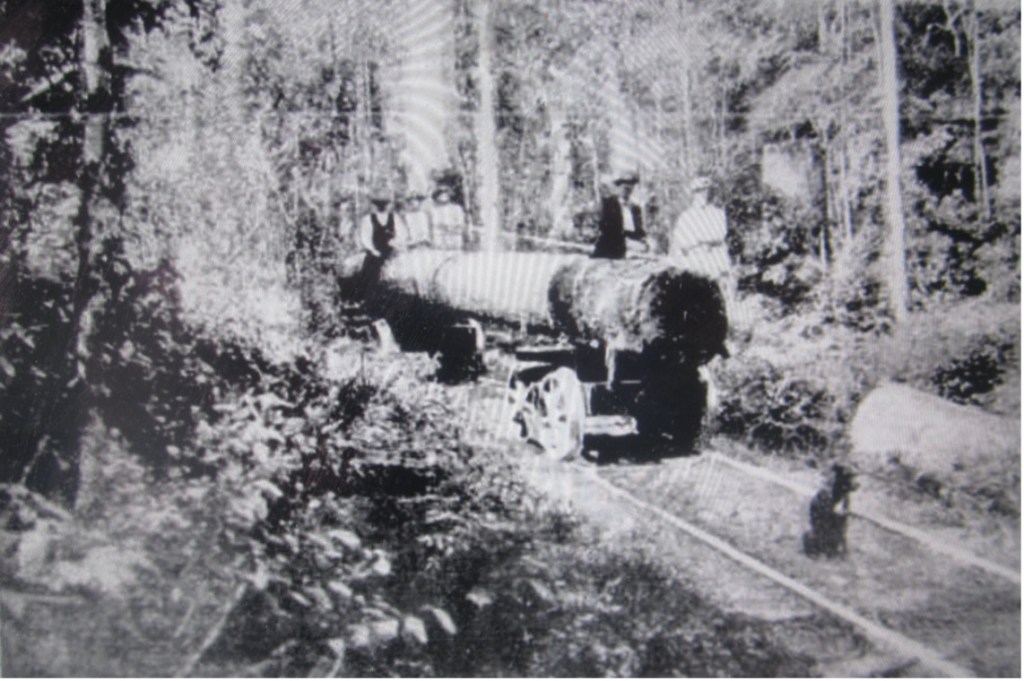
A timber tramway that appears to rely of gravity to propel the timber log
Timber droghers— queer, flat-bottomed punts propelled by paddle-wheels— pick up cargoes of sawn wood or piles from the mills or from the “log wharves” along the rivers, and carry them down to the mouth of the Myall River. Nearby is the Duckhole— a bay of fair size and carrying up to 21ft. of water. Large steamers anchor here, and the timber which has accumulated at the mouth of the Myall River is brought on board by lighters. Some sailing craft are towed up the river to the timber stacks.
The lack of a good wharf in the port where deep-sea vessels might anchor, and where timber might be stacked, is the greatest drawback to the development of the timber trade. A drogher reaches the port, there is no vessel waiting to take her cargo, so she dumps it somewhere on the bank and goes off for a fresh load. Small coasting vessels are able to come up the river to get this timber, but vessels trading to foreign ports cannot do so, consequently there is very little direct export trade from Port Stephens to other countries. The huge vessels of the Federal-Houlder-Shire line have put in occasionally to load sleepers for South Africa, and they have had to have the timber lightered out to them. The revenue which the Government receives from Port Stephens and district for fishing and oyster fees and timber royalties must be over £5000 a year, but the only wharf is a little jetty at Nelson’s Bay, on the southern side, although quite three-quarters of the trade comes through the Myall River.‘
“Coughing” Droghers – 1913
A correspondent for the Sun of 26 September 1913, page 6, wrote of his first experiences in viewing operating droghers at Tea Gardens:
‘The first night one spends at Tea Gardens, which, is the name of the little village on the bank of the Myall River, one is awakened by a loud, wheezing sound that is like the regular asthmatical coughing of a giant. One goes curiously to a window that overlooks the river and through the gloom sees a strange black mass surge slowly past. Next day one learns that it was a timber drogher. Presently one comes shuffling by in the daylight. It is the strangest craft one has ever seen. It is a great raft fitted up as a steamboat.
The engines are all at the stern and sheltered by square weatherboard houses, and the propelling is done by paddle-wheels either at the sides or at the stern. The forepart of the boat is flat and free from any structure, and there is where the timber is stacked. Sometimes the cargo will consist of long turpentine piles, which are being brought from the Myall Lakes for shipment all over the world. The piles will stretch beyond even the ample width of the droghers, and if one sees a vessel so loaded, she has the appearance of a child carrying a bundle of very long sticks crossways in its arms.
At first sight the timber droghers excite only ridicule, but when one has had a little experience of them one develops a great respect for the extraordinary skill with which they are navigated. To get an idea of the difficulty of navigating one down the Myall River one must imagine that Pitt-street had suddenly been transformed into a waterway, at its narrowest part— a water-way alive with sandbanks and sunken snags. The drogher will be represented by a huge furniture van floating on its side with all the furniture packed on the top and one paddle-wheel at the stern to send it along. To navigate that van along Pitt-canal would be about equivalent to the task of bringing a drogher down the Myall.
Naturally, they often go aground. Then the captain passes a line on shore, makes it fast to a stout tree, and winds up on the winch. Sometimes the strain is strong enough to pull the drogher off the bank, and she goes on her way. If she won’t come off with the strain the captain and crew light their pipes and wait for the tide.’
In 1913 there were about a dozen of these craft plying between Port Stephens and the Myall Lakes.
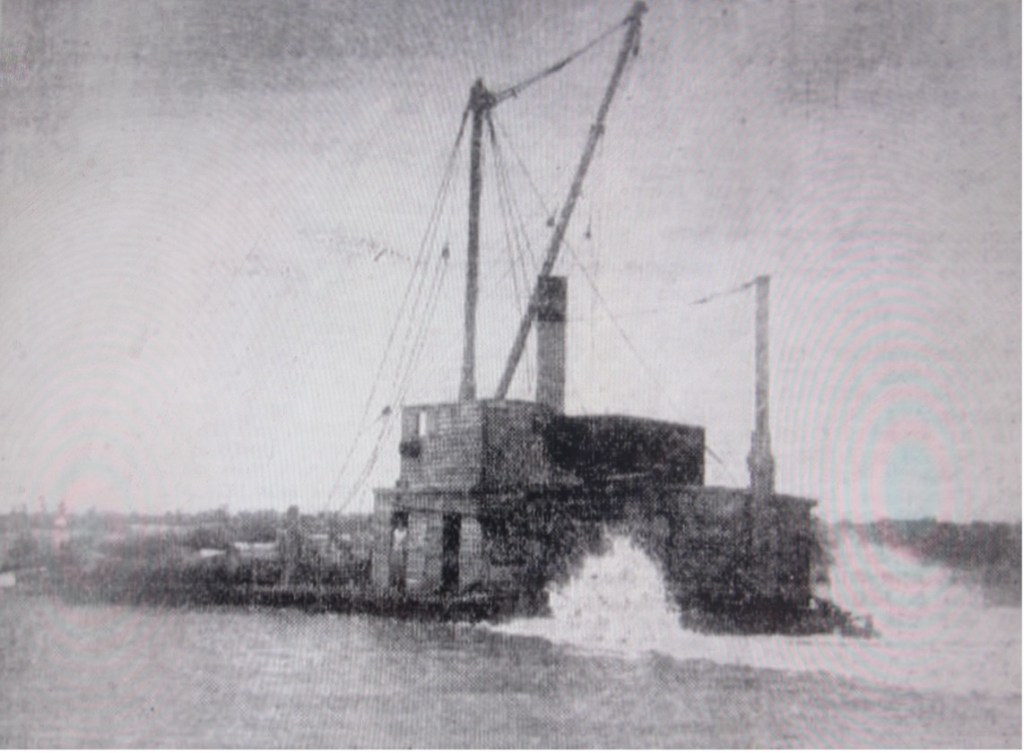
Paddle wheel drogher on the Myall River at Tea Gardens [The Land, 14 December, 1951]

Steam boiler from a river drogher, circa 1920 – on display at the Bulahdelah Courthouse Museum [Author Photo – November 2024]
Wharf Sought for North Side of Port Stephens for Timber Trade – 1913
The Farmer and Settler of 30 September 1913, page 2, reported on the need for a wharf on the north side of Port Stephens that was large enough to allow timber to be loaded directly onto large ships:
‘In showing to what importance the timber industry of Port Stephens has grown, notwithstanding the conspiracy of suppression to keep back the development of that port, the ‘Sun’ puts down the annual output of sawn timber at 10,500,000 superficial feet. The commercial timber trees of the district are tallowwood, black-butt, spotted gum, grey gum, ironbark, blue gum, brush box, and red and white mahogany. This timber goes to all parts of the world. Germany, Eastern Asia, England, and America take large quantities of the sawn timber, and many a South African train today runs over sleepers that were grown in the gullies about the Myall lakes. The unsawn timber such as turpentine tiles, telegraph poles, and girders, are also exported in large quantities.
What is absolutely needed, says the writer, is a port where deep-sea vessels might anchor, and where timber may be stacked, and the want of this is the
greatest drawback to the development of the timber trade. At present when a drogher reaches the port, and there is no vessel waiting to take her cargo, she dumps it somewhere on the bank and goes off for a fresh load. Small coasting vessels are able to come up the river to get this timber, but vessels trading to foreign ports cannot do so; consequently there is very little direct export trade from Port Stephens to other countries.
The huge vessels of the Federal-Houlder-Shire line have put in occasionally to load sleepers for South Africa, and they have had to have the timber lightered out to them. The revenue that the Government receive from Port Stephens and district for fishing and oyster fees and timber royalties must be over £5,000 a year, but the only wharf is a little jetty at Nelson’s Bay, on the southern side, although quite three-quarters of the trade of the district comes through the Myall River.’
New mill constructed at Tea Gardens – 1916
The Gloucester Advocate of 5 April 1916, page 2, reported:
‘Messrs. Allen Taylor and Co. are erecting a new sawmill at “Winda Woppa,” Port Stephens. The firm is also having a large punt built by Mr Miles, of Forster, for the carriage of logs to the new mill. The same firm are also having about seven miles of tramway put down from Bulahdelah to tap the timber around Purgatory, between Bulahdelah and Stroud. This belt is said to contain an immense quantity of timber. Steel rails are being used and a steam locomotive will be engaged on the work. This, in conjunction with other progressive ventures in the district, points to the enormous advantages of Port Stephens being turned to the account which nature intended for such a splendid harbour.’

Birdwood Timber Mill at Winda Woppa – 1916
Request for former timber land to be made available for farming – 1917
While timber-getting in each local area brought short term prosperity, the time would always come when the timber had been cut and remaining residents required another source of income. The problem faced by residents in the Upper Myall River area was summarised in the following article published in the Dungog Chronicle of 18 May 1917, page 7:
‘A deputation consisting of twenty residents of Upper Myall waited on the Hon. W. Bennett at Bulahdelah last week, requesting him to urge upon the Minister for Lands the need for making land available in the neighbourhood for additional holdings.
The deputation was introduced by Councillor Barry and Mr D. Brislane. It was pointed out that between 20 and 30 settlers resided at Upper Myall, on holdings from 40 acres in extent to 235, averaging about 110 acres each. When engaged as teamsters, and timber-getters these holdings were found large enough, but now that the sawmill had been removed from the neighbourhood, they would be compelled to get their living from the land or move on. The timber had been cut out of the forest within a distance of six or seven miles of the road and river, and the land was of fair quality. What was required was that this land should be made available so that each settler could make up his holding to a living area.
Now that a butter factory had been erected at Bulahdelah, they desired to go in for dairying, and they could not succeed unless they had more land, so as to have a “turn out” for their dry cows and young stock. The prosperity of the district depended upon the dairying industry, since the timber had been cut out, and they were very anxious that their wishes might be met. Messrs Colin Newell and M. Hogan pointed out that there was land fit for farms on each side of Horne Creek, near Bunyah, which should also be thrown open for settlement. The land was superior and contained no timber of marketable value. Mr Bennett said he was astonished to find so many settlers residing on such small holdings. They showed that they had been industrious and frugal, when they had been able to rear their families, and make such nice homes as they had. He could quite understand their anxiety to secure sufficient land to enable them to make a living at dairying.
They were entitled to it. He (Mr Bennett) believed it was better for the State to give settlers sufficient land to enable them to make a decent living, rather than have families starving on small areas. Mr Ashford was a farmer and was sympathetic with the settlers of the State, and he was sure he would meet their wishes if he possibly could. Some of the adjacent land had, he was informed, been incorporated into permanent forest reserves, but he understood that on the western side of the river there was still land that could be made available. He would not rest satisfied until he had it thrown open for settlement. In regard to the permanent reserves, it was as well for them to understand that it was the intention of the forestry department to lease the grass right of it under improvement tenure, at low rental. The object was to secure tenants who would, whilst having the use of the land assist in the preservation of timber, by cleaning up the rubbish and guarding against bush fires, etc. He sympathised with the deputation, and said he would lay their case fully before Mr Ashford, whom he felt sure would do his best for them.’
Busy time at Tea Gardens for timber industry – 1917
The Newcastle Morning Herald and Miners’ Advocate of 4 December 1917, page 3, reported:
‘Notwithstanding the critical times and depression caused by the late strike [New South Wales General Strike], the timber industry appears to be in full swing again. Messrs. Allen Taylor and Co’s sawmill is now turning out from 55,000 to 60,000 super feet of sawn timber weekly and gives employment to a large number of men. With the big supply of sleepers coming forward from Wooton, Buladelah, and depots, Winda Woppa is now quite a busy centre, and seems likely to outrival Tea Gardens, and the ‘Narani’, ‘Our Jack’, and other steamers of the fleet now trade regularly to Port Stephens. Andrew Cook and Company’s sawmill at Tea Gardens is also busily engaged, and these industries, together with the new fish depot [at nearby Pindimar] recently opened, are giving the place a much needed impetus.
The public, and more particularly ship-masters trading to and from the port, hail with great relief a much-needed and long-looked-for want, the arrival of the dredge, ‘Delta’, in charge of Mr. D. Williams. The entrance to Corrie Creek is silted up, and almost unnavigable, and at low water vessels of very small draft and build can only with difficulty negotiate the passage, and when this particular place and a few other bad spots are done, Tea Gardens will once more be easy of access.’
Tea Gardens as the industrial centre of Port Stephens – 1919
The Dungog Chronicle of 25 February 1919, page 2, reported on the economic activity at Tea Gardens:
‘Allen Taylor’s big sawmill is in full swing, Cook’s mill cannot turn out sufficient timber to meet orders and there is talk of another mill being started, so that whilst being a charming pleasure resort Tea Gardens is also the industrial centre of Port Stephens.’
The Gloucester Advocate of 30 July 1919, page 2, further reported:
‘Extensive preparations for the development of the timber industry in the Myall Lakes district have been made since the termination of the war. There are already eight or nine sawmills in operation in the area, and between 400 and 500 men are engaged in the various branches of the work, either in the mills or in the bush timber cutting.
Several new mills are about to be erected by the Jarrah Company, of West Australia, on the Karuah River. The company had closed down because of the war, but will be re-opening in the district in September. It is understood that a light line of rail will be erected from a new mill to the deep water on the frontage on the Karuah River. Allen Taylor and Company propose erecting another mill between Bulahdelah and Bungwahl. Others are in contemplation of different centres on the lakes.’
Timber tramline near Port Stephens – 1920
The Sydney Mail of 13 October 1920, page 5, published:
‘This fine photograph [see below] of an engine drawing a load of railway sleepers over a viaduct on a mountain timber line was obtained by a “Sydney Mail” photographer in the beautiful Myall Lakes district. In the surrounding forests there are some magnificent hardwoods. It was officially stated the other day that the forest area of N.S.W. — that is, the territory carrying forests which yield timber supply of appreciable commercial value — is estimated to comprise about 11,000,000 acres, of which about 8,000,000 acres is still in the possession of the Crown.

Timber tramline in the Myall district [Sydney Mail, 13 October 1920]
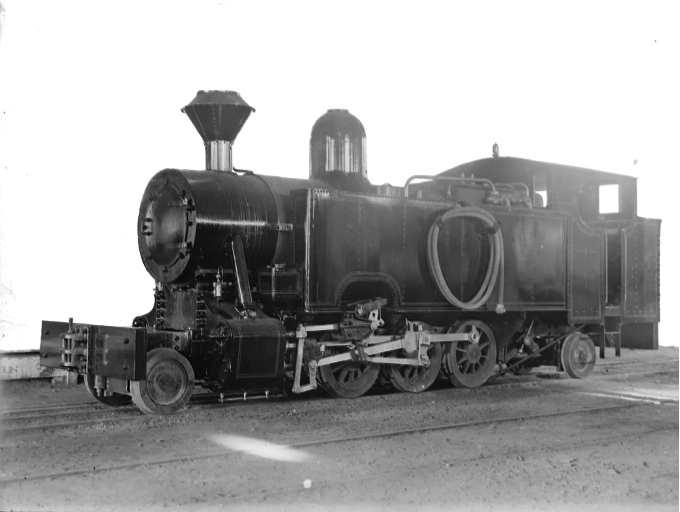
Steam locomotive, ‘Wootton’ built by Clyde Engineering in Sydney for Allen Taylor and Company, to operate on the timber tramway between Wootton and the wharf at Mayers Point on the eastern side of Myall Lake. The timber was then shipped to the Birdwood Mill at Winda Woppa, near Tea Gardens [Powerhouse Museum Collection]
Pines and Hardwoods of Australia, Limited – 1922
The Dungog Chronicle of 19 May 1922, page 3, reported:
‘Shareholders in the Queensland Pine Company, Limited, have approved the scheme formulated by the board for the purchase of hardwood timber properties in this State. The properties are situated about 12 miles from Port Stephens, and are estimated to contain about 100,000,-000 super feet of best Australian hardwood.
The company expects to have its timber-cutting activities prolonged by more than 15 years as a result of the acquisition of the new areas. The capital of the company is to be increased by an issue of 100, 000 new £1 shares to £200,000. The meeting of shareholders at which the scheme was adopted sanctioned the issue of two fully paid bonus shares for every five existing paid-up ordinary shares, and for one fully paid share for every four existing contributing or partly paid preference shares. The name of the company has been altered to Pines and Hardwoods of Australia, Limited.’
Bullock teams as an integral part of the timber industry – 1923
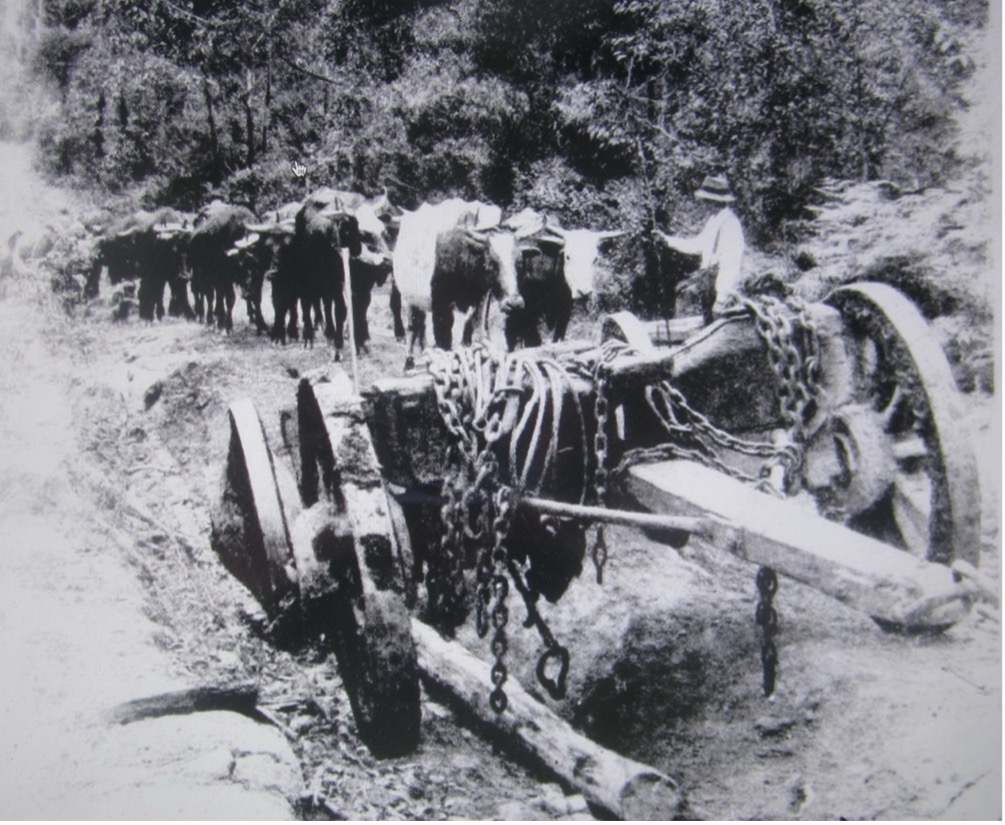
A scene in the Myall Lakes district, with the bullock team still hauling timber to the waterside, despite the advances of machine power [Sydney Mail, 12 September 1923].
Observations on the timber trade at Tea Gardens – 1924
The Gosford Times and Wyong District Advocate of 27 March 1924, page 3, published the experiences of a traveller to Tea Gardens and their observations on the importance of the timber industry activities to the town:
‘Twenty years ago Tea Gardens was a wayside village of 50 citizens. Now there is a population of over 1000. Tea Gardens is the hub of a very busy district. The main avenue of employment is the timber trade. Messrs Allan Taylor and Company are largely responsible, having the largest timber mill in the district. Mr. Andrew Cook also has a mill, which incidentally gives employment to a large number engaged in the carrying trade on the river, apart from those actually engaged in the mills. ……
Traffic upon the river is very heavy. There are 10 punts, each 80ft long, capable of carrying up to 120 tons, and two river steamers (‘Nepean’ and ‘Myall River’), travelling daily, while the ‘Allyn River’ and the ‘Coweambah’ ply between Tea Gardens and Newcastle. Incidentally Coweambah, is the aboriginal name for Tea Gardens. At present every available man in the timber trade in this district is working overtime, loading the s.s. ‘Kurew’ with ironbark poles, 40ft long, to be utilised in New Zealand as electric light poles. The ‘Kurew,’ which belongs to the Union s.s. Co. is moored in Salamander Bay, the cargo being conveyed down the river on the timber punts.’
The Newcastle Sun of 31 July 1924, page 3, further reported:
‘The timber trade at Tea Gardens and Myall River has been fairly active for some time. A large mill at Winda Woppa, on the opposite side of the town, has a fairly large output. The timber, which is of splendid quality, is cut for the Sydney trade, being mostly tallow-wood and box. The mill is owned by Allen Taylor, and employs about 40 hands. It is equipped with all the latest machinery. A large number of electric light poles are being shipped for New Zealand. The industry, which was slack for years, shows an all-round improvement.’
Waterside strike fails at Port Stephens – 1924
The Dungog Chronicle of 18 November 1924, page 2, reported:
‘A big sailing ship (5 masts) is at present in Salamander Bay, Port Stephens, loading timber for Mr. Gus Brown for New Zealand. The captain has refused to employ wharf laborers. An attempt was made to get the seamen to strike, but they informed the union officials that they were under American articles and refused to comply with the request.
The secretary of the Waterside Workers’ Union has wired that the ship should be loaded by the water side workers, but his advice had no effect. An effort was then made to get the Merchant Service Guild to refuse to run to the ship, but that body claimed that it was running to the lighter from which the ship is being loaded, and not to the ship. The effects of the strike in Salamander Bay are therefore nil, except that the waterside workers have to scratch their heads and see the ship loaded and good money lost to them.
Timber industry in the Myall River and Port Stephens areas buoyant – 1924
The Newcastle Morning Herald and Miners’ Advocate of 6 December 1924, page 7, reported:
‘Notwithstanding the depression caused by the closing down of Messrs. Allen Taylor and Company’s two sawmills at Bulahdelah and Wooton, the outlook at their Birdwood (Winda Woppa) sawmill appears promising. At the present time Allen Taylor and Company are making extensive improvements, and have a large gang, chiefly skilled men, engaged erecting the engineer’s shop, which gear was recently transferred from Bullahdelah. The firm has installed a large oregon tank, capable of holding 20,000 gallons of water, which is pumped from a well sunk in the sand, and this will not only supply the sawmill and four lighters with feed water, but outside firms as well.
The sawmill is taxed to its utmost capacity, and turning out some fine timber, chiefly ironbark, tallow-wood, and box. The chief difficulty is in coping with the export trade, which has assumed very large proportions, and in this branch there is very keen competition. The sand pump ‘Neptune’ dredged the channel from the mouth of Corrie Creek to Winda Woppa, and the residents viewed with alarm the action of the Works Department in taking her away immediately afterwards, but apparently, they thought the ‘Swansea’ would be more fitted to cope with the Upper Myall River. There is now good navigable water for steamers of considerable size right up to Winda Woppa, and when some of the bad places higher up are done, the conditions will be further improved.
The dredge ‘Swansea’ is doing good serviceable work. She is at present located just above the Tea Gardens, engaged cutting a channel which previously at this particular plate was practically unnavigable. It was quite a common thing to see the usual traders hung up in view of the Tea Gardens. The much needed improvement will obviate the delays that were so common, and lessen the great expense to shipowners which this loss of times means.’

A fleet of timber droghers is kept busily engaged in bringing the great hardwood logs cut in the great forests near the Myall Lakes to the seaboard at Port Stephens [Sydney Mail, 18 February 1925]
Timber Industry calls for protection from imports – 1925
The Newcastle Sun of 25 February 1925, page 9, reported:
‘The timber industry in the well-wooded northern district is passing through a crisis. Hundreds of men are engaged in this work. Thousands of pounds are invested. Owing, however, to unfair American competition, oregon timber is being landed in Australia at a cheaper rate than can the hewers of the Port Stephens district dispose of their supplies. ……
“Hundreds of mills in various parts of the north coast have ceased to work,” declares one experienced miller, who attributed the position to what he termed “this unfair American competition.” The Americans, he declared, were shrewd enough to stop the import of Australian hides when they saw that the industry was assuming large proportions. “What we want,” he averred, “is protection in some form or other.” Evidence of the importance of the timber industry can be seen at almost every stage of the Great Lakes’ tourist route. Punt after punt, pushing wearily along, carries its wooden freight to the mouth of the river as tribute. For all the world the scene might be on the Mississippi in the days of Lincoln, the lumberman, as these clumsy, but nevertheless extremely efficient plodders bring the logs from the river’s upper reaches.
The importance of this district cannot be overestimated. It is astonishing to recall that over thirteen and a half million feet of timber was shipped alone from Port Stephens last year. “When I came here 25 years ago, they told me that the timber was finished; that there was nothing left in the industry,” again remarked the miller. “There is just as much here as ever there was.” Five years would see a young tree coming into profit. Every miller knows what “the second crop” reveals. Recently a demand for poles from New Zealand has set in. This is occasioned by the Dominion’s big electrical schemes. Poles to carry the current are in request from all parts of this country. An order now almost completed, believed to have been the largest received in one lot from across the Tasman, was for £46,000 worth of saplings for the Southland Power Board at the Bluff.
This has meant an influx of labour. To some extent it has assisted the district over a difficult time. When orders failed for other classes of timber, New Zealand’s demand for saplings continued. Thousands of pounds worth of orders, in addition to the one mentioned, have been received. Then there is another who takes his share of the general prosperity, and one who plays no unimportant part in the industry. He is the “bullocky” with his team.
So profitable has this work proved, that it is the natural desire of many young men to whirl the whip alongside a team. With a capital of £80 a young man in the Port Stephens’ district took unto himself a wife. As he paid a deposit of £50 on a bullock team, there was really very little left for the couple to commence matrimony with. Faith, however, was pinned in the team. Subsequent events proved that this was justified. Within three years he had paid £600 in cash for a home. The bullocks and outfit, in addition, were cleared from debt. As a good team costs anything up to £300, some idea of his earnings can be gained. It is stated that the teamsters earn from £10, £15, and £20 a week with their patient oxen.’
Timber salvaged from former warship Psyche in Port Stephens – 1925
The Newcastle Morning Herald and Miners’ Advocate of 2 June 1925, page 5, reported:
‘The salvaging of the timber from the old warship ‘Psyche’ has been completed. The vessel was sunk in Salamander Bay at the beginning of the year. Up to that time it had been used by Messrs. Mills and Rigby, of Newcastle, as a storeship for timber. During the heavy gales that prevailed in January the Psyche took a list and sank in 56 feet of water. The Newcastle Patent Slipway and Engineering Company were the successful tenderers for the salvage of the cargo, which comprised 2044 poles and girders, the approximate value of this being £3000. The work was carried out by divers Saalfield, who had charge of operations, and Luxton, who worked three hours each a day.
Their task was made difficult by the heavy nature of the timber, each piece having to be slung and drawn to the deck of the lighter moored above. Nineteen hundred of the 2000 have been handled. The balance cannot he salved, as they are between the wreck and the harbour bottom. The New Zealand Insurance Company were the underwriters for the cargo. There was no hitch in the diving operations.’
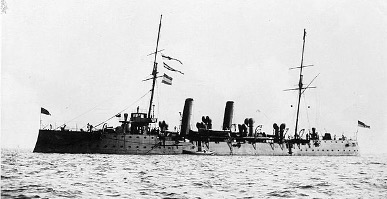
Psyche [Australian War Memorial]
Timber Industry still booming in Port Stephens region – 1926
The Newcastle Morning Herald and Miners’ Advocate of 28 July 1926, page 3, reported:
‘The timber trade of the port is still booming. Large quantities of poles, girders, piles and sawn timber are being shipped to South Australia and to New Zealand. Messrs. Allen Taylor and Coy. have reopened their sawmill at the Myall Lakes.’
Extra employment provided by new mill at Tea Gardens – 1926
The Dungog Chronicle of 30 November 1926, page 2, reported:
‘The Myall River Timber Coy. is the new name for Mr. Rigby’s sawmill at Tea Gardens, which recommenced operations on Monday last, under the management of Mr. J. de Lore, who is well known in the timber world as a most capable man and one immediately suited for the position. The starting of the mill means a big thing for the town, as it provides employment for many who have been feeling the effects of the slack times.’
Just over a year later the Dungog Chronicle of 6 December 1927, page 6, reported on the closure of the mill:
‘The roar of saws tearing through the logs, hiss of steam, and the clatter of machinery are no longer to be heard at the top-end of Tea Gardens, as Rigby’s saw mill has shut down again. Mr. Rigby has found it almost impossible to dispose of his sawn timber at a satisfactory price and has now started on a new campaign.
He intends establishing a timber yard in Newcastle, where he will market all his own timber and any benefit in prices will go to the consumer instead of the middleman as is now the case. As soon as the whole scheme is finalised the mill, will reopen and the output will be greater than ever before, consequently more hands will be employed and the whole district will benefit. Mr. Rigby and his managers are goers once they start at anything, so it should not be long before the Myall River Timber Coy’s. timber is being used by most of the builders in the Newcastle and Maitland Districts.’
Large Overseas Steamer Loaded Timber for Canada – 1927
The Daily Commercial News and Shipping List of 21 December 1927, page 4, reported:
‘It is some years since an oversea vessel has been in port at Port Stephens. Yesterday the Union Co.’s vessel Waitemata arrived there from Newcastle to load piles for Vancouver and Victoria, B.C., and it is probably the first time that a vessel of such tonnage as the Waitemata has been in the port to load for overseas. The Waitemata is due at Sydney tomorrow, and will berth at No. 5 wharf, Darling Harbour, to complete, and is to leave again on December 24 for the Canadian ports.’
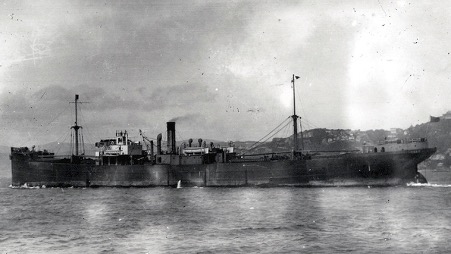
Waitemata
Timber industry improving at Tea Gardens – 1928
The Maitland Weekly Mercury of 2 June 1928, page 9, reported
‘The timber trade is showing signs of improvement. The s.s. ‘Pooita’ and the ‘Margarel W.’ have loaded for New Zealand, while three coasting vessels have taken away cargoes of sawn timber for Newcastle and Sydney.’
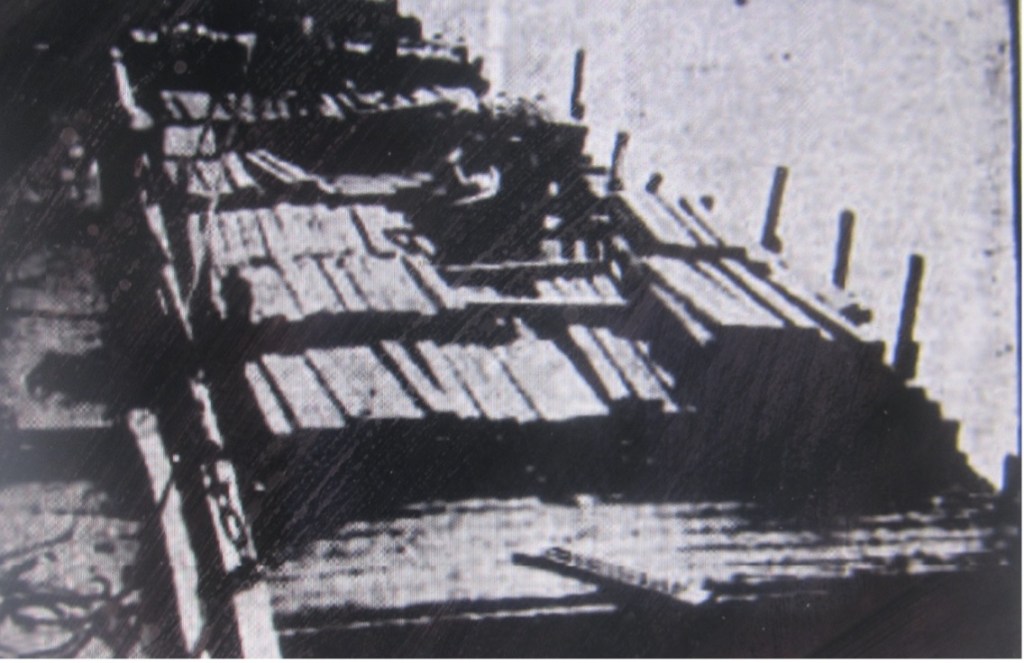
The balance of 25,000 sleepers being loaded aboard the ‘Iron Chief’ at Johnston’s Bay [Sydney]. The cargo, which was collected from Coffs Harbor, Port Stephens and Newcastle was being shipped to Port Augusta. The sleepers were to carry the North-South Transcontinental railway tracks [Newcastle Sun, 27 February 1928]
Sawmill burns down at Tea Gardens – 1928
The Dungog Chronicle of 14 September 1928, page 6, reported:
‘A big fire occurred early on Friday morning, when the Myall River Timber Coy.’s Sawmill was totally destroyed. The fire was apparently first noticed by Mr . W. Radcliffe who saw what appeared to be a torch light, when he was going aboard the s.s. ‘Nepean’ to get up steam a little after 2 a.m. When next he looked the small light had grown to a fair size and he realised the mill was on fire. Immediately he gave the alarm by blowing the whistle of the ‘Nepean’ and in no time practically the whole of the townspeople were making their way to the scene.
Mr. E. Motum was first on the scene and saw that the outbreak had originated near the furnace, as there the whole of the building was ablaze, he endeavoured to get to the whistle to give the alarm, but the flames kept him back, he then notified Mr. Davey, the overseer of the mill, in the meantime a large crowd had gathered, but it was soon evident that nothing could be done as the fire had too great a hold.
In a space of 30 minutes the whole building was enveloped in flames, and in a very short time the building collapsed, and within an hour only the smoke stack was standing. Fortunately for the company most of the sawn timber had been transferred to the public wharf awaiting transhipment to the company’s timber yard in Newcastle. Willing hands shifted other sawn timber out of reach of the flames and also removed the telephone, books, etc., out of the office, which was in danger.
How the fire originated is a mystery. The mill had been working on the previous day and it is thought that by some means or another the fire wood near, the boiler caught alight and smouldered for some hours before bursting into flames. Owing to there being no fire brigade there was no means of fighting the fire and no attempt was made to save it as the fire had too great a hold. Fortunately, no wind was blowing. If there had been, nothing would have saved Mr. H. Thurlow’s slipway or Mr. W. Ward’s big shed on either side of the mill. Motum Bro’s, sheds and boats would also have been in danger, in fact even now there is a grave danger of some of these buildings catching as the sawdust is still alight, and if not put out will be a source of danger for some months to come, as it will smoulder perhaps for 12 months. ……
The destruction of the mill is a serious blow to Tea Gardens and district as it provided employment for a number of hands, not to mention the timber getters and carriers. Mr. Robert Rigby, who is the chief of the company has had more than his share of bad luck in recent years, but with the pluck that has characterised his career, it is expected that he will surmount this serious rebuff and come out on top as time wears on. It is not yet known whether or not the mill be rebuilt, but it is safe to assume that if Mr. Rigby can raise sufficient capital, he will have the mill with all the latest machinery at work in the course of a few months.’
Japanese steamer Assama Maru Port Stephens – 1931
The Newcastle Sun of 3 October 1931, page 7, reported:
‘One of the first foreign steamers for many years to sail direct to New South Wales coastal ports, the Japanese vessel ‘Assama Maru’ arrived at Port Stephens this morning to load a cargo of sleepers.
The object of considerable interest in shipping circles, the ‘Assama Maru’ left Miike last month for Eden, on the South Coast. There she loaded sleepers, and continued her voyage to Sydney. After the ‘Assama Maru’ has loaded her Port Stephens cargo, she will sail for Byron Bay, on the North Coast, where a further load of sleepers will be taken on. The ‘Assama Maru’ is the first foreign steamer to call at Port Stephens for many years.’
New sawmill for tea tree timber – 1931
The Dungog Chronicle of 30 October 1931, page 4, reported:
‘Mr. W. Ripley has installed a sawmill on his property on the Myall River near Tamboi for the purpose of commercialising tea tree timber which is in abundance. This class of timber has many useful and ideal purposes, such as furniture, flooring, weatherboards, toys, etc.’
Timber mill purchase – 1933
The Dungog Chronicle of 21 July 1933, page 4, reported:
‘Messrs. Gooch Bros, and L. Smith have purchased Messrs. Stacey Bros. timber mill. This firm was operating at Upper Myall. The new purchasers intend to reerect the mill near the Myall river where soft brushwood timber will be cut for market. This will be an avenue for employment for some 6 or 8 men.’
Huge tree felled near Tea Gardens – 1934
The Newcastle Morning Herald and Miners’ Advocate of 25 November 1933, page 8, reported:
‘Mr. E. Gough felled a tallowwood tree on J. Johnson’s land near the Tea Gardens road. It measured 26ft. 6in. in girth and was 48ft. long. As no conveyance could be secured to take it to the mill, the tree was cut into railway sleepers, 200 being secured. Their value at the stump was £30. The tree contained upwards of 9000 feet of timber.’
Haulage of timber on main roads causes damage – 1934
Due to damage caused by the haulage of excessively heavy timber loads over main roads in the Port Stephens Shire, timber haulers were subjected to compliance requirements, to ensure that road surfaces were no longer damaged. The Maitland Daily Mercury of 4 January 1934, page 4, reported:
‘The information that no objection would be raised to the carrying of reasonable loads of timber over main roads in Port Stephens Shire, is contained in a communication received by Mr. J. Cromarty, secretary of the Port Stephens Ratepayers’ Association, from the Minister for Transport, Mr. Bruxner.
The letter, which was forwarded on by Mr. Bennett, M.L.A., states : — “With reference to my letter of 7th instant, in answer to your personal representations on behalf of the Port Stephens Shire Ratepayers’ Association regarding the haulage of timber over main roads within the Port Stephens Shire, I am advised by the Commissioner for Main Roads that in July last on account of the excessive loads of timber which were being carried on the Pacific Highway in the Port Stephens Shire between Hexham and Raymond Terrace, very considerable damage was being caused to the road pavement, and it was accordingly necessary to take immediate action to prevent this.
“The Department, exercising its powers under the Local Government Act, notified a general prohibition in respect of timber haulage, but at the same time, with a view to affording timber carriers an opportunity of continuing their operations, offered to permit this class of traffic where the operators conformed to reasonable load limits specified by the Department. “In any case, therefore, where the type of vehicle proposed to be used is such that its maximum loading will not be injurious to the road, every latitude is granted by the Department, and, it is only where loading on a large scale is desired by the vehicle owner that security is asked by the Department to guarantee compliance with the conditions.”
Additional forestry licence creates continued employment – 1934
The Newcastle Morning Herald and Miners’ Advocate of 28 July 1934, page 18, reported:
‘A report from the Port Stephens, states that an exceptional run of good work has favoured the mill in that centre for the past eight months. The granting of the licence of the State Forests at Bulahdelah has resulted in continued employment. The steamers ‘Coweambah’, ‘Fanny’, and ‘Idante’ are regularly trading between the ports, carrying timber. Teamsters are busily engaged in log hauling. A supplementary industry is the cutting of stakes for the oyster lessees. Large quantities of the stakes are taken by steamer from Karuah, Pindimar, and the Tea Gardens. Messrs. Armstrong and Royse have had their mill overhauled. This work was carried out by their engineer (Mr. A. Kelly). Sleeper-cutting is spoken of as a still “worthwhile” occupation in the district. The last pass comprised 900 sleepers. The rejects were less than 1 per cent.’
Arrival of ship to load timber becomes a social occasion – 1934
The Dungog Chronicle of 14 September 1934, page 4, reported:
The s.s. ‘Nelore’ called in Port Stephens during last week and loaded fourteen thousand sleepers for China ports. Allen Taylor and Co., were the shippers, and the cargo was handled by the Port Stephens Waterside Workers under the direction of Captain Smith, stevedore for that line fr steamers.
This vessel runs a timetable (passengers and cargo) between Tasmanian ports and China, via Sydney and Melbourne, and at the time of calling here had a part passenger list, also a quantity of mixed general cargo. Quite a number of passengers made the trip to Newcastle by motor whilst the vessel was in port here.
A ship of between seven and eight thousand tons she was manned with a crew of Chinese sailors and firemen numbering one hundred and twenty-five, and eighteen British officers, also four Malayans, as quartermasters. Two Customs officers from Newcastle met her on arrival here and remained aboard whilst she was in port. On the Thursday night while the crew were loading a party of young folk from Tea Gardens were entertained by the Captain and officers. A dance was held, and a tasty supper served. A delightful evening was spent by all.’
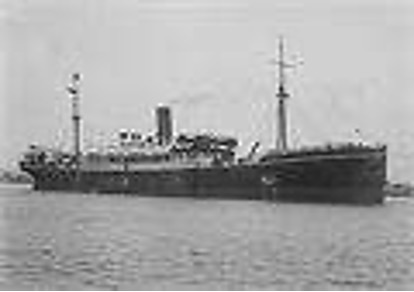
Nelore
Additional timber allowed to be cut in Bulahdelah area – 1935
The Dungog Chronicle of 25 June 1935, page 4, reported:
‘Mr. C. E. Bennett, M.L.A. has received the following communication from the Minister for Forests: — “With further reference to your representations concerning a petition from Mr. A. J. Chick and other licensed timber cutters and teamsters at Bulahdelah, requesting that sections 1 to 9, inclusive, within Myall River State Forest No. 294 be thrown open to timber operations, I desire to inform you that the part of Myall River State Forest referred to in such representations is already included in special licenses to existing mills in the locality for mill logs, and the Forestry Commission may not issue further licenses over the area to the Petitioners for the obtaining of mill logs therefrom. Arrangements have been made, however, for the cutting of sleepers on Compartments 1 and 2, and approval has been given for the cutting of poles, piles and girders in a small way.”
Timber milling on the Myall – 1936
The Sydney Mail of 22 April 1936, page 2, reported:
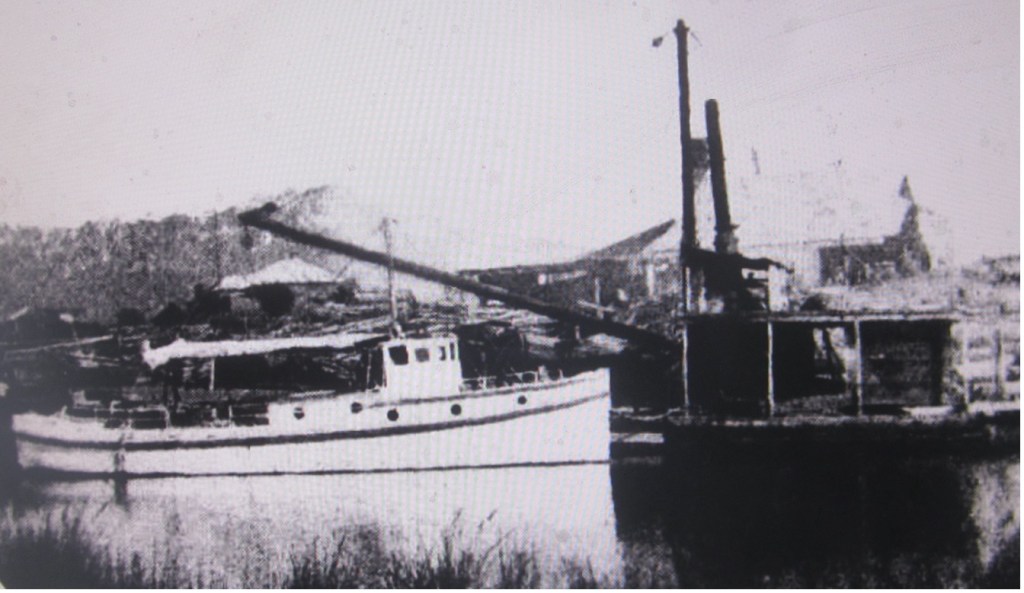
Relf’s Mill, Bulahdelah
‘In the above photograph is shown a launch at Relf’s mill, Bulahdelah, about to tow down the Myall River a puntload of sawn boards used in the oyster industry at Port Stephens. Tom Gilbert erected the mill over 50 years ago. Then Hitchcock and Robinson carried on the business, and after them came Justin McSweeney, who built several two and three masted sailing vessels with a capacity of 70,000 to 90,000 super feet, the ‘Rozelle’, the ‘Cynthia’, the ‘Myall’, the ‘Australia’, and also several punts.
Sir Allen Taylor followed McSweeney, and now Mr. Sam Relf, who had a hand in the shipbuilding business 35 years ago, runs the mill, the principal timbers milled today being brush box, tallowwood, and flooded gum. Vigger’s mill, on the outskirts of the town, is handling large quantities of brush box, which is used extensively for bridge decking. These two mills each put through 4000 super feet a day. The first sawmills in this district were Dickson’s and Macrae’s, neither of which is in existence now.’
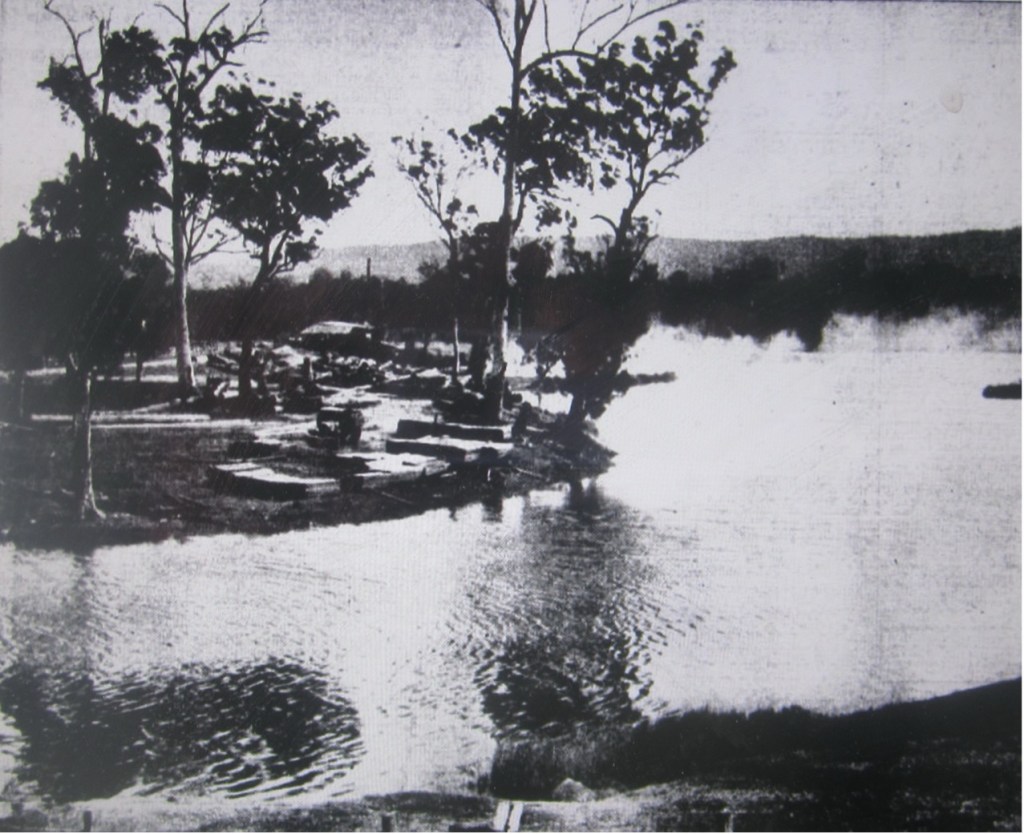
A scene on the Myall River at Bulahdelah, showing on the bank of the stream one of the sawmills which prepare for the Newcastle and Sydney timber markets [Newcastle Morning Herald and Miners’ Advocate, 6 June 1936]
Myall River State Forest cutting areas – 1936
By 1936, new cutting areas had to be found to maintain production levels. In addition, new transport routes for sending the timber to market had to be established as much timber near the Myall River had been cut. The Dungog Chronicle of 18 September 1936, page 2, reported:
‘Mr. C. E. Bennett, M.L.A., is in receipt of the following communication from Hon. Roy S. Vincent, Minister for Forests: —
With further reference to representations made by you last year on behalf of the Timber Workers Association of Bulahdelah, and the teamsters of Girvan, regarding the allocation of cutting areas within the Myall River State Forest, I desire to inform you that it has been decided, following upon an investigation locally by the Chief Inspector of the Forestry Commission, that further consideration of the question of means of timber disposal in the Myall River State Forest is to be deferred until after the forest has been fully investigated in terms of a recent arrangement, when information regarding the present volume of stand available, location of stands, present means of access, roads necessary to provide access further, and the position generally, will assist in determining the future organisation necessary within this forest.
In the meantime, the licensing system as at present in force will be continued. The officer in charge of the investigation of this State Forest has been directed to inspect and report on timber reserves 55365 and 57308 and other Crown lands within the Parish of Euther, with a view to adding to the Myall River State Forest area, and also investigate the possibility of an outlet from those Reserves and Crown lands areas, down Mammy Johnston’s Creek to Stroud Road Railway Station.’
Visit of passenger ship to load railway sleepers for China – 1937
The Newcastle Sun of 4 May 1937, page 7, reported:
‘For the first time for some years an overseas passenger vessel made a call at Port Stephens today, when the E. and A. Company’s steamer ‘Nankin’ arrived from Hobart.
The ‘Nankin’ left Melbourne last Thursday for China and Japan, via Hobart, Port Stephens, Newcastle, Sydney and ports. The liner will load a quantity of railway sleepers at Port Stephens for Shanghai. After that the ship will proceed to Newcastle to load bunker coal. The visit of the 7200 ton liner at Port Stephens was quite an event for the port, which usually sees only small coastal ships and occasional interstate freighters, which call to load timber.
The Union Co.’s vessel ‘Karetu’ was at Port Stephens yesterday to load. The ‘Nankin’ arrived at 1 a.m. today, and is not expected to finish loading until late tomorrow, and will probably reach Newcastle early on Thursday morning. There was a shortage of wharf labour at Port Stephens today, as the Karetu was still in port and was due to sail tonight. Previous to the war several vessels were chartered to load hardwood at Port Stephens, and for several months the five-masted schooner ‘Inca’ and the big steel four-masted barquentine ‘Alta’ were under charter, carrying hardwood from there to Melbourne, towing to Port Phillip, and sailing back for another cargo.

Nankin
Timber industry still thriving in Port Stephens and Myall Districts – 1937/1938
The Dungog Chronicle of 26 November 1937, page 5, reported:
‘The timber trade still continues to flourish in the Myall district. Many haulers are at work in the bush, and last week Mr. Matheson purchased a hauler also for the purpose of hauling logs from the forest in the Upper Myall district.’
The Dungog Chronicle of 28 January 1938, page 4, further reported:
‘A big order for pit props has been received by the Pindimar estate and cutters will be occupied for many months. Increased activity in the coal mining fields of the Newcastle district has been responsible for the heavy demand. Mr. Philips of Pindimar, who has accepted the big order, is being kept busy. The bad condition of the punt at Karuah is handicapping delivery, and Stroud Shire Council is endeavouring to secure another punt in order to release the Karuah punt for repairs.
In addition to pit props, many mill logs are being transported from the Tea Gardens district to mills at Newcastle and Raymond Terrace. Crooks [a piece of timber with a natural curve in it] for boat building purposes are also in great demand. This is quite an important industry, and many are engaged in it.
Sleepers in considerable quantities come into Tea Gardens by drogher from the Myall Lakes and by motor lorry from the country served by the Tea Gardens-Bulahdelah road. Since this road has been pushed along there has been increased production from a timber point of view. Logs for the mill at Winda hoppa and poles, piles etc., for overseas market are continually being punted down the Myall. Altogether, those engaged in the timber industry in Port Stephens are having a very busy time. There are practically no unemployed in the Tea Gardens district.’
Farming destroys forest trees – 1940
The Dungog Chronicle of 10 December 1940, page 3, reported:
‘The quantity of timber being destroyed in the Upper Myall district is still enormous. Proof of this is to be seen in the journey along the branch roads through partly-settled areas. Between Markwell and Bulahdelah full-grown trees in endless numbers stand ringbarked on either side of the roadway. Years ago the thinning out of the timber began to make way for closer settlement. The trees die after being ring-barked, and the branches decay and fall, finally being gathered up and burned. Thus, the clearing process goes on, with waste predominating in this rich timber belt. Thousands of the trees so destroyed have attained to 70ft. or 80ft., taking about 30 years to grow to that height, then to be destroyed in ruthless fashion. There they stand like ghosts in their thousands.’
Timber traffic damages local roads – 1942
The Dungog Chronicle of 25 August 1942, page 3, reported on proceedings of the Stroud Shire Council that dealt with the damage done to Council roads by heavy timber traffic:
‘The [Shire] President introduced Mr. R. L. Fitzgerald, M.L.A., who said he had come to the meeting to see if the Council had any matters which it would like him to attend to. The President said that there was one matter in particular which had been exercising the minds of the Councillors and that was the damage being done to the roads by heavy timber traffic from the State Forests. The Council got no rates from the Forestry Department and he thought that the Council should get some assistance from the Department to help it to maintain the roads.
Some years ago the rates on state forests amounted to about £2,000 a year and when the Government cut out the rating on State forests the Council got nothing to compensate it for the loss in revenue. Cr. Wilson said that the road that he had in mind was the main road from Booral to Bulahdelah. It had got into such a state as to be almost untrafficable, and this was almost entirely due to the heavy lorry loads of timber being hauled from the state forests over it. The Council was not in a position to provide the money to keep this important road up to the mark.
Cr. Flannery said that the other day he kept a tally of timber lorries passing along the road and he estimated that something like 42,000 feet of timber went past in the day. The Forestry Department seemed agreeable to spend a mint of money on its own roads and he thought that a little bit of a grant for the Council’s road would be more than justified. Cr. Zeininger said that he agreed with Cr. Flannery. Although the Forestry Department spent a lot of money on its own roads, the Council roads were just as essential to their purpose and there was not one ton of timber that did not go over the Council’s road. He referred in particular to the Bulahdelah-Tea Gardens road. This was a light tourist road, and as Mr. C. E. Bennett had pointed out to the Department during his term in Parliament, the Department was diverting its heavy timber traffic on to this lightly constructed road. This was the cause of the bad condition into which the road was getting. In this connection he would also mention the proposal he had brought up at last meeting for the dredging of the Myall River. He understood the proposal had been submitted to the Department of Public Works and urgent action should be taken so that the river can be used instead of the roads.’
All timber traffic to be transported along the Myall River – 1943
The Dungog Chronicle of 23 November 1943, page 3, carried a further report on the haulage of timber. The Stroud Shire Council received a letter:
‘From the Premier’s Department, advising that with a view to effecting economies on the Stroud-Bulahdelah-Newcastle route in the use of motor vehicles, arrangements are being made for timber to be transported by lighter down the Myall River to Port Stephens, and then by s.s. ‘Boambee’ to Newcastle. Mill owners had been advised that the Road Transport Department will not permit the operation of motor vehicles for the carriage of timber from the Bulahdelah-Stroud district to Newcastle when all requirements in this regard can be satisfactorily met by water and rail transport services.’
Port Stephens busy with timber activity – 1944
As timber could no longer be transported by road due to government regulations and petrol rationing, Port Stephens again became busy with the movement of timber products. The Dungog Chronicle of 7 January 1944, page 3, reported:
‘There has been much activity in the timber trade in Port Stephens for some considerable time, but particularly during the past week or so. Allen Taylor and Co. were busy loading a coastal boat. The ‘Iluka’ and ‘Myall River’ took big consignments from Bulahdelah to the Duckhole, Pindimar, to put on board an ocean-going ship. Members of the Wharf Labourers’ Union have been working long hours, and irrespective of the day or night. The authorities who keep an eye on petrol and rubber have put all the timber lorries off the run from Bulahdelah to Newcastle, and now the timber has to come down the Myall River from Bulahdelah per the ‘Myall River’ and ‘Iluka,’ to the ocean going boats anchored at Pindimar.’
Large amount of timber loaded for export to New Zealand – 1946
The Newcastle Morning Herald and Miners’ Advocate of 6 February 1946, page 2, reported:
‘Almost 1000 tons of timber for New Zealand is being loaded by the Union Steamship Company’s ‘Karetu’ (3218 tons), at Port Stephens. The timber, mostly large poles and sleepers, is floated down stream on lighters to an anchorage almost opposite Nelson’s Bay, where the ‘Karetu’ is lying. Waterside workers were taken from Newcastle to the job. For some years the Union Company has used Port Stephens for the loading of timber. On occasions, vessels have gone aground in shallow areas. The ‘Karetu’ will arrive at Newcastle on Thursday to take on steel and more timber before going to Sydney to complete loading.’
Further timber exports to New Zealand – 1949
The Dungog Chronicle of 21 May 1949, page 3, reported:
‘S.S. James Cook’ finished loading poles, sleepers and sawn timber for Auckland on Wednesday. The turnaround of this ship has been a long one. Owing to bad weather she had to leave her berth at Coff’s Harbour and stand off for four days, there being too much sea at the jetty for her to continue loading operations. Three quarters of her load was picked up at Coffs Harbour, the balance at Port Stephens. ……..
It is expected that the ‘James Cook’ will arrive back from New Zealand the first week in July with a full load of pine. This timber has already made its presence felt on the market here. Our small millers find that there is no demand for the inferior timber that they have been placing on the market for the making of cases. Australia has no need to worry about a market for the timbers that pine will take the place of. Unlike other wars, time has brought its changes: the Masonite people are showing that all our timbers will be made use of and put to better use than cases and boxes.’
The Dungog Chronicle of 20 August 1949, page 3, also reported:
‘The ‘James Cook,’ after loading 700 tons of timber here, over the weekend, sailed for Newcastle on Tuesday for bunkers before leaving for New Zealand. It is expected that her return cargo will be pine for Sydney and Newcastle. The s.s. ‘Karetue’ is expected here on the 23rd to load a thousand tons of timber for New Zealand. The timber droghers are having a busy time assembling this cargo, as most of it is at the dump at Bulahdelah. This ship’s company have already picked out a site for piles to be driven to moor their ship in Duck Hole. It will need 800 to a 900 feet of wharf and extra haulage over 20 miles to solve the problem of loading which will also save the great expense of droghers. It will also solve the problems of all other shippers from the North.”
Furniture company establishes a mill on Myall River – 1949
The Dungog Chronicle of 10 September 1949, page 3, reported:
‘Officials of a furniture timber company spent a few days on the Myall picking a site for their mill. The spot will be at what is known as Top End of Barlow’s and arrangements are now under way to get the plant on the job. It is expected that the timber will be shipped by water transport to Salt Ash, where it will be picked up by lorries.’
The Dungog Chronicle of 10 December 1949, page 3, further reported on the establishment of the furniture timber mill:
‘The Myall Maple Company started their saw mill operating on Wednesday when the first log was cut. This mill will cut special size timber for furniture and many sizes will be shipped away crated. The output is expected to be approximately 10,000 per week.’
The Dungog Chronicle of 18 March 1950, page 5, further reported:
‘Mr. Bert Young is a busy man installing a 55 H P. Southern Cross Diesel Engine in the Broadwater Maple Timber Co. Saw Mill on the Myall River. A road is also being formed from this mill back to the sea coast by which all timbers will be carried to the mill in motor trucks. This will also allow timber to be taken away in lorries. The road being cleared by private enterprise, this again shows how badly the road from Hawk’s Nest to Mungo Brush is needed.’
New mill established in the Tea Gardens township – 1950
The Dungog Chronicle of 12 August 1950, page 3, reported:
‘The Tea Gardens Timber mill has started operations at Witt St. This will be handy for the townspeople, who want a piece of timber, for this mill has really been acting like a shop. Firewood or building materials are on tap. ……Allen Taylor’s saw mill started work again this week and the drogher ‘Ability’ arrived with a full load of logs on Tuesday. It is expected now that there will be no more stoppages unless rain sets in again.’
Bucket line saves timber mill – 1950
The Newcastle Morning Herald and Miners’ Advocate of 9 December 1950, page 1, reported:
‘Residents of Ten Gardens saved Birdwoold timber mill from being destroyed by fire when they formed a bucket line from Myall River last night. The fire broke out about 8.30 o’clock. There was sufficient steam on the mill boiler for Mr. J. Davey to summon assistance on the siren. More than 50 men and women formed a firefighting party on the river and lagoon. While women filled buckets, men ran with them back to the building. Many men went from Tea Gardens to the fire by launch. Mr. S. Bush, mill employee, who was fighting the fire, said a strong southerly blew sparks against the weatherboards. Men knocked boards from the ground and top floors in an effort to stop the fire spreading. The most serious damage was to No. 2 saw bench and the walls and decking on the first floor. The mill caretaker, Mr. H. Asquith, was the only person injured. He was burnt about the hands while removing weatherboards. The blaze was controlled by 10.30 o’clock.’
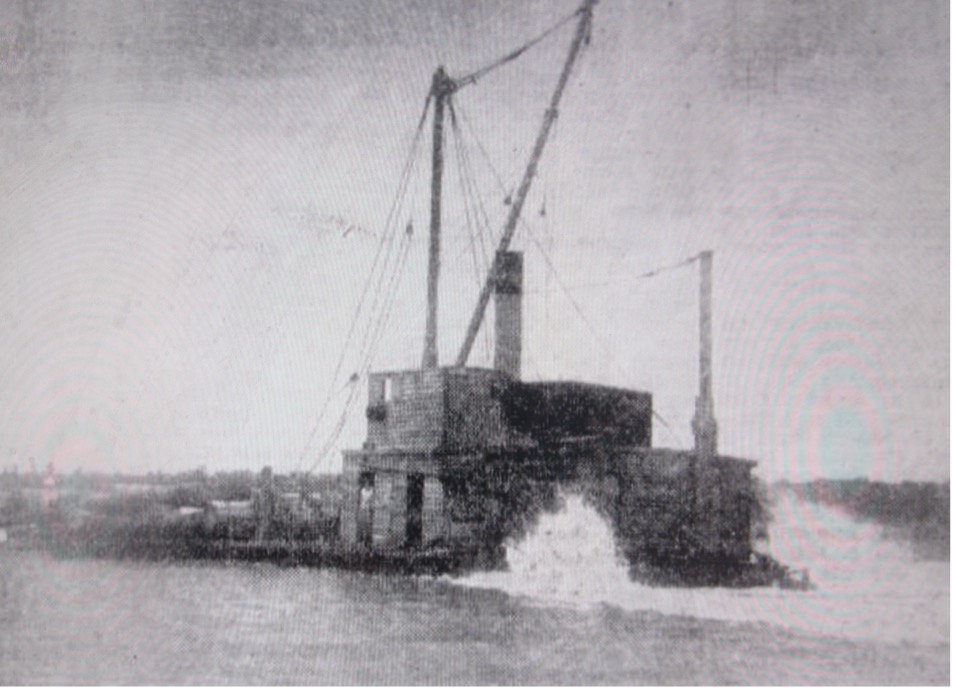
A drogher on its way to the mill at Winda Woppa with a load of hardwood logs. View taken on the Myall River at Tea Gardens [The Land, 14 December 1951]
A travel consultant’s view of the timber industry – 1954
It is appropriate to finalise this early history of the Myall and Port Stephens timber industry by considering the story written by Allan Watkins, a travel consultant that was published in the Newcastle Morning Herald and Miners’ Advocate of 31 July 1954, page 5:
‘It all began with a magazine of an incongruous, odd-looking steamer sporting paddle-wheels. At first glance I presumed it to be some Hollywood fabrication for yet another showboat-on-the-Mississipi epic — until the familiar names of Bulahdelah, Winda Woppa, Tea Gardens sprang into life from the caption below. The picture of the droger, as the double-decker craft is called, a name surviving from the lateen-sail West Indian coastal vessels, tantalised my curiosity to such an extent that on the spur of the moment I rang through to Tea Gardens, booked a holiday cottage there for a week, gave a detailed list of groceries and meat requirements to the general store and teed up bus and ferry time tables. …..
So it was rather surprising to find here, right under my Novocastrian nose, fields far greener than those to which I’d travelled. The enthusiasm for this latest jaunt was still prevailing when I embarked on the passenger ferry and set sail across Port Stephens. The ferry throbbed at a steady pace round the twisting Myall River and on every bend, new delights were waiting to greet the happy observer. Local passengers were set ashore where most convenient to them and with commendable disregard to timetables and setting down stops.
I sat in the sun on the bitumen roof, soaking up atmosphere of the oyster racks, the stunted mangroves and ti-trees, the smooth sandbanks, the bright blue sky twice as big here as it seemed at home. At midday the ferry reached its destination, and with a one track mind I immediately went in search of the drogher. It was everything I had expected. Berthed at the wharf opposite the hotel, its deck cleared of the boxwood, tallow and gum brought down from the timber camps round Bulahdelah, it did not appear the least ungainly or incongruous.
The paddle wheels were still, the slide steam engine cold and no one was on board to give it life: yet it possessed an old-world charm and dignity immune from the streamlined fashions of this atomic age.
Soon afterwards I was fortunate in meeting Mr. Gazzard, one of the key men from the Tea Gardens sawmill, who in turn directed me to Mr. Motum, skipper of the drogher berthed at the wharf. There are two droghers on the Myall run, he informed me, both of them aged and well-scarred, though good for many more years of useful work. No other type of steamer has the benefit of their exceedingly shallow draft (less than 5ft.) and it is mainly this, with their great cargo capacity, that makes them so ideal for this specialised work. The replacements of the usual propeller by paddle wheels was necessary to overcome the problems of mud and silt banking up along the shallows.
At Mr. Motum’s invitation I clambered all over the drogher, from the wheelhouse aft, which houses the skipper’s quarters, to the fuel lockers behind the boiler, meeting on the way the ticketed engineer and deckhand who make a trio of the drogher’s crew. With the tide up, the journey from Bulahdelah to Tea Gardens varies from 7½ hours at the most, depending on wind and current variations. During wet weather the drogher will occasionally miss a trip to the timber camps as the logs become too slippery and dangerous to handle.
The droghers, Mr. Motum said, are 100 feet long, with a beam of 27ft. 6in., and weigh approximately 90 tons. They are equipped with 5-ton derricks, twice the height of the wooden housing, with patent loading and swinging gear, and the necessary lifeboat and lifesaving gear.
That was enough statistics for one day. There were other points of interest at Tea Gardens I wanted to see, the little-publicised work of the Forestry Commission in planting pine forests in that area, acres and acres of sturdy young trees in varying stages of growth. The latest plantations come right to the main road, and in future years should give an attractive approach to the township. However, the confidence in this long-range afforestation programme is not shared by many of the local residents, who maintain that the scheme has yet to prove itself, and that many of the areas planted years ago have not reached a stage of development and maturity essential to the success of the plan for commercial purposes.
At Tea Gardens there are many other pleasures to give relaxation to the weary city dweller. ……Another day, on Mr. Gazzard’s invitation, I went round to McCann’s sawmill where a drogher’s 5-ton derrick was making light work of unloading a cargo of logs. Giant stacks of sawn timber lay on the wharf awaiting transportation to Sydney. The distribution from this mill has changed since war days, when a great deal of this excellent timber was used for wharf piles and construction in the Pacific Islands, and carried in these same droghers to American and other overseas ships berthed in Port Stephens.
So it was, at the end of a week, I packed my bag and said goodbye to all the new friends I had made. I sat on the ferry roof again and saw the drogher’s paddle wheels churning the placid river into foam as it sailed away upstream. …… It is almost in Newcastle’s backyard, far and inaccessible enough to alienate it from the smoke and clocks and ulcers of city living, but close enough for a stranger to share its freedom and serenity.’
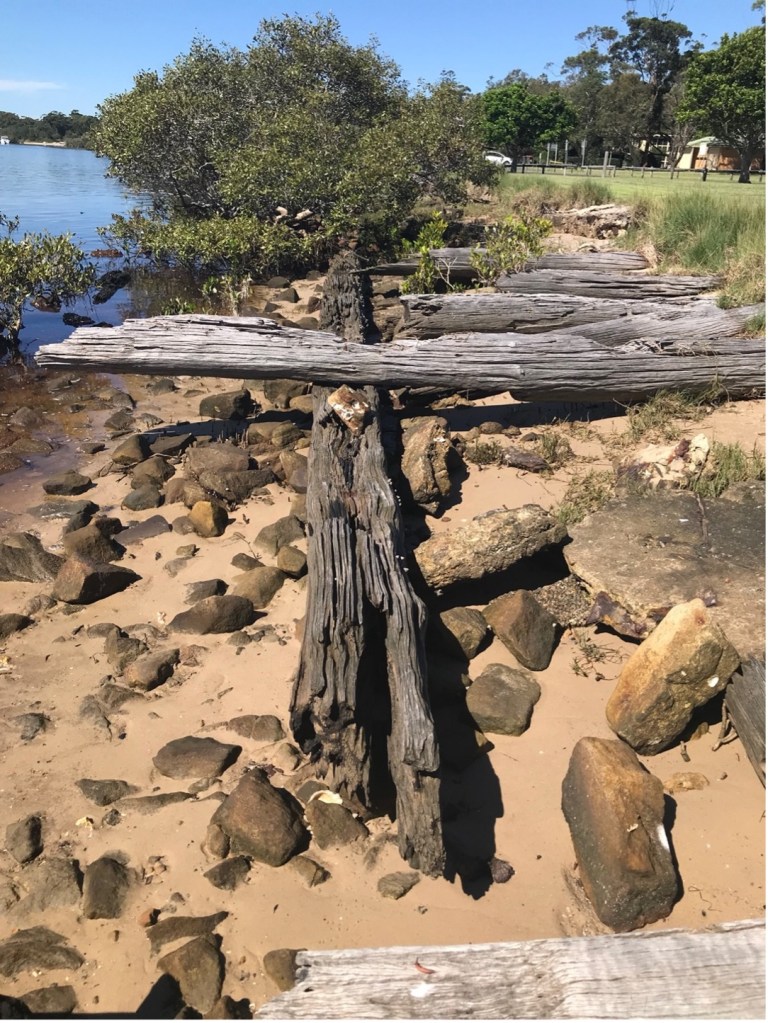
Remains of a timber wharf at Winda Woppa, near Tea Gardens, adjacent to a former timber mill [Author photo, 2023]
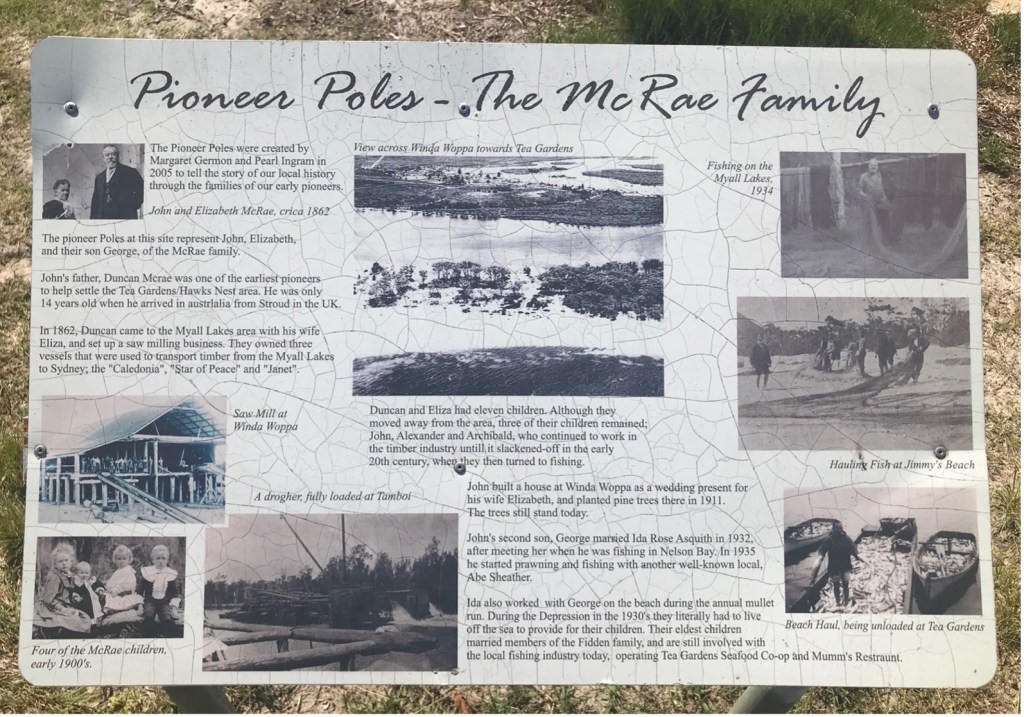
A plaque adjacent to the above timber wharf commemorating the McRae family who were involved with timber milling and is referred to in this paper [Author photo, 2023]
Concluding Comments.
By the early 1950’s, the halcyon period of timber getting and milling in the Port Stephens and Myall areas were over. As many areas of native forests had by then been cut, forest plantations were established to provide for further timber needs. Oxen and droghers were generally no longer used for the transport of timber. The large number of workers who carried out many types of dangerous timber jobs were no longer required due to mechanisation having taken over forestry operations.
Tea Gardens and the Myall entered a quieter period and were discovered by tourists.
Postscript
The memory of the droghers however lived on at Tea Gardens. For the 1988 Bicentennial celebrations, a committee was formed with one project being the building of a replica of a timber carrying drogher from the area’s early days.
Nota (a journal circulating at Hawks Nest and Tea Gardens), of 1 June 1985, page 2, reported:
‘A public meeting was held at the Community Hall on March 28 and April 18 and a committee was formed to organise projects and celebrations for the Bicentennary in 1988. The Myall River drogher plan has been accepted as the major community project for the area. This is to be used as a local history museum and information centre.’
Nota of 1 November 1985, page 5, reported that the drogher plan may fail to attract Government Bicentennial financial support:
‘Tea Gardens Hawks Nest Bicentennial committee’s attempts to attract a grant to build a replica of a drogher appear to have fallen on stony ground. …….
A spokesman, Mr Bob Atkins, said the drogher was still a talking point in the community but interest would soon die if there was no concrete decision from the Authority. The Great Lakes Shire Council has promised land adjacent to the swimming pool, to build and place the replica. Mrs Winn said the drogher would be a static replica that could house a museum and a tourist information office.
It would have the same dimensions as the timber built, paddle-wheel powered, punt-like vessels which ploughed the waters of the Myall River until the 1950s. She said the replica would probably be built from moulded concrete with the museum housed under a mock log stack on the deck and the tourist office on the bridge.’
Nota of 1 February 1986, page 3, further reported that the funding application had been rejected:
‘The Hawks Nest/Tea Gardens Bicentennial committee has missed out on a Federal grant to build a replica of a timber carrying drogher from the area’s early days. According to the publicity officer for the committee, Mrs Helen Freeman, the Bicentennial Authority notified it last month that it had been unsuccessful. No reasons were given by the Authority for its rejection of the request.’
Researched and compiled by Kevin McGuinness
May 2023

 Port Stephens - a history exploration