
Introduction
In the early 1920’s, following the conclusion of the First World War, the Australian Government coordinated the dispersal of captured war trophies, such as artillery and smaller machine guns, to communities for public display.
The display of the war trophies was meant to be a visual reminder of the sacrifice and heroism displayed by the armed services in the First World War.
War trophies were keenly sought by communities throughout Australia. Larger population areas were eligible to receive a large artillery item, while smaller communities, with at least 300 residents, were able to apply for a smaller item such as a machine gun.
The Port Stephens area was successful in receiving several captured machine guns for Nelson Bay, Tea Gardens and Williamtown.
Most areas that received war trophies displayed the smaller pieces in halls or other public buildings, while larger pieces were often displayed in parks.
Many smaller population centres did not have suitable indoor facilities for the display of the smaller war trophies, apart from local schools.
In New South Wales, the then Minister for Education Mr Thomas Mutch prohibited the display of war trophies in all public schools. This decision upset many councils, as their areas did not have adequate public indoor facilities in which their war trophies could be safely displayed.
The Port Stephens Shire Council was particularly outraged by the Minister’s decision and decided to challenge it. This paper sets out the Council’s public challenge to the Ministers decision, which received much newspaper attention at the time.
The Council was eventually successful in having the ban overturned but it took a change of government to achieve it.
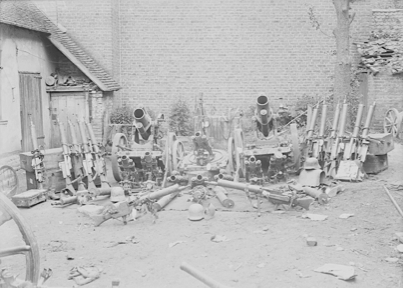
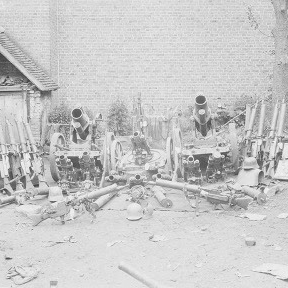
War trophies captured by Australian troops during battle of Hamel [Australian War Memorial]
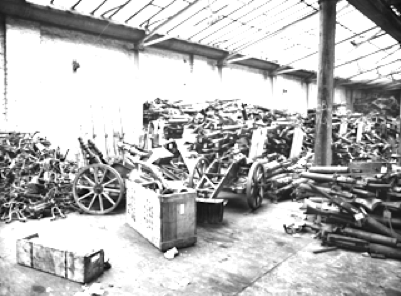
Captured German artillery stored at the Australian War Trophy Store in England [Australian War Memorial]
Port Stephens War Trophies
In response to applications made, several war trophies consisting of captured machine guns were allocated to towns in the Port Stephens area, such as Nelson Bay, Tea Gardens and Williamtown, by the Commonwealth Home and Territories Department.
Samples of the documentation relating to the Nelson Bay and Tea Gardens machine gun allocations during 1921 are set out below:
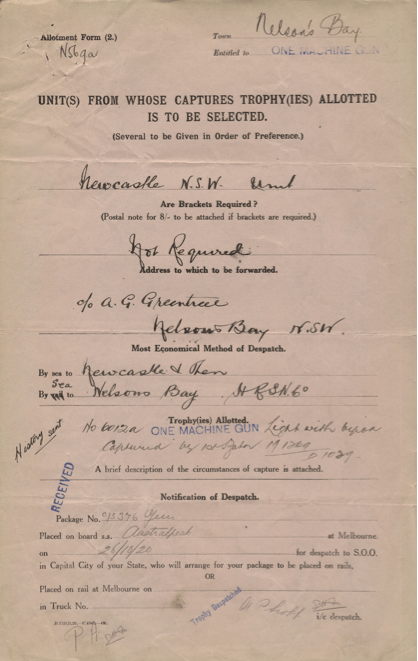
Allotment Form for Nelson Bay [Australian War Memorial]
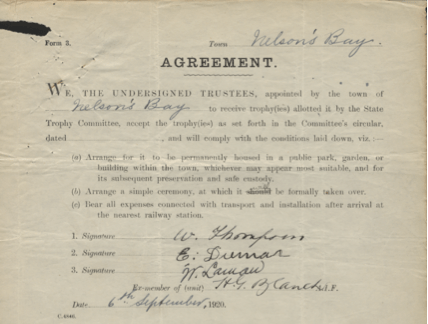
Agreement Form for Nelson Bay [Australian War Memorial]
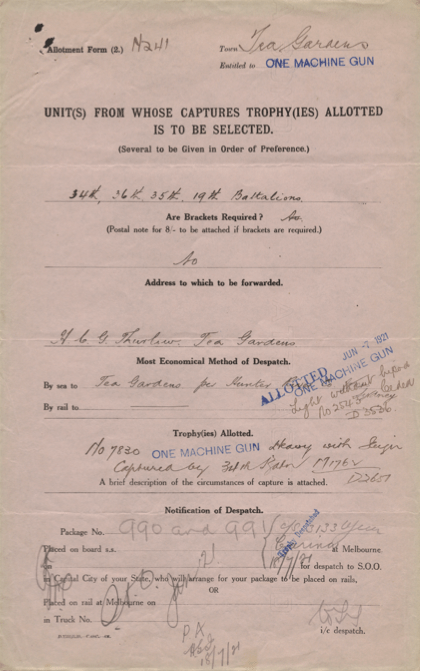
Allotment Form for Tea Gardens [Australian War Memorial]
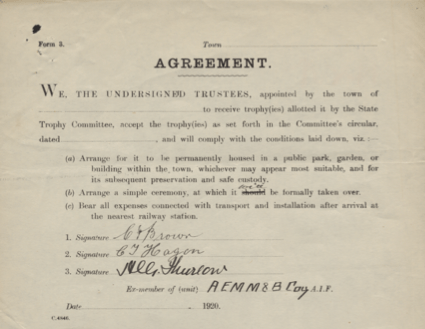
Agreement Form for Tea Gardens [Australian War Memorial]
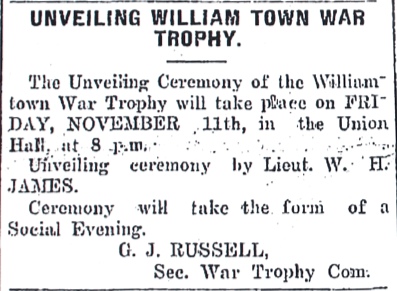
The Raymond Terrace Examiner and Lower Hunter and Port Stephens Advertiser of 4 November 1921, carried the following advertisement concerning the unveiling of their war trophy:
Education Minister bans display of War Trophies in schools – 1920
The Sydney Morning Herald of 11 September 1920, page 13, reported:
‘The Minister for Education, Mr. Mutch, has placed an embargo against the erection of machine guns as war trophies in public schools. Many districts have received donations of machine guns for exhibition as a commemorative trophy, in connection with the war, from the Commonwealth Government.
The Minister said yesterday that he has received many requests for permission to erect these guns in public schools; but, while fully realising the motive which has prompted those applications, Mr. Mutch does not regard a machine gun as a suitable trophy for exhibition in schools, and he has consequently been constrained to decline these requests. He desires it to be generally notified, therefore, that he will be unable, to entertain any application of this nature.’
Resentment of the Minister’s Decision – 1921
The Sydney Morning Herald of 24 March 1921, page 9, reported:
‘A communication from the New South Wales State War Trophy Committee was read at a meeting of mayors and shire presidents in Sydney yesterday to the effect that information had been received that the Minister for Education (Mr. Mutch) had issued an order prohibiting the exhibition of war trophies in the schools under his control.
The meeting carried a motion expressing surprise and keen resentment at such action, which, it was declared, was not in accordance with public opinion and feeling.’
The Daily Telegraph of 30 March 1921, page 6, further reported:
“Machine-guns are not going to be placed in our public Schools as long as I hold office,” said the Minister for Education yesterday. He was referring to the criticism of his decision against the exhibition of war trophies in the schools, and other statements made during his absence in Queensland. The Minister also commented on the fact that war trophies had been displayed at The King’s School [at Parramatta]. “I have no Jurisdiction over The King’s School,” he said. “As far as I am. concerned, they can fill the place with machine-guns if they wish.”
Port Stephens Shire Council voices concern – 1921
The Raymond Terrace Examiner and Lower Hunter and Port Stephens Advertiser of 8 April 1921, page 2, reported:
‘Councillor Shearman moved, and Councillor Lavis seconded that the cooperation of all shires and municipalities be asked to strongly protest against the action of the Minister for Education in refusing to allow war trophies to be affixed in our public schools. The Councillors unanimously condemned the action of the Minister, as unpatriotic and difficult to understand, and thought it absurd that such a stimulus to patriotism should be blocked by one man.’
Port Stephens Shire Council seeks cooperation from Councils – 1921
Port Stephens Shire Council wrote to all New South Wales Councils and sought their support of their resolution of strongly resenting the action of the Minister for Education in disallowing the setting up of war trophies in public schools, and declaring that if he will not withdraw his objection the people should claim the right of majority rule, and ignore the Minister’s order.
The defiant action by the council received much publicity from newspapers throughout New South Wales. The decisions of 128 councils on the Port Stephens Shire Council resolution was reported in the newspapers, with the following results.
The following 60 Councils decided that no action would be taken on the Port Stephens Shire Council motion:
Lismore; Bathurst; Manilla; Narrabri; Hay; Goulburn; Bexley; Liverpool; Kempsey; Turon; St. Marys; Armidale; Nymboida; Cessnock; Muswellbrook; Blacktown; Bourke; Terania (Lismore area); Goodradigbee (Yass area); Coreen (Corowa area); Balranald; Gunning (Crookwell area); Nambucca; Muswellbrook; Kyogle; Picton; Shellharbour; Inverell; Gloucester; Taree; Armidale; Braidwood; Bathurst; Nepean; Parkes; Manilla; Bexley; Forbes; Macleay; Tamworth; Dumaresq (Armidale area); Copmanhurst; Wingecarribee (Berrima area); Patricks Plains; Bourke; Meroo (Mudgee area); Cootamundra; Nymboida; Pictin; Coreen (Albury area); Manning River; St. Peters; Rockdale; Coraki; Muswellbrook; Braidwood; Nepean; Waradgery (Riverine area); East Maitland; Wallendbeen.
The following 57 Councils reported that support would be offered on the Port Stephens Shire Council motion:
Maitland; Gosford; Newtown; Goulburn; Molong; Tumut; Grafton; Lambton; Copmanhurst; Hamilton; Marrickville; Gundagai; Camden; Monaro; Bannockburn (Inverell area); Queanbeyan; Merewether; Camden; Wallsend; Singleton; Auburn; Macquarie (Wellington area); Singleton; Kyogle; Murrumburrah; Wollondilly; Hume (Albury area); Dorrigo; Raymond Terrace; Urana; Tomki (Casino area); Dorrigo; Nattai; Berrigan; Bathurst; Amaroo (Molong area); Lachlan; Tumut; Albury; Lambton; West Maitland; Demondrille (Murrumburrah area); Deniliquin; Bannockburn (Inverell area); Boolooroo (Moree area); Wingham; Central Illawarra; Ballina; Berrigan; Nattai; Wakool (Deniliquin area); Broken Hill; Lachlan; Wollondilly; Manning; Jemalong (Parkes area); Cessnock; Culcairn.
The following 11 Councils reported that support would be offered on the first part of the Port Stephens Shire Council motion, but not on the second part, which some councils thought was too militant:
South Grafton; Mitchell (Wagga Wagga area); Gundagai; Blue Mountains; Adjungbilly (Cootamundra area); Goobang (Parkes area); Waratah (Newcastle area); Ermington and Rydalmere; South Grafton; Wallarobba (Dungog area), Parramatta.
Minister reaffirms his decision – 1921
The Sydney Morning Herald of 12 April 1921, page 8, reported:
‘Further reference was made by the Minister for Education, Mr. Mutch, yesterday, to his refusal to allow machine and other guns to be exhibited as war trophies in Public schools.
Replying to statements made by the Rev. W. R. Milne, Mr. Mutch said the agitation in the display of these memorials appeared to him to have a political purpose behind it. The Government, he said, had given every assistance to local committees for the setting up of war memorials and trophies, although the Cabinet had taken the attitude that the exhibition of trophies generally was a matter of the Federal Government. The Minister added that in his opinion the ideals of courage and self-sacrifice could be better expressed in a thousand ways.
Mr. Albert Bruntnell, M.L.A., replying to Mr. Board, Director of Education, on the subject of exhibiting machine guns in schools, says that it will be impossible to conceal the gruesome phases of the war from our school children, for even the splendid honour boards, of which Mr. Board approved, were reminders of the death and sufferings of our brave men. When the children saw the star opposite a name on the roll of honour, they knew full well that it meant “killed in action.” Mr. Mutch and Mr. Board might combine in thwarting the desire of the parents and relatives of our devoted soldiers to perpetuate the memory of their heroic sacrifice by the display in the schools of the trophies of war, but they would never eradicate from the hearts of patriotic Australians the fervent ambition to honour the heroes by displaying the objects of their achievement.’
Approval given to display War Trophies in schools – 1922
It took a change of government in New South Wales for approval to be given to the display of war trophies in public schools. The Newcastle Morning Herald and Miners’ Advocate of 8 May 1922, page 4, reported:
‘Mr. Bruntnell, the [new] State Minister for Education, has reversed the decision of Mr. Mutch, the former Minister, who prohibited the placing of war trophies, on the premises of public schools. Mr. Mutch said that he did not object to the placing of war materials in schools, but he would not permit them to take the form of guns or other trophies captured by Australian troops from the enemy. It is not easy to discern the line of argument which guided Mr. Mutch’s decision in the matter. He did say that he did not believe in the glorification of war and that he did not think the minds of the young should be specially directed to the horrors of war.
It was never proposed that the placing of guns in the school grounds should be made an excuse for inculcating a love of war. To attempt to do such a thing would be utterly wrong and in total opposition to Australian public opinion. It would, however be just as easy to make an honour roll the base of a lesson glorifying war as it would be to make a captured gun the base for such a lesson. Australia cannot forget the war, and the facts, cannot be camouflaged out of sight. It would indeed be a bad thing to attempt to hide them from the children of the present day and of succeeding years. On the other hand the children should be taught the lessons of war. They should be told of the great heroism of the men who fought and died to save this country from the tyranny of Germany.
The war trophies which are in this country are some of the material evidence of the valour of Australian soldiers. To hide them from the gaze of the children would be a futile mistake. There will be wide spread satisfaction on account of the intimation that Mr. Bruntnell has not been long in wiping out the mistake which was made by his predecessor.’
Port Stephens Shire Council applies for permission to display War Trophies – 1922
The Maitland Daily Mercury of 12 May 1922, page 3, reported:
‘Councillor Shearman moved that a request be made to the Minister for Education that war trophies, such as guns, etc, which were small, be housed in public schools. There were several in the shire, and nowhere to put them. The public schools he thought the proper place. Councillor Cromarty seconded, and Councillor Graham supported.— The motion was carried.’
The full conditions pertaining to the lifting of the school display ban were reported in the Raymond Terrace Examiner and Lower Hunter and Port Stephens Advertiser of 14 July 1922, page 4:
‘Mr. T. H. Hill, M.L.A., forwards the following correspondence under date of 4th July, from the Under-Secretary of the Education Department: — Dear Sir,— With reference to your representations on behalf of Mr. H. G. Ralston, of Hinton, relating to the placing of War Throphies (Machine Guns) in Public Schools in the Port Stephens Shire in those centres where there is no suitable public building to exhibit them, I have to inform you that the Minister for Education prefers that such trophies be placed in a suitable position in the school play-ground, unless there is some special circumstances which would make it advisable to place them in the school buildings. In each case the matter is to be decided by the local inspector of the schools. It is suggested therefore, that Mr. Ralston communicate with Mr. B. C. Harksness, Inspector of Schools, Taree, with a view to obtaining his sanction as to the position in which they are placed.”
Concluding Comments
The Western Age of 18 August 1922, page 1, reported:
‘The work of distributing the war trophies allocated to Australia has now been practically completed. New South Wales’s share consisted of 164 guns, 196 trench mortars, and 1366 machine guns.’
The display locations of machine guns allocated to the Port Stephens region, and their current status is unknown to the author of this paper.
Further information relating to the First World War is published on this website and can be viewed at the following links:
First World War Memorials at Nelson Bay
First World War Memorial at Karuah – Port Stephens
When the First World War Came to Anna Bay – Port Stephens
Researched and compiled by Kevin McGuinness
April 2023

 Port Stephens - a history exploration