
Introduction
The first school in the Port Stephens area was established by the Australian Agricultural Company at Carrington. It was set up under the auspices of Commissioner William Edward Parry on 17 May 1830, to cater for the educational needs of the children of assigned servants and convicts. This school operated until the company ceased its operations at Carrington and transferred its administrative operations to Stroud.
In 1848, the National Board of Education set up the establishment of government schools in New South Wales.
The Public Schools Act of 1866 established two new types of schools, viz
- provisional (15-25 pupils) and
- half-time (at least 10 pupils) schools.
At provisional and half-time schools, parents were expected to provide the site and necessary school buildings and furniture for students.
Half-time schools had a travelling teacher appointed who managed two teaching posts in their area.
From 1 January 1867, all national schools with pupil numbers above 25 were renamed public schools.
In the Port Stephens area, government schools were established at:
- Hawks Nest around 1878 – by late 1888 it operated from Tea Gardens;
- Anna Bay in 1879;
- Salt Ash in 1883 (provisional)
- Pindimar in 1924.
The first mention of the pending establishment of a new school at Nelson Bay was published in the Sydney Morning Herald of 22 February 1881, page 5:
‘We are likely to have a Public school granted shortly, which will be a great boon, there being no school nearer than Myall.’
Provisional Half-Time Public School Established at Nelson Bay – 1885
A provisional/half-time school was established at Nelson Bay in 1885.
The first teacher at Nelson Bay was William Thompson who was appointed in December 1885. In 1886, Walter Weiss was appointed as a half-time teacher for both Anna Bay and Nelson Bay.
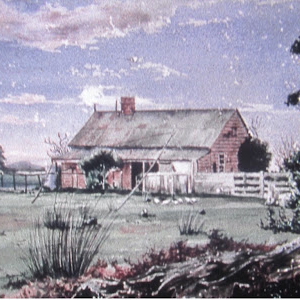
The school operated from one of former cottages on elevated land at Fly Point, Nelson Bay, that had been previously used by the Custom authorities. The site had been selected by the Department of Public Instruction in 1883.
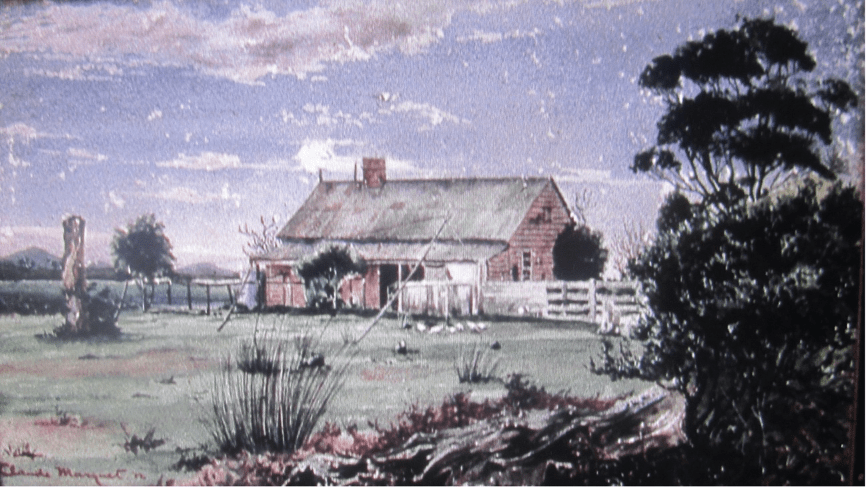
The cottage at Fly Point which was used as the first school. [Painting by Claude Marquet in 1912, held by University of Newcastle]
The school was granted fill-time status in 1890 and became known as Nelson Bay Public School.
The Newcastle Morning Herald and Miners’ Advocate of 23 December 1890, page 5, reported:
‘Five years ago [1885], the Educational Department granted a provisional half-time school in this port, under the charge successively of Messrs. Thompson and Weiss. In May of this year [1890], the school was raised to full time, under the care of Miss Bridekirk. This lady was trained in the Clarencetown Public School. She entered upon her duties with the highest credentials, and during her stay with us has given good solid proof of her zeal and ability as a teacher.’
A new school was opened on 15 July 1893 on the site of two acres of land donated by Captain John Dalton in Government Road at Westpoint.
Throughout the years of operation of the Nelson Bay Public School, the local community provided much support to both the teachers and the pupils, by assisting with activities such as the training of children for concerts and with fund raising.
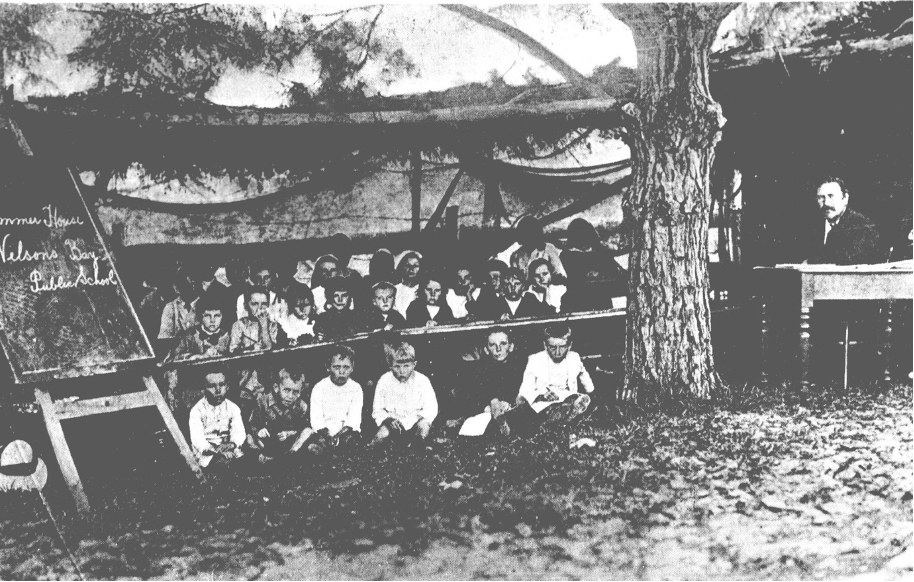
The ‘Summer House’ at Nelson Bay School [University of Newcastle collection].
Breaking-up for Christmas – 1890
The Maitland Mercury and Hunter River General Advertiser of 27 December 1890, page 6, reported:
‘On breaking up for the Christmas vacation, the friends of the school determined to mark their approval of the teacher’s work [Miss Bridekirk] by inviting the children to tea. The children and their friends formed a picturesque group as they assembled for tea on a grassy slope of this charming bay. After a bountiful repast, all joined in games and other diversions. Later in the evening, the schoolroom was crowded, while the children went through a programme of songs and recitations, much to the delight of the parents.
The chairman of the meeting urged upon the parents the necessity of cordially seconding the efforts of the teacher, quoting a memorable sentence of that eminent British statesman, W. E. Forster, who said “that a good education was the birthright of every English child;” and the chairman urged the parents to see that their children were not defrauded of their precious birthright. The necessity of a new schoolroom was pointed out, as the present cottage is totally unsuitable. This beautiful seaside resort is growing in popularity, and better school premises are, and will be, urgently needed. This very happy evening was brought to a close by stripping the Christmas tree of its various gay gifts. Each youngster went home rejoicing in the possession of something to gladden and make bright the Christmastide.’
Farewell to Teacher – 1891
The Maitland Mercury and Hunter River General Advertiser of 9 July 1891, page 6, reported:
‘The parents and the community generally have to regret the removal from this place of Miss Bridekirk, the teacher of our Public School. She received her training in the Clarence Town schools. During her twelve months’ work amongst us she has proved herself an excellent teacher, and has given the fullest satisfaction to the parents. On her coming over to bid a hasty farewell to the children and parents, Capt. Dalton placed his steamer the “Tahlee” at the disposal of the parents and scholars. A large party embarked here, and the steamer conveyed Miss Bridekirk to Sawyer’s Point [Karuah]. The ride of 15 miles through the superb scenery of Port Stephens was thoroughly enjoyed. With hearty cheers, and many wishes for her future success, we bade adieu to a public servant of high character and ability.’
New School Necessary – 1892
The old cottage at Fly Point proved to be unsuitable for the developing needs of the children. The land offered by Mr. Dalton was subsequently chosen as the site for the new school.
The Australian Town and Country Journal of 30 July 1892, page 17, reported:
‘A Public Meeting of the residents was held on Saturday afternoon, at the schoolroom, for the purpose of discussing the necessity of having a new school erected. After some discussion a resolution was carried to the effect that the Government be requested to build a new school on the land at present owned by Mr. Cromarty, if the land can be secured at a reasonable cost, and, if not, on the land that has been generously offered by Captain John Dalton, free of cost. The latter piece of land is two acres, in area, and is in a splendid position.’
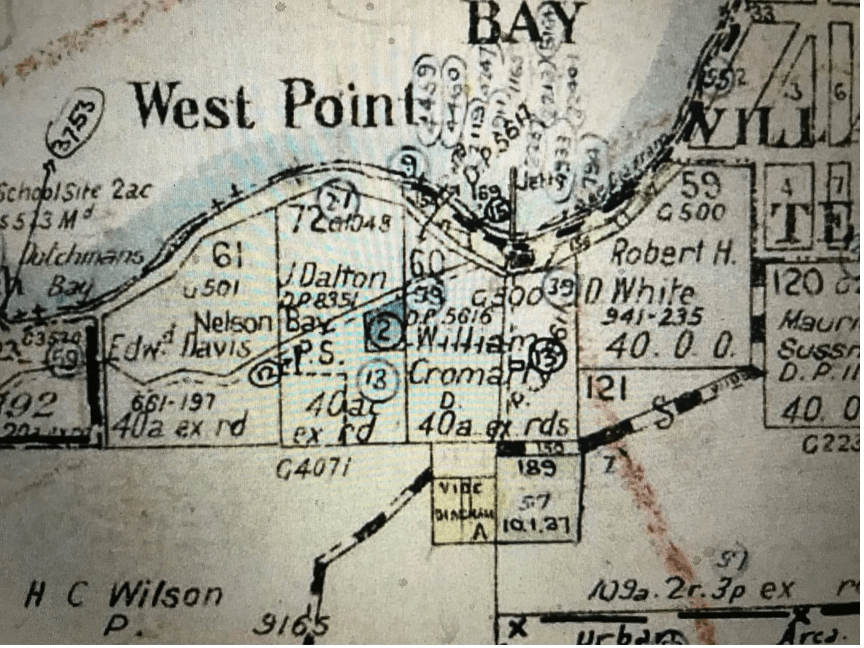
Parish map showing land owned by Captain John Dalton at West Point, Nelson Bay, with the land donated for school purposes marked by a circled number 2.
New School Opened – 1893
The Maitland Mercury and Hunter River General Advertiser of 20 July 1893, page 3, reported on the opening of the new Nelson Bay school:
‘The people of Nelson’s Bay, Port Stephens, assembled in large numbers on Saturday last to celebrate the opening of the new Public School. Previously the school had been held in a cottage, and owing to its crowded and insanitary condition, the residents urged the Educational Department to erect them suitable premises. Mr. Hart, the member for the district, used his influence but without success. Capt. Dalton offered to convey to the Department two acres of freehold land, centrally situated, on condition that a school was built. The offer was accepted, and this beautiful Bay rejoices in a building, which for design, workmanship, and convenience reflects credit upon the officers of the Education Department.
On the afternoon of the 15th instant the building was crowded to listen to a representative from each branch of the Legislature. The Hon. R. H. D. White occupied the chair. In well-chosen words he commented on the value of education.
He pointed out to the children that these were their happiest days—the seed-time of their lives—and urged them to make the best use of their privileges, and to imitate the example of Solomon, who asked earnestly for knowledge and wisdom. He then called upon our excellent member, Mr. Hart, to declare the school open.
Mr. Hart delivered a most interesting and instructive speech. He spoke of his first visit to the bay more than thirty years ago, when there were but two selectors between Nelson’s Bay and Raymond Terrace. He little thought that he should live to see such a contrast, and to assist at the opening of a beautiful building for the instruction of the youth of the place. He then gave a resume of the educational history of the colony, grouping his facts into four distinct periods. He showed how the per centage of illiterates had decreased in each succeeding period. He dwelt upon the generous grants devoted to the education of the people, amounting in 1892 to the sum of £847,790. He closed a really admirable address by declaring the school open.
After the children and visitors had partaken of tea, and had indulged in a variety of sports, the room was again crowded, under the presidency of Mr. Hart, to witness an entertainment by the children. The songs, recitations, and other exercises reflected great credit upon the teacher, Miss Sladden, whose care for the welfare of the children is highly appreciated by all concerned. Donations to the prize fund were announced from the Hon. R. H. D. White, Mr. Hart, and Mr. A. Price ; and Mrs. Parish, a visitor from Sydney, gladdened the hearts of the juveniles by the gift of a pound’s worth of toys. The National Anthem closed a celebration which marks a distinct step in the progress of the prettiest seaside resort north of Newcastle.’
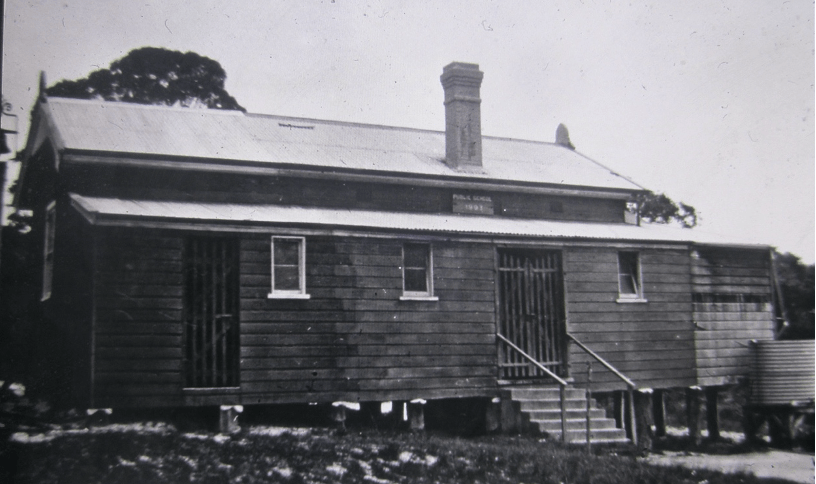
The school erected on land donated by John Dalton, adjoining Government Road, Nelson Bay. The school bell can be just seen on the far left. The plaque above the stairs reads ‘Public School, 1893’.
Prize Giving – 1893
The Newcastle Morning Herald and Miners’ Advocate of 28 October 1893, page 3, reported:
‘On Saturday last a distribution of prizes in connection with the Public School took place. This is the second time within the year that these fortunate young folk have been feted and presented with gifts. Upon this occasion the prizes consisted of a number of large, handsomely-bound books. There was a book for each child attending the school, and in addition to these special prizes were given in each class for arithmetic, spelling, and needle-work.
The children, with their parents and a number of friends, assembled at the schoolroom at 3 o’clock. Mr. James Dalton, who takes a warm interest in the children, conducted the examination for prizes. The competition was very keen, and the excellence of the work reflects great credit upon the pupils and their teacher. If these subjects are to be taken as samples of the rest of the school work, Miss Sladden may confidently look forward to a high skill mark at the forth-coming regular inspection.
The names of the prize-winners in each class are as follow:—Third class: Rachel Davis, arithmetic; Wm. Laman, spelling; Lucy Glover, sewing. Second class: Ernest Bagnal, arithmetic; Walter Glover, spelling; Ethel Johnson, sewing. First class: Henry Lambourne, arithmetic; Grace Lambourne, spelling; Gortie Glover, sewing. Miss Simpson judged the sewing and presented the prizes. The children, after being regaled upon biscuits and lollies, then departed for their homes.’
Bush Fires Threaten School – 1894
The Sydney Morning Herald of 13 November 1894, page 5, reported:
‘A very large bush fire reached Nelson’s Bay about 12 o’clock today, and threatened the total destruction of Thompson’s Sea Breeze Hotel, the telegraph office, and the Public school. Only for the way in which the citizens of the Bay worked the three places named would have been destroyed, as a southerly gale was blowing at the time. The country for about five miles around is all burnt, the telegraph poles being burnt down, causing an interruption of the line. The fire was burning at 8 p.m., but all danger is over. The newly-fenced cemetery has suffered severely by the fire.’
Arbor Day – 1896
The Newcastle Morning Herald and Miners’ Advocate of 10 August 1896, page 7, reported:
‘Arbor Day was held on Friday last at the Public School here, under the supervision of the teacher (Miss Sladden). All the children set a tree each, and they now look eagerly towards the annual Arbor Day, as, thanks to their energetic teacher, they are always provided with good things after each tree planting is finished in the nature of cakes, lollies, &c.’
School Library Opened – 1897
The Newcastle Morning Herald and Miners’ Advocate of 31 March 1897, page 3, reported:
‘The library of our local Public School was opened on Friday night by Mr. Jas. Dalton, in the presence of a large number of people. The school was nicely decorated with ferns and flowers for the occasion by Miss Sladden and school children, and their work was appreciated by all. The children gave an entertainment of songs and recitations. Mr. R. A. Price, M.P., had consented to open the library, but misfortunes had befell him, and he did not arrive till the conclusion of the meeting.
Mr. James Dalton, on declaring the library open, eulogised Miss Sladden on her success in collecting so much money for the purchase of over 100 suitable books for young and old, and gave as his opinion that the Government should give £1 for every £1 collected to such libraries, as the books actually became the property of the State. After the usual vote of thanks had been given, a most successful meeting was brought to a pleasant termination by all singing ‘God Save the Queen.’ ‘
Concert in Aid of School Library – 1899
The Newcastle Morning Herald and Miners’ Advocate of 25 April 1899, page 5, reported:
‘A concert in aid of the Public School Library took place in Lund’s Hall, Nelson’s Bay, on Saturday night, and was a decided success. Mr. T. Cragg was in the chair. The concert opened with an overture by Mrs. C. Laman, which was nicely executed. Mr. C. Hannell gave the “Village Blacksmith” in his usual masterly style. Mr. Knight then introduced the gramaphone, which was highly appreciated. Miss Williams gave for her first item “The Venetia Boat” very nicely. Mr. G. Priest followed with the comic song “The Ragged Coal.” Little Miss Millie Noble then gave the old favourite “Daddy,” which was splendidly received by the audience. Miss Curry, who has a nice voice, sang “What might have been.” Mr. T. Cragg gave the serio comic “Up in a Balloon.” Miss Shannon sang very nicely, and Mr. E. Garner contributed “A man that’s done wrong to my parents.” The second part opened with an overture by Miss L. Noble. Mr. C. Hannell then gave “In Happy Moments,” Miss Millie Noble the recitation “Papa’s Letter,” Miss Shannon the song “Alice, where art thou,” and Mr. T. Cragg, whose recitation “A woman of mind,” causing roars of laughter. Mr. Garner then gave a comic song, and Miss Curry the song “Can a boy forgot his mother.” Mr. Morris rendered “Hanlan, the boat puller.” Mr. P. Hannell sang very nicely; Miss. Williams contributing as her second item “The Holy City.” Miss Millie Noble following with the recitation “Little Jim.”
Mr. Dalton, on behalf of Miss Sladden, moved a hearty vote of thanks to the performers, who had assisted at the concert, and pointed out that influence should be brought to bear on the Government to grant £ for £ raised by the public for their library, as the Government was the gainer, since the books actually became the property of the State. Mr. J. Noble seconded the motion. The audience then sang ‘God Save the Queen,’ bringing one of the best concerts over held in Nelson’s Bay to close.’
Farewell to Miss Sladen – 1902
The Newcastle Morning Herald and Miners’ Advocate of 2 May 1902, page 3, reported:
‘A farewell tea and concert was given on Saturday to Miss Sladden, of Nelson’s Bay Public School, prior to her departure from the district. Mr. J. Dalton occupied the chair, and an excellent musical programme was provided. During the evening a marble clock was presented to Miss Sladden by the Public School and Sunday School children, and a solid silver cruet and biscuit barrel by the people of Nelson’s Bay.
Mr. Dalton, in making the presentation, spoke in eulogistic terms of Miss Sladden’s worth and good citizenship, and of the high esteem in which she is held throughout the district. Captain Dalton replied for Miss Sladden, and referred in the highest terms of praise to Miss Sladden. The musicall item, included:—Duet (piano and violin), Mrs. C. Layman and Mr. H. Streathfield; Mr. H. Furlougher sang “Au Revior,” and Miss Glover “Dreaming as She Sleeps.” An action song by the children and a few recitations by some of the junior pupils were much appreciated, as also were Mr. Dalton’s graphophone selections. The singing of ‘God Save the King’ brought to a close an enjoyable evening. Praise is due to the ladies of Nelson’s Bay who provided lavish refreshments and worked so earnestly to make the function a success.’
The Maitland Weekly Mercury of 17 May 1902, page 12, reported that the Public Service Board has approved of the transfer of Miss M. Eastwood, from Dungog to Nelson’s Bay Public School, as teacher.
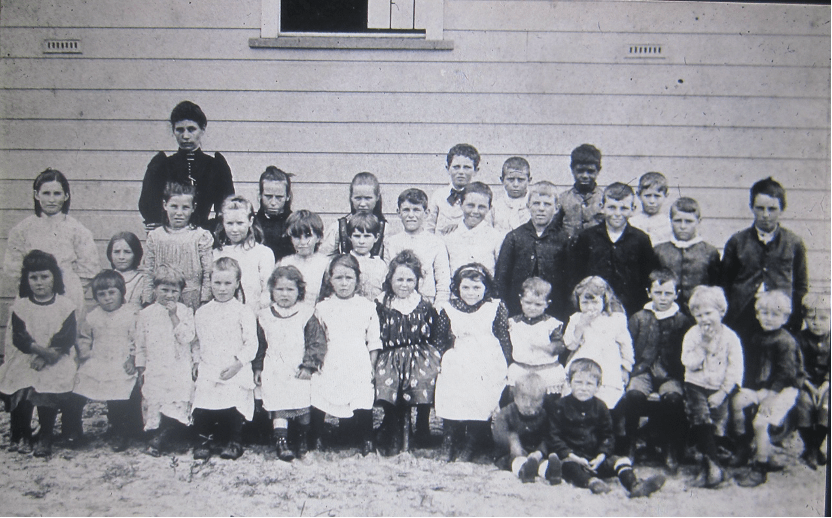
Miss Sladen (later Mrs. Chalmers) with her pupils outside the Nelson Bay school [University of Newcastle collection].
School Concert in Aid of the School Library – 1903
The Newcastle Morning Herald and Miners’ Advocate of 6 October 1903, page 6, reported:
‘A concert given by the pupils of the Nelson’s Bay Public School in aid of their library took place in Lund’s Hall on Friday night, and was a great success. Mr. E. J. Paten, Inspector of Fisheries (chairman), in opening the proceedings referred to the death of Mr. Kevin, Inspector of schools, Raymond Terrace, who, he said, was the father of school libraries.
The hall was packed, even standing room not being obtainable. The training of the children showed great care on the part of their teachers (Miss Eastwood, Mrs. Chas. Laman, and Miss C. Lund). The following programme was given in a creditable manner :- Maypole Dance, by school children; Action Song, “There was a Fly,” children; recitation, “Easter Morning,” Ivy Noble’; Action Song, “Some Folks,” children; recitation, “Little Pauper,” Vera Olive; song, ‘”Tit for Tat,” Mrs. C. Laman; recitation, “Housewife’s Tragedy,” G. Roberts; action song, “Little Washorwomen,” children; dialogue, “Geese,” Ivy Noble and Emma Glover; song, “Marguerite,” Misses Lund; recitation; “Bush Christening,” J. Lambourne; pianoforte duet, Mrs. C. Laman and Miss C. Lund; recitation; Hodge and the Vicar,” E. Glover; song “Won’t You Buy,” children; recitation, “Boy Rights,” H. Nicholls; action song, “This is how we beat the drum,” children; recitation, “Little Match Seller,” Ella Noble; song, “Dreaming as She Sleeps,” N. Lund; action song, “Song of the Wood,” children; recitation, “Man from Snowy River,” Mr. M. Blanch.
After a short interval, a cantata, entitled “Red Riding Hood’s Rescue,” was given by the children, the following characters being well sustained :—Miss Carrie Lund (Mother), Miss Annie Lambourne (Buttercup), Miss Nettle Lund (Red Riding Hood), Miss Ivy Noble (Rose), Master J. Lambourne (Robin), Master Geo. Roberts (Woodman), and Mr. Thos. Mogork (Wolfe). Pretty dresses of the children were shown to advantage by the use of limelight, manipulated by Mr. Griffiths and Mr. S. Thompson. A vote of thanks was accorded to Miss C. Laman and Miss Carrie Lund for assisting to train the children, also to Mr. Paton, the chairman.’
Fatal Accident in the School Grounds – 1906
The Sydney Morning Herald of 16 June 1906, page 12, reported:
‘Arthur Laman, aged 13 years, son of Mr. Walter Laman, met on Wednesday with a painful accident, which terminated fatally today. It appears that the lad was playing with other children in the local school grounds, and had climbed a tree. He jumped off the limb, alighting on a tree which had been broken off at the top. This penetrated his bowels fully nine inches. The poor lad was taken to Anna Bay, where he was examined by Dr. Meredith, of Raymond Terrace, who ordered his removal to Newcastle Hospital. He lingered in that institution till 7 o’clock this morning. The coroner found that Laman died from injuries accidentally received.’
Dr. Danysz Donates to Library Fund – 1906
In 1906 the Council of the Australian Pastures Protection Board brought Dr Jean Danysz, a well-known bacteriologist with the Pasteur Institute in Paris, to New South Wales, to conduct experimentation on rabbit extermination at Broughton Island, near Port Stephens, using a virus he had developed in France.
The Newcastle Morning Herald and Miners’ Advocate of 4 December 1906, page 5, reported:
‘The [Nelson Bay] public school children’s library fund has been augmented by a donation of £1 from Dr. Danysz, who, with his assistant, is at present a visitor at the bay.’
New Teacher Appointed – 1909
The Raleigh Sun of 9 July 1909, page 6, reported on the appointment of Leslie Francis Barry-Cotter as a teacher at Nelson Bay school:
‘Mr. Barry-Cotter, teacher of Bellawougarah public school for several years past, has been transferred to Nelson’s Bay, in the Port Stephens district, and left last week for his new sphere of labours.’
Mr. Barry-Cotter was destined to become a well-known person in the Port Stephens district. Firstly, he introduced a forward-looking nature study course at the school which involved a worldwide study of fish. Secondly, after he resigned as a teacher and while still at Nelson Bay, he became a director of the newly established ‘Port Stephens Fire Brick Company‘, which undertook the manufacture of clay Fire Bricks at Swan Bay, Port Stephens.
Study of Fish Life – 1912
The Sydney Morning Herald of 27 August 1912, page 5, reported on the nature study course:
‘Some time ago an interesting departure in nature study was made by the Nelson’s Bay Public School and the results achieved have been of a most satisfactory character. It was decided to take to the subject of fish life as a nature study. In the first place a bureau of information was organised and in the words of the teacher, “in so doing we had no idea of the countless wonders that were to be found close around us and the inexhaustible supply of information to be gleaned from our environment.”
It was decided to write to the chief fishing centres throughout the world requesting literature pertaining to the industry. The senior pupils also communicated with those of the schools in the chief oversea fishing centres says Mr. L. Barry-Cotter and they told of the local fishing industry, explained the object of writing are requested the exchange of ideas, postcards and general information dealing with fish and fishing. After this the pupils made a collection of the various specimens of local fish and classified them under their scientific names. The interest treated in this way was contagious. The owners of the fishing boats entered into the spirit of the undertaking and brought to the schools many interesting specimens. In this way each week something new was brought to the collection.
Great excitement naturally prevailed when the English and foreign mail arrived. A number of heavy packages were received. One in particular arrested attention. It was from Japan and contained a full account of the fishing and oyster industries of Japan, and was sent by the Bureau of Fisheries at Tokyo. The work was translated into English in parts, and was accompanied by numerous prints of the actual cultivation. “We marvelled at the size of the cultivated area said Mr Barry-Cotter “and recalled our own local flats where the same cultivation would apply and as our town is a fishing port, no doubt the boys, many of whom will become fishermen, will determine to emulate in the future the practical methods of the Japanese.”
Soon after this a batch of letters arrived from Aberdeen, replies to the letters of the senior pupils. Each pupil read his or her letter to the class. They told of the trawlers of the granite city and their work, the fish markets, means of distribution, and other interesting information. Another letter arrived soon after this the—three beautifully illustrated books from the Prince of Monaco.
These were followed at short intervals by communications and literature from Samoa, Alaska, Amsterdam, Havre, Washington (U.S.A.), California and Florida, until the school library now consists of about 1000 pages of literature dealing with the oyster, the latest nets and means of capture, the operations of the trawlers, and kindred information. These books are read by the senior pupils with the greatest interest; most of the books are well illustrated, and serve to show that with the most conservative estimate, there is a great wealth in the industry at the doors of the pupils.
Nearly every Saturday excursions are made to the numerous bays for research work, and often on holidays the net is got ready, and motor launches and boats requisitioned, and large captures of fish are generally made. The boys learn to shoot the net without the assistance of the teacher. Any new species discovered is placed in the specimen bottle with formalin, date of capture and locality being marked. The edible fish are distributed among the boys and the return journey made. On the next school day the new specimens are discussed and classified, and the available literature bearing on them is consulted.
“I have found these excursions of the utmost value,” explained Mr. Barry-Cotter, “and with their aid nature study has become particularly interesting, and a medium of much correlation of other objects. The children are individual collectors, and the value of the bureau is extending beyond the school. The parents have visited on many occasions, and in so doing have come into closer touch with the school. It seems very evident that our efforts will inculcate in a rising generation a desire for improved methods and that an effort will be made to be more up-to-date with appliances, boats, etc. …..
“Briefly our method is to take each fish separately and learn all we can about it. We take what is locally known as the bait fish. After looking up Mr. David Stead’s, “The Fishes of Australia,” we find that the proper name is “The Angler,” …….
The following week we may take the blenny, of the family Blenniidae. We learn that it is common in the Indian Ocean, but less common in the Pacific; also that it is a sea snake and is supposed to be venomous; then an octopus—we recall the old stories of the ships of the ancients that were supposed to have been dragged to the bottom of the Mediterranean by these monsters. We turn up Webster and find that the greatest known length from tip to tip of arm is 14ft. and so on.” ‘
In 1925, one of these supposed sea monsters was reported off the Port Stephens coast in the vicinity of the Point Stephens lighthouse, by the steam ship St. Francois Xavier.
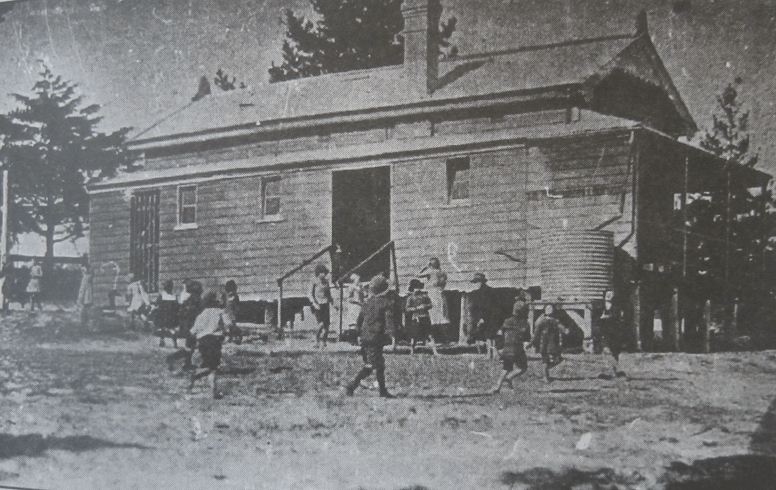
Children at play, Nelson Bay Public School, circa 1913. The veranda is located on the right of the building and the school bell is just visible on the far left. [Published in ‘The Port Stephens Story’, compiled by M. A.Bartlett]
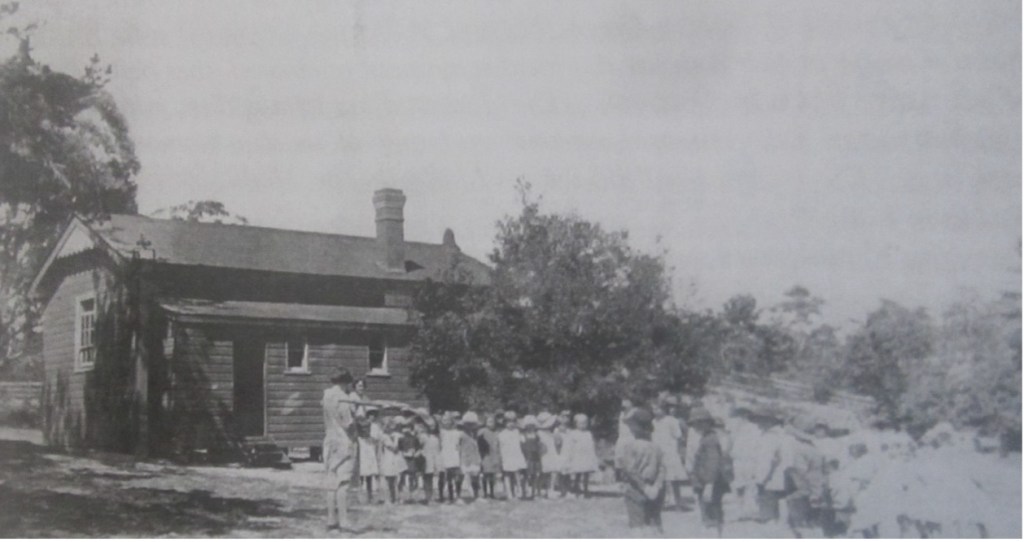
Nelson Bay Public School – 1915 [Tomaree Family History Group Nelson Bay NSW Inc.]
Nelson’s Bay Parents’ and Citizens’ Association and Progress Association formed – 1917
The Raymond Terrace Examiner and Lower Hunter and Port Stephens Advertiser of 16 February 1917, page 3, reported:
‘A large and representative meeting of residents of the pretty little village of Nelson’s Bay was held in the local public school on the 8th, at the instance of Mr. A. G. Greentree the local teacher, with a view to forming an association for the advancement of the locality. Mr. W. Thompson was voted to the chair, and briefly introduced Mr. Greentree, who then clearly explained the object of the meeting, and pointed out the many ways in which an association could accomplish useful work.
An informal discussion took place in which several speakers participated, after which it was unanimously decided to form an association to be known as ‘The Nelson’s Bay Parents’ and Citizens’ Association and Progress Association.’ The following officers were elected: President, Mr. C. Deamer; Vice-Presidents, Mrs. Tullis, Mr. Payten and Mr. W. E. Lamen; Secretary, Mr. T. Lamen; Treasurer, Mr. Greentree; committee, Mesdames W. Thompson, W. Lamen. C. Diemar, Miss Olive, Messrs. W. Thompson, E. Diemar, J. Lund, H. Thompson, and S. Lamen. The annual membership fee was fixed at 1/- for gentlemen and 6d for ladies. Meetings are to be held fortnightly, and it is hoped that members will roll up and work harmoniously for the good of the place.’
School Piano Fund – 1917
The Raymond Terrace Examiner and Lower Hunter and Port Stephens Advertiser of 11 May 1917, page 3, reported:
‘A concert in aid of the School Piano Fund was given in the local hall on the 3rd inst, and notwithstanding the unfavourable weather was a great success. The stage and hall were tastefully decorated with flags and ferns, and presented a gay appearance. Mr. Greentree presided, and a most enjoyable programme was submitted, and each item was well received by the audience, the following were the items rendered :
Instrumental duet Misses Olive and Leman, solo, Miss Hilda Laman ; song, Mr O. Robinson ; recitation, Miss Hazel Greentree; song, Miss Phena Thompson ; song Mrs Phyllis Thompson ; song, Mr. R. Robinson ; song, Miss Gladys Rush ; song, Miss Dorothy Thompson ; comic song, Mr. Phil Jenkins ; recitation, Miss Norsen Merrin ; character sketches, Misses Olive and Blanch ; song, Mr. W. Rush ; recitation, Mr. J. Lambourne ; song, Miss Melva Deamer ; humorous dialogue, Misses Olive, Thompson, Rush, Mogork, Laman, and Diemar.
At the conclusion of the entertainment, Mr Greentree in a brief address explained the object of the entertainment, and thanked one and all for the assistance given, and the entertainment concluded with the singing of the National Anthem.’
Celebration of Empire Day – 1917
The Maitland Daily Mercury of 28 May 1917, page 2, reported:
‘Empire Day was celebrated at the local Public School on Thursday, when special reference was made during the morning to the significance of the day. In the evening, a gift evening, under the auspices of the local Parents and Citizens’ Association was arranged to provide comforts for the soldiers at the front. Mr. A. G. Greentree presided, and the room was well filled with parents and friends of the children.
Stirring patriotic addresses were delivered by Mr. W. Thompson and the chairman. The school children contributed a programme, of patriotic songs, choruses, and recitations, and showed evidence of careful training. They were ably assisted by Miss Minnie Diemar, Mr. Phil Jenkins, and Mr. Jack Lambourne. As a result of the effort a case containing about 100 articles is being despatched to the War Chest [a public charity], for transmission to the boys in the trenches.’
Fund Raising – 1917
The Raymond Terrace Examiner and Lower Hunter and Port Stephens Advertiser of 20 July 1917, page 3, reported:
‘A ‘silver coin’ entertainment, promoted by our local teacher under the auspices of the local Patriotic League, eventuated in the local school-room on the 29th ultimo, to raise funds to purchase material for the local knitting and sewing class.
A programme of choruses, songs and recitations was rendered by the school pupils and friends. A spelling bee for a prize donated by Mr. Greentree created much interest amongst the children, the winner being Master Jim. Deamer. It is proposed to hold similar entertainments monthly, the proceeds to be devoted to local patriotic movements.’
Unveiling of First World War Roll of Honour – 1918
The Raymond Terrace Examiner and Lower Hunter and Port Stephens Advertiser of 11 January 1918, page 3, reported:
‘In the local public school on Friday last an honour roll, erected in honour of old boys of the school and others who enlisted from the locality, was unveiled by Mrs. W. Laman and Mrs. E. Diemar. The room was filled to overflowing, and the gathering included many visitors. The chair was occupied by Mr. A. Greentree, and seated on the platform were the parents of the boys at the front, Private G. Lambourne (returned), and leading district residents.
Proceedings commenced with the singing of the National Anthem, after which a programme of patriotic songs, choruses, etc., was rendered by the school children and Misses Olive, Laman, Thompson, Rush, and Mr. Rush Addresses appropriate to the occasion were delivered by Messrs. W. Rush, W. Jamieson, W. P. Lance, D. Jordan and the chairman. The unveiling ceremony was performed by two mothers of boys at the front, to the strains of ‘Rule Britannia.’
The board, which is of polished Queensland maple, is of massive design, with the Union Jack and Australian flags and Coat of Arms above the panel, on which the following names are inscribed in letters of gold: J. Dalton (killed), H. Blanch, S. Smith, A. Davis, G. Lambourne, J. Murray, C. Smith, G. Laman (killed), H. Laman (missing), A. Diemar, J. Davis, L. Bagnall, Bertie Bennett, G. Glover (killed), G. Roberts, C. Bagnall, D Johns. The board was designed by Mr. P. Jenkins, and the work was executed in Sydney under his supervision, to whom the local residents are indebted for assistance. Proceedings terminated with the National Anthem, cheers for the King and Allies, boys at the front, the parents of the boys, and the chairman.’
Persons who volunteered their services from the local area were also commemorated on the War Memorial in Apex Park at Nelson Bay.
Farewell to Gunner Aubrey C Olive, a Former Pupil – 1918
The Raymond Terrace Examiner and Lower Hunter and Port Stephens Advertiser of 15 March 1918, page 3, reported:
‘Gunner Aubrey C. Olive, son of Mrs. E. Tullis, of “The Anchorage,” Nelson’s Bay, was home on final leave last week, when advantage was taken to tender him a farewell. On Monday, 4th instant, he was entertained at a social evening at Mr. E. Diemar’s residence, where music, singing and games whiled away a very pleasant evening. …….
Yet another surprise was in store for Aubrey, as on Wednesday morning he was accorded a farewell in the local public school by the parents and pupils. As an old boy of the school, Gunner Olive has accepted the honor of representing the Nelson’s Bay public school as the school recruit, and will be the especial care of the boys and girls of the school. On assembling in the school room, where there was, in addition to the children, a large number of parents and citizens, the teacher in charge (Mr. Greentree) expressed on behalf of the pupils the gratitude felt for Gunner Olive in going forth as a representative of the school to assist in the great struggle for liberty. Mr Paton also added his tribute in an address full of good advice to the children. Several songs and choruses were rendered by the children and friends, and proceedings concluded by all singing the hymn ‘”As a Nation we Implore” and the National Anthem. A large crowd assembled at the wharf to witness the departure of Gunner Olive, who makes the eighteenth recruit to enlist from Nelson’s Bay.’
Farewell to Private George Lambourne, a Former Pupil – 1918
The Raymond Terrace Examiner and Lower Hunter and Port Stephens Advertiser of 5 July 1918, page 3, reported:
‘On Wednesday, 26th ult. Private George Lambourne was entertained at a social evening by the citizens of Nelson’s Ray, in the local Public School, prior to his departure for the front. The school room was tastefully decorated for the occasion, the union jack and Allies’ flags being interspersed with ferns and wattle. Mr. A. G. Greentree presided, and seat-ed with him on the platform were Private Lambourme, Mr. H. Lambourne, Senior, father, and the brothers and sister of the young recruit. A first class musical programme was rendered by local and visiting amateurs, among those assisting being Mrs. C. Diemar, Miss Kossman, Misses H. Laman, Phena, Phillis, and Dorothy Thompson, Mrs. J. Lamborne, Miss Dixon., and O. F. Robinson. Miss Freda Laman played the accompaniments in her usual efficient manner.
The chairman gave an address, eulogistic of the pluck and determination of the guest of the evening, and humorously referred to the records of George’s school days, as gathered from the school records, and congratulated the soldier on his manliness as displayed at all times. Reference was made to the fact that this was the third occasion on which he, Private Lambourue had offered his services, being rejected soon after the opening of hostilities; offering again in September, 1915, he was accepted, and reached Egypt, from which place he was invalided home, reaching Sydney in May 1916, and was accorded a fitting welcome on his arrival at Nelson’s Bay.’
The Red Cross Day Fund Concert – 1918
The Newcastle Morning Herald and Miners’ Advocate of 8 May 1918, page 7, reported:
‘As the result of the local effort to assist the Red Cross Day Fund, £12 5s was raised at a concert and sale of gifts in the Nelson’s Bay Public School on Saturday last.’
Peace Celebrations at School – 1919
The Raymond Terrace Examiner and Lower Hunter and Port Stephens Advertiser of 25 July 1919, page 3, reported:
‘Peace Day was celebrated in this seaside hamlet last week end. On Friday afternoon a gathering of parents and children assembled at the local public school, when peace medals were distributed to 112 children. A short programme was rendered by the school pupils, including Kipling’s Recessional Ode, and Thanksgiving Hymn for Peace.
The teacher in charge read the address prepared by Mr. Bean, concluding with the National Anthem. On Friday evening the Rev. R. Mowbray conducted a service in the local church, when, there was a large congregation. Special reference was made to the Peace celebrations, and appropriate hymns were sung. Saturday 19th, was devoted to a monster picnic and sports held on the local park. The day was perfect, and a most pleasing peace celebration resulted. …….
The whole of the functions were organized and carried out under the auspices of the Nelson’s Bay Parent’s and Citizen’s Association, and liberal support was given by the public. About a dozen returned soldiers accepted the committee’s invitation and participated in the celebration.’
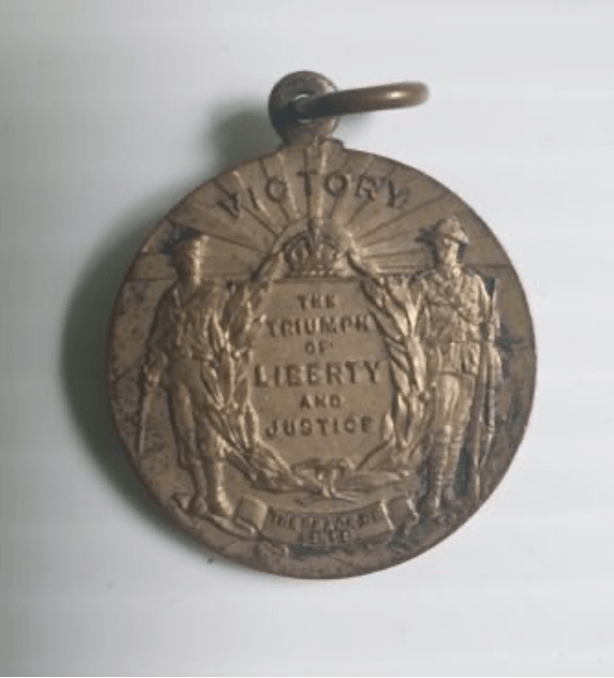
1919 Australia Victory Peace Medal
School Teacher Transferred – 1922
The Maitland Daily Mercury of 2 May 1922, page 4, reported that Mr. F. Allen, a schoolteacher at Nelson’s Bay had been transferred to Seaham.
Headmaster visits Broughton Island – 1922

Mr. S. R. Richardson (left) visited Broughton Island on a fishing excursion in 1922 with Con Catsicas
Concert to aid Piano Fund – 1923
The Raymond Terrace Examiner and Lower Hunter and Port Stephens Advertiser of 13 April 1923, page 3, reported:
‘A concert was promoted here and held on Saturday night, 31st last, in aid of the Piano Fund at the Public School, and the Tennis Club. On account of the hall not being available the concert was held in the school grounds, the verandah being utilised as an impromptu stage, and tarpaulins enclosed the ends, making a very creditable substitute. Decorations too of flowers and greenery had been applied with very good art in affect; and when the curtain dropped the 300 persons assembled were pleased with the effort of the teacher and the committee to make the best out of difficult conditions.
The programme opened with a nicely played overture by Mrs. J. Lund, and Miss Laman; the school boys were interesting and amusing, and encored, in ‘Soldier Boy’ and did well. Song by Mrs. Evans was well received, and comic songs given by Mr. Bewley were encored, he contributing several items. Mrs. Dyer was applauded and had to respond for her songs, and one old number “Ben Bolt” was rapturously listened to. Daph and Myra were very good in their item. Miss Flora Parkin and chorus of school girls were well received in “Mammy Joe,” and Mr. T. Mogork was brought back for a second instalment of “Hard Times”, comic. The school children in rod and wand drill showed excellent training, their time and action being very commendable. More was required by the audience, and a repetition of part given. Mr. M. Johnson gave a couple of cornet solos. A comic by Vega and Ronnie, two little pupils was good, and a dialogue “Women’s Rights” by Mabel Dulcie, Alf and Abe, pupils of the school, was well applauded. An operetta comprised the second part, and was acceptable. The concert on the whole was a very creditable effort, and the effect in the hall would have been greatly added to. But nevertheless, the performers did well, and are to be commended. A collection was taken up and about £10 collected.’
School Improvements – 1923
The Raymond Terrace Examiner and Lower Hunter and Port Stephens Advertiser of 23 November 1923, page 3, reported that Director of Education announced that it is proposed to carry out repairs to the school and teachers’ residence at Nelson Bay.
Parents and Citizens’ Association Meeting – 1924
The Newcastle Morning Herald and Miners’ Advocate of 17 June 1924, page 3, reported that:
‘The Parents and Citizens’ Association met on Friday, the president, Mr. M. Roche, being in the chair. Correspondence was received from Elvy and Co., donating the final payment of £5 on the school piano, and thanking the association for their prompt settlement of the account ; From A. E. Vesper, secretary for Nelson’s Bay Progress Association, notifying the parents and citizens of the proposed visit of a Parliamentary party, including Mr. Ley, and others, and asking the Parents and Citizens’ Association to cooperate with the Progress Association in entertaining the visitors ; From the Education Department, promising a junior assistant for the school in the coming quarter should the average attendance continue to exceed 45.
The secretary, Mr. A. Blanen, produced a balance-sheet of the piano fund, showing that the piano was now fully paid for, and a credit balance of £12 was in hand. A vote of thanks was accorded the teacher and Mrs. Richardson for their strenuous work in raising over £100 in the past twelve months for the benefit of the school. A donation of £1 was passed to be forwarded to the “Lawson Memorial Fund.” It was decided to co-operate with the Progress Association in entertaining the visiting members, and the president and secretary were appointed as a delegation to ask that the matter of having an assistant appointed be expedited.’
The Raymond Terrace Examiner and Lower Hunter and Port Stephens Advertiser of 18 July 1924, page 3, further reported:
‘Mr. J. J. Fitzgerald, M.L.A. is in receipt of the following from the Under-Secretary, Department of Education, Sydney. —
“I wish to add that the request of the Nelson’s Bay Parents and Citizens’ Association for the appointment of an Assistant teacher at the Nelson’s Bay public School is at present under consideration.” ‘
Children from Pindimar travel to Nelson Bay for schooling – 1925
In February 1925, an announcement was made that a new public school would be built at Pindimar. Up until this time , children from this district had to travel to Nelson Bay for schooling.
The Newcastle Sun of 24 February 1925, page 9, reported:
‘The Minister for Education (Mr. Bruntnell), has officially accepted a grant of land, valued at over £400, from the Pindimar Company, at Pindimar, in the Port Stephens district, for a school.
The erection of the building is also to be proceeded with without delay. This will be a boon greatly appreciated by the children of this district, as until recently they have had to travel over four and a half miles of water to Nelson’s Bay for their schooling, and in wintertime the trip is not always pleasant.
The new school opened in July 1925.
Additional Class – 1925
The Newcastle Morning Herald and Miners’ Advocate of 24 March 1925, page 5, reported:
‘Word has just been received that the Nelson’s Bay Public School has been raised to class 5, as from 1st January. This school is growing steadily and is now carrying out secondary work, in addition to the primary.’
End of School Year Concert – 1925
The Newcastle Morning Herald and Miners’ Advocate of 21 December 1925, page 4, reported:
‘The Nelson’s Bay public school closed their school year by holding an exhibition and sale of school work, and concert. The work was of a high class, and reflected great credit upon the school. The concert items were well rendered and greatly appreciated by a packed audience.
The programme included choruses and action songs and songs, and recitations were rendered by Miss Jean Gordon, Miss Whitney, Jack Neal, Edna Whitney, and Queenie Hunter; dialogue (“Freckles”), Vega Jensen, Thora Richardson, Una Thompson, Daphne Lund; dialogue (‘Winning a Wager”), Edna Whitney, Nancy Roche, Edna Asquith, Heather Dumar, and David Roche.
During the evening Mr. W. Thompson, president of the progress association, presented David Roche with a medal, gained as dux of school; Miss Daphne Lund, runner-up, with a book; and Nancy Roche, and Nancy Gordon with books for Scripture, presented by Mr. H. Reeks.
Mr. Richardson, headmaster, presented Mrs. J. Lund, with a book of poems in appreciation of help received as accompanist to the various school entertainments held during the past three years. At the conclusion two “fish ponds” proved very popular with the scholars, each of whom received a present.’
Farewell for Assistant Teacher – 1926
The Newcastle Morning Herald and Miners’ Advocate of 28 January 1926, page 7, reported:
‘Miss K. M. Davoren, assistant teacher of Nelson’s Bay Public School, was entertained at the Church of England Memorial Hall prior to her departure to take up duties as assistant at Bullahdelah. On behalf of the parents, citizens, and pupils of the school, Miss Davoren was presented with a xylonite manicure set, and hand-mirror. Miss Davoren was a prominent Oddfellow, and held the position of treasurer in the Pride of Nelson’s Bay branch of the G.U.O.O.F. Her successor at the school is Miss R. Beggs, who has been transferred from Granville.’
Empire Day Celebrated – 1926
The Newcastle Morning Herald and Miners’ Advocate of 26 May 1926, page 3, reported:
‘Empire Day was celebrated at Nelson’s Bay Public School, when a varied programme was given almost entirely by the pupils. The essays on Empire topics were very creditable, and showed careful preparation. Songs and recitations were spiritedly rendered. In addition to the choruses, the programme was contributed to by Master Harry Lund, Master Herb Williams, Masters Alf Diemer, Ron Laman and Gordon Thompson, Miss Thora Richardson, Miss Vera Jensen, Miss Una Thompson, Miss Edna Whitney, Miss Heather Dumar, Miss June Hillman, Miss Jean Gordon, Miss Edna Asquith, Miss Ida Asquith, Miss Olga Asquith, Miss Helen Hunter, Miss Nancy Gordon. The head master also briefly addressed the children.’
Planning Required for a Nelson Bay Secondary School – 1926
The Newcastle Morning Herald and Miners’ Advocate of 13 July 1926, page 3, reported:
‘The monthly meeting of the Nelson’s Bay Progress Association was held on Saturday, Mr. W. Thompson, the president, being in the chair. ……
The need of a secondary school for Port Stephens is assuming prominence, and as Nelson’s Bay is naturally the centre, and the Education Department hold an area of two acres as a school reserve, it was resolved to write the department asking that this site he kept in view when the needs of the district demand a high school.’
Parents and Citizens’ Association Reorganised – 1926
The Newcastle Morning Herald and Miners’ Advocate of 20 August 1926, page 9, reported:
‘The Parents and Citizens’ Association in connection with Nelson’s Bay Public School has been reorganised. The association will at once endeavour to have a new classroom built, and the present building remodelled. The headmaster reported that eight pupils were preparing for their entrance to high school examination, and six others for the permit to enrol. Mrs. A. V. Lund was elected secretary and Mrs. C. C. Diemar treasurer. The office of president was held over until next meeting.
At the monthly meeting of the progress association the president, Mr. W. Thompson in the chair. ….. The Minister of Education wrote that his department had decided not to sell school reserve on Fly Point [near Shoal Bay road], and asking the association to more fully explain its needs regarding school on this reserve. It was decided to reply that the reserve in question is the natural site for a high school for Port Stephens district, when sufficient numbers of pupils warrant its erection, and asking the department to keep the site in view.’
Radio to be Demonstrated at School – 1926
The Newcastle Morning Herald and Miners’ Advocate of 20 October 1926, page 4, reported:
‘The Radio Broadcast League wrote urging the installation of a set in the local school. The headmaster, Mr. Richardson, stated that he had arranged for a demonstration to be given the following night, and suggested that the matter be held over until the next meeting [of the Nelson’s Bay Parents and Citizen’s Association].’
School Threatened by Bushfires for Second Time – 1926
The Newcastle Morning Herald and Miners’ Advocate of 2 November 1926, page 5, reported:
‘During Friday and Saturday morning fires were observed on the hills to the west of the town, and a very strong and hot north-west wind swept the flames through the dense scrub towards the village. Soon the surrounding hills and scrub land were a raging furnace. …… The public school, Church of England Memorial Hall, and residence occupied by Mr. Hope were even more seriously endangered.’
New Primary School Wanted – 1928
The Dungog Chronicle of 24 April 1928, page 2, reported on the need to replace the old school building, which was 35 years old:
‘Mr. Hunter, of the Parents and Citizens’ Association, asked for a new school at Nelson’s Bay. “I do not think,” he said, “you will get a worse school in New South Wales or one with such inadequate accommodation. It was built for 45 pupils, and now there are 80. There are two teachers, and they have to teach 8 classes in a building 37 feet by 16 feet. If it is not pulled down, it will blow down, for it is white-ant eaten. Mr. Bruntnell (N.S.W. Chief Secretary) said he would have a look at the school, and put their representations before the Minister for Education.’
The Dungog Chronicle of 15 May 1928, page 2, further reported:
‘When Hon. A. Bruntnell (Chief Secretary) was in Nelson’s Bay recently, the Hon. W. Bennett, introduced a deputation from the P. and C. Association, who urged that a new school should be erected there, to meet the increased attendance. Mr. Bruntnell inspected the old building, and now reports that the Department of Education recognises the necessity for this work, and it will receive consideration when the building programme for the next financial year is reviewed.’
New School Building – 1928
The Maitland Daily Mercury of 8 September 1928, page 6, reported:
‘The Hon. W. Bennett, M.L.A., for Gloucester, informs us that, in response to his representations, the Minister for Education has given instructions for the necessary plans and specifications for the erection of new school buildings at Bundook and also at Nelson’s Bay. At the latter place, owing to the increased population, the old buildings, besides being white-ant eaten, are much too small for requirements.’
The Newcastle Sun of 11 September 1928, page 6, further reported:
‘Plans for a new primary school building to be erected at Nelson’s Bay are being prepared, according to the local schools’ inspector (Mr. Lees).’
Coal Strike Increases Nelson Bay School Attendance – 1929
The Raymond Terrace Examiner and Lower Hunter and Port Stephens Advertiser of 28 March 1929, page 3, reported:
‘Since the strike commenced amongst the miners at the South Maitland and Cessnock fields, many families have made their homes along the foreshores of the Port and particularly around Nelsons Bay. The increased population has added also to the school attendance by about 50 children and an additional teacher has been supplied, and the Church of England building utilised, as sufficient rooms are not available at the public school.’
Empire Day Celebrations – 1929
The Newcastle Morning Herald and Miners’ Advocate of 1 June 1929, page 4, reported:
‘The Empire Day celebrations in connection with the Nelson’s Bay Public School attracted a large attendance to Arcadia Hall, which had been extensively decorated and lighted by electricity, the current being supplied free of charge by Mr. H. Donald. The whole of the programme was rendered by the children numbering about 50. Mr Dixon was conductor, and Miss Palmer accompanist. Miss Jean Gordon, the school captain, presided, and after the opening chorus, spoke briefly on the significance of Empire, Master Gordon Thompson following with an address on the life of Nelson. Addresses were also given by Miss June Hillman, Miss Queenie Hunter, and Miss Ina Dixon.
The building of the Australian Flag was a well-arranged tableau, the component parts being placed in position and explained by Miss Enid Blanch, Master Neville Blanch, Master Mark Diemar, and Master Bernard Thompson. The five stars of the Southern Cross were named and placed by Misses Joyce Lund, Jean Lambourne, Milba Wells, Stella Asquith, and Mary Catsicas. Miss Nancy Gordon concluded with an appropriate quotation for the large Commonwealth star.
A vote of thanks, which was accorded to all who had assisted to make the celebration a success was responded to by Mr. J. W. Hunter, the President of the parent’s and Citizens’ Association, who referred to the high standard of the programme and to the splendid training the children were receiving. Mr. R. H. Dixon, in expressing his personal thanks to all who had assisted referred to the need for a tennis court at the school, and read a list of material required for its equipment. Within five minutes the whole of the requisites had been donated by the audience. Before the gathering dispersed, the Headmaster presented Miss Jean Gordon with a bouquet, in appreciation of the manner in which she had conducted the proceedings.’
Library Donated to School – 1932
The Maitland Daily Mercury of 31 May 1932, page 7, reported:
‘The [Nelson Bay] public school has, through the munificence of Mr. G. H. and Mrs. Pepper, become the possessor of a beautiful book case and a library of 500 volumes of suitable books for the children. The selection of books range from those that would delight the boys of 16 down to those that would amuse the tiny tots of six years or so.
The collection has appropriately been named the “Pepper Library,” and as a token of appreciation the school children have attached to the book case a commemorative silver plate suitably inscribed. The library and case were formally presented to the school recently, when Mr. and Mrs. Pepper and Misa Una Pepper visited the school and briefly addressed the children. Mr. Pepper said that he worked as a boy on the Tomago Estate, and it was due to the kindness of Mrs. Windeyer (mother of Mr. R. Windeyer, K. C.) that he received the rudiments of reading, writing and arithmetic. Mrs. Windeyer did this to help the boys and young men on the estate to better themselves. That was all that he received in education in those days. He exhorted the boys to be industrious and upright, so that they might become efficient citizens.
Mrs. Pepper drew for the pupils a vivid picture of the early days, when life was much simpler than in the present day. She said that she was pleased that their gift had been appreciated, and concluded by wishing the girls every success in life, and expressed the hope that they would grow to be useful and honourable citizens. A short musical programme was rendered by the pupils, after which the headmaster (Mr. R. Dixon) responded on behalf of the school children and wished Mr. and Mrs. Pepper many more years to enjoy life’s evening. Mr. G. H. Pepper is aged 90 years, and Mrs. Pepper 85. Mr Pepper is one of the oldest residents of the Lower Hunter, and may be termed the “grand old man” of the Lower Hunter. Philanthropic acts such as this are nothing new to Mr. Pepper.’
Assistant Teacher Farewelled – 1932
The Raymond Terrace Examiner and Lower Hunter and Port Stephens Advertiser of 23 June 1932, page 3, reported:
‘One or the most successful and numerously attended functions ever held at Nelsons Bay, took place in the Church of Engand Hall, last Saturday evening. Miss Freda Palmer who has been assistant teacher here for over three years has been promoted to Muswellbrook. The residents arranged a social in her honour and asked her to return and accept their good wishes and a memento of her stay here. The chair was taken by Mr. Zeininger (President of the Social Club of which Miss Palmer had been secretary for over twelve months).
On her entrance to the Hall the audience rose and sang ‘For She’s a Jolly Good Fellow’ followed by three cheers. Mrs. C. Deimar playing the pianoforte accompaniment. The chairman briefly stated that when the news of the sudden promotion of Miss Palmer was heard the residents thought some expression should be given of the regard in which their guest was held and so the evening was arranged. After a few more eulogistic remarks a concert programme was entered upon interspersed with dancing.
The first item was a part song by ex-pupils under the baton of Mr. R. Dixon, headmaster of the school. It was a good item the girls were loudly applauded for their effort. A dance followed and between the dances the following took part in the programme. — Mr. M. Johnson in a brief speech referred to Miss Palmer’s social qualities as a genial sport and her popularity in the community. A recitation by Miss Campbell entitled “The Bride’s Visit to the Butcher” was well rendered and received. (Miss Campbell is Miss Palmer’s successor). Miss June Hillman, on behalf of ex-pupils in a brief neatly phrased speech spoke of the esteem they had for their old teacher. Mr. Alston also mentioned the loss the town and scholars had to regret and wish that the future for Miss Palmer would be as bright and happy as she had made the lives of the young folk during her stay. Miss Jean Lambourne, speaking on behalf of the present pupils bore evidence to Miss Palmer’s hold on the affection of all who came under her kind tuition.
Master Neville Hill was encored for his recitation. A recitation of a poem by Herry Lawson was given by Mr. Alston and was well received. Supper followed, the good things were amply provided by the ladies, the gentlemen assisting in waiting on the visitors. Supper was followed by a duet, “Love’s Old Sweet Song”. Mr. R. Dixon, headmaster of the school, then made the presentation of a short , illuminated address to Miss Palmer. The address stated: — “On the eve of her departure the guest was asked to accept the testimonial and accompanying gift as a token of esteem, goodwill and friendship.” The address mentioned that her willingness at all times to help socially was recognised by all, and ending with hopes for a happy future. Miss Palmer made a good effort to respond, but traces of her emotion were evident. Mr. M. Roach responding on her behalf mentioned that Miss Palmer from the day of her arrival among them to the day of her departure had been the same genial, happy influence in their midst and he thanked the residents on Miss Palmer’s behalf for their spontaneous and practical proof of her popularity. Dancing was then kept up till midnight. Mr. G. Lambourne proved an efficient M. C. and Mr. Jarrett supplied the music for the dancers. “Auld Lang Syne” followed by cheers brought a happy evening to a close.’
Improved Assembly Area – 1935
The Dungog Chronicle of 9 August 1935, page 4, reported:
‘Mr. C. E. Bennett, M.L.A., has received the following communication from Hon. D. H. Drummond, Minister for Education:— With further reference to your personal representations on behalf of the Nelsons Bay Urban Area Committee, relative to the request of that body that an improved assembly area be provided at the Public School at that centre, I desire to inform you that I have arranged for that work to be carried out by this Department’s Day Labour Staff, and that it will be put in hand at an early date.’
Review of Activities of the Parents and Citizens Association – 1946
The Raymond Terrace Examiner and Lower Hunter and Port Stephens Advertiser of 22 August 1946, page 3, reported:
‘The monthly meeting of the Nelson Bay P. and C. Association took place at the school on August 13th. Mr. A. L. Manning in the chair. The Secretary was instructed to write thanking Mr. James Kirk, manager of Durness cattle station for grass cuttings with which to cover sand patches in the school grounds.
Among the accounts passed for payment included one for installation of electric light in school buildings. The meeting reviewed the Association’s past activities including — securing a daily bus service for conveyance of pupils to Newcastle High School, installation of electric light in the school, provision of wireless cabinet in school; laying down of cricket pitch for the school; grassing of school playgrounds (incomplete); providing picnics, etc for pupils.
Among matters for future consideration were providing a swimming instructor for the children and the setting aside of the baths at certain times for the purpose. This was left over till the next meeting, owing to the headmaster, (Mr. Basham) being absent, with a cold. The meeting expressed regrets that the headmaster was indisposed and hoped that he would soon be well again.’
The Dungog Chronicle of 15 November 1946, page 3, further reported:
‘The Nelson’s Bay P. and C. Association, in conjunction with Mr. Basham, the Headmaster of the Nelson’s Bay School, have arranged with Mr. T. Brown, proprietor of the swimming baths, to give the school children swimming lessons twice weekly. The instructors who volunteered their services and who are to be commended for so doing, are Mr. T. Brown (Life Saving Certificate), Miss T. Brown (Royal Life Saving Medallion) and Mr. T. Dives, (Surf Life Saving Medallion). The children are fortunate in having such able instructors and parents should be grateful for the care and tuition bestowed upon the children; both the P. and C. Association and the school staff are doing good work and, in this instance, have received actual assistance.’
School Picnic – 1946
After the austerity of the Second World War years, what better way for Nelson Bay school children and their parents to celebrate the end of the 1946 school year than to participate in a school picnic. At Nelson Bay, with its vast waterways, what better way to commence the celebrations that to travel by boat to the venue. In this case the venue were the grounds surrounding Tahlee House, near Carrington, Port Stephens.
The Dungog Chronicle of 8 November 1946, page 3, published the following report
‘Mr. H. Thurlow, Hon. Secretary of Nelson’s Bay P. and C. writes: — This year the picnic will be held at Tahlee upon the upper harbour of Port Stephens, about eight miles west of Nelson’s Bay. This locality had a distinct historical value and was originally a Government grant to the Australian Agricultural Company. Located here is a wonderful and attractive old stone church of ancient architecture and also the last resting place of many old pioneers of Port Stephens.
Permission to land at the White Estate [the owner of Tahlee House], Tahlee, has been obtained from the manager and the location affords an ideal spot for a picnic, with extensive park lands and well laid out gardens, etc. The boat conveying the school picnic will leave Nelson’s Bay at 9 am. on Saturday, November 30, and parents will provide a lunch basket. Donors desirous of making subscriptions to the picnic are requested to forward same to the public school.’
Need for a Secondary School at Nelson Bay Raised – 1948
While the need for a secondary school at Nelson Bay was first recognised in 1926, the campaign for a high school gathered pace from 1948.
The Newcastle Morning Herald and Miners’ Advocate of 16 October 1948, page 4, reported:
‘Nelson’s Bay Parents and Citizens’ Association decided to support the request of the Progress Association for a central school in the district.’
The Newcastle Morning Herald and Miners’ Advocate of 2 June 1951, page 6, further reported:
‘It was reported to Nelson’s Bay Progress Association that a site for a new school had been recommended to the Department of Education. Officials said it was believed the site was adjacent to the hostel for migrants, where the department had established a school for migrant children. This building was temporary and unsuitable. It was decided to protest to the Minister against any site being selected without consultation with local public organisations. Members said there were two public schools in the town. The new building should meet the needs of all children in the district. The association will also seek the provision of super primary classes to obviate the need of many children travelling four hours a day to get secondary education.’
The Country Women’s Association also became involved in the campaign for a new secondary school in Nelson Bay. The Newcastle Morning Herald and Miners’ Advocate of 6 September 1951, page 5, reported:
‘The need for a secondary school at Nelson’s Bay will be discussed at the 25th annual conference of the Country Women’s Association Hunter River Group, at Merriwa on September 18 and 19. Nelson’s Bay C.W.A. branch will ask the conference to request the Education Department for the school. Children from the Nelson’s Bay area have to travel to Newcastle to high school.’
The Land of 28 September 1951, page 26, further reported:
‘Children who must travel into Newcastle from Nelson Bay to attend secondary schools, could tour five times round Australia for the mileage covered and the time occupied in a year. This was stated by a delegate to the 25th annual Hunter River Group Conference of the Country Women’s Association, held at Merriwa last Wednesday.
The delegate was from the Nelson Bay branch of the Association, which put before conference the request that the Education Department be asked to erect a secondary school at Nelson Bay.
She said that the school bus had been put on as a result of agitation by the local Parents and Citizens’ Association, but that it was now not a bus for school children alone, many of whom had to stand up to two hours, there being insufficient room in the bus to sit down.
Not only was this very detrimental to the health of growing girls, but children who had to spend up to five hours daily in traveling were far too tired to do their home lessons efficiently. It was frequently after 7 o’clock before they reached home.
Other children in the district, who did not travel into Newcastle to school were compulsorily forced to attend the district primary school. Some of these children had outgrown the top class three years ago and hated school as a result.
Residents of Nelson Bay, plus the neighbouring Tea Gardens, felt that the Department of Education should have enlarged the Nelson Bay school to take the extra children from the Migrants’ Camp, a mile away, instead of building a school at the camp, where hundreds of children were now being entirely segregated and had no chance of being assimilated into Australian national life under such conditions.
By transferring the new [migrant] school and its four teachers to Nelson Bay school, and by providing some secondary school standard teachers, all the children in the district could be fully educated instead of travelling into Newcastle, where they were again split up and distributed over a number of schools.
It was also stated that the Department’s contention that the migrants were only a temporary population was not borne out by facts, as many of them were purchasing homes and settling permanently in the area and all had large families.
The motion, which was carried unanimously, will be placed before the State Executive’s educational sub-committee, which will be asked to take it up with the Department of Education.’
Super-Primary School Promised – 1952
The call for the establishment of secondary education at Nelson Bay heightened further during 1952. The Raymond Terrace Examiner and Lower Hunter and Port Stephens Advertiser of 15 October 1953, page 2, reported:
‘The Annual meeting of the Nelson Bay Country Women’s Association was held on Tuesday, October 6th and the report presented stated that a very satisfactory year had been concluded. ……..
As a result of our persistent correspondence to obtain a super-primary school at Nelson Bay, a deputation waited on Mr. Drake at Nelson Bay on May 2nd. The deputation was promised a school in the new year.’
The Port Stephens Shire Council also became involved with the secondary school campaign. The Newcastle Morning Herald and Miners’ Advocate of 11 November 1953, page 9, also reported:
‘A deputation will wait on the Minister for Education (Mr. Heffron) seeking the establishment of secondary school classes at Nelson’s Bay. The President (Cr. Randall) said this at the Port Stephens Shire Council meeting yesterday. The Nelson’s Bay Urban Area Committee asked the council to support its efforts to have the classes established. Cr. Randall, who will be on the deputation, said, if it were possible, he would also approach the Minister about other urgent educational needs in the shire.’
Additional Accommodation at Nelson Bay School for Secondary Education – 1954
The Raymond Terrace Examiner and Lower Hunter and Port Stephens Advertiser of 22 July 1954, page 1, reported:
‘A tender has been accepted by the Education Department for erection of a double timber classroom at Nelson Bay school [for secondary education]. In a letter announcing this, to Mr. Fitzgerald, the Minister says: “I refer to your personal representations on behalf of the Nelson Bay Branch of the Country Women’s Association of New South Wales, (Mrs. L. G. Randall, Shoal Bay, Hon. Secretary) concerning the need for additional accommodation at Nelson Bay Public School. You will be pleased to learn that I have accepted a tender from A. H. McKenzie and Sons, of 38 Hunter Street, East Maitland, for the erection of a double timber class-room unit at this centre. You may assure your correspondent that action to complete the contract documents will be taken as soon as possible and that every endeavour will be made to have the classrooms completed at an early date.’
The Raymond Terrace Examiner and Lower Hunter and Port Stephens Advertiser of 21 October 1954, page 3, further reported:
‘The [Country Women’s Association] Branch expressed pleasure that the Education Department had started on a secondary room at the local school. It was hoped, the report added, that children would soon be able, to continue their schooling at Nelson Bay.’
Concluding Comments
The early history of the Nelson Bay Primary school illustrates the educational hardships faced by country communities. To provide an education for their children, the local community had to have a close relationship with the school and its teachers.
The history also illustrates the additional hardship faced by students when their educational needs outgrew those available from the local primary school.
Epilogue : Recent Developments
The primary school at Nelson Bay became a Central School in 1955. A central school contained both primary and secondary departments, to provide secondary education for children both from nearby primary schools as well as from its own primary section.
A secondary school block was opened in 1957 in Shoal Bay Road at Fly Point. Nelson Bay High School was established on this site from 1 January 1975.
In 1980’s, the NSW Government decided to sell off both the sites of the Nelson Bay Primary School and Nelson Bay High School and to eventually close both schools.
Nelson Bay Public School was relocated to another site in Wahgunyah Road, adjacent to St Michael’s Catholic Primary School. Mr Ted Brown was the Principal at the time. It was reported in the Port Stephens Examiner of 15 July 2019 in his obituary, that ‘a challenge for Mr Brown came in the mid-1980’s when Nelson Bay Public School, which had then been located in Wahgunyah Road, flooded….’
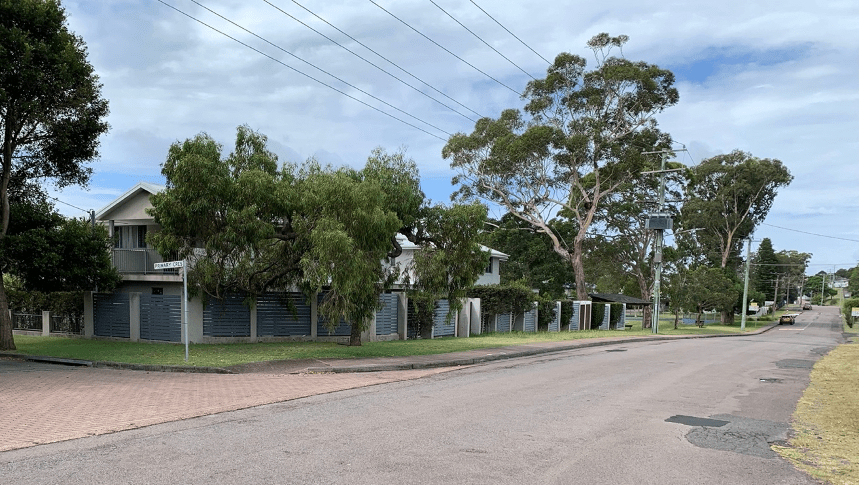
Former site of Nelson Bay Public School, circa 1980’s, on the corner of Wahgunyah Road and Primary Crescent [Author Photo March 2023]
Nelson Bay High School was demolished in 1990’s. A new housing estate was built on the site.
Both schools were relocated to facilities at Salamander Bay in 1998 to become Tomaree Primary School and Tomaree High School making up the Tomaree Education Centre.
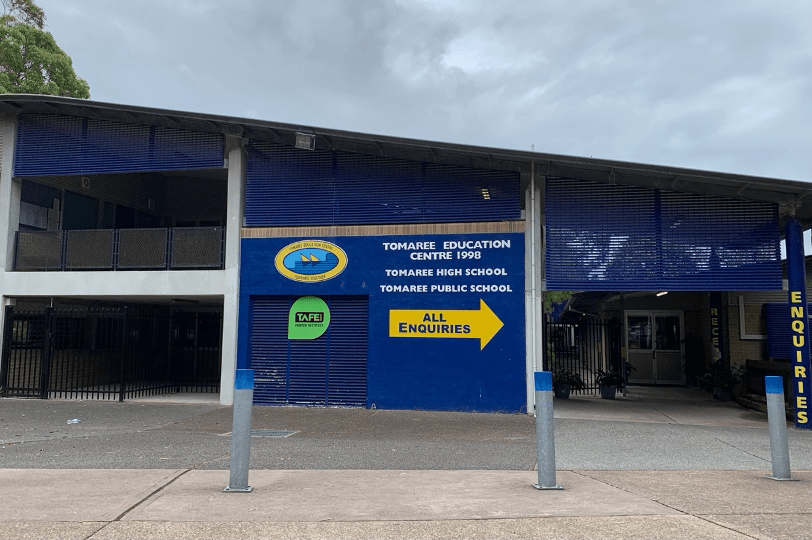
Tomaree Education Centre, Salamander Bay [Author Photo March 2023]
Tomaree Community College took over the premises of the former Nelson Bay Primary School in Government Road at Nelson Bay.

One of the buildings of the Nelson Bay Primary School in Government Road now used by the Tomaree Community College, with the original school bell [Author photo March 2023]
Researched and compiled by Kevin McGuinness
March 2023

 Port Stephens - a history exploration