
Introduction
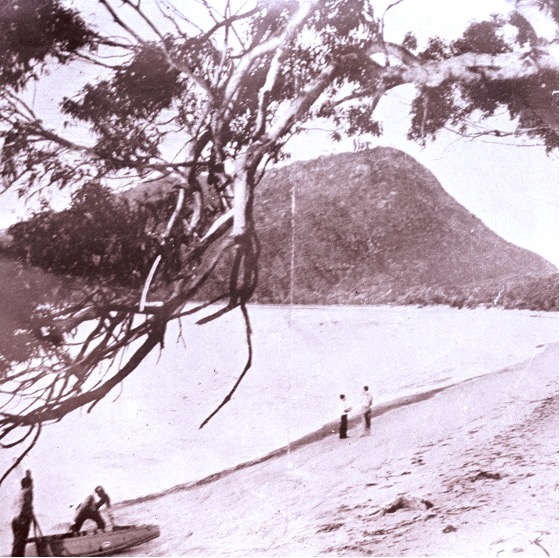
Mount Tomaree at the southern entrance to Port Stephens, is the traditional land of the Worimi people.
According to the NSW State Heritage Register, Tomaree Head was declared a reserve under the Crown Lands Alienation Act of 1861. It was used for recreational purposes and occasional squatting from the 1860s until the 1930s.
For a number of years prior to the Second World War, the headland had fallen into a state of neglect and the native flora and fauna was suffering.
A conservationist, Arthur Dickinson, who it could be said was ahead of the times, used his initiative to have the NSW Government appoint him as an Honorary Ranger for the headland.
This paper sets out the story of Arthur Ernest Dickinson, the first Honorary Ranger, in the Port Stephens area.
Appointment as an Honorary Ranger
The first official references to Arthur Dickinson and Mount Tomaree, were published in two editions of the NSW Government Gazette, viz:
(1) 24/12/1931 (page 4226) stating the appointment of Arthur Ernest Dickinson, J.P., of South Head, Nelson Bay, as an Honorary Ranger, under the provisions of the Birds and Animals Protection Act, 1918, and the Careless Use of Fire Act, 1912; and
(2) 15/1/1932 (page 124) reporting his appointment as an Honorary Ranger in pursuance of the provisions of the Wild Flowers and Native Plants Protection Act, 1927.
To allow him to reside on the South Head at Mount Tomaree, Arthur Dickinson obtained a Government lease of the area. The NSW Government there Gazette of 23/3/1934 (page 1323) published the details of a Special Lease (no. 1932-95), that was subject to a rent, granted to him.
The lease was to remain in place until 1947. The Government Gazette of 3/10/1947 (page 2334), announced that special lease 1932-95, held by A. E. Dickinson, had been withdrawn, for Hospital purposes. By this time, Arthur Dickinson was no longer resident there having moved to Myall Lakes around 1939, when Mount Tomaree was taken over for defence purposes.
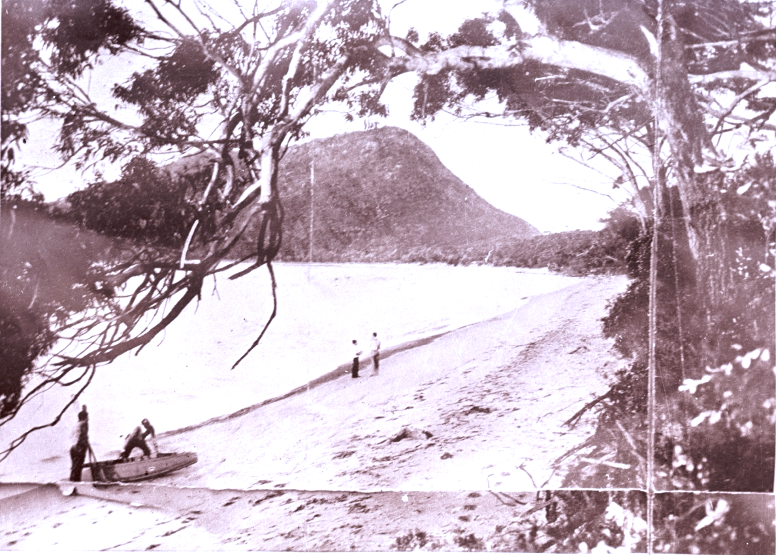
Mount Tomaree area, as it would have appeared when Arthur Dickinson was the Honorary Ranger, prior to the construction of the military buildings during the Second World War
Sanctuary for Birds
The Newcastle Morning Herald and Miners’ Advocate of 12 June 1934, page 4, carried the following report on Arthur Dickinson and his bird sanctuary on Tomaree headland
‘Mr. A. E. Dickinson, Honorary Government Ranger, at Nelson’s Bay, has shown much zeal in providing a harbourage for Australian birds on the south side of Port Stephens entrance. As a lover of nature, he set up a little camp at the foot of the south headland, had it proclaimed as a sanctuary for flora and fauna, and so attempted to check the spoliation of bird and plant life.
Unfortunately, he found that his efforts in this direction were frustrated to a great extent by increasing vandalism, and Mr. Dickinson himself was subjected to much indignity because of his desire to protect birds and plants. In order to obtain a greater measure of authority over the land, he has now obtained a lease of the area for the sole purpose of protecting the bird life, and now the south headland is in his private possession.
Entry for camping and other legitimate purposes is given readily. Mr. Dickinson undertakes to do all in his power to see that those who are content to observe the proper rules of the bird sanctuary have enjoyable visits. Already, he says, his relatively greater powers in the protection of birds and plants are having a beneficial effect.’
The Dungog Chronicle of 28 January 1938, page 4, and The Sun of 23 January 1938, page 5, both carried the same story about the work of Arthur Dickinson in more descriptive terms:
‘Port Stephens, that magnificent harbor of the North Coast, is known to too few Australians, but none, who have sailed between the massive guardians to its tranquil waters, will ever forget the experience. These two headlands are giants, pitiless and cruel, but to the harbor they protect they show the quiet beauty of verdant, gentle hills. For untold years these two hills — South Head particularly — have been a sanctuary for birds. Birds have lived, sheltered, and rested there, making the rugged hills live with melody. However, man came, and the quiet of the peaceful hills was shattered. Trees were cut down, scrub burnt, and the birds knew that this resting place was theirs no longer. Progress must be served, but progress never came to South Head, only destruction, and no attempt was made at development. Man came again.
This time a man with the spirit of the mountain itself, a fighter and a protector. South Head now shelters at its foot the modest home of one who is striving and fighting to return to the birds their ancient sanctuary. This gentleman has given his time, his labour, his peace of mind, and his money to the task of saving the birds. He had the area proclaimed a sanctuary, and, fitting this insufficient, lived there himself. In his capacity as an honorary Government ranger he attempted to check the spoliation of bird and plant life, but he found that, as a ranger, he had no real standing in law. However, as a property owner he would have a definite one, therefore he applied for and obtained a lease of the whole area of the headland for the sole purpose of protecting the bird and plant life, expending his own money to protect a public responsibility. He has a long way to go yet, but already his work is bearing fruit, and South Head once more rings with the music of its feathered friends, and a good Australian may take it as a song of praise for himself.’
Family link to the First Fleet.
Arthur Dickenson’s great grandfather was Lieutenant George Johnston who sailed to Australia with First Fleet. He accompanied Governor Arthur Phillip to Sydney on 26 January 1788.
Both newspaper articles as quoted above explored Arthur Dickenson’s family history:
‘It is doubly interesting to read of his work at this time — our sesqui-centenary — as this nature lover, Mr. A. E. Dickinson, is an interesting link with the landing of Governor Phillip and the founding of Sydney. His great-grandfather, Lieutenant George Johnston, after fighting with his regiment at Bunker’s Hill, and seeing his father killed in action, returned to England and volunteered for duty with the first fleet.
After deciding that Botany Bay was not a suitable place for a settlement, Governor Phillip, leaving the remaining ten vessels of the fleet in Botany Bay, sailed in H.M.S. Supply with Lieut. Ball, R.N., Captain David Collins, Lieut. P. G. King, and Lieut. George Johnston, for Sydney Cove. At daybreak on January 26, 1788, Governor Phillip ordered a party of forty convicts, with a guard of forty marines, under Lieut. Johnston, to land and cut down trees, clear and prepare a camp round the Tank Stream in readiness for the general landing next day. H.M.S. Sirius and the rest of the fleet arrived and anchored between 6 and 7 p.m., but did not land that night.
The only persons to land in Sydney Cove on the first Anniversary Day were those from H.M.S. Supply. The descendants of Lieut. George Johnston and Lieut. P. G. King are the only two families in Australia that have a direct connection with the landing on Anniversary Day in Sydney. Lieut. George Johnston, A.D.C. (afterwards Lieut.-Col.), who deposed Governor Bligh on January 26, 1808, was the only person who landed in Sydney on Anniversary Day from H.M.S. Supply to remain permanently in Sydney, where his descendants have since resided without a break. His son, Commander Robert Johnston, grandfather of Mr. A. E. Dickinson, was the first Australian to enter the British Navy. After his return to Australia, he discovered and named the River Clyde. The fighting spirit of this family still lives in the gentleman who is devoting his life to the preservation of our wonderful bird and plant life.’
Myall Lakes Bird Sanctuary
After leaving Mount Tomaree around 1939, Arthur Dickinson purchased a property named ‘Parkland’ near the Myall Lakes, and resided there until his death. At that time the area was a popular with recreational shooters, due to the large number of ducks and other birds. The following article published in the Dungog Chronicle of 24 February 1939, page 4, shows that he repeated the protection activities pioneered at Mount Tomaree:
“Ducks and swans are plentiful on the Myall Lakes, and shooters are always after them. As this area has been declared a sanctuary, Mr. A. E. Dickinson, of “Parklands,” intends to protect the birds, and with the assistance of two more rangers will patrol the area.”
Obituary for Arthur Dickinson
Arthur Dickinson died on 25 May 1954 at his residence, “Parklands’, Myall River. The Dungog Chronicle of 5 June1954, page 5, carried the following Obituary:
‘The death occurred at the Bulahdelah District Hospital on Tuesday, May 25, of Mr, Arthur Ernest Dickinson, after a long illness.
The late Mr. Dickinson, who was born at Croydon, Sydney, 78 years ago, was well known in the district, having resided on his property, ‘Parkland,’ on the Myall Lakes for the last 15 years. Having retired, Mr. Dickinson devoted his time to his hobby of caring for his animals, being a lover of birds and cattle and horses.
Mr. Dickinson was a son of English parents who migrated to Australia and became the owners of the Annandale Estate, Sydney, and he was a member of a family of nine — three boys, and six girls — all of whom predeceased him. Mr. Dickinson, who was a bachelor, was well known for his generosity towards charities and his particular interest in shows. He was a member of the Light Horse during the 1914-1918 War, and upon his discharge, commenced work as an overseer on a sheep property, and later entered into partnership with one of his brothers in the purchase of a sheep property.
He later bought his own station and proved himself a fine horse-man, both in the show ring and on the polo field. After his retirement, he settled at Nelson’s Bay for a number of years before purchasing ‘Parkland’ his Lake property. The late Mr Dickinson was a much travelled man and a collector of antiques, many of which he gathered over the years during his frequent trips overseas.
He was buried in the Church of England section of the Bulahdelah Cemetery on Wednesday, after a service conducted by Rev. Richardson.’
Concluding Comments
The story of Arthur Dickinson, a conservationist, who was ahead of his time, appears not to be widely known and thus unappreciated.
The material set out in this paper seeks to preserve his memory and achievements.
Researched and compiled by Kevin McGuinness
August 2021

 Port Stephens - a history exploration