
Introduction
In October 1938, the largest military exercises since the end of the First World War were conducted at False Bay (now called Fingal Bay).
The first exercise, on 6-7 October, involved 4,000 military personnel from the Army, Navy and Air Force and a large number of support services. Several weeks later, on 20-21 October, a second exercise was conducted at Fingal Bay involving over 1000 troops.
Information on the two military exercises is set in this paper.
Many of the images displayed are of poor quality and have been included as they provide a useful visual extension to the written descriptions of events.
FIRST EXERCISE
Initial Preparations
Details of the first arrangements for the planned exercise appeared in the Newcastle Sun of 6 September 1938, page 1:
‘Military authorities in Newcastle have asked the N.R.M.A. to arrange for 30 Newcastle car owners to place themselves and their cars at the disposal of the authorities for the combined navy, army and air force exercises near Port Stephens on October 6 and 7. The cars, it is understood, will be used to rush militia from Newcastle to the scene of the “invasion” to aid in repelling the “enemy.”
Troops from the 13th Battalion will comprise the “enemy.” They will be landed at a spot, yet unknown, from H.M.A. Ships Canberra, Sydney and Voyager. The landing will be opposed by units of the 1st Infantry Brigade and Field Brigade, and Royal Australian Air Force planes from Richmond will cooperate with both attackers and defenders. The army personnel to make the attack will be embarked in the ships off Newcastle late on October 6. Everything will be worked out in theory and on the mobility of the troops on the land will depend, to a large extent, the success or otherwise of the mock invasion, which will take place at dawn. Senior officers of the navy, army and air force will observe the exercises, which are regarded as the most important since the war.’
Further details of preparations were included in the Newcastle Morning Herald and Miners’ Advocate of 28 September 1938, page 8:
‘More than 1200 members of militia units will march into camp at Rutherford next weekend for the most comprehensive military exercises that the North has known since compulsory training was abandoned. It is expected that the Governor-General (Lord Gowrie), the newly appointed Inspector-General of Military Forces (Lieutenant-General Sir Ernest Ker Squires) and many other senior officers will watch the combined exercises. Emphasis has already been placed upon the coastal defence, and landing exercises, which will be carried out by the 1st Infantry Brigade in cooperation with the Navy and Air Force, but practical training in preparation of trenches and wire entanglements will also be part of the camp training.
The 1st Infantry Brigade is composed of four infantry battalions—2nd/35th, 33rd, 41st, and the 13th which cover the territory from Newcastle to Tamworth, Lismore, and Kempsey. This will be the first camp since voluntary training was restored that the four battalions have marched into camp at Rutherford together. In addition to these four battalions there will be the usual service units of Royal Australian Engineers, Army Service Corps, and 1st Field Ambulance. Advance parties and service units will move into camp next Friday as this year all battalions will voluntarily arrive on Sunday and spend an additional day in camp.
Monday will see the infantry units carrying out defence exercises, including the digging of trenches and erection of wire obstacles. On Tuesday the camp will carry out company counter-attack exercises to be followed by company withdrawal exercises on the Wednesday morning. The usual sports, to which the public is invited, will be held on Wednesday afternoon. Thursday and Friday will be devoted to the big landing exercises and the defence of beaches. The 13th Battalion will be the offensive battalion and the remainder of the brigade the defenders. Following this landing exercise, each battalion will fire field firing exercises at targets placed at different distances from the beach and will then withdraw and travel by bus to camp.
The 1st Brigade, Royal Australian Artillery, which will be in camp at Williamtown simultaneously, will participate in these exercises, and will also carry out firing exercises at targets at sea. This firing will take place from the foreshores of Fingal Bay on Friday, and shipping will be warned to keep at least three miles east of a line between Morna Point, Point Stephens and South Head, Port Stephens. There will also be a “danger area” about Point Stephens Peninsula, Fingal Head, and Fingal Point for the general public.
A further appeal has been made by the Defence authorities at Newcastle for the use of cars and lorries to assist in transporting the troops and supplies during the manoeuvres in the Nelson’s Bay district. The lorries, which should be of 30cwt. or 2-ton capacity, will be needed for October 6 and 7, and the cars for October 5, 6, and 7. The N.R.M.A. office and Gale Brothers’ garage, Porcher and Parry Streets, Newcastle can give all particulars.’
Final Exercise Plan
The Sun of 2 October 1938, page 8, carried the following report on the final plan for the exercise:
‘Plans for the combined operations to be held on October 6 and 7 at Rutherford are now complete. The exercise will start with a message to the Commander, 1st Infantry Brigade, to rush his troops to the coast to repel a possible raid by an enemy. The troops will be conveyed by motor transport to the coast, where they will immediately prepare the beach defensive positions for the defeat of an enemy’s attempted landing. This will give practice to officers in moving troops over long distances in a specified time, and bring out the lesson that the old rate of moving at 15 miles a day has now changed to one of 100 miles a day or possibly more.
Meanwhile other army units will be embarking in H.M.S. ships in preparation for a landing to be made at dawn on the 7th. Defending aircraft will be searching for the enemy and reporting the presence and location to posts in Headquarters and Army Headquarters. From the exercises it is hoped to gain experience of landing forces in the face of opposition, and from the defenders’ point of view the power of modern arms and air in repelling an invasion.
The 1st Infantry Brigade, 1st Field Brigade, and attached troops will carry out on October 6 and 7 an exercise embodying the occupation of a sector of coast for beach defence. As the 1st Infantry Brigade will move from Rutherford to the coast in buses, it will be impossible for the 1st Field Brigade, which is horsed, to keep pace with this movement.
Thursday night, October 6, will be spent in preparing gun positions, gun platforms, ammunition supply, etc., preparatory to resisting an imaginary landing to take place the following morning. After this landing has taken place, battle practice in conjunction with the infantry will be carried out in Fingal Bay, at the conclusion of which on Friday the infantry battalions will embus and withdraw direct to Rutherford.’
4000 Troops Await Attack
TheDaily Advertiser of 7 October 1938, page 4, reported:
‘For 10 miles the thick bush south of Nelson Bay bristled with bayonets, and field batteries raced from point to point. Communication was maintained by telephone and wireless. As night fell it was stated “The enemy might make a night landing near Anna Bay.” Observer’s on the ridges scanned the bay with night glasses, and barbed wire was hurriedly erected along the water front. A later message said “that the zero hour” would probably be a little before dawn.’
A reporter wrote in the Daily Telegraph of 7 October 1938, page 2, about the scene at Fingal Bay hours before the military exercise was due to begin:
‘Tonight I am lying on a military groundsheet, waiting, with 4000 troops, for machine-gun bursts to signal the commencement of Australia’s biggest defence rehearsal since the war. Two yards from me is a 4.5 howitzer camouflaged with gum tree boughs and pointing menacingly seawards. The gun crew is having a few hours’ rest on rough ground under the trees. In four hours I saw 100 machine guns, 16 field guns, 20 Lewis guns, and thousands of rifles ready to shatter the silence.
On the beach below the biggest of 300 men can be seen hurriedly and silently lifting sandbags and digging trenches. They have been digging for eight hours without rest. In the surrounding hills, valleys, and beaches the rest of the 4000 troops are ready in battle stations. When Sydney is having its breakfast hostilities will be at their height. The 4000 troops were transported 62 miles from Rutherford to Port Stephens this morning in 68 motor buses and 50 private cars.
When a radio message was received on the big convoy that an enemy was sighted off the coast, an accident occurred. Signal Officer S. H. L. Grant was thrown from his car into a culvert on the road from Fingal Bay. The Governor-General (Lord Gowrie), who followed the convoy, was first to the rescue. Lord Gowrie picked up Lieutenant Grant, and, with others, assisted him into his own car. Shortly after, Lord Gowrie’s own car was bogged in rough country, and Lord Gowrie had to push the car out. Lieut. Grant was not badly injured. Lord Gowrie showed keen interest in the activities among all units in the field. The inspection lasted some hours. He will be up at 3 a.m. to witness the defensive action. The fleet will fire live ammunition until midday, when hostilities will cease.
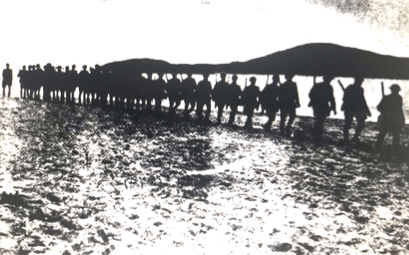
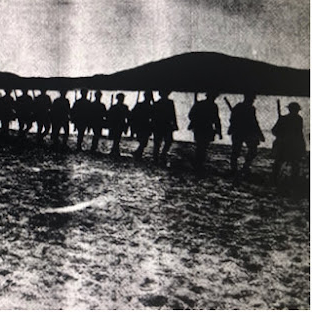
“Dawn Silhouette”. Troops marching along the Fingal Beach shore preparing to go into action to repel the “invader” from the sea [Newcastle Sun, 7 October 1938, page 8]

The area of Fingal Bay where the above photo was taken [Author photo 2022]
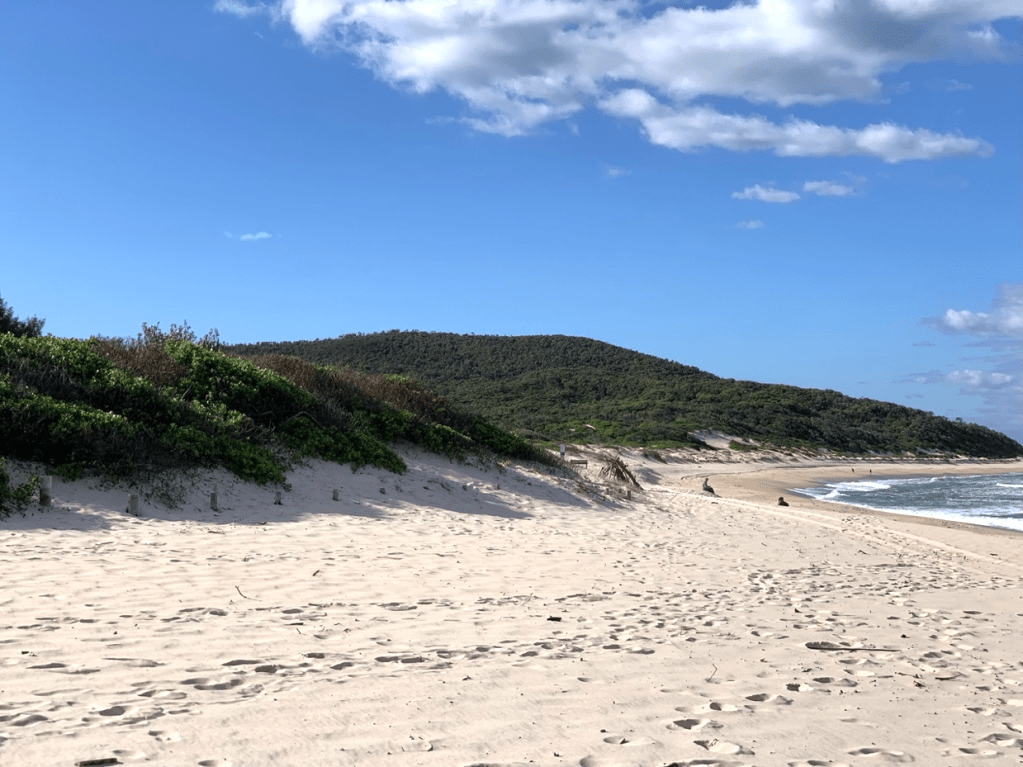
An area of the sand dunes at Fingal Beach where the guns and soldiers were positioned during the military exercises [Author photo 2022]
Battle commences with guns flashing and Verey Lights ‘stabbing the dawn’
The Maitland Daily Mercury of 7 October 1938, page 7, reported:
‘Gun flashes and Verey lights stabbed the heavy dawn mists today in a lively two hours battle. Australian forces technically repelled an imaginary army which had landed two battalions on a lonely beach near Port Stephens. To meet the invaders, four thousand keen young troops spent the night in their trenches and machine gun posts, while lightning illuminated the tangled bushland behind them, and thunder rivalled the heaviest of artillery.
A deluge lushed the area for two hours while infantrymen huddled under waterproof sheets and dripping gum boughs. The young army in the drier but murky dawn, flung itself into the battle with a gusto that even outpaced the fixed timetable. Every dune and every bank of tangled ti-tree covered a machine gun nest, which fought a capable defensive action. With, the first of dawn at 4.40 a.m. batteries of 18 pounder field guns, masked by green branches, let loose their first salvoes at the mythical enemy transports, cruisers and destroyers that had nosed their way into False Bay under the cover of night. For miles the great length of beach was swept by skilfully directed fire while Verey lights and star shells lit the darkness.
Units, which had prepared for the battle on the beach under the direct gaze of the inspector general of the Commonwealth Military forces, Lt.-General E. Kerr Squires, swung into action with precision. Messages from the intelligence section keyed up the defenders. Among the first of them relayed by wireless amplifiers to waiting regiments told of the hearing of sounds of anchors being lowered far out at the entrance of the bay. A succession of messages told how transports were sighted, how enemy cruisers and destroyers had moved up in the darkness and how they had been thrown into silhouette by flares from defensive aircraft. From field telephone and wireless crackled the information to the front line and the back areas that the enemy naval vessels had opened fire to cover the landing of the troops.
Shells were assumed to have ploughed into the sand dunes and wrecked some of the defensive posts. No. 2 company of the 2/35th Battalion was reported to be badly knocked about, and other units had also suffered casualties. Through the ravines, choked with head-high ti-tree and scrub, moved stretcher parties. Umpires nominated which of the defenders had become casualties, and what class of wound they had suffered. Realism was carried to the extent of bandaging the “wounds” and rushing the “wounded” to the casualty clearing station, and thence to the field hospital, which was situated in a secluded spot near Nelson’s Bay.
A whole machine gun section was the next announced casualty and now the enemy convoy was held to be clearly visible in the growing light. Cutters had been lowered and were towing boats filled with troops. Up on the sandy heights the ghostly figures of gunners sprang into action and the field guns blazed away at the cruisers and transports. Machine guns got the range of the incoming boats and the defence began to strike with plenty of force.
The defenders were not to be granted a shattering technical victory. A section of the invisible enemy, after heavy losses, was held to have landed a company towards the south-end of Anna Bay. It reorganised and sprang northwards under the cover of the sand dunes and scrub. At 5 a.m., half of the other landing party was stated to have rushed under cover of the dunes, advancing to the north. Lewis gun and rifle fire was said to have decimated a party of attackers attempting to land at Shoal Bay. An assault of Bob’s Beach had more success, and Hill 300 was taken by the invaders, who landed at Boat Harbour, and gained a secure foothold.
While machine guns chattered and field guns roared defiantly, the defence suffered a setback in the False Bay section. The enemy troops were stated to have fought their way through a cleft in the coastal dunes, and, moving through the shadowy bush, seized Piccadilly Junction, a defence inner strong post. In a half-roofed old shed was the Brigadier, Col. F. P. M. Solling, and Major Wells, who, working over maps, made new dispositions to meet this thrust, while the 41st Battalion from Grafton and Lismore had taken the third shock of the onslaught. The 13th Battalion from Maitland worked in reserve.
Reinforcements were rushed through the undergrowth to close the imaginary gap. Another message was relayed along the line that the commander of the 41st, Lt.-Colonel D. Jeater, had narrowly escaped capture. Field guns and howitzers blazed away with great intensity, and at 4.35 a.m. the 2/35th Battalion from Newcastle repulsed the Anna Bay landing party. Quick decisions by all commanding officers were made to cope with the landing of a second enemy party.’
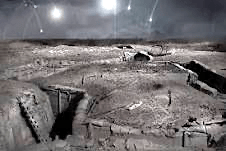
Verey Lights over a foreign battlefield
The Newcastle Morning Herald and Miners’ Advocate of 8 October 1938, page 10, also carried a thorough report on the military exercise:
‘After fierce fighting with heavy casualties on both sides, the 1st Infantry Brigade repulsed enemy troops which twice yesterday endeavoured to land at False Bay beach, north of Newcastle. A small party actually landed and captured the 41st Battalion headquarters, but a strong force of reserves recaptured the post and took many prisoners. No. 2 platoon of the 2nd/35th Battalion defending a sector on the southern end of the beach, was badly knocked about. No. 3 and 4 platoons of the 41st Battalion were “wiped out.”
Sad reading that would be if it were actual warfare. But the battle was only part of the tactical exercises undertaken by the 1st lnfantry Brigade and the 1st Field Artillery Brigade, associated with the annual encampment of the brigades. They were carried out on a scale not before attempted in the Newcastle area. At dawn yesterday, the enemy made his first unsuccessful attempt to land. The second attempt was made at 9 a.m. Infantrymen entrenched below the ridges raked the approaching boats with an enfilding fire. Coloured Verey lights at 4.40 a.m. announced the approach of the enemy.
From ridges behind the sand dunes a harsh purple light shot into the air and floated slowly down to the water. Headlands were thrown into bold relief, but no trace of the approaching enemy could be seen. At the southern end of the beach a blue Verey light was sent aloft. Others followed in quick succession, until the leading boats in the line of “tows” were located. The artillery opened fire from the centre, and machine guns went into action on the right flank. Nearer and nearer, it seemed, drew the line of boats. It was apparent that the enemy planned to put men ashore at several points. Some of the boats were at the south end, some went north, and several were headed straight for the centre of the beach.
A burst of machine-gun fire on the right was taken up by other machine gunners nestling along the beach. A battery of artillery added its fierce roars to the din. Dawn was just breaking; the False Bay ridge from north to south was a line of gun flashes. The battle lasted for two hours. The defending force did not escape without casualties. It was assumed that some of the tows broke through and landed men on the South Beach. A defending platoon suffered casualties. More troops were landed, and No. 2 platoon of the 2/35th Battalion was badly knocked about; while Nos. 3 and 4 platoons of the 41st Battalion were “wiped out.” A small body of enemy, it was ruled, gained the sand dunes and proceeded north.
A murderous fire in the centre beach cut boats adrift. Some were sunk, others floated broadside on, and were exposed to a raking fire from the centre and flank. A report from Anna Bay said that a pinnace with five boats laden with men had approached the shore but had many killed and wounded. The morale of the others had broken. They attempted to regain the transports, and many, it was said, were killed in attempting to rush from the boats across the beach. But a small party of the imaginary enemy had penetrated behind a defending platoon and taken possession of Picadilly Circus—headquarters of the 41st Battalion. A strong force of reserve infantrymen was thrown into the fight, engaged the enemy here, and took the post.
Casualties were numerous: stretcher bearers were frequently called to attend to the casualties in the defenders’ ranks. The invaders, after finding it impossible to land a strong force, returned to the transports, but were exposed to the bombing planes which were circling overhead, but anti-aircraft guns were assumed to be on the cruised convoys of the enemy and the aeroplanes had to rise into a cloud bank out of range. Still determined to land men, this tenacious enemy sent other pinnaces draw-lag boat loads of troops towards the beach. It was a disastrous move.
The artillery had their range and bombers were swooping low. In addition, Vickers and Lewis gun crews were not wasting many shots; while a cross fire from the 33rd Battalion swept the beach and the water in the immediate vicinity. It seemed that boats were cut adrift, some were sunk, others washed ashore. Those adrift and still afloat were picked up by the already overloaded pinnaces and towed back to the transports. So the first action ended.
The “dawn landing” was an interesting manoeuvre, but it relied chiefly on blank ammunition and a lot of imagination for realistic effect. The more spectacular effort, however, was reserved for the exercises after the troops had had breakfast. This time ball ammunition was fired. It was “a great show,” to use the military term, and the Governor-General (Lord Gowrie) and senior military officers were interested spectators. Targets were placed in similar positions to those used in the dawn operations— transports at 3000 yards, pinnaces and boats leaving the transports at about 1500 yards, and tows nearer the beach. High overhead a Hawker Demon droned, circling the transports.
Batteries, camouflaged on the ridge of False Bay, fired two rapid rounds; geysers rose about the transports. Boats had been lowered and were making for the shore. From end to end of the beach the Vickers guns barked: a hail of bullets flung the water up. No boat could have lived in that fierce leaden spray. For 10 minutes the intense fire was maintained. Soon the Lewis guns and the rifles came into action. The sharp, united snapping of the smaller weapons won like the crackling of a thousand whips; above it all the deep booming of the artillery caused the ground to tremble.
Far out in the bay the shells flung up columns of water; closed in shore smaller columns rose and fell with the rattling of over 1000 rifles. For 20 minutes this went on; the air was rank with cordite fumes, and smoke rolled over the water. It was a most interesting and spectacular exercise, and the quality of the firing won high praise.’
Photos of the First Military Operation
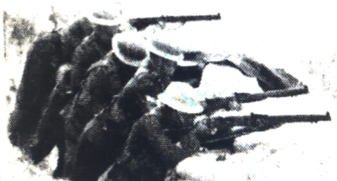
A section of the infantry, entrenched near Fingal beach, while the dawn attack was in progress. [Northern Star, 11 October 1938, page 1]
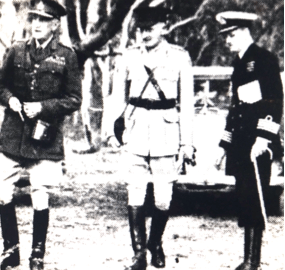
The Governor-General, Lord Gowrie with Sir Ernest Squires and Captain Bracegirdle, at early morning manoeuvres at Port Stephens. [Northern Star, 11 October 1938, page 1]
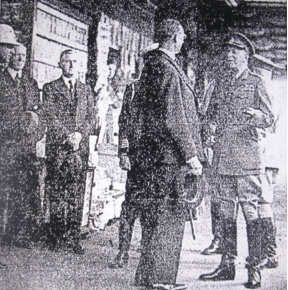
The Governor-General, Lord Gowrie), welcomed at Newcastle railway station by the President of the Newcastle Aero Club, Mr. A. A. Rankin. [Newcastle Morning Herald and Miners’ Advocate, 7 October 1938, page 11]
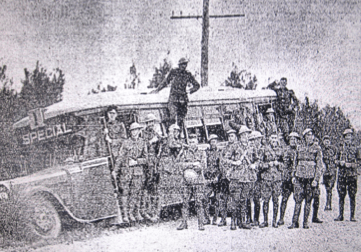
Troops alighting from a bus after having been transported from Rutherford to Port Stephens [Newcastle Morning Herald and Miners’ Advocate, 7 October 1938, page 11]
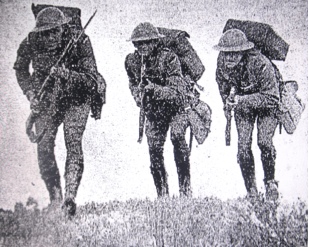
Infantrymen advance to repulse [Newcastle Morning Herald and Miners’ Advocate, 7 October 1938, page 11]
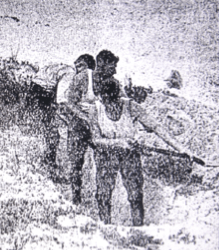
Digging on a sand dune at Fingal Bay (False Bay) [Newcastle Morning Herald and Miners’ Advocate, 7 October 1938, page 11]
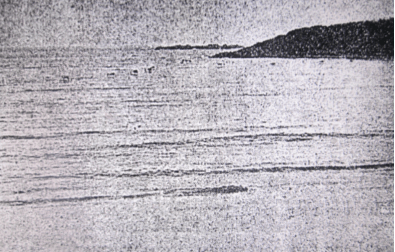
Canvas targets, representing enemy boats approaching the shore, moored in Fingal Bay [Newcastle Morning Herald and Miners’ Advocate, 7 October 1938, page 11]
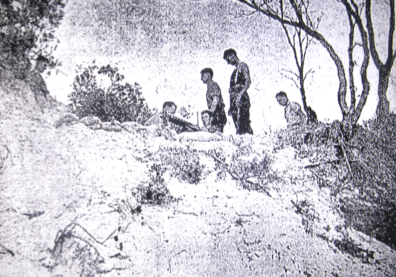
A machine-gun emplacement on a ridge at Fingal Bay [Newcastle Morning Herald and Miners’ Advocate, 7 October 1938, page 11]
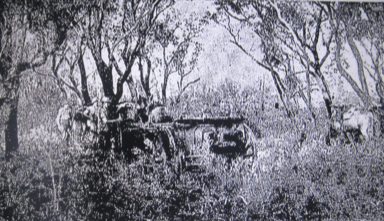
A howitzer gun team concealed by overhanging trees [Newcastle Morning Herald and Miners’ Advocate, 7 October 1938, page 11]
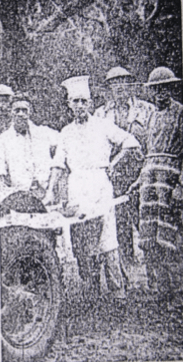
Cooks at a field kitchen [Newcastle Morning Herald and Miners’ Advocate, 7 October 1938, page 11]
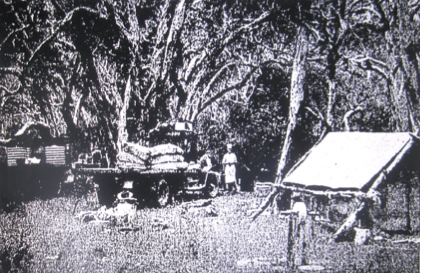
One of the field kitchens [Newcastle Morning Herald and Miners’ Advocate, 7 October 1938, page 11]
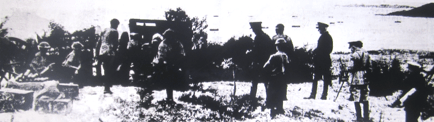
Eighteen-pounder guns of the 1st Field Brigade in action at Fingal Bay with live ammunition, watched by the Governor-General [Sydney Morning Herald, 8 October 1938, page 14]
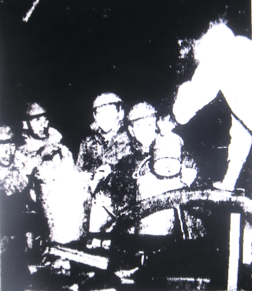
Field kitchen at the rear of the beach defences providing hot soup for the troops before the dawn attack was made in the rain [Sydney Morning Herald – 8 October 1938, page 14]
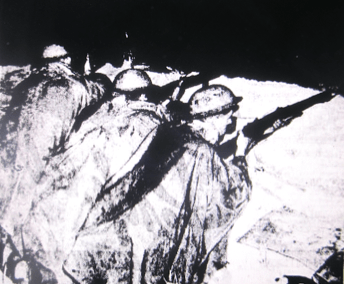
Troops defend the coast against an imaginary invader at dawn [Sydney Morning Herald, 8 October 1938, page 14]
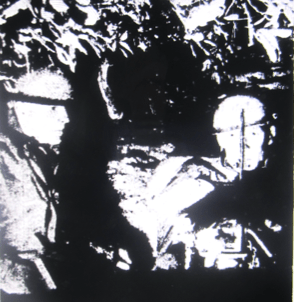
A vickers machine-gun in a camouflaged gunpit at Fingal beach [Sydney Morning Herald, 8 October 1938, page 14]
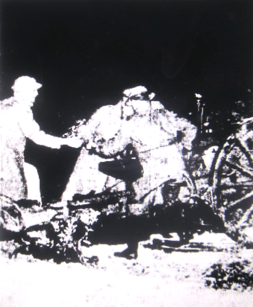
An 18-pounder field gun firing [Sydney Morning Herald, 8 October 1938, page 14]
After the Battle
The Daily Telegraph of 10 October 1938, page 2, reported:
‘Scores of crayfish in Port Stephens were killed during last week’s military manoeuvres. After the heavy bombardment on Friday morning campers found dead crayfish floating in shallow water. A few dead bream and reef fish were also seen. Military experts said yesterday that the shells would have practically the same effect as dynamite in the water. Fish killed by dynamite are edible, but they will not keep for any length of time.’
SECOND EXERCISE
The Newcastle Sun of 12 October 1938, page 1, reported on the second stage of the military exercise:
‘Training in gas protective measures, wiring and general beach defence will be carried out in the Port Stephens region next week by the 8th Infantry Brigade. The brigade will entrain for Rutherford Camp, near West Maitland. next Sunday, and the beach defence exercises will be carried out on Thursday, October 20, and Friday, October 21. As the average period of voluntary service of the 8th Infantry Brigade is longer than that of the 1st Infantry Brigade which fought the mock battle near Port Stephens last week, the exercises will be more advanced.
The 30th Battalion, Scottish Regiment, of 500 men, the strongest militia battalion in the Commonwealth, will have a troop train to themselves. The 7th Field Artillery, 8th Field Company Engineers, 8th Field Ambulance, 1st Field Hygiene Section, a part of the 1st Division Signals and details of the Army Service Corps will also take part in the manoeuvres. Training will be given in the use of searchlights by the engineers, in beach defence, and there will be a demonstration of the use of mortars in defending the coast. An Air Force Squadron will cooper-ate on Friday, October 21. Last week poor air visibility prevented the Air Force from cooperating fully in the mock battle. The exercises next week will be studied in their relation to those of last week, so that adjustments in training can be made to correct common faults.’
Military Exercise
The Newcastle Morning Herald and Miners’ Advocate of 21 October 1938, page 13, reported:
‘Preparing to repel an imaginary enemy coming in 30 transports to a locality north of Newcastle, 1000 men of the 8th Infantry Brigade were rushed from Rutherford to a point near Nelson’s Ray yesterday. Last night the men had dug themselves in for 12 miles along the coast north of Anna Bay. Barbed-wire entanglements were erected, and gas alarms placed along the front line. The 18th Battalion occupied False Bay, which will probably be the focal point of attack. Army intelligence has advised that the invaders will attempt a landing under a barrage of gas shells. Every man in the line was issued with a gasmask.
The imaginary attack to take place at dawn to-day, is part of the exercises of militia from the metropolitan area, who are completing a week’s training under active service conditions. For the first time outside bodies are cooperating with the military in the defence exercises. Rutherford Camp sprang into orderly activity yesterday morning. Headquarters had been advised by Army intelligence that several divisions of hostile infantry, conveyed by cruisers, were steaming north. It was believed that at least 30 ships would anchor at a bay north of Newcastle and would attempt a landing in the vicinity of Port Stephens. To repel the invaders four battalions of the 8th infantry Brigade were rushed overland to the coast. Some followed the route over Hexham punt to Raymond Terrace, others entrained to Civic Station and joined buses, there travelling over the Stockton ferry and Anna Bay road.
Meanwhile the 7th Field Artillery Brigade, encamped at Williamtown, was ordered north with two guns of the 27th Battery. Swiftly but carefully the column moved out. The utmost caution was needed. Every available point of cover was utilised. Events had moved so quickly that hostile aircraft might be within striking range. Carefully camouflaged, the guns moved along the uneven track. Soon after 4 p.m. the guns were in positions on one part of the coast. It was heavy work for the horses, dragging the guns up sandy slopes, but nightfall found the muzzles pointing to sea.
The gun crews showed remarkable keeness. Fearing that there would not be sufficient concealment for the guns the men, on their own volition, had bought yards of fishing net. This was thrown over the guns and covered with leafy boughs. Along the waterfront at False Bay the 18th Battalion had dug in. Machine-gun nests were selected and camouflaged; the guns of the 25th Buttery frowned over the sand dunes behind them. Supporting the 18th Battalion was the new 3lb Stokes trench mortar, imported recently. Its operation will be carefully watched by high military officers. Away to the north of False Bay the 36th Battalion was entrenched with a field gun in support. The 30th Battalion —the N.S Scottish Regiment—was entrenched at Anna Bay with the Field Artillery.
From Anna Bay for 12 miles along the coast, trenches had been dug. At night fall they were manned by steel-helmeted troops. Five miles back in the bush two howitzers attached to the 7th Brigade were stationed. In another part of the bush a fourth battalion was held in reserve. Brigade headquarters, which had been connected by telephone and wireless with every vital point covered by the troops, watched without seeing all that was going on along the coast.
Headquarters gave instructions and received intelligence of suspicious movements at sea. It learned last night that since 11 a.m. yesterday a long line of ships had been cruising along the coast, had split up into small bodies and would probably attempt a landing at points along the coast. There was a suggestion that a false attack would be made on Newcastle at about 2 a.m., but the main attack would be expected at dawn in the vicinity of False Bay.
Preparing for the gas attack, the 8th Field Engineers had erected gas alarms and other warnings to inform the troops when gas shells landed on the beaches. Back at an advanced dressing station members of the New South Wales Red Cross were cooperating with the Army Medical Corps. It was the first time that a civilian body had cooperated with the military in manoeuvres. At the moment other private bodies are also cooperating. They include the National Roads and Motorists’ Association (Sydney section), and a major oil company has a representative with the troops for investigation purposes.
Intense interest is being taken in the exercises by the three arms of the defence service. Major-General J. L. Hardie viewed the manoeuvres from the military standpoint, Captain H. C. Phillips, of Garden Island, represented the Navy, and Group Captain H. F de La Rue represented the Air Force. It was explained last night that it had become necessary for the Navy to obtain first-hand information of beach exercises because the time might arise when it would have to lend a force of men for such work. Other interested spectators were the Director of Military Training, Colonel E. P. Plant, of Army Headquarters, and Major A. P. O. White, Assistant Director of Supply and Transport.
The Brigade Signal Section and the 8th Field Ambulance took a leading part in the manoeuvres. The signal section had wired the road from brigade headquarters and had connected every point by wires running through the bush. Gun positions were wired. There was a wire running from the gums to the horse lines five miles away, while the aerodrome at Newcastle was in constant touch with brigade headquarters by wire. A steel pick attached to a strand of barbed wire was one gas alarm. Tapped with a hammer, its ring reached through the bush. “Gas Over” was the alarm that the ringing pick sounded. Immediately troops in the area donned their gas masks, which were carried in small bags fastened to the front of tunics. Like monsters from another world the troops looked in those grotesque masks.
Early last night the battalions started to wire their positions. Rolls and rolls of barbed wire rested along the beach, apron fashion, in front of the trenches. This will have the effect of holding up invading troops if any should land. Night fell with the troops standing to their posts, gas masks at hand and lookouts posted on neighbouring hills. Sentries were in position on all roads, and along the beach. It was impossible to move into or out of the front-line area without being challenged. Fresh water for supplying the needs of troops is being obtained by the engineers who have sunk spearhead pumps into the sand. An ambulance dressing station is just behind the front line, and stretcher bearers in gas masks were standing by last night. The enemy is assured of a hot reception when he comes ashore—if he gets that far.’
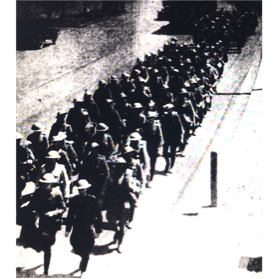
Troops marching through Hunter Street, Newcastle, to join buses and travel to the second manoeuvres at Fingal Bay [Maitland Daily, 20 October 1938, page 7]
Emergency landing by Air Force Plane
The Daily Examiner of 24 October 1938, page 4, reported:
‘One of the ten Hawker Demon Air Force planes which had been cooperating in the military manoeuvres at Port Stephens made an emergency landing on the golf links about eight miles from Wyong yesterday. The landing was made without dam-age, but the plane was still at the golf links to night. Engine trouble which had caused the landing, could not be rectified in time to allow the plane to take off today.’
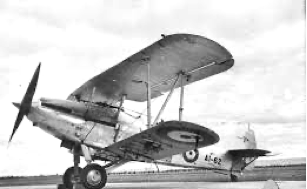
R.A.A.F Hawker Demon [Australian War Memorial]
Photos of Second Military Operation
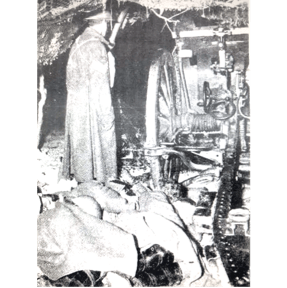
The crew of a field gun snatch forty winks near the beach while a sentry keeps watch. [Sydney Mail, 26 October 1938, page 8]
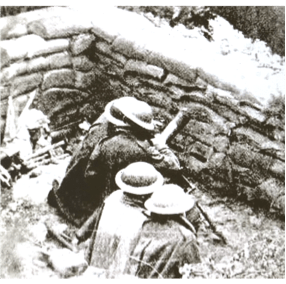
Behind a sand-bagged emplacement the crew of a Stokes mortar prepares for action. This gun was in use for the first time. [Sydney Mail – 26 October 1938, page 8]
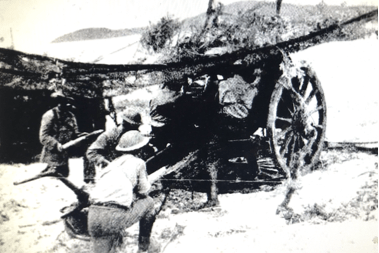
Camouflaged against aircraft observation, an 18-pounder overlooks Fingal Bay, where transports and cutters are represented by floating targets [Sydney Mail, 26 October 1938, page 8]
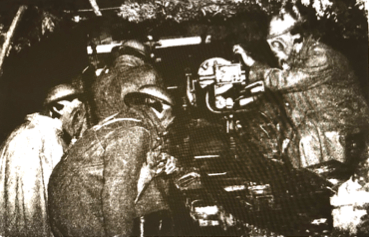
Artillerymen in action at night at Fingal Bay, wearing gasmasks. [Sydney Mail – 26 October 1938, page 19]
Interlude at Shoal Bay
The Daily Examiner of 28 October 1938, page 13, reported”
‘There was a bright interlude during the military manoeuvres at False Bay. A gun team dragging a limber [gun support cart] into position on the brow of a sand dune took the steep incline at a gallop. On the hill and almost in the track of the racing horses several high military officers and press representatives stood watching the gun crew work. They were deeply engrossed with that occupation when the horses appeared galloping towards them. A burst of enemy gunfire could not have had a more telling effect. Stout officers and some pressmen, nearly as stout, scattered like chaff before a breeze. Some hopped aside, others tried to run, but slipped down an embankment, and at least one lost his footing and rolled down. It was the perspiring gun crew who had the last hearty laugh.’
No compensation to Port Stephens Shire Council
The Maitland Daily Mercury of 19 December 1938, page 4, reported:
‘The Department of Defence informed that it would not grant the sum of £200 towards repairing the damage done to the Nelson’s Bay road by the recent military manoeuvres. Cr. Upton said it was more than ordinary wear and tear. There were large holes in the road made by the gun carriages. The engineer said the edges of the tar had been cut.’
Concluding Comments
The young troops participating in the military exercises did not realise that in just over a decade many of them may have been called upon to defend the interests of Australia in the great battle of the Second world War.
Most holiday makers that today spend time at Fingal Bay would not know of the major the military exercises that had previously taken place in 1938 on the beach and sand dune behind.
The following military related papers are published on this website and can be viewed at the following links:
When World War One Came to Anna Bay
Camouflage of Mount Tomaree – 1941/42
HMAS Assault at Nelson Bay Port Stephens – 1942/43
A Pictorial History of HMAS Assault – Nelson Bay
United States Landing Force Equipment Depot at Nelson Bay – 1942/43
Royal Marines at Port Stephens – 1945/46
‘Operation Boomerang’ at Port Stephens – March 1952
War Diary of Tomaree Coastal Artillery Battery Port Stephens – 1942/1944
Post War History of the Gan Gan Military Camp At Port Stephens
15th Northern Lancers at the Gan Gan Military Camp – 1949
Military Training Camp At Gan Gan – February 1951
School Cadets At The Gan Gan Military Camp – April 1951
Army Commando Training Exercises at Gan Gan – 1953 and 1955
First Army Camp for Women of the Citizen Military Forces at Gan Gan – April 1954
University Students at the Gan Gan Military Camp 1950 and 1962
Military Picnic at One Mile Beach, Port Stephens
Port Stephens Residents Serving in The Australian Military Forces in The Second World War
Letters from the Front Sent by a First World War Soldier of Port Stephens
Tank Traps at Birubi Beach – Port Stephens
Researched and compiled by Kevin McGuinness
July 2022

 Port Stephens - a history exploration