
Introduction
In the early 1900’s, large rabbit infestations were causing significant problems to pastoralists in New South Wales and elsewhere. The rabbits were having major impacts on the amount of grass available for livestock. Existing rabbit culling methods of trapping, fencing, and poisoning were largely ineffective. Rabbits were able to breed on large areas of Crown land and reinfect nearby farming lands where eradication had previously taken place.
A new method of rabbit eradication was deemed necessary by way of the introduction of a virus that only killed rabbits, and which could be spread by infected rabbits to other rabbits, regardless of whether they were on pastoral or Crown lands.
In 1905, the Council of the Australian Pastures Protection Board opened communications with Dr Jean Danysz, a well-known bacteriologist with the Pasteur Institute in Paris. He was invited to travel to New South Wales and conduct experimentation on rabbit extermination using a virus he had developed to eradicate rodents in France.
The Australian Pastures Protection Board believed that the Dr Danysz’s rodent virus, if properly proved under Australian conditions could be the most efficient method for the eradication of the rabbit infestation problem. Broughton Island, off Port Stephens, was chosen as the ideal location for experimentation.
The impending arrival of Dr Danysz set off two protest movements. The first sought the banning of the importation of a virus that had the potential to kill many types of useful animals, and people.
The second protest movement had its basis in ‘class warfare’. It was supported by industrial unions who claimed the proposed eradication of rabbits would deprive many thousands of rabbit trappers of a living, forcing them to work on pastoral lands for lower wages. This would further enrich large pastoralists who mainly supported eradication, thus increasing their profits at the expense of workers.
Despite the protests, which delayed the commencement of experimentation by several months, Federal Government approval was given to Dr Danysz in 1906 to conduct his rabbit extermination experiments at Broughton Island. These were to be under strict government oversight by a government official, Dr Frank Tidswell.
Dr Danysz, returned to France in May 1907, and left the balance of the experimentation in the hands of his assistant, Mr A Latapie, with oversight by Dr Tidswell.
By 1908, it had become evident that the experimentation had failed after a scientific review sought by the Federal Government. At the Health Boards Conference of the various Australian States held in February 1908, it was reported that the Danysz virus was identical to a virus that already existed among the Australian rabbit population. It was proven that the Danysz virus would only kill rabbits that had been directly infected or those kept in proximity in an enclosed area close to an infected rabbit. Under Australian conditions, the Danysz virus was not able to be transferred from rabbit to rabbit in natural open environments, which was essential.
The Australian Pastures Protection Board, which had funded the research, was reluctant to accept the negative findings of the experimentation and sought to have the Danysz virus tested on the mainland, but the Commonwealth Government did give its approval.
Between 1905 and 1908, the Danysz virus and Broughton Island received much national press coverage, and the story of this interesting chapter of Australian history is told in this paper.
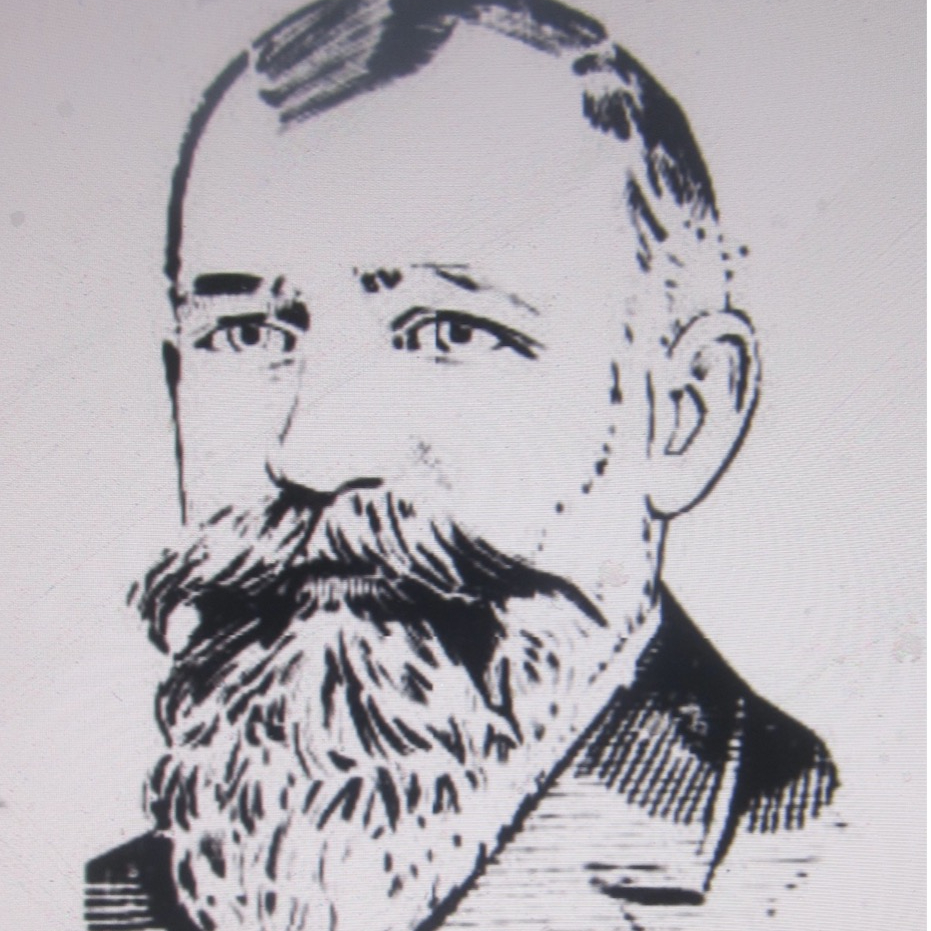
Illustration of Dr. Danysz [Lithgow Mercury, 22 June 1906, page 7]
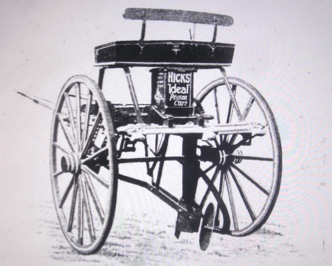
A ‘Hicks’ Poison Cart, of the Type Widely Used to Distribute Rabbit Poison on pastural properties. Apart from rabbits. the poison distributed also killed other animals and birds. It was hoped that the Danysz virus would end the use of poison carts. [Grenfell Record and Lachlan District Advertiser, 2 May 1908, page 6]
Early communication with Dr Danysz in Paris – 1905
The Kiama Independent, and Shoalhaven Advertiser of 31 March 1905, page 2, reported:
‘Minister for Lands has the matter in hand in connection with the proposed visit of Dr. Danysz to New South Wales to study the rabbit problem and the extermination of the pest. A cable has been received from Mr. Paul Wenz, of Nanima station, near Cowra, and who is at present in Paris, stating that Dr. Danysz will be prepared to leave for Sydney within the next two months on an intimation being received that the Government desires him to come out. ……. The whole matter is being considered by the Minister, and a decision as to certain aspects of the proposal will shortly be arrived at.’
The Kiama Independent, and Shoalhaven Advertiser of 23 May 1905, page 2, further reported:
‘When the Premiers’ Conference was sitting at Hobart, an arrangement was come to with the other states that New South Wales should take action with the view of securing a scientific expert to deal with the question of rabbit destruction, and that the various States would cooperate in meeting the necessary expenses. Since then a communication from Dr. Danysz was received, expressing his willingness, to proceed to Australia on a six months’ visit. Remuneration was asked for at the rate of £600 per month, from the time of his departure until the date of his return to Paris, together with all expenses connected with the installation and the studying of the question in Sydney. This letter was sent to the other States, with a request that they would intimate whether they were prepared to join in the expense of bringing out the scientist. The Minister for Lands, who has had charge of the matter, has, in addition, been in communication with Dr. Danysz regarding the question of expense, but nothing definite, has been settled. Victoria and Tasmania have now replied, declining to contribute towards the expenses associated with the proposed experiments by the scientist. A cable has also been received from Dr. Danysz, stating that unless a definite arrangement with him is made at once, he will not be able to come for 12 months. The matter now rests with Mr. Ashton to settle.
Speaking last Thursday evening about the position the affair had assumed, through the decision of Victoria and Tasmania, Mr. Ashton said the question of further action would have to be carefully considered, after consultation with the Premier. The Minister was, however, apparently not very much surprised at the determination of Victoria, as it is believed she is looking for war, to improving her export trade in rabbits. It was reported in the Sydney daily papers on Saturday that arrangements are being made for the exportation to London of over 5,000,000 rabbits from New South Wales. One company alone, it is said, is prepared to export 10,000 crates per week, and an army of trappers will consequently have to be employed. Surely this is better, and certainly more profitable, than poisoning.’
Proposal by stock owners to bring out Dr. Danysz presented to the Premier – 1905
The Young Chronicle of 11 November 1905, page 2, reported:
‘Representatives from the Pastures Boards’ Council of Advice, …. on Wednesday waited upon the Premier, with whom was the Minister for Lands, to discuss certain matters affecting stockowners. The press was not admitted, but the Premier has furnished a report of the proceedings. ……
The second matter was the rabbit question. It was stated that the stock-owners were so desirous of having experiments made with a view to the extermination of the rabbit that they were prepared, if the Government would grant them permission, to bear the whole of the expenses of bringing out Dr. Danysz from Paris for the purpose of allowing him to experiment with his diseases in New South Wales. Two stockowners had signified their willingness to allow the experiment to be carried out on their runs, leaving their sheep, cattle, horses, etc., thereon whilst the experiment was being made. Of course, they understood that the whole thing would be under Government supervision, and that any experiment would have to be carried out under certain conditions.
They had it from Dr. Danysz himself that the disease would attack the rabbits in the lungs and throat, and the contagion would come by a mucus from the nostrils that would foul the burrows and food. The disease would be highly contagious, and the course of it would run from three days to six weeks, and any rabbit taking it would be almost sure to die. ……..
On the second question, the Premier said that the Government had always been in favour of doing something to exterminate the rabbits. The deputation offered to bring out Dr. Danysz, and to shoulder all expenses connected with his visit. Under those circumstances he would say to them “Fire away.” But they would have to comply with certain conditions which he thought they would admit would be reasonable. If they would come forward with a business-like proposal, the Government would endorse that proposal every time.’
Approval for experimentation given – 1905
The Australian Town and Country Journal of 6 December 1905, page 13, reported:
‘The secretary to the Pastures Boards’ Council of Advice [a sub-committee of the Australian Pastures Protection Board] has received a letter from the Under-secretary for Lands, granting the council permission to experiment in the destruction, of rabbits by disease. …..
The letter runs as follows:— “Referring to your council’s interview with the Premier on November 8, when the matter of the rabbit question and the stockowners’ desire to have experiments made with Dr. Danysz’s method at their own cost, were introduced and discussed, and your letter of the 9th respecting the introduction of a disease amongst the rabbits and control of the experiments…..
I am directed to inform you that the Premier has approved of the experiments being proceeded with under the supervision of the Pastures Protection Boards’ Council of Advice, in accordance with the conditions mentioned in your letter, and provided they are conducted under reasonable and expert supervision, but it has been represented by the Department of Navigation that the Broughton Islands, near Port Stephens would be far more suitable for the purpose than Montagu Island, and it is suggested that the board should take those representations into consideration.” ‘
Preparations begin for experimentation – 1905
The Daily Telegraph of 16 December 1905, page 11, reported:
‘The Stock Boards’ Council of Advice deliberated on the rabbit question yesterday and the previous day and brought matters to a head in regard to inviting Dr. Danysz to experiment in Australia. A letter was received from Mr. Ashton, giving his consent to the experiments with a virus, and agreeing to the nomination of Dr. Danysz as the bacteriologist. By direction of the council, a letter has been written to the doctor, asking for the fullest information, and apprising him of the situation as it stands to-day. Messrs. Dalgety and Co. were appointed the council’s agents and will conduct the necessary negotiations in Paris. Messrs. R. T. B. Gaden, R. T. Keys, and the Chief Inspector of Stock, Mr. Jones, were appointed a sub-committee to investigate the suitableness of the various islands which have been suggested to the council as sites for the experiments. These gentlemen will make their reports to the council in January next.
As previously mentioned, Sir Francis Suttor, Mr. James Ashton, and Mr. W. Alison have been appointed trustees to the fund, and contributions are invited from private stockowners not only in New South Wales, but throughout Australia, as the council regards the matter of vital importance to the whole Commonwealth. …… The council roughly estimates that the experiments will cost £15,000, and feels sure that the interests of all stockowners being so vitally concerned, no difficulty will he encountered in raising the money. The foundation of the fund will be the contributions from the pastures boards, and as they are to be asked to contribute at the rate of £100 per board, about £6000 is expected from this source.’
Initial laboratory requirements submitted by Dr. Danysz – 1905
The Sydney Stock and Station Journal of 29 December 1905, page 5, reported:
‘The following is an extract from a letter received from Dr. Danysz last mail by Mr. Paul Wenz : — Instut Pasteur, Paris, November 13th, 1905. Dear Mr. Wenz, —
….. In order to avoid the delays through correspondence and to make possible my sailing in March, 1906, it would be necessary that I should be informed definitely by the end of December, or, at the latest, beginning of January. My conditions are still the same as set forth in my letter to the Government of New South Wales in January last, viz. : — Installation of a laboratory and of a small, enclosed paddock for the first experiments on rabbits and on some domestic animals (sheep, goats, pigs, fowls, etc.). This experiment station should be built as per sketch : —
200 meters x 100 meters, Middle Passage, 2 meters, wide, Cross Passages, 1 meter wide. This enclosure should have at least 8 separate sections in order to study separately. 1st. Virulence of disease by inoculation and contagion between healthy and contaminated animals. 2nd. Virulence of the cultures by ingestion and power of contagion (“contagiosite.”) 3rd, 4th, 5th and 6th. Development of the disease or epidemic in contaminating 1 per cent., 5 per cent., 10 per cent., 25 per cent. of rabbits enclosed in a small section. 7th and 8th. Different ways of contamination. In the sections 3, 4, 5, 6 it will also be necessary to study the persistency of the disease after the destruction of rabbits.
When one section will be empty after the death of all rabbits, it will be left unoccupied for a certain time; healthy rabbits would then be put in in order to see how long the disease will remain in the soil. (200 to 300 live rabbits would be required.) In all these small enclosures sheep, fowls, goats, etc., will be kept the whole time of the experiment. Near the enclosure a shed would be wanted 12 metres long by 5 or 6 metres wide, for special experiments on rabbits and other animals in cages. All this should be fixed near the laboratory, composed of a large room and a few small ones. Should people in Australia come to a decision, they could start the buildings before my arrival and thus gain time.
As for the conditions, they would be the same as the ones I already told you— 115,000 francs (£4,600) for the first six months — with an agreement in due form—30,000 francs (£1200) cash before sailing, the balance 85,000 francs (£3,400) to be placed in a Sydney bank to my credit. As soon as it is definitely decided, kindly let me know by cable. I shall at once get ready. …. — Yours, etc. (Signed) Danysz.’
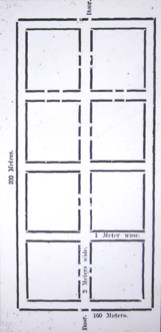
Sketch of Laboratory Submitted by Dr. Danysz [Sydney Stock and Station Journal, 29 December 1905, page 5]
Preparations commence at Broughton Island – 1906
The Sydney Mail and New South Wales Advertiser of 17 January 1906, page 163, reported:
‘Citizens of Sydney who sit at home at ease but faintly realise the bitter battle being waged between men on the land and the rabbits which infest station properties. In the last 20 years millions in cash have been fruitlessly spent in endeavours to exterminate the grass-eating pest, which has now become a national danger. As a veteran western squatter recently remarked: “It’s a fight to the finish between sheep and rabbits, and one must go under.” Bunny has practically taken possession of the Western Division, and if unchecked will ere long be found all over the State.
The fecundity of the rabbit is proverbial, but it is not generally known that the doe has her first litter, which averages half a dozen, at the age of four months. In three years the progeny of two rabbits goes well into the millions. Poison, fumigation, scalp rewards, trapping, wire-netting, and other devices have each and all failed to stop the rodents’ remorseless march. Stockowners are promptly fined if they fail to keep rabbits down. Yet the chief offender in this respect is the Government, whose reserves are practically nurseries for the pest.
About six weeks ago the Minister for Lands approved of experiments being made with Dr. Danysz’s method of destruction by disease, one condition being that the whole of the cost of the trial is to be borne by stockowners. Dr. Danysz is an eminent bacteriologist of the Pasteur Institute, Paris. His fee for conducting the experiments in this State is said to be £5000. The estimated cost of the tests is £15,000, and it is hoped that this sum will be raised within the next few weeks. Contributions are expected from the whole of Australia. At a meeting in Melbourne last week £3050 was subscribed in a few minutes by banks and financial institutions. New South Wales subscriptions total about £1000 at present, but this sum will be largely increased when outstanding lists come in. Rabbit extermination is a national affair and should receive national support. …..
Assuming Dr. Danysz’s germ cultures to be fatal to rabbits, it is, of course, of paramount importance to ascertain that the disease will be innocuous to sheep, cattle, horses, and other live stock. ….. Broughton Island, was inspected, and found to fill the bill, and a recommendation will be made in its favour.
Messrs. Gaden, Jones, George Yeo (acting secretary to the project), and D. J. Dunnett (stock inspector, Cannonbar) left Sydney on the 3rd inst. for Newcastle, where they stayed the night. At 6.30 next morning the party was joined by Mr. Keys, who had journeyed from Muswellbrook. A start was at once made on the Storm King for Broughton Island, which is about 31 miles north of Newcastle, and 10 past Port Stephens. At 11 a.m. the island was reached, and anchor dropped half a mile from the shore, owing to the shallowness of the water.
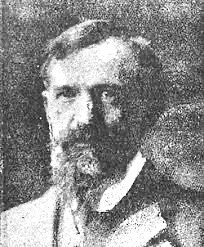
Dr. Jean Danysz [Wikipedia]
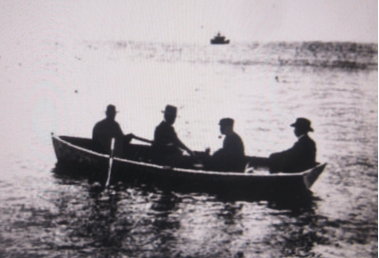
Inspection Party Landing on Broughton Island from the ‘Storm King’ [Sydney Mail and New South Wales Advertiser, 17 January 1906, page 163]

Inspection Party on Broughton Island: (left to right) R. T. B. Gaden; R. J. Keys; G. Yeo; R. D. Jones; D. J. Dunnett [Sydney Mail and New South Wales Advertiser, 17 January 1906, page 163]
The inspectors tramped bravely nearly all over Broughton Island. The day was so hot that the big man from Bengalla said he would give half a sovereign for the loan of a horse. Later on, when mopping perspiration, he raised his bid to a pound. The water supply, though not abundant, is considered sufficient for the animals to be isolated on the island. At a slight expense, by erecting catchment troughs, a good deal of water which is now wasted could be profitably conserved. Taken as a whole the inspectors considered Broughton Island an ideal place for the proposed experiments. The party returned to Newcastle about 6 p.m. and reached Sydney at half-past 10 the same night.’
Landing rabbits on Broughton Island – 1906
The Evening News of 10 March 1906, page 6, reported:
‘When the decision was made that rabbits should be placed on Broughton Island considerable difficulty was anticipated in landing many of them alive. Usually when they have been brought even as far as Sydney great loss has occurred. The first point was, therefore, the construction of proper coops or crates. Mr. J. A. Gunn, of Wagga, who has had experience in such a line, provided us with plans, which after some slight alteration in the way of additional ventilation, proved a thorough success.
Mr. Charles Binnie, of Baan Baa Station, near Narrabri, agreed to provide 600 rabbits. Arrangements were made with the Railway Department to land them in Newcastle on Friday morning, 2nd instant, and the Storm King was chartered, and all stores loaded the night before, and no possible, hitch could apparently occur. “The best laid plans gang aft aglee,” and our first hitch occurred through the truck with the rabbits being left behind at Werris Creek. Mr. Binnie had taken the trouble to come with the rabbits; but having seen them loaded, and the truck attached to the train deemed that all was well.
As our party was finishing breakfast at Newcastle, at about 6 o’clock, he appeared, with disgust largely written on his features, and announced the detention of the truck at Werris Creek. Immediate inquiries from the station master, Mr. Richardson, elicited the information that the best he could do was to wire instructions for it to come on by the train arriving at 3 p.m. So we frequently and fervently blessed the Werris Creek men and kicked our heels until 3 o’clock. Immediately after the arrival of the train, Mr. Richardson had the truck shunted close to our boat, the rabbits were shipped, and we cleared Nobbys Head at about 3.45.
A beautiful calm passage to Port Stephens, where we put into the township of Nelson’s Bay, only disturbed by a report from Mr. Reid, of the Storm King, that a strong southerly was coming up the coast. Next morning the day broke ominously, and, sheltered as Nelson’s Bay is, we could see that a heavy wind was blowing. We however, made a start about 6 o’clock, and reached the heads. The landsmen among us regarded the sea, with its huge white horses and rolling breakers with alarm, but as Captain Nelson stolidly kept on his course, we remained silent. But when we began ploughing into the sea — and ploughing in this connection is an expressive word — and it was a case of holding on to something, we looked as far as we could see out of our eyes for spray at one another in trepidation.
At last, when it became evident that we ran a big chance of losing rabbits and stores, a hurried consultation was held with the owner, and a return to port decided on. We turned just where the ‘Thordis’ was wrecked next morning, and the operation was one of considerable risk in such a sea. We felt much happier when we got back to smooth water and wiped the spray from our eyes. It appears a strong ebb tide was running out, which, meeting the south-easterly gale, produced what the sailors called a “lumpy” sea — I am inclined to think that if a lump of the Pacific Ocean had struck us, the further proceedings would have interested the rabbits no more, if not ourselves.
We lost the boat we were taking down for the use of the men on the island, when we were turning. All we saw was a huge sea, towering over it crashing into it, and twisting it round, and breaking the rope. We did not go back for it, contenting ourselves by saying, “Good-bye, Toss-up.” We had christened it by that name through Mr. R. T. Keys tossing the owner for a certain price and winning the toss. We little knew how appropriate the name was going to be. Returning to Nelson’s Bay, we landed the rabbits on the wharf, and opening the crates, found to our astonishment that only 27 rabbits were dead; the rest quite lively.
About midday the weather slightly moderated, and having landed the stores and reshipped the rabbits, the Storm King again started for the island. The north side of Broughton Island, has a long beach, called North Bay, sheltered from the southerly, and here the rabbits were landed with no great difficulty, and liberated. Most of them cleared off inland; but a curious incident happened to some three or four, which seemed dazed by their knocking about, and made straight for the sea. All but one got back, but he swam boldly out for about a hundred yards before he succumbed.
Some six or seven more were found dead, the final tally being 567 landed sound and well out of 600, which Mr. Shaw, of the Stock Department, pronounced first rate. From our former experience with rabbits, it would have seemed impossible to anticipate that we should ever be so deeply interested in the welfare of any rabbit as we were in our cargo. We never dreamt of having anything to do with them, except with a waddy. The result, however, was highly successful. …
On Monday we started for the island, with the stores and men; got comfortably into Esmeralda Bay, which face the south-east. Fortunately, the sea was comparatively smooth, or we could not have gone in, and we brought up at anchor at the end of the bay. …..
There are sheltered places for buildings, close to what we believe will prove to be an ample water supply, and good level dry ground for the erection of yards for the rabbits in close quarters. Broughton Island is a great fishing ground for schnapper, lobster, etc., and at North Bay are several rough huts occasionally occupied by fishermen. At Esmeralda Bay there are a roomy building and some outbuildings, erected by Mr. Crawford for fishing expeditions, but apparently not used for some time. In this building our stores and men were placed, and glad we were to get the stores out of the rain. Probably the last thing Mr. Crawford ever thought was that rabbits would be the cause of his cottage being occupied. After a walk over to North Bay, we returned to negotiate some lunch, when an exciting scene occurred.
The stores were being landed, and the small boat was on the beach, with the captain in charge, when a yell came from the fireman of the Storm King. A fierce squall was coming up the bay, and the tug, although moored to the rocks, and anchor down, was apparently drifting, without waiting to land the balance of the stores. Captain Nelson shoved off, and made for the ship. The wind forced the boat away, and at one time we feared it would not reach the tug. After tremendous exertions, it reached the side, and the captain hardly seemed over the bulwarks before he appeared at the wheel, yelling instructions to the engineer. We watched with anxiety, wondering if we were going to finish up with a wreck, and a compulsory week on the island. However, after backing and filling, or whatever the nautical terms are, the captain soon had her under control, and the squall went down as quickly as it got up. About 12.30 we got under weigh for Newcastle, waving “good-bye” to the two who were left on the island, with nothing but the rabbits for company. After a 3½ hours bucking match, we reached Newcastle at 5 o’clock, delighted that our trip had been so successful.’
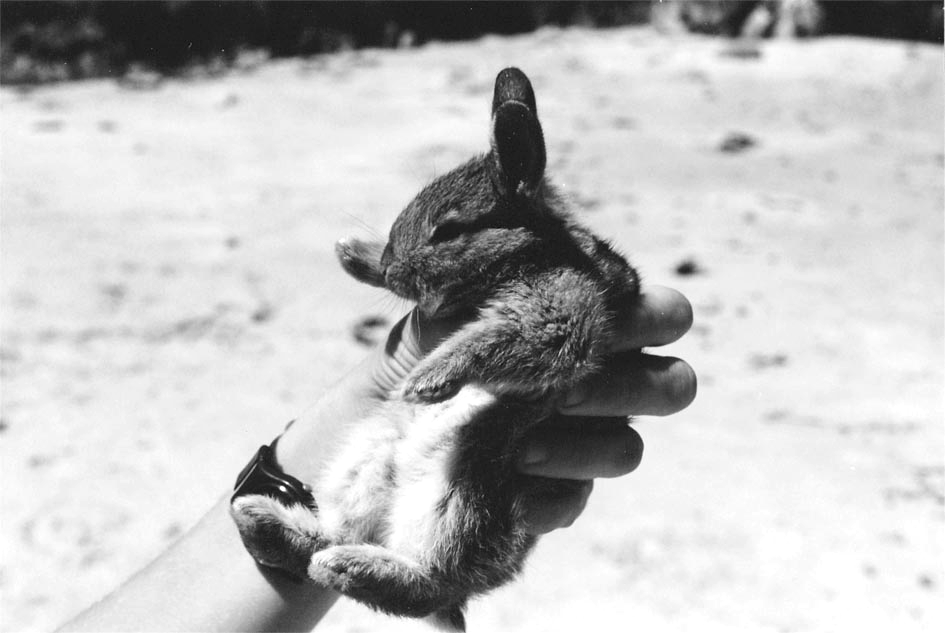
A Broughton Island rabbit
Protests to halt the Danysz experiments commence – 1906
As news of the proposed Danysz research spread, various protest groups commenced activities aimed at halting the rabbit extermination experimentation.
The Leader of 1 May 1906, page 1, reported:
‘There is an interesting development (says the “Sydney Morning Herald”) in the Danysz experiment scheme. The committee which has charge of the arrangements has received from a solicitor representing Mr. W. A. Benn and others an intimation that if the proposal goes further legal proceedings will be initiated. Mr. Benn represents large rabbit export interests, and it is understood that the action threatened is on their behalf. Contracts appear to have been made with the proviso that in the event of a disease being introduced against the rabbit the supplies should at once cease. It is assumed that the opening move will be for an injunction to restrain the scientist from commencing operations, and that the case will be subsequently fought out on the contention that the experiments are an undue interference with vested interests, or that they are a menace to the public safety.
The Council of Advice of the Pastures Protection Boards, which has received the legal letter, has forwarded it to the Government. The Government gave the Council leave to go ahead, and thus stands behind the experiments, and will be the real defendant if it comes to a fight. Mr. Benn has been struggling against the Danysz scheme from the first; his arguments being that it means the introduction of an unknown and highly dangerous disease, and that it is an unjustifiable interference with the rabbit industry. No notice has been taken of the solicitor’s letter, and until something further is done preparations for Dr. Danysz’s work will proceed as quickly as possible.’
Apart from the threatened legal, various meetings and actions were conducted at regional and town levels. For instance, the Age of 8 May 1906, page 2, reported:
‘On Tuesday evening next a meeting of ratepayers and residents [of Queanbeyan] will be held in the Council chambers to protest against the introduction of disease amongst the rabbits as proposed by Dr. Danysz, the French scientist. We have already expressed our opinion on this subject and, nothing that has since transpired in connection. with the proposed experiment has in any way tended to alter that opinion. We think the proposal to inoculate rabbits with disease is fraught with the gravest danger to the lives of human beings and stock and that it should not, under any circumstances be permitted to be put into effect. We even recognise danger, in experimenting with the disease on an island off the coast. It is all well enough to say that the proposed disease will not affect human beings, but we cannot understand how any guarantee to this effect can be given. It must be remembered that once the disease is started, no human power can recall it and past experience in the introduction of exotics should teach caution. We trust the meeting will be well attended and that there will be a full expression of opinion on the subject.’
Workers believe the Danysz ‘Abomination’ will supress wages – 1906
The Worker of 17 May 1906, page 3, reported on the following views held by an activist named Frank Cotton who held great reservations regarding the Danysz experiments:
‘Dear Worker. — It is hardly conceivable that the State Government while Parliament is in recess should have authorised a so-called experiment with death-dealing microbes of unknown potency. Every scientist in Australia, individually, every scientific body, every health officer of the other States, the Federal Premier and several of the Victorian and Federal Ministers have all united in condemnation of the scheme. Our own Board of Health, being Government officers, have, of course, not been consulted. Neither the State nor Federal Parliaments are sitting, and meantime the State Premier of New South Wales continues to afford his countenance and assistance to a scandalous proposal ostensibly to benefit a few pastoralists who occupy so much land at peppercorn rentals that they have neither the means nor the will to cope with the rabbits on their leaseholds.
This is not the worst of if. The agitation by these pastoralists is not against the rabbit, but against the rabbit trade in skins and carcases— and why? Because they see plainly enough that the rabbit provides a sure and safe means of employment to tens of thousands of men who would otherwise be working for them for their tucker or massing round the Queen’s Statue in Sydney. These men actually refuse to allow trapping on their properties. They profess to desire to get rid of the rabbit pest; and refuse to allow the means patent to all intelligent men to be used to reduce the numbers. It will be no consolation to the unemployed to be told, some years hence that it is to be regretted that the experiments have failed, or to the taxpayers and stockowners to have found, out to their cost what the importation of a deadly contagious curse has cost Australia.
Dr. Danysz is due to land in Australia within the next few weeks. If nothing is done before he lands to prevent the inauguration of his scheme the news will be cabled to England and elsewhere that the experiments have begun and then good-bye to the trade in skins and carcases and to the use of the rabbit as an article of food for our people. The export trade and the local consumption of rabbits and skins in the Commonwealth is equal in value to the whole export trade in meat from even New Zealand, and exceeds the export trade in meat from Australia, and in the rabbit business more than 80 per cent. of the total value, is represented by wages against about 20 per cent. with meat it is not too late even yet for the men of New South Wales to speak out as the Victorians are already doing. If they do not do so they deserve to suffer not only in their pockets, but in their name for having allowed an incalculable evil to be inflicted by New South Wales on the Commonwealth.
Once we allow the experiments to be commenced under so-called safeguards at Broughton Island and who is to guarantee that the disease is not spread by birds and insects to the mainland. The Stale of New South Wales is allowing the experiment, so every taxpayer and the assets of the State are responsible for any damage done to the whole Commonwealth, and this is all done on the “ipse dixit” of a few monopolists who are engineering the abomination to keep down wages and to make men buy their beef and mutton, no matter at what cost.’
Dr. Danysz arrives in Australia – 1906
The Monaro Mercury, and Cooma and Bombala Advertiser of 1 June 1906, page 2, reported on various aspects relating to the proposed Danysz experiments:
‘Dr. Danysz, the eminent French bacteriologist, is a passenger by the R.M.S. ‘Mongolia’, which called at Freemantle on Monday, on her way from London to Sydney. Dr. Damysz is about to conduct experiments at Broughton Island, under the auspices of the Council of Advice of the Rabbit Destruction Fund, for the extermination of rabbits. Interviewed on the steamship, Dr. Danysz would not give an opinion as to how the virus is likely to act in Australia. It will, he said, depend very largely upon the climatic and other conditions existing in Australia, with which he is not at present familiar. When asked was there any possibility of the disease spreading to animals’ other rabbits, the doctor gave a non-committal reply. His object is to demonstrate that it will not. His own opinion, is still that it will not, but he intends that his experiments shall leave no doubt on the subject. He is a scientist and prefers to demonstrate the fact rather than advance opinions, which may or may not be accepted.’
Protests continue on the eve of Dr. Danysz arrival in Sydney – 1906
The Australian Town and Country Journal of 6 June 1906, page 14, reported:
‘Dr. Danysz, who will conduct the rabbit experiments at Broughton Island, is due to arrive in Sydney by the R.M.S. ‘Mongolia’ tomorrow (June 7). Dr. Danysz says the microbes which he proposes to introduce among the rabbits are innocuous to human beings and all farm animals.
A deputation protested to the Minister for Customs, in Melbourne, last week, against the Danysz rabbit-destruction experiment. A petition, signed by 12,000 persons, was presented. It was represented that the rabbit export trade was worth to Australia over £1,000,000 a year, and the dangers of the disease spreading were emphasised. Sir William Lyne said it was in the power of the Federal Government to issue a proclamation prohibiting the importation of the virus of any infectious or contagious diseases. The Minister said he was dead against the importation of any disease and would make a recommendation to the Cabinet.
The Premier of Tasmania says he cannot support the Danysz rabbit experiments, on account of the great danger of disease being introduce among cattle. The Federal Premier says that he has been informed that the Victorian State Government is adverse to the Danysz rabbit experiments.
Mr. Carruthers says that every possible safeguard is being arranged in connection with the experiments of Dr. Danysz, and there exists not the slightest cause for fear.
The rabbit trade at Gundagai was worth £2500 for May alone. The local skin-buyers paid out £1500 for skins alone, whilst the carcase trade was worth £1000. These amounts are exclusive of the payments made for carcases at the sidings. Since January, two rabbit trappers in the Trangie district have forwarded 100,000 rabbit skins to Sydney.
Mr. George Yeo, secretary to the Pastures Boards’ Council of Advice, who is attending to the erection of the buildings at Broughton Island in connection with Dr. Danysz’s experiment, has returned, and reports that good progress is being made with the necessary buildings. The doctor’s cottage and laboratory are nearly completed, and the barracks well advanced. Pig-styes and fowl houses are completed, and Mr. Yeo expects to take the pigs, fowls, ducks, geese, etc., down next week. The stock on the island are all doing well, especially the cattle, which are putting on condition. The rabbits are increasing and have now possession of the whole of the island. There are at present, on the island horses, cattle, sheep, goats, and dogs.
At a public meeting held at Parkes, resolutions were carried in protest against the introduction of a disease for exterminating rabbits, and against Dr. Danysz’ experiments on Broughton Island.’
Cartoonist’s view on the Danysz experimentation – 1906
The Lithgow Mercury of 19 June 1906, page 3, published the following comments and cartoon of the two opposing views on the Danysz experiments:
‘But for the rabbit industry as stated it is more than probable that the pastoral industry would have got the destructive rodent fair with its new little gun, but the Commonwealth Government provided a fence regarding “the importation of the virus of any contagious or infectious disease whether affecting men, animals, or plants,” and this enabled the offender to reach the security of his burrow. Just whether the gunner will be able to overcome the fence or the fence to effectually block the gunner is a question that is in present agitation.’
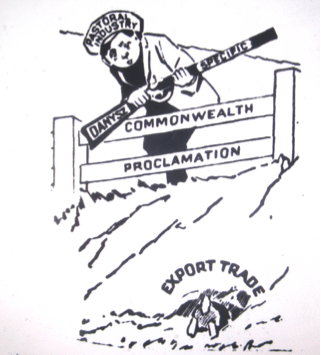
[Lithgow Mercury of 19 June 1906, page 3]
Dr Danysz arrives at Broughton Island – 1906
The Sydney Mail and New South Wales Advertiser of 20 June 1906, page 1614, reported on the first visit by Dr. Danysz to Broughton Island and provided his comments on various criticisms’ concerning the proposed experimentation:
‘ “This is my St. Helena,” said Dr. Danysz, when on Friday last he stepped from a small boat on to Broughton Island, where he expects to spend two years experimenting with the object of enabling pastoralists to cope with the rabbit pest. Considerable work has, however, to be done at the island before all will be ready for the French scientist. ……
We have received the following communication from Dr. Danysz, in reply to the various criticisms that have been published upon the subject of his proposed experiments for the extermination of rabbits by disease: — “When I sailed for Australia, I had no idea that I would find here such a considerable and organised opposition against my work. For long years I have been used to live and work in laboratories of the old world, where all scientific researches are limited only by the intellectual capabilities of the scientist, or by the want of facilities to study. There, all those researches aiming at the general welfare in progress in any direction by the powers of the country, are encouraged by the public. I could not suppose that I would have to face such formidable obstacles in this country, which, from a social point of view, has gone ahead so rapidly, and which finds itself with some of its institutions at the head of progress. And why is this? Because I want to start an experimental study, which, whatever the result will be, cannot be of any danger to anybody.
I must tell you frankly that I feel somewhat at a loss to be obliged to insist on the absolute immunity of any experimental study or research made by a specialist who by profession must necessarily know his work. I feel very strongly, because I belong to an institution where any man having sufficient experience may enter and study all diseases known not only in Europe, but in the whole world. This institution, situated in the heart of Paris, is open to all comers, and accessible to all visitors (non-specialists). There we have microbes of all the most dangerous diseases, with which we inoculate everyday guinea pigs, rabbits, sheep, goats, horses, etc., in order to find a remedy. Nobody has ever the idea to suspect our good faith or our knowledge; neither has anybody any fear of seeing dangerous microbes escape from our tubes and from our laboratory, propagate themselves outside, and become a danger to the public. This applies to all other laboratories of bacteriology and pathology in Europe, as well as in America, and if one may point out rare examples of contagion, the only victims have been the scientists who have handled the microbes.
You will find nowhere the example of an epidemic or epizootic created by study. The first point I should like to make clear is, then, that studies and laboratory experiments entrusted to competent men cannot become a public danger. As to the necessity for experimental studies. In the letters published in the Australian press, before and since my arrival in Sydney, the destruction of rabbits by means of a microbe is criticised from two points of view different, and somewhat opposed. It has been said that it is impossible to destroy rabbits with a disease, and it has often been said in the same article that the introduction of a contagious disease for rabbits could become dangerous to useful animals, perhaps even to men. Such arguments contradict one another. It is therefore better to discuss them seriously. The merest common sense tells us that if a disease special to rabbits cannot really stop their multiplication, by what special property could it then become a danger to animals which so far have always shown themselves refractory?
The foremost condition of the actual undertaking was to find a disease infectious for rabbits, and only for rabbits. In all letters I have written, either to the New South Wales Government or to the Council of Advice, I have always affirmed most emphatically that the microbe I propose to introduce into Australia have shown themselves innocuous to all other animals in Europe; but in spite of this, I would never advise their application on a large scale before having proved on the spot by most careful experiments that these microbes are not more dangerous for the Australian animals.
In my first letter to the Premier of New South Wales I have said that the different conditions of life and of climate might create different receptivities and immunities, but one cannot affirm anything before having produced experimental proofs, which are irrefutable. I have said already that it is possible to experiment with all diseases without fear; I am only asking at present to try these first experiments, which will show — 1st. Whether the microbes are really “disease producing” and mortal for rabbits.2nd. Whether they are innocuous to other animals in Australia.
Until we get the results of these experiments discussion is only waste of time. What we know about the general properties of these microbes amongst rabbits gives us very useful indications, but no absolute certainty until proved scientifically. …..
My first thought is to render my cultures dangerous and contagious enough for rabbits, to find a practical way of spreading them (the cultures), and the best method of fighting the pest. If the rabbits are a pest in Australia, I think you must fight it with all possible means which today science puts at your service. Science allows us today to make a judicious choice between good and bad microbes. Then we take the ones we can multiply and utilise without danger, in order to fight the pests. We can destroy the others. I do not think I have ever hoped to completely destroy the rabbits in Australia with a disease. What I hope is that the diseases introduced and kept going will check their exceptional multiplication and enormously decrease their numbers, and that they will take the place of the methods now in use, which are dangerous, and not efficacious.’
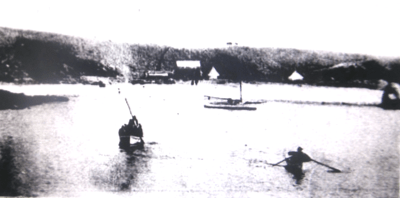
Dr Danysz’ Party going ashore [Sydney Mail and New South Wales Advertiser, 20 June 1906, page 1614]
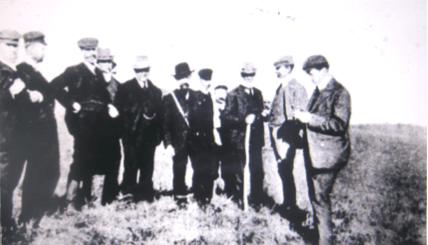
Dr. Danysz and members of the Rabbit Destruction Fund Committee at Broughton Island. (left to right) T. I. Campbell, W. Alison, H. Roxbrough, Dr. Tidswell, Dr. Danysz. G. Yeo, Captain A. W. Pearce, H. W. Bell, C. Minnie, – Danysz, junior [Sydney Mail and New South Wales Advertiser, 20 June 1906, page 1614]
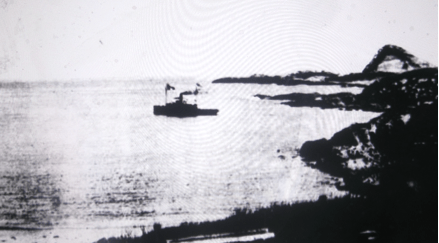
The ‘Storm King’ at Anchor in Esmeralda Cove, Broughton Island [Sydney Mail and New South Wales Advertiser, 20 June 1906, page 1614]

Buildings at Broughton Island. (left to right) Men’s Quarters; Kitchen; Dr. Danysz’s residence; The Laboratory [Sydney Mail and New South Wales Advertiser, 20 June 1906, page 1614]
Approval given for experimentation to commence at Broughton Island after a four-month delay – 1906
The Braidwood Dispatch and Mining Journal of 17 October 1906, page 2, reported:
‘While he was in Melbourne last week, Mr. Ashton, Minister for Lands, interviewed the Prime Minister with reference to the future experiments proposed to be carried out by Dr. Danysz for the destruction of rabbits by means of a disease. Mr. Deakin agreed that there was no reason why the field experiments at Broughton Island should not be proceeded with, and be informed Mr. Ashton that he would communicate with Dr. Tidswell, appointed by the Federal Government to supervise the experiments, intimating that a commencement may be made at Broughton Island as soon as convenient.
Dr. Tidswell says he has received a telegram from the Prime Minister intimating that the experiments which had hitherto been confined to the laboratory might now be gone on with at Broughton Island. He construes this as an indication that the Federal Government has given up control of the matter, and that any further action rests with the State Government. It is expected steps will be taken immediately to permit Dr. Danysz carrying on his field work at Broughton Island.’
The Yass Evening Tribune of 18 October 1906, page 2, further reported:
‘In connection with the laboratory experiments which were carried out by Dr. Tidswell to demonstrate the character of the virus which Dr. Danysz proposes to use on Broughton Island, and its harmlessness or otherwise, a great deal of time was necessarily occupied. This preliminary business was completed some weeks ago, and the fear that Australia might be swept from end to end by some terrible plague if the virus were set free to do its work on the continent has no doubt been quite dispelled. Meanwhile Dr. Danysz, who has been here since June 7 has not yet begun his work. Permission has now been given to go to Broughton Island, where he will start operations for the first time. These will show, so for as be knows them, and will enable him to ascertain, so far as he does not yet know them, the special practical conditions in which the virus can be effectively applied.
As for Dr. Danysz, however, three or four months of his valuable time have been lost. He is being remunerated by the pastoralists, but his real work has been at a standstill. The hope may therefore be expressed that advantage will very speedily be taken of the permission to go to Broughton Island. Dr. Tidswell has received a letter from the Prime Minister covering the telegram granting permission for the experiments to be conducted at Broughton Island. No directions are given, and the doctor is simply referred to the “Hansard” report of the debate in Parliament. Reading this debate, Dr. Tidswell came to the conclusion that the Federal Government had not relinquished control of the experiments on the island, as was from the telegram itself imagined to be the case. It seems to be probable that Dr. Tidswell will have to go to Broughton Island to watch the experiments, but so far no arrangements have been made for his accommodation. The pastoralists’ committee at considerable expense have erected quarters for Dr. Danysz and room for laboratory work, but if Dr. Tidswell goes to the island on behalf of the Federal authorities, provision will have to be made for him and an assistant. Some little further time may therefore be lost in making these necessary preparations.’
Poem featuring Dr Danysz, the ‘Bunny’ Slayer – 1906
With Dr Danysz featuring regularly in Australian newspapers, and various cartoons, it was befitting that the Clarence River Advocate of 9 November 1906, page 4, published the following poem, titled ‘Rabbits’:
‘Matilda Jane lived on the Shore,
A frisky, happy maiden,
Her heart hold loads of mirth in store,
With sunshine she was laden.
But love ensnared her in his wiles,
She wedded a young fellow whose name was Rabbits,
and her smiles are now a sickly yellow.
For every time she hears the name of Danysz, the “bunny” slayer,
A thrill of fear runs through her frame,
And then she breathes a prayer.
She grows more gloomy every day,
Her mind is surely failing,
She guards her husband every way,
His fate in fear bewailing.’
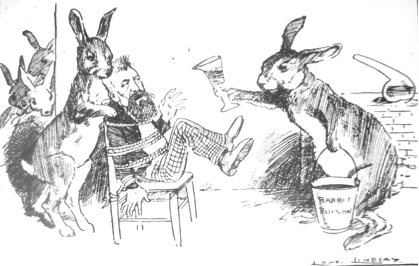
Trusting that the rabbit of Broughton Island won’t administer a dose of his famous rabbit exterminator to Dr. Danysz. Cartoon by Lionel Lindsay [Evening News, 10 November 1906, page 10]
Dr Danysz arrives back in Sydney – 1906
The Burrangong Argus of 10 November 1906, page 2, reported on the need for more rabbits on Broughton Island:
‘Dr. Danysz is in Sydney again after a spell of nearly three weeks at Broughton Island. The object of his return to the metropolis is to consult with the Pastoralists’ Board of Advice regarding the future conduct of the experiments in rabbit extermination, with which he is so very anxious to proceed. How does he like life on the island? The scientist does not hesitate to tell a Daily Telegraph representative last night that everything that could be done for the comfort of himself and his staff has been done. “We are very well provided for,” he said, “the quarters are comfortable, the island is pleasant to live on, and the climate is charming; but the communication is very slow. We have a sailing boat to go to Nelson’s Bay, and that sort of thing; but it takes a very long time to get away from Broughton Island, and when it is bad-weather we cannot get away at all.”
The newspaper representative concluded that the experimentalists at the island therefore had everything they wanted, and said so, but Dr Danysz did not wholly agree with such a conclusion. “We have everything ready for the experiments,” he explained. “The laboratory is fixed up ready for work, and I am anxious to do something now. Yes; we have everything we want— excepting the animals. Where are the rabbits? Are there none left in Australia? I can use 150 a week, and want them, but I have been there three weeks, and no rabbits have come.” Dr. Danysz did not speak complainingly, but there was a something in his tone that indicated impatience, or, at least, surprise at the inactivity of those at whose instance he has come to Australia.
In answer to inquiries, he explained that there are some rabbits on the island—about two per acre—but when he has wanted them he has had to hunt them and dig them out of their burrows. He wants as many rabbits as he can get the many different phases of the experiments —the conditions under which the virus will operate, how long it will remain active, and the various circumstances under which the rabbits will be affected in the Australian climate—all these things have to be gone into carefully and exhaustively. That is what Dr. Danysz is here to do, but a gentleman who was present at the interview suggested, apropos to a casual remark, that it was not fair to expect him to bury himself on Broughton Island for all time. “The doctor’s time,” said this gentleman, “is valuable to him, it should be equally valuable to us in Australia, and he has told me that he is so anxious not to be losing time that he would even be prepared to pay the freight on rabbits if he could be certain of a regular and adequate supply.” ‘
Medical episode on Broughton Island – 1906
The reporting of a widespread illness among those working on Broughton Island caused a sensation in newspaper reporting, as some reporters assumed it must have been caused by the Danysz virus.
The Maitland Weekly Mercury of 24 November 1906, page 6, reported:
‘A sensation was caused in the city at noon today by the receipt of a telegram from Broughton Island stating that illness had broken out among persons on the island, and asking for medical aid to be sent as soon as possible. Inquiries made of the Health authorities and the police by press representatives in regard to the nature of the sickness were fruitless, but it was ascertained that the outbreak, the exact character of which is not yet known locally, was serious, and it is also reported that the illness is epidemic on the island, although authentic information on this point is not available.
Mr. J. C. Reid, the Newcastle agent for the inhabitants of the island, states that Dr. Danysz is ill, and had asked for medical aid. Immediately on receipt of the telegram, Dr. Robert Dick, officer of the Board of Health for the district, left for Broughton Island by the steamer Storm King, taking with him a complete medical and ambulance equipment. There are now on the island Dr. Danysz, Mr. Cadden, two ladies (the housekeeper and her daughter), two youths, an old man who does odd jobs, and a Greek fisherman named Nicholas, who has a boat there, and does the messages for the little island colony to and fro between Port Stephens and Broughton Island.
Mr. Rush, of the Newcastle Customs, visited the island on Friday last when he says all was well. Mr. Rush describes the island as a huge laboratory. He says Dr. Danysz and those on the island with him seemed to be very comfortable, being well housed and well supplied with provisions. The party on the island kill their own sheep and have four cows and ample supplies of fresh milk. The news of this serious outbreak on the island reached the city by telegraph from Nelson’s Bay, where intelligence was received by special messenger from Broughton Island. Dr. Tidswell left the island a few days ago and returned to Sydney.’
The Sydney Stock and Station Journal of 30 November 1906, page 6, further reported:
‘All is well at Broughton Island, and the work is going ahead. Dr. Danysz and his staff have recovered and are now able to explain the nature of the attack they had. The doctor thinks it was caused by the tanks they kept the rainwater in, and they are now getting all their drinking water from a spring on the island. But the mushroom theory still has some colour of support. But anyway, that is a detail, and the experiments are going ahead, and that they will be successful is the sincere wish of all good Australians.’
Cartoon of Dr Danysz at play – 1906
The Evening News of 8 December 1906, page 3, published the following cartoon drawn by Lionel Lindsay featuring Dr. Danysz on Broughton Island:
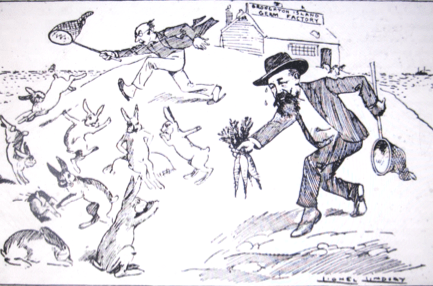
Caption: We learn on unreliable authority that at a recent sports gathering on Broughton Island an interesting competition was Dr. Danysz and staff v The leading germ. After a close contest the germ won by a rabbit.
Dr Tidswell’s Interim report – 1907
The Murrurundi Times and Liverpool Plains Gazette of 1 March 1907, page 2, reported on Dr. Tidswell’s interim report:
‘A telegram from Melbourne, dated Friday last, in regard to the Broughton Island experiment, will be of wide general interest to the country. It was as follows: —
“Dr. Tidswell has forwarded the Prime Minister an interim report upon the rabbit inoculation experiments on Broughton Island. After describing the establishment on the island, the preliminary work of fixing up the laboratory and apparatus brought from Europe, and certain tests and experiments of a technical nature in connection with the virus, Dr Tidswell wrote: — “I must claim your indulgence if I feel obliged to refrain from submitting any details concerning these experiments. They are being conducted by Dr. Danysz’s direction and under his supervision.
No doubt they will be fully described by him in due course. Many of them are still in progress, and there are several others yet to be performed. Until the full evidence is available conclusions as to the probable issue would be premature, and as likely as not fallacious. So far as the work has gone there has been nothing to suggest that the virus will attack any animals other than rabbits, or that it is likely to escape from the island.” “Dr. Tidswell states that he is given every facility by Dr. Danysz to watch the work, and has his full confidence as regards his objects and methods.”‘
Forecast of the ending of experimentation on Broughton Island – 1907
The Sydney Stock and Station Journal of 15 March 1907, page 6, reported:
‘Dr. Danysz has returned to Broughton Island in company with Dr. Tidswell. Mr. Gunn is pleased with the prospects, and everything is booming. We have a long time to wait before we get final judgment, and the matter is in good hands. We are glad that Dr. Tidswell is on deck once more.
The following paragraph from yesterdays “Sydney Morning Herald” will be interesting: — Work at Broughton Island. — The experiments at Broughton Island will shortly reach a stage at which Dr. Danysz considers little more can be done on the island beyond watching the spread of the disease and confirming the fact of its absolute harmlessness to all other animals at all seasons of the year. This will necessitate the inland experiments being continued till about October, and in the meantime Dr. Danysz contemplates visiting Europe for some months, leaving his assistant, M. Latapie, to watch the developments on his account, while Dr. Tidswell watches and confirms the results as to safety on behalf of the Government.’
Protests against experimentation by Dr Danysz on the mainland – 1907
The Queanbeyan Leader of 9 April 1907, page 2, published a hard-hitting commentary on the damage the Danysz virus may cause to pastoral workers:
‘Shortly an attempt will be made to introduce the abominable, filthy disease, cultivated by Dr. Danysz, among the rabbits on the Australian mainland. That the banks and mortgage companies and large landowners favor it, and likewise that there should be strenuous opposition to its introduction, especially from the Australian working class, goes without saying. That the rabbits constitute a destroying pest none would be so foolish as to deny; but there is an economic reason, from a capitalist-class viewpoint, for the general favouring of the Danysz horror by the squatter class and the men who control the banks and other large mortgage institutions.
During the winter months, especially in the country districts adjoining railway lines, working men are able to earn far better money as trappers than they have ever received as station employees. This notwithstanding the disadvantages which belong to any business necessitating the employment of the Sydney agent and the local middleman. In scores of small country centres many thousands of pounds have been earned in this way every winter, while during the summer months numbers of men secure a fair income by trapping for the skins only. The inevitable result of this has been to diminish the supply of station labour hitherto available, and to force upward the wages of the “station hands.”
The station labourer generally works from starlight to starlight — and if his wages exceed fifteen shilling a week and rations, he may regard himself as a more specially-favoured individual than many of his fellows ; for it is an astounding fact that the capitalist system of production makes our great primary industries the vilest sweating concerns. The man for whom the rabbit pest provides employment secures far better remuneration than does he who, as a wageworker, tills the land and harvests the crop in the great agricultural centres, or he who tends the flocks and herds and rides the long boundary miles on the stock-raising and wool-growing holdings.
That the long hours, low pay and servile conditions of station life should be willingly abandoned for the much more high remunerated and comparatively freer calling of the trapper is easily understandable. There is a dearth of “station hands” at the old, sweated wage-rate, but the offer of a decent living wage with anything like human conditions would find a ready response. While the present system of land ownership prevails, with its inevitable mortgage thraldom, there never will be — there never can be — a decent living-wage system for the pastoral and agricultural industries of Australia.
The small landholders are generally opposed to the Danysz method because the small holders are mostly wage workers as well. The large holders and the mortgagees who favour its adoption unanimously recognise that — even if the disease will not affect other forms of animal life (and there is no guarantee that it will not)— it cannot under any circumstances totally eradicate the rabbit pest, that it can at the very best only prove a means of partial destruction. But what they do emphatically know is that, once the disease is introduced to the mainland, the vile nature of it will immediately remove the rabbit as an article of diet. The rabbit as a pest will remain; as a very large contributor towards the cost of his own destruction, as a raiser of wages and a finder of employment for the country workers in the bitter winter months, he will disappear. “Station hands” will flock back to their “starlight to-starlight occupations and servile conditions, and station wages will not rise above the “15/ a week and rations,” which ruled previously. This is the economic reason why the Australian capitalist class is feverishly anxious that the French doctor shall let his carefully cultivated disease loose in all its filthiness among the rabbit life of Australia. …..
For the economic reasons — principally wage-reducing reasons — stated above, the voice of Australian capitalism has declared in favour of Dr. Danysz and his precious disease. The workers of Australia are the people most directly affected, and these should offer every possible opposition to the proposal, and the representatives should throw every available obstacle in the way of its infamy being carried into effect.’
Preparations made for the departure of Dr Danysz – 1907
The Sydney Mail and New South Wales Advertiser of 8 May 1907, page 1191, reported:
‘Few missions in Australia have been more carefully watched, or fraught with greater importance, than that guided by Dr. Danysz, the French scientist, at Broughton Island. It is difficult to estimate the value to Australia of a successful and economic method of extirpating the rabbit plague. Dr. Danysz started his experiments with this object in view. After spending seven months at the work, he has handed in a second report to the Government, and leaves on Saturday next for Marseilles by the India. If the Federal Government decides to allow the rabbit experiments to be carried on in the open country, he will return to Australia; but if not he will remain in France. In the meantime, the Broughton Island work will be conducted by Mons. Latapie.
In the report recently submitted [by Dr. Danysz] the following appears: — ‘The aim of the researches I had to make on Broughton Island was to find out — (1st) if the rabbit virus can give in practice better results than the means of destruction hitherto employed; and (2nd) if the rabbit virus can be used on stations infested with rabbits without any danger to man, domestic or wild animals. The first of these two questions may be considered as solved as far as it can be under the special conditions of climate and soil found on the island, and which will rarely be found on the mainland.
As regards the second question, viz., the harmlessness of the rabbit virus to other animals, I will show in the course of this report, the results of the very reassuring experiments made up to now; but I have thought it necessary to expose domestic animals to contagion for a whole year and to carry on the experiments till October next. It is known that some contagious diseases of men and animals are more frequent and more virulent at certain seasons of the year. We must see whether sheep, cattle, horses, pigs, fowls, etc., can resist the rabbit virus with the same indifference during the spring as well as during the summer; in autumn as well as in winter. This part of the work will be carried on fully by Dr. Tidswell, who will make a special report on this important question.
My aim was also to find by every means available to me on the island a method of rabbit destruction that can be used by anybody, and which would be serviceable on large stations. We could not limit ourselves to show that the disease was contagious and say that it was sufficient to destroy the rabbits. To sum up, the experiments of contagion which we have been able to make on Broughton Island have proved that the pasteurellosis of the rabbits is just, as contagious and spreads itself just as well amongst rabbits in the open, under conditions as similar as possible to natural life, as it does in cages. The observations made enable us to hope that on the mainland, by the help of different climatic conditions, the disease will be more contagious than on the island. It was hardly possible up to now to carry on any precise experiments with rabbits living in liberty on the island.
The 600 rabbits introduced in March 1906, have not multiplied as was expected; they have only bred once, and actually there are not more than three or four to the acre. To sum up, from all the experiments made up to now, we can conclude that the rabbit virus will destroy at least as many rabbits as the best poison, by direct infection, and two or three times as many by contagion. It is, besides, very probable that in the districts once infected epidemics will break out spontaneously from time to time and will greatly reduce the number of rabbits. Considering the conditions under which we had to make our experiments so far, we could not possibly do much more.
I wrote, in a letter to the Premier of New South Wales, dated January 25, 1905, that ‘whatever the disease or diseases which could be employed to fight the invasion of rabbits it is not to be hoped that definite results could be obtained after one single intervention, or even of several repeated during one or several years, or even that it be possible to exterminate all the rabbits in the whole of Australia once for all.’ The rabbit mortality will most often, if not always, be in proportion to the intensity and the extent of the measures — in relation to the infected territory; but only a fairly long experience could give us precise information with regard to this question. These experiments can only be carried out on stations, and before that can be done we must wait for Dr. Tidswell’s report, and for the sanction of the Government. Meanwhile, M. Latapie will continue on Broughton Island to keep up the virulence of our cultures, so that everything will be ready when the time comes to start on the mainland.’

Farewell picnic given by Dr. Danysz to the employees at Broughton Island [Sydney Mail and New South Wales Advertiser, 8 May 1907, page 1191
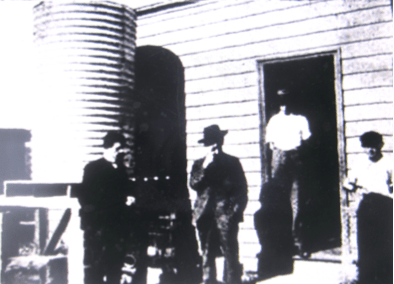
Dr. Danysz (smoking cigarette) and assistants. M. Latapie is on the left [Sydney Mail and New South Wales Advertiser, 8 May 1907, page 1191]
Health Boards Conference finds the Danysz virus ineffective – 1907
The Scrutineer and Berrima District Press of 22 February 1908, page 4, reported:
‘The report of the conference of representatives of the health boards of the various Australian States on the questions submitted to it by the Federal Government respecting the Danysz virus for the destruction of rabbits was made available on Tuesday. The questions submitted by the Prime Minister for consideration were: — 1. Whether the microbe found amongst rabbits on the mainland is identical with that suggested by Dr. Danysz for destruction of rabbits. 2. Whether it is advisable to continue the experiment on the mainland with the Danysz microbe.
The conference found that : — 1. The respective microbes are alike in form and size. 2. The respective microbes exhibit the same biological characters when grown comparatively in the following cnlture media, viz , gelatine, agar, milk, broth, peptone water, potato, glucose, sucrose, maltose, lactose, galactose, ruffinose, arabinose, mannite, dulcite, erythrite, sorbite, glycerol, and ethyl glycol boullions. 3 The microbes are equally lethal to rabbits artificially infected with them. 4. All the microbes affect in a similar manner, rabbits exposed under similar conditions. 5. The virus isolated from rabbits captured on the mainland proved to have the same action as the Danysz virus upon animals other than rabbits. 6. Rabbits immune to the Danysz virus were found to be immune also to the local virus.
From this evidence the conference concluded that the microbe suggested by Dr. Danysz for the destruction of rabbits is specifically identical with the miorobes isolated from rabbits captured on the mainland of Australia. The conference found that the local virus was isolated in 1902 from rabbits captured at Yalgorgin, New South Wales, and there is reason to believe that it has been prevalent in Australia from a much earlier date.
Question No. 2 — Whether it is advisable to continue the experiments on the mainland with the Danysz microbe ? The evidence upon this point before the conference was as follows: — Efficacy for rabbits. — 1. The virus can be cultivated to a point of virulence in which (a) a culture injected will kill rabbits ; (b) blood of a rabbit so killed will, if injected into another rabbit, kill that other ; (c) blood of an infected rabbit will, if rubbed into the skin or placed upon the nose of a healthy rabbit, kill that rabbit. 2. It has been shown that the spread of disease from rabbit to rabbit was most marked amongst rabbits in cages and pens, was much less amongst rabbits in yards, and sank to an insignificant degree when the rabbits were permitted to lead their habitual life in the wider area referred to, as the peninsula on Broughton Island.
The conference has therefore to point out, as an inference, that the nearer the conditions approach the natural the less effective is this method of destruction. Effects on other animals. — The virus was tested upon an extensive series of animals other than rabbits, including all the domestic animals of importance, with results which showed that the disease was communicable to only certain kinds of animals. But whilst these were susceptible of infection by artificial means, they showed no tendency to acquire the disease when exposed to conditions under which it was readily caught by the susceptible rabbit. The conference, therefore, concluded that under natural conditions the virus would not injuriously affect animals other than rabbits, failing the influence of some circumstances at present unforeseen.
In connection with the question under review, attention may be called to the statements made by Dr. Danysz in his report dated April 27, 1907, concerning the conditions on the island. He there asserts that a certain form of the disease did not occur on the island, and that therefore we must conclude that the special climatic conditions of the inland prevent the appearance of this form of the disease, and that such conditions will not exist on the mainland.” Subsequent experience having shown that the form of the disease referred to does occur on the island. Dr. Danysz’s premises in this connection are wrongly assumed. Further, the conference finds no evidence to show that the special conditions of soil and climate present on the island have been factors acting adversely to the virus as an epidomic agent.
Consequently, it sees no justification for Dr. Danysz’s opinion that “on the mainland by the help of different climatic conditions the disease will be more contagious than on the island.” Having considered this evidence the conference finds that, whilst there is no reason to apprehend injury to animal life in general, neither is there reason to expect any effective destruction of rabbits by the use of the virus.
The conference further considered the fact that the importation of the virus is at present prohibited by a Commonwealth proclamation, and the recission of this would leave the importers and any other person who became possessed of the virus free to distribute it whenever and wherever they passed throughout Australia, except in New South Wales, where restrictions are imposed by the Noxious Microbe Act of that State. As there is no prospect of any compensatory benefits arising to serve as a justification for the creation of such circumstances, the conference feels that the release of the microbe cannot he rationally contemplated. The conference therefore recommends that the prohibition of the Commonwealth be maintained.’
The Armidale Chronicle of 22 February 1908, page 4, continued criticism of the Danysz virus in the following report:
‘The committee which has reported on the Danysz microbe is not particularly complimentary to the learned gentleman who exploits the alleged specific. It finds there is no evidence at all to warrant the hope which he held out that experiments on the mainland might be more favourable than those on Broughton Island. The disease induced by the microbe will run its natural course wherever it may be, and there is not a scintilla of evidence to show that there is any more hope of exterminating rabbits by its means than there is of destroying the rats which infest the Pasteur laboratories.
Dr. Danysz seems to be far too sanguine, and far too ready to jump at conclusions which are quite unwarranted. The Australian health officers have nothing to gain by their verdict. In the interests of ” Science” (with a big S), they would probably have preferred to report favourably. But the evidence was too strong for them. They don’t object to experimenting with the Yalgogrin microbe on the mainland, provided the investigation is conducted by the Government on lines which are approved by other Governments. But they specifically place on record their conviction that no diminution of the rabbit pest can be expected to ensue. The Pasteur Institute, it should be known, is not regarded nearly so seriously in Paris as in other parts of the world.’
Australia “A Laughing Stock” according to Dr Latapie – 1909
The Sydney Mail and New South Wales Advertiser of 27 January 1909, page 10, reported:
‘A writer in the “Pastoralist’s Review” makes reference to a meeting when abroad with Dr. Latapie, who accompanied Dr. Danysz to Australia when, the French scientist made his effort to end the rabbit pest. Dr. Latapie is reported to have said that “Dr. Danysz was quite assured of the absolute success of his experiments; also, that Australia was the laughing stock of the scientific world because of her treatment of him (Dr. Danysz).”
This is a remarkable statement, and must be promptly challenged, and attributed to some misapprehension. “The Sydney Mail” is especially well informed on this matter, one of its representatives having interviewed Dr. Danysz at the Pasteur Institute in Paris in April last. The result of that interview was published in this paper on June 3, 1908. Dr. Danysz then said that he would not claim that the microbe he had introduced would exterminate the rabbits. He pointed out that there were large areas where it would be impossible to spread the virus; also that in the dry season an intense heat would be death to the microbe. He added that under certain conditions his microbe would be effective; for instance, the grass should be green and short and the atmosphere moist.
All he claimed was that his microbe was “the best means yet discovered for coping with the pest.” He was reminded of the Yalgogrin microbe but would not say positively whether it was identical with his own. The concluding words of our article of June 3 summed up the impression gained by our representative during his long talk with the scientist: “The above may help Australian people to come to some conclusion regarding the efficacy of the Danysz microbe. It certainly does not prove that the rabbit problem has been solved.”
What was said in April last year is true to-day. Dr. Danysz did not then claim that success was assured (presumably we are supposed to add, “had he been allowed to continue his experiments as he wished”). On the contrary, his references to the favourable conditions that were essential to success showed that he realised it was impossible to exterminate the rabbits, for the simple reason that such conditions do not prevail in Australia, except here and there in widely separated parts, according to the vagaries of the season. The experiments were justified, and those who contributed to the expense cannot regret their enterprise; but no good will be done to science or to the fame or personal feelings of Dr. Danysz by any attempt to avoid the simple, outstanding, indisputable fact that the French scientist, so far as the rabbit pest was concerned, left Australia no better off than he found it.
As to Australia being the “laughing stock of the scientific world,” there are certain circumstances in which a clean, healthy, young country is willing to be a laughing stock. It may be true that in France the authorities have so much confidence in Dr. Danysz that they do not consider it necessary to closely watch his dealings with various insidious and dangerous microbes. In Australia, despite the fame of the scientist, the authorities were not disposed to welcome his microbes until they were assured that there would be no danger to the community — meaning the people’s interests as well as their lives. In the cause of science, as in war, a few lives lost here or there matters littie— a creed that would not dismay Europe with its teeming population. But Australia felt clean, robust, young, and healthy, and took reasonable precautions to remain so.
The microbe was landed; and did his best — or worst. Without any of our precautions Dr. Danysz would probably have exposed us to no danger or loss; but even though all prospects pointed in the direction of safety, there was still every need for taking no risk. Dr. Danysz and Dr. Latapie may be so accustomed to the company of menacing microbes leering at them from rows of bottles that the shudder of the lay visitor may be amusing, but it takes some time and experience to become accustomed to these deadly companions.
So Australia, in the innocence and cleanliness of youth. kept the microbe at bay until convinced that it was deadly only to rabbits (and very small birds). All very simple, all very natural; and from that point onward Dr. Danysz had no reason to complain of lack of opportunity to “make good.” The courteous little Frenchman was hurt by the precautions— but there was no ill-feeling. To the “Sydney Mail” he made in April last no boastful claims. Nor did he say that the scientific world was laughing at Australia. Apparently, it is since April, 1908, that it started to rock with laughter. Let it rock.’
Epilogue
During 1906 and 1907, the Danysz experiments gained much publicity throughout Australia. Despite all the sensational reports in the newspapers about the dangers of the experimentation, and to the ‘class warfare’ it represented, the endeavours of Dr. Danysz and his team, failed to provide an effective rabbit eradication method.
The Sun of 18 September 1913, page 11, published an article that reflected on the Broughton Island unsuccessful tests:
‘A number of squatters determined to try to get rid of the rabbit several years ago, and Dr. Danysz, a French scientist, was brought to Australia to carry out experiments with the object of discovering some disease which would decimate the rabbits without affecting other animals. The experiments were carried out on Broughton Island, which is off the coast a few miles to the north of Port Stephens, and large numbers of rabbits were taken from the mainland to the island. The rabbit disease was never taken to the mainland, and in a few months Dr. Danysz went back to France. The rabbits were left on Broughton Island. A gentleman who recently stopped at the island said yesterday that it was alive with rabbits. The disease which had been spread amongst them had seemed to have the effect of stimulating their productivity. He shot a number, and they were quite healthy, showing that the disease had died out altogether. It was not strong enough to impair the health of the Australian rabbit. The houses, laboratories, and sheds used by Dr. Danysz and his assistants are still standing but are becoming ruinous. They are being used by Greek fishermen, who have practically taken possession of the island.’
The Sunday Times of 8 April 1928, page 28, reported on the death of Dr. Jean Danysz in Paris in March 1928:
‘There passed away recently in Paris an interesting personality whose name should surely be remembered, particularly by pastoralists and others of the kind, throughout Australia. This is Dr. Danysz, the Polish scientist, who went out some 20 years ago at the invitation of the Government to exploit a theory destined to exterminate our rabbits in their unwanted millions. He had just published, some months before his death, a book, entitled, “La Genese ‘Energie Physique,” which dealt in a detailed treatise with the subject of the nervous system and its far-reaching effects, and critics reviewing this book hailed it as one of the most remarkable studies of its kind of the day. Of his five sons, not one chose the career of medicine, but working with Dr. Danysz in his laboratory was his daughter-in-law, who, he told me, rendered him invaluable assistance.’
Broughton island became part of Myall Lakes National Park in 1972, and all rabbits on the island that remained from the Dansyz experimentation, were eradicated by 2009.
Concluding Comments
The experimentation by Dr. Dansyz had a negative environmental impact on Broughton Island in that the rabbits that he introduced remained a nuisance for over eighty years, before they were eliminated.
Further information on Broughton Island is published on this website at the following link.
Researched and compiled by Kevin McGuinness
March 2023

 Port Stephens - a history exploration