
Introduction
During a smallpox crisis in 1895, and again during the influenza epidemic in 1919, proposals were made to have Port Stephens serve as a quarantine area. It would be equipped with appropriate staff and facilities to aid in the biosecurity of the more populated areas of Newcastle and Sydney.
Firstly, in 1895 Newcastle authorities proposed to ban the practice of ships arriving in the port, with infectious diseases on board, and being quarantined there. Instead, it was advocated that such ships to proceed to Port Stephens for quarantine. The New South Wales Government did not approve the proposal.
Secondly, beginning in 1919 during the influenza pandemic, much effort went into a proposal to close and move the North Head Quarantine Station, located at Manly in Sydney, to Port Stephens or another location.
From 1832, ships arriving in Sydney with disease on board had their crew and passengers offloaded to the North Head Quarantine Station. In the case of major outbreaks, it was feared that infections would spread from the quarantine area into greater Sydney.
This paper deals with the history and machinations of both proposals from the point of view of the Port Stephens region.
PROPOSAL ONE:
Ban on the Quarantining of Ships at Newcastle with Smallpox Onboard – 1895
The Newcastle Morning Herald and Miners’ Advocate of 6 November 1895, page 5, reported on a proposal to ban the quarantine of any ship at Newcastle, and instead to require such affected ships to proceed to Port Stephens for quarantine:
‘A special meeting of the committee of the Newcastle Chamber of Commerce took place yesterday afternoon. …. The President informed the committee that he had called them together to report progress in regard to the Chamber’s action concerning the quarantining of vessels arriving from infected ports with smallpox on board. He stated that a communication had been sent to the Colonial Treasurer asking him if he would authorise the sending of vessels in future having smallpox on board to either Port Stephens, Broken Bay, or Sydney, it being understood that in the event of either of the former places being chosen the Government would make the necessary provision for medical attendance. To this communication, which was sent only on Monday, a reply had not been received, but he thought that if the Government would consent to do this in future it would do away with any risk of inspection that might exist through the mooring of such vessels in this harbour. The committee were of opinion that the matter should be followed up by a deputation to the Colonial Treasurer, so that the matter could be settled beyond all doubt. Messrs. Keightley, Bewick, and Wallace were ultimately appointed to form the deputation.’
The Newcastle Morning Herald and Miners’ Advocate of 7 November 1895, page 5, reported on the outcome of a meeting by a member of parliament with the Premier on the quarantine issue raised by the Newcastle committee:
‘Mr. Dick, M.P., who last night, on the adjournment of the Assembly, referred to the matter of the danger caused by the proximity of quarantine vessels to the populated parts of Newcastle and Stockton, today had an interview with the Premier [Sir George Reid] on the subject. He pointed out the danger arising from vessels in quarantine to the residents of Stockton, owing to the proximity of the quarantine buoys. He also explained that there was considerable dissatisfaction in Newcastle with the present arrangements. Mr. Reid asked Mr. Dick if he could make any suggestion to overcome the difficulty. Mr. Dick said the only course he could suggest would be to make a quarantine station at Port Stephens. Mr. Reid had this referred to the Board of Health, and it is understood the board is favourably inclined to the suggestion. Mr. Dick then inquired, if this were done, would the Board of Health have power to order immediately that a vessel should proceed to Port Stephens. Mr. Reid said he did not know if this power existed, but if not he would endeavour to have some satisfactory alteration made.’
The Sydney Morning Herald of 6 December 1895, page 6, reported on the outcome of the meeting of the Newcastle Chamber of Commerce with the Premier:
‘Messrs. Stewart Keightley (president), R. A. Wallace (vice-president), and G. Bewick, a prominent member of the Newcastle Chamber of Commerce, accompanied by Messrs. W. T. Dick and J. L. Fegan, Ms. L.A., waited upon the Premier yesterday afternoon to bring under his notice some of what are regarded as the pressing requirements of that port.
It was explained that the first matter was with regard to the Quarantine Station which it was proposed to establish at Fullarton Cove near Stockton. This site was regarded as quite unsuitable, inasmuch that it was near to a public school, and also to the road and river traffic. The deputation suggested that vessels ordered to quarantine should be taken either to Sydney, Port Stephens, or Broken Bay, as the medical men who had been consulted said there was no site near Newcastle suitable for the purpose. ……
Mr. Reid, in reply, said he would bring these matters under the notice of the proper departments, and get reports upon them. He would be glad to do all he could to meet the views of the members of the deputation.’
The Daily Telegraph of 8 February 1896, page 5, reported that the proposal to quarantine vessels at Port Stephens was not approved by the government:
‘There is good reason to believe that, acting on the report furnished by Professor Anderson Stuart after his recent visit of inspection to Newcastle, the Government have definitely decided not to establish a quarantine station at this port. The land in North Harbor set apart for the quarantine station will, therefore, not be utilised for this purpose, at least at present, and probably not for some years to come. In future vessels appearing off this port with infectious disease on board will, it is understood, be ordered on to Sydney by the health officer, and the crews and passengers, if any, will re-landed at the quarantine station there, whilst the ships, after being fumigated and disinfected, will be towed up here to discharge ballast and load coal, so that their departure may not be unnecessarily delayed.’
PROPOSAL TWO:
Proposed Relocation of the North Head Quarantine Station to Port Stephens or Other Ports – 1919
The Sydney Morning Herald of 7 February 1919, page 6, reported:
‘Ever since the Federal authorities assumed jurisdiction over quarantine the people of Sydney have protested vigorously but vainly against the retention of the station at the very doors of the city. At the end of last year, with the appearance of pneumonic-influenza, the agitation gathered weight, for, not content with filling the waters near North Head with ships that were potential centres of defection and crowding North Head itself with contacts and cases, the Commonwealth actually proposed to turn part of the harbour itself into an annexe of the quarantine area. This, fortunately, was avoided, but on the more general question our complaints have fallen on deaf ears, with the result that with the present visitation the difficulty has assumed a more acute form. Vessels arrive from infected ports every day and have to be held until pratique [a clean bill of health] can safely be given.
The waters in the existing quarantine area can only accommodate a limited number, and so we have the extraordinary spectacle of the overflow lying on the Bank or in Rose Bay, or wherever an anchorage can be found. Of course, it may be argued that they must go somewhere, and that if there is no room for them at North Head they must be sent to some other part of the harbour. This we quite admit; but it merely emphasises the arguments in favour of the removal of the Quarantine Station, lock, stock, and barrel, from its dangerous proximity to Sydney.
It is safe to say that in no other great city in the world would such a state of affairs be endured for a moment. Here at the very gates of Sydney and along-side a populous suburb, which is also the Mecca of the pleasure-seeker and holiday maker, we have, so to speak, the laboratory in which germ cultures of infectious diseases are produced. It is not even sufficient for its purpose, for in times of stress, as we have seen, vessels have to move further down the harbour. It has not even the advantage of being a good anchorage, for in its crowded condition a south-east gale might do considerable damage. To put the matter on the lowest ground the unnecessary withdrawal from public use of so much land so near the city is shockingly bad economy. But the chief of all the arguments against North Head as a quarantine station is the risk to which it exposes Sydney, a risk which grows greater every year as the city extends its frontiers.
If Sydney had only one suitable location on the coast, we could understand the reluctance of the authorities to make a change. But there are several places within easy distance of Sydney which would serve as well. When Port Stephens or Jervis Bay or Broken Bay is mentioned, the stereotyped reply is that there are objections to each. No doubt there are; but, we venture to say, in no case the objections are or can be as great as they are lo the continuance of the present system, which jeopardises the largest city in the Commonwealth. The position is intolerable; and its evils are so manifest that it is difficult to understand the failure of the Federal authorities to appreciate them.’
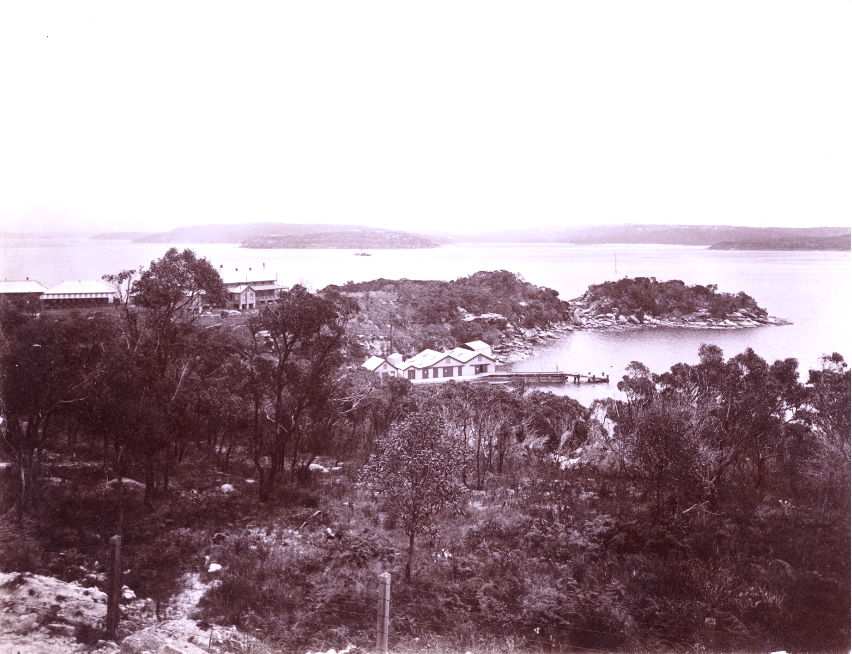
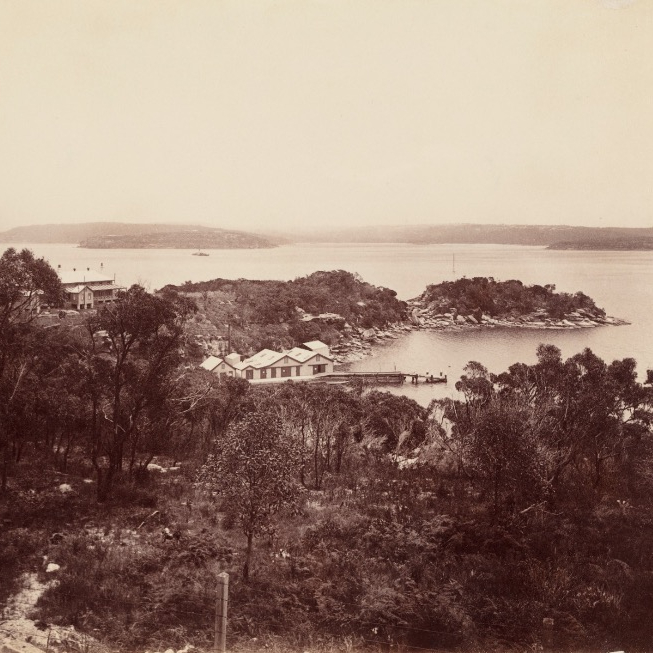
North Head Quarantine Station circa 1900 [State Library of NSW]
Meeting with the Commonwealth Government 1919 – Port Stephens the favoured site
The Newcastle Morning Herald and Miners’ Advocate of 29 April 1919, page 5, reported:
‘Mr. Massy Greene, Minister for Quarantine and Customs, received a deputation organised by the Manly Council, the Quarantine League, and other bodies, at the Custom house, Sydney, today, and gave consideration to a request for the removal of the Quarantine Station at North Head to another place. Mr. Orchard, M.P., who introduced the deputation, explained that the deputation realised that the quarantine site was excellent for shipping purposes, but these things should not be considered where the health of the people was concerned. To have such an area alongside the first city of the Commonwealth was of no good to the general community. In time it would be found essential for the site to go. It might not be possible to at once remove the station, but a site should be set aside.
He suggested that the buildings erected at Canberra to accommodate alien enemies should be utilised. Mr. Orchard was supported by other speakers, who, among other things, suggested that the site at Jervis Bay should be utilised. The Minister, in reply, said that the matter had been under the Governments consideration for some time, and that it had been decided that it was impracticable to remove the site at the present. In fact, it would involve serious risks to the community to do so, and, further, an expenditure of £250,000 would be incurred in if an entirely new station was erected.
It was quite possible that some other disease might come to Australia besides influenza, and it was essential that they should have a properly equipped station to cope with it. As regards Mr. Orchard’s proposal in respect to Canberra, the works officer had reported that it would cost more to take down the buildings than to erect them at Manly or elsewhere. The Federal Government was of opinion that Port Stephens would be best suited, and probably it would give more natural facilities. He had instructed his officers to go fully into the question, and to, as far as possible, arrange for the transfer of the quarantine station from North Head to Port Stephens, and see how it would fit in with the general trade of Sydney.
He was not in a position to state definitely what the Federal Government had decided to do, but if, after the matter had been gone into thoroughly, the Government was satisfied that the transfer could be made, it would be for the Cabinet to ask the State Government for its co-operation.’
The Sydney Morning Herald of 29 April 1919, page 6, further reported:
‘It is, of course, natural that until the Federal Ministry has complete evidence regarding the suitability of Port Stephens as the site for a quarantine station Mr. Massy Greene, the Minister for Customs, should decline to commit himself to any definite decision regarding an alternative area for the quarantine depot in the vicinity of Manly. The point of immediate importance, however, is not whether the Ministry is in possession of an adequate number of reports upon the advantages and disadvantages of the several possible sites for a new quarantine station, but whether Mr. Massy Greene and his colleagues are convinced of the cogency of the objections to the continuation of quarantine at North Head. If these objections are valid, as we believe they are, no possible excuse can be advanced to justify postponing decision upon the crux of the whole business—that is, the removal of the station.
That having been done, the problem of where the new station should be would obviously be simplified. This is exactly the point at which the reply given by Mr. Massy Greene to a large deputation in Sydney yesterday was open to the criticism of being less frank than it might have been. The Minister did not say that he accepted the case against continuation of quarantine at North Head, nor that the Government would change the site. What he did say was (1) that “If the public health was really endangered” the amount of expenditure involved in making a change would not be considered; and (2) that reports were being obtained about the suitability of Port Stephens as a quarantine port.
This clearly suggests that the attitude of the Minister towards North Head is being left to determination by the character of such reports as he may be furnished with about Port Stephens. While it is satisfactory to be told that investigations concerning removal are being made there would certainly be more reason for gratification if we knew that these followed the determination to end the scandal of which complaint is made. The objections to the quarantine station are so many and so strong as to be, in the opinion of practically the whole population of Sydney, beyond the region of controversy.’
The Daily Telegraph of 29 April 1919, page 6, provided a more spirited report on the meeting with the Commonwealth Government:
‘The Minister for Customs yesterday received a deputation which urged the removal of the Quarantine Station from North Head. The Minister’s sanctum had been prepared for a deputation. That is, about a dozen chairs had been distributed about the spacious room. Mr. Massy Greene had just concluded an interview with a deputation of four, when the quarantine removal advocates filed in. The chairs were filled in a moment. Suburban aldermen and Mayors occupied the space in front of the table. Others had perforce to take positions on the flank, and even behind the Minister, yet even then all the members of the deputation had not come in from the corridor. After a little “packing,” however, the last man — and the last woman, for there were two women present — had squeezed in, Mr. R. B. Orchard, opened the proceedings.
The deputation, said Mr. Orchard, comprised representatives of the City Council, a large number of representatives of suburban councils, and country shires, as well as representatives of public bodies and private citizens. Its object was to urge emphatically upon the Minister the necessity of at once removing the Quarantine Station from its present location at North Head. It had been a burning question for many years, and the present epidemic had demonstrated the absolute need for an immediate change. The present location was suitable for shipping firms, for passengers, and for mercantile interests, but they should not be considered when the safety of the community was at stake.
He suggested that the buildings erected at Canberra for the housing of alien enemies were ideal for the purpose of a new quarantine station. Dr. Arthur, member of the Legislative Assembly for Middle Harbor electorate, which embraces the station and Manly, said that unless the station was removed it would someday bring calamity to the city. It only needed a number of cases of virulent smallpox to be confined there, and contacts to walk about Manly as they did now, to have the State, and perhaps the Commonwealth, ravaged by the disease. He considered that the ideal site was at Jervis Bay.
Ald. Reid (Mayor of Manly) said that ships in the present quarantine station were a blot on the fairest harbor in the world. One of the evils of the situation was that Manly Beach was continually polluted with refuse from the ships. He could prove, too, that many contacts from the station had come into Manly. The Inspector General of Police had a report on such occurrences, which should be of interest to the Minister. The soldiers in the station could not be entirely blamed. One of them had said to him that when he got into quarantine a dirty plate was thrust at him, together with a dirty mug. They had snakes in their beds, yet the Germans at Holdswortliy were housed in comfort. He knew of a case of a soldier who had broken quarantine to go home. His mother was now dead (influenza) and his sisters were ill. Mr. Greene: Can you give me particulars of that case? Ald. Reid: I can and will.
Continuing, Ald. Reid said that with regard to the cost of removing the station he would suggest that the land on which it stood be handed back to the State Government, which should pay the expenses of removal. North Head site had been valued at half a million sterling as a residential site. Even if it was worth only half that, the State could pay for the removal and have a profit in hand if it alienated the land.
Mr Massy Greene, in reply, said that the matter had been carefully considered by the Federal Government. On one point it was quite satisfied. No immediate move could be made. “Whatever might be done in the future a move at present was impracticable. He agreed that some other and more serious disease might come along, but what would happen then it the Slate had only a small and poorly equipped station? He had had inquiries made as to the cost of removing the buildings at Canberra, and he had found that it would run into more than they were worth to have them removed to Sydney. A voice: Who wants them in Sydney? (Laughter.) The cost of a new and up-to-date station, continued the Minister, would be about £250,000. At every terminal port, in the world there were quarantine facilities, and if they were removed from Sydney he had no doubt that a proportion of Sydney’s trade would go too.
In placing a new station, it must be remembered that there were three trade routes to Sydney — one each from the north, south, and east. Ships from the south could be dealt with at Melbourne. Therefore, to meet the other routes the Federal Government held the opinion that Port Stephens was the best site. But he held the opinion that the placing of the station outside of Sydney would have a serious effect on the city’s trade.’
The Dungog Chronicle of 2 May 1919, page 2, also reported:
‘There have been many agitations for opening up that great port which lies above Newcastle, Port Stephens, and the agitations have sprung from different causes. At the present time since the influenza epidemic has assailed the people of New South Wales, there has been impressed upon the minds of the Government authorities the necessity for having a suitable place for purposes of quarantine. The best method of keeping the country free from the epidemics that periodically carry off so many of the States’ citizens is to keep disease out of the State, and quarantine is the way.
The unsuitability of the present site on North Head is unquestioned. Speaking on the matter recently the Minister for Customs, in reply to a deputation urging removal of the station from North Head said: — Every terminal port in the world had quarantine facilities, and there could be no doubt that if Sydney had not these facilities the trade of the port would to some extent be interfered with. There was great difficulty in finding a place for quarantine other than Sydney and still allow the trade of the country to go on unimpeded. The exigencies of quarantine were such that the authorities had to be prepared for some emergencies. Improvisation was out of the question.
Most of the sea traffic converging on Sydney, apart from that coming past the southern coast, came down from the north and north-east. It would not be proper in cases of sickness to send vessels further south; therefore, the Government had come to the opinion that for a quarantine port of New. South Wales it should look northward. Port Stephens appeared to offer the desired facilities. A short railway to Maitland would give the necessary connection. Departmental officers had been directed to go into the subject and report upon a transfer of the quarantine area from North Head to Port Stephens. In the event of such removal, he did not think anything could be done to prevent a certain amount of trade being diverted from Sydney.
If it was decided to make Port Stephens the State quarantine port, the development of that port would probably follow, and in that way the Federal Government would probably be able to recoup itself for the large outlay necessary for the equipment of a modern quarantine station.’
Specific location of Quarantine Station in Port Stephens examined – 1919
The Raymond Terrace Examiner and Lower Hunter and Port Stephens Advertiser of 9 May 1919, page 3, examined the issue of what location in Port Stephens best suited a quarantine station, by reporting:
‘The proposal to make Port Stephens a quarantine station at once raises the question, “Where is the best site around its broad waters for the location of the necessary buildings, requiring as it will a fairly large extent of land to provide the required buildings and the grounds?” For it is supposed that an effort made now, with the experience gained in properly planning an up-to-date quarantine station, will be towards laying out the buildings and grounds in such a way that they will embrace all the cheerfulness that such places should have. The gardens and surroundings must be such that they add a bright appearance to the whole aspect to convalescing patients and also to contacts.
The buildings used for the patients affected will need to be some distance, not miles, away from the buildings used for contacts, and those recovering. Acres will therefore be required, and as Port Stephens will in the future develop into a very large port, say in 100 years’ time [2019], it is as well to look ahead and thus avoid the mistakes that the past has disclosed. It may be in 100 years’ time science will have mastered the microbe, or perhaps he will then be only on the highway to a full knowledge of devious combinations and working’s.
However, the development of the port for business purposes is bound to be large, and it is therefore essential that the best sites for business purposes along and back from the foreshores should not he encroached upon for quarantine purposes, but a location selected that will not interfere with the developments for wharves, warehouses, and offices. The important question of water supply, too, has to be considered, and the closer to the Chichester main the site can be placed the better the flow, and the less expense in providing water. Also, the nearer the main rail line the better and cheaper, for a quarantine at Port Stephens would not only serve sea borne patients but the large populations growing in the mine towns of Newcastle and suburbs.
The questions therefore which are foremost in deciding the location are— Healthy and cheerful surroundings, nearness to water mains and railway line, and the shortest distance to carry patients to the Quarantine Station from inshore centres of population. There are plenty of sites available, and it is a question of selecting the best. From a long acquaintance with Port Stephens and its surroundings we unhesitatingly say that the site should be somewhere between Tanilba and Telegherry Creek, on the foreshores of the south-west end of the harbor, for choice somewhere about what is known as Shelley’s Point. This gives ample room for acres to be used, high land facing the bay, and the cool breezes of the summer from the north-east. It is also closer to the water main and the railway by four miles than Salamander Bay or further east. It won’t be for years to come likely to be required for business or residential purposes, whereas any area east of Telegherry Creek towards the heads will be required for a trading port in wharves, and warehouses, and so forth. We hope that all questions of location will be viewed with an eye to the future as well as at present, and that the work of fixing the site won’t be left to the hurried judgement of those who won’t study all the details. It may be of course, that the quarantine may never be located at Port Stephens, but should it be so, then the matter of site is most important to the future development of the port.’
Royal Commission sought to examine suitability of Port Stephens as a Quarantine site – 1919
The Sun of 14 May 1919, page 4, reported:
‘At the Manly Council last night Alderman Quirk moved— “That Mr. Massy Greene, the Federal Minister, be asked to appoint a Royal Commission to go into the question of removing the quarantine station from North Head to Port Stephens, its report to be presented at the same time as that of the Minister’s departmental officers.” He said that the commission should be made up of independent men. Alderman Keirle, in seconding the motion, said, “They can sling off at us about provincialism, but the fact is we are being governed by Melbourne people. We are being governed by civil servants, who dominate Ministers. If the people were consulted 750,000 in this State would vote for its removal tomorrow.”
Alderman Ogilvy said, “It is Sydney versus Melbourne over again, Melbourne men will report on the new site. It is absurdly unfair.” Alderman Purves said, “The appointment of a commission will enable the Ministers to get away from their officers.” The Mayor said, “If the commission is appointed, I will give startling evidence to prove that the station is not only dangerous to Manly, but to the whole of the State.” The motion was unanimously agreed to, and it was also decided to cable to Brigadier-General Ryrie, the Federal member for the district, asking him to support the request.’
A Royal Commission was never appointed.
Minister questioned in Parliament – 1919
The Daily Telegraph of 24 October 1919, page 4, reported on the questioning in Melbourne of the Minister for Customs about the quarantine site issue:
‘Mr. Orchard, member for Nepean, questioned the Minister for Customs in Parliament regarding the steps taken for the removal of the present quarantine station from North Head, Sydney.
The minister replied that a report was being prepared of investigations made as to the suitability of Port Stephens for quarantine purposes, and as soon as this was received and considered, he would make an announcement of the intentions of the Government.’
Federal Government again considers Quarantine issue – 1920
The Daily Commercial News and Shipping List of 6 March 1920, page 4, presented an analysis of the current situation regarding the location of the quarantine station:
‘Now that the new Federal Parliament has been elected and the Government has been returned to power, it is to be hoped that the question of the removal of the Quarantine Station from its present site at North Head will be considered as soon as possible, as with the cold weather coming on, with the risk of another influenza outbreak, there should be no time lost in getting a move on and to try at least to prevent a repetition of last winter’s scourge.
The sites most favoured for the new station are Port Stephens and Jervis Bay, but it does not matter so much which of the two is selected so long as the station is removed from Sydney. For many years now the present station, has done good service, but the lesson learned last year should be inwardly digested by the powers that be, and the urgent necessity for a change given proper consideration.’
Jervis Bay receives support as the site for a Quarantine Station – 1923
The Sun of 16 November 1923, page 10, reported:
‘The question of the removal of the quarantine station from North Head has been taken up by the Minister for Trades and Customs, Mr. Chapman. He is endeavouring to arrange for the Acting-Prime Minister (Dr. Earle Page) to visit the station, and as Dr. Page is expected to be in Sydney at the weekend he will do so then.
The various sites to which it is suggested the station could be transferred are Broken Bay, Botany Bay, Port Stephens, or Jervis Bay. Mr. Chapman favours Jervis Bay because there is a better depth of water there for big steamers. The Acting-Prime Minister will investigate whether the present station can be removed, where it can be put, the cost of the removal, and what can be done with the present site.’
The Sun of 24 November 1923, page 4, further reported:
‘Now that the Acting Prime Minister is about to visit the Quarantine Station at North Head, in response to the Manly Council’s appeal to have it removed, Dr. Arthur, M.L.A., draws attention to sites that have been suggested from time to time. These are: Jervis Bay; Port Stephens; Eliot Islet, Broken Bay; Flint and Steel Bay, Broken Bay; south-west arm, Broken Bay; Dangar Island, Broken Bay; Pittwater; Shark Rock, Cowan Creek; Refuge Bay, Cowan Creek; and Kurnell, Botany Bay.
Dr. Earle Page will be accompanied in his inspection of the present station by Mr. Austin Chapman, Minister for Customs, who has charge of the Federal Navigation Department. The hope is entertained by Dr. Arthur that the Ministers will realise the value of the land occupied by the station and make it their business to inspect some of the above suggested sites.’
Quest for removal of Quarantine Station continues – 1925
The Evening News of 16 February 1925, page 6, reported:
‘A deputation from the Manly Council and citizens of Manly interviewed Major-General Sir Neville Howse. V.C., Federal Minister for Health, regarding the removal of the Quarantine Station from North Head. Dr. Arthur. M.L.A., introducing the deputation, said he could not say where the opposition to the removal of the station came from, but to have it where it was, was a public scandal.
About five years ago he induced Sir George Fuller to visit Jervis Bay with a view of forming a quarantine station on a peninsula in the bay, which was eminently suited for the purpose. He considered both Broken Bay and Port Stephens were unsuitable. Mr. Scott Fell, M.L.A.. supported Dr. Arthur. He said that North Head was a menace to Manly and to the City. He pointed out that the distance to Jervis Bay was only short. Steamers were often held up for three or four days in Sydney Harbor before being granted pratique [clearance].
The Mayor of Manly, Ald. Samuels, said that there was a vessel now in Fremantle which was reported to have a case of smallpox on board. That vessel would shortly anchor at Manly and the city’s front door. He considered that was a great menace to the country at large. He referred to a site in Broken Bay and invited the Minister to visit it. Ald. Heaton, Manly, said he knew the proposed Broken Bay site, and he considered it unsuitable owing to the water being too shallow.
Ald. Reid said he had got an awful scare once when two contacts escaped from quarantine and walker into his shop near Fairy Bower. He left them to do what they liked with the shop and never stopped running till he could not run any further. Dr. Cumpston had persistently opposed the removal of the quarantine. He pointed out that the sewerage floating on to the foreshores of the harbor from infected boats was a very real danger. Ald. Keirle, Manly, said he did not wish to labor the matter, but he did hope that the Minister would take some steps to remove a very great menace. Dr. Arthur reminded the Minister that Lord Kitchener commented on the fact that North Head was not fortified.
The Minister in reply said he had previously met the deputation without having previously reviewed the details of former deputations on the subject of the Quarantine Station. He assured them that he would give the question the fullest and most careful consideration from every angle and he hoped to be able to arrive at a definite conclusion at an early date.’
Port Stephens no longer the preferred site for Quarantine Station – 1925
The Northern Star of 14 August 1925, page 4, reported:
‘In the House of Representatives this afternoon under private members’ business Sir Granville Ryrie submitted a motion for the removal of the quarantine station from North Head, Sydney, which he said, was an eyesore to the residents of Manly and a menace to the health of the community. Incidentally, he made a vigorous attack on the Director of Health (Dr. Cumpston), who he said, was obsessed with the idea that he must oppose everything suggested by anyone else. Indeed, he believed he would oppose himself. (Laughter.)
The station occupied 600 acres of extremely valuable country which could be transformed into one of the best holiday resorts in the Commonwealth.
Sir Neville Howse, Minister for Health, replied that Jervis Bay was the only alternative to North Head, and it would cost £250,000 to make the change. In addition, Jervis Bay did not contain sufficient anchorages for dealing with an emergency. He did not think the committee of inquiry, suggested would serve any good purpose.
The motion was defeated by 38 votes to 18. Mr. Hughes (N.S.W.) voted with the majority, but subsequently explained he did so under a misunderstanding, thinking that another motion on the business paper was under discussion.’
North Head Quarantine Station not to be moved – 1926
The Sydney Morning Herald of 2 August 1926, page 12, reported:
‘Speaking on Saturday afternoon at a tree planting ceremony at the Manly Nature Park, Dobroyd Point, Sir Granville Ryrie, M.P., said that although he bad made every effort to induce the Federal Government to remove the Quarantine Station from North Head, he had failed. He added that, backed by the Manly Council, he had worried the departments concerned to such an extent that he was ashamed to worry them further.
He had had to deal with two departments – Health and Defence – and although they were at present under one Minister (Sir Neville Howse), it had been impossible to overcome the opposition of the Federal Health Officer, Dr. Cumpston. Mr. Roland Green. M.P., said that although he was a resident of Manly, he was able to see the opposite view. Health and defence were of paramount importance, and he considered that the station should remain as it was.’
Improvement plans proposed for North Head Quarantine Station – 1927
The Labor Daily of 4 August 1927, page 4, (and numerous other newspapers) carried the latest proposal regarding the removal of the Middle Head Quarantine Station:
‘The opening up of the present quarantine area at North Head, and the laying out of its 670 acres in park lands and residential areas, was the proposal of a deputation to the Lord Mayor yesterday. The removal of the quarantine site to Jervis Bay or Port Stephens was the suggestion of Ald. Mostyn, who expressed himself as being heartily in sympathy with the deputation. Ald. Keirle suggested an island off the coast of Queensland as being the most suitable spot, owing to the fact that practically every ship which it has been found necessary to quarantine of late years came from the East.
Plans for the improvement of the area were placed before the Lord Mayor by Mr. G. A. Taylor, president of the Town Planning Association. Park spaces would, under Mr. Taylor’s figures, take up 270 acres, and the rest could be occupied by residences. A carriageway around the foreshores is a part of the proposal. Others present on the deputation were Mr. Archdale Parkhill. M.H.R., Mr. D. L. Davidson and Colonel Spain. A deputation, which will be led by the Lord Mayor, is to wait on the Prime Minister on his return from Brisbane and will urge him to take steps to unlock the land as soon as possible.’
Concluding Comments
The various efforts commencing in 1919 to have the quarantine station relocated from North Head to Port Stephens [or another location] failed.
By 1927 the efforts had centred on the relocation of the quarantine station to ‘anywhere’ so that the Sydney north head site could be redeveloped.
It was not until 16 March1984 that the quarantine station closed, and the site and facilities were reserved as part of the Sydney Harbour National Park and thus made available to the community.
The site is now known at the ‘Q Station’ and is operated by a company as an accommodation and function facility.
Information on the Spanish Influenza Epidemic in the Port Stephens Area in 1919 is published elsewhere on this website and can be found at this link.
Researched and compiled by Kevin McGuinness
February 2023

 Port Stephens - a history exploration