

A New Northern State in NSW – Port Stephens Proposed as the Port
By the end of the First World War, there was a realisation in the northern regional areas of New South Wales that there was a disproportionate economic influence being exerted by the Sydney region.
In particular, it was recognised that all road and rail networks led to Sydney, and to a lesser extent to Newcastle. To access major markets for agricultural produce it was necessary for regional farmers to send their crops to Sydney for processing and sale. Similarly, to export local produce and manufactures it was also necessary to send shipments to Sydney for dispatch overseas.
Those living in the northern regions of New South Wales believed that they should be able to minimise their economic dependence on Sydney and Newcastle. In order to achieve the necessary decoupling from these two cities, various plans were hatched for the creation of a new northern state.
Hand in hand with establishing a new northern state, it was also necessary to develop a new northern port to cater for the export of produce and manufactures. Port Stephens was generally considered to be the best option for development as the major port for a new northern state.
This paper explores the issues of decentralisation and new state movement. It covers the various conflicting proposals for the regional boundaries, the location of new northern capital city and the development Port Stephens as the major port.
The agitation for a new state and for Port Stephens as its port, began in Tamworth as early as 1914.
Tamworth Farmers demand a new Port – 1914
The Tamworth Daily Observer of 8 July 1914, page 2, reported:
‘The Tamworth District Council of the Farmers and Settlers’ Association yesterday decided to join in the agitation for the opening of Port Stephens. The secretary of the Liverpool Plains District Council of the Farmers and Settlers Association wrote stating that at a meeting it was decided to ask the Tamworth Council to meet them in conference with the view of forming a deputation to wait upon the Government and place the movement of urging the Government to open up Port Stephens before it. They decided to hold the meeting in Sydney on July 17, and trusted that the Tamworth Council would endeavour to be represented.
Mr. W. Peek, president, said that this had become a very live question, and he thought that they should give all the assistance they could and try and forward the movement. They learnt on reading the papers that the Government had the idea of spending a few million pounds on Newcastle to make it the port of the north. They would never make Newcastle harbor the port of the north. That centre would always be congested by its own business. Railways still continued to be built with points towards Sydney, and every time new land was opened up Sydney was the point at which it was aimed to take the produce. …………
The State of New South Wales was very nearly as big as the United Kingdom, and yet all the produce of this State was taken towards one point. There were also other good ports such as Jervis Bay in the south, and Byron Bay in the north. They could be all opened up. Port Stephens was an excellent harbor, and had a magnificent entrance. The Chamber of Commerce and the “Daily Observer” had been working hard in the interests of Port Stephens, and the District Council should give all the support possible. He would move that the Tamworth District Council give its hearty support towards the object in view by the Liverpool Plains District Council. Mr. Evans said he would second the motion. He remembered when there was a shortage of trucks, they were told that they had them in Sydney, but owing to the congestion they could not get the empty trucks out.
Mr. W. Walker said that all the delegates from the north should give their support to …. this. He would ask the delegates to be fully alive to the need of Port Stephens for the northern district. It was a good port, and there was suitable land about it for the formation of a town. Port Stephens would suit them far better as the capital of the north than Sydney. …… The motion was put and carried unanimously.
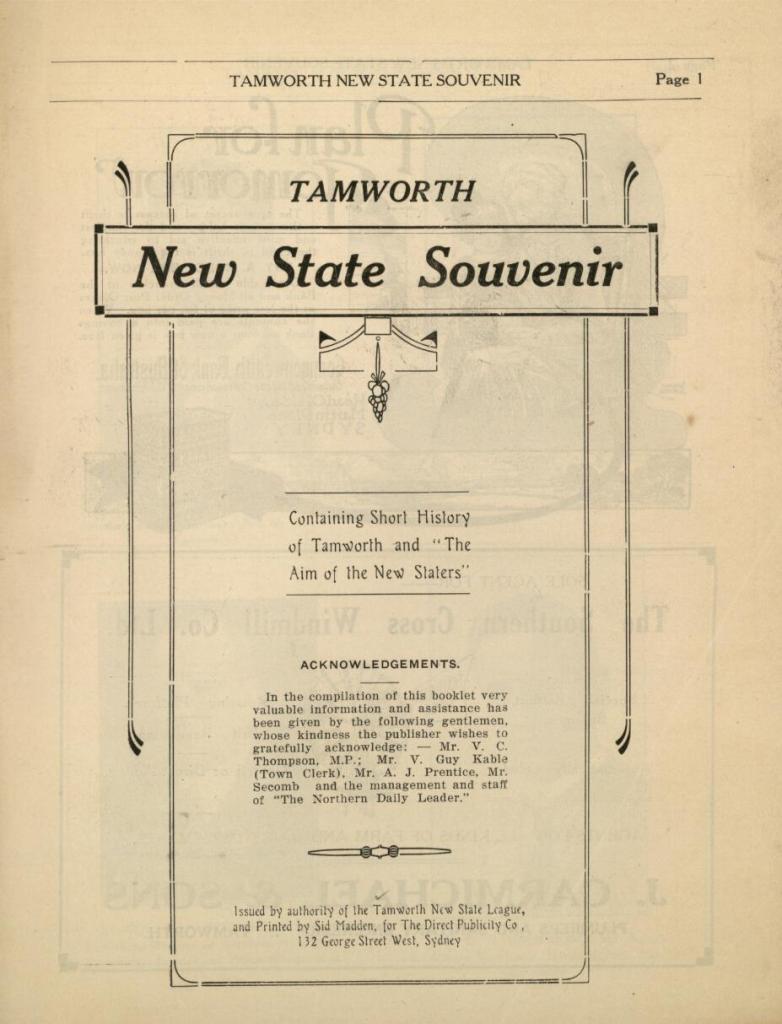
Tamworth New State Souvenir – published by the Tamworth New State League
Fight for Port Stephens continues – 1918
By 1918, several districts of northern New South Wales had begun to look at the issue of decentralisation and the concept of a new northern state. Meanwhile the active agitation for the creation of the development of Port Stephens continued in the Tamworth region.
The Daily Observer of 4 July 1918, page 2, reported:
‘The Tamworth District Council of the F. and S. Association handled the subject of Port Stephens remarkably well, and the President, Mr. W. J. Peek, is to be especially commended upon his clear and sound statement of the case for this natural Northern outlet. Other members also showed a good grasp of the position, and especially of the disadvantages of Newcastle. In deciding to hold a conference at Tamworth the Council took the best possible step towards launching the big campaign needed to combat the aggressive interests of Newcastle and forcing the Government to take heed of the real views of the people in the North and North-west.
The conference is likely to attract widespread attention in all parts of the State, and it may be the beginning of the great fight for decentralisation which must come sooner or later if New South Wales is ever to be freed from the octopus-grip of Sydney. This is a very big subject, and the F. and S. Council has shown a determination to deal with it in a big way. There is not much use in continually hammering at the superlative merits of Port Stephens as against Newcastle. The facts are too definite to need proof. The pleaders for Newcastle will doubtless deny the merits of Port Stephens to the end. The vested interests of Sydney will almost certainly continue their opposition to the opening of a port which would provide a fine site for a new rival city. It is inevitable that the powerful forces behind the Newcastle agitation will make every endeavour to crush the Port Stephens movement. They fear that if this new harbor is opened up it will mean a permanent set-back to their own city. It may mean a temporary set-back; but while Newcastle retains the coal and steel industries it will always be a great industrial centre, and the proximity of the new port will eventually react to the advantage of Newcastle.
As Port Stephens becomes great so Newcastle will become great. The two places will probably be interdependent. This aspect of the question will not appeal to the vested interests of Newcastle. There are always people ready to sell posterity for present gain. They never look beyond their own lives, caring nothing for the lives of those who come after. So long as they are wealthy and prosperous in their time they are prepared to let posterity take care of itself, and are heedless of the burdens they place upon posterity. Such a selfish, short-sighted policy cannot always be tolerated. Because it has been tolerated for so long the people of New South Wales today are saddled with burdens they need never have had. The idea is to throw off at least some of these burdens as soon as possible, and place no more of the same kind upon future generations.
The Tamworth movement may take some time to bring to a head, but having behind it a great principle which must operate for the good of the whole State, and particularly of the Northern portion, it must grow into an irresistible agitation capable of moving every obstacle. The support certain to be received from other Northern centres will have a great effect upon the Government. Port Stephens may not be opened at once, but some good will have been achieved if Newcastle is not allowed to usurp the position its great sister harbor should occupy. The time must come when the claims of Port Stephens will be seriously considered. The task of forcing those claims upon the attention of Parliament will be much simplified if millions of pounds have not been wasted in patching up Newcastle.
When the war ends there will have to be an immediate and complete reconstruction of the State’s developmental system. The great increase in land settlement will enormously add to the production, and the question of access to the nearest and best ports will become insistent. In the meantime the best possible turn the North and North-west can do the State is to prevent the committal of the State to the premature policy of opening up the inferior ports and keeping the best ones closed.’
Tamworth Conference – 1918
Tamworth continued to take the lead in promoting the opening up of Port Stephens to become the new port for the north and north-west of the State. The Newcastle Morning Herald and Miners’ Advocate of 17 October 1918, page 5, provided a comprehensive summary of the Tamworth conference and overview of the arguments advocated for a new port:
‘A conference, convened by the Tamworth Decentralisation League, was held today for the purpose of urging on the Government the expediency of opening Port Stephens as a port for the north, and carrying out the recommendations of the Decentralisation Commission in regard to the construction of connecting railways. About forty delegates were present from all parts of the north and north-west, …….. The conference lasted the whole day, and the discussion was long and interesting.
The following resolutions were carried:— (1) That this meeting of delegates, representing municipalities, shires, farmers and settlers’ associations, primary producers’ unions, agricultural societies, railway and decentralisation leagues, progress associations, pastures protection boards, and chambers of commerce of the northern and north-western portion of New South Wales, affirms the desirability of establishing a port for oversea shipment at Port Stephens, with the necessary railway connections with the north, north-west, and North Coast. (2) That for the purpose of giving effect to the last resolution, leagues be formed in the north and north-west, with a central council, and that the delegates present undertake to form such leagues in their respective districts.
Alderman Bourne, the mayor of Tamworth, in officially opening the conference, said the time had arrived when people dwelling in the metropolis of New South Wales must take notice of the question of decentralisation. In June, 1910, a Royal Commission heard evidence in regard to decentralisation as it affected the railways and ports, and 374 witnesses were examined. Certain recommendations were made by the Commission. One affected Jervis Bay on the south and Port Stephens on the north. The people in the south had held conferences, but until the present conference, the north and north-west had not taken definite action. The Tamworth Chamber of Commerce had instituted a conference in 1914, but the war upset the scheme. Newcastle was rival to Port Stephens. In the former port much money had been spent during the past eight years. Newcastle was taking advantage of this fact, and said, “Why spend more money elsewhere?” Some months ago Tamworth took up the cudgels on behalf of Port Stephens, and the present conference was the result.
In moving the first resolution, Mr. C. Vincent (Manilla), said in the past New South Wales had been kept back by a lack of railway connection with the coast. If the resolutions were passed, there was nothing to prevent any other body fighting for any other port on the coast. Although Newcastle was advocated as the port for the north, it would never be able to deal with the great territory in the north, and south-west. The people of Tamworth were to be congratulated on their action in bringing such a vital matter forward. Alderman Walker (Narrabri), in seconding the motion, said everyone would admit that the north-west was the richest portion of the State, despite droughts and other disabilities. He trusted that every delegate at the conference would leave no stone unturned to see the work of the conference brought to a successful conclusion.
In supporting the proposition, Lieutenant-colonel Abbott, M.H.R., said the matter of decentralisation was an all absorbing one. If the war had not intervened, the question of decentralisation would have been settled long ago. However, the war was not far from an end, and industrial and economic matters would then be dealt with in a national way. Centralisation had been the curse of Australia, particularly in New South Wales. …… Newcastle was all very fine, but that city had got more than a fair deal. Newcastle had its hands so full that work there would outstrip the capacity of the port.
Port Stephens offered the ideal port for the north, with its wide and deep harbour. Sydney wanted money for a North Shore bridge, or a city railway, but all the money available should be spent for the benefit of the producers. The man on the land had to pay for the war, and city railways would not help them. Looking at it broadly, if Australia did not study the man on the land by giving them greater facilities for getting their produce to market, Australia was doomed. The Commonwealth had land and resources, but not the facilities. It was necessary to have decentralisation, and pioneer lines of railways run out by the Commonwealth Government, not by the State, to tap the virgin centres off Commonwealth, and to connect these districts with the ports. This was better than the Government purchasing high-priced lands near the towns.
At Port Stephens there were all nature’s facilities, but they must have railway connection. This would be the means of developing a lot of country which at present was only used for grazing. This would help soldiers’ settlement. This would be a good argument for the Federal authorities to step in and do what the State had failed to do. He was an out and out advocate for Port Stephens, because Newcastle had all it could manage. Mr. Austin Chapman, M.H.R., said twenty-eight years ago, when he first entered Parliament, decentralisation was a burning question, and had been ever since. Although no great action had been taken on the South Coast, the Nationalists had made decentralisation, particularly in regard to the opening up of Jervis Bay, a live question. He suggested that the State National party should add Port Stephens to its planks. Of course, Newcastle and Sydney were looking after their own interest, thus opposition to Port Stephens resulted. He advised the people of the north to keep jogging their members along. ……
Mr. F. A. Heywood (Farmers and Settlers’ Association, Manilla) said if the people of Sydney and Newcastle were not so selfish, and recognised that other ports should be opened, then it would be better for the State. Mr. J. Langworthy (Manilla) said, as an old Port Stephens boy, he could say that Port Stephens was the port for the man on the land in the north and north west. Nature had endowed Port Stephens with one of the finest harbours in the world. If the producers remained quiet all their produce would still have to be hauled through the bottleneck to Sydney and Newcastle.
Councillior Perrott (Liverpool Plains Shire) said, according to the Decentralisation Commission, it was stated that Newcastle originally had a depth of thirty feet over ninety acres, while Port Stephens had four and a half square miles over thirty feet deep. In addition to that there was another mile and a half square which could be availed of. Newcastle, with all the money which had been expended on it, only had nineteen acres which could accommodate vessels in over thirty feet of water. This showed that Newcastle would be an expensive harbour to maintain. Newcastle could never be made, no matter what expenditure, a big port for oversea vessels. There was no comparison between the two harbours.
Mr. D. Grove (editor of “The Austral-Briton,” Sydney) said by the connection by a canal of Port Stephens and Newcastle, that area would become one of the best in the whole of the British Empire. He could say that Port Stephens was undoubtedly the best natural harbour in the world. All that people in the north and north-west wanted was to profit by the natural outlets, supplied them by providence to make it one of the richest areas in the Commonwealth. The nearest outlet for the district was Port Stephens, and he suggested that flat rate zones should be created to convey the products to the nearest port.
Mr. Scott-Griffiths (town-planning architect, Sydney) said he wanted to give some professional advice in regard to the scheme. Many people and many municipalities around Sydney had strong feelings in regard to decentralisation, and he suggested that circulars be sent to the local governing bodies in the metropolis, asking for their cooperation. If this was done, he was sure that fully 60 per cent. of them would give the desired assistance. He knew this, because a citizen of Sydney was not a selfish man. ……..’
Separation Movement for a Proposed New State -1920
The new state movement and the associated development of Port Stephens, continued to be advocated in the Tamworth region. The Richmond River Express and Casino Kyogle Advertiser of 9 January 1920, page 8, reported:
‘Tamworth “Daily Observer” has entered upon a campaign in support of the separation movement aiming at the creation of a new State comprising the northern portion of New South Wales. The question has been raised before, but in an isolated way, and the object of the “Observer” is now to concentrate the thought and effort of the whole of the North, North-western and North Coast districts upon the creation of an entirely new State (which would be about the same size as Victoria) and give the lead to other localities throughout Australia, which will perhaps be inspired to make a similar move, and thus bring about a complete revision of the system of government and development throughout the Commonwealth.
In the first of a series of articles upon the subject the “Observer” writes : — The time has come to talk about a new State for the North. It is obvious to all who have closely studied the plan of Government in New South Wales that in spite of all the rival policies of different parties, and the expenditure of countless borrowed millions, the evils of centralisation are merely being intensified. The patent fact of our political life is that the system under which we are governed is swelling the population of one city to abnormal proportions, while keeping the vast inland and coastal areas stationary. Not only this, but the burden of dual taxation by Federal and State Governments is falling with increasing weight upon the sparse population of the country districts, without giving them a commensurate reward in profitable development.
The Northern portion of New South Wales especially has suffered from the policy of Government on centralised lines. It is plain enough that the task of developing the huge Northern area, which is larger than the United Kingdom, is altogether beyond any Government of New South Wales. For years every portion of the North and North-west has been crying out for some essential work, and has always been denied. The reason is that it is physically impossible for a Government charged with the task of developing 310,000 square miles of diversified country to provide a hundredth of the requirements of any particular area. The North is larger than the State of Victoria and represents fully one-third of New South Wales. It has a wonderful variety of soil land climate, and is easily the most potentially wealthy portion of the State. Its population in proportion to its size is greater than that of Queensland.
The idea of setting up a new State in the North is not new, but it has never before been taken seriously. Let us take it seriously now; for the changed circumstances of our times render it a necessity. Before the war the North Coast was agitating for separation from Sydney, but at that time the national outlook had not altered, and the problems of the future had not begun to loom so largely before our eyes. In any case, the North Coast movement was too circumscribed. If there is to be a new State it should embrace the entire Northern portion of New South Wales, including the North Coast, Tablelands, North-West and North from Newcastle, upwards. Even this area is unwieldy; yet how much more unwieldy is the area at present being governed from Sydney ?
The subject is a big one, requiring much discussion. The details of a new State cannot be worked out in a moment; they will take time. The first thing necessary is to convince the people scattered throughout the entire North that they can achieve the boon of self-government within measurable time. The task of paving the way for a new Northern State— which would be somewhat larger than Victoria— is a hard one. It may take ten years or more to bring to a head. Yet how much better to aim at this grand consummation than to continue in the old rut of begging and pleading with the selfish interests of Sydney for a little railway here and a bit of a port there?
At present the whole North is stationary. It should be developing faster than any other portion of the Commonwealth, owing to its superior productive possibilities. As a separate State it would almost certainly in a few decades be the brightest jewel in the Australian Commonwealth. An area embracing the rich North Coast, the wonderful Tablelands, the vast productive North-west, the Tamworth, Upper Hunter, Maitland and Newcastle districts must under its own system of government quickly take a leading place among the States of the Commonwealth.
The objections likely to be raised to a new State are innumerable; but they can all be effectively answered. The first objection— which will be raised by Sydney and the interests identified with Sydney’s commercial and political influence — will be that such a State is quite unnecessary, as the present system of Government provides all that the North can hope to do for itself. The answer is emphatically that the North has for years been wanting at least half-a-dozen essential development railways, and has not obtained one, and is today as far off obtaining any as ever.
It has been agitating vainly for access to its natural trade outlets of Port Stephens and Coff’s Harbor, and has not reached within, coo-ee of the attainment. It has also been dissatisfied for many years with the system which ties it to Sydney Departments in all administrative detail, and which renders it unable to move hand or foot without the permission of officials in the metropolis. It is impossible to erect a tiny bush school over the whole vast Northern territory without years of agitation and masses of Departmental correspondence.
The next objection will probably be that the proper course is to agitate for unification — the scheme under which it is proposed to divide Australia into a large number of smaller local-governing areas, with the control of railways, lands, ports, waterways, and all national phases of government vested in the Commonwealth. The answer is that Australia is not likely to seriously entertain a plan which would involve a stupendous amount of fresh, centralisation. In any case the erection of a new State on the lines suggested for the North cannot impede any better plan when it enters the field of practical politics. It is not likely that local development will ever be handed over to a central Government; for the whole lack of proper development has been caused by centralisation. If a Government centred in Sydney is unable to develop 310,000 square miles on rational lines, how is one centred in Melbourne or Canberra to develop 3,000,000 square miles ? When the time comes for Australia, to hand over national functions to one Parliament; and confine local functions to a number of smaller Parliaments, the new State in the North will be able to yield up as much of its functions as are required of it. In the meantime it will have started to develop itself for its own benefit.’
Booklet Published -1920
The Daily Examiner of 24 February 1920, page 4, reported:
‘A booklet containing the articles recently reprinted in the “Daily Examiner,” from the “Daily Observer,” Tamworth, is now to hand. In addition to the articles mentioned there is a foreword by Dr. Earle Page, M.H.R., and addenda, map, etc. The whole work is very complete and puts up a first-class case for a movement whose success will be warmly welcomed on the North Coast from whence it originally emanated. There are several points in the book open to controversy, such as the inclusion of Newcastle and the advocacy of opening Port Stephens when ports further north are more urgently required. These are, however, capable of adjustment in conference. The main point is to endorse and advocate the principle of the New State, and this we do whole-heartedly, and will give it every publicity and encouragement. The people of the North Coast will also be found behind a movement which is destined to make for the development and proper government of their districts.’
New State Movement continues to grow -1920
The Gloucester Advocate of 1 May 1920, page 2, reported:
‘The New State movement is now definitely launched on its perilous way. A first conference has already been held— “The Glen Innes New State Conference”, which will, doubtless, in time to come, be marked as epochal in the history of the foundering as a concrete State what is destined to become the most important and flourishing part of the Commonwealth of Australia, and we are convinced
that this is no vain boast, for there is contained in the proposal all the elements — the natural resources to be developed, and the public spirit, already aroused, behind the movement —to fully justify the assertion, bold as it appears to be.
Even the Sydney press, which, it was expected would be emphatically opposed to it, evinces a desire to damn the project with faint praise, and condescends to encourage with grandmotherly advice. Yet they appear to be genuinely surprised at the unanimity with which the idea has been taken up by all sections of the people living within the area it is proposed to erect into the new community.
Speaking of this claim, that the public opinion in the proposed New State area is solidly in its favour, the “Sydney Morning Herald” says:— ‘How far the claim is justified it is difficult to say, but clearly the agitation can no longer be dismissed as the work of a few irresponsible cranks and visionaries. The time may come— it actually has come, according to the advocates of the idea — when we shall have to take it seriously, and consider the issues involved.” The “Daily Telegraph,” which has devoted several columns of its space to the subject from the pen of a special correspondent, remarks, inter alia: — “Among the organisers, of course, there prevail great enthusiasm and confidence. That is only to be expected.” But your representative has directed his attention to ascertaining if behind these enthusiasts there is a considerable body of influential public opinion. There is. Of some, thirty or forty persons picked at random is official and unofficial capacities, rich graziers — If in this stricken land such a one exists — poor farmers, and, without regard to their politics, not one dissentient was found.
Further inquiry in the Glen Innes district has entirely dispelled the idea that there is anything in the nature of wild-cat-ism about the new State movement, so far as the people are concerned. Of course, these sapient journals enlarge upon the difficulties to be encountered before the movement can be brought to a successful issue, but in these comments they are telling us nothing new, whilst there is a certain amount of satisfaction in the ostensible admission that the stand we have taken up is not, to say the least of it, unjustifiable.
But the projectors of the movement fully realise the difficulties they will have to encounter, and they are not dismayed. Many a large enterprise has been successfully attained whose initiation has not been half as promising as this one. The objective has been mapped out — “The North Star” — and the determination come to that this objective must be reached. At this juncture it is not intended to discuss the reasons — they are cogent enough — that have led the people of the North to this unalterable resolution. They know what they want, and why they want it — and although, now they have made the move there may be an attempt on the part of this or future Governments — repentant too late — to divert them from their declared object by promises of attention, or even by actual attention, too long neglected wants, such tactics will be wholly futile. ……..
But still there is a small fly in the ointment. It is necessary that Newcastle, with its industrial resources, and its adequate port, should become an integral part of the New State; but the attitude of Newcastle, just at present, is not at all satisfactory to the originators and supporters of the movement. Apparently, the public men of Newcastle do not yet realise the importance to them of the proposal at its true value, and they, therefore, although apparently not actively hostile to the movements are indifferent to its progress and sceptical as to its ultimate success. Now, if any portion of the proposed New State has reason to be warm in its advocacy, and anxious for its attainment, that portion should be Newcastle. No part of the proposed State has more to gain by its foundation than that city. For years it has complained bitterly of the criminal neglect of its most palpable wants, and of the oft-broken promises to have these needs attended to. For years the differential treatment with Sydney has been lamented, whereby the business naturally its own, has passed its doors and gone by the connivance of the powers that be to the Sydney “grab-all.” ………….
Their only hope is separation. Let this assertion he emphasised, and what will separation mean for Newcastle? It will mean that, in the first place, instead of being “the second city of the State,” it will be the first city, with all the potentialities pertaining to such a position. It will automatically become the chief shipping port of the territory, with all the offices and interests it represents, instead of playing second fiddle to Sydney, as it does now, notwithstanding its priority of industrial importance. It will become the indisputable terminus and port of export as well as import for all the territory embraced within the New State, with all differentialisation and centralisation, and future inflation of Sydney, at the expense of Newcastle for ever made impossible. It may be uncertain as to whether Newcastle will be made the capital of the New State or not, but this is immaterial, as its situation and resources will always ensure to it the proud position of being the first and most important city, instead of being deemed as now, as of only secondary importance. ……
But the truth seems to be that Port Stephens is the rock in their path. Port Stephens has, doubtless, been located by the home authorities as the Australian Naval Base. But even so, this does not detract one iota from the importance of Newcastle. On the other hand, it must rather add to its importance, and the naval base must always be secondary and subsidiary to the economics of the principal port. Port Stephens is too near to Newcastle, and too far behind it in the way of advancement, ever to become a rival city; and its resources not being a tithe of those of Newcastle, precludes the probability even of the population of Port Stephens ever reaching that of the older place. Port Stephens may become a large suburb of Newcastle, but for ages to come it can be nothing more. The railway proposed to connect the North Coast and the North-west districts with Port Stephens, junctioning above Gloucester, will probably be a strategical line, built by the Commonwealth — as it ought to be— and used principally for military and naval purposes, and when this line is constructed it is very certain there would be another line along the coast connecting it and Port Stephens with the city of Newcastle ……..
Mention has been made here of the financial aspect of the question as put by the “Sydney Morning Herald.” It says: — ‘In the proposed Northern State, there arre hundreds of miles of railway lines built, and maintained by New South Wales. There are schools and courthouses, and harbour works, and all the paraphernalia of administration which belong to the Government of New South Wales. They have been built, for the most part, out of loans, the security for the repayment of which they represent. The new State can hardly expect that we should make it a present of those. No doubt its members, as former members of New South Wales, may be regarded as part-owners of all public property in the State wherever situated. But incorporation in a new State will not absolve them from their corresponding liabilities. If they wish to take over a proportion of the assets of New South Wales they must also take over their aliquot share of her debts. ……….
It has been said that to form a new State, definite steps must be taken along constitutional lines, and that this action involves finally the consent of the Parliament of the State from which it is intended to be separated, and the doubt is expressed that we shall ever get a Parliament elected in New South Wales to give this consent. It is possible not. But if the separation cannot he brought about constitutionally. it may be revolutionally, as hinted by the “Bulletin.” If the people of the north are really determined not to remain members of this State, we cannot compel them to do so. It is not within the bounds of possibility that New South Wales could ever become the scene of a war of secession, such as the American Civil War, and, as before remarked, we have ample precedent for separation and all differences are adjustable.’
Land Speculators and Port Stephens – 1920
The Daily Observer of 12 May 1920, page 2, reported:
‘It is being suggested by some newspapers that the Northerners who are working for a New State with the object of making the people in the area independent of the selfish interests in a distant city are merely succeeding in helping land speculators to dispose of building sites at Port Stephens. How this can be sinisterly connected with a big movement to create a Greater North is difficult to see; but evidently the fact is being used to throw discredit on the bona fides of the New State movement. Port Stephens is after all only one aspect of the whole Northern developmental problem; undoubtedly it is of vital interest to some sections of New Staters who believe Nature has provided the North with a natural harbor which will one day enormously add to the prestige of the New State. For the present it does not constitute even the smallest part of the general Northern aspiration, and if it were opened tomorrow would not solve the greater problem of properly developing an area nearly as large as Victoria.
The fact that speculators have rushed in to secure the best building sites at Port Stephens, and are now, in expectation of the arrival of a New State within the next few years, busily trying to dispose of their land at a substantial profit, in no way affects the broad issue of establishing self-government in the North. This paper has already drawn attention to the land speculation going on at Port Stephens, and has used it as another instance of the utter neglect of Northern interests by Sydney Governments. It has even gone the length of breaking new ground in advocating, as the solution of the Port Stephens land difficulty, the acquisition by the New State of all land round the harbor and its-retention by the community.
Port Stephens offers an ideal opportunity for providing another valuable object lesson to the old States, each of which is suffering severely from a city landlord evil. For over a hundred years the site of another big city has been allowed to go to waste. Now, when the Northern people, to whom this, fine port belongs by right, are bestirring themselves to achieve a bigger destiny, Sydney and Newcastle speculators are stepping in to buy for a song the land which will someday be worth millions in rental values. The regrettable mistake of the New South Wales Government in allowing private persons to buy Port Stephens while it is still in its virgin state will eventually cost the North a pretty penny; but the price will have to be paid if the awful example of Sydney and other big cities is not to be repeated in the New State.
It will be a wise move for the Government of the New State to make one of its first acts the compulsory resumption of all the land round Port Stephens at the value existing on the date of the birth of the New State. Unless this is done another 50 years will see the citizens of the Port paying heavy tribute to landlords, many of whom will reside in Sydney. In addition to preventing this gigantic evil, for which there is no excuse in these enlightened days, the State itself will become the owner of the site of the future city, and will collect the ground rents, which will increase from year to year until they reach millions.’
North Coast residents consider the Southern Boundary of the New State – 1920
The Daily Examiner of 28 May 1920, page 2, reported:
‘Tamworth duly carried out its “revolt” on Wednesday and it is interesting to note the degree of earnest expression given by the residents to their first big move in favour of the New State. So far ninety per cent. of the agitation has come from the Central Northern town and the balance from Tableland and North-western centres. On the whole the policy of the people in the proposed area has been one of good natured tolerance and interest rather than of active and progressive propaganda. Next week other towns will follow Tamworth’s lead and on the northern line a fairly strong move will be in progress. Later on some effort will be made to stir up the rather apathetic North Coast. This area has been through the agitation process for the same object before to-day and the people are rather content to sit back and watch other centres than to any of the initiatory work.
It must not be thought that the people here are any the less conscious of the value of separation. They and their forefathers have been more or less mixed up in such movements since 1856; when the time comes for putting the shoulder to the wheel in earnest the people of the Coast will be found solidly in the van. One thing that is exercising the minds of those most interested here in the movement is the proposed southern boundary of the new area. There is a strong feeling against the inclusion of Newcastle and Port Stephens, the former because it is considered a second metropolitan octopus and the latter because Northern Rivers’ residents look to have their own harbors developed and not to see a port constructed at the far end of the New State.
Given altered boundaries and there would be quickly a stimulated interest where now there is apathy. In this connection it must be remembered that so far only tentative proposals have been put forward, and one of the motions carried unanimously on Wednesday was: — “That, in order to formulate a proper plan for the proposed New State, a convention be held as soon as possible, consisting of representatives of Northern public opinion, such convention to suggest the boundaries, the form of Government, and the methods by which the separation from New South Wales should be achieved.” Dr. Earle Page, M.P., will be speaking at the various Northern meetings to be held next week, and it is his intention to put forward a proposal that for the time being the area contained in the New State movement should be restricted to the five Federal electorates of Richmond, Cowper, New England, Gwydir and Darling. These electorates embrace a population of about one-sixth of the State of New South Wales and an area of approximately one-fifth. The referendum referred to in the motion above could be taken among the electors of this area, and its representatives discuss the enlargement or curtailment of boundaries.’
Necessary to have Port Stephens in the New State – 1920
The Northern Star of 7 June 1920, page 2, reported:
‘An outstanding objective in the platform of the new State organisation is ”The opening of Port Stephens.” Few people realise what Port Stephens is. Mr. de Burgh, chief engineer for harbors, in giving evidence before the Royal Commission of Decentralisation stated: “There is a larger area inside Port Stephens carrying 30 feet of water than in Port Jackson.” That same Commission in their report said :—”As to the ports suggested north of Port Stephens it must be stated that none of them presents any conspicuous natural advantage.” Port Stephens is therefore the harbor and port designed by nature for the shipping and sea trade of the northern portion of New South Wales. For many years Port Stephens has been little more than a name, and with the exception of the ardent angler few have seen the natural beauties of the place. …….
The more people that take up land round Port Stephens, the more responsible voices there are to advocate and expedite the commercial opening of the port. The more settlers there are the more the necessity for opening the port. An excellent advertisement appears, in this edition by Mr. Halloran, who in addition to the work of surveying and town planning, also controls for the various owners the selling of these estates. In conclusion another ex-tract from the Commissioner’s report :—”The weight of expert evidence is entirely favourable to Port Stephens as an oversea port. Port Stephens not only offers an economical and easily equipped deep sea port for the relief of Sydney, but its situation admits also of connections with the trunk railways of the State, which would make it effective from a decentralisation point of view. By means of suitable railway connections Port Stephens could be made the port for the whole of the North Coast, the northern, north-western and a considerable portion of the western districts, an area comprising 125,000 square miles.’
The Gloucester Advocate of 3 July 1920, page 1, also reported:
‘The lead set by the Inverell New State League in regard to Port Stephens should be immediately followed up by other New State Leagues. There is no question that the destiny of this great natural port is of vital concern to Northern New South Wales; and as the New State movement is concerned primarily with the destiny of the entire North, it is quite fitting that these bodies should utilise their growing organisation to bring pressure on the careless political interests in Sydney concerning the foolish policy of allowing speculators to grab the site of the future city.
An increase of speculative activity around Port Stephens is being attributed in some quarters to the New State movement, and various sinister suggestions have been made that some of the New Staters have speculative interests in that locality. Nothing of a big or useful public nature was ever done without the intrusion of the type of man who cannot imagine anyone spending time and energy without a personal axe to grind; so that New Staters, who consider Port Stephens to be merely desideratum of their great movement, can afford to treat the motive mongers with contempt. But the best answer to them is to carry on, side by side with the bigger New state campaign, a minor campaign for keeping Port Stephens the property of the Government of the future Northern State.
It is, indeed, a regrettable fact that New South Wales laxity in the past has allowed a considerable area or land within a radius of 15 miles of Port Stephens to be alienated; but the late Holman Government did. In response to Northern representations several years ago, agree to the policy or not alienating any more lands there. Whatever land is now being offered for sale on a speculative basis has been alienated in the past, and so far as is known — unless the present Labour Government, which should on its policy be strongly against alienation, is permitting lands to be sold at the port — the bulk of the city has been preserved to the State — whether the State be New South Wales or the new Northern one.
Whether the New State comes or not, there can be no two sides to the Port Stephens alienation issue. Here is a virgin city site— one of the few in Australia alongside a really great port— and in view of the experience of the people of all the existing great cities, it would be sheer criminal folly to allow it to be sold for a song to present-day speculators, who, by holding for a few years, may be reaping enormous unearned increment, brought by the growth of the future city.’
Map of proposed New Northern State includes Newcastle and Port Stephens -1920
The Sydney Mail of 7 July 1920, page 8, reported the following:
‘The following map was prepared for “The Daily Observer” by Mr. E. B. Henderson, draughtsman, of the Tamworth Lands Office. The boundaries marked embrace the whole of the northern railway systems, but are purely tentative, and offered as a basis for discussion. It is probable that in defining the boundaries of the new State a commission consisting of northern New South Wales, Queensland, and New South Wales representatives would have to be constituted to investigate and report.’
The map includes the Newcastle and Port Stephens ports.

Boundaries of the proposed New State
New State Movement spreads Interstate – 1921
During the years 1920 and 1921 much debate in the media and in Parliament occurred on all aspects pertinent to various new state movements that had sprung up in various states.
An article published in the Muswellbrook Chronicle of 19 August 1921, page 6, outlined current developments:
‘For over a quarter of a century, almost every politician of every party in every State of Australia has preached decentralisation. Of all the fine sounding catchwords and phrases used as baits for votes, this nicely balanced polysyllable has been the favourite. The bait cost next to nothing—a cubic inch of breath at the most and the magic word is uttered—and the fish bite greedily at it. ………
But, to the indignant surprise of professional politicians and the more narrow-minded of city-dwellers, the dream has come true—not in all its lurid details of course, but in the form of an Australia-wide movement for the splitting up of the cumbersome and unwieldy States into more workable areas, for the freeing of our broad pastures and rich agricultural lands from the money-sucking domination of city interests—in the form of a movement that aims among others things at establishing secondary industries in the country towns and at the opening up of the many fine ports that stud our coastline (Coff’s Harbour, Port Stephens, Port Kembla, Jervis Bay, Twofold Bay),—to mention only the undeveloped ports of New South Wales), and at the linking up by railway of these ports with their natural inland feeding lands. ……..
Thousands of people in all parts of Australia (there are two New State organisations in Western Australia, two in Queensland, and another in the Riverina, besides the very strong organisation in the northern parts of New South Wales) have grown tired of government by city influence, and have decided that they would be better governed by a parliament which they could watch and influence our present parliaments.
In each case, the present seat of government is something like 300 miles distant from the nearest boundary of the proposed new State. In each case, the people (without having yet decided the exact town) have determined to place their capital in the middle of the new State, where, in the nature of things, a very big city is less likely to grow than on the coast. Australia does not want a few big cities, but a number of fair-sized and well equipped ports, with railways running inland from each of these ports to bring the export products of the inland districts to the ships by the shortest route. This is what each of the New State movements stands for.’
Proposed New Northern State Boundaries include Port Stephens – 1923
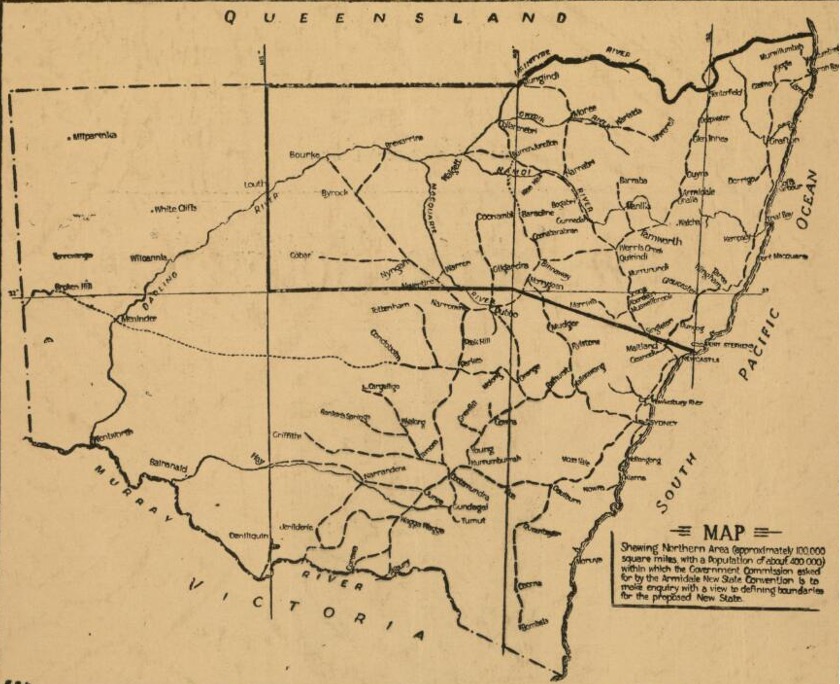
Boundaries of the proposed New State [map published in the Tamworth New State Souvenir, 1924, issued by the Tamworth New State League.]
The Sydney Morning Herald of 13 June 1923, page 16, reported:
‘The Northern New State Convention, which sat recently at Armidale, approved of the boundaries for the proposed New State, as shown in the above map. On the north, the New State will be bounded by the Queensland border, from Point Danger to the intersection of the 145th meridian of east longitude, about 20 miles to the west of the township of Bellingen. The 145th meridian will serve as the western border to its intersection with the 32nd parallel of latitude, about 80 miles to the west of Nymagee. The southern boundary will be the 32nd parallel of latitude from its intersection with the 145th meridian, to its intersection with the 149th meridian, the latter point being about 25 miles to the north-east of Dubbo, and thence in a straight line from this point to the east coast of Australia, cutting this slightly to the south of Port Stephens. The area thus enclosed embraces about 100,000 square miles, with an approximate population of 400,000.’
Inclusion of Port Stephens in the New Northern State questioned – 1924
The Northern Star of 21 January 1924, page 4, reported:
‘The proposal to cut off the North Coast and the adjacent tableland area from the parent State and to create a new and separate administration is no longer an academic question limited to the interest of the few, but has become an issue of nationwide importance.
For the welfare of the future of the Richmond it is essential that every voter, whether he is in favour or against any change being made, should take an active interest in the movement. The people of the immediate North Coast, particularly in the territory embraced in the Richmond and Tweed have certain specific and well defined interests, which must be zealously safeguarded. It is for this reason that they should take a closer interest in the movement, now that it has emerged from the doctrinaire stage into an issue of practical politics. There are large and powerful influences directly opposed to a northern new State. It is obvious to all familiar with political machination that the current of this opposition of vested interest having been momentarily turned aside will break out in a new direction with reinforced vigour.
Already the first ripples of the course into which this under stream in the movement is being directed are beginning to show on the surface. And it is at this point where the people of the Richmond and Tweed should determinedly dam the waters before they grow into a roaring torrent that will sweep all before it. The North Coast must be organised to withstand all opposition, and the surest way to win general public support from the outside in a movement of this kind is not to need it. …………
There has lately been an insidious influence at work to counteract the possible benefits that would accrue from a new State of limited area. It is believed that if the boundaries were extended to embrace Port Stephens the colossal area would present such difficult problems of administration that it would collapse under its own weight. And, unfortunately, there have lately been surface indications that there are one or two men on the confines of the movement who are likely to forget to adopt in practice the excellent precepts they have so splendidly approved in theory. ……….
The boundary question of the proposed new State is the most vital issue at present under review. Should Newcastle or Port Stephens be included it will mean that the development of the Richmond will be held in check for years. A new State that does not give an immediate incentive to the development of Ballina as a deep sea port and the linking up of Tenterfield with Casino and the extension of the railway system through the Clarence Valley to open up the great wealth that now lies untapped at our back door, so to speak, will be of very little value to the Richmond.
With Port Stephens included within the boundary future railway construction would inevitably tend to take a southern direction, and the evil of which we now complain would be merely accentuated. Indeed, we would have an added burden of expense without a single compensating advantage. …….
To have the railways centring upon Port Stephens might benefit the country south of Tamworth, but if the southern boundary is placed contiguous to Newcastle, it is inevitable that the evil of centralisation will be maintained in vigorous growth. The north cannot come to the full blossom of its prosperity until there is a railway from Inverell to Guyra and thence to Coff’s Harbour; and one from Armidale to link up half-way on the Coff’s Harbour line; a line from Inverell to Glen Innes and then on to Grafton, and one from Tenterfield to Casino. The possibility of those necessary railways being constructed under existing conditions is too remote for serious consideration, and whether they would be brought any nearer to accomplishment if Port Stephens were to be made the harbour of the North Coast seems to be equally as intangible.’
Royal Commission into New State Proposal- 1924
The Gloucester Advocate of 8 July 1924, page 2, reported on the proceedings of a Royal Commission that commenced its inquiry in Sydney on 30 April 1924, examining the new state proposals:
‘The Royal Commission is now collecting the opinions of North Coasters for and against the New State. As on the Tableland and in the central inland districts the population is heavily in favour of separation from Sydney. On the general issue of a New State the North Coasters are unanimous; but they appear to be altogether unnecessarily exercised over the premature issue of the boundaries.
The majority of witnesses seem to think that Tamworth, as the headquarters of the inland part of the movement, is strongly desirous of the inclusion of Port Stephens, and that the Upper Hunter’s support is based upon adherence to this port. The fact are that while the majority of people in the central and southern areas of the New State are strongly and naturally favourable to the inclusion of a port which offers so many advantages to them, they are much more concerned about the creation of a New Northern State. It is safe to say that if a vote were taken at any time on the general question of having a new State without Port Stephens, the inhabitants would overwhelmingly support separation. They would do so with less satisfaction on account of having been wrongfully deprived of their natural trade outlet; but would be for the New State none the less.
The real issue is not a port any more than it is a railway — it is local control so as enable the North to make more rapid headway than it is ever likely to do as a part of the Old State. The intrusion of the Port Stephens issue is unnecessary at this stage. It is an issue that must be settled sooner or later. Whether the North Coast people like it or not, the question of whether it is better to have a State that will include the Upper Hunter or whether it is better to have one embracing only the far North Coast and Tablelands must be submitted as a definite proposition to the people either of the North or of New South Wales as a whole.
The best plan for the New Staters to pursue is to ask first that a vote be taken in the North within an area to be delimited by the present Royal Commission. This request could be so based on the assumption that after hearing evidence the Royal Commission was satisfied that a prima facie case had been made out to test the real views of the Northern people. This test can only be applied by way of a definite submission to a definite community. If the verdict is “Yes,” the State Government will then be bound to submit the whole issue of the proposed separation to the people of New South Wales. Until that verdict is obtained one way or the others the matter of exactly what area shall be separated within a parallel or a few degrees can safely be left in abeyance.
The final settlement of the boundaries of the New State will have to be left to a Commission, which will delimit them in accordance with the wishes of the Parliament of New South Wales and the views of the Northern people as disclosed as the first referendum. Presumably the next step would be to elect a Northern Convention within that area, and give it the task of framing a constitution and at the same time of pronouncing upon the boundaries. It would then be possible for compromise. The Old State would doubtless agree to such reasonable modifications in the boundaries proposed as the majority of the convention desired. It is hard to see how until this final stage is reached that any area or port can be included or left out. Possibly there is some readier way of settling this question, but it is not apparent at present. Certainly the way is not to begin by killing the whole New State Movement.’
Royal Commission Hearings – 1924
The Armidale Chronicle of 17 December 1924, page 3, provided further commentary on the Royal Commission:
‘The Commission began by taking evidence in Sydney. Dr. Earle Page, the Federal Treasurer, was the first Northern witness, and he submitted a carefully prepared statement. A number of leading Sydney men, such as Mr. Windeyer, K.C., Dr. Watson (editor of Commonwealth Historical Records), Mr. Macartney Abbott, and others, followed Dr. Page. The Commission then commenced a series of four tours to the Northern districts.
The first embraced the main Northern line from Scone to Glen lnnes. About 60 witnesses were heard, of whom not more than five were against the New State. Evidence on this tour was taken at Tamworth, Armidale, Glen Innes, and Scone, and the Commission made two visits to Tamworth and Armidale. Some very fine written statements were submitted by many of our witnesses. ……….
The second tour was to the far North Coast, and embraced Grafton, Maclean, Lismore and Murwillumbah. About 60 witnesses were heard, not more than 10 being in opposition. Of these, seven were at Maclean, where no favourable evidence was given.
The third tour was to the North West, and embraced Gunnedah, Narrabri, Moree, and Inverell. About 40 witnesses were heard and of these about 15 wore hostile. More of the opposition was at Moree. There was no opposition at Inverell.
The fourth and last Northern tour embraced the middle and lower North Coast districts, and included Coff’s Harbor, Taree, Kempsey, Bellingen, and Dorrigo. About 45 witnesses were heard, and of these some 15 were in opposition. There was no opposition worth speaking of at Coff’s Harbor or Dorrigo, but the majority of witnesses at Taree and Kempsey were hostile.
In the intervals between the tours, and since the conclusion of the last tour, the Commission has been taking evidence in Sydney, principally that of Departmental officials. Most of this latter evidence has been in the direction of giving the Commission information about the cost of establishing the proposed Northern State. The Treasury officials submitted lengthy evidence, showing that Dr. Page’s previous evidence regarding finance was incorrect, his estimate of a surplus of at least £500,000 being wholly wrong. Mr. Stevens, assistant director of finance, submitted a counter statement showing a deficit of approximately £1,250, 000. He contended that this would involve an addition of £3 per head to the taxation of the Northern New State.
Dr. Page appeared again before the Commission in November and submitted an amended financial statement. He complained that some of the figures on which he had based his previous statement, and which had been supplied by the N.S.W. Departments, had been found to be wrong. However, he totally disagreed with Mr. Stevens’ estimates, and submitted figures to show that in comparison with other States, N.S.W. was today the most extravagantly governed State in the Commonwealth. Allowing for a margin of security, he estimated that the New State would, on the most conservative basis, commence with a surplus of a little under £200,000. He based this estimate largely upon the cost of similar administration in other States.’
Royal Commission rejects New State Proposals – 1925
The Sydney Morning Herald of 7 May 1925, page 9, reported on the findings of the Royal Commission which examined proposals for the establishment of three new states within New South Wales:
‘The report of the Royal Commission, of which Judge Cohen was chairman, on the creation of new States was considered by a special meeting of the Cabinet yesterday morning. It was subsequently made available by the Premier.
As already forecasted in these columns, the Commission recommended instead of new States with quasi-sovereign powers, an extension of the system of local government, and a further decentralisation of administration. “We are unanimously of opinion,” says the report, “that in its original form the proposal for the creation of a new State in the northern part of New South Wales is neither practicable nor desirable. With the exception of Mr. Commissioner Sinclair, we are also of opinion that in any amended form a proposal for the creation of such a new State is neither practicable nor desirable. Mr. Sinclair is of opinion that it would be practicable to establish a new State bounded on the north by the existing boundary between New South Wales and Queensland, on east by the coast of New South Wales, on the south by the southern boundaries of the shires of Macleay, Apsley, Upper Hunter, Warrah, Tamarang, Coonabarabran, and Walgett, and on the west by the Barwon River and excluding any portion of the Western Division. He is, however, of the opinion that under existing circumstances it is not desirable that such a State should be created.
“We are also unanimously of opinion that the proposals for the creation of new States in the Riverina and Monaro, in either their original or in any amended form, are neither practicable nor desirable. “The only proposal which involved the inclusion of any part of any other State was that for the creation of a new State in the Monaro. As we do not consider that this proposal is either practicable or desirable, we answer this question in the negative.
“We are of opinion that it is not necessary to establish a new State or new States in order to secure reasonable powers of self-government and efficiency of administration, in the areas which it has been proposed should be created into new States. We are however, of opinion that such ends can be adequately secured by the adoption of the scheme for the extension of local government.’
Port Stephens again suggested for inclusion in New State – 1926
The Kyogle Examiner of 30 April 1926, page 1, in reporting on the meeting of the Northern New State Movement meeting held at Lismore reported:
‘Mr. Sinclair, who was a member of the Royal Commission, put forward an earnest plea that members face a hitherto neglected question— that of the boundaries of the proposed New State. The absence of a definitely defined area, or even the haziest idea as to what should constitute that area, was particularly noticeable among the witnesses before the commission. He claimed that there was no need to saddle the New State with the area of country west of Bourke, with all its non-paying railway lines. There was no demand among the residents of that district as a whole for inclusion in the New State, and that was another fact very evident from the tenor of the evidence of the witnesses examined. The question had been asked, and he thought with justice. Would the man from Bourke or Dubbo be any more in touch with the men of Murwillumbah or Lismore if they formed part of a new State than they were in touch with the present administration, and of what advantage would it be to them to be in touch with the North Coast areas?
Continuing, he urged that the effort be made to organise within certain defined boundaries. He thought that a line, including the Upper Hunter, along the top of the Liverpool Ranges, is as far west as support could be expected from, and no further south than Port Stephens. Mr. Ager thought that it was absolutely necessary “to hold these conventions within our area” to keep the matter before the public. In addition All Australia conventions were necessary in view of the possibility that a convention of the northern New State area be held during the present year.
Mr. Perdriau seconded the motion but believed that a wider view was necessary. In the future the movement should concentrate on the national aspect. The aim of the larger convention would be to focus attention on the coming constitutional session of the Federal Parliament. He urged that every effort be made to get visitors from other parts of the Commonwealth to crystalise the viewpoint of the northern New State movement and the New State movements in general. The motion was carried after some discussion. Mr. Perdriau moved that the convention be a northern New State movement convention, and that invitations to attend be extended to allied movements and kindred bodies in Australia. Seconded by Mr. Akers and carried. On the motion of Mr. Tighe it was resolved to invite all public bodies to send delegates.’
New States Movement considered by Federal Parliament – 1926
The Northern Star of 28 May 1926, page 5, reported:
‘In the House of Representatives today Mr. V. C. Thompson (N.S.W.) moved, that in the opinion of the House a referendum throughout Australia should be taken during the life of the present Parliament on the question of amending the Federal Constitution so as to give the Commonwealth Parliament power to establish new States, on such terms and conditions as it may think fit, within boundaries of existing States, with or without the consent of the State Parliaments.
Mr. Thomson said that he had previously introduced the same motion into the House and would not traverse the same grounds again. This was a movement against centralisation. It had been said that the new States movement was a joke. It was no more a joke than it was 75 or 80 years ago when the settlers of Victoria were struggling for separation from Sydney, and later when the settlers of Moreton Bay were also making a similar endeavour. ………..
The State Parliaments had entered into a deliberate conspiracy with the commercial and capitalist interests in the metropolitan cities to defraud the rural interests of their rights. The founders of the constitution did not intend that there should not be new States. …….
Several ports in that State [N.S.W.] could be made good outlets if connected with proper railway systems, yet no attempt appeared to be made to do so. Port Stephens, 20 miles only from Newcastle, where there was an artificial harbour, had been neglected and shut up deliberately. It was one of the finest harbours in the world, but had been left in the same condition as Captain Cook found it. The debate was adjourned.’
Advance Port Stephens Movement Formed – 1927
The Dungog Chronicle of 23 August 1927, page 4, reported:
‘The hon. secretary of the Tea Gardens Progress Association has received the following letter from Mr. Edward McC. S. Hill, in connection with the Advancement of Port Stephens. The matter will be dealt with at the meeting of August 27th.
The Hon. Secretary, Progress Association, Tea Gardens, Dear Sir, — In connection with my work for the “New State” movement I am very specially interested in everything concerning the harbour of Port Stephens. I may say at once that I am now working principally on the assumption— almost amounting to a belief — that, when the Australian New States are being formed, New South Wales between Newcastle and the Queensland border will be formed into two new states. This being so I am striving to impress upon everyone interested in the progress of what will then be the southern of these two States the immediate necessity of doing everything possible to at once work for the advancement of Port Stephens and its surrounding district.
You will have seen that Newcastle is striving to its utmost to obtain assistance from the Government and from the surrounding towns in order to secure its future. And it can be very plainly seen that it intends this future to be secured at the expense of Port Stephens — an immensely superior harbour. Newcastle is asking the Government to give it some “millions of pounds” for improvement work, and if it succeeds in getting this Port Stephens will be doomed for at least another fifty years. I want all who can to work with me now with the determination that Port Stephens shall at once come into its own, and that we may place it safely on the road to being possibly. ……..
I have learned that there are Progress Associations at Karuah, Tea Gardens and Nelson’s Bay, and I am sending a copy of this letter to each, and I would earnestly ask that a united consideration be given to the following suggestion. I have already written to Mr. L. Bennett, Editor, of “The Port Stephens Pilot,” placing the suggestion before him, and asking for his opinion concerning it. I have also mentioned the matter further north. Would it be possible to arrange a “Pilgrimage” to Port Stephens to view the Port, and to have its beauty and its possibilities demonstrated on the spot? A conference could be held there, and plans arranged for future work, and generally a forward movement be initiated.
All the principal towns say south of the Macleay or the Nambucca should be interested in the matter, and many would doubtless attend from those towns. It should be arranged as a kind of pleasure excursion, and I believe that if properly worked up it should be very successful, and should create such an interest in Port Stephens as has never hitherto been manifested. The Progress Associations on the spot might fully discuss this suggestion as they would be in a good position to know it would be likely to meet with success, and also the necessary arrangements which would have to be made in connection with it. I will be pleased to learn their ideas concerning it, and they can be assured that I will give them all the assistance which I possibly can if the suggestion meets with their approval. I am, Dear Sir. Faithfully yours, Edward McC. Hill, Wingham, Manning River, 11th August, 1927.’
The Gloucester Advocate of 20 September 1927, page 4, further reported:
‘Mr. Edward McC. S. Hill, of Wingham wrote in these columns some weeks ago pointing out that the time was at hand when some concerted action should be taken to assure the opening up of Port Stephens. Mr. Hill communicated with the various Progress Associations and put his ideas before them. It will be remembered that Tea Gardens P. A. failed to hold a meeting since the attendance was insufficient to form a quorum. Mr. Hill wants the movement to keep going. He is not satisfied to let it die. He was joined by a fellow enthusiast in Dr. Pern, of Sydney, who wrote a letter to the Editor supporting Mr. Hill’s proposals.
Mr. Hill says: — Perhaps they do not like the idea of a perfect stranger to the place, and one who possibly has no interest in the place, butting in, and interfering in their affairs, and, from so great a distance as I am from them, seeming to be trying to tell them what they ought to do. I would be very sorry if they should look upon my actions in this light. As a matter of fact, I am paying rates to the Stroud Shire on two small pieces of land on the northern shore of the Port, and this alone should show that I am not out of my place in asking for their help, and in striving to help them, to open up Port Stephens to the world, so that even in our time it may show something of the wonderful future which we know it has before it. But this is not my chief interest in Port Stephens.
My chief interest is it is that it must one day be the splendid Port of a New State, and that to it must come the ships of the world to receive the products and the manufactures from all the districts surrounding Tamworth, Werris Creek, Muswellbrook, Coonabarabran, Coonamble, and even from far off Nyngan, and Cobar, and Bourke, and from places which are unknown today. I want this New State, and I want it to have a Port worthy of it, and of which it shall be worthy, and I want it to have an opportunity from its very inception to place itself as one of the most prosperous States in Australia. This is my chief interest in Port Stephens.
The prosperity of Port Stephens means the prosperity of this New State, and I want all who hope to dwell in it to realise this, and to immediately work for the prosperity of both Port and State. Now, what can we do about the whole affair? I notice in looking over the “Pilot” that there are several other Progress Associations around Port Stephens besides those to which I wrote. Surely it should be possible to get representatives of the Associations, and possibly members of other bodies existing around the Port, to fix upon some place, and upon some day, where, and when, all can meet as a Conference and have a good, informal chat about the Port and the State, and form a great Central Association, with representatives from all, which will leave no stone unturned to make the great potentialities of Port Stephens known throughout Australia. This would be in the interests of all, and it should be easily done. This Association could then arrange, if the suggestion is accepted, for a well-advertised “Pilgrimage” to the Port, and I am quite confident that this could be made the greatest occasion which Port Stephens has ever seen.
If this Conference can be arranged — and it need only be arranged as an informal friendly chat — I will be very happy to attend it, and I am sure will learn much that will help me in my work for both Port and State. If I can in any way help the Association in the matter I hope they will let me know. I am, dear Sir, Yours faithfully, Edward McC.’
The Dungog Chronicle of 6 December 1927, page 6, also reported:
‘The meeting held in the Australia Hall on Friday night last in connection with the Advance Port Stephens movement, which was presided over by Mr. H. A. Holloway was not largely attended owing to the tremendous downpour of rain. When the secretary learned that the Tea Gardens-Karuah road was impassable he got in touch with the various towns from which representatives were coming, and advised them not to make the trip as they would probably get stuck on the road, this kept at least 50 visitors away.
To those who attended Mr. E. McC. S. Hill, of Wingham gave an outline of what was proposed to be done regarding the opening up of Port Stephens by rail and road. He said the movement was a big one and extended from the Coast right through the North West as far as Inverell, they all recognised that Port Stephens was the natural port for them, and it was not now a matter of asking, but demanding that the Government construct railways to open it up. Mr. Hill said he had always advocated the New State movement, but he recognised that that was now dead for the time being and he was concentrating on having Port Stephens opened up as it was the finest and best Port in Australia.
Higher up the Coast there was a big movement to make the Clarence a port, or Coff’s Harbour, but that was impossible as the Clarence was not suitable and could never be made a port, while Coff’s Harbour was just an open roadstead. He was sorry that the weather had interfered with the attendances at the meeting, but the large number of apologies received more than compensated him for coming as it showed that there were a large number keenly interested and that the movement was going to go no matter where the opposition came from. He suggested that the next meeting be held at Gloucester within a fortnight and then concrete proposals could be brought forward. Mr. Geo. White, who came from Sydney for the meeting, supported the movement and thought that now was the time to make a move, he had interviewed the Hon. F. Chaffey M.L.A. who had promised support, as also had the Hon. W. Bennett, M.L.A., and other members of Parliament. It was decided on the motion of Messrs. Dennett and White “The Advance Port Stephens” movement be started and those present form themselves into a committee with power to add to their numbers. It was agreed that the next meeting be held at Gloucester on a date to be arranged by the hon. Secretary of the Progress Association. The meeting is to be advertised.’
New States Convention at Armidale – April 1929
The Maitland Daily Mercury of 4 May 1929, page 6, reported:
‘Whatever its leaders may think, or profess to think, the New States Convention, which sat for three days last week at Armidale, must be marked down as a disappointment. It certainly, as the Federal Country Party’s bulletin says, gave the lie direct to those who have in the near past been spreading abroad the report that the New State Movement was dead. Nothing dead could put forth such a volume of talk as issued from delegates during those three days, so the movement is not dead. The disappointing feature about the Convention is that from the point of actual results attained it can be fairly described in the old Latin phrase “Vox et praetorea nihil.” This, indeed, is tacitly admitted by one of the movement’s press champions, which, while describing the Convention as wholesome evidence of Northern faith in the future, admits that “no concrete proposal which the public could easily visualise was born of the speeches of the Parliamentarians and the host of delegates.” In spite of this, however, he says ‘the note of the discussions was clear and resonant , in favour of some radical change in the centralised system of government which is the bugbear of the rural population. Sooner or later, if this rural effort is kept up, the entrenched forces of the big cities must be awakened to the portent of this rural revolt against a lopsided and unjust distribution of the benefits of government.” Sooner or later. Yes, but if nothing more concrete is put forward than is visible to date, it will be very much later. As the journal above quoted says: “No agitation can go on for ever on lines of generalisation. It is futile to be content with swearing allegiance to an ideal, unless steps are taken to translate that ideal into something tangible.”
Proposals distinctly in the direction of “something tangible” were contained in the Provincial Council’s scheme propounded by the Central Executive, but these were rejected by the Convention at the insistence of Dr. Earle Page — who wants nothing less than a New State with Grafton as its capital — Mr. Bruxner, who apparently read into the scheme some attempt to dictate to the State Government the terms of larger local government that are desired to ensure decentralisation, and other Parliamentarians who— well — followed their leaders. The common-sense point of view is that the extended local government powers suggested under the Provincial Council’s scheme would have been a step nearer to the New State ideal, and made the latter objective more easily achievable. However, the politicians thought differently, and nothing tangible resulted. The scheme was pushed aside because it did not come right up to the ideal of a New State.
About the only decision of the Convention that can be considered in any way tangible was the final resolution, carried on the motion of Mr. V. C. Thompson, M.H.R., asking the State Parliament for a referendum in the North to determine the true opinions of the population likely to be affected. But there is nothing really tangible even in this resolution, for there is no indication whatever as to the boundaries within which the referendum should be taken. Something tangible, however, was put forward by Dr. Norman Porn, who advocated a New State, with definite boundaries, and with railway connections to the deep support of Port Stephens, as an economic proposition. In fact, he urged it, as the only economic proposition possible, and argued that from an economic standpoint the interests of the north-eastern corner of New South Wales were closely bound up with Brisbane. He was howled down, ruled out, and generally speaking, “squelched.”
The Convention did not want any argument or discussion on the question of harbours, and, anyhow, Dr. Pern’s scheme put Grafton out of the running as the capital of the Northern New State, so it could not be taken into consideration. So the Convention finished up with “talk, and nothing more.” However, the proposals for the new State of Banksland, with Port Stephens as the deep sea port, will have to be considered and must carry great weight in the New State arguments of the near future, To quote our Tamworth contemporary, the “Northern Daily Leader,” the task “is one which will test the New Staters as they have never yet been tested.”
All-Australian New State Movement – 1929
The Dungog Chronicle of 17 May 1929, page 3, reported:
‘Judging from the deliberations’ of the Armidale Convention of 22nd and 24th of April, it appears quite clear that it will take a long time — how long nobody could well estimate — to bring about a Northern New State “attained as part of a National Movement for a new Federal System with a new distribution of power, and a new distribution of territory.”
That, I understand, is the ideal of the All-Australian New State Movement. The boundaries of these “new states” would be defined by a special Commission formed for that purpose. I understood at this Convention that the All-Australian Movement will not do away with the Northern New State organisation and ideal, although this latter must necessarily become subsidiary to the greater movement if it is agreed by the Northern New State Executive that the only way to arrive at an autonomous Northern New Stale is through the All-Australian Movement to get the necessary alteration made to the existing Constitution. The Northern New State is at present a vague, ephemeral kind of thing — like a spirit — and when the sceptic asks that the body be defined in which that spirit is supposed to reside, the reply is ‘hush, hush!” When again a plan is brought forward of a real live economic Northern New State, he is again told he will jeopardise the All-Australian New State Movement!. ………….
In my opinion the efforts of those who appreciate the importance of economic decentralisation at Port Stephens should be devoted to converting the Northern New State Movement into one that will aim at an eventually autonomous New State with boundaries enclosing. Firstly, “a Port that oversea vessels can regularly and unfailingly call at in all weathers and tides, and where there exists a minimum cost of upkeep.” Secondly, “a hinterland that in economic competition with other adjacent ports is sufficiently large and rich in resources to support a population capable of producing enough wealth to guarantee its public service and share of national debt.” Port Stephens alone fulfills the first and other “requirements of an Oversea Harbour” existing between Sydney and Brisbane, and the Hinterland that Port naturally serves — which includes the whole of the North and North West tablelands together with North Coast area from Dora Creek up to Bellingen River— when connected up with the railway links mentioned and recommended by the 1911 Decentralisation Commission will provide such an area demanded.’
All Australia New States League – 1931
The Raymond Terrace Examiner and Lower Hunter and Port Stephens Advertiser of 12 February 1931, page 4, reported:
‘The All-Australian New States League asked Councils cooperation in the movement to abolish State Parliaments and create new and smaller states or provinces. They suggest four states for New South Wales with a greater measure of Local Government liberty. Cr. Ralston said the [Port Stephens Shire] Council should cooperate and the matter receive every consideration. They were over governed and out of the seven parliaments we had not one capable leader. We should have some drastic reform. If we allow this movement to go by we are doing the wrong thing. Cr. Meredith seconded the motion. He thought if they could put it the industrial section into one State, divided up from the rest of the State we would be better as we would have the rural districts. The industrialists could then manage their unions as they liked without interfering with the rural areas. He instanced America as an illustration of the success of smaller States. We might get away from this rotten party government. The President said it was the talk of the day now. The city dweller was pampered at the expense of the primary producer. We must get a change through the country. It was agreed to cooperate.’
New States Royal Commission – 1933
The Singleton Argus of 13 November 1933, page 4, reported:
‘The Royal Commissioner (Mr H. S. Nicholas), who has been appointed by the Government to inquire as to the areas in New South Wales which are suitable for self-government as States in the Commonwealth of Australia, opened his inquiry in Sydney recently. At the opening sitting definite proposals on behalf of the New England movement, the Western movement, and the Federal Reconstruction movement were placed before the Commissioner. The areas suggested by each of these organisations are indicated in the map [below].
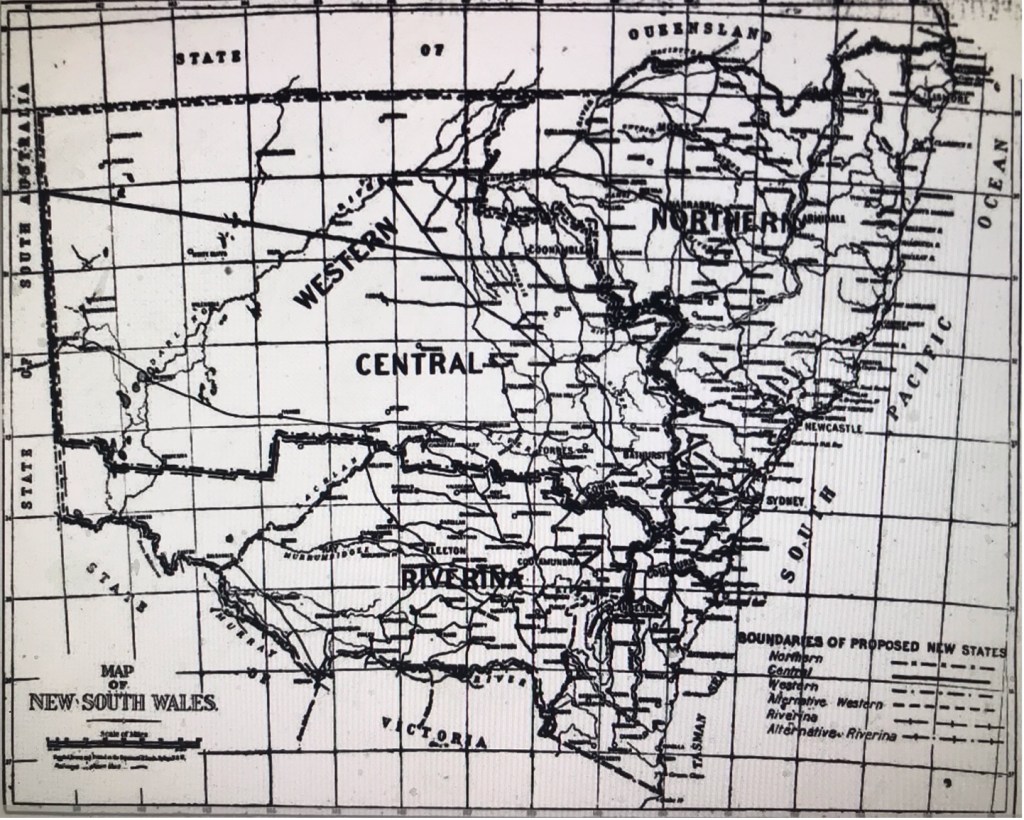
Map illustrates boundaries of proposed New States that were submitted to the Royal Commission: Northern; Central; Western; Alternative Western; Riverina; Alternative Riverina. Port Stephens was to be located within the Northern State.
So far as the New England movement is concerned, it will be seen that the area proposed for a New State excludes Newcastle, but includes Maitland, although the Maitland coalfield generally is excluded. Amongst other places included in the area and within 30 or 40 miles of the proposed boundary are Port Stephens, Paterson, Singleton, Jerry’s Plains, Denman, Merriwa, Cassilis, Bundella, Binnaway, Coonabarabran, Baradine, and Carinda. On the North the boundary follows the existing boundary between New South Wales and Queensland, but none of the far western country is included in the area. ………
The Federal Reconstruction movement, has submitted proposals for the division of the State into three areas. The main features of these proposals are that each State is to have a stretch of coastline, and each of them a proportion of the far western country; Newcastle and Port Stephens are included in the Northern of the three States, Sydney in the Central-State, and Jervis Bay in the Southern. It will be seen that the southern boundary of the middle or Central State follows the southern boundary submitted by the Western movement for their State, but that the northern boundary of the proposed Central State differs materially from the boundary submitted by the New England movement as their south western limit.
The Commissioner will take evidence in Sydney, and he will also visit the country as soon as possible. …… The following extract from the opening statement made by the Commissioner at the first sitting indicates the nature of the evidence which is required:— ”I propose to have the various proposals circulated, and to invite witnesses to give reasons for or against them, or to suggest alternatives. As at present advised, I do not propose to take general evidence on the advantages or disadvantages of subdivision or centralisation, or on the influence each subdivision has had on the development of other countries. On the other hand, I shall ask those who advocate the establishment of a New State in any area to show that that area has resources sufficient to enable it to carry on as a State in the Commonwealth, and I shall be glad of evidence of the effect which the excision of any portion of New South Wales will have on the part that is left. ”On the other matters which must be taken into account in deciding on suitable areas, I do not express any opinion at present, but such matters must include community of interests and facilities of communication.’
The report of the New States Royal Commission was released during January 1935, and received much newspaper coverage. For instance, the Cootamundra Herald of 23 January 1935, page 1, reported:
‘Two areas in New South Wales are recommended as being suitable for self-government as new States by the Royal Commissioner (Mr. Justice Nicholas), whose report was presented to Parliament yesterday by the Premier.
The chief recommendations are as follows: — 1. — That the area in the northern part of New South Wales is suitable for self-government as a State. 2. — That the area in the central, western, and southern portion of New South Wales is suitable for self-gov-ernment as a State. 3. — That a separate referendum should be taken in each of the areas to ascertain the opinions of the electors on the proposal to establish self-governing States in each such area. 4. — That the referendum in the northern area should be taken, and the results be made known before the referendum is taken in the central, western, and southern areas. 6.— That before any referendum is held, steps should be taken by the Government to inform the electors of the questions at issue, and of the advantages and disadvantages of sub-division.’
Port Stephens would have been included in No. 1 new state.
The Sydney Mail of 30 January 1935, page 9, carried the following map of the proposed two new states and commentary:
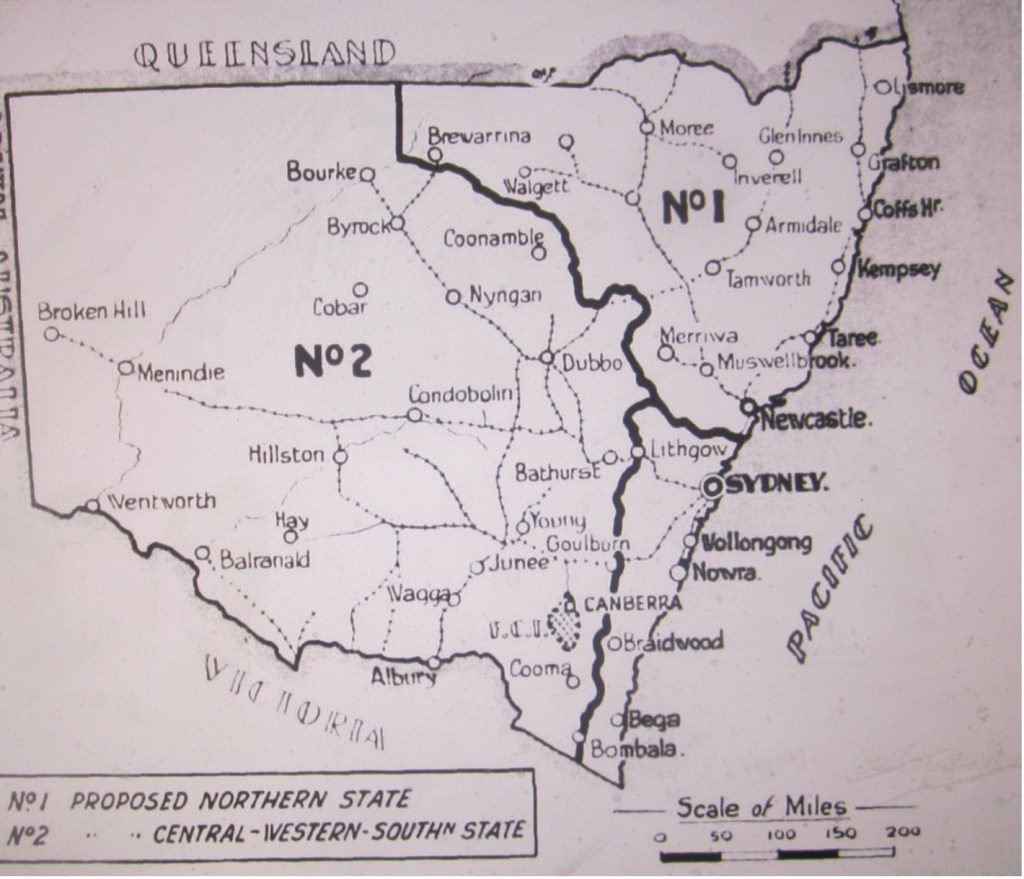
The two New States recommended by the Royal Commission.
‘The report of the Royal Commissioner, Mr. H. S. Nicholas (now a member of the Supreme Court Bench) on the proposed creation of new States was tabled in the Legislative Assembly yesterday. The above map shows the two areas, one in the northern and the other in the central-western and southern portions of the State, which the Commissioner recommends as suitable for new States. He rejected the proposal that there should be a new State in the west, but included the district submitted for his consideration in that area in the central-western-southern division.’
Post War Period
With an obvious hiatus during the years of the Second World War, no further moves were ever taken at government level to establish a northern state. Post war, some community interest continued.
Northern New State Movement – Newcastle’s Position 1949
The Newcastle Morning Herald and Miners’ Advocate of 7 February 1949, page 2, reported:
‘The conference of the Northern New State Movement in Armidale this week will be held in a calmer atmosphere than when the Stevens-Bruxner Government set up a Royal Commission in 1933 to report what areas were suitable for separation from New South Wales. It was reported in our columns at the time that feeling in the country was at fever heat, partly in reaction against the Lang Government, and that there was a suggestion in some quarters of possible rebellion if the movement met with deliberate obstruction.
The Newcastle delegates to the Armidale convention will not need to carry pistols, but they must be prepared to uphold the interests of this city against propaganda from a number of northern towns which cherish the ambition of becoming the capital of a northern State and regard Newcastle as an intruder and possible rival. The new State movement remains theoretical to the extent that the constitution requires that any separation of territory from a State shall have the consent of the Parliament of that State. It labours under the disability that the process of centralisation, which continues with few checks, while strengthening the abstract argument for the creation of new States, sensibly increases the difficulty of obtaining the consent of a Sydney-dominated Parliament to separation.
If the indulgence hitherto given the rural vote in New South Wales is cancelled and all votes have equal value, metropolitan control of the New South Wales Parliament will become absolute. But even if there is no early prospect of the subdivision of the State, Newcastle must make up its mind whether it wishes to be included in the northern State —if one is ever established.
In 1924, the new State movement proposed to include portion of the Upper Hunter Valley and Port Stephens, but later the boundary was moved south to take in Maitland, mainly because it is the junction of the main northern and north coast railways. The boundary submitted to Mr. Justice Nicholas as Royal Commissioner in 1934 embraced Maitland, the whole of the Hunter Valley and Port Stephens. For very cogent reasons, Mr. Justice Nicholas altered this and fixed a boundary south of Newcastle and north of Wyong. He pointed out that the boundary proposed in 1933 placed Newcastle and its suburbs in one State and the sources of its water supply and catchment area in another State. The separation of Newcastle from Port Stephens and the Hunter Valley would be a surgery so crude as to deserve the title only of butchery.
The link between Newcastle and the North-west, upon which the Royal Commission placed some emphasis, has since been strengthened by the building of wheat silos in Newcastle, its development as a wool-selling centre and by the commencement of the Sandy Hollow-Maryvale railway. If there is to be a northern State, Newcastle must be in it. Any boundary which severed it from its hinterland would be unnatural and vexatious, and would leave Newcastle merely an appendage of Sydney.’
End of Port Stephens Shire Council’s Involvement in New England New State Movement – 1953
The Raymond Terrace Examiner and Lower Hunter and Port Stephens Advertiser of 12 February 1953, page 1, reported:
‘New England New State Movement appealed to Local Government bodies to hold a referendum with General elections in December, 1953 on the question —’Are you in favour of the establishment of the State of New England.’ Council considered the referendum too costly.’
Resurgence 2004/2005
The movement for the establishment of a New England New State continued into 2000s. Wikipedia states:
‘The New England New State Movement underwent a resurgence in 2004, primarily in response to State (Labor) Government shire amalgamations and farmers responses to new vegetation management policies. The Annual General Meetings of NSW Farmers [NSWF] passed resolutions to investigate the feasibility of a non-metropolitan state in both 2004 and 2005. A task force was formed chaired by then NSWF President Mr Malcolm Peters. Some polling was commissioned and a convention was held but little further effort appears to have taken place.’
A group of dedicated activists continue to agitate for a new state in the area. It is being carried out in an informal sense or through social media.
Concluding Comments
In the 1920s and 1930s, the agitation for a new northern state in New South Wales was not only visionary but serious in its intent. Various conventions were held and two Royal Commissions, in 1924 and 1933, were established at government level.
But nothing ever eventuated in terms of a new state entity.
The story is very interesting in terms of the priorities and machinations of government policy of the day and no doubt of the influence of vested interests.
In terms of current events, regional issues are coming to the fore again and demand action at government level.
Information on related topics is published on this website and can be viewed at the following links:
Early Proposals for Railways in Port Stephens
Royal Commission on Decentralisation of Railways – 1911
Researched and compiled by Kevin McGuinness
July 2022

 Port Stephens - a history exploration