
Introduction
A sea serpent is a sea monster spoken of in ancient mythologies. Although sea serpents have been feared over time, no such creature has been captured. Over the centuries, the sighting of sea serpents has been reported around the world, but most have been dismissed as lacking substance. The best-known alleged sea serpent would be the Loch Ness monster in Scotland.
For a period during February 1925, the sighting of a sea serpent close to Port Stephens caused a newspaper frenzy.
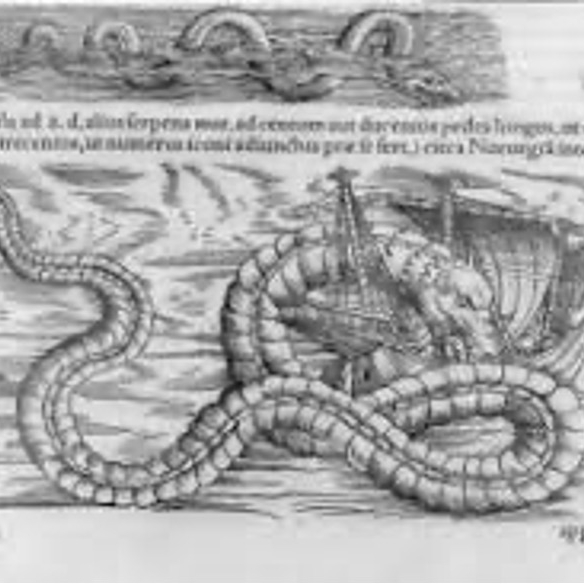
A sea serpent as imagined in Europe during the 17th century.
The Sighting of the Sea Serpent
The Sydney Morning Herald of 7 February 1925, page 17, together with many other newspapers carried the following identical article about the sighting of a sea serpent:
‘An extraordinary story that a sea serpent 60 feet in length had been sighted off Port Stephens on Monday, is recorded in the official log of the steamer St. Francois Xavier, owned by the Compagnie Navels D’Oceanie, which arrived in Newcastle from Noumea this week.
An extract from the ship’s official log, obtained from the agents, John Read and Company, this afternoon, reads as follows:
“At 6.30 p.m. on February 2, several officers and a portion of the crew of the steamer St. Francois Xavier report having seen, when exactly abeam of the lighthouse at Port Stephens, a huge sea serpent, of dark yellow colour, about 60 feet in length, and two feet in diameter. The steamer was about a mile out from the shore and passed within a few yards of the monster. While the vessel was passing it, the serpent appeared to be asleep, its head and tall being in a horizontal position, while its body formed five coils. On the centre of the back was a snakelike fin, resembling a shark’s. Doubtless awakened by the noise of the propellers, it extended its head several yards out of the water, the head being turtle shaped, with a graceful neck. It remained in this position for several minutes and then disappeared. The Chinese members of the cross referred to the serpent as the “dragon,” a symbolic monster of Chinese mythology.”
The St. Francois Xavier, which sailed for Saigon this afternoon, was commanded by Captain Charlot. Mr. J. G. Berryman, lighthouse keeper at Port Stephens, stated this afternoon that no serpent had been sighted either by himself or any of his assistants at the lighthouse.’
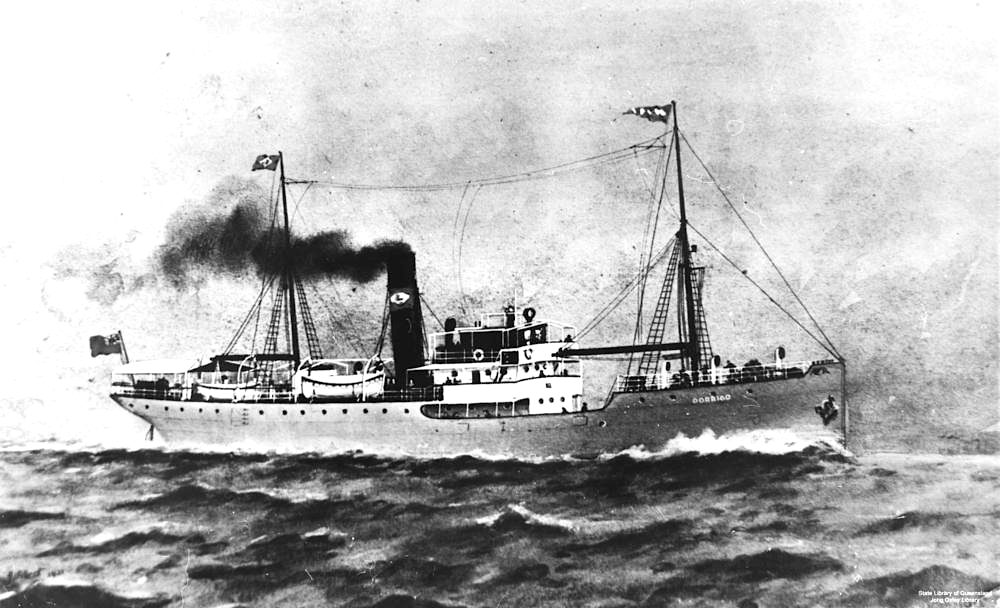
Steamship ‘St. Francois Xavier’, later named the ‘Dorrigo’ [State Library of Queensland]
Analysis of the Sighting
The Sydney Morning Herald of 14 February 1925, page 16, followed up its previous report on the sighting of the sea serpent, with an analysis of the validity of such sightings:
‘The sea-serpent has ever been a fruitful theme for wonderment and discussion. The scientist and the layman alike have had “great argument about it ” almost ever since there have been scientists and laymen to argue about anything. And evermore, to carry the quotation and its application further, they have come out the same door wherein they went.
In common with the legends of the flood, of a lost Atlantis, and of the mermaid—to name but three of many— the mystery of the sea-serpent has intrigued almost every people and every age. On the principle that there is no smoke without fire, this common interest among so many widely varying witnesses might be accepted as strong evidence in favour of the creature’s existence, were it not that this kind of “root-idea” is admittedly a well of inspiration from which a number of matters which now we know to be but myths have sprung. They may —and probably did—have some common and well-founded origin; but in the course of ages that origin has been lost sight of, and the developments of the idea have been so great and so many as to lose everything but the merest thread of connection with the root. And among these myths, mysteries, legends, call them what you will, that of the sea-serpent has always held a high and honoured place.
It may be that the very venue which he has chosen is partly responsible for this. For the sea has ever been the home of secret happenings; and they that go down to it in ships, and have business in deep waters, are so constantly meeting with the strange in its depths and the inexplicable upon its surface that it has justly acquired a mystery unique and almost terrifying in its fascination. There is always something new out of Africa, said the ancients; but ancients and moderns alike are agreed that for that novelty which is combined of the gruesome and the fantastic there is no place like “the halls and pillars or the vasty deep.” The sea-serpent has been observed in all ages and all climes; but the report which we published quite recently, that he had been seen a few miles off Port Stephens, is, we believe, the first time he has been reported in Australian waters. And whether the report be believed or not, it is at least interesting to find that these home waters of ours are to be no longer exempt from all as-sociation with the “great unknown.”
Many of us confess to a somewhat ashamed belief in the sea-serpent, despite the sneers that have been thrown out at every hint of his existence, despite the denials of the doctors and the laughter of the laymen. For if it be true that there are more things in heaven and earth than are dreamt of in our philosophy, it is still more greatly true—if there can be comparisons in such a matter as truth that in the sea are such things as not even the nightmares of the most dyspeptic of philosophers could conceive. And among them swims—why should we doubt it? – his monstrous majesty the king of all the serpents. He may have been proved to be a row of leaping porpoises, a mighty trail of seaweed with up-ended root, a giant octopus, or even an attenuated flight of gulls that hugged the surface of the waves; he may be to this very date, indeed, the dim un-outlined monster of an imagination working, like Frankenstein, with morbid tools.
But yet it is possible to disbelieve in him entirely, so many and so varied are the stories told of his existence and appearance. Mr. Philip Gosse, the eminent father of an eminent son, in his well-known “Romance of Natural History”—one of the most fascinating books of its kind ever written—collated the evidence that had been advanced up to his day upon the very vexed question of the sea-serpent’s existence; and, scientist as he was, and loth to believe where absolute proof was not forthcoming, nevertheless he came to the implied conclusion that there was something in it. We use the term “implied” advisedly, for Mr. Gosse was much too old a bird to be caught by chaff, and so saved himself by qualification and supposition; but no one reading his book can come to any other opinion than that he did really in his heart believe that in the story of the serpent, of the sea there was some grain of curious truth.
Nor was he alone in his generation in such a belief. Many another name of repute could be added to his; many another who dared to take a stand against the tide of popular contempt and publish his faith. For it is a curious thing to remember that whereas men may believe in fairies and yet be talked of with respect, or of ghosts and be listened to with attention, yet let any man declare himself upon the side of the sea-serpent and there are no bounds to the derision and the hilarity with which his confession is received. A strange thing, truly; for there is nothing inherently in-credible in such a monster. Indeed, it would be only what we might expect to find, if we consider the strange survivals of the ancient fauna which still exist. Most certainly his ancestors swarmed amid the strange warm seas of earlier ages; why should he not, their lineal descendant, still wander through his wide inherited domain?
And now comes Mr. J. G. Lockhart with his volume of up-to-date strange stories of the sea, and brings the chain of evidence to yet a greater strength. No longer are they the haphazard tales of seamen and of those unused to setting down exact and detailed data upon which we are forced to rely; their statements are borne out by the reports of observers eminently qualified. And in particular the report of Messrs. Waldo and Nicholl, both members of the Zoological Society, published so lately as 1905, in the proceedings of that society, must be given credence. They saw the creature close, observed him with attention, corroborated each other’s notes, and wrote while yet their memories were fresh their full account. And, reading it, one is struck with the resemblances which their description bears to many of the earlier ones. There are, indeed, such great similarities and small divergences as might be expected—and are usually forthcoming—from different witnesses who are both sane and truthful. In view of this the story of the crew of St. Francois Xavier and the serpent which they claim to have seen this week upon our northern shores may well be more fitly received than with the contemptuous shrug of the incredulous. We do not say that it is true; but there are many reasons why it may be.
Concluding Comments
The sighting of a sea serpent near Port Stephens, was not the last alleged sea serpent to be sighted on the New South Coast. For example, five years after the Port Stephens sighting, the Sydney Morning Herald 9 July 1930, page 15, reported on possible sightings of a sea serpent in the Wollongong area:
‘Mr. Charles Messenger, who left Sydney in a launch in order to search for the sea monster alleged to be haunting the South Coast, arrived at Port Kembla this afternoon. He had a rough passage down the coast but saw nothing of the “sea serpent.” He will shelter at Port Kembla tonight, and proceed on his search in the morning.’
Some wise thoughts on the issue were published in the Sydney Morning Herald of 23 May 1931, page 8, in which the possibility of sea serpents was left tantalisingly possible to the readers of the day:
‘In “The Case for the Sea Serpent” Commander R. T. Gould examines the evidence in a number of instances in which a sea-serpent is said to have been seen, and he comes to the conclusion that there may be something in these stories after all. When mariners tell us that they have seen one of these elusive reptiles we are politely sceptical. It must have been a whale or a floating tree, or seaweed, or porpoises swimming in line of column. And yet a lurking doubt remains.
The testimony sometimes comes from sources that command respect. On one occasion, off the coast of West Africa a sea serpent was seen from a British man-of-war, and a French vessel which passed through those waters later reported an identical apparition.
The most plausible types of sea serpent, according to the author, are a seal with an elongated neck, a huge turtle-like creature and an immense creature resembling the prehistorical plesiosaurus, a lizard-like thing with flippers. And after all is our incredulity warranted? The remote depths of the ocean may contain forms of life of which we know nothing, monstrous shapes which never leave those depths unless by chance some submarine convulsion hurls them to the surface. If there are more things in heaven and earth than are dreamt of in our philosophy the same may apply to the ocean.’
Researched and compiled by Kevin McGuinness
November 2022

 Port Stephens - a history exploration